Slashdot Mirror
Domain: bme.hu
Stories and comments across the archive that link to bme.hu.
Comments · 52
-
Re:FAT chance
P.S. The only reason I know so much about FAT is I tried to write a boot sector virus in assembler in school. Yeah, it didn't work as expected and I ended up erasing my own boot sector.
This reminds me of this story.
-
Re:2D is the hard question
In 3D the number most likely jumps to infinity. This is like the how many colours does it take to colour a map so that no adjacent countries have the same colour. 1D is trivally 2, 2D is four but the proof sucks, 3D is clearly infinity.
Although it might be tempting to "analogize" the problem the 4 color map problem, in fact the problems are not at all similar and have a different answer.
Even, the wikipedia entry on this problem has an answer to this particular generalization to 3D...
The problem can easily be extended to higher dimensions. In particular, finding the chromatic number of space usually refers to the 3-dimensional version. As with the version on the plane, the answer is not known, but has been shown to be at least 6 and at most 15.
This is a pointer to paper the illustrates the upper bound for R^3 in case you are interested.
-
Re:Get away with murder.
You know, that could be the 127.0.0.1 script kiddie bait for the swatting generation. Try giving your address as "1600 Pennsylvania, D.C." (which certainly fits your second point for a whole *bunch* of people), or local equivalent, and wait for the fireworks to start...
I'm assuming that the Secret Service (or local equivalent) will actually will get the address of the swatter before they roll, but either way it's popcorn time. -
This was discussed before
As proposed extension of Kardashev scale, type IV.
See this science paper for an example: http://mono.eik.bme.hu/~galant...
-
Galantai Scale focuses on human survivability
Galantai proposes an alternative to the Kardashev scale that focuses on survival of the species. The short version is that if we can survive the destruction of the planet we are at one level, survive solar system destruction at least another level up, without detailing the kinds of events that would make multiple star systems unlivable - there are levels above that. These are links to the Galantai scale stuff: http://www.centauri-dreams.org... http://mono.eik.bme.hu/~galant...
-
Re:GNUSTEP's graphical underpinnings?
-
Re:Use the Moon
This would eliminate a lot of the problems you're describing, since the cable would hang freely and not be subject to so much stress.
(Same ac)
Take a look at this image:
https://www.me.bme.hu/~karolyi/results/advect/karmanstream.gif
As the air goes through a cylinder it creates vortex. Those vortexes change the pressure on a side of the cylinder, effectively transferring momentum (quantity of movement in my language. Is momentum the right word in English?) from air to the cylinder. Momentum follow conservation laws. In free floating cable, how would you deal with this excess of momentum? I believe it would be unstable.
If the cable is "bolted" to the ground, now the transferred momentum will damage the cable by creating fatigue. That's actually fine, a lot of things are subject to fatigue and still works, like jet airplanes. But a fundamental thing to make this kind of things safe is non destructive testing. There's no such thing for a hypothetical composite with carbon nanotubes. And even if you're able to create a way to perform NDT, how would you deal with damage (which you know it will occur)? It's complicated.
For the economics argument for a space elevator, there's plenty of closed iron mines around the globe. It's just not effective to mine them down at current prices. How cheap must a space elevator be so you can run an expensive operation in space and bring down through it? The space elevator R&D/building/maintance costs are must also be part of the equation. Call this the maximum viable cost. It's probably way lower to make it feasible in the current world. I'll make this calculation when I have the time and post it somewhere. I'm a scifan and had to deal with a lot of engineering economics in my life (I still do feasibility studies today).
Yes, it's not impossible just "not possible with existing technology" as you said.
-
Re:Get big ones
I bittorrent on my phone's internet, just to make back the money I spend on text messages the phone carrier doesn't have to pay for.
-
Re:My how mobile devices has grownBut Apple would allow it, though probably make sure it was limited to WiFi. Losing on point after point, don't you just feel even more stupid retreating to a position I wasn't even talking about in the first place?
You've already conceded that Apple would probably make needless restrictions. In the meantime, Symtella works just fine on AT&T's network. Enjoy writing crippled apps for your iPhone. When they revoke your key because they want to Sherlock your Watson, enjoy explaining where it went to your user base. Only a hater would worry about such things instead of blindly trusting Apple. <sarcasm
-
My favorite photo
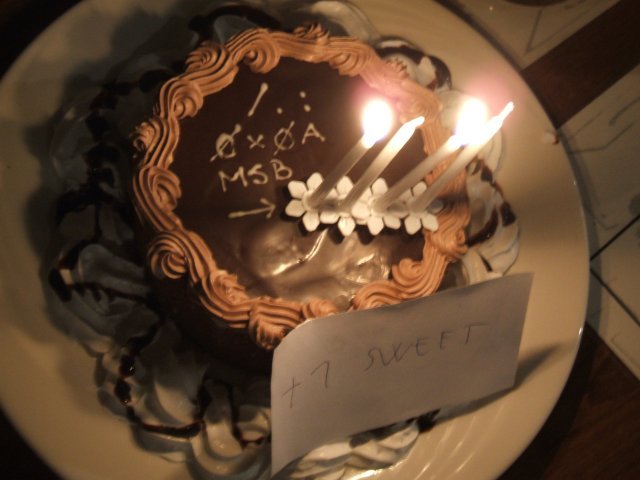
My favorite photo is:
http://www.math.bme.hu/~gergoe/cake.jpg -
Budapest Slashdot birthday party is over
Hi folks, we had our
-
Symtorrent
Symtorrent http://symtorrent.aut.bme.hu/ is a Bit Torrent client designed specifically for S60 phones. N70, N95 etc.
Make sure you have a generous data plan, though! -
Re:This is lame
Then there are already versions for Symbian S60 platforms like:
SymTorrent (http://www.aut.bme.hu/portal/SymTorrent.aspx?lang =en) -
Re:This is lame
A client for Symbian platform also exist. SymTorrent is a full-featured and complete BitTorrent client for Symbian OS 3rd edition http://www.aut.bme.hu/portal/SymTorrent.aspx?lang
= en. s This is a free/open source (GPL) program. As a person who blogs about S60 3rd edition freewares, I have tested it, and it works very well. -
algorithms
Do you mean a better programmer as in, better at doing harder problems, or just being more experienced. Look here http://www.inf.bme.hu/contests/tasks/ for interesting and pretty difficult problems
-
a webserver in C and C++
I took the challange and implemented a webserver with GET and HEAD support in 66 minutes. Get the GPLed source from here: http://www.inf.bme.hu/~pts/wstest.c . Use it at your own risk
Since I don't want to be employed as a C++ programmer in the near future, I used only the C subset of C++. The code compiles cleanly with GCC 3.4.5:
both ``g++ -ansi -pedantic -W -Wall wstest.cpp'' and ``gcc -ansi -pedantic -W -Wall wstest.c''. During the short test phase valgrind didn't show any memory handling problems -- not even problems related to bad use of free().
In the remaining few hours I would have added CGI support, if-modified-since support, and continued downloading support using HTTP/1.1 partial content ranges.
(Whoever asked for ``Content-Transfer-Encoding: gzip'' support, tell him that it will be available in the Premium Edition only, and he should contact my sales department for prices.)
My opinion about problem solving in IT job interviews: I like taking the challenges, but who can give me a problem which tests whether I can design large softwares well? -
Plenty of GonzoGonzo journalists? My favorite thing to read. Especially considering that regular journalists constantly lie anyway, while the War Nerd will tell the truth even if he doesn't like it.
Let's see, off the top of my head, Gary Brecher, Matt Taibbi, Mark Ames or John Dolan.
Of course, those are all eXile alumns, and one of them is probably a Nom de Guerre, but I'm sure others can be found if you look hard enough.
-
Re:Or just write it in perl
The code you sent didn't compile. I have the correct version, but I wasn't able to include it here (Slashdot said: Lameness filter encountered. Post aborted! Reason: Please use fewer 'junk' characters.) Copy-paste it from here:
http://www.inf.bme.hu/~pts/slashout.html -
Ontario Highschool Fun
In Ontario (Canadian province in case you are wondering) there is highschool competition organized by the ECOO (Educational Computing Organization of Ontario) http://www.ecoo.org/ecoocs/Contests.html. when I took part in them there was no age restriction, I took part in all of them once I knew of their existance.
Its generally is in teams of 4 and you are provided a set of 4 problems and have 2 hours to solve them. 4 people 4 problems, does not sound bad, until you notice you have 30mins to code and test. There are bonus points for handing in sollutions earlier (the faster you do, the better bonus), also, there is bonus for flawless first attempt.
As per the language, I dont think there is a restriction. First year we wrote in QuickBasic (closest to my c64 basic), the other years we wrote in Turing (another Ontario specific thing, Turing is a language developed for Ontario Highschools by HoltSoft / University of Toronto http://www.holtsoft.com/turing/).
Choose a language you know well and dont have alot of trouble getting to work with. One year a team showed up with their own pc (requirement at higher levels), but could not work with their tools.
Some questions are simple, here are some I remember:
1) draw a star provided you know the number of spikes
2) game of life
3) kernel / process simulation
It is assumed you know what a highschool student should know, hence trigonometry is not explained, but for game of life or the kernel/process simulation the problem was explained in detail.
One question we were given (third stage) was:
1) here is a formula for volume of tetrahedron
2) here are 4 points, calculate the volume
3) here is another point, tell us if this point lies within the tetrahedron
we were at a loss, how were we to know if the point lies or not? My friend who had this problem (I had kernel/process simulation, but was writting way too verbose code that amounted to nothing) knew that answer lies within the question, and tried to get us to help him, but 4 people 4 problems, everyone had own thing to do.
So what we did? cheated...
For Canadian Highschoolers there is another contest being run, this time by one of the Worlds best computer universities, the University of Waterloo (watcom = Waterloo Compilers, Sybase and RIM are also Waterloo graduate startups). Its called Canadian Computing Competition http://cemc.uwaterloo.ca/ccc/index.shtml. Unfortunatelly I never took part in this as no one at my school knew of it, and when I became informed it was too late.
Finally, for university studs there is the ACM competition, the mother of all computer competitions. Checkout the problems archive, if you solve one question a day you will have years of fun http://www.inf.bme.hu/contests/tasks/
Both in my highschool and my university people who were interested in competition banded together and ran clubs that were mentored by knowledgable people who were out to help us.
In highschool by last grade we coded basic stuff in ASM, C, C++, Watcom Basic, QBasic, Watcom Pascal, Borland/Turbo Pascal, Turing, OOTuring. I with my friend for class project did simple statistics based AI in bp. Heck, we went through all sorting methods. I had nothing to do at University for first 2 years, computer programming wise.
ahh, those were the times... -
Re:fascinating
One method is the automatic detection of bilingual websites.
Our reasearch team used a manual method. We have built a large (2 million sentences) Hungarian-English parallel text database using Project Gutenberg, open source software documentation, EU legal texts and other online resources.
It has a simple web query interface at
http://szotar.mokk.bme.hu/hunglish/corpus
The search is still completely unoptimized, and the user interface is spartan, but it works. -
no scarcity in the spectrum
I would like to draw your attention to the work of Yochai Benkler http://www.benkler.org/.
He argues that there is no scarcity in the radio spectrum, and government regulation or market allocation is essentially outdated by the arrival of smart radios.
"The current legal framework for radio transmission relies on administrative licensing of broadcasters. The emerging regulatory alternative replaces licensing with an exhaustive system of property rights in the radio frequency spectrum. This article analyzes a third alternative: egulating wireless transmissions as a public commons, as we today regulate our highway system and our computer networks. The choice we make among these alternatives will determine the path of development of our wireless communications infrastructure.
Its social, political, and cultural implications are likely to be profound."
the article quoted is Overcoming Agoraphobia: Building the Commons of the Digitally Networked Environment http://www.benkler.org/agoraphobia.pdf
in that article he argues for treating the spectrum as a commons: "Our capacity to think about the truly central questions concerning regulation of wireless communications is obscured by the language we use to discuss the problem. When we speak of regulating wireless communications, we speak of managing a resource, the spectrum. Generally, we use market-based solutions for resource management, and therefore when posed with such a problem look for something to which we can affix property rights to be traded in the market. But there is no such thing as spectrum. There is no ether out there, no finite physical resource that needs to be allocated. There are simply people communicating with each other, transmitting and receiving messages with equipment that uses electromagnetic waves to encode meaningful communications and send them over varying distances without using a wire. Spectrum management means regulating how these people use their equipment. Spectrum allocation, whether it be done by licensing or auctioning, is the practice whereby government solves this coordination problem by threatening most people in society that it will tear down their antennas and confiscate their transmitters if they try to communicate with each other using wireless communications equipment without permission."
As for assigning private rights to commons there is a big problem. Once You start to dismantle the commons, You bump into BIG problems, like in the case of any cultural expression.
another very good article an that question: Michael F. Brown: Can Culture Be Copyrighted? http://www.williams.edu/AnthSoc/brown-ca98.pdf
or to put it in an other way: just because all images in this picture are private property, should we think this form of expression (by Banksy) is illegal without the IP owners consent: http://mokk.bme.hu/~bodo/banksy/banksy3.jpg? -
Re:MacOS _should_ have these things.
Well, technically there is a VFS layer in the kernel, that abstracts the idea of a filesystem away from the implementation. So you use all the same calls for accessing ext2, reiserfs and smbfs.
Yes, I know Linux has that sort of thing, just as {Free,Net,Open}BSD do, and just as OS X does, and just as a bunch of other UN*Xes do, going all the way back at least as far as SunOS 2.0 (or "Sun UNIX 4.2BSD Release 2.0" or whatever it called itself back then).
In the big reiser4 flamewar on the kernel mailing list, there was talk of extending the Linux vfs (where the stuff belongs, rather than in any specific filesystem) with file-as-directory stuff and so on, which could help with the browsing zip files and stuff.
What "stuff" are you saying belongs there? I'm not convinced that "file-as-directory stuff", if by that you mean something that lets you look at a tarball or a zipball or... as a directory showing the files and directories in the *ball, belongs in the VFS layer.
Something that lets you mount a *ball as a file system, with the contents of the *ball as the contents of the file system, might be, but hooks to allow such a thing, and stuff that lets you look inside *balls (and do a bunch of other things as well), are available for Linux, so perhaps all that's needed in the kernel is FUSE (if AVFS is usermode code that plugs into FUSE).
I haven't looked at the webdavfs kext in Darwin 7.4 to see if it could be used to talk to usermode daemons other than the webdavfs daemon, so I don't know whether OS X already has something that could do the same as FUSE.
Some of the remote mounting could probably be done today (lufs? autofs? not sure really),
lufs or FUSE, probably, unless autofs isn't specialized towards talking to a user-mode automounter daemon.
but it probably wouldn't be as clean as it works out in KDE.
Why not? If it's done below the VFS layer, it's definitely cleaner in one sense - anything that ultimately uses open/close/read/write/etc. can use it. It might not be as clean in the sense that you wouldn't just be able to say ftp://ftp.foobar.org/pub/current-release.tar.gz to access the file in question, but if you couple it with something that lets you register a mount helper for a URI scheme (so you can find the appropriate code to handle an SMB mount for smb://hostname/..., an NFS mount for nfs://hostname/..., and so on), something along the lines of what's done in KDE could be done in a wrapper I/O library.
It's not as clean in the portability sense, as you'd have to worry about different "user-mode file system" frameworks on different OSes (even if the framework you use is the NFS client, there are probably different ways of doing setting up a user-mode NFS server on different OSes) and different ways of doing mounts of different file system types, but it's arguably cleaner from the end-user standpoint.
-
Re:I can't agree
So a next-generation save/open box should include comprehensive network protocol support.
With all due respect, I think that this is a really, really awful idea.
The reason why I'm not a fan of implementing network transparency at the KIOSlave or GNOME-VFS or whatnot layers is that this sort of functionality is *not* KDE or GNOME or whathaveyou specific. It just isn't part of the desktop environment. It should be implemented at a lower level, so that *all* programs running on the machine can take advantage of the functionality.
Hmm, you didn't give a reason why, and I'm not sure it's as obvious as you suggest. It would certainly be good if KDE and GNOME continue work through freedesktop.org to unify the underlying technologies that needn't be split up, like the coming transition to DBUS. It would be really great if the kio_slave system went the same way, forming the inspiration and basis for a cross-desktop protocol transparent filesystem (and note also X11 independent, since freedesktop.org doesn't rely on X11 for a lot of its technologies, e.g. DBUS).
But why all apps? When would most people really need all apps to do this? And how could KDE, for example, effect this sort of ground-level change?
Rather than wait around for someone to develop something that could be used by *all* applications, the KDE Project went ahead and made their own system that worked and is now influencing others. And thanks to technologies like Fuse and AVFS we may find that the kio_slave system is sort of "backported" to the basic UNIX filesystems by way of allowing them to be mounted onto the filesystem just as you'd mount a CDROM. -
Re:Web/file browser
Why not AVFS?
Don't make things browse to network shares. Make networked things look like file systems to the tools available. Same idea, only with less recoding, and as such a smaller point-of-break. -
Re:In a grumpy mood
-
Re:The C64 was the bestIt was actually possible to know everything there is to know about it.
Of course, it is possible to know everything that is stated in the official documentation. Unfortunately this does only reproduce the specifications of the C64 chipset, not the actual implementation.
One amazing thing about the C64 is that it offers and endless amount of ways to abuse the hardware to do even more amazing things. (Does the documentation state anything about 320x200x16 graphic modes,8 bit samples, fullscreen graphics?) Still today people find new coding tricks now and then. (Check out this site, the top ten list)
The C64 CPU is well known, all of its illegal opcodes have been decoded and documented. You can even find the reverse engineered circuit on the web. (click - sorry its hungarian, use your imagination to navigate the site).
Also the C64 video chip, the VIC, is thouroughly documented based on empirical knowledge (here). However, there are still pieces and bits left..
The sounds chip, the SID, has been reverse engineered to a state where fairly accurate emulation is possible. Unfortunately this is only true for the digital part. The analog part of the sid (mainly programmable filters) does hardly follow the specification and is subject to variations between different SID-chip revisions etc. This problem can only be solved by reverse engineering the actual circuit of the filter.
-
You might want to have a look at...
-
Re:Do it in Perlit'll only take 20 minutes to knock up in perl.
I don't know about you, I'm not planning on knocking up who ever this is using Perl... and its probably not going to take me 20 minutes, either!
-
How funny is it...
that this picture here has threee times as many hits on it than the rest of the site (pre slashdotting too).
I bet she's just one of the caterers too.
-Malakai -
Yes
Very exited indeed! Now I'm exited too.
-
winner
gets a date with Her.
-
Re:Terehertz Specs (pics)Here's some example pics: not safe for work
--sex
-
Re:suspend-to-RAM?
This is actually explained pretty well on the project's page which is here
-
Re:rebooting will not die, yet.
You could try the software suspend patches. Allows any hardware to suspend without hardware support (so it will work on desktops too) I think it does some nice stuff to try and minimize the suspend image (like swapping all processes out first) but don't know if it is stable. The homepage is Software Suspend
. -
Software Suspend (for Linux)
Check out the software suspend patch for Linux. It allows the system to be suspended by SysRq-D (or shutdown -z) into swap space and resumed (or not) at the next reboot.
-
Linux patch: swsusp
Take a look at the linux-patch "swsusp", it might be something like what you're looking for.
-
Already available for Linux
There is a kernel patch to do this. It's called Software Suspend. It is also part of the FOLK project (Functionality Overloaded Linux Kernel, a project to merge the largest possible amount of patches into the kernel).
-
Software suspend
Linux software suspend may be of interest.
-
Re:you can
AHA! I knew I still had it
http://falcon.sch.bme.hu/~seasons/linux/swsusp.htm l
this is what you need. -
Linux needs a real-time scheduler!
There is a lot of good stuff here. Some of the more useful and general-purpose patches -- such as VLAN, TUX, and Software Suspend -- should get a chance to become mainstream. The various IPC and speed improvements should make it in, too.
There's currently a debate over which real-time scheduler is the best. Personally, I'd like to see it resolved in the same way as the other options with choices: let all of them be integrated into the mainstream, and let the user select which one to use, either at compile or boot time! I'd like to see an option in the kernel configuration, asking what real-time scheduler you wanted: MontaVista, RTLinux, RTSched, Linux-SRT, RTAI, DWCS, something else, or simply the default.
Linux needs a real-time scheduler today. Currently, things become choppy whenever it decides to service the system in some way, such as syncing the disk. Playing movies, audio/video recording, burning CD's, even playing games would benefit from real-time support. I hope that this can become mainstream in 2.6!
Super eurobeat from Avex and Konami unite in your DANCE! -
Yes.I found this about a year ago, and couldn't get it to work, but it seems a lot better now.
Software Suspend for Linux 2.2.x
It will save the state of your machine to the swap space and on bootup recognize the saved state and restore it. No BIOS or fimware junk nessacary
-
Re:Any Linux have hybernate?
Sorry to reply to myself, but I did some looking around. There's a "suspend to disk" patch (which requires patching the kernel and sysvinit, but not shutdown). Look here for more info on that. This is the same "swsusp" program mentioned previously.
-
Re:KDE 2 Almost What He Seeks Already
Ok, so you can control KDE2 stuff via DCOP. What does that do for all the command line stuff that existed long before KDE was even conceived?
What about a system that provides a GUI for those command line tools, such as Kaptain (http://www.hszk.bme.hu/~tz124/kaptain/)? It's a Qt app that allows the user to set up scripts or grammars that define the CLI options. Kaptain builts the GUI and then fires off the CLI tool with the parameters that were set via the GUI. It seems to work ok. It currently just sends the stderr/stdout of the program to the shell where you ran the kaptain script. However, to fully take advantage of a GUI environment, it should pop up a window and display the output there (it may do that already, I've just started playing with it).
-
Re:Why reject?i'd hazard this kernel patch is the one in question.
i've not tested it, but now that i've got a laptop
and windows people to impress, i just might give it a go
-
sig sig sputnik -
More easy $$$ :-)
There is also a $1,000,000 prize for anyone solving Goldbach's Conjecture which is another of the 23 problems Hilbert stated at the ICM. See this article , it's an unrelated contest to bring attention to a book, Uncle Petros and Goldbach's Conjecture which I definetely recommend. It's more of a story/biography than a math book though.
-
More easy $$$ :-)
There is also a $1,000,000 prize for anyone solving Goldbach's Conjecture which is another of the 23 problems Hilbert stated at the ICM. See this article , it's an unrelated contest to bring attention to a book, Uncle Petros and Goldbach's Conjecture which I definetely recommend. It's more of a story/biography than a math book though.
-
Rieman or Artin?
Often the Riemann Hypothesis is called Artin's conjecture. Personally I think Riemann's name is overused in mathematical circles. Emil Artin was a much better clavichord player after all...
-
Re:Mouseless pointer movement
I know this is not very professional, but I use something different to eliminate the mouse. In fvwm(2) I set the keys Ctrl-Shift- to move the mouse a short distance, Alt-Shift- to move a larger distance, and to click I wrote a simple X program (click.c) which I call with the Alt-1, Alt-2,
-
Re:Programming contests
Check this out. It's a programming contest archive. If anyone has similar pages, post the url.
-
Re:Might suit some, but not generally
Reread my post. It does infact create a single filestore. os2tvfs:/z:/. The path under z:/ does not determine the physical location of a file, free space and write priorities given when mounting NFS exports into Z: determine where physical files go. ost2tvfs:/z:/foo.mp3 might be on an os2 box in my living room while os2tvfs:/z:/bar.txt might be on a linux box in the basement (or alaska, if i were to incorporate stuff not on my LAN in my VFS, which i don't plan on doing). If i wanted finer control of where files ended up, i could cron a script that moves things around, which would be transparent to the z: mount.
I'll give you that it does nothing for spanning large files, but it also does not incure the problems with spanning files. If a box goes down, you only loose access to the files on that box. If you say 'stuff this' and decide you don't need the virtual FS anymore, you just stop accessing stuff through z:. your files are still there, in the native OS's FS. Things that ended up located on an OS2 box are accessable on that OS2 box, the same goes for things on the linux boxes (or fbsd boxes, win32 boxes, be boxes.. whatever. anything that can export NFS can join the VFS)
As for file availability depending on the state of the machine it is on-- of course. If you want otherwise, you will have to sacrafice storage space, which is contrary to the point.
I don't propose that this is 'generally useful'. It has the negative of sending ALL files through the tvfs box before they make it to their destination. That's not very efficient. However, as far as i can see, it does provide a basic solution to the original posters problem, assuming he would not mind sticking an os2 box in the corner.
On an aside, there is another possible tool for this kind of problem: avfs (A Virtual File System).
Avfs was originally designed so you could access
Recently it's gained the ability to load user-written extensions, mainly for other archive formats. I imagine it could be hacked to do the job of TVFS in my setup.
--sean