Slashdot Mirror
Domain: caltech.edu
Stories and comments across the archive that link to caltech.edu.
Comments · 1,527
-
Re:not like the brain does.Disclaimer: I work with the MIT algorithms daily and know several of the authors of this work (though I'm not at MIT).
This paper's claim to recognize scenes like the brain does, is overdrawn. As far as i can tell from their paper (it is a journal version of their cvpr paper) only their low-level Gabor features are similar to what the brain does.
Their low-level Gabor filters are indeed similar to V1 simple cells. The similarity between their model and the brain goes a lot further, though. The processing goes through alternate stages of enhanced feature selectivity with roughly Gaussian tuning (the S layers) and pooling over spatial location and scale via a max operation (the C layers). If you read more papers from their lab, there is a significant amount of biological plausibility in both of these operations, and a great deal of effort has gone into tuning the various layers to behave in accordance with physiological data.The rest of the paper uses the currently popular bag-of-features model, which is a model that discards all spatial information between image features, which i don't think the brain does.
The model is roughly equivalent to a bag-of-features, but with the nice feature (from a biologist's perspective) that it builds the bag in a biologically plausible way. The features themselves are picked randomly from natural images in a training stage that takes the place of human development. Discarding spatial information makes the model a lot more tractable, and it isn't clear what role spatial information plays in the processing of the ventral visual system, which is what their algorithm models.Furthermore, for classification algorithms they consider a Support Vector Machine and Boosting. Both of these classifiers are certainly not comparable to what the brain does. Why not use a neural network if they aim is to mimic the brain?
They use these classifiers on top of their algorithm simply to determine how good the model was at extracting relevant feature information. Since they want to quantify how much information is there, it is wise to choose the best method they can to locate the information.Furhtermore, they only conside feed-forward information, where research shows that there is at least as much information going back as there is going forward.
Feedback is definitely very important (this is what my own research is about), but feedforward accomplishes a lot with a vastly simpler computational model.Don't get me wrong, it is still a nice paper, with good results. (however, all Caltech datasets are highly artificial, with objects artificially rotated in 1 direction) So, nice paper, but to compare it with the workings of the human brain is too much.
Here are the Caltech datasets they used: vision.caltech.edu. I think the "artificial" datasets you refer to are the "3D objects on turntable," which are a bit artificial. However, the images they refer to in the paper discussed here are from the Caltech-101 dataset, which consists of real-world images of objects from 101 different categories - most of the images are not at all artificial. -
Re:It's not clear
The research group's publications might shed a bit more light on how this works.
-
Paper
What the CFD-literate Slashdotters will want to read is the actual paper (warning, pdf) that the article is based upon.
It's a neat method, but it's nothing revolutionary. The upshot is that their method tries to conserve vorticity (fluid spin) better than the other methods currently used for graphics, with the aim of getting rid of hacks that are now necessary to Make Things Look Good. The entire spin (no pun intended) in the article about "equations for computers, not for people" is journalistic sensationalism.
All told, it's a vorticity-based Finite Element Method, which is solved as a sparse linear system. Cool pictures, though.
-
Re:Looks like my wallpaper won't be changing for a
I know. These images suck from the Spitzer Infrared Space Telescope.
There is absolutely no way that we can extrapolate any color from those images. -
Re:Looks like my wallpaper won't be changing for a
I know. These images suck from the Spitzer Infrared Space Telescope.
There is absolutely no way that we can extrapolate any color from those images. -
Re:Aren't the optics the valuable part?A little budget math:
Total HST cost: $6 billion
Yearly HST operations budget: $337 million
Single servicing mission in 2008: $900 million
I like Hubble a lot, but other missions which don't require (or allow) Shuttle service and cost on the order of $0.3-0.8 billion seem to me far more cost effective. The mirror is a tiny fraction of the cumulative operations costs.
-
Re:Oh well...
http://today.caltech.edu/calendar/item.tcl?calend
a r_id=71129
One of the "nontrivial examples" mentioned as able to be "quantumly copy protected" was DVDs and other multimedia.
Your question, by the way, makes no sense in the context of basic knowledge of quantum information theory. -
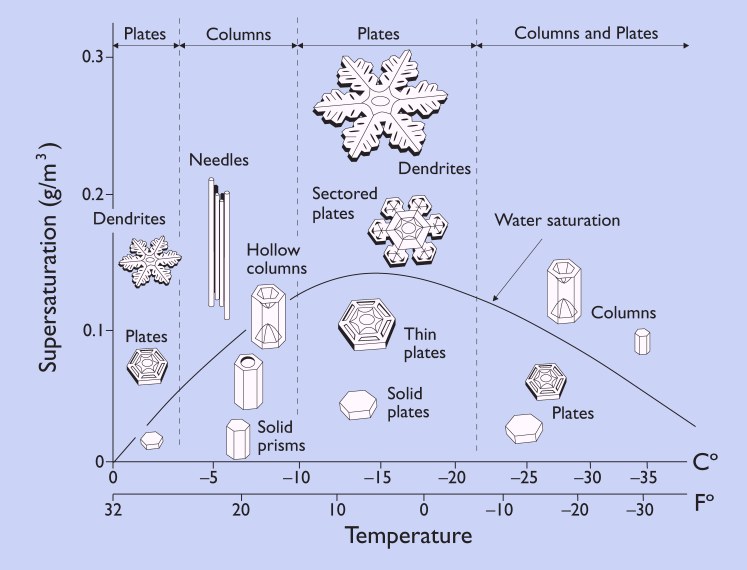
Re:Number of atoms in the universeIt's to do with exponentials. Let's say that a particular snow crystal can form in one of fifteen ways. ((That's all the possibilities depicted on this chart). Then, two such crystals covers 225 possibilities (minus those that simply can't be joined for whatever reason). A snowflake with a hundred crystals would have fifteen to the hundred (ie: one googol) possible permutations.
However, is our starting number of 15 reasonable? The standard snowflake crystals are all formed at temperatures just below freezing under fairly normal conditions. The rate at which the water cools will have a major impact, as will any airborne particles around which the snow crystals can condense. (Particles may cause a break in the symmetry or may force the ice to contain patterns that simply aren't possible when only hexagonal ice crystals are present.) There again, anything dissolved in the water will change the chemistry as well. As not everything freezes at the same temperature, it is entirely possible for snowflakes to acquire bubbles and other oddities where something has remained liquid even as the water froze.
Then, there are the exotic states of frozen H2O which are not considered "ice", per se. Water that has frozen under really strange pressures or at extreme rates will not form regular ice crystals, but form other solid states instead. Slashdot has covered a few of these in the past. Is it possible to have a snowflake form from such states? Maybe. Then you add a whole new set of possibilities to the mix, although it would be unlikely that you could get a mixture of regular ice and these exotic states. (Not impossible, though. If the higher-level clouds chucked down snow in the exotic states, which then got added to by regular snowflake crystals, then you could indeed have a mixture. Not sure this could happen on Earth, but there may be planets where this is common.)
-
Re:define 'substantial'
I haven't, but in theory, everyone else would have that same problem -- so you'd still have a 6 month headstart in the process. Let's also not forget that if people were to be unscrupulous, there's the whole pre-print process were someone could get a head start.
And in some cases, it's not the data itself that gives away what was going on -- eg. K40506A.
Also, people are free to find other funding for their efforts, if they want an extended embargo period, or to never release their data. -
Re:Can someone smarter than me...
Okay, I'll bite...
Although light from the "nearby" supernova travels at the speed of light towards earth, the shockwave from matter of the supernova which potentially destroyed this formation travels slower (think like the supernova generated lightning and thunder). When the supernova blew, it sent light towards earth and a shockwave towards the "pillars" (at least this is what is suggested by the latest picture).
FWIW, the bbc has a better article on this
http://news.bbc.co.uk/2/hi/science/nature/6246333. stm
In the BBC article, it seems to indicate more detailed observations of a "shell-shaped" cloud of hot dust near the pillars being heated by a exploding star. Using data from the telescope they were able to infer the temperature of the dust and match it to a supernova. I'm guessing they predicted the speed of the shockwave and noted that it would take about 1000 years to destroy this formation given the recent observation, but since the distances to both are "astronomical", we see what it was doing 7000 years ago, so if the shockwave speed prediction is correct, it will have already happened and we are just waiting for the light from this event that probably already happened to reach us.
A quick google search shows that Nicholas Flagey (the scientist quoted) has an article on this type of stuff (in french, for those that read french http://www.ias.u-psud.fr/www/data/document/01/004_ FORM.PDF ).
If you are really, really interested, apparently there is a scheduled talk on this given by Mr Flagey at caltech on Jan 16th
http://spider.ipac.caltech.edu/seminars/ -
More links to PR
Here are the press release links: Nature, Hubble Space Telescope, European Space Agency and Subaru Telescope. The COSMOS project web page can be found there.
-
Re:Please explainSomeone1234: If light existed only for 14.7 billion years, then objects couldn't be farther than 14.7 billion light years, in fact, much less. As the maximum speed they could have (relative to us) is the speed of light.
LionKimbro: No; There's no reason to believe things didn't start beyond us. Furthermore, there is the expansion of space.
In addition to what Lion said, it's important not to assume that light existed since the beginning of the universe. According to the chart linked to below (which the orignal article also links to), it took about 400 million years for objects to start projecting light.
http://www.spitzer.caltech.edu/Media/releases/ssc
2 006-22/ssc2006-22b.shtmlDisclaimer: I don't know jack about this subject, I'm just passing on what I'm reading.
-
Re:Mexican scientists must be humble
While I understand the frustration at the idiot comments that have been posted so far, I think you are way off base in regards to the scientific research and education that goes on in the US. If you were too lazy to read the article before responding, the summary even states that the US has supplied funding for this project.
While it is amazing that Mexico has built a new LMT, I feel obligated to remind you of the multiple telescopes the US operates such as Gemini, KECK, NASA IRTF, CSO, SMA, NRAO. These are but a few off the top of my head. -
What's wrong with the IAU definition?That is, an object that orbits the sun, is large enough to be round, and has "cleared the neighbourhood" of smaller objects.
Most people seem to trip up on the last part. I think the idea is that an object shouldn't have any "rivals" in its orbit, for lack of a better word. I was browsing some astronomy sites a few months ago and found a good page on Sedna which had a discussion of what should be considered a planet. This is before the recent reclassifications but I think it illustrates what the IAU was thinking. It's also interesting that Ceres was at first considered a planet but then was downgraded because it was found to just be one object in a belt of objects. This is exactly the same as what happened to Pluto.
I know there's going to be lots of weird shit in the galaxy which blurs the lines, but I think the current definition is pretty good for within our solar system. And after all, why should everything be easily classified? Isn't it the strange, hard-to-classify findings that usually advance science the most? We can make up new terms or modify the existing definitions as we find new objects.
Anyway, here's the words of someone who has forgotten more about astronomy than I've ever learned.Discussion of Sedna
Population classification. This definition requires a little more explanation and a little more understanding of the solar system, but, in the end, leads to the most satisfactory definition of "planet". Just like the solar system very naturally divides itself between round objects and non-round objects, it also very naturally divides itself between solitary individuals and members of large populations. The best known example of a large population is the asteroid belt. We call it a population because one region of space contains objects with a continuous range of sizes from one moderately large object (Ceres) to a handful of slightly smaller objects (Vesta, Pallas, Hermione) to a huge number of extremely small objects (rocks, dust particles). The solitary individuals are much different. In their region of space there is only them (Earth, say) and then a collection of much much smaller objects (the near-earth asteroids), with no continuous population in between. A single example helps to dramatize the difference between a continuous population and a solitary individual. Ceres, the largest asteroid, has a diameter of 900 km. The next largest asteroid, Pallas, has a diameter of 520 km. After that is Vesta at 500 km, and Hygiea at 430 km, and the list continues on down. The jump in size between asteroids is never more than a factor of two. In contrast, the earth has a diameter of about 12,000 km, while the largest other object in the earth's vicinity, the asteroid Ganymed, has a diameter of about 41 km, a factor of 300!
Mercury, Venus, Earth, Mars, Jupiter, Saturn, Uranus, and Neptune all count as solitary individuals by this definition. Pluto and Quaoar do not. Pluto is clearly a member of the Kuiper belt population, as can be seen from the fact that there are objects in the same vicinity slightly smaller than Pluto (Quaoar, 2004 DW, Varuna), and then even a larger number slightly smaller than that, and then on down.
What about Sedna? Sedna is currently the only object known in its orbital vicinity, but we strongly suspect that there will be many others found out there with time. We thus feel it is more reasonable to classify Sedna as a member of a large population (the inner Oort cloud of objects) rather than a solitary object. This classification saves us from having to go back and reclassify Sedna in a decade when we find more objects!
Since there is a clear scientific distinction between solitary individuals and members of large populations it is instructive to come up with words to describe these objects. The large populations can each be descri -
Re:Need all the help they can get.I know that NASA does not do the greatest marketing in the world, but your initial statement With the exception of the Mars rovers, most of NASA's recent history has been riddled with failures, mistakes and oversights is incorrect. Following this is a sampling of recent NASA successes.
- Aura (atmospheric science) - launched in 2004 http://aura.gsfc.nasa.gov/
- CALIPSO (atmospheric science) - launched in 2006 http://www-calipso.larc.nasa.gov/
- Gravity Probe B (relativity experiment) - launched in 2004 http://einstein.stanford.edu/
- Hubble Space Telescope Advanced Camera for Surveys (space science) - launched in 2002 on servicing mission 3B http://sm3b.gsfc.nasa.gov/
- Spitzer Space Telescope (space science) - launched in 2003 http://www.spitzer.caltech.edu/
- Swift (space science) - launched in 2004 http://swift.gsfc.nasa.gov/
-
Hubble is OldDon't forget that Hubble is old and that there are new telescopes being sent up in orbit. For example, the Spitzer Space telescope that has produced some neat images as well.
Servicing Hubble may be equivalent to getting a memory upgrade for that old 386 in the corner that only accepts EDO-RAM and that can only run a custom-patched version of Red Hat 2 of which you have lost the CDs. You might as well throw it out and replace it with something more up to date.
-
Re:We'd reach new heights of absurdity...
That's not true. It's perfectly allowed to take the stairs. Here's some equipment you'll need, though.
-
Re:Sounds Like...
Are MIT and CalTech [sic] known for football? Nope.
What are you talking about!?! Our football team is undefeated since 1993!
-
Re:a theory needs to predict
"It could be that we're like the dog being taught nuclear physics"
Howabout quantum mechanics?
http://alumnus.caltech.edu/~jsu/farside.gif -
Re:W2K FTW
Another word: WEBDAV. If you ever tried to set up a WebDAV enabled WWW site with Apache, you will find out that WinXP has totally skrwd the WebDAV support (that was working in W2K); after losing a lot of time on it, I found this, and yet it did not work completely OK. If you Google around, you will find many people bashing MS for this.
-
Research backs up the articleThe article points out that other components of our cost of living provide a much greater opportunity for saving absolute $$ than gas. The author mentions food (red peppers) as an example, with extreme price volatility. A Caltech economist tracked this volatility in the grocery and airline businesses (ah, the benefits of cheap undergrad labor!): The Price is Right Mysterious
The standard supermarket chains carefully tune pricing to maximize profits from those that ignore prices while also luring the bargain shoppers. The warehouse stores are in the middle; you can beat them at a standard supermarket. You can do better than cutting your grocery bill in half, which, according to the Slashdot article government stats, would save about as much the average annual budget for gas in 2004.
If determined to shop gas prices, don't bother driving around. Use the AAA website: AAA Gas Price Finder
-
Re:Hm
Already been done at Caltech...Nate Lewis Rap Remix.
-
Re:A question of fairness and integrity
Having 15 different names for Mars doesn't work very well because you need to refer to the damn thing.
LOL. Most of the astronomical objects I study have about 15 names. See this one, for instance:
MRK 0586 aka KUG 0205+024 aka 2E 0526...
But voting on a definition of an unscientific word?
Scientists have their own definitions of words like force, mass, gravity, charge... now add "planet" to the very long list. -
It's further oort than thatThus, Voyager 1 is further out than the furthest positively-identified objects in the solar system and is getting close to a theorized inner Oort cloud.
100 AU is nowhere near the Oort cloud. Sedna's orbit is highly eccentric ranging from around 92 au out to around 850 au. The Oort cloud is even further out at 50,000 au. -
Re:Creaky and old fashioned? How about useful.
Reminds me of Alice in UNIX land. An oldie but a goodie.
What I am still waiting for is multi-pointer capable x11 (two mouses) and pressure-sensing mouse buttons. -
To put the distance in perspective...Voyager 1 is 100 AU away. 2003 UB313 is 97 AU and Sedna is only 90 AU away. Thus, Voyager 1 is further out than the furthest positively-identified objects in the solar system and is getting close to a theorized inner Oort cloud. I'm sure that I read that it has passed the heliopause - a shockwave that marks the end of the solar winds and the start of the interstellar wind, which would mean that the outermost planet of the solar system is outside the heliosphere. Of all the planets (and plutons) in the solar system, it alone will never feel a single breath of the solar wind.
If, as seems possible, this amateur radio astronomer can detect signals from Voyager 1, it may also be possible for amateur radio astronomers to detect the presence of very faint signals coming from the furthest objects in the solar system, as the iron within them cuts through the charged particle stream of the interstellar winds, which is all you need to generate a radio wave. -
To put the distance in perspective...Voyager 1 is 100 AU away. 2003 UB313 is 97 AU and Sedna is only 90 AU away. Thus, Voyager 1 is further out than the furthest positively-identified objects in the solar system and is getting close to a theorized inner Oort cloud. I'm sure that I read that it has passed the heliopause - a shockwave that marks the end of the solar winds and the start of the interstellar wind, which would mean that the outermost planet of the solar system is outside the heliosphere. Of all the planets (and plutons) in the solar system, it alone will never feel a single breath of the solar wind.
If, as seems possible, this amateur radio astronomer can detect signals from Voyager 1, it may also be possible for amateur radio astronomers to detect the presence of very faint signals coming from the furthest objects in the solar system, as the iron within them cuts through the charged particle stream of the interstellar winds, which is all you need to generate a radio wave. -
Mike Brown's take on thisMike Brown, leader of teams that have discovered 2003UB313 and 11 other objects that meet the proposed definition of planet, has the following on his webpage now:
The IAU proposal officially recognizes only 12 planets; where does the number 53 come from?
By the proposed IAU definition, anything large enough to be pulled by its own gravity into the shape of a sphere and which is in orbit around a star is a planet. The proposal officially recognizes 12 planets (the nine previously recognized plus Ceres and Pluto's moon Charon plus 2003 UB313) creates a complex committee procedure for an object to become officially recognized. This part of the proposal is perhaps the weakest. In no other area of astronomy is there a definition for a class of objects and then a committee that has to decide if an object fits the definition. There are simply definitions. If an object fits the definition it is part of the class. If the IAU proposal is accepted then scientifically all of the spherical objects out there are indeed classified as planets, regardless of how long it takes for a committee to officiailly declare them to be so.
A relatively simple analysis show that there are currently 53 known objects in the solar system which are likely round. Another few hundred will likely be discovered in the relatively near future. Regardless of what the official count is from the IAU proposal these object all fit the scientific definition of the word planet and if the scientific definition is to have any credibility they should all generally be considered planets.
What should the public think about 53 planets?
Most people, when first confronted with a proposal to make 44 new planets in the solar system, seem to react by looking blankly for a second, then shaking their heads and muttering something about astronomers being crazy. Astronomers are not actually crazy, at least most of them. Astronomers have needed a good scientific definition of the word "planet" for many years now and this one works well for scientists. It doesn't, however, work terribly well for the rest of the world. The solution is the one that should have happened long ago: a divorce of the scientific term "planet" for the cultural term "planet." No one expects school children to name the 53 planets (most, in fact, don't even have names). If I were a school teacher I would teach 8, or 9, or perhaps 10 planets and then say "scientists consider many more things to be planets too" and use that opportunity to talk about how much more there is in the solar system. But at the end of the day I would talk about 8 or 9 or 10. Not 53.
Culture and science have always meant something different when they use the word planet, and with this new scientific definition so clearly far removed from what the rest of the world things a planet is there will no longer be any need to confuse the scientific word with the cultural one.
How am I going to vote on the IAU resolution?
This one is easy to answer. I am not an IAU member, I took no part in drafting the resolution, and I get no vote. If I were to vote, however, I would have to decide that while the definition itself is viable the extra non-scientific beauracratic barrage attached to the resolution would doom it for me. -
confusing proposalMike Brown makes some excellent points in the linked article- that this proposal is a mess. Having both Pluto and Charon be considered planets because they orbit a point (their barycenter) which is outside of either of them ("double planet") is a complete distraction, to my mind. He had an interesting summary of the issue here, handicapping possible IAU decisions but didn't predict this one:
A planet is a celestial body that (a) has sufficient mass for its self-gravity to overcome rigid body forces so that it assumes a hydrostatic equilibrium (nearly round) shape, and (b) is in orbit around a star, and is neither a star nor a satellite of a planet.
Presumably, a satellite of a planet must have its orbit's barycenter lie within the interior of a planet to count as a satellite, which seems somewhat arbitrary. As is pointed out, Pluto and Charon would be planets, a double planet and "plutons" under these definition, though "pluton" will not have an actual formal definition. I think the committee, which had already been disbanded once for not coming up with a workable definition, decided to attempt too much and also address the double planet issue which they've muddled. So I suspect in the IAU vote either this will not pass or it will pass on the votes of the non-solar-system astronomers, who may be sick of all the attention this issue has raised.
-
What is Sedna, then? (No, not Xena)
Xena has really stolen the spotlight, and it seems everyone has forgotten about Sedna. If Kuiper belt objects are now planets, then why should we exclude planet-like objects in the Oort cloud? http://www.gps.caltech.edu/~mbrown/sedna/
-
Re:Legalise Drugs
What about Philip Morris' lobbyists? It seems they would have alot to gain through the legalization of marijuana.
-
Re:Leopard spots, snail shells, and Leonardo of Pi
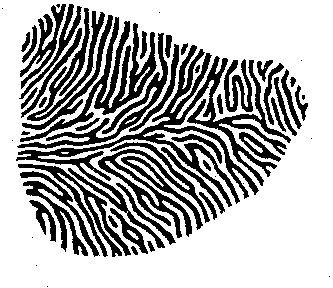
The BBC had an article on how lead atoms could self organise into patterns
Similar patterns are found in the striate cortex in the visual part of the brain.
Interactive examples include reaction-diffusion equation applets
My favourite is quasi-crystalline patterns. They aren't periodic like squares, hexagons or triangles, but do have symmetry. -
Re:The real moon conspiracy
The principle danger of the Van Allen belts is high-energy protons, which are not that difficult to shield against. And the Apollo navigators plotted a course through the thinnest parts of the belts and arranged for the spacecraft to pass through them quickly, limiting the exposure.
I have seen this argument rage a bit and am certainly no authority. There was a writeup by soeome at Caltech that seems to support the assumption that the LEM could have made it through the Van Allen belt without killing the Astronauts, but it must be observed that by his own admission, he is seeking to justify that solution rather than being skeptical of it.
"It has to be possible to go to the Moon, because we who are old enough all saw them on TV; a million of us (me included, for Apollo 11) saw the actual launch; a few of us (me included, for Apollo 8) saw the Trans-Lunar Injection burn, from low-Earth orbit to trans-lunar trajectory in the dark sky over Hawaii; and how could anyone fake all that?!"
This is pretty typical. Everyone wants to believe that we went to the moon. I am not disputing that we did. I am, actually, just suggesting that there might have been a bit of extra technology at work that the general public isn't aware of. And I don't think anyone would dispute the fact that the US keeps a lot of military secrets. Anyhow, let's move along...
First, the assumption that a given mission must expend all the vehicle's fuel is highly naive. Every rocket is provided with slightly more fuel than its mission requires, as a safety margin. In any event, the rocket is not compelled to burn all of it. The Saturn V was a sophisticated flying machine that was able to shut off its engine when the desired velocity was obtained, regardless of remaining fuel.
Again, I am not a rocket scientist (IANARS), but my point had nothing to do with the ability to turn on and off the boosters. My point was simply about the required delta-v to make it to the moon and back in the time it took.
By comparison, a fully-loaded Harrier jump jet produces 27,000 lbf thrust at liftoff -- ten times more than a lunar module. Yet you typically do not see a crater under a Harrier. This is because popular intuition dictates that a rocket engine of any size is automatically more powerful than a jet engine of any size. In fact, most jet engines are more powerful than the lunar module's rocket engines.
From Wikipedia, we see that the descent thrust of the Lander was just under 10,000 lbf of thrust, so your choice of the Harrier jump jet is a good one for comparison's sake at about 2.5x the thrust of the lander. Really, this issue is almost trivial to point out the paradox in: We have footprints in fine dust on the moon from Neil Armstrong just feet from the thruster that must have been firing to keep the lander from crashing. Without an atmosphere to blow the dust back over the scatter region where the 10,000 lbf thrust would have scattered such dust (very violently), how is it possible that there was dust for Neil to step inot after the lander landed?
Some conspiracists point out that the film of the lunar module ascending from the lunar surface to meet the command module doesn't show any visible exhaust products. That's because by the time it comes into view of the command module the engine has stopped firing. Just as a baseball thrown upward will continue to rise after it has left the propulsive effect of your hand, the lunar module continues to rise after its engine stops firing. Unlike space ships in the movies, real spacecraft don't have to fire their engines continuously in order to make headway.
Actually, the videos (google for them) clearly show the lander firing and heading off into deap space
-
easy install for MacOS X?
Does anyone know if there are binaries published? Gnucash site is down and google was of no help.
Yes, I know it can be built with fink, but even on my macbook that'll probably mean at least 6 hours of compiling, since gnucash has so many dependencies, it's not even funny...a friend says the old 1.x versions had almost 200 dependencies...and it'll be a fairly sizeable waste of disk space to have the entire
If we can have a 100-150MB self-contained package for gimp with double-click goodness for OSX, why not gnucash?
-
Re:Human Physiology?
It's not free, but you might enjoy this anyway.
Understanding the Human Body: An Introduction to Anatomy and Physiology
I've listened to lectures from the teaching company. They're very good. The only question I'd have is at what level are these lectures being presented. Usually, these courses are introductory or of a survey nature at best.
Also, these courses are free as well:
an introductory anatomy class from Berkeley
video lectures from "The neuronal basis of conciousness" course at Caltech
I know this may not be quite what your looking for. I've found that it's pretty rare for professors to post advanced undergraduate or introductory graduate lectures online. -
Neuroscience/Consciousness lectures
Christof Koch, a neuroscientist at Caltech, has some online lecture videos from a course he teaches each year on the neural basis of consciousness. They're pretty neat, and give a nice overview of visual neuroscience. There's lots of fun stuff about how splitting the brain splits consciousness, experiments which probe at our inner "zombie agents," and so forth.
-
Re:Not Merely Flawed Logic
First of all, in case you all didn't notice. Pope John Paul II died, therefore is not the current pope. So, it isn't appropriate to refer to him as "The Pope", unless you mean to suggest that he had this conversation with his spirit, in which case I doubt he would be so brash in the recounting of it.
Second of all, this whole story is based on an anecdote which leads up to a joke punchline. I highly doubt Stevie H. ever spoke to John Paul II, let alone have this particular alleged conversation.
Third of all, there has been countless examples of John Paul II saying that science was a very good thing, and that no science would ultimately lead to something that contradicted truth. An one example check out his words. In fact, his predecessor, Pope Pius XII, stated in his 1950 encyclical Humani Generis that the theory of evolution contradicted in no way with the teachings of the Catholic Church, Pope Leo XIII also stated in his encyclical Providentissimus Deus that "truth can not contradict truth", and John Paul II seconded that motion.
I would suggest everyone is out of date in their understanding of the Catholic Church's stance on science.
Let's not make
As a Catholic myself, I and my whole family have always been taught that the pursuit of science can only *help* us understand the universe and the world around us, and that this ultimately will help us to know and understand the nature of God. What science can't teach us, but philosophy (and yes religion) can, is how to live our lives or gain a sense of morality.
The assertion that has already been made I see by at least one
Lastly, every good Catholic knows that what the pope says about science is irrelevent. In fact, the doctrine of papal infallibility pertains to the singular domain of faith and morals, not science, not fact, not popular opinion, and not politics. Even if John Paul II "personally" discouraged Stevie H. from pursuing his line of scientific hypothesis (which I doubt), he has already officially encouraged it in a dogmatic way (a much more potent way). -
Re:Interesting Effect
Richard Feynman started on the road toward his Nobel-prize winning contributions to quantum electrodynamics by studying the spin of cafeteria plates.
-
Re:Almost there... still
If you go by the progress rate of existing fusion devices starting from 1965, it goes right back to 50 years (52.3 specifically, but who's counting?)
2006 - 1965 = 41 years.
Yes, and if what I was doing was counting how long it had been since 1965, then that'd be a big error on my part. If, on the other hand, you try reading in context, you might realize that I wasn't in fact talking about today at all.
If we're calling the last period an anomaly, and indeed it was simply linear progression from 1965 to 2004
There are other things than exponential and linear.
I would be willing to bet (and I would love to see the data that disproves this) that when the research first started the scientists involved got milli- or microseconds of production
Why do I get the feeling you're not actually going to love this? There's dispute, but most people believe the effort into fusion began with Lyman Spitzer and the Princeton Plasma Physics Library in 1951. (He's certainly the beginning of the American effort, at least.) The first known successful controlled fusion device was a pinched-Deuterium device at the Berkeley Radiation Laboratory (now the Lawrence Berkeley National Laboratory, losing hard drives for safety since 1997.) The papers governing the discovery were declassified in 1958; the scientists say the actual experiment was successful as early as 1955. So, there's a four year gap before they even got the pinch working.
People like you are why I think we should require a license to use statistics.
What in the holy name of fuck are you talking about? I used simple math to derive that equation
Yes. Simple, completely invented math. That's why I gave those examples you conveniently clipped away. You know, the ones where I said "this isn't exponential" and you said "then they must be linear?"
What you'll note is that the primary problem here is you're guessing; That's why you think fusion progress is exponential, when in fact almost no research is. (Don't get confused about Moore's law; that has little to do with research, and everything to do with progress in manufacturing techniques.) That's why you chose doublings, when in fact the progress in power output has been nowhere near annual doubling. In 1992, the highest output was 350mW. Now, in 2006, it's
The reason I think there should be a license to use statistics is because people like you say "well if we just double it every year, then (google calculator) FUSION IN SEVEN YEARS." It doesn't work that way. You don't just sit on your hands and expect a breakthrough every six months. There aren't predictable rates of raise and decline. Hell, in some years there isn't actually any change at all, and in some other years, the only reason there's change is because someone built a bigger version of the old machine, not because of new science (certain parts of the history of the ZETA were very much like this.) In other years, you see more progress during one year than the previous ten. Some of the big advances towards fusion didn't come out of fusion research at all; lithography gave them much better laser guiding, auto manufacturing taught them how to pull current from 0 to about half the hoover dam in under a second without melting the cables, the heavy magnetics come largely out of NASA and Tokyo universities, and the computer power is thanks to good old Corporate America, <cheer type="text/school">Go Fightin' Bankers<cheer>.
And, if you need further examples of why just picking some progression at random and saying "o -
Re:US Education Standards
Probably because Ivy League schools are almost exclusively focused on Accounting, Economics, Business, Law, etc. They're not hard-numbers schools. Our policy makers and politicians and lawyers and fortune-500-scandal-hiding accountants go to Ivy League schools, along with a number of kids from American dynasty families that are still here from the 1800's. Ivy league schools are hard to get into like Country Clubs are hard to get into. You need to be white anglo, rich, and have connections. Academics rarely has anything to do with it.
If you want hard sciences, you go to a school that focuses on hard science. Try sending the same people to MIT, or Cal Tech, or the University of Michigan.
In the same token, if you send your kid to MIT for Piano performance, or Business Management, don't be surprised when that isn't the focus of the school.
~W -
Well, you Caltech guys can go ask 'em.
There's a well timed lecture at Caltech on the subject:
http://today.caltech.edu/eas/item?calendar_id=6170 3&template=ist-all
It's interesting to note that one of the applications of this technology could be a device that allows you to see the insides of an object by making portions of it invisible. -
We never had this problem back when VMS was king
comp.os.vms was a place where the n00bs (myself included) could go to learn from the "grey beards".
It was always peaceful and there was no snobbery nor name-callling.
Well, most of the time anyway...
http://alumnus.caltech.edu/~vance/carl_lydick.html
http://www.myths.com/~dpm/vms/carl.html
-
Wiki for computational complexity
For a Wiki which already exists which archives existing knowledge on computational complexity in great detail, particularly the P=NP question, see The Complexity Zoo.
The website isn't exactly lightning-fast, so I'm sure they'll thank me for the link... -
Re:Anyone care to...
-
What did Mike Brown Really say?From TFA:
The reasons are simple. Even Mike Brown says there is no scientific basis for calling 2003 UB313 a planet. Here is what he said last year:
I will not argue that it is a scientific planet, because there is no good scientific definition which fits our solar system and our culture, and I have decided to let culture win this one.He's using Mike Brown's acceptance of the generally accepted cultural view that planets are 'anything pluto sized or larger' as a way of discrediting 2003 UB313. In fact, Mike Brown had felt previously that the definition of Planet was unsatisfactory and threw out some ideas on how the definition could be altered. http://www.gps.caltech.edu/~mbrown/sedna/index.ht
m l#planets links to the text in question. Mike Brown has since come to the conclusion that culture is going to decide what defines a planet, not a bunch of scientists. So basicly, unless the scientists who want to change the definition of a planet can convince society to listen, it's going to be like a tree falling in a forest with no one around to hear it. Sure, it happened, but who cares? -
Not the first thoughCaltech MiniMIPS (1998)
A good survey paper listing other efforts (pdf warning).
And more details of the Manchester Amulet processors. Note that Amulet has ARM core.
-
Caltech press releaseWhich part of "Thou shalt not steal" are the MIT hackers not quite clear on?
Looks like at least somebody still knows how to appreciate a decent prank.
-
Re:Simulating intelligence?
Some cool artificial life programs...
Evolutionz
Avida
AntWorld
And a whole list of others here. -
why via the moon?
delta v for various trips (km/s) borrowed from http://www.pma.caltech.edu/~chirata/deltav.html:
earth-moon 15.2
moon-mars 2.9
earth-mars 13.5
therefore, earth-mars via moon 18.1
Why would you spend the extra delta-v to go to Mars via the moon? If they meant to go to the moon in order to practice, then maybe it would work.
The only way it seems to make sense is if you could build a huge ship out of lunar materials and then just send the people and some lightweight materials from the earth. As far as I know, the lunar materials are not the right stuff (pardon the pun) to build and fuel a spacecraft. -
Other DNA nanotech labs
If you are interested in DNA nanotech, definitely check out the SciAm article by Ned Seeman (the founder of the field). Here are some links to lab pages:
Ned Seeman
William Shih
Eric Winfree
John Reif