Slashdot Mirror
Domain: collaboration-world.com
Stories and comments across the archive that link to collaboration-world.com.
Comments · 52
-
Re:Article ignores NeXTstep's place
If people supported GNUStep and push Apple to help it, Linux would have a lot of OS X software ports now and even Apple software in the future. The number 1 issue is of course, would people want Apple closed binaries/frameworks on their Linux/*BSD?
It is more like "What would happen if..." thing now. Still, if one starts coding on OpenStep, it is really easy to port same application in native form to OS X or even Windows. I don't understand why you mention both BeOS and GNUstep in same context. GNUstep is there, working and even a real good mail client is coded using it. http://www.collaboration-world.com/gnumail/
-
Re:Why Not?
MacOS itself is NOT based on FreeBSD, hell in 10.2.x ages, BSD layer was even optional. Utility vendors were saying "Install BSD layer" in system requirements.
MacOS X is based on NeXT, it is naturally multiplatform, Apple could release "OS X and/or iLife for Windows" right tomorrow if they wanted to and if they have another "secret project in closet".
NeXT lives as OpenStep/GNUStep and already available for Windows
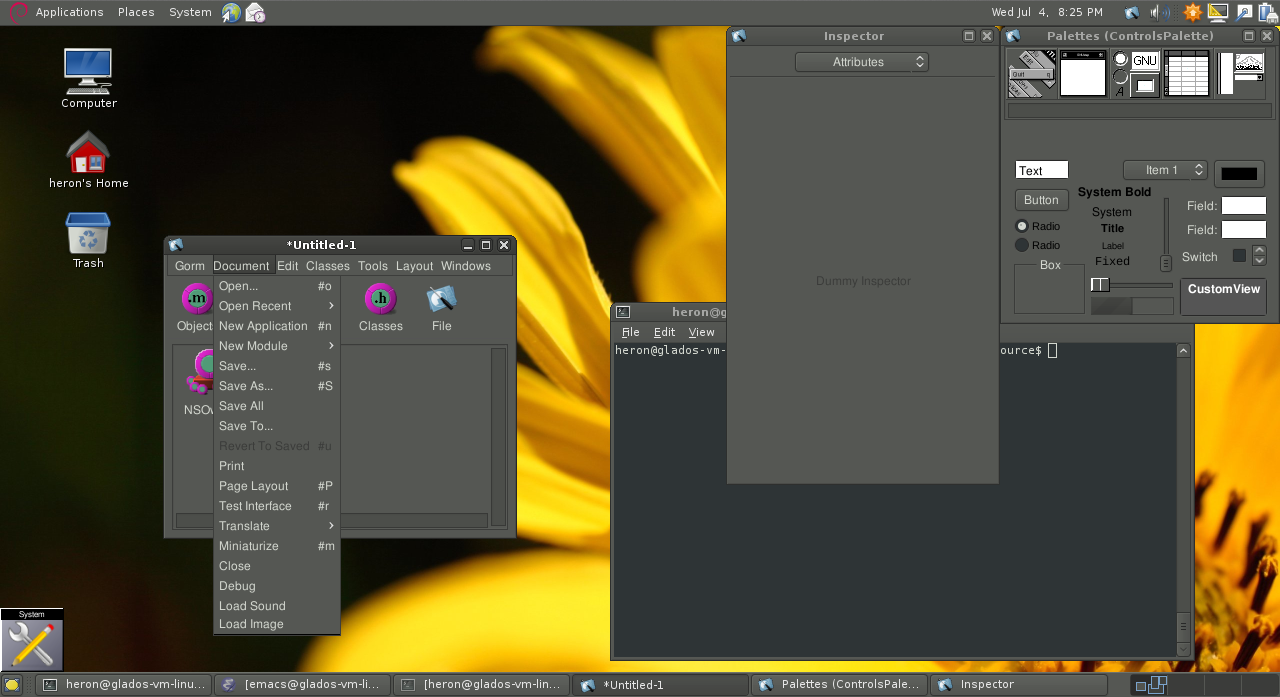
http://www.gnustep.org/images/full-screenshot1.pngOS X is not just that simple, it is almost a schizoid mix of BSD Lite, FreeBSD, Mach, Cocoa and Carbon. The OS and Developer tools itself forces developer to code "OS X friendly" code. The closest thing to OS X is WindowMaker/GNUStep (which I have no clue why doesn't get support) or in sense of integration and application discipline, KDE.
Also how will Ubuntu boss force developers to do things in the recommended ways? OS X really, really bugs developers to "move on", it is usual to get messages like "The functionality this application uses is depreciated, in current versions it will generate this warning once, in the future, it will segfault" on OS X. Try saying a similar thing on Linux, see amount of forks overnight
What makes me sad is the lack of funding/support GNUSTep gets. They already have a full function framework which only suggests you to start your project on their stuff first (without Cocoa) and its child's toy to port it to OS X. You would say "Yes, everyone claims that". No, it is not an empty promise. GNUMail.app is already living proof that it can be easily done with single developer.
http://www.collaboration-world.com/gnumail -
Re:Well, except that they haven't.A good X11 mail client I can suggest GNU Mail based on Next Mail.app (yes, that one) to people who uses both Linux and OS X.
http://www.collaboration-world.com/gnumail/
It is in early stages but easily comparable to OS X Mail right now. It does SSL/TLS/IMAP and local mail.
In fact I suggest it because it doesn't have kitchen sink included yet -
Example of GNUstep cross-platform in action
Example of GNUstep cross-platform in action
GNUmail installer, GNUmail application on Windows, GNUmail on OS X.
GNUmail itself: http://www.collaboration-world.com/gnumail/
-
Example of GNUstep cross-platform in action
Example of GNUstep cross-platform in action
GNUmail installer, GNUmail application on Windows, GNUmail on OS X.
GNUmail itself: http://www.collaboration-world.com/gnumail/
-
Re:Open up Cocoa (not going to happen)Cocoa stuff can't be compiled with GNUStep.
How so ? Not A Problem,
Frankly, I think that if you can get rather complex apps like GNUmail or Cenon running both on OSX and on GNUstep, surely it's in the domain of the reality, not just pie in the sky.
The problem is more about OSX developers not beeing really interested in porting their apps to linux. On the other hand, they are very interested to port their app to Windows, but somehow most of them just wait for Apple to release YellowBox and/or wait for a good GNUstep/Windows port, with very few actually helping GNUstep (sure, not that surprising...)
Note that GNUstep/Windows status is getting better, although GNUstep apps aren't integrated graphically with Windows, at least now it kinda work (eg like addresses, but more importantly, Gorm (the GNUstep gui builder) compiles on Windows since a few releases).
Imagine running GNUStep on OpenDarwin and being able to run all Mac apps -- that's what the goal ought to be!
Not Possible. GNUstep is not Wine, it's not binary compatible with Cocoa, it's source compatible (mostly).
Anyway, sure, it's not always as easy as a simple recompilation from OSX to GNUstep, but it often is. And when it's not.. it's not that difficult to do the "port", in my opinion/experience, particularly with recent progresses with nib loading (not complete yet, but very close now).
-
GNUMail?
I think the reason why Mail.app looks so different is proably because it is one of the truly cross platform mail apps. I remember reading somewhere that Mail.app is one of the few applications that can compile cleanly and with all functionality intact on both OS X and Linux running GNUStep. If that were the case, it might explain the different GUI, as they may have had to make some comprimises to make the application truly cross platform.
Apple Mail isn't open-source, and Mail 2 uses more custom widgetry and Apple-proprietary frameworks than the previous version. GNUMail is a mailer for GNUStep and Mac OS X consciously patterned after Apple Mail 1.x. -
GNUMail?
I think the reason why Mail.app looks so different is proably because it is one of the truly cross platform mail apps. I remember reading somewhere that Mail.app is one of the few applications that can compile cleanly and with all functionality intact on both OS X and Linux running GNUStep. If that were the case, it might explain the different GUI, as they may have had to make some comprimises to make the application truly cross platform.
Apple Mail isn't open-source, and Mail 2 uses more custom widgetry and Apple-proprietary frameworks than the previous version. GNUMail is a mailer for GNUStep and Mac OS X consciously patterned after Apple Mail 1.x. -
Re:Are hackers quick to forsake open source?Open Source? URL:http://www.gnustep.org/> Cocoa and Objective C are open. Only some of the newer APIs are closed.
There is a nice little Mail Client for GNUStep and Mac OSX.
http://www.collaboration-world.com/cgi-bin/project Open Source Projects:
BSD Ports http://darwinports.opendarwin.org/
APTGET http://fink.sourceforge.net/
X11 http://www.xdarwin.org/
A lot of OS X and cross-platform projects http://sourceforge.net/softwaremap/trove_list.php? form_cat=309
Gentoo anyone? http://www.metadistribution.org/macos/
Freshmeat has a lot of OS X and cross-platform projects http://freshmeat.net/browse/839/
http://www.opendarwin.org/
http://developer.apple.com/darwin/As you can see, contributing the OS X platform does not mean abandoning OSS or cross-platform software development.
You can contribute to Open Darwin or to the many cross-platform software projects on freshment or sourceforge.
-
Re:yeah... but it looks like its from the 80s
If you compare some of the OS X and GNUstep screenshots, you can see that GNUstep's interface, while looking ugly and outdated, still gets the job done just as well, and that they're really not too far behind as far as UIs go.
-
It's the fonts, stupidOK, I'm going to go off on a limb here with a rant that's probably an unpopular opinion. But what do I hate about virtually all Linux distros (and the current Mac)? It's this fad of antialiased fonts.
Am I the only one left who prefers clean bit-mapped fonts?
Sure, the screenshots shown in the article look pretty snappy from a distance, because the fonts are large. But to get a lot of work done you want small, even tiny fonts. That's the whole point of high screen resolution, right?
Antialiased small fonts look awful. Compare the crisp, clean bitmaps of NeXTSTEP or even Windows to the small blurry fonts in GNUStep or the Mac. With aliasing letters bleed together , the shapes aren't quite right, etc. It gets so tiring to read after a while.
And if you turn off antialiasing they're barely legible (and sometimes even touch each other - I hate it when letters touch each other!) because no one takes the time to produce correct bitmaps for specific font sizes. (OK, to be honest I haven't seen the Mac with antialiasing turned off.) I don't even care about a zillion different sizes, just give me a couple of fixed sizes, small and smaller, that look right.
As much as I hate Windows, one thing it has going for it is that the fonts are very clean and legible with antialiasing turned off. I tried the latest Ubuntu for a while, playing with all the font settings available (even LCD subpixel) and in end couldn't stand it because of the fonts. Such a beautiful OS gone to waste because it's unreadable with antialiasing turned off, and I can't stand it turned on. Isn't readability like half the point of a computer in the first place? Or do all people care about anymore is just getting a pretty "printed page" effect from a blurry distance?
The irony is that font bitmaps are not even copyrightable! Heck, just steal them from NEXTStep! Or even Windows! (The bitmaps, that is.) Why doesn't anyone do this?
(End rant.)
-
It's the fonts, stupidOK, I'm going to go off on a limb here with a rant that's probably an unpopular opinion. But what do I hate about virtually all Linux distros (and the current Mac)? It's this fad of antialiased fonts.
Am I the only one left who prefers clean bit-mapped fonts?
Sure, the screenshots shown in the article look pretty snappy from a distance, because the fonts are large. But to get a lot of work done you want small, even tiny fonts. That's the whole point of high screen resolution, right?
Antialiased small fonts look awful. Compare the crisp, clean bitmaps of NeXTSTEP or even Windows to the small blurry fonts in GNUStep or the Mac. With aliasing letters bleed together , the shapes aren't quite right, etc. It gets so tiring to read after a while.
And if you turn off antialiasing they're barely legible (and sometimes even touch each other - I hate it when letters touch each other!) because no one takes the time to produce correct bitmaps for specific font sizes. (OK, to be honest I haven't seen the Mac with antialiasing turned off.) I don't even care about a zillion different sizes, just give me a couple of fixed sizes, small and smaller, that look right.
As much as I hate Windows, one thing it has going for it is that the fonts are very clean and legible with antialiasing turned off. I tried the latest Ubuntu for a while, playing with all the font settings available (even LCD subpixel) and in end couldn't stand it because of the fonts. Such a beautiful OS gone to waste because it's unreadable with antialiasing turned off, and I can't stand it turned on. Isn't readability like half the point of a computer in the first place? Or do all people care about anymore is just getting a pretty "printed page" effect from a blurry distance?
The irony is that font bitmaps are not even copyrightable! Heck, just steal them from NEXTStep! Or even Windows! (The bitmaps, that is.) Why doesn't anyone do this?
(End rant.)
-
Re:no, it shouldn't
People choose the desktop they like, and that happens to be either Gnome or KDE.
Granted, the majority of open source desktops run Gnome or KDE, but the preference is not either/or. It's all inclusive. Why? Because there is no single solution for everyone, especially in the open source world where most people are arrogant individualists and are proud of it. The point of this release preview is NOT the gui. The gui is superficial and will probably change/modernize as the project hits 1.0 and beyond. The point of this release was to preview the underpinnings that have taken so long to get into a truely usable state. I was astonished at how gorm works almost exactly like the NeXT DE did in the video of Jobs evangelizing his OS that was posted not too long ago here on slashdot. I am also astonished that you can take a GNUstep app like GNUmail.app, compile it on an OS X box with a simple click, and have it run without any modifications, with a cocoa look-and-feel. No GTK-to-Cocoa porting bullshit. THAT is the point of GNUstep. Personally I think that's pretty damn cool. While a GTK app will run well on *BSD/Linux/Solaris and run buggy on Windows, a well-written GNUstep app will run stably, without modification, on OS X and GNUstep...doubling (if not more - there are probably more OS X users than GNUstep users) the userbase for GNUstep apps.
While I do not think there should be a forced de-facto open source desktop, I do think GNUstep is a damn neat project and should be respected, not shit upon by fanboys of a particular opensoure DE. -
Re:yeah... but it looks like its from the 80s
To be honest, yes. You can see the issue most clearly by comparing this and this. One is GNUMail compiled under GNUstep, the other is the very same GNUMail compiled under MacOS X.
To my eye, for reasons I can't fully explain, at first glance the GNUstep version looks more cluttered and complicated even though some inspection will show all the same UI elements in the same places with the same icons. It's the colors, and the sizing and style of the widgets, and just the general feel given off by the look as a whole.
Jedidiah. -
Re:yeah... but it looks like its from the 80s
To be honest, yes. You can see the issue most clearly by comparing this and this. One is GNUMail compiled under GNUstep, the other is the very same GNUMail compiled under MacOS X.
To my eye, for reasons I can't fully explain, at first glance the GNUstep version looks more cluttered and complicated even though some inspection will show all the same UI elements in the same places with the same icons. It's the colors, and the sizing and style of the widgets, and just the general feel given off by the look as a whole.
Jedidiah. -
Re:This Should Be THE Desktop Environment for Linu
GNUmail.app is one app that runs on both OS X and GNUstep. I've seen a small handful of others. However, there are some hurdles in porting an OS X app to GNUstep- if you use any Quartz compositing, it just won't work, for one. Or if you use any Carbon convenience functions, or any number of other non-OpenStep APIs that exist within OS X.
But you are quite right in the last part. No way will your average Linux h4ck3r drop C/C++ and go to ObjC. A shame, as ObjC is a lot nicer, but it just won't happen. -
More options...
Repeat after me: E-mail clients on Linux are NOT a problem.
* Mutt (console based and unlike PINE its Free and better)
* Evolution (for GNOME)
* KMail (for KDE).
* Sylpheed (for GTK+).
* GNUMail (for GNUstep)
* More at Freshmeat.net > Communications
Perhaps redundant links here and there, but this is a good overal start. I excluded Thunderbird and Mozilla because those are heavily known already. Also, some of the above clients might run on other Unices, other OSes -- including MacOSX and Windows. -
Assuming "applause" is meant non-literally
Are you saying companies shouldn't be applauded for using standards?
The more openness, the more applause, of course.
But Apple is very much looking out for themselves first and foremost, and they still have a very long way to go before I give them a full-on standing ovation.
It's still vendor lock-in. It's still proprietary programs (Safari is closed, WebCore isn't).
Why should I have to write a better iCal? Had it been free, I could've "stood on it's shoulders". Apple Mail is also a program I'd want a better free version of. -
Re:RealPlayer is actually quite nice
Since you like Cocoa, you might also want to look at GNUStep on the GNU/Linux and *N*X side of things. It attempts to provide the next-step-after-OpenSTEP UI toolkit, and even brings some of the Cocoa APIs as well.
Best of all, I hear taking code from it to OS X is just a quick recompile for a native experience, which is always nice. You can see screenshots of a app that does just that here. -
Re:NeXTcube
dude OSX uses an Openstep implematation as its API. have you written any code on OSX? All the objects derive from NSobject and they all have the prefix NS. NS obviously standing for NextStep. Oh yeah and we still use Objective-C. The Next iterfacebuilder that Lee liked so much? Yes it is called interface builder and saves files as
Finally, lots of code written for OSX builds on Gnustep and Openstep. For example GNUmail
So, yes it is correct to say that OSX is the modern version of NextStep just like WinXP is the modern Windows -
Re:finally, a reason to switch from...
There's a simple answer.
-
Re:too bad we're talking about X and not OSX
The cross-platform development success stories, like GNUMail.app, are inspiring and the latest CVS of GORM (Interface Builder clone) is getting awfully close to how IB works in OS X. But we probably aren't going to see a real imitation of the OS X window server. The project was threatened by Apple attack-lawyers a few years ago and people are (understandably) nervous about ripping off Apple look and feel. There is a patch to offer a (NeXT-ish looking) horizontal menu like Apple has always used.
-
If there was any sanity...
...in the open source community, we'd see more effort going into GNUstep.
Works with everything we have today? Check, there's compatibility with KDE and GNOME applications as well as Motif, with window style hints too.
High level language support? Check, Objective-C provides Smalltalk-like object orientation, and automatic memory management is available. There are also bindings to Ruby and Java. You can even build Java applications with native quality look and feel.
Compatible with what programmers know today? Yup, Objective-C is a slight superset of C, so almost any programmer can get to grips with it in a weekend. (Speaking as someone who did.)
Good class libraries? Yes, modeled on NeXT's excellent work, the same foundation used to build OS X. I've written Cocoa code, it's the most painless class library I've encountered. (Yes, I write Java too and have written C++.)
Cross platform? Yes again, programs are portable between GNUstep and Cocoa without too much work--see GNUmail for an example. Non-GUI programs even port to Windows without major effort, allegedly.
Good developer tools? Again, yes. Excellent developer tools on OS X. Doubtless the free tools on Linux could use some work, but that shouldn't be too hard. We can even build them using the OS X tools if necessary.
Pretty UI? Well, I think it looks OK. Not as nice as Aqua, but it's functional.
Mature? Well, the Objective-C compiler is GCC, Apple use it for their developer tools and push back improvements, the class library design has been refined over the course of 10+ years.
Think about it, people. We could unify the Linux and Apple developer communities. All work towards one common goal. Get 10%+ desktop market share for OpenStep/OS X/GNUstep in no time.
Hell, get GNUstep up to scratch and you'd probably see developers porting their commercial applications from OS X to Linux. Wouldn't you like to see products from Adobe, Macromedia, maybe even Apple available to run on your Linux desktop?
Think about all the problems that have been solved by NeXT and Apple. Application packaging? Solved, applications are bundles of files that you can just drag-drop wherever you want to keep them, and they work.
But no, the GNOME crowd will shun a tried and tested, open source, native code solution that works today and is backed by the single biggest vendor of UNIX desktops, in favor of cloning an untested patented bytecode-based Microsoft solution. Gates and co must be laughing.
But hey, go GNOME. Let's reinvent those wheels. Maybe your next set won't be square. -
Re:C "Dying", Scripting Languages, Cross PlatformHow much more cross platform do you want?
Cocoa/GNUstep is pretty nice. Mac and UNIX is working pretty well (see GNUMail.app for a good example), the win32 graphics backend is maturing rapidly, and there's a guy who has put together a small-footprint PDA distribution too. Besides that, "write once, compile anywhere" is much more reasonable than "write once, run anywhere".
-
Re:Next step - better apps
-
I'm so sick of this: Cocoa IS PORTABLE!It's called GNUstep. And yes, there are applications that build cleanly on both platforms. GNUMail.app, for example. There's also a project called Renaissance that allows you to craft your interface with XML, avoiding even issues with Apple's proprietary
There are also clones of NeXT/Apple's InterfaceBuilder and ProjectBuilder and a host of end user applications. GNUstep builds on Linux and other UNIX systems. The Foundation classes work fine on Windows and there's serious work to perfect the GUI classes on Windows as well.
-
Re:OS X Email ClientsAlso, there's:
We may still be missing some. Also, there's plenty of X-Windows based clients that you could install as well.
-
Re:Wow those Macs look nice
Try GNUMail. It's similar to Mail.app, but it runs on Linux with GNUStep.
-
Re:Does Cocoa (and this book) relate to GNUStep?I know that GNUStep is implemented in Obj-C, but would this book be useful for learning Obj-C and the GNUStep interface?
I haven't read it but judging from the title and review, I don't think it will do you much good right now. It appears to be talking about some of Apple's own custom frameworks and lower level UNIX stuff. Somebody on the GNUstep list mentioned recently that they're interested in cloning Rendezvous but it's still just vapor.
Now, Aaron Hillegass' previous book, Cocoa Programming for Mac OS X, is VERY good and will mostly stand you in good stead with GNUstep. It's a great introduction to OpenStep/Cocoa/GNUstep concepts. Combined with the documentation on the GNUstep site, the docs over at Apple and asking questions on the GNUstep mailing lists, you'll be fine.
would I gain any cross-platform Linux-Mac OS X benefits
the GNUstep frameworks and Apple's Cocoa are both based on the OpenStep API, so they're mostly source-compatible. There are some pitfalls and considerations that you'll need to know about before you start on any ambitious programs, however. I'd suggest just becoming familiar with Cocoa and/or GNUstep first, then try writing a simple little app and porting it. There's a very cool project underway called Renaissance that will make portable UI design much easier. I can say that it's easier to design/build on Linux/GNUstep and then move to OS X rather than the other way around.
GNUmail is an example of a great portable OS X/Linux/BSD success story. Nice app.
Hope this helps. Drop on by the GNUstep discussion list some time and say hi. Always nice to know who's interested in the project.
-
Aren't they forgetting someone?
NetBSD's pkgsrc works very well for me on OSX. I haven't tried portage or darwin ports, but fink seemed a little strange....almost but not quite debian goodness.
Still, I think all this work is kind of weird. I can see the porting effort for things like the text-based things (emacs!) and the very large projects (OO.o!)....but running standard unix apps under X on top of OSX doesn't take advantage of OSX's strong points. For all the hype, this could be happening with people on cygwin....
Kudos to the GNUMail.app people, of showing what can be done. -
Re:GPG
Have you guys ever considered making Fire portable between OS X and GNUstep platforms, like GNUMail.app? I'm sure you'd get cooperation from the GNUstep folks to reduce the effort required on your part.
-
Re:My thoughts on Apple
And don't forget that Cocoa applications are source-portable with GNUstep. There are even GPL'd clones of Mail.app, and Interface Builder and Project Builder.
-
Re:Apple is also dead
Not only that, but OS X is really OPENSTEP 5.0. And we all know that NeXT is really dead! Where can I send flowers while I read email with GNUMail.app and design software with Gorm.app?
-
GNUstep + 3DKit
You should take a look on GNUstep + 3DKit
GNUstep (url) is an OpenStep implementation. It aims to be multiplatform (even if for now it's mostly linux/bsd based... under Windows it's alpha state), and as Mac OS X is also an OpenStep implementation, it's really easy to write GNUstep apps and port them to Mac OS X (in fact most time you only have to create a new project in ProjectBuilder, add your files, redo you nib with InterfaceBuilder, and voila, it's done). Take a look at GNUMail for an example of a GNUstep/MacOSX program.
Big advantage of GNUstep is the OpenStep framework (Foundation and AppKit), which is really powerfull and easy to use, along with RAD GUI builder (Gorm on GNUstep, InterfaceBuilder on Cocoa); You could program in Objective C or Java (But Objective C is nicer imho), or even in ruby/smalltalk
It should be easy to add scripting to your application with StepTalk (url) and AppTalk (url), and 3DKit is a framework for creating 3D Scenes (url)
If you want some tutorials, check this site -
Re:Cocoa all the wayI googled but couldn't find anything linking lucas and jobs.
Here's where the thread starts (it's hard to follow, Geocrawler's threading sucks). The page where the thread starts is here. It does seem a little odd at first, but keep reading, it's all in there. The post about the WebObjects guy is here. Of course, you can make what you like of these posts, but when you read the entire discussion from beginning to end, it appears to be credible (the fact that Wagner was also around for quite some time before and after the incident, and made some contributions to the project, also lend some legitimacy to the whole affair).
But the code is also apples copyrighted code.
No proprietary code is used in GNUstep or its applications; so we're safe there.
I don't know how you can make a clone without violating the code, even if you just reproduce the apis-- the apis are copyrighted as well.
Well, the API spec is "open" (Sun and NeXT released it on October 19, 1994). The GNUstep project clean-roomed everything from that "open" spec. Thus the conclusion that the project is on solid ground.
I think cocoa developers aren't helping much because they are working on applications and are focused on that.
Well, one way they could help is to make sure that their applications are portable. This does take a little effort, however, and people have said that they don't want to even look at the project unless porting is effortless--and yet, they aren't willing to assist in *making* it effortless. I don't know how accurate that assessment is.
PErsonally, I could help in the future, if Gnustep looks like its going to be viable
Well, it's already in a fully useful state. Applications have been written with it, and they work well; for instance, GNUmail is nice, works extremely well, and runs on OS X as well as GNUstep platforms. There are quite a few other applications already (check out the GNUstep community site). We even have usable Interface Builder and Project Builder clones.
(Which is something I simply haven't researched yet because it isn't the appropriate time to consider porting my app.)
I understand. But the problem is, it can be a difficult job to port later if you don't take some considerations early on in the project. For instance, you can't use QuickTime because of a Sorensen patent--there's not much we can do about that one. But there are some newer clsses in Mac OS X that aren't implemented yet in GNUstep. We need people interested enough to implement, test, or fix them. That means OS X developers, mostly. And they're not interested, as noted before.
I think it would be a strategically good move for apple to move cocoa to windows
NeXT produced Yellow-Box, which was just that. There was a lot of hope that Apple would continue to offer it when they bought NeXT. There were a lot of disappointed OpenStep developers when the decision was made to drop it. It's pretty well established that Apple's main source of revenue is hardware. There's been speculation that they might--*might*--consider porting the OS to x86 (most of the work was done back in the NeXT days) but simply offering people the possibility of using the development environment to write Windows applications is definitely not in their best interest.
Great to hear that you're interested in GNUstep, though. We need all the help we can get, even if it's just allowing the porting of applications. The Cocoa APIs and dev tools are very nice, and would make UNIX development much more fun and productive.
-
Re:Try pwm
For a more heavy-duty WM, I recommend WindowMaker over GNOME or KDE. WindowMaker is fairly light-weight, and has a much cleaner appearance and feel. Another nice feature about WindowMaker is that it has a lot of the nice Apps that you see in OSX, like the mail program and the column-file navigator. Better, its easy to port an OSX program to WindowMaker if you have the source, as its based on OpenStep.
Window Maker is what I'm currently running at home. I used to use AfterStep, but got fed up with it for various reasons.
Contrary to what dh003i says, it is strictly a window manager - it doesn't have any applications associated with it, except for WPrefs.app). The applications like Mail.app (well, it's called GNUMail.app) and the "column-file navigator" (called GWorkspace.app) are part of GNUstep, not Window Maker. -
Re:is OS X open source?GNU step can be used to run OS X applications on other UNIX platforms, but not Windows yet.
No. GNUstep can be used to write applications that can be compiled - and run - on MacOSX. Getting GNUstep to work on Windows is in progress.
I just do not understand what exactly is GNU step. Is it a language, a complier, an operating system, an emulator?
It's an API (Application Program Interface), a collection of libraries, header files,
-
Re:Mac Os X Programming
Letting all the new Cocoa developers know about GNUstep. It's a GPL'd implementation of Cocoa, and runs on all UNIX platforms (Linux, BSD, etc.) and Windows (the Application Kit graphics backend is in an alpha state). We have several applications written (including Interface Builder and Project Builder clones), some of which are completely portable to Mac OS X (like, GNUmail.app). It's fun and cool.
-
Re:You also have Carbon
I'm not sure that I agree than Carbon will make your app easier to port. There is an open-source, cross-platform reimplementation of most of Cocoa called GNUStep, which is based on the old OpenStep spec (just like Cocoa). Using GNUStep you can run the same (or very similar) code on, say, Linux and OS X. See GNUMail.app for an example. Here is a screenshot of it running under Mac OS X, and here is a pic of the same program running on Linux via GNUStep.
-
Re:this is all well and good
Two points.
-
GNUStep is not a window manager. It is an implementation of the OpenStep API as published by NeXT several years ago, now known in its current form as Cocoa, the development environment that Apple is pushing for OS X. In principle, GNUstep allows one to write applications that build and work under Mac OS X and Linux/BSD. One example of such an application is GNUmail, which is excellent. On a side note, I can't emphasize enough how many things this OO development framework gets right, in comparison to certain other Linux development environments, which are only now random-walking their way toward sanity.
- Apple products carry a price premium, but it's not nearly as awful as you describe. In fact, their notebook line is probably (IMHO) where they shine brightest. If you compare a T-series Thinkpad (a far better comparison), the margin narrows. 256MB/40GB/1.8GHzP4 for the Thinkpad, and $2500. For the same price, you get the PowerBook with 256MB/30GB/667MHzG4. The CPU speed on the Apple suffers, even when Altivec optimizations are included, but on a laptop this is a much less important concern. More critically, the Apple gets an easy 5 hours of battery life, and the Thinkpad only 3 hours. The PowerBook has additional features, such as twice the video memory, solid Firewire support, and full gigabit ethernet -- which are important to keep in mind.
When it all comes down to it, you get what you pay for -- and it doesn't matter much if you buy from a high-end PC manufacturer or from Apple. So pick what suits you best!
-
GNUStep is not a window manager. It is an implementation of the OpenStep API as published by NeXT several years ago, now known in its current form as Cocoa, the development environment that Apple is pushing for OS X. In principle, GNUstep allows one to write applications that build and work under Mac OS X and Linux/BSD. One example of such an application is GNUmail, which is excellent. On a side note, I can't emphasize enough how many things this OO development framework gets right, in comparison to certain other Linux development environments, which are only now random-walking their way toward sanity.
-
Re:What is with the NextStep obsession?Your post was so full of misunderstanding that you are either woefully ignorant, or trolling, or both in all likelyhood. But in the interest of truth, I'll go ahead and deal with your points.
if there's such a nice API and software development tools, why was nothing ever developed with it.
Because plenty of stuff *has* been developed with it. You're just ignorant of them. For example, it has been heavily used in the intelligence industry and on Wall Street. And I'm sure you've probably heard of Mac OS X, right? Guess what the primary development platform is. You should check out Softrak and the peanuts FTP archive some time too. And maybe the OMNI Group and some others. Is there as much software as there is for Windows? No. Is that because MFC is a superior development platform? Pffffft. It's because Microsoft has the marketing muscle and lock-in advantage (and an awful lot of luck thrown in for good measure).
And why is every application that was developed as part of it so primitive and un-user friendly.
You've never used any of this stuff, have you? There are some quite attractive and usable applications out there. GNUmail is very nice, for instance, and was developed primarily by one author in a very short period of time. Are there poorly designed UIs as well? Of course. But that's the fault of those who design. And that happens everywhere--UNIX, Windows, Mac OS, BeOS, etc.
Is it just a coincidence that it was a brilliant platformed developed by people with no design sense.
I find it to be quite elegant looking. But at any rate, I was talking about the API. Y'know, stuff like Array and String classes and responder chains. Stuff you don't actually "see". How it actually looks is not set in stone. That's why Mac OS X looks completely different but is built on the same basic classes as OPENSTEP or GNUstep.
-
Re:What is with the NextStep obsession?Your post was so full of misunderstanding that you are either woefully ignorant, or trolling, or both in all likelyhood. But in the interest of truth, I'll go ahead and deal with your points.
if there's such a nice API and software development tools, why was nothing ever developed with it.
Because plenty of stuff *has* been developed with it. You're just ignorant of them. For example, it has been heavily used in the intelligence industry and on Wall Street. And I'm sure you've probably heard of Mac OS X, right? Guess what the primary development platform is. You should check out Softrak and the peanuts FTP archive some time too. And maybe the OMNI Group and some others. Is there as much software as there is for Windows? No. Is that because MFC is a superior development platform? Pffffft. It's because Microsoft has the marketing muscle and lock-in advantage (and an awful lot of luck thrown in for good measure).
And why is every application that was developed as part of it so primitive and un-user friendly.
You've never used any of this stuff, have you? There are some quite attractive and usable applications out there. GNUmail is very nice, for instance, and was developed primarily by one author in a very short period of time. Are there poorly designed UIs as well? Of course. But that's the fault of those who design. And that happens everywhere--UNIX, Windows, Mac OS, BeOS, etc.
Is it just a coincidence that it was a brilliant platformed developed by people with no design sense.
I find it to be quite elegant looking. But at any rate, I was talking about the API. Y'know, stuff like Array and String classes and responder chains. Stuff you don't actually "see". How it actually looks is not set in stone. That's why Mac OS X looks completely different but is built on the same basic classes as OPENSTEP or GNUstep.
-
Re:HOWTO report security problems to Apple
There's also a GPG plugin for Apple's Mail.app. It's a bit limited, but it's free (as in speech) and an active project. Additionally, there's GNUMail a clone of Mail.app with better, built-in GPG support
-
Re:History repeats itselfThis creates a wonderful opportunity. Instead of aiming for 'end users', Linux desktops should aim at amateur developers who want a free and simple workbench for writing the kinds of applications that made Windows 3.1 rule the world.
You are talking about GNUstep. For many years, the OpenStep API and development tools have been far superior to *anything* else in the Windows or UNIX world. The GNUstep project has already got usable alpha clones of the NeXT development tools that are a joy to work with. Take a look at this mail client developed quickly with GNUstep tools. It runs on GNUstep platforms and Mac OS X.
The GNUstep project is actively tracking the additions made to Cocoa (what Apple decided to call OpenStep after buying NeXT).
GNUstep frameworks and applications will build on most UNIXes, on Mac OS X (obviously), and win32 platforms. Support for the GUI backend is Alpha on win32 but is progressing.
GNUstep has a database framework much like NeXT's Enterprise Object Framework and a web development system much like WebObjects. Also available is a 3D framework, music and sound frameworks, a networking framework, an email framework, and others.
Like Apple, you can write your applications in Objective C or Java. Unlike Apple, the GNUstep project provides several other language options: Ruby, Guile, and other scripting languages by way of StepTalk.
-
Re:History repeats itselfThis creates a wonderful opportunity. Instead of aiming for 'end users', Linux desktops should aim at amateur developers who want a free and simple workbench for writing the kinds of applications that made Windows 3.1 rule the world.
You are talking about GNUstep. For many years, the OpenStep API and development tools have been far superior to *anything* else in the Windows or UNIX world. The GNUstep project has already got usable alpha clones of the NeXT development tools that are a joy to work with. Take a look at this mail client developed quickly with GNUstep tools. It runs on GNUstep platforms and Mac OS X.
The GNUstep project is actively tracking the additions made to Cocoa (what Apple decided to call OpenStep after buying NeXT).
GNUstep frameworks and applications will build on most UNIXes, on Mac OS X (obviously), and win32 platforms. Support for the GUI backend is Alpha on win32 but is progressing.
GNUstep has a database framework much like NeXT's Enterprise Object Framework and a web development system much like WebObjects. Also available is a 3D framework, music and sound frameworks, a networking framework, an email framework, and others.
Like Apple, you can write your applications in Objective C or Java. Unlike Apple, the GNUstep project provides several other language options: Ruby, Guile, and other scripting languages by way of StepTalk.
-
Re:Why history will remember Andreesen, not Clark
Everyone stands on the shoulders of other giants. Let's give Marc and Eric some credit;
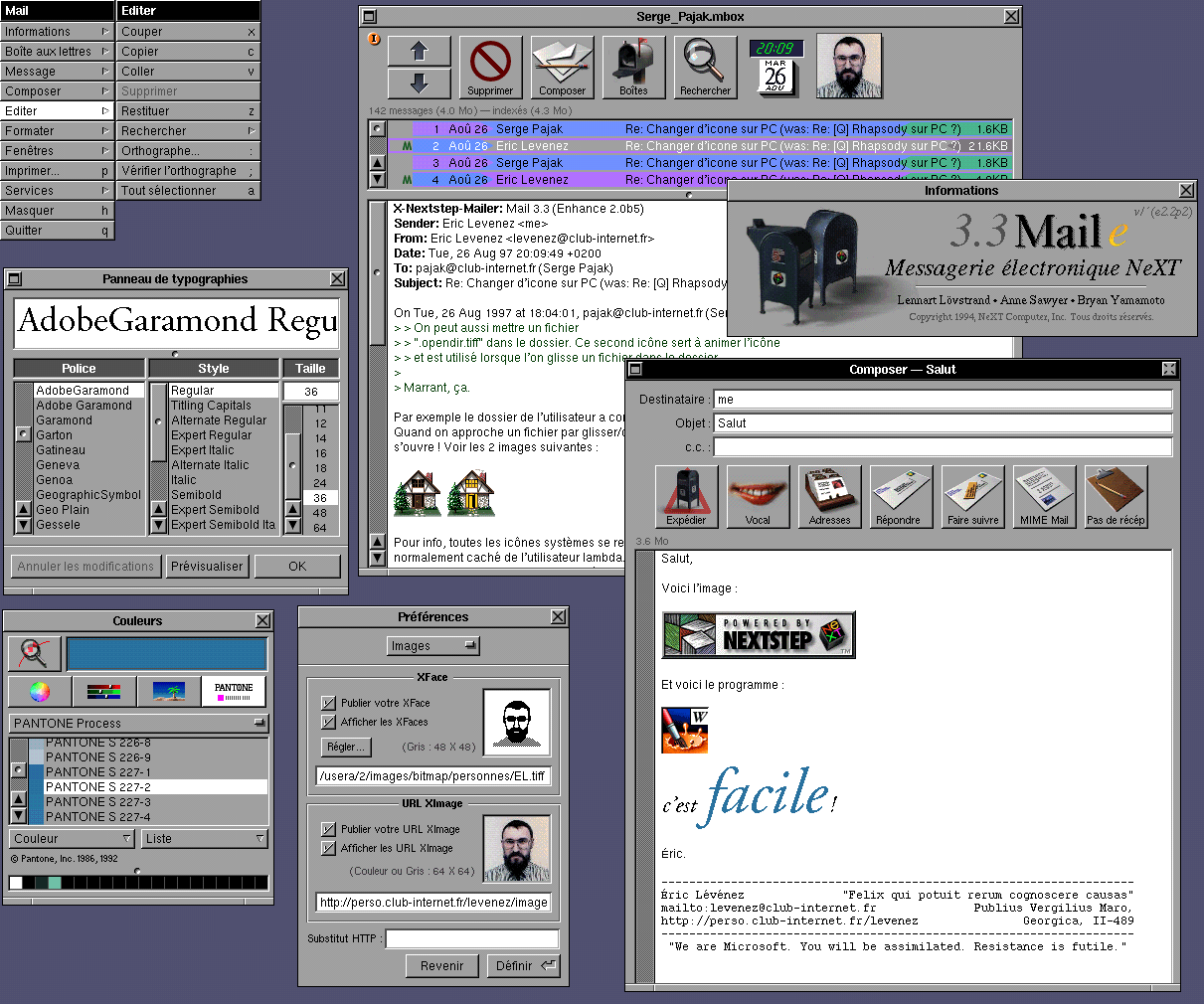
You're right. But I disagree when you write that Berners-Lee's browser had "no GUI controls beyond a scroll bar"... In fact it was not only a GUI browser but even a GUI html editor, and the page you're commenting on explains how to make a link using the NeXT menus on the left. Or see this page:"WorldWideWeb was a graphical point-and-click browser with mode-free editing and link creation. It used style sheets, and multiple fonts, sizes, and justification styles. It would download and display linked images, diagrams, sounds animations and movies from anything in the large NeXTStep standard repertoire."
He continues with a link to the original source code, BTW. I wonder if anyone has been able to compile this lately. Could it be patched to run on GNUstep (or even Mac OS X -- compare this)? Now that'd be fun. -
Actually, we have something closer.GNUStep though not terribly similar in looks to aqua, is technologically very close to the modern NeXT-style development.
Don't believe me? Check out these screenshots:
GNUMail on Linux/GNUStep
GNUMail under Aqua/MacOS X
Don't write off GNUStep just because they haven't reached the popularity of KDE or GNOME. I think that with Apple's dominance in the UNIX market place, that we may see GNUStep become increasingly important.
-Peter -
Actually, we have something closer.GNUStep though not terribly similar in looks to aqua, is technologically very close to the modern NeXT-style development.
Don't believe me? Check out these screenshots:
GNUMail on Linux/GNUStep
GNUMail under Aqua/MacOS X
Don't write off GNUStep just because they haven't reached the popularity of KDE or GNOME. I think that with Apple's dominance in the UNIX market place, that we may see GNUStep become increasingly important.
-Peter -
OS X is cool, but...
I prefer GNUstep + Debian, Mac's are too expensive for my taste.
If more developers get involved, GNUstep
would evolve much faster (obviously), and once it fully conforms to the OpenStep specification, then everyone could focus on all the stuff that Apple added.
Some GNUstep applications have been successfully ported to OSX, like GNUMail with little changes, but full source compability isn't quite there yet, and ObjectiveC++ is still missing in gcc.
However, if I had the money, I would run to the nearest reseller and get myself an iMac right away. -
Re:Mod this question up, please.GNUmail.app, a GPL'd Cocoa email client (written for GNUstep, but now ported to MOSX as well) in an attempt to mimic NeXTSTEPs Mail.app, includes this feature, if you're interested.
Offtopic, I think it's really significant that GPL'd software invades the Objective C/Cocoa world. We REALLY need more software for this great API and it's a niche that GNU can fill.