Slashdot Mirror
Domain: creativecommons.org
Stories and comments across the archive that link to creativecommons.org.
Comments · 953
-
Jamendo ...
*** Disclaimer : I'm one of the founder of Jamendo ***
Reading this
We started jamendo beginning of 2005. The aim of Jamendo is to help artists use P2P technologies and particulary BitTorrent to get to a larger audience. We combine Creative Commons Licence with BitTorrent to have artists publish their work, and promote a legal use of BitTorrent or eMule or Shareaza or
Thanks to our jamloader , artists put their demo CD in their PC/Mac/Linux and automagically their work get published as a torrent on jamendo and accessible with eMule. The software rips the CD to FLAC, ask to choose one of the 6 creative commons licenses and uploads the datas to our servers. On our servers we do the rip in other various formats, Ogg, MP3, AAC, and do the creative commons watermarking. We also do some kind of community moderation, in order to avoid the ones that upload the latest Britney Spears or the ones that upload the latest neo-nazy band. Bands have to link back to our website from their official website as a control ( see godon for exemple )
Finally we use iRate as our core technology to do the rating of the music, and do intelligent propositions to our audience. Our XMLRPC-iRate server ( http://irate.jamendo.com/ ) supports the latest features of the iRate protocol but today, there's not enough client software, but we have the project to write our jamplayer that will combine iRate and BitTorrent and foxytunes.
What about the money ? Our business model differs from the one of magnatune for instance ( I quote magnatune because John Buckman made a very nice and cool entry in his blog, thanks again to him). We have a more ad-centric model were the service is free for the artists, is free for the audience, but the web pages are ad supported (no popup), the streamed music may be ad-supported up to 1 audio ad every 3 songs, the published archive in P2P networks are high quality archives with no ads. The idea is : bandwidth heavy is ad-supported, bandwidth friendly (i.e. BitTorrent) is ad-free ! We are not a label but rather a "community driven music hosting company" , we allow the bands to put their paypal button to receive donation on their jamendo page, jamendo takes no margin.
Sorry again
Laurent. -
Don't Knock it 'till You've Tried It!
Sure, the stuff linked here may well be of great interest to you! There's lots of music, released both by independent labels and artists, and by "bootleg-friendly" labels and bands. There's public-domain (or otherwise legally/freely distributable) videos, books, photos, music, and text strewn about all over the place if you know where to look, and this article links to plenty of great places to start. Download some music and have a listen. You may like it. I was stunned by how much good stuff is out there that I not only don't have to pay for but don't have to break any laws to legally obtain!
The Creative Commons Directory is a great place to find other stuff licensed under a free/open license (maybe not BitTorrent-distributed, but of course you can fix that by seeding and posting to any of these sites linked in the article!). -
Re:The CCL is a great idea, but...
It's definitely a step in the right direction that Lessig has codified the Creative Commons license...
Creative Commons is a giant step backwards, because it's taken all the people who might have been interested in creating free non-software works, and persuaded them to release their stuff under a non-free, GPL-incompatible license, such that all of us working on free software can't really make any use of it. All of the Creative Commons version 2 licenses are broken and should be avoided, just like the GNU FDL, the OSL, etcetera. You can see a fairly complete summary of all the problems found so far at http://people.debian.org/~evan/ccsummary
This should not come as a great surprise. Have a look at the people responsible for creative commons. Note how they're mostly lawyers and corporate types. This is not a grassroots effort, despite the way they allude to being related.
Creative Commons has shown no interest in fixing their licenses. Consider why that might be. -
Lessig vs. Lessig (or, CC vs. remix compulsory)Back during the hype over Danger Mouse's Grey Album, I noted this from the Creative Commons:
"We work to offer creators a best-of-both-worlds way to protect their works while encouraging certain uses of them -- to declare 'some rights reserved.'"
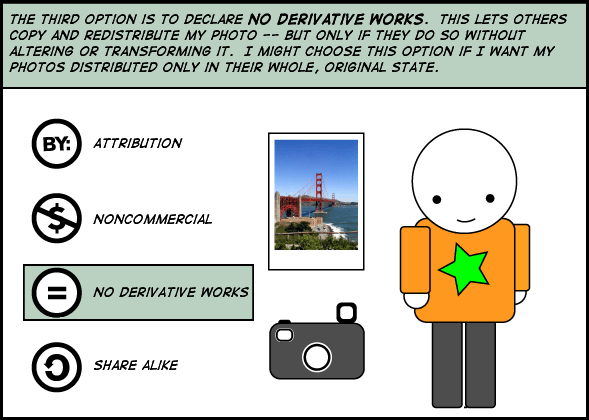
Among the rights an artist may choose to reserve when configuring their Creative Commons license is "No Derivative Works," explained in cartoon here.
Indeed, the Creative Commons' leading example musician is Roger McGuinn who: "chose the Creative Commons license that maximizes a combination of free distribution with artistic control and integrity." -- note that Roger McGuinn chose "No Derivative Works."
However, Larry Lessig would take that right away, from a post to his blog:
"Should the law give DJ Danger Mouse the right to remix without permission? I think so, though I understand how others find the matter a bit more grey."
"Should the law give DJ Danger Mouse a compulsory right to remix? That is, the right, conditioned upon his paying a small fee per sale? Again, I think so, and again, you might find this a bit less grey."
So, what exactly does Creative Commons mean by "some rights reserved" -- would it perhaps be more accurate if they said: "some rights reserved until we can change the laws to take those rights away"?
-
Re:Why it won't happen
I hope you're trollin.
That said, between preexisting public domain (myths, legends, Grimm, Aesop, Arthur) and reformulating known PD stories, it's doable.
Heck, there actually *are* cheap animated knockoffs of the same stories redone by Disney. And, like pixar, we can start short and CC (I suggest attributable S&SA) them to let others build on our work.
That actually sounds like fun... -
Re:Difficult
I agree, all licenses sound like some lawyer crap. But they must sound like that, otherwise some smartass could figure a way around them.
I have no problem with EULAs sounding like crap, but they at least could provide us, mortals, with some text we actually understand. I love the way Creative Commons license does this. Check out their site -> http://creativecommons.org/licenses/by-nc-sa/1.0/.
If you just want to install it and orget about it you only need to read the "You are free to" and "Under the following conditions" statements. Of course if you plan to mess with the code or use it to it's max, you might want to read the whole text.
And btw, to answer your question - yes, I've read the GPL several times now and still don't get it completely. Whenever I notice a license like that (that I don't know fully) I try to search if anyone has written a short "what you can", "what you can't" article. Thats easy with the BSD license, because it only says "do what you want, we don't give a shit" -
Re:Creative Commons a great start...
Why not follow a geekcode system. You can still have your yes/no/dont_care options, but at the end, you get a customised license.
As with http://creativecommons.org/, you get 2 licenses. One in plain English (you can use this commercially, you must supply changes as patches, etc) and one in legal jargon. Then, your text only LICENSE file contains both. You could even reduce the license to a license code that can be pasted back into an osicode decoder. -
Not a simple task - 1 license, many OPTIONS
This won't be easy - tearing people away from their, "but I need this clause" licenses.....
How about taking the 3 or so licenses as mentioned, but allowing each (or some) to have a number of options that could be opted for on a case by case basis? Rather than a one-size-fits-all, perhaps an aproach like the various Creative Commons licenses would be better for the entire community?
Find some common elements from a large number licenses from the "Approved" Open Source License Collection and make some of the most common language available as "plug-ins" to some sort of meta-license that encompasses a large cross-section of what's currently being used.
Rather than chooing a particular license just because it has some sort of attribution or distribution clause the author is interested in, bring consistency to the community but still allow individuals to apply special clauses to the documents that protect (or ensure the freedom of) their work.
Just an idea... -
This is a vital issue for open sourceIt's a vital open source/ free culture copyright issue as well. Consider the Wikipedia encyclopedia. It's largely under the GFDL. Anyone can redistribute it. Anyone should also presumably be able to say that it is what they are distributing, since redistribution is a fundamental purpose of the GFDL.
Yet there's also an interest in people not being able to claim that they are wikipedia.org, the site where the work is being built.
A trademark on "wikipedia" might seem like one way to proceed, in part because that covers all of the other domains in various countries, until you notice that trademark law may then restrict of others from distributing the title page part of the work, "Wikipedia, the free encyclopedia".
Now, it seems fairly clear that the Wikimedia Foundation would inevitably have to be granting a license to use the trademark name because that's required for others to distribute the work, something the Foundation is required to do by the GFDL license the Foundation is granted by the authors of the encyclopedia.
The United States Supreme Court has touched this general area of the interaction between copyright and trademark law in its Dastar v. Twentieth Century Fox Film Corp decision. That held that a trademark couldn't be used to prevent the publc domain right to use a work. That's correctly taken as a major victory for the public domain but very similar logic also seems to apply when it comes to trademarks for open source works, particularly when, as in the Wikipedia case, the prospective trademark owner isn't the author of the work but simply a (albeit very important!) licensee.
Still, it's uncomfortably messy and it would be nice if a future GFDL version clarified that trademark law may not be used to prohibit distribution of the correctly named work either, as it does now for technnical means.
This is an area which the Creative Commons ShareAlike License seems to better resolve in the wording of its license grant, though it's still not as explicit as it might usefully be.
The views in this post are mine alone. No part of this post should be taken as reflecting the views of the Wikimedia Foundation or its Board - indeed, it's possible that the Foundation or one or more of its Board members might disagree, since it's not something I've discussed with the whole board.
-
Creative Commons
By shutting down BitTorrents, MPAA and media moguls are just ushering in a new era of digital copyright... or should I say, copyLeft. Creative Commons licenses are spreading faster than you can say.... See: http://creativecommons.org/audio/ Lessig's project has appeared on slashdot before.
Sure, you may not be able to download that favorite Zepplin tune anytime soon. But the future has to start somewhere; Creative Commons is the best alternative for consumers and producers alike. See their economic and legal models. -
Re:If you are a billionaire, you own it! ;-)I am reading that post as well. He's got some trouble typing with some DOuble CAps and forgetting to end sentences with periods
but he has some interesting things to say.
Things started to get a little shakey back in 1998.
In October of 1998 the Digital Millenium Copyright Act was passed. The DMCA was basically a law that set a very un-nerving precedent. That the government would do what it could to protect the interests of content owners at the expense of technological development.
To stay on topic:
All contents copyright © 2005, Mark Cuban. All rights reserved.
Blog Maverick is a member of the Weblogs, Inc. Network. Privacy Policy
He's not a very stereotypical blogger, imperfect typing (lj and blogger kiddies don't count as they're takin a free ride) and no Creative Commons. Oh well. -
Interesting
If "trivial borrowing from sound recordings isn't supported by copyright law" then we can start copying pop music like there was no tommorow. Gentlemen, start your Pirate2Pirate applications! But seriously, wouldn't it render the new Creative Commons Sampling Plus License irrelevant? Any lawyers here?
-
Jim's Big Ego in Boston did this...
Boston's fun, funny, hip, and technologically-aware Jim's Big Ego did this in May 2004. Their song, "Mix Tape," makes some good statements about the RIAA. Several contest entries and the original song and component tracks are available for download.
http://www.bigego.com/egog/article.php?story=20040 504090919481
http://creativecommons.org/weblog/entry/4162 -
Why not get visual
This guy obviously has some brains. Read just part of that, and you realize that.
IMHO here's what he should be researching and perfecting:
Visual EULA's
Just like creative commons has iconic easy to read licenses (link goes to LGPL sample).
Why? Because they are easy to read, use, analyze.
The US would benefit so much if we required electronic licenses to follow such a format. EULA's, TOS, AUP's, SA's, etc.
A standard of icons, and formatting.
So anyone, can have the option of viewing in that format, or the legal jargon.
Some more useful additions to the Creative Commons icons:
- Monitors Traffic or Usage
- Commercial Mailing
- Advertising Included
You get the idea.
Every program, with the option to view the license in an easy to read visual format.
Then everyone knew what they were installing or signing up for.
Would be much better than the "canned spam act", or "anti-spyware" bills in progress. -
Re:Wanting to get paid for work you did
That was the intention behind the original copyright laws: death of copyright-holder + 20 years.
Try again. The original copyright terms in the United States were fourteen years, renewable once for an additional fourteen (but they had to be actively renewed).
They were not "death + x years".
See Creative Commons . -
Free Culture Good, Piracy Bad
There is a ton of good legal content that will be created once the bandwidth issue is solved. It's sad that the default comment is "well this sucks because the **AA will still be able to track me down when I use it to break the law." Most of use see the cultural usefullness of these things but the handfull of anarchists among us are hurting the movement.
The fact that this can get through firewalls and that it won't fail under heavy load (as happens with bittorrent trackers) are the important things. -
Re:Curious tone
I don't believe that P2P and fair use are compatible concepts, I've seen nothing that suggests that giving copies to other people is legal fair use.
I suspect you mean that you consider P2P and "fair use" incompatible in the context of the article, which might make some sense.
But if you are making a more general statement, I'd recommend familiarizing yourself with the ongoing discourse about copyright. Good starting places might be Creative Commons or the writings of Lawrence Lessig.
P2P is only a distribution technology. Fair use, copyright, licensing, etc. are legal concepts, and other issues entirely. They can be as compatible or incompatible as we (society) want them to be. -
Well, if you like flowers...
...try some random shots from my collection. There's a few sunsets and stuff in there too. Uses a Creative Commons Sharealike 2.0 licence.
-
Re:what was that thing....
Creative Commons licensing and public domain are two completely different things. They're mutually exclusive.
Creative Commons doesn't seem to think so.
http://creativecommons.org/licenses/publicdomain/ -
Re:We need more artists on board
create a site where you can license your photos via a creative commons license.
one of those licenses probably has all the rights & restrictions you desire. -
what was that thing....
There was something I remember Lawrence Lessig talking about... hrm, now what was it... oh! I remember! It was a repository for public domain images called the Creative Commons. What was this article about again?
-
Copyright?
Information that is deemed for the public good should not have restrictive copyrights in place. You should consider switching to a Creative Commons license that allows for others to cite, copy, and otherwise distribute the useful information you've collected. Doing otherwise would be counterproductive.
-
Re:Proof that a group
I really don't understand what's up with you artsy types. Coders spend a zillion hours of their free time to make a free open source game just so others can enjoy it but you can't do the same for a bunch of notes? Sure, dream on that one day you'll be famous and you can sell the rights for some disgustingly large sum of money.
You missed the parent's point completely.
Coders give PlaneShift their work under the GPL. "Artsy types" give their work under PSL (the PlaneShift Lisence). From that link:
You may not copy, modify, publish, transmit, sell, participate in the transfer or sale or reproduce, create Derivative Works from, distribute, perform, display or in any way exploit any of the Material released under this License unless expressly permitted by the PlaneShift Team.
This is what the parent referred to as "relicensing". Also, since they are donating their work (as in not being paid for it), AFAIK, it's actually impossible for them to give up copyright under US Law... In other words, the PSL would never stand up in court, so stop pretending to be lawyers (people go to school for a long time for that), shove your PSL up your ass, and publish the stuff under some sort of CCL. -
Re:Filesharing to Fair Use?
Fair use movement? Like this?
-
SuprNova helped distribute my self made TV Show
I personally *will* mourn the loss of SuprNova but not for the reason you think.
A large number of downloads of my own self-produced TV Show and band originated from SuprNova and helped provide an easily accessable portal for distribution. My works are free to copy and distribute and in no way were infringed upon by being listed on the SuprNova site. I also remember seeing many many other Internet distributed TV shows and movies. If they are looking for an example for legitimate uses for their service, please come see me. -
Re:On a related note...
I'm busted! I don't know anythign about EU law at all. In the US there's a thing called de minimus for derivative works. You can read about how it applies to collage work. It's a really vague concept that might cause trouble. At least in the US, the only way to be sure that it's ok to cut up the picture and make your own art is for the copyright owner to grant you that right explicitly in a license. Otherwise, you have to wonder if your work will be different enough to be considered a new work. What would be great is if you found a picture under a Creative Commons license.
-
I think your wrong..I see where your coming from, but this isn't an OSS project. The complaints about selection are valid to a degree, after all as a Linux user I already do have some good DRM-free alternatives available to me:
AllofMP3
So I think its safe to say that Linux users have quite a few choices available to them, some of which seem to have both good prices *and* a good selection. Personally, I'm not complaining about the selection at Medion, but all this noise about being the only Linux friendly, DRM-free store seems a little disingenuous (but hey, its the holiday, so its probably good marketing!).
eMusic
Magnatune
Warp Records Bleep Store
Audio Lunchbox
I don't speak German so I don't know about this one
Creative Commons has plenty about DRM-free open music sources
Since I buy ZERO music containing DRM limitations I hope they do suceed in ramping up their selection while continuing to support the Linux platform (emusic used to even have a working Linux download manager...but last time I checked it was too out of date to run on modern systems so it right-click/save-as). -
Re:The Good and the Bad.
I would like to think as you do that bands will skip the middleman and go right to publishing their music online, but that wouldn't just be a radical shift for the music industry...it'd basically be blowing it up and starting it all over again. The promotion machine that is the music industry is what bands need to try to make money, not the selling outlet.
the industry is the promotion machine that is needed to squeeze most artists out of the picture almost entirely, while making outrageous amounts of money on a few.
one
two
three -
Re:Yes and no.
I just wish that more artists would realize the benefits of allowing the free distribution of their music.
Here, here. As a muscian I fully agree and have been directing every other musician I know to creativecommons.org.
If more people hear your music more people will buy your music, but that isn't understood by most musicians. The percentage of people that buy your music may be smaller, but that doesn't matter if you maximize the amount of people that hear your music your net will be larger.
If you are only getting radioplay locally and say 100,000 people hear your stuff and 2% buy it, you've sold to 2000 people. But lets say you reach 1 million people online through them downloading your music, to make the same sales only 0.2% that download need to buy.
I'm not sure what the numbers are (or if anyone knows for sure) how many people that download music actually buy it, but the numbers don't have to be big. Plus the exposure to further regions mean more oportunities to travel. Maybe your band is only slightly popular here, well it could be huge in japan or germany.. but if your music never gets there how will you know?
There are groups i would have never heard of if friends didn't send me mp3's (ie tarkan which a turkish friend sent to me). If I like it I pass it on to other friends etc. That way a band gets exponetially more listeners than local radio/video play. Alas some bands are dumb and do not understand this or think they are so huge and world renound they don't need such a distribution method (metalica). -
Re:Oher areas
Well, it already has, to a small degree.
In music, there is the Creative Commons.
And, in books, there is WikiBooks.
So, yes, it does seem to want to expand to other things. -
Flickr is Geek-Friendly, Amateur-FriendlyI like: no storage limits and effective use of "tag" keywords to mark photos, as well as the general usage of the site (photostreams, comments, and so on.)
The comments are encouraging for an amateur photographer like me who wants to take good pictures for people to enjoy, and not be eviscerated by a professional critic.
Definitely room for improvement (sets of sets, printing integration), but they seem to be hard at work making this happen. And it looks like they're going to charge $60/year, which seems kind of pricey compared to the competition.
What finally (after a couple days) pushed me over the edge to pay them and subscribe were the fact that they have seamless integration with Creative Commons licenses for your photos (cool-factor points), and an open open API for managing your photos through 3rd-party scripts. With it, I've written a python script that I use to batch-upload and annotate photos. I haven't tried their client with Wine, so I don't know if that option exists for Linux-only users.
-
Creative Commons
Has any big company ever used a Creative Commons license? Or even a non-"all rights reserved" copyright?
-
Does he need it ?With all the talk of DRM
This work is licensed under a Creative Commons License
That license is indeed liberal
-
Creative Commons would probably more appropriate
A Creative Commons license would probably be more appropriate for a T.V. show, even if the show is mostly about GPL.
Don't forget to install your mozcc extension in your Mozilla based browser so you can determine the creative commons license status of the web page that the T.V. show is on -
Science Commons
There's also a branch of creative commons formed to work on this.
Science Commons
They're more focused on 1. supporting open access to scientific literature, especially taxpayer-funded literature and 2. building licenses and modular contracts that allow companies and universities to waive some IP rights when it makes sense (such as, if we know we aren't going to make money on a gene patent and you could use it to cure tuberculosis, good on ya, but if you want to use it to make a viagra competitor, we get a piece...so to speak). -
Creative Commons Anonymous AttributionInteresting that this is distributed under the Creative Commons license. The license type used is as follows:
By Attribution, Non-Commercial, Share Alike
The author obviously wants anonymity, so why the attribution requirement? Just seems strange...
-
Bandwidth / storage solvedBesides the fact that the Internet Archive has promised unlimited bandwidth and storage for life for any Creative Commons licensed material, it should be noted that BitTorrent is also playing a role in this.
By syndicating
This is big, and it is hot. It's not *entirely* the downfall of big media, but it is in fact the eventuality of big media as our channel list grows, and our options for consumption and means of consuming this media grow.
Some claim that this means TV and Film will die, or that all this material will end up looking like the lamest of public-access tv....
Well, public access TV looks almost exactly in production, quality, and distribution as mid-80's regionally-produced TV shows (like Romper Room, or Cleveland's SUPERHOST!)
Also, your kids are going to school and learning video production... on DV equipment in some cases.
So, it's not the end of big media... it's the start of a new decentralized wonder. It'll probably both be worse than today (ads that make Futurama's attempts at advertising parody not funny anymore), and much purer (how about a family, community, slashdot, or special interest group TV show? Commercial free?)
As a side note, some of these patterns will most likely be evident in tonight's Frontline on PBS about the "persuasion industry"
Anyway, start looking into this stuff, because it is what you make it. If you want to bitch about it, well, start your own damn TV show.
-
Re:No real comparison done here...
Sure. Go nuts with it. I'd put it on cafepress.com, but nobody's ever bought the shirt I have there to begin with...
In fact: I hereby license the phrase "Live Free or Diebold" to anyone who wants to use it under the Creative Commons license, thus:
This work is licensed under a Creative Commons License.
I don't know if you can get any Slashdottier than that.
-
Re:No real comparison done here...
Sure. Go nuts with it. I'd put it on cafepress.com, but nobody's ever bought the shirt I have there to begin with...
In fact: I hereby license the phrase "Live Free or Diebold" to anyone who wants to use it under the Creative Commons license, thus:
This work is licensed under a Creative Commons License.
I don't know if you can get any Slashdottier than that.
-
Simple answer
Why isn't protection for open source software and limitation of intelectual property law a political issue?
It's too bloody confusing. Half of Slashdot seemingly doesn't understand the difference between copyright and patents. The vast majority of the general public wouldn't relate to it at all. (Though this is one area where projects such as Creative Commons may help in the long term.)What can we do to force politicians to bring these issues to the forefront?
Your best bet would be to find a section of the bible pointing out that software patents are bad. -
Re:It's Just
Actually, music under a creative commons license ( http://www.creativecommons.org/ ) is perfectly legal to share.
-
You mean...
...Creative Commons?
(unfortunatly, CC's website is down -
Here's correct link to Comics of Creative Commons
The link in the parent didn't work. I found the correct link at http://creativecommons.org/learn/licenses/how1.
-
Re:If it's legal to share...
All the tracks will be available for download after November 9 at http://creativecommons.org/wired
-
Rubbish
It's a simple acknowledgement that one size does not fit all.
In fact, by assembling a variety of licence options under one roof and explaining the options in a consistant and coherant way (and with comics), they go a long way to helping people really understand the issues. -
Re:Sharing is only the half of itAs a point of clarification, there are several varieties of CC licenses (one of the great things about CC), some of which specifically allow derivative works and some of which do not.
-
Re:LicenseThe Attribution-ShareAlike license is the closest in spirit to the GPL. The Attribution license is the closest to BSD.
There are two big problems with the GFDL, which caused me to change the licensing on my own books to CC by-sa:
- The GFDL requires the work to be distributed in a form that's editable with free software. That's very hard to define. For instance, my books have illustrations in Adobe Illustrator/EPS format. This format is theoretically editable with free software, but in reality it's going to be a long, hard road for me to convert them to Inkscape/SVG and fix all the stuff that gets lost in translation.
- The GFDL's own bearded-hacker community seems to have ambivalent feelings about it, as shown by Debian's decision to reject it as unfree.
Someone actually approached me about using some of my materials in their own book, which is GFDL-licensed. It turned out that the licenses were not really compatible, so I had to offer it to them under GFDL (which I did).
-
Re:LicenseThe Attribution-ShareAlike license is the closest in spirit to the GPL. The Attribution license is the closest to BSD.
There are two big problems with the GFDL, which caused me to change the licensing on my own books to CC by-sa:
- The GFDL requires the work to be distributed in a form that's editable with free software. That's very hard to define. For instance, my books have illustrations in Adobe Illustrator/EPS format. This format is theoretically editable with free software, but in reality it's going to be a long, hard road for me to convert them to Inkscape/SVG and fix all the stuff that gets lost in translation.
- The GFDL's own bearded-hacker community seems to have ambivalent feelings about it, as shown by Debian's decision to reject it as unfree.
Someone actually approached me about using some of my materials in their own book, which is GFDL-licensed. It turned out that the licenses were not really compatible, so I had to offer it to them under GFDL (which I did).
-
Right Tool for the Right Job(TM)
At the risk of being modded down into oblivion I will say that your question touches on one of the very reasons that the now almost defunct jabberdoc.org saw such great demise. Despite pleas from the Jabber community to release JabberDoc under the Creative Commons, the JabberDoc team decided to go with the GNU Free Documentation License instead. This led to many restrictive policies as well as bureaucratic confusion. You can read more about it on old Jabber mailing lists.
Obviously, there was a lot to be learned here, but it is really just a matter of using the right tool for the right job, and in many cases the GNU Free Documentation License is not the right tool for certain jobs. Even RMS himself stated this when first interviewed on the scope of the license. -
Re:License
Possibly because the ShareAlike licence is more "Free" and in the spirit of the GPL than the FDL is?