Slashdot Mirror
Domain: daringfireball.net
Stories and comments across the archive that link to daringfireball.net.
Comments · 613
-
How to market ad space?
there's nothing to say that websites can't sell ads to legitimate advertisers and put up advertisements.
This works for Daring Fireball and Read the Docs. But before you recommend requiring the ad-supported web at large to adopt their business model, please consider the following nothings:
1. A publisher selling ads on its own website has to somehow convince advertisers that the publisher exists in the first place, is worth the advertisers' time, and can detect and not charge for fraudulent page views or clicks. If a web publisher hired you to market the publisher's ad space to advertisers, what steps would you recommend taking to do so?
2. Interest-based advertising pays three times the CPM compared to context-based advertising according to a study by Beales and Eisenach. -
Surveillance by proprietary software
Your content isn't worth the trouble. Toss me an add and let me see the content.
Some sites don't even toss me an ad. They toss me the URL of a third-party proprietary computer program written in JavaScript that surveils my browsing history across multiple websites and uses the battery life and Internet bandwidth that I pay for to choose an ad from one of a dozen or more ad networks. And if I say no to proprietary software or no to surveillance, these sites are incapable of falling back to a publisher-hosted ad like those seen on Daring Fireball and Read the Docs because interest-based ads pay three times the CPM.
-
Much lower CPM for non-interest-based ads
Such old-fashioned ads can be seen on Daring Fireball and Read the Docs. But their cost per thousand impressions (CPM) is one-third of what interest-based advertising can produce according to a 2014 study by Beales and Eisenach.
-
Re:I have to think this will be restored sometime.
Apple apparently confirmed at least some of your thoughts in a comment given to BuzzFeed:
We are working together with Google to help them reinstate their enterprise certificates very quickly
As Daring Fireball points out, however, they've said nothing of the sort with regards to Facebook.
-
A slim minority of ads aren't hostile
Unlike your naive world of 2007, here in the future all ads are in fact user hostile
I agree with you that the vast majority of web ads are user-hostile. This includes any ad hosted by a third-party ad network or ad exchange, as those have a habit of stalking users across multiple websites to infer their interests in order to give advertisers the feeling of more control over what viewers see their ads. Ad networks and ad exchanges do this because interest-based advertising reportedly pays out three times as much per view as context-based advertising.
But "all" is stretching it. I don't see how ads that are hosted by a website's publisher, such as the display ads on Daring Fireball and Read the Docs, are user-hostile. Newspapers and magazines got along fine with this model for decades, despite web publishers complaining that they could never make money that way.
-
Re:Anti-Trust violation?
These two are ad characteristics that cannot be directly controlled by the publisher via the placement of code:
- autoplaying audio (other than preroll before relevant video)
<video autoplay muted>
- animated ads that include flashing elements
If the publisher can approve or veto creative before it appears on the site, the publisher can veto creative incorporating flashing. If the publisher cannot approve or veto creative before it appears on the site, the publisher can switch to a different ad network or exchange, switch to publisher-hosted ad delivery without any network or exchange, or not use video as a format.
As a publisher myself, I don't want to show such ads, but first, there is no option in a network that says "don't show animated ads with flashing elements"
You could drop animated ads altogether. If your network doesn't allow that, you could drop your network and sell your ad space through a form on your site. A sponsor interested in your site could upload creative for approval and purchase page views. Then you could approve or reject the creative. See for example how ads work on Daring Fireball.
Plus "Main content portion" is subjective, and some algorithm could whack you on that.
Acceptable Ads criteria define "primary content" in terms of how HTML5 expects the <main> element to be used. In this respect, Better Ads Standards are more lenient than Acceptable Ads criteria, which require inline ads to take up zero percent of primary content.
it seems easy to break that rule inadvertently, for example, with a page that has less content than normal.
Then the ad serving script needs to measure the body of each article before ads are inserted into that article.
What is scary here is that there is no appeal process
Any webmaster who successfully claims control of a site in Google Search Console can clean up ads on that site and submit a request to have that site reevaluated.
-
Tracking protection installed by default in Fx
Whatever Ad-Blocker is installed by default will be the ad-blocker that all the websites that want to show Ads spend their efforts detecting and making workarounds for
The Mozilla Firefox web browser is installed by default on most GNU/Linux distributions and available for Windows, macOS, and Android. Private Browsing is installed by default (but not enabled by default) in Firefox. Private Browsing includes a "tracking protection" feature that causes Firefox not to connect to servers involved in large-scale surveillance of viewers' browsing habits across multiple websites to gather interest data and "retarget" viewers.
Sites could work around tracking protection by falling back to different ads that do not stalk the user, particularly ads hosted by the website operator such as those seen on Daring Fireball and Read the Docs. But they don't. Instead, sites using Google's Funding Choices, Admiral's Engage, and the like require users of Private Browsing to click "Disable protection for this site". They do this because the cost per thousand impressions (CPM) of interest-based advertising is three times the CPM from contextual advertising alone.
-
Re:ZenPad 3S 10
I found the article you (very likely) referred to:
https://daringfireball.net/lin...This is an interesting theory/rumor. There's no way to verify this without someone in Apple speaking out, and that's not likely to happen until USB-C is well adopted. As well adopted it is on cell phones that doesn't mean it can't be abandoned on a whim, it's still fighting for space on desktop computers and even on laptops where adoption is gaining some traction.
I like USB-C very much, it's a large improvement over other ports in this space. One thing that bothers me, and this it mostly an implementation issue than anything, is that I can't just connect two computers by USB-C and expect them to talk to each other. I could do this with Thunderbolt and FireWire. Doing this with Ethernet and serial needed only a crossover cable, at least in early implementations, later Ethernet and serial didn't require even that. Apple supported this kind of networking or master/slave system (depending on the setup or other specifics) going way back, going back to LocalTalk or even earlier. Windows even supported networking on FireWire and other cables. This is not supported on the non-Thunderbolt USB-C computers, and no Windows computer I have seen support such a connection. This is a very non-Apple non-feature. I would like to see this fixed in the future, but again it's largely an implementation issue than a problem with the spec itself as demonstrated by Apple allowing such with their USB-C ThunderBolt systems.
-
Actually
No better than the hundreds of chat apps that came before
Actually, it's worse. Slack uses markdown, which is crippled right out the door as far as text formatting goes, missing many basic formatting capabilities; but they didn't stop there. They broke markdown's ability to embed inline images (and replaced it with a non-markdown mechanism), disallow both CSS and even basic HTML, and don't provide any means to replace the basics they left unavailable, never mind extend them. Need to actually inline an image with your text? Too bad. Need colored messages? Too bad. It's like being back in 1990 again. Except, you know, HTML could actually do those things then. As now.
Any company or server-savvy-person-having group is far better off using Rocket Chat for even better capabilities, without being permanently subject to the limits imposed by the Slack team. Plus, you have the source code, and you can contribute formatting upgrades to the project, so your tech people can both add the formatting capabilities you need and if you like, help everyone else out at the same time, instead of being stuck with an absolute minimalist communications format.
Ryver is the same way; too basic to bother with, broken, unfixable, unfixed.
It was a great day here when we discovered Rocket Chat. All the doors that had been closed at Slack and Ryver opened for us, and at the same time, the fees went away. There's no good reason for any tech savvy company to use these services today, unless they're just looking to burn funds while suffering with an inferior system.
-
The Atlantic and "ad or tracking blockers"
The Atlantic's troubleshooting guide deliberately treats users of tracking blockers the same as users of ad blockers, insistently referring to "ad or tracking blockers" in the same breath each time. The wording appears intentionally constructed to dodge "I want the ads, just not the tracking." My first guess is that ads that are not based on tracking users, such as those seen on Daring Fireball and Read the Docs, have a CPM much lower than ads that are based on tracking users, and this lower CPM is lower than the lowest CPM that will fully fund both the writing and the hosting of The Atlantic.
-
Re:Ads, paywalls, or what else?
The real version of AdBlock Plus has been malware since they started deciding some ads were acceptable for the end user.
If you oppose all web advertisements, would you prefer having to pay $5 for each distinct domain that you visit in a month?
How about we gets less intrusive and trespassing ads?
Personally, I agree. And I admire Daring Fireball's print-like model, also seen on Read the Docs, where the advertiser sends the ad image to the publisher and the publisher hosts it. Firefox Tracking Protection blocks ads that track me but allows publisher-hosted ads, such as those on Daring Fireball and Read the Docs. But I imagine that fibonacci8 would disagree because "deciding some ads were acceptable for the end user" would amount to "malware".
-
Having to hire an ad sales team
They shouldn't auto-play if they're video based.
Exactly. Such an ad will pause on the first frame and cover up the page until the user clicks to start the ad playing and waits for the ad to finish playing. This is a prestitial, and Chrome would likely automatically block it because countdown prestitials before a non-video payload violate the Better Ads Standards, but a publisher* can deploy anti-adblock to send more people to the back button.
And, last but not least, they shouldn't track you.
In order for an ad not to track the viewer across websites, it would have to be hosted by the publisher, as opposed to going through an ad network or ad exchange. Sites that have adopted this more print-like model include Daring Fireball and Read the Docs. But for sites with less reach or less homogeneous readership than those two, how is a publisher supposed to find willing advertisers without having to hire an in-house ad sales team?
* In adtech jargon, a "publisher" is the operator of a website that carries advertisements.
-
Tracking blocking
Sometimes I submit a support request that a website mistakenly detected the tracking protection built into Firefox as an ad blocker. I tell them that I see ads hosted by the publisher,* such as those on Daring Fireball and those on Read the Docs, and sometimes I click ads hosted by the publisher. But I don't blindly accept scripts that allow third parties to insert arbitrary proprietary scripts that track my "click-stream" from one website to another in order to build an interest profile and try to sell me things I just bought. If a site's ad script requires such tracking in order to run, the site needs to fall back to publisher-hosted ads. Even if publisher-hosted ads have a lower CPM than interest-based ads based on tracking, it's still more than the zero that a site gets if I leave after hitting its adblock wall.
* In the web advertising market, a "publisher" is the operator of a website on which advertisements appear.
-
Switching from abusive ads to static images
Nor is my comment history the topic. So ad hominems aside:
Your comment appears to promote "regular ads that consist of text or an image" as an alternative to the script-driven ads responsible for the abuses that Google Chrome will block. For example, Daring Fireball runs "regular ads that consist of text or an image" and are hosted on Daring Fireball's server (source). But that model requires each publisher to staff an ad sales department in order to advertise the site's ad space to advertisers, and advertisers are likely to pay far less if they can verify only clicks, not views.
So let's say a publisher that doesn't get quite as many views as the Markdown documentation on Daring Fireball wants to switch from abusive ads to "regular ads that consist of text or an image." How would such a publisher go about marketing its ad space to advertisers in a cost-effective manner?
-
I hate cross-site tracking
Those who hate cross-site tracking can answer a mix of 1 and 2 in a constent manner.
1. I hate ads. I'd rather pay for my content directly.
I'd rather pay for my content directly, but I'm not buying a month's subscription to ten different sites just to read one article on each of those sites. So how do I spend 1-5 cents on a single article or pay $10 per month for a bundle of sites? Adult Check would have been great for this, but the publisher of Perfect 10 magazine sued it out of business when too many publishers on Adult Check's network displayed infringing photos from the magazine. Google Contributor appears to be ideal except for two things:
1. The same company also operates DoubleClick and AdSense. This makes it more likely that Google will share my article purchase history with its advertising division to trigger "interest-based ads" on third-party sites.
2. Reloading the same article counts as an additional purchase at full price. This disincentivizes publishers from increasing server reliability, as each reload means more revenue.2. I don't mind ads.
I don't mind ads hosted on the publisher's server because they have no third-party ad network or ad exchange to track "click-stream" (viewing history) across multiple sites. Daring Fireball does it right, selling display ad space directly to advertisers. So does Read the Docs. But I don't see how a smaller publisher can reach advertisers in order to do this.
-
How to find advertisers that allow self-hosting?
I'm interested in switching my blog to hosting its own ads. How would I go about finding sponsors? Last I checked, well-known advertisers preferred to buy inventory from ad networks and ad exchanges so that they could reach multiple publishers' sites with one buy, target very specific inferred demographics regardless of correlation with a particular site's subject matter, and benefit from economies of scale in click fraud detection. If you have operated a site that hosts its own ads, how did you overcome these obstacles? I know Daring Fireball does, but I don't have quite his scale yet.
-
Ads without tracking
So what's the difference between an advertising site and a tracking site?
A publisher* that doesn't track your browsing across multiple websites will sell its ad space directly to advertisers and host its own ads rather than handing the ad space off to a third party ad network or ad exchange. Daring Fireball and Read the Docs are examples.
* A "publisher" is a site that shows ads, and an "advertiser" is a company that pays a publisher for ad space.
-
Re:Pease take some more "features" out
when they stop websites from opening a huge opaque overlay over something I just started to read.
I have this in my bookmarks bar. One click and those overlays vanish from the page. (I didn't write it, I think I found it here)
javascript:(function()%7B(function%20()%20%7Bvar%20i%2C%20elements%20%3D%20document.querySelectorAll('body%20*')%3Bfor%20(i%20%3D%200%3B%20i%20%3C%20elements.length%3B%20i%2B%2B)%20%7Bif%20(getComputedStyle(elements%5Bi%5D).position%20%3D%3D%3D%20'fixed')%20%7Belements%5Bi%5D.parentNode.removeChild(elements%5Bi%5D)%3B%7D%7D%7D)()%7D)() -
Re:Wait, what?
Is the summary correct...???
No, it's not.
Gruber is suggesting a Pro version might be able to help Apple spread its operations and logistics issues when it comes to sourcing components for the latest iPhone.
Apple's problem is not as simple as putting better stuff into the hardware. It's doing that 1 million times a day, every day, for every new version of iPhone that hits the shelves. He suggests a Pro version of the device at a high price-point would give them some breathing space when doing that.
Just imagine the logistics of just boxing and shipping 1 million of *anything* every day, let alone sourcing, assembling and testing something as complex and impressively well built (for this scale of engineering) as an iPhone.
-
Re:In my case I can confirm
I'm waiting for the headline, "Is Betteridge's Law True?"
You'll wait as long as it takes to get an accurate, researched summary from Slashdot.
Gruber did not "claim the iPhone 8 will start at $1,200".
-
If you feel like linking to DF...
... Gruber has written specifically about AMP. https://daringfireball.net/lin...
If you are a publisher and your web pages don't load fast, the sane solution is to fix your fucking website so that pages load fast, not to throw your hands up in the air and implement AMP.
He has written more about it in the past -- links are in that piece.
-
Re:In other news
Sorry to reply to my own post; but here is a citation for Safari beats Chrome, which is just as relevant as Chrome beats Edge; since both Safari and Edge are single-platform browsers:
See, esp. Footnote 2.
-
Re:They should get into eco-firendly raw materials
They're trying to do that. Lisa Jackson was reviewed on Daring Fireball and they really are trying to get out of a lot of those things that are super harmful.
http://daringfireball.net/link...
You can read the transcript or listen to the podcast. Either way, she was great.
-
Re:Software lock-in
I've got good news for you
Evidently, Apple has realized they made a pretty big mistake with the trashcan Mac Pro design and they're going back to a modular, upgradable form factor. -
Re:Quick: Contact CEO. Tell him Apple is computer
For some well-crafted definition of "neglect" that may be true, but for any reasonable definition they certainly are. The product line has had gaping holes for a decade, products are cancelled and not replaced, products go many years without update, software gets buggier and buggier. It's not different than Microsoft neglecting their Win95/98 codebase with Millennium and likely equally by design. The Mac Pro is neglect at its finest.
Actually, Apple realized that, and in a really uncharacteristic move, not only admitted they had "painted themselves into a thermal-corner" with the Mac Pro, but also revealed that they are hard at work on a totally revamped line of Desktop Macs, including a new "modular" Mac Pro, "Pro"-oriented iMacs (perhaps even ones with Xeons), and a "not-so-mini" Mac mini. (Wonder what that means!) I personally think they are shooting for a home-server with the new mini, with an integrated AppleTV, and possibly more. Time will tell... It would only cost THEM about $20 to integrate an AppleTV into a mac mini; $25 if it retains its own case that is designed to "snap on" the new mini, or operate standalone.
https://daringfireball.net/201...
Oh, and the iMac has only been a year and a half since its last update, and the MacBook Pro was only a year between the 2015 and 2016 models; so those haven't really been neglected.
But it looks like Apple is taking the online commenters to heart, and is getting off its butt with the rest of the Mac lineup.
Oh, and in the Software world, Apple just announced today Updates to Final Cut Pro X and iMovie. At least one of those Applications are "Pro"-oriented...
http://appleinsider.com/articl...
So, things are actually looking-up in the Mac-World.
-
Re:He should sell the remainder...
If he's smart, since Apple's revenues have been losing momentum. The last quarter's numbers were pretty disappointing, after adjusting for the extra week.
Compared to what exactly?
As compared to the same period in the previous year. (via)
Ahh, so not compared to the lame quarters of the competition.
-
Re:He should sell the remainder...
If he's smart, since Apple's revenues have been losing momentum. The last quarter's numbers were pretty disappointing, after adjusting for the extra week.
Compared to what exactly?
As compared to the same period in the previous year. (via)
-
Re:Will There Be More Room?
Phil Schiller said there will be space for about the same number of attendees: "I asked whether the move to San Jose changed the number of people who’d be able to attend. Schiller said it did not — attendance will be about the same." from http://daringfireball.net/2017...
-
Re:Of course
Anyone that watches Apple knows this, and it isn't that big of a deal. Next year they will be penalized by IT in the same vein.
Exactly. Next year they'll have that much further to have to go if they don't want to report a down quarter, so it's of virtually no net-benefit to them.
That said, it is of interest that the last few times they've had a 14-week quarter, they've mentioned it right at the start of their briefing in order to set expectations, whereas there was no mention of it this time. I don't think they were trying to hide anything, but I don't think they were doing the media any favors. In fact, I'd wager that they were trying to let the media jump to the obvious conclusions so that they might benefit from a short-term reversal in the narrative that's been playing out.
Of course, it's also questionable whether or not they even would have had a down quarter had it been a 13-week quarter, given the positioning of Christmas within the quarter. The summary pulled just the "had another down quarter" portion from DaringFireball's comments, but the original quote actually continued on with:
I don’t think it’s quite right to ding the quarter by a full 8 percent — the entire last week started with Christmas day — but surely some sort of correction is necessary for year-over-year comparisons.
Ideally, we'd consider the last 13 weeks of the year, eliminating the first week from their 14-week quarter. Unfortunately, Apple doesn't break the numbers down so we can do that, which means our best approximation is to knock their numbers down by 1/14th. Doing that, however, results in us giving as much weight to their first week—which was likely their weakest—as we give Christmas week, thus unfairly punishing them for having a longer quarter. Obviously, that would result in a greater downward shift than is warranted.
-
Re:Daring fireball?
He's been doing the site full-time for many years and his annual income is well into six figures. You tell me if it's still "a thing".
-
Re:Samsung is Android now?
Depends what performance. Single core, sure, but multi-core they get trounced. App performance seems to depend more on the quality of the app than anything.
Bzzt!. Not according to Daring Fireball.
Um, and also not if the Android in question runs something equal to, or less than, a Snapdragon 821, like several do, including the Pixel.
A fact confirmed by this Test, too... -
More likely a manufacturing-at-scale problem...
...according to Gruber.
-
Already not a real button
As the NYT article says, the home "button" is already not a real button but a virtual button in the iPhone 7. It doesn't move but provides taptic feedback. Making it part of the screen would be a minor change at this point, but would allow more space for the screen. Also, read here for some interesting commentary about how many people in some countries never use the home button: http://daringfireball.net/2016... (scroll down to Home Button.)
-
Re:Apple says "Fuck You"
....to those who run older versions of IOS and have bought an app. But at least it's okay because you can side load the app. Oh wait.
FUCK YOU Apple. Android sucks but not as bad as you do.
You shouldn’t expect your Android phone to ever get a major OS update. Instead, you get updates to Google Play Services. That sucks, but that’s just how it is, and almost certainly how it always will be. Yep, meanwhile that 4S still gets the latest updates which is 5+ years ago and 4 major upgrades. Man, that REALLY sucks!!!!
-
Re:"Apple commentator John Gruber"
This is an old comment but it suggests you are wrong: "a few readers have asked whether I personally own Apple stock. Good question. I do not." http://daringfireball.net/link...
-
Re:Steve Jobs book
However, just for curiosity I read "Steve Jobs" by Walter Isaacson and was blown away. I hadn't enjoyed a book that much in a long time, and I mainly read non-fiction.
So you read "Steve Jobs" by Walter Isaacson, which is quite flawed, and thus fiction. http://daringfireball.net/2012/02/walter_isaacson_steve_jobs
There is much that is wrong with Walter Isaacson’s biography of Jobs, but its treatment of software is the most profound of the book’s flaws. Isaacson doesn’t merely neglect or underemphasize Jobs’s passion for software and design, but he flat-out paints the opposite picture.
Isaacson makes it seem as though Jobs was almost solely interested in hardware, and even there, only in what the hardware looked like. Superficial aesthetics.
[How Isaacson doesn't understand what "Antennagate" was about, and gets the technical details completely wrong because of his "looks above everything else" theory]
Isaacson, it seems clear, mistrusted Jobs. That’s good. But rather than using that mistrust to push back, to ask insightful questions, he instead simply turned to others.
Again, skepticism is good. But rather than do the research to verify Jobs’s version of events, to learn the facts so as to be able to dispute Jobs himself, he simply turned to sources he did trust, like Hertzfeld and Gates. But Gates is an odd choice to trust, because he clearly has a conflict of interest. His company competed against Jobs’s, and at a personal level, he is Jobs’s only rival in terms of historical stature in the industry.
...
You could learn more about Steve Jobs’s work by reading Rob Walker’s 2003 New York Times Magazine piece than by reading Isaacson’s book, but even then we’re left wanting for the stories behind any of Apple’s products after the iPod. Isaacson’s book may well be the defining resource for Jobs’s personal life — his childhood, youth, eccentricities, cruelty, temper, and emotional outbursts. But as regards Jobs’s work, Isaacson leaves the reader profoundly and tragically misinformed.
Isaacson gives us the story of an asshole. But the world is full of assholes. What we need is the story of the one man who spearheaded so many remarkable products and who built an amazing and unique company.
-
Re:Question.
A new version of iOS can be be uploaded to a phone when it's put into DFU mode without a passcode and without wiping out the data.
-
Re:Monospace!
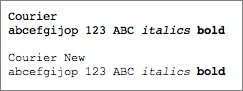
Courier is way better than Courier New
Courier New looks anaemic on paper.
(Posting in monospace just to make a point.)
-
Re: They can't lead in market numbers forever
I had a completely different experience.
No doubt, not everybody has the same size hands and same preferences. It's funny to look at the posts defending whatever screen size Apple is currently producing and even predicting that no other will ever exist. There's certainly no shortage of people out there defending the company's decisions based on their own made-up justifications - that actually turn out to be wrong.
-
Re:The Power of Control
-
Re:The Power of Control
-
Re:Clarifications:
> it was a unit Apple gave them
Apparently with strings (NDA) attached? Or are you saying the NDA from their original developer relationship prevented this? Both of these seem a bit sketchy to me.
Does THIS look "sketchy" to you, seriously?
-
Re:Development kit
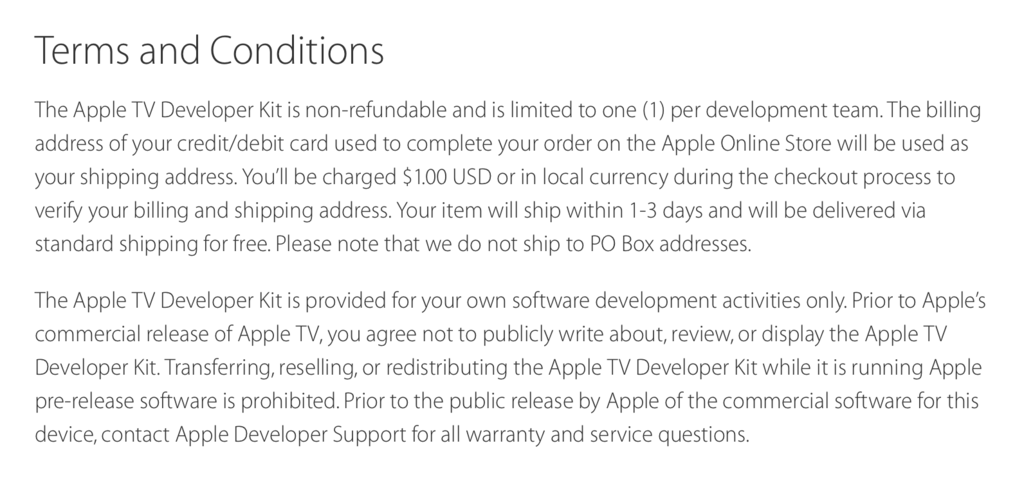
While I am all for being able to do anything to my personal devices, I believe they did a tear down on a Development kit of the Apple TV which they distributed to app creators. I'm sure there was a clause regarding tear down and app removal.
And here it is.
You tell me: Did iFixit violate the above-referenced term of the AppleTV Pre-Release Developer Kit? -
Re:Think Different
Did you RTFA to see that the AppleTV they took apart was one that Apple lent them?
You keep saying that. The article never said anything about a lent item. They do not have to give it back. They did have to pay for it. A dollar. But a sale is a sale.
And an Agreement is an Agreement.
Idiot. -
Re:Unauthorized Teardown
...again with the corporate boot licking.
Only corporations can have rights. People don't have rights. They only are allowed to do what our corporate masters tell us we can do.
You are a true retard.
People certainly have rights; but they can voluntarily abrogate those rights through an Agreement.
IFixit did exactly that when they both signed their Developer Agreement, which has a provision restricting the dissemination of Trade Secrets in relation to the receipt of Pre-Release materials. And if that wasn't enough, there is no doubt that they agreed to not post pictures, a review, etc. of their Pre-Release AppleTV in exchange for Apple selling them a Pre-Release AppleTV for $1.00.
And then they did just exactly that! -
Re:Unauthorized teardown
Um, my understanding is they were not GIVEN a unit at all, they were SOLD a unit. So how does First Sale doctrine not apply? (Note: the price is irrelevant.)
I apologize for my ASSUMPTION. They were sold (under strict conditions) for US$1.00, ostensibly so that Apple could verify Name and Address through the Credit Card payment.
However, I am not sure that the Doctrine of First Sale gives the user unfettered "rights" to the goods, if they have specifically abrogated certain of those rights by way of a legally-binding Contract (Agreement).
And, as another Slashdotter has posted (who also received a Pre-Release AppleTV Developer Kit), the relevant portion of the Agreement (Contract) that was signed by iFixit in order to receive their Pre-Release AppleTV, makes it pretty clear that they were not to post a Review, Pictures, etc. of their Pre-Release AppleTV.
And before you start baying about how "Click To Agree" Online Contracts are NOT legally binding, you might want to get in sync with the year 2000, when that was changed, at least in the United States.
Yes, Virginia, you really HAD better read that EULA more carefully next time you just want to Install something; because you, like iFixit, really ARE "signing" (and agreeing to the terms of) a legal Contract.
So, with that in mind, there is absolutely no room for a defense of iFixit's actions that any reasonable person (or jury) would believe. -
Re:Fools Tread.
The developers agreement is exactly like any other EULA.
There is no difference.
But maybe the specific AppleTV Pre-Release Agreement is not (and most likely not; see below).
Courtesy of another Slashdotter who also received the AppleTV Pre-Release kit, here is the relevant section thereof, which any reasonable person (or Jury) would conclude iFixit willfully and wantonly violated.
Not every online contract is invalid ab initio In fact, as of the year 2000, in the United States at least, Electronically "signed" Contracts are every bit as legal and binding as paper equivalents.
Typical Slashtard, can't be bothered to do 5 seconds of Googling before exposing his ignorance to the world. -
Re:Plausible speculation ... Dyslexia at work?
Those terms are not a valid contract and not legally binding on anyone.
Sez you. Prove it.
Also, keep in mind that they signed a SEPARATE, specific AppleTV Pre-Release Agreement, as per another Slashdotter who also received the AppleTV kit, the relevant portion seems pretty clear, and assuming it isn't a hoax, I would say that iFixit clearly violated same. -
Re:Unauthorized teardown
Their issue is not that they took apart the hardware. Their issue is that they took apart the hardware and then did an article about it before the ATV4 hit stores. Here's the relevant portion of the agreement.
Everyone is getting this wrong - the issue is not that they tore it apart but that they did an article on it before the NDA was up. If they did an article on the still-assembled unit they would be in violation of the NDA as well. They were not giving these things away to be reviewed, they were giving them to people to write apps for them.
Quite frankly the majority of Slashdot seems to be completely down with disregarding all of contract law, which is sort of hilarious given the fervor with which they go after GPL violators with. -
Re:Two major problem with phone benchmarks
1. Javascript benchmarks. They should be outlawed, period. They test the software (browser) more than the CPU. Also they are probably single threaded or close to be.
2. On-screen 3D game benchmarks. Because they favor phones with low-res display such as iPhones.
None of the benchmarks in TFA even consider RAM size and flash memory speed, which both have real-world benefits.
I'm sure that ALL of these benchmarks are done by Apple shills.
Right.
Oh, and whiner, I found this and this about the memory subsystem in the iPhone 6s. Glad you asked!