Slashdot Mirror
Domain: daughtersoftiresias.org
Stories and comments across the archive that link to daughtersoftiresias.org.
Comments · 147
-
Re:I couldn't find your project on kickstarter.
Sure - here you go.
-
Oblig. (and at this point, redundant) skepticism
I post this link in every SS1/SS2 thread I come across...
http://www.daughtersoftiresias.org/misc/ss1.html
Although many others previously have expressed the same opinion (the SS1/SS2 designs as is will never make it to LEO), this is some more technical background to this opinion. -
Re:Adding to the Speculation
His criticisms did get increasingly harsh as time went on, esp. about US military action overseas -- for example, The War Prayer. At one point, he suggested that this be the new American flag. He had a lot of pressure on him not to ruin his reputation by being too vocal of an antiwar voice.
-
Re:I missed something
Bah, what Galileo did wasn't special. Anyone with just a regular old consumer grade digital camera and a tripod can do the same (shorter exposure later that summer).
What a bragger.
-
Re:I missed something
Bah, what Galileo did wasn't special. Anyone with just a regular old consumer grade digital camera and a tripod can do the same (shorter exposure later that summer).
What a bragger.
-
Boom in Japan.
There at least was one when I was in Japan in 2005...
(Honest to YHVH, that's not a photoshop. I have no idea what it was for, but I was glad when my train started moving again!)
-
Obligatory skepticism
Space tourism, yeah. But orbital flights?
Why SpaceShipOne Never Did, Never Will, And None Of Its Direct Descendants Ever Will, Orbit The Earth -
Re:Great news!
What about it? Are you making this argument? And, by the way, those numbers are already out of date; batteries have already improved beyond that point.
Battery energy density has increased by 4.5x in the past 20 years, and only appears to be speeding up. The energy density argument falls flat when you combine that with A) EVs harness almost all of the energy in their batteries, while ICEs only harness a fraction of the energy in their fuel; and B) EVs have a heavy energy store and light motor, while ICEs have a heavy engine and a light energy store. It's an inverted paradigm. The ridiculously powerful Tesla Roadster, for example, is propelled by a motor the size of a watermelon. When you pair heavy with heavy and light with light (i.e., the battery pack competes for bulk and mass with the engine that the vehicle no longer needs), EVs are perhaps 10 years of battery tech away from being on par with your average ICE vehicle in terms of range per vehicle systems mass/volume.
Of course, IMHO, that's a false issue anyway, because the only reason ICE vehicles need such huge fuel tanks is to get around the *inconvenience* of having to stop by the gas station all the time during your everyday life. EVs never have to; you plug in when you get home, and whenever you take off, you've got a full charge. So having such huge ranges is pointless. All that matters is that you be able to drive a reasonable length of time on the highway between stops for those occasional long-distance, and that when you do stop, you can be back on your way in a reasonable length of time. The standard recommendations for safety are not to drive more than 2 hours at a time without a 15 minute break. So, a good minimum range would be, say, 3-4 hours -- about 200-250 miles. We're already at (and will soon be exceeding) that point with commercially-produced EVs. Beyond that, you need to refill your vehicle's energy. And there are several solutions for this. There are three "90% solutions" which all work on today's infrastructure -- PHEVs, range-extending trailers, and ICE-vehicle rental (or ownership as a second vehicle, or other equivalent). In those solutions, you only use gas on those rare cross-country trips, and are pure-electric the rest of the time. The two main "100% solutions", which require new infrastructure, are rapid charging and battery swapping. Rapid charging has been demonstrated up to 300kW (~24 miles range per minute of charging for a moderately light/streamlined electric car -- so a 15 minute meal break yield 360 miles range), and battery swapping takes about 3 minutes.
-
Re:Same old story...
the GP's p.o.v. was that the battery improvements over the years, while real, are less than spectacular.
You don't call a 4.5x-fold increase in energy and a 10x increase in power over 20 years impressive? Geez.
200Wh/kg you say? Wow, that's so impressive! To put things in perspective, the light dino juice has an energy density of about 11000Wh/kg.
Deceptive comparison. One, you only can capture about 20% of that energy, and two, the main part of the weight of a gasoline car is not it's fuel, but it's drivetrain. In an EV, you replace that big heavy ICE drivetrain with a much smaller, lighter electric one of the same output. For example, picture your typical supercar engine capable of pushing the vehicle from 0-60 in 3.9 seconds. Got the image in your mind? Giant thing that you need a strong crane to hoist around? Compare that to the same-power Tesla Roadster motor, which is the size of a watermelon and just over 100 pounds.
In short, the *net system mass* isn't anywhere close to that different between gasoline and electric vehicles -- about 3-4 fold (and that's using some older numbers in that link that are now out of date, esp. the LFP numbers; the comparison is closer nowadays). At the rapid rate batteries are improving and the slow rate ICEs are improving, that difference will disappear over the next 20 years.
-
Re:it was my idea
Ah, the "long tail" argument -- that old zombie of electric vehicles. No matter how many times you knock it down, it comes coming at you.
Power plants are more efficient than internal combustion engines. While the engine itself can *peak* at a fairly high effiency number (percentage-wise, as much as the upper 30s for gasoline and mid 40s for diesel), that's not what you get in practice, as that's only for a narrow torque/rpm range. In practice, you also have parasitic and braking losses. Total well-to-wheel consumption is about 14% for gasoline and 17% for diesel. Engines are slowly getting more efficient, but at the same time fuel production is getting *less* efficient as we have to move more to syncrude and deepwater (think tar sands and outer continental shelf). Power plants, however, are only getting more efficient, and fairly rapidly. Well-to-AC power for an average coal plant in the US is 32%, and natural gas is 42%. Those numbers are higher in Europe. Next gen coal plants are over 40% and next-gen natural gas 60%-ish. Coal, the dirty fuel, is only half our generation. After that is natural gas (a very low carbon fuel per unit energy) and nuclear (a near zero carbon fuel). After that is hydro and then wind (both near zero carbon). There's also a smattering of other generation methods such as diesel, solar, geothermal, and biomass that combined make up a couple percent of our grid.
AC power transmission in the US averages 92.8% efficiency. Your typical EV charger is 92-93% efficient (rapid chargers, closer to 90%). Li-ion batteries are generally 96% (rapid charge) to 99% (trickle charge) efficient. Electric drivetrains average 85-90% efficient (they can peak at over 95% on a really good one). And regen braking is pretty much standard. So your net well-to-wheels efficiency is very high, and your carbon is low. And while petroleum gets dirtier, the grid gets cleaner. Last year, for example, over 2/5ths of our new power that went online was wind, and most of the rest was natural gas.
But wait, it gets better. Most EV charging is done at night, on a timer to take advantage of low off-peak rates. Coal power plants take a while to ramp down. In the process, you can sometimes get what's called "spinning standby" -- power generation capacity that's literally wasted because there's nothing to consume it. This mainly occurs in the evenings. Charging off of it is literally free of environmental consequences. Furthermore, most power plants run more efficiently at higher capacity. Evening out the day/night peaks makes the grid as a whole more efficient.
Perhaps having a DOE study conducted at PNL explain it to you will help. Here's a graph comparing the efficiencies of different drivetrain options, and here's one for emissions.
Can this zombie of a notion please accept its headshot and stay down?
-
Re:it was my idea
Ah, the "long tail" argument -- that old zombie of electric vehicles. No matter how many times you knock it down, it comes coming at you.
Power plants are more efficient than internal combustion engines. While the engine itself can *peak* at a fairly high effiency number (percentage-wise, as much as the upper 30s for gasoline and mid 40s for diesel), that's not what you get in practice, as that's only for a narrow torque/rpm range. In practice, you also have parasitic and braking losses. Total well-to-wheel consumption is about 14% for gasoline and 17% for diesel. Engines are slowly getting more efficient, but at the same time fuel production is getting *less* efficient as we have to move more to syncrude and deepwater (think tar sands and outer continental shelf). Power plants, however, are only getting more efficient, and fairly rapidly. Well-to-AC power for an average coal plant in the US is 32%, and natural gas is 42%. Those numbers are higher in Europe. Next gen coal plants are over 40% and next-gen natural gas 60%-ish. Coal, the dirty fuel, is only half our generation. After that is natural gas (a very low carbon fuel per unit energy) and nuclear (a near zero carbon fuel). After that is hydro and then wind (both near zero carbon). There's also a smattering of other generation methods such as diesel, solar, geothermal, and biomass that combined make up a couple percent of our grid.
AC power transmission in the US averages 92.8% efficiency. Your typical EV charger is 92-93% efficient (rapid chargers, closer to 90%). Li-ion batteries are generally 96% (rapid charge) to 99% (trickle charge) efficient. Electric drivetrains average 85-90% efficient (they can peak at over 95% on a really good one). And regen braking is pretty much standard. So your net well-to-wheels efficiency is very high, and your carbon is low. And while petroleum gets dirtier, the grid gets cleaner. Last year, for example, over 2/5ths of our new power that went online was wind, and most of the rest was natural gas.
But wait, it gets better. Most EV charging is done at night, on a timer to take advantage of low off-peak rates. Coal power plants take a while to ramp down. In the process, you can sometimes get what's called "spinning standby" -- power generation capacity that's literally wasted because there's nothing to consume it. This mainly occurs in the evenings. Charging off of it is literally free of environmental consequences. Furthermore, most power plants run more efficiently at higher capacity. Evening out the day/night peaks makes the grid as a whole more efficient.
Perhaps having a DOE study conducted at PNL explain it to you will help. Here's a graph comparing the efficiencies of different drivetrain options, and here's one for emissions.
Can this zombie of a notion please accept its headshot and stay down?
-
Re:20 vacuum cleaners...
Even at 240V the charge time will be measured in hours though unless people plan on using cable so thick they need a fork lift truck to move it.
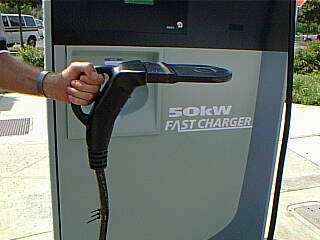
What are you talking about? Oahu already has a network of 60kW chargers, and the company that produced them (AeroVironment) makes chargers as powerful as 250kW. Here's what they look like. Here's what an older, inductive 50kW Magnecharge charger looks like.
Does that look like you need a forklift to you? 50kW = charge a 200Wh/mi (Volt-or-Prius-like) EV at a rate of 4.2 miles per minute of charging. 60kW = 5.0 miles/minute. 250kW = 20.8 miles/minute. For an Aptera-like vehicle, double those numbers. For an SUV or pickup without extra streamlining, halve them.
Here's a handy spreadsheet to determine how fast you'll go compared to an ICE car with different battery packs and charging powers after you take into account things like overhead for charging stops and starting each trip with a full pack. We see that, to pick an example, for six hour driving/charging in an Aptera-type vehicle at 55mph (versus a gasoline vehicle that goes 430 miles at that speed, with a minimum of 8% of your trip for restrooms/meals/getting out to stretch/etc, 1.2 minutes to gas up an ICE car, and an overhead of 6 minutes per time you have to stop to refill or recharge the vehicle), you go 56% as far if you charge from normal wall outlets, 60% from kitchen or garage outlets, 66% as far from low-power RV outlets, 76% as far from washer/dryer outlets, 84% as far from high-power RV outlets, 86% as far from old-school 60A chargers, 89% as far from a Tesla-type or new Yazaki charger, 97% as far from a 60kW charger, and 100% as far from a 250kW charger.
In short, charging from commodity outlets that already exist will increase your travel time by a relevant amount (although not as apocalyptically as a lot of people portray it, at least in an Aptera-type vehicle), but once you get up to the high-power chargers, the penalty is pretty insignificant.
Personally, I don't understand why we aren't making a push to use methanol fuel cells.
The fact that it's toxic, low density, and causes several times the energy waste might have something to do with it.
-
Re:1000+ a day isn't very much
Play nice. Also, it's still in beta, so don't expect perfection.
-
Re:Why batteries
You left out the bit about them needing replacement every couple of years.
1886 called; their want their knowledge of battery chemistry back.
The longevity of a battery pack depends entirely on its chemistry. Early 1900s EVs were often powered by nickel-iron cells, which have extremely long lifespans. Jay Leno has one that's still operating on its original batteries today. At the same time, they also had lead-acid batteries, which were much cheaper and had more storage capacity, but had very short lifespans.
You see the same thing in today's chemistries. Traditional li-ion gets 160-180Wh/kg. However, they're unstable and only last for a few years. But phosphates and stabilized spinels, while they only get 90-120Wh/kg, lasts for decades under accelerated aging tests.
There is nothing fundamental about being a "battery" that means it must die in short order. Ask any owner of a RAV4EV.
As for novel chemistries, there's a ton of them at various stages of working their way toward commercialization. Even if most of them fail, the odds of *all* of them failing seem vanishingly small. Li-ions should be in the 250-400Wh/kg range within a decade, and be significantly cheaper per watt hour to boot.
-
Re:That's it?
Oh, god, not hydrogen again... do we really have to keep kicking this dead horse?
-
Re:That's it?
Yep. Batteries don't advance as fast as computers, but they've advanced a heck of a lot faster than anything in the transportation industry. In the past 15 years, battery energy densities have tripled, and power densities even more than that. And they show no signs of slowing down; check out the list of recent li-ion tech breakthroughs that promise 2-4 fold increases in energy density. The odds of every last breakthrough on that list failing to make it to commercialization seems vanishingly small.
-
Big list
I've compiled a big list of upcoming EVs and their stats here.
-
Re:Ideal location
Here's a starter on lithium reserves.
-
Re:Ideal location
Charge time isn't an issue on Oahu. Oahu has the US's first rapid charging network. Here's the current map, and here's where they're building more.
Here's some prices on fast chargers (at least 1999 prices), in case you're interested:
60kW Aerovironment PosiCharge: $40,000
120kW Aerovironment PosiCharge: $80,000
35kW Norvick Minit Charger: $35,000
250kW Norvick Minit Charger: $125,000So, the bigger ones are about the same price as gas station per-pump.
-
Re:Thermodynamics 101
The energy density issue is very misleading.
-
Re:Credit crunch my butt
With all of the EVs coming out, there's only *one* that you like?
-
Re:Efficiency
As for ICE efficiency, Toyota says their Prius gasoline engine achieves 40% and Volkswagen determined their 3-cylinder Lupo diesel engines are at 50%.
You're confusing engine efficiency and well-to-wheels efficiency. Heck, even pump to wheels efficiency is a lot lower than engine to wheels due to all of the parasitic losses in a car.
Here's an interesting study comparing the well-to-wheels efficiency of various vehicle types in Norway. Check out the graphs.
As for the "long tailpipe" argument, it's busted here.
-
Re:Electric Gas Cans?
That's not true. The electric motor in the Prius is incapable of driving the car alone except in "NEV" type conditions -- low speeds, low acceleration, etc. Otherwise, it needs gasoline engine assistance. Hence, in "normal" driving, there is no EV-only driving. In Google's experience with a small plug-in Prius fleet, they were averaging about 70mpg, not counting the electricity used. Some people report as high as 100mpg; it'll really depend on your driving style.
This is very different from an ER-EV configuration like the Volt uses, where *only* a powerful electric motor drives the wheels. It gets infinite miles per gallon (electricity only) in the first 40 miles, then switches to charge sustaining mode with the 1.4L gasoline/E85 generator. Such vehicles are far better for the environment than a standard PHEV.
I should point out that Toyota is one of the least bullish companies on EVs/PHEVs. Probably the only one more vocally opposing them is Honda. Pretty much everyone else is moving strongly in the direction of EVs/PHEVs. Check out an incomplete list of upcoming EVs/PHEVs.
-
Re:buy an old S10 and convert it to electric
Sure, if a used vehicle, 40 miles range, 60mph top speed, very poor power, and having to replace your lead-acid batteries every 3-6 years is acceptable to you, then yes, you can do that. As for me, I need 100+ miles range, 80-90mph top speed, reasonable acceleration, and a battery pack that lasts the life of the vehicle. Hence, I'm on the waiting list for a $27k Aptera. However, it's hardly the only such vehicle that's coming out in the next couple years; there are dozens. If, for some reason, Aptera weren't to work out, I'd probably go with a Mitsubishi i-MiEV. I just prefer the Aptera because of its extreme efficiency.
-
Re:Not true
Sounds like you may want something like the Aptera Typ-1e. Doesn't have ABS (at least as far as they've announced), though -- however, it's only 1500 pounds, so the stopping distance should be similar to that of a normal car with ABS. Also, doesn't have power steering, but again, at Aptera Forum or Aptera Wiki if you want to learn more about it than I have space to cover here.
-
Mythbusting
As is usual whenever electric cars comes up, it's time for some mythbusting.
No, they don't increase pollution and overload the grid; precisely the opposite (more specifically, the only pollutant that goes up is particulate matter, and it's displaced away from population centers. NOx and SOx remain the same, CO2 drops, and CO and VOCs are nearly eliminated; the grid gets to make use of its surplus off-peak capacity and, with smart charging, can eliminate the supply/demand fluctuations that are currently so troublesome).
Yes, they are far more energy efficient than their alternatives.
No, modern batteries don't take forever to charge. The phosphates, titanates, modern spinels, and others can all charge in 5-20 minutes, given sufficient power.
Yes, fast chargers exist. The SAE J1772 standard covers Level 3 charging at hundreds of kilowatts. Yes, chargers as strong as 250kW exist. Yes, there's already a network of 60kW Level 3 chargers in place around Oahu. Install one yourself.
No, the batteries are not toxic. Current li-ions are only mildly toxic, and this only because of their cobalt-based cathode. The phosphates and spinels eliminate this cathode in favor of nontoxic elements.
No, lithium is not running out.
Yes, the batteries last a long time. The phosphates last 7000+ gentle cycles, having only 20% capacity loss after 1000 abusive cycles. The titanates? 20,000 cycles. Accelerated aging tests suggest LG Chem's packs will last 40+ years in typical use.
Yes, both rapid charging stations and EVs make financial sense.
Hmm, did I miss any?
-
Mythbusting
As is usual whenever electric cars comes up, it's time for some mythbusting.
No, they don't increase pollution and overload the grid; precisely the opposite (more specifically, the only pollutant that goes up is particulate matter, and it's displaced away from population centers. NOx and SOx remain the same, CO2 drops, and CO and VOCs are nearly eliminated; the grid gets to make use of its surplus off-peak capacity and, with smart charging, can eliminate the supply/demand fluctuations that are currently so troublesome).
Yes, they are far more energy efficient than their alternatives.
No, modern batteries don't take forever to charge. The phosphates, titanates, modern spinels, and others can all charge in 5-20 minutes, given sufficient power.
Yes, fast chargers exist. The SAE J1772 standard covers Level 3 charging at hundreds of kilowatts. Yes, chargers as strong as 250kW exist. Yes, there's already a network of 60kW Level 3 chargers in place around Oahu. Install one yourself.
No, the batteries are not toxic. Current li-ions are only mildly toxic, and this only because of their cobalt-based cathode. The phosphates and spinels eliminate this cathode in favor of nontoxic elements.
No, lithium is not running out.
Yes, the batteries last a long time. The phosphates last 7000+ gentle cycles, having only 20% capacity loss after 1000 abusive cycles. The titanates? 20,000 cycles. Accelerated aging tests suggest LG Chem's packs will last 40+ years in typical use.
Yes, both rapid charging stations and EVs make financial sense.
Hmm, did I miss any?
-
Mythbusting
As is usual whenever electric cars comes up, it's time for some mythbusting.
No, they don't increase pollution and overload the grid; precisely the opposite (more specifically, the only pollutant that goes up is particulate matter, and it's displaced away from population centers. NOx and SOx remain the same, CO2 drops, and CO and VOCs are nearly eliminated; the grid gets to make use of its surplus off-peak capacity and, with smart charging, can eliminate the supply/demand fluctuations that are currently so troublesome).
Yes, they are far more energy efficient than their alternatives.
No, modern batteries don't take forever to charge. The phosphates, titanates, modern spinels, and others can all charge in 5-20 minutes, given sufficient power.
Yes, fast chargers exist. The SAE J1772 standard covers Level 3 charging at hundreds of kilowatts. Yes, chargers as strong as 250kW exist. Yes, there's already a network of 60kW Level 3 chargers in place around Oahu. Install one yourself.
No, the batteries are not toxic. Current li-ions are only mildly toxic, and this only because of their cobalt-based cathode. The phosphates and spinels eliminate this cathode in favor of nontoxic elements.
No, lithium is not running out.
Yes, the batteries last a long time. The phosphates last 7000+ gentle cycles, having only 20% capacity loss after 1000 abusive cycles. The titanates? 20,000 cycles. Accelerated aging tests suggest LG Chem's packs will last 40+ years in typical use.
Yes, both rapid charging stations and EVs make financial sense.
Hmm, did I miss any?
-
Re:Wait to winter time when there is less sun to s
Working against that, you need to amortize your capital costs and pay for maintenance. Still, in some parts of the country, solar can indeed give you a reasonable mortgage length and IRR
-
Re:To be fair, who among you HASNT wanted to sue
He's also sued the Magna Carta.
-
Re:Now only if...
Well lets take an honest look at this on.
The Hummer has terrible resale value for a lot of reasons. A big one is that it is a terrible vehical with a terrible repair history. A Prius is a Toyota and has a great repair history.Okay, how about a Toyota Sequoia with a Honda Civic Hybrid? $26k versus $20k, but just over $17k 5-year depreciation instead of just over $8k 5-year depreciation.
It doesn't matter what comparison you do; guzzlers have horrible depreciation in comparison to fuel-efficient cars. Namely, because guzzlers continue to cost a lot to run, while a person who's buying used is doing so to save money.
Why not compare it to a Lexus, Honda, Acura, or Mazda 3 or 6.
Because we're comparing fuel-efficient vehicles with guzzlers, obviously.
"The average car on the road is now roughly nine years old, implying an average lifespan of 18 years. Ignoring inflation on gasoline prices and interest on the purchase, this would work out to a savings of $41,400 over the lifespan of the vehicle. That's a *Lot* of money. Saying it has to cost under $20k is just stupid."
Yea you are ignoring the interest that you would have to pay on the extra money.And inflation on gas prices. If you want more detailed calculations that include interest and inflation, go here.
The other thing you are forgetting is that car loans are limited to usually five years
And so one should pretend that economics doesn't matter because of this, right? Whether the money is coming from a car loan, a savings account, home equity, or whatnot, economics is still economics. All that changes is the interest rates.
and you are ignoring the cost of a battery pack replacement. I doubt that any battery pack will last the 18 years you are perdicting for a car life span.
1) That's covered by the linked calculations.
2) LG Chem expects their spinel packs for the Volt to last 30 years. A123 has already gotten over 7,000 cycles on their pack. AltairNano titanate cells have done over 20 *thousand* cycles."Let's toss in another $500 in maintenance savings -" $500 a year? On my Mazda all I have had to do is change the oil and get new tires.
Um, no. In 2005, the average driver spent $2,013 in gasoline and motor oil plus $2,339 on other vehicle expenses (repairs, insurance, etc). Unless you have a magical car that never breaks, your car needs more than just oil and tires changed.
And those are not available yet for a car sized battery pack
BZZT, sorry, try again! *Almost all* new PHEVs and EVs coming out in significant volume in the coming years are using one of those chemistries, and the prototypes are running on them. The only glaring exception to this is Tesla.
plus I question the very idea of charging a Li/Poly car pack in five or ten minutes.
I love how you confused LiP, spinel, and titanate cells with li-poly; that was just the icing on the cake.
That will out a LOT of heat.
Li-ion variants tend to be over 99% efficient at slow charging and ~96% or so efficient at fast charging. 60kW*4%=2.4kW -- 50% more power as heat than a blow dryer consumes. 250kW*4%=10kW, still the tiniest fraction of the heat released by a running internal combustion engine.
None of those technologies are available right now.
What part of "Already Installed Across Oahu" don't you get? What, do you need a link? Or two? How about a map? Or
-
Re:Thank god!
Okay, well, first let's look at some common outlets in the US. Your standard NEMA 5-15R has a 15A breaker and, while there's a nominal delivery voltage of 120V, you'll probably get 117V or so out of it. That's 1.755kW. Kitchen outlets generally have a 20A breaker, so 2.34kW. The NEMA TT-30R, the standard low-power RV outlet, is also a nominal 120V, so assuming 117V still, that's 3.51kW. Dryer outlets are split-phase, either NEMA 10-30R or 14-30R (the 14-30 ones are properly grounded; the 10-30s are grounded through the neutral). They're able to feed a nominal 240V (we'll say 234V) at 30A. That's 7.02kW The higher power equivalents, the 10-50R and 14-50R, are the standards for range outlets. The 14-50R is also the standard high-power RV socket. This is 11.7kW.
Okay, so these are the outlets found all across the country. The RV ones are especially interesting, since RV parks can often be found in even the most remote places, and I'm sure your average RV park owner would love a new revenue stream, what with RV travel down due to high gas prices. Now, let's take an upcoming EV like the Aptera Typ-1e -- 2+1 seating, 120 miles@55mph, 70 miles@80mph, 90mph top speed, 0-60 in Oahu. They use 60kW PosiCharge fast chargers by Aerovironment. Aerovironment already makes them as big as 250kW.
To get an idea of what sort of driving distances you can get in a given length of time and how those compare to gasoline, there's always this convenient spreadsheet. Adjust the EV pararmeters to those of the EV of your liking. Explanations of the formulae and parameters are at the bottom.
Oh, and as for Mercedes? Who wants to bet that they'll make one or two EV/PHEVs, one fuel cell vehicle, and do the cheap/lazy thing and simply make all of the rest of their vehicles flex-fuel capable?
-
Re:extinction of zinc?
Oh really. Now explain to me what you think is limiting our production capacity by -- oh, let's say, coal liquefaction. Steel, with all of those steel mills shuttered across Appalachia? Unskilled labor, with huge unemployment in said regions and elsewhere? Engineers, with huge numbers in places like India and China trying to get visas? Rates of coal extraction, when China is mining through their their more-difficult-to-get reserves mostly by manual labor three times faster than we are (on a percentage basis)? Tell me, what do you think is the limiting factor?
Here's some things that should clue you in on oil prices. Oil companies aren't being valued by the market as though oil was $140+ a barrel; they're being priced as though it was $50-70 a barrel. Oil companies aren't betting on projects with expected oil prices at $140+ a barrel; the most expensive I've seen them undertake are the Bakken (~$50/barrel) and Greenland (~$50/barrel), and in the former case, it's only small oil companies, and in the latter case, it's only very preliminary work. The people who should know what they're talking about are *not* betting on these prices being sustained, or anythign close to them. Only the futures market is way up. Now, if that doesn't look like a standard commodities bubble, I don't know what does. Well, that and perhaps this: have you checked out prices of rents in oil exploration and transportation? Drilling ship rents are 3-4 times what they were a year ago. Fine, that's to be expected. Rig rents are 3-4 times what they were a year ago. Again, that's to be expected. But *tankers*, too, are renting at 3-4 times what they were a year ago. Go on, explain that one under the "scarcity" theory. If there's a scarcity, where's all of this oil coming from? Iran and Venezuela are both known to be renting tankers and just storing oil in them. In Iran's case, a slowdown in demand in India has lead a refiner there to stop buying their sour crude, only needing their more local sweet crude. They're looking for a new buyer, and in the meantime, they're stockpiling. The situation is such that a company with oil in a tanker, even with the current high prices, is paying less on the rent for the tanker than they're gaining by holding onto the oil as prices rise.
The exact same thing happened in the last oil spike. When prices collapsed, they all rushed to port to unload as fast as possible, furthering the price fall. Bubbles work that way.
The Simon-Ehlrich Wager wasn't a fluke. For more detail, I've written a fair bit on the concept of peak oil (w/references).
-
Re:Who knew?
Oh, and by the way, please elaborate on the proven viability of SS2.
For years, I was warning people that Scaled was playing fast and loose with safety. I wrote this in 2006 (and updated with the latter link in early 2007, before the accident):
"Rutan, on the other hand, nearly killed his test pilot by launching in high wind shear conditions, and launching before resolving the cause of wild rolls at rocket ignition. With just a small handful of flights. On a task that is incredibly easy compared to reaching orbit. Some view the rocketplane tourism industry as a disaster waiting to happen."
I would rather have been proven wrong.
-
Re:Doomers
Yes.
-
Re:i couldn't have said it better myself
Electric cars are great -- with one exception: batteries utterly suck.
Not any more, really. There's certainly room for improvement, but they're way beyond how you portray them.
A battery has perhaps 1% of the energy-density of gasoline
Response here.
and to add insult to injury, needs hours to recharge
Not with lithium phosphate, spinel, or titanate batteries, which are what is going into this next generation of EVs. They can be recharged in minutes. Most next-gen EVs have a fast charge port rated for between 5 and 20 minute charges, depending on the vehicle.
Dragging around 1000 lbs of batteries to get the same amount of energy you'd get from a gallon or two of gasoline
The Aptera Typ-1e, to pick one, "drags around" 300 pounds of batteries. This replaces about 400 pounds of internal combustion engine. Yes, there's also an electric motor, but those are much smaller and lighter than ICEs. Yes, the range is less, but honestly, if you're not getting out of your car to stretch every two hours, you're not following normal driving safety recommendations anyways. And next-gen battery techs, which I could easily list over a dozen for you that are currently in various stages of working their way to commercialization, promise several times the energy density (one such battery has already made it into the Subaru G4e prototype -- a 2x density lithium vanadium oxide battery). There's room for a density doubling at the cathode via layering of materials with various reactivity, and nearly a 10xing at the anode via either silicon or tin nanoparticles or nanowires. And the number of approaches being taken is really impressive. And this is just lithium ion -- also consider ultracaps like the EESU, lithium sulphur, sodium ion, etc.
Invent a battery that can do even 10% of what gasoline can, and that recharge quickly, and electric cars would take over nearly completely in 5-10 years.
Glad to hear that electric cars will be taking over nearly completely in 5-10 years, then. -
Re:Securing energy independece...until it's gone
Yeah, it's not like we've found over a dozen supergiants in the past decade, including some of the largest fields ever discovered, or anything. Oh, wait, we have. Well, it's not like there are many orders of magnitude more fuel potential via syncrude from other sources. Oh, wait, there is.
By the way, I agree we should invest in alternative energy. But I'm not going to let what I want to happen get in the way of the facts. -
Re:Securing energy independece...until it's gone
Yeah, it's not like we've found over a dozen supergiants in the past decade, including some of the largest fields ever discovered, or anything. Oh, wait, we have. Well, it's not like there are many orders of magnitude more fuel potential via syncrude from other sources. Oh, wait, there is.
By the way, I agree we should invest in alternative energy. But I'm not going to let what I want to happen get in the way of the facts. -
Re:Fungible
The simple mathematics are that if something is being used faster then it is created, it will reach zero.
And therein lies the fundamental error. First off, you're not using "oil"; you're using gasoline or diesel or any number of refined products. You pull up light sweet crude, and it's pretty close to what you want out; you don't have to refine it much. You pull up sour crude, heavy crude, ultra-heavy crude, or even bitumen, and you've got a big refining task ahead of you. You cook oil out of keragenous rock like shale, and you're doing even more organic chemistry. Ultimately, you can make oil simply from CO or CO2, plus water for the H2, plus energy, via Fisher-Tropsch or Sabatier synthesis. In short, for oil to be able to *physically* run out, you need "peak energy" to occur.
Of course, the doomers make lots of other arguments. They're easily taken down, though. And I do mean "doomers". The more extreme ones are sort of a death cult. -
Re:Bring the boys back home, send em up N
B) This is about oil reserves INSIDE THE UNITED STATES
Actually, the Bakken formation extends into Canada, too.
The Bakken has a rather interesting history. Estimates on how much oil it produced have varied a lot. Back in the '70s, they thought it only had about 10B barrels -- which is a lot, but not when it's spread out over such a huge formation. To make matters worse, the formation is a dozen meters or so thick in most places. All together, recovery rates were expected to be 1-3%, and expensive at that. Not many takers.
Things have changed. After Price's paper that predicted over 400 billion barrels, computer simulations have been developed; the latest runs expect 200-300 billion barrels. Furthermore, horizontal drilling means that you can enter the thin formation and then run along it; this is what is used in the very successful Elm Coulee field.
The Bakken is just one minimally tapped deposit. There's absolutely no shortage of recoverable oil in the world. The problem is the consequences of recovering and burning it all.
C) The US is moving to 'alternative fuels'. The debate is not over whether or not to, but how big a priority it is.
Are you kidding? There's a huge debate over whether or not to, especially after the most recent papers suggesting that even sugarcane ethanol leads to more greenhouse gasses than gasoline. Let alone the fact that there's a widely growing acceptance that, despite the momentum, corn ethanol is a huge blunder. There's the food-for-fuel competition (food prices are up 40%, mostly from fuel prices and alternative fuel pressure). Now, I think it's good that corn prices aren't as artificially low as they used to be, but now they're artificially high, and everything is getting pushed up by the increased demand for biofuel land -- even other staples like wheat.
And what about cellulosic ethanol, this supposed panacea? This is one thing that drives me crazy. Look at how most big cellulosic ethanol companies are making the stuff. They turn the biomass into syngas (CO+H2) by burning it in a poorly oxygenated environment, and then use a complex, inefficient biological or catalytic process to convert it into ethanol. Well, here's the thing: we've been making syngas into *gasoline* for most of a century. That's how Nazi Germany and Apartheid-era South Africa kept their engines running (excepting, in the case of Germany, after we bombed most of their facilities). And it's a relatively efficient -- 70% or so. So, instead of making a fuel that we're *already set up for*, we're instead making a *less dense* fuel that we can only use in *limited quantities* in most cars and *can't ship in our pipelines*. Why? Because "cellulosic gasoline" isn't a buzzword. Nobody likes the word "gasoline", but lots of people like the word "ethanol". You get more investment, you get more tax breaks, and on and on. So the inferior solution gets chosen.
Anyways, if you want to *actually* clean up your act, either increase your MPG or switch your miles over to electricity (the significantly higher thermodynamic efficiencies of power plants mean that even dirty power plants run a car cleaner than a gasoline engine -- plus, electricity is a lot easier to clean up). Biofuels are an "easy" solution that isn't really a solution at all. -
Re:More practical than other X prizes
Electric cars are a big deal because power plants are more efficient than even diesel engines, the US only loses about 7.2% power in transmission, AC/DC conversion is 90-95% efficient, li-ion batteries are over 99% efficient, and electric motors are 85-90% efficient in a general driving cycle (as much as 95%). Also, power plants have centralized scrubbers and can ultimately be replaced with renewables.
-
Re:So what
Heck, we are looking at hitting coppers limits
Morbo voice: "Resources do not work that way!"
What is being talked about here is *economically recoverable reserves*. What is economically recoverable depends on two things:
1) Current prices. As prices rise, by definition of the term "economically", more reserves become economical. Typically increasing exponentially.
2) Technology. Technology improvements act as a counter to increasingly difficult to extract reserves. Improvements can outpace it, wherein prices drop, or be outpaced by it, wherein prices rise. Example: adjusted for inflation, oil today is cheaper than it was back in the late 1800s when it bubbled to the surface in Pennsylvania (as opposed to having to be driven up from miles underground in inhospitable locations)
The applicability of this to oil and lithium are discussed. -
Re:So what
Heck, we are looking at hitting coppers limits
Morbo voice: "Resources do not work that way!"
What is being talked about here is *economically recoverable reserves*. What is economically recoverable depends on two things:
1) Current prices. As prices rise, by definition of the term "economically", more reserves become economical. Typically increasing exponentially.
2) Technology. Technology improvements act as a counter to increasingly difficult to extract reserves. Improvements can outpace it, wherein prices drop, or be outpaced by it, wherein prices rise. Example: adjusted for inflation, oil today is cheaper than it was back in the late 1800s when it bubbled to the surface in Pennsylvania (as opposed to having to be driven up from miles underground in inhospitable locations)
The applicability of this to oil and lithium are discussed. -
Re:Attract thrill seekers with the mundane?
These sort of "space" flights do almost nothing to advance actual, orbital rocketry. The best you could argue is that they might come up with ways to reduce the cost of working with composites, which could indirectly help some aspects of the rocketry industry -- although companies like Boeing are probably doing a lot more to that regard than the entire rocketplane joyride industry will ever do.
Just because they both deal with "space" doesn't mean that they're optimizing toward the same thing. These joyrides have a lot more to do with supersonic airplanes than they do with orbital rockets. So, mind you, kudos to them for helping advance low-end supersonic aircraft flight. But don't look to them for anything related to orbit or beyond. -
Re:Who Killed the Electric Car?
Completely inaccurate. The error in your thinking is that power plants are far more efficient than ICEs, and the other steps don't lose much at all.
Your pretty graphic shows 80% efficiency because it's based on a flawed assumption: that the energy cost of loading up your car with its energy source is the same.
The "pretty graph" wasn't created by me; its source is linked. It is from the peer-reviewed "Well to wheel study of passenger vehicles in the Norwegian energy system". It covers electricity generated by non-renewable sources, and just like the DOE study conducted at PNL, determines that it's much better for the environment than an ICE.
Finally: every single point on your precious "fourth IPCC WG1 report" has been thoroughly debunked.
So now it's *my* fourth IPCC WG1 report? Apparently I run the IPCC now. Amazing, that! Hey, where's that "point by point" debunking? Given that the IPCC WG1 merely *summarizes the existing papers*, it really needs to be a point-by-point debunking of each of the several thousand papers. Even if it was a debunking of the summarizing of the papers, it'd still have to be several thousand pages long. How did this amazing piece of debunking manage to sneak through the cracks? -
Re:Who Killed the Electric Car?
I don't think you are putting it in the right perspective with regards to the physics. What do you say to this? See the last paragraph where they look at drive train total power density. As for the lifetime of battery packs, there is a lot of innovation being made. If the ev takes off, then it will be like hard drives being expensive back in the early 80s.
-
Re:Who Killed the Electric Car?
The physics are that batteries don't have the energy density of liquid hydrocarbons. That part is the simple physics.
And that's why off-the-cuff calculations can be misleading. The majority of the weight of a gasoline drivetrain (from tank to wheels) is not the fuel, which is light, but the engine. The motor is light in an EV drivetrain, while the batteries are heavy. The mass of batteries isn't in competition with the mass of the fuel in a traditional car; it's in competition with the mass of the engine.
Batteries are expensive and do wear out so that is another cost item.
Automotive li-ion batteries are designed to last 10+ years, and even then, they're not "dead" -- they just have reduced range. EVs don't have the other parts of a car that you might have to replace over its life -- generally the transmission, most belts, radiator, spark plugs, muffler, cataltyic converter, pumps, and in an extreme case, the whole engine block. One of the great things about EV drivetrains is that they're so darned simple. If your batteries are reliable, your maintenance is largely reduced to that of the tires, while your energy costs are reduced to around a penny per mile (give or take in either direction).
Put your money where your mouth is.
Already have. I hope you enjoy your $0.10-$0.15/mi in fuel and ~$50/mo amortized maintenance/replacement costs; I'll be enjoying my $0.005/mi and $15/mo amortized maintenance/replacement costs. -
Re:Strangely the brits
Sure do. Here you go.
-
Re:inflation adjustment
Phoenix is widely accepted by the EV community as being significantly overpriced, thanks to their use of AltairNano batteries. If you want a 5 seater, the similar-stat MiEV is a much more economical option, at $24k.
The main range limiter at this point isn't the batteries themselves; it's the relatively high cost of automotive li-ion batteries due to small-scale production. Five years from now, the same price vehicle will buy you double the range without any battery improvements. Yet the battery improvements do keep lining up in the lab, and we're talking about 2-3 times the energy density from at least five different battery chemistries (just the ones I've tallied up so far, and I've hardly read all of the research coming out). The odds that *none* of them will make it to commercialization seems implausible to say the least. Give it ten years for that, and you're looking at EVs that cost around the same ($25k or so) and have gasoline-equivalent range and are fast charge capable, release far less CO2 and other pollutants, cost around a penny per mile in energy costs (more or less depending on the vehicle and your rates), and cost a small fraction as much in maintenance. Automotive li-ions are rated for 10+ years, and it's not like they suddenly "die" then; in practice, they last the lifespan of the car. Apart from the batteries, the only other moving parts are the drive shaft from the electric motor, the wheels, and occasionally a belt or small cooling fan. 90% of the complexity of the engine and all pollution controls on the vehicle itself disappear. There's generally not even a transmission because electric motors perform well over a wide torque range.
Oh, and yes, we already have the power infrastructure (study commissioned by the DOE) -- everywhere except the pacific northwest.
For a lot more info, read this. -
Re:Who Killed the Electric Car?