Slashdot Mirror
Domain: daviddarling.info
Stories and comments across the archive that link to daviddarling.info.
Comments · 94
-
A ten meter tether is not a space elevator
A ten meter tether is not a space elevator, and is not really anything like a space elevator.
Twenty kilometer tethers have already been demonstrated in space, notably the NASA Small Expendable Deployer System Experiments
(SEDS and SEDS II): http://www.daviddarling.info/e... -
Re:paths
That is actually a neat idea.
I found this: https://en.wikipedia.org/wiki/...
And this picture with explanation: http://www.daviddarling.info/e... -
NASA Looks At Reviving Atomic Rocket Program
FINALLY !
It's been about 50 years that the NERVA program has been on hold - mostly because of the atmospheric nuclear test ban treaties of the time, and also the space nuclear bans related to those test bans.Check out these 2 sites / articles for some history of a WORKING nuclear powered rocket engine - - -
NERVA testing - https://www.youtube.com/watch?...
and - http://www.daviddarling.info/e...I was in high school, and missed out on actually seeing one of the tests at Jackass Flats in early 1967 because I was underage and couldn't get the security clearance needed - really sucked.
-
Re:Maybe now, but
http://www.daviddarling.info/e... or http://en.wikipedia.org/wiki/A...
as well as the old standby Einstein-Rosen bridge: http://en.wikipedia.org/wiki/W...
-
Looks familiar
That one with Titan "floating" in front of Saturn closely reminds me of a work by Chesley Bonestell from the early 50's:
-
link for spaceprobe speeds
New Horizons had fastest Earth escape velocity. But it didnt have the gravitational slingslots of some of the other probes. Here is a list of velocities.
-
Re:There's no starship with just an ion drive
An "Enterprise-type" starship is a misnomer at best. An ion drive to get to even the closest star would have to be a "generation" ship. It would take generations of people, born, liviing, dying, to reach the nearest stars.
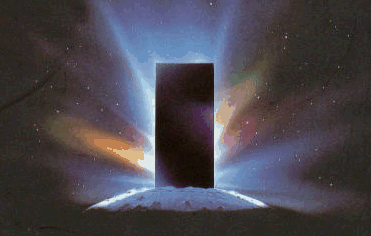
The alternative would be some sort of 2001-type hibernation, which also would not be anything like the Enterprise.
"Beam me up Scottie, there's no intelligent life in this article."
Thanks to time-dilation as you approach the speed of light, if you can maintain 1G of acceleration, it doesn't take many generations of people to go to very far-flung places. You can travel 1500 light-years to the Orion Nebula in only 30 years of ship time.. Of course 3000 years would have passed on earth by the time you get there. In just 60 years, you can travel 2 million light years. (which an observer on earth would see as 5 million years)
A 1G ship can also be thought of as a (one-way) time-machine. Step inside the ship for a big circular voyage and when you step out 30 years later, 3000 years will have passed on Earth.
-
already widely used
The HS601 and its XIPS system is technically electric since it is an Ion propulsive device. The above FTA is more about plasma thrust, but again all these concepts have been around for 50yrs: it's well known higher specific impulse == more acceleration for space flight == a better engine (and ions have more impulse than anything chemical)...
-
Re:This toy is a joke for deep space demonstration
Tell it, Brother! Check out this other stupid dipshit wasting his time with useless toy!
-
Re:All about energyNuclear not suitable for space? The folks at Nerva and Liberty Ship would like to have a word with you.
The Mars mission* became NERVA's downfall. Members of Congress in both political parties judged that a manned mission to Mars would be a tacit commitment for the United States to decades more of the expensive Space Race. Manned Mars missions were enabled by nuclear rockets; therefore, if NERVA could be discontinued the Space Race might wind down and the budget would be saved.
* The Mars mission mentioned here was a NASA mission planned in the mid 1960s.
The only reason we don't have nuclear powered rockets right now is that politicians were worried about budget. -
funny
Here is the breakdown of the Martian atmosphere:
carbon dioxide 95.32%
nitrogen 2.7%
argon 1.6%
oxygen 0.13%
carbon monoxide 0.07%
water vapor 0.03%
neon, krypton, xenon, ozone, methane trace
The average surface pressure is only about 7 millibars (less than 1% of the Earth's)
http://www.daviddarling.info/encyclopedia/M/Marsatmos.htmlSo, Mars does have an atmosphere, but is it usable to Earth life?
You would need s source of nitrogen, lotsa miracle gro would be handy -
Re:Limits? Ha!Agreed.
Before 1947, it was believed that the speed of sound represented a physical barrier for aircraft and pilots. As airplanes approach the speed of sound, a shock wave forms and the aircraft encounters sharply increased drag, violent shaking, loss of lift, and loss of control. In attempting to break the barrier, several planes went out of control and crashed, injuring many pilots and killing some. The barrier was eventually shown to be mythical, however, when Chuck Yeager surpassed the speed of sound in the X-1.
http://www.daviddarling.info/encyclopedia/S/sound_barrier.html
-
Re:How big a telescope do we need to see cities?
Why build when you can visit? As any relativistic physicist would note, the largest lens in the Solar system is the sun
-
Wrong answered with wrong modded informative
For pity sake
1) The matter in a black hole isn't missing. It's accounted for. We can't know what kind of matter is in there because we can't know anything about stuff beyond the event horizon
2) We still don't know what Dark matter is, but we know that the so called WIMP model is most likely to account for most of it. We know this due to studies of objects like the bullet cluster of galaxies which can't be explained by MACHOs. In the bullet cluster, you see 2 galaxies that have collided - the normal matter in the form of gas and dust in each galaxy got slowed down, but the dark matter passed through each other. That wouldn't happen with MACHOs, and we would expect to be able to detect MACHOs in such a matter rich area by their microlensing events.
http://www.universetoday.com/2010/03/01/what-can-the-dark-matter-be/
http://www.daviddarling.info/encyclopedia/D/darkmat.html3) What's even more interesting is that recent work suggests black holes do not absorb dark matter
http://www.universetoday.com/2010/03/22/astronomers-find-black-holes-do-not-absorb-dark-matter/#more-60422 -
Re:Lightspeed limited, not an ansible
This raises a question that has been on my mind for awhile. I hope I can explain this but I'm not an expert in physics so bear with me.
Also, please do not just say "Your wrong, GTR says that can't happen", you would be "citing authority" and it really kills the validity of your rebuttal. Sort of like saying "God exists because the Bible says so". Please explain WHY its wrong, as in cite what portion of GTR says it can't happen so I can read it and see where how I went wrong.
According to General Theory or Relativity, as defined in the link you posted, if a mass were to suddenly appear at a location in space-time, say in the forward Lagrange point of Jupiter's orbit, it would take X amount of time before the gravity from that mass would affect the orbits of the other planets in the Solar system. X being equal to time it would take for light to travel from the location of the mass to the rest of the planets in the Solar system.
Have I got it right so far?
But my understanding is that, according to GTR, gravity is caused by the deformation of space-time by a mass. So the mass that suddenly appeared would deform space-time around it, thus imposing a gravitational influence on all objects in range.
Here is what has me going "wait, what?"
Also according to GTR space-time can expand/contract at speeds greater than that of c in a vacuum, as described in the "inflation" theory of the early universe and Alcubierre's "warp drive" theory. Since the mass deforms space by "stretching" it wouldn't that mean that the influence of a mass could affect an object at a distance in less time than it would take light to travel that same distance? Since the "fabric" of space-time could alter faster than light can travel across it.
I'm hoping to get some insight into how I could be wrong, because based on what I know I can't see any reason why it can't happen. It could explain why we haven't detected gravity waves using interferometry, if the gravity wave, a distortion of space-time was moving faster than light it wouldn't be able to affect the phase of the light beams.
Thank you in advance to those who actually provide some useful info to help me improve my understanding. -
Re:blackouts
All modern inverters? Or only grid intertie inverters? Ump, something to look into... Ah there are still stand-alone inverters. So just have a stand-alone inverter supplying the building with a intertied inverter connected to the grid.
Sorry, I meant all inverters that are meant to be able to connect to the grid. Meaning inverters that send power to the grid from say solar without a battery, and inverters that can maintain a battery bank. The former shuts off completely, while the latter just disconnects from the grid.
If you're building a system on grid, it might not be a bad idea actually to go with two systems like you mentioned, from a practicality standpoint. IE, design a small backup system that doesn't interact with the grid, and use it to backup say your refrigerator, computer, ham radio, whatever. (In fact, you could probably use this system as a constant source of DC for things like the router for your Net connection, if you designed it so that you're not draining too much to prevent it from being useful as a backup.) Then you could add on grid connected PV as you like. This would make sense if the grid is very reliable in your area, as once the grid goes down you can't do anything with the intertied system. Then again, if you wanted to back up more of your house and only have one system, you could look into the hybrid inverter (that does both).
I don't know about now but at one tyme restaurants had to pay others to haul off the used grease. You're right about having a backup, some people demand it and others adjust. For my own home, I want a backup if not a hybrid system. Ideally I'd have geothermal, solar, wind, and maybe a micro hydro system. Of course such a system would cost a lot. But before I ever get to where I can build my home off the grid I'll log energy usage for at least a year and see where I can be more efficient.
Falcon
I've heard stories of restaurants dumping their waste grease out in the back, right next to the dumpster. I'm not sure about the laws about that, but I'd imagine if you asked they'd be more than happy to give it to you. They might also be interested in a way to become greener.
You can start out with a small backup system by picking out a stand-alone inverter and battery bank. That'll act like a big UPS, basically, and you can add a little solar later if you want, or other RE source, whatever. You have the right idea about logging energy usage. Remember that using more efficient appliances will make covering your usage much cheaper.
If you are looking for off-grid property, you'll really luck out if you can do microhydro. It's the cheapest source, and you get it 24 hrs/day a decent portion of the year (depending on how the stream acts seasonably, obviously). If you get enough flow you'll almost have energy to burn. (And you probably will, since most if not all microhydro plants need a constant load. A lot of people use air and water heaters for this.) If you have a lot of flow you can look for a centrifugal pump from an old industrial site and actually run it backwards for power, Google around, it's been done.
You can always start small, maybe enough to charge your laptop, and get a little experience. Check out my setup here, not too much going on yet. Once you play with a little, though, the bug bites.
-
Re:blackouts
I believe that everywhere in the US in order to pass inspection you have to be using UL listed equipment if you want to intertie (IE, run in phase with the grid and sell your extra power back.) All modern inverters built for this have to pass all sorts of anti-islanding tests. In addition to this a lot of areas require a separate, labeled, lockable disconnect so that the utility workers can disconnect your system from the grid.
All modern inverters? Or only grid intertie inverters? Ump, something to look into... Ah there are still stand-alone inverters. So just have a stand-alone inverter supplying the building with a intertied inverter connected to the grid.
Biodiesel for backup would be pretty cool, especially if you can get grease from a restaurant to use to make it. A lot of people far off the grid will have a generator as backup, but some do without. When you don't have the grid the trick is to watch what your system produces, and adjust your load accordingly.
I don't know about now but at one tyme restaurants had to pay others to haul off the used grease. You're right about having a backup, some people demand it and others adjust. For my own home, I want a backup if not a hybrid system. Ideally I'd have geothermal, solar, wind, and maybe a micro hydro system. Of course such a system would cost a lot. But before I ever get to where I can build my home off the grid I'll log energy usage for at least a year and see where I can be more efficient.
Falcon
-
Re:Implications?
Actually that's a good point. If you want to colonise the galaxy with machines you don't need to hurry.
However I looked up the figures for a 1g spacecraft and you could make a 10 year ship time (24 years time on Earth) round trip to Sirius.
http://www.daviddarling.info/encyclopedia/O/one-g_spacecraft.html
That's not so bad - you could probably put the crew into suspended animation. Or you could build an ecosphere on board that was self sustaining. Neither of these things are technically feasible right now of course, but neither of them seem to contradict any known physical principles.
I.e. a quantum propeller - a devices that generates thrust without expelling mass - provided it could give 1g acceleration which admittedly is rather a lot - could give you V style spacecraft.
Of course, there's still an issue of energy to power it. Presumably you need to carry something to generate that, unless you could mine it out of the vacuum or something similarly elegant. This last possibility is more speculative obviously.
-
Re:Troubleshooting skills.
why didn't anyone in the Star Trek universe ever come up with the idea of using warp drives as weapons in a systematic way? A runabout crashing into a borg cube at warp seven would do quite a bit more damage than a photon torpedo, I would imagine. I guess kinetic energy just isn't "futuristic" enough.
According to some of the best speculative physics out there, warp drive must operate by either manipulating space-time itself, or by creating an artificial wormhole or some other means of traveling in extra dimensions. Within your local frame of reference your velocity would be quite low, as would your kinetic energy. You could also move at EXACTLY the speed of light by reducing the relativistic mass of your vessel to zero. Still no kinetic energy weapon there.
Using warped space itself as a weapon is a possibility, but who is to say that phasers don't already do some of that. Phasers certainly can't work merely by firing a beam of photons at the target, like a laser. If they did work like lasers, you wouldn't be able to see the beam.
Sublight engines, on the other hand, might be a possibility as the basis of a kinetic energy weapon. IIRC impulse drive could move a starship somewhere around 1/2c. -
Re:Bad science
If you explode a nuke outside the Van Allens, the fallout is swept away by solar wind. We've done it before. http://www.johnstonsarchive.net/nuclear/hane.html However, a conventional nuke might only decimate an incoming Big Rock, leaving 90% behind. I'd rather see a pusher plate mated to the Big Rock, then detonate specially designed nukes against the plate, like in the Project Orion ship in FOOTFALL. http://www.daviddarling.info/encyclopedia/O/OrionProj.html http://books.google.com/books?id=4S2KocYp8AkC&pg=PA159&lpg=PA159&dq="pusher+plate"+Orion&source=bl&ots=yRM2KRDRst&sig=NWZvu3gbjAAwyKva2-Jl_jlduhM&hl=en&ei=qnucSs-xCJSwsgPxwNCaDg&sa=X&oi=book_result&ct=result&resnum=4#v=onepage&q=%22pusher%20plate%22%20Orion&f=false
-
Re:Shut off turbines during bad weather?
Why do you furl the sail in high winds? Is it... because otherwise the masts break?
That is why it is also called furling when you shut down a wind turbine in high winds.
-
Re:Minimal?
Ps. for nuclear-thermal i assume you mean http://en.wikipedia.org/wiki/Project_Orion_(nuclear_propulsion) which so many people love the idea of...
No, that's nuclear pulse propulsion.
Nuclear thermal means a reactor (not a bomb) produces heat, which heats a fluid that is then ejected as reaction mass (e.g., NERVA).
Nuclear thermal is great for in-space propulsion, but most nuclear thermal engines have a poor thrust to weight ratio for launching from the surface.
-
Voodoo economics / creative accounting
Just a quick question: why, exactly, do MBAs need to know calculus?
Please, I'm not following.
"In the fall of 1972 President Nixon announced that the rate of increase of inflation was decreasing. This was the first time a sitting president used the third derivative to advance his case for reelection." http://www.daviddarling.info/encyclopedia/D/derivative.html
-
Voodoo economics / creative accounting
Just a quick question: why, exactly, do MBAs need to know calculus?
Please, I'm not following.
"In the fall of 1972 President Nixon announced that the rate of increase of inflation was decreasing. This was the first time a sitting president used the third derivative to advance his case for reelection." http://www.daviddarling.info/encyclopedia/D/derivative.html
-
Re:So let's stop faffing around
I am "potentially impressed" by an engine that needs enough electricity it requires its own nuclear reactor in space, uses radio waves to excite plasma, and uses a magnetic field as a nozzle. It's the VASMIR Designed by Franklin Chang-Diaz.
-
Re:Bigger and stronger?
They could just continue where they stopped last time.
-
Re:So look at it, take it apart, spend a few minut
Around the time of stephensons rocket it was commonly believed you would die if you went that fast, but not I believe by scientists, but by the general public.
It's an interesting footnote to history, commonly mentioned in history programmes, but not in itself interesting.
As for the speed of sound.. try http://www.daviddarling.info/encyclopedia/S/sound_barrier.html -
Convergent Evolution
There are many things that have evolved multiple times without a common origin.
Please read:
http://www.daviddarling.info/encyclopedia/O/octopus_eye.html
http://en.wikipedia.org/wiki/Convergent_evolution -
Re:Yes it IS
-
Re:Awesome!
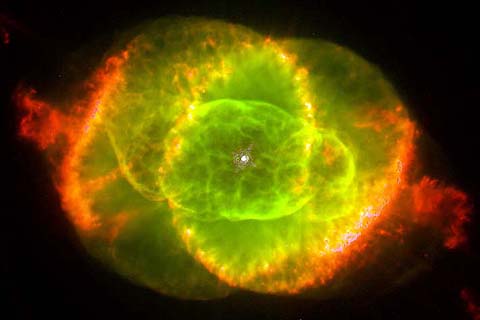
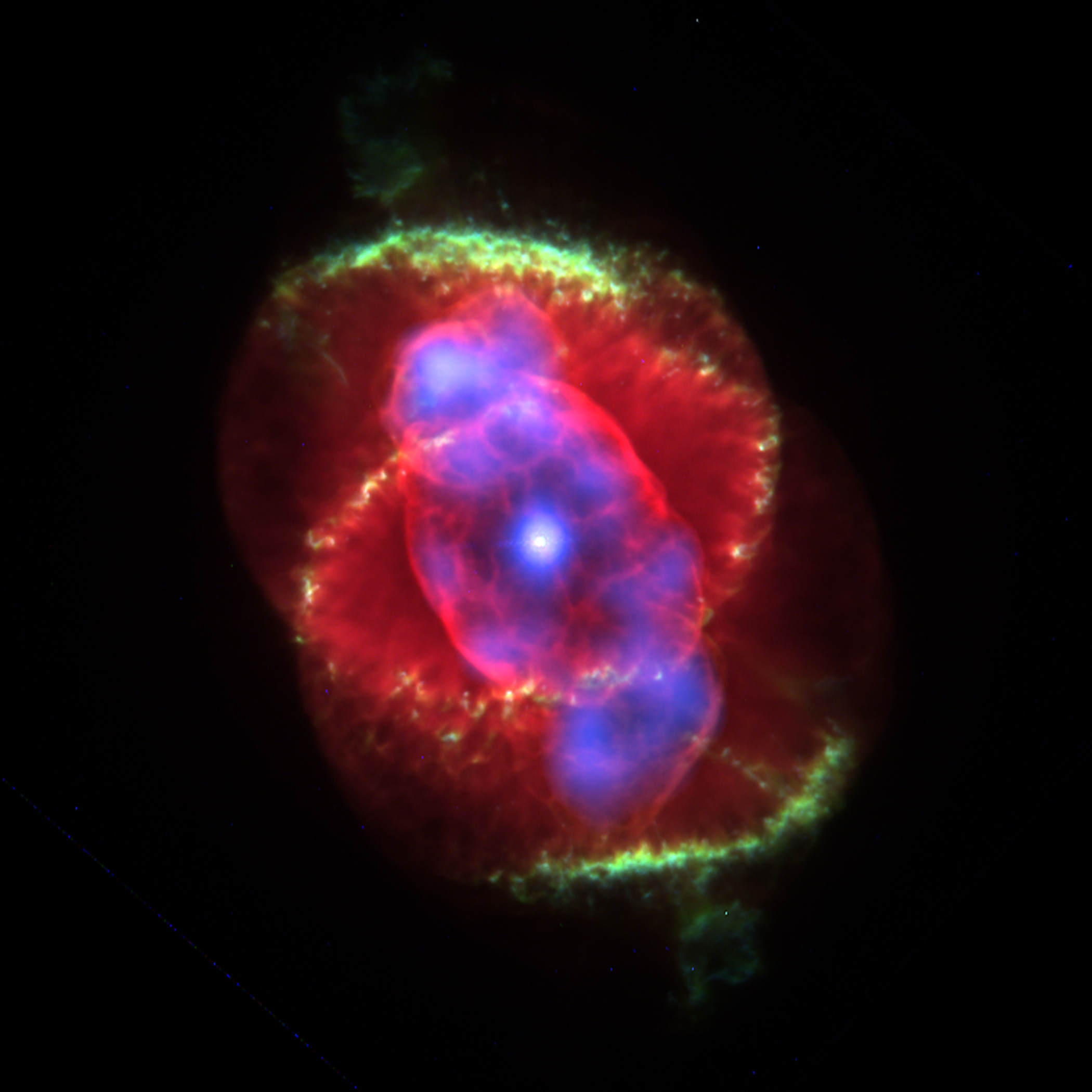
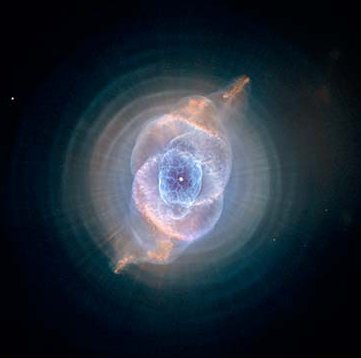
You know, almost all of those astronomical images are artificially colored and enhanced to maximize their ascetic appeal. Have a look at some of the various images of the cat's eye nebula to see. A quick Google turns up 5 different colorings:
http://www.daviddarling.info/images/Cats_Eye_Nebula.jpg
http://www.uni-sw.gwdg.de/~panders/Images/AstroImages/03_CatEyeNebula.jpg
http://www.spacetoday.org/images/Hubble/HubbleBeauty/CatsEyeNebulaNASA.jpg
http://upload.wikimedia.org/wikipedia/commons/5/5a/NGC6543.jpg
http://www.daviddarling.info/images/Cats_Eye_Nebula_2.jpg
The interpretation of the horsehead nebula is at least consistent (most of the time), but there is still plenty of artistic license being taken.
http://www.nasa.gov/images/content/52238main_MM_image_feature_89_jw4.jpg
http://www.nasa.gov/images/content/45506main_MM_Image_Feature_73_rs4.jpg
http://www.geocities.com/scott_metz/alternity/graphics/horsehead_nebula.jpg
http://www.sidewalk-astronomy-club.com/img/horsehead-nebula.jpg
http://www.fourthdimensionastroimaging.com/sitebuilder/images/horsehead-712x571.jpg
I was sort of disappointed when I found that out... -
Re:Awesome!
You know, almost all of those astronomical images are artificially colored and enhanced to maximize their ascetic appeal. Have a look at some of the various images of the cat's eye nebula to see. A quick Google turns up 5 different colorings:
http://www.daviddarling.info/images/Cats_Eye_Nebula.jpg
http://www.uni-sw.gwdg.de/~panders/Images/AstroImages/03_CatEyeNebula.jpg
http://www.spacetoday.org/images/Hubble/HubbleBeauty/CatsEyeNebulaNASA.jpg
http://upload.wikimedia.org/wikipedia/commons/5/5a/NGC6543.jpg
http://www.daviddarling.info/images/Cats_Eye_Nebula_2.jpg
The interpretation of the horsehead nebula is at least consistent (most of the time), but there is still plenty of artistic license being taken.
http://www.nasa.gov/images/content/52238main_MM_image_feature_89_jw4.jpg
http://www.nasa.gov/images/content/45506main_MM_Image_Feature_73_rs4.jpg
http://www.geocities.com/scott_metz/alternity/graphics/horsehead_nebula.jpg
http://www.sidewalk-astronomy-club.com/img/horsehead-nebula.jpg
http://www.fourthdimensionastroimaging.com/sitebuilder/images/horsehead-712x571.jpg
I was sort of disappointed when I found that out... -
Re:Chemical Rockets?
Well, according to the article, "Once there, astronauts could spend up to 16 months on the Martian surface, and would use nuclear energy to power their habitat." So, at least once they arrive they will be on nuclear power. I don't know why NASA wouldn't want to use NERVAs to go to Mars. Based on a quick google search I did, travel time to Mars would take around 90 days using NERVAs versus 6 months using the "advanced cryogenic fuel propulsion system" cited in the BBC article linked in the summary. Perhaps it would be too difficult to revive a program that has been dead since 1973. But given the radiation concerns NASA has about such a long mission, it seems like it would be worth it to cut travel time in half. - Joe
-
Re:Rob Peter to pay Paul
I'm glad you agree that the problem is not technical, but political/sociological. This is exactly what I think, except I have a little more faith in human race then you do.
It took over twelve years from the doom and gloom alarm over global warming before we even convened a pannel that created the Kyoto protocol.
Large asteroid is extinction event. Global warming is not, as far as we know (unless we overlooked some tipping point that would suddenly turn Earth into Venus). I like to believe that in face of such great danger, there would be proportionally effective response from the policymakers. You are, of course, free to believe otherwise and we won't know who's right until the day we can see it with our own eyes.
Let us hope this day will never come...
-
E8 is not the answer, M is the answer!
E8 is not the answer, M is the answer!
AFAIK, E8 is the largest exceptional Lie group, but why limit reality to Lie groups?
(http://en.wikipedia.org/wiki/Classification_of_finite_simple_groups)
I think our reality deserves to be described by the largest sporadic group, the Monster:
http://www.daviddarling.info/encyclopedia/M/Monstrous_Moonshine_conjecture.html
http://en.wikipedia.org/wiki/Monster_group
http://math.ucr.edu/home/baez/week66.html -
Re:top 10
Propulsion has been solved back in the 60s. The political will to fund the mission and tell the anti-nuke, "let's all go live in unheated mud huts to save the earth" crowd to bugger off is what's lacking. After all, why fund exploration and aspirations when there are farm subsidies and endless petty wars right at hand?
Computers aren't the issue here, mechanical engineering and guts are. -
Re:center of gravity?
That's why these rings are spun on their axis (which passes through the center of gravity) to simulate gravity via centripetal acceleration. Some call that "centrifugal force," but my high school physics teacher insisted (as do many textbooks) that this is an erroneous term because the force is "fictitious". (Yeah, being the smart-ass with the top grade in the class, I asked her how she explained the operation of a centrifuge -- especially one large enough to hold people, like certain carnival rides and their even bigger cousins that NASA uses for training of astronauts. The force doesn't feel so fictitious when you're inside the machine.)
There's also a big star in the middle of a ringworld, at least a Niven-style ringworld, so it's even more important not to allow the thing to collapse in on itself; spinning the structure solves this problem, but introduces another. It has been calculated that the substance the ring is made out of, called scrith in Niven's books, needs the tensile strength equivalent to the strong nuclear force to not tear itself apart. But if you can solve that engineering problem, then the ring and anything on its surface will stay ring-like and gravity won't cause everything to fall into the center of mass -- providing you spin the ring. -
Re:Bullshit, venus debunks you!
You're neglecting the effect of the Sulfuric Acid Cloud Layer on Venus. Also Mercury does not have any atmosphere. So, it's not a valid comparison.
-
Bullshit, venus debunks you!
venus is an example of how extreme co2 driven temperatures can rise.
and NO, it's not solar radiation alone, mercury is much cooler.
temperatures on venus are hot enough to melt lead, and this is with cloud cover reflecting a tremendous amount of sunlight back out into space.
no, this assertion of logarithmic effect is bullshit, and we have a huge model floating around the sun that disproves it. -
Re:time to educate the masses again...Orion and afterburners are as well (well, I'm not certain about the latter, and the former is only "combustion" in the loosest of general definitions, but it is external. Hopefully).
--
Evan -
Re:Iron? Am I wrong?
I agree, (type II) supernovae actually destroy their iron core in order to create heavier nuclei from the new, neutron-rich environment.
Here's a link:
http://www.daviddarling.info/encyclopedia/R/r-proc ess.html
Here, they are simulating a type I supernova: a white dwarf that 'steals' mass from its neighbor until it reaches some critical mass, and we see a supernova. -
We can see them from here.
Well, that would mean sending a robot probe first, I would think.
No need to do that: just build a big big f*ing telescope in orbit and we can even get small resolution images and atmospheric chemical composition analysis from here. And if we are really lucky, an existing European space telescope can already detect terrestrial planets around Epsilon Eridani (but they must have the right alignment). -
So simple.Pay OPEC to implement a secure system of energy rationing.
For those of you who do not know what a ration is, you get a given a book containing a limited number of coupons, usually by a government, but the current crop of Western Governments don't know the meaning of the word 'govern', so we have to look elsewhere for the coupon issuing authority. As well as parting with money you have to give the product vendor the number of coupons corresponding to the volume of product purchased.
Coupon book empty? So sorry, no more product!
Works wonderfully for food, gas, energy, and indeed products of all kinds. The result is healthy and self reliant communities, to say nothing of a World in which we can continue to live for many generations. Otherwise we face a Venusian future.
-
Prototype
Here's a snapshot of a prototype of what these artifacts will look like.
-
From Wiki, and I know I've read similar on NASA...
but I couldn't find it.
"Voyager 1 is not heading towards any particular star, but in 40,000 years it will be within 1.7 light years of the star AC+793888 in the Camelopardis constellation."
From http://www.daviddarling.info/
"An earlier planned route past Neptune would have resulted in the probe coming within 0.8 light-years of Sirius in just under 500,000 years from now - easily the closest and most interesting foreseeable stellar encounter of the four escaping probes. However, the Neptune flyby trajectory actually chosen (the "polar crown" trajectory) means that the nearest Voyager 2 will come to any star in the next million years is 1.65 light-years when it passes Ross 248 in about 40,000 years."
From that quote it looks like it was originally planned to fly by a star. The same site has this to say about Voyager 1: "Thereafter, it will have a journey lasting almost 40,000 years before it passes the M4 red dwarf AC +79 3888 at the remote distance of 1.64 light-years (0.50 parsec)." -
anthropomorphism at its best!
http://www.daviddarling.info/encyclopedia/A/anthr
o pomorphism.html It is really scary when scientists *never* think outside the box... -
Re:The hard truth
-
Spaceflight-specific, sort of.
David Darling has tons of info on spaceflight and advanced propulsion concepts. Some of them are present-day stuff, like ion thrusters and solar sails. Others are pure wild speculation, various forms of faster-than-light travel, etc. It's incredibly readable and quite broad.
Are you familar with ShouldExist and HalfBakery? They're also not sci-fi-specific, but a good place to check out ideas and post your own. -
Observations...
I'm a little skeptical of their method. TFA mentions that the quasar was lensed by a foreground galaxy and they measured the flickering as individual stars lensed the quasar. It just doesn't work that way. When a galaxy gravitationally lenses a background object, the image will appear as an arc or multiple points around the lensing galaxy. This configuration doesn't allow for flickering due to individual stars because you are using the combined masses of all those stars to do the lensing. Given that a typical galaxy has 100 billion stars, any individual effects are
Reading some more into it, I found the paper:
http://arxiv.org/PS_cache/astro-ph/pdf/0505/050551 8.pdf
Lots of math and theory, but no data to be had, which I find suspicious... I did some googling on the quasar Q0957+561 and found several links.
This site, by the author:
http://cfa-www.harvard.edu/~rschild/qgl.html
This goes into how measuring the time delay between the flickering images of the quasar can give an estimate on the age of the universe (correlation between geometric distance and redshift). Also, he seems to have a persecution complex....
Also:
http://www.extrasolar.net/planet.asp?PlanetID=74
Again, the same author suggests a minute fluctuation in one lensed image and not the other is consistent with a microlensing event by a planet in the foreground galaxy. I still don't see how you can say that since the paper in the first link talks about how years of observations and statistical correlations were needed to make the discovery of the MECO. One fluctuation out of many observations is like spitting in the ocean...
This link gives an alternate explanation for the planet microlensing event:
http://www.daviddarling.info/encyclopedia/Q/Q0957+ 561.html
And the obligatory Wikipedia article:
http://en.wikipedia.org/wiki/Twin_Quasar
One thing I noticed is that most of sites I found are either from the author himself or use his papers as the primary source. He also appears to have his fingers in everything from determining the age of the universe (his estimate was 12 billion years as opposed to 13.7 billion, but still pretty good), detecting extrasolar planets, and now debunking black holes. Dr. Schild has done some good work, but I'm skeptical of his recent "discoveries". -
Re:Impressive turn-around time, too...
What? Not even one of these
-
Re:Inflatable?
Well, there's also the Whipple Shield, which puts a thin layer of material a distance from the main vehicle. Small space debris will hit the thin piece of metal and disintegrate because of the high velocity/energy. The main shield then has to protect against a force diffused over a larger surface area.