Slashdot Mirror
Domain: ec.gc.ca
Stories and comments across the archive that link to ec.gc.ca.
Comments · 118
-
Re:re-read
I was not specific - I said under most situations. I was NOT specifically referring to water. Actually, I was thinking paint and then gasoline both which took way too long to catch up with expert opinion (which should be enough when health and safety are involved... except profit $$$ so then it has to be 100% scientific consensus...)
I can only gather from your previous post and this one that you believe that unleaded gasoline and lead-free paint all have 0 parts per billion of lead in them, correct?
I'm not sure how else to read your claim that there is NO safe acceptable level under most situations, and that you have no specifically listed gasoline and paint as examples. Of course you still provide no citations, so let me include another of my own. In addition to the lead standards on water, here is the canadian standards for lead in unleaded gasoline and the EPA standard for lead in paint. These are just the first google results to come up, but they each demonstrate set levels of greater than 0 bpp.
http://www.ec.gc.ca/lcpe-cepa/...
https://www.epa.gov/lead/hazar...
You see, the thing is that at such a detailed level, you can measure the amount of toilet water that gets onto your toothbrush everyday. You can pick a small enough quantity of arsenic or plutonium to consume everyday that you'll be fine, even if that numbers is something like 0.001 pbb. You don't seem to know what your talking about and your failure to provide any references is reinforcing that impression.
-
Re:Don't give him ideas
> I would like to get Emergency Alerts ("flash flooding in your area for the next two
> hours") while disabling Amber alerts ("child abducted by parent 500 miles away."
> Seriously. The last Amber Alert I got was two months ago for an event 383
> miles away.. which had happened 18 hours earlier). How do I do that?If you want to do that at home, and you live in North America...
* block the messages on your cellphone
* get a weather radio for USA http://www.nws.noaa.gov/nwr/ or Canada https://www.ec.gc.ca/meteo-wea... depending on where you liveThey work in standby mode, and come on when the appropriate signal is transmitted.
-
Re:Denied!
"The countries that have refused to sing/ratify"
Who are they?
The US (signed, but never ratified)
Canada (ratified, then withdrew in 2011)
Andorra
South Sudan
Palestine
The Vatican."collectively reduced their carbon emissions"
Ok, I'll ignore the minnows (I assume I can ignore the CO2 emissions of Andorra).
The idea is to reduce emissions from the 1990 base line, so how have the US and Canada done?
Carbon dioxide (CO2) emissions in te United States increased by about 7% between 1990 and 2013.
and. looking at the graph, emissions rose steadily to 2008 then fell quite a bit. Seems causing a major economic downturn is the way the US cuts its emissions, not fracking.
And Canada? Same story, rose from 600 megatonnes C to 700, steady rise 'till 2008, sudden drop, then a slow rise since 2010-2011..
"by more than those that did sign up".
Well, no. The EU and Russia have reduced their emissions since 1990, Japan has very slightly increased them, but nothing like the emissions growth of the US or Canada.
Looks like you need to do a little more reading.
-
Re: Coral dies all the time
comparing at equal pressures gives more of an apples to apples comparison. Since you can clearly see how radically the temperatures fluctuate based on pressure.
Um, well yeah. The temperatures on different planets are very different, even at the same pressure - as you'd expect, given all the other differences, like distance from the Sun, cloud cover, chemical composition and who knows what else. I'm really not sure where you're going with all this. It certainly doesn't show that "the chemistry of the atmosphere makes almost no difference." It just shows that there are a lot of factors that determine temperature. The pressure may be "apples to apples" but nothing else is.
And of course the temperature goes up & down with the pressure at different altitudes; that's the Pressure-Temperature law I linked to earlier. Perhaps I'm missing something, but I don't see what any of this has to do with the Greenhouse Gas effect.
As to trapping heat... CO2 is hardly unique in this feature nor do I see why it plays a special role in the Earth atmosphere.
What's different about CO2 compared to the other, stronger greenhouse gases like water vapour and methane is that it accumulates over a long time.
Water vapour is a stable quantity in the atmosphere (for a given temperature). Any excess simply precipitates out as rain. It doesn't increase, at least not until you start warming the air up.
Methane does accumulate, for a while - but it is broken down by UV light over a period of years, so it has only a short term effect as well. It can still be a problem (e.g. if melting permafrost like the Siberian Traps releases significant methane into the atmosphere, which is a real concern and could trigger other warming feedbacks), but it doesn't build up over a long time, so any direct effects of a methane pulse are short-lived.
CO2 takes centuries to be removed from the atmosphere. This is done by vegetation, to a small extent, but the vast majority of CO2 uptake is done by the ocean. Even so, this is a slow process. CO2 has been building up rapidly in our atmosphere, and even if we stopped emitting ALL anthropogenic CO2 tomorrow, it would still take centuries to return to pre-industrial levels. Worse, much of that CO2 being absorbed by the oceans is being converted to carbonic acid, which is resulting in ocean acidification - a decreasing pH that we've been observing for some time, and is already having measurable results on sensitive ocean ecosystems.
I had a hard time finding a graph for CO2 ironically... maybe you can help me out there.
I did find this which should serve: https://commons.wikimedia.org/...
Yep, that looks like a useful graph. It's certainly clear that water vapour has a bigger effect - but the primary point here is that CO2 also blocks outgoing energy. It's in addition to the effect of water vapour. Water doesn't "black out" the effect of CO2, it adds to it, trapping more energy.
While the water vapour effect is bigger, the CO2 effect is added to this - and that is steadily increasing, as the CO2 in our atmosphere increases. This is enough extra trapped energy to change the temperature equilibrium of our planet; we've done the maths. See e.g. Myhre '98 for how this is forcing value is derived, while Puckrin '04 compares our radiative flux models for a variety of greenhouse gas mixes with atmospheric observations, and finds them to agree well.
Have a look here for a comparison of the radiative forcing values of the significant greenhouse gases, particularly the Greenhouse Gases section and
-
Re:Shoot Them?
Why not shoot the geese? The article didn't say that they were protected, endangered, or otherwise not-shootable. Is the section of Ottaway the geese are polluting not safe for discharging firearms?
In New Mexico, we have a number of animals that require culling (due to the elimination of top level predators) and the way New Mexico Game and Fish solves the problem is by issuing hunting licenses. This seems to work pretty well for us.
Bloody good question, as a resident of the Ottawa area I can testify that there doesn't exactly seem to be a shortage of geese, and in some places they really are a nuisance.
So I did a little digging, sure enough our efficient government have created a Canada Goose FAQ. And it turns out that the little buggers are protected under the Migratory Birds Convention Act because their migratory. However:
The Act gives the federal government the responsibility to establish hunting seasons, and Canada Geese are greatly appreciated by migratory game bird hunters across the country. More than 500 000 Canada Geese are taken in Canada each year by hunters.
Migratory Birds Hunting Regulations, 2013–2014: Ontario
There is an open season on the Canada Goose from the beginning of September to the middle of December. But with a limit of 5 geese per licenced hunter per day.
So yes, hunting geese is an option, but no, just shooting them in the spring would be illegal.
TL;DR -- It's the nesting season, their migratory and there's international agreements covering the treatment of migratory birds, we can only hunt/shoot them in the fall.
-
Re:Shoot Them?
Why not shoot the geese? The article didn't say that they were protected, endangered, or otherwise not-shootable. Is the section of Ottaway the geese are polluting not safe for discharging firearms?
In New Mexico, we have a number of animals that require culling (due to the elimination of top level predators) and the way New Mexico Game and Fish solves the problem is by issuing hunting licenses. This seems to work pretty well for us.
Bloody good question, as a resident of the Ottawa area I can testify that there doesn't exactly seem to be a shortage of geese, and in some places they really are a nuisance.
So I did a little digging, sure enough our efficient government have created a Canada Goose FAQ. And it turns out that the little buggers are protected under the Migratory Birds Convention Act because their migratory. However:
The Act gives the federal government the responsibility to establish hunting seasons, and Canada Geese are greatly appreciated by migratory game bird hunters across the country. More than 500 000 Canada Geese are taken in Canada each year by hunters.
Migratory Birds Hunting Regulations, 2013–2014: Ontario
There is an open season on the Canada Goose from the beginning of September to the middle of December. But with a limit of 5 geese per licenced hunter per day.
So yes, hunting geese is an option, but no, just shooting them in the spring would be illegal.
TL;DR -- It's the nesting season, their migratory and there's international agreements covering the treatment of migratory birds, we can only hunt/shoot them in the fall.
-
Re:Shoot Them?
Why not shoot the geese? The article didn't say that they were protected, endangered, or otherwise not-shootable. Is the section of Ottaway the geese are polluting not safe for discharging firearms?
In New Mexico, we have a number of animals that require culling (due to the elimination of top level predators) and the way New Mexico Game and Fish solves the problem is by issuing hunting licenses. This seems to work pretty well for us.
Bloody good question, as a resident of the Ottawa area I can testify that there doesn't exactly seem to be a shortage of geese, and in some places they really are a nuisance.
So I did a little digging, sure enough our efficient government have created a Canada Goose FAQ. And it turns out that the little buggers are protected under the Migratory Birds Convention Act because their migratory. However:
The Act gives the federal government the responsibility to establish hunting seasons, and Canada Geese are greatly appreciated by migratory game bird hunters across the country. More than 500 000 Canada Geese are taken in Canada each year by hunters.
Migratory Birds Hunting Regulations, 2013–2014: Ontario
There is an open season on the Canada Goose from the beginning of September to the middle of December. But with a limit of 5 geese per licenced hunter per day.
So yes, hunting geese is an option, but no, just shooting them in the spring would be illegal.
TL;DR -- It's the nesting season, their migratory and there's international agreements covering the treatment of migratory birds, we can only hunt/shoot them in the fall.
-
Re:Shoot Them?
Why not shoot the geese? The article didn't say that they were protected, endangered, or otherwise not-shootable. Is the section of Ottaway the geese are polluting not safe for discharging firearms?
In New Mexico, we have a number of animals that require culling (due to the elimination of top level predators) and the way New Mexico Game and Fish solves the problem is by issuing hunting licenses. This seems to work pretty well for us.
Bloody good question, as a resident of the Ottawa area I can testify that there doesn't exactly seem to be a shortage of geese, and in some places they really are a nuisance.
So I did a little digging, sure enough our efficient government have created a Canada Goose FAQ. And it turns out that the little buggers are protected under the Migratory Birds Convention Act because their migratory. However:
The Act gives the federal government the responsibility to establish hunting seasons, and Canada Geese are greatly appreciated by migratory game bird hunters across the country. More than 500 000 Canada Geese are taken in Canada each year by hunters.
Migratory Birds Hunting Regulations, 2013–2014: Ontario
There is an open season on the Canada Goose from the beginning of September to the middle of December. But with a limit of 5 geese per licenced hunter per day.
So yes, hunting geese is an option, but no, just shooting them in the spring would be illegal.
TL;DR -- It's the nesting season, their migratory and there's international agreements covering the treatment of migratory birds, we can only hunt/shoot them in the fall.
-
Re:Projections
http://www.epic.noaa.gov/epic/...
http://www.giss.nasa.gov/tools...
http://edgcm.columbia.edu/
http://nomads.gfdl.noaa.gov/CM...Some data: http://www2.cesm.ucar.edu/
Some background info:
http://www.ec.gc.ca/ccmac-cccm...
http://www.climateprediction.n...
http://www.climate.uvic.ca/
https://www.ipcc.ch/pdf/techni...This one has videos: http://vimeo.com/user12523377/...
In this age of information, ignorance is a choice.
-
Re:But
Since when does fresh water not count as a natural resource? Quebec has the largest fresh water reserves in Canada (Statistics Canada) and largely contributes to Canada containing 3 of the world's renewable freshwater reserves (Environment Canada).
(FYI: there are more senators in Quebec than Alberta for historical reasons. This was adopted to ensure that both French- and English-speakers from Quebec were represented appropriately in the Senate Senate of Canada)
-
Of course it's just weather
By definition, this is "weather", not "climate", it only lasts a week.
Climate change is defined by decades at a very minimum. Climate change is this:
http://www.ec.gc.ca/adsc-cmda/default.asp?lang=en&n=8C03D32A-1
Environment Canada takes readings every day, in hundreds of locations outside urban heat islands, and averages them across a whole season to get an average temperature. And then it graphs that number for every year since 1945. While even that graph swings wildly up and down from year to year and even has warmer and colder decades, the regression across almost 70 years shows a steady upward trend. It's most dramatic for our winter (2.8C) but all the seasons have shown statistically significant increases.
I was a huge skeptic until about 2004, but this and several papers I managed to puzzle my way through, plus the book "The Ice Chronicles", finally brought me around by about 2006.
Yes, there are Snowmaggedons. And there are these. And when you add them all up, the warmer spells are getting a little more frequent and the colder spells a little less so. Over decades. That's climate.
-
Re:We could have balanced commentary... nahhh
I ducked nothing - the fact is you have not presented a single fact in all your posts while I have presented many facts and pieces of data. When you start backing up your wild claims with some actual facts then maybe you can try to make demands, but hand waving doesn't get you there.
Frankly, I find that argument more apt to you than me. You've presented exactly one fact in this argument to support your conclusion that the conservatives are better at curbing emissions than the Liberals. And that alleged fact is that emissions were lower in Canada in 2009 than in 1998. You have not cited where your number comes from and I have explained the facts that would lead us to expect emissions to fall in 2009. You also haven't been willing or able to explain what you think the Conservatives actually did to decrease emissions by 25% in 1 year.
The reason is that they didn't do anything. The two largest contributors to greenhouse gases in Canada are oil production, transportation, and electricity generation in that order. Both oil production and electricity fell during the recession because demand fell significantly. These are facts. It is a fact, that GDP didn't grow in 2009, it shrank by more than 3%. It is a fact that during a recessionary year, our emissions were still 17% over Kyoto targets.
Even the Conservative Government credits the reductions in 2008 to slower economic growth and less coal-fired power. Power generation is a provincial matter, not a federal one.
Now if we look at the actual reasons why GHG emissions increased between 1990 and 2009, 54% comes from fossil fuel industries, and 45% from transportation. Which means the single largest contributor to the failure to meet Kyoto targets? Alberta. The booming oil industries in Alberta are responsible for almost half of the increase in GHGs.
Frankly, I find your hostile and abusive behavior to be the real polarizing problem here. I have been more than fair, I attribute blame to both the Liberals and the Conservatives, yet you can't seem to accept that. I made one comment about the Prime Minister, at the outset, I have not invented any conspiracies. Unless you somehow think recessions are conspiracies. I have repeatedly shown that the facts don't mean what you think they mean and you have repeatedly ignored everything I have written, to criticize me for not agreeing with you.
Considering you can't even recognize that context is vitally important when discussing trends and the fact that you think the largest recession in decades isn't important to the numbers under discussion, leads me to believe that you are clueless partisan with no interest in actual discussion. I'm done here.
-
Re:More detailed explanation
Environment is provincial jurisdiction.
Riiight. So the federal ministry of the environment, http://www.ec.gc.ca/default.asp?lang=En
the federal minister of the environment, http://www.ec.gc.ca/default.asp?lang=En&n=B6832638-1
and the many federal environment laws http://www.ec.gc.ca/default.asp?lang=En&n=48D356C1-1
don't exist? If this was all unconstitutional, they would have been laid off long ago.
-
Re:More detailed explanation
Environment is provincial jurisdiction.
Riiight. So the federal ministry of the environment, http://www.ec.gc.ca/default.asp?lang=En
the federal minister of the environment, http://www.ec.gc.ca/default.asp?lang=En&n=B6832638-1
and the many federal environment laws http://www.ec.gc.ca/default.asp?lang=En&n=48D356C1-1
don't exist? If this was all unconstitutional, they would have been laid off long ago.
-
Re:More detailed explanation
Environment is provincial jurisdiction.
Riiight. So the federal ministry of the environment, http://www.ec.gc.ca/default.asp?lang=En
the federal minister of the environment, http://www.ec.gc.ca/default.asp?lang=En&n=B6832638-1
and the many federal environment laws http://www.ec.gc.ca/default.asp?lang=En&n=48D356C1-1
don't exist? If this was all unconstitutional, they would have been laid off long ago.
-
Re:Get your facts straight
Passing a bill, as the opposition, telling the government they have to somehow reach the Kyoto targets...
Yeah, that's real bold action there.
It's easy to say you want to achieve the targets, the problem is actually doing something to achieve those targets. That's the unpopular part that generally gets parties in trouble, that's why the other parties didn't propose any specific measures, they wanted the credit for achieving Kyoto, but they also wanted the Conservatives to take the political hit for taking the necessary action (and don't imagine the opposition would let them off easy).
The truth is since 1990 the only thing that's slowed emissions is the recession.
We actually did have one party actually try to take specific action to achieve Kyoto once, Stephane Dion ran on a platform of introducing a carbon tax, and then he lost the election because voters didn't want to pay for carbon (even though the tax was supposed to be revenue neutral and be offset by reductions in income tax).
We didn't cut our carbon because our economy and population were both growing. Now we could have done better than we did, more fuel efficient vehicles, starting to clean up our power generation, etc. However, since we had no shot at the Kyoto targets without major economic consequences we didn't have much motivation to do anything in between. I really think Kyoto was flawed that way and there needed to be some mechanism for countries with big primary industry, who obviously weren't going to hit Kyoto, to make gains from some intermediate action rather than volunteering to a giant slap on the wrist at the end.
As it is just yesterday we threw away an opportunity to clean up the oilsands, though in this case the environmental movement is probably more to blame.
-
Re:"Our" Fault?
Oh, will you stop with the "one simple rule that the Canadians require"? This myth started during the BP disaster and has persisted, but it's completely false. Canadian jurisdictions do not require "relief wells to be drilled in parallel with the main bore". In fact, I don't know of any jurisdiction in the world that requires that.
Two blowouts have occurred in the offshore areas of Canada in the vicinity of Sable Island, offshore Nova Scotia. They happened back in the 1980s. One of them required a relief well to be drilled to bring it fully under control but had no significant release into the environment (it was mainly a sub-surface blowout), the other did not (was handled on board the initial rig). Both involved natural gas wells, and therefore had minimal environmental impact. Sable Island is a very fragile, protected area. The effect from the one with the release was hardly noticeable there because of favorable winds, and the very light oil/condensate associated with the blowout quickly broke down naturally (it was ~1500 barrels). The nature of the oil and/or gas and the amount makes a big difference in terms of environmental impact. Anyway, no parallel relief wells were required to be drilled then, no parallel relief wells are required now.
What is being considered in Canada is a regulation along those lines only in the Canadian Arctic because in that location the seasonal sea ice dictates that if a blowout occurred, it might be a full season before equipment could be moved into the area to drill a relief well (i.e. another rig). And it's only one idea under consideration for dealing with the special conditions in the Arctic Ocean. Other options exist and are also being considered.
Drilling a parallel relief well wouldn't be a panacea anyway. There are risks drilling any well, and the relief well could experience a blowout too.
-
Re:The "law"
It looks like it is handled directly thru the gov't.
http://www.ec.gc.ca/energie-energy/default.asp?lang=En&n=6766D86C-1
Are your electric companies gov't owned up there? Or are they gov't regulated, but privately owned?
-
Re:Define "toxic"
Section 64 of CEPA 1999 defines a substance as toxic "if it is entering or may enter the environment in a quantity or concentration or under conditions that: have or may have an immediate or long-term harmful effect on the environment or its biological diversity; constitute or may constitute a danger to the environment on which life depends; or constitute or may constitute a danger in Canada to human life or health." That's the definition they use. It is up to the government to determine what is a "long-term harmful effect" on human life or health. They have conducted studies indicating it is acutely toxic (determined by LD50, like you suggest) to aquatic life, so that's "immediate or long-term harmful effect on the environment or its biological diversity". Also, it's been found, by Canadian, US, and EU studies, to have a significant effect on fetal and childhood development. Specifically on the development of the brain and prostate gland. This makes it a "reproductive toxin" as described in CPR (Controlled Product Regulations) sections 55 and 58. This is not done by LD50, but by evaluation of studies as to whether or not current studies indicates "Evidence of a physiological effect". They looked at those Canadian, American, and European studies, and concluded that there is in fact evidence of physiological effect. So, while it is not toxic in the sense of having an LD50, it is toxic by their definition of having a physiological effect on fetal and child development. Anywho, here is the Environmental Protection Act that defines that stuff. And here is the actual announcement from the government, which you can reach from TFA if you follow enough links.
-
Re:secrecy and data hiding
And I doubt there are any nations in the world licensing weather data.
How about Canada or New Zealand, or EU wide. The UK data is licensed by the MET Office and the Department for Rural Affairs.
And that's just from a 30 second Google search.
-
Humdity
I'm an Aussie living in Melbourne so I get the joke. Occasionaly we get a news report of a London heat wave with a few days around 30degC, old people are dropping dead and young people are splashing around half naked in city fountains. It seem bizzare since a hot day here is 10-15degC hotter and we don't have dramas with old people until it gets around 40 or above.
A few years back I went on my first trip to the UK (at the end of July) we had a 3 day stop over in Hong Kong on the way. Hong Kong was as unbearable as Darwin is in the wet season, 30-35 deg, no breeze and near 100% humidity. As we were approaching London the pilot announced the temprature in London had just broken it's record maximum temp ( 32degC IIRC ). The wife and I snickered at each other...the english have no idea what hot is... We stopped snickering as soon we walked out of the airport and hit a wall of warm humid air that was exactly like Hong Kong or Darwin, the only weather difference between the three places was the pollution levels.
Of course the reason for the discomfort is high humidity from the massive ocean currents that bring warm water from the Gulf of Mexico. -
Re:Oh, Canada, what shall we call it?
And as it happens, the government, or at least parts of it, still use WordPerfect extensively.
Actually I don't know any Canadian federal department that still uses WordPerfect, heck I don't even know if the last version works under Windows XP. That's not to say some underfunded group like Indian and Northern Affairs Canada, Parks Canada, or Canadian Wildlife Service doesn't.
Treasury Board and nearly everyone in Ottawa (nation's capital) uses MS Office as a corporate standard.
The department I've associated with uses MS Office nationally, but my small group uses OpenOffice internally. I don't even run MS-Window on my desktop or laptop.
Environment Canada, Department of National Defence, Communications Security Establishment, and I believe the Coast Guard have groups or divisions that use Linux or *BSD (OpenBSD for certain), and tools like KDE, GNOME, Apache, Tomcat, Perl, PHP, GCC, netfilter, pf, OpenSSH, Squid, bind, and plenty of other common open source / Free Software for desktops (think engineering workstatons, not too many office PCs), and servers.
-
Re:As a Rhode Islander
Funny that, I was looking at the US per-state GDP just last night.
Oregon is a nice place. I was through Portland many years ago after biking from Port Angeles around the mountainous backside of Washington, then back inland along the Columbia River through to Portland (elevation 60 feet IIRC) where we visited Peter Norton's alma mater, the west again to the Oregon coast along the Van Duzer corridor, a rather wussy pass through the Rockies as these things go, but we happened to buck the headwind of all time. On a Ferry, I would have been looking for spray. One of those days where you crest a false flat, then gear *down* for the descent.
Portland reminded me of Vancouver, minus East Hastings, but also minus the international food scene. Mother-earth Birkenstocks, check. Birkenstocks with purple daisies, check. Birkenstocks with bike cleats, check. What's not to like?
Let's take a GDP stroll mostly along the Appalachians, the one region of the US I've never visited (unless you count Pittsburgh).
44 Kentucky 29,842
45 Alabama 29,697
46 South Carolina 29,642
47 Oklahoma 29,545
48 Montana 27,942
49 Arkansas 27,875
50 West Virginia 24,748
51 Mississippi 24,062
The only reason Oregon looks bad by any measure is having done so little with so much. Reminiscent of the Hudson's Bay Company, the oldest commercial corporation in North America. Sold off more assets than Rockefeller and Carnegie combined (fur trade, oil and gas, trans-continental railway rights, etc.) but always kept its eye on the prize: $10 dress shirts. With a competent management team, a business plan, a vast supply-chain infrastructure, a will to succeed, a grasp on reality, and lots of immigrant labour, it could have been Walmart. Who knew?
If you want a cheap cooling bill at the site of massive Hydro infrastructure, check out Cold and colder.
Kitimat would need undersea cables tapping into the Pacific grid, but if you wanted your data center to resemble Cheyenne Mountain, that could be arranged. In Sept-Iles you would enjoy the language laws and two layers of Federal government. In both locations you would enjoy Canadian privacy laws we have passed, and the DMCA we haven't yet passed. 30 annual days with a high above 20 degrees C (68 F). 100MW there would barely ripple the meters.
You'd end up with higher latencies, and less routing redundancy. The ports and heavy infrastructure would be world class, but you might also discover that Fedex doesn't guarantee same week delivery for six months out of the year.
The one concession I would have demanded from Google at Dulles is an Enron-esque contract to shed load during a grid crisis. Should be no problem for Google to design the data center to shed load a a MW/minute for half an hour. The spiders, for example, can tolerate a little downtime. Plus Google has the capacity to load-balance globally.
Not many people realize this, but the phone companies in the 1970s routinely routed long distance calls from Boston to Tampa through western time zone -
Re:As a Rhode Islander
Funny that, I was looking at the US per-state GDP just last night.
Oregon is a nice place. I was through Portland many years ago after biking from Port Angeles around the mountainous backside of Washington, then back inland along the Columbia River through to Portland (elevation 60 feet IIRC) where we visited Peter Norton's alma mater, the west again to the Oregon coast along the Van Duzer corridor, a rather wussy pass through the Rockies as these things go, but we happened to buck the headwind of all time. On a Ferry, I would have been looking for spray. One of those days where you crest a false flat, then gear *down* for the descent.
Portland reminded me of Vancouver, minus East Hastings, but also minus the international food scene. Mother-earth Birkenstocks, check. Birkenstocks with purple daisies, check. Birkenstocks with bike cleats, check. What's not to like?
Let's take a GDP stroll mostly along the Appalachians, the one region of the US I've never visited (unless you count Pittsburgh).
44 Kentucky 29,842
45 Alabama 29,697
46 South Carolina 29,642
47 Oklahoma 29,545
48 Montana 27,942
49 Arkansas 27,875
50 West Virginia 24,748
51 Mississippi 24,062
The only reason Oregon looks bad by any measure is having done so little with so much. Reminiscent of the Hudson's Bay Company, the oldest commercial corporation in North America. Sold off more assets than Rockefeller and Carnegie combined (fur trade, oil and gas, trans-continental railway rights, etc.) but always kept its eye on the prize: $10 dress shirts. With a competent management team, a business plan, a vast supply-chain infrastructure, a will to succeed, a grasp on reality, and lots of immigrant labour, it could have been Walmart. Who knew?
If you want a cheap cooling bill at the site of massive Hydro infrastructure, check out Cold and colder.
Kitimat would need undersea cables tapping into the Pacific grid, but if you wanted your data center to resemble Cheyenne Mountain, that could be arranged. In Sept-Iles you would enjoy the language laws and two layers of Federal government. In both locations you would enjoy Canadian privacy laws we have passed, and the DMCA we haven't yet passed. 30 annual days with a high above 20 degrees C (68 F). 100MW there would barely ripple the meters.
You'd end up with higher latencies, and less routing redundancy. The ports and heavy infrastructure would be world class, but you might also discover that Fedex doesn't guarantee same week delivery for six months out of the year.
The one concession I would have demanded from Google at Dulles is an Enron-esque contract to shed load during a grid crisis. Should be no problem for Google to design the data center to shed load a a MW/minute for half an hour. The spiders, for example, can tolerate a little downtime. Plus Google has the capacity to load-balance globally.
Not many people realize this, but the phone companies in the 1970s routinely routed long distance calls from Boston to Tampa through western time zone -
Re:Fantastic for Students and New Researchers
That's really weird that this appeared on Slashdot tonite, just as I was downloading the historical weather data for Canada. Still waiting for it to download. I was thinking that it would be a nice data set that would be interesting to work with. It's not a huge dataset by any means, only 200 MB zipped, but it's still bigger and more real than any of the stuff I got to use in university. And a lot larger than any real data set I could generate on my own. Does anybody else have any links to interesting open data sets?
-
Re:abandonment of sovereignty?
First the facts...
http://en.wikipedia.org/wiki/Wickard_v._Filburn
"Despite these notices Filburn planted 23 acres and harvested from his 11.9 acres of excess area 239 bushels. "
That's about 15,000 pounds of extra wheat. Even at today's prices ("prices soar to $10 per bushel" http://money.cnn.com/2007/12/17/news/economy/wheat_prices.ap/index.htm) , that's about $150,000 dollars worth of extra wheat today so assume similar purchasing power back then.
Looking over daily consumption for cattle: http://www.ec.gc.ca/ceqg-rcqe/English/Html/Table1_agriculture.cfm I see about 20 pounds a day of grain. 15,000 pounds of extra grain would last about 750 "cow days". So two cows for a year. A lot of pigs or sheep.
That is a minuscule amount of wheat to throw away the constitution and state's rights for. -
Re:Article is useless without a graph!
Quebec did not separate October 30, 1995 The cities of Montreal, and Hull had good weather.
http://www.climate.weatheroffice.ec.gc.ca/climateData/hourlydata_e.html?timeframe=1&Prov=QC&StationID=5415&Year=1995&Month=10&Day=10
http://www.climate.weatheroffice.ec.gc.ca/climateData/hourlydata_e.html?timeframe=1&Prov=ON&StationID=4337&Year=1995&Month=10&Day=10
How is that for democracy. 50.5% ha, it could have easily gone the other way.
p.s. A large portion of Quebec economy is generated with North-South Trade with the USA.
Quebec would do alright if separated. it would take quite a financial hit but it would bounce back. It has the resources and positioning to do so. -
Re:Article is useless without a graph!
Quebec did not separate October 30, 1995 The cities of Montreal, and Hull had good weather.
http://www.climate.weatheroffice.ec.gc.ca/climateData/hourlydata_e.html?timeframe=1&Prov=QC&StationID=5415&Year=1995&Month=10&Day=10
http://www.climate.weatheroffice.ec.gc.ca/climateData/hourlydata_e.html?timeframe=1&Prov=ON&StationID=4337&Year=1995&Month=10&Day=10
How is that for democracy. 50.5% ha, it could have easily gone the other way.
p.s. A large portion of Quebec economy is generated with North-South Trade with the USA.
Quebec would do alright if separated. it would take quite a financial hit but it would bounce back. It has the resources and positioning to do so. -
Re:Meteorology
In Canada the largest employer would be Environment Canada and they basically look for someone with a B.Sc. in Physics, Mathematics (typical, will accept other science degrees typically) and an approved one-year diploma or certificate in meteorology. They pay you to attend a 9 month in-house training program (the pay isn't great, but it's free education).
Meteorologist - Environment Canada
Oh yeah, AFAIK they are looking for staff, and I think they have lots of openings. Plus they pay their Met staff better than their IT staff. You can make around 100k without going into management. -
compound info
These polybrominated diphenyl ethers are compounds that are thought to cause damage to the environment at higher levels than today but this could change. the long term health effects of these chemicals isn't as well known as we would like but is's probably a good idea to go on the side of caution [thalidamide and t-butyl methyl ether to name a few that went horribly wrong] although right now industry won't like it because they can't make money off of their sale, it is much better to be alive and healthy because of the ban and lose money than the alternative. US gov PBDE faq http://www.atsdr.cdc.gov/toxprofiles/phs68-pbde.h
t ml canadian PBDE faq http://www.ec.gc.ca/CEPARegistry/documents/subs_li st/PBDE_draft/PBDEfaq.cfm -
Re:Same as our Softwood lumber
In the early 1990s, the US listened to environmentalists who were concerned about the Northern Spotted Owl, and banned almost all logging in old-growth areas of national forests in the Pacific Northwest, which had been the cheap source of softwood lumber.
In Canada, the government ignored the environmentalists.
This is why softwood lumber from Canada is much cheaper than from the United States. It is also why the Spotted Owl is nearly extinct in Canada. Its numbers there decreased from about 200 in 1993, to about 22 in 2006.
Canadians are continually told about how poor the environmental protection is in the US, and how the government is doing great things to protect the environment in Canada. It's not true. Almost all environmental protections are stronger in the US than in Canada. Even in the area of greenhouse gas emissions, Canada is actually further from Kyoto compliance than the US. Not that the US is doing anything good in that area. In 2004, it was 16% above its 1990 baseline of emissions. Yet somehow Canada has managed to do even worse, with emissions at 27% above the 1990 baseline.
But then, this is one of those areas which defies the common wisdom. Even when confronted with the plain, well-documented facts, people simply refuse to believe it.
So, go on believing that Canada is in the right here. There's probably no amount of evidence that would convince the typical person anyway. -
Re:We Stand On The Shoulders of Giants
"Speaking of bad weather, I think these guys - http://www.metoffice.gov.uk/ who are the authority on weather prediction in the UK. Use Fortran for weather forecasting and climate prediction http://www.metoffice.gov.uk/research/nwp/numerica
l
Same thing with Meteorological Service of Canada ( http://www.msc-smc.ec.gc.ca/ ). Fortran is all over the place, here. Most of our programs that handle meteorological or air quality data are written in some species of Fortran.
-HT -
Re:Competition, competition, competition
To be fair, most of the Canadian population is in a short strip within a few hundred miles of the Canada-US border. In fact, half of the Canadian population is in the Quebec City-Windsor Corridor, which at about 1,100 km by 100 km makes its population density around 150 people/sq km. Further, the three territories in Northern Canada comprise a third of Canada's area and a three-hundredth of Canada's population (0.03 people/sq km), with half of that three-hundredth living in the three territorial capitals.
I'm not saying that the US doesn't have its own corridors or sparsely populated regions, nor that Canada hasn't done a lot to spread broadband access across its sparsely populated regions (since it said it would and has worked hard to do so), but taking one massive area and assuming the population is homogeneously distributed is lacking of insight at best and disingenuous at worst. -
Re:Antartica
"It's because the Great Lakes are warmer than usual because of the unusually warm December and January,"
Actually, http://ice-glaces.ec.gc.ca/prods/WIS58CT/200702051 80000_WIS58CT_0002968329.gifThis shows that the great lakes are currently freezing over. They do this in the winter to some degree or another. Hence the surface water temperature is 4 degrees celsius or lower. Almost certainly 0 degrees celsius. To be clear, the water temperature is NOT warmer. Also note that Lake Erie is now completely frozen over. While you are at the Environment Canada web site, I encourage you to look at the "past weather" data. In particular, plot up temperature data for the last 50 years or so. Note that from 1950 to about 1975, most sites will show a decrease. To really appreciate the trend, plot either the 12 month or 60 month running average. As those of us who are old farts will remember, in the 1970's this data was used as evidence that a new ice age was coming.
Cheers
JE -
Re:What is your source?I have used the Environment Canada site for my local forecast for years - it's world-class and hey, I pay for it through my taxes. Plus, the weather office is right across town so I know the measurements are locally-accurate. For a time I even screen-scraped the pre-CSS version of the page for my city every 15 minutes to add a META REFRESH tag and a set of the other links I use. I'm a weather nerd, yes. I have a set of pages loaded into tabs in Konqueror and set the ones I can to refresh every half-hour. It occupies a permanent spot on my main virtual desktop and I have a couple old monitors burned with the image of that page from when I had a separate machine for my "weather console".
The forecast for my city:
http://weatheroffice.ec.gc.ca/forecast/city_e.html ?ab-50&unit=m&b_templatePrint=trueAnd radar:
http://gfx.weatheroffice.ec.gc.ca/radar/index_e.ht ml?id=wrnThen continental satellite imagery in the Infrared band:
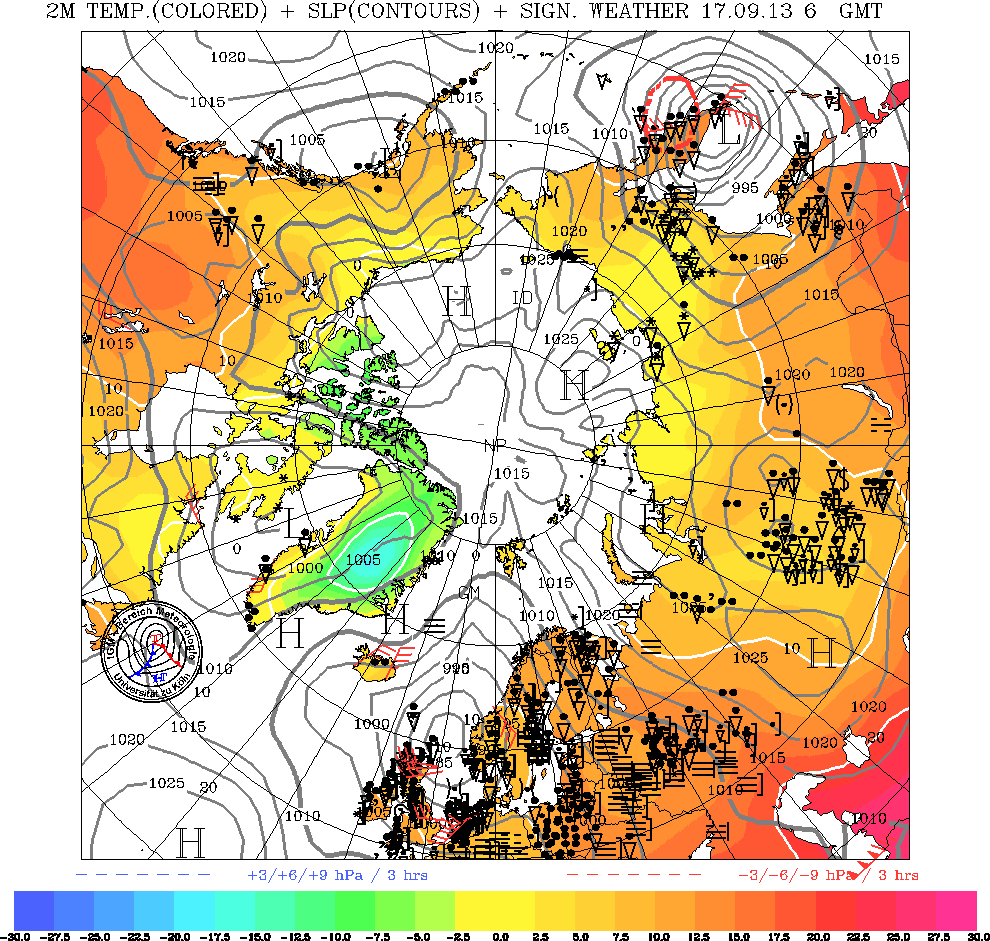
http://gfx.weatheroffice.ec.gc.ca/data/satellite/g oes_nam_1070_100.jpgAnd the big (polar) picture, a meteorological map:
http://www.uni-koeln.de/math-nat-fak/geomet/meteo/ winfos/arcisoTTPPWW.gifFinally, for the super-big picture (I have this for fun):
http://sohowww.nascom.nasa.gov/data/realtime/realt ime-update.htmlFunny that this item came along - I was just thinking today of resurrecting a page I used to have for weather links that friends used to use to get their weather. There's a weekend project...
-
Re:What is your source?I have used the Environment Canada site for my local forecast for years - it's world-class and hey, I pay for it through my taxes. Plus, the weather office is right across town so I know the measurements are locally-accurate. For a time I even screen-scraped the pre-CSS version of the page for my city every 15 minutes to add a META REFRESH tag and a set of the other links I use. I'm a weather nerd, yes. I have a set of pages loaded into tabs in Konqueror and set the ones I can to refresh every half-hour. It occupies a permanent spot on my main virtual desktop and I have a couple old monitors burned with the image of that page from when I had a separate machine for my "weather console".
The forecast for my city:
http://weatheroffice.ec.gc.ca/forecast/city_e.html ?ab-50&unit=m&b_templatePrint=trueAnd radar:
http://gfx.weatheroffice.ec.gc.ca/radar/index_e.ht ml?id=wrnThen continental satellite imagery in the Infrared band:
http://gfx.weatheroffice.ec.gc.ca/data/satellite/g oes_nam_1070_100.jpgAnd the big (polar) picture, a meteorological map:
http://www.uni-koeln.de/math-nat-fak/geomet/meteo/ winfos/arcisoTTPPWW.gifFinally, for the super-big picture (I have this for fun):
http://sohowww.nascom.nasa.gov/data/realtime/realt ime-update.htmlFunny that this item came along - I was just thinking today of resurrecting a page I used to have for weather links that friends used to use to get their weather. There's a weekend project...
-
Re:What is your source?I have used the Environment Canada site for my local forecast for years - it's world-class and hey, I pay for it through my taxes. Plus, the weather office is right across town so I know the measurements are locally-accurate. For a time I even screen-scraped the pre-CSS version of the page for my city every 15 minutes to add a META REFRESH tag and a set of the other links I use. I'm a weather nerd, yes. I have a set of pages loaded into tabs in Konqueror and set the ones I can to refresh every half-hour. It occupies a permanent spot on my main virtual desktop and I have a couple old monitors burned with the image of that page from when I had a separate machine for my "weather console".
The forecast for my city:
http://weatheroffice.ec.gc.ca/forecast/city_e.html ?ab-50&unit=m&b_templatePrint=trueAnd radar:
http://gfx.weatheroffice.ec.gc.ca/radar/index_e.ht ml?id=wrnThen continental satellite imagery in the Infrared band:
http://gfx.weatheroffice.ec.gc.ca/data/satellite/g oes_nam_1070_100.jpgAnd the big (polar) picture, a meteorological map:
http://www.uni-koeln.de/math-nat-fak/geomet/meteo/ winfos/arcisoTTPPWW.gifFinally, for the super-big picture (I have this for fun):
http://sohowww.nascom.nasa.gov/data/realtime/realt ime-update.htmlFunny that this item came along - I was just thinking today of resurrecting a page I used to have for weather links that friends used to use to get their weather. There's a weekend project...
-
Additional comments...
(the fact that you must post quick at Slashdot or your comment will be buried really lowers post quality since people (or at least I) sometimes rush their comments uselessly...
We must not forget online forecasting websites often offer a trend for a whole day, but (in Canada's weather office case, see parent) it is worthed to read the accompanying text to know how the weather will evolve throughout the day. If you need close to real-time observations, use radar information, such as this one for Toronto.
Also, one must be aware that global-scale models are computed at a "low" spatial resolution (one point every kilometer 33 km in Canada) (don't forget, those models run in real 3D, not in 2.5D, thus adding several points in the vertical axis). There are various higher resolution models which are also ran: in Canada (IIRC), the 'regional' model runs at a 15km horizontal spatial resolution. I underline this only because it is important to know that models at this time can't tell you the weather for your own neighborhood specifically. (I am however working on weather projects at the city-scale, 5m spatial resolution!!! but those models are run over an urban area on a need-to-run basis, computers aren't fast enough for meteorologists -
What is your source?
(I work at the Canadian Meteorological Centre, but I am not a meteorologist myself)
One thing that struck me is the 'abnormal diversity' of weather information sources. In Canada, weather models are computed in one place, a ~1000 processors computer in a basement which does only one thing: forecasting weather (the constant real-world observations that are ingested are used to adjust the models). Only one 'real' source (of course, there's the american, british, french, etc. official forecasting models to which we compare 'scores' on a daily basis). However, there's plenty of other canadian websites which will give you weather forecasts (one example). From what I know, these "other websites" have a significantly smaller workforce of meteorologists to interpret the models results than the Meteorological Service of Canada (the CMC is part of the MSC). That's why I would favor the 'original' source instead of a 'second-hand' source. I must however admit, commercial online sources of weather forecasting sometimes offer value-added products, such as the number of ski trails opened, offer general weather information capsules, etc.
And by the way, the official Environment Canada weather website is the most visited website in Canada (or at least, that's what they tell us, the employees! -
What is your source?
(I work at the Canadian Meteorological Centre, but I am not a meteorologist myself)
One thing that struck me is the 'abnormal diversity' of weather information sources. In Canada, weather models are computed in one place, a ~1000 processors computer in a basement which does only one thing: forecasting weather (the constant real-world observations that are ingested are used to adjust the models). Only one 'real' source (of course, there's the american, british, french, etc. official forecasting models to which we compare 'scores' on a daily basis). However, there's plenty of other canadian websites which will give you weather forecasts (one example). From what I know, these "other websites" have a significantly smaller workforce of meteorologists to interpret the models results than the Meteorological Service of Canada (the CMC is part of the MSC). That's why I would favor the 'original' source instead of a 'second-hand' source. I must however admit, commercial online sources of weather forecasting sometimes offer value-added products, such as the number of ski trails opened, offer general weather information capsules, etc.
And by the way, the official Environment Canada weather website is the most visited website in Canada (or at least, that's what they tell us, the employees! -
Re:Reminds me of a film about Oil spills from Exxo
Also we all laughed while the film had a diagram of most of the oil evaporating and doing little harm in Valdez.
That's actually what happens, you know. Most of the lighter fractions of crude oil (the majority of the oil, that is) evaporate very quickly leaving behind the sticky tars and such. One of the most ecologically sound methods of getting rid of an oil spill is to light it up (since that's what were going do with the oil anyway), but that can't happen after the lighter fractions evaporate since the tars need 'help' to burn. -
Weather layers for Google Earth
Ok, I must admit, the way they represent it in Second Life is interesting. Symbolic, not realistic, but sometimes symbolization is simply more efficient than realism.
US weather radar layers for Google Earth.
3D pseudo-real-time global clouds layer for Google Earth.
And while we're at it, weather radar data for Canada.
Oh yeah.. you can't use GE at work (as clearly specified in the license), so use the great (and open source) NASA World Wind instead. -
Re:A reasonable altyernative
I'm pretty sure the Inuit would like to extend a large 'fuck you' (or its own equivalent). It isn't so much expansion up in Nunavut but their long time homes.
Pretty sure brown bears are the ones suffering human encroachment from us southlanders expanding...polars I think are the ones expanding into us as their homes melt.
Government does tend to be actively concerned about the bears. -
Re:As a Canadian...
So far Canada seems to be following your advice!
-
Missing Linkhttp://ice-glaces.ec.gc.ca/content_contenu/images
/ bearours3.jpgAlways check your links!
-
Re:In true Aussie style:
How about a swimming lesson in the Northwest Territories? This can be equally effective..
-
Re:Interesting...You've just totally missed my point.
Firstly, humans are emitting Gigatonnes of CO2 and other greenhouse gases per year.
Secondly, CO2 concentrations in the atmosphere are increasing.
What do these 2 facts mean, taken together? They mean that humans are contributing to CO2 concentrations.
Thirdly, we know that CO2 levels are significantly higher than even a few hundred years ago - this is a very rapid rise.
Fourthly, we absolutely know that an increase in atmospheric C02 will enhance the greenhouse effect. There is a vast array of historical evidence for this, and also it is basic physics which is well understood.
Pretending that things are otherwise is just a wilful blindness.
We also know that the Earth is warming up extremely rapidly - more rapidly than it has at least for the last 20k years. This should be a matter for huge concern because even a couple of decades of stalling and global-warming-denial in the guise of scientific skepticism can allow for much more serious environmental and economic damage to accumulate.
The rest of your argument I think just misses the point. What you are not taking into account is that although anthropogenic C02 is small compared to C02 from natural sources, those natural emissions have historically been balanced by natural sequestration of C02. The historically new anthropogenic emissions are not, and hence over time these extra emissions are building up and up.
I recommend you check out the website of the Carbon Dioxide Information Analysis Centre, and the Candadian Meteorological Service - which incidentally contradicts your opinion about volcanism:On a global scale, volcanoes release less than 1% of human emissions of carbon dioxide and hence are a minor contributor to changes in its atmospheric concentrations.
Most recent estimates by volcanic experts with the U.S. Geological Survey suggest that, globally, volcanoes release about 150 million tonnes (Mt) of CO2 into the atmosphere each year. By comparison, humans annually emit more than 22 billion tonnes (Gt) of CO2 from fossil fuel combustion alone, and another 6 or so Gt of CO2 from deforestation activities. That is more than 100 times as great as volcanic emissions.Mount Etna, in Sicily, is the largest single volcanic emitter of CO2, estimated at 25 Mt of CO2 per year. By comparison, emissions from Mount St. Helens following its eruption several decades ago were less than 2 Mt of CO2/year.
compare with the 5 Gigatonne figure which the US Dept of Energy gives for US emissions. -
Re:If only it felt like it
And frankly it is irrelevent whether humans are to blame or not. It is warming, which is going to cause climate change. Are we ready for it? If not, we may want to try to stop it (or at least slow it down).
This hits the closest to the question we really should be asking ourselves. Most scientists and politicians are stuck trying to prove or disprove whether global warming/climate change is actually happening and/or whether and to what degree human activity is responsible for it. From a public policy standpoint, these questions have no bearing. The public policy question we should be grappling with is this:
Should we expend our resources on attempting to mitigate/prevent climate change or should we expend our resources on adapting to climate change, whether that change is man-made or not?
The well-known example of the former approach is the Kyoto protocol. I'll take my own country of Canada as an example of where I stand on this. Canada, led by a legacy-seeking bumbler of a Prime Minister, signed on to the Kyoto protocol a few years ago, committing itself to reducing greenhouse gas emissions to 6% below 1990 levels by -- what is it, 2010? Anyway, Canadian emissions have increased by 24% since 1990. As of the 2003 figures (Link), we would have to reduce our emissions by about 180 megatonnes. That's equivalent to the total emissions produced by every plane, train, and automobile in the entire country. Park them all for good, and our target is met.
It should be bloody obvious that such an approach is hardly a wise use of resources. The economic damage from doing this could be nothing short of catastrophic, and may not stop the climate change anyway. Better in my view to continue to grow our economies, generate more wealth, and direct resources into adapting to changing climates as needed. Humans are a remarkably adaptable species, after all; it's the reason we're on top of the food chain.
-
Re:Global warming is a myth because we say it is.
Calgary, AB, Canada.
This winter cant even be called winter.
The temperature has been +5 to +10 celsius more times than i can count.
This weekend, the forcast says its going to be +12 on saturday, and +15 on sunday.
Theres the actual daily temperatures for Calgary in January
http://www.climate.weatheroffice.ec.gc.ca/climateD ata/dailydata_e.html?timeframe=2&Prov=XX&StationID =2205&Year=2006&Month=1&Day=9
the high temperatures are from experience are between noon and 4 pm.
the low temperatures are between 4am, and 8am.
This past year has been very warm, no snow... doesnt even feel like winter.
Kyle -
Re:What is the Timeline for global warming?
Guys in BC are reporting a LOT of rain.
Trees budding already.
No doubt there is a lot of changes going on all over the place.
From where I sit, things are just not right at all.
If Alberta does not get a sustained snow/rain fall before spring, there is going to be water restrictions/bans and a whole lot of fire fighting going on.
The fire fighters I work for are already reporting for duty in January.
That is just crazy.
Just so you don't think I'm doing the Chicken Little dance, here is the long term forcast 9-12 months, from environment Canada:
http://www.weatheroffice.ec.gc.ca/saisons/image_e. html?img=ccatemp_12_s_m1
http://www.weatheroffice.ec.gc.ca/saisons/image_e. html?img=ccapcpn_12_m1_s
If things don't go back to normal, there is about to be some serious issues to contend with.