Slashdot Mirror
Domain: ed.gov
Stories and comments across the archive that link to ed.gov.
Comments · 681
-
Re:Again?!
-
Re: Stupid people are stupid
The only area of education not dominated by women in the past ten years is STEM, and men are also far behind women in biology & related sciences, and math, leaving really only computer science and the engineering fields, and physics to men.
O RLY?
Looking at the 2012/13 numbers, women do indeed significantly outnumber men as recipients of bachelor's and master's degrees. Women received about 1,052,000 bachelor's degrees to men's 787,000. (That's 57% to women.)
The source of that disparity - about 265,000 degrees - is interesting. About a quarter of the difference (a surplus of 61,000 degrees) is in education--principally teaching degrees. Another third (a surplus of over 84,000 degrees) are in nursing. Another quarter (another surplus of about 61,000 degrees) come from psychology. There's a good-sized surplus in social work and other social and community services (14,000), family and consumer sciences (18,000), and in visual and performing arts (21,000). That's about a quarter million degrees right there.
In other words, a lot of that surplus is 'job training'- or 'job certification'-type degrees, mostly in areas that are traditionally associated with soft, squishy notions of womanhood, and often in occupations associated with relatively lower salaries.
-
Time to teach Math and English.
The Waterloo Cedar Falls Courier reports that Ben Schafer, an associate CS prof at the Univ. of Northern Iowa, was recognized at Code.org's annual summit for training 570 K-12 teachers in Iowa, which is equivalent to 5.5 percent of all U.S. teachers trained.
This statement needs to be taken into context. I think that the word that the OP meant to say is "indoctrinated". All certified teachers are trained. By that standard, if 570 teachers represents 5.5% of teachers in the entire United States, then there are only roughly 10,364 teachers in the United States (570*100)/5.5.
According to national statistics, there are 3.1 million teachers in the United States.
Doesn't someone do editing for clarity or fact checking around here?
-
Re:Critical thinking
From what I have been able to find, the set of core academic subjects is already much larger than you think. It isn't just English, Math, Science, History. From an archived No Child Left Behind FAQ I found (source), here is a list of current core academic subjects (it may have changed since this documents first publishing):
English, reading or language arts, math, science, foreign languages, civics and government, economics, arts, history and geography
I see no reason why computer science (at a primary/secondary school level) shouldn't be at least equally important as foreign languages, arts, and geography.
-
Re:$805M budget
And what you'll find is that they started to get bad when a lot of welfare programs were released that disincentivized work, disincentivized a stable household, undermined the quality of inner city public education, and a tediously long list of things that really hurt those people. And it was all government action. And it was all with good intentions.
Are you saying that the the center city neighborhoods throughout the country were filled with happy, hard-working black people until Lyndon Johnson's Great Society program came along in the 1960s and gave them government money?
You don't know too much about segregation in the U.S. Black people couldn't even vote in most parts of the formerly Confederate states until the Voting Rights Act of 1964, and even then they were often killed when they tried to register to vote. Black schools were far worse than white schools. When the courts ordered them to integrate their schools, they shut down the public schools entirely and opened private "segregation academies."
The federal government efforts (and money) to improve minority education had good results. Black (and hispanic) math and reading scores rose from 1971-2012, and narrowed the gap with whites. http://nces.ed.gov/nationsrepo...
The reason the "problem" is concentrated in minority districts is that black people started out as slaves, and after they were freed, they were suppressed by the white power structure whenever they showed hard work and skill -- especially when they showed hard work and skill. Read Ida Wells, who was the subject of last week's Google Doodle:
https://en.wikipedia.org/wiki/...
In 1889 Thomas Moss, a friend of Wells, opened the People's Grocery in the "Curve," a black neighborhood just outside the Memphis city limits. It did well and competed with a white-owned grocery store across the street. While Wells was out of town in Natchez, Mississippi, a white mob invaded her friends' store. During the altercation, three white men were shot and injured. Moss, and two other black men, named McDowell and Stewart, were arrested and jailed pending trial. A large white lynch mob stormed the jail and killed the three men.
-
Re:Not donating to private charities is easy
No they [food needs] ’re not [provided for by private markets].
Hah! I grew up, where children were encouraged to "Thank the Party" for providing food and other aspects of "Happy Childhood". I didn't realize, here in the US I must also be thanking the Government for the daily sustenance...
Education provided by the government is at least 2 to 4 times as costly as it needs to be for a good education.
Source, and please define “good education”.
Since 1960-ies, the per-pupil annual costs of public schools has quadrupled in inflation-adjusted dollars, while the education quality remained the same at best, or worsened — 70% of 8th-graders nation-wide can not be said to read proficiently, for just one example.
These indisputable facts may not directly support ChrisMaple's statement, but they certainly do make mockery of any claim, that the tax-collecting government is somehow uniquely well-qualified in educating children and that the only way to provide for education is to coerce citizens into paying for it.
I would further add, that no "KKKorporation", however evil, would be able to quadruple the price of its offering(s) without significantly improving the quality (or a spike in raw-material costs). Only a government-backed racket can get away with such a thing — and only because its source of financing is backed by the armed coercion.
-
Re:Not donating to private charities is easy
No they [food needs] ’re not [provided for by private markets].
Hah! I grew up, where children were encouraged to "Thank the Party" for providing food and other aspects of "Happy Childhood". I didn't realize, here in the US I must also be thanking the Government for the daily sustenance...
Education provided by the government is at least 2 to 4 times as costly as it needs to be for a good education.
Source, and please define “good education”.
Since 1960-ies, the per-pupil annual costs of public schools has quadrupled in inflation-adjusted dollars, while the education quality remained the same at best, or worsened — 70% of 8th-graders nation-wide can not be said to read proficiently, for just one example.
These indisputable facts may not directly support ChrisMaple's statement, but they certainly do make mockery of any claim, that the tax-collecting government is somehow uniquely well-qualified in educating children and that the only way to provide for education is to coerce citizens into paying for it.
I would further add, that no "KKKorporation", however evil, would be able to quadruple the price of its offering(s) without significantly improving the quality (or a spike in raw-material costs). Only a government-backed racket can get away with such a thing — and only because its source of financing is backed by the armed coercion.
-
A Pint's a Pound the World Around
"A Pint's a Pound the World Around."
By Charles A. L. Totten.
International Institute for Preserving and Perfecting (Anglo-Saxon) Weights and MeasuresThey bid us change the ancient "names."
The "seasons" and the "times;"
And for our measures go abroad
To strange and distant climes.
But well abide by things long clear
And cling to things of yore.
For the Anglo-Saxon race shall rule
The earth from shore to shore.
Then down with every "metric" scheme
Taught by the foreign school.
We'll worship still our Father's God!
And keep our Father's "rule"!
A perfect inch. a perfect pint.
The Anglo's honest pound.
Shall hold their place upon the earth.
Till Time's last trump shall sound!CHORUS:
Then swell the chorus heartily.
Let every Saxon sing:
"A pint's a pound the world around."
Till all the earth shall ring.
"A pint's a pound the world around"
For rich and poor the same;
Just measure and a perfect weight
Called by their ancient name!http://files.eric.ed.gov/fullt...
A History of the Metric System Controversy in the United States. U.S. Metric Study Tenth Interim Report. National Bureau of Standards (DOC) , Washington, DC
REPORT NO NBs-SP-345-10 August 1971. 307p. Superintendent of Documents, U.S. Government Printing Office, Washington, D.C. 20402 (Catalog No. 0 13.10:345-10, $2.25) -
Re:So what's news about this?
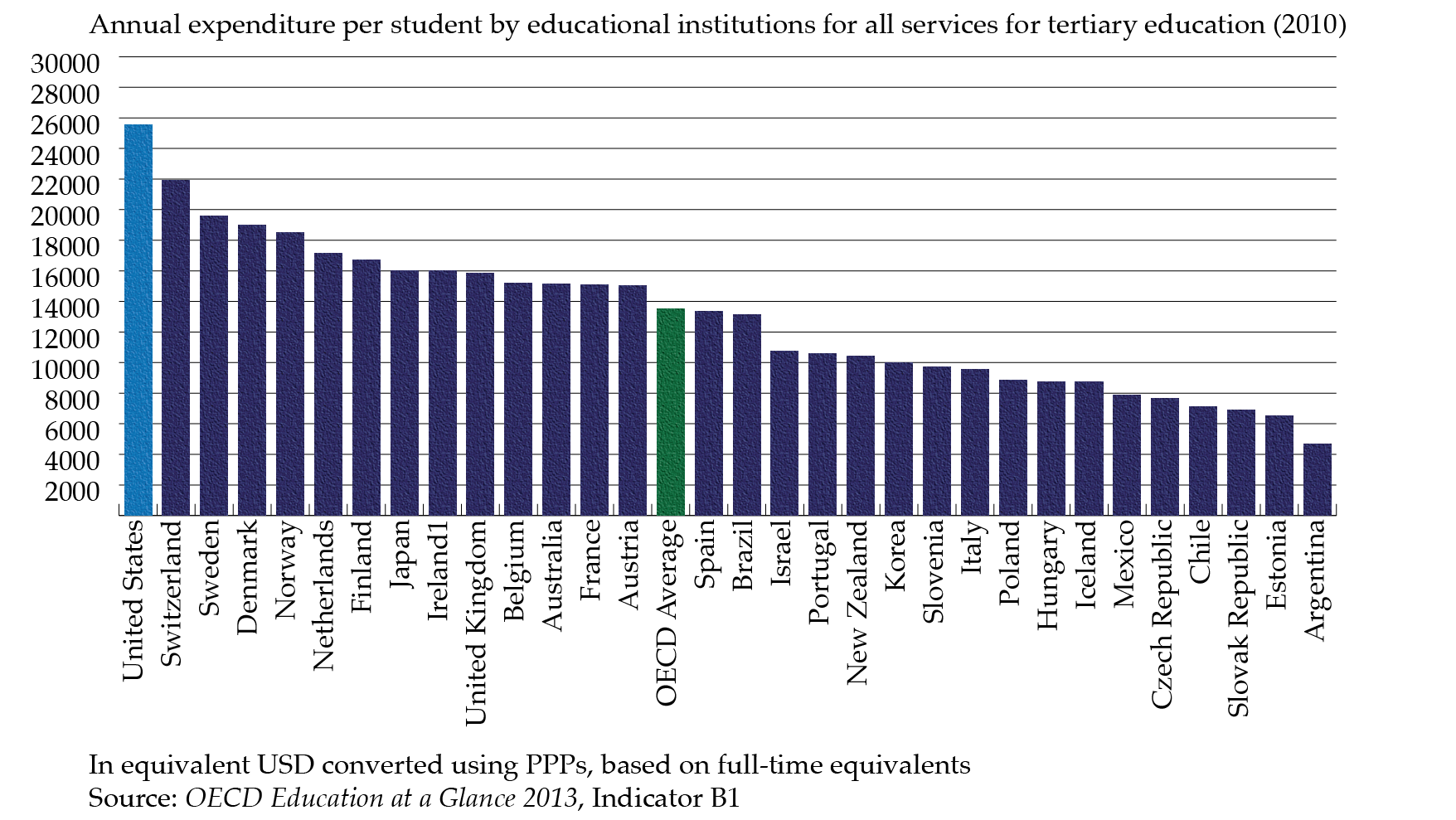
10th would be pretty good - better than average. It certainly would not explain the chronic underperformance. The US government says we are only below Switzerland, Norway, and Austria by one measure and only behind the Swiss by another measure.
In any case, the meme of "Americans don't invest in education" is a faulty one. We just don't invest our dollars very well.
-
Re:Why is ITT even eligible for federal student lo
If the loan delinquency rate is the criteria, there are over 600 FSA qualified institutions with worse rates than ITT, including a lot of public community colleges.
-
Re:Why is ITT even eligible for federal student lo
If student loans are available for other privately run schools, such as Stanford, MIT and Yale, why should ITT be any different?
I'm guessing your question wasn't real, but a political comment. Here's the real answer, anyway, which was found using a simple Google search. Yes, there are standards for Federal student aid programs. -
Re:That title is incredibly misleading.
Are you serious or just trolling?
The US Department of Education is part of the executive branch of the Federal government with a very big budget.
-
Re:sage
And the data said that charter schools were failing and the testing was unscientific gobbledygook.
[...]
For example, she knows about the NAEP http://nces.ed.gov/nationsrepo... which actually did a good, scientific study of charter schools and found that they were on average worse than public schools.
No they didn't. On average, they found they were about the same. In some states, charter schools did consistently perform worse than public schools, but in some states, charter schools consistently performed better. Not an argument for charters schools, but not one against them either.
-
Re:sage
The people who put down public schools and experienced union teachers are "visionaries" but they don't have facts to back them up. If you want the facts, do a Google search for "Diane Ravitch."
Ah yes, a single data point proves everything. Sorry. No.
I have had exceptional public school teachers that cared about the students, knew their material, and provided a rich, learning environment. I have had hideous public school teachers that made it obvious that they hated the students, wished they were elsewhere, and only because thy had been on the job so long and were tenured that it was too late to change careers at that point. I have had public school teachers at almost every point in between.
I'm extremely glad that you had only exceptional experiences with public school teachers. But please, don't start pretending that you're representative of all public school students' experience or that your teachers were representative of all public school teachers.
Do your homework. I said do a Google search for "Diane Ravitch." Do I have to do everything for you?
https://en.wikipedia.org/wiki/...
Ravitch was assistant secretary of education under GWHB and Bill Clinton. She believed in testing and charter schools and getting rid of unions. The Wall Street Journal gave her a column. But she knew how to understand data. And the data said that charter schools were failing and the testing was unscientific gobbledygook. So -- unlike some people -- when the evidence went against her, she admitted she was wrong. She has more data than you knew existed. For example, she knows about the NAEP http://nces.ed.gov/nationsrepo... which actually did a good, scientific study of charter schools and found that they were on average worse than public schools. And I'm not going to find it for you, you can look it up yourself, although you're probably too lazy for that.
There's plenty of data. And it doesn't do what the "visionaries" say. Most of this stuff has been tried before, and didn't work.
I didn't say that I had only exceptional experiences with public school teachers. I had good teachers and bad teachers, like every institution. but most of them -- enough of them -- were good. I found more dedicated people in the public schools than I found in private businesses.
-
Re:Self-Confidence
if they cannot point to any evidence.
Here's some: http://www2.ed.gov/rschstat/ev...
Although the null result tends to dominate in studies of academic preformance (no preference for single-sex or coeducational settings), single sex does show advantages in the accumulated studies in the social/emotional areas.
-
Re:Hurrah for sex-segregation!
Some research has suggested benefits for same-sex segregated education, particularly for girls. http://files.eric.ed.gov/fullt... The separate but equal issue is a problematic, but there may be ways to reproduce the benefits of same-sex education without the full separation (such as dividing a class into two groups, or having a co-educational school with single-sex classes). Sex segregated schools can also be problematic for the transgendered, but at younger ages I don't think it would be as big of a deal for most individuals.
-
School budgets
With prices generally ranging from $400 to $3,000 for typical desktop 3D printers, they are not cheap, and with budgets within many school districts running dry, both in the United States and overseas, the unfortunate fact is that many schools simply canâ(TM)t afford them
That's a myth. The U.S. spends more than a quarter of a million dollars per K-12 classroom every year (average 20-23.4 students per class). We could easily afford one 3D printer per school. Heck, we could afford one per classroom.
The problem is schools are top-heavy and administrators suck up most of that money, then create an artificial financial crisis every time a budget cut is threatened. This gets teachers and the teachers' union to claim we aren't spending enough on education, when we're already spending way more than we should be.
Yes I'm aware that first link I gave says administration is only $843 per student per year. That's because the administrators have gamed the stats to hide how much money they're sucking up. If you drill down into the numbers (p.56), you find that "In 2008-09, salary and employee benefits for school staff amounted to $8,797 per student." Subtract $843 for administration and that leaves $7954 per student supposedly going to instructional teachers.
For 2010, the average student to teacher ratio was 16.0 (this includes substitutes and assistants). Ask yourself, is the average teacher making ($7954 * 16) = $127,264 per year in salary and benefits? Of course not. The figure is inflated because the administrators have misclassified most of their salary and benefits as "instructional" instead of "administration" to hide how much money their draining from our educational system. -
School budgets
With prices generally ranging from $400 to $3,000 for typical desktop 3D printers, they are not cheap, and with budgets within many school districts running dry, both in the United States and overseas, the unfortunate fact is that many schools simply canâ(TM)t afford them
That's a myth. The U.S. spends more than a quarter of a million dollars per K-12 classroom every year (average 20-23.4 students per class). We could easily afford one 3D printer per school. Heck, we could afford one per classroom.
The problem is schools are top-heavy and administrators suck up most of that money, then create an artificial financial crisis every time a budget cut is threatened. This gets teachers and the teachers' union to claim we aren't spending enough on education, when we're already spending way more than we should be.
Yes I'm aware that first link I gave says administration is only $843 per student per year. That's because the administrators have gamed the stats to hide how much money they're sucking up. If you drill down into the numbers (p.56), you find that "In 2008-09, salary and employee benefits for school staff amounted to $8,797 per student." Subtract $843 for administration and that leaves $7954 per student supposedly going to instructional teachers.
For 2010, the average student to teacher ratio was 16.0 (this includes substitutes and assistants). Ask yourself, is the average teacher making ($7954 * 16) = $127,264 per year in salary and benefits? Of course not. The figure is inflated because the administrators have misclassified most of their salary and benefits as "instructional" instead of "administration" to hide how much money their draining from our educational system. -
School budgets
With prices generally ranging from $400 to $3,000 for typical desktop 3D printers, they are not cheap, and with budgets within many school districts running dry, both in the United States and overseas, the unfortunate fact is that many schools simply canâ(TM)t afford them
That's a myth. The U.S. spends more than a quarter of a million dollars per K-12 classroom every year (average 20-23.4 students per class). We could easily afford one 3D printer per school. Heck, we could afford one per classroom.
The problem is schools are top-heavy and administrators suck up most of that money, then create an artificial financial crisis every time a budget cut is threatened. This gets teachers and the teachers' union to claim we aren't spending enough on education, when we're already spending way more than we should be.
Yes I'm aware that first link I gave says administration is only $843 per student per year. That's because the administrators have gamed the stats to hide how much money they're sucking up. If you drill down into the numbers (p.56), you find that "In 2008-09, salary and employee benefits for school staff amounted to $8,797 per student." Subtract $843 for administration and that leaves $7954 per student supposedly going to instructional teachers.
For 2010, the average student to teacher ratio was 16.0 (this includes substitutes and assistants). Ask yourself, is the average teacher making ($7954 * 16) = $127,264 per year in salary and benefits? Of course not. The figure is inflated because the administrators have misclassified most of their salary and benefits as "instructional" instead of "administration" to hide how much money their draining from our educational system. -
It's only $2.5K per school anyway
It works out to $2424 per school, roughly. Might add one faculty member per school system, at least for larger systems.
-
Re:Define "Threatened" and "Unwelcome"
The truly funny part is that women wanted absolutely nothing to do with computers until there was money to be made.
That's sexist. Generalizing the motives of 50% of the world's population, 3 billion people. Worse still the generalization is a negative one. No, women couldn't be interested in computing, they are only in it for the money.
This is exactly what women are complaining about. It's no bullshit, you just demonstrated it.
How many women studied computer science in the early 90's? I'll tell you because I did: Basically none.
Either your memory is faulty or you were quite unlucky: http://nces.ed.gov/programs/di...
-
Re:^THIS
Nope. You really should learn to understand what you link to and learn how to look up basic facts.
1969 average salary: ~8600 adj. for inflation in 2014: ~55K
2014 average teacher pay: $56,383
http://nces.ed.gov/programs/di...
From your link you didn't seem to understand:
" Instruction expenditures include salaries and benefits of teachers and teaching assistants as well as costs for instructional materials and instructional services provided under contract."Look, you really need to stop looking at a graph and assume it proves your point because the bars are higher. YOu need to start UNDERSTANDING your links and what they say. You really look like a moron. I don't think you are a moron, I just think you haven't bothered to train yourself to think things through.
-
Re:^THIS
Funding for public schools needs to increase at all levels.
Why? How much is enough? The average class size right now is about 22 students (average of elementary and secondary), and about $12,600 per student. So that's $277,000 per classroom of funding. Of that, the teacher "cost" is about $6800 per student. Meaning about half the income goes to the teacher (or $149,600 - for a class of 22) and the other half goes for everything else.
IF this was, in fact, what was happening - as is claimed by the links I provided - then teachers would be exceedingly well-paid - better than 94% of all taxpayers in the US. But this isn't happening. Why? Maybe money (and VAST amounts of it) are being siphoned off for other things. Lots of vice-principals, lots of extra counselors and specialty cafeterias, lots of buying of fads of technology, lots of half-million-dollar-a-year union bosses, etc.
We already massively outspend the rest of the OECD on a per-student basis. And we pay well in the middle of the pack for the OECD. If we cannot educate children AND pay highly desirable salaries with over a quarter of a million per classroom - something is SERIOUSLY fucked up. All the other OECD countries seem to do a lot better in compensating their teachers whilst spending considerably less per student. The LAST thing we should do is simply throw more money at the problem. Because too much money is already wasted...
-
Re:^THIS
Funding for public schools needs to increase at all levels.
Why? How much is enough? The average class size right now is about 22 students (average of elementary and secondary), and about $12,600 per student. So that's $277,000 per classroom of funding. Of that, the teacher "cost" is about $6800 per student. Meaning about half the income goes to the teacher (or $149,600 - for a class of 22) and the other half goes for everything else.
IF this was, in fact, what was happening - as is claimed by the links I provided - then teachers would be exceedingly well-paid - better than 94% of all taxpayers in the US. But this isn't happening. Why? Maybe money (and VAST amounts of it) are being siphoned off for other things. Lots of vice-principals, lots of extra counselors and specialty cafeterias, lots of buying of fads of technology, lots of half-million-dollar-a-year union bosses, etc.
We already massively outspend the rest of the OECD on a per-student basis. And we pay well in the middle of the pack for the OECD. If we cannot educate children AND pay highly desirable salaries with over a quarter of a million per classroom - something is SERIOUSLY fucked up. All the other OECD countries seem to do a lot better in compensating their teachers whilst spending considerably less per student. The LAST thing we should do is simply throw more money at the problem. Because too much money is already wasted...
-
Re:^THIS
Funding for public schools needs to increase at all levels.
Why? How much is enough? The average class size right now is about 22 students (average of elementary and secondary), and about $12,600 per student. So that's $277,000 per classroom of funding. Of that, the teacher "cost" is about $6800 per student. Meaning about half the income goes to the teacher (or $149,600 - for a class of 22) and the other half goes for everything else.
IF this was, in fact, what was happening - as is claimed by the links I provided - then teachers would be exceedingly well-paid - better than 94% of all taxpayers in the US. But this isn't happening. Why? Maybe money (and VAST amounts of it) are being siphoned off for other things. Lots of vice-principals, lots of extra counselors and specialty cafeterias, lots of buying of fads of technology, lots of half-million-dollar-a-year union bosses, etc.
We already massively outspend the rest of the OECD on a per-student basis. And we pay well in the middle of the pack for the OECD. If we cannot educate children AND pay highly desirable salaries with over a quarter of a million per classroom - something is SERIOUSLY fucked up. All the other OECD countries seem to do a lot better in compensating their teachers whilst spending considerably less per student. The LAST thing we should do is simply throw more money at the problem. Because too much money is already wasted...
-
Re:As a parent, which requires no testing or licen
This is true for the homeschooled children that do pursue a collage career. However, those who do fail so bad that they don't even apply for college aren't counted. This skews the numbers pretty badly.
To summarize:
SchoolType | 1yr GPA | 4yr GPA | 4yr graduation rate
Public . . | . 3.12
Private
Catholic . | . 3.13
Home . . . | . 3.41 -
Re:Needs fairly strong justification
Mum and/or Dad are not teachers. We're not qualified to be, and re-assurances from the homeschooling organisation are vacuous. Don't kid yourself about this. Being a teacher is a career choice, and there are very specific skillsets involved.
You're gonna have a hard time explaining why homeschooled kids score ~90th percentile across the board on standardized tests vs 50th for public schools. Or why they have a 0.25 GPA higher than public, private, or catholic after 4 years of college, and the highest graduation rates (page 23).
In fact I have yet to see any study that contradicts the well known heirarchy, public used for cost per pupil (4/5th of the way down).
Incidentally, I didnt attempt to bias-check the numbers too heavily, because two of them are government provided and all of them claim to use gov't data; I've also never seen anything to contradict this despite googling several times. However, if you take particular issue with a source, I would love to see a counter-study -- preferably one that does not introduce its own bias by "attempting to control for socio-economic factors" in an arbitrary way.
-
Re:Thank you, school monopoly...
Since 1960-ies the per-pupil annual cost of public schools quadrupled (inflation-adjusted), while the quality of education remains the same (if it has not gotten worse). What other industry could get away with such a thing?
The cost of living has gone up as well as the cost of supplying said education (buildings, transportation, etc), but that cannot, in any way, be used as a measure of students intelligence or desire, capacity to learn, or measures of the "quality of education". Sure, it is a teacher's job to teach, but, more to the point, it's a student's job to learn - which cannot be forced. In addition, students are being asked to learn more, and/or more in-depth, than they were in the 60s, but over the same 12-year period of time in school.
The cost of many things have gone up since the 1960s, but I doubt the quality as progressed at similar slope.
-
Re:Thank you, school monopoly...
Since 1960-ies the per-pupil annual cost of public schools quadrupled (inflation-adjusted), while the quality of education remains the same (if it has not gotten worse). What other industry could get away with such a thing?
Well, colleges and the healthcare industry, since you're asking.
At least the schools don't cause too many deaths, and the first 12 years are free.
-
Thank you, school monopoly...
If a moron at a local pizzeria causes you grief, you'll simply order from a different restaurant next time. But there is no such choice in the single most important sphere of all: the children education. And TFA is just one little example of it.
Since 1960-ies the per-pupil annual cost of public schools quadrupled (inflation-adjusted), while the quality of education remains the same (if it has not gotten worse). What other industry could get away with such a thing?
-
Re:SjwDot.org
Ran across this interesting tidbit while looking up some stats for myself last time one of these articles got posted here.
Of the 7.6 million STEM workers, only 24% are women.Of the 3.7 million public schoolteachers, only 24% are men.
I'll start taking all this gender equality stuff being reported seriously when I see at least half as many articles complaining about the latter as I see about the former. If one is a "problem", so is the other. Otherwise I'll take it there's an implicit assumption that women like to teach (or are better teachers) than men. And likewise men like STEM (or are better at STEM) than women.Small sample - in my city there is IBM campus.
Field engineers - mostly males (and with few exceptions white)
Field engineers managers - as above
Software development - mostly males with larger share of females (and with few exceptions white)
Business Professional Services - (this is HR & accounting) - mostly females with very small share of males (4:1 or 8:1 ratio)
BPS managers - half and half males/females
As total gender ratio m/f perhaps 60%/40%Perhaps humping disk arrays and servers at 2AM is not so interesting for females if they can choose job "under roof".
-
Re:SjwDot.org
Ran across this interesting tidbit while looking up some stats for myself last time one of these articles got posted here.
Of the 7.6 million STEM workers, only 24% are women.
Of the 3.7 million public schoolteachers, only 24% are men.
I'll start taking all this gender equality stuff being reported seriously when I see at least half as many articles complaining about the latter as I see about the former. If one is a "problem", so is the other. Otherwise I'll take it there's an implicit assumption that women like to teach (or are better teachers) than men. And likewise men like STEM (or are better at STEM) than women. -
Re:Honest question.
The problem with so few women in IT is that one has to ask is there something that is preventing women from getting jobs in IT. It's a fair question. In our society, there should be nothing that stops someone from getting a job - equal access is important. The problem is that no one is asking what sucks about IT.
Actually the first question that comes to my mind is, why isn't there a similar crusade to stamp out gender bias in public education? 76% of public school teachers are female. That's actually the exact same ratio as STEM, where 76% of STEM employees are male. Why do STEM jobs get all the press while public education gets none? You would think with them being public school teachers, it would be a lot easier problem to address it first since they all effectively have the same employer.
-
Re: Not for life, not all that much money!
-
Re:Free?
Your numbers are bogus.
Maybe, but you haven't proven that. You quoted cost per student. I quoted cost per tax payer, of which there are vastly more of. Second, this guy
http://nces.ed.gov/fastfacts/d...
Says the cost per student is closer to $10k (if you add all the graphs). I'll give you that private school is still cheaper but for high school its pretty close.
-
Questionable Statistics
These articles use very selective statistics in order to make a point that goes along with the author's political leanings. The first article basically says students are paying the same amount each month because the terms of their loans are longer. The second article looks at households headed in an age range from 20 to 40? This adds in people who did not go to college or are 20 years out to drive down the average debt so the numbers fit the narrative. It doesn't give previous averages either. Why not compare have debt burden of new graduates from previous dates to debt burdens on current graduates.
Adjusted for inflation, average tuition costs have gone up %230 since 1981. http://nces.ed.gov/fastfacts/d... Fill in whatever politics you want around the numbers, but at least be honest with the numbers you are using. -
Re:Free?
But still, it might be ok if the covered courses are useful
And thus begins the road to ruin. No, it is not Ok to force people at gun-point (which is how taxes are collected) to pay for other people's anything. It worked so well for the public schools, which now cost 4 times more per pupil, than in 1960-ies, we are dizzy with success, aren't we — even if 2/3rd of the nation's 8th graders can't be said to read "proficiently".
not just "community organizer" type courses
And that's the other evil of it — not only will taxpayers be forced to pay for it, the actual courses will be decided by our benevolent and omniscient rulers. Do you suppose, it will be possible to avoid taking "Womyn's Studies" or "Climate Change Mitigation"?
-
Re:Considering how few boys graduate at ALLI'm nut certain how to define "utterly", but the majority of college graduates at all levels are now indeed female
If you don't believe me, here is the Guvmint weighing in on the matter:
http://nces.ed.gov/fastfacts/d...
We will perhaps one day reach the point where the apparent need to grease the skids for females will ring as hollow as Republican laments of "Won't someone think of the wealthiest?" Perhaps nearer than we think.
-
Re:Considering how few boys graduate at ALL
Women are within 5% of parity in Math, Statistics, and the Physical Sciences three years ago. They're nearly SIXTY PERCENT of all biology graduates and at least that many if not a full 2/3rds or more of fucking EVERYTHING else.
The only one changing the subject here is you and the other shameless FUD spreaders trying to wave a red herring like CompSci that's only 10% of conferred degrees. You're a bunch of mendacious dissemblers screaming "pay no attention to literally every measure of academic success and every other degree out there, look only at our dishonest cherry picked outliers!".
It is an indisputable fact that women absolutely DOMINATE every aspect of the US education system from start to finish and top to bottom. There is no disparity anywhere in the education system which FAVORS men, only disparities ranging from profound to catastrophic which harm them, and it's disgusting that this is still not enough for people like you. It's not fucking derailing to point this out on a news story specifically about boys being openly thrown to the wolves.
-
Re:What about men going to college?
Possibly because you're exaggerating. In 2012 the gap was 56/44. So 1.27 women for every man. It probably doesn't get reported on very often since women have outnumbered men in terms of total enrollment since 1979. One explanation might be that there are many more professions that are male-dominated but that don't require a college degree. Skilled tradesman, for example. Construction. Anything where physical strength is a prerequisite. So if you're a man who doesn't seem cut out for college then you have options. If you're a woman then, perhaps, you have fewer options. So there's greater motivation to get a degree.
It might also be worth noting that the gender gap decreases substantially among "traditionally aged" students (24 and under) as family income rises. So the gender imbalance is coming from poorer students and older students. -
Government's monopoly on education
I already pay a small fortune in school tax
You are quite right to curse. The per-pupil spending has quadrupled since 1960ies (inflation-adjusted). And that's just national average. The locales with high population density — where you'd expect economies of scale to provide for lower per-pupil costs — actually pay even more. But the quality of education has remained level at best — 70% of 8th-graders can't be said to read proficiently!
No one in their right mind would willingly pay 4 times more for the same bad (and worsening) service, if they had a choice. Thus, it is not surprising, the teachers' unions have made ensuring, you have no other choice, one of their top priorities.
-
Re:Microsoft losing to the school what?
I've seen studies that have shown that they interfere with learning, but none (that weren't sponsored by someone trying to sell stuff) that showed they improved learning.
I'll help you since your workplace must be blocking Google. From what I was able to briefly find, the meta-analysis of current research shows three things:
1) Blended use of technology and traditional learning probably produces the best results.
2) We are still figuring out how to best use technology in the classroom, but we are improving.
3) There has not been nearly enough large scale research to "prove" any assertions about the effectiveness of individual techniques in bringing technology to the classroom.Does the Use of Technology Improve Learning?
The Answer Lies in Design
Effective Use of Technology as a Learning Tool
Learning with Technology. Evidence that technology can, and does, support learning.
Evaluation of Evidence-Based Practices in Online Learning. A Meta-Analysis and Review of Online Learning Studies
Using Technology in Education: Does It Improve Anything?And depending on your definition of "sponsored by someone trying to sell stuff", you are probably unlikely to find many studies at all like that (a fact brought up by a couple of the above studies). Since most school districts cannot afford to spend money on unproven technologies, a large percentage of these studies have their devices donated or heavily subsidized by the device manufacturer. Here are some iPad specific ones, but even though some of them may have had iPads donated they still back up their research with actual test scores.
Five Studies to Prove the iPad’s Educational Worth
iPad improves Kindergartners literacy scores
Study Finds Benefits in Use of iPad as an Educational Tool
iPads Improve Classroom Learning, Study Finds
iPad a Solid Education Tool, Study Reports -
Re:If the money is used to hire much better teache
Also, the core claim that the US spends the most per student - if we are talking about primary and secondary students - not college - is not true although it is on the high end. Switzerland, Norway and Luxembourg spend more, and Austria and Denmark are almost same.
But they get far more for their money, and (if I had to guess) in those countries that *probably* includes university tuition, not just grades 1-12.
-
Re:Not enough
Every developed country in the world provides free public education to children.
There are some countries like England where the rich send their children to private schools, but that's more for making social connections than for the better education.
And in the US, the main reason for sending children to private schools is to have them grow up among a wealthy class rather than to associate with the working class.
That's the main reason for private schools, and in the US, the public school movement got its big boost in the 1960s and 1970s with the segregation academies, which grew up when white parents in the south didn't want to send their children to school with black students.
You can look up Wall Street Journal editorials about how the federal government had no right to enforce integration.
Most wealthy towns have good public schools. That's why people are willing to pay such high taxes to live in those towns. If you have a school board with adequate funding, that is run by parents whose children are in the school, who want good education, you'll have good schools.
If you want to run an experiment, you can run public schools alongside private schools, give them each the same amount of money, and see who does better. We did an experiment like that. That was charter schools. The conservabots said that the private schools with financial incentives would do better. (The charter schools actually got more money, but never mind.) When after several years they were finally evaluated by the NAEP, which everybody agreed was an objective, qualified evaluator, the charter schools did no better and the public schools did slightly better. http://nces.ed.gov/nationsrepo...
In New York City, there are no private schools as good as Bronx Science and Stuyvesant. They are a meritocracy, and admission is by entrance exam, so a rich kid can't do any better than a smart kid. The private schools will take anybody who can pay $40,000 a year. In contrast, public schools cost the city about $20,000 a year.
-
Re:If the money is used to hire much better teache
You (The US) already spends the most on education per student then any other nation and yet have some of the worst test results.
That may be true, but it's not going to teachers!. (Link describes North Carolina, but I think the same is true elsewhere.)
I don't think "throwing money at it" will make it better. Sure, teachers will take home more money but the test results clearly show this doesnt improve the quality of education.
This study disagrees.
Also, the core claim that the US spends the most per student - if we are talking about primary and secondary students - not college - is not true although it is on the high end. Switzerland, Norway and Luxembourg spend more, and Austria and Denmark are almost same.
-
Postdoc "Holding Pattern" - 1971 publication
This isn't exactly a new idea.
From the journal of the American Physical Society, April 1971, The Manpower Crisis in Physics :
-
Re:Low pay?
Comparing teacher salaries to private sector salaries is misleading. Often teachers have benefits that cannot be matched in the private sector including generous defined benefit pensions, retirement health care and time off. Total teacher compensation is heavily back-end loaded.
-
Re:Maybe, we just should not do SAME thing nationw
You might find recommendations on how to teach, but they are not enforced as requirements.
Distinction with no (or little) difference. The giant Federal Department of Education is paid for by our tax-dollars ($70bln per year give or take). If it issues "recommendations", they are either followed or are rejected necessitating local replacements (paid for by more tax-dollars).
The argument that a citizen (or a local government) are free to reject the (higher) government's "free" help is bogus, because we aren't free to refuse paying for it, whether we use it or not.
-
Re:Men in education and healthcare?
Ah I get your rules now.. Only you're allowed to say your anecdotes are correct. I'm not. I forgot. Sorry. That's about the kind of logic I'd expect from a feminist or any social 'justice' warrior, really. Maybe your area wasn't the norm? Oh, oops, sorry, another failure to conform. When will I ever learn never to question?
You're engaging in the same sort of systemic shaming towards me that you would not tolerate towards women. The only arguments you've made are an ad hominem and a generalization that men are more selfish than women. Knock it off with the shaming language if you expect people to take your morality seriously.
As far as toxic environments go, school has always been a place where you are told to sit down, shut up and do as you're told, which can be good or bad depending on the circumstances. Today, though, mainly because of feminism's push in government and education to focus on women and girls at the expense of men and boys, students are encouraged to express and focus on their feelings and feminine traits (as long as they are 'positive', definition to be set by the faculty) like conformity and group awareness, instead of on objective measurements of achievement and competition. Naturally, girls respond well to this, but the boys? not so much. This cultural toxicity to individual expression and achievement (which tend to be masculine traits) has long since spread into the faculty dynamics as well. There are fewer men involved today because education isn't very rewarding to them anymore. Like the boys in class, the men are expected to behave/express themselves like dominant female space expects them to or face career-ending fallacious accusations. It has nothing to do with selfishness, not on the part of men anyway.
A quick search gave me this
http://www.edweek.org/media/po...
go to page 12, there's a graph that shows the trend from 86.
http://nces.ed.gov/fastfacts/d...
read under demographics.. 76% of teachers are female in 2008.These sound about right to me. I don't know where you're justifying your 'more male teachers today than in the past' prideful patriarchy shit, but it's not in alignment with at least this cursory reality check.
-
Re:sorry
True.
Back in '92, Mississippi was at the absolute bottom 50 of 50 in basic prose literacy. [Sates with high immigration have since pushed them up to #42..]
In '92, Mass was in the middle of the pack, at about half as many illiterate residents.