Slashdot Mirror
Domain: edge.org
Stories and comments across the archive that link to edge.org.
Comments · 307
-
Lisp bigot patient zero
The Spirit of Unlimited Possibilities — 15 March 2019
In which John Brockman says "I was there, Gandalf."
Among the reasons we don't hear much about cybernetics today, two are central: First, although The Human Use of Human Beings was considered an important book in its time, it ran counter to the aspirations of many of Wiener's colleagues, including John von Neumann and Claude Shannon, who were interested in the commercialization of the new technologies. Second, computer pioneer John McCarthy disliked Wiener and refused to use Wiener's term "Cybernetics." McCarthy, in turn, coined the term "artificial intelligence" and became a founding father of that field.
Cybernetics, rather than disappearing, was becoming metabolized into everything, so we no longer saw it as a separate, distinct new discipline. And there it remains, hiding in plain sight.
This whole language debate hinges on Lisp bigot patient zero. Lisp is the whole enchilada, because John McCarthy says it's so. On the other hand, Wiener's terminology nicely captures the entire spectrum of cognitive processes, from radio to infrared, from ultraviolet to gamma ray. I tend to split the difference by referring to the technological field as "artificial cognition".
Why is it that Lisp bigots have this terrible knack of perverting language?
McCarthy : intelligence
Neither of these culturally prevalent definitions was entirely credible on day one. Wiener for sure knew that "intelligence" was far, far down the road, just as Stallman's original critics also knew that one man's freedom is another man's viral-license insurgency. I've personally known that "AI" was bogus terminology since the mid-seventies (when I first discovered Asimov), and Brockman has known it since 1965.
Humankind's big questions — 1 January 2017
Brockman was also quick to realize that science writing could be effective in taking debates across traditional disciplinary boundaries. As a student at Columbia Business School, he spent his evenings in south Manhattan, where the sub-cultures and artists hung out.
Brockman recalls: "The artists were all reading science. Robert Rauschenberg turned me on to James Jeans' The Mysterious Universe, and Claes Oldenburg was reading George Gamow's One, Two, Threeââ¦âInfinity."
But even more influential was a series of dinners organized by John Cage, at which the composer introduced his ideas to young artists.
Brockman recalls: "Luckily, I was part of the group, and one evening — it must have been in 1965 — Cage said, 'Here, this is for you' and handed me a copy of Cybernetics by Norbert Wiener. Everything I've done since goes back to that moment."
The actual problem has always been exactly the other way around: it's not that we excessively glorify machines, who are nowhere near doing anything seriously impressive, but that we excessively exalt human intelligence, which does sometimes truly knock our socks off, but much of the time is entirely derivative, and far too often leaves machine cognition smelling like a rose (e.g. every asshole who's ever killed someone by texting while in "control" of a moving automobile).
What's the IQ required to text while controlling a moving vehicle. 15 points below a cockroach? "A just question, my liege. Late is the hour in which these narcissistic dipshits continue to imperil their fellow man."
Intelligence is hard work. Humans are lazy. You do the math on just how secure your simian heritage leaves you as we enter into the Great Cyborg Reconciliation with it's innate and ineluctable lazy-dipshit displacement imperative.
-
Kai-Fu Lee on China's VC ambitions
Edge: A Conversation With Kai-Fu Lee [3.26.18]
After the boring stuff (a who's-who of artificial intelligence research, including one Bob Mercer) and the "~ ~ ~ ~" article divider, this one-way-mirror interview is all about the technological VC ambitions arising in China now.
-
Re:His Twitter post claims it was to spur discussi
https://mobile.twitter.com/boz...
I'm not sure I believe anything any of them say but it certain does provide a different view of it than the article portrays.
I don't understand what the fuss is about except that its trendy to dump on Facebook for any and every conceivable or even illogical reason. All cyber technology comes with and implicit and inherent danger that it will be either used nefariously or misused to harm. It was and remains perfectly legitimate subject matter. Kurzweil in his discussion of the Singularity has made similar points in his books and you don't have to believe in the Singularity to understand the technological inertia he cites.
Most recently, AI folks discuss the same subject matter; https://www.edge.org/conversat...
-
Re:Arrest records...
Nobody has any intrinsic right to be forgiven for something that happened in the past, or deserves to have any record of a mistake expunged
Nobody excluding almost everyone under the age of 16 or 18 in almost every high-income social democracy. In some countries, people under the age of 18 amount to half the population.
Note that I'm using a definition of "expunge" roughly equal to "subject to the least necessary controlled and restricted sharing among professionals who would immediately lose their professional certification should they flout this rule".
Secondly, many modern moral philosophers disagree with you across the board, arguing that adults to, in fact, have a natural right to a public reputation that isn't unduly punitive, and that in the digital age, the old de facto social arrangements no longer suffice.
Jennifer Jacquet: "Shaming At Scale" — 2014
She's easy on the eyes, but it's a trap. In Edge's Superforecaster masterclass she practically loses her shit when informed that a certain strand of software developers are disproportionately represented in the superforecasting group because of their superior breadth of knowledge and worldly engagement.
She just can't bring herself to comprehend that anyone can manage to ingest, digest, and mentally catalogue ten Wikipedia pages per every delicious, cheesy Cheeto.
Warning: This Post Contains Spoilers For 'Star Wars: The Last Jedi'
Best line in the post (spoiler alert):
Thankfully, I feel shame like a wet sock feels rain.
This is funny, because most of us feel a 10,000 foot perch on the global pillory of public shame like a 10,000 volt electric chair.
So You've Been Publicly Shamed (2015) — Jon Ronson
He also interviews Adria Richards, who publicised the faces of two tech developers at PyCon for a joke comparing the technical term "dongle" and the slang term "dong", leading a developer named Hank getting fired and an online backlash that in turn led Richards to get fired from her job
One dumb sentence, and suddenly you're the blue dress elect of your generation. When most modern moral philosophers look at this, their eyes water.
-
Plastafarianism
The point of the (well written) original article was that Damore had handled things poorly due to his condition, not that his opinions arose due to his condition.
Wow, today's first winner in the reading comprehension test.
I'll do you further honour by not even awarding you a gold star, which you would humbly decline in any case, recognizing that this "amazing" feat of yours was merely degree of difficulty 1.0 (had Slashdot not degenerated into some kind of Special Olympic group hug for the reading impaired).
Pinker vs. Spelke — 2005
On 22 April 2005, Harvard University's Mind/Brain/Behavior Initiative held a debate on the public discussion that began on January 16th with the public comments by Lawrence Summers, president of Harvard, on sex differences between men and women and how they may relate to the careers of women in science.
It's interesting to note that since the controversy surrounding Summers' remarks began, there has been an astonishing absence of discussion of the relevant science
This entire debate just seems fated to devolve into Plastafarianism.
Plastafarianism is a religious order that believes that human behaviour is so infinitely malleable, that no observed human behaviour whatsoever can't be adequately (and preferably) explained by environmental cues or conditioning.
Failure to share the perspective that such explanations are universally adequate, complete, satisfactory, and decisively preferable in all discourse dimensions will get your balls cut off.
Plastafarianism believes that whatever evolutionary biology brought to the male/female table has already undergone so many cultural face lifts, it's surpassed the 3.0 emjay* threshold of utterly obscured, obliterated, and eradicated (UOOE).
[*] An exponential scale where 0.5 emjays is defined as precisely fifty M.J. years (The Evolution Of Michael Jackson's Face 1958 FROM 2009).
Earnest discussion of effects above and beyond the 3.0 emjay threshold is either a form of cultural psychosis or culpable gullibility (at which point, the though police arrive in their giant white hats, bearing shrink-wrap David Byrne white suits, and powerful white heat guns).
One of the old tenets of feminism is that once we kick all the old hidebound alpha males out of political office, the world will become a kinder and gentler place—because the women who will slot in to replace these males really are wired differently, biologically. Unfortunately, the XX chromosome test hasn't proved much better at screening out assholes than your mother's tired, old Y chromosome test.
Why Some Teams Are Smarter Than Others — 18 January 2015
Finally, teams with more women outperformed teams with more men. Indeed, it appeared that it was not "diversity" (having equal numbers of men and women) that mattered for a team's intelligence, but simply having more women. This last effect, however, was partly explained by the fact that women, on average, were better at "mindreading" [cognitive empathy] than men.
Huh, women might perform better than men in some corporate settings due to a possibly innate biological advantage (though Plastifarianism would deny that any such biological factor—even a relatively strong effect*—could withstand the lawfully established 3.0 emjay UOOE social pertinence filter).
[*] Plastifarians are presently hard at work reha
-
wood considered passe
C is perfectly fine for most of what it is used for, and there is a huge amount of legacy code (plus toolchains, IDEs, and much much more) that exist in the C domain.
C persists because its designers decided to invent a language to express how the world actually is, rather than how faddish humans would like that world to be (in particular, even LISP doesn't entirely pass this test, because—like it or lump it—real computers are state machines).
C is not perfectly fine, though it's perhaps the adequate and (mostly) comfortable marriage we've long had, warts and all.
ESR, I've slowly learned, is generally full of shit. Long ago I was fooled by his giant, noisy he's-one-of-us hat. But over time I came to perceive that he is primarily a noisy propagandist, who almost always wades into a debate to noisily send it down the river in the wrong initial direction.
Here he builds his entire case around the dangerous word "replacement", invoking the metaphorical reasoning processes associated with small, painstakingly divisible pies. What he is simultaneously hiding behind his back is the glove metaphor: that every language has a natural application domain where it excels for some people, at least some of the time (or it will soon wither and die).
What's he's trying to argue is that some other languages now exist that don't instantly disqualify themselves (due to stupid, faddish design decisions) from potentially becoming the next hegemonic ecosystem for all things systems programming-ish (C would remain the size of India for decades to come, even if China ultimately asserts itself as the new, "uncontested" superpower).
[*] Hegemonic thinking and the human predilection for fads are fused together at the hip bone.
He also means that within the next five to ten years, C might develop and increasingly strong legacy body odor (as if your grandfather's shaving cream didn't already have such a smell).
The legacy smell of C is that of a hearty pioneer, after many decades of a life well lived, who ain't dead yet, not by a long shot.
Stewart Brand: Good Old Stuff Sucks (2008)
The Christmas mail order catalog people know what my age group wants (I'm 69). We want to give a child wooden blocks, Monopoly or Clue, a Lionel train. We want to give ourselves a bomber jacket, a fancy leather belt, a fine cotton shirt. We study the Restoration Hardware catalog. My own Whole Earth Catalog, back when, pushed no end of retro stuff in a back-to-basics agenda.
Well, I bought a sequence of wooden sailboats. Their gaff rigs couldn't sail to windward. Their leaky wood hulls and decks were a maintenance nightmare. I learned that the fiberglass hulls we'd all sneered at were superior in every way to wood.
Remodeling an old farmhouse two years ago and replacing its sash windows, I discovered the current state of window technology. A standard Andersen window, factory-made exactly to the dimensions you want, has superb insulation qualities; superb hinges, crank, and lock; a flick-in, flick-out screen; and it looks great. The same goes for the new kinds of doors, kitchen cabinetry, and even furniture feet that are available — all drastically improved.
Brand is a kinder, gentler, less rhetorically clueless ESR, and here he gives us a third metaphor: C as wood. Many an aspiring bullshitter has announced to the world this or that "wood replacement". For a long time, most of those wood "replacements" sucked. That was Brand's middle phase.
Now for many purposes (e.g. window frames, etc. etc. etc.) we have wood replacements that don't suck.
Roll the presses! Wood considered passe.
The thing is, humanity has never really needed a wood replacement. Wood is pretty good at many things. We've been using wood for a long time. I mean—crikey!—Jesus once listed carpentry on his brief CV. But that doesn't mean we shouldn't continue to pursue other materials or not find other great ways to build stuff.
It does mean, however, that wood considered passe is typical ESR weak sauce.
-
giving lip for fun and profit
On 22 April 2005, Harvard University's Mind/Brain/Behavior Initiative held a defining debate on the public discussion that began on January 16th with the public comments by Lawrence Summers, president of Harvard, on sex differences between men and women and how they may relate to the careers of women in science.
The debate at MBB, "The Gender of Gender and Science" was "on the research on mind, brain, and behavior that may be relevant to gender disparities in the sciences, including the studies of bias, discrimination and innate and acquired difference between the sexes".
Apparently, nothing has changed. I thought Pinker argued the issues and Spelke mostly engaged in an end run, but the audience (a tweed of elite leftish sympathizers) voted for Spelke.
Spelke was among the strongest critics of Lawrence Summers and in April 2005 faced Steven Pinker in an open debate over the issue.
She declared that her own experiments revealed no difference between the mental capacities of male and female children ranging in age from 5 months to 7 years old.
Yeah, androgen is just a confound, leave it out.
Besides, only half the debate is about capacities. The other half is about drive and narrowness of focus. Women generally don't wish to be as mentally narrow as the most extreme men, and sometimes choose balance over advancement.
I get it. Women resent the past and present reality that choosing balance over wonk navel-gaze has such a striking impact on the pocketbook, at the top end of the curve.
Society can decide—collectively—to diminish the natural premium of an unconstrained market. And maybe we should (sometimes naked incentive is quite the bitch), though you won't get many of the more strident voices in this debate to admit that this is what we're actually talking about.
Here's the butt-naked truth: a lot of young males who aren't getting laid don't give a flying fuck about life balance.
I get it. It's hard to compete with testicles hell bent on a self-destructive war path of personality implosion.
Hitchens: Why Women Aren't Funny — 2007
This was written precisely to lampoon the cognitive morass surrounding this issue.
This is not to say that women are humorless, or cannot make great wits and comedians. And if they did not operate on the humor wavelength, there would be scant point in half killing oneself in the attempt to make them writhe and scream (uproariously). Wit, after all, is the unfailing symptom of intelligence. Men will laugh at almost anything, often precisely because it is—or they are—extremely stupid. Women aren't like that.
...
Fran [Lebowitz] responded: "The cultural values are male; for a woman to say a man is funny is the equivalent of a man saying that a woman is pretty. Also, humor is largely aggressive and pre-emptive, and what's more male than that?"
...
There are more terrible female comedians than there are terrible male comedians, but there are some impressive ladies out there. Most of them, though, when you come to review the situation, are hefty or dykey or Jewish, or some combo of the three. When Roseanne stands up and tells biker jokes and invites people who don't dig her shtick to suck her dick—know what I am saying? And the Sapphic faction may have its own reasons for wanting what I want—the sweet surrender of female laughter.Natalie Morales Calls Christopher Hitchens an 'A–hole' for Saying Women Aren't Funny — 2017
The "Access Hollywood" and "Today" host
Awesome! Di
-
Re:dumbest thing i've seen all week.
I came to say the same thing; generally speaking the genes are being passed on before cancer takes its toll.
Takes its toll?
On May 1, 2016, the wildfire began southwest of Fort McMurray, Alberta. On May 3, it swept through the community, destroying approximately 2,400 homes and buildings and forcing the largest wildfire evacuation in Albertan history.
By May 1st your genes are toxic. No toll.
By May 3rd your home burns down. Toll.
Edge Master Class 2010: W. DANIEL HILLIS ON "CANCERING"
Hillis continues..."We misunderstand cancer by making it a noun. Instead of saying, "My house has water", we say, "My plumbing is leaking." Instead of saying, "I have cancer", we should say, "I am cancering." The truth of the matter is we're probably cancering all the time, and our body is checking it in various ways, so we're not cancering out of control. Probably every house has a few leaky faucets, but it doesn't matter much because there are processes that are mitigating that by draining the leaks. Cancer is probably something like that.
The first time I read that passage I went "well, that's a bit dramatic". But over the years I've come to realize that what separates the truly superior mind is the ability to read the lines of flow on the river well before the rocks arrive.
Dramatic sounding or not, six years ago, Hillis was already on the right flow line to miss these rocks completely—the mind-shrinking idea that cancer has no evolutionary significance until it ravages suburbia.
I don't believe this thesis anyway. Insufficient focus on gonads.
-
Re:Determinism?
No, it was not determinism that quantum theory killed. Under Heisenberg's incorrectly named "principle of uncertainty," the exact position and momentum of a physical system cannot be measured a at the same time, but that doesn't mean they are undetermined, just that we cannot measure both of them at the same time. The term for it is Unschärferelation, that roughly translates as "unsharpness relationship", but due to Slashdot's lack of support of Unicode at the time, it was not possible to keep that in the original German, so the translation "principle of uncertainty" was adopted [source].
-
Re:Climate denying views
Freeman Dyson doesn't believe human activity is causing global climate change...
This is incorrect. Here's Wikipedia summary, but here are some choice quotes
'One of the main causes of warming is the increase of carbon dioxide in the atmosphere resulting from our burning of fossil fuels such as oil and coal and natural gas.' (Heretical Thoughts about Science and Society, by Freeman Dyson)
'In 2008, he endorsed the now common usage of "global warming" as synonymous with global anthropogenic climate change, referring to "measurements that transformed global warming from a vague theoretical speculation into a precise observational science.' (from the above linked Wikipedia article)
If Freeman Dyson says your maths are rubbish -- They are.
He doesn't appear to be making any claims about the math.
My objections to the global warming propaganda are not so much over the technical facts, about which I do not know much, but it’s rather against the way those people behave and the kind of intolerance to criticism that a lot of them have. I think that’s what upsets me. (Freeman Dyson Takes on the Climate Establishment)
-
Re: Actual Reason
A rather compelling argument has been made that widening income inequality is an inherent result of capitalism. The topic is covered in some depth in this book. Borrowing a brief summary from here:
...as long as the rate of return on capital (r) is greater than the rate of economic growth (g), wealth will tend to concentrate in a minority, and that the inequality r > g always holds over the long term...
To what extent this is a problem and what solutions there are can be debated. As long as you avoid debating with those who hold the insane position that all inherent effects of capitalism are good by definition.
This is why there are progressive tax systems. I thought it was obvious, what do you mean "argument has been made"? Was it a mystery why the US has tax brackets??
-
Re: Actual Reason
A rather compelling argument has been made that widening income inequality is an inherent result of capitalism. The topic is covered in some depth in this book. Borrowing a brief summary from here:
...as long as the rate of return on capital (r) is greater than the rate of economic growth (g), wealth will tend to concentrate in a minority, and that the inequality r > g always holds over the long term...
To what extent this is a problem and what solutions there are can be debated. As long as you avoid debating with those who hold the insane position that all inherent effects of capitalism are good by definition.
-
Re:And in other news
Feel free to provide some scientific evidence that contradicts the well-established fact that this is a social and not a biological issue.
-
Re:What's TSYNC ?
Would have been nice if TFS had included an explanation of what the TSYNC feature is.
This would be inconsistent with masses of people clicking into the discussion thread going "WTF?" and then sticking around to post a comment.
I'd quit Slashdot in a heartbeat (abandoning what limited loyalty remains) if I were willing to wade through the alternatives in search of an alternative forum in which the paragraph as a unit of discourse has not yet been un-invented.
Back in grade nine, back in the 1970s, in a school where the majority of students ended up in vocational college, I already held a low opinion of people who charged ahead with the lingo-of-the-day without providing the least context. Slashdot in its current incarnation routinely falls below the personal standards I used to judge my 14-year-old classmates back when Star Wars was the hottest property in known history (I was quietly polite about it, but none of those people became my friends). Every freaking time a Slashdot story does this (i.e. pretty much daily), I have a grade-nine flashback to the least nerd-compatible environment I've ever been forced to endure.
Edge has a pretty good piece today: Yuval Noah Harari in conversation with Daniel Kahneman.
I don't have a solution, and the biggest question maybe in economics and politics of the coming decades will be what to do with all these useless people.
He merely means by "useless" the portion of the population who have no skills at anything that can't be better done by a (recently or soon-to-be-invented) machine.
There's no fixed algorithm for ensuring that one remains a viable member of the "useful" population, but I'm going to continue with my grade-nine policy of gravitating toward those who 1) employ paragraphs when engaged in written communication; and 2) provide adequate background before lapsing into the lingo-of-the-moment.
As I said, there's no fixed algorithm and I might well be wrong, but from where I presently sit, I'm voting as stated on this matter with my entire bag of skin.
-
Re:Let it happen
I imagine you'd start by laying down a set of climate benchmarks, agree on what is an acceptable variation under normal conditions, then should the averages begin to venture beyond those on the regular basis
I don't think you've read much Taleb. Your "benchmark" sounds like something freshly checked out from the LTCM Lemma Loans Library.
In a sufficiently complex system (Rule 110), means are not guaranteed to exist (Cauchy--Lorentz distribution).
Still, we would be better off if we knew when we were dealing with a wicked problem, as opposed to the regular kind. If we could designate some problems as wicked we might realize that "normal" approaches to problem-solving don't work. We can't define the problem, evaluate possible solutions, pick the best one, hire the experts and implement. No matter how much we may want to follow a routine like that, it won't succeed. Institutions may require it, habit may favor it, the boss may order it, but wicked problems don't care.
And he's specifically thinking about this particular problem.
Know any problems like that? Sure you do. Probably the best example in our time is climate change.
It's an open question whether the earth's climate is still considered to be a wicked problem 500 years from now, or five million years from now. Even a future Extropian Eloi might find themselves stuck with having to participate in a climate lottery.
-
Re:Surprised Freeman Dyson is not listed
http://edge.org/conversation/h...
Why is it that "heretics" need to indulge in easily debunked ad hominem attacks like this:
It is much easier for a scientist to sit in an air-conditioned building and run computer models, than to put on winter clothes and measure what is really happening outside in the swamps and the clouds. That is why the climate model experts end up believing their own models.
Here are some people wearing winter clothes and measuring what is really happening outside. Perhaps Professor Dyson should get out of his "air-conditioned" Princeton office and do some climatology field work.
-
Surprised Freeman Dyson is not listed
-
storm drain
The test of a first-rate intelligence is the ability to hold two opposed ideas in mind at the same time and still retain the ability to function. — F. Scott Fitzgerald
Stack ranking, meet regression to the mean.
Yes, p accomplishes 1-p (for some p, always) but it's not necessarily the same people in the p pie slice year over year. The Pareto does not state that 20% of the people with account for 80% of the output and will continue to do so, because as we all know 100% of what drives performance is whether you have it, or you don't, end of story.
Sapolsky on Heights And Lengths And Areas Of Rectangles:
The problem with "a" gene-environment interaction is that there is no gene that does something. It only has a particular effect in a particular environment, and to say that a gene has a consistent effect in every environment is really only to say that it has a consistent effect in all the environments in which it has been studied to date. This has become ever more clear in studies of the genetics of behavior, as there has been increasing appreciation of environmental regulation of epigenetics, transcription factors, splicing factors, and so on. And this is most dramatically pertinent to humans, given the extraordinary range of environments—both natural and culturally constructed—in which we live.
What does stack-ranking achieve as a long-term evolutionary pressure? It helps the company accumulate the people who are best at concealing their dips, no matter how the chill winds blow.
Just what you want cultivate, a whole cadre of engineers specializing in meteorology.
There was a different passage about genetics I was trying to find. A population will only retain multiple genetic phenotypes if each of those phenotypes is advantageous in some circumstance or environment. Any phenotype that dominates across the board, in nearly every circumstance, soon extinguishes the competition.
That we have so many phenotypes indicates that human circumstance is extremely fluid.
-
hacking pompous insularity
Also, a false report that denigrates some other organization but bolsters one's value in the eyes of another can also be fraudulent, particularly if the others net value, including goodwill is harmed.
Dude, eristic argument is the mainstay of civilization. We're always engaged in the internecine struggle to discredit other parties to our own ends. I'm doing it right now.
More interestingly, this is perhaps the founding principle of the human language capacity.
The article
From the text itself:
We do all these irrational things, and despite mounting results, people are not really changing their basic assumption. They are not challenging the basic idea that reasoning is for individual purposes. The premise is that reasoning should help us make better decisions, get at better beliefs. And if you start from this premise, then it follows that reasoning should help us deal with logical problems and it should help us understand statistics. But reasoning doesn't do all these things, or it does all these things very, very poorly.
But for some reason, psychologists are unable to challenge this basic premise that reasoning really is supposed to help us. And that's why Dan Sperber came up with the idea that reasoning doesn't have this function of helping us get better beliefs and make better decisions. Instead, reasoning is for argumentation. Dan's basic idea is that the function of reasoning, the reason it evolved, is to help us convince other people and to evaluate their arguments.
What this fellow did is conduct a hack against pompous insularity. Take a turd, disguise it with some food colouring, put it on their plate when they aren't looking, then watch the gobble it up while the pound the table exclaiming "We don't eat turd!"
What you end up demonstrating is that they distinguish turd from non-turd mainly by social optics, and not by its sensory quality.
Always the rule with those engaged in pompous insularity is that no outsider has standing to challenge their practices unless first vetted by the gatekeepers of the pompous insularity itself.
In order to achieve this, you'll have to master the extremely arduous standards of the profession (prestige barriers are usually high) in the pursuit of an outcome (deflating the eminent within that profession) that will have you black-listed from any form of employment where you could ever hope to receive a personal gain in exercise of the mastery you slaved to achieve. And then the gate keepers mock you when you say "thanks, but no thanks".
It's so much easier to sneak a poop pie onto the buffet table and watch them eat it smacking their lips.
It's the same deal with a packet filter in network security: hard crunchy outside, soft chewy inside. The professional walls are exceedingly hard to breach, but the defences inside those walls (which involve hard intellectual work to sustain) have long since gone to the dogs, yet they behave externally as if their house is in perfect order. This is an eternal story.
What it comes down to is whether one regards this kind of hack, which begins with a small deception, as a valid form of whistleblowing.
-
the cult of innovation
They'll also innovate their way out of problems if there's a strong economic case for doing so.
Yes, they do. A typical innovation is to move head office to a foreign country so if they get in too much legal trouble in one place, they can continue to operate elsewhere.
If at all possible, the first recourse in the private sector is to innovate your way out of bearing the downside. Contrary to your ideological end cap, this happens a great deal more often than just the companies who've gained some form of monopoly power. It would be tedious just to list the corporate inventiveness on this front (some of which is criminal, not that this makes much difference when prosecutors are left holding an empty cage.)
Here's one they actually caught. Enron convict Jeffrey Skilling has reached a deal to be released early from prison
Skilling was sentenced to 24 years in prison for his role in the Enron debacle. Under the deal, he could shave nearly a decade off the 15 years remaining on his prison term.
He must have given a lot of blow jobs during his years in the can to collect enough cigarettes to make whole his many victims, justifying his early release for good behaviour.
Actually solving the problem is the private-sector recourse of last resort, unless it leads to a future business model where there's a substantial likelihood of being able to innovate your way out of bearing the downside. Now there's an incentive to get the saliva flowing in the profit motive.
The government isn't better or worse, just different. The worst outcomes occurs as a collaboration between the government and the private sector. Regulatory capture is a transaction between hookers and johns to bugger the public purse.
Here's the concluding paragraphs of Michael I. Norton taking the piss out of Hayekian overreach in his Edge.org essay Markets Are Bad; Markets Are Good:
When we think of groups, we think of the conditions under which groups are likely to behave well or behave poorly. We don't often think of them as self-correcting, as always performing well over time, or most importantly, as either inherently good or inherently bad.
Applying the same logic to markets—think of them in this context as "groups writ large"—will assist with the development of a richer and more accurate theory of when and why markets are likely to have terrible or uplifting consequences.
Mainly they behave well when something firmly bars the gate to behaving badly. Greenspan believed that Wall Street corporations could successfully police each other, if the government stayed out of the way.
Greenspan admits 'mistake' that helped crisis
Greenspan, 82, acknowledged under questioning that he had made a "mistake" in believing that banks, operating in their own self-interest, would do what was necessary to protect their shareholders and institutions. Greenspan called that "a flaw in the model
Oops. By the downside-mitigating innovations of Goldman Sachs, who picked up the cheque for that mess? "Too big to fail" was cleverly crafted.
Unfortunately, markets are not some automatic panacea for all that ails the human condition. They are just one little piece of the puzzle that sometimes weave extraordinary magic. America's founding fathers weren't a market. They were just a bunch of extremely astute men well aware of how easily it all goes wrong, who sat down and tried to do the right thing, acting on moral sentiments rather than market incentives. What tangle of corporate i
-
Statistician and author?
This guy is not a statistician.
http://www.edge.org/memberbio/nassim_nicholas_taleb
He is someone who *uses* statistics, just like the scientists he criticizes, albeit with probably a fair bit more understanding of the underlying mathematics. But nonetheless, it is wrong to label him a "statistician" just to add unwarranted authority to his words.
-
Universal Internet Repeaters and Disciplined Minds
If the "tired light hypothesis" was true, and the "observable" universe was actually much older than 14 billion years, if could be possible for a system at the edge of what we observe to take information it has observed from further way and repeat it in our direction. Thus, even if photons from further way could not make it to us, in theory information could -- potentially from a distributed internet spanning endless quadrillions of light years of space and time. Thus the idea of a cosmological horizon is incomplete:
http://en.wikipedia.org/wiki/Cosmological_horizonBy the way, Hugh Everett's life is another example of how poorly academia often rewards thinking outside the box: http://en.wikipedia.org/wiki/Hugh_Everett
Too bad he did not know how to escape "The Pleasure Trap" (which can be hard under stress):
http://www.drfuhrman.com/library/article16.aspxSci-fi author James P. Hogan used the Many Worlds Interpretation is some of his sci-fi novels from around the 1980s and 1990s (not sure exactly when the first was). Hogan often championed the academic underdog, arguing they should get a fairer hearing, whether they were right or not..
http://en.wikipedia.org/wiki/Tired_light
http://en.wikipedia.org/wiki/Electric_Universe_(physics)
http://en.wikipedia.org/wiki/Halton_Arp
http://www.thesunisiron.com/Semmelweis is another example:
http://en.wikipedia.org/wiki/SemmelweisOne can see more extreme examples in times now despised enough to admit of them like Deutsche Physik or Lysenkoism:
http://en.wikipedia.org/wiki/Deutsche_Physik
http://en.wikipedia.org/wiki/LysenkoismSomething to think about for the modern day (a book recommend by JP Hogan):
http://www.disciplined-minds.com/
"Who are you going to be? That is the question.
In this riveting book about the world of professional work, Jeff Schmidt demonstrates that the workplace is a battleground for the very identity of the individual, as is graduate school, where professionals are trained. He shows that professional work is inherently political, and that professionals are hired to subordinate their own vision and maintain strict "ideological discipline."
The hidden root of much career dissatisfaction, argues Schmidt, is the professional's lack of control over the political component of his or her creative work. Many professionals set out to make a contribution to society and add meaning to their lives. Yet our system of professional education and employment abusively inculcates an acceptance of politically subordinate roles in which professionals typically do not make a significant difference, undermining the creative potential of individuals, organizations and even democracy.
Schmidt details the battle one must fight to be an independent thinker and to pursue one's own social vision in today's corporate society. He shows how an honest reassessment of what it really means to be a professional employee can be remarkably liberating. After reading this brutally frank book, no one who works for a living will ever think the same way about his or her job."A different-but-related take on that by Freeman Dyson:
http://edge.org/conversation/heretical-thoughts-about-science-and-society -
Re:Global warming..
Excuse me using extrem vocablary, but this is utter bullshit!
Here's a quick run-down from the man responsible for the (media-created) "global cooling" of the 70s.
Besides the excellent explanation of what went wrong in the first place, how he found out about it and published his new findings immediately, the part I especially like about that article is the the final paragraph:
Ironically, inside the scientific world, this switch of sign of projected effects is viewed as precisely what responsible scientists must do when the facts change. Not only did I change my mind, but published almost immediately what had changed and how that played out over time. Scientists have no crystal ball, but we do have modeling methods that are the closest approximation available. They can't give us truth, but they can tell us the logical consequences of explicit assumptions. Those who update their conclusions explicitly as facts evolve are much more likely to be a credible source than those who stick to old stories for political consistency. Two cheers for the scientific method!
-
Scientific certainty?
Gag me.
Did someone really just use that term?
cf. http://www.edge.org/conversation/a-philosophy-of-physics
The term scientific certainty almost always comes up in terms of the Global Warming debate these days, although evolution has been in there as well. I'm sick of either side using it as a debate point, its unscientific.
You can almost never be certain of anything. That's not how science works.
-
Less violent now?
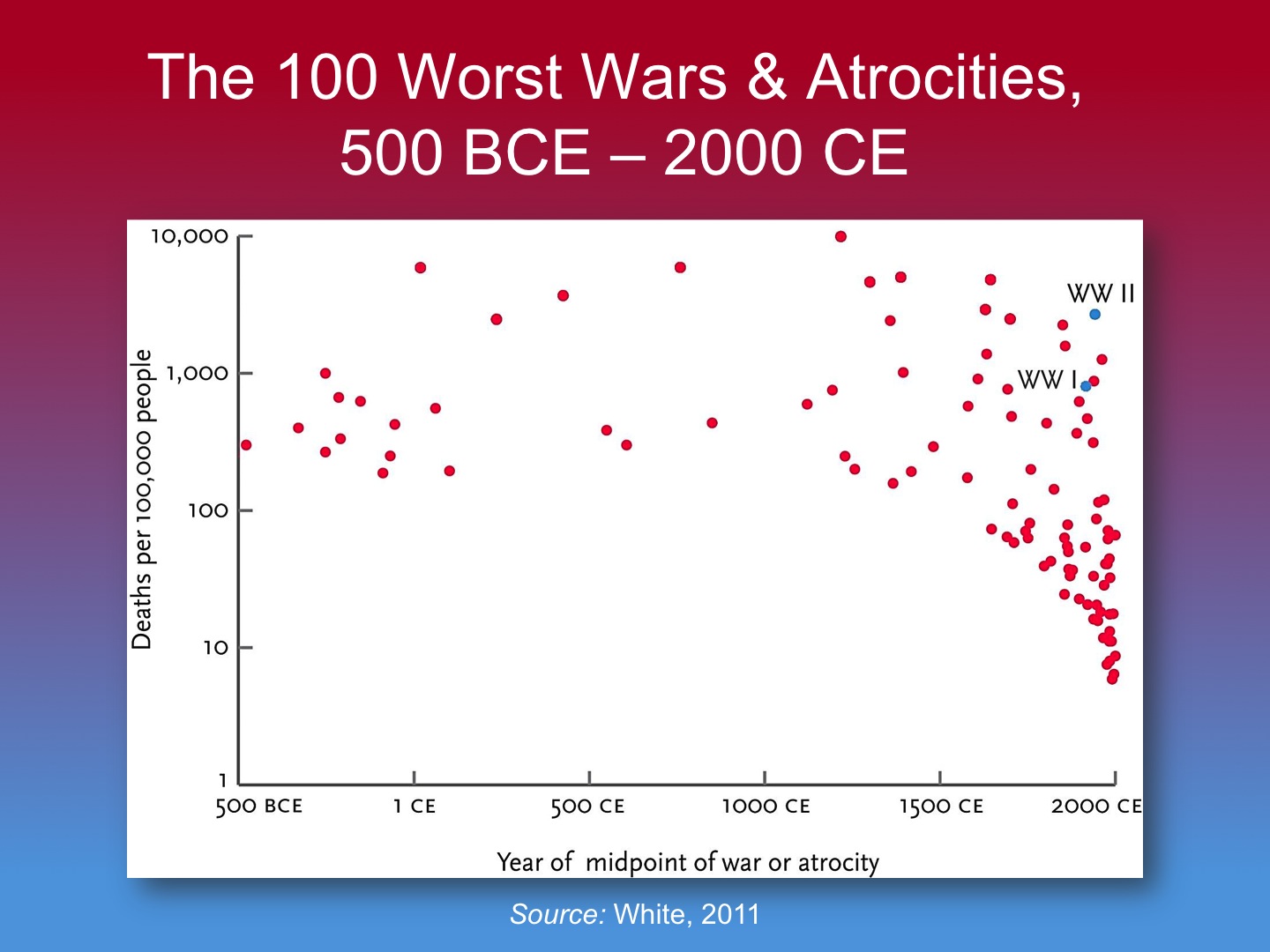
Really? You'd think that if you read Pinker's book on the decline of violence, but not if you re-examine his statistics. By examining only the worst events in a particular period, he provides a skewed view of the risk of death by violence. Much better to consider the probability of dying by all violent causes in a particular year/century. Given that some major atrocities in centuries past were exaggerated, it's likely that the 20th century is at least the second and possibly the most violent in the last 2K years. (And killing only gets more efficient with time and technology...)
http://www.edge.org/3rd_culture/MC11slides/sp-Slide039a.JPEG
http://www.nytimes.com/imagepages/2011/11/06/opinion/06atrocities_timeline.html?ref=sunday -
Re:Why are you behaving in the role of narcissist
Why are you pretending that you have expertise in an area you provably do not- climatology-
You need to review Dyson's bio a little more closely. He was one of the first physicists to work on global warming at all, and I would venture to say that a lot of the experimental work that's been taken place in the last 20 years has happened because of his prompting.
and making dramatic pronouncements which are directly counter to what people who DO have the requisite educational and research specialization are making?
If you'd like to know why he said what he said, you might start by reading his argument: The Question of Global Warming.
It's great that you have cultivated an impish, child-like , authority-resistant public persona, but science is not really interested in any of that.
Actually, Dyson disagrees with you on this point, he's argued that there's a need for scientific heretics. Ane previously, he's had a book published on this subject: The Scientist as Rebel
Interestingly enough, this book did not provoke any great controversy. We all like the idea of intellectual rebels and heretics in principle, but when they go up against one of our own beliefs, then they're just incredibly arrogant for going against the authorities.
(By the way... speaking of arrogance, it takes some balls to lecture Freeman Dyson about science... but whatever.)
If you want to attack Dyson's policy recommendation on global warming, by the way, I suggest going after him on the economics. I guarantee you that he knows more about climate science than you or I do, but on a subject like the costs of imposing heavy carbon taxes he's got to defer to economists, and they've got they're own problems with objectivity.
-
Taboo.
No one will address the human population issue. Everyone is scared (except China) of having to enforce limits on people's sex organs. Instead they will let it go until things collapse, like a person ignoring their diet until they have a heart attack then they go to their doctor demanding to be fixed.
We have invented modern taboos, such as any restriction on any person wanting to do anything in any place at any time is bad, and not only is it bad, but it's literally Hitler.
China isn't fooled, and so they're not only limiting population, but using eugenics to improve the abilities of their population.
It's going to be interesting when the next war comes about. Chinese supermen versus the obese sofa-bound citizens of Western liberal democracies.
I can't get excited by any conservation tech or effort because I know population increases will erase any gains.
Generally I agree. The exception might be spaceflight cheap enough to displace most of our population to Mars.
-
Re:The political construct is unraveling
I recall in the 1970's when we were all headed to the next ice age - the computer models all kept falling into something called "white earth" and never warmed up again.
Here's a good and insighful read of the author of the study that became media's "next ice age" in the 1970s has to say about it: http://www.edge.org/q2008/q08_7.html#schneider
He ends with:
Ironically, inside the scientific world, this switch of sign of projected effects is viewed as precisely what responsible scientists must do when the facts change. Not only did I change my mind, but published almost immediately what had changed and how that played out over time. Scientists have no crystal ball, but we do have modeling methods that are the closest approximation available. They can't give us truth, but they can tell us the logical consequences of explicit assumptions. Those who update their conclusions explicitly as facts evolve are much more likely to be a credible source than those who stick to old stories for political consistency. Two cheers for the scientific method!
-
Re:With apologies to Michio Kaku
For interesting critiques on Kurzweil, you might...
... read Jaron Lanier, particularly his One Half of a Manifesto, where he makes a pretty compelling case that Kurzweil is a "cybernetic totalist" who's pretty much willing to throw away everything that makes human life worth living in order to prove that human nature is mechanistic and reducible to mere information.
... watch The Transcendent Man, a documentary on RK, which makes the pretty compelling case the Kurzweil is in fact obsessed with "the technological singularity" not because he has a rational basis for it to be, but because he's wracked with guilt for never having a good relationship with his father, and he's obsessed with the idea that the Singularity could not just prolong him forever, but resurrect his dead father as well. He's driven by the idea that death is abandonment or alienation and he's terrified of being abandoned, again.
-
repeat after me: I am not an aggregate
We believe that tailoring your web experience â" for example by showing you more relevant, interest-based ads, or making it easy to recommend stuff you like to friends â" is a good thing.
This is "your" as the anonymous plural. I'm an individual, not an aggregate, thank you very much. I mainly have any friends left at all for not presuming that my tastes are theirs. Strangely, I surround myself with people who have strong minds and distinct tastes. My social circle is not an echo-chamber of group think.
From [all-caps title suppressed]
These Big Data issues are important, but there are bigger things afoot. As you move into a society driven by Big Data most of the ways we think about the world change in a rather dramatic way. For instance, Adam Smith and Karl Marx were wrong, or at least had only half the answers. Why? Because they talked about markets and classes, but those are aggregates. They're averages.
While it may be useful to reason about the averages, social phenomena are really made up of millions of small transactions between individuals. There are patterns in those individual transactions that are not just averages, they're the things that are responsible for the flash crash and the Arab spring. You need to get down into these new patterns, these micro-patterns, because they don't just average out to the classical way of understanding society. We're entering a new era of social physics, where it's the details of all the particlesâ"the you and meâ"that actually determine the outcome.
Reasoning about markets and classes may get you half of the way there, but it's this new capability of looking at the details, which is only possible through Big Data, that will give us the other 50 percent of the story. We can potentially design companies, organizations, and societies that are more fair, stable and efficient as we get to really understand human physics at this fine-grain scale. This new computational social science offers incredible possibilities.
I don't mind my search results personalized, but my preference here is to have specific crud removed, not favoured results promoted. Alibaba and scribd and certain content mills would be early casualties, and no link to Elsevier in the top ten, ever. Mostly I can skim a list of 50 search results in the blink of an eye, thank you very much (and I don't find the skim gestalt useless, either).
Here's the thing, Google, you don't have to guess. Just give me a place to dial in my personal preferences, and then you'll know for certain: I don't want those stinking suggestions. My one burning desire in the user interface for the last decade is more capacity to disaggregate myself from faddish workflows. Ubuntu 10.10, that's how I like it, uh huh uh huh.
(*) I use a FF extension Make-Link to copy and paste links. Sometimes when you copy an all-caps link it comes out properly, if the all-caps was coded as a presentation style. I used to have an extension decaps to deal with this, but it broke in some FF upgrade. Over my dead body I'm retyping the title by hand to change the case, and neither am I leaving it there to scream at people.
-
Identity
Identity is clearly the focal point of this discussion. Do we admit the existence of polylithic identities, or do we insist that all of a single person's persona be linkable to their physical selves? The nymwars turned on this questions. I'd like to point out a comment by Jaron Lanier in the Q&A section of http://edge.org/conversation/mc2011-history-violence-pinker:
"I'd like to hypothesize one civilizing force, which is the perception of multiple overlapping hierarchies of status. I've observed this to be helpful in work dealing with rehabilitating gang members in Oakland. When there are multiple overlapping hierarchies of status there is more of a chance of people not fighting their superior within the status chain. And the more severe the imposition of the single hierarchy in people's lives, the more likely they are to engage in conflict with one another. Part of America's success is the confusion factor of understanding how to assess somebody's status."
And I think this observation answers in the affirmative to the value of polylithic identity. Naturally, the above is anecdotal, and I am unaware of more rigorous studies, but statements to the effect of "...if you have nothing to hide" routinely spouted by generally privileged, non-minority, center-of-the-bell-curve folk grossly disregard the fact of the diversity of experience that people have (even themselves, if examined honestly).
Ohm's Database of Ruin spells the collapse of the carefully nurtured identities that people have created. This may certainly lead to violence and barbarism if Lanier's hypothesis holds, all in the name of profit, bureaucratic efficiency, and laziness.
-
welcome to the monkey house
This is the problem we have in society where instead of advancing thought and morals, we advance an atheist agenda lacking in morals.
Atheists lack a defining text. And people think managing programmers is like herding cats. Unification of agenda under a grand banner is mostly a theist creation.
More simply put, without any moral guide lines we only have survival of the fittest to guide us.
Apparently, we hadn't properly solved the equations for Iterated Prisoner's Dilemma after three decades of study and you suspect on gut instinct that the grand mechanism of fitness is tapped out? Let me guess, you're soon about to argue that lack of a moral code correlates with lack of fitness?
Guess what happens to people with no moral guide lines? Well, you simply need to look at the declining mental and moral health of the USA to see how this turns out.
Bee Eye Enn Gee Oh.
Shortly after the 1983 Korean Air Lines Flight 007 incident I attended some Sunday services at a televised evangelical church in Toronto out of courtesy to the family I was boarding with. One of the speakers they invited was Hal Lindsey. I don't recall the other guests by name. In one service it was preached that America engage in eye-for-eye tactics and shoot down an equivalent aircraft from the Soviet sphere. Nice. Well, America evened the score on quick trigger fingers not long after with the Iran Air Flight 655 incident in 1988. If we had deliberately boarded the eye-for-an-eye bus, we'd now be asking the Irish for advice on how to cool the exchange.
The other sermon I recall rather vividly was the claim that the rapidly rising disease in western society was a sign of God's wrath. He was referring in particular to the number of distinct diagnostic categories, completely oblivious to the fact that refinements in diagnostic category are the hallmark of science making progress. Where we used to have one lump for infectious disease, we now distinguish thousands of pathogens, all the way down to minor strains.
FOX News excluded, mental health in America has probably never been better. I watched the extremely difficult movie Breaking the Waves over the weekend. There wasn't a shred of mental health in evidence in that nasty Calvinist congregation. Every one of them would rather crush pint glasses with their bare hands than seek help for depression. Hitchens was exceedingly vocal about how Mother Teresa defined misery as next to godliness. She did almost nothing to alleviate suffering.
MT was not a friend of the poor. She was a friend of poverty. She said that suffering was a gift from God.
As society less frequently accepts that suffering is next to godliness, more people seek treatment for minor mental health conditions. The same data you cite reads to me as major progress.
-
Re:US and UK, best friends forever
The plural of anecdote is not data. If you are looking for evidence you should have a look at Steven Pinker's work on the history of violence, e. g. here: http://www.edge.org/3rd_culture/pinker07/pinker07_index.html:
The decline of violence is a fractal phenomenon, visible at the scale of millennia, centuries, decades, and years. It applies over several orders of magnitude of violence, from genocide to war to rioting to homicide to the treatment of children and animals. And it appears to be a worldwide trend, though not a homogeneous one.
It is true that the "rest of the world" is not living in absolut peace. It is also true that the human race has never been as peaceful as it is today. And to add another meaningless anecdote: In some countries the imbeciles that lust for war even have to resort to fighting war on plants and abstract concepts to get their fix.
-
2 reasons bubbles happen
1. People are stupid
2. People do what people around them do
source - http://edge.org/conversation/infinite-stupidity-edge-conversation-with-mark-pagel -
Re:Indeed
-
s/brittanica/Britannica/ did not see the threat
Absolutely true and should have been the story angle in the first place if slashdot wasn't trolling for page views. We're geeks. Why do we put up with this? Too often this place flirts with becoming People magazine or Entertainment Tonight, where the game is to scandalize the most banal information ever promulgated between living organisms.
So let me add my own story, circa 1986. I walk up to a Britannica booth in a local shopping mall and ask with the clarity of youth: "When is the CD version coming out?" The sales guy hisses at me like Voldemort. This is a decade before Encarta enters the picture. All you needed was a working brain to see that 600MB on a silver disc was a fatal illness. Britannica was cancering for a decade before Encarta metastasized.
[x] Minor edit
[x] No insight bonus -
Re:The open question...
I'm 52 years old, since I was a kid I've been hearing predictions [...] of the earth getting much colder;
Here's a nice article from one of the authors of that infamous 70's Global Cooling Study, that was mentioned all over the press.
Let me quote a very insightful paragraph from that article:
Ironically, inside the scientific world, this switch of sign of projected effects is viewed as precisely what responsible scientists must do when the facts change. Not only did I change my mind, but published almost immediately what had changed and how that played out over time. Scientists have no crystal ball, but we do have modeling methods that are the closest approximation available. They can't give us truth, but they can tell us the logical consequences of explicit assumptions. Those who update their conclusions explicitly as facts evolve are much more likely to be a credible source than those who stick to old stories for political consistency. Two cheers for the scientific method!
-
Nature is sexist
The fact that brain function related to intelligence is not identical in men and women is well established, despite similarities in generalized intelligence measurements and political correctness. It's more nature than nurture; don't blame society. This has been debated by the experts, and the nature side won: http://www.edge.org/3rd_culture/debate05/debate05_index.html (also note Pinker's references), as much as an inconvenience this is to some people. I expect to be modded down for this, as it's always easiest to shoot the messenger... cheers anyway, folks.
-
performative belief
However, unless you believe in God, you are an atheist.
You're a word bully, aren't you? Here's another stripe of aWTFism: I have no clue what God is, so it's impossible to judge whether any of my beliefs are congruent.
I guess you'll argue that I don't really believe if I'm not willing to manufacture a mental representation of the emperor's clothes, of what the "god" word entails. Cognitive psychology tells us that we're normally fast and loose about said manufacture. We're also pretty good at manufacturing an excess of objective certainty if we swing the other direction.
What do we call ourselves who are content to navigate the uncertainty of life, the universe, and everything without recourse to belief steroids?
And what about belief algebra? Does it lessen one's belief in God to also believe in alien abduction? What do you call someone with promiscuous belief targets where only one is labelled as a god?
Here's something else I can choose to believe in or not. On the question of understanding it, I have fewer options.
The Book of Revelation: Prophecy and Politics
I was always partial to the views of Wittgenstein on metaphor. Do you have any feeling of ethereal awesomeness in search of a good word? Excellent, you're one of us! Or if you won't say so, it turns into "are you going to play nice with our little in-group ritual, or stand out there in the cold?" And if that doesn't work "Not even at risk of burning for all eternity?"
If God functions merely as a shibboleth for an in-group ritual, I guess you could say I'm functionally atheist. If I wasn't going to tell the truth in the first place, putting a bible under my hand isn't going to change my story. Lying as lifestyle is often associated with people with an exaggerated sense of personal autonomy. I think often the real question behind god is whether you're willing to concede anything bigger than yourself. I view myself as a pattern in an information space where boundaries are far less black and white. Instead of using the word "god" as a pipe brush for linguistically unattached sentiments pertaining to human collectivity, I have other modes of expression available, after digesting some equations explaining "you can't get there from here" concerning many woolly sentiments (courtesy Cantor, Turing, Godel, Kolmogorov/Chaitin).
So perhaps atheist means "exactly the same mental things that everyone else experiences attached to different words". I suspect J. L. Austin would be fine with viewing "I am atheist" or "I am agnostic" as a performative utterance rather than expressing a truth value. By that token, your harsh declamation is justified, with one small correction: Unless you proclaim, you're atheist; a theist being anyone in performative garb.
Personally, I'm not rushing to engage in any of the available performatives in this sphere. Here's one that I will accept: I'm aperformative. (Don't tell the girls.) I have no tattoos, either.
-
Re:Recognition vs. Relevance.
Your post reminded me of an essay written by Daniel Dennett entitled Thank Goodness!, where he does precisely what you say people don't do: thank the inventors and creators for their hard work and tenacity, as well as the doctors, nurses, clean-up staff, et al.
-
Re:Support them from your own money
If Red Hat can't hack it in the presence of competition from CentOS then Red Hat needs to die, because it's not providing a service anyone values enough to actually pay for.
There's a big difference between price as determined by market dynamics and willingness to pay. Red Hat is doing work people are willing to pay for, but parasitic market dynamics create a condition where people don't have to. It's a parameter in the Red Hat business model whether enough people can tell the difference.
The same dynamic exists with second hand bike parts. Let's suppose a pawn shop has a bit of both. If I make a point of purchasing only those parts where I have fair confidence that the parts aren't stolen property, other scumbags will show up and buy whatever remains asking fewer questions. The few bucks I saved will soon need to be invested in even larger and more pointless bike locks.
I know that Canada used to sell (and might continue to do so) tritium for non-weapons use only. This only makes it easier for the entire supply of American produced tritium to be consumed internally. Net effect: more tritium available for warheads.
Mother Nature seems to have pointed the species toward figuring out where your bread is buttered, at least some of the time.
It's pretty sad with the size of the human brain that the best most people can manage is asshole calculus. Mother nature doesn't cluck half so approvingly as you wish to believe.
-
Gleick has done a lot
Gleick has done some highly regarded work. I waded through some material on his web site many years ago, and felt a strong respect.
From my old notes, here's an audio interview about a previous book. A Miracle Made Lyrical: Jim Gleick's Isaac Newton
Also high praise for Chaos from I Missed the Complexity Revolution
I don't understand how this reviewer has never heard of Chaitin, but finds this book vastly too elementary. Oddly, I mentioned Chaitin in an earlier post this very day. Perhaps reviewer should tear a page out of the Roger Ebert school of criticism:
When you ask a friend if Hellboy is any good, you're not asking if it's any good compared to Mystic River, you're asking if it's any good compared to The Punisher. And my answer would be, on a scale of one to four, if Superman is four, then Hellboy is three and The Punisher is two. In the same way, if American Beauty gets four stars, then The United States of Leland clocks in at about two.
That's a lot of words to pour out without defining expectations or genre. And there are many sub-genres within science writing.
-
Re:and it will never happen....
If your government is so incompetent why do you keep voting the same people in? I suspect that some people in the USA would not give credit to any government function no matter how efficient and cost effective it was as they have a strong belief that government is the problem no matter what the facts say. And the fact is that good government exists all around the world and is huge part of our current era of peace and prosperity.
What era of peace and prosperity you ask? If you look at the facts, and not headlines, you will see that the percentage of people dying by violence has never been lower in all of history.
In Canada we vote for competent people and government generally functions well. The basics get done correctly, and cost effectively. We do have idiots that want to, and do, spend huge amounts of money on unnecessary stadium roofs and other boondogles, but generally the day to day operation of government works well. Even the boondogles are of good quality.
So stop voting for people who think iron age myths trump science and you might get some good government.
-
a hedge worth having
The obvious thing is that you are supposed to be hedged.
You need to imbibe some Argumentative Theory, followed by a Black Swan shooter.
There's a mathematical definition of hedge, and there's the social theory of hedge. The later means "but I think I can get away with it, so it's OK". The mathematical version depends on having correct variance models. If you don't, no hedge exists. Taleb 101.
Society would benefit from hedging itself against the tendency of bankers to hedge themselves deep into the grey zone.
Seriously, bankers talking about risk is a lot like Tom Cruise interviewed after filming Days of Thunder appearing to say--very fervently--that the idea from the movie that you can't control circumstance at 200 mph is full of baloney and that he really got mad filming those scenes where other characters throw this in his face. He races his own cars and believes in control over destiny, which is common among people who take insane risks.
Even if you have LTCM wonks dictating algorithms to be coded by nuclear power engineers and run in NSA bunkers, you can't escape precipice risk. But you can shepherd all the risk with your border collie safeguard systems into the universal millisecond of doom.
So in the lingo, an unhedged risk is the one where only one bank has egg on its face, and a hedged risk is where every fucking bank has egg on its face, and greater society picks up the tab.
-
A pox on all their houses
Most climate science on both sides of the argument is on shaky ground. I totally agree with Freeman Dyson.
My first heresy says that all the fuss about global warming is grossly exaggerated. Here I am opposing the holy brotherhood of climate model experts and the crowd of deluded citizens who believe the numbers predicted by the computer models. Of course, they say, I have no degree in meteorology and I am therefore not qualified to speak. But I have studied the climate models and I know what they can do. The models solve the equations of fluid dynamics, and they do a very good job of describing the fluid motions of the atmosphere and the oceans. They do a very poor job of describing the clouds, the dust, the chemistry and the biology of fields and farms and forests. They do not begin to describe the real world that we live in. The real world is muddy and messy and full of things that we do not yet understand. It is much easier for a scientist to sit in an air-conditioned building and run computer models, than to put on winter clothes and measure what is really happening outside in the swamps and the clouds. That is why the climate model experts end up believing their own models.
http://www.edge.org/3rd_culture/dysonf07/dysonf07_index.html
The true believers on both sides are way too confident in their beliefs. They (both sides) are closer to religion than they are to real science. There is way too much ad hominem and way too little real science.
If I had to pick a side in the debate, I would tend to side with Henrik_Svensmark. http://en.wikipedia.org/wiki/Henrik_Svensmark His theory about cosmic rays modulating cloud formation has, at least, the advantage of being falsifiable. That stands in stark contrast with Al Gore who takes absolutely anything as proof of anthropogenic global warming.
-
Some Specific Places on the Internet
I agree with reading about it on the Internet. I like RSS, but I've found it homogenizes my content so that things don't jump out at me and the really interesting stories get buried with all the mediocre ones. So I keep the following list of bookmarks to check on a weekly basis:
ABC (Australia) Science, ABC (US) Science, Air & Space Magazine, ARKive, Ars Technica, BBC SciTech News, CBS Sci-Tech News, Chet Raymo, Cosmos News, Current: Science, Discover, Discovery News, Edge, Economist Science, EurekAlert!, Flyp media, Futurity, h+, Inkling Magazine, LiveScience, Massimo Pigliucci, Mother Jones Environment, MSNBC Science News, National Geographic News, National Public Radio (US), Natural History Magazine, New Scientist, New York Times Science, New Yorker Science, Newsweek Science, Orion, PhysOrg, Popular Mechanics, Popular Science, R&D Magazine, Ripley's Believe It or Not!, Science Daily, Scientific American, Seed Magazine, Science Cheerleader, Science News, Schrodinger's Kitten, Slashdot Science, Smithsonian, Space.com, The Technium, Time Magazine Science, USA Today Science, US News & World Report Science, Wired News, World Changing
-
Re:Newton's
It's one of the theories of inflationary cosmology. You can read more about it here:
http://www.edge.org/3rd_culture/guth02/guth02_print.htmlor a paper here: http://arxiv.org/abs/gr-qc/0001011
-
Re:What scientists...
As with climate change, the few real scientists who are skeptical seem to be from fields which have nothing whatsoever to do with the topic at hand
So what? It is not like Navier-Stokes becomes solvable when applied to climate or weather.
Anyway, I have a counter example: Freeman Dyson. So there you have a guy who have been intimately involved in climate science and who don't by what Mann, Hansen, et. al. are saying. I hope that now you can also agree that comparing being skeptical on climate change and creationism is not fair.
-
Approximations & errors in assumptions & c
What's interesting about these sorts of discussions is that they are much more approachable for everyone than if we were arguing over calculus type things. And, these sorts of calculation are sometimes much more amenable to reasonable discussions and amendments and improvements related to bounds than overly precise ones about exact outcomes.
As Freeman Dyson said:
http://www.edge.org/3rd_culture/dysonf07/dysonf07_index.html
"As a scientist I do not have much faith in predictions. Science is organized unpredictability. The best scientists like to arrange things in an experiment to be as unpredictable as possible, and then they do the experiment to see what will happen. You might say that if something is predictable then it is not science. When I make predictions, I am not speaking as a scientist. I am speaking as a story-teller, and my predictions are science-fiction rather than science. The predictions of science-fiction writers are notoriously inaccurate. Their purpose is to imagine what might happen rather than to describe what will happen. I will be telling stories that challenge the prevailing dogmas of today. The prevailing dogmas may be right, but they still need to be challenged. I am proud to be a heretic. The world always needs heretics to challenge the prevailing orthodoxies. Since I am heretic, I am accustomed to being in the minority. If I could persuade everyone to agree with me, I would not be a heretic. We are lucky that we can be heretics today without any danger of being burned at the stake. But unfortunately I am an old heretic. Old heretics do not cut much ice. When you hear an old heretic talking, you can always say, "Too bad he has lost his marbles", and pass on. What the world needs is young heretics. I am hoping that one or two of the people who read this piece may fill that role."Back of the envelope calculations can give us a better idea of the range and scale of possibility, even if someone probably needs to do more detailed calculations to really make things work. So, we can answer "Might it fly?" with ballpark figures, whereas, "What is the best way to make it fly, given certain constraints and goals?" might take calculus or something else (evolutionary annealing algorithms or whatever).
It's been said (Knuth) that "premature optimization is the root of all evil":
http://en.wikipedia.org/wiki/Program_optimization
but related to that may be the notion that teaching people optimization techniques and high precision math (like calculus or even the full times table) as opposed to basic approximation (like working with only one degree of precision or round numbers) may be the root of all extreme dumbness and math illiteracy?By the way, related to general errors in assumptions (or calculations), especially in relation to the LHC at CERN:
http://reason.com/archives/2008/09/02/a-1-in-1000-chance-of-gotterda
"At the Global Catastrophic Risk conference, Future of Humanity Institute research associate Toby Ord asked an interesting question: How certain should we be about safety when there could be a risk to the survival of the human species? As Ord argued, "When an expert provides a calculation of the probability of an outcome, they are really providing the probability of the outcome occurring, given that their argument is watertight. However, their argument may fail for a number of reasons such as a flaw in the underlying theory, a flaw in their modeling of the problem, or a mistake in their calculations.""There is also the risk of "social group think" perhaps leading to this:
"The CERN black hole"
http://www.youtube.com/watch?v=BXzugu39pKMSeriously, the LHC cost billi
-
Re:An odd approach...
It appears it was referenced in his eulogy.