Slashdot Mirror
Domain: energy.gov
Stories and comments across the archive that link to energy.gov.
Comments · 643
-
Re:I think fuel cells + recycling CO2 is greener.
No, depending how you do it it is between 65% and 70%
Between 65% and 70% would necessitate both the electrolyser and the fuel cell to be on average 82% efficient. This is simply not happening with existing technology. Practical fuel cells reach 50%-60% efficiency. Meanwhile, practical electrolyzers need around 45 kWh per kg of generated hydrogen, so they're around 70%-75% efficient. So the overall roundtrip from electricity to hydrogen to electricity is between 35%-45% for pure hydrogen.
high end systems obviously reaching over 90%.
I'm not even going to comment on that.
-
Re:Careful about proving my point?
I don't know why you have an issue with this.
I have an issues with this because, by all my research, you are wrong on this. You have failed to provide a citation proving this, I have failed to find a citation proving this. The math is NOT "right above". You have posted no math that I can see. Indeed, I keep encountering statements in documents that air core transformers can sometimes be preferred in order to prevent Hysteresis and Eddy loses, otherwise known as "iron losses". Air core works better at higher frequencies, Hmm.. I wonder what EV inductive chargers use... Ah yes, high frequencies. 85 kHz seems common, though some are much higher.
2. Coupling factor, as shown by my and your sources, is somewhat independent from the core material used. An iron core transformer CAN be less efficient than an air core transformer. YOUR citations show this.
You will never be as efficient when you terminate your charging system with a transformer (air core or iron core, although iron is more efficient) as compared to a hard-wired connector. Just not going to happen.
What do you meant terminate? The transformer is necessary regardless of connector -whether inductive or hard wired. You're going to need to match wall voltage to what the battery needs, and the best way to do that is with a transformer. It's also hardly the "end" of the circuit. You're still going to need to transform the power from AC to DC, for example, and likely are going to want to smooth it out.
Combined with your insistence that iron-core transformers are always more efficient than Air Core and other issues like seemingly being totally ignorant of the effects of frequency on transformer design, the general necessity to match wall voltage to battery voltage through the use of a transformer, etc... I don't believe that you are actually an EE. You're making too many basic mistakes about physics. If you are an EE, you're probably a very specialized one that doesn't deal with the same issues that will come up in designing an inductive charger for EVs.
I've also told you a couple times what you need to do to convince me.
1. Citations, Sources. I'm not taking your word on this stuff. Note that most of my posts are littered with citations. The one time you tried, you linked to sources that agreed with me!
2. Reasoning that goes beyond the transformer/inductive loop. As I've said, I'm looking at the complete system, not just the loop.For example, what is your response to this?
Vermont Energy Investment Corporation, Transportation Efficiency Group
Average efficiency, level 2(240V) charge: 86.4%, level 1(120V): 83.7%.
Interestingly, temperature can change the charge efficiency by more than 2%!
Then the DOE chimes in, with a wireless charging system that is 90% efficient.
Plugless power, is getting 84-90%The quoted official, Momentum Dynamics, it might be important to note that they've been targeting bus charging - 200kW. So, if the technology scales well, that could be part of their claiming high efficiency.
What's up with wireless EV charging - has an interesting writeup of what's going on under the hood. Though it mostly focuses on the cost, which can be cheaper for wireless? Interesting.
One reason f
-
Re:Physical lies
More efficient? That's a lie. Flat out. They are not even as efficient. Even your own numbers say so.
Then cite them. Prove your assertion with evidence. At this point you're committing the fallacy of "proof by assertion". IE that you'll prove your argument right if you merely say it enough times.
Meanwhile, well:
https://www.energy.gov/eere/vi...
https://www.sciencedirect.com/...
https://insideevs.com/momentum...
https://www.businesswire.com/n...And I don't think you realize that the losses of the inductive charging portion is in addition to the losses of the charger in the first place. It's an additional loss...
Prove it. Everything I've seen shows that they're looking at "wall to battery" efficiency. Wired chargers have losses as well. It could very well be that inductie chargers are covering up, efficiency wise, by being substantially more expensive, but I've done the research.
Inductive chargers are integrated. It isn't charger + inductive coil, it's an inductive charger. It's a complete integrated charging system(assuming it is efficiently designed).
Though it is good that we've identified where the difference in thought comes from. Problem is, I believe you're wrong because you haven't actually cited any evidence.
Let me guess, you're not an electrical engineer, are you?
Back to ad hominem attacks are we?
Let me guess, you're not an electrical engineer either, and as you apparently aren't willing to do research, like what I actually DID, I may not be an electrical engineer, but I've taken classes in electronics and I'm perfectly able to read and interpret studies and technical documents, you're talking out of your ass?
Stop and think: what is more efficient - power via high-tension line, or power via broadcast energy?
Red herring fallacy. What is efficient for transporting electricity over hundreds of miles in the hundreds of kV isn't necessarily efficient for transporting electricity over something like 6".
In addition, because we are looking at chargers, which have to alter and maintain specific voltages, amperages, not to mention converting AC into DC, there's quite a bit of electronics involved. That is where the savings are seen.
Plus, consider, the inductive element is like 6" of travel. How many feet of power power cord are we typically looking at? Probably 9 feet or more?
Finally, consider that I'm showing citations of 90% or more efficiency. The difference between 90% and 92% isn't all that great, and can be justified through things like system convenience and life. If you end up having to replace the power cable more often than the inductive unit, whether due to wear, weathering, accident, theft*, or vandalism**, you may find yourself having to do a cost analysis to determine which is more economical. Well, you need to do that anyways, but that comes down to having to bust out the spreadsheets on specific proposals that are deeper than we're going here anyways.
TLDR: Stop attempting argumentative fallacies on me and debate properly and we might get somewhere.
*Damn copper thieves feeding their meth habits....
**A properly buried inductive unit should experience less vandalism than an open air cable. -
Re:Efficiency levels
Basically you're switching from a 100% efficient cable to 80% efficient wireless.
Problem:
1. As LynnwoodRooster identified, cables aren't 100% efficient themselves.
2. The 80% efficiency is for the entire charging circuit, and is a false number. I'm seeing numerous examples around 90%.Of course, the ideal isn't to just look at the "wireless link" and assume all other parts are still present and the same loss. It's better to look at the loss from the input on the charging 'station' to what the vehicle receives. Most charging stations have extensive electronics, after all. Inductive chargers allow some of the loss to be "shifted" to the inductive link, as the link itself remains ~90% efficient.
-
Re:Motivated Reasoning
Cost? About $800 for an 80 kWh equivalent tank, that seems a lot cheaper than an 80 kWh battery pack. And if we have an abundance of energy from solar and wind, why can't it make hydrogen? Is "wasting" solar power a bad thing?
Hydrogen allows for lighter vehicles (and weight is the biggest impact on road damage - which is a significant cost itself), near-instant refilling, and can utilize the 225,000+ gas stations around the US without the need to build (expensive!) new charging stations.
-
Re:So much for electric powered aircraft
Flying LA-Vegas or Boston-NYC is idiotic when you could build a train or hyperloop
Airports already exist. High-speed rails and hyperloops don't.
Flying requires expending energy to climb to altitude, whereas trains run on the surface
The air density, and thus the drag, is far higher on the ground than at 30,000 feet.
Trains are not much better than current aircraft at energy efficiency, so electric planes will be better than trains. And the planes don't need a trillion dollars of new infrastructure.
Progress on electric buses and short-haul electric planes was part of the reason California killed their SF-LA high-speed rail project.
-
Re:I fear poor support long term
By that, I mean we already know the average vehicle owner doesn't keep a car or truck more than about 6 years.
Your wrong about how long people keep cars.
-
Re:Is this a good thing or a bad thing?
I doubt the world has the manufacturing capacity to maintain that trend. What's the source for the historical data? This source projects an increase from 113 GW to 404 GW between 2020 and 2050 (US only). That's a factor of 4 in 30 years; a factor of 10 per decade would yield an increase of a thousand-fold in 30 years.
This source says "U.S. wind power has more than tripled over the past decade". That's a factor of 3, not 10, and it's from the American Wind Energy Association.
The World Wind Energy Association says, "The overall capacity of all wind turbines installed worldwide by the end of 2017 reached 539’291 Megawatt" (539 TW, not 959).
I'd be very pleased to see the world move away from fossil fuels as quickly as feasible. I'd be even more pleased if the result were greater decentralization (such as replacing large power plants with distributed solar panels). I just don't think it's going to be quick or easy. And it isn't just that fossil-fuel businesses are Evil; it's more than people in general don't like change, especially when the change seems to make things worse, and especially when it's forced on them.
-
Re:Fairly easy to do this
Well, if 90 percent of the Department of Energy budget is for fossil fuel incentives, and their budget is x amount, the math is fairly simple
It's not that simple, because despite it's name, the Department of Energy is not primarily about the production and consumption of energy. Rather, it's primary mission is managing the U.S. nuclear weapons program: the design and manufacture of the weapons, making sure they still work, fundamental nuclear research, etc.
Here is the DoE FY2019 budget request fact sheet. It's a $30.6B department - tiny in the scope of the U.S. federal government. The top line item, fully one half of that budget, is "National Nuclear Security Administration".
Surprised? You're not alone. The present Secretary of Energy, Rick Perry, also apparently didn't know that the DoE, ya know, doesn't do much with energy. That is, of course, when he wasn't forgetting about it entirely. Ooops.
And it's here, at the end of what I hope was an informative post, that I'll point out Obama's first DoE secretary was a Nobel laureate in physics. -
Re:Cool
You would not be correct, but that's your opinion.
I think this paper supports your argument however it appears that some government web sites ( energy.gov) are still shutdown. You may find this article interesting.
-
Re:Who would have thunk?
From Ford, GM, Chrysler, and AMC pulling a "fuck you plebs, you'll buy what we make" in the 1970's
The Arab Oil Embargo happened rather suddenly. Ford, GM, Chrysler, AMC were making big cars because that's what people wanted. The Japanese were making small cars because that market niche was mostly ignored by the other automakers, making it easier for them to be competitive there. When the oil embargo doubled gas prices, suddenly those small fuel-efficient cars became a much bigger share of the market, and Ford, GM, Chrysler, AMC were caught flat-footed by the market shift.
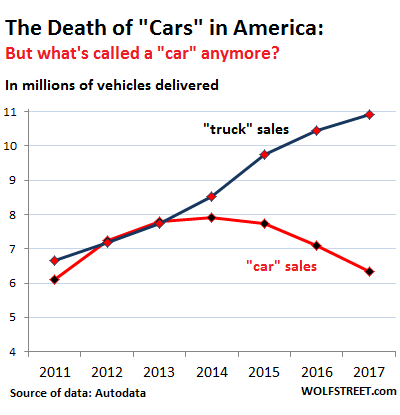
But it should also be noted that the vast majority of buyers wanted, and still want bigger cars. Truck sales are approaching 2x car sales. And the shift away from cars and towards trucks began in the 1970s when the CAFE fuel efficiency standards were introduced, forcing automakers to make smaller more fuel-efficient cars.
It's a myth that automakers had to be forced by regulators to produce the type of cars that people wanted. If anything, regulations are preventing them from producing the vehicles people want, with the looser light truck CAFE standards being a loophole that people are using to buy a bigger less fuel-efficient vehicle. Regulating the supply side like CAFE does isn't very effective because people just find a different way to get what they want. If you want to encourage people to buy more fuel-efficient vehicles, you have to manipulate the demand side - crank up fuel taxes so they want to get a more fuel-efficient vehicle. -
Re:Tax Payer BailoutThe irony is that the argument put forth by both sides about the GM bailout were backwards. When a company goes bankrupt (chapter 7 dissolution, not chapter 11 restructuring), it does not disappear. The parts are sold off to the highest bidder. Things like factories and their workers become part of another car company. The closer the company was to solvency, the more viable its business was and thus a greater percentage of its parts would be absorbed by other companies. But if a company was in a terrible state, then a very small percentage of its parts would be salvaged by other companies.
The left argued that GM needed to be bailed out because it was only barely insolvent, and a small bailout could save x million jobs that would be lost at GM and its suppliers. But if they were just barely insolvent, the the vast majority of those jobs would have survived in other companies after a bankruptcy. And thus no bailout was needed.
The right argued that GM should be allowed to fail because it was an inefficient wreck crippled by union contracts. But if that were true, then bankruptcy would have caused the loss of millions of jobs at GM and its suppliers. And the economy would've had to absorb the shock of its failure (and trickle-down failures among suppliers), in lieu of absorbing the cost of a bailout. So a bailout would probably have been preferable (given the poor state of the economy due to the housing bubble bursting).So now GM is going back to building gas-guzzlers instead of responsible, (more) environmentally friendly smaller cars.
Companies build what people want, while complying with laws. They follow, they don't lead. Light truck sales have risen dramatically in recent years to nearly 2x car sales. If you look at long-term trend, you see that transition picked up pace in the 1980s. Precisely when tougher CAFE standards kicked in. (The sales data actually goes back to the 1940s, but is not available for free online anymore. It shows the ratio of car to truck sales being relatively constant until the 1970s when CAFE began.)
Americans want to buy big cars. CAFE prevented automakers from legally offering big cars for sale. So Americans looked elsewhere and found trucks were still big. So they began buying trucks instead of cars. The fault here lies with the American public, not car companies.
CAFE is a stupid way to encourage fuel efficiency (especially since it's based on MPG, which is the inverse of fuel efficiency, so it puts most of the compliance pressure on the vehicles which are already most efficient).. If you want to increase fuel efficiency, just crank up the fuel tax on gasoline. -
Re:Not Obama's
First, as to your last paragraph, I have no doubt that EVs will be more than 50% of new passenger vehicles (minus trucks) by end of 2022/3. We will see more EVs sold in America/Europe, than ICE (again, minus trucks). Ppl can see this coming a mile away. EVs are cheaper to own, lower maintenance, faster, more room in same volume, etc. etc. Tesla is the only EV that is actually cheaper than its competition, but, they will force legacy car makers to follow. Even now, the luxury car makers are moving to decent luxury EVs because they are losing huge numbers of sales to Tesla (according to Porsche, BMW, Audi, Volvo, Caddy). Interestingly, Lexus and infiniti have dropped sales a great deal over the last 2 years, but, they are not saying anything, except still focusing on H2 cars.
Range anxiety. Ok. Where do you live? I am going to assume that you are American. There are a FEW spots left in America that does not have decent coverage, but will be covered before end of next year. Here is what is being looked at for Tesla over the next month or so
As to paying more for the larger battery, it gives us the ability to driver further on occasion when needed, but otherwise, it makes sure that my battery will outlast me and my kids. But if you think that gas is cheaper than electricity, you have to be kidding. Here, lets get a perspective. Our car does 250 MPC when full. That is 85 KWH, but we are going to assume 100 kWh (easier calcs). Now, we pay $.08/kWh in the summer and $.0459/kWh for winter (xcel TOU). We will simply use $.08. So, that means to drive 250 miles, we will pay $8.00 or
In a comparable car, say a class S, the owner will get 15-20 MPG. Let say that gas is at $2.00 / gal (in Denver, it is $2.5-2.80, but we will go your way). To drive 250 miles, you will have 12.5-16 gal. Lets assume 14 gals, so, $28 to drive 250 miles. That makes it $.112 / mile. Now, I have been weighed all of this your way, and it still turns out that gas will be 4x what electricity will costs. And notice that the MB's Class S that competes against our Model S, are slow, high maintenance, and will actually costs a great deal more to get less luxury in the car.
In addition, resale values on Luxury ICE vehicles are plummeting. OTOH Tesla are holding their values (note that most EVS drop at same rate as ICE, but the Tesla does not).
This page is Oct, but in Nov, EV sales are now over 2.5% of car sales in America. I will guess that EVs are over 3% for Dec.
Note that next year, a number of REAL EVs will be released. Rivian has a truck and SUV coming. Porsche has Taycon. There are decent EVs coming from MB, Audi, Jag, volvo, etc. And these EVs will be cheaper than the competing ICE vehicles. -
Re:Not Obama's
Sure 95% of trips but folks have range anxiety anyway because they worry that you never know when you will hit that 5% trip beyond your range.
Your argument (to which I was responding) was that EVs don't have sufficient range for most commuters. You now agree with that they do.
I am not going to argue that something like a Leaf is sufficient as an only car. It clearly won't do long trips and charging is slow. However, Teslas are capable of being a primary/only car and other manufacturers are catching up. The Chevy Bolt costs ~ $35k and that is the average price of all new cars.
But they do wear out. Prius batteries where degrading their range limits in about 5-6 years, if my friend's car was a valid example. He was getting 70% of his initial new range at about 5 years. Yea, it's not a 100% EV, but it's a data point.
Rule of numb is 1200 cycles is the high end and unless you have a less than average commute,Here in CA (and other CARB states), manufacturers are required to warranty batteries such that your friend would be getting a new one, if your anecdote is true. So, it's an exceptional case. Note also that plug-in hybrids typically use more of their battery capacity in normal driving than pure EVs do -- this is harder on the batteries, so not applicable to pure EVs.
The typical battery warranty is 8 years/100,000 miles:
https://www.energy.gov/eere/ve...As far as I can tell, Toyota gives an 8 year/100,000 mile warranty on the "hybrid system", which I assume would include the battery. So I think your "anecdote" is actually a lie.
As I pointed out earlier, you are attempting to replace facts with your ignorance: charge cycle count is not a good indicator of battery life. I backed this up with data, while all you bring is the same repeated bullshit.
They have higher maintenance costs per mile,
No, they don't. This is complete bullshit. As I showed, battery life of EVs is likely to be sufficiently long that an equivalent ICE vehicle would be scrapped, so replacement at that time is moot.
I'll stick to my cheap, comfortable and quick to fill up gasoline powered pickup truck thank you
So you don't care about climate change. Perhaps you don't think that climate change is real? All you care about is your own selfish issues. You don't care about driving (Teslas are very fun to drive). Or perhaps you have a financial interest in natural gas usage?
Energy costs for an EV are much lower than those of a gasoline-powered car in most states. Added to the reduced maintenance costs, any added cost of the new vehicle is easily amortized over the life of the vehicle.
If you want to argue further, bring some real data, not bald assertions, anecdotes and bullshit.
-
Re:Carbon "negative" is easy
Logs do not have as high an R value as other materials we use.
According to the DOE, a log has an R-value of 1.51 per inch, including the effects of thermal mass. Or about R-18 from one foot log walls. And 12 inch logs would be considered really, really, really damn big. The same report says a typical log wall with no windows is R-8.
A 2x4 wall with basic fiberglass insulation is R-14. Spray foam can easily double that. 2x6 exterior walls are pretty common now, so that even more insulation can get shoved in there.
And this also blissfully ignores the air infiltration issues from logs, which is why we started building "log cabins" with conventional framing and a half-log veneer.
-
Re:The long-term implications
Siting new transmission lines has become a formidable challenge to utilities in congested areas such as Long Island. HTS cable can carry several times more current than a conventional copper cable with the same diameter. HTS cables can be installed in existing rightsof-way, helping to reduce the cost and environmental impact of grid upgrades.
So the electricity losses are of less concern.
-
The long-term implications
We don't need literally room temperature superconductors in order to have a lot of the benefits that people associate with room temperature superconductors. -23 C is within essentially close to the range of conventional refrigeration equipment. Once one doesn't need to rely on liquid nitrogen cooling for superconductors, the general use goes way up. The pressure is of course a pretty big issue, but if for example one had something that was a superconductor at -30 C and 2 gigapascals that would be incredibly practically useful.
And it is worth keeping in mind that even superconductors which require very cold temperatures are now being produced and used in large enough quantities that we can use them as part of the regular electric grid. The US Eastern electric grid already has a superconducting cable in Long Island https://www.energy.gov/oe/downloads/long-island-hts-power-cable and the Tres Amigas Superstation https://en.wikipedia.org/wiki/Tres_Amigas_SuperStation is going to have superconducting lines to allow efficient transfer between the three major US grids (East, West and Texas). This sort of thing will also help renewable energy a lot; since right now, there's often more wind or solar power somewhere than one directly needs but hard to get it elsewhere, and then not enough wind or solar at some other time. More efficient grids mean that excess can be much more easily transferred to where it can be used.
-
Re:Too little, too late
Here's something you could educate us both on, how much would this algae based fuel cost?
Why don't you google it?https://www.google.co.th/searc...
1.7 million hits
https://www.sciencedirect.com/... an easy read, you can even download the PDF.
And as you are so fond of youtube videos: https://www.youtube.com/watch?...
Or if you like a more official one: https://www.energy.gov/eere/bi...So, your defense is your ignorance?
Ignorance about what? If you disagree with me or I say something wrong: it is not a lie. Period. The previous discussion is/was not about anything where anyone could be proven wronghttps://www.eia.gov/tools/faqs... 391.71 million gallons (or about 9.33 million barrels per day).
Energy per gallon: 370kWh
-
Re:Nope
Even that is not the case.
From TFS, a "conventional car
According to the DoE, an average BEV powered in West Virginia (95.7% coal power) would emit 4.29 tonnes a year, compared to an average ICE emission of 5.19 tonnes/year, a difference of 0.9 tonnes. So the ICEV emissions would exceed the BEV even in the worst-case power mix after just 3.5 years.
-
Re:Intermittant renewables
-
SMDs are just theory right now
So what you are looking for is a Small Modular Reactor. These are relatively small reactors that can be produced on an assembly line and shipped to the installation site, so they are cheaper than conventional nuclear designs.
Being cheaper than current reactor designs is kind of damning with faint praise. And these are proposed reactor designs, not actual products that can be bought today. The DOE is claiming that we might see them in 10-15 years which is how researches talk when they mean probably never.
Most don't require active cooling, which means you don't get meltdowns.
Meltdowns are just one of many failure modes for fission reactors to worry about and not anywhere near the most likely. And your use of the word "most" is not comforting since it means the number is not zero.
Also, you can bury them in a vault for protection from attack or sabotage.
The very fact that this would be a serious concern is rather worrisome don't you think? Nobody is going to be attacking wind turbines or solar panels or fossil fuel plants and even if they did and succeeded it wouldn't be a major catastrophe.
They require no maintenance. You run them until their fuel is spent, then you pull one out of service and recycle it.
There is no such thing as a man made device that never needs maintenance or that never fails. Reliable and easy to replace I could believe. As soon as someone says "no maintenance" what it actually means is easily replaced, disposable, or they are lying. The DOE does not claim they do not require maintenance. Any engineer that makes such a claim is either clueless or lying.
You end up with a few pounds of waste material per unit over the course of it's lifespan, which is a couple of decades.
That's the theory which has yet to be demonstrated in practice. If they can do it in practice then I'm all about it but right now you are talking about proposed designs and prototypes as if they are working products which they are not. And I think you are grossly overstating the likely actual outcome.
As the earlier post pointed out that one of the biggest problems with nuclear fission plants is that every design proposed is cheaper to operate if corners are cut which would reduce safety. When profit motive is at odds with safety you should always assume that profit motive will eventually win in some cases. This would be acceptable except that the failure modes for fission reactors are FAR more immediately and acutely catastrophic than any other power source we have access to. Fossil fuels may kill the whole planet eventually but a fission plant failure can render a large area uninhabitable by people for centuries in an instant.
-
Re:How do they plan to recharge?
Try this. Make sure that Tesla and Level 2 are off.
Now, do it with just Tesla.
What do you see? The fact is, that you can not go across the country using CCS, CHademo, AND Level 2. It is only Tesla that allows you to drive around most of the nation.
All in all, unless these companies spend billions just in America, they will get nowhere. -
Re:How do they plan to recharge?
Try this. Make sure that Tesla and Level 2 are off.
Now, do it with just Tesla.
What do you see? The fact is, that you can not go across the country using CCS, CHademo, AND Level 2. It is only Tesla that allows you to drive around most of the nation.
All in all, unless these companies spend billions just in America, they will get nowhere. -
Re:Molten sodium or salt?
The "liquified sodium" a major error in the article, and no one has promoted any of several posts correcting it. From this, it is clearly a molten (chloride) salt fast reactor, so it can burn any nuclear fuels. Opponents of nuclear often conflate the chemically stable salts used in MSRs with the reactive sodium metal commonly used as coolant in fast reactors. For MSRs based on fluoride salts, they conflate it with liquid fluorine, which is even more horrifying and wrong. It is a deliberate attempt to confuse people and damage the reputation of MSRs, which are remarkably safe.
Molten salts exhibit exceptional chemically stability, are impervious to radiation, and have very high boiling points, making them an ideal medium for nuclear reactions. The most dangerous fission products which are volatile in conventional solid-fueled reactors, form stable salt compounds in an MSR, and remain trapped even in the event of an accident. In an MSR, there is no pressure or stored chemical energy to be released, so any dispersal of radioactivity is impossible.
-
Re:Ah yes, the answer is *sodium*
Here is a direct link to the molten salt reactor in question. Think sodium chloride, ie. table salt, not "liquefied sodium" as the article mistakes. The metallic sodium that has caused so much trouble in fast reactors is something completely different. The fuel and coolant in these reactors is inherently stable and safe, chemically trapping the radioactivity. The stable chemistry and low pressure ensures that there is nothing to disperse radioactivity, even in the event of an accident.
-
Re:Strange
Lets see.
Here is a map of just Tesla Super Chargers. I see load in Texas.
Here is a map of all commercial electric chargers Keep in mind with EVs, most of your electricity comes from your own home since few trips are more than 100 miles.
Here is a graph of Tesla registrations by state, about a year ago. Since over 5% are in Texas, that would mean at least 20K cars are Tesla just in Texas.
The real issue is that you are noticing what you want to see. -
Re: DST
When I click that link, the very first thing I see on the page is this:
In 2008, Energy Department experts studied the impact of the extended Daylight Saving Time on energy consumption in the U.S. and found that the extra four weeks of Daylight Saving Time saved about 0.5 percent in total electricity per day.
When I click on that link I go to this government page: https://www.energy.gov/article...
On that page it says:
While this might not sound like a lot, it adds up to electricity savings of 1.3 billion kilowatt-hours -- or the amount of electricity used by more than 100,000 households for an entire year.
So... I'm not sure who's the liar here. Maybe you're just lying to yourself.
-
Re:Solving the wrong problem
Build that and you'll probably find coin operated EV chargers installed at every convenience store and office building parking lot.
The raw electricity to charge a plug-in car is over $2.50, add profit and overhead, and you could be looking at $7.50-$10 per charge - that's a lot of coins.
Electric car development,
Electric car factories,
Car battery factories,
consumer purchase of the electric car,
charging stations in public places,
charging stations at office buildings,
charging stations at home,
are ALL subsidized, and are allowed to run tax-free on public roads and bridges.If electric cars aren't ubiquitous, it isn't for lack of government support.
-
Re:are you a millennial?
And Gen-X actually.
-
Re:So where's the "Honda crashes into bus!" storie
Searching electric vehicle ems training brings up quite a few resources from DOE, NFPA, and many other organizations. 15 years after the widespread introduction of the Prius as the first modern electric car to sell in large volumes I expect all certified safety organizations have procedures in place for handling electric vehicle accidents.
Here's a good summary from the DOE: https://www.energy.gov/sites/p...
-
Re:grid, always with the grid
You might not need a grid in the traditional sense in the future but you would want a microgrid. https://www.energy.gov/article...
The reason is that if a component in your household breaks, the system could switch automatically to the microgrid that your neighborhood shares and draw power off of that until you can get your distributed generation fixed. In addition, if you produce more than your battery bank can store, you can sell the power into the microgrid. -
"Going Green" by Killing Bats and Birds
It is well-known that wind turbines directly impact birds and bats, yet so many people continue to tout wind as a "green" or "clean" energy source that protects the environment.
Except it's killing animals that are supposed to be a part of this "green" environment.
-
Re:More to come
It's not clear which part you think was "wrong." Your self-serving article brags of ~2 million real-world miles a year -- that could be done by a fleet of less than 30 cars running 8 hours a day at an average of 25 MPH. To put that in even more perspective, total miles driven in the U.S. is over 3 trillion a year. And in any event, that says nothing in particular about the distribution of those miles, times of day, environmental conditions, etc., which was OP's point.
-
Frequency deviations
Related:
In 2011 the US did a yearlong experiment : "The group that oversees the U.S. power grid is proposing an experiment would allow more frequency variation than it does now without corrections"
https://phys.org/news/2011-06-...As noted in the comments, this would affect devices such as phonographs, VCR's tape players, some bar heaters and some clocks. As far as I can tell, the experiment was conducted because:
https://www.energy.gov/sites/p...
POWER SYSTEMS MUST HAVE ADEQUATE FLEXIBILITY TO ADDRESS VARIABILITY AND UNCERTAINTY IN DEMAND (LOAD) AND GENERATION RESOURCESI recall reading that the regulation of these cycles can cost 1% of the power supply used (sorry, can't find the source link). Another reason for the deregulation may be this:
https://phys.org/news/2006-05-...
Big names pony up for power-line broadband
Current Communications announced Thursday it had received $130 million in investments to accelerate Broadband over Power Line technology. Current uses BPL technology to provide broadband service that runs across power lines, allowing the potential for a new source of retail Internet service as well as accommodating "smart grid" electric meters for utility companies.
"This technology provides utilities with a more intelligent, real-time and secure power grid that should help conserve energy, reduce electricity disruptions and protect critical infrastructure," said Alex Urquhart, president of GE Energy Financial Services. -
Re: Thank you!
Really? You saying all this time Obama was researching a lithium battery?
https://energy.gov/eere/vehicl... (Until some Trump lackey gets appointed to pull all the useful content off their website.)
-
Re:Nope Nope Nope
Grants. We call those grants. If it was sold to the US people as a "loan program" when it didn't expect to get the money back, that.... could be fraud. The government trying to get into the "venture capitalist" business where they give out tax money to risky ventures would be so ripe for corruption it's an obviously bad idea. You can't trust people to make bets with other people's money.
I'd fully support R&D grants to help solar technology and engineering. Like this guy. He looks cool. I'm down for that.
-
Re:Sure, but why pick on Solar Panels?
Because if you're going to offer a tax incentive such as the renewable energy tax credit it makes sense to have it benefit your own industry and also recoup some of the expense in the form of tariffs from overseas producers.
I hope we see more tariffs on chinese products all around. The only free trade we should have is with countries that share our environmental and labor laws.
-
Re:The miraculous vanishing carbon atom
...But where did the carbon atom from the methane go. Typically, you burn methane to produce heat, water and carbon dioxide, the heat you use, the water usually goes down the drain and the carbon dioxide goes up the flue. Where did the carbon atom go in the process being set up here?
With just a moment of Googling I found a description of the process. The carbon is released as carbon dioxide, so it is swapping carbon releases as methane for carbon released as CO2. But since methane is 25 times as potent a greenhouse gas, molecule for molecule, this is a 25-fold reduction in greenhouse emissions.
I know. I'm thinking to much. It's a curse.
No bothering to do any research, and just thinking a little tiny bit is a curse I grant you.
-
Re:Funny how they still have to speculate
-
Re:Misleading summary yet again
According to the US Department of Energy, using national averages in the USA for power production shows well-to-wheel emissions about 50% less for EVs than gasoline ICE vehicles. Your assertion of it being a wash in the US is completely false. In fact, I could not find a state who's electricity production was so bad that driving an ICE vehicle would be better than an EV.
This is called economies of scale. Large-scale power-producing "factories" are much more efficient than everyone having their own small power-producing "factory" in their own automobile.
-
Re:That title (of original article) is not accurat
If pumped storage hydroelectric is not useful in actual practice then why is there, according to the US Department of Energy, 51 active pumped storage hydroelectric projects as of 2014?
https://www.energy.gov/sites/p...
If the Raccoon Mountain project was just a demonstrator built 40 years ago then why is it still in operation? Why did they bother to repair it 5 years ago? Why build 50 more in the USA if Raccoon Mountain was "merely proven technology" but not "actually useful in practice"?
So, we agree it is a proven technology. It is also useful in practice. We've built plenty of them in the USA, and we are building more. You said to look if other utilities built any more after Raccoon Mountain. I see that they did. Therefore, according to your argument, pumped storage hydro is useful in practice.
-
Re:Rating my Nissan Leaf
That's great compare a gas guzzling SUV to a leaf... yea that's like coming a tank to a lambo in terms of speed.
Actually, one of my other three cars is a Porsche. The last two are a Toyota and a Mitsubishi Endeavor - the SUV. All have well over 100,000 miles, and all records are meticulously kept.
I spend $80~ in gas a month, in 5 years that only $4800~ which at that point your battery would dead of very very close to it based on the miles put on a car per year, factor that I drive 30,000 in 1 year.
Assuming that you paid a minimum of $2.00 per gallon in the U.S...$2.00x40Gal=$80 so you would use 40 Gal*12 months or 480 Gal to travel 30,000 Miles. 30,000 Miles/480 Gal = 62.5MPG.Either you get at least 62.5 miles per gallon or you are a troll. I will leave the reader to determine which is true.
Electric cars are great, but pretending they can beat the same types of cars that are fuel based is stupid, they are only better in one way, off the line torque! The rest of your advantages aren't advantages to all, You can't fix your car, you can't mod your car (to do anything useful, yes running apps on the dash wow cool but not) Electric cars are more fragile in the sense that the more electrically controlled components the weaker the overall system becomes, the more and more the car has to rely on a sensors and cameras the more things can and will go wrong with it. Tesla's have not been around for 10 years yet, show me the repair bill of a Tesla after 10~ years, if you think parts don't last forever, wait until you see what electronics last for.
There is only one real drawback to owning the Leaf - range. That is being remedied by the Chevy Bolt and Tesla Model 3. There are tons of advantages besides torque. One of the best is never having to be accosted by homeless people for money while filling up at a gas station.
The Leaf is not fragile in any respect. In fact, I just threw the snow tires on, while putting the Porsche up for the winter. As someone who does my own work (just replaced the 4 O2 sensors, head gaskets, spark plugs, and ignition coils in the SUV last week for $600) I appreciate the modularity of the Leaf as well as overall minimal moving parts. It's the 480V that you need to watch out for.
As for modifications, did you just get here from the 60's? Time to put a 4 barrel Holley Carb on your cherry ride?
Ohh but your saving the environment... give me a break! How do you think these batteries are produced? How do you think they will dispose of them? And don't get me started on the electrical production alone, first it takes almost twice the energy capacity of the battery to charge the battery and I can guarantee you aren't using a 100% nuclear source of power and even if you are, how do you think they are disposing of the waste? Burying it? Yea thats good! Combine all of these and it's not better then using petrol based cars, its might even be worse depending on the effects of the waste have on the planet, but go on please tell me the benefits of owning an electric car?
Where do I start, troll? Never said a thing about the environment in my post. Straw man argument. But if you want to know, batteries are recyclable. In a worst case scenario, the energy that the car uses was generated by coal. If so, the car gets the gasoline equivalent of 50 MPG. Comparatively, combustion engines average between 20% and 40% efficiency, with the remainder lost to entropy as heat.
-
Re:Why turn CO2 into stone?
Why are they turning CO2 into stone? Why not convert it into something useful, like ethanol?
Because if you convert it into ethanol or into a tree, the path back to atmospheric carbon is a lot shorter.
-
Why turn CO2 into stone?
Why are they turning CO2 into stone? Why not convert it into something useful, like ethanol?
-
Re:Television?
Mod parent up. U.S. oligopolies have crushed competition. Ireland (population ~5 million) has more mobile phone carriers and a more competitive market than the U.S. (population ~300 million.) The FCC failed by allowing incompatible cell phone standards to fragment the market into siloed monopolies, not unlike the war of the currents more than a century ago.
Yes I can watch OTA TV on my phone in Europe. My unlocked GSM phone is compatible with networks in all of Europe, much of the Mideast and Asia. I can listen to FM even on the occasions when I'm out of the range of a working cell phone tower. Unlimited data is $25/month.
U.S. mobile phone service has become much more expensive, less coverage than I had on analog in the mid 1990s. And it's vulnerable to storms and other natural disasters.
-
Re: Watch out Mandiant
Depends on what procedures they adopted. If it was something like the PCI standard they likely could have followed everything, well except the part about not retaining sensitive information, and still gotten hacked. The PCI standard is the bare minimum that should be followed but is something written for MBA types so it has checkboxes that give you a warm fuzzy feeling. It does offer some protection but there are better standards but these are harder and require actual thought. Also if they were reasonably intelligent they would have implemented some well known system benchmarks but those can be inconvenient for people who want the keys to the kingdom. Given what has happened I would guess they implemented the parts of PCI that didn't deal with personal information and called it a day.
Personally, even if they were using PCI, I would love to see them get browbeat because there are better standards, such as the US government's NIST Special Publication 800 and/or 1800 series, the NERC CIP standard, the Cybersecurity Procurement Language for Energy Delivery Systems document. If those weren't enough there are other well respected ones out there as well to choose from. If a business, especially a large one, isn't required to be covered by one I would suggest looking at all of them and make rational choices out of each of them. If a business is required to follow one fully implement that but then still pull from the others to go beyond and then get regulators to scrutinize competitors who are lacking. -
Re:I'll take 10 million
I see someone has no idea of what they are talking about in this regard. Here is the current standard that grid operators have to comply with. Also here is what is currently being asked of suppliers by the grid operators when getting a new system. Add in that the systems be benchmarked against these or these is also becoming written into the contracts now. I would assume that operators in the oil and gas industry either have similar things or are at least smart enough to re-purpose the above as the effort to do so would be minimal. A lot of the security efforts for securing the grid are not to protect it from the general internet, they are already separated and if not the company fucked up really bad and if NERC finds out the company will be paying some huge fines so let NERC know. Instead the security is to protect the control system from stupid users who find a USB rubber ducky in the parking lot, connects their corporate laptop to the control network, someone doing malicious things out at some remote substation that then gets into the main control system, or malicious insider. The people going after the grid are professionals and more often than not state actors not little Timmy from down the street who just found out about Low Orbit Ion Cannon or Armitage.
-
Re:Do they meet PCI compliance?
Probably except for the part about not storing personal information but then they aren't card processors. The PCI standard while it is a standard is really the bare minimum that companies should be held to for them to not be found guilty of criminally negligence for breaches. The actual standard is here and having had to deal MBAs asking about our compliance makes it seems like it is something written for the MBA types to check off a bunch of stuff. There are much better standards and if you aren't an MBA you can figure out how to make them applicable to your business. Personally I like the NERC CIP standard with liberal utilization of the CIS benchmarks as a good starting point for securing a system. If you want others there is always the US government's set of security benchmarks, the DoE document Cybersecurity Procurement Language for Energy Delivery Systems, or a bunch of stuff at the SANS site that you could use as a guide.
-
Government-sponsored
For those wondering, the research is sponsored by tax-dollars.
Such control of private enterprises by government officials is Crony Capitalism if one wishes to be charitable, and Fascism in other cases.
-
Re: Electric cars going the way of 3D TV and RoR
there are more than 900 stations in Texas spread all over (map does not include RV parks).
we have a Tesla that we charge overnight on a simple 120V since my wife only goes about 60 miles
when we take long trips we use the Tesla SCs, which make life easy.