Slashdot Mirror
Domain: esa.int
Stories and comments across the archive that link to esa.int.
Comments · 950
-
Re:Another Stupid Global Warming DenierOne of the BIG DATA POINTS of the anthropogenic global warming proponents is to point to the melting of the Greenland Ice Sheet. It's widely held up as proof - why, the AGW scientists have measured the melt and concluded that Greenland is melting, and we're going to lose all that ice and we're going to flood.
Of course, a real study of the thickness of the ice sheet shows that it's actually GROWING, an average of 5.4 cm per year. If you only look at the edges, yes they're losing 2 cm per year. Of course, the vast majority of the ice sheet is in the center, and it's GROWING by 6.4 cm per year.
Selective data is oft-used on the pro-AGW side; when a basic flaw in the underlying data is discovered, rather than doing the proper scientific thing - which is to step back, re-examine the data, your process, and your conclusions - the modus operandi seems to be to slander the source, label, attack, and whine.
So I assume we can wait for you to take the ESA to task for their latest measurements showing that Greenland is NOT melting away, since it does not fit the current AGW claims?
Not a denier, just one who's keeping an open mind, looking at the data critically...
-
Re:North Pole?
There is a fascinating story on the accidental discovery that Mars once had a magnetic field.
-
Not interstellar... probably
The zodiacal dust is actually dust in our own solar system - you can see it at dawn and dusk as the zodiacal light. However, one suggestion in Brian May's thesis is that there may be a component of the zodiacal dust that is interstellar. It's something that future observations he's proposing could test.
It's interesting to note that very little has been done on the zodiacal light since he started his PhD work in the early 70s. However, the next generation of cosmic microwave background satellites like Planck will need improved knowledge of foreground dust so that its contaminating emission can be removed. This has added new interest and impetus to the kind of studies that Brian May is resurrecting. -
Re:These missions seem pre-scripted
I have some more details about what will be found at the bottom of Victoria crater. It's technically called a fulgamite (not a fulgarite). Fulgamites are superficially glassified, whereas fulgarites are underground tubes of glassification.
The formations in Victoria crater (and in thousands of other craters and canyons) a glassified mounds of debris. In CJ Ransom's experiments where a plasma gun is shot at various types of soil, the charged probe gathers material from the area surrounding the dark mode release of electrical energy and shoots it into the air. The shallow crater that forms gradually grows larger as more and more material is sucked in to the center of the plasma vortex.
If the energy is high enough, the material will be swept into the center of the vortex and then re-deposited below the discharge zone, where the heat would tend to glassify the surface, leaving it partially solidified. That's why the formations on Mars don't move around in the "wind" -- they're covered with a crust of tiny ceramic beads that have been fused together.
These sand dunes will look very similar to those observed at Endurance Crater
Endurance Crater "Dune" Field
One interesting aspect to these "sand dunes" inside the craters on Mars is that they all -- without fail -- exhibit identical morphology, from the polygonal formations to the trailing tendrils that look like they rise right out of the ground, rather than resting on top of it. Not one NASA commentator has remarked on that fact, despite being presented with, literally, thousands of examples from orbit and from Spirit and Opportunity.
There is a similar structure in the Argyre Planitia crater -- a giant, glassified, polygonal mound with ribbon-like structures, frozen in place:
Argyre Planitia
Argyre Planitia is 900 kilometers in diameter.
Once NASA discovers that these formations are hard rather than soft, they will likely call them "pachydermal weathering". But, in the process of coming to this conclusion, they will completely ignore the fact we can also generate these structures in the laboratory using a plasma gun. My guess is that they will also likely gloss over the morphology of the glassified "dunes", which Wallace Thornhill discusses on his www.holoscience.com site towards the bottom of this page.
As I've stated before, if NASA wants to prove to itself that water activity is responsible for these structures, it might have some success. However, there is no doubt that they are demonstrating a preference for one interpretation over electrical interpretations as the electrical interpretation would undermine their contention that impact craters are the results of explosions resulting from physical collisions. To accept that electrical plasmas are involved would force them to accept that bodies in space can acquire and trade charge -- a fact which they should have learned from the Deep Impact mission, which Wallace Thornhill also accurately predicted in great detail. -
Re:Electric Universe Prediction for Victoria Crate
I *love* the fact that astrophysical predictions are classified on Slashdot as "Troll". That's pretty interesting. It's a sign of the times that predictions no longer mean anything to mainstream astrophysical enthusiasts.
Anyways, I have some more details about what will be found at the bottom of Victoria crater. It's technically called a fulgamite (not a fulgarite). Fulgamites are superficially glassified, whereas fulgarites are underground tubes of glassification.
The formations in Victoria crater (and in thousands of other craters and canyons) a glassified mounds of debris. In CJ Ransom's experiments where a plasma gun is shot at various types of soil, the charged probe gathers material from the area surrounding the dark mode release of electrical energy and shoots it into the air. The shallow crater that forms gradually grows larger as more and more material is sucked in to the center of the plasma vortex.
If the energy is high enough, the material will be swept into the center of the vortex and then re-deposited below the discharge zone, where the heat would tend to glassify the surface, leaving it partially solidified. That's why the formations on Mars don't move around in the "wind" -- they're covered with a crust of tiny ceramic beads that have been fused together.
These sand dunes will look very similar to those observed at Endurance Crater
Endurance Crater "Dune" Field
One interesting aspect to these "sand dunes" inside the craters on Mars is that they all -- without fail -- exhibit identical morphology, from the polygonal formations to the trailing tendrils that look like they rise right out of the ground, rather than resting on top of it. Not one NASA commentator has remarked on that fact, despite being presented with, literally, thousands of examples from orbit and from Spirit and Opportunity.
There is a similar structure in the Argyre Planitia crater -- a giant, glassified, polygonal mound with ribbon-like structures, frozen in place:
Argyre Planitia
Argyre Planitia is 900 kilometers in diameter.
Once NASA discovers that these formations are hard rather than soft, they will likely call them "pachydermal weathering". But, in the process of coming to this conclusion, they will completely ignore the fact we can also generate these structures in the laboratory using a plasma gun. My guess is that they will also likely gloss over the morphology of the glassified "dunes", which Wallace Thornhill discusses on his www.holoscience.com site towards the bottom of this page.
As I've stated before, if NASA wants to prove to itself that water activity is responsible for these structures, it might have some success. However, there is no doubt that they are demonstrating a preference for one interpretation over electrical interpretations as the electrical interpretation would undermine their contention that impact craters are the results of explosions resulting from physical collisions. To accept that electrical plasmas are involved would force them to accept that bodies in space can acquire and trade charge -- a fact which they should have learned from the Deep Impact mission, which Wallace Thornhill also accurately predicted in great detail. -
Re:These missions seem pre-scripted
I have some more details about what will be found at the bottom of Victoria crater. It's technically called a fulgamite (not a fulgarite). Fulgamites are superficially glassified, whereas fulgarites are underground tubes of glassification.
The formations in Victoria crater (and in thousands of other craters and canyons) a glassified mounds of debris. In CJ Ransom's experiments where a plasma gun is shot at various types of soil, the charged probe gathers material from the area surrounding the dark mode release of electrical energy and shoots it into the air. The shallow crater that forms gradually grows larger as more and more material is sucked in to the center of the plasma vortex.
If the energy is high enough, the material will be swept into the center of the vortex and then re-deposited below the discharge zone, where the heat would tend to glassify the surface, leaving it partially solidified. That's why the formations on Mars don't move around in the "wind" -- they're covered with a crust of tiny ceramic beads that have been fused together.
These sand dunes will look very similar to those observed at Endurance Crater
Endurance Crater "Dune" Field
One interesting aspect to these "sand dunes" inside the craters on Mars is that they all -- without fail -- exhibit identical morphology, from the polygonal formations to the trailing tendrils that look like they rise right out of the ground, rather than resting on top of it. Not one NASA commentator has remarked on that fact, despite being presented with, literally, thousands of examples from orbit and from Spirit and Opportunity.
There is a similar structure in the Argyre Planitia crater -- a giant, glassified, polygonal mound with ribbon-like structures, frozen in place:
Argyre Planitia
Argyre Planitia is 900 kilometers in diameter.
Once NASA discovers that these formations are hard rather than soft, they will likely call them "pachydermal weathering". But, in the process of coming to this conclusion, they will completely ignore the fact we can also generate these structures in the laboratory using a plasma gun. My guess is that they will also likely gloss over the morphology of the glassified "dunes", which Wallace Thornhill discusses on his www.holoscience.com site towards the bottom of this page.
As I've stated before, if NASA wants to prove to itself that water activity is responsible for these structures, it might have some success. However, there is no doubt that they are demonstrating a preference for one interpretation over electrical interpretations as the electrical interpretation would undermine their contention that impact craters are the results of explosions resulting from physical collisions. To accept that electrical plasmas are involved would force them to accept that bodies in space can acquire and trade charge -- a fact which they should have learned from the Deep Impact mission, which Wallace Thornhill also accurately predicted in great detail. -
Re:1800's logic though that travelling100MPH=death
If you take the example from the article, 20 lightyears away, a round trip would take 40 years (easy to calculate, as radio waves travel at the speed of light
As for finding earth-like planets, I think we will have to wait for the darwin mission to really start hunting them. -
Re:not flat, part of Burns Cliff
Flowing currently. Not just occasional outflow events from the edges of a cliff. Louros Valles has a river at it's bottom and extremely complex, fractal patterns along it's course. I'm not saying it's got a raging class 5 river, but it looks swampy/pond-like and wet. The colors are from the HRSC camera and approximate natural color (ie. the greens and purples in the balanced image are real). Read their description below.
ESA released image:
http://www.esa.int/SPECIALS/Mars_Express/SEM6TZ57E SD_1.html
Contrast and brightness leveled out, bottom cropped off image:
http://www.wakeshield.net/sandbox/LourosValles_bal anced.jpg
Prediction, per my image: When we land in Louros Valles, the greens will prove to be living "berries" like the rover found in Meridiani. The purple in the image will be... something alien. 8)
From ESA site:
'Sapping' is erosion by water that emerges from the ground as a spring or seeps from between layers of rock in a wall of a cliff, crater or other type of depression. The channel forms from water and debris running down the slope from the seepage area.
You can also search for "Mars ponds" for links like this:
http://www.curiousnotions.com/mars/
This is claimed to be a dried out pond, but it sure looks to have residual liquid in it (unlike Burns Cliff!):
http://apod.nasa.gov/apod/image/9806/marspond_mgs_ big.gif
It's a really interesting subject, very much on the edge of discovery.
Josh -
Here is picture of frozen lake on Mars
Since it is on ESA, does not seems to be fake http://www.esa.int/SPECIALS/Mars_Express/SEMGKA80
8 BE_0.html This is rather old news If this is a fake please let me know. -
Re:Not the first ion thruster propelled spacecraft
And, of course, the ESA's SMART-1, which was a lunar science mission
http://www.esa.int/SPECIALS/SMART-1/index.html -
Re:"Electric ions"?
The European Space Agency (ESA) has recently sent a satellite to the moon using ion propulsion. (http://www.esa.int/SPECIALS/SMART-1/SEMLZ36LARE_
0 .html) -
What about the elephant in the room?...Nice talk, but not one person wanted to mention the behemoth lurking over cosmology today,...
That would be Burkhard Heim's unified theory from the 1950s. His work brought up the idea that gravity comes in several varieties, only one of which is experienced by us puny beings (so far). One of his additional gravitational entities is, today, called "Dark Energy" although he named it "Quintessence." It is the other, however, which is the "elephant in the room."
Heim deduced that a messenger particle he called a "gravitophoton" could be produced by using a very intense magnetic field (>20 Teslas) to produce electron-positron pairs from the background vacuum. The gravitophoton would have two types, attractive and replusive. Sound fanatasic?!
Uh, uh! Last year, the findings of two+ years of careful experiments with rotating, superconducting disks were announced by the European Space Agency (ESA). See http://www.prweb.com/releases/2006/3/prweb364473.
h tm . A non-Newtonian gravitational field has been conjured up and made to produce a measureable force in one direction and, upon accelerating the super-conducting disc in the opposite direction, have that non-Newtonian gravitational field produce a force in the opposite direction!This makes talk about 'branes and Big Bangs idle chit-chat. Nor are these results a one-shot fluke. Two-hundred-plus runs were made, and the results studied for eight months, before the scientists doing the experiments could convince themselves that they weren't nuts! Their published work is here -- http://esamultimedia.esa.int/docs/gsp/Experimenta
l _Detection.pdfOf course, well-established scientists don't need to hear about this. It sort of means a lot of what they know is wrong.
-
European probe proved life likely in 2004
Hi Folks.
This "Life on Mars" is so funny !
A European probe closed the case years ago :
http://www.esa.int/esaCP/Pr_51_2004_p_EN.html
Not only there's water, but its presence is geographically correlated with methane.
i.e. great probability of life, to be found under the sand crust.
But national pride at the NASA is badly hurt and they'll make announcement over announcement to overshadow the truth.
It's just like the space station that has no other purpose than making us forget that every meaningful experiment was already done on MIR, over 20 years ago.
The space news have shifted.
Now, one should watch China re-using old soviet technology, Japan having its own vector...
And water found on exoplanets.
Life on mars....
It's SO has-been !
BTW, this rovers are just great !
Amazing !
I told you the electric car is the best ! -
Re:"highly contradictory" indeed
Here is a link to the original press release, with better images. Like the AC said, for more details you can get the journal article. It doesn't seem to be up on any of the usual pre-print archives.
-
Pedant police strike again
The Ariane 5 is the largest non-commercial (since it is operated by the European Space Agency or ESA) European launch vehicle and it first successfully launched in 1997. It can throw 16 metric tons into LEO.
-
Re:It might just take a while
This type of technology (but with regular arrays) has already found application is space: http://www.iso.esac.esa.int/manuals/HANDBOOK/lws_
h b/node14.html. Water vapor is not a big concern there.
--
Tap the Sun: http://mdsolar.blogspot.com/2007/01/slashdot-users -selling-solar.html -
Re:Is this really fair?
Wrong. http://www.spaceflight.esa.int/users/downloads/us
e rguides/physenv.pdf
For the difference between the two (zero gravity and free fall): http://en.wikipedia.org/wiki/Weightlessness#Zero_g ravity -
From the horses mouth
-
Re:Current limits of technology
It's a potentially a little worse unless you have a deep-space relay satellite network (at a place like Mars/Sun L3 or L4) to handle periods of Earth/Sun/Mars conjunction, sometimes nearly 3 weeks of blackout.
http://www.esa.int/spacecraftops/ESOC-Article-full Article_par-40_1093589522422.html -
Re:The PacificActually, the uncertainty mostly isn't due to error in position; it's due to the fact that, when we observe a NEO, it's a point of light in the sky. We really don't know how far away it is. If it's near to the Earth and Sun, it moves more quickly; if it's farther away, it moves more slowly. If you remember that things move in circles or ellipses around the Sun, then you might get the idea that the uncertainty "ellipse" (due to a small error in position left-right, but a very large error in depth) due to the different orbital velocities, it "stretches out" over time, wrapping the ellipse's major axis around the Sun until it's basically a straight line.
There's a fantastic animation of this process at Spaceguard's site, just scroll down to the second animation.
-
Re:Again?
http://earth.esa.int/applications/dm/archdm/disma
n /db/synthesis_reports/SRCanada.html: Look at figure 3.
and http://www.canadainfolink.ca/chartten.htm
or http://www.britannica.com/eb/art-71476
http://atlas.nrcan.gc.ca/site/english/maps/peoplea ndsociety/population/population2001/density2001 gives some general information.
-dave -
The second best camera around Mars
I completely agree with you: the problem with space missions is that even a very small problem can be unsolvable if the hardware is more than 100 million km away!
But even if we completely lose the camera, it will be a big problem but not a disaster for science: there are currently 3 operational spacecrafts orbiting Mars (2 American + 1 European) and High Resolution Stereo Camera on ESA Mars Express, the second best camera after HiRISE with a resolution of up to 2 metre/pixel, is still working and sending back beautiful images.
-
The second best camera around Mars
I completely agree with you: the problem with space missions is that even a very small problem can be unsolvable if the hardware is more than 100 million km away!
But even if we completely lose the camera, it will be a big problem but not a disaster for science: there are currently 3 operational spacecrafts orbiting Mars (2 American + 1 European) and High Resolution Stereo Camera on ESA Mars Express, the second best camera after HiRISE with a resolution of up to 2 metre/pixel, is still working and sending back beautiful images.
-
The second best camera around Mars
I completely agree with you: the problem with space missions is that even a very small problem can be unsolvable if the hardware is more than 100 million km away!
But even if we completely lose the camera, it will be a big problem but not a disaster for science: there are currently 3 operational spacecrafts orbiting Mars (2 American + 1 European) and High Resolution Stereo Camera on ESA Mars Express, the second best camera after HiRISE with a resolution of up to 2 metre/pixel, is still working and sending back beautiful images.
-
Not possible - - yet
Telescopes are not an option: http://calgary.rasc.ca/moonscope.htm
No lunar recon probes have had the camera resolution to do it as far as I know. The closest was SMART-1 which was plowed into the moon.
http://www.esa.int/SPECIALS/SMART-1/SEM1O6BUQPE_0. html -
Full Atricle before they fix link and slashdotted
The Mars Express spacecraft, from the European Space Agency (ESA), has indicated to scientists that the dry atmosphere and surface on the planet Mars does not necessarily mean Mars is dry underneath the surface. In fact, a huge storehouse of water and carbon dioxide could be found in underground reservoirs.
Related stories
AWA launches AWA Franchise Network
EPA flush with success over new high-efficiency toilets
No drop in PS3 price until at least 2008. Except in Japan?
New twist in Wii water death.
The saying 'no two snowflakes are alike' may be false
The exploratory mission of the Mars Express--whose name refers to the quickness of its design and manufacture and to the short relative distance it traveled between the Earth and Mars due to careful timing of the mission--originally consisted of the Mars Express Orbiter and the Beagle 2. On June 2, 2003, the spacecraft was launched from Baikonur Cosmodrome in Kazakhstan powered by a Soyuz-Fregata rocket. Unfortunately, after entering Mars orbit in December 2003 and deploying from the orbiting Mars Express Orbiter the Beagle 2 was lost on December 25, 2003, when it failed to communicate to the already-orbiting NASA Mars Odyssey. The ESA Mars Express team declared the Beagle 2 officially lost on February 6, 2004.
The Mars Express Orbiter continued its important science mission without Beagle 2. One of its first indications that Mars might possess underground water came in November 2005 when the MARSIS (Mars Advanced Radar for Subsurface and Ionosphere Sounding) experiment found the presence of underground water ice. MARSIS has the ability to remotely sense and record subsurface reflections; that is, it can analyze the composition of the ground beneath the surface of Mars (down to about five kilometers [three miles]), specifically with regards to the presence of frozen water.
Then, in 2007, ASPERA (Analyzer of Space Plasmas and Energetic Atoms), another instrument onboard the Mars Express Orbiter, found that the rate of water loss on Mars is much lower than believed. Dr. Stanislav Barabash of the Swedish Institute of Space Physics (Kiruna, Sweden) headed a team whose research from the Mars Express Orbiter found the entire planet only loses about 20 grams of oxygen and carbon dioxide each second--a rate that was only about 1% of what was previously believed to be lost. If Barabash's discovery proves to be correct, then only a relatively miniscule amount of water and carbon dioxide would have disappeared over the past three to four billion years.
Barabash's team does not know what happened to this water. They surmise that it might have been removed through one or more currently unproven processes (such as dramatic asteroid and comet impacts, solar winds, or magnetic storms). Or, they also think that a possible scenario is that the water may still be on Mars, only stored underground. In fact, Barabash reported to New Scientist that: "We are talking about huge amounts of water. To store it somewhere requires a really big, huge reservoir."
Barabash and his colleagues report their findings on January 26, 2007, in Science magazine.
Scientists know that when Mars was a much younger planet it contained large amounts of liquid. However, scientists do not know where all of that liquid went. Mars Express and other spacecraft sent to explore Mars may soon find out. Future manned missions to Mars may find plenty of water to support humans and to provide hydrogen and oxygen for rocket fuel. Whether that occurs or not will only be found out sometime in the future--as more information is carefully and deliberately retrieved from Mars.
Information about the Mars Express mission is found at ESA's site: http://www.esa.int/SPECIALS/Mars_Express/index.htm l.
Information about the Mars Express mission can also be found at NASA's site: http://marsprogram.jpl.nasa.gov/express/.
The Home Web page of the Swedish Institute of Space Physics is located at: http://www.irf.se/. -
Did I miss something, or did they?
Seriously...there's been a decent number of sightings of ice water on Mars including European Space Agency and again recently with NASA.
There's nothing new here. Stating a theory that perhaps less water has disappeared than previously thought? What's expected? Ice is known to have a lower planetary dispersion rate.
To add to all of this, it's scientifically reasonable to assume there should be fairly large quantities of water under the surface. Logic applies, we've seen landforms that support the belief of water having once been on mars, and we've got recent pictures to show some (likely a lot) is still there. Guess what, anybody who knows anything about dessert geography also knows that water naturally burrows below the surface. This is just putting 2+2 together.
What are they going to report on next, the discovery of Magnetic Fields and how they might exist on other planets? -
MARSIS
Don't know where the link was supposed to go, but some (not really new) information can be found here, along with a nice section of Mars North Polar Cap obtained with the remarkable Italian MARSIS instrument. Nice to see another world studied by geologists with just the same techniques used here on Earth.
-
MARSIS
Don't know where the link was supposed to go, but some (not really new) information can be found here, along with a nice section of Mars North Polar Cap obtained with the remarkable Italian MARSIS instrument. Nice to see another world studied by geologists with just the same techniques used here on Earth.
-
What about Heim Theory?
It's esily verificable because some possible experiments has been already proposed:
http://en.wikipedia.org/wiki/Heim_theoryThis theory also succesfuly predicts masses of all known and some unknown particles. The predicted masses have been derived by Heim using only 4 parameters - h (Planck's Constant), G (Gravitational constant), vacuum permittivity and permeability. For example theory predicted that neutrino got mass in 1980s - long before it has been found by experiment.
Also another prediction of gravitomagnetic force (Heim-Lorentz Force) proposed here:
http://www.hpcc-space.com/publications/documents/A IAA2005-4321-a4.pdfseems to be validated by ESA (European Space Agency) experiments:
http://www.esa.int/SPECIALS/GSP/SEM0L6OVGJE_0.html
http://www.hpcc-space.com/publications/documents/A rtificialGravity.pdf
http://arxiv.org/pdf/gr-qc/0603033This theory also explains the "Dark Matter" phenomenon.
If Heim theory is true then it will mean that we will most likely be able to travel with superluminar speed and produce artificial gravitational fields (antigravitation):
http://www.hpcc-space.com/publications/documents/A IAA2006-4608LetterExtndVersionRevised.pdfIt's much easier to test then string theory, so why do not to direct some extra attention and money for further testing it??
-
Uh oh!
Are you saying that God lost his erection?
-
More links to PR
Here are the press release links: Nature, Hubble Space Telescope, European Space Agency and Subaru Telescope. The COSMOS project web page can be found there.
-
Re:We've already landed there ffs.
The interesting part of this data is not the mere presence of liquid methane, but the imagery that appears to show entire lakes. Before the Huygens probe landed, many hoped it would see such lakes - or even splash down in one (see this pre-landing article from the ESA, for example). While some evidence suggests Huygens' touch-down point may have once been covered by liquid, the lander didn't see any lakes or oceans directly. So these latest findings just make the overall nature of Titan's 'hydrologic' system more visible. It seems like each pass by Titan that Cassini makes fleshes out the picture a little more.
-
We've already landed there ffs.
-
We've already landed there ffs.
-
Re:I've Seen This one...
-
Kurt Vonnegut Jr.
I titled this article "The Sierras of Titan" as a pun for Kurt Vonnegut Jr.'s early sci-fi novel 'The Sirens of Titan." The book means a lot to me so I heavily recommend it but before you mod me offtopic, let me explain why Vonnegut picked Titan, of all the mass in the galaxy.
There have been experiments on the abundant chemicals on Titan done by astronautical & nuclear engineer Robert Zubrin who has been quite influential in the proliferation of humans to other pieces of mass ASAP.
While you may be able to argue that these experiments were too early or had inherent flaws within them, they were done to try to prove that a "chemical revolution" could occur on Titan similar to what we theorize happened on earth early on. I haven't heard many people address the fact that it could have taken billion of years to progress on earth but I am quite interested to see if there is a way to engineer bacteria to break methane down into oxygen or some other gas that we could potentially exploit to make oxygen.
As you may have seen in other media, Titan is often used because of these experiments. It's a bit of a romantic dream but these mountains are just a little more to add to the possibility.
Oh, I also forgot to include a link to the Cassini-Huygens mission which has images, videos, wallpapers and all that jazz of Titan and its mountains. -
Conspiracy Theories
So you, with absolutely no references and a head full of conspiracy theories, know better than NASA, the ESA, the NOAA, the WMO, and the EPA -- all of whom believe in the theory of anthropogenic ozone depletion caused by CFCs, and publish research that supports that theory?
Seriously, here in reality, science supports the theory of anthropenic ozone depletion. It supports the theory of anthropogenic global warming. It supports almost all the theories that scientists and environmentalists endorse, and that paranoid antigovernment sociopaths bitterly decry as attempts to destroy the US economy.
The ESA's research has found ozone-depleting clouds containing CFC-derived radicals. But Europeans are automatically wrong since they try not to fight unwinnable $500 billion dollar wars of attrition in the middle east anymore, right?
The NOAA is pretty sure that ozone depletion is caused by Humans. Are your tax dollars being used as part of a grand conspiracy to destroy America? Better start writing more threatening letters to the government.
NASA's ozone depletion FAQ. But everyone knows that NASA is a liberal conspiracy developed by socialists to undermine industrialism in all its forms.
To summarize: don't be such a fucking idiot. Anthropogenic ozone depletion is completely real.
-
Re:Need all the help they can get.
I think the biggest question is why do armchair quarterbacks like you feel compelled to criticize the work of people with the benefit of hindsight on a system that only with the most incredible dilligence could even get that far?
Can you imagine what NASA would have to wade through if this was tried? 'Please don't do it, the Face on Mars came to me in a dream and said it would hurt its healing Atlantean rays', 'Can you look for L Ron on the way down?', 'I'm writing to inform you that I purchased your proposed landing site from a web site and I will be charging a landing fee of ONE MILLION DOLLARS', 'Dude - it'd be bitchin' if Line 32050 said PRINT "I LOVE YOU BRITNEY"' and a million and one other idiocies.
NASA has had a relatively impressive success rate with Mars; compare this to the awful Russian space program attempts to visit the Red Planet, and ESA's ill-fated Mars program.
Agree entirely - except for the last bit; ESA's Mars Express orbiter is working just fine. Beagle 2 - thrown together in a hurry on a shoe-string and relying on marginal chances didn't make it. -
Re:Who would have thought that
I'll sure be happy when/if OWL eventually materializes (currently it's still more a concept than 'real'), as it would undeniably be a revolutionary telescope.
However, I don't really see Hubble service mission and OWL as direct competitors:
- OWL is at least a decade away in the future even without any delays, whereas Hubble service mission (if it happens) is about a more immediate problem that needs to be addressed in a couple of years, unless 'we' accept a gap of several years in existence of large space-based telescopes.
- Space-based and ground-based telescopes are still different beasts; it's not possible to currently haul truly gigantic telescopes to space, but space does provide its own benefits, such as no unwanted loss of many bands of electromagnetic spectrum; any ground-based telescope will have a hard time matching the infrared and UV observation performance of space-based telescopes, even if the difference in aperture is huge. Space-based telescopes also do not have to struggle with being blinded roughly half of the time due to daylight, which somewhat lessens the impact of smaller diameter.
- I'd assume that they're not completing directly for the same money, as OWL is an European project.
I have a recollection of adaptive optics also having issues with correcting large fields of view; if that's true, earth-based telescopes would excel mostly on small targets. However, this bit might be worth taking with a grain of doubt, as I might have just misunderstood something myself.
So, my opinion is that having both kind of telescopes would be nice; huge earth-bound telescopes for visible light/high resolving power and smaller space telescopes for peeking into other wavelengths. I'd really like to see something like Darwin or TPF as well, though... -
"Someday"?
this type of radar may someday be used on Mars to locate water in a future mission
What the (thin) article doesn't say is how this technology is different from, for example, the Italian MARSIS ground penetrating radar, operating on board of the ESA Mars Express probe since 2004, probing for water down to 5 km under the surface. Or the new Shallow Subsurface Radar now being deployed by the NASA Mars Reconnaissance Orbiter probe. -
Re:time to photograph the cities of mars
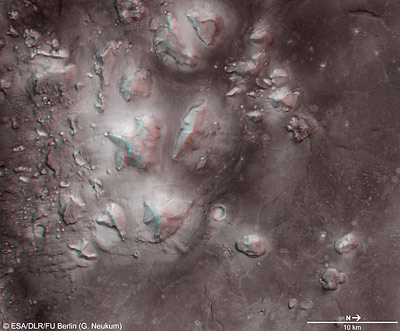
This would be a good time to take more pictures of Cydonia
The ESA already did. It's just a bunch of rocks.
It would be interesting to find out who build these vast cities and pyramids and if they have a connection with earth.
The connection is that we also have rocks on Earth! Isn't that weird?! -
Re:Start with the jokesCydonia...
Is it really "intensely curious", or is it the fact that it's just not that interesting an area? Hasn't it been analyzed to death already? Does it even look like a face if you don't squint your eyes and believe?
Here's a few links about it anyway:
http://www.esa.int/SPECIALS/Mars_Express/SEM09F8LU RE_0.html http://science.slashdot.org/article.pl?sid=06/09/2 2/0634233 http://www.badastronomy.com/bad/misc/hoagland/face .html http://www.space.com/scienceastronomy/solarsystem/ mars_face_010525-1.html http://en.wikipedia.org/wiki/Face_on_Mars -
Not Really the First
First Super Close-Up Pictures of Mars
Look, I love and worship NASA as much as the next American but I must point out that (from another Slashdot article) the ESA's Mars Express has used a High Resolution Stereo Camera on selected areas at a super resolution of 2 metres/pixel.
Now, 1 meter resolution might be twice as good as 2 meter resolution but my dumbass isn't going to know the difference. My point is that those are two very high resolutions so I think the Mars Express gets the credit of being the first to get super close-up pictures. Don't worry, American's will not be out done by Europeans -- there will not be a super resolution images of mars gap! Every American will now be proud to say that their screensaver takes up roughly twice the amount of room as their European counterpart.
In all seriousness though, these images would be very useful for selecting landing sites for more missions and possibly manned missions in the very far future. The MRO and Mars Express seem to have very similar objectives -- studying the composition of Mars, it's weather, atmosphere & geology -- I wonder if they couldn't have been a combined effort for an even greater return. Then again, I'm just glad both of them are fulfilling their goals instead of both burning up on entry due to a conversion of units error. -
Re:Primary Goal of the Mission
But, for the love of science, when do we get the rest of the data from the mission -- you know, the stuff that is, like, going to alter the way we view Mars? Is the public never going to see these results?
First off, I debate the implication that pictures of the surface have no value. There is a reason why almost every space probe we've launced bothers with the bulk and weight of at least some sort of camera, much less a big one. At the very least, visible light is the format our eyes are used to looking at and good for picking out spots of interest based on geometry, color, and shadowing. Things as mundane as color can differentiate types of rock, for example, and apparent texture yields clues as to the degree of weathering that occurs in a location (ie, how the atmosphere affects the surface, from your post). Also, if I understand right, the stereo cameras on the Express give them the ability to create a 3-D map of the surface, so simultaneously they're getting topography data (certainly that has value, although I don't know what large scale errors might be inherent to the method) without the added weight/power requirement of a radar.
Besides, far infrared, microwave, x-ray, or broadband spectrometers are not magic. They only give us details that visible light doesn't. What you use depends on what you're looking for.
Secondly, if you want to see all the data returned from the mission, you probably aren't going to find it on the ESA public website. There's a lot of data. Gigabytes so far if I understand right. Even the extremely well-published Mars rovers, the hyper-photo-active darlings of NASA, only have data from the visible/near-visible light instruments posted regularly. I think if you want any really comprehensive set of data, especially raw data, you need to formally request it.
Also, related to the last point, I've heard the ESA is somewhat protective of their data. Not surprisingly, since their tax money built the Express, they probably want to give their scientists the first crack at interpreting it and publishing the papers that will change the way we view Mars.
Anyway, you may have already seen it, but here is a pile of Mars Express-related images from ESA. It looks to me like a lot of them are screenshots of textured 3-D models based on multiple exposures.
-
Re:Primary Goal of the Mission
Here you go: Top left
-
Re:That's no face...
Now look at this photo and you'll see what else these aliens left behind for us. How Walt managed to pass off Mickey Mouse as his own creation for all these years, I'll never know.
-
Re:However they analyze it
This one kinda looks like a ninja! http://www.esa.int/images/309-230906-3253-6-3d3-C
y donia_L.jpg -
Re:A face huh?
Yes I do realise that, thank you
But take a look at http://esamultimedia.esa.int/images/marsexpress/30 8-230906-3253-6-3d2-Cydonia_H.jpg and you'll see what I'm talking about. What I think they've done is really enhance the contrast of the picture. The colouring still reminds me of old 1950's style drawings of craters and the like.
I wasn't trying to imply the pictures are fake at all, by the way. -
That's no face...Look closely at this image of cydonia. Now look closely at the torso on this image, that's proof positive that intelligent aliens with hyperdrive technology have travelled through this galaxy. For the doubters, here's a larger image. I just can't believe that world governments have managed to keep the truth covered up for so long!
The world needs to know!