Slashdot Mirror
Domain: esa.int
Stories and comments across the archive that link to esa.int.
Comments · 950
-
Re:They went backwards...
At this point there is no reason any system should be using anything less than a 64bit value for time moving forward.
So you're saying it should take over a second to transmit the time? GPS has 50 bps data rate (100 bps in some configurations) according to table #1 at https://gssc.esa.int/navipedia.... I'm pretty sure there are other circumstances such as communicating with Mars or further or a submarine deep down with low bit rates as well.
Although making one integer smaller is not going to save you anything measurable even on a system from the 70's. Its one integer.
In 1984, Apple released the ProDos disk operating system which packed day, month and year into 2 bytes to save room. I'd guess going further back that packing more then the date into an integer happened as well as systems such as the PDP-1 that used 6 bit bytes.
-
Re:How elliptical are the orbits, I wonder.
Apparently this data can be found in RINEX format here: ftp://gssc.esa.int/gnss/data/h....
Despite these satellites being lost as far as the constellation usability is concerned, the ESA plans to have the system completed by 2020, and that would mean 100% coverage across Europe and most of the world. Right now my phone uses Galileo as well as GPS and Glonas. I just noticed that Glonas reports nearly 100% coverage of the globe right now also.
Some of the GPS units I'm working right including the U-Blox M8T with RTKLIB and the ZED-F9P (integrated RTK) see satellites from GPS, Glonass, Galileo, Beidou, and QZSS. In fact I was able to briefly get an RTK fix on my M8T (Reach RS+) using only Beidou observation data from my base unit, apparently. With cheap receivers like the ZED-F9P, lots of satellite constellations, it's really a golden age for low-cost, high-accuracy GNSS work for agriculture, drones, etc.
-
Re:England had it rightESA is not the EU
ESA is an multinational space agency including Canada and Switzerland. While there are many EU member states also involved in ESA, ESA and the EU have nothing to do with each other directly. They are separate organisations. However, ESA is operating Gallileo which is an EU funded project. Beside that ESA gets its finances directly from its member states. https://www.esa.int/About_Us/W...
-
Re:click the link
It's a rendering. Real MEO data, but the image is CGI.
These images are an excellent celebration of such a milestone. Taken by the Mars Express High Resolution Stereo Camera (HRSC), this view of Korolev crater comprises five different ‘strips’ that have been combined to form a single image, with each strip gathered over a different orbit. The crater is also shown in perspective, context, and topographic views, all of which offer a more complete view of the terrain in and around the crater.
Mars Express gets festive: a winter wonderland on Mars
But I agree, it is one of the greatest Martian images ever.
-
Re:Can't view engadget w/o being logged in?
primary source: http://blogs.esa.int/alexander...
-
Re:Motherboard?
Thanks for keeping up the good work.
-
Motherboard?
Really, clickbait to a site which describes it as "a booger?" How about a link to the source.
-
Re: Ouch
Why is somebody as dumb as you on
-
Re:not what the article was about anyway
Re: "The current flows predicted by the debunked EU theory have not been observed."
(they infer "turbulence" as the cause of the 27 star forming filaments, which plainly appear to branch off of one another! lol!)
Henri Poincaré, at the conclusion of the preface to his book, 'Hypothéses Cosmogoniques', states:
One fact that strikes everyone is the spiral shape of some nebulae; it is encountered much too often for us to believe that it is due to chance. It is easy to understand how incomplete any theory of cosmogony which ignores this fact must be. None of the theories accounts for it satisfactorily, and the explanation I myself once gave, is a kind of toy theory, is no better than the others. Consequently, we come up against a big question mark.
-
Re:Zut Alors!
We must faaaaart in zehr zheneral deerection!
Indeed, they are designing a methane engine now.
-
Not Zero, Nor Binary
The entire Gaia mission is based upon the fact that all it's measurements have an error rate.
The mission planners have scheduled multiple data releases. Each release contains more stars and a lower error rate. Thus each data release 'contains' the stars and data from the prior releases, only with better accuracy and fewer gaps.
http://sci.esa.int/gaia/60186-gaia-s-surprising-discoveries-scrutinising-the-milky-way/
This was widely reported. How the F- did you miss that??
-
Re:New Gif?
Because the ESA is using 1960's film cameras?
You do see stars in Apollo photos. Just not when the camera is set to properly expose the sunlit lunar surface, which causes the stars to be vastly underexposed. Looking at the data for one of the images, it's a 12.5 second exposure. The scene is indirectly illuminated, you can see what appears to be an overexposed, sunlit highlight in the last frame of the animation.
The "falling" stuff is the starfield, they're all moving in unison. Read the comments at the original source - the images capture NGC2362 (Mag 4.1) and MGC2354 (Mag 6.1).
The stuff moving in semi-random directions (but mostly toward the upper left, it appears) is the "snow." That includes the streaks. In order for a cosmic ray to produce a streak, it would have to be traveling along the plane of the image sensor (or strong enough to effect an entire sensor row/column). -
Re:No grav lensing
Re: "How, tell me, should a planet not only move across the orbits of several other planets without disturbing them AT ALL but then suddenly change its velocity enough to actually change its orbit? Do you have a faint idea just how much energy is necessary for something like this?"
Who says that the planets were not disturbed at all? Plato clearly states the fact that they were indeed disturbed, and further, that all of mythology is an attempt to convey this event:
"Phaethon, the son of Helios, having yoked the steeds in his father's chariot, because he was not able to drive them in the path of his father, burned up all that was upon the earth, and was himself destroyed by a thunderbolt. Now, this has the form of a myth, but really signifies a declination of the bodies moving around the earth and in the heavens, and a great conflagration of things upon the earth recurring at long intervals of time"
... then further on
"All of these stories, and ten thousand others which are still more wonderful, have a common origin; many of them have been lost in the lapse of ages, or exist only as fragments; but the origin of them is what no one has told"
What do you think he means by "a great conflagration of things upon the earth recurring at long intervals of time?" Plato of course had no idea what gravity was, but he appears to be describing a debris field that returns to the planet over many years. In fact, that's one very logical way to explain why cultures like the Mayans would construct calendars which far exceed the seasonal variations necessary to farm.
What I notice is that when data does not conform to peoples' pre-existing notions, they tend to just completely ignore it. Taken at face value, the following data would seem to suggest that something extremely fundamental has changed in our solar system:
"Earth and the other rocky planets aren't made out of the solar system's original starting material, two new studies reveal.
Scientists examined solar particles snagged in space by NASA's Genesis probe, whose return capsule crash-landed on Earth in 2004. These salvaged samples show that the sun's basic building blocks differ significantly from those of Earth, the moon and other denizens of the inner solar system, researchers said
McKeegan and his team measured the abundance of solar wind oxygen isotopes. Isotopes are versions of an element that have different numbers of neutrons in their atomic nuclei. Oxygen has three stable isotopes: oxygen-16 (eight neutrons), oxygen-17 (nine neutrons) and oxygen-18 (ten neutrons).
The researchers found that the sun has significantly more oxygen-16, relative to the other two isotopes, than Earth."
Re: "At the very least we could have seen a significant difference in temperature if the planet radiated 15% more energy than it receives."
Your expectations would seem to be wrong, but there have been additional vindications regardless:
Venus Express discovered that surface features were not quite where they should be, evidence that Earth's cloud-covered neighbour spins a little slower than previously measured
R.A. Kerr, "Venus is looking too Pristine," Science, Vol. 250 (Nov. 16, 1990), p.912.
-
Re:No grav lensing
(1) Notice what neither you nor anybody else in the mainstream ever talks about: There must be some typical distance between stars at which they stop interacting with one another. What is this distance? I, and some others, have argued that the typical force of 1.5 x 10⁻¹⁴ Earth gee's meets this requirement. This is a completely inconsequential force, and nobody should be attempting to construct a cosmology based upon forces like this. All of you are wasting your time. We can already see that nothing will come of any of these efforts, yet you persist. I mean no offense by suggesting it, but it seems to me that you do so simply because this is what we were all taught, and you're struggling to reset your mental framework.
(2) You're thinking too deeply about the words I am using, and not enough about the nature of the situation. Look, for example, at the human body: If you traverse through the scales of the human body, you will progress through a variety of situations which have differing dominant forces: at the bacterial scale, gravity is inconsequential and the electric force dominates; at other scales, the effects of water or chemistry may dominate; at our perception, gravity dominates. In the electrical view, the universe is very much like a large organism. In fact, the term plasma was coined as a reference to blood plasma -- because it appears alive. In the laboratory, plasmas naturally form vessels which transport charge (we call them Birkeland currents); the plasma observably forms cell walls which protect their charge (we call them plasma double layers); the plasma forms into macro-structures like stars (similar to cells) and galaxies (similar to organs). Halton Arp has observed the galaxies essentially procreating. His ejection hypothesis even observes damage to the host during the process of birthing (he became famous for cataloging these "peculiar galaxies").
The point of what I am doing above is to demonstrate that there is more than one mental framework which we can approach the problem with, and the very fact that dark matter has not been found even as the instrumentation has become a million times more sensitive suggests that your own favored approach is rapidly approaching its endpoint. So, what are you going to do about it? Will you decide to seek out alternative frameworks? Or, will you go online and argue against those who already are, so that in the event that you reach this dead-end, everybody is now in the same unfortunate position as yourself?
(3) Wal has dedicated his life to doing just that. Gravity has become his main focus in these later years.
(4) We are talking about cosmology here. What aspects of the Big Bang creation event are "falsifiable"? I mean, context matters tremendously. An important part of science is to clearly understand its limits. Cosmology is an intersection between physics and metaphysics; there are some aspects which are scientific, and others like the origin of the universe which are truthfully beyond the limits of what science can do. This has nothing to do with Peratt. It's the nature of the game.
And either way, it is already admitted by the ESA that
our Galaxy is threaded with filamentary structures on every length scale. From nearby clouds hosting tangles of filaments a few light-years long to gigantic structures stretching hundreds of light-years across the Milky Way's spiral arms, they appear to be truly ubiquitous. The Herschel data have rekindled the interest of astronomers in studying filaments, emphasising the crucial role of these structures in the process of star formation.
This is a clearcut vindication for plasma scaling -- the claim that plasma structure replicates over enormous scales in the manner of a fractal. Theorists are attempting today to use this observation of s
-
Re:There's a far simpler explanation
EU === Electric Universe, but also EU == electrical cosmology. Its central thesis is that cosmic plasmas behave as laboratory plasmas -- an important claim in light of the realization, since 1958, that most of the matter that we can see with telescopes is matter in the plasma state (>99%).
One thing to know is that in the EU, there is no dark matter problem: Since we clearly observe plasma to conduct in the laboratory, what is being claimed is that the cosmic plasma is conducting across vast distances of space over plasma filaments -- much like what is already observed with a novelty plasma globe. These filaments are referred to by mainstream astrophysicists as "interstellar clouds", but in fact, "clouds" like the Large and Small Magellanic Clouds are highly filamentary. They are hardly the only ones; in fact, hydrogen filaments are ubiquitous in space, and have been shown to precede the formation of stars.
What seems to confuse a lot of people about the debate is that mainstream astrophysicists are arguing against the idea that we can model cosmic plasmas as laboratory plasmas. But, this is indeed the case. They have been using fluids models to model cosmic plasmas, and this creates the extraordinary situation that when astronomical observations exhibit the features of laboratory plasmas, even professional astrophysicists and cosmologists will commonly fail to recognize very common forms observed in the laboratory for electricity over gas. When these failures are pointed out, the debate can become extremely emotional -- and we have a situation where stating "the obvious" creates a very acrimonious situation.
-
Re:An epic failure in science journalism
Re: "Ok explain to me how the electric universe works on materials that are not magnetic. Gravity works on everything that has mass. Take me same physics problem and explain how it works on non ionized carbon."
You seem to be asking how electric forces at the largest scales can influence the structure of the universe, even when we are talking about neutral matter.
If you've played with an electrostatic lifter, then you basically already know the answer to this question: The air in the atmosphere is of course an insulator, yet the application of an electric field induces a movement of this neutral air such that it can temporarily raise the lifter.
So, what is going on there? What appears to be happening is that the movement of the charged particles is exerting a drag upon the neutrals. In the plasma laboratory, you may see this mentioned as an "ion sump" or part of a larger process known as "Marklund convection". There would seem to be little discussion of this phenomenon in astrophysics circles, yet notice this observation from Herschel:
the material along filaments is not at all static: astronomers have detected what appear to be accretion flows, with the most prominent filaments drawing matter from their surroundings through a network of smaller filaments.
At the point where we are talking about a complex field of accretions along filaments, it's important to realize that we have really strayed rather far from the original idea of gravitational accretion, as it was portrayed within the textbooks; and people need to be cognizant of the tendency to push parameters in simulations towards unrealistic numbers, in order to replicate these observations with gravity.
It's worth noting, further, that plasma is widely acknowledged as the most common state for matter. It's important to never forget this even as you observe radio astronomers discussing neutral HI filaments. The instruments detect the neutral matter, but this should not be confused as meaning that this region is dominated -- either in terms of its forces or by the percentage of matter present -- by neutral matter. The Marklund convection process can easily explain why the cores of these electrodynamic plasma filaments should be neutral, and it is arguably a better fit for the morphology of these accretion fields revealed by the Herschel observations.
-
Re:An epic failure in science journalism
The mistake of the mainstream approach has been to base the cosmic plasma models more upon what we imagine the plasma should do, based upon principles, than upon what we observe that the plasma does do within the laboratory. Since the Alfven story is not told in academia, the story which would teach this lesson remains completely unknown -- and so people continue to repeat the same mistaken logic. Put another way, when science journalists refuse to be objective, by refusing to tell the stories that mainstream scientists find awkward, there are real-world consequences for the public's conversations on these topics. It basically entraps the public into an ideology.
Re: "Gravity and the electric force both fall off with distance squared (other forces fall off faster)."
I see this sort of argument all of the time, and to be honest, it's evident that you've not learned enough of the debate to identify where the point of contention is. The idea that has been put forward is not based upon these simple principles; it's a hypothesis which has been constructed from modern observations of actual plasmas in actual laboratories. So, in that regard, we have a complete disconnect here: You've decided that you can argue against an argument which you've not taken the time to learn.
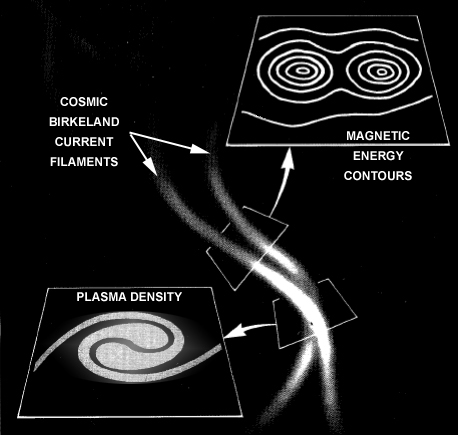
The actual argument which has been put forward is that, in the laboratory, what we observe plasmas doing is forming filaments which have a tendency to pair up. Take the time to learn the geometry of the claim by thinking about the pictures here, here and here -- which become progressively more complex.
It takes a little bit of mental effort to understand, but a person does not have to be a physicist or a mathematician to discern from these diagrams that there is a long-range attraction between these filaments, as well as a short-range repulsion.
Now, realize that plasmas are observed to scale over enormous distances. This is not based upon somebody imagining this as a principle (that would be absurd); the scaling is observed . So, what that means is that in a vague sense -- with some caveats -- we can scale this process up to the galactic regime. The observations of ESA's Herschel can fairly be called a vindication of this claim, as well.
One implication of this geometry is that the electric force can be extended to any distance we observe the filaments extending to. There is no known limit -- which is why this is a perfectly valid, and very physical, explanation for the dark matter problem.
Another important implication -- which is intriguing, honestly -- is that the universe appears to be a plasma fractal. There is repetition of structure happening across vastly different scales -- and this fact has not yet been adequately stated by science journalists to the public. It certainly bears great meaning for what the universe actually is.
-
Re:Mistaken Bias?
Re: "What dominates conversations is a complete lack of credible evidence for this."
Remember, IF electricity does flow through the cosmos, then the universe must be highly filamentary. This was predicted by plasma cosmologist Hannes Alfvén, see Cosmical Electrodynamics (1950).
I don't know if you ever heard about the Herschel Telescope. A very cool gadget.
http://sci.esa.int/herschel/55...
"Herschel's Hunt for Filaments in the Milky Way"
28 May 2015
"Observations with ESA's Herschel space observatory have revealed that our Galaxy is threaded with filamentary structures on every length scale. From nearby clouds hosting tangles of filaments a few light-years long to gigantic structures stretching hundreds of light-years across the Milky Way's spiral arms, they appear to be truly ubiquitous. The Herschel data have rekindled the interest of astronomers in studying filaments, emphasising the crucial role of these structures in the process of star formation."
"One of the key aspects that emerged from these observations is the presence of a filamentary network nearly everywhere in our Galaxy's interstellar medium."
-
Re:Amazing
Here's some more interesting space related news: http://www.esa.int/Our_Activit...
I can't submit anything at the moment as it always gets marked as spam and I have to email the site operators to fix my account.
-
Under the surface [Re:Geology...]
I would like to see the next Mars rover mission equipped tools to "see" deep below the surface. For example, a moveable geophone system or ground-penetrating radar, or land stationary seismic detectors around the planet to monitor long-term like we do on Earth.
Your wish is granted: the next NASA mission, Insight, has a five-meter drill, and also a seismometer.
https://insight.jpl.nasa.gov/h...
Launches May 2018.Mars missions so far have only scratched the surface (literally) and taken photos.
Two of the Mars orbiters had ground-penetrating radar: SHARAD on the Mars Reconnaissance Orbiter and MARSIS on Mars Express.
SHARAD: https://mars.nasa.gov/MRO/mission/instruments/sharad/
MARSIS: http://sci.esa.int/mars-express/34826-design/?fbodylongid=1601
-
Re:Experiment?I was wondering this myself. I hate it when all you get is the PR campaign BS.
https://journals.aps.org/prl/a...
https://arxiv.org/pdf/1709.027...
http://sci2.esa.int/Microscope... -
Re:The satellite lost was to replace...
Interesting link but too shy on details. It says that they have identified a component in the rubidium clocks which short circuits, but to date the hydrogen master clocks are failing at twice the rate of the rubidium ones.
http://www.esa.int/Our_Activit... this link provides more information on the problems with the PHM clocks. It appears there are multiple mechanisms causing multiple different devices to fail.
According to Wikipedia the mitigation that ISRO has made is to power down 2 of the rubidium clocks and only power them back up in case the primary fails. Could be related to the ESA's work.
-
Re:Sounds great!
The EPA can use "Common Science", reports from private parties, and medical research, but only if sufficient data is provided that the conclusions of the reports can be independently verified. Note that without this information, even the EPA cannot validate the conclusions of the reports it was using. The problem, therefore, is that without some kind of requirement like this, who and what EPA chooses to use as the basis for decision making is incredibly discretionary.
Thanks for the link to the bill. The actual text for the bill reads "publicly available online in a manner that is sufficient for independent analysis and substantial reproduction of research results". How about things like ESA's Copernicus Programme of Earth observation satellites? The data access requirements say that public online access is only available to a "rolling on-line archive covering the last month(s) of selected Sentinels core products". You need at least an "International Agreement" (whatever that is) to access the full data set. Does that mean the EPA can't use any science based on Copernicus/Sentinel data?
-
Re:10 Shocking Facts New Science....
IANAS, but if I had to place my bet it would be on the supernova method being off due to imperfections in our cosmic distance ladder. The ESA's GAIA mission should help refine that the shortest rung of that distance ladder:
Gaia is an ambitious mission to chart a three-dimensional map of our Galaxy, the Milky Way, in the process revealing the composition, formation and evolution of the Galaxy. Gaia will provide unprecedented positional and radial velocity measurements with the accuracies needed to produce a stereoscopic and kinematic census of about one billion stars in our Galaxy and throughout the Local Group. This amounts to about 1 per cent of the Galactic stellar population.
By combining Gaia data with information from these less precise catalogues, it was possible to start disentangling the effects of ‘parallax’ and ‘proper motion’ even from the first year of observations only. Parallax is a small motion in the apparent position of a star caused by Earth’s yearly revolution around the Sun and depends on a star’s distance from us, while proper motion is due to the physical movement of stars through the Galaxy.
In this way, the scientists were able to estimate distances and motions for the two million stars spread across the sky in the combined Tycho–Gaia Astrometric Solution, or TGAS.
-
Re:10 Shocking Facts New Science....
IANAS, but if I had to place my bet it would be on the supernova method being off due to imperfections in our cosmic distance ladder. The ESA's GAIA mission should help refine that the shortest rung of that distance ladder:
Gaia is an ambitious mission to chart a three-dimensional map of our Galaxy, the Milky Way, in the process revealing the composition, formation and evolution of the Galaxy. Gaia will provide unprecedented positional and radial velocity measurements with the accuracies needed to produce a stereoscopic and kinematic census of about one billion stars in our Galaxy and throughout the Local Group. This amounts to about 1 per cent of the Galactic stellar population.
By combining Gaia data with information from these less precise catalogues, it was possible to start disentangling the effects of ‘parallax’ and ‘proper motion’ even from the first year of observations only. Parallax is a small motion in the apparent position of a star caused by Earth’s yearly revolution around the Sun and depends on a star’s distance from us, while proper motion is due to the physical movement of stars through the Galaxy.
In this way, the scientists were able to estimate distances and motions for the two million stars spread across the sky in the combined Tycho–Gaia Astrometric Solution, or TGAS.
-
Re:Note: Gravity wave != Gravitational wave
By calling it a gravity wave, you just look stupid and ignorant of the topic of discussion.
From here:
"By studying how the atmospheric densities changed and were perturbed over time, we found two different types of wave: Atmospheric gravity waves and planetary waves," explained co-author Sean Bruinsma of the Centre National D'Etudes Spatiales (CNES), France."
I'm sure he'll be heartbroken that BitZtream from Slashdot thinks he stupid. But then, armchair blowhard slashdot experts truly do know everything, so how can he compete?
-
Re:Fixed that for you...
To be useful the probe has to send back some telemetry via radio. Otherwise how do you know it landed? And anyone can receive that telemetry, so you can't really do a sneaky moon landing
Not to feed the conspiracy theorists, but the Lagrange L1 and L2 points lie outside the Earth-Moon system and see the back side of the moon half the time. They are/were occupied by SOHO, WMAP (first link), and Planck. The James Webb Space Telescope is going to be parked at L2 as well.
Theoretically, any of them could be used to relay transmissions from the back side of the moon undetectable from Earth. For that matter, you could turn SOHO around to photograph the back side of the moon if you wanted to. (So could JWST, but it wouldn't have the benefit of sunlight lighting up the half of the moon it sees.) A few missions have been sent into orbit around the moon as well.Say you do somehow land a robotic probe there for no reason at all, how would you conceal it from orbiting satellites that are photographing the surface? We can see the Apollo and Surveyor and various Russian probe landing sites on those photos, taking by various different countries.
Concealing something on the entire surface of the moon is easy. LRO produces the highest resolution images of the moon's entire surface, but the Apollo landing sites still barely show up. We know where to point the camera because we know where the sites are. If we didn't know where, well the moon's surface area is 38 million km^2, so the back side is 19 million km^2. If the lander you're trying to find is 1 square meter, that's like trying to find one special grain of sand 2 mm^2 sitting on top of 38 km^2 of beach. Good luck.
-
Re:Measuring from space
Wow, mapping a buildings from space with millimeter accuracy. From an orbit 693km high. That's an accuracy of 1:100,000,000 while flying 24,000 km/h.. Crazy. And then imagine the capabilities of really good US satellites aren't even known because classified.
The ESA link to this story: http://www.esa.int/Our_Activities/Observing_the_Earth/Copernicus/Sentinel-1/Satellites_confirm_sinking_of_San_Francisco_tower
THAT'S the damn thing that pulled an eye image when I looked to the sky the other day. I was wondering how in the hell the government of Jaiaguanaga found me after all of this time. *shakes fist at sky...and stuff*
-
Measuring from space - Geology is IMPORTANT
The imagery looks like the actual measurements are LiDAR derived.
Similar levels of accuracy are available from the GPS system when differential GPS is used. More information about GPS here:
Continuously Operating Reference Station (CORS) http://geodesy.noaa.gov/CORS/It is rocket science, however today not surprising. The really hard part of this is that the data is available in near real time. See the Sentinel mission website
https://sentinel.esa.int/web/sentinel/missions.Any time a building incurs settlement like this I wounder if the foundation layer - likely some sort of clay - is a thixotropic material potentially subject to liquefaction when shaken. Reference Jan. 17, 1995 Hyogo-Ken Nanbu Earthquake:Technical Paper on Liquifaction and,Earthquake Impact on Kobe
-
Measuring from space
Wow, mapping a buildings from space with millimeter accuracy. From an orbit 693km high. That's an accuracy of 1:100,000,000 while flying 24,000 km/h.. Crazy. And then imagine the capabilities of really good US satellites aren't even known because classified.
The ESA link to this story: http://www.esa.int/Our_Activities/Observing_the_Earth/Copernicus/Sentinel-1/Satellites_confirm_sinking_of_San_Francisco_tower
-
Re:Exactly the reverse is true
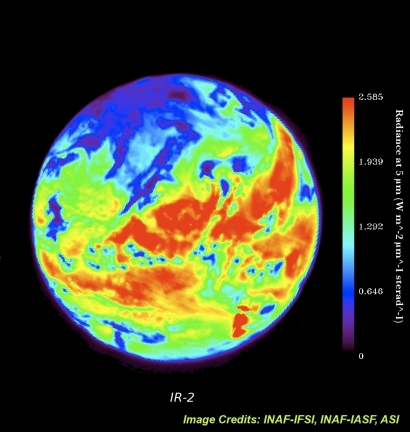
There are a great many studies about their contribution though, and confidence is very high that the increasing humidity is a positive feedback even with the resulting extra clouds factored in.
The naive explanation for this would be that clouds do not cover 100% of the globe, but IR-opaque water vapor does.
-
Re:Im not trying to be that guy..
No, hydrazine does not need an oxidiser: it's a monopropellant.
Schiaparelli had three 17.5 litre tanks, each filled with 15kg of hydrazine. There was also a 15.6 litre tank of high-pressure helium used to keep the hydrazine under pressure during firing.
Would it hurt people to occasionally do some research before contributing to the general drivel that Slashdot has become?
-
Re:Meanwhile, the fucking Mars rover
Different objectives - impacting a comet is by design a limited function. And Rosetta went MUCH farther - rovers traveled maybe 250 million km from earth, but Rosetta traveled 6.4 Billion km. See here.
-
Re:Is there a new track?
Is anything wrong with the mission? Their objective was 0.007 mas precision for stars at magnitude 10, and today (after 2.5 years out of a planned 5 years), they announce positions and parallaxes with a standard error of 0.3 mas?
-
Re:Overall a disappointing mission
I thought the mission performed poorly too, but your criticism is off-base. The surface gravity of the comet was several hundred thousand times less than Earth gravity. It wasn't like landing on Mars. It was like docking with the International Space Station, except without a docking adapter. Landing on a planet is relatively easy in contrast because you've got a huge margin of error by which you can over-thrust and still land successfully. e.g. On Earth, basically everything between 0 and 1g upward thrust will still slow you down, yet will not compromise your landing (cause you to lift back up) after you touch down.
When docking in zero-g or near-zero-g, you need to match velocities precisely - the margin of error is almost nil. That's why they went with the harpoon system - because docking is a damned difficult thing to do even when you have a docking adapter and a computer and human pilot right there giving real-time thrust correction inputs.
I expected more from the mission only because the Japanese pulled off an even tougher "landing" (the asteroid was about 1/300th the mass of the comet). That spacecraft however was designed as touch-and-go, rather than permanently landing ("attaching" is probably a better word at these low surface gravities). -
Re:Why the heck
Article and non-flash photos here at ESA web site: http://www.esa.int/Our_Activit...
-
Re:40cm?
Sorry, Michael, I guess we Earth dwellers just don't have the technology your Martian foster parents had... </humor_attempt>
Actually, it's not a hole, just an "affected area" (from URL http://www.esa.int/Our_Activit...)...
The pictures of the affected area show a diameter of roughly 40 cm created on the solar array structure, confirming an impact from the back side, as suggested by the satellite’s attitude rate readings.”
-
Galactic magnetic field
The European Space Agency (ESA) has done some magnetic field work on our own Milky Way from their Planck satellite.
Even more impressive is the polarized dust in our galaxy, showing directionality of magnetic fields.
-
Galactic magnetic field
The European Space Agency (ESA) has done some magnetic field work on our own Milky Way from their Planck satellite.
Even more impressive is the polarized dust in our galaxy, showing directionality of magnetic fields.
-
Re:National level?
A better question is, Who thinks asteroid mining is economically feasible to the extent that they needed a law regarding property rights for it? This supposes that the money that can be gained from asteroid mining would exceed the cost of launching mining equipment into space, mining the asteroid, hauling the ore to Earth, landing it safely, and processing it into a usable form, all of which seems like it would be prohibitively expensive. This would only be the case if the materials which compose asteroids were substantially different from materials that can be obtained on Earth, but they don't seem to be: http://www.esa.int/Our_Activit...
-
Re:Housekeeping
And it's badly in need of room service to tidy up the place. That place is a mess.
-
Re:Isn't it widely accepted...Venus does have a weak magnetic field, but it's not generated in the core but in the atmosphere through collision with the solar wind:
As on Earth, solar ultraviolet radiation removes electrons from the atoms and molecules in the upper atmosphere, creating a region of electrically charged gas known as the ionosphere. This ionised layer interacts with the solar wind and the magnetic field carried by the solar wind.
During the continuous battle with the solar wind, this region of the upper atmosphere is able to slow and divert the flow of particles around the planet, creating a magnetosphere, shaped rather like a comet's tail, on the lee side of the planet.
If we think of planet's iron core as a gigantic power generator, then Venus's slow rotation, when compared to Earth or Jupiter, might explain the absence of a strong internal magnetic field.
-
Re:Greenhouse gasses?
Instead of making flippant remarks why don't you do some research?
I'm really sick of know-nothing Slashtards.
-
Re:Mogensen and Aimbetov will only stay until 11 S
The Danish crewman was bringing up some special Lego models that are going to be used as prizes in school competitions, but I'm surprised by the short duration as well...
http://www.theguardian.com/sci...
it seems his mission is a short one anyway...
-
The other other launcher
The European Space Agency has sent a few deliveries to ISS too using its hugely successful Ariane 5 launcher and a robot delivery vehicle
.
-
Re:How timely...
Yes, ESA (European Space Agency) uses SPARC, but another implementation (LEON2 and 3, fault tolerant versions [1] ). And NGMP[2] I think is also SPARC based.
LEON is developed by Gaisler, and was funded by ESA.
Alvie
[1] https://en.wikipedia.org/wiki/...
[2] http://microelectronics.esa.in... -
Re:Impressive, if true
Nope: http://www.esa.int/esapub/bull...
You can get to the Moon for circa 800 ms-1 for a flyby. Injection is more but can be done for well under 3000 if you're willing to wait.
You are right - obviously you can't actually land on that, and manoeuvering/circularization adds more, but there's been a lot of work on this.
The 3000 figure is if you're using the classic, fast approach of the Apollo missions. But you can also do it very cheaply - so cheaply you could get enough delta-V out of a sufficiently high orbit Cubesat with arc-thrusters.
-
Re:ESA science
It's really great that the ESA is doing such great space science today. While NASA is off draining its resources on space cowboys and bloated contractor budgets the ESA is pioneering novel astronomy and leading the way, with no manned program at all.
If only the US would do programs like SMEX-11 (Small Explorer satellite program) like the ESA does instead of their "heavy" lift stuff we would know so much more about the universe.
Are you talking about this ESA?
http://www.esa.int/Our_Activit...Let me answer for you.
buh buh buh I meant "without no ESA manned rockets program" -
Re:Oh look, StartsWithABang
You're assuming that the RTG would drop in and replace the entire electrical system, which is doubtful. However I can't comment on how much - the mass freed up could be between 3.9kg and 16.1kg, although more likely to be at the top end. Batteries *may* still be needed to provide peak power for drilling etc (Curiosity has an RTF and Lithium Ion batteries). I admit the reason I had *assumed* RTGs weren't selected was down to mass - I was surprised when I heard RTGs weren't being used.
The other problem could have been geometry - Voyager (for example) is a satellite, so it's not a problem to place the RTGs at the end of a boom so they don't interfere with other instrumentation - as long as you get your centres of mass and thrust set up you're fine. Curiosity is about 900kg, so placing the RTG at one end won't shift the centre-of-mass a great deal. On Philae the difference will be greater, and something that could have been deemed risky for landing in such a small gravity field - I doubt there are many places where gravity is perpendicular to the surface.
I'm guessing the real reason was a mixture of engineering and politics - ESA haven't developed RTG technology so they went with something they knew and designed accordingly.
-
Re:Electric Joule Heating
It takes a lot of effort to look at a galaxy connected by wires, and nevertheless refuse to consider that the wires might actually be conducting
"Observations with ESA's Herschel space observatory have revealed that our Galaxy is threaded with filamentary structures on every length scale. From nearby clouds hosting tangles of filaments a few light-years long to gigantic structures stretching hundreds of light-years across the Milky Way's spiral arms, they appear to be truly ubiquitous. The Herschel data have rekindled the interest of astronomers in studying filaments, emphasising the crucial role of these structures in the process of star formation."
See recent article at http://sci.esa.int/herschel/55...
Notice also people who try so hard to ignore electrical cosmology then subsequently just have no idea that they are re-discovering things that laboratory astrophysicists discovered in the 19th century
https://plus.google.com/+Chris...