Slashdot Mirror
Domain: facebook.com
Stories and comments across the archive that link to facebook.com.
Stories · 468
-
Facebook Finally Ends XMPP Support For 3rd Party Chat
New submitter AcquaCow writes: Facebook has been pushing their Messenger app to all devices, requiring it for chatting with friends and family. It was announced last year that they would be ending their chat API and that the service would end on April 30, 2015. April passed, so did May, but the service remained functional. Finally, as of July 7th, 2015 it has not been possible to connect to chat.facebook.com. This doesn't seem to be an outage at this point. Looks like we have to wait for 3rd party messenger apps to adopt support for Facebook's Platform API v2 to allow new connectivity. -
Facebook Finally Ends XMPP Support For 3rd Party Chat
New submitter AcquaCow writes: Facebook has been pushing their Messenger app to all devices, requiring it for chatting with friends and family. It was announced last year that they would be ending their chat API and that the service would end on April 30, 2015. April passed, so did May, but the service remained functional. Finally, as of July 7th, 2015 it has not been possible to connect to chat.facebook.com. This doesn't seem to be an outage at this point. Looks like we have to wait for 3rd party messenger apps to adopt support for Facebook's Platform API v2 to allow new connectivity. -
Neil Young Says His Music Is Too Good For Streaming Services
An anonymous reader writes: After years of complaining about modern music formats Neil Young today announced that he's pulling his music from all streaming services. He made the announcement on his official Facebook page saying: "Streaming has ended for me. I hope this is ok for my fans. It's not because of the money, although my share (like all the other artists) was dramatically reduced by bad deals made without my consent. It's about sound quality. I don't need my music to be devalued by the worst quality in the history of broadcasting or any other form of distribution. I don't feel right allowing this to be sold to my fans. It's bad for my music. For me, It's about making and distributing music people can really hear and feel. I stand for that. When the quality is back, I'll give it another look. Never say never." -
Where Facebook Stores 900 Million New Photos Per Day
1sockchuck writes: Facebook faces unique storage challenges. Its users upload 900 million new images daily, most of which are only viewed for a couple of days. The social network has built specialized cold storage facilities to manage these rarely-accessed photos. Data Center Frontier goes inside this facility, providing a closer look at Facebook's newest strategy: Using thousands of Blu-Ray disks to store images, complete with a robotic retrieval system (see video demo). Others are interested as well. Sony recently acquired a Blu-Ray storage startup founded by Open Compute chairman Frank Frankovsky, which hopes to drive enterprise adoption of optical data storage. -
Google Takes Over NYC's Free WiFi Project
dkatana writes: Google's new Smart Cities venture Sidewalk Labs announced the purchase of Intersection, the new company behind the LinkNYC project. nGoogle wants to speed up the developing of free internet access to New York residents and visitors, as a way to gather more information about their activities. Users of the pylons will provide the company invaluable data about their habits, places they visit, and browsing activity.
As part of the original LinkNYC plan, Intersection is scheduled to start deploying the new ad-supported, locally manufactured, WiFi 'pylons' this fall, reaching all five boroughs of the city. It will be the largest and fastest free municipal WiFi system in the world. After that, the company plans to start rolling out similar initiatives in other U.S. cities, but details have not been made public yet. -
Robots Compete In Navigating Simulation Of Japan's Fukushima Daiichi Plant
schwit1 writes: A new DARPA Robotics Challenge completed its final competition recently. 25 teams operated robots around a landscape designed to simulate the hazardous environment that aid workers found after the Fukushima Daiichi reactor in Japan melted down multiple times in 2011. Engineers tried to help, but disaster ensued, rendering a huge area around the plant uninhabitable after toxic steam was released into the skies. The radioactive leftovers are still emitting a million watts of heat. First prize is $2m, second prize is $1m, and third gets $500,000. -
Facebook Now Supports PGP To Send You Encrypted Emails
An anonymous reader writes: You can now have Facebook encrypt email it sends to you by adding your PGP key to your profile. The PGP feature is "experimental" and will be rolled out slowly. The announcement reads in part: "...today we are gradually rolling out an experimental new feature that enables people to add OpenPGP public keys to their profile; these keys can be used to 'end-to-end' encrypt notification emails sent from Facebook to your preferred email accounts. People may also choose to share OpenPGP keys from their profile, with or without enabling encrypted notifications." -
Galapagos Island Volcano Erupts After 33 Years, Threatening Fragile Ecosystem
An anonymous reader writes: Wolf volcano in the Galapagos islands has erupted for the first time in more than 30 years, sending lava flowing down its slopes and potentially threatening the world's only colony of pink iguanas. The Galapagos National Park says that currently there is no risk to tourism operations, but the Environment Ministry is notifying tourist operators to take precautions. A tourist boat passing by took an amazing picture of the eruption. -
Video Games: Gateway To a Programming Career?
Nerval's Lobster writes: Want more people to program? Encourage them to play more video games, at least according to Facebook CEO Mark Zuckerberg. In an online Q&A, Zuckerberg suggested that a lifetime spent playing video games could prep kids and young adults for careers as programmers. "I actually think giving people the opportunity to play around with different stuff is one of the best things you can do," he told the audience. "I definitely would not have gotten into programming if I hadn't played games as a kid." A handful of games, most notably Minecraft, already have a reputation for encouraging kids to not only think analytically, but also modify the gaming environment — the first steps toward actually wrestling with code. Those of you who have done programming work in your career: did video games influence your path? -
(Hack) and Slash: Doing the LORD's Work
Emmett Plant (former Slashdot editor as well as video interviewee) writes: Legend of the Red Dragon was written by Seth Robinson in 1989, and it remains one of the most popular games of the DOS BBS era. Chris England has been doing his part to keep the game alive for the past twelve years, adapting an installation that runs on Linux. I was only able to play for two days before I was overcome with curiosity -- I wrote to Chris, politely inquiring as to how it all came together. Read on below for a look into Chris's motivations, the state of the project, and just how deeply nested it can all get, when bringing games from early BBS days into the modern era. Emmett Plant: What was your first encounter with LORD?
Despite it's PG-13 nature, I discovered the game at age 12 when I was running a local dial-up BBS [The Slaughter House, Langley BC] and echo-mail network. I had never heard of the game, but users kept asking for it. I ignored the first few requests, but eventually caved to my loyal regulars and installed it. My first time "playing" it was actually just to test to see if it worked. Had I have been more inquisitive and known it was an interactive text based RPG about slaying dragons, I would have installed--and played it--much earlier.
EP: You've had this game running for well over a decade now. Has it gotten easier to manage as time has gone by, or has it become more difficult?
With many years of fine tuning and automation, it has become very easy to manage. Between work and my addiction to the remote British Columbia wilderness, either my time was saturated or I was simply not around to keep up with issues like investigating players suspected of using multiple accounts or dealing with players taking advantage of known bugs. This led to a level of frustration among users in early years. For example, in our environment there is no carrier detection. If a player disconnected in an IGM [In-Game Module], they were essentially protected from being battled by other users. Fast forward to today where if a player attempted this, within a short period of time the system would detect it and leave them vulnerable, "sleeping in the fields.”
EP: You've created a custom BBS to manage these games -- How does it work?
The BBS part is a fairly basic sign-up, authentication and menu system made in perl. Much like a regular BBS, when a user selects the menu option to enter a game, a dropfile is generated and passed to the game. After that, things get a little different. It dynamically creates an autoexec.bat to invoke the games start.bat file with the appropriate node parameter and then fires up dosemu. The BBS itself listens locally on a non-standard port through xinetd/in.telnetd, as I needed to create a proxy script to reside in front listening for the incoming telnet connections. This was necessary in order to sanitize some undesirable input with a script that could make decisions and manipulate the packet contents in some cases. Aside from that, there are a number of automation scripts running in the background which range from compensating for lack of carrier detection and analyzing logs to converting LORD color ASCII to HTML and of course sending me a text message when it's time to announce a winner and reset a game.
EP: LORD was written in the dial-up era. What challenges have you faced in making it available for the modern age?
There are so many pieces that need to work together. I tried a number of combinations of operating systems, dosemu/dos versions, netfossil drivers, ANSI drivers, BBS software, LORD versions, IGM's, etc. It was difficult to find a combination where all components would play nice for the long haul. Having a stable environment was a top priority, so I decided to make my own BBS, forget about the fossil routines and just run the game as if it's running locally. This resulted in stability, but presented a number of other challenges from a security standpoint. IGM's with special sysop functions like "drop to DOS" were out of the question and I needed to prevent every possible method that could be used to break out of a batch file.
EP: There's a Facebook group and a Twitter account for the games -- How are these social media tools used?
Prior to Facebook and Twitter, we used a forum on the website so players could communicate outside the game and I could announce upcoming rounds. Though I had moderators, it was still something I needed to babysit and keep secure. I was very happy to outsource the forum to Facebook as it was less work for me while at the same time, it gave the game a little more mainstream/modern exposure. Twitter seemed like a good platform to announce the start of new rounds, but I think most rely on the Facebook notification.
EP: How do you deal with problematic players?
If someone gets completely out of hand and or won't adhere to warnings, disabling the account and iptables seems to solve the issue efficiently. It takes a lot more effort for someone to change their IP address, and sign up again from a new email address than it does for me deal with it. And for what motive? To write something rude or annoying in the daily news or flowers? Most people just don't get that bored, so it has only come to that a couple of times.
EP: What do you do for a dayjob?
You probably guessed, but I will go ahead and confirm that I’m a System Administrator.
EP: Why do you do this?
Though I shut down the dialup BBS after a few years of service--in pursuit of figuring out how Internet web servers, mail servers and database servers worked--those sysop/sysadmin instincts didn't go away. I felt rather guilty about letting BBS users down, but the reality is that I needed to selfishly tie up the phone line and replace DOS with Slackware. Making this system was my way of making up for it and then some.
--
Editorial Note: The author of this piece made a $10 donation to the site before inquiring to write this article. He’s a level 8 warrior in Game 1, and he’s been killed at least three times already. He does not regret the donation. -
FWD.us To Laid-Off Southern California Edison Workers: Boo-Hoo
theodp writes: Speaking at a National Journal LIVE event that was sponsored by Mark Zuckerberg's FWD.us and Laurene Powell Jobs' Emerson Collective, FWD.us "Major Contributor" Lars Dalgaard was asked about the fate of 500 laid-off Southern California Edison IT workers, whose forced training of their H-1B worker replacements from offshore outsourcing companies sparked a bipartisan Senate investigation. "If you want the job, make yourself able to get the job," quipped an unsympathetic Dalgaard (YouTube). "Nobody's going to hold you up and carry you around...If you're not going to work hard enough to be qualified to get the job...well then, you don't deserve the job." "That might be harsh," remarked interviewer Niharika Acharya. Turning to co-interviewee Pierre-Jean Cobut, FWD.us's poster child for increasing the H-1B visa cap, Acharya asked, "Do you agree with him?" "Actually, I do," replied PJ, drawing laughs from the crowd. -
Singapore's Prime Minister Shares His C++ Sudoku Solver Code
itwbennett writes: Several weeks ago, during a speech at the Founders Forum Smart Nation Singapore Reception, Singapore's prime minister Lee Hsien Loong said that he used to enjoy programming, and that the last program he wrote was a Sudoku solver in C++. To back that up, earlier today he announced (on Facebook and Twitter) that his code is available to download. He wrote on Facebook that he wrote the program 'several years ago' and that the code does 'a backtrack search, choosing the next cell to guess which minimises the fanout.' -
Meet the Firmware Lead For Google's Project Ara Modular Smartphone (Video)
According to Wikipedia, 'Project Ara is the codename for an initiative that aims to develop an open hardware platform for creating highly modular smartphones.' Google is the sponsor, and the project seems to be moving faster than some people expect it to. There's a Project Ara website, of course, a GitHub repository, a Facebook page, even an Ara subreddit. During his conversation with Timothy Lord, Ara firmware project lead (and spokesman) Marti Bolivar said it won't be long before prototype Ara modular phones start user testing. Meanwhile, if you want to see what Marti and his coworkers have been up to lately, besides this interview, you can read a transcription of his talk (including slides) from the January Project Ara Developers Conference in Singapore. -
How and Why the U-Pick Game Marathon Raises Money With Non-Stop Gaming (Video)
On June 12 through 14th of this year, the fourth (not "fourth annual," but close) iteration of the U-Pick Video Game Marathon for Charity --“UPickVG IV” for short --will be streaming on an Internet connection near you. The U-Pick crew's volunteers will be playing and broadcasting video games, non-stop, as a fundraiser for Charity Water, a cause they've supported since the beginning. I talked with organizers Stephanie and Grant Kibler from their video-game lounge of a living room about what it takes to broadcast an online gathering like this, and why they've adopted this as an annual event. Hint: some esoteric video-capture hardware helps, and so does a beefy network connection, for high-quality streaming of games that pre-date today's multiplayer, network-oriented options. That's significant, because U-Pick's stable of titles isn't limited to modern ones, and observers are encouraged to suggest appropriate games (hence "U-Pick").The remote viewers' choices and donations influence the event by deciding which games are represented on the Wheel of Destiny that the team spins to decide which games get played.The play itself, though,*is* limited to the players who'll be on hand at a Northern Virginia co-working space that will serve as this year's venue. It turns out to be easier to stream the output of old consoles than it is to control them from remote (never mind the latency that would mean), but maybe one day participants will be able to play as well as shoulder-surf and laugh at the players' running commentary. You can check out the Upick page on Facebook, too, and watch one of their practice runs each Sunday. (Note: Video #1 talks mostly about the game play and how you can join. Video #2 - below - talks more about hardware and behind-the-scenes work.) -
Columbia University Doctors Ask For Dr. Mehmet Oz's Dismissal
circletimessquare writes Dr. Mehmet Oz serves as vice chairman of Columbia University Medical Center's department of surgery. He is a respected cardiothoracic surgeon but his television show has been accused of pushing snake oil. Now other doctors at Columbia University want Dr. Oz kicked off the medical school faculty. Dr. Oz has responded on his Facebook account: "I bring the public information that will help them on their path to be their best selves. We provide multiple points of view, including mine which is offered without conflict of interest. That doesn't sit well with certain agendas which distort the facts. For example, I do not claim that GMO foods are dangerous, but believe that they should be labeled like they are in most countries around the world." In their letter, the doctors accuse Dr. Oz of quackery: "Dr. Oz has repeatedly shown disdain for science and for evidence-based medicine, as well as baseless and relentless opposition to the genetic engineering of food crops. Worst of all, he has manifested an egregious lack of integrity by promoting quack treatments and cures in the interest of personal financial gain." -
Embedded Linux Takes to the Skies (Video)
This is an interview with Clay McClure. He makes his living designing 'custom Linux software solutions for technology start-ups in Atlanta and the San Francisco Bay area.' He also works on Embedded Linux for autonomous drones. Here's a link to slides from a talk he gave on exactly that topic: Flying Penguins - Embedded Linux Applications for autonomous UAVs, and that's far from all he has to say about making Linux-controlled drones. However, for some reason Timothy and Clay didn't talk about using drones for target practice. Perhaps they can discuss that another time.
NOTE: We urge you to read the transcript of this interview even if you prefer watching videos; it contains material we left out of the video due to sound problems. -
eBay Sales Patterns Show That the Maker Movement is Still Growing (Video)
Meet Aron Hsiao. He works for Terapeak, a company that tracks sales through online venues such as eBay and Amazon in order to help merchants decide what to sell -- and how. The five 'maker' categories Terapeak tracks (drones, robotics, Arduino, Raspberry Pi and 3D printing) outsold Star Trek-related merchandise by a huge amount, namely $33 million to $4.3 million, during a recent 90 day study period. Star Wars merchandise did better at $29.4 million, but still... And as another comparison, Aron says that all Apple laptops combined, new and used, sold $48.4 million, so the DIY hobbyist movement still has a ways to go before it catches up with Apple laptops -- but seems to be heading steadily in that direction.
Drones are the hottest hobbyist thing going right now, Aron says, but all five of the hobbyist/tinkerer' categories Terapeak tracks are growing steadily at a rate of up to 70% year over year, with drones leading the way and robotics trailing (but still growing). It's good to see people taking an interest in making things for themselves. If you remember (or have heard of) the Homebrew Computer Club, you have an idea of what tinkerers and hobbyists can produce if given even a tiny bit of encouragement. And it's good to see that the DIY mindset is not only still alive, but growing -- even if it seems to be moving away from traditional hobby tinkering (cars; radios) toward concepts (drones; robotics) that weren't considered mass market 'homebrew' possibilities even a few years ago. -
Facebook Engineering Tool Mimics Dodgy Network Connectivity
itwbennett writes: Facebook has released an open source application called Augmented Traffic Control that can simulate the connectivity of a cell phone accessing an app over a 2G, Edge, 3G, or LTE network. It can also simulate weak and erratic WiFi connections. The simulations can give engineers an estimate of how long it would take a user to download a file, for instance, given varying network connections. It can help engineers re-create problems that crop up only on very slow networks. -
Education Company Monitors Social Media For Test References
theodp writes: As if people haven't found enough to hate about the new 11+ hour K-12 PARCC standardized testing, the Washington Post reports that Pearson, the world's largest education company, is monitoring social media during the administration of the PARCC Common Core test to detect any security breaches, saying it is "obligated" to alert authorities when any problems are discovered. The monitoring of social media was revealed in a message that a New Jersey School Superintendent sent to colleagues about a "Priority 1 Alert" initiated by Pearson in response to a student who referenced a PARCC test question in an after-school Tweet. The news was broken in a blog entry by former NJ Star-Ledger reporter Bob Braun, who also posted the Superintendent's message and called the monitoring of social media nothing less than "spying." Pearson has a contract of more than $100 million to administer the PARCC in New Jersey. -
Come and Take It, Texas Gun Enthusiasts (Video)
In Texas, guns are a common sight:gun-racks are visible in the back of many pick-ups, and pistols, cannons, and rifles are part of the state's iconography. Out-of-sight guns are common, too: The state has had legal (though highly regulated) concealed carry for handguns since 1995, though -- contrary to some people's guess, and with some exceptions -- open carry of handguns is not generally legal. One thing that's definitely not a common sight, though, is a group of people manufacturing guns just outside the south gates of the Texas capitol building. But that's just what you would have encountered a few weeks ago, when an organization called CATI (Come and Take It) Texas set up a tent that served as a tech demo as much as an act of social provocation. CATI had on hand one of the same Ghost Gunner CNC mills that FedEx now balks at shipping, and spent hours showing all comers how a "gun" (in the eyes of regulators, at least) can be quickly shaped from a piece of aluminum the ATF classifies as just a piece of aluminum. They came prepared to operate off-grid, and CATI Texas president Murdoch Pizgatti showed for my camera that the Ghost Gunner works just fine operating from a few big batteries -- no mains power required. (They ran the mill at a slower speed, though, to conserve juice.) -
Drones Underwater, Drones on Wheels (Video)
Rocky Mountain Unmanned Systems seems to be primarily in the business of selling aerial 'copter drones ranging in price from sub-$100 up into $1000s. But there they were at the 2015 CES (Consumer Electronics Show), showing off a submarine drone and a wheeled drone. These products don't seem to be on the company's website or even on their Facebook page quite yet. Jon McBride, the person manning their CES booth, told Timothy these products would be around soon, as in February. But it looks like a bit of extra patience is in order, although you can contact Jon through the company's Facebook page (his suggestion) if you have an urgent need for an underwater or wheeled drone for your business or government agency -- or even just for fun. -
Advice on How to Start an IT Business (Video)
Lee Drake owns a small IT service and sales company in Rochester, New York, called OS Cubed. He was a cubicle denizen many years ago, and didn't like it. So he started his own business, first with a partner and later as the sole owner. Rochester may be part of the infamous "rust belt," but Lee seems to be doing well, to the point where he's happy to pass on some tips about how to start and grow your own IT business. While Lee's company specializes in "Microsoft solutions," his advice applies to almost any IT business -- and almost any other kind of business, too. -
Something Resembling 'The Wheel of Time' Aired Last Night On FXX
eldavojohn writes: If you didn't partake in the DDOS attack on Dragonmount as fans tried to figure out just what the %&#% was going on last night, you should probably prepare yourself for Billy Zane filled disappointment and watch a curious pilot covering the prologue of The Eye of the World by Robert Jordan that apparently aired around 01:30 AM Eastern time on FXX. The reviews of said pilot are unkind and appear to contain question marks all the way down starting with Jordan's Widow disavowing its authorization.
The world of film and TV development is a confusing one, but it appears that NBC initially bought options to turn it into a mini series which were then optioned by Universal/Red Eagle Entertainment in conjunction with Red Eagle Games to do a coordinated release. Red Eagle games announced a combined effort with Jet Set games and around 2012 began releasing information on an "Aiel War" project to target mobile gaming platforms. But that appeared to die with its failed kickstarter attempt. It is suspected that Red Eagle Entertainment is behind the odd FXX airing last night. Was this an eleventh hour "use it or lose it" move by Red Eagle Entertainment without Universal's knowledge? In any case, it was a secretive, odd, low-budget, disappointing start to The Wheel of Time in film. -
Arkansas Declares a High School CS Education State of Emergency
theodp writes: Aiming to deliver on Governor Asa Hutchinson's inspired-by-Code.org-and-others Plan For Job Creation Through Technology Education, the Arkansas House voted 99-0 last week to require high schools to offer [but not require] a course in computer science, either in a traditional or online setting, starting this fall. Hutchinson learned last December that the state has only 6 qualified instructors to teach CS to high school students, so it's envisioned that the courses will be offered online through Virtual Arkansas ("where AR kids are Our kids").
Interestingly, House Bill 1183 includes a pretty dire-sounding Emergency Clause: "It is found and determined by the General Assembly of the State of Arkansas that computer science and technology skills are of vital importance to meet the growing needs of the workforce; that public school students need opportunities to develop computer science and technology skills in order to be competitive in the future; and that this act is immediately necessary to ensure that the Department of Education has the time necessary to develop and modify academic standards for computer science courses before beginning of the 2015-2016 school year. Therefore, an emergency is declared to exist, and this act being immediately necessary for the preservation of the public peace, health, and safety shall become effective on: (1) The date of its approval by the Governor." -
Facebook Brings React Native To Native Mobile Development
the_insult_dog writes Despite a lack of dev tools, samples, tutorials, documentation or even a blog post or press release, Facebook's announcement that it's bringing the popular React.js JavaScript library to iOS and Android native mobile development stirred up comments like "groundbreaking" and "game changing." In a series of videos from the recent React.js Conference 2015, Facebook engineers said they're rejecting the "write-once, run-anywhere pipe dream" in favor of a "learn-once, write-anywhere" paradigm. All efforts to duplicate native performance and look-and-feel actually feel like "s__t", an engineer said in explaining the company's new approach to native development in a conference keynote video. Yet to be proven, with tools in the works, it's supposedly a huge success internally at Facebook and experts said the new approach could shake up the whole mobile dev industry. -
Listnr Wants to be 'Your Listening Assistant' (Video)
This Listnr is "a new listening device connected to the cloud" being developed by a team in Japan that's currently running a Kickstarter project looking for $50,000 by March 7. The other Listnr "is a free music service helping people discover the best music from independent artists on Soundcloud and Bandcamp." More accurately, that's what it was, since their last Facebook post was in 2011 and their domain name is now for sale. Today's Listnr -- the listening device one -- claims it is able to tell whether a baby it hears is laughing, crying, gurgling or trying to talk. It is supposed to respond to finger snaps, hand claps, and other audio commands. It has an open API so that you can extend its use however you like. The company, too, is working on new applications for their product. Will there be enough of them, and will they interest enough people, to make this a success? Co-Founder Rie Ehara says, "We wanted to build something using sound to enrich and delight our lives." As of today (Feb. 2), Listnr is slightly less than halfway to its Kickstarter goal, so it's still a coin-toss whether or not Listnr will succeed. -
Facebook Censoring Images of the Prophet Muhammad In Turkey
An anonymous reader writes: Immediately following the Charlie Hebdo attack, Mark Zuckerberg said, "... this is what we all need to reject — a group of extremists trying to silence the voices and opinions of everyone else around the world. I won't let that happen on Facebook. I'm committed to building a service where you can speak freely without fear of violence." Now, Facebook has begun censoring images of the prophet Muhammad in Turkey. According to the Washington post, "It's an illustration, perhaps, of how extremely complicated and nuanced issues of online speech really are. It's also conclusive proof of what many tech critics said of Zuckerberg's free-speech declaration at the time: Sweeping promises are all well and good, but Facebook's record doesn't entirely back it up." To be fair to Zuckerberg and Facebook, the company must obey the law of any country in which it operates. But it stands in stark contrast to the principles espoused by its founder. -
Neil DeGrasse Tyson Explains His Christmas Tweet
140Mandak262Jamuna writes Neil DeGrasse Tyson tweeted on christmas day what appeared to begin as a tribute to Infant Jesus, but ended up celebrating Isaac Newton. Apparently this was retweeted some 77000 times, far above his average of 3.5K retweets and caused many to be angry. He doubled down on it by tweeting about people being offended by objective truths. Then wrote a fuller explanation. -
The Joys and Hype of Hadoop
theodp writes "Investors have poured over $2 billion into businesses built on Hadoop," writes the WSJ's Elizabeth Dwoskin, "including Hortonworks Inc., which went public last week, its rivals Cloudera Inc. and MapR Technologies, and a growing list of tiny startups. Yet companies that have tried to use Hadoop have met with frustration." Dwoskin adds that Hadoop vendors are responding with improvements and additions, but for now, "It can take a lot of work to combine data stored in legacy repositories with the data that's stored in Hadoop. And while Hadoop can be much faster than traditional databases for some purposes, it often isn't fast enough to respond to queries immediately or to work on incoming information in real time. Satisfying requirements for data security and governance also poses a challenge." -
How Your In-Store Shopping Affects the Ads You See On Facebook
itwbennett writes Facebook has made several acquisitions over the years to help advertisers target their ads and extend their reach. Custom Audiences is one such targeting tool, allowing retailers to match shoppers in their stores with their accounts on Facebook. It's often done through an email address, phone number or name. Facebook won't give hard numbers, but there seems to be a lot of matching going on. For decades, marketers have been trying to understand more about what's happening at the point of sale, 'so their systems are really robust at capturing a strikingly large amount of transactions,' says Brian Boland, Facebook's VP of advertising technology. -
Make a Kids' Power Wheel Toy Awesome for $500 (Video)
You can spend less than $500 if you like. That's the maximum amount allowed if you're competing in the Power Racing Series. Interviewee Josh Lee is a member of the Southern Polytechnic State University Electric Vehicle Team. The modified electric 'ride on' toy they showed off and raced at Maker Faire Atlanta (where this video was made) is just one of their many projects. And, obviously, they're just one of many 'slightly deranged' teams involved in learning about and building electric vehicles. (Alternate Video Link) -
Debunking a Viral Internet Post About Breastfeeding Racism
Bennett Haselton writes: A editorial with 24,000 Facebook shares highlights the differences in public reaction to two nearly identical breastfeeding photos, one showing a black woman and one showing a white woman, each breastfeeding an infant. The editorial decries the outrage provoked by the black woman's photo compared to the mild reaction elicited by the white woman's photo, and attributes the difference to racism. I tried an experiment using Amazon's Mechanical Turk to test that theory. Read on to see the kind of results Bennett found.You can see the side-by-side pictures in the November 10 editorial by Ruby Hamad. My first thought, upon seeing the pictures, was that this is not a controlled experiment -- the woman on the left is breastfeeding in public, while the woman on the right is breastfeeding against a blank wall inside a presumably private room. While I think breastfeeding in public should be completely normalized, it's not the same thing as breastfeeding in private, and so that might have accounted for the difference in reactions, if there was any.
My second thought was that the data on people's reactions was not collected in a systematic way. According to the editorial, the black photo of the black mother, Karlesha Thurman, was posted on the Facebook page Black Women Do Breastfeed, and "[w]hile Karlesha received many supportive comments, the backlash was so severe, she eventually deleted the photo." The photo of the Australian woman, Jacci Sharkey, was posted by the University of the Sunshine Coast on their Facebook page, where it received 275,000 Facebook "likes", but also, according to the editorial, "more than a few detractors, proving that breastfeeding in public is (still!) a contentious issue for women of all races." There's no apples-to-apples comparison gauging people's reactions to the two photos under similar conditions.
But just because the methodology was imprecise, doesn't mean that the underlying phenomenon might not be real. Maybe Internet users really do have different gut reactions to pictures of black women and white women breastfeeding.
One quick way to get a rough answer is Amazon's Mechanical Turk service, where you can pay legions of workers some small amount of money per person to complete some menial task that can't be automated by a computer. I've used it dozens of times for surveys (such as gauging whether people would strongly prefer slideout keyboard phones) and for amateur psychological experiments (including one experiment which suggested that people who answered a math problem correctly were more likely to disagree with an attorney general's dubious legal argument). So I created a poll on Mechanical Turk, limited to U.S. users and with a payout of 25 cents for each person who answered. The poll asked:
Our academic department has asked everyone to submit a "fun" photo of themselves, so that our photos can be displayed together on the department home page. One of our employees submitted a photo that has caused some internal debate about whether the photo is inappropriate. I wanted to do a poll to get the opinion of a random sample of Internet users of different backgrounds.
Do you think this is an appropriate picture to be used in a photo collection on our academic department home page?Since the original photos had been published in different contexts anyway, I tried to find a middle ground for the wording of the survey question, to emphasize that the photos were going to be published in a "fun" setting, but still integrated into the women's professional environments. The survey-takers were then (randomly) shown either the black woman's photo or the white woman's photo, and answered "Yes, the image is fine" or "No, the image is inappropriate". Then respondents were asked to fill in their age, gender, ethnicity, and education level.
(One thing that I've found with all of my previous surveys on Mechanical Turk, is that there is strong evidence that survey-takers are not answering randomly. Strong correlations often occur where you would expect them to -- for example, in a survey about what are the greatest causes of global strife, the same people tend to select "Energy shortages" and "Environmental damage" above other options, whereas another subgroup will tend to select both "Atheism" and "Decline of traditional values". And any survey where I've added a textbox for users to enter "more thoughts", most users enter something reasonably thoughtful which corresponds to the multiple-choice answers they've selected. Formal research by the psychologist Samuel Gosling has similarly found that Internet surveys can be useful for psychological research and are not plagued with bot-responders or random answers. So I'm working under that assumption.)
The results: Out of 47 respondents who saw the black girl's picture, 36 said the image was inappropriate (77%). Out of 54 respondents who saw the white girl's picture, 38 said the image was inappropriate (70%). For such a small sample, that's not enough to definitively say whether the small difference is due to random chance, or due to small differences in opinion in the population being surveyed. What it does show, even with such a small sample, is that in the underlying population there's almost certainly no huge gap between people's opinions of black women vs. white women breastfeeding in photos.
In both surveys, both male and female respondents voted the photos "inappropriate" with about the same frequency. For the black woman's photo, 22 out of 26 men (86%) and 14 out of 21 women (67%) voted the photo inappropriate; for the white woman's photo, 19 out of 30 men (63%) and 19 out of 24 women (79%) voted it inappropriate. There also didn't appear to be any correlation between the age of the respondents and their responses. (You can view the breakdown of answers in terms of respondent demographics here for the black woman's picture and here for the white woman's picture; the crummy layout is because I just copied-and-pasted the output from my own custom-written survey-taking tool, where I usually just view the results for myself.) As for the gap between black and white survey-takers, in the case of the black woman's photo, 24 out of 34 white survey-takers (70%) and 5 out of 6 black survey-takers (83%) voted it inappropriate, while for the white woman's photo, 25 out of 36 white survey-takers (69%) and 4 out of 4 (100%) of black survey-takers voted it inappropriate -- but those discrepancies probably don't mean much, since the population of self-identified black respondents was too small in both cases to draw any conclusions.
Even with small samples, though, I would argue that this is a better way to answer the question of latent racism than to draw fuzzy conclusions based on the trolling comments posted on a Facebook photo. My guess is that even if there was an underlying difference in the frequency of negative comments posted to the two photos, part of it could have been due to the photo being posted in a Facebook group titled "Black Women Do Breastfeed", a group name that is practically begging for trolls to wait for a chance to try and provoke an outraged response. The white woman's photo, on the other hand, was posted on the University of the Sunshine Coast Facebook page, which is not the kind of place that maladjusted nitwits hang out trying to start a flame war. And for the trolls who did post on the white woman's photo, their natural inclination would be to make some immature comment about b00bs; whereas for the trolls posting on the black woman's photo, the easiest cheap shot would be to make it about race. But that doesn't mean that there is actually a racially motivated difference in people's reactions to the photos.
Besides, if you want to use Facebook to raise awareness of racism, there are properly controlled scientific experiments that have demonstrated the extent of prejudice, such as the infamous 2003 resume callback experiment which showed that resumes with white-sounding names on them received about 50% more callbacks than resumes with black-sounding names. A viral story with 24,000 Facebook shares, about two isolated incidents under different circumstances, is not necessarily evidence of racism. It might be. But you have to do some kind of controlled experiment to check first.
-
Debunking a Viral Internet Post About Breastfeeding Racism
Bennett Haselton writes: A editorial with 24,000 Facebook shares highlights the differences in public reaction to two nearly identical breastfeeding photos, one showing a black woman and one showing a white woman, each breastfeeding an infant. The editorial decries the outrage provoked by the black woman's photo compared to the mild reaction elicited by the white woman's photo, and attributes the difference to racism. I tried an experiment using Amazon's Mechanical Turk to test that theory. Read on to see the kind of results Bennett found.You can see the side-by-side pictures in the November 10 editorial by Ruby Hamad. My first thought, upon seeing the pictures, was that this is not a controlled experiment -- the woman on the left is breastfeeding in public, while the woman on the right is breastfeeding against a blank wall inside a presumably private room. While I think breastfeeding in public should be completely normalized, it's not the same thing as breastfeeding in private, and so that might have accounted for the difference in reactions, if there was any.
My second thought was that the data on people's reactions was not collected in a systematic way. According to the editorial, the black photo of the black mother, Karlesha Thurman, was posted on the Facebook page Black Women Do Breastfeed, and "[w]hile Karlesha received many supportive comments, the backlash was so severe, she eventually deleted the photo." The photo of the Australian woman, Jacci Sharkey, was posted by the University of the Sunshine Coast on their Facebook page, where it received 275,000 Facebook "likes", but also, according to the editorial, "more than a few detractors, proving that breastfeeding in public is (still!) a contentious issue for women of all races." There's no apples-to-apples comparison gauging people's reactions to the two photos under similar conditions.
But just because the methodology was imprecise, doesn't mean that the underlying phenomenon might not be real. Maybe Internet users really do have different gut reactions to pictures of black women and white women breastfeeding.
One quick way to get a rough answer is Amazon's Mechanical Turk service, where you can pay legions of workers some small amount of money per person to complete some menial task that can't be automated by a computer. I've used it dozens of times for surveys (such as gauging whether people would strongly prefer slideout keyboard phones) and for amateur psychological experiments (including one experiment which suggested that people who answered a math problem correctly were more likely to disagree with an attorney general's dubious legal argument). So I created a poll on Mechanical Turk, limited to U.S. users and with a payout of 25 cents for each person who answered. The poll asked:
Our academic department has asked everyone to submit a "fun" photo of themselves, so that our photos can be displayed together on the department home page. One of our employees submitted a photo that has caused some internal debate about whether the photo is inappropriate. I wanted to do a poll to get the opinion of a random sample of Internet users of different backgrounds.
Do you think this is an appropriate picture to be used in a photo collection on our academic department home page?Since the original photos had been published in different contexts anyway, I tried to find a middle ground for the wording of the survey question, to emphasize that the photos were going to be published in a "fun" setting, but still integrated into the women's professional environments. The survey-takers were then (randomly) shown either the black woman's photo or the white woman's photo, and answered "Yes, the image is fine" or "No, the image is inappropriate". Then respondents were asked to fill in their age, gender, ethnicity, and education level.
(One thing that I've found with all of my previous surveys on Mechanical Turk, is that there is strong evidence that survey-takers are not answering randomly. Strong correlations often occur where you would expect them to -- for example, in a survey about what are the greatest causes of global strife, the same people tend to select "Energy shortages" and "Environmental damage" above other options, whereas another subgroup will tend to select both "Atheism" and "Decline of traditional values". And any survey where I've added a textbox for users to enter "more thoughts", most users enter something reasonably thoughtful which corresponds to the multiple-choice answers they've selected. Formal research by the psychologist Samuel Gosling has similarly found that Internet surveys can be useful for psychological research and are not plagued with bot-responders or random answers. So I'm working under that assumption.)
The results: Out of 47 respondents who saw the black girl's picture, 36 said the image was inappropriate (77%). Out of 54 respondents who saw the white girl's picture, 38 said the image was inappropriate (70%). For such a small sample, that's not enough to definitively say whether the small difference is due to random chance, or due to small differences in opinion in the population being surveyed. What it does show, even with such a small sample, is that in the underlying population there's almost certainly no huge gap between people's opinions of black women vs. white women breastfeeding in photos.
In both surveys, both male and female respondents voted the photos "inappropriate" with about the same frequency. For the black woman's photo, 22 out of 26 men (86%) and 14 out of 21 women (67%) voted the photo inappropriate; for the white woman's photo, 19 out of 30 men (63%) and 19 out of 24 women (79%) voted it inappropriate. There also didn't appear to be any correlation between the age of the respondents and their responses. (You can view the breakdown of answers in terms of respondent demographics here for the black woman's picture and here for the white woman's picture; the crummy layout is because I just copied-and-pasted the output from my own custom-written survey-taking tool, where I usually just view the results for myself.) As for the gap between black and white survey-takers, in the case of the black woman's photo, 24 out of 34 white survey-takers (70%) and 5 out of 6 black survey-takers (83%) voted it inappropriate, while for the white woman's photo, 25 out of 36 white survey-takers (69%) and 4 out of 4 (100%) of black survey-takers voted it inappropriate -- but those discrepancies probably don't mean much, since the population of self-identified black respondents was too small in both cases to draw any conclusions.
Even with small samples, though, I would argue that this is a better way to answer the question of latent racism than to draw fuzzy conclusions based on the trolling comments posted on a Facebook photo. My guess is that even if there was an underlying difference in the frequency of negative comments posted to the two photos, part of it could have been due to the photo being posted in a Facebook group titled "Black Women Do Breastfeed", a group name that is practically begging for trolls to wait for a chance to try and provoke an outraged response. The white woman's photo, on the other hand, was posted on the University of the Sunshine Coast Facebook page, which is not the kind of place that maladjusted nitwits hang out trying to start a flame war. And for the trolls who did post on the white woman's photo, their natural inclination would be to make some immature comment about b00bs; whereas for the trolls posting on the black woman's photo, the easiest cheap shot would be to make it about race. But that doesn't mean that there is actually a racially motivated difference in people's reactions to the photos.
Besides, if you want to use Facebook to raise awareness of racism, there are properly controlled scientific experiments that have demonstrated the extent of prejudice, such as the infamous 2003 resume callback experiment which showed that resumes with white-sounding names on them received about 50% more callbacks than resumes with black-sounding names. A viral story with 24,000 Facebook shares, about two isolated incidents under different circumstances, is not necessarily evidence of racism. It might be. But you have to do some kind of controlled experiment to check first.
-
Debunking a Viral Internet Post About Breastfeeding Racism
Bennett Haselton writes: A editorial with 24,000 Facebook shares highlights the differences in public reaction to two nearly identical breastfeeding photos, one showing a black woman and one showing a white woman, each breastfeeding an infant. The editorial decries the outrage provoked by the black woman's photo compared to the mild reaction elicited by the white woman's photo, and attributes the difference to racism. I tried an experiment using Amazon's Mechanical Turk to test that theory. Read on to see the kind of results Bennett found.You can see the side-by-side pictures in the November 10 editorial by Ruby Hamad. My first thought, upon seeing the pictures, was that this is not a controlled experiment -- the woman on the left is breastfeeding in public, while the woman on the right is breastfeeding against a blank wall inside a presumably private room. While I think breastfeeding in public should be completely normalized, it's not the same thing as breastfeeding in private, and so that might have accounted for the difference in reactions, if there was any.
My second thought was that the data on people's reactions was not collected in a systematic way. According to the editorial, the black photo of the black mother, Karlesha Thurman, was posted on the Facebook page Black Women Do Breastfeed, and "[w]hile Karlesha received many supportive comments, the backlash was so severe, she eventually deleted the photo." The photo of the Australian woman, Jacci Sharkey, was posted by the University of the Sunshine Coast on their Facebook page, where it received 275,000 Facebook "likes", but also, according to the editorial, "more than a few detractors, proving that breastfeeding in public is (still!) a contentious issue for women of all races." There's no apples-to-apples comparison gauging people's reactions to the two photos under similar conditions.
But just because the methodology was imprecise, doesn't mean that the underlying phenomenon might not be real. Maybe Internet users really do have different gut reactions to pictures of black women and white women breastfeeding.
One quick way to get a rough answer is Amazon's Mechanical Turk service, where you can pay legions of workers some small amount of money per person to complete some menial task that can't be automated by a computer. I've used it dozens of times for surveys (such as gauging whether people would strongly prefer slideout keyboard phones) and for amateur psychological experiments (including one experiment which suggested that people who answered a math problem correctly were more likely to disagree with an attorney general's dubious legal argument). So I created a poll on Mechanical Turk, limited to U.S. users and with a payout of 25 cents for each person who answered. The poll asked:
Our academic department has asked everyone to submit a "fun" photo of themselves, so that our photos can be displayed together on the department home page. One of our employees submitted a photo that has caused some internal debate about whether the photo is inappropriate. I wanted to do a poll to get the opinion of a random sample of Internet users of different backgrounds.
Do you think this is an appropriate picture to be used in a photo collection on our academic department home page?Since the original photos had been published in different contexts anyway, I tried to find a middle ground for the wording of the survey question, to emphasize that the photos were going to be published in a "fun" setting, but still integrated into the women's professional environments. The survey-takers were then (randomly) shown either the black woman's photo or the white woman's photo, and answered "Yes, the image is fine" or "No, the image is inappropriate". Then respondents were asked to fill in their age, gender, ethnicity, and education level.
(One thing that I've found with all of my previous surveys on Mechanical Turk, is that there is strong evidence that survey-takers are not answering randomly. Strong correlations often occur where you would expect them to -- for example, in a survey about what are the greatest causes of global strife, the same people tend to select "Energy shortages" and "Environmental damage" above other options, whereas another subgroup will tend to select both "Atheism" and "Decline of traditional values". And any survey where I've added a textbox for users to enter "more thoughts", most users enter something reasonably thoughtful which corresponds to the multiple-choice answers they've selected. Formal research by the psychologist Samuel Gosling has similarly found that Internet surveys can be useful for psychological research and are not plagued with bot-responders or random answers. So I'm working under that assumption.)
The results: Out of 47 respondents who saw the black girl's picture, 36 said the image was inappropriate (77%). Out of 54 respondents who saw the white girl's picture, 38 said the image was inappropriate (70%). For such a small sample, that's not enough to definitively say whether the small difference is due to random chance, or due to small differences in opinion in the population being surveyed. What it does show, even with such a small sample, is that in the underlying population there's almost certainly no huge gap between people's opinions of black women vs. white women breastfeeding in photos.
In both surveys, both male and female respondents voted the photos "inappropriate" with about the same frequency. For the black woman's photo, 22 out of 26 men (86%) and 14 out of 21 women (67%) voted the photo inappropriate; for the white woman's photo, 19 out of 30 men (63%) and 19 out of 24 women (79%) voted it inappropriate. There also didn't appear to be any correlation between the age of the respondents and their responses. (You can view the breakdown of answers in terms of respondent demographics here for the black woman's picture and here for the white woman's picture; the crummy layout is because I just copied-and-pasted the output from my own custom-written survey-taking tool, where I usually just view the results for myself.) As for the gap between black and white survey-takers, in the case of the black woman's photo, 24 out of 34 white survey-takers (70%) and 5 out of 6 black survey-takers (83%) voted it inappropriate, while for the white woman's photo, 25 out of 36 white survey-takers (69%) and 4 out of 4 (100%) of black survey-takers voted it inappropriate -- but those discrepancies probably don't mean much, since the population of self-identified black respondents was too small in both cases to draw any conclusions.
Even with small samples, though, I would argue that this is a better way to answer the question of latent racism than to draw fuzzy conclusions based on the trolling comments posted on a Facebook photo. My guess is that even if there was an underlying difference in the frequency of negative comments posted to the two photos, part of it could have been due to the photo being posted in a Facebook group titled "Black Women Do Breastfeed", a group name that is practically begging for trolls to wait for a chance to try and provoke an outraged response. The white woman's photo, on the other hand, was posted on the University of the Sunshine Coast Facebook page, which is not the kind of place that maladjusted nitwits hang out trying to start a flame war. And for the trolls who did post on the white woman's photo, their natural inclination would be to make some immature comment about b00bs; whereas for the trolls posting on the black woman's photo, the easiest cheap shot would be to make it about race. But that doesn't mean that there is actually a racially motivated difference in people's reactions to the photos.
Besides, if you want to use Facebook to raise awareness of racism, there are properly controlled scientific experiments that have demonstrated the extent of prejudice, such as the infamous 2003 resume callback experiment which showed that resumes with white-sounding names on them received about 50% more callbacks than resumes with black-sounding names. A viral story with 24,000 Facebook shares, about two isolated incidents under different circumstances, is not necessarily evidence of racism. It might be. But you have to do some kind of controlled experiment to check first.
-
Michelle Sleeper Creates 'Gaming, Comics, and Pop Culture Based Props'
If you go to a sci-fi or gaming convention you'll see people in exotic "character" costumes, often holding exotic props, with some of the most popular being futuristic firearm mockups of one sort or another. Who makes all these cool fannish items? A whole bunch of artists and artisans, including Michelle Sleeper (who says she got tired of jokes about her name many years ago). She's not only one of these artisans, but is also a committed 3-D printer user, since 3-D printing is how she forms a high percentage of her props (with the word "props" being used here in the theatrical rather than the nautical sense). To keep up with what Michelle is making, you should check her blog. One of her most interesting posts, titled Atlanta Mini Maker Faire: On missing deadlines, failure, and triage, is about preparing for the event where Timothy Lord met and interviewed Michelle.
Even if gamer gatherings and SF conventions aren't your thing, the interview (along with the links above) gives a nice glimpse into the life of an independent artisan who uses technology to create a lot of her art. (Alternate Video Link) -
Rhode Island Comic Con Oversold, Overcrowded
New submitter RobertJ1729 writes The Rhode Island Comic Con (RICC) is in the middle of a complete meltdown as hundreds are turned away at the door or denied reentry due to the event organizers selling far more tickets than the venue can accomodate. The Providence Journal reports that "According to Providence Fire Chief David Soscia, too many people were being let in at a time and the organizers were not correctly counting them. That led to over-congested areas in the building which has a maximum capacity of 17,000 people." Meanwhile the Rhode Island Comic Con Facebook page is being flooded with comments from angry attendees describing chaos both inside and out of the convention center. RICC initially posted, "Hello RICC fans! WE ARE NOT OVERSOLD!," and promised to honor tomorrow tickets sold for today. That post generated several hundred angry comments before eventually being deleted (though it survives in part on RICC's twitter feed). Commenters are alleging that RICC is deleting negative Facebook comments. Users are tweeting at #ricomicconfail2014 to vent their frustration. -
Facebook Sets Up Shop On Tor
itwbennett writes: Assuming that people who use the anonymity network want to also use Facebook, the social network has made its site available on Tor, Facebook software engineer Alec Muffett said in a post on Friday. Facebook also decided to encrypt the connection between clients and its server with SSL, providing an SSL certificate for Facebook's onion address. This was done both for internal technical reasons and as a way for users to verify Facebook's ownership of the onion address. Since it is still an experiment, Facebook hopes to improve the service and said it would share lessons learned about scaling and deploying services via an onion address over time. -
Facebook Apologizes To Drag Queens Over "Real Name" Rule
An anonymous reader writes Facebook apologized to drag queens and the LGBT community after an outcry over the social network's policy of requiring members to use real names on their accounts. While the policy itself will stay in place, Facebook says, it will be changing how the rule is enforced. In a Wednesday post, Facebook's Chief Product Officer Chris Cox apologized to "the affected community of drag queens, drag kings, transgender, and extensive community of our friends, neighbors, and members of the LGBT community for the hardship that we've put you through in dealing with your Facebook accounts over the past few weeks." -
Microsoft On US Immigration: It's Our Way Or the Canadian Highway
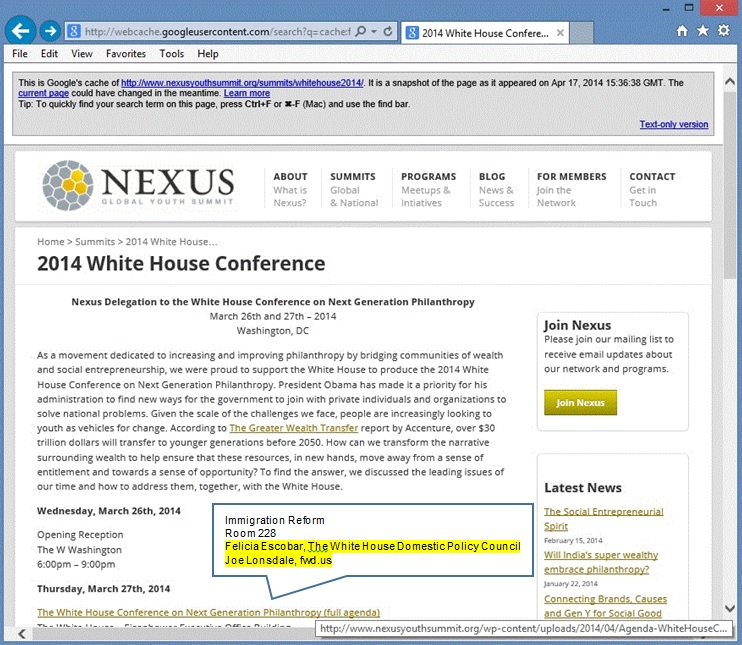
theodp writes Even as it cuts about 14% of its workforce, Microsoft is complaining that the company might be denied some of the "roughly" 1,000 H-1B visas for foreign workers it intends to seek, and made it clear that the company could shift some work to Canada or overseas if it can't get talent on its terms. "If I need to move 400 people to Canada or Northern Ireland or Hyderabad or Shanghai, we can do that," said William Kamela, a senior federal policy lead at Microsoft, who later explained that about 60% of Microsoft's workforce is in the U.S., yet it makes 68% of its profits overseas (where it also stashes its cash out of IRS reach). Kamela made the statements on a panel at a two-day conference on high-skilled immigration policy, where he sat next to Felicia Escobar, special assistant to President Barack Obama on immigration. The day before the conference, Mark Zuckerberg's FWD.us PAC — which counts Bill Gates as a Founder and Steve Ballmer and Microsoft General Counsel Brad Smith as Major Contributors — posted its "MythBusters" video on H-1B visas. -
Commander Keen: Keen Dreams Source Code Released
New submitter ildon writes: Recently, the rights holder of former game publisher Softdisk's game library put the rights to some of their old titles up for sale, including Commander Keen: Keen Dreams, one of the few games in the series not to be published by Apogee. A group of fans created an Indiegogo campaign to purchase those rights. We are just now seeing the fruits of that effort with the full source code of the game being published to GitHub. About a year ago, Tom Hall found the sources to episodes 4-6, but it's not clear what, if any, progress has been made on getting Bethesda to allow that code to be released. -
MetaFilter Founder Says Vacation Firm Forged Court Docs To Scotch Review
IonOtter (629215) writes Matt Haughey, founder of MetaFilter, has challenged a Cease & Desist letter from Sundance Vacations, a seller of time-shares with a reputation for aggressive sales tactics and suppression of criticism. Only this time, it seems that the plaintiff may have forged court documents ordering Mr. Haughey, Facebook, Google, Yahoo, Bing and other search engines to remove any and all mentions of the links and posts in question. Legal blog Popehat has picked this up as well, prompting Ken White to wryly note, "...Sundance Vacations is about to learn about the Streisand Effect." The story is gaining traction, and being picked up by Boing-Boing, as well as hitting the first page of search results on Google. -
David Klann Talks About Using Open Source Software in Broadcast Radio (Video)
David Klann works with Driftless Radio, call letters WDRT, in Wisconsin. This is community radio, with no huge advertisers or morning shock jocks with names like Bobba the Fet Sponge. They use open source software for just about everything except accounting, and that includes processing their audio for both OTA (Over the Air) and online streaming. Their transmitter runs a "stripped down" version of Debian, and David is proud that they had 3 1/2 years of uptime -- that only ended when David did a kernel upgrade that forced a reboot. (Alternate Video Link) -
The Grumpy Programmer has Advice for Young Computer Workers (Video)
Bob Pendleton calls his blog "The Grumpy Programmer" because he's both grumpy and a programmer. He's also over 60 years old and has been programming since he was in his teens. This pair of videos is a break from our recent spate of conference panels and corporate people. It's an old programmer sharing his career experiences with younger programmers so they (you?) can avoid making his mistakes and possibly avoid becoming as grumpy as he is -- which is kind of a joke, since Bob is not nearly as grumpy as he is light-hearted. (Transcript covers both videos. Alternate Video Link One; Alternate Video Link Two) -
Is "Scorpion" Really a Genius?
An anonymous reader writes CBS's upcoming hacker show Scorpion is pitched as based on the real life of Irish 'eccentric genius' Walter O'Brien a.k.a. "Scorpion". Some of the claims made for the real Scorpion are extraordinary. A child prodigy with an IQ of 197, hacking Nasa at age 13, [supplying] Ireland with more Personal Computers than DELL and Gateway together. Searching online I wasn't able to find anything which, for me, clearly backed up any of these (or other) claims. For example, rather than being the sixth fastest programmer in the world in 1993, his team ranked 90th out of 250 teams. Curiously, his degree grade was an ok, but hardly stellar B+ (II-I). Does anyone know anything to back up the genius claims being made about Scorpion? -
Facebook Seeks Devs To Make Linux Network Stack As Good As FreeBSD's
An anonymous reader writes Facebook posted a career application which, in their own words is 'seeking a Linux Kernel Software Engineer to join our Kernel team, with a primary focus on the networking subsystem. Our goal over the next few years is for the Linux kernel network stack to rival or exceed that of FreeBSD.' Two interesting bullet points listing "responsibilities": Improve IPv6 support in the kernel, and eliminate perf and stability issues. FB is one of the worlds largest IPv6 deployments; Investigate and participate in emerging protocols (MPTCP, QUIC, etc) discussions,implementation, experimentation, tooling, etc. -
A Look At the Firepick Delta Circuit Board Assembler (Video)
From the Firepick website: 'We are developing a really cool robotic machine that is capable of assembling electronic circuit boards (it also 3D prints, and does some other stuff!). It uses a vacuum nozzle to pick really tiny resistors and computer chips up, and place them down very carefully on a printed circuit board.' There are lots of companies here and in China that will happily place and solder components on your printed circuit board, but hardly any that will do a one-off prototype or a small quantity. And the components have gotten small enough that this is really a job for a robot (or at least a Waldo), not human fingers. || There are obviously other devices on the market that do this, but Firepick Delta creator Neil Jansen says they are far too expensive for small companies, let alone individual makers.
The Firepick Delta Hackaday page talks about a $300 price for this machine. That may be too optimistic, but even if it ends up costing two or three times that amount, that's still a huge step forward for small-time inventors and custom manufacturers who need to populate just a few circuit boards, not thousands. They have a Haxlr8r pitch video, and have been noticed by TechCrunch, 3DPrintBoard.com, and Adafruit, just to name a few. Kickstarter? Not yet. Maybe next year. Open source? Totally, complete with GitHub repository. And they were at OSCON 2014, which is where Timothy found them. (Alternate Video Link) -
Long-range Electric Car World Speed Record Broken By Australian Students
New submitter is_this_gdog writes: The Sunswift solar car team from UNSW Australia has broken an international world speed record for the fastest long-range electric vehicle, averaging a speed of 107km/h (66mph) over 500km (310miles) from a single charge with their car, eVe. Solar panels were not used for this record (with solar, the car has a range of over 500 miles), the challenge was endurance speed with battery only. There are faster electric cars, and one or two with longer range if you go slow enough — Sunswift eVe is the first to officially do 500kms at highway speeds (pending official FIA approval). Pictures of the car are available here. -
The Loophole Obscuring Facebook and Google's Transparency Reports
Jason Koebler writes The number of law enforcement requests coming from Canada for information from companies like Facebook and Google are often inaccurate thanks to a little-known loophole that lumps them in with U.S. numbers. For example, law enforcement and government agencies in Canada made 366 requests for Facebook user data in 2013, according to the social network's transparency reports. But that's not the total number. An additional 16 requests are missing, counted instead with U.S. requests thanks to a law that lets Canadian agencies make requests with the U.S. Department of Justice. -
Hack A Day Prize is a Trip To Space (Video)
Last month, at Maker Faire Bay Area 2014, Timothy Lord spotted a guy wearing a very large piece of headgear that included two crossed wrenches. The guy turned out to be Mike Szczys, Managing Editor of hackaday.com, which says, "The Hackaday Prize will send one person into space for building the next evolution of hardware." That's certainly of interest to the hardware hacker/maker crowd. How they're going to arrange the space flight (probably one of those "just above the atmosphere" hops) isn't specified, but even so the contest is an interesting idea, and the Hack A Day site seems to have some interest hacks and tutorials on it. So go ahead and enter the contest -- and don't forget to take your camera with you on your flight into space, because we'll want to see pictures! (Alternate Video Link) -
This 360-Degree, 4K Video Camera isn't Getting Kickstarted (Video)
This is something that caught Tim Lord's eye as he cruised the 2014 Bay Area Maker Faire: A 360 4K-resolution video camera. It's not out yet for retail sale, but if you look at the Centrcam website you can see a number of videos their cameras have shot, including some high-motion ones that they say, truthfully, are excellent to watch full-screen. The people who came up with this aren't college students who have never done any professional design work. Rather, they're "the same team that engineered and built the Apple iPhone cameras." So it's no wonder they have made something pretty cool that has already been used to make videos for Fox Sports, National Geographic, and the U.S. Army, among others. Their Kickstarter blurb is pretty cool, too. It is one of the most detailed ones we've ever seen. It's sad that they only got $607,628 of their $900,000 funding goal, considering all the work they've put into their product, along with the great presentation. They didn't know this would happen at the time this video was shot at the Maker Faire; their Kickstarter time window didn't close until four days ago. But there are other ways to fund a startup, and we hope they manage find one -- because we would eventually like to get our hands on one of their cameras and test it for ourselves, possibly with a little help from some of the Bradenton Riverwalk Skatepark regulars. (Alternate Video Link)