Slashdot Mirror
Domain: facebook.com
Stories and comments across the archive that link to facebook.com.
Stories · 468
-
James Cameron and Eric Schmidt's SOI Grieve Loss of Nereus ROV
theodp (442580) writes "Wealthy guys love extreme submarines, observed Billionaire in 2012. And the Washington Post reported that deep sea exploration is getting to be a rich man's game in 2013. The NY Times also covered the privatization of American science earlier this year. So, it's not too surprising to see the [Google Chair Eric] Schmidt Ocean Institute (SOI) post filmmaker James Cameron's eulogy-of-sorts for the loss of the Nereus ROV, the hybrid remotely operated vehicle that's believed to have imploded under 16,000 PSI of pressure at a depth of 9,990 meters as it explored the Kermadec Trench. 'I feel like I've lost a friend,' wrote Cameron. 'I always dreamed of making a joint dive with Nereus and [Cameron's] Deepsea Challenger at hadal depth.' Also feeling Cameron's pain is SOI, which used the Nereus to explore the Mid-Cayman Rise in 2013 and had plans to use the $6 million HROV again to explore the Mariana Trench in two missions later this year. SOI is currently working with the Woods Hole Oceanographic Institution to build the world's most advanced deep-diving robotic vehicle for use on SOI's ship R/V Falkor, which Wendy Schmidt indicated provides ship time that enables researchers to tap into available funding." -
Ben Starr Answers Your Questions About Sustainability and Kitchen Tech
Last week you had the chance to ask chef, travel writer, reality TV star, and all around food geek Ben Starr about sustainable farming, brewing, and building the perfect kitchen. Read below to see what he had to say. Kitchen Knives
by cphilo
What knives do you recommend? I use Chicago Cutlery, but I have been told that Wusthof is worth the money.
Ben: I have a collection of many different brands of knives, mostly gifts from other people, so I don't have a strict brand loyalty. I can tell you that the best knives I've ever worked with were Globals, which we used on MasterChef. They are as sharp as razor blades, you have to be very careful with them! My favorite knives in my home kitchen are Shun knives, made in Japan and of excellent quality, but they are breathtakingly expensive. (All were gifts!) When it comes to me, a cheapskate, buying knives for myself, I invariably fall to the IKEA Slitbar series. Their 6" full tang chef's knife is $24 with a nice wood inlay, sharp, heavy, balanced, and I don't have to worry about a dinner guest tossing them into the dishwasher, like I do with my expensive knives. If you're looking for a great knife series at a great price that you won't constantly worry about, you can't go wrong with IKEA Slitbar. And while we're on the subject, NEVER buy a set of knives. You don't need them all. Buy knives individually. You need a paring knife, a couple of 6" or 8" chef's knives (I have five), a bread knife, and possibly a boning knife if you like working with whole fish or breaking down your own meats (in which case you'll also need a cleaver). You can do pretty much anything with that.
How do I (slowly) assemble my own awesome kitchen
by krotscheck
What is the most efficient, and ordered, way to assemble a world-class kitchen? Many of us don't have the budget (especially when coming out of college) to buy all the crazy-awesome tools that make for a world class kitchen in one go, so we have to slowly purchase items as our budget allows and/or old cheaper items get used up. Do you have a recommended order, from a batchelor/ette's first egg pan to elaborate computerized sous-vide, in which someone can build their own world-class kitchen over several years?
Ben: 15 years ago when I first got out of college, my answer was totally different than it is today, because of one word: Craigslist. Back when I was out of college, my only option for getting a good Kitchenaid stand mixer was at full retail, brand new, at Williams Sonoma. Now I can pick one up for half that price or less, gently used, on Craigslist almost any day of the week. So don't be afraid to buy quality used kitchen items, these things are built to last 20-30 years if not longer. Start with pans, and you don't have to spend a pretty penny here. You need only one inexpensive nonstick pan, a small egg/omelet pan, and I recommend a ceramic coating rather than conventional nonstick surfaces, as they pose less health risk. Don't spent lots of dough on a nonstick pan, its surface will wear out eventually. Get the heaviest one you can find for cheap. I have only one "clad-type" saute pan, those expensive layered stainless steel pans with a copper core. Again, you can get them used, and a good one lasts forever. All the rest of my cookware is cast iron, which is cheap even when you buy it brand new. I love cast iron: a well-seasoned pan is almost as nonstick as Teflon, but sears beautifully in a way that nonstick pans never could. Check thrift stores and garage sales for used cast iron, it is easily rehabilitated even if it's crusty or rusty. Keep it in shape with a gentle hand washing after use (a well seasoned pan will clean up almost instantly), then dry it well, give it a light spray of cooking oil, and put it back in your pantry. The only time you'll ever regret your cast iron collection is when it comes time to move!
For appliances, start with the indispensable basics: a quality stand mixer (avoid the Artisan model Kitchenaids, they are underpowered, go for the bigger, stronger ones), a decent stick blender, and a food processor with a large capacity and plenty of attachments. As your technique becomes more sophisticated (and hopefully your income more lucrative) you can begin saving up for the biggies: a Vitamix blender, an immersion circulator (ie "sous vide") with vacuum sealer, and any additional equipment necessary for the food hobbies you'll inevitably acquire, like beer brewing, cheesemaking, charcuterie, etc. And, again, all these things can be acquired used on Craigslist, often for a song, with many, many years of life left. After that, specialty attachments for your Kitchenaid can follow, like pasta extruders, meat grinders, etc. Don't forget that companies OTHER than Kitchenaid manufacture attachments for it, and are often of much higher quality. I'm currently enamored with an all-stainless steel, fully dishwasher-safe meat grinder attachment made by a small Texas company called Smokehouse Chef, which actually cost me LESS than Kitchenaid's poorly-reviewed model.
The Presentation Layer
by Dissenter
As a chef that embraces modern technology, do you think that the 3D printed food technology is something you will have in your kitchen some day or is it just a fad?
Ben: Just as we've seen the movement of laboratory equipment into the commercial kitchens of Modernist chefs (cryovacs, immersion circulators, liquid nitrogen, rotary evaporators, etc.), we're going to be seeing 3D printed food pop up in those same kitchens in no time. I don't think Modernist cooking is going anywhere, but it most certainly represents the minority of chefs and restaurants. Most of us have no desire to eat foie gras cotton candy, citrus dust, and scallop foam on a regular basis...though on occasion it can be an intriguing, inspiring, and expensive curiosity. When it comes down to it, people in all cultures around the world invariably gravitate towards the honest, straightforward comfort foods they've enjoyed since childhood, so the home kitchen and the restaurant industry will always be dominated by authentic foods with a long heritage and a story behind them. High-tech food will never be more than a solid but rare corner of the industry that has a larger impact on its culture than its size belies, in the same way that a single groundbreaking artist may impact generations of artists after him/her...though their own body of work and those they influence still represent a tiny fraction of the whole body of human art.
Innovations in Brewing
by KermodeBear
What are some of the most interesting and promising recent innovations available to the home brewer?
Ben: I'm stoked about new ways of achieving barrel-aged flavors without the need for barrels. Ageing on wood chips was the old method, but new products from companies like Black Swan Cooperage are allowing a much faster maturation time and can be inserted right into the secondary fermentation bottle. As a chef and brewer, I'm also VERY excited to see more culinary beers on the market. I've been brewing beers with grapefruit and tamarind and bananas and cardamom for years, and for awhile, the purist community stuck their nose up at any beer that contained anything more than water, barley, hops and yeast. Not any longer!! Go hogwild, people. Brew me a beer with bacon fat and maple syrup! I'm excited to see a generation of highly drinkable gluten free beers emerging, so that beer lovers with gluten sensitivities can enjoy quality beer again. (There are now innovations in the mashing process that can remove most of the gluten from a full barley grain bill, so it's no longer necessary to resort to sorghum!)
Also, with the skyrocketing micro-brew trend, professional-quality equipment for brewing in larger-than-5-gallon batches is coming down in price and becoming more readily available (especially when small breweries go out of business and sell their equipment), making it possible for serious homebrewers to make the jump to brewing larger batches at home, and possibly even going professional, without having to sign away your firstborn child. But still, homebrewing is dominated by the do-it-yourself spirit of ordinary folks, rather than manufacturers and industry innovators, and beer innovation comes as we build and tweak our own mash tuns, wort chillers, and climate-controlled fermentation chambers in our garages. WE are the innovators.
Industrial Livestock and the High Meat Diet
by Sir_Eptishous
Do you agree with the following statement, and would you comment? Industrial livestock production and the high meat consumption diet of the industrialized world are unsustainable and are causing great damage to the Earths ecosystems, and that the only real solution being that the amount of meat being consumed must drop considerably.
Ben: I'm not sure how any rational human being could disagree with that statement. Our population is soaring. Developing nations are making the leap closer to becoming industrialized. This means more and more affluent meat eaters coming online each day. Our commercial meat production methods are already unsustainable, inhumane, and imminently susceptible to disaster, either from natural or engineered pathogens. Still, some nations meet their demands for meat on a smaller, localized scale without massive, industrialized, intensive production facilities...like France or Finland...where the majority of their population still enjoy meat on as regular a basis as Americans (though certainly in smaller portions), but the majority of animals are still raised on smaller, non-factory farms. I believe the biggest meat problems in America (other than poor animal husbandry) are portion size, with so much cooked meat going to waste, and low meat cost, which leads to mass spoilage and waste in the grocery store or the home fridge. If meat were more expensive, we would be more careful with it, not eat as much of it in one sitting, and be less likely to walk away from a grill full of chicken breasts (we can always throw some more on if they burn, right?) And meat raised on small farms most certainly costs more to produce, and therefore demands a higher retail price, in addition to being much higher quality. Raise the price of gas? People will use less of it and be more cautious with it. (Look at Portland.) It works the same with meat.
Re:Soylent Green
by HappyHead
More importantly, what do you think about Soylent, the food substitute?
Ben: Horrific name choice, to be certain, as no one would be able to find nutritive food substitutes appetizing with that name! When we think in terms of scale...yes, in a few hundred years, the population of the planet will be too large to be fed entirely on "natural" or minimally processed foods. Arable land is disappearing, climate is rapidly changing, and that's going to force us in two directions: genetic modification of crops and animals to be able to raise more of them on less land, and engineering food products that are more densely nutritious than, say, a tomato, in order to meet the body's minimum requirements. Pondering this type of future isn't inspiring for me. I don't eat "just to survive" and I never want to. Part of what separates us from the animal kingdom is our palates...we live to eat. Food is at the core of how we celebrate with loved ones, and how we share our love and passion with new friends. And as our current food supply becomes more and more engineered, we're seeing an ever-more-popular upwelling of resistance, with millions searching out foods that are closer to the earth, from small family farms, or growing their own. There's no reason to think this movement won't reach revolutionary proportions by the time Soylent is the primary source of calories on the planet. While Soylent may have been pioneered by someone who finds cooking and eating to be a burden, this is most definitely NOT the common sentiment on the planet. Virtually all people love to eat well. Many, if not most people love to cook. Soylent will not become common until it is the only affordable option.
Local gardens and farms?
by mlts
What do you think of replacing the stereotypical front yard with some type of garden and some home raising of animals (chickens come to mind)? I'm nowhere near a farmer, but having the ability to have food available a few feet away seems like a wise idea, especially with food prices skyrocketing.
Ben: This is already happening all over the US. People in Manhattan have chicken coops on their balconies. People are digging up backyards and front yards to plant tomatoes, and apartment dwellers are joining community gardens. I live in a 1300 square foot house on a tiny, suburban lot...but I have 11 chickens, a huge garden, fruit trees and bushes, and I produce enough food not only for my household and neighbors, but to supply my small, ephemeral restaurant. Not only is self-sufficiency (or at least partial self-sufficiency) a smart idea, it is ENORMOUSLY fulfilling to eat and share foods that you've raised yourself. However, it's important to realize that food production at home IS NOT CHEAPER than the grocery store. Mass-produced, industrial ingredients are far cheaper than the costs involved in having a garden and animals. My water bill in the summer is over $300 a month, just because of my garden...and I live in an area with very cheap water. Building a pen and coop for a few chickens will run into the hundreds, and feeding them even the cheapest available food is going to cost more per month than buying eggs from the grocery store. Feeding them organic? You don't even wanna know. Raising your own food isn't about saving money. But it is endlessly fulfilling, healthy, fun, and sets a strong example for those around you to begin reconnecting with the food chain.
scalability
by globaljustin
Mr. Starr, thanks for taking questions.
My question: When will we see a scalable local/organic logistics solution for delivering food to a large metro area? Ex: The size of Denver...we see stories of "innovative tech solutions" all the time here on /., but usually they are limited to one "green" building, one research team's "urban farm" concept, one restaurant chef applying these in one restaurant in Brooklyn... I'm asking when will we see one of those solutions applied at scale? I ask because in my mind that is the threshold or 'tipping point' in the industrial food situation.
Ben: I tend to be an excessively optimistic person, but I'm not sure I can be when this question is asked. Right now these innovative projects are far too expensive to be applied on a large scale. In this way (and in many other ways), our food supply mimics our energy supply. It won't be until we literally run out of petroleum sources that electric cars will become commonplace. It won't be until our coal and natural gas reserves are tapped out that you'll see solar panels and windows on many homes. As long as factory farms CAN produce meat and vegetables cheaply, they will be the primary suppliers of food on the planet. As long as the average person can buy 2 dozen conventional eggs for the same price as a dozen organic eggs, the majority of them will choose conventional. As technology advances and genetic engineering makes it cheaper for industrial farms to produce more food at less cost on less land, organics and urban farming will never be more than a curiosity for most, and fully embraced by only a few. But there is power in visibility and education. When a young person sees skyscrapers topped with vegetable gardens, or a college student takes note of a local chef who's supporting a local farmer and notices a change in the quality of the food, we're planting the seeds of change for that moment when it becomes NECESSARY for us to produce food for our cities inside our cities, and for people to be partially responsible for producing their own food.
But "Scalability" is the enemy of slow food. If skyscraper walls and roofs become farms, that becomes the business of corporations. And when the individual care and stewardship of the farmer is taken out of the picture, we end up with the same problems we have now. Large-scale "organic" farms are nothing of the sort, they still rely on chemicals and methods that are, in fact, not organic, to produce on the scale necessary to supply retailers. (The number of dangerous and non-organic compounds and methods now allowed by the USDA in farming practices and still have the "Certified Organic" label is appalling. Responsible, sustainable, organic farming cannot be accomplished on a large scale.) The only time we'll see sustainable, organic ingredients as the norm is when a fourth of our population is back in small-scale, diverse family farming. And our country's size, comparatively light population density, government, and economy do not encourage that.
Butchers
by Onuma
Current society focuses more and more on technology to make cooking easier, quicker, make prepared foods more readily accessible, etc. One area we have not really changed is butchering, except to say that there are far fewer butchers today than a generation ago. There could be no quality cuts of meat without them. Do you think butchers are a dying breed, or will we see a resurgence within that profession?
Ben: Butchering has most certainly changed with the advent of industrialized animal husbandry. Most butchering happens at centralized locations now, with steaks, chicken breasts, and the like being cut, packaged and delivered to the grocery store, rather than an in-store butcher doing the breaking down and packaging. Butchers are a rapidly vanishing phenomenon...you have to really search to find one in most places. The other day, I was at an upscale gourmet market and asked the person behind the meat counter if they could cut some flat iron steaks for me out of the chuck, and they looked at me like I was speaking a foreign language and said, "Everything comes already cut and packaged to us. We can't really cut anything for you." Luckily, as more and more folks are taking a closer look at their food, more artisan butcher shops are popping up in urban areas, and as long as some of us are willing to pay a little more to have our meat cut the way we like, and to know the name of the farm where that meat was raised, there will always be a butcher who will capitalize on that...as long as the law permits him to.
Fat Sick and Nearly Dead
by labnet
I've been watching some documentaries lately, along the lines of Fat, Sick and Nearly Dead & Food Matters (both worth watching).The common theme (which I have heard for many years now) is to eat raw and stay away from processed foods: the reason being; most chronic disease is caused by the lack of available micronutients. You may be getting energy from processed foods, but all the complex biomechanics for healthy cell life is being starved, causing heart disease, diabetes, weight gain, etc etc.From your experience with food around the world, what do you think is the optimum daily diet.
Ben: You've asked two very separate questions here. In terms of processed foods, I don't think any rational person thinks that a lifetime diet heavy in processed foods isn't going to cause significant health problems. (Whether or not they are willing and/or able to change their diet is a different issue.) In terms of converting to a raw diet, I think that's comparable to the question about Soylent. Are we eating simply to stay alive and keep at the top of our health? Or are we eating to celebrate and enjoy life? Perhaps when I'm 70 I'll have a different perspective on this, but I can guarantee you that I won't regret my life of enjoying whatever foods I want to. Now, I'm not overweight or diabetic, but I live an indulgent life. I don't deny myself a good beer or some fried chicken...when I want it, I enjoy it. Eating is one of the things that make life truly rich and enjoyable. And while I've had some lovely and interesting creations by raw chefs, heat transforms ingredients in a complex and interesting way. It makes ingredients BETTER (though in some cases it makes them less nutritious, and in other cases it makes them MORE nutritious). I admire those who staunchly live the raw lifestyle, because it's not easy. In the same vein as our hunter-gatherer ancestors, a much larger portion of their time and energy goes into acquiring their food than it does for you and me. And they obviously find it fulfilling enough to continue it. But I could NEVER do the exclusively raw thing. There's not enough diversity. My entire life is about food. I take incredible joy from both eating and cooking. But if your goal is exclusively to maximize your years on this planet...yes, you should be eating raw...and raising all your own food...and living as far away from urban centers and their pollution as possible...and following a carefully planned exercise and sleep routine...and then, are you truly LIVING? For me, the optimum daily diet is whatever I feel like eating, eating until I'm satisfied but not stuffed, being active in whatever way I ENJOY being active (ie...hiking and foraging and canoeing and playing with my chickens and my dog as time flies by, rather than languishing on a treadmill, counting the seconds until I'm done), and focusing on truly enjoying and appreciating my food, so that it enriches my life, and makes me happier and more fulfilled. Life is already too short to allow food to become a burden and a chore. Food should make life richer and more fun. -
Finding the Next Generation of Teachers With "Innovative Microsoft Ads"
theodp (442580) writes "Back in 2011, the U.S. Dept. of Education delegated teacher recruitment to Microsoft (RFP, pdf). 'The decision to turn over TEACH to [Microsoft] Partners in Learning serves to expand the already outsized influence Gates and his fortune have on public education,' wrote the Washington Post at the time. So, 'what happens when a public institution in a democracy — the US Department of Education — outsources its goal of recruiting good teachers to a private industry?' Well, in addition to Teach.org and redundant social media efforts on Twitter, Facebook, Tumblr, Instagram, Linkedin, and YouTube, the U.S. is now relying on 'Innovative Microsoft Advertising to Recruit the next Generation of Teachers'. From the press release, 'The Ad Council and TEACH have formed a unique outreach campaign with Microsoft's Advertising team in an effort to recruit the next generation of teachers who will drive innovation and redefine teaching in K-12 classrooms. Microsoft donated over 125 million impressions across Xbox 360, Windows 8, and MSN in order to encourage consumers to rediscover teaching through interactive ad units. This media effort is an extension of the Ad Council and TEACH's public service advertising (PSA) campaign, Make More...Throughout March, consumers were able to engage with TEACH "NUads on Xbox", via gesture, voice or controller on their Xbox 360 consoles...Most recently, Microsoft leveraged their Windows 8 platform to provide a unique experience to consumers, enabling them to navigate through a series of questions to help "discover their true passion," along with the opportunity to play challenging mind and word games, such as a word scramble and tangrams.' Check out the demo of the Windows 8 platform experience [YouTube], in which a person is advised 'You'd Make a Great Science & Tech Teacher,' on the basis of a 'Personality Quiz' consisting of five dragged-and-dropped photos." -
Facebook and Google's Race To Zero
theodp (442580) writes "As Facebook and Google battle to bring the Internet to remote locations, Alicia Levine takes an interesting look at the dual strategy of Zero Rating and Consolidated Use employed by Google's FreeZone and Facebook's 0.facebook.com, websites which offer free access to certain Google and Facebook services via partnerships with mobile operators around the world. By reducing the cost to the user to zero, Levine explains, the tech giants not only get the chance to capture billions of new eyeballs to view ads in emerging markets, they also get the chance to effectively become "The Internet" in those markets. "If I told you that Facebook's strategy was to become the next Prodigy or AOL, you'd take me for crazy," writes Levine. "But, to a certain degree, that's exactly what they're trying to do. In places where zero-rating for Facebook or Google is the key to accessing the Internet, they are the Internet. And people have started to do every normal activity we would do on the Internet through those two portals because it costs them zero. This is consolidated use. If Facebook is my free pass to the Internet, I'm going to try to do every activity possible via Facebook so that it's free." The race to zero presents more than just a business opportunity, adds Levine — it also presents a chance for tech companies to improve lives. And if Google and Facebook fall short on that count, well, at least there's still Wikipedia Zero." -
Did Facebook Buy Oculus To Counter Google Glass?
Nerval's Lobster (2598977) writes "In a statement soon after Facebook announced the acquisition of Oculus Rift, CEO Mark Zuckerberg suggested that the bulky Oculus headset had the potential to transform VR into the "most social platform ever." Whatever his reasons for shelling out $2 billion for the company, it's clear that Facebook is now a player in the augmented-reality space, which Google is also exploring in its own way. Yes, Google Glass serves a different function—overlaying maps and text over the wearer's view of the real world, rather than immersing people in a virtual environment—but the potential customer base for both devices is basically the same, and now Google has some real competition if it wants to transform Glass into some sort of gaming device. And despite some blowback from Markus Persson, it's likely that developers will continue to explore Oculus as a gaming platform, Facebook or no. Zuckerberg might be talking a good game about virtual realities far into the future (does he have to pay to promote his own posts on Facebook? Joke.), but this acquisition was likely a short-term play, as well." -
Facebook Buying Oculus VR For $2 Billion
Several readers sent word that Facebook will acquire Oculus VR for $2 billion. Mark Zuckerberg says the Oculus Rift virtual reality headset is the beginning of something big: "This is really a new communication platform. By feeling truly present, you can share unbounded spaces and experiences with the people in your life. Imagine sharing not just moments with your friends online, but entire experiences and adventures." The obvious question is: why Facebook would buy a company focused on VR gaming? The Oculus team says, "But when you consider it more carefully, we're culturally aligned with a focus on innovating and hiring the best and brightest; we believe communication drives new platforms; we want to contribute to a more open, connected world; and we both see virtual reality as the next step. ... It opens doors to new opportunities and partnerships, reduces risk on the manufacturing and work capital side, allows us to publish more made-for-VR content, and lets us focus on what we do best: solving hard engineering challenges and delivering the future of VR." Put more simply: money and connections. -
Fluke Donates Multimeters To SparkFun As Goodwill Gesture
Actually, I do RTFA writes "We recently heard about the confiscation of a delivery of multimeters to SparkFun for infringing on Fluke's trademark. One common thread in the discussions was the theme that Fluke should have let that shipment through as a goodwill gesture to SparkFun and the Maker community. Well, Fluke did one better. They announced they were sending more than $30k worth of official multimeters to SparkFun for them to do whatever they want with. SparkFun is most likely going to give them away. A great example of win-win-win?" -
Facebook Introduces Hack: Statically Typed PHP
alokmenghrajani (2602135) writes with news of Facebook's new Open Source language, Hack. Quoting: "Today we're releasing Hack, a programming language we developed for HHVM that interoperates seamlessly with PHP. Hack reconciles the fast development cycle of PHP with the discipline provided by static typing, while adding many features commonly found in other modern programming languages. ... Traditionally, dynamically typed languages allow for rapid development but sacrifice the ability to catch errors early and introspect code quickly, particularly on larger codebases. Conversely, statically typed languages provide more of a safety net, but often at the cost of quick iteration. We believed there had to be a sweet spot. ... Hack has deep roots in PHP. In fact, most PHP files are already valid Hack files. ... Our principal addition is static typing. We have developed a system to annotate function signatures and class members with type information; our type checking algorithm infers the rest. Type checking is incremental, such that even within a single file some code can be converted to Hack while the rest remains dynamically typed. ... If a function parameter or class member does not have an explicit type annotation, the type checker considers its type to be dynamic, and it does not check the type of that value." In addition to static typing, they've introduced proper closures that capture the lexical environment, generics, collections, and array shapes. The Hack website has more details. There's a fairly complete language manual, tools to infer types in PHP source and annotate the code, and source available under the PHP license. -
Facebook's Face Identification Project Is Accurate 97.25% of the Time
kc123 tips news that 'DeepFace,' the software research project created by Facebook engineers to identify people in pictures, is now accurate 97.25% of the time. In other words, it's almost as good at recognizing faces as humans, who are able to determine whether two photos show the same person 97.53% of the time. The article says DeepFace reaches that level of accuracy "regardless of variations in lighting or whether the person in the picture is directly facing the camera." It continues, "DeepFace processes images of faces in two steps. First it corrects the angle of a face so that the person in the picture faces forward, using a 3-D model of an 'average' forward-looking face. Then the deep learning comes in as a simulated neural network works out a numerical description of the reoriented face. If DeepFace comes up with similar enough descriptions from two different images, it decides they must show the same face. ... The deep-learning part of DeepFace consists of nine layers of simple simulated neurons, with more than 120 million connections between them. To train that network, Facebook’s researchers tapped a tiny slice of data from their company’s hoard of user images—four million photos of faces belonging to almost 4,000 people." -
NASA Forgets How To Talk To ICE/ISEE-3 Spacecraft
Hugh Pickens DOT Com writes "Randall Munroe's XKCD cartoon on the ICE/ISEE-3 spacecraft inspired me to do a little research on why Nasa can no long communicate with the International Cometary Explorer. Launched in 1978 ISEE-3 was the first spacecraft to be placed in a halo orbit at one of Earth-Sun Lagrangian points (L1). It was later (as ICE) sent to visit Comet Giacobini-Zinner and became the first spacecraft to do so by flying through a comet's tail passing the nucleus at a distance of approximately 7800 km. ICE has been in a heliocentric orbit since then, traveling just slightly faster than Earth and it's finally catching up to us from behind, and will return to Earth in August. According to Emily Lakdawalla, it's still functioning, broadcasting a carrier signal that the Deep Space Network successfully detected in 2008 and twelve of its 13 instruments were working when we last checked on its condition, sometime prior to 1999.
Can we tell the spacecraft to turn back on its thrusters and science instruments after decades of silence and perform the intricate ballet needed to send it back to where it can again monitor the Sun? Unfortunately the answer to that question appears to be no. 'The transmitters of the Deep Space Network, the hardware to send signals out to the fleet of NASA spacecraft in deep space, no longer includes the equipment needed to talk to ISEE-3. These old-fashioned transmitters were removed in 1999.' Could new transmitters be built? Yes, but it would be at a price no one is willing to spend. 'So ISEE-3 will pass by us, ready to talk with us, but in the 30 years since it departed Earth we've lost the ability to speak its language,' concludes Lakdawalla. 'I wonder if ham radio operators will be able to pick up its carrier signal — it's meaningless, I guess, but it feels like an honorable thing to do, a kind of salute to the venerable ship as it passes by.'" -
Facebook To Buy WhatsApp
Facebook has announced an agreement to buy WhatsApp, the mobile messaging platform used by over 450 million people. The deal involves $4 billion in cash and an additional $12 billion in Facebook stock. They say WhatsApp will remain independent; its headquarters won't move, and it will continue to exist separately from Facebook's Messenger app. Mark Zuckerberg indicated they will focus on growth: 'Over the next few years, we're going to work hard to help WhatsApp grow and connect the whole world. We also expect that WhatsApp will add to our efforts for Internet.org, our partnership to make basic internet services affordable for everyone.' On WhatsApp's blog, they say, "Here’s what will change for you, our users: nothing. WhatsApp will remain autonomous and operate independently." -
Facebook Analyzes the Impact of Love On Their Business
c0lo writes "Facebook might understand your romantic prospects better than you do. In a blog post, the company's team of data scientists announced with hard numbers that hints at budding relationships before the relationships start. The two people enter a period of courtship, during which timeline posts increase. After the couple makes it official, their posts on each others' walls decrease—presumably because the happy two are spending more time together (and less on FB?!) A subsequent blog entry offers an insight on break-ups: it is the last of a series of 6 blogposts that ran last week on the "love" theme." -
Facebook Analyzes the Impact of Love On Their Business
c0lo writes "Facebook might understand your romantic prospects better than you do. In a blog post, the company's team of data scientists announced with hard numbers that hints at budding relationships before the relationships start. The two people enter a period of courtship, during which timeline posts increase. After the couple makes it official, their posts on each others' walls decrease—presumably because the happy two are spending more time together (and less on FB?!) A subsequent blog entry offers an insight on break-ups: it is the last of a series of 6 blogposts that ran last week on the "love" theme." -
Facebook Debuts New Gender Options, Pronoun Choices
beaverdownunder writes "Facebook has recognized it's a gender-diverse world — at least in the U.S. In addition to Male or Female, Facebook now lets U.S. users choose among some 50 additional options such as 'transgender,' 'cisgender,' 'gender fluid,' 'intersex' and 'neither.' 'Users also now have the ability to choose the pronoun they would like to be referred to publicly: he/his, she/her, or the gender-neutral they/their.' A post on Facebook's Diversity page said, 'When you come to Facebook to connect with the people, causes, and organizations you care about, we want you to feel comfortable being your true, authentic self. An important part of this is the expression of gender, especially when it extends beyond the definitions of just "male" or "female." ...We also have added the ability for people to control the audience with whom they want to share their custom gender. We recognize that some people face challenges sharing their true gender identity with others, and this setting gives people the ability to express themselves in an authentic way.'" -
Watching a FIRST Competition Robot Being Built (Video)
We have shown clips from FIRST Robotics Competitions before on Slashdot, with a concentration on the Dexter Dreadbots because they're the "home team" for Slashdot's home office in Michigan. Today we hear from team mentor Jennifer Bryson and watch as the team works on their 2014 competition robot. They need to have it finished by February 18, so they're in the home stretch of the robot-building task. The competition itself starts on February 28 and keeps going until the world championships are held during the last weekend in April. The Dreadbots did well last year. This year? Who knows. But win or lose, it's all For Inspiration and Recognition of Science and Technology, AKA FIRST, also AKA "The ultimate Sport for the Mind." And if you're not near Ann Arbor, MI, check for a FIRST competition near you. It's an international organization, so you're likely to find one -- and if you don't, perhaps you can help start a FIRST team where you live.And for those of you who don't see the video below, here's a link to it. -
Israeli Group To Attempt Moon Landing
cold fjord writes: "NDTV reports, 'Israel plans to do what only the world's biggest countries have so far managed to do: land an unmanned spacecraft on the moon ... only Russia, the U.S. and China have soft landed on the moon, and India hard landed its tri-colour using the moon impact probe in 2008 ... The washing machine-sized spacecraft that weighs 121 kilograms is being readied by a not-for-profit venture called SpaceIL. ... The Israeli lunar probe had its genesis after the $30 million Google Lunar X Prize was announced as a competition which challenged non-state-owned space agencies to land on the moon, send back photos, and move 500 meters on the surface of the moon. About two dozen global teams are racing to win the prize- SpaceIL reckons it's in pole position. ... ex-NASA engineer Yonatan Winetraub and two of his friends conceived of the spacecraft in 2010 ... then used a Facebook page to promote the dream. Today, the dream has matured into a $36 million mission with 20 full time employees and 250 volunteers. ... Around 40,000 school students have been associated with this project.' Further details are available here." -
Facebook Mocks 'Infection' Study, Predicts Princeton's Demise
Okian Warrior writes "In a followup to the earlier story about Princeton researchers predicting the end of Facebook by 2017, Facebook has struck back with a post using similar statistical techniques to predict that Princeton itself may be facing irreversible decline. By using similar methods ('likes', mentions in scholarly papers, Google searches) Facebook has created graphs that indicate Princeton is losing ground compared with its rivals and may have no students at all by 2021." -
Facebook's Biggest Bounty Yet To Hacker Who Found "Keys To the Kingdom"
mask.of.sanity writes "Facebook has paid out its largest bug bounty of $33,500 for a serious remote code execution vulnerability which also returned Facebook's etc/passwd. The researcher could change Facebook's use of Gmail as an OpenID provider to a URL he controlled, and then sent a request carrying malicious XML code. The Facebook response included its etc/passwd which contained essential login information such as system administrator data and user IDs. The company quickly patched the flaw and awarded him for the proof of concept remote code execution which he quietly disclosed to them." -
The Whole Story Behind Low AP CS Exam Stats
theodp writes "At first glance, the headline in The Salt Lake Tribune — Very Few Utah Girls, Minorities Take Computer Science AP Tests — appears to be pretty alarming. As does the headline No Girls, Blacks, or Hispanics Take AP Computer Science Exam in Some States over at Education Week. Not One Girl Took The AP Computer Science Test In Some States warns a Business Insider headline. And so on and so on and so on. So how could one quibble with tech-giant backed Code.org's decision to pay teachers a $250 "Female Student Bonus", or Google's declaration that 'the ultimate goal of CS First is to provide proven teaching materials, screencasts, and curricula for after-school programs that will ignite the interest and confidence of underrepresented minorities and girls in CS,' right? But the thing is, CollegeBoard AP CS exam records indicate that no Wyoming students at all took an AP CS exam (xls) in 2013, and only a total of 103 Utah students (xls) had reported scores. Let's not forget about the girls and underrepresented minorities, but since AP CS Exam Stats are being spun as a measure of CS education participation (pdf) and equity, let's not forget that pretty much everyone has been underrepresented if we look at the big AP CS picture. If only 29,555 AP CS scores were reported (xls) in 2013 for a HS population of about 16 million students, shouldn't the goal at this stage of the game really be CS education for all?" -
Google Co-Opts Whale-Watching Boat To Ferry Employees
theodp writes "Purportedly intended to defuse tensions over gentrification that have led to blockades and vandalism of Google's ubiquitous shuttles (video), which make use of public San Francisco bus stops (map), Wired reports that Google is now chartering a ferry to take its workers from SF to Silicon Valley. 'We certainly don't want to cause any inconvenience to SF residents, and we're trying alternative ways to get Googlers to work,' Google explained. Inconveniencing whale-seeking visitors to The Aquarium of the Pacific, however, is apparently not considered evil. After learning that Google had co-opted the $4 million, 83-foot, 150-passenger whale-watching catamaran MV/Triumphant to ferry as few as 30-40 Googlers to work, some expressed concerns on Facebook that Google would be The Grinch That Stole Whale Watching Season (not to worry; the boat's slated to make its 'triumphant' return to Long Beach after Google's '30-day trial')." -
CES 2014: A Powered, Remote Control Paper Airplane (Video)
Shai Goitein started with a powered paper airplane, the PowerUp 1, which was pretty cool. But he didn't stop there. The PowerUp 3 is a powered paper airplane you control with your smartphone. He calls this "a mixture of origami and technology." He also says it's a great toy, class project or whatever for the younger set, since kids start making paper airplanes at the age of six or seven. Adults? Why not? This is obviously a suitable toy for anyone with a two-digit (or three-digit) age number. And PowerUp 3.0 is a Kickstarter-funded project, with (at this writing) $928,091 pledged -- against a $50,000 goal, with another 15 days of Kickstarter funding left to go. There's also a smartphone-controlled PowerUp paper boat kit. Unlike the PowerUp airplane kits, it's not sold out (at this writing). Yet. -
Surge In Online Orders Overwhelms UPS Christmas Deliveries
Hugh Pickens DOT Com writes "Reuters reports that the high volume of online orders of holiday packages overwhelmed shipping and logistics company UPS delaying the arrival of Christmas presents around the globe and sending angry consumers to social media to vent. The company projected 132 million deliveries last week "and obviously we exceeded that," said UPS spokeswoman Natalie Black without disclosing how many packages had been sent. "For now, UPS is really focused on delivering the remaining packages. You might not see trucks, but people are working." Asked why the company underestimated the volume of air packages it would receive, Black noted that previous severe weather in the Dallas area had already created a backlog. Then came "excess holiday volume" during a compressed time frame, since the period between Thanksgiving and Christmas was shorter than usual this year. Amazon.com responded with an email to affected customers offering shipping refunds and $20 gift cards to compensate. Packages shipped via UPS for Amazon.com by Prime customers, who pay $79 a year for two-day shipping, may be eligible for additional refunds. Amazon's stated policy for missed deliveries is to offer a free one-month extension of Prime. Frustrated consumers took to social media, with some complaining that gifts purchased for their children would not arrive in time to make it under the tree by Christmas morning. '"A lot of these employees keep saying 'It's the weather' or 'It's some kind of a backlog,' said Barry Tesh. 'Well then why, all the way up until the 23rd, were they offering next-day delivery? That guaranteed delivery was 80% of my decision to buy the gift."' However, others on social media urged shoppers to be more appreciative of the delivery company's work during the holiday season. 'While others take vacation and time off in December, remember we aren't allowed ever to be off in December. Ever,' said a 20-year veteran UPS driver on the UPS Facebook page. 'So when you see your family and complain that your package is held up, everyone who moves your package is working and doesn't get the Xmas experience you get, Be thankful for that.'" -
Facebook Patented Making NSA Data Handoffs Easier
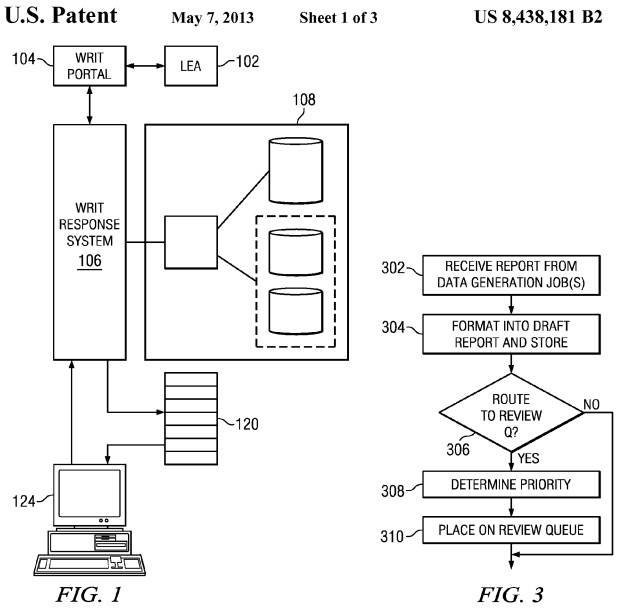
theodp writes "In June, Facebook CEO Mark Zuckerberg blasted 'outrageous press reports' about the PRISM surveillance program, denying that Facebook was ever 'part of any program to give the U.S. or any other government direct access to our servers.' What Zuckerberg didn't mention, and what the press overlooked, is that the USPTO granted Facebook a patent in May for its Automated Writ Response System. Like the NSA-enabling systems described by the NY Times on the same day Zuckerberg cried foul, the patent covers technical methods to more efficiently share the personal data of users with law enforcement agencies (LEAs) in response to lawful government requests via APIs and secured portals installed at company-controlled locations. 'While handing over data in response to a legitimate FISA request is a legal requirement,' the Times noted, 'making it easier for the government to get the information is not, which is why Twitter could decline to do so.'" -
Movie Review: Ender's Game
Ender's Game is the quintessential classic military sci-fi book. It ranks near the top of virtually every list of good sci-fi novels. When Hollywood decided to finally go forward with a movie adaptation, the initial reaction from most fans was one of skepticism. (After all, we saw what they did to I, Robot.) But there was reason to hope, as well, because Ender's Game is more action-friendly than many sci-fi stories, and the filmmakers had a big budget with which to make it. The movie was finally released last week; read on for our review. In short: the film tries too hard to straddle the line between assuming viewers are familiar with the details and bringing new viewers up to speed. The cuts to the story were both too much and not enough. It left us with only brief glimpses at too many characters, and introduced themes without fleshing them out enough to be interesting.Note: in the lead-up to this film's release, a boycott was organized in response to Orson Scott Card's efforts as an anti-gay-marriage activist. If you find your desire to see one of your favorite stories clashing with a desire not to support Card's political views, an organization called the Equality Initiative has offered an alternative. They suggest going to see the movie, if you want, and then simply donating the ticket price to any of several related charities.
First, let's get the obvious out of the way: they cut a lot from the novel. Really, quite a lot. As a book, Ender's Game is not terribly long, and it's a very quick read. That makes it sound ideal for a movie interpretation at first blush. But part of the reason it's such a quick read is that it's dense with plot, character development, and internal narratives. The movie is dense as well, but mostly with events. What makes the book great is not so much what the characters do, but why they do it and how. So while the movie conveys the majority of what happened in the book, it fails to convey the reasons behind the facts. I don't know that they could have done any better within a two-hour time limit, but it leaves us with a question: is this film for people who have read the book, or for people who haven't?
Since the book has been out since 1985, I'm going to assume most of you are familiar with the story. I won't reveal the major plot twists, but minor and intermediate spoilers may follow. If you aren't familiar with it, then here's the bottom line: go read the book! It's good.
Right from the beginning we see how deep the cuts go. Central to Ender's time at home is the whirlwind of conflicting emotions running through him about his monitor, his family, and his status as a Third. The film rushes through these, hitting each only briefly enough to show the viewer that there exists something deeper. Ender mentions being a Third, but doesn't explain what a Third is, or why it's a point of shame and embarrassment. They introduce Peter, but fail to show that their relationship is more complex than your typical sibling rivalry. In the book, Peter is brilliant, sadistic, intuitive, and a hell of an actor when adults are around. In the movie, he's just a jerk for a few seconds before Ender rockets off toward the plot.
Even Ender's early fight with Stilson loses much of its impact. In the book, it really isn't much of a fight; Ender immediately has Stilson at his mercy. The point of the scene was to show Ender's deliberate use of brutality and intimidation to secure safety from the larger group of enemies. He's reluctant, but not hesitant. In the movie, this is distilled down to a command for Stilson to "stay down" before the fight has concluded and a shaky warning to the others.
So, even just 10 minutes into the film, we see the film is not taking the time to illustrate these characters to a new audience. That trend continues: most of the minor characters are cardboard cutouts of their literary counterparts. Bean is somehow in the same initial launch group as Ender, and simply serves as an ally. Peter and Valentine just serve as occasional spurs for Ender's development. (Yes, that means the entire secondary plot was scrapped. I'm not too sad about that; there's no way they could have given it enough time to do it justice. And it was always the least believable thing, for me, in a novel about space battles and insectoid aliens.) Alai makes mention of peace, but he doesn't have a role as a peacemaker. The contrast between his connection with Ender and the constant violence surrounding them is lost. Petra has more interaction with Ender than most, but it has some bizarre romantic overtones.
Well, then, what about the scenery? If the movie is for fans of the book, it should at least be awesome to see expensive CGI of the scenes we imagined in our heads when reading it, right? And it is.. sometimes. The space battle sequences are impressive, and seeing the students fly around in zero-g was neat. But it was also jarring, at times. Take the Battleroom at the school, for example. In my head, it was an approximation of space, with a dark background interrupted only by the simple "stars" and the gates. In the movie, there's an awful lot going on, visually. The walls are windows dominated by a view of Earth. Everything's polished and shiny. The light pistols shoot bright, Star-Wars-like laser bolts that flash dramatically when they hit something. All the ships in the battlefleet look fancy and brand new, instead of hastily constructed and out of date. Ender's interface in command school is far more graphical and pretty than is sensible. It's cool to see, and I suspect viewers who are unfamiliar with the book won't think twice about it. But it's clear that this interpretation is not straining to be as faithful to the book as possible, which is mildly disappointing.
The movie's acting was decent. There won't be any Oscar nominations, but they didn't have a whole lot to work with. As I mentioned earlier, most characters had their subtleties stripped away. Asa Butterfield does a respectable job with Ender, using glances and body language to supplement some of the situations where the story was simplified from an internal narrative. The casting director definitely made the right decision going with kids in their early teens rather than the much-younger ages from the book. Harrison Ford played Graff well enough, but it'd be more accurate to say he played Harrison Ford. If you tend to like his characters, you'll enjoy the role. If not, you might like Viola Davis, who played a surprisingly good Major Anderson. Those two characters were tweaked a bit in order to separate out their conflicting emotions about training Ender, and they pull it off. Ben Kingsley does a fine job in his abbreviated role as Ender's adversarial mentor.
A few other random notes:
- They gave up the biggest plot twist ahead of time; there were at least two obvious references to what was going to happen. Ender is kept in the dark, but the audience is not, which is too bad for new viewers.
- The fantasy game was represented pretty well. Like most other plot elements, it was stripped down to its essentials, but I was surprised by how well they integrated it into the story. I was expecting it to be cut altogether.
- Due to the trimming and simplifying of the story, the movie's dialogue was largely original. It mostly paraphrased the book. However, they occasionally threw in direct quotes from some of the more stylized lines. It happened infrequently enough that it broke immersion.
It's inevitable that a successful book won't fit within the confines of a movie script. We knew this going in. Nevertheless, some adaptations have succeeded by being as faithful as possible to the ideas behind the book. Ender's Game doesn't manage this. Other adaptations have been successful by reimagining the work for a new medium, thus drawing in new fans. Ender's Game doesn't quite manage this, either. It straddles the line, and in doing so, leaves us with a sequence of events that seems entirely arbitrary, when it should instead seem inevitable. If you're thrilled about the possibility of seeing expensive CGI for one of your favorite stories, go see it. Otherwise, give it a pass.
-
Facebook Isn't Accepting New Posts, Likes, Comments...
An anonymous reader writes "Some of the functionality is missing from Facebook this morning. You can't post, comment or like anything today." -
What Employee Lock-In Means At Facebook
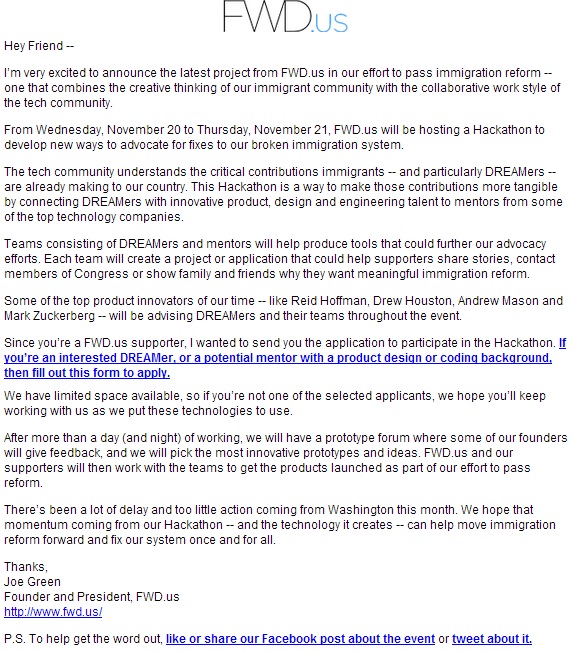
theodp writes "In the early days of Facebook, the company would go into what CEO Mark Zuckerberg called lockdown, where no one is supposed to leave until the task at hand is done. Speaking on Saturday at Startup School 2013, CNET reports, Mark Zuckerberg remarked that the practice persists to this day. Facebook doesn't lock people in the office, but it comes "as close to that as we can legally get," Zuckerberg said to an eruption from the crowd. The lockdown isn't the first at-home-in-a-Bangladesh-garment-factory management technique Zuck's touted at Startup School. Back in 2007, Zuckerberg drew fire for advising company founders "you should only hire young people with technical expertise" if they want to be successful. And while there are no reports of Facebook hiring 9-year-old bosses yet, the LA Times reports that only young undocumented immigrants are welcome at the hackathon hosted by Zuckerberg's FWD.us next month where "tech CEO's like Mark Zuckerberg, Reid Hoffman, Drew Houston and Andrew Mason will be sitting side-by-side with undocumented youth [with technical expertise] creating tech products to help the immigration reform movement" (invitation to 'day (and night) of working')." -
Activists Angry After Apple Axes Anti-Firewall App
Hugh Pickens DOT Com writes "BBC reports that Chinese web users are criticizing Apple after the company pulled a free iPhone app called OpenDoor, which enables users to bypass firewalls and access restricted internet sites. The developers of OpenDoor — who wish to remain anonymous — told Radio Netherlands that Apple removed the app because it 'includes content that is illegal in China.' 'It is unclear to us how a simple browser app could include illegal contents, since it's the user's own choosing of what websites to view,' say the developers. 'Using the same definition, wouldn't all browser apps, including Apple's own Safari and Google's Chrome, include illegal contents?' Chinese internet users were disappointed by the move by Apple. Zhou Shuguang, a prominent Chinese blogger and citizen journalist, told U.S.-based Radio Free Asia that Apple had taken away one of the tools which internet users in China relied on to circumvent the country's great firewall. 'Apple is determined to have a share of the huge cake which is the Chinese internet market. Without strict self-censorship, it cannot enter the Chinese market,' says one Chinese user disappointed by the move by Apple." -
Social Networks Force Barilla Chairman To Apologize For His Anti-gay Remarks
ifchairscouldtalk writes "Pasta maker Barilla is in hot water over its chairman's anti-gay comments. Guido Barilla said his brand would 'never feature gays in ads' because Barilla does not agree with them. He added, '[if gay people] like our pasta and our advertising, they'll eat our pasta, if they don't like it then they will not eat it and they will eat another brand.' Vehement protest worldwide calling for a boycott of Barilla products via Twitter and Facebook forced the chairman to apologize with a video on Facebook." -
The MinnowBoard is a Low-Cost, Open Hardware Single-Board Computer (Video)
Out in the Northeast Texas town of Ft. Worth, a company called CircuitCo started making something they called the BeagleBoard -- an open source hardware single-board computer for educators and experimenters. Now, with help and support from Intel, they're making and supporting the Atom-based MinnowBoard, which is also open source, and comes with Angstrom Linux to help experimenters get started with it. David Anders is the Senior Embedded Systems Engineer at CircuitCo. Slashdot's Timothy Lord met David at LinuxCon North America 2013 in New Orleans and made this video of him talking about the recently-released MinnowBoard and the more mature BeagleBoard. -
IBM VP Talks About Another $1 Billion for Linux Development (Video)
Brad McCredie is an IBM VP, and head of IBM's Power Systems development. (He's also one of the mere few hundred IBM Fellows that have been named in the past 50 years.) He pointed out in his keynote at this year's LinuxCon gathering that IBM has been adopting and supporting Linux (and associated software, like Apache) in various ways for the past decade and a half. Famously, the company promised to support Linux to the tune of a billion dollars in 2001, and McCredie renewed the promise on Tuesday. I sat down to talk with him about just how they'll go about spending the next billion dollars on Linux development; when a company has more than $200 billion in market capitalization, there are lots of ways to spread it around. Spending on hardware is one way, and McCredie also talked about the recently announced OpenPower consortium, which ties directly into the ongoing Linux push. -
Facebook Deletes Social Fixer Community Page Without Explanation
New submitter ComradeF writes "Matt Kruse, author of the Social Fixer for Facebook browser extension, warns users of the dangers of building a community on a platform that can and will shut you down on a whim: 'It's gone. Years of work and almost 340,000 fans, wiped out. Erased. I have never been given any details about what "community standards" I was apparently violating (because I wasn't). This is a case of Facebook choosing to shut down someone's business just because they want to, not because they were doing anything wrong. This is extremely frustrating and disappointing to me, and should be to others as well.' The administrators and moderators of his Page found that their personal Facebook accounts have been silenced for 12 hours, as well." I've recently installed Social Fixer, and find it tremendously useful; this news just inspired me to donate a few bucks to Kruse — cheaper than what Mark Zuckerberg would like to hear my complaint. -
Search For Evi Nemeth Continues
oneiros27 writes "Although the initial search for Evi Nemeth (and some other people who didn't write Unix books) ended, family and friends of the missing crew are funding a private search effort for the crew. They've managed to get more images from DigitalGlobe of the drift area, but now need help looking through the pictures. If you've got some free time, you might be able to help save some lives." -
Meet a Group of Aspiring Mars Colonists
Velcroman1 writes "The group was down to Earth — but not for long, they hope. These folks want to go to Mars. 'I want off the planet – I want humanity off the planet,' declared Leila Zucker, 45, also known as 'Dr. Leila,' because she is, in fact, a doctor who works nearby in the emergency room at Howard University Hospital. She has yearned to be an astronaut — and a doctor — since the age of 3, she told FoxNews.com. 'One dream fulfilled, one to go,' she said happily. Zucker joined not a million, but 100 or so 'aspiring Martians' from across the country, one with green hair and costume antennae, for a 'Million Martian Meeting' held Saturday in Washington, D.C., which was sponsored by the Facebook page of the same name. The group came together as applicants of the Mars One project, an ambitious 10-year plan for a one-way trip to colonize the Red Planet." -
Geeks.com Online Shop Has Closed
Duggeek writes "After 17 years, one of the best kept secrets in shopping, Geeks.com, has shuttered its online doors. Myself, I have a small book of sales orders from years past. According to the latest announcement, that stack will not be growing any larger. Quoting: 'Our vision has always been to provide the geeky tech consumer an alternative avenue to purchase quality refurbished and new techy products and gadgets. That vision was the cornerstone of our slogan "Best Deals Every Nanosecond." Unfortunately after a lot of difficult consideration the owners of Geeks.com feel we are unable to come through on this vision any longer. There are many why's... The e-commerce landscape, as well as the consumer electronics market, has changed dramatically with intense competition and a 1000lb gorilla (do we really need to say who) competitor that can lose millions of dollars to buy customers and suck up inventory. They can lose money with impunity, supported by the stock market. We cannot.' The landing page of their website now goes directly to this announcement; the storefront is switched off. They maintain a Facebook page where a combination of remorse and surprise is rapidly growing. The letter also asserts that they will fulfill all business obligations to online customers during their transition to both a solitary, brick-and-mortar presence in California and a wholesale division, Evertek. Personally, just about every keyboard in my closet was purchased from them, and another box full of USB devices as well. Five of my PC builds exist because of them. Feel free to share your own memories of the former Computer Geeks Discount Outlet." -
Sad Day In FarmVille: Facebook's New Game Developer Program
Nerval's Lobster writes "If struggling online-games developer Zynga thought things were bad before, they could be turning a whole lot worse: Facebook is rolling out a pilot program for small- and medium-sized game developers. 'Through the program, we will work with select game developers and provide promotional support for their games in placements across our mobile apps,' reads a note on the Facebook Developers Website. Facebook is promising those developers access to the social network's '800 million monthly mobile users,' a variety of analytics tools for measuring their games' impact, and a 'unique targeting ability' for finding the right audiences — all for a cut of the games' revenue. 'We will be collaborating deeply with developers in our program by helping them cultivate high-quality, long-term players for their games,' the note added. Zynga benefited mightily from its relationship with Facebook, but other developers have subsequently realized they can utilize many of Zynga's tricks — and the social network's enormous audience — for their own ends. King is now Facebook's top app developer, largely on the strength of its Candy Crush Saga game. If Facebook encourages more small- and medium-sized developers to jump into the social gaming, it could fill the arena with even more competitors, which could prove bad news for the already-reeling Zynga. But for Facebook, the benefits are obvious: if any of those tiny-for-the-moment developers create a hit game, the revenues will come flooding in. That would supplement the social network's ad revenue, all while ensuring it doesn't need to overly depend on a single large developer with a set portfolio of games. Zynga has already been suffering from gaming-studio closings, games being shut down, and a declining user-base." -
Network Solutions Hit With DDoS
New submitter Landy DeField was the first of many of write in about Network Solutions' website and DNS outage: "If your website does not load this morning you need to ask yourself do we use Network Solutions? Because all of their servers are all currently down. You can confirm this by visiting this site." The only solid information from Network Solutions is a post on their Facebook page: "Network Solutions is experiencing a Distributed Denial of Service (DDOS) attack that is impacting our customers as well as the Network Solutions site. Our technology team is working to mitigate the situation. Please check back for updates." There have been several reports that the outage is causing hosted DNS to fail, leading to a number of unresolvable websites. -
MS Tackles CS Education Crisis With Popularity Contest
theodp writes " The lack of education in computer science is an example of an area of particularly acute concern,' Microsoft General Counsel Brad Smith told Congress (PDF) as he sold lawmakers on the need to improve 'America's access to high skilled foreign talent'. Smith added that Microsoft also wants to 'help American students and workers gain the skills needed for the jobs that will fuel the innovation economy.' Towards that end, Microsoft will award $100,000 worth of donations to five technology education nonprofits 'who teach programming and provide technical resources to those who might not otherwise get the chance.' So, how will Microsoft determine who's most worthy? With a popularity contest, of course! At the end of October, the top five vote-getting nonprofits — only Windows AzureDev Community members are eligible to vote — will split the Microsoft Money. By the way, currently in second place but trying harder is Code.org, the seemingly dual-missioned organization advised by Microsoft's Smith which has reached out to its 140,000 Facebook fans, and 17,000 Twitter followers in its quest for the $50,000 first prize." -
UCSD Lecturer Releases Geotagging Application For "Dangerous Guns and Owners"
NF6X writes "UCSD Lecturer Brett Stallbaum has released an Android app called Gun Geo Marker to allow people to 'Geolocate Dangerous Guns and Owners.' The app description states: 'The Gun Geo Marker operates very simply, letting parents and community members mark, or geolocate, sites associated with potentially unsafe guns and gun owners. These locations are typically the homes or businesses of suspected unsafe gun owners, but might also be public lands or other locations where guns are not handled safely, or situations where proper rights to own or use any particular type of firearm may not exist.' I question how the motivation behind developing this app differs from, say, developing an app to allow others to publicly geotag homes of people believed to belong to a particular religion or political party." -
FWD.us Remixes the Statue of Liberty Greeting
theodp writes "In the days leading up to the Senate's passage of the landmark immigration bill, Facebook CEO Mark Zuckerberg unveiled a new ad from FWD.us, his pro-immigration reform PAC. The ad, 'Emma', contains an altered version of Emma Lazarus' famous 1883 poem 'The New Colossus' ('Give me your tired, your poor...'), which is engraved on a bronze plaque inside the Statue of Liberty. 'In doing so,' notes the Latin Times, 'it [the ad] departs radically from the meaning of Lazarus' original — which exalted the Statue of Liberty as a "mother of exiles" and redeemer of the world's rootless poor — to accommodate the PAC's call for more high-skilled workers from abroad be allowed to work and live legally in the United States.' Instead of the original's call for 'the wretched refuse of your teeming shore' and 'the homeless, tempest-tossed', the FWD.us remix asks for 'the influencers and the dreamers...talent that is searching for purpose...those dedicated to the doing'. Here's a YouTube Doubler of readings of both versions — pick your fave, kids!" -
Facebook Bug Exposed 6 Million Users
jamaicaplain sends this quote from the NY Times: "Facebook has inadvertently exposed six million users' phone numbers and e-mail addresses to unauthorized viewers over the last year, the company said late Friday. Facebook blamed the data leaks, which began in 2012, on a technical flaw in its huge archive of contact information collected from its 1.1 billion users worldwide. As a result of the problem, Facebook users who downloaded contact data for their list of friends obtained additional information that they were not supposed to have. Facebook's security team was alerted to the problem last week and fixed it within 24 hours. But Facebook did not publicly acknowledge the flaw until Friday afternoon, when it published a message on its blog explaining the situation." -
UK Town of Ipswich Remodelled As Zelda Level
cyclomedia writes "Switch Fringe is a relatively new not-for-profit annual music and arts festival in the UK town of Ipswich, and this year's program features a full page map of the town with details about each venue. Unlike most other maps this one is in the form of a Zelda level. This is in part due to this year's theme 'Re-imagining Ipswich,' that PixelH8 is coming out of semi-retirement to play a gig during the proceedings and possibly due to the fact that the map's designer — The Decibel Kid — spent too much time playing Zelda on a Gameboy Color during the first Web bubble." -
Anxiety Gaming Wants To Offer Mental Help Via Game Console
An Ominous Cow Erred writes "In an odd approach to reaching out to otherwise shut-in sufferers of mental distress, an organization called Anxiety Gaming is betting that online intervention is the best way to reach people with emotional difficulties. Their argument is that the social nature of modern gaming makes it a valid means of reaching people who might not otherwise seek help through more traditional channels. According to their Facebook page, their future intentions seem to include distributing consoles to homes for foster youth, to encourage them to look to games for positival interpersonal communication." -
Facebook's Complaint Process Is Arbitrary — But So Is Campaigning
Bennett Haselton writes "After initial abuse reports failed to shut down some anti-women and pro-rape pages on Facebook, a wider lobbying campaign succeeded in prompting a Facebook policy change. This has been alternately hailed as a vindication of the campaigner's cause, or derided as proof that Facebook can be cowed by humorless feminists. In reality, the success of the campaign was most likely the outcome of a mostly arbitrary and random process that required a lot of luck, just as the initial abuse reports didn't succeed because they didn't have the necessary luck on their side. Neither result should be taken to reflect on the merits of the campaigner's actual points." Read on for the rest of Bennett's thoughts. On May 28th, Facebook released a statement acknowledging that it had not responded effectively to complaints against pages containing "gender-based hate speech" (e.g. "Slapping hookers in the face with a shoe." and several much worse examples glorifying rape or violence). The decision came at the end of the "#fbrape" campaign by feminist groups to pressure advertisers whose ads had been appearing on the most offensive pages; major advertisers like Nissan announced that they were withdrawing advertisements from Facebook until they could be assured their ads would not appear on the pages in question (most of which were ultimately shut down by Facebook).
I've written before about the arbitrariness of Facebook's abuse-report process, and in particular how it can be abused by convening a "flash mob" of users to file abuse reports about pieces of content that they want removed, even when that content doesn't violate Facebook's terms. The solution I proposed, briefly, was for Facebook to sign up, say, 100,000 volunteers (or even paid users) to review "abuse reports." and when an abuse report is received, have the report evaluated by a random subset of 100 of those volunteers, to vote on whether the report is legitimate. The decision whether to remove the content can be based on what percent of those 100 users vote that it violates the terms of service. The nice property of this system is that it can't be manipulated by conscripting a "flash mob" of users to file complaints all at once — no matter how many mobsters you have filing abuse reports, if your complaints don't have merit, they won't pass the random-sample review (unless you manage to control a significant proportion of the 100,000 users that the 100 users are randomly selected from, but that would be a very tall order).
This also means that no abuse complaint would be ignored because too few people submitted it — any abusive content that was reported, would trigger the 100-user review. (Or if you thought cranks would waste too much of the reviewers' time by filing phone abuse reports, you could only trigger the 100-user review after, say, 3 people had complained about a given page. Or you could start ignoring complaints from users after they had filed a certain number of complaints that were all rejected by the 100-user review process.) Readers suggested various improvements to the algorithm and pointed out potential problems, but I think the basic idea is still sound.
Some of the abusive pages cited by the #fbrape campaigners, are truly graphic and offensive, certainly in violation of Facebook's "community standards" against "hate speech." If they had been reviewed by a 100-user random sample, they probably would have been removed. As it is, the complaints probably landed in the lap of some $1-an-hour grunt worker who ignored them (Facebook's opacity in regards to its review process gives us little more information than that). If the complainers had been luckier, perhaps the abuse reports might have gotten noticed by someone more proactive.
So even if the #fbrape campaigners didn't put it in these terms, their gripe was essentially that the Facebook complaint review process leads to arbitrary outcomes, and the complaints didn't gain traction because luck wasn't on their side.
But what about the #fbrape campaign itself, to bring the pages to Facebook's attention through media action, after the initial abuse reports were ignored?
This is probably an example of what could be called the "Salganik Effect." Matthew Salganik is a Princeton University professor who in 2006 conducted a study examining how certain songs became popular in simulated worlds in which users could rate songs and recommend them to their friends. In his simulation, he divided users into eight artificial "worlds" in which the users in a given world could only see the ratings and recommendations from other users within that world. Then each world was seeded with the same set of songs to see which songs grew in popularity. His team found that the set of songs which became "successful." varied wildly between worlds — such that within any given world, although the very worst songs never came popular, the set of songs that did become popular were essentially a random selection from among those that were merely "good enough."
Online movements gain traction through such a similar process — users 'liking' a page or recommending it to friends, recommendations radiating out from the popular elite according to Malcolm Gladwell's "Law of the Few -- that this suggests the success of a campaign like #fbrape could have been the result of an arbitrary process dominated by luck, just like the success of a song in one of Salganik's artificial worlds. We can never know for sure, since we can't divide real-life Facebook users into multiple artificial worlds, or re-run history to see how often the outcome would be different. But you should read Everything Is Obvious* (Once You Know The Answer), a book written by Duncan J. Watts, one of the co-authors of Salganik's study. The book argues that many of the outcomes that seem like foregone conclusions in hindsight, such as the success of a product, twitter meme, company, idea, or person, are really the result of an arbitrary process that is impossible to predict, much less control. If you liked Freakonomics or Thinking, Fast And Slow, you should add Everything Is Obvious to your reading list right away.
In the case of the #fbrape campaign, the strong form of the conclusion would be to say that the success of the campaign is probably the outcome of a random process. But everyone should at least agree with the weak form of the conclusion, which is that the success and failures of online campaigns could be a random process — and that it's a mistake to say that the success of a campaign definitely is determined by the merits of the campaign's ideas or by the efforts of the campaign organizers. If we can't prove how much luck has to do with it, we have to acknowledge that it could be quite a lot.
That doesn't mean the #fbrape campaign didn't have merit. Like the songs in Salganik's artificial worlds that were "good enough" to succeed if given the chance, the #fbrape campaign organizers did have a point. But we shouldn't take the phenomenal success of the campaign to mean that they had that much more of a valid point than many other campaigns which fizzled out due to bad luck. (Thus I think that articles like this one by Sandy Garossino, even if they're right about the problem of pro-rape content, are missing the point insofar as they imply that the movement's success was due to the hard work of the "smartest feminists on the planet." It's a bit early to declare that "On May 27th, women won the Internet.")
The initial complaints failed because of an arbitrary process, and then the #fbrape campaign succeeded because of an equally arbitrary process. The next such awareness campaign, even if it has merit, might not have luck on its side.
The arbitrariness in both of these processes can be fixed. For the first process — abuse reports submitted to Facebook — the fix is easy: have each complaint reviewed by a random subset of volunteers or employees who are signed up to review such content, as described above. This makes the outcome dependent on the attributes of the content itself (as it should be), rather than luck and/or the size of the mob that wants something removed.
The arbitrariness in the second process — the process by which memes "catch fire" and spill over into mainstream media and broader awareness — is a taller order, but I think it can be fixed by essentially the same algorithm. What would be required would be for a site that has the power to make new memes through its sheer dominance, like Google+ or Reddit, to implement the random-sample-voting algorithm for memes and calls-to-action. Any user can submit an argument — very broadly, any type of exhortation that "we" should do "something" -- and these arguments could be reviewed by a random sample of, say, 20 other users on the site. Those arguments that have the highest percentage of "Yes" votes would get promoted on the front page. (This is the algorithm I was pushing in a previous article, Censorship By Glut.)
The system sounds deceptively simple, but note what's missing: You can't manipulate the voting by rallying your friends to vote for your idea (or by creating multiple "sockpuppet" accounts to vote up your own post). You don't even have the accidental Salganik effects, where friend-to-friend recommendations result in a chaotic feedback loop where certain ideas race ahead of others due to random factors that have nothing to do with the idea's merits. You've taken the arbitrariness out of the process, so that the fate of the idea is a function only of the attributes of the idea itself, which determines the percentage of randomly sampled users who vote it up. (This is not quite the same as rewarding the ideas with the most "merit" — rather, it's the ideas that the population being sampled perceive to have the most merit — but at least the outcome is not random, and the system cannot be gamed.)
Meanwhile, I hope that Facebook won't err too far on the side of abolishing sexist humor where the humor is in proportion to the offensiveness. In Women, Action & the Media's list of examples of "gender-based hate speech." they included a Facebook page titled "Hope you have pet insurance because I'm about to destroy your pussy." which I would optimistically like to think refers to enthusiastic sex and not rape. (The humor really derives from the fact that the words appear next to a physically unattractive man, which is one group that feminists never seem to get riled up about defending.) And what about jokes about anti-male violence, which were left out of WAM's examples? A friend of mine likes posting things on his Facebook like "I was trying to remember the name of Rihanna's ex, and then it hit me," which I thought was funny, but which some WAM supporters probably would have reported as "abusive content." I wonder how many of those same people would have filed a report if he'd said, "I was about to say the name of Lorena Bobbitt's ex, but I got cut off." -
Facebook's Complaint Process Is Arbitrary — But So Is Campaigning
Bennett Haselton writes "After initial abuse reports failed to shut down some anti-women and pro-rape pages on Facebook, a wider lobbying campaign succeeded in prompting a Facebook policy change. This has been alternately hailed as a vindication of the campaigner's cause, or derided as proof that Facebook can be cowed by humorless feminists. In reality, the success of the campaign was most likely the outcome of a mostly arbitrary and random process that required a lot of luck, just as the initial abuse reports didn't succeed because they didn't have the necessary luck on their side. Neither result should be taken to reflect on the merits of the campaigner's actual points." Read on for the rest of Bennett's thoughts. On May 28th, Facebook released a statement acknowledging that it had not responded effectively to complaints against pages containing "gender-based hate speech" (e.g. "Slapping hookers in the face with a shoe." and several much worse examples glorifying rape or violence). The decision came at the end of the "#fbrape" campaign by feminist groups to pressure advertisers whose ads had been appearing on the most offensive pages; major advertisers like Nissan announced that they were withdrawing advertisements from Facebook until they could be assured their ads would not appear on the pages in question (most of which were ultimately shut down by Facebook).
I've written before about the arbitrariness of Facebook's abuse-report process, and in particular how it can be abused by convening a "flash mob" of users to file abuse reports about pieces of content that they want removed, even when that content doesn't violate Facebook's terms. The solution I proposed, briefly, was for Facebook to sign up, say, 100,000 volunteers (or even paid users) to review "abuse reports." and when an abuse report is received, have the report evaluated by a random subset of 100 of those volunteers, to vote on whether the report is legitimate. The decision whether to remove the content can be based on what percent of those 100 users vote that it violates the terms of service. The nice property of this system is that it can't be manipulated by conscripting a "flash mob" of users to file complaints all at once — no matter how many mobsters you have filing abuse reports, if your complaints don't have merit, they won't pass the random-sample review (unless you manage to control a significant proportion of the 100,000 users that the 100 users are randomly selected from, but that would be a very tall order).
This also means that no abuse complaint would be ignored because too few people submitted it — any abusive content that was reported, would trigger the 100-user review. (Or if you thought cranks would waste too much of the reviewers' time by filing phone abuse reports, you could only trigger the 100-user review after, say, 3 people had complained about a given page. Or you could start ignoring complaints from users after they had filed a certain number of complaints that were all rejected by the 100-user review process.) Readers suggested various improvements to the algorithm and pointed out potential problems, but I think the basic idea is still sound.
Some of the abusive pages cited by the #fbrape campaigners, are truly graphic and offensive, certainly in violation of Facebook's "community standards" against "hate speech." If they had been reviewed by a 100-user random sample, they probably would have been removed. As it is, the complaints probably landed in the lap of some $1-an-hour grunt worker who ignored them (Facebook's opacity in regards to its review process gives us little more information than that). If the complainers had been luckier, perhaps the abuse reports might have gotten noticed by someone more proactive.
So even if the #fbrape campaigners didn't put it in these terms, their gripe was essentially that the Facebook complaint review process leads to arbitrary outcomes, and the complaints didn't gain traction because luck wasn't on their side.
But what about the #fbrape campaign itself, to bring the pages to Facebook's attention through media action, after the initial abuse reports were ignored?
This is probably an example of what could be called the "Salganik Effect." Matthew Salganik is a Princeton University professor who in 2006 conducted a study examining how certain songs became popular in simulated worlds in which users could rate songs and recommend them to their friends. In his simulation, he divided users into eight artificial "worlds" in which the users in a given world could only see the ratings and recommendations from other users within that world. Then each world was seeded with the same set of songs to see which songs grew in popularity. His team found that the set of songs which became "successful." varied wildly between worlds — such that within any given world, although the very worst songs never came popular, the set of songs that did become popular were essentially a random selection from among those that were merely "good enough."
Online movements gain traction through such a similar process — users 'liking' a page or recommending it to friends, recommendations radiating out from the popular elite according to Malcolm Gladwell's "Law of the Few -- that this suggests the success of a campaign like #fbrape could have been the result of an arbitrary process dominated by luck, just like the success of a song in one of Salganik's artificial worlds. We can never know for sure, since we can't divide real-life Facebook users into multiple artificial worlds, or re-run history to see how often the outcome would be different. But you should read Everything Is Obvious* (Once You Know The Answer), a book written by Duncan J. Watts, one of the co-authors of Salganik's study. The book argues that many of the outcomes that seem like foregone conclusions in hindsight, such as the success of a product, twitter meme, company, idea, or person, are really the result of an arbitrary process that is impossible to predict, much less control. If you liked Freakonomics or Thinking, Fast And Slow, you should add Everything Is Obvious to your reading list right away.
In the case of the #fbrape campaign, the strong form of the conclusion would be to say that the success of the campaign is probably the outcome of a random process. But everyone should at least agree with the weak form of the conclusion, which is that the success and failures of online campaigns could be a random process — and that it's a mistake to say that the success of a campaign definitely is determined by the merits of the campaign's ideas or by the efforts of the campaign organizers. If we can't prove how much luck has to do with it, we have to acknowledge that it could be quite a lot.
That doesn't mean the #fbrape campaign didn't have merit. Like the songs in Salganik's artificial worlds that were "good enough" to succeed if given the chance, the #fbrape campaign organizers did have a point. But we shouldn't take the phenomenal success of the campaign to mean that they had that much more of a valid point than many other campaigns which fizzled out due to bad luck. (Thus I think that articles like this one by Sandy Garossino, even if they're right about the problem of pro-rape content, are missing the point insofar as they imply that the movement's success was due to the hard work of the "smartest feminists on the planet." It's a bit early to declare that "On May 27th, women won the Internet.")
The initial complaints failed because of an arbitrary process, and then the #fbrape campaign succeeded because of an equally arbitrary process. The next such awareness campaign, even if it has merit, might not have luck on its side.
The arbitrariness in both of these processes can be fixed. For the first process — abuse reports submitted to Facebook — the fix is easy: have each complaint reviewed by a random subset of volunteers or employees who are signed up to review such content, as described above. This makes the outcome dependent on the attributes of the content itself (as it should be), rather than luck and/or the size of the mob that wants something removed.
The arbitrariness in the second process — the process by which memes "catch fire" and spill over into mainstream media and broader awareness — is a taller order, but I think it can be fixed by essentially the same algorithm. What would be required would be for a site that has the power to make new memes through its sheer dominance, like Google+ or Reddit, to implement the random-sample-voting algorithm for memes and calls-to-action. Any user can submit an argument — very broadly, any type of exhortation that "we" should do "something" -- and these arguments could be reviewed by a random sample of, say, 20 other users on the site. Those arguments that have the highest percentage of "Yes" votes would get promoted on the front page. (This is the algorithm I was pushing in a previous article, Censorship By Glut.)
The system sounds deceptively simple, but note what's missing: You can't manipulate the voting by rallying your friends to vote for your idea (or by creating multiple "sockpuppet" accounts to vote up your own post). You don't even have the accidental Salganik effects, where friend-to-friend recommendations result in a chaotic feedback loop where certain ideas race ahead of others due to random factors that have nothing to do with the idea's merits. You've taken the arbitrariness out of the process, so that the fate of the idea is a function only of the attributes of the idea itself, which determines the percentage of randomly sampled users who vote it up. (This is not quite the same as rewarding the ideas with the most "merit" — rather, it's the ideas that the population being sampled perceive to have the most merit — but at least the outcome is not random, and the system cannot be gamed.)
Meanwhile, I hope that Facebook won't err too far on the side of abolishing sexist humor where the humor is in proportion to the offensiveness. In Women, Action & the Media's list of examples of "gender-based hate speech." they included a Facebook page titled "Hope you have pet insurance because I'm about to destroy your pussy." which I would optimistically like to think refers to enthusiastic sex and not rape. (The humor really derives from the fact that the words appear next to a physically unattractive man, which is one group that feminists never seem to get riled up about defending.) And what about jokes about anti-male violence, which were left out of WAM's examples? A friend of mine likes posting things on his Facebook like "I was trying to remember the name of Rihanna's ex, and then it hit me," which I thought was funny, but which some WAM supporters probably would have reported as "abusive content." I wonder how many of those same people would have filed a report if he'd said, "I was about to say the name of Lorena Bobbitt's ex, but I got cut off." -
Facebook's Complaint Process Is Arbitrary — But So Is Campaigning
Bennett Haselton writes "After initial abuse reports failed to shut down some anti-women and pro-rape pages on Facebook, a wider lobbying campaign succeeded in prompting a Facebook policy change. This has been alternately hailed as a vindication of the campaigner's cause, or derided as proof that Facebook can be cowed by humorless feminists. In reality, the success of the campaign was most likely the outcome of a mostly arbitrary and random process that required a lot of luck, just as the initial abuse reports didn't succeed because they didn't have the necessary luck on their side. Neither result should be taken to reflect on the merits of the campaigner's actual points." Read on for the rest of Bennett's thoughts. On May 28th, Facebook released a statement acknowledging that it had not responded effectively to complaints against pages containing "gender-based hate speech" (e.g. "Slapping hookers in the face with a shoe." and several much worse examples glorifying rape or violence). The decision came at the end of the "#fbrape" campaign by feminist groups to pressure advertisers whose ads had been appearing on the most offensive pages; major advertisers like Nissan announced that they were withdrawing advertisements from Facebook until they could be assured their ads would not appear on the pages in question (most of which were ultimately shut down by Facebook).
I've written before about the arbitrariness of Facebook's abuse-report process, and in particular how it can be abused by convening a "flash mob" of users to file abuse reports about pieces of content that they want removed, even when that content doesn't violate Facebook's terms. The solution I proposed, briefly, was for Facebook to sign up, say, 100,000 volunteers (or even paid users) to review "abuse reports." and when an abuse report is received, have the report evaluated by a random subset of 100 of those volunteers, to vote on whether the report is legitimate. The decision whether to remove the content can be based on what percent of those 100 users vote that it violates the terms of service. The nice property of this system is that it can't be manipulated by conscripting a "flash mob" of users to file complaints all at once — no matter how many mobsters you have filing abuse reports, if your complaints don't have merit, they won't pass the random-sample review (unless you manage to control a significant proportion of the 100,000 users that the 100 users are randomly selected from, but that would be a very tall order).
This also means that no abuse complaint would be ignored because too few people submitted it — any abusive content that was reported, would trigger the 100-user review. (Or if you thought cranks would waste too much of the reviewers' time by filing phone abuse reports, you could only trigger the 100-user review after, say, 3 people had complained about a given page. Or you could start ignoring complaints from users after they had filed a certain number of complaints that were all rejected by the 100-user review process.) Readers suggested various improvements to the algorithm and pointed out potential problems, but I think the basic idea is still sound.
Some of the abusive pages cited by the #fbrape campaigners, are truly graphic and offensive, certainly in violation of Facebook's "community standards" against "hate speech." If they had been reviewed by a 100-user random sample, they probably would have been removed. As it is, the complaints probably landed in the lap of some $1-an-hour grunt worker who ignored them (Facebook's opacity in regards to its review process gives us little more information than that). If the complainers had been luckier, perhaps the abuse reports might have gotten noticed by someone more proactive.
So even if the #fbrape campaigners didn't put it in these terms, their gripe was essentially that the Facebook complaint review process leads to arbitrary outcomes, and the complaints didn't gain traction because luck wasn't on their side.
But what about the #fbrape campaign itself, to bring the pages to Facebook's attention through media action, after the initial abuse reports were ignored?
This is probably an example of what could be called the "Salganik Effect." Matthew Salganik is a Princeton University professor who in 2006 conducted a study examining how certain songs became popular in simulated worlds in which users could rate songs and recommend them to their friends. In his simulation, he divided users into eight artificial "worlds" in which the users in a given world could only see the ratings and recommendations from other users within that world. Then each world was seeded with the same set of songs to see which songs grew in popularity. His team found that the set of songs which became "successful." varied wildly between worlds — such that within any given world, although the very worst songs never came popular, the set of songs that did become popular were essentially a random selection from among those that were merely "good enough."
Online movements gain traction through such a similar process — users 'liking' a page or recommending it to friends, recommendations radiating out from the popular elite according to Malcolm Gladwell's "Law of the Few -- that this suggests the success of a campaign like #fbrape could have been the result of an arbitrary process dominated by luck, just like the success of a song in one of Salganik's artificial worlds. We can never know for sure, since we can't divide real-life Facebook users into multiple artificial worlds, or re-run history to see how often the outcome would be different. But you should read Everything Is Obvious* (Once You Know The Answer), a book written by Duncan J. Watts, one of the co-authors of Salganik's study. The book argues that many of the outcomes that seem like foregone conclusions in hindsight, such as the success of a product, twitter meme, company, idea, or person, are really the result of an arbitrary process that is impossible to predict, much less control. If you liked Freakonomics or Thinking, Fast And Slow, you should add Everything Is Obvious to your reading list right away.
In the case of the #fbrape campaign, the strong form of the conclusion would be to say that the success of the campaign is probably the outcome of a random process. But everyone should at least agree with the weak form of the conclusion, which is that the success and failures of online campaigns could be a random process — and that it's a mistake to say that the success of a campaign definitely is determined by the merits of the campaign's ideas or by the efforts of the campaign organizers. If we can't prove how much luck has to do with it, we have to acknowledge that it could be quite a lot.
That doesn't mean the #fbrape campaign didn't have merit. Like the songs in Salganik's artificial worlds that were "good enough" to succeed if given the chance, the #fbrape campaign organizers did have a point. But we shouldn't take the phenomenal success of the campaign to mean that they had that much more of a valid point than many other campaigns which fizzled out due to bad luck. (Thus I think that articles like this one by Sandy Garossino, even if they're right about the problem of pro-rape content, are missing the point insofar as they imply that the movement's success was due to the hard work of the "smartest feminists on the planet." It's a bit early to declare that "On May 27th, women won the Internet.")
The initial complaints failed because of an arbitrary process, and then the #fbrape campaign succeeded because of an equally arbitrary process. The next such awareness campaign, even if it has merit, might not have luck on its side.
The arbitrariness in both of these processes can be fixed. For the first process — abuse reports submitted to Facebook — the fix is easy: have each complaint reviewed by a random subset of volunteers or employees who are signed up to review such content, as described above. This makes the outcome dependent on the attributes of the content itself (as it should be), rather than luck and/or the size of the mob that wants something removed.
The arbitrariness in the second process — the process by which memes "catch fire" and spill over into mainstream media and broader awareness — is a taller order, but I think it can be fixed by essentially the same algorithm. What would be required would be for a site that has the power to make new memes through its sheer dominance, like Google+ or Reddit, to implement the random-sample-voting algorithm for memes and calls-to-action. Any user can submit an argument — very broadly, any type of exhortation that "we" should do "something" -- and these arguments could be reviewed by a random sample of, say, 20 other users on the site. Those arguments that have the highest percentage of "Yes" votes would get promoted on the front page. (This is the algorithm I was pushing in a previous article, Censorship By Glut.)
The system sounds deceptively simple, but note what's missing: You can't manipulate the voting by rallying your friends to vote for your idea (or by creating multiple "sockpuppet" accounts to vote up your own post). You don't even have the accidental Salganik effects, where friend-to-friend recommendations result in a chaotic feedback loop where certain ideas race ahead of others due to random factors that have nothing to do with the idea's merits. You've taken the arbitrariness out of the process, so that the fate of the idea is a function only of the attributes of the idea itself, which determines the percentage of randomly sampled users who vote it up. (This is not quite the same as rewarding the ideas with the most "merit" — rather, it's the ideas that the population being sampled perceive to have the most merit — but at least the outcome is not random, and the system cannot be gamed.)
Meanwhile, I hope that Facebook won't err too far on the side of abolishing sexist humor where the humor is in proportion to the offensiveness. In Women, Action & the Media's list of examples of "gender-based hate speech." they included a Facebook page titled "Hope you have pet insurance because I'm about to destroy your pussy." which I would optimistically like to think refers to enthusiastic sex and not rape. (The humor really derives from the fact that the words appear next to a physically unattractive man, which is one group that feminists never seem to get riled up about defending.) And what about jokes about anti-male violence, which were left out of WAM's examples? A friend of mine likes posting things on his Facebook like "I was trying to remember the name of Rihanna's ex, and then it hit me," which I thought was funny, but which some WAM supporters probably would have reported as "abusive content." I wonder how many of those same people would have filed a report if he'd said, "I was about to say the name of Lorena Bobbitt's ex, but I got cut off." -
Facebook's Complaint Process Is Arbitrary — But So Is Campaigning
Bennett Haselton writes "After initial abuse reports failed to shut down some anti-women and pro-rape pages on Facebook, a wider lobbying campaign succeeded in prompting a Facebook policy change. This has been alternately hailed as a vindication of the campaigner's cause, or derided as proof that Facebook can be cowed by humorless feminists. In reality, the success of the campaign was most likely the outcome of a mostly arbitrary and random process that required a lot of luck, just as the initial abuse reports didn't succeed because they didn't have the necessary luck on their side. Neither result should be taken to reflect on the merits of the campaigner's actual points." Read on for the rest of Bennett's thoughts. On May 28th, Facebook released a statement acknowledging that it had not responded effectively to complaints against pages containing "gender-based hate speech" (e.g. "Slapping hookers in the face with a shoe." and several much worse examples glorifying rape or violence). The decision came at the end of the "#fbrape" campaign by feminist groups to pressure advertisers whose ads had been appearing on the most offensive pages; major advertisers like Nissan announced that they were withdrawing advertisements from Facebook until they could be assured their ads would not appear on the pages in question (most of which were ultimately shut down by Facebook).
I've written before about the arbitrariness of Facebook's abuse-report process, and in particular how it can be abused by convening a "flash mob" of users to file abuse reports about pieces of content that they want removed, even when that content doesn't violate Facebook's terms. The solution I proposed, briefly, was for Facebook to sign up, say, 100,000 volunteers (or even paid users) to review "abuse reports." and when an abuse report is received, have the report evaluated by a random subset of 100 of those volunteers, to vote on whether the report is legitimate. The decision whether to remove the content can be based on what percent of those 100 users vote that it violates the terms of service. The nice property of this system is that it can't be manipulated by conscripting a "flash mob" of users to file complaints all at once — no matter how many mobsters you have filing abuse reports, if your complaints don't have merit, they won't pass the random-sample review (unless you manage to control a significant proportion of the 100,000 users that the 100 users are randomly selected from, but that would be a very tall order).
This also means that no abuse complaint would be ignored because too few people submitted it — any abusive content that was reported, would trigger the 100-user review. (Or if you thought cranks would waste too much of the reviewers' time by filing phone abuse reports, you could only trigger the 100-user review after, say, 3 people had complained about a given page. Or you could start ignoring complaints from users after they had filed a certain number of complaints that were all rejected by the 100-user review process.) Readers suggested various improvements to the algorithm and pointed out potential problems, but I think the basic idea is still sound.
Some of the abusive pages cited by the #fbrape campaigners, are truly graphic and offensive, certainly in violation of Facebook's "community standards" against "hate speech." If they had been reviewed by a 100-user random sample, they probably would have been removed. As it is, the complaints probably landed in the lap of some $1-an-hour grunt worker who ignored them (Facebook's opacity in regards to its review process gives us little more information than that). If the complainers had been luckier, perhaps the abuse reports might have gotten noticed by someone more proactive.
So even if the #fbrape campaigners didn't put it in these terms, their gripe was essentially that the Facebook complaint review process leads to arbitrary outcomes, and the complaints didn't gain traction because luck wasn't on their side.
But what about the #fbrape campaign itself, to bring the pages to Facebook's attention through media action, after the initial abuse reports were ignored?
This is probably an example of what could be called the "Salganik Effect." Matthew Salganik is a Princeton University professor who in 2006 conducted a study examining how certain songs became popular in simulated worlds in which users could rate songs and recommend them to their friends. In his simulation, he divided users into eight artificial "worlds" in which the users in a given world could only see the ratings and recommendations from other users within that world. Then each world was seeded with the same set of songs to see which songs grew in popularity. His team found that the set of songs which became "successful." varied wildly between worlds — such that within any given world, although the very worst songs never came popular, the set of songs that did become popular were essentially a random selection from among those that were merely "good enough."
Online movements gain traction through such a similar process — users 'liking' a page or recommending it to friends, recommendations radiating out from the popular elite according to Malcolm Gladwell's "Law of the Few -- that this suggests the success of a campaign like #fbrape could have been the result of an arbitrary process dominated by luck, just like the success of a song in one of Salganik's artificial worlds. We can never know for sure, since we can't divide real-life Facebook users into multiple artificial worlds, or re-run history to see how often the outcome would be different. But you should read Everything Is Obvious* (Once You Know The Answer), a book written by Duncan J. Watts, one of the co-authors of Salganik's study. The book argues that many of the outcomes that seem like foregone conclusions in hindsight, such as the success of a product, twitter meme, company, idea, or person, are really the result of an arbitrary process that is impossible to predict, much less control. If you liked Freakonomics or Thinking, Fast And Slow, you should add Everything Is Obvious to your reading list right away.
In the case of the #fbrape campaign, the strong form of the conclusion would be to say that the success of the campaign is probably the outcome of a random process. But everyone should at least agree with the weak form of the conclusion, which is that the success and failures of online campaigns could be a random process — and that it's a mistake to say that the success of a campaign definitely is determined by the merits of the campaign's ideas or by the efforts of the campaign organizers. If we can't prove how much luck has to do with it, we have to acknowledge that it could be quite a lot.
That doesn't mean the #fbrape campaign didn't have merit. Like the songs in Salganik's artificial worlds that were "good enough" to succeed if given the chance, the #fbrape campaign organizers did have a point. But we shouldn't take the phenomenal success of the campaign to mean that they had that much more of a valid point than many other campaigns which fizzled out due to bad luck. (Thus I think that articles like this one by Sandy Garossino, even if they're right about the problem of pro-rape content, are missing the point insofar as they imply that the movement's success was due to the hard work of the "smartest feminists on the planet." It's a bit early to declare that "On May 27th, women won the Internet.")
The initial complaints failed because of an arbitrary process, and then the #fbrape campaign succeeded because of an equally arbitrary process. The next such awareness campaign, even if it has merit, might not have luck on its side.
The arbitrariness in both of these processes can be fixed. For the first process — abuse reports submitted to Facebook — the fix is easy: have each complaint reviewed by a random subset of volunteers or employees who are signed up to review such content, as described above. This makes the outcome dependent on the attributes of the content itself (as it should be), rather than luck and/or the size of the mob that wants something removed.
The arbitrariness in the second process — the process by which memes "catch fire" and spill over into mainstream media and broader awareness — is a taller order, but I think it can be fixed by essentially the same algorithm. What would be required would be for a site that has the power to make new memes through its sheer dominance, like Google+ or Reddit, to implement the random-sample-voting algorithm for memes and calls-to-action. Any user can submit an argument — very broadly, any type of exhortation that "we" should do "something" -- and these arguments could be reviewed by a random sample of, say, 20 other users on the site. Those arguments that have the highest percentage of "Yes" votes would get promoted on the front page. (This is the algorithm I was pushing in a previous article, Censorship By Glut.)
The system sounds deceptively simple, but note what's missing: You can't manipulate the voting by rallying your friends to vote for your idea (or by creating multiple "sockpuppet" accounts to vote up your own post). You don't even have the accidental Salganik effects, where friend-to-friend recommendations result in a chaotic feedback loop where certain ideas race ahead of others due to random factors that have nothing to do with the idea's merits. You've taken the arbitrariness out of the process, so that the fate of the idea is a function only of the attributes of the idea itself, which determines the percentage of randomly sampled users who vote it up. (This is not quite the same as rewarding the ideas with the most "merit" — rather, it's the ideas that the population being sampled perceive to have the most merit — but at least the outcome is not random, and the system cannot be gamed.)
Meanwhile, I hope that Facebook won't err too far on the side of abolishing sexist humor where the humor is in proportion to the offensiveness. In Women, Action & the Media's list of examples of "gender-based hate speech." they included a Facebook page titled "Hope you have pet insurance because I'm about to destroy your pussy." which I would optimistically like to think refers to enthusiastic sex and not rape. (The humor really derives from the fact that the words appear next to a physically unattractive man, which is one group that feminists never seem to get riled up about defending.) And what about jokes about anti-male violence, which were left out of WAM's examples? A friend of mine likes posting things on his Facebook like "I was trying to remember the name of Rihanna's ex, and then it hit me," which I thought was funny, but which some WAM supporters probably would have reported as "abusive content." I wonder how many of those same people would have filed a report if he'd said, "I was about to say the name of Lorena Bobbitt's ex, but I got cut off." -
DoS Attack Forces EVE Online Offline
Resorting to the out-of-band messaging that is Facebook, CCP Games has announced that "At 02:05 GMT June 2nd, CCP became aware of a significant and sustained distributed denial-of-service attack (DDoS) against the Tranquility cluster (which houses EVE Online and DUST 514) and web servers." -
Linux is an Obvious Choice for Automating the Beer-Brewing Process (Video)
Linus Torvalds, Jon 'maddog' Hall, and many other names closely associated with Linux are also closely associated with beer. (Ed. note: I have personally watched them associate with beer, and may have even joined them.) It comes as no surprise, therefore, when Linux advocate and LinuxAutomation.org founder Kurt Forsberg talks about using Linux to control his beer brewing. Kurt is a strong believer in Linux Automation who talks about home thermostats, sprinklers, and many other application, "anything you can automate..." but, he adds, "we spend all our time brewing beer so we haven't explored many of those yet." He says this with a big smile, of course. And if you want to keep up with Linux Automation on Faceboook, go ahead; like everyone + dog they have a Facebook page. -
How Facebook Built Natural Language Into Graph Search
Nerval's Lobster writes "Facebook's Graph Search is an ambitious project: give users the ability to search through the social network's vast webs of data via natural-language queries. But that's much easier said—so to speak—than done. Although human beings think nothing of speaking in 'natural' language, a machine must not only learn all the grammatical building-blocks we take for granted—it needs to compensate for the quirks and errors that inevitably pop up in the course of speech. The Facebook team tasked with building Graph Search also knew that the alternate option, keyword-based search, wasn't a viable one. 'Keywords, which usually consist of nouns or proper nouns, can be nebulous in their intent,' Facebook engineering manager Xiao Li wrote in an April 29 posting on Facebook's blog. 'For example, "friends Facebook" can mean "friends on Facebook," "friends who work at Facebook Inc," or "friends who like Facebook the page."' That left the team with building a natural-language interface. The posting digs deep into the elements of the backend, including everything from 'parse trees' to a lexical analysis system." -
Pearson Vue Now On Day 5 of Massive Outage
Reader Patrick In Chicago is one of a few readers to write with this unpleasant news: "Computer-based testing provider Pearson Vue is now in day 5 of a global outage, preventing test-takers worldwide from sitting for exams. I was personally turned away from a Cisco exam on Wednesday morning because Pearson was unable to deliver. Countless people have posted to Pearson Vue's Facebook page detailing various states of panic. There are people who have certifications expiring. Others are unable to sit their medical board exams. Still others are unable to sit exams that they are required to pass in order to work — Pearson Vue's incompetence has actually prevented people from going out and making a paycheck." This reminds me of a friend of mine who had to wait half a year to re-take his bar exam, because of a software glitch on the part of ExamSoft's software.