 Slashdot Mirror
Domain: flickr.com
Stories and comments across the archive that link to flickr.com.
Comments · 3,631
-
There are ads I would like to see again, such as..
McDonald's fancies your burger sexually. No really. They do
-
Re:time to move to China
Or sign a deal with this guy http://www.flickr.com/photos/gageskidmore/3756257143/.
They cant sue if its a figurine of someone who looks & dresses like Steve Jobs.
-
Re:Last one. A riddle, and I'm going to wing it.
To the off-topic -1.
http://farm4.static.flickr.com/3583/3517705927_6b311390d6.jpg
eat it. -
At least their home page was honest!
-
I had a sighting at Kaikoura as well ...
But I'm pretty sure it was a whale spout in the sunshine.
-
Re:Look at it from the other side.
You're quite right, the startup costs are the biggest barrier to sci-fi (I think "speculative fiction" is a tautology since all fiction is speculative by nature, and if "sci-fi" was good enough for Asimov it's good enough for me, but it's really not important...a rose by any other name would still be a hydrocarbon emitting reproductive organ of the Rosa genus). The two genres you've chosen are a good comparison, since they both usually involve high tech gizmos, interweaving story lines and special effects.
Real spies are basically civil servants who work in fairly nondescript offices for the most part, so you don't need a war room style C&C centre unless you want a big screen for a cartoony supervillain to deliver an ultimatum (but when you do that every episode it just gets silly. Note that when they have a C&C centre in a Bond film it's borrowed from the military, not an MI6 asset, and for a one-off like that it's not too difficult to arrange a traffic control room or similar). A slightly tricked-out office space filled with computers loaned on a product placement deal and dimly lit around the edges to hide a lack of detail will do for the bookend set, maybe a nice conference room for briefings, and you can use real locations for bridging shots and exteriors. Costumes are standard modern day clothing (either second hand or more product placement), and makeup rarely goes beyond fake blood and moulage. In all, a good looking pilot can be done for about $150k, provided you leave the effects heavy shots and helicopter stunts until later in the season, but what we're really talking about here is a sophisticated cop show with some wire work and extra explosions (the BBC's "Spooks" is a good example, though "24" follows the same principle IIRC).
You lose all of those advantages with sci-fi, since technically it's period drama and you usually can't let the real world creep in; nobody will believe your ship's computer is a Dell running Windows 7, and a Seiko watch in the year 2400 is anachronistic even if it does pack an electromagnet, laser and circular saw. The sets have to be built from scratch if you want to avoid trainspotters*, which costs as much as any stud-frame construction with unique interior decoration, so you're looking at anywhere up to $70k for a single large set once you've paid the carpenters, electricians and fabricators. Space exteriors and other CGI assets have to be final quality to impress the commissioning editors (no matter what they say, they can't imagine the final product), so there's the modelling and rendering costs, the makeup has to be good enough to stand up in HD, and costumes are usually short run custom creations or one-offs. It's easy to go over $250k on a three-set piece before a single live action frame is shot.
Obviously the biggest difference is the sets, and savings can be made depending on the story. "Caprica" cleverly used a retro-near-future style which let them raid any period in the 20th century for props, costumes and architecture, "Sky Captain" was notable for it's entirely CGI world, and from memory much of "The Man From Atlantis" was shot in the back of a shaggin' wagon.
The figures I'm bandying about here are considered bargain basement, "Jason Of Star Command" level; seamless shows like "Space:1999" and "ST:TNG" cost around $1.5M per episode (adjusted for inflation) with the startup costs amortised across the first season, so the pilots would be closer to $6-7M in today's money (both of those shows were presold, however, so I'm not sure anyone knows the figure precisely).
Not really a conclusive answer, sorry, but there are so many variables it's hard to estimate accurately, and that's kind of the problem: other genres present a more certain profit margin for the networks on the same viewer figures, and like any business they're in it for the profit. Hey, ho.
*I'm one myself; when watching old Dr Who episodes I can't help but laugh at the
-
Re:DIY for 20G
-
Re:DIY for 20G
-
Yahoo Video Also Closing
Got this notice in my Yahoo email inbox on Dec. 15:
Dear Yahoo! Video user,
After careful consideration, we will be removing all general user-generated content upload capability and user-uploaded video from Yahoo! Video. As a result, your videos, user profiles, ratings, favorites, and playlists will no longer be available after March 14, 2011. User video content from Yahoo! Video that remains embedded on third party sites will no longer be playable after March 14, 2011.
Available on your profile page is a software utility that will allow you to download the videos you have uploaded to Yahoo! Video to your computer through March 14, 2011. You can find your profile by clicking on the 'My Video' tab or going to http://video.yahoo.com/mypage.
Once you download your videos, you may choose to upload them to another site such as Flickr, which now allows video uploads. You can find out more here: http://www.flickr.com/explore/video.
Thanks for your understanding and thanks for being a part of Yahoo! Video.
If you have any questions about this change, please visit our FAQ section, or contact Customer Care.
The Yahoo! Video Team
-
Re:Flickr photos (not slashdottable)
http://www.flickr.com/photos/prestonlee/sets/72157625613518344/show/
Hi everyone.. thanks for taking down the server every 20 seconds.
-
Direct Link to Preston's Flickr Set...
... is here. (Pretty Sure.)
"Here's a quarter, kid. Buy yourself a decent server."
-Sean -
Flickr photos (not slashdottable)
-
Re:I wish Slashdot would mirror these.
-
Re:Does that mean the company owes a royalty to Go
Like this: Windows Help Search, but on the internets.
-
Re:Wait...
The In-n-Out Burger bumper sticker was apparently intentionally designed to encourage people to cut off the B and R I
-
Re:I have no idea....
The Wikileaks environment looks pretty sweet: plants everywhere makes a completely different environment.
http://www.flickr.com/photos/jukri/4944923254/ -
Re:Here is the stat that really mattersI've been in the same crash as the GP. In fact, I've been in it, the last six times I've had crashes. Here's the scenario: red light, cars stopped. I stop. I have cars to the right of me. I have a concrete lane divider to the left of me. I have a car ahead of me. I look up into the rear-view mirror and realize that I have 1.2 seconds before the car behind me, whose driver is talking on a cellphone and hasn't seen that traffic is stopped. So, in that 1.2 seconds I have, where I'm unable to go right, left, or forwards, what am I supposed to do to avoid this crash?
In the big crash I had I have no idea what exactly happened, since I don't remember that entire month, but according to the eyewitnesses, traffic was stopped, and I'd slowed down to a near-stop with, again, cars on either side of me, when the semi ran into the back of my car at 65 mph. Again: what do you think I could have done to avoid injury, when I had a car directly ahead of me (and in the crash, my car was smashed into hers, so answering "leave more space ahead of your car so you can move forwards" counts as a completely useless answer, since the amount of space required to do that was larger than the amount of space I had available) and cars on both sides.
I'd be really interested in knowing how I can avoid these crashes, since I've had the same exact accident four times in the last four years and I'd really like to have your amazing powers of accident-avoidance to prevent having another one. Please keep in mind the criteria: cars on one side, immediately beside me. Concrete barrier on the other, close enough there's no room for me to actually go that direction. Car immediately ahead of me. Less than 2 seconds to recognize the person behind me is not going to stop and do something.
-
great link n/t
> My last year's visit to show off: http://www.flickr.com/search/?q=chernobyl&w=78303790%40N00
-
But... it's already open to tourists!
My last year's visit to show off: http://www.flickr.com/search/?q=chernobyl&w=78303790%40N00
-
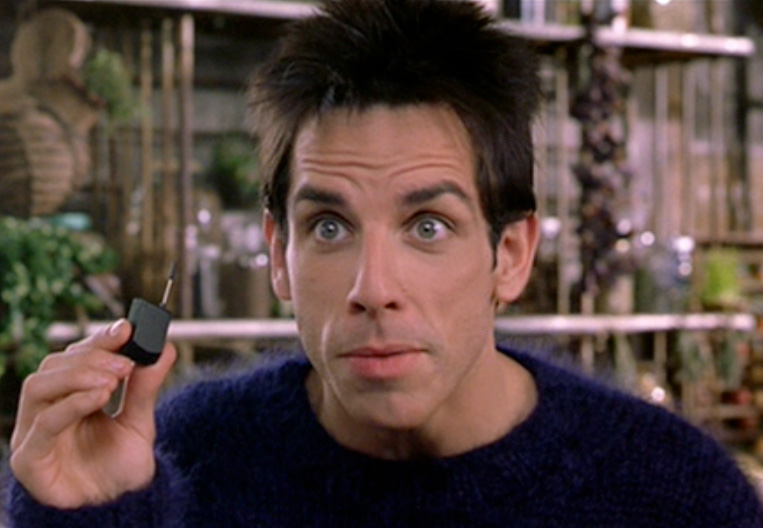
Zoolander's cellphone
Is that what powers Zoolander's cellphone?
http://farm2.static.flickr.com/1333/856357878_bb4a4ae794_o.jpg
http://www.phonedog.com/img/blog/2009/04/Zoolander.jpg -
Re:Typos
As opposed to what? The good ol' days when editors read the articles and proof-read submissions? When men were real men, and small furry creatures, etc etc.
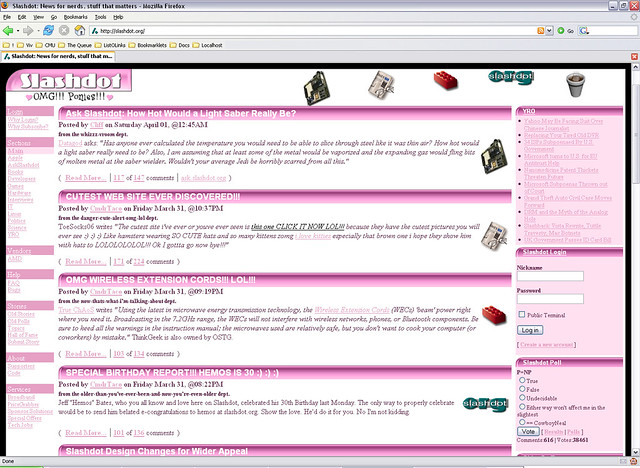
And ponies. Pink ponies.
-
Re:Vietnam war exposer
I remember watching the news videos of the last remaining people being pulled from the U.S. Compount in Saigon by helicopter.
Could you be thinking of the famous photo by Hubert van Es, with all those people on the rooftop staircase? It was actually an apartment building, not the embassy.
http://www.msnbc.msn.com/id/30755090/ns/world_news-asia-pacific/
http://www.flickr.com/photos/16844030@N02/1920939675/ -
Re:Sunfart
But they cause really pretty side effects, which I'm kind of addicted to photographing.
-
Re:I'd invest in that
Of course nobody I know would go there. I'm college educated.
I say there is a large segment of this great country that would positively love this park. Might as well make a few bucks off of them.
-
Re:It's all a scam
This graphic sums up, better than mere words, the quality of Symantec, and the general scumminess that so easily creeps into "protection" businesses...
-
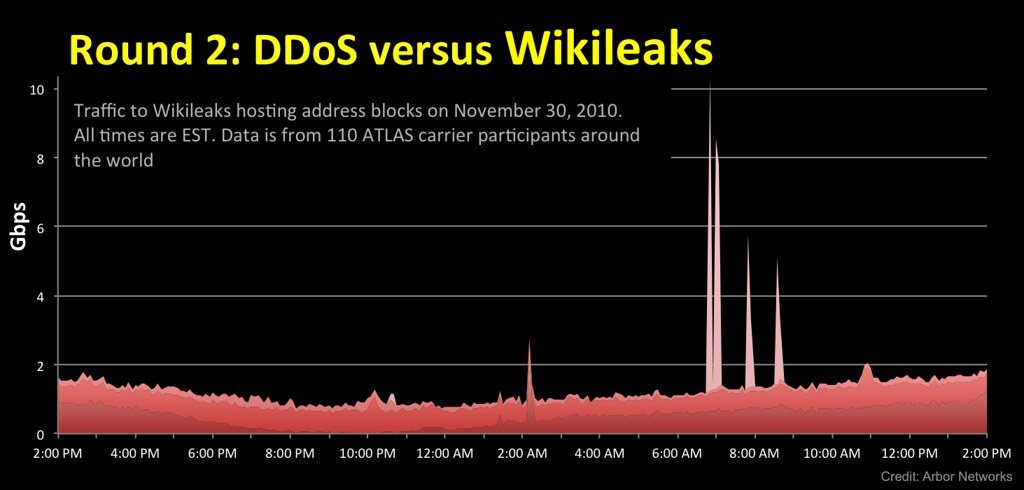
Victim: Arbor Networks confirms it
also, no ddos attacks (supposedly over 10gbps) were ever confirmed by their upstreams (bahnhof/ovh).
The ddos attacks have been confirmed by Arbor Networks.
This image released by Arbor clearly shows a spike of over 10Gbps.
-
Kirk Douglas' Father (1884 - April 11, 1954)
http://www.flickr.com/photos/windy_valley/4870155079/
EVENING RECORDER
AMSTERDAM, NY
MONDAY, APRIL 12, 1954HARRY DEMSKY, KIRK DOUGLAS' FATHER, DIES
Harry Demsky, father of Movie Actor Kirk ' Douglas, died last night at the Jewish Home for the Aged in Troy.
Demsky, 70, who came to the United States in 1906, ran a waste metals business in Amsterdam for many years. Following his retirement, he made his home at the Fourth Ward Hotel. He had been living at the home of a daughter in Troy before entering the Jewish Home last Friday.
Kirk Douglas flew east Saturday to visit his father and returned to California early yesterday when it appeared that the sick man was out of immediate danger.
Demsky's widow, Mrs. Bertha Sandler Demsky, is a resident of the Troy Jewish Home
-
Perhaps, if Facebook just changed their buttons...
...to look a bit more like this, Facebook users would have a better idea of what to expect?
Earlier I wrote:
Every time you see the Facebook button Just imagine in its place a knot-hole with a creepy Zuckerberg eye peering out (imaginary muffled fapping noise optional).
Feel free to add it to your sites!
-
Re:The USA does not put intelligence sources at ri
It's an ethical dilemma; the other side of the equation is THIS.
-
Re:Quicker Than Sound
Using a sound trigger to capture lightning strikes is counterproductive. Using an IR sensor to measure the ambient IR, then trip the shutter when the IR spikes up works a treat, though. I built a variation on the Camera Axe last summer, and have been using it to take daylight photos of lightning strikes like this one.
-
Re:Technically correct - it's not just DSLRs
Two things:
- All public photography is illegal in Kuwait, except for licensed journalists. This includes DSLRs, compacts, camera phones, video, everything.
Really?. Kuwait doesn't seem do too well on the enforcement end of things.
Kuwait does not publish its laws, has no freedom of information - legally or culturally - and sees no problem at all with lying about what the law is. Like all police states, Kuwait would rather that everyone be guilty of something. Enforcement is completely arbitrary - visiting businessmen (better believe I mean 'men') taking snaps are unlikely to be hassled, unless you do something rash like film the slave labour conditions in their foreign-staffed construction sites.
You might just type a bit before you rant on... Yes, I am sure that Kuwait does all manner of nasty, underhanded things (rather like some other countries we mention from time to time) but your comments are uselessly hyperbolic.
-
Yeah, You, SpecificallySince 1 pixel is 1/2 meter, this is approximately what you look like from space: ---> .
Digital Globe has a flikr feed at http://www.flickr.com/photos/digitalglobe-imagery/
-
Re:Hoax
I would agree this seems fishy. However as stated in this Directive ICE has the authority to do some fairly clandestine stuff without any approval, such as registering 'fake' domains to poorly beguile terrorists, miscreants, and other groups found the oracle on high deems unworthy. I suppose this could extend to transferring DNS to a sleazy hosting outfit... however I bet this is a little bit closer to home, sleezy outfits seem to attract one another. I seriously doubt DHS and ICE have anything to do with copyright infringement despite claims to the contrary, especially considering at least of the the 'victims' seems to be up and running.
P.S, The FEDs usually fell entire forests when delivering mail informing you of tax violations, compliance violations, legal violations, and penalties. It's usually quite unambiguous.
-
Agreed, its place in history is older than Nazis
As an American, I was pretty alarmed the first time I vacationed in Vietnam and found so many swastika symbols everywhere. They were on the ceilings of temples, in the courtyards, and on people's grave stones. I took some photos, wondering what the symbolism was, having no idea that it was an ancient symbol.
I posted the photos to flickr and they were invited to a flickr pool that is working towards showing the non-nazi uses of the symbol and how it has a bigger place in the timeline of history than just the German empire of the 40's.
If anybody wants to see how it is used in other places, here is the flickr pool: http://www.flickr.com/groups/1207899@N24/
Note: Like any brand, the Nazi's had their own logo. Not all swastikas are black white and red and rotated 45. The OP question was probably related specifically to the Nazi swastika.
-
Frigid
Looks like this appliance can do more than cool your food (see top left of image)
-
Re:Beer
And it seems their beta-testers have been using the calendar function to plan interesting things:
http://www.flickr.com/photos/54577173@N04/5054479509/in/photostream/
(See top left)
-
Re:This is nothing new
This building also has a bad rep.
-
Re:No
For under $200 you can have awesome sound.
My choice for a value setup is Grado SR80i headphones and a NuForce uDAC2 combo USB DAC and headphone amp. The "L-cush" pads are a recomended upgrade, or you can try the "sock mod"Yes, you can get better sound from a system that sells for the price of a car but ~$200 gets you sound that is probably better then you've ever heard, and exceeds the quality of the source material most people listen to.
I use my grados with an external powered subwoofer when I want to shake the house, but usually they're fine by themselves..
-
150 in one
Perhaps I'm atypical, but I absolutely loved my "150 in one" electronic kit. Here is a pic of the exact same kit I had when I was 8. I built every project, and came up to plenty of my own little circuits. I don't know what the modern equivalent is nowadays - perhaps heavier on the digital / logic side?
-
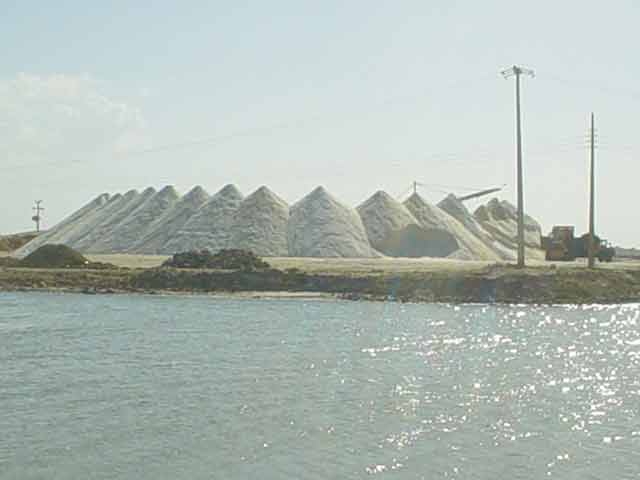
Re:Gold for salt.
I guess that the amount produced by evaporating salt water was tiny compared to mining, and thus commercially inviable.
This might be true, but I find it hard to believe. I grew up in Brazil and some of my earliest memories are seeing windmills like these pumping seawater into evaporation ponds in the Rio de Janeiro state. The amount produced was by no means "tiny".
Today, the biggest economic competitor to this business is tourism, seafront real estate is becoming too expensive for evaporation ponds, but in the poorer regions in the Brazilian northeast this is still a major resource.
-
Incompatible input format.
Sorry, I must be "evolved". This meat does nothing for me.
Calming Images:
A pile of classic arcade game cartridges.
Earth as seen from the mother ship.
Our place in the known universe. -
Re:Hmmm ....
Contrails aren't that wide and don't appear singly.
WTF are you talking about? I've seen contrails that spread half way across the sky and turn into cirrus clouds when the conditions are right.
Not even sure what you mean by not appearing singly. Here you go - single contrail: http://www.flickr.com/photos/misterbucketspartytime/1681098779/
-
Re:Oh common..
Captain Sticky! To the StickyMobile!
Off to the Super Hero Retirement Home in the sky...
http://jamesewelch.wordpress.com/2009/05/14/san-diego-super-heroes/ -
Re:Luckily
out of the millions of objects and packages people make and use, printer cartidges are the only ones of the right shape and size to hold explosives.
Nope, there are other dangerous things that are currently prohibited.
-
Windows 1.0 review
A while ago, I scanned in a review of Windows 1.0 that I found in an old magazine. It's quite interesting to read - the subtitle is "brightening up MS-DOS", and it is described as taking only four seconds to switch applications, compared to 30 seconds to start Microsoft Word from scratch! Glad to see some things never change.
-
Re:National or state makes quite a difference
please don't tell me you want someone below the poverty line to pay $2,500 in taxes.
No, not at all. I was just trying to show how percentages act across widely diverse income levels.
My flat tax concept is designed both to completely eliminate the highly regressive effects of the income tax on the poor, and to eliminate all tax loopholes, large and small, obsolete the vast bulk of the IRS, encourage investment and savings, and simplify tax collection enormously. It can be extended from the federal level to the state level easily, too, though it'd be a bear to do -- and as pointed out earlier, it'd take a constitutional convention to legitimately obtain the authority for any of this.
My method builds in a true zero tax liability structure up to a defined "poverty" level, which may be determined as locally as desired down to the individual, or as globally as the entire population. Individually is most accurate; globally is least expensive. Some level of compromise is called for.
Every new transaction (land, buildings, services, stocks, goods, diapers, TP, gardening, etc.) is taxed at the same rate; used items are taxed if they have gained in sales price and then, only for the amount gained. No double (or more) dipping.
Basically, each person is given a tax allowance at the beginning of each month. For instance, if the poverty level is determined to be $2000 in monthly spending, and the tax rate is 35%, then each person gets a check for $700.
This completely covers the tax liability for all spending up to that $2000 level. Over that, everyone has to come up with their own tax dollars. In this way, basic needs are wholly tax free for everyone -- no matter what your income -- and everything else, isn't. Totally level playing field at the bottom, totally proportional playing field elsewhere.
With the check arriving at the beginning of the month, and disbursed as tax fees by the end, there is no ongoing cost for the tax mechanism other than check distribution; electronic distribution would be preferable as it can be zero cost.
Of course, both the 35% tax rate and the $2000 poverty level are hand waving. Those would have to be carefully determined in order for the government to recoup the funds needed and for the poor to be served appropriately.
Here are three short cartoons that go over the basics:
-
Re:National or state makes quite a difference
please don't tell me you want someone below the poverty line to pay $2,500 in taxes.
No, not at all. I was just trying to show how percentages act across widely diverse income levels.
My flat tax concept is designed both to completely eliminate the highly regressive effects of the income tax on the poor, and to eliminate all tax loopholes, large and small, obsolete the vast bulk of the IRS, encourage investment and savings, and simplify tax collection enormously. It can be extended from the federal level to the state level easily, too, though it'd be a bear to do -- and as pointed out earlier, it'd take a constitutional convention to legitimately obtain the authority for any of this.
My method builds in a true zero tax liability structure up to a defined "poverty" level, which may be determined as locally as desired down to the individual, or as globally as the entire population. Individually is most accurate; globally is least expensive. Some level of compromise is called for.
Every new transaction (land, buildings, services, stocks, goods, diapers, TP, gardening, etc.) is taxed at the same rate; used items are taxed if they have gained in sales price and then, only for the amount gained. No double (or more) dipping.
Basically, each person is given a tax allowance at the beginning of each month. For instance, if the poverty level is determined to be $2000 in monthly spending, and the tax rate is 35%, then each person gets a check for $700.
This completely covers the tax liability for all spending up to that $2000 level. Over that, everyone has to come up with their own tax dollars. In this way, basic needs are wholly tax free for everyone -- no matter what your income -- and everything else, isn't. Totally level playing field at the bottom, totally proportional playing field elsewhere.
With the check arriving at the beginning of the month, and disbursed as tax fees by the end, there is no ongoing cost for the tax mechanism other than check distribution; electronic distribution would be preferable as it can be zero cost.
Of course, both the 35% tax rate and the $2000 poverty level are hand waving. Those would have to be carefully determined in order for the government to recoup the funds needed and for the poor to be served appropriately.
Here are three short cartoons that go over the basics:
-
Re:National or state makes quite a difference
please don't tell me you want someone below the poverty line to pay $2,500 in taxes.
No, not at all. I was just trying to show how percentages act across widely diverse income levels.
My flat tax concept is designed both to completely eliminate the highly regressive effects of the income tax on the poor, and to eliminate all tax loopholes, large and small, obsolete the vast bulk of the IRS, encourage investment and savings, and simplify tax collection enormously. It can be extended from the federal level to the state level easily, too, though it'd be a bear to do -- and as pointed out earlier, it'd take a constitutional convention to legitimately obtain the authority for any of this.
My method builds in a true zero tax liability structure up to a defined "poverty" level, which may be determined as locally as desired down to the individual, or as globally as the entire population. Individually is most accurate; globally is least expensive. Some level of compromise is called for.
Every new transaction (land, buildings, services, stocks, goods, diapers, TP, gardening, etc.) is taxed at the same rate; used items are taxed if they have gained in sales price and then, only for the amount gained. No double (or more) dipping.
Basically, each person is given a tax allowance at the beginning of each month. For instance, if the poverty level is determined to be $2000 in monthly spending, and the tax rate is 35%, then each person gets a check for $700.
This completely covers the tax liability for all spending up to that $2000 level. Over that, everyone has to come up with their own tax dollars. In this way, basic needs are wholly tax free for everyone -- no matter what your income -- and everything else, isn't. Totally level playing field at the bottom, totally proportional playing field elsewhere.
With the check arriving at the beginning of the month, and disbursed as tax fees by the end, there is no ongoing cost for the tax mechanism other than check distribution; electronic distribution would be preferable as it can be zero cost.
Of course, both the 35% tax rate and the $2000 poverty level are hand waving. Those would have to be carefully determined in order for the government to recoup the funds needed and for the poor to be served appropriately.
Here are three short cartoons that go over the basics:
-
Re:National or state makes quite a difference
I wish you had read the thread instead of just replying to a sentence or two. You're entirely missing the point. Which is just what they want you to do. I've written this (again) just for you. So please do me the courtesy of reading the whole thing.
No, it most certainly is not. Someone making that little is tax-exempt and need not even file.
ok, right. Now here we go with what happens from there:
Now, the guy hasn't filed, and hasn't paid, right? And he's got the whole $100 he earned. He pays that to you so you'll do some work for him. YOU, however, are not poor, and if you have a 35% tax rate, you'll pay $35 of that $100 to the taxman.
Now, are you going to give the guy $100 worth of work, considering you only KEPT $65, or are you going to limit it to $65? And if he's only getting $65 worth of work out of his $100 because of that tax hit on the worker side of his transaction, what is his effective tax rate?
35%.
If that's still not clear, try this:
-
Re:National or state makes quite a difference
I wish you had read the thread instead of just replying to a sentence or two. You're entirely missing the point. Which is just what they want you to do. I've written this (again) just for you. So please do me the courtesy of reading the whole thing.
No, it most certainly is not. Someone making that little is tax-exempt and need not even file.
ok, right. Now here we go with what happens from there:
Now, the guy hasn't filed, and hasn't paid, right? And he's got the whole $100 he earned. He pays that to you so you'll do some work for him. YOU, however, are not poor, and if you have a 35% tax rate, you'll pay $35 of that $100 to the taxman.
Now, are you going to give the guy $100 worth of work, considering you only KEPT $65, or are you going to limit it to $65? And if he's only getting $65 worth of work out of his $100 because of that tax hit on the worker side of his transaction, what is his effective tax rate?
35%.
If that's still not clear, try this:



.jpg)