Slashdot Mirror
Domain: gnome.org
Stories and comments across the archive that link to gnome.org.
Stories · 456
-
GNOME Internet Radio Locator 1.6.0 Released (gnome.org)
Longtime Slashdot reader ole writes: GNOME Internet Radio Locator 1.6.0 is now freely available for GNOME systems. The 1.6.0 release is a stable release with Internet radio stations from Norway, Sweden, Denmark, England, Scotland, France and Belgium, as well as U.S.A., Canada, Mexico and Guatemala, mapped for GNOME Maps and city text search interface with auto-completion for 76 world cities that are featured in this release. You may download the 1.6.0 release of GNOME Internet Radio Locator here and download packages for Fedora 28 and 29 on x86_64 here -
GNOME Internet Radio Locator 1.6.0 Released (gnome.org)
Longtime Slashdot reader ole writes: GNOME Internet Radio Locator 1.6.0 is now freely available for GNOME systems. The 1.6.0 release is a stable release with Internet radio stations from Norway, Sweden, Denmark, England, Scotland, France and Belgium, as well as U.S.A., Canada, Mexico and Guatemala, mapped for GNOME Maps and city text search interface with auto-completion for 76 world cities that are featured in this release. You may download the 1.6.0 release of GNOME Internet Radio Locator here and download packages for Fedora 28 and 29 on x86_64 here -
Apache OpenOffice, the Schrodinger's Application: No One Knows If It's Dead or Alive, No One Really Wants To Look Inside (theregister.co.uk)
British IT news outlet The Register looks at the myriad of challenges Apache OpenOffice faces today. From the report: Last year Brett Porter, then chairman of the Apache Software Foundation, contemplated whether a proposed official blog post on the state of Apache OpenOffice (AOO) might discourage people from downloading the software due to lack of activity in the project. No such post from the software's developers surfaced. The languid pace of development at AOO, though, has been an issue since 2011 after Oracle (then patron of the project) got into a fork-fight with The Document Foundation, which created LibreOffice from the OpenOffice codebase, and asked developers backing the split to resign.
Back in 2015, Red Hat developer Christian Schaller called OpenOffice "all but dead." Assertions to that effect have continued since, alongside claims to the contrary. Almost a year ago, Jim Jagielski, a member of the Apache OpenOffice Project Management Committee, insisted things were going well and claimed there was renewed interest in the project. For all the concern about AOO, no issues have been raised recently before the Apache Foundation board to suggest ongoing difficulties. The project is due to provide an update this month, according to a spokesperson for the foundation. -
Ubuntu and CentOS Are Undoing a GNOME Security Feature (bleepingcomputer.com)
An anonymous reader writes: Current versions of Ubuntu and CentOS are disabling a security feature that was added to the GNOME desktop environment last year. The feature's name is Bubblewrap, which is a sandbox environment that the GNOME Project added to secure GNOME's thumbnail parsers in July 2017, with the release of GNOME 3.26. In recent years, security researchers have proven that thumbnail parses can be an attack vector [1, 2, 3].
Ubuntu Security Tech Lead Alex Murray said the Ubuntu team chose to disable Bubblewrap inside Ubuntu because they did not have the time to perform a security audit. Murray blamed the many CPU bugs (Spectre, Meltdown, etc.), which kept the team busy and prevented them to audit the feature. -
The GNOME Foundation Is Hiring (gnome.org)
"The GNOME Foundation is pleased to be able to offer paid employment to exceptional people who have the drive to help us complete our mission," reads a new announcement. Gnome.org explains: Today, July 6th 2018, the GNOME Foundation has announced a number of positions it is recruiting for to help drive the GNOME project and Free Software on the desktop.
As previously announced, this has been made possible thanks to a generous grant that the Foundation has received, enabling us to accelerate this expansion. "These positions are key to ensuring that the Foundation remains sustainable and that we are able to support the community in key areas," said Neil McGovern, Executive Director of the GNOME Foundation.
The Foundation is currently recruiting for four posts:- Development Coordinator. This will ensure that we receive sufficient funds to continue our work delivering free software.
- Program Coordinator. The Program Coordinator will free up time from those involved in organizational, administrative and logistical problems.
- Devops/Sysadmin. The systems and services we run need proper maintenance and care. As Flathub [An app store and build service for Linux] continues to grow, more support is needed to achieve this.
- GTK+ core developer. GTK+ is core to our entire platform. Investing in development and maintenance of this toolkit will benefit the whole GNU/Linux ecosystem.
"The Foundation is keen to hear from any person who is interested in applying for one of these posts."
-
The GNOME Foundation Is Hiring (gnome.org)
"The GNOME Foundation is pleased to be able to offer paid employment to exceptional people who have the drive to help us complete our mission," reads a new announcement. Gnome.org explains: Today, July 6th 2018, the GNOME Foundation has announced a number of positions it is recruiting for to help drive the GNOME project and Free Software on the desktop.
As previously announced, this has been made possible thanks to a generous grant that the Foundation has received, enabling us to accelerate this expansion. "These positions are key to ensuring that the Foundation remains sustainable and that we are able to support the community in key areas," said Neil McGovern, Executive Director of the GNOME Foundation.
The Foundation is currently recruiting for four posts:- Development Coordinator. This will ensure that we receive sufficient funds to continue our work delivering free software.
- Program Coordinator. The Program Coordinator will free up time from those involved in organizational, administrative and logistical problems.
- Devops/Sysadmin. The systems and services we run need proper maintenance and care. As Flathub [An app store and build service for Linux] continues to grow, more support is needed to achieve this.
- GTK+ core developer. GTK+ is core to our entire platform. Investing in development and maintenance of this toolkit will benefit the whole GNU/Linux ecosystem.
"The Foundation is keen to hear from any person who is interested in applying for one of these posts."
-
Microsoft Sticks With Controversial 'GVFS' Name Despite Backlash (medium.com)
New submitter DuroSoft writes: It has been over a year since Microsoft unveiled its open source GVFS (Git Virtual File System) project, designed to make terabyte-scale repositories, like it's own 270GB Windows source code, manageable using Git. The problem is that the GNOME project already has a virtual file system by the name of GVfs that has been in use for years, with hundreds of threads on Stack Overflow, etc. Yet Microsoft's GVFS has already surpassed GVfs in Google and is causing confusion. To make matters worse, Microsoft has officially refused to change the name, despite a large public backlash on GitHub and social media, and despite pull requests providing scripts that can change the name to anything Microsoft wants. Is this mere arrogance on Microsoft's part, laziness to do a quick Google search before using a name, or is it something more sinister? -
'Razer Doesn't Care About Linux' (gnome.org)
An anonymous reader shares a blog post: Razer is a vendor that makes high-end gaming hardware, including laptops, keyboards and mice. I opened a ticket with Razor a few days ago asking them if they wanted to support the LVFS project by uploading firmware and sharing the firmware update protocol used. I offered to upstream any example code they could share under a free license, or to write the code from scratch given enough specifications to do so. This is something I've done for other vendors, and doesn't take long as most vendor firmware updaters all do the same kind of thing; there are only so many ways to send a few kb of data to USB devices. The fwupd project provides high-level code for accessing USB devices, so yet-another-update-protocol is no big deal. I explained all about the LVFS, and the benefits it provided to a userbase that is normally happy to vote using their wallet to get hardware that's supported on the OS of their choice. I just received this note on the ticket, which was escalated appropriately: "I have discussed your offer with the dedicated team and we are thankful for your enthusiasm and for your good idea. I am afraid I have also to let you know that at this moment in time our support for software is only focused on Windows and Mac." The post, written by Richard -- who has long been a maintainer of GNOME Software, PackageKit, GNOME Packagekit, points out that Razer executive Min-Liang Tan last year invited Linux enthusiasts to suggest ideas to help the company make the best notebook that supports Linux. -
Should Apps Replace Title Bars with Header Bars? (gnome.org)
Gnome contributor Tobias Bernard is on a crusade against title bars -- "the largely empty bars at the top of some application windows [that] contain only the window title and a close button." Instead he wants to see header bars -- "a newer, more flexible pattern that allows putting window controls and other UI elements in the same bar." Tobias Bernard writes: Header bars are client-side decorations (CSD), which means they are drawn by the app rather than the display server. This allows for better integration between application and window chrome. All GNOME apps (except for Terminal) have moved to header bars over the past few years, and so have many third-party apps. However, there are still a few holdouts.
He's announcing the CSD Initiative, "an effort to get apps (both GNOME and third-party) to drop title bars and adopt GNOME-style client-side decorations... The only way to solve this problem long-term is to patch applications upstream to not use title bars. So this is what we'll have to do."- Talk to the maintainers and convince them that this is a good idea
- Do the design work of adapting the layout and make mockups
- Figure out what is required at a technical level
- Actually implement the new layout and get it merged
Implementation is already in progress for Firefox, though it has not yet been started for other high-priority apps like LibreOffice, GNOME Terminal, and Skype. "If you want to help with any of the above tasks," writes Tobias, "come talk to us on #gnome-design on IRC/Matrix."
-
Should Apps Replace Title Bars with Header Bars? (gnome.org)
Gnome contributor Tobias Bernard is on a crusade against title bars -- "the largely empty bars at the top of some application windows [that] contain only the window title and a close button." Instead he wants to see header bars -- "a newer, more flexible pattern that allows putting window controls and other UI elements in the same bar." Tobias Bernard writes: Header bars are client-side decorations (CSD), which means they are drawn by the app rather than the display server. This allows for better integration between application and window chrome. All GNOME apps (except for Terminal) have moved to header bars over the past few years, and so have many third-party apps. However, there are still a few holdouts.
He's announcing the CSD Initiative, "an effort to get apps (both GNOME and third-party) to drop title bars and adopt GNOME-style client-side decorations... The only way to solve this problem long-term is to patch applications upstream to not use title bars. So this is what we'll have to do."- Talk to the maintainers and convince them that this is a good idea
- Do the design work of adapting the layout and make mockups
- Figure out what is required at a technical level
- Actually implement the new layout and get it merged
Implementation is already in progress for Firefox, though it has not yet been started for other high-priority apps like LibreOffice, GNOME Terminal, and Skype. "If you want to help with any of the above tasks," writes Tobias, "come talk to us on #gnome-design on IRC/Matrix."
-
Could 2018 Be The Year of the Linux Desktop? (gnome.org)
Suren Enfiajyan writes: Red Hat worker and GNOME blogger Christian F.K. Schaller wrote why GNU/Linux failed to become a mainstream desktop OS... "My thesis is that there really isn't one reason, but rather a range of issues that all have contributed to holding the Linux Desktop back from reaching a bigger market. Also to put this into context, success here in my mind would be having something like 10% market share of desktop systems. That to me means we reached critical mass."
He named the following reasons:
- A fragmented market
- Lack of special applications
- Lack of big name applications
- Lack of API and ABI stability
- Apple's resurgence
- Microsoft's aggressive response
- Windows piracy
- Red Hat mostly stayed away
- Canonical's business model not working out
- Lack of original device manufacturer support
Then he ended with some optimism:
"So anyone who has read my blog posts probably knows I am an optimist by nature. This isn't just some kind of genetic disposition towards optimism, but also a philosophical belief that optimism breeds opportunity while pessimism breeds failure. So just because we haven't gotten the Linux Desktop to 10% marketshare so far doesn't mean it will not happen going forward. It just means we haven't achieved it so far.
"One of the key identifiers of open source is that it is incredibly hard to kill, because unlike proprietary software, just because a company goes out of business or decides to shut down a part of its business, the software doesn't go away or stop getting developed. As long as there is a strong community interested in pushing it forward it remains and evolves, and thus when opportunity comes knocking again it is ready to try again."
The essay concludes desktop Linux has evolved and is ready to try again, since from a technical perspective it's better than ever. "The level of polish is higher than ever before, the level of hardware support is better than ever before and the range of software available is better than ever before...
"There is also the chance that it will come in a shape we don't appreciate today. For instance maybe ChromeOS evolves into a more full fledged operating system as it grows in popularity and thus ends up being the Linux on the Desktop end game? Or maybe Valve decides to relaunch their SteamOS effort and it provides the foundation for a major general desktop growth? Or maybe market opportunities arise that will cause us at Red Hat to decide to go after the desktop market in a wider sense than we do today? Or maybe Endless succeeds with their vision for a Linux desktop operating system...." -
GNOME 3.26 Released (betanews.com)
BrianFagioli shares a report from BetaNews: Today, GNOME 3.26 codenamed "Manchester" sees release. It is chock full of improvements, such as a much-needed refreshed settings menu, enhanced search, and color emoji! Yes, Linux users like using the silly symbols too! "System search has been improved for GNOME 3.26. Results have an updated layout which makes them easier to read and shows more items at once. Additionally, it's now possible to search for system actions, including power off, suspend, lock screen, log out, switch user and orientation lock. (Log out and switch user only appear if there's more than one user. Orientation lock is only available if the device supports automatic screen rotation.) These search features can be accessed in the usual way: click Activities and type into the search box, or simply press 'super' and start typing," says the GNOME Project. The full release notes are available here. -
GNOME's Text Editor gedit 'No Longer Maintained', Needs New Developers (gnome.org)
AmiMoJo brings news about gedit, the default text editor for GNOME: In a post to the gedit mailing list, Sébastien Wilmet states that gedit is no longer maintained and asks "any developer interested to take over the maintenance of gedit?" Just in case you were considering it, he warns "BTW while the gedit core is written in C (with a bit of Objective-C for Mac OS X support), some plugins are written in Vala or Python. If you take over gedit maintenance, you'll need to deal with four programming languages (without counting the build system). The Python code is not compiled, so when doing refactorings in gedit core, good luck to port all the plugins (the Python code is also less "greppable" than C). At least with Vala there is a compiler, even if I would not recommend Vala."
Sébastien's comments were surrounded by a <rant-on-languages> tag, but they're still crying out for some serious discussion. Any Slashdot readers want to share their own insights on Python, some fond thoughts on gedit, or suggestions for maintaining a great piece of open source software? -
Fedora Will Get Full Mp3 Support, As IIS Fraunhofer Terminates Mp3 Licensing Program (fedoramagazine.org)
An anonymous reader quotes Fedora Magazine: Both MP3 encoding and decoding will soon be officially supported in Fedora. Last November the patents covering MP3 decoding expired and Fedora Workstation enabled MP3 decoding via the mpg123 library and GStreamer... The MP3 codec and Open Source have had a troubled relationship over the past decade, especially within the United States. Historically, due to licensing issues Fedora has been unable to include MP3 decoding or encoding within the base distribution... A couple of weeks ago IIS Fraunhofer and Technicolor terminated their licensing program and just a few days ago Red Hat Legal provided the permission to ship MP3 encoding in Fedora. -
GNOME Dev Schaller Assures Ubuntu Users the Move To Step Away From Unity Will Bring Consistency Across Linux Distros (gnome.org)
Earlier this week, Canonical announced that Ubuntu will be ditching Unity as the default user interface on desktops to go back to GNOME next year. The company also said that it will be ending development of Ubuntu software for phones and tablets, in what is a push to focus on cloud. In a blog post, Christian Schaller, a developer on Fedora and GNOME (and Senior Software Engineering Manager at Red Hat), offered some assurance to the community that this is the right move in the grand scheme of things. He writes on an official blog post: We look forward to keep working with great Canonical and Ubuntu people like Allison Lortie and Robert Ancell on projects of shared interest around GNOME, Wayland and hopefully Flatpak. It is worth mentioning that even as we [have] been competing with Unity and Ubuntu, we have also been collaborating with them, most recently on [the] integration of features they wanted from GNOME Software such as user reviews. Of course now sharing a bigger set of technologies collaboration will be even easier. I am personally happy to see this convergence of efforts happening because I have -- for a long time -- felt that the general level of investment in the Linux desktop has not been great enough to justify the plethora of Linux desktops out there. Now having reached a position where Canonical, Endless, Red Hat and Suse again share one desktop technology stack and along with consulting companies such as Centricular, CodeThink, Collabora and Igalia helping push parts of the stack forward, we are at least all pulling in the same direction. This change should also make life easier for ISV who now have a more clear target if they want to try to integrate their UI with the Linux desktop as 'the linux desktop' becomes a more meaningful term with this change. -
GNOME 3.24 Released (softpedia.com)
prisoninmate quotes a report from Softpedia: GNOME 3.24 just finished its six-month development cycle, and it's now the most advanced stable version of the modern and popular desktop environment used by default in numerous GNU/Linux distributions. It was developed since October 2016 under the GNOME 3.23.x umbrella, during which it received numerous improvements. Prominent new features of the GNOME 3.24 desktop environment include a Night Light functionality that promises to automatically shift the colors of your display to the warmer end of the spectrum after sunset, and a brand-new GNOME Control Center with redesigned Users, Keyboard and Mouse, Online Accounts, Bluetooth, and Printer panels. As for the GNOME apps, we can mention that the Nautilus file manager now lets users browse files as root (system administrator), GNOME Photos imitates Darktable's exposure and blacks adjustment tool, GNOME Music comes with ownCloud integration and lets you edit tags, and GNOME Calendar finally brings the Week view. New apps like GNOME Recipes are also part of this release. The full release notes can be viewed here. Softpedia notes in conclusion: "As mentioned before, it will take at least a couple of weeks for the new GNOME 3.24 packages to land on the stable repositories of your favorite distro, which means that you'll most probably be able to upgrade from GNOME 3.22 when the first point release, GNOME 3.24.1, is out on April 12, 2017." -
Red Hat Announces Fedora Will Support MP3 Playback (fedoraproject.org)
Long-time Slashdot reader jrincayc shares news from Red Hat's Fedora Engineering Manager, Tom Callaway. On the Fedora-legal mailing list, Callaway announced: Red Hat has determined that it is now acceptable for Fedora to include MP3 decoding functionality (not specific to any implementation, or binding by any unseen agreement). Encoding functionality is not permitted at this time.
And the same day Christian Schaller announced on the Gnome blog that mp3 playback would be supported in Fedora Workstation 25. You should be able to download the mp3 plugin on Day 1 through GNOME Software or through the missing codec installer in various GStreamer applications. For Fedora Workstation 26 I would not be surprised if we decide to ship it on the install media.
He added, "I know this has been a big wishlist item for a long time for a lot of people..." -
GNOME 3.22 Desktop Environment Officially Released (softpedia.com)
Reader prisoninmate writes: Today, September 21, is a big day for Linux users, especially those who love the GNOME desktop environment, as the next major release is now officially available. Yes, that's right, we're talking about GNOME 3.22, dubbed Karlsruhe after the German host city of the annual GUADEC (GNOME Users And Developers European Conference) event, which took place last month between August 12-14, 2016. Prominent features of the GNOME 3.22 desktop environment include batch rename functionality and support for integration of compressed files built directly into the Nautilus file manager, a new Week View, support for alarms, and the ability to drag and drop events to the GNOME Calendar, as well as an updated GNOME Music app that supports handling of music libraries with thousands of tracks. There are lots of improvements for the GNOME Games app as well, as it now offers support for numerous retro gaming consoles. Among other improvements, we can mention Flatpak integration, photo sharing, revamped GNOME Software app with support for firmware updates, redesigned keyboard settings and a brand new GNOME Control Center panel, and a redesigned dconf Editor. A video overview of the new features of GNOME 3.22 is available on the official website. -
GNOME 3.22 Desktop Environment Officially Released (softpedia.com)
Reader prisoninmate writes: Today, September 21, is a big day for Linux users, especially those who love the GNOME desktop environment, as the next major release is now officially available. Yes, that's right, we're talking about GNOME 3.22, dubbed Karlsruhe after the German host city of the annual GUADEC (GNOME Users And Developers European Conference) event, which took place last month between August 12-14, 2016. Prominent features of the GNOME 3.22 desktop environment include batch rename functionality and support for integration of compressed files built directly into the Nautilus file manager, a new Week View, support for alarms, and the ability to drag and drop events to the GNOME Calendar, as well as an updated GNOME Music app that supports handling of music libraries with thousands of tracks. There are lots of improvements for the GNOME Games app as well, as it now offers support for numerous retro gaming consoles. Among other improvements, we can mention Flatpak integration, photo sharing, revamped GNOME Software app with support for firmware updates, redesigned keyboard settings and a brand new GNOME Control Center panel, and a redesigned dconf Editor. A video overview of the new features of GNOME 3.22 is available on the official website. -
GNOME 3.20 Officially Released (softpedia.com)
prisoninmate writes: After yet another six months of hard work, the highly anticipated GNOME 3.20 desktop environment for GNU/Linux operating systems has been officially released on March 23, 2016. Release highlights include support for operating system upgrades via GNOME Software, middle-click paste, kinetic scrolling, drag-and-drop support for Wayland, keyboard shortcuts and gestures overlay for most of the core apps, XDG-Apps technology for installing multiple versions of an app, and much more goodies. -
Tracking Protection In Wi-Fi Networks Coming Soon To Linux
prisoninmate writes: Fedora contributor and NetworkManager developer Lubomir Rintel explains how your devices are being identified on a network by a unique number that most of us know by the name of MAC address. Same goes for mobile networking, as your laptop's or mobile phone's MAC address is, in most cases, broadcasted everywhere you go before you even attempt a connection to a wireless network. And that's a problem for your privacy. The solution? Randomization of the MAC address while scanning for Wi-Fi networks. Apple is already using this method on iOS 8 and later mobile operating systems, and so is Microsoft in Windows 10, so Linux users will ["likely"] get it in the upcoming NetworkManager 1.2 release. -
GNOME Settings Area Getting a Refurbishment (gnome.org)
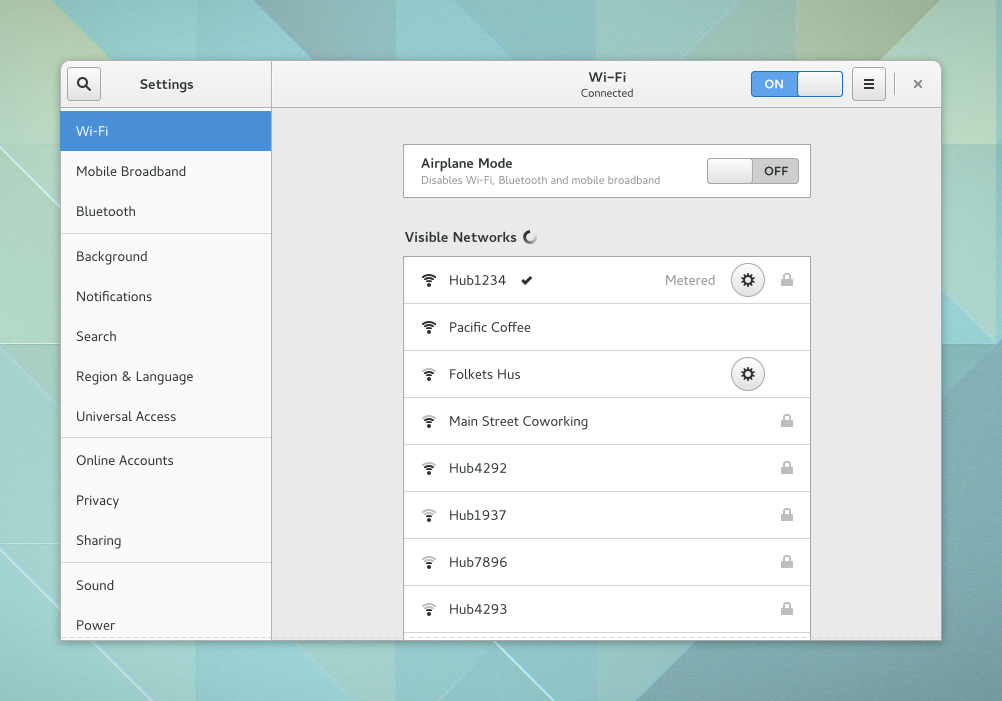
jones_supa writes: Allan Day has written a blog post today about some of the improvements that are being worked on for GNOME's settings area. The new GNOME Settings area is working toward a model that uses a list sidebar for navigation. The window is now resizable, and overall should be a nice upgrade. The new GNOME settings area certainly bears some resemblance to the Windows 10 settings app. Work is also ongoing specifically around improving GNOME's network settings, redesigned sound settings, experiments around improved display support, and various other enhancements to GNOME's settings area. For now, this work is considered experimental and all may not be completed in time for the GNOME 3.20 release in March. -
GNOME Settings Area Getting a Refurbishment (gnome.org)
jones_supa writes: Allan Day has written a blog post today about some of the improvements that are being worked on for GNOME's settings area. The new GNOME Settings area is working toward a model that uses a list sidebar for navigation. The window is now resizable, and overall should be a nice upgrade. The new GNOME settings area certainly bears some resemblance to the Windows 10 settings app. Work is also ongoing specifically around improving GNOME's network settings, redesigned sound settings, experiments around improved display support, and various other enhancements to GNOME's settings area. For now, this work is considered experimental and all may not be completed in time for the GNOME 3.20 release in March. -
BBC Confirms 50% Bitrate Savings For H.265/HEVC Vs H.264/AVC (bbc.co.uk)
An anonymous reader writes: A research team from the BBC has done a series of tests to confirm earlier computations showing a ~50% savings in bit rate for H.265/HEVC compared to video using H.264/AVC at comparable quality. "The subjective tests used a carefully selected set of coded video sequences at four different picture sizes: UHD (3840x2160 and 4096x2048), 1080p (1920x1080), 720p (1280x720) and 480p (832x480), at frame rates of 30Hz, 50Hz, or 60Hz. The video content was chosen to represent diverse spatial and temporal characteristics, and then coded using HEVC and AVC standards at a wide span of bit rates producing a variety of quality levels." Here is the full published analysis. "The tests confirmed the significant compression efficiency improvements achieved in HEVC, verifying the results previously reported using objective quality metrics (PSNR based methods)." The team did not test against VP9, which is shaping up to be an impressive standard as well. -
Getting More Women Coders Into Open Source
Nerval's Lobster writes: Diversity remains an issue in tech firms across the nation, with executives and project managers publicly upset over a lack of women in engineering and programming roles. While all that's happening on the corporate side, a handful of people and groups are trying to get more women involved in the open source community, like Women of OpenStack, Outreachy (which is geared toward people from underrepresented groups in free software), and others. How much effort should be expended to facilitate diversity among programmers? Can anything be done to shift the demographics, considering the issues that even large, coordinated companies have with altering the collective mix of their employees? -
LibreOffice 5.0 Released
New submitter ssam writes: The Document Foundation has announced LibreOffice 5.0, the tenth major release since the launch of the project, bringing new features including Windows 10, Android and Ubuntu touch compatibility, superior interoperability features, an updated UI, and lots of under the hood improvements. For people still running OpenOffice it is probably time to move over. -
GNOME 3.16 Released
kthreadd writes Version 3.16 of GNOME, the primary desktop environment for GNU/Linux operating systems has been released. Some major new features in this release include a overhauled notification system, an updated design of the calendar drop down and support for overlay scrollbars. Also, the grid view in Files has been improved with bigger thumbnail icons, making the appearance more attractive and the rows easier to read. A video is available which demonstrates the new version. -
GNOME 3.16 Released
kthreadd writes Version 3.16 of GNOME, the primary desktop environment for GNU/Linux operating systems has been released. Some major new features in this release include a overhauled notification system, an updated design of the calendar drop down and support for overlay scrollbars. Also, the grid view in Files has been improved with bigger thumbnail icons, making the appearance more attractive and the rows easier to read. A video is available which demonstrates the new version. -
NetworkManager 1.0 Released After Ten Years Development
An anonymous reader writes: After ten years of development focused on improving and simplifying Linux networking, NetworkManager 1.0 was released. NetworkManager 1.0 brings many features including an increasingly modernized client library, improved command-line support, a lightweight internal DHCP client, better Bluetooth support, VPN enhancements, WWAN IPv6 support, and other features. -
NetworkManager 1.0 Released After Ten Years Development
An anonymous reader writes: After ten years of development focused on improving and simplifying Linux networking, NetworkManager 1.0 was released. NetworkManager 1.0 brings many features including an increasingly modernized client library, improved command-line support, a lightweight internal DHCP client, better Bluetooth support, VPN enhancements, WWAN IPv6 support, and other features. -
Groupon Backs Down On Gnome
Rambo Tribble writes: Groupon has announced it will abandon the 'Gnome' name for their product, ending the recent naming controversy that had the open source community up in arms. They said, "After additional conversations with the open source community and the Gnome Foundation, we have decided to abandon our pending trademark applications for 'Gnome.' We will choose a new name for our product going forward." The GNOME Foundation has thanked everyone who helped.
My question... does this represent Gnu thinking on the part of Groupon? -
GNOME Project Seeks Donations For Trademark Battle With Groupon
Drinking Bleach writes Groupon has released a tablet-based point of sale system called Gnome, despite the well-known desktop environment's existence and trademark status. This is also not without Groupon's internal knowledge of the GNOME project; they were contacted about the infringement and flatly refused to change the name of their own product, in addition to filing many new trademark applications for theirs. The GNOME project is seeking donations to help them in a legal battle against these trademark applications, and to get Groupon to stop using their name. They are seeking at least $80,000 to challenge a first set of ten trademark applications from Groupon, out of 28 applications that have been filed. -
GNOME 3.14 Released
An anonymous reader writes "GNOME 3.14 was released today and it includes some interesting changes such as re-worked default theme, multi-touch gestures for both the system and applications, and new animations. Information including details on all the new features can be found here." -
GNOME 3.14 Released
An anonymous reader writes "GNOME 3.14 was released today and it includes some interesting changes such as re-worked default theme, multi-touch gestures for both the system and applications, and new animations. Information including details on all the new features can be found here." -
Raspberry Pi Gets a Brand New Browser
sfcrazy writes The Raspberry Pi team has announced a new browser for Raspberry Pi. They had worked with Collabora to create an HTML5-capable, modern browser for Pi users. While announcing the new browser, Eben Upton said, "Eight months and a lot of hard work later, we're finally ready. Epiphany on Pi is now a plausible alternative to a desktop browser for all but the most JavaScript-heavy sites." -
Comparison: Linux Text Editors
jrepin writes: Mayank Sharma of Linux Voices tests and compares five text editors for Linux, none of which are named Emacs or Vim. The contenders are Gedit, Kate, Sublime Text, UltraEdit, and jEdit. Why use a fancy text editor? Sharma says, "They can highlight syntax and auto-indent code just as effortlessly as they can spellcheck documents. You can use them to record macros and manage code snippets just as easily as you can copy/paste plain text. Some simple text editors even exceed their design goals thanks to plugins that infuse them with capabilities to rival text-centric apps from other genres. They can take on the duties of a source code editor and even an Integrated Development Environment." -
The New 501(c)(3) and the Future of Open Source In the US
An anonymous reader writes: If you're involved in the free and open-source software movement — especially in the United States — you may want to read through this, as long as it may seem. It appears that the United States' Internal Revenue Service has strongly shifted its views of free and open-source software, and to the detriment of the movement, in my opinion. From the article: "The IRS reasons that since Yorba’s open source software may be used for any purpose, Yorba is not a charity. Consider all the for-profit and non-charitable ways the Apache server is used; I’d still argue Apache is a charitable organization. (What else could it be?) There’s a charitable organization here in San Francisco that plants trees throughout the city for the benefit of all. If one of their tree’s shade falls on a cafe table and cools the cafe’s patrons as they enjoy their espressos, does that mean the tree-planting organization is no longer a charity?" -
The GNOME Foundation Is Running Out of Money
An anonymous reader writes "The GNOME Foundation is running out of money. The foundation no longer has any cash reserves so they have voted to freeze non-essential funding for running the foundation. They are also hunting down sponsors and unpaid invoices to regain some delayed revenue. Those wishing to support the GNOME Foundation can become a friend of GNOME." -
The GNOME Foundation Is Running Out of Money
An anonymous reader writes "The GNOME Foundation is running out of money. The foundation no longer has any cash reserves so they have voted to freeze non-essential funding for running the foundation. They are also hunting down sponsors and unpaid invoices to regain some delayed revenue. Those wishing to support the GNOME Foundation can become a friend of GNOME." -
GNOME 3.12 Released
New submitter Sri Ramkrishna writes: "Like clockwork, the next version of GNOME has been released with updated applications, bugfixes, and so forth. People can look forward to faster loading times and a little better performance than before. A video has been created to highlight the release! Check it out!" The release features "... app folders, enhanced system status and high-resolution display support. This release also includes new and redesigned applications for video, software, editing, sound recording and internet relay chat. Under the hood, support for using Wayland instead of X has progressed significantly." There are a bunch of new features for programmers too. -
GNOME 3.12 Released
New submitter Sri Ramkrishna writes: "Like clockwork, the next version of GNOME has been released with updated applications, bugfixes, and so forth. People can look forward to faster loading times and a little better performance than before. A video has been created to highlight the release! Check it out!" The release features "... app folders, enhanced system status and high-resolution display support. This release also includes new and redesigned applications for video, software, editing, sound recording and internet relay chat. Under the hood, support for using Wayland instead of X has progressed significantly." There are a bunch of new features for programmers too. -
GNOME 3.12 Released
New submitter Sri Ramkrishna writes: "Like clockwork, the next version of GNOME has been released with updated applications, bugfixes, and so forth. People can look forward to faster loading times and a little better performance than before. A video has been created to highlight the release! Check it out!" The release features "... app folders, enhanced system status and high-resolution display support. This release also includes new and redesigned applications for video, software, editing, sound recording and internet relay chat. Under the hood, support for using Wayland instead of X has progressed significantly." There are a bunch of new features for programmers too. -
Official Wayland Support Postponed From GNOME 3.12
An anonymous reader writes "GNOME 3.12 was going to have official Wayland support as one of its main features for the upcoming desktop release. The developers have now decided to delay the official Wayland support until at least GNOME 3.14 while the support found there will be shipped as a preview. Missing features like drag 'n' drop and clipboard support are still missing from GNOME's Wayland code, which made them decide another six months of development work is needed. Other GNOME 3.12 features are mentioned on the GNOME Wiki." -
Official Wayland Support Postponed From GNOME 3.12
An anonymous reader writes "GNOME 3.12 was going to have official Wayland support as one of its main features for the upcoming desktop release. The developers have now decided to delay the official Wayland support until at least GNOME 3.14 while the support found there will be shipped as a preview. Missing features like drag 'n' drop and clipboard support are still missing from GNOME's Wayland code, which made them decide another six months of development work is needed. Other GNOME 3.12 features are mentioned on the GNOME Wiki." -
FFmpeg's VP9 Decoder Faster Than Google's
An anonymous reader writes "A VP9 video decoder written for FFmpeg, FFvp9, now holds the title of being the world's fastest VP9 video decoder. FFvp9 is faster than Google's de facto VP9 decoder found in libvpx, but this doesn't come as too much of a surprise given that FFmpeg also produced a faster VP8 video decoder than Google a few years back with both single and multi-threaded performance." -
Gnome 3.12 Delayed To Sync With Wayland Release
sfcrazy writes "Gnome developers are planning to delay the release of Gnome 3.12 by approximately a week. It's a deliberate delay to sync the release with the availability of Wayland 1.5. Matthias Clasen (Fedora and Gnome developer) explains that 'the GNOME release team is pondering moving the date for 3.12.0 out by approximately a week, to align the schedule with the Wayland release plans (a 1.4.91 release including all the xdg-shell API we need is planned for April 1). The latter 3.11.x milestones would be shifted as well, to avoid lengthening the freeze period unnecessarily.'" -
GNOME 3.10 Released
kthreadd writes "Version 3.10 of the GNOME software collection has been released. New in this release is improved support for Wayland, the upcoming X replacement. The system status menus have been consolidated into one single menu. Many of the applications in GNOME now features header bars instead of title bars, which merges the titlebar and toolbar into a single element and allows applications to offer more dynamic user interfaces. GNOME now also includes an application for searching, browsing and installing applications called Software. Several other new applications have also been added to GNOME including Music, Photos, Notes and Maps." -
GNOME 3.10 Is Now Properly Supported On Wayland
An anonymous reader writes "One week ahead of the GNOME 3.10 release, all of the basic Wayland support for GNOME has been merged. With today's GNOME Shell 3.9.92 release the Wayland branch was merged and there was also an updated Mutter Wayland release, besides earlier GNOME 3.9.x packages fostering the Wayland support. Fedora 20 is expected to ship with GNOME on Wayland as a technology preview. Additional details about the current GNOME Wayland support are available from the GNOME Wiki." -
GNOME 3.10 Is Now Properly Supported On Wayland
An anonymous reader writes "One week ahead of the GNOME 3.10 release, all of the basic Wayland support for GNOME has been merged. With today's GNOME Shell 3.9.92 release the Wayland branch was merged and there was also an updated Mutter Wayland release, besides earlier GNOME 3.9.x packages fostering the Wayland support. Fedora 20 is expected to ship with GNOME on Wayland as a technology preview. Additional details about the current GNOME Wayland support are available from the GNOME Wiki." -
Intel, Red Hat Working On Enabling Wayland Support In GNOME
sfcrazy writes "After shooting down Canonical's Mir, Intel and Red Hat teams have increased collaboration on the development of Wayland. Developers at Intel and Red Hat are working together to 'merge and stabilize the patches to enable Wayland support in GNOME,' as Christian Schaller writes on his blog. The teams are also looking into improving the stack further. Weston won't be used anymore, so GNOME Shell will become the Wayland compositor. It must be noted that Canonical earlier committed to supporting and embracing Wayland. Despite that promise, the company silently stopped contribution, and it was later learned that they were secretly working on their own display server, Mir. Intel's management recently rejected patches for Mir, leaving its maintainance to Canonical. Before Intel's rejection, GNOME and KDE also refused to adopt Mir. Intel's message is clear to Canonical: if you promise to contribute, then do so."