Slashdot Mirror
Domain: gnome.org
Stories and comments across the archive that link to gnome.org.
Comments · 3,430
-
Gstreamer is Gnome technology!
Gnome is a rival to KDE, the popular collection of programs for Linux and freinds. Unfortunatley, ever since Gnome 2.4 (and the BETA 2.5) was released, I have found more and more Zealots who MUST advocate it at every possible moment. Here are some of their most common claims and what they REALLY MEAN.
Claim : Unlike KDE, Gnome is free
Translation : GPL is freerer than LGPL. LGPL allows corporations like Novell
and Sun to have propeitry forks and lock away their changes from the user. Now
that Novell has taken over Ximian you can expect Gnome to get put under
corpirate lock. With KDE you have the choice, you either PAY UP or pay with
your source code. Most companies agree, the majority of commerical software for Linux is written in Motif and Qt, and NOT GTK. Apart from Ximian's desktop, there is no major product using GTK.
Claim : Nautilus is much better than konqueror.
Wrong, if your using nautilus for anything more than a simple finder clone you
can forget it. No split screen, no ioslaves (gnome-vfs can't compare, sorry) and forget about being able to
have a decent file dialog, not to forget that it is as unstable as hell and is
STILL slow on >3 Ghz machines. The latest version decided to copy Windows 95, complete with a my computer icon on the desktop.
Claim : Gnome is easier to use than KDE
Yep, nothing like using gconf-editor to edit all except the most trivial of
settings. Want tear off menus? Want a useable file dialog? You won't find it
here. Gnome was a lot more usable back in the 1.4 series, before sun came along with their usabillity "study".
Claim : Gnome has eye candy
Yes, my pirated Win32 fonts with the patent infringing font renderer. Bit
stream vera sans looks like Tahoma put through a shreadder! Of course I still
reboot into windows to print using "Comic Sans MS. Gnome themes don't even let you change the colour scheme. Looking at sites like art.gnome.org you will see that the majority of themes are the same one in different colours!
Claim : Gnome is not ugly like KDE
I am too stupid to realise that the look of KDE can be changed by going to the Appearence and themes section in KDE, not to mention that KDE has more themes wrote for it. Popular themes such as Keramik, Liquid, dotNET, Plastik and Alloy were wrote for KDE first, but somebody wrote a crappy port of it on art.gnome.org, so Gnome must be good.
Claim
Yawb! Along with Galeon, mozilla, thunderbird, konqueror, atlantis, lynx,
netscape and w3m. Yes I need another browser! Not to mention that its got a
religiously offensive name and it dosen't allow bookmark folders. It also
crashes like a crazy! Apple chose khtml for a REASON! its stable and light! Epiphany is also a faliure, it has gone through 6 major bug fixes and none of the major distrobutions use it because they stick with decent browsers.
Claim : Gnome is more popular than KDE
Despite the fact that the only mainstream Gnome based distro has been EOL'd,
and all the newbie distros such as Mangadrake, Lindoze, $u$E, Lycoris,
Xandroze, Gentoo use kde default, bruce perens decided to make a gnome based distro and everybody hated it because KDE wasn't in it.
Klaim : You KDE guys must be sick of the K
Our G's and monkeys are SO MUCH better, gedit, glib, gconf, bobono, ghex,
gless, same-gnome, gstreamer.
Claim : Gnome has multimedia framework
Its a kludge of esd combined with broken xine libraries. No wonder it crashes
all the time and dosen't work on 95% of video files. But we have Rhythmbox, a cheesy Itune clone using it, so it rules!
Zealot : My Gnome work station.....
My 2Ghz G5 box my mum bought for me from PC world, that is made of
made to break components and running Debian Gnu/Linux, but it has a GEFORCE RADEON 9000 card and a CUTE one button mouse, so it -
GSteamer and MPLayerRecently I read a short but interesting discussion of GStreamer in context of MPlayer, triggered by an announcement of a bonobo component wrapping MPlayer.
I wonder what will happen when MPlayerG2 comes out from an incubator. Will the two projects simply compete, or will they work out some way to integrate/support each other?
-
Re:Some things in life money cant buy...
And yes, its a shame that MS Projct is the defacto standard PM PC Tool, and I havent seen any OSS that comes close.
There are a couple. Last time I checked out Mr Project it had a fair way to go but wasn't bad:
Mr Project
Toutdoux
Cheers
Stor -
Time for a unified translate-o-maitc
I think that all the Translate-o-matics should be merged. But KDE isn't hated enough to have one, so behold the Gnome-translate-o-matic 2004!
Gnome is a rival to KDE, the popular collection
of programs for Linux and freinds. Unfortunatley, ever since Gnome 2.4 (and the BETA 2.5) was released, I have found more and more Zealots who MUST advocate it at every possible moment. Here are some of their most common claims and what they REALLY MEAN.
Claim : Unlike KDE, Gnome is free
Translation : GPL is freerer than LGPL. LGPL allows corporations like Novell
and Sun to have propeitry forks and lock away their changes from the user. Now
that Novell has taken over Ximian you can expect Gnome to get put under
corpirate lock. With KDE you have the choice, you either PAY UP or pay with
your source code. Most companies agree, the majority of commerical software for Linux is written in Motif and Qt, and NOT GTK. Apart from Ximian's desktop, there is no major product using GTK.
Claim : Nautilus is much better than konqueror.
Wrong, if your using nautilus for anything more than a simple finder clone you
can forget it. No split screen, no ioslaves (gnome-vfs can't compare, sorry) and forget about being able to
have a decent file dialog, not to forget that it is as unstable as hell and is
STILL slow on >3 Ghz machines. The latest version decided to copy Windows 95, complete with a my computer icon on the desktop.
Claim : Gnome is easier to use than KDE
Yep, nothing like using gconf-editor to edit all except the most trivial of
settings. Want tear off menus? Want a useable file dialog? You won't find it
here. Gnome was a lot more usable back in the 1.4 series, before sun came along with their usabillity "study".
Claim : Gnome has eye candy
Yes, my pirated Win32 fonts with the patent infringing font renderer. Bit
stream vera sans looks like Tahoma put through a shreadder! Of course I still
reboot into windows to print using "Comic Sans MS. Gnome themes don't even let you change the colour scheme. Looking at sites like art.gnome.org you will see that the majority of themes are the same one in different colours!
Claim : Gnome is not ugly like KDE
I am too stupid to realise that the look of KDE can be changed by going to the Appearence and themes section in KDE, not to mention that KDE has more themes wrote for it. Popular themes such as Keramik, Liquid, dotNET, Plastik and Alloy were wrote for KDE first, but somebody wrote a crappy port of it on art.gnome.org, so Gnome must be good.
Claim
Yawb! Along with Galeon, mozilla, thunderbird, konqueror, atlantis, lynx,
netscape and w3m. Yes I need another browser! Not to mention that its got a
religiously offensive name and it dosen't allow bookmark folders. It also
crashes like a crazy! Apple chose khtml for a REASON! its stable and light! Epiphany is also a faliure, it has gone through 6 major bug fixes and none of the major distrobutions use it because they stick with decent browsers.
Claim : Gnome is more popular than KDE
Despite the fact that the only mainstream Gnome based distro has been EOL'd,
and all the newbie distros such as Mangadrake, Lindoze, $u$E, Lycoris,
Xandroze, Gentoo use kde default, bruce perens decided to make a gnome based distro and everybody hated it because KDE wasn't in it.
Klaim : You KDE guys must be sick of the K
Our G's and monkeys are SO MUCH better, gedit, glib, gconf, bobono, ghex,
gless, same-gnome, gstreamer.
Claim : Gnome has multimedia framework
Its a kludge of esd combined with broken xine libraries. No wonder it crashes
all the time and dosen't work on 95% of video files. But we have Rhythmbox, a cheesy Itune clone using it, so it rules!
Zealot : My Gnome work station.....
My 2Ghz G5 box my mum bought for me from PC w -
Re:So does this mean...In order for this to work you have to link against kdelibs and Qt, which means your software must be made available under a GPL compatible license. Therefore this isn't an option for proprietary software, unless you buy licensing from TrollTech.
Yeah yeah, I know the standard argument
However, that doesn't matter for free software, which is like 99.9% of most Linux desktops anyway. A slightly more practical problem is that apps have to be ported to use this stuff, ie you can't just install QtGtk and have all your apps use the KDE dialogs overnight (nice though that'd be).
Still, I expect it will help in the short term.
Long term I'm really not sure how to solve this one - QtGTK is a nice hack but ultimately dialogs are currently a part of a widget toolkit, and especially considering things like customization etc it's really not trivial to abstract it.
Worse, it's really not easy to dlopen/dlsym C++ stuff like this, so you will end up with multiple builds of programs - one that depends on kdelibs and uses the dialogs, and another virtually identical one that doesn't. Having multiple builds of software for features like this is exactly what we are trying to get away from now - it only complicates the already overcomplex software installation process on Linux.
If we go down this route then we'll end up with loads of software with lots of duplicated dialog code. It's not so bad for just common file dialogs etc, especially considering that KDE offers more types of dialog than GTK does anyway (though i'd note not gnome libs et al), but it sets a worrying precedent.
A better solution IMHO would be to do the following:
- Sort out the VFS mess. The problem with KIO (and to a lesser extent gnome-vfs) is that it's so easy to write VFS plugins that people do it lots. This is bad. Rarely have I seen a program that is implemented better as a VFS plugin than a normal app. VFS systems are useful for some things, like network transparent file access - though you have to be careful about breaking POSIX filing system semantics in, for instance, httpfs - but they are a disaster when people start writing things like kamera:/ or audiocd:/
The solution here is probably either to work on a shared desktop VFS system, or (politically somewhat harder) deprecate KIO and gnome-vfs in favour of lower-level systems. I've already been advocating doing the same for sound servers for some time now - this problem is simply not the desktops to solve.
Yes, that will mean that people on HPUX or whatever probably can't get network transparent file access. Boo hoo. Use a better OS if this really bugs you. Duplicating this functionality at a higher level simply causes fragmentation and people re-inventing the wheel.
-
I think the new GTK file picker is pluggable. The KDE one could probably be made so without too much disruption. Do what Red Hat did for bluecurve and design a commonly designed set of common dialogs which Qt and GTK can both use. They don't actually have to be the same, as long as they look the same. Combined with unified theming and having the VFS at the kernel level, this would provide "good enough" consistancy without having to maintain dual builds of every single app out there.
This situation is complicated by the fact that KDE and GTK/Gnome don't share a HIG. Realistically speaking, this is a problem that needs to be solved on KDEs end - the current HIG is entirely non-descript and apps that comply with it simply resemble your average Windows app. It might not be a big issue, I don't know....
- Sort out the VFS mess. The problem with KIO (and to a lesser extent gnome-vfs) is that it's so easy to write VFS plugins that people do it lots. This is bad. Rarely have I seen a program that is implemented better as a VFS plugin than a normal app. VFS systems are useful for some things, like network transparent file access - though you have to be careful about breaking POSIX filing system semantics in, for instance, httpfs - but they are a disaster when people start writing things like kamera:/ or audiocd:/
-
Re:Theme THIS!
Konqueror is integrated and has some nice features other browsers can only dream about
I hate to be the bringer of inconvenient reality here, but pretty much every browser I've ever used has had "restore Webpages," to use your terminology. Most of them call it "save session on exit" though. And bookmark handling... well, you can go on all day about Konqueror, but when you're done Epiphany will still have the best bookmarking facilities I've ever seen.As for "integration," well, I can't open an X session over SSH via UDP through the file-selection dialog, but my office suite can work with MS Office documents and I can click "aim:" protocol links in my browser and have my IM client handle them. Stick that in your crack pipe and smoke it.
-
Patents
For logo design, you'll probably need a vector program. Does GIMP integrate with Sketch the way Photoshop integrates with Illustrator?
For logo design, you'll probably need support for PANTONE colors, which are patented.
-
Re:The problem with gimp...
For the story of why MDI wasn't adopted earlier, read the following:
http://bugzilla.gnome.org/show_bug.cgi?id=7379
I read this... For the most part the discussion is intelligent and most people explain the reason for their views well. It contains several dozen comments, some are close to being essays. Then you go and take the lamest one, and say this is whay open source is like... which is OK, because you're a Troll.
What is NOT ok is your post being moderates as Insightful. -
File selection boxes are wrong
Mutter mutter RISCOS mutter mutter...
-
Re:The problem with gimp...
The problem with gimp...is its User interface... What happened to the MDI model.
Someone responded saying the problem has been partially solved in later versions of gimp, with "docking" ability. But I think Photoshop and its imitators have shown that a true MDI workspace is ideal for image editing.
For the story of why MDI wasn't adopted earlier, read the following:
http://bugzilla.gnome.org/show_bug.cgi?id=7379Putting my own personal bias into it, attitudes like Sven's (for example, an exerpt from a message on 2002-12-10 08:31: "WiW is evil! Why do you want to put a large window all over your screen that hides everything but your application? Because your desktop sucks? Then get a better one.") are what I see as the big imediment towards adoption of open source. If someone in a commercial project vocally complained that the customers of that project wanted dumb things and that their environments were inferior, he or she would be fired.
I understand that these people have given freely of their time to improve GIMP, but they also claim to want widespread adoption of it; something that won't happen if they establish a mental wall between their personal agendas and the desires of other users.
-
RPMS (and SRPMS) for RHL9/FC1
-
Re:I need to askGo ahead write one
I would, but it's already been done.
-
Re:Ummmm, Who Is Eugenia?
The love-sending widget will not be present in the final release of the new file selector, and is included in mockups to demonstrate how developers can add in special-purpose widgets into the window. For example, The GIMP may insert a quality slider in that place for saving JPEG images.
Early mockups used the phrase " Frobnicate the file
These screenshots are linked from Federico Mena-Quintero's Activity Log, which is really rather fun to read. You may also be interested in Planet Gnome, which aggregates the weblogs of many interesting Gnome and Open Source personalities.
-
Re: Gnome is lookin' good!
> But a buddy was showing me some of his favorite GTK themes on his Gnome desktop, and I have to admit that I was impressed. Unfortunately, when I checked to see how many packages I'd have to install for Gnome, there were over 30 -- Mozilla was one of the dependencies!
> So, can any
The eyecandy comes from different places. Applications that use the GTK+ widgets will render with your choice of GTK+ theme, regardles of what window manager you use. The window manager eyecandy will only effect the "decorations" around the windows, though some of them will allow nice customizations for that. The panel and panel applets are provided by GNOME itself.
I use GNOME, but mostly for the panel these days; most of my favorite applications have been cast aside by current GNOME management. However, by using GARNOME I can comment out the builds for crap that I don't want, and almost trivially add back in a cast-aside GTK+ application that I do want.
I use the Sawfish window manager (another cast-aside), customized to look like the old ShinyFusion theme I used to use under Enlightenment, with many virtual desktops to organize my work (I typically stay logged in for six months at a time), and with lots of nifty buttons in the "decorations" to allow things like maximize-vertically, maximize-horizontally, maximize-both, etc.
BTW, you can window shop for eyecandy at themes.org. It is organized according to what component supports a theme (window manager, toolkit, etc.). -
More informaion
-
Gnome translate-o-matic 2004
Gnome is a rival to KDE, the popular collection of programs for Linux and freinds. Unfortunatley, ever since Gnome 2.4 (and the BETA 2.5) was released, I have found more and more Zealots who MUST advocate it at every possible moment. Here are some of their most common claims and what they REALLY MEAN.
Claim : Unlike KDE, Gnome is free
Translation : GPL is freerer than LGPL. LGPL allows corporations like Novell
and Sun to have propeitry forks and lock away their changes from the user. Now
that Novell has taken over Ximian you can expect Gnome to get put under
corpirate lock. With KDE you have the choice, you either PAY UP or pay with
your source code. Most companies agree, the majority of commerical software for Linux is written in Motif and Qt, and NOT GTK. Apart from Ximian's desktop, there is no major product using GTK.
Claim : Nautilus is much better than konqueror.
Wrong, if your using nautilus for anything more than a simple finder clone you
can forget it. No split screen, no ioslaves (gnome-vfs can't compare, sorry) and forget about being able to
have a decent file dialog, not to forget that it is as unstable as hell and is
STILL slow on >3 Ghz machines. The latest version decided to copy Windows 95, complete with a my computer icon on the desktop.
Claim : Gnome is easier to use than KDE
Yep, nothing like using gconf-editor to edit all except the most trivial of
settings. Want tear off menus? Want a useable file dialog? You won't find it
here. Gnome was a lot more usable back in the 1.4 series, before sun came along with their usabillity "study".
Claim : Gnome has eye candy
Yes, my pirated Win32 fonts with the patent infringing font renderer. Bit
stream vera sans looks like Tahoma put through a shreadder! Of course I still
reboot into windows to print using "Comic Sans MS. Gnome themes don't even let you change the colour scheme. Looking at sites like art.gnome.org you will see that the majority of themes are the same one in different colours!
Claim : Gnome is not ugly like KDE
I am too stupid to realise that the look of KDE can be changed by going to the Appearence and themes section in KDE, not to mention that KDE has more themes wrote for it. Popular themes such as Keramik, Liquid, dotNET, Plastik and Alloy were wrote for KDE first, but somebody wrote a crappy port of it on art.gnome.org, so Gnome must be good.
Claim
Yawb! Along with Galeon, mozilla, thunderbird, konqueror, atlantis, lynx,
netscape and w3m. Yes I need another browser! Not to mention that its got a
religiously offensive name and it dosen't allow bookmark folders. It also
crashes like a crazy! Apple chose khtml for a REASON! its stable and light! Epiphany is also a faliure, it has gone through 6 major bug fixes and none of the major distrobutions use it because they stick with decent browsers.
Claim : Gnome is more popular than KDE
Despite the fact that the only mainstream Gnome based distro has been EOL'd,
and all the newbie distros such as Mangadrake, Lindoze, $u$E, Lycoris,
Xandroze, Gentoo use kde default, bruce perens decided to make a gnome based distro and everybody hated it because KDE wasn't in it.
Klaim : You KDE guys must be sick of the K
Our G's and monkeys are SO MUCH better, gedit, glib, gconf, bobono, ghex,
gless, same-gnome, gstreamer.
Claim : Gnome has multimedia framework
Its a kludge of esd combined with broken xine libraries. No wonder it crashes
all the time and dosen't work on 95% of video files. But we have Rhythmbox, a cheesy Itune clone using it, so it rules!
Zealot : My Gnome work station.....
My 2Ghz G5 box my mum bought for me from PC world, that is made of
made to break components and running Debian Gnu/Linux, but it has a GEFORCE RADEON 9000 card and a CUTE one button mouse, so it -
Re:As a member of the Linux community...Bah, if SCO wins -- and I am sooo worried about that!
Any attempts to stifle Linux that causes corporations pain would be like dealing with the alcoholic drink manufacturers...you could only go so far before repeal (in the form of a successful counter suit).
Linux is too necessary now to be substantially dammaged; it is like a tribe of 600lb gorrillas going through weight training and protien packs. Groups of 800lb gorrillas is an eventual result. Besides, they are so cute when they are young (2003 'photo' of the next generation).
-
Re:Woot!
FWIW, Nautilus will fix the password entry, or at least work around it. Check out this post - it describes the keyring that should be able to fix it.
I think it's really just a workaround in the case of SMB browsing, although the keyring is a cool thing to add in general. Samba ought to be caching the password for the share in the connection, but the implementation only caches passwords for root users. I don't know if there's going to be a practical issue using the workaround, or if performance will improve significantly if samba gets a boost there. Time will tell (I really need some free time to hack - arguably I should quit reading -
Arabic seems like a more useful target
Ports to languages like Farsi are interesting, but maintainers of applications really need to focus on Arabic, Hindi, whatever the primary Chinese used for computers is, Spanish and English. If your application ships with these languages, you cover your bases VERY nicely. Let localized distributions help you out on the smaller languages (*cough*klingon*cough*).
Don't get me wrong, I applaud these people for their work, but package maintainers can easily get caught up in a sort of fad around certain translations, and sometimes that hurts if the biggest languages are not covered well.
On another front, Gnome also supports right-to-left languages, so don't feel you have to chose KDE... choose whichever supports your needs best from an application standpoint. -
Putting out the flames.
It looks like the same old flamewars are starting again. Here is some information to debunk the myths and trolls on this thread.
KDE/Gnome is ugly
Well if don't like the look, change the theme. Both desktops are very themeable. Go into the control panel and change it. Also check Gnome art and KDE look. You will soon see that the most popular Gnome downloads are Klones of kde themes (Such as Crystal, Keramik and Plastik).
The leading desktop environment.
This is the most controversial point. While people try to convince themeselfs that Gnome is leading, it is actually KDE. Look at most of the Linux Distros out there. All the desktop distros (Mandrake, Lindows, Gentoo, Suse) use KDE by default, while distros aimed at Servers and geeks (Like redhat, debian, slackware) use Gnome. Recent surveys show that 70% of users prefer KDE, 20% for Gnome and 10% for others such as Windowmakers, BoxFlux, Twm, etc.
KDE/Gnome is bloated
Nonsence, both desktops are modular, and when only the base pakages are installed, they are very light. Its only when you install the add on packs such as kdeutils, koffice that you get USEFUL utillites. Not to mention that part of the reason why gnome feels lighter is because a lot of the configuartion has been removed, and they have to use tools such as gconf-editor to edit the advanced stuff. KDE lets you have all the stuff and dosent hide it.
This is meant to be insightful. I choose KDE as my preferred desktop enviornment, but I'm fed up of gnome trolls spreading noncence about KDE and fed up of kde trolls spreading noncence about gnome. Make your own choice, but dont spread FUD about the competition. KDE 3.2 is coming out soon and I think 90% of trolls will be silenced by its improvements, its that good! -
Re:It's the licenseI'm not going to debate the relative merits of Qt to Gtk+, but I do want to correct some misconceptions you have about Gtk+.
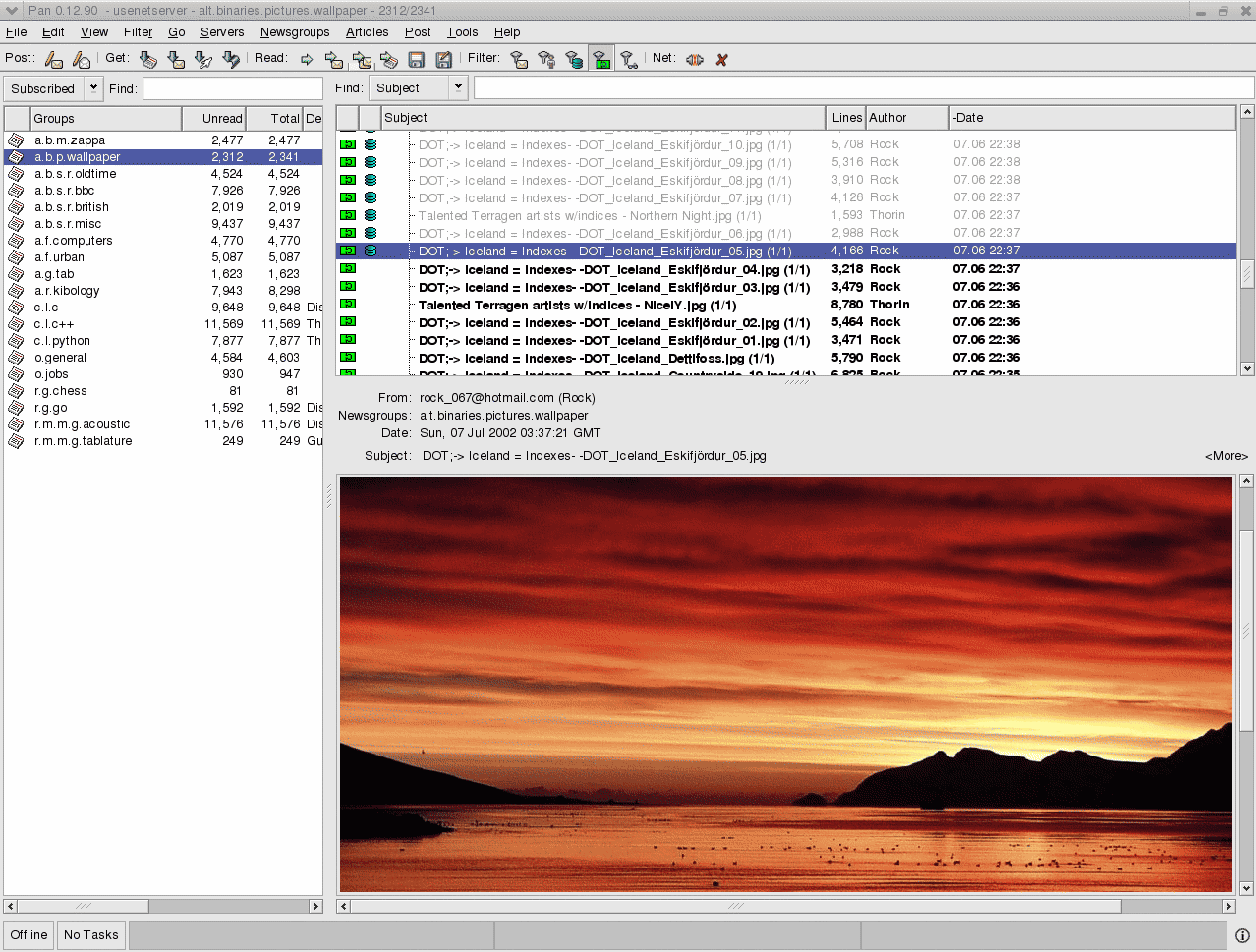
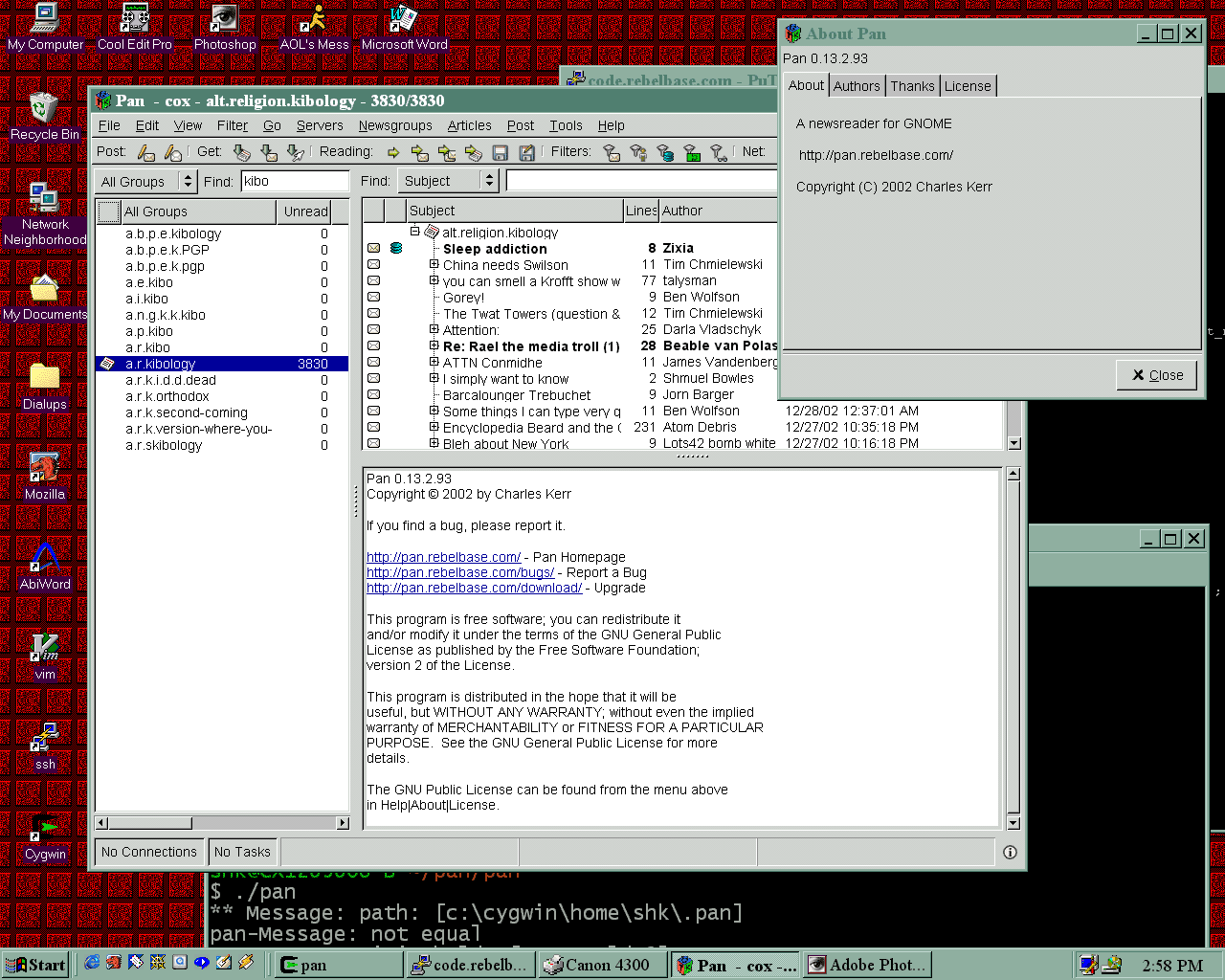
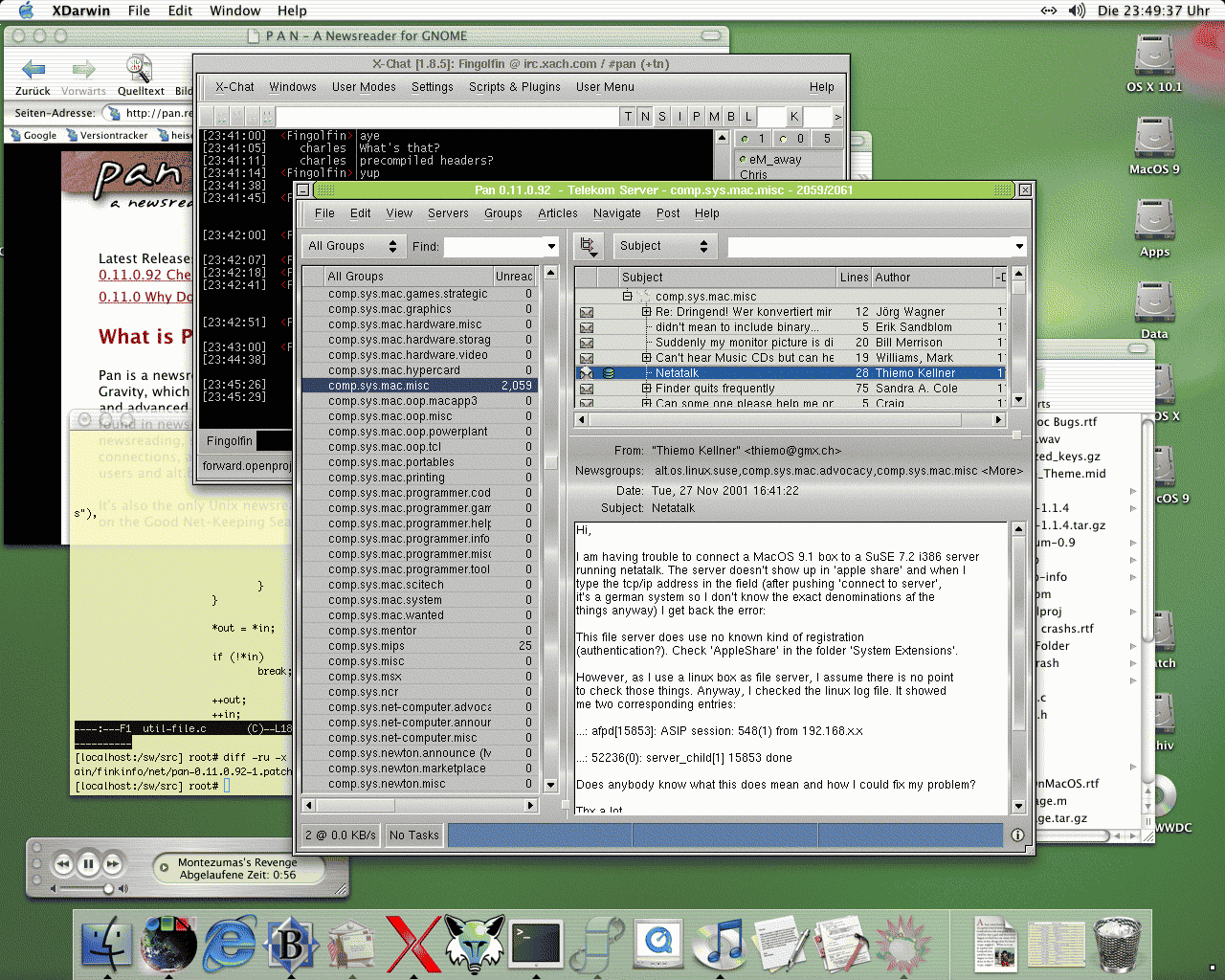
- When you write in Gtk+, you can get an application that runs on all the platforms you listed. My gtk+ newsreader Pan runs on Linux, Windows, and Mac OSX.
- The window manager is orthogonal to the topic of what's important from the software maker's point of view: ICCCM compliance is the only feature any application writer cares about. No application requires a specific WM. To do so would needlessly limit their audience.
- Likewise, you're misinformed about Mono: nobody is telling anyone that they have to port anything to Mono. C# is just another language that Gnome supports. Never in the 4+ years I've worked on Pan has anyone mentioned porting Pan to C#.
- gtk doesn't lack documentation. In fact the documentation team has made leaps and bounds over the last year.
- If you prefer RAD tools, Anjuta and Glade are available.
- Discussing Qt as a `modern C++ based toolkit' and disparaging Gtk+ as lacking a `modern API' is just language bias (and ignores moc's pre-STL cruftiness). If you want to use gtk+ in an OO language, many language bindings are available.
Again, this isn't to take anything away from Qt -- its tools are pretty good, and its documentation is excellent. However, Gtk+ is very good too.
-
Re:It's the licenseI'm not going to debate the relative merits of Qt to Gtk+, but I do want to correct some misconceptions you have about Gtk+.
- When you write in Gtk+, you can get an application that runs on all the platforms you listed. My gtk+ newsreader Pan runs on Linux, Windows, and Mac OSX.
- The window manager is orthogonal to the topic of what's important from the software maker's point of view: ICCCM compliance is the only feature any application writer cares about. No application requires a specific WM. To do so would needlessly limit their audience.
- Likewise, you're misinformed about Mono: nobody is telling anyone that they have to port anything to Mono. C# is just another language that Gnome supports. Never in the 4+ years I've worked on Pan has anyone mentioned porting Pan to C#.
- gtk doesn't lack documentation. In fact the documentation team has made leaps and bounds over the last year.
- If you prefer RAD tools, Anjuta and Glade are available.
- Discussing Qt as a `modern C++ based toolkit' and disparaging Gtk+ as lacking a `modern API' is just language bias (and ignores moc's pre-STL cruftiness). If you want to use gtk+ in an OO language, many language bindings are available.
Again, this isn't to take anything away from Qt -- its tools are pretty good, and its documentation is excellent. However, Gtk+ is very good too.
-
Re:Maybe more automatic testing tools for GUI?I am not overly familiar with O/S development, are there any similar style guidelines around?
The GNOME Human Interface Guidelines and to a somewhat lesser extent the KDE Style Guidelines fufill the same purpose as the MS and Apple guidelines.
-
Accessibility and KDE
I didn't see any one else comment about this. Just today we learned that KDE has full accessibility support. Reading about accessibility in GNOME it definitely appears as if the KDE offering is much more comprehensive. (Please correct me if I'm reading this the wrong way.) Shouldn't accessibility support play an important part in the selection of a desktop?
-
Re:Here's hoping the GNOME team ...
GNOME's menu icon can be invoked with Ctrl-F1. The GNOME desktop is theoretically entirely keyboard-navigable. Details can be found here.
-
Re:More KDE-GNOME cooperation
I was referring to this. Also, OpenOffice was a much more touted member before the GTK2 ports of Abiword and Gnumeric. I remember the previous website, anyway, had much more prominent references to OO.
-
Re:More KDE-GNOME cooperation
fwiw, the GNOME office website is at http://www.gnome.org/gnome-office/.
-
Congrats!
This is a big step onward. Anyone know how this assistive technology compares with gnopernicus ? Or do the separate softwares need to be made due to differences between Gnome & KDE?
-
Ok,
It's ugly.
Well, not ugly for unix, but ugly for a desktop. Even the Fisher Price look of a default XP install looks more polished than those screens.
Hell a new vanilla install of KDE looks more polished than those screens.
And they're charging for it?
Ehh, no thanks, I'll take my ugly free. -
Re:Troll. A good one, but a troll nevertheless
What, besides the fact that the KDE project is moving over to the media subsystem and accessiblity architecure (and already uses the XML libs) all developed for the GNOME project isn't a big dent in the statement that KDE has more advanced technology? Pfff.
I didn't say that KDE has more advanced technology, just that it's further along in general. Compare GNOME architecture to KDE architecure. I'd rather not get into a big point-by-point argument, as the architecture of both is quite involved. I'm not saying GNOME is bad in any way, just that KDE is further along, and in many ways has a better engine. That's not to say GNOME will not become better than KDE, but remember that KDE has had longer to mature than GNOME. And in many ways, Qt is a better toolkit than GTK.
Yeah, I'll bet that GNOME hello world program really stretched things.
Ad Hominem attacks are a really nice way to make your point there. Have you gone through the GTK and Qt tutorials, by any chance? From your talk, I rather assume not.
Good lord, are you deliberately being clueless. I can write an application for GNOME with a license that says "FUCK YOU, I OWN YOU AND YOUR FIRST BORN CHILD." and link to the GNOME libs. May I suggest a little research on your part before mouthing off again (it doesn't however, seem to affect the zealot upmodding that goes on).
Well, apart from the fact that a licence is limited by law, you're more or less correct, except there are limitations to the LGPL. No static linking is a headache for proprietry developers not associated with a particular distribution.
However, perhaps I was exaggerating a little. Ironic that KDE is more Free-as-in-speech than GNOME though, especially considering GNOME's origins
Still, a LGPL licence for GTK I like more than a GPL licence for it.
Oh man, you've clearly never used GNUMERIC.
And you clearly don't know the meaning of the word "former". As I said, I prefer Gnumeric over KSpread, but KSpread intergrates better with KDE and KOffice than Gnumeric does with GNOME. That's a result of KDE's architecture.
If you've got lots of users, you've got survival. GNOME the project guaranteed its survival by those large commericial deals.
Because commercial deals are the only way of getting users. And no commercial deal has ever resulted in few users adopting a product.
SUSE is now run by Novell and Ximian is now running the desktop.
Perhaps you could indicate a modern SUSE distro that favours GNOME over KDE? Oh, that's right, there isn't one.
Personally, I can't see that Novell would make SUSE switch. Would they go to all the trouble of remaking YAST and changing focus? KDE is a largely European effort. GNOME is more USian. SUSE is European, and it's developers have quite a bit of experience with KDE.
That SUSE will change desktops is pure speculation. It may occur, but I don't think it's too likely myself, and you've offered nothing in the way of evidence to suggest that this is their strategy.
You are like all KDE zealots, you constantly repeat the same tired meme... until you are incapable of seeing anything else.
AC: KDE's going to die! GNOME's superior!
Me: I don't think so.
AC: You damn KDE zealot!
As I said before, this looks a lot like a troll, though your zealous pursuit of this thread seems to indicate otherwise.
Yes, written by Nicholas Petreley and pals... look, get out more. See the world.
Conspiracy theories aside, my searches turn up zip. Perhaps you could find an article that explains the superiority of the GNOME engine over KDE's? -
Like Metacity?
You mean like Metacity does?
ftp://ftp.gnome.org/pub/GNOME/sources/metacity/2.4 -
ha ha
The very fact that the Unix world is so full of self-righteous cultural superiority, "advocacy," and slashdot-karma-whoring sectarianism while the Windows world is more practical ("yeah, whatever, I just need to make a living here") stems from a culture that feels itself under siege, unable to break out of the server closet and hobbyist market and onto the mainstream desktop.
i think the article shows a bit of a polarised image. okay, i see the point of OS advocates being too tech-oriented, but we also have some efforts that really try to aim at end users, more or less succesfull. allright, it's not as easy as using MacOSX, but it's quite close in many aspects. and quite usable for the novice, especially in the distributions that try to make it simple (xandros, lindows, etc)
linux on the desktop? very possible. a lot more likely than the writer of this article would like us to believe IMHO -
Donations to geek charities
-
Re:Who gets to vote?
I surprised no one answered this.
Members of the GNOME foundation get to vote for the board. Basically these are the people who contribute to GNOME. So, if you translate or code or give presentations to do with GNOME you can be a member. There is no charge or anything like that. -
What's going on with the names of the developers?
There appears to be some serious funkiness in the names of developers with (presumably) accents in their names in the list of contributors
A beautiful looking site otherwise and a great project, but this looks unprofessional
-
Re:Fails during build
This is installed with intltools. Upgrade to 0.28 and make sure OrigTree.pm is OK.
-
Re:What's the big excitement?> What's the url to the kde beta?
> 1.5 is a rehauling, but doesn't place the program back at the alpha stage by any means.
It's more than an rehaul. It has been rewritten into a UI client and a data server part. More kind of a rewrite.
-
Inconsistencies?
It's openness has been without a strong de facto standard in interface design
What have you found wrong with the GNOME guidelines? Or do you mainly complain that too many high-profile apps do not conform, or that the competing KDE guidelines would confuse users too much?
it's installations are too open to user intervention.
I don't completely understand what you mean by this.
A cute label maker that Just Works with standard printers.
Provided the makers of label paper deign to cooperate by providing specifications of where the labels are placed on the page. However, too many printers are not "standard printers" in that they do not conform to a "standard" language such as PostScript or HP PCL; these non-standard printers need the cooperation of the manufacturer. In addition, "cute" implies clip art, and the free software community has found it rather hard to attract visual artists who are willing to free license their works under e.g. Creative Commons Attribution-ShareAlike.
A photo app that lets them just plug in a digicam and browse pictures
Again, provided the camera manufacturer deigns to cooperate.
or draw smiley faces on Cousin Bob without worrying about layers and opacity.
It's possible to edit an image in GIMP without creating a new layer, just as in Microsoft Paint.
Much like the academics on the pre-Mosaic internet, many Linux users tend to feel like people should have to know what 'root' privileges are to use a computer, as well as where the proper config files are and what a mount point is. (some go much further)
I agree that config files and mount points could be simplified as Mac OS X has, but I've found it rather easy to get people to understand the concept of superuser. Use an analogy between root and the head of the household.
-
Re:Blowtus Goats
mozilla has it's preferances in edit->preferances, while firebird has it in Tools->Options. talk about confusing, but it's probably Firebird's attempt to look like IE.
to me it makes more sense to be able to modify an application's properties in Edit-Preferences. gnome has their Human Interface Guidelines, and obviously, they've picked file preferences for their guideline. then again, they can never get their ok/cancel buttons in line with the rest of the developed world. -
RTFA
RTFA, or at least LATFSS (look at the fscking screenshots)
HH
-- -
less like Outlook, strange UI things
one of the things i've noticed with the (dear me) evolution of Evolution is that when it originally reared its head it was almost a complete copy of Outlook from a UI point of view.
the version that comes with XD2 seems to have begun a move away from Outlook. and i'm debating in my mind if this is a good thing or not. surely the "switch"-like campaign would favour apps that looked and behaved more like MS apps for the sake of familiarity when moving across to a new environment. obviously the bad side of this is the whole innovation-stiffling argument that if one just mimicks Microsoft behaviour, what benefit other than cost is being added?
anyway, i would be in a better position to speak once actually having given it a test - but the UI on those screenshots seems a lot LESS intuitive than i've seen in previous releases. a few examples:
Calendar
it may seem obvious to a geek, but what is "Local"? and how does that differ from "On This Computer" in the tasks screenshot? also, what the heck is the "Component" button at the bottom there? and why do the buttons at the bottom there look so ugle. the ones on Tasks have icons, those don't. basically inconsistent UI.
i understand that this is a dev. release, but it seems silly to me to ignore UI in a odd release while developing the functionality and then maybe coming back to it in the following release. the way a user interacts with software should be considered throughout a development cycle as interaction changes can often lead to large programming changes.
-
less like Outlook, strange UI things
one of the things i've noticed with the (dear me) evolution of Evolution is that when it originally reared its head it was almost a complete copy of Outlook from a UI point of view.
the version that comes with XD2 seems to have begun a move away from Outlook. and i'm debating in my mind if this is a good thing or not. surely the "switch"-like campaign would favour apps that looked and behaved more like MS apps for the sake of familiarity when moving across to a new environment. obviously the bad side of this is the whole innovation-stiffling argument that if one just mimicks Microsoft behaviour, what benefit other than cost is being added?
anyway, i would be in a better position to speak once actually having given it a test - but the UI on those screenshots seems a lot LESS intuitive than i've seen in previous releases. a few examples:
Calendar
it may seem obvious to a geek, but what is "Local"? and how does that differ from "On This Computer" in the tasks screenshot? also, what the heck is the "Component" button at the bottom there? and why do the buttons at the bottom there look so ugle. the ones on Tasks have icons, those don't. basically inconsistent UI.
i understand that this is a dev. release, but it seems silly to me to ignore UI in a odd release while developing the functionality and then maybe coming back to it in the following release. the way a user interacts with software should be considered throughout a development cycle as interaction changes can often lead to large programming changes.
-
Re:Developer release?
So is Evolution 1.5 a development release? Are they following the same numbering scheme as the Linux kernel?
Yes and yes.
If you don't want to be testing 1.5 then you should be waiting for a stable 2.0. Of course, if you can, testing 1.5 is a good thing.
-
This is a testing release
This is one of the Evolution testing releases that go along with Gnome 2.5. The goal is a stable Evolution 2.0 and Gnome 2.6 later in the spring. Check out he roadmap.
So by all means, pick up 1.5 if you want to help with bug fixing, but this is not a "stable" release.
-
Dinner
Screenshot 2
If you need a PIM to remind you to eat dinner, you have serious issues. -
Re:Improve X? Yes , but only its colour system.What you're asking X to do is exactly what GDK does. It's not a toolkit, it's a layer over Xlib which hides the complexity of the colour model. It's very quick: you can use it for video windows, for example.
Here's a link to the docs. As a side benefit, your code becomes portable to win32 too.
Some systems really do need the visual/colormap stuff. If your hardware is a 4 bit deep framebuffer plus a colormap, you're going to need exact control over it. Other systems let you have different bit depths in different windows (!), and you need to be able to control that too. -
Re:listing of various localized gnome
-
Re:listing of various localized gnome
How about the Gnome Translation Project?
(check project->translation->status for a nice overview of how good every language translated) -
Future of Linux generallyI think a more general question about how Linux is going to topple Microsoft on the desktop is also warrented. The answer has to be innovation, Linux has been playing "catch-up" for too long.
Fortunately, there are a few really interesting technologies that have received surprisingly little attention, but which I believe point the way toward Linux overtaking Microsoft, and perhaps even Apple on the desktop:
- Dashboard
This is a wonderful idea where a "dashboard" essentially acts as a memory augmentation tool. It watches what you are doing and presents information it thinks might be relevant. For example, if you are chatting with someone on IRC, it will look for information about that person and present it to you (such as their name, homepage, recent blog entries etc). Applications can support it by sending it "clue packets" to alert it to what it might want to pay attention to. - Zero Install
This software essentially eliminates the process of information by mapping web-servers to the filesystem, and combining this with a fast local cache. If your software relies on another piece of software, it can just refer to its binary or libraries on this "web" filesystem, and the appropriate files will be downloaded transparently. The next time you need them, they will be cached. It is infinitely cooler than DEBs or RPMs, and very flexible indeed. - Gnome Storage
This project blurs the line between filesystems and databases, creating much more flexibility than is possible with more conventional filesystems. This is particularly powerful when combined with Zero Install. Microsoft is also moving in this direction with their WinFS that will be part of Longhorn.
- Dashboard
-
Re:Gnome v. KDE
> One of the articles you presented was an exposition of the
> difference between writing for GTK in C and Python and Qt in C++.
> It seemed a little apples-and-oranges, since nice C++ interfaces
> are available for GNOME.
Maybe it -seemed-, yep. Unfortunately, it -is- not, as clearly expressed in another of the articles I presented, that from a Rosegarden developper, written after he switched to Qt/KDE from GTK/GNOME-with-C++. Interestingly, you'll note that the GTKmm maintainers didn't understand either how Qt/KDE in particular made his life a lot easier.
Besides, I still have more articles to link to -- I've been studying that precise issue for quite some time now, you know, and ressources on that matter don't lack. Although I fully understand why you wouldn't want to hear that... Apparently, from the way our minds work, emotional reactions have a lower interrupt level than what philosophers like to call our higher functions, which, frankly, sucks. (Which is why I tried to thoroughly study the depth of -both- desktop environments before I cared either way, if you want to know.)
> If you want to talk about the proprietary companies on GUIs, you
> might consider that HP and Sun do that on GNOME. Even on their
> Unix platforms.
I know, yes. However, and even though for each of these two you could prolly quote as many or twice as many other companies using the other desktop API, there's another reason still why Sun and HP are a subtly, but importantly different matter, I think.
They're selling desktops for OTHER people to develop on. It's -their- best interest to make the offer look as cheap as possible, and then let the customers deal with the (possible) costs of additional development times. Which is exactly what they should be doing, of course. That's what MS does as well, and it works great, commercially speaking.
Besides, you'll note that both Sun and HP are large corporations with money to spare, making them not the best example one could pick when talking about which choice is less costly, I think.
> One of the things I'd like to go for is the principle of least surprise.
I totally agree with you on this! Not on your conclusion, however.
In terms of development, the principle of least surprise would have it that development tools are paid for separately. Sometimes much expensively.
This, frankly, sucks. But that's the principle of least surprise for you, though, I suppose...
The best situtation would be to be able to develop either way without fixed costs, of course. As another poster suggested, the best thing that could happen to the Linux desktop would be if someone like IBM bought off Qt and LGPL'ed it. However, until then, people for whom money isn't a commodity will pick the least costly choice. That's the way this world works, unfortunately. I wish it was otherwise, you can believe me.