Slashdot Mirror
Domain: google.com
Stories and comments across the archive that link to google.com.
Stories · 3,747
-
Google Open Sources Etherpad, Piratepad Launches
Thomas Nybergh writes "The Etherpad code was released by Google under the Apache license a few hours ago. Google's initial plan, after acquiring the service, was to use Etherpad's tech with its new Wave collaboration platform and to shut down the original service entirely. Soon after the Etherpad code was released, the Swedish Pirate Party launched their instance of the service at piratepad.net. An announcement, which also mentions a new Tor node, is published on the party website (Google translation). The original Etherpad service had in a short time become a killer application for collaborative work within at least the Swedish, and according to my personal experience, in the Finnish Pirate Party as well. The Etherpad open source project is available at Google Code." -
Yes, Google Does De-List Pages; But When?
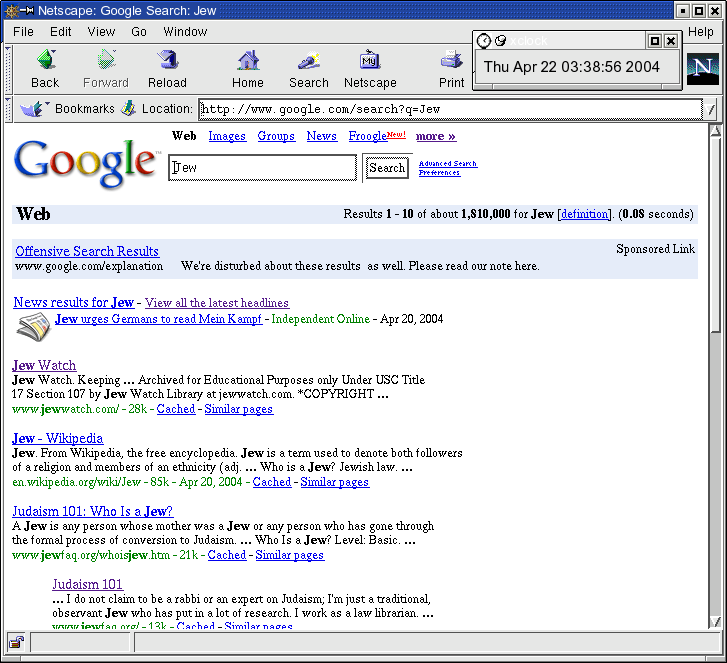
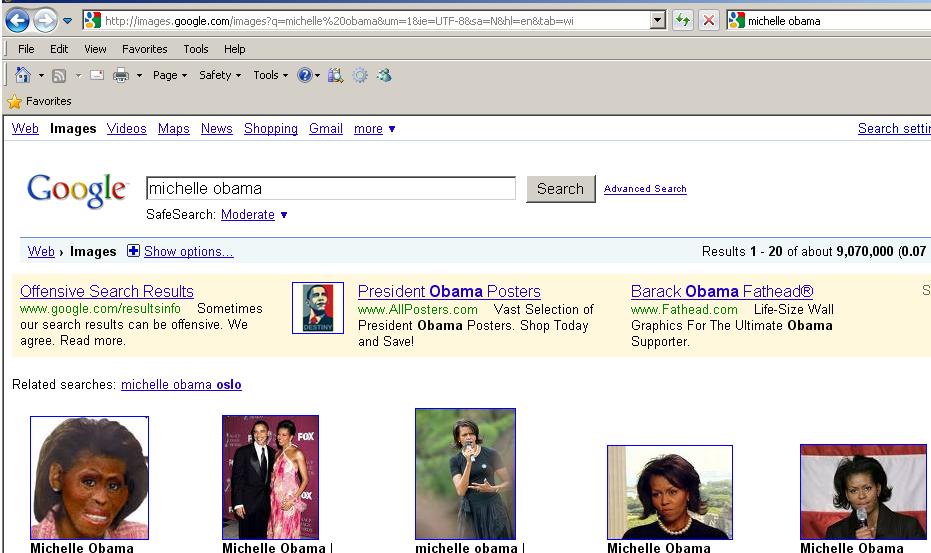
Frequent Slashdot contributor Bennett Haselton writes "Google finds itself inserting a disclaimer once again above some offensive search results. But the disclaimer still leads many to believe (incorrectly) that Google doesn't tamper with search results even in cases of 'harmful' or 'offensive' material. We know that Google has in fact de-listed some pages at the request of offended parties. What is their real policy on the issue?" Read on for Bennet's essay.In 2004, when Google users discovered that the top search result for the word "Jew" was the anti-semitic site Jew Watch, Google ran a disclaimer in the space usually reserved for ads, explaining that their results only reflected the reality of link counts on the Web, and that they did not endorse any Web sites which appeared at the top of their listings. Now the disclaimer has been dusted off again, as the top result on Google Images for "Michelle Obama" is a picture of a monkey's face with Michelle's hairdo. (Ironically, it looks as if the original image would have fallen out of the rankings, if it hadn't been for a follow-up blog post about the controversy, which itself now comes up as the first result.)
I first heard about the controversy from Dennis Prager's column in which he takes a New York Times columnist to task, because the columnist complained about "racially offensive images of the first couple" that come up in Google searches. Prager was unable to find any examples from Googling "first couple" or "Michelle and Barack Obama pictures," so he concluded that the NYT columnist "wildly exaggerated, if not made up" his claims. I tried Google Image searches for "first couple," "Barack Obama," and some other terms, and I couldn't find anything controversial either. However, it only took 10 seconds to enter "first couple google images controversy" on the regular Google Web search and find multiple blog posts explaining what all the fuss was about. Back to Google 101 for Dennis.
Many of the blog posts refer to Google's disclaimer about not tampering with search results. Those on one side are urging Google to make an exception and "fix" the results, while others sagely observe that Google just reflects reality, it doesn't create it.
All of this punditry is starting from a premise that's wrong. Google has actually removed pages from their search results — not because the pages were illegal or because the webmasters were search engine spamming, but because of the page's "offensive" content. In the "Chester's Guide" incident, a councilman in Chester, England discovered that one of the search results for "chester guide" was a satirical page titled "Chester's guide to picking up little girls." Although the page itself was obviously just someone's idea of sick humor, a Chester city councilman (who admitted that he hadn't looked at the page, saying that the title told him everything he needed to know) urged Google to remove the page from their index. Google at first refused, but later manually blacklisted the page to prevent it from appearing in their search results.
Whether or not you think this was the right decision, probably depends on what you think is the purpose of Google. If Google's purpose is to return the most useful results, then it made sense to remove the link, as Danny Sullivan of Search Engine Watch argued at the time, since it almost certainly was not a useful result for people searching for "Chester Guide." On the other hand, if the primary purpose of Google is to reflect the reality of what pages on the Web feature certain words most prominently (combined with all the other factors that Google weighs, of course), then the results shouldn't be altered.
But more people should at least realize that it happened. The Google disclaimer doesn't precisely say that they never blacklist pages or modify search results ("Google reserves the right to address such requests individually"), but it seems to give most people the impression that that's the case. According to that crudest of Googling techniques for which novice searchers are so frequently lampooned, there appear to be about 400 times as many stories on the Web about the Google "Jew Watch" controversy (where Google stood their ground) as there are stores about the "Chester's Guide" incident (where Google caved).
And Google-number-three Matt Cutts posted on his blog back in March explaining why Google does not remove "offensive" pages from search results; over a hundred comments followed, debating the pros and cons of the position, but none of them mentioned the Chester incident or any other case where Google actually had removed pages except as a result of a court order. One isolated comment from "Anonymous" said:
This is not quite true. I know of at least one web site that was de-listed for containing illegal content and/or promoting illegal activity.
which may or may not have been a reference to the Chester Guide incident. And that was it.
Is this a lot of hay to be making over something that happened years ago? Well, for one thing, I doubt if it happened just once. Consider that the Chester Guide incident involved a public declaration of outrage by a city council, and a public statement from Google, and still hardly anyone knows that it ever happened. If other incidents occurred without those high-profile elements, it would be even harder to discover them now. We'll probably never know how many such incidents took place, unless someone sues Google (maybe the owner of a blacklisted website, or maybe the victim of a RipOffReport hatchet job wondering why that site hadn't been blacklisted long ago), subpoenas Google for a list of cases where pages were de-indexed, and publishes the list if it's not sealed by a court order.
But whether it was one time or a handful, consider that political candidates like Arnold Schwarzenegger and Al Franken got asked during their campaigns about things they did 20 years earlier, and it's fair to ask a candidate about their past, because it's the same person standing in front of you now. Why did you do that? Have you stopped? Why?
And in the big scheme of things, Google is probably more powerful than a single US senator or the governor of California. So, can't we ask? What are their real rules about page removal? Have those rules changed since the Chester's Guide controversy? Can they even tell us what their rules are, or do they consider it a trade secret?
It is well known, of course, that Google censors some results in their search engines branded for different markets like China and even in liberal democracies like Germany. But nobody would call that a slippery slope towards censorship in the US version of Google, because the censorship in the Chinese and German versions is done at the behest of the governments there. On the other hand, Google does admit that they will de-index pages which include credit card numbers or social security numbers (which are all too easy to find on the Web). This might not seem like a controversial position, but even this act of voluntary self-censorship may be dipping their toe in the water further than it seems. Most people do consider their credit card information more private than their home address. But surely there are people like J.D. Salinger who less about the privacy of their credit card number (which is easily changeable) than their home address (which isn't). If someone finds Salinger's address and posts it on the Web, should Salinger be able to demand that Google de-index the page? Why should Google cater to the majority who want to keep their credit card number secret, but not to the minority who care more about keeping their address secret? Another commenter on Matt Cutts's blog post asked:
"hi. I have a question. My mom 'googled' herself and it shows some of her medical problems. She wants/needs these pages removed from search engines."
Again, why shouldn't that be considered at least as private as a credit card number?
And finally, even Google's decision to display an "offensive results" disclaimer, for some results but not for others, raises the same "Where do you draw the line?" questions as the issue of page removal. The Michelle Obama monkey picture gets a disclaimer. But search for 'george w bush' and the first row includes a photoshopped (I think!) image of Bush flipping off the press. Does that warrant a disclaimer as well? (Maybe that's considered less unfair because, even though the picture is fake, it does depict something that actually happened.) The first image result for "bristol palin" is a photo of her engaged in underage drinking — a real photo, but probably unfair to call it the single most relevant photo of her on the Web.
So while Google might consider credit cards and social security numbers and search engine spam to be on one side of a "bright line," and everything else is served up without alteration, I think the line is blurrier than that, for at least those three reasons: (a) credit cards and SSNs are less private than some other that things that Google serves up anyway; (b) Google has unambiguously removed some content that fell outside that bright line, as in the Chester's guide incident, and (c) they make other "slippery slope" judgment calls about search results all the time (as in the question of when to show the disclaimer). So I hope that Google someday comes out with a more complete answer to the question. What is their real policy on what they will remove? The Chester's guide incident — would they do that sort of thing if the same situation came up today, or have their rules changed? If they want to go really deep, then is there a general set of principles from which their rules follow — explaining why, for example, they treat credit card numbers as more private than sensitive medical information? (Google did not respond to my request for comment, either through official channels or the unofficial back channels of friends who work there.)
I hope Google gives an answer some day. Even just to say, "It's a classified internal policy and that's all we're going to tell you." But once and for all, the answer is not "Google doesn't remove content just because it's 'offensive' or 'harmful.'"
Meanwhile, a modest suggestion about the disclaimer displayed above the search results: Put it where people will actually see it, in a separate line below the ads, but above the search results. Right now the link to the disclaimer is displayed as one of three ads across the top, and people don't look at the ads. But hey, people do buy ads, so if you push the disclaimer down a bit where people will read it, you also free up space for 50% more ad revenue!
-
Yes, Google Does De-List Pages; But When?
Frequent Slashdot contributor Bennett Haselton writes "Google finds itself inserting a disclaimer once again above some offensive search results. But the disclaimer still leads many to believe (incorrectly) that Google doesn't tamper with search results even in cases of 'harmful' or 'offensive' material. We know that Google has in fact de-listed some pages at the request of offended parties. What is their real policy on the issue?" Read on for Bennet's essay.In 2004, when Google users discovered that the top search result for the word "Jew" was the anti-semitic site Jew Watch, Google ran a disclaimer in the space usually reserved for ads, explaining that their results only reflected the reality of link counts on the Web, and that they did not endorse any Web sites which appeared at the top of their listings. Now the disclaimer has been dusted off again, as the top result on Google Images for "Michelle Obama" is a picture of a monkey's face with Michelle's hairdo. (Ironically, it looks as if the original image would have fallen out of the rankings, if it hadn't been for a follow-up blog post about the controversy, which itself now comes up as the first result.)
I first heard about the controversy from Dennis Prager's column in which he takes a New York Times columnist to task, because the columnist complained about "racially offensive images of the first couple" that come up in Google searches. Prager was unable to find any examples from Googling "first couple" or "Michelle and Barack Obama pictures," so he concluded that the NYT columnist "wildly exaggerated, if not made up" his claims. I tried Google Image searches for "first couple," "Barack Obama," and some other terms, and I couldn't find anything controversial either. However, it only took 10 seconds to enter "first couple google images controversy" on the regular Google Web search and find multiple blog posts explaining what all the fuss was about. Back to Google 101 for Dennis.
Many of the blog posts refer to Google's disclaimer about not tampering with search results. Those on one side are urging Google to make an exception and "fix" the results, while others sagely observe that Google just reflects reality, it doesn't create it.
All of this punditry is starting from a premise that's wrong. Google has actually removed pages from their search results — not because the pages were illegal or because the webmasters were search engine spamming, but because of the page's "offensive" content. In the "Chester's Guide" incident, a councilman in Chester, England discovered that one of the search results for "chester guide" was a satirical page titled "Chester's guide to picking up little girls." Although the page itself was obviously just someone's idea of sick humor, a Chester city councilman (who admitted that he hadn't looked at the page, saying that the title told him everything he needed to know) urged Google to remove the page from their index. Google at first refused, but later manually blacklisted the page to prevent it from appearing in their search results.
Whether or not you think this was the right decision, probably depends on what you think is the purpose of Google. If Google's purpose is to return the most useful results, then it made sense to remove the link, as Danny Sullivan of Search Engine Watch argued at the time, since it almost certainly was not a useful result for people searching for "Chester Guide." On the other hand, if the primary purpose of Google is to reflect the reality of what pages on the Web feature certain words most prominently (combined with all the other factors that Google weighs, of course), then the results shouldn't be altered.
But more people should at least realize that it happened. The Google disclaimer doesn't precisely say that they never blacklist pages or modify search results ("Google reserves the right to address such requests individually"), but it seems to give most people the impression that that's the case. According to that crudest of Googling techniques for which novice searchers are so frequently lampooned, there appear to be about 400 times as many stories on the Web about the Google "Jew Watch" controversy (where Google stood their ground) as there are stores about the "Chester's Guide" incident (where Google caved).
And Google-number-three Matt Cutts posted on his blog back in March explaining why Google does not remove "offensive" pages from search results; over a hundred comments followed, debating the pros and cons of the position, but none of them mentioned the Chester incident or any other case where Google actually had removed pages except as a result of a court order. One isolated comment from "Anonymous" said:
This is not quite true. I know of at least one web site that was de-listed for containing illegal content and/or promoting illegal activity.
which may or may not have been a reference to the Chester Guide incident. And that was it.
Is this a lot of hay to be making over something that happened years ago? Well, for one thing, I doubt if it happened just once. Consider that the Chester Guide incident involved a public declaration of outrage by a city council, and a public statement from Google, and still hardly anyone knows that it ever happened. If other incidents occurred without those high-profile elements, it would be even harder to discover them now. We'll probably never know how many such incidents took place, unless someone sues Google (maybe the owner of a blacklisted website, or maybe the victim of a RipOffReport hatchet job wondering why that site hadn't been blacklisted long ago), subpoenas Google for a list of cases where pages were de-indexed, and publishes the list if it's not sealed by a court order.
But whether it was one time or a handful, consider that political candidates like Arnold Schwarzenegger and Al Franken got asked during their campaigns about things they did 20 years earlier, and it's fair to ask a candidate about their past, because it's the same person standing in front of you now. Why did you do that? Have you stopped? Why?
And in the big scheme of things, Google is probably more powerful than a single US senator or the governor of California. So, can't we ask? What are their real rules about page removal? Have those rules changed since the Chester's Guide controversy? Can they even tell us what their rules are, or do they consider it a trade secret?
It is well known, of course, that Google censors some results in their search engines branded for different markets like China and even in liberal democracies like Germany. But nobody would call that a slippery slope towards censorship in the US version of Google, because the censorship in the Chinese and German versions is done at the behest of the governments there. On the other hand, Google does admit that they will de-index pages which include credit card numbers or social security numbers (which are all too easy to find on the Web). This might not seem like a controversial position, but even this act of voluntary self-censorship may be dipping their toe in the water further than it seems. Most people do consider their credit card information more private than their home address. But surely there are people like J.D. Salinger who less about the privacy of their credit card number (which is easily changeable) than their home address (which isn't). If someone finds Salinger's address and posts it on the Web, should Salinger be able to demand that Google de-index the page? Why should Google cater to the majority who want to keep their credit card number secret, but not to the minority who care more about keeping their address secret? Another commenter on Matt Cutts's blog post asked:
"hi. I have a question. My mom 'googled' herself and it shows some of her medical problems. She wants/needs these pages removed from search engines."
Again, why shouldn't that be considered at least as private as a credit card number?
And finally, even Google's decision to display an "offensive results" disclaimer, for some results but not for others, raises the same "Where do you draw the line?" questions as the issue of page removal. The Michelle Obama monkey picture gets a disclaimer. But search for 'george w bush' and the first row includes a photoshopped (I think!) image of Bush flipping off the press. Does that warrant a disclaimer as well? (Maybe that's considered less unfair because, even though the picture is fake, it does depict something that actually happened.) The first image result for "bristol palin" is a photo of her engaged in underage drinking — a real photo, but probably unfair to call it the single most relevant photo of her on the Web.
So while Google might consider credit cards and social security numbers and search engine spam to be on one side of a "bright line," and everything else is served up without alteration, I think the line is blurrier than that, for at least those three reasons: (a) credit cards and SSNs are less private than some other that things that Google serves up anyway; (b) Google has unambiguously removed some content that fell outside that bright line, as in the Chester's guide incident, and (c) they make other "slippery slope" judgment calls about search results all the time (as in the question of when to show the disclaimer). So I hope that Google someday comes out with a more complete answer to the question. What is their real policy on what they will remove? The Chester's guide incident — would they do that sort of thing if the same situation came up today, or have their rules changed? If they want to go really deep, then is there a general set of principles from which their rules follow — explaining why, for example, they treat credit card numbers as more private than sensitive medical information? (Google did not respond to my request for comment, either through official channels or the unofficial back channels of friends who work there.)
I hope Google gives an answer some day. Even just to say, "It's a classified internal policy and that's all we're going to tell you." But once and for all, the answer is not "Google doesn't remove content just because it's 'offensive' or 'harmful.'"
Meanwhile, a modest suggestion about the disclaimer displayed above the search results: Put it where people will actually see it, in a separate line below the ads, but above the search results. Right now the link to the disclaimer is displayed as one of three ads across the top, and people don't look at the ads. But hey, people do buy ads, so if you push the disclaimer down a bit where people will read it, you also free up space for 50% more ad revenue!
-
Yes, Google Does De-List Pages; But When?
Frequent Slashdot contributor Bennett Haselton writes "Google finds itself inserting a disclaimer once again above some offensive search results. But the disclaimer still leads many to believe (incorrectly) that Google doesn't tamper with search results even in cases of 'harmful' or 'offensive' material. We know that Google has in fact de-listed some pages at the request of offended parties. What is their real policy on the issue?" Read on for Bennet's essay.In 2004, when Google users discovered that the top search result for the word "Jew" was the anti-semitic site Jew Watch, Google ran a disclaimer in the space usually reserved for ads, explaining that their results only reflected the reality of link counts on the Web, and that they did not endorse any Web sites which appeared at the top of their listings. Now the disclaimer has been dusted off again, as the top result on Google Images for "Michelle Obama" is a picture of a monkey's face with Michelle's hairdo. (Ironically, it looks as if the original image would have fallen out of the rankings, if it hadn't been for a follow-up blog post about the controversy, which itself now comes up as the first result.)
I first heard about the controversy from Dennis Prager's column in which he takes a New York Times columnist to task, because the columnist complained about "racially offensive images of the first couple" that come up in Google searches. Prager was unable to find any examples from Googling "first couple" or "Michelle and Barack Obama pictures," so he concluded that the NYT columnist "wildly exaggerated, if not made up" his claims. I tried Google Image searches for "first couple," "Barack Obama," and some other terms, and I couldn't find anything controversial either. However, it only took 10 seconds to enter "first couple google images controversy" on the regular Google Web search and find multiple blog posts explaining what all the fuss was about. Back to Google 101 for Dennis.
Many of the blog posts refer to Google's disclaimer about not tampering with search results. Those on one side are urging Google to make an exception and "fix" the results, while others sagely observe that Google just reflects reality, it doesn't create it.
All of this punditry is starting from a premise that's wrong. Google has actually removed pages from their search results — not because the pages were illegal or because the webmasters were search engine spamming, but because of the page's "offensive" content. In the "Chester's Guide" incident, a councilman in Chester, England discovered that one of the search results for "chester guide" was a satirical page titled "Chester's guide to picking up little girls." Although the page itself was obviously just someone's idea of sick humor, a Chester city councilman (who admitted that he hadn't looked at the page, saying that the title told him everything he needed to know) urged Google to remove the page from their index. Google at first refused, but later manually blacklisted the page to prevent it from appearing in their search results.
Whether or not you think this was the right decision, probably depends on what you think is the purpose of Google. If Google's purpose is to return the most useful results, then it made sense to remove the link, as Danny Sullivan of Search Engine Watch argued at the time, since it almost certainly was not a useful result for people searching for "Chester Guide." On the other hand, if the primary purpose of Google is to reflect the reality of what pages on the Web feature certain words most prominently (combined with all the other factors that Google weighs, of course), then the results shouldn't be altered.
But more people should at least realize that it happened. The Google disclaimer doesn't precisely say that they never blacklist pages or modify search results ("Google reserves the right to address such requests individually"), but it seems to give most people the impression that that's the case. According to that crudest of Googling techniques for which novice searchers are so frequently lampooned, there appear to be about 400 times as many stories on the Web about the Google "Jew Watch" controversy (where Google stood their ground) as there are stores about the "Chester's Guide" incident (where Google caved).
And Google-number-three Matt Cutts posted on his blog back in March explaining why Google does not remove "offensive" pages from search results; over a hundred comments followed, debating the pros and cons of the position, but none of them mentioned the Chester incident or any other case where Google actually had removed pages except as a result of a court order. One isolated comment from "Anonymous" said:
This is not quite true. I know of at least one web site that was de-listed for containing illegal content and/or promoting illegal activity.
which may or may not have been a reference to the Chester Guide incident. And that was it.
Is this a lot of hay to be making over something that happened years ago? Well, for one thing, I doubt if it happened just once. Consider that the Chester Guide incident involved a public declaration of outrage by a city council, and a public statement from Google, and still hardly anyone knows that it ever happened. If other incidents occurred without those high-profile elements, it would be even harder to discover them now. We'll probably never know how many such incidents took place, unless someone sues Google (maybe the owner of a blacklisted website, or maybe the victim of a RipOffReport hatchet job wondering why that site hadn't been blacklisted long ago), subpoenas Google for a list of cases where pages were de-indexed, and publishes the list if it's not sealed by a court order.
But whether it was one time or a handful, consider that political candidates like Arnold Schwarzenegger and Al Franken got asked during their campaigns about things they did 20 years earlier, and it's fair to ask a candidate about their past, because it's the same person standing in front of you now. Why did you do that? Have you stopped? Why?
And in the big scheme of things, Google is probably more powerful than a single US senator or the governor of California. So, can't we ask? What are their real rules about page removal? Have those rules changed since the Chester's Guide controversy? Can they even tell us what their rules are, or do they consider it a trade secret?
It is well known, of course, that Google censors some results in their search engines branded for different markets like China and even in liberal democracies like Germany. But nobody would call that a slippery slope towards censorship in the US version of Google, because the censorship in the Chinese and German versions is done at the behest of the governments there. On the other hand, Google does admit that they will de-index pages which include credit card numbers or social security numbers (which are all too easy to find on the Web). This might not seem like a controversial position, but even this act of voluntary self-censorship may be dipping their toe in the water further than it seems. Most people do consider their credit card information more private than their home address. But surely there are people like J.D. Salinger who less about the privacy of their credit card number (which is easily changeable) than their home address (which isn't). If someone finds Salinger's address and posts it on the Web, should Salinger be able to demand that Google de-index the page? Why should Google cater to the majority who want to keep their credit card number secret, but not to the minority who care more about keeping their address secret? Another commenter on Matt Cutts's blog post asked:
"hi. I have a question. My mom 'googled' herself and it shows some of her medical problems. She wants/needs these pages removed from search engines."
Again, why shouldn't that be considered at least as private as a credit card number?
And finally, even Google's decision to display an "offensive results" disclaimer, for some results but not for others, raises the same "Where do you draw the line?" questions as the issue of page removal. The Michelle Obama monkey picture gets a disclaimer. But search for 'george w bush' and the first row includes a photoshopped (I think!) image of Bush flipping off the press. Does that warrant a disclaimer as well? (Maybe that's considered less unfair because, even though the picture is fake, it does depict something that actually happened.) The first image result for "bristol palin" is a photo of her engaged in underage drinking — a real photo, but probably unfair to call it the single most relevant photo of her on the Web.
So while Google might consider credit cards and social security numbers and search engine spam to be on one side of a "bright line," and everything else is served up without alteration, I think the line is blurrier than that, for at least those three reasons: (a) credit cards and SSNs are less private than some other that things that Google serves up anyway; (b) Google has unambiguously removed some content that fell outside that bright line, as in the Chester's guide incident, and (c) they make other "slippery slope" judgment calls about search results all the time (as in the question of when to show the disclaimer). So I hope that Google someday comes out with a more complete answer to the question. What is their real policy on what they will remove? The Chester's guide incident — would they do that sort of thing if the same situation came up today, or have their rules changed? If they want to go really deep, then is there a general set of principles from which their rules follow — explaining why, for example, they treat credit card numbers as more private than sensitive medical information? (Google did not respond to my request for comment, either through official channels or the unofficial back channels of friends who work there.)
I hope Google gives an answer some day. Even just to say, "It's a classified internal policy and that's all we're going to tell you." But once and for all, the answer is not "Google doesn't remove content just because it's 'offensive' or 'harmful.'"
Meanwhile, a modest suggestion about the disclaimer displayed above the search results: Put it where people will actually see it, in a separate line below the ads, but above the search results. Right now the link to the disclaimer is displayed as one of three ads across the top, and people don't look at the ads. But hey, people do buy ads, so if you push the disclaimer down a bit where people will read it, you also free up space for 50% more ad revenue!
-
Yes, Google Does De-List Pages; But When?
Frequent Slashdot contributor Bennett Haselton writes "Google finds itself inserting a disclaimer once again above some offensive search results. But the disclaimer still leads many to believe (incorrectly) that Google doesn't tamper with search results even in cases of 'harmful' or 'offensive' material. We know that Google has in fact de-listed some pages at the request of offended parties. What is their real policy on the issue?" Read on for Bennet's essay.In 2004, when Google users discovered that the top search result for the word "Jew" was the anti-semitic site Jew Watch, Google ran a disclaimer in the space usually reserved for ads, explaining that their results only reflected the reality of link counts on the Web, and that they did not endorse any Web sites which appeared at the top of their listings. Now the disclaimer has been dusted off again, as the top result on Google Images for "Michelle Obama" is a picture of a monkey's face with Michelle's hairdo. (Ironically, it looks as if the original image would have fallen out of the rankings, if it hadn't been for a follow-up blog post about the controversy, which itself now comes up as the first result.)
I first heard about the controversy from Dennis Prager's column in which he takes a New York Times columnist to task, because the columnist complained about "racially offensive images of the first couple" that come up in Google searches. Prager was unable to find any examples from Googling "first couple" or "Michelle and Barack Obama pictures," so he concluded that the NYT columnist "wildly exaggerated, if not made up" his claims. I tried Google Image searches for "first couple," "Barack Obama," and some other terms, and I couldn't find anything controversial either. However, it only took 10 seconds to enter "first couple google images controversy" on the regular Google Web search and find multiple blog posts explaining what all the fuss was about. Back to Google 101 for Dennis.
Many of the blog posts refer to Google's disclaimer about not tampering with search results. Those on one side are urging Google to make an exception and "fix" the results, while others sagely observe that Google just reflects reality, it doesn't create it.
All of this punditry is starting from a premise that's wrong. Google has actually removed pages from their search results — not because the pages were illegal or because the webmasters were search engine spamming, but because of the page's "offensive" content. In the "Chester's Guide" incident, a councilman in Chester, England discovered that one of the search results for "chester guide" was a satirical page titled "Chester's guide to picking up little girls." Although the page itself was obviously just someone's idea of sick humor, a Chester city councilman (who admitted that he hadn't looked at the page, saying that the title told him everything he needed to know) urged Google to remove the page from their index. Google at first refused, but later manually blacklisted the page to prevent it from appearing in their search results.
Whether or not you think this was the right decision, probably depends on what you think is the purpose of Google. If Google's purpose is to return the most useful results, then it made sense to remove the link, as Danny Sullivan of Search Engine Watch argued at the time, since it almost certainly was not a useful result for people searching for "Chester Guide." On the other hand, if the primary purpose of Google is to reflect the reality of what pages on the Web feature certain words most prominently (combined with all the other factors that Google weighs, of course), then the results shouldn't be altered.
But more people should at least realize that it happened. The Google disclaimer doesn't precisely say that they never blacklist pages or modify search results ("Google reserves the right to address such requests individually"), but it seems to give most people the impression that that's the case. According to that crudest of Googling techniques for which novice searchers are so frequently lampooned, there appear to be about 400 times as many stories on the Web about the Google "Jew Watch" controversy (where Google stood their ground) as there are stores about the "Chester's Guide" incident (where Google caved).
And Google-number-three Matt Cutts posted on his blog back in March explaining why Google does not remove "offensive" pages from search results; over a hundred comments followed, debating the pros and cons of the position, but none of them mentioned the Chester incident or any other case where Google actually had removed pages except as a result of a court order. One isolated comment from "Anonymous" said:
This is not quite true. I know of at least one web site that was de-listed for containing illegal content and/or promoting illegal activity.
which may or may not have been a reference to the Chester Guide incident. And that was it.
Is this a lot of hay to be making over something that happened years ago? Well, for one thing, I doubt if it happened just once. Consider that the Chester Guide incident involved a public declaration of outrage by a city council, and a public statement from Google, and still hardly anyone knows that it ever happened. If other incidents occurred without those high-profile elements, it would be even harder to discover them now. We'll probably never know how many such incidents took place, unless someone sues Google (maybe the owner of a blacklisted website, or maybe the victim of a RipOffReport hatchet job wondering why that site hadn't been blacklisted long ago), subpoenas Google for a list of cases where pages were de-indexed, and publishes the list if it's not sealed by a court order.
But whether it was one time or a handful, consider that political candidates like Arnold Schwarzenegger and Al Franken got asked during their campaigns about things they did 20 years earlier, and it's fair to ask a candidate about their past, because it's the same person standing in front of you now. Why did you do that? Have you stopped? Why?
And in the big scheme of things, Google is probably more powerful than a single US senator or the governor of California. So, can't we ask? What are their real rules about page removal? Have those rules changed since the Chester's Guide controversy? Can they even tell us what their rules are, or do they consider it a trade secret?
It is well known, of course, that Google censors some results in their search engines branded for different markets like China and even in liberal democracies like Germany. But nobody would call that a slippery slope towards censorship in the US version of Google, because the censorship in the Chinese and German versions is done at the behest of the governments there. On the other hand, Google does admit that they will de-index pages which include credit card numbers or social security numbers (which are all too easy to find on the Web). This might not seem like a controversial position, but even this act of voluntary self-censorship may be dipping their toe in the water further than it seems. Most people do consider their credit card information more private than their home address. But surely there are people like J.D. Salinger who less about the privacy of their credit card number (which is easily changeable) than their home address (which isn't). If someone finds Salinger's address and posts it on the Web, should Salinger be able to demand that Google de-index the page? Why should Google cater to the majority who want to keep their credit card number secret, but not to the minority who care more about keeping their address secret? Another commenter on Matt Cutts's blog post asked:
"hi. I have a question. My mom 'googled' herself and it shows some of her medical problems. She wants/needs these pages removed from search engines."
Again, why shouldn't that be considered at least as private as a credit card number?
And finally, even Google's decision to display an "offensive results" disclaimer, for some results but not for others, raises the same "Where do you draw the line?" questions as the issue of page removal. The Michelle Obama monkey picture gets a disclaimer. But search for 'george w bush' and the first row includes a photoshopped (I think!) image of Bush flipping off the press. Does that warrant a disclaimer as well? (Maybe that's considered less unfair because, even though the picture is fake, it does depict something that actually happened.) The first image result for "bristol palin" is a photo of her engaged in underage drinking — a real photo, but probably unfair to call it the single most relevant photo of her on the Web.
So while Google might consider credit cards and social security numbers and search engine spam to be on one side of a "bright line," and everything else is served up without alteration, I think the line is blurrier than that, for at least those three reasons: (a) credit cards and SSNs are less private than some other that things that Google serves up anyway; (b) Google has unambiguously removed some content that fell outside that bright line, as in the Chester's guide incident, and (c) they make other "slippery slope" judgment calls about search results all the time (as in the question of when to show the disclaimer). So I hope that Google someday comes out with a more complete answer to the question. What is their real policy on what they will remove? The Chester's guide incident — would they do that sort of thing if the same situation came up today, or have their rules changed? If they want to go really deep, then is there a general set of principles from which their rules follow — explaining why, for example, they treat credit card numbers as more private than sensitive medical information? (Google did not respond to my request for comment, either through official channels or the unofficial back channels of friends who work there.)
I hope Google gives an answer some day. Even just to say, "It's a classified internal policy and that's all we're going to tell you." But once and for all, the answer is not "Google doesn't remove content just because it's 'offensive' or 'harmful.'"
Meanwhile, a modest suggestion about the disclaimer displayed above the search results: Put it where people will actually see it, in a separate line below the ads, but above the search results. Right now the link to the disclaimer is displayed as one of three ads across the top, and people don't look at the ads. But hey, people do buy ads, so if you push the disclaimer down a bit where people will read it, you also free up space for 50% more ad revenue!
-
Yes, Google Does De-List Pages; But When?
Frequent Slashdot contributor Bennett Haselton writes "Google finds itself inserting a disclaimer once again above some offensive search results. But the disclaimer still leads many to believe (incorrectly) that Google doesn't tamper with search results even in cases of 'harmful' or 'offensive' material. We know that Google has in fact de-listed some pages at the request of offended parties. What is their real policy on the issue?" Read on for Bennet's essay.In 2004, when Google users discovered that the top search result for the word "Jew" was the anti-semitic site Jew Watch, Google ran a disclaimer in the space usually reserved for ads, explaining that their results only reflected the reality of link counts on the Web, and that they did not endorse any Web sites which appeared at the top of their listings. Now the disclaimer has been dusted off again, as the top result on Google Images for "Michelle Obama" is a picture of a monkey's face with Michelle's hairdo. (Ironically, it looks as if the original image would have fallen out of the rankings, if it hadn't been for a follow-up blog post about the controversy, which itself now comes up as the first result.)
I first heard about the controversy from Dennis Prager's column in which he takes a New York Times columnist to task, because the columnist complained about "racially offensive images of the first couple" that come up in Google searches. Prager was unable to find any examples from Googling "first couple" or "Michelle and Barack Obama pictures," so he concluded that the NYT columnist "wildly exaggerated, if not made up" his claims. I tried Google Image searches for "first couple," "Barack Obama," and some other terms, and I couldn't find anything controversial either. However, it only took 10 seconds to enter "first couple google images controversy" on the regular Google Web search and find multiple blog posts explaining what all the fuss was about. Back to Google 101 for Dennis.
Many of the blog posts refer to Google's disclaimer about not tampering with search results. Those on one side are urging Google to make an exception and "fix" the results, while others sagely observe that Google just reflects reality, it doesn't create it.
All of this punditry is starting from a premise that's wrong. Google has actually removed pages from their search results — not because the pages were illegal or because the webmasters were search engine spamming, but because of the page's "offensive" content. In the "Chester's Guide" incident, a councilman in Chester, England discovered that one of the search results for "chester guide" was a satirical page titled "Chester's guide to picking up little girls." Although the page itself was obviously just someone's idea of sick humor, a Chester city councilman (who admitted that he hadn't looked at the page, saying that the title told him everything he needed to know) urged Google to remove the page from their index. Google at first refused, but later manually blacklisted the page to prevent it from appearing in their search results.
Whether or not you think this was the right decision, probably depends on what you think is the purpose of Google. If Google's purpose is to return the most useful results, then it made sense to remove the link, as Danny Sullivan of Search Engine Watch argued at the time, since it almost certainly was not a useful result for people searching for "Chester Guide." On the other hand, if the primary purpose of Google is to reflect the reality of what pages on the Web feature certain words most prominently (combined with all the other factors that Google weighs, of course), then the results shouldn't be altered.
But more people should at least realize that it happened. The Google disclaimer doesn't precisely say that they never blacklist pages or modify search results ("Google reserves the right to address such requests individually"), but it seems to give most people the impression that that's the case. According to that crudest of Googling techniques for which novice searchers are so frequently lampooned, there appear to be about 400 times as many stories on the Web about the Google "Jew Watch" controversy (where Google stood their ground) as there are stores about the "Chester's Guide" incident (where Google caved).
And Google-number-three Matt Cutts posted on his blog back in March explaining why Google does not remove "offensive" pages from search results; over a hundred comments followed, debating the pros and cons of the position, but none of them mentioned the Chester incident or any other case where Google actually had removed pages except as a result of a court order. One isolated comment from "Anonymous" said:
This is not quite true. I know of at least one web site that was de-listed for containing illegal content and/or promoting illegal activity.
which may or may not have been a reference to the Chester Guide incident. And that was it.
Is this a lot of hay to be making over something that happened years ago? Well, for one thing, I doubt if it happened just once. Consider that the Chester Guide incident involved a public declaration of outrage by a city council, and a public statement from Google, and still hardly anyone knows that it ever happened. If other incidents occurred without those high-profile elements, it would be even harder to discover them now. We'll probably never know how many such incidents took place, unless someone sues Google (maybe the owner of a blacklisted website, or maybe the victim of a RipOffReport hatchet job wondering why that site hadn't been blacklisted long ago), subpoenas Google for a list of cases where pages were de-indexed, and publishes the list if it's not sealed by a court order.
But whether it was one time or a handful, consider that political candidates like Arnold Schwarzenegger and Al Franken got asked during their campaigns about things they did 20 years earlier, and it's fair to ask a candidate about their past, because it's the same person standing in front of you now. Why did you do that? Have you stopped? Why?
And in the big scheme of things, Google is probably more powerful than a single US senator or the governor of California. So, can't we ask? What are their real rules about page removal? Have those rules changed since the Chester's Guide controversy? Can they even tell us what their rules are, or do they consider it a trade secret?
It is well known, of course, that Google censors some results in their search engines branded for different markets like China and even in liberal democracies like Germany. But nobody would call that a slippery slope towards censorship in the US version of Google, because the censorship in the Chinese and German versions is done at the behest of the governments there. On the other hand, Google does admit that they will de-index pages which include credit card numbers or social security numbers (which are all too easy to find on the Web). This might not seem like a controversial position, but even this act of voluntary self-censorship may be dipping their toe in the water further than it seems. Most people do consider their credit card information more private than their home address. But surely there are people like J.D. Salinger who less about the privacy of their credit card number (which is easily changeable) than their home address (which isn't). If someone finds Salinger's address and posts it on the Web, should Salinger be able to demand that Google de-index the page? Why should Google cater to the majority who want to keep their credit card number secret, but not to the minority who care more about keeping their address secret? Another commenter on Matt Cutts's blog post asked:
"hi. I have a question. My mom 'googled' herself and it shows some of her medical problems. She wants/needs these pages removed from search engines."
Again, why shouldn't that be considered at least as private as a credit card number?
And finally, even Google's decision to display an "offensive results" disclaimer, for some results but not for others, raises the same "Where do you draw the line?" questions as the issue of page removal. The Michelle Obama monkey picture gets a disclaimer. But search for 'george w bush' and the first row includes a photoshopped (I think!) image of Bush flipping off the press. Does that warrant a disclaimer as well? (Maybe that's considered less unfair because, even though the picture is fake, it does depict something that actually happened.) The first image result for "bristol palin" is a photo of her engaged in underage drinking — a real photo, but probably unfair to call it the single most relevant photo of her on the Web.
So while Google might consider credit cards and social security numbers and search engine spam to be on one side of a "bright line," and everything else is served up without alteration, I think the line is blurrier than that, for at least those three reasons: (a) credit cards and SSNs are less private than some other that things that Google serves up anyway; (b) Google has unambiguously removed some content that fell outside that bright line, as in the Chester's guide incident, and (c) they make other "slippery slope" judgment calls about search results all the time (as in the question of when to show the disclaimer). So I hope that Google someday comes out with a more complete answer to the question. What is their real policy on what they will remove? The Chester's guide incident — would they do that sort of thing if the same situation came up today, or have their rules changed? If they want to go really deep, then is there a general set of principles from which their rules follow — explaining why, for example, they treat credit card numbers as more private than sensitive medical information? (Google did not respond to my request for comment, either through official channels or the unofficial back channels of friends who work there.)
I hope Google gives an answer some day. Even just to say, "It's a classified internal policy and that's all we're going to tell you." But once and for all, the answer is not "Google doesn't remove content just because it's 'offensive' or 'harmful.'"
Meanwhile, a modest suggestion about the disclaimer displayed above the search results: Put it where people will actually see it, in a separate line below the ads, but above the search results. Right now the link to the disclaimer is displayed as one of three ads across the top, and people don't look at the ads. But hey, people do buy ads, so if you push the disclaimer down a bit where people will read it, you also free up space for 50% more ad revenue!
-
Yes, Google Does De-List Pages; But When?
Frequent Slashdot contributor Bennett Haselton writes "Google finds itself inserting a disclaimer once again above some offensive search results. But the disclaimer still leads many to believe (incorrectly) that Google doesn't tamper with search results even in cases of 'harmful' or 'offensive' material. We know that Google has in fact de-listed some pages at the request of offended parties. What is their real policy on the issue?" Read on for Bennet's essay.In 2004, when Google users discovered that the top search result for the word "Jew" was the anti-semitic site Jew Watch, Google ran a disclaimer in the space usually reserved for ads, explaining that their results only reflected the reality of link counts on the Web, and that they did not endorse any Web sites which appeared at the top of their listings. Now the disclaimer has been dusted off again, as the top result on Google Images for "Michelle Obama" is a picture of a monkey's face with Michelle's hairdo. (Ironically, it looks as if the original image would have fallen out of the rankings, if it hadn't been for a follow-up blog post about the controversy, which itself now comes up as the first result.)
I first heard about the controversy from Dennis Prager's column in which he takes a New York Times columnist to task, because the columnist complained about "racially offensive images of the first couple" that come up in Google searches. Prager was unable to find any examples from Googling "first couple" or "Michelle and Barack Obama pictures," so he concluded that the NYT columnist "wildly exaggerated, if not made up" his claims. I tried Google Image searches for "first couple," "Barack Obama," and some other terms, and I couldn't find anything controversial either. However, it only took 10 seconds to enter "first couple google images controversy" on the regular Google Web search and find multiple blog posts explaining what all the fuss was about. Back to Google 101 for Dennis.
Many of the blog posts refer to Google's disclaimer about not tampering with search results. Those on one side are urging Google to make an exception and "fix" the results, while others sagely observe that Google just reflects reality, it doesn't create it.
All of this punditry is starting from a premise that's wrong. Google has actually removed pages from their search results — not because the pages were illegal or because the webmasters were search engine spamming, but because of the page's "offensive" content. In the "Chester's Guide" incident, a councilman in Chester, England discovered that one of the search results for "chester guide" was a satirical page titled "Chester's guide to picking up little girls." Although the page itself was obviously just someone's idea of sick humor, a Chester city councilman (who admitted that he hadn't looked at the page, saying that the title told him everything he needed to know) urged Google to remove the page from their index. Google at first refused, but later manually blacklisted the page to prevent it from appearing in their search results.
Whether or not you think this was the right decision, probably depends on what you think is the purpose of Google. If Google's purpose is to return the most useful results, then it made sense to remove the link, as Danny Sullivan of Search Engine Watch argued at the time, since it almost certainly was not a useful result for people searching for "Chester Guide." On the other hand, if the primary purpose of Google is to reflect the reality of what pages on the Web feature certain words most prominently (combined with all the other factors that Google weighs, of course), then the results shouldn't be altered.
But more people should at least realize that it happened. The Google disclaimer doesn't precisely say that they never blacklist pages or modify search results ("Google reserves the right to address such requests individually"), but it seems to give most people the impression that that's the case. According to that crudest of Googling techniques for which novice searchers are so frequently lampooned, there appear to be about 400 times as many stories on the Web about the Google "Jew Watch" controversy (where Google stood their ground) as there are stores about the "Chester's Guide" incident (where Google caved).
And Google-number-three Matt Cutts posted on his blog back in March explaining why Google does not remove "offensive" pages from search results; over a hundred comments followed, debating the pros and cons of the position, but none of them mentioned the Chester incident or any other case where Google actually had removed pages except as a result of a court order. One isolated comment from "Anonymous" said:
This is not quite true. I know of at least one web site that was de-listed for containing illegal content and/or promoting illegal activity.
which may or may not have been a reference to the Chester Guide incident. And that was it.
Is this a lot of hay to be making over something that happened years ago? Well, for one thing, I doubt if it happened just once. Consider that the Chester Guide incident involved a public declaration of outrage by a city council, and a public statement from Google, and still hardly anyone knows that it ever happened. If other incidents occurred without those high-profile elements, it would be even harder to discover them now. We'll probably never know how many such incidents took place, unless someone sues Google (maybe the owner of a blacklisted website, or maybe the victim of a RipOffReport hatchet job wondering why that site hadn't been blacklisted long ago), subpoenas Google for a list of cases where pages were de-indexed, and publishes the list if it's not sealed by a court order.
But whether it was one time or a handful, consider that political candidates like Arnold Schwarzenegger and Al Franken got asked during their campaigns about things they did 20 years earlier, and it's fair to ask a candidate about their past, because it's the same person standing in front of you now. Why did you do that? Have you stopped? Why?
And in the big scheme of things, Google is probably more powerful than a single US senator or the governor of California. So, can't we ask? What are their real rules about page removal? Have those rules changed since the Chester's Guide controversy? Can they even tell us what their rules are, or do they consider it a trade secret?
It is well known, of course, that Google censors some results in their search engines branded for different markets like China and even in liberal democracies like Germany. But nobody would call that a slippery slope towards censorship in the US version of Google, because the censorship in the Chinese and German versions is done at the behest of the governments there. On the other hand, Google does admit that they will de-index pages which include credit card numbers or social security numbers (which are all too easy to find on the Web). This might not seem like a controversial position, but even this act of voluntary self-censorship may be dipping their toe in the water further than it seems. Most people do consider their credit card information more private than their home address. But surely there are people like J.D. Salinger who less about the privacy of their credit card number (which is easily changeable) than their home address (which isn't). If someone finds Salinger's address and posts it on the Web, should Salinger be able to demand that Google de-index the page? Why should Google cater to the majority who want to keep their credit card number secret, but not to the minority who care more about keeping their address secret? Another commenter on Matt Cutts's blog post asked:
"hi. I have a question. My mom 'googled' herself and it shows some of her medical problems. She wants/needs these pages removed from search engines."
Again, why shouldn't that be considered at least as private as a credit card number?
And finally, even Google's decision to display an "offensive results" disclaimer, for some results but not for others, raises the same "Where do you draw the line?" questions as the issue of page removal. The Michelle Obama monkey picture gets a disclaimer. But search for 'george w bush' and the first row includes a photoshopped (I think!) image of Bush flipping off the press. Does that warrant a disclaimer as well? (Maybe that's considered less unfair because, even though the picture is fake, it does depict something that actually happened.) The first image result for "bristol palin" is a photo of her engaged in underage drinking — a real photo, but probably unfair to call it the single most relevant photo of her on the Web.
So while Google might consider credit cards and social security numbers and search engine spam to be on one side of a "bright line," and everything else is served up without alteration, I think the line is blurrier than that, for at least those three reasons: (a) credit cards and SSNs are less private than some other that things that Google serves up anyway; (b) Google has unambiguously removed some content that fell outside that bright line, as in the Chester's guide incident, and (c) they make other "slippery slope" judgment calls about search results all the time (as in the question of when to show the disclaimer). So I hope that Google someday comes out with a more complete answer to the question. What is their real policy on what they will remove? The Chester's guide incident — would they do that sort of thing if the same situation came up today, or have their rules changed? If they want to go really deep, then is there a general set of principles from which their rules follow — explaining why, for example, they treat credit card numbers as more private than sensitive medical information? (Google did not respond to my request for comment, either through official channels or the unofficial back channels of friends who work there.)
I hope Google gives an answer some day. Even just to say, "It's a classified internal policy and that's all we're going to tell you." But once and for all, the answer is not "Google doesn't remove content just because it's 'offensive' or 'harmful.'"
Meanwhile, a modest suggestion about the disclaimer displayed above the search results: Put it where people will actually see it, in a separate line below the ads, but above the search results. Right now the link to the disclaimer is displayed as one of three ads across the top, and people don't look at the ads. But hey, people do buy ads, so if you push the disclaimer down a bit where people will read it, you also free up space for 50% more ad revenue!
-
Yes, Google Does De-List Pages; But When?
Frequent Slashdot contributor Bennett Haselton writes "Google finds itself inserting a disclaimer once again above some offensive search results. But the disclaimer still leads many to believe (incorrectly) that Google doesn't tamper with search results even in cases of 'harmful' or 'offensive' material. We know that Google has in fact de-listed some pages at the request of offended parties. What is their real policy on the issue?" Read on for Bennet's essay.In 2004, when Google users discovered that the top search result for the word "Jew" was the anti-semitic site Jew Watch, Google ran a disclaimer in the space usually reserved for ads, explaining that their results only reflected the reality of link counts on the Web, and that they did not endorse any Web sites which appeared at the top of their listings. Now the disclaimer has been dusted off again, as the top result on Google Images for "Michelle Obama" is a picture of a monkey's face with Michelle's hairdo. (Ironically, it looks as if the original image would have fallen out of the rankings, if it hadn't been for a follow-up blog post about the controversy, which itself now comes up as the first result.)
I first heard about the controversy from Dennis Prager's column in which he takes a New York Times columnist to task, because the columnist complained about "racially offensive images of the first couple" that come up in Google searches. Prager was unable to find any examples from Googling "first couple" or "Michelle and Barack Obama pictures," so he concluded that the NYT columnist "wildly exaggerated, if not made up" his claims. I tried Google Image searches for "first couple," "Barack Obama," and some other terms, and I couldn't find anything controversial either. However, it only took 10 seconds to enter "first couple google images controversy" on the regular Google Web search and find multiple blog posts explaining what all the fuss was about. Back to Google 101 for Dennis.
Many of the blog posts refer to Google's disclaimer about not tampering with search results. Those on one side are urging Google to make an exception and "fix" the results, while others sagely observe that Google just reflects reality, it doesn't create it.
All of this punditry is starting from a premise that's wrong. Google has actually removed pages from their search results — not because the pages were illegal or because the webmasters were search engine spamming, but because of the page's "offensive" content. In the "Chester's Guide" incident, a councilman in Chester, England discovered that one of the search results for "chester guide" was a satirical page titled "Chester's guide to picking up little girls." Although the page itself was obviously just someone's idea of sick humor, a Chester city councilman (who admitted that he hadn't looked at the page, saying that the title told him everything he needed to know) urged Google to remove the page from their index. Google at first refused, but later manually blacklisted the page to prevent it from appearing in their search results.
Whether or not you think this was the right decision, probably depends on what you think is the purpose of Google. If Google's purpose is to return the most useful results, then it made sense to remove the link, as Danny Sullivan of Search Engine Watch argued at the time, since it almost certainly was not a useful result for people searching for "Chester Guide." On the other hand, if the primary purpose of Google is to reflect the reality of what pages on the Web feature certain words most prominently (combined with all the other factors that Google weighs, of course), then the results shouldn't be altered.
But more people should at least realize that it happened. The Google disclaimer doesn't precisely say that they never blacklist pages or modify search results ("Google reserves the right to address such requests individually"), but it seems to give most people the impression that that's the case. According to that crudest of Googling techniques for which novice searchers are so frequently lampooned, there appear to be about 400 times as many stories on the Web about the Google "Jew Watch" controversy (where Google stood their ground) as there are stores about the "Chester's Guide" incident (where Google caved).
And Google-number-three Matt Cutts posted on his blog back in March explaining why Google does not remove "offensive" pages from search results; over a hundred comments followed, debating the pros and cons of the position, but none of them mentioned the Chester incident or any other case where Google actually had removed pages except as a result of a court order. One isolated comment from "Anonymous" said:
This is not quite true. I know of at least one web site that was de-listed for containing illegal content and/or promoting illegal activity.
which may or may not have been a reference to the Chester Guide incident. And that was it.
Is this a lot of hay to be making over something that happened years ago? Well, for one thing, I doubt if it happened just once. Consider that the Chester Guide incident involved a public declaration of outrage by a city council, and a public statement from Google, and still hardly anyone knows that it ever happened. If other incidents occurred without those high-profile elements, it would be even harder to discover them now. We'll probably never know how many such incidents took place, unless someone sues Google (maybe the owner of a blacklisted website, or maybe the victim of a RipOffReport hatchet job wondering why that site hadn't been blacklisted long ago), subpoenas Google for a list of cases where pages were de-indexed, and publishes the list if it's not sealed by a court order.
But whether it was one time or a handful, consider that political candidates like Arnold Schwarzenegger and Al Franken got asked during their campaigns about things they did 20 years earlier, and it's fair to ask a candidate about their past, because it's the same person standing in front of you now. Why did you do that? Have you stopped? Why?
And in the big scheme of things, Google is probably more powerful than a single US senator or the governor of California. So, can't we ask? What are their real rules about page removal? Have those rules changed since the Chester's Guide controversy? Can they even tell us what their rules are, or do they consider it a trade secret?
It is well known, of course, that Google censors some results in their search engines branded for different markets like China and even in liberal democracies like Germany. But nobody would call that a slippery slope towards censorship in the US version of Google, because the censorship in the Chinese and German versions is done at the behest of the governments there. On the other hand, Google does admit that they will de-index pages which include credit card numbers or social security numbers (which are all too easy to find on the Web). This might not seem like a controversial position, but even this act of voluntary self-censorship may be dipping their toe in the water further than it seems. Most people do consider their credit card information more private than their home address. But surely there are people like J.D. Salinger who less about the privacy of their credit card number (which is easily changeable) than their home address (which isn't). If someone finds Salinger's address and posts it on the Web, should Salinger be able to demand that Google de-index the page? Why should Google cater to the majority who want to keep their credit card number secret, but not to the minority who care more about keeping their address secret? Another commenter on Matt Cutts's blog post asked:
"hi. I have a question. My mom 'googled' herself and it shows some of her medical problems. She wants/needs these pages removed from search engines."
Again, why shouldn't that be considered at least as private as a credit card number?
And finally, even Google's decision to display an "offensive results" disclaimer, for some results but not for others, raises the same "Where do you draw the line?" questions as the issue of page removal. The Michelle Obama monkey picture gets a disclaimer. But search for 'george w bush' and the first row includes a photoshopped (I think!) image of Bush flipping off the press. Does that warrant a disclaimer as well? (Maybe that's considered less unfair because, even though the picture is fake, it does depict something that actually happened.) The first image result for "bristol palin" is a photo of her engaged in underage drinking — a real photo, but probably unfair to call it the single most relevant photo of her on the Web.
So while Google might consider credit cards and social security numbers and search engine spam to be on one side of a "bright line," and everything else is served up without alteration, I think the line is blurrier than that, for at least those three reasons: (a) credit cards and SSNs are less private than some other that things that Google serves up anyway; (b) Google has unambiguously removed some content that fell outside that bright line, as in the Chester's guide incident, and (c) they make other "slippery slope" judgment calls about search results all the time (as in the question of when to show the disclaimer). So I hope that Google someday comes out with a more complete answer to the question. What is their real policy on what they will remove? The Chester's guide incident — would they do that sort of thing if the same situation came up today, or have their rules changed? If they want to go really deep, then is there a general set of principles from which their rules follow — explaining why, for example, they treat credit card numbers as more private than sensitive medical information? (Google did not respond to my request for comment, either through official channels or the unofficial back channels of friends who work there.)
I hope Google gives an answer some day. Even just to say, "It's a classified internal policy and that's all we're going to tell you." But once and for all, the answer is not "Google doesn't remove content just because it's 'offensive' or 'harmful.'"
Meanwhile, a modest suggestion about the disclaimer displayed above the search results: Put it where people will actually see it, in a separate line below the ads, but above the search results. Right now the link to the disclaimer is displayed as one of three ads across the top, and people don't look at the ads. But hey, people do buy ads, so if you push the disclaimer down a bit where people will read it, you also free up space for 50% more ad revenue!
-
Yes, Google Does De-List Pages; But When?
Frequent Slashdot contributor Bennett Haselton writes "Google finds itself inserting a disclaimer once again above some offensive search results. But the disclaimer still leads many to believe (incorrectly) that Google doesn't tamper with search results even in cases of 'harmful' or 'offensive' material. We know that Google has in fact de-listed some pages at the request of offended parties. What is their real policy on the issue?" Read on for Bennet's essay.In 2004, when Google users discovered that the top search result for the word "Jew" was the anti-semitic site Jew Watch, Google ran a disclaimer in the space usually reserved for ads, explaining that their results only reflected the reality of link counts on the Web, and that they did not endorse any Web sites which appeared at the top of their listings. Now the disclaimer has been dusted off again, as the top result on Google Images for "Michelle Obama" is a picture of a monkey's face with Michelle's hairdo. (Ironically, it looks as if the original image would have fallen out of the rankings, if it hadn't been for a follow-up blog post about the controversy, which itself now comes up as the first result.)
I first heard about the controversy from Dennis Prager's column in which he takes a New York Times columnist to task, because the columnist complained about "racially offensive images of the first couple" that come up in Google searches. Prager was unable to find any examples from Googling "first couple" or "Michelle and Barack Obama pictures," so he concluded that the NYT columnist "wildly exaggerated, if not made up" his claims. I tried Google Image searches for "first couple," "Barack Obama," and some other terms, and I couldn't find anything controversial either. However, it only took 10 seconds to enter "first couple google images controversy" on the regular Google Web search and find multiple blog posts explaining what all the fuss was about. Back to Google 101 for Dennis.
Many of the blog posts refer to Google's disclaimer about not tampering with search results. Those on one side are urging Google to make an exception and "fix" the results, while others sagely observe that Google just reflects reality, it doesn't create it.
All of this punditry is starting from a premise that's wrong. Google has actually removed pages from their search results — not because the pages were illegal or because the webmasters were search engine spamming, but because of the page's "offensive" content. In the "Chester's Guide" incident, a councilman in Chester, England discovered that one of the search results for "chester guide" was a satirical page titled "Chester's guide to picking up little girls." Although the page itself was obviously just someone's idea of sick humor, a Chester city councilman (who admitted that he hadn't looked at the page, saying that the title told him everything he needed to know) urged Google to remove the page from their index. Google at first refused, but later manually blacklisted the page to prevent it from appearing in their search results.
Whether or not you think this was the right decision, probably depends on what you think is the purpose of Google. If Google's purpose is to return the most useful results, then it made sense to remove the link, as Danny Sullivan of Search Engine Watch argued at the time, since it almost certainly was not a useful result for people searching for "Chester Guide." On the other hand, if the primary purpose of Google is to reflect the reality of what pages on the Web feature certain words most prominently (combined with all the other factors that Google weighs, of course), then the results shouldn't be altered.
But more people should at least realize that it happened. The Google disclaimer doesn't precisely say that they never blacklist pages or modify search results ("Google reserves the right to address such requests individually"), but it seems to give most people the impression that that's the case. According to that crudest of Googling techniques for which novice searchers are so frequently lampooned, there appear to be about 400 times as many stories on the Web about the Google "Jew Watch" controversy (where Google stood their ground) as there are stores about the "Chester's Guide" incident (where Google caved).
And Google-number-three Matt Cutts posted on his blog back in March explaining why Google does not remove "offensive" pages from search results; over a hundred comments followed, debating the pros and cons of the position, but none of them mentioned the Chester incident or any other case where Google actually had removed pages except as a result of a court order. One isolated comment from "Anonymous" said:
This is not quite true. I know of at least one web site that was de-listed for containing illegal content and/or promoting illegal activity.
which may or may not have been a reference to the Chester Guide incident. And that was it.
Is this a lot of hay to be making over something that happened years ago? Well, for one thing, I doubt if it happened just once. Consider that the Chester Guide incident involved a public declaration of outrage by a city council, and a public statement from Google, and still hardly anyone knows that it ever happened. If other incidents occurred without those high-profile elements, it would be even harder to discover them now. We'll probably never know how many such incidents took place, unless someone sues Google (maybe the owner of a blacklisted website, or maybe the victim of a RipOffReport hatchet job wondering why that site hadn't been blacklisted long ago), subpoenas Google for a list of cases where pages were de-indexed, and publishes the list if it's not sealed by a court order.
But whether it was one time or a handful, consider that political candidates like Arnold Schwarzenegger and Al Franken got asked during their campaigns about things they did 20 years earlier, and it's fair to ask a candidate about their past, because it's the same person standing in front of you now. Why did you do that? Have you stopped? Why?
And in the big scheme of things, Google is probably more powerful than a single US senator or the governor of California. So, can't we ask? What are their real rules about page removal? Have those rules changed since the Chester's Guide controversy? Can they even tell us what their rules are, or do they consider it a trade secret?
It is well known, of course, that Google censors some results in their search engines branded for different markets like China and even in liberal democracies like Germany. But nobody would call that a slippery slope towards censorship in the US version of Google, because the censorship in the Chinese and German versions is done at the behest of the governments there. On the other hand, Google does admit that they will de-index pages which include credit card numbers or social security numbers (which are all too easy to find on the Web). This might not seem like a controversial position, but even this act of voluntary self-censorship may be dipping their toe in the water further than it seems. Most people do consider their credit card information more private than their home address. But surely there are people like J.D. Salinger who less about the privacy of their credit card number (which is easily changeable) than their home address (which isn't). If someone finds Salinger's address and posts it on the Web, should Salinger be able to demand that Google de-index the page? Why should Google cater to the majority who want to keep their credit card number secret, but not to the minority who care more about keeping their address secret? Another commenter on Matt Cutts's blog post asked:
"hi. I have a question. My mom 'googled' herself and it shows some of her medical problems. She wants/needs these pages removed from search engines."
Again, why shouldn't that be considered at least as private as a credit card number?
And finally, even Google's decision to display an "offensive results" disclaimer, for some results but not for others, raises the same "Where do you draw the line?" questions as the issue of page removal. The Michelle Obama monkey picture gets a disclaimer. But search for 'george w bush' and the first row includes a photoshopped (I think!) image of Bush flipping off the press. Does that warrant a disclaimer as well? (Maybe that's considered less unfair because, even though the picture is fake, it does depict something that actually happened.) The first image result for "bristol palin" is a photo of her engaged in underage drinking — a real photo, but probably unfair to call it the single most relevant photo of her on the Web.
So while Google might consider credit cards and social security numbers and search engine spam to be on one side of a "bright line," and everything else is served up without alteration, I think the line is blurrier than that, for at least those three reasons: (a) credit cards and SSNs are less private than some other that things that Google serves up anyway; (b) Google has unambiguously removed some content that fell outside that bright line, as in the Chester's guide incident, and (c) they make other "slippery slope" judgment calls about search results all the time (as in the question of when to show the disclaimer). So I hope that Google someday comes out with a more complete answer to the question. What is their real policy on what they will remove? The Chester's guide incident — would they do that sort of thing if the same situation came up today, or have their rules changed? If they want to go really deep, then is there a general set of principles from which their rules follow — explaining why, for example, they treat credit card numbers as more private than sensitive medical information? (Google did not respond to my request for comment, either through official channels or the unofficial back channels of friends who work there.)
I hope Google gives an answer some day. Even just to say, "It's a classified internal policy and that's all we're going to tell you." But once and for all, the answer is not "Google doesn't remove content just because it's 'offensive' or 'harmful.'"
Meanwhile, a modest suggestion about the disclaimer displayed above the search results: Put it where people will actually see it, in a separate line below the ads, but above the search results. Right now the link to the disclaimer is displayed as one of three ads across the top, and people don't look at the ads. But hey, people do buy ads, so if you push the disclaimer down a bit where people will read it, you also free up space for 50% more ad revenue!
-
Google Demonstrates Quantum Computer Image Search
An anonymous reader sends along this quote from New Scientist: "Google's web services may be considered cutting edge, but they run in warehouses filled with conventional computers. Now the search giant has revealed it is investigating the use of quantum computers to run its next generation of faster applications. Writing on Google's research blog this week, Hartmut Neven, head of its image recognition team, reveals that the Californian firm has for three years been quietly developing a quantum computer that can identify particular objects in a database of stills or video (PDF). Google has been doing this, Neven says, with D-Wave, a Canadian firm that has developed an on-chip array of quantum bits — or qubits — encoded in magnetically coupled superconducting loops." -
ARM-Powered Laptops To Increase Linux Market Share
Charbax writes "Last April, Microsoft argued that it controlled the netbook OS market for devices sold in certain Microsoft-friendly US retail stores, while ABI Research claims that Linux actually has 32% of the worldwide netbook market, and that its market-share is growing. At the recent Netbook World Summit in Paris France, Aaron J. Seigo, Community leader at the KDE Foundation, and Arnaud Laprévote, CTO at Mandriva Linux, give us their estimation for next year's Linux market share (video) in the consumer laptop market. Their estimation is that Linux will dominate in ARM-powered laptops and that those may take over a significant share of the overall laptop market by their significantly cheaper prices (as low as $80), longer battery life (as long as 20-40 hours on a small battery using the Pixel Qi screens), as well as lower size and weight. Running some of the Chromium OS builds for ARM available shortly and having a full browser experience on those cheaper and better ARM-powered Linux laptops could make it a significant mass market success to shake up the Intel and Microsoft consumer PC/laptop monopoly in its boots." -
MySpace Buys and Then Takes Down Imeem
Conchobair was one of several users letting us know that Myspace has snapped up free music streaming site imeem. Visitors to the imeem site are being sent to a MySpace redirect page, which states that they are "working to migrate your imeem playlist to MySpace Music." Currently there is no way to access imeem music or playlists or to make use of imeem apps on Android or iPhone. The AP reports that the deal was done for less than $1M — not bad for 16M subscribers — noting that the music startup was running out of cash. PC Mag notes: "Last week it was announced that Apple had purchased Lala, and now MySpace snaps up imeem. Are Pandora and Rhapsody next?" -
Google Chrome Extensions Are Now Available
kai_hiwatari writes "The Google Chrome Extensions site is now open for Windows and Linux users — but not yet for Mac — and contains around 300 extensions. AdBlock is not yet available, however. (The closest thing to it is Adsweep, but right now it seems to be broken. Who wants to take this on?) Does the availability of extensions put Chrome at risk of becoming bloated, like many complain about with Firefox?" -
Google Chrome Extensions Are Now Available
kai_hiwatari writes "The Google Chrome Extensions site is now open for Windows and Linux users — but not yet for Mac — and contains around 300 extensions. AdBlock is not yet available, however. (The closest thing to it is Adsweep, but right now it seems to be broken. Who wants to take this on?) Does the availability of extensions put Chrome at risk of becoming bloated, like many complain about with Firefox?" -
Google Upgrades Chrome To Beta For OS X, Linux
wkurzius writes with this nugget from Mac Rumors: "As anticipated, Google has finally released an official beta version of its Chrome browser for Mac. The initial beta version, termed Build 4.0.249.30, requires Mac OS X Leopard or Snow Leopard, and is only compatible with Intel-based Macs." And hierofalcon writes with word that Chrome has also been made available as an official Linux Beta. -
DVD-by-Mail Services Cleared In Patent Troll Case
eldavojohn writes "Media Queue holds the rights to patent 7389243 which is simply a patent on the notification system (like e-mail) to users of changes in the status of their DVD rental queues. Of course, they filed suit in a random place against Netflix, Blockbuster and everyone else sending e-mail updates about DVD-by-Mail services. It was later moved to California and was dismissed last week. In related news on the ailing patent system, the USPTO unveiled a new plan to reduce backlog in its system by offering pending patents special examiner status if the holder abandons another co-pending unexamined application." -
Google Launches Dictionary, Drops Answers.com
ObsessiveMathsFreak writes "Google has expanded its remit once again with the quiet launch of Google Dictionary. Google word search definitions now redirect to Google Dictionary instead of to Google's long term thesaurus goto site, Answers.com, which is expected to take a serious hit in traffic as a result. Dictionary pages are noticeably more plain and faster loading than their Answers.com equivalents, and unusually feature web citations for the definitions of each word. This means that, unlike most dictionaries, Google considers ginormous a word." -
Scientific Journal Nature Finds Nothing Notable In CRU Leak
eldavojohn writes with an update to the CRU email leak story we've been following for the past two weeks. The peer-reviewed scientific journal Nature has published an article saying the emails do not demonstrate any sort of "scientific conspiracy," and that the journal doesn't intend to investigate earlier papers from CRU researchers without "substantive reasons for concern." The article notes, "Whatever the e-mail authors may have said to one another in (supposed) privacy, however, what matters is how they acted. And the fact is that, in the end, neither they nor the IPCC suppressed anything: when the assessment report was published in 2007 it referenced and discussed both papers." Reader lacaprup points out related news that a global warming skeptic plans to sue NASA under the Freedom of Information Act for failing to deliver climate data and correspondence of their own, which he thinks will be "highly damaging." Meanwhile, a United Nations panel will be conducting its own investigation of the CRU emails. -
Spain's Proposed Internet Law Sparks Protest, Change
[rvr] writes "Last Monday, the Spanish Government published the latest draft for the Sustainable Economy Act, which would enable a Commission dependent of the Ministry of Culture to take down websites without a court order, in cases of Intellectual Property piracy. On Wednesday, using Google Wave, a group of journalists, bloggers, professionals and creators composed and issued a Manifesto in Defense of Fundamental Rights on the Internet, stating that 'Copyright should not be placed above citizens' fundamental rights to privacy, security, presumption of innocence, effective judicial protection and freedom of expression.' Quickly, more than 50,000 blogs and sites re-published the manifesto. On Thursday morning, the Ministry of Culture Ángeles González Sinde (former president of the Spanish Academy of Motion Picture Arts and Sciences) organized a meeting with a group of Internet experts and signers of the Manifesto. The meeting was narrated in real time via Twitter and concluded without any agreement. On Thursday afternoon, the Prime Minister's staff had a private meeting with the Ministry of Culture and some party members (who also expressed their opposition to the draft). Finally, Spain Prime Minister José Luis Rodríguez Zapatero announced in a press meeting that the text will be changed and a court order will continue to be a requirement, but [the government] still will search for ways to fight Internet piracy." -
Google Launches Public DNS Resolver
AdmiralXyz writes "Google has announced the launch of their free DNS resolution service, called Google Public DNS. According to their blog post, Google Public DNS uses continuous record prefetching to avoid cache misses — hopefully making the service faster — and implements a variety of techniques to block spoofing attempts. They also say that (unlike an increasing number of ISPs), Google Public DNS behaves exactly according to the DNS standard, and will not redirect you to advertising in the event of a failed lookup. Very cool, but of course there are questions about Google's true motivations behind knowing every site you visit." -
Google Tries Not To Be a Black Hole of Brilliance
theodp writes "Google says it's declined to pursue awesome job prospects to avoid an over-concentration of brilliance at the search giant. Speaking at the Supernova conference, Google VP Bradley Horowitz said the company intentionally leaves some brainpower outside its walls: 'I recently had a discussion with an engineer at Google and I pointed out a handful of people that I thought were fruitful in the industry and I proposed that we should hire these people,' said Horowitz. 'But [the engineer] stopped me and said: "These people are actually important to have outside of Google. They're very Google people that have the right philosophies around these things, and it's important that we not hire these guys. It's better for the ecosystem to have an honest industry, as opposed to aggregating all this talent at Google."'" -
Windows 7 Under Fire For Patent Infringement
eldavojohn writes "A patent issued in 2003 called 'Method and system for demultiplexing a first sequence of packet components to identify specific components wherein subsequent components are processed without re-identifying components' is now owned by Implicit Networks, who has recently claimed Windows 7 infringes upon it with its Filtering Platform. This is used in Vista, Windows 7 and Windows Server 2008. Implicit is seeking a jury trial and damages. A shocking turn of events; you actually want to cheer for Microsoft this time as Implicit is nothing more than a patent licensing company (troll) and has done battle with Sun, AMD, Intel and NVIDIA." -
The Cloud Ate My Homework
theodp writes "Over at CNET, James Urquhart sings the praises of cloud computing, encouraging folks to 'really listen to what is being said, understand how the cloud is being used, and seriously evaluate how this disruptive model will change your projects, your organization, and even your career.' Fair enough. Over at the Google Docs Help Forum, some perplexed cloud computing users spent the month of November unsuccessfully trying to figure out why they've been zinged for inappropriate content. Among the items deemed inappropriate and unshareable include notes on Henry David Thoreau ('the published version of this item cannot be shared until a Google review finds that the content is appropriate'), homework assignments, high school yearbook plans, wishlists, documents containing botanical names for plants, a list of websites for an ecommerce class, and a list of companies that rent motorcycles in Canada. When it comes to support in the cloud, it kind of looks like you might get what you pay for." -
The Cloud Ate My Homework
theodp writes "Over at CNET, James Urquhart sings the praises of cloud computing, encouraging folks to 'really listen to what is being said, understand how the cloud is being used, and seriously evaluate how this disruptive model will change your projects, your organization, and even your career.' Fair enough. Over at the Google Docs Help Forum, some perplexed cloud computing users spent the month of November unsuccessfully trying to figure out why they've been zinged for inappropriate content. Among the items deemed inappropriate and unshareable include notes on Henry David Thoreau ('the published version of this item cannot be shared until a Google review finds that the content is appropriate'), homework assignments, high school yearbook plans, wishlists, documents containing botanical names for plants, a list of websites for an ecommerce class, and a list of companies that rent motorcycles in Canada. When it comes to support in the cloud, it kind of looks like you might get what you pay for." -
The Cloud Ate My Homework
theodp writes "Over at CNET, James Urquhart sings the praises of cloud computing, encouraging folks to 'really listen to what is being said, understand how the cloud is being used, and seriously evaluate how this disruptive model will change your projects, your organization, and even your career.' Fair enough. Over at the Google Docs Help Forum, some perplexed cloud computing users spent the month of November unsuccessfully trying to figure out why they've been zinged for inappropriate content. Among the items deemed inappropriate and unshareable include notes on Henry David Thoreau ('the published version of this item cannot be shared until a Google review finds that the content is appropriate'), homework assignments, high school yearbook plans, wishlists, documents containing botanical names for plants, a list of websites for an ecommerce class, and a list of companies that rent motorcycles in Canada. When it comes to support in the cloud, it kind of looks like you might get what you pay for." -
The Cloud Ate My Homework
theodp writes "Over at CNET, James Urquhart sings the praises of cloud computing, encouraging folks to 'really listen to what is being said, understand how the cloud is being used, and seriously evaluate how this disruptive model will change your projects, your organization, and even your career.' Fair enough. Over at the Google Docs Help Forum, some perplexed cloud computing users spent the month of November unsuccessfully trying to figure out why they've been zinged for inappropriate content. Among the items deemed inappropriate and unshareable include notes on Henry David Thoreau ('the published version of this item cannot be shared until a Google review finds that the content is appropriate'), homework assignments, high school yearbook plans, wishlists, documents containing botanical names for plants, a list of websites for an ecommerce class, and a list of companies that rent motorcycles in Canada. When it comes to support in the cloud, it kind of looks like you might get what you pay for." -
Recipient of First Software Patent Defends Them
Arguendo writes "Martin Goetz, who obtained the first software patent in 1968, has penned a thoughtful defense of software patents for Patently-O. Goetz argues that there is no principled difference between software and hardware patents and that truly patentable software innovations require just as much ingenuity and advancement as any other kind of patentable subject matter. The Supreme Court is of course currently considering whether to change the scope of patentable subject matter in the Bilski case, which we've discussed before." Does it weaken Goetz's argument that his description of the software lifecycle harks back to the waterfall days and bears little resemblance to current development practice in open source and/or Internet contexts? -
Colleges Struggling With the Digital Bathroom Wall
theodp writes "Back in the day, anonymous character assassination was confined to permanent marker scrawl in bathroom stalls. But now, thanks to sites like the student-run CollegeACB.com (ACB=Anonymous Confession Board), which can get hundreds of thousands of hits on a good day, TIME reports that anonymous slander is going viral on campus. Even the most elite universities — normally the land of the politically correct — have been struggling with the problem of anonymous gossip sites and their very un-PC posts, which an Amherst dean likens to 'the worst of junior high.' If he thinks things are bad now, wait until the kids start getting creative with Google Sidewiki." -
Moving Decimal Bug Loses Money
mario.m7 writes "Poste Italiane, the Italian postal service, suffered yesterday from an abnormal computation in ATM and credit card operations, since the decimal comma was not taken into account. The whole sum was therefore multiplied by 100, resulting in a 115,00 Euro transaction being debited as 11.500 Euro! Thousands of accounts are deep in the red and locked (link pumped through translator), so that no more operations are possible. Poste Italiane is gradually recovering the problem, fixing the error and re-crediting the sum debited in excess. Consumer associations have offered support to clients in case this lasts longer and causes damage." -
Google Analytics May Be Illegal In Germany
sopssa sends in a TechCrunch story that begins "Several federal and regional government officials in Germany are trying to put a ban on Google Analytics, the search giant's free software product that allows website owners and publishers to get detailed statistics about the number, whereabouts, and search behavior of their visitors (and much more)." Here's Google's translation of the article from Zeit Online (original in German). A German lawyer cited there says that penalties for websites that uses Google Analytics could amount to €50,000 (about $75,000). Reader sopssa adds, "The amount of data Google collects from everywhere on the Internet is indeed huge, and website owners should be using a local open source alternative to keep visitor data private." -
Amazon Scores Gift-Delivery Patent
theodp writes "In May, the USPTO rejected Amazon.com's patent claims (PDF) for its Method and System for Placing a Purchase Order Via a Communications Network (a 1-Click spin-off). At the time, a USPTO Examiner cited Bilski, explaining that elements of CEO Jeff Bezos' gift-delivery invention 'may be performed largely within the human mind,' coming to essentially the same conclusion a NY Post reporter arrived at in 2002. But Amazon's attorneys have worked their legal wordsmithing magic (PDF), convincing the USPTO that 'obtaining delivery information for a gift from one or more information sources other than the gift giver and recipient' is indeed novel and patentable. A Notice of Allowance for the patent was mailed to Amazon on November 17th, just in time for Holiday Season injunction-giving!" -
Amazon Scores Gift-Delivery Patent
theodp writes "In May, the USPTO rejected Amazon.com's patent claims (PDF) for its Method and System for Placing a Purchase Order Via a Communications Network (a 1-Click spin-off). At the time, a USPTO Examiner cited Bilski, explaining that elements of CEO Jeff Bezos' gift-delivery invention 'may be performed largely within the human mind,' coming to essentially the same conclusion a NY Post reporter arrived at in 2002. But Amazon's attorneys have worked their legal wordsmithing magic (PDF), convincing the USPTO that 'obtaining delivery information for a gift from one or more information sources other than the gift giver and recipient' is indeed novel and patentable. A Notice of Allowance for the patent was mailed to Amazon on November 17th, just in time for Holiday Season injunction-giving!" -
Google Patents Displaying Patents
theodp writes "Google has actually managed to patent displaying patents. The USPTO issued US Patent No. D603,866 to six Google inventors for their 'graphical user interface for display screen of a communications terminal.' Among the six inventors is the guy who introduced Google Patents. Ironically, Google Patents can't seem to find the new Google patent for Google Patents." -
Google Patents Displaying Patents
theodp writes "Google has actually managed to patent displaying patents. The USPTO issued US Patent No. D603,866 to six Google inventors for their 'graphical user interface for display screen of a communications terminal.' Among the six inventors is the guy who introduced Google Patents. Ironically, Google Patents can't seem to find the new Google patent for Google Patents." -
First Malicious iPhone Worm In the Wild
An anonymous reader writes "After the ikee worm that displayed a picture of Rick Astley on jailbroken iPhones, the first malicious iPhone worm (Google translation; original, in Dutch) has now been discovered in the wild. Internet provider XS4ALL in the Netherlands encountered several of such devices (link in Dutch) on the wireless networks of their customers and put out a warning. After obtaining a copy of the malware it was discovered that the jailbroken phones, which are exploited through openSSH with a default password, scan IP ranges of mobile internet providers for other vulnerable iPhones, phone home to a C&C botnet server, are able to update themselves with additional malware and have the ability to dump the SMS database as well. Owners of a jailbroken iPhone with a default root password are advised to flash to the latest Apple firmware in order to ensure no malware is present." -
WHO Says Swine Flu May Have Peaked In the US
Hugh Pickens writes "The World Health Organization says that there were 'early signs of a peak' in swine flu activity in parts of the Northern Hemisphere, including the US. The American College Health Association, which surveys more than 250 colleges with more than three million students, said new flu cases had dropped 27 percent in the week ending on November 13th from the week before, the first drop since school resumed in the fall. Nonetheless, Dr. Anne Schuchat, the director of vaccination and respiratory disease at the CDC, chose her words carefully. 'We are in better shape today than we were a couple of weeks ago,' she says. 'I wish I knew if we had hit the peak. Even if a peak has occurred, half the people who are going to get sick haven't gotten sick yet.' Privately, federal health officials say they fear that if they concede the flu has peaked, Americans will become complacent and lose interest in getting vaccinated, increasing the chances of another wave. However, Dr. Lone Simonsen, a former CDC epidemiologist, says she expects a third wave in December or January, possibly beginning in the South again. Based on death rates in New York City and in Scandinavia, Simonsen argues that both 1918 and 1957 had mild spring waves followed by two stronger waves, one in fall and one in midwinter, adding that in the pandemic of 1889, the bulk of the deaths occurred in the third wave. 'If people think it's going away, they can think again.'" -
FAA Computer Glitch Causes Widespread Airline Delays
seven of five writes with this excerpt from an Associated Press report: "A problem with the FAA system that collects airlines' flight plans caused widespread flight cancellations and delays nationwide Thursday. It was the second time in 15 months that a glitch in the flight plan system caused delays. The FAA said in a statement that it is having a problem processing flight plan information. 'We are investigating the cause of the problem,' the agency said. 'We are processing flight plans manually and expect some delays. We have radar coverage and communications with planes.'" -
Hackers Broke Into Brazil Power Grid Operator's Website Last Thursday
An anonymous reader writes "A week ago, 60 Minutes had a story (we picked it up too) claiming that hackers had caused power outages in Brazil. While this assertion is now believed to be in error, hackers were inspired by the story actually to do what was claimed. Last Thursday, they broke into ONS, the operator of the grid (Google translation; Portuguese original). DarkReading has specific details on the SQL injection vulnerabilities the hackers probably used." -
NASA Willing To Team With China; Rumors of a Budget Cut
eldavojohn writes "2009 has been an interesting year for NASA — from a new strategy to even closer ties with an old enemy. So it's perhaps no surprise that NASA has publicly stated that they are ready to team up with China. NASA Chief Charles Bolden said, 'I am perfectly willing, if that's the direction that comes to me, to engage the Chinese in trying to make them a partner in any space endeavor. I think they're a very capable nation. They have demonstrated their capability to do something that only two other nations that have done — that is, to put humans in space. And I think that is an achievement you cannot ignore. They are a nation that is trying to really lead. If we could cooperate we would probably be better off than if we would not.' While the budget of the China National Space Administration is a fraction of NASA's, partnering with them has been considered since 2008. In possibly related news, rumors are circulating of the Obama administration cutting NASA's budget by ten percent for fiscal year 2011 despite the success of Monday's Atlantis launch. Considering the Augustine panel's recommendations, such a cut could halt US human space flight for a decade." -
Optical Mice Used To Detect Counterfeit Coins
JimXugle writes "El Mundo reports that Spanish researchers at The University of Lleida have used a modified optical mouse to detect counterfeit €2 coins (Original article, in Spanish) with a success rate comparable to that of an expert trained to do so. Details are to be published freely in the journal Sensors." -
Hackers Fail To Crack Brazilian Voting Machines
blueser writes "From Nov 10th to Nov 13th the Brazilian Government hosted a public hacking contest to test the robustness of its voting machines. 38 participants from private and public IT companies (including the Brazilian Federal Police) were divided into 9 teams, which tried several different approaches to try to tamper with the software installed on the machines, and even to physically interfere in other stages of the process. All attempts (aside from a minor one which would not compromise the overall results) failed, and observations from the participants and neutral observers will be taken into account to improve the process even further. Here is the official announcement for the contest (Google translation; Portuguese original). A summary of the results is available in the Brazilian press (original). Brazilian voting machines use Linux." US voting officials ought to be envious of their Brazilian counterparts, or ashamed, or both. Perhaps this MIT-developed cryptographic voting system offers a way forward. -
Hackers Fail To Crack Brazilian Voting Machines
blueser writes "From Nov 10th to Nov 13th the Brazilian Government hosted a public hacking contest to test the robustness of its voting machines. 38 participants from private and public IT companies (including the Brazilian Federal Police) were divided into 9 teams, which tried several different approaches to try to tamper with the software installed on the machines, and even to physically interfere in other stages of the process. All attempts (aside from a minor one which would not compromise the overall results) failed, and observations from the participants and neutral observers will be taken into account to improve the process even further. Here is the official announcement for the contest (Google translation; Portuguese original). A summary of the results is available in the Brazilian press (original). Brazilian voting machines use Linux." US voting officials ought to be envious of their Brazilian counterparts, or ashamed, or both. Perhaps this MIT-developed cryptographic voting system offers a way forward. -
Google Files a Revised Books Settlement Proposal
At 14 minutes to midnight last night, Google, the Authors Guild, and the Association of American Publishers filed a revised settlement agreement with a US district court in New York. Here is the blog post of Dan Clancy, Google Books engineering director. Google has provided an outline of the differences from the original settlement (PDF) and a FAQ (PDF); the full revised settlement (PDF) is also available. In brief, the changes include limiting the settlement to books published in the US, UK, Canada, and Australia; a court-appointed fiduciary to represent the rights of orphaned works' (undiscovered) rightsholders; and further opening up Google's library to competitors in ways that don't favor Google. The new plan was immediately criticized as a "sleight of hand" by the Open Book Alliance, a consortium of Google's opponents including Microsoft and Amazon. The Internet Archive said, "None of the proposed changes appear to address the fundamental flaws illuminated by the Department of Justice and other critics that impact public interest." -
Google Files a Revised Books Settlement Proposal
At 14 minutes to midnight last night, Google, the Authors Guild, and the Association of American Publishers filed a revised settlement agreement with a US district court in New York. Here is the blog post of Dan Clancy, Google Books engineering director. Google has provided an outline of the differences from the original settlement (PDF) and a FAQ (PDF); the full revised settlement (PDF) is also available. In brief, the changes include limiting the settlement to books published in the US, UK, Canada, and Australia; a court-appointed fiduciary to represent the rights of orphaned works' (undiscovered) rightsholders; and further opening up Google's library to competitors in ways that don't favor Google. The new plan was immediately criticized as a "sleight of hand" by the Open Book Alliance, a consortium of Google's opponents including Microsoft and Amazon. The Internet Archive said, "None of the proposed changes appear to address the fundamental flaws illuminated by the Department of Justice and other critics that impact public interest." -
Vatican Debates Possibility of Alien Life
Pickens writes "The Telegraph reports that the Vatican's Pontifical Academy of Sciences is holding its first ever conference on alien life, the discovery of which would have profound implications for the Catholic Church. For centuries, theologians have argued over what the existence of life elsewhere in the universe would mean for the Church. Among other things, extremely alien-looking aliens would be hard to fit with the idea that God 'made man in his own image' and Jesus Christ's role as savior would be confused; would other worlds have their own Christ-figures, or would Earth's Christ be universal? Just as the Church eventually made accommodations after Copernicus and Galileo showed that the Earth was not the center of the universe, and when it belatedly accepted the truth of Darwin's theory of evolution, Catholic leaders say that alien life can be aligned with the Bible's teachings. 'Just as a multiplicity of creatures exists on Earth, so there could be other beings, also intelligent, created by God,' says Father Jose Funes, a Jesuit astronomer at the Vatican Observatory and one of the organizers of the conference. Others do not agree. 'If you look back at the history of Christian debate on this, it divides into two camps. There are those that believe that it is human destiny to bring salvation to the aliens, and those who believe in multiple incarnations,' says Paul Davies, a theoretical physicist. 'The multiple incarnations is a heresy in Catholicism.'" -
Nicaragua Creates Innovative Agricultural Information System With Open Source
johanneswilm writes "Nicaragua is the second-poorest country of the Americas. It is now also the Latin American country with the most capable web-based information system for agriculture, thanks to open source software. ALBAstryde itself is open source, and it is based on Django and jQuery. It allows the user to play with the data, and its reach is further extended by a net of radio stations which are broadcasting the numbers to remote peasants, who thereby, for the first time ever, get up to date data on prices and general production levels in the country. The implementation for the ministry of agriculture of Nicaragua already contains live data." -
HTTP Intermediary Layer From Google Could Dramatically Speed Up the Web
grmoc writes "As part of the 'Let's make the web faster' initiative, we (a few engineers — including me! — at Google, and hopefully people all across the community soon!) are experimenting with alternative protocols to help reduce the latency of Web pages. One of these experiments is SPDY (pronounced 'SPeeDY'), an application-layer protocol (essentially a shim between HTTP and the bits on the wire) for transporting content over the web, designed specifically for minimal latency. In addition to a rough specification for the protocol, we have hacked SPDY into the Google Chrome browser (because it's what we're familiar with) and a simple server testbed. Using these hacked up bits, we compared the performance of many of the top 25 and top 300 websites over both HTTP and SPDY, and have observed those pages load, on average, about twice as fast using SPDY. Thats not bad! We hope to engage the open source community to contribute ideas, feedback, code (we've open sourced the protocol, etc!), and test results." -
HTTP Intermediary Layer From Google Could Dramatically Speed Up the Web
grmoc writes "As part of the 'Let's make the web faster' initiative, we (a few engineers — including me! — at Google, and hopefully people all across the community soon!) are experimenting with alternative protocols to help reduce the latency of Web pages. One of these experiments is SPDY (pronounced 'SPeeDY'), an application-layer protocol (essentially a shim between HTTP and the bits on the wire) for transporting content over the web, designed specifically for minimal latency. In addition to a rough specification for the protocol, we have hacked SPDY into the Google Chrome browser (because it's what we're familiar with) and a simple server testbed. Using these hacked up bits, we compared the performance of many of the top 25 and top 300 websites over both HTTP and SPDY, and have observed those pages load, on average, about twice as fast using SPDY. Thats not bad! We hope to engage the open source community to contribute ideas, feedback, code (we've open sourced the protocol, etc!), and test results." -
Thief Steals Van and Finds a Lion Inside
A German car thief got a little more than he bargained for when he stole a van that was transporting Circus Probst's five-year-old lion. A few hours later the van was found crashed into a road sign and the thief has yet to be found. Caesar the lion was unhurt but appeared to be suffering from some indigestion. -
Google Under Fire For Calling Their Language "Go"
Norsefire writes "Since releasing the 'Go' programming language on Tuesday, Google has been under fire for using the same name as another programming language that was first publicly documented in 2003. 'Go!' was created by Francis McCabe and Keith Clark. McCabe published a book about the language in 2007, and he is not happy. He told InformationWeek in an email: 'I do not have a trademark on my language. It was intended as a somewhat non-commercial language in the tradition of logic programming languages. It is in the tradition of languages like Prolog. In particular, my motivation was bringing some of the discipline of software engineering to logic programming.'"