Slashdot Mirror
Domain: gsu.edu
Stories and comments across the archive that link to gsu.edu.
Comments · 508
-
there are no energy savings
it's a law.
-
Re:How do you measure spin?
Spin is basically an intrinsic angular momentum property possessed by quantum particles. It's as if these particles are all naturally spinning like little tops, and the angular momentum inherent in this spinning is found to always be multiples of 1/2 of Planck's constant divided by twice pi or 1.05450*10^-34 J*s. As you know, the force-carrying particles all have integer spin, and the matter particles all have half-integral spin.
Spin is one of the easiest quantum properties to measure, especially for charged particles, which accounts for its popularity as a building block in quantum computers. You measure spin the same way you measure angular momentum in the macro world of classical physics, apply a torque to the particle. This will cause the particle to precess at a particular rate that would be characteristic of its angular momentum. An easy way to do this for a charged particle would be to place it in a strong magnetic field. A spinning charged particle would have a magnetic moment, hence putting it in a magnetic field would cause it to align with the field, and since accelerating a charged particle causes it to radiate photons, you can measure angular momentum by measuring the frequency of the emitted radiation (this is known as the Larmor frequency). This is essentially what happens in the Stern-Gerlach experiment that first established the quantization of angular momentum (except that the original Stern-Gerlach experiments actually measured the actual physical deflection of ions passing through a nonuniform magnetic field), and is the basis for nuclear magnetic resonance techniques. Some of the most promising quantum computer designs are actually based on using nuclear spins as qubits, and using NMR techniques to prepare spin states and induce the behavior of quantum logic gates.
-
Re:How do you measure spin?
You want the Stern-Gerlach experiment You send the particle through a magnetic field, and then detect it on a photographic plate.
-
Re:Ummm... Priorities?This is doubly wrong.
First of all, the human eye isn't the most sentitive to blue light, it much more sentitive to green. You can see the human eye's response curve here and a breakdown of color vs wavelength.
Secondly, the lumen or candela rating already takes this into account. At the peak of photopic vision, 555 nm (green), there are 683 lumens per watt. If you had one watt of blue light, it would only be about 100 lumens, because the human eye is less sensitive to that wavelength.
In other words, one watt of green light appears brighter than one watt of blue light, because humans are more sensitive to that color. One lumen of green light is just as bright as one lumen on blue light, because the lumen measurement takes this into account. That's the whole point of lumens, they are watts times luminous efficacy for human vision.
-
Re:Ummm... Priorities?This is doubly wrong.
First of all, the human eye isn't the most sentitive to blue light, it much more sentitive to green. You can see the human eye's response curve here and a breakdown of color vs wavelength.
Secondly, the lumen or candela rating already takes this into account. At the peak of photopic vision, 555 nm (green), there are 683 lumens per watt. If you had one watt of blue light, it would only be about 100 lumens, because the human eye is less sensitive to that wavelength.
In other words, one watt of green light appears brighter than one watt of blue light, because humans are more sensitive to that color. One lumen of green light is just as bright as one lumen on blue light, because the lumen measurement takes this into account. That's the whole point of lumens, they are watts times luminous efficacy for human vision.
-
Re:At least we have some good news
The resolution of the human eye is about 2500x2500 (6-7,000,000) cone cells (color) and 35000x35000 (120,000,000) rod cells (grey). Not evenly spread and the rods are not individually sensitive with multiple rods triggering the one nerve. See this more detail.
---
It's wrong that an intellectual property creator should not be rewarded for their work.
It's equally wrong that an IP creator should be rewarded too many times for the one piece of work, for exactly the same reasons.
Reform IP law and stop the M$/RIAA abuse. -
Re:Criticism without Solution
There is one waste product from nuclear plants that people seem to always overlook. They raise the ambient temperature of whatever area they are in. This is a small amount, and I'm not even sure that it's noticable anywhere, but it is there, and will affect the environment over time.
This is a side effect of thermodynamics. We extract energy from the temperature gradient between the nuclear pile and the surrounding environment. The efficiency of this operation is dependent on the temperature difference.
But:
1) Coal and oil-fired stations also produce said heat, as do any other heat engine based systems.
2) If the nuclear pile operates at a higher temperature than the boilers in a conventional powerplant, then the nuclear power station will produce less environmental heat for a given energy output.
So, relative to a large patch of nothing, a nuclear power station will heat up its environment. However, we do not currently generate our power from large patches of nothing.
[ Have a look here for some info on Carnot cycles and heat engines ] -
Re:What if
As far as we know, black holes result from the collapse of a star. They don't just "appear" for no reason. The new ones discovered were obscured by their accretion disks and the torus of gas and matter surrounding them
But the problem is that we don't know really much about them. The black holes were discovered first theoretically by studying the consequences of Einstein equations by Karl Schwarzschild around 1915. So "we" (as in "we, humans") knew about the black holes years before the very first empirical confirmations of the Schwarzschild theory (if we take Cygnus X-1 as the first discovery, it's 1972; so the actual observation came over half century after the theoretical prediction!) Obviously, the collapse of a star is the most plausible reason for a black hole to appear in our Universe. But theoretically a Schwarzschild sphere can be present in our Universe for no particular reason - for example, it can be here just because it's a fscked up Universe after all. -
Re:stop the insanityHolography is actually really simple to accomplish, and I imagine that's what was being used here. Unfortunately, it's just far too expensive to film an entire movie like this, and not too many people have the kind of equipment required to view it.
Of course, the images shown on that site only seem to use red lasers, but I see no reason why a green and a blue can't be used as well to reconstruct the proper colouring.
-
About energy content: yes. About feasibility no.Nuclear reactions generally have about 1,000,000 (a million) times as much energy as chemical reactions. That's because nuclei are held together by a much stronger force than the electromagnetic forces that hold electrons inside molecules and atoms.
Nuclear fission shows that difference very clearly. A normal person could lift the amount of nuclear fuel that would power (say) Denver for a couple of weeks -- replacing many coal trains of material that are normally dumped into chemical reactors ('furnaces').
Hydrogen reactions are about 10x more energetic than heavy metal reactions, per nucleon (proton and/or neutron) involved. The curve of the binding energy shows how much energy you can get from elemental transmutation (nuclear reactions). When you change one element into another, you have to insert or extract energy equivalent to the difference in height of the curve. Uranium is way off on the heavy-metal side of the curve, where the slope isn't great (comparatively little energy required to transmute); but hydrogen is that spike on the lightweight side. Lots of energy available there.
-
Someone else thought of ithttp://www.student.gsu.edu/~anishica1/microfilm.s
c an.tif it is a Microfilm article of an April 13, 2000 printed statement that describes how to foil MP3 sharing networks. It was in the Chicago Tribune.The Cuckoo Egg method, while it does not say to put Cuckoo Eggs on web sites, that would be the next logical step. However, one has to use their brain to figure that out.
Face it, two methods were thought of before the patent was filed. The patent is false, why can't you accept that? Unless you can show evidence that these people who filed the patent had the idea before the other two, I am going to stick with my theory that their patent is false.
-
Re:False patent
Actually, this chicago tribune article is dated 13 APRIL 2003. Even earlier than that story.
http://www.student.gsu.edu/~anishica1/microfilm.sc an.tif
Sorry, it's straight out of the microfilm scanner, didnt have time to crop it
The article is by a Illinois College Professor and gives the general idea of the mechanism -
Re:This is Cool Stuff!
He's basically created a "transistor" that allows through only electrons of a particular spin.
What, you mean, like, say... a magnetic field? *grin* Seriously though, for those who aren't really familiar with spin, theres a decent quick-and-dirty spin primer here, which includes a bit of details on the stern-gerlach experiment, which shows one way one might select electrons of only a certain spin. -
Re:With all the Wi-Fi traffic...
Some adjustment needs to be made for the 'gain' of the microwave, because all the energy is trapped inside the box, and WiFi is radiated into free space. An additional adjustment needs to be made for proximity, because it is probably not convenient to have your access point close to your chicken.
A BIG adjustment. Remember the inverse square law.
Unfortunately your chicken will cook sooner from the sunlight than from ambient microwave radiation. I'm a little more concerned about our brains, though, which don't need to be piping hot before serving. -
Re:But...
Or even 1972 Toyota Corollas, but you need expend an extrordinary amount of energy getting their momentum large enough for the effect to be noticeable because (IIRC) the condition for diffraction is that the DeBroglie wavelength of the particle has to be the same order of magnitude as the slit spacing. If I did the calcs correctly (choosing round numbers), a 2000Kg Toyota moving at 10^6 m/s (1/3 speed of light) would require a slit spacing around 10^-45m, but it's been 10 years since grad school, so I might have messed up.
See DeBroglie Wavelength.
Here's a web calculator for calculating stuff about it.
And here's a calculation with a pitched baseball, if you still don't believe me.
-
Re:But...
Or even 1972 Toyota Corollas, but you need expend an extrordinary amount of energy getting their momentum large enough for the effect to be noticeable because (IIRC) the condition for diffraction is that the DeBroglie wavelength of the particle has to be the same order of magnitude as the slit spacing. If I did the calcs correctly (choosing round numbers), a 2000Kg Toyota moving at 10^6 m/s (1/3 speed of light) would require a slit spacing around 10^-45m, but it's been 10 years since grad school, so I might have messed up.
See DeBroglie Wavelength.
Here's a web calculator for calculating stuff about it.
And here's a calculation with a pitched baseball, if you still don't believe me.
-
Biot-Savart
It sounds like you're using induction to do the power transfer. Calculate from first principles, most likely the Biot-Savart law directly, since your normal solenoid inductance calculation makes assumptions that aren't valid in your case. You will have to prepare and evaluate some integrals based on your off-axis geometry.
-
Biot-Savart
It sounds like you're using induction to do the power transfer. Calculate from first principles, most likely the Biot-Savart law directly, since your normal solenoid inductance calculation makes assumptions that aren't valid in your case. You will have to prepare and evaluate some integrals based on your off-axis geometry.
-
Biot-Savart
It sounds like you're using induction to do the power transfer. Calculate from first principles, most likely the Biot-Savart law directly, since your normal solenoid inductance calculation makes assumptions that aren't valid in your case. You will have to prepare and evaluate some integrals based on your off-axis geometry.
-
Biot-Savart
It sounds like you're using induction to do the power transfer. Calculate from first principles, most likely the Biot-Savart law directly, since your normal solenoid inductance calculation makes assumptions that aren't valid in your case. You will have to prepare and evaluate some integrals based on your off-axis geometry.
-
Re:So trueAs the Ideal Gas Law may be derived from the Kinetic Theory of Gasses.
For the non-chemistry geeks among us, this may be helpful in understanding the parent.
-
Re:Gosling's RMS comments show him to be anti-FreeYou are missing my point.
What I am saying is that you have flexibility to define what your system is. And this is used to make the laws of thermodynamics balance.
Now the question is what do you mean when you say "system of life" ?
I don't know of any precise definition. The best one can try to do is to include the whole universe with the presumption that you are not missing anything. But then your total energy is infinite.
Also, I do not care whether life is outputting more energy than it receives. What I care about whether it can increase supply of energy avaiable to it!
I.e. I care about whether 10 years from now I would be able to do more, perhaps, by doing smarter things or, perhaps, by simply having access to more energy.
This was the whole point of my comments: the original article mentioned that if programmers are not compensated outright than 1st law of thermodynamics somehow implies they must be losing something.
I made the point that application of this law has a problem. Note that I said "Sentience and its products are manifestly quantum phenomena and so do NOT have to obey such law."
As another poster mentioned information is not described well by thermodynamics (but you can actually apply stochastical mechanics to it). However, even if you look at the conventional energy available, you still have positive surplus in most cases. This is usually called "progress" - doing things smarter or simply on a larger scale.
From my point of view E=mcc is *NOT* the limit of the total energy, but rather a limit on the rate with which you can increase your output. Yes, a given kilogram of matter will not yield more than a certain amount of energy, but you can always get another kilogram and so on. On the other hand you cannot reach more matter faster than (ct) cubed and so your increase in the output is limited.
I also feel there is a misunderstanding about application of physical laws. You can apply them in a situation they were not designed for and they can break then. Finding out why they break and whether it is possible to make them work, perhaps with some modifications, is the business of Physics.
The very reason you do not expect the law to break in an ordinary situation is because it was extensively tested and any observed breakage likely indicates a flaw in the experiment. (Or, if you are lucky, a new phenomenon).
Lastly, thermodynamics most definitely applies to open systems. See, eg, Hyperphysics webpages
P.S. Looks like I used up the word "point" too much.. Sorry - its late night and I have more problems to solve..
-
Re:Of course, Monty Python reference.
The interesting thing is that in the US things are emitting tones at 120 Hz, not 60. (however, there is a Bb at ~116Hz and a B at ~123 Hz, so calling this a Bb is still pretty close). Since the current reverses direction *twice* per cycle, metal in transformers, etc. expands and contracts *twice* per cycle, generating sound at twice the current frequency. For more information, see this link on magnetostriction
-
Re:Definitely a violationThat's an insufficent link. There is no such thing as a "permanent" magnet, just "really high magnetization strength" magnets. For any material, if you apply a large enough external magnetic field, you can demagnetize that magnet.
Also, try telling everyone who works with inductive circuits that they're not storing energy in magnetic fields.
If you have more questions take a look here for more information. This is a great site about all sorts of physics concepts.
-
Re:CENTRIPETAL FORCEGood page defining centripetal, centrifugal, and coriolis forces and explaining the difference between them.
Here's the short explanation of why the centrifugal force is "imaginary": The centrifugal force is used only by people who are in rotating frames (for example: standing on the edge of a turntable) to explain why balls they drop tend to fall away from them instead of straight down. An observer who is not rotating needs no centrifugal force to explain this: the ball simply travels in a straight line after being released, while the person on the turntable moves in a curve. The centrifugal force is a convenient shortcut for people on the turntable because by using it they can assume they are at rest and still use Newtonian physics even though they are really rotating. (As the site explains, this also requires the use of the coriolis force to completely explain the motion of objects from the turntable perspective.)
The centripetal force is the force inward keeping the person on the turntable moving in a circle around the center instead of moving off in a straight line due to inertia. Both the person on the turntable and the observer can agree that this force exists; the person on the turntable can feel the acceleration. Therefore the centripetal force is "real" because everyone agrees it exists no matter what frame they're in.
At least here at Slashdot we can have some educating "goin on".
-
Re:Interplanetary pollution
Can someone explain why and how you can speed up/shorten travelling time by using planets as slingshots?
A slingshot maneuver serves two purposes. First of all, the slingshot allows you to change the direction of the velocity vector. This is important since most of the velocity you get from being in Earth orbit is perpendicular to a path directly to the Sun.
Look at it this way, imagine you have a ball on a string. You swing the ball around your head and let go. Does the ball travel directly away from you? If you film it and slow down the film you will see that it actually moves sideways, perpendicular to the string. If you want to hit something you need to let go just about 90 degrees before the string is pointed at the object. And if you want to hit something above you there is no way to do so from an orbit perpendicular to the ground. You might have to bounce the ball off another object to get it to go where you want it to.
The slingshot also does provide a velocity boost. Here is an excellent explanation of this usage. It boils down to the fact that all of the planets in the solar system are not stationary. By taking up a temporary orbit and changing direction of your velocity to be in the direction of the planet you end up adding the planets velocity to your current velocity. -
Re:the problem is that Industrial Designers LOVE tThe eye is relatively insensitive to deep blue. As an approximation, sensitivity is 10 times greater to yellow-green light. Sensitivity is also low for deep red. To find a graph, look for "luminous efficacy".
*cough*
"Blue" Cone Distinctions
The "blue" cones are identified by the peak of their light response curve at about 445 nm. They are unique among the cones in that they constitute only about 2% of the total number and are found outside the fovea centralis where the green and red cones are concentrated. Although they are much more light sensitive than the green and red cones, it is not enough to overcome their disadvantage in numbers. However, the blue sensitivity of our final visual perception is comparable to that of red and green, suggesting that there is a somewhat selective "blue amplifier" somewhere in the visual processing in the brain.
The visual perception of intensely blue objects is less distinct than the perception of objects of red and green. This reduced acuity is attributed to two effects. First, the blue cones are outside the fovea,[1] where the close-packed cones give the greatest resolution. All of our most distinct vision comes from focusing the light on the fovea. Second, the refractive index for blue light is enough different from red and green that when they are in focus, the blue is slightly out of focus (chromatic aberration). For an "off the wall" example of this defocusing effect on blue light, try viewing a hologram with a mercury vapor lamp. You will get three images with the dominant green, orange and blue lines of mercury, but the blue image looks less focused than the other two.
[1] Which means that averted viewing will pick up blue better than direct viewing... which means that blue will tend to distract you if you look away from it. -
Re:More energy than put in?Ahem.
Yes, you can have proton-proton fusion. The result is a deuterium nucleus plus a positron (anti-electron) And yes, this is what primarily powers the Sun.see Here (amongst other sites) for details.
-
Re:sublight speed ;)
So an escape velocity can vary in speed as the angle of escape changes.
Wrong! It absolutely does not matter which direction the velocity vector points to. All that matters is the kinetik energy of the body. The kinetic energy is 1/2 * m * (v^2), where v is scalar, the speed in your terminology.
See this page , it is really neat, you can compute escape velocities for different planets.
-
Re:Fusion
Before we get all excited about fusion, we need to consider a few things.
The first fusion plants are likely to be deuterium-tritium reactors, not pure hydrogen-hydrogen fusion. Note the neutron flying off in the bottom left of that diagram. You'll end up with highly irradiated reactors. The University of Wisconsin did some engineering studies of these issues in relation to the UWMAK tokamak design, and came up with some quite sobering conclusions, published in Science in 1975 or 1976. Hydrogen might be abundant, but the materials which need replacing in the reactor on a regular basis might be in much shorter supply. -
Re:Thank you, Slashdot
Actually, it's worse than that. They disabled the automated safety features of the reactor.
The accident was eloquent testimony to the power of human stupidity.
D -
Re:isn't this already the case?
You said: " I don't know if they can id specific weapons, but can't they already identify the reactor of origin for the nuclear materials used?"
The nuclides currently of interest in making a nuclear weapon are U-233, U-235 and Pu-239. U-233 can be made from neutron absorption of Th-232 (and subsequent double B- decay), U-235 occurs about 0.7% as natural U, and Pu-239 can be made by neutron absorption of 238 (and susequent double B- decay). The reason these nuclides are of interest is that if one of them absorbs a neutron, due to the quirks of physics, it now has enough energy for the nucleus to break apart without requiring any kinetic energy from the neutron. This is not true for most other common radionuclides.
So, if the bomb used U-233, it came from a thorium breeder reactor, U-235 came from some type of seperation plant (which requires advanced materials--tends to indicate a fully industrialized country), and Pu-239 would come from a uranium breeder reactor. Since U-233 and Pu-239 would be chemically seperated from the rest of their respective reactors' fuel, you aren't really going to get any good design information about their breeder reactors that created the U-233 or Pu-239. A U-235 bomb is the only one that you can really tell based on environmental impurities or irregularities in the U-234, U-235, and U-238 concentrations where the U was mined.
So how can you tell if the bomb was created with U-233, U-235, or Pu-239? Well, there is a statistical distribution of fission products created during fission of any fisionable nuclide. This distribution will vary from nuclide to nuclide. Each of these radionuclides will have a half-life (and branching ratios) as it decays to various radionuclides. If you know when the bomb detonated, you should be able to determine its type by the radionuclides left over at the point of detonation, right? Not exactly, for 2 reasons. First, some radionuclides are gaseous (once cooled to ambient temperature) prior to a decay and solid afterwards or vice versa, so environmental factors have to be taken into account (or just measuring radionuclides that will be solid at all points in their decay chains). Second, and most important, a nuclear bomb has lots of neutrons flying around. Depending upon the size of the bomb, the tamper, they type (atomic bomb, thermonuclear bomb, etc.), --basically the design--the concentration of neutrons in time for the bomb will vary. Whats important about this is not that all the fissionable material will be used up--thats the point of the bomb--but that the fission fragments will also be exposed to a neutron flux and transmuted.
What does this mean? Based on the fallout you can determine what the fissionable material is and the design of the bomb within your mathematical models.
Finally one point that I think needs pointing out: U-233, U-235, and Pu-239 are selected because they require no kinetic energy of a neutron hitting them to cause fission. Thats useful for a nuclear reactor where you want to control the fission rate, but in a nuclear bomb you have to use neutrons that are travelling very very fast; therefore, there will be a significant kinetic energy imparted upon an absorbing nucleus that one of these fast neutrons hits. Meaning: other nuclides (other than U-233, U-235, and Pu-239) could potentially be used in an advanced (but probably very large) nuclear bomb. -
While we're at it
Walt Dismal suggests:
One solution is to not use electricity.
OK so far.
Build a solar-powered steam engine and use it to run a Carnot cycle in reverse (heat pump) during the day. All mechanical, no electricity. Cheaper than solar cells plus batteries plus charger/inverter.
While we're at it, we can make the air conditioner even more efficient by making it out of point masses and assuming no friction.
[Hint: The Carnot cycle is a theoretical model from the thermodynamics unit in physics class, it's not a real heat pump to cool anything. It makes some assumptions (eg. a fully reversable process, no entropy increase) that we don't know how to engineer. It's the oversimplified ideal heat pump, not a real one.] -
Re:Absorbing technique instead
You're talking about masking, which is the practice of "covering" softer sounds with louder sounds. It's one of the acoustic principles that are exploited for perceptual audio codecs.
-
Re:I've RTFAed, but I can't see...
Are you sure the lumen isn't a physicist's unit? From this page: "The lumen is the standard unit for the luminous flux of a light source. It is an SI derived unit based on the candela. It can be defined as the luminous flux emitted into unit solid angle (1 sr) by an isotropic point source having a luminous intensity of 1 candela."
-
Hmm...
This is nice and all but I would much rather see a device (like your cellphone, pda, or gameboy) take advantage of the piezoelectric effect so the batteries charge when you use the device.
-
Todays lecture is on electromagnetic radiation....
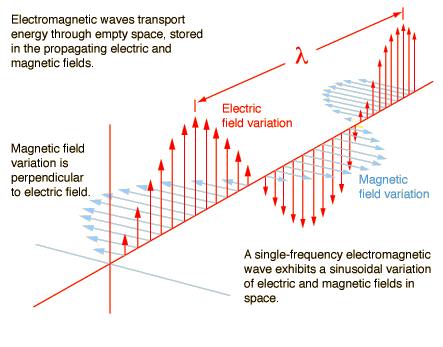
Electromagnetic waves are self-propetuating in that the electric field creates a magnetic field which re-creates the electric field. All EM waves travel at the speed of light and their frequency corrisponds to how fast the radiation changes polarity. The speed of the wave (c = 3*10^8 m/s) is equal to the frequency * wavelength. The wavelength of Terahertz radiation is between 1mm and
Xrays, Ultra-violet, Visible Light, Infared, Microwave, Radar, UHF, VHF and FM/AM radio all corrispond to different frequencies of electromagnetic radiation with wavelengths from 10 picometers to 10 kilometers. If you want to know more take a physics course on electromagnetism, as it is very interesting material. -
Re:Three Mile Island vs Chernobyl
The differences between TMI and Chernobyl are essentially those of design and the ways in which they affected the disaster.
Unlike TMI, Chernobyl almost seemed to be "how dumb can we be and get away with it". (See the quote: "like airplane pilots experimenting with the engines in flight".) -
Re:Three Mile IslandRight in principle, wrong in detail:
In the US reactors use deuterium(heavy water) as a moderator
No, the US reactors use light water as a coolant and moderator.The Canadians use heavy water in the Candu design.
For the details of what happened at Chernobyl see
-
May not mean anything
It may not be anything but a statistical anomoly. How we date and locate things has always fascinated me. I.e. this is older because it is underneath this other thing. This volcanic rock is this old because there is this much of a potasium isotope present. We have been acurately recording radiometrics for how long now? 20-30 years? (I know we have been recording them longer but not to the accuracy we can today) So think about the statistics: We look at the decay across 30 years and immediately say it must have a half life of 1.251 billion years? excuse me but thats a pretty small sample rate for my tastes. THis example uses K-AR but that just because I found google hits faster than for carbon isotopes
-
Re:How about foil-lined bags?Who told the criminals about Faraday cages?
What is a Faraday Cage?
A Faraday Cage is the phenomenon that occurs when you surround an object with a conductor (read: metal), basically stopping all charge from entering/exiting conductor.
Here is a simple decution of why:
Gauss's Law states when a conductor is charged the charge resides on the surface of the object--with a solid metal sphere, all the charge would be sitting on the outside surface.
Now imagine a hallow sphere: The charge can only be on the surface of an object, therefore this allows no charge 'inside' the sphere.Examples in everyday life:
->Lightning strikes your car
-> Lightning strikes a plane. (Studies say by average, every plane in the US is hit by lightning once a year)
-> Your Cell phone gets poor reception in basements and lower floors of buildings because of the rebar in the concrete.I found a cool app. of Faraday's Cage where you control the charge--really helpful if you still don't get it.
-
Re:Umm...
Ampere's law says that the integral of the magnetic field aver a closed curve is equal to the intensity of the current passing through the curve.
Since the circumference of a circle is proportional to its radius, low-frequency magnetic fields are proportional to the inverse radius from their source.
-
Re:Get a fan.
No. Sound is additive. While you create one noise with the fan, you still have the original noise.
Going stictly by physics, that's correct. But people hear things based on psychoacoustics, and a sufficiently loud fan WILL prevent you from hearing quiet keypresses and mouse clicks (see this page for an explanation, including mathematical formulas).
The people using IM with sound probably have their speakers too loud. Go over to their desk when they're not around, and turn the speakers down or off. -
Re:Not the point!
Ahem...NAND is the universal gate for all you youngsters...(I learned to program on keypunch machines...Ibm 360 assembler...anyone else out there familiar with that?
Check it out: Universal gate
And I definitely agree that only those who understand (not necessarily use) assembly are the ones who truly understand how a computer works...today's "programmers", raised on high level languages, produce mainly junk (exemplis gratis - MS Windows
CdnYoda (too lazy to login -
Re:Not the first doughnut element
How the hell was this determined? Particularly the wobbly Uranium nucleus. Is it just a theory based on mathematical predictions, or is it actually based on direct observations like X-ray, neutron or electron diffraction studies?
Yes.
A number of experimental tools are available for nuclear shape determination:
-The electric quadrupole moment
-Neutron scattering experiments
-Giant dipole resonance
-Momentum distributions of collision fragments
In principle the nucleons can be approximated as particles existing in a square potential well, defined by the positions of all the other particles. Solving for a wave function in a potential well like that reveals a set of solutions with associated quantum numbers, which turn out to be somewhate analogous to those calculated for the hydrogen atom with its inverse-square potential, and which we can identify in the energy levels and spectra of real, nonidealized nuclei.
Things are complicated by the fact that the potential within a nucleus is not strictly definable as a potential. It is created by the sum of the nuclear and electromagnetic forces and these fall off at different rates. The nuclear force is short range, but the electromagnetic force reaches all the way across the nucleus. So when they reach a certain size you see the effects of the charge buildup. Large scale movements of particles through the nucleus become evident, and sometimes pieces even break off if merely poked by a slow neutron. Your skepticism is not unreasonable. In fact researchers had a hard time believing their own experiments when they exposed uranium to neutrons and suddenly had to explain the appearance of barium. -
Re:Not the first doughnut element
I confess I have no idea what shape the average nucleus is - not that much of a physicist but neutrons in orbitals - what are these orbitals orbiting precisely??
I refer you to the shell model of the nucleus. Maybe I should have called them "shells" and not "orbitals". Still, the nucleus is not a still life like a bunch of grapes. Each particle is moving around in a shell with an identifiable set of quantum numbers.
Oxygen has 8 protons, (for the most part) 8 neutrons and (in the stable state) 8 electrons - the electrons are arranged so that there are two on the internal 1s orbital then two in the 2s and four more in the 2p orbital - if this was filled it would have 6 and would then be an O(2- superscript) ion... the bit about orbit shapes would seem to refer to d and f orbitals but well I got a bit lost in the bs science.
Look, these are the nuclear magic numbers: 2,8,20,28,50,82,126. 2 is helium. 8 is oxygen. There is no point in arguing about it.
-
Re:Quantums vs. PressureNo.. If you examine shroedingers equation you'll see that there is a term for the constraining potential, U(x,y,z).
While it is difficult to solve this equation for any complicated systems, we can see that the constraining potential is dependant on the pressure of the gas since the atoms in the fluid would be closer and that would mean the strength of the van de walls force between them would be increased.
At some critical pressure and tempreture, these forces would change the shape of the constraining potential enough to make forming a liquid energetically favourable.So, far from quantum mechanics being nullified the result is expected by it.
Simon.
-
Re:Flying Clocks
While not 100%, I'm fairly certain that atomic clocks are in fact precise enough for it to be an issue, since this link cites succesful experiments with it in 1971.
-
Re:Suck at blue something horrid.
Yes, there is a reason for this... The blue-sensitive cones make up about 2% of the total cones in your eye.
However there is another significant aspect of blue. Because of the way the color sensitivity of your cones works, you are particular good at discriminating between different shades of blue.
This article is what you get when you give someone with no formal education in science and research undeserved attention. It's already well known that blue contributes very little to your perception of intensity, thus it is difficult to see detail in a blue image because it lacks contrast. -
Re:Suck at blue something horrid.
Yes, there is a reason for this... The blue-sensitive cones make up about 2% of the total cones in your eye.
However there is another significant aspect of blue. Because of the way the color sensitivity of your cones works, you are particular good at discriminating between different shades of blue.
This article is what you get when you give someone with no formal education in science and research undeserved attention. It's already well known that blue contributes very little to your perception of intensity, thus it is difficult to see detail in a blue image because it lacks contrast.