Slashdot Mirror
Domain: harvard.edu
Stories and comments across the archive that link to harvard.edu.
Stories · 425
-
Star Wars Takes Over Harvard Commencement
An anonymous reader writes "Harvard University celebrated its 356th Commencement on Thursday. It is tradition at Harvard is to have an undergraduate deliver a Latin Salutatory address. This year's speaker, Charles Joseph McNamara, delivered an address all about Star Wars in Latin! TheForce.net has a write-up of the event, and the speaker was really hilarious. He apparently doesn't like Star Wars that much, but it's still awesome. The video is available online, and you too can see him do a Yoda voice and make light-saber motions ... in front of over 30,000 people. The speech is under "Morning Exercises" on the Harvard site. The Latin Oration begins at about 1:09:30." -
How to Save the Internet
An anonymous reader writes "An article up at the Harvard Business Review's website by Jonathan Zittrain, one of the founders of the Berkman Center, discusses how the desire to clamp down on Internet openness can be avoided. From the piece: 'Those who provide content and services over the Internet have lined up in favor of "network neutrality," by which ISPs would not be permitted to disfavor certain legitimate content that passes through their servers. Similarly, those who offer open APIs on the Internet ought to be application neutral, so all those who want to build on top of their interfaces can rely on certain basic functionality. Generative systems offer extraordinary benefits. As they go mainstream, the people using them can share some sense of the experimentalist spirit that drives them.'" -
On Diamond-Based Quantum Computing
Roland Piquepaille writes "Quantum computing is usually associated with extremely low temperatures. Physicists at Harvard University have shown that diamonds can be used to create stable quantum computing building blocks at room temperature. A nitrogen vacancy in diamond could lead to quantum registers able to store or retrieve data. '"The problem is, what makes single nuclear spin so stable - its weak interaction with its surroundings - also prevents us from directly manipulating it," Lukin says. "How do you control something that can't interact with anything?" You do it gingerly and indirectly, the Harvard physicists report in Science. They found that nuclear spins associated with single atoms of carbon-13 - which make up some 1.1 percent of natural diamond - can be manipulated via a nearby single electron whose own spin can be controlled with optical and microwave radiation.'" -
First Map of an Extrasolar Planet
jiawen writes "Data from the Spitzer Space Telescope has been used by researchers to make the first-ever map of an extrasolar planet. It's a weather map, more precisely, showing temperature variations over the surface of a Hot Jupiter. It really is hot: even the coldest regions are about 1200 degrees F." -
Harvard Law Professor Urges University to Fight RIAA
NewYorkCountryLawyer writes "Distinguished Harvard University Law School Professor Charles Nesson has called upon Harvard University to fight back against the RIAA and stand up for its students, writing 'Seeking to outsource its enforcement costs, the RIAA asks universities to point fingers at their students, to filter their Internet access, and to pass along notices of claimed copyright infringement. But these responses distort the University's educational mission. ...[W]e should be assisting our students both by explaining the law and by resisting the subpoenas that the RIAA serves upon us. We should be deploying our clinical legal student training programs to defend our targeted students.'" -
From Bess to Worse
Frequent Slashdot contributor Bennett Haselton writes " From about 1996 to 2003, there were regular reports listing examples of sites stupidly blocked by blocking software. The genre has tapered off recently, probably as a result of the Supreme Court ruling in 2003 that the Children's Internet Protection Act (CIPA) was constitutional, requiring blocking software in schools and libraries that receive federal funds, despite all the evidence of over-blocking presented at the trial. The last high-profile story about a site blocked by blocking software was about the blocking of BoingBoing almost a year ago. But the lack of recent reports on blocking software errors doesn't mean that the software has gotten better." The rest of his essay follows.One product that generated several reports over the years was "Bess, the Internet Retriever" from N2H2, which has since been bought out by Secure Computing, which also makes a blocking program called SmartFilter (the one that blocked BoingBoing) and now sells "SmartFilter, Bess Edition" which uses the same database as Bess. Different organizations and individuals published a series of investigative reports about Bess from 1997 until 2002, listing sites about gay rights, eating disorders, and other subjects that were blocked as "pornography". In Ben Edelman's supplemental report, submitted as testimony in the CIPA trial, he listed examples of erroneously blocked sites that he had reported to N2H2 in his first expert report, and which were still being blocked five months later.
Since Bess represents a set of data points showing how the accuracy of a blocking program can change, or not change, over the years, recently I began testing it again. I didn't know whether to expect it to be better or worse. On the one hand, advances in technology and greater revenue to censorware companies could have caused the software to improve. On the other hand, the number of Web pages, and the rate at which dynamic sites like blogs change content every day, has exploded. The result? I'm still tabulating data, but it looks as if the accuracy rate is roughly the same as it was in 2000, when about 30% of blocked sites were obvious errors. Then and now, I found most of the errors by starting with a large list of URLs culled from search engines and other sources, and simply running them through the software to see what was blocked.
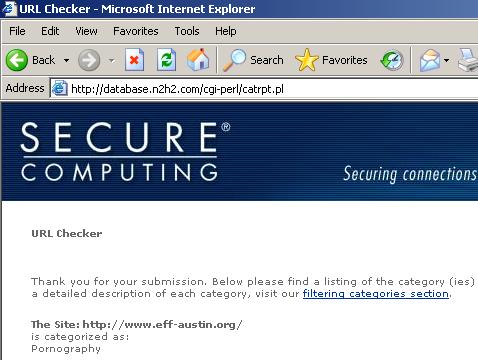
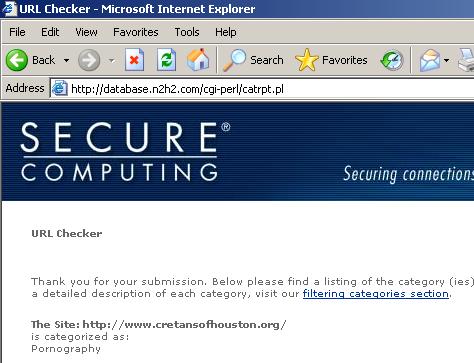
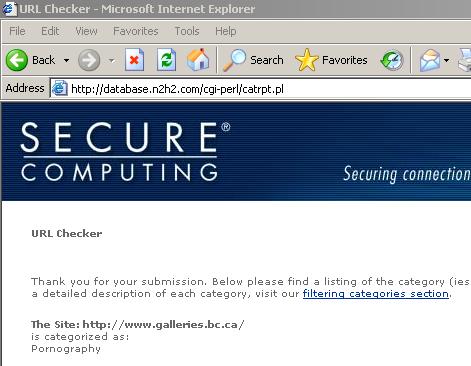
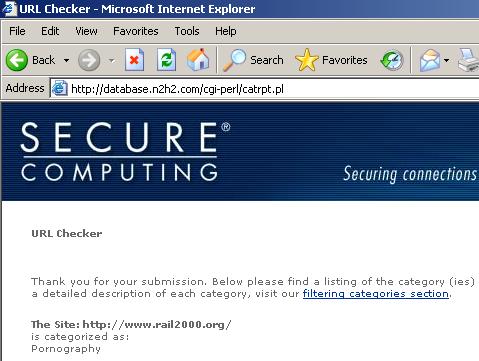
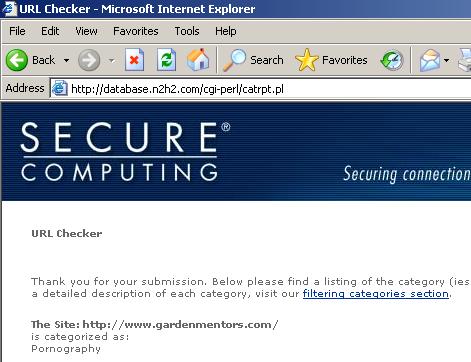
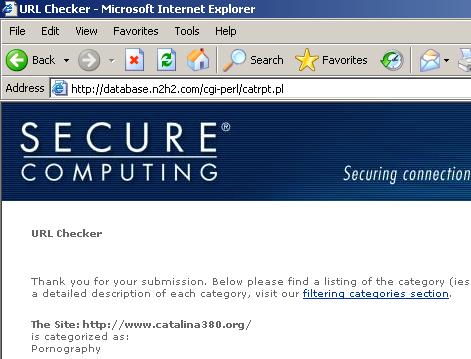
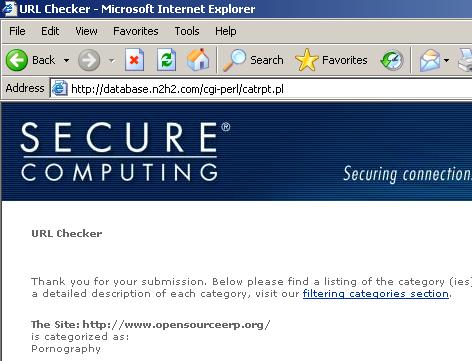
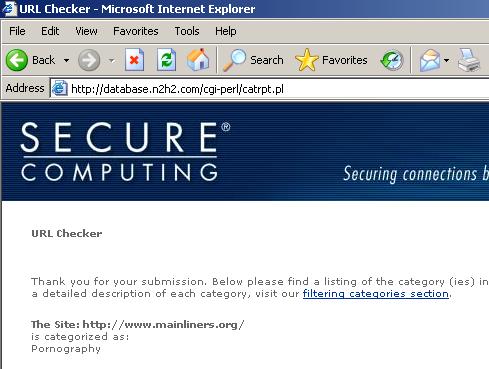
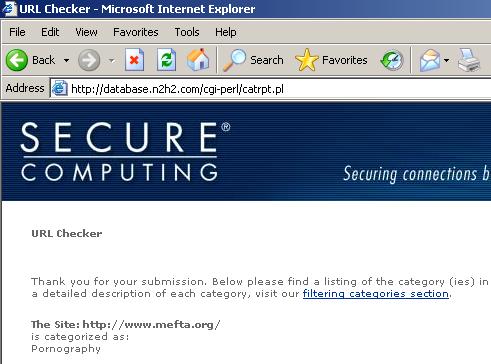
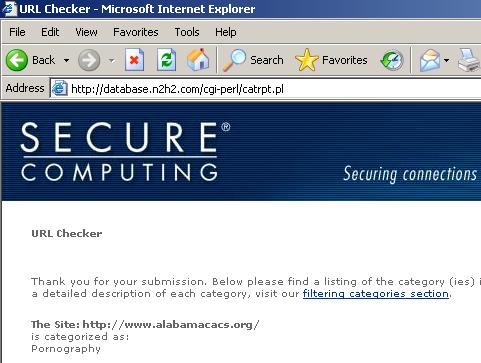
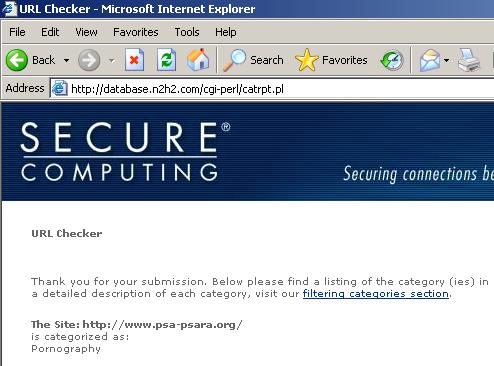
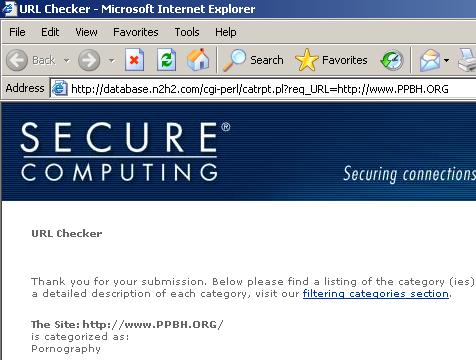
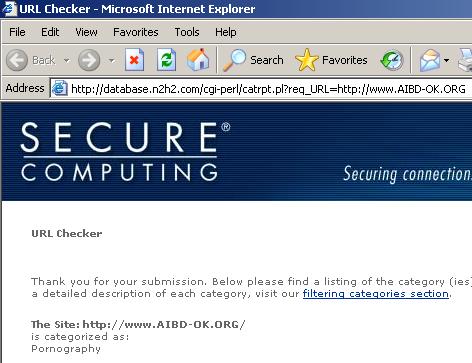
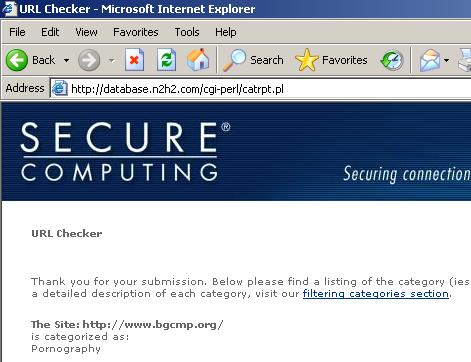
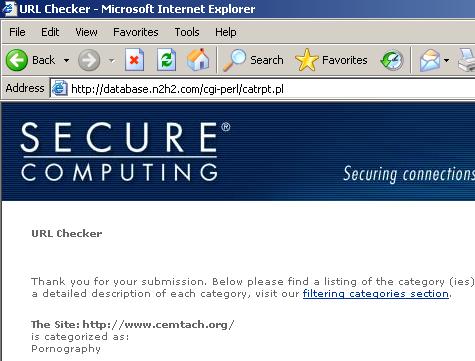
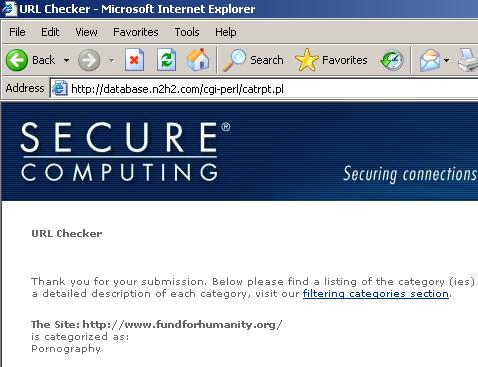
Here is a partial list of some of the questionable categorizations made by Bess; as of this writing, all of the following sites are listed as "Pornography" when you look them up on Secure Computing's Bess lookup form. (This is not just a fluke of the lookup tool; I tested against a copy of the software that all of these sites really were blocked.) The "screen cap" link next to each site links to a snapshot of the results taken from the lookup form (you can check on http://database.n2h2.com/ to see if the page is still returning the same results, although the more obvious errors will probably be fixed after this article is published):
- The Electronic Frontier Foundation, Austin chapter (screen cap)
- Cretans of Houston (screen cap). That's Cretans, as in "people from the island of Crete". Not to be confused with the Cretins of Houston, located here.
- The Rhode Island Coalition Against Domestic Violence (screen cap)
- The website of the public art galleries of British Columbia, Canada (screen cap)
- Rail2000, now the Bay Rail Alliance, a consumer group lobbying for a San Francisco regional rail system (screen cap)
- Rainbow Service Organization, a gay rights advocacy group (screen cap)
- GardenMentors.com, a custom gardening services company in Seattle (screen cap)
- A web site for Catalina 380 series boats (screen cap)
- Open Source ERP, a site promoting open source software for enterprise resource planning and customer relationship management (screen cap)
- The Bryn Mawr Mainliners, a barbershop harmony group (screen cap)
- Timber Trails, an outdoor recreation site (screen cap)
- The MEFTA Institute: "Middle East Free Trade Areas for Business Peace" -- world peace through cheap oil! (screen cap)
- Topple Rummy, a (somewhat out-of-date) site calling for the ouster of Donald Rumsfeld (screen cap)
- The Alabama Network of Children's Advocacy Centers (screen cap)
- PSARA, a non-profit organization for training cruise travel agents (screen cap)
- Park Place Behavioral Health Care, a non-profit mental health care agency (screen cap)
- The Oklahoma chapter of the American Institute of Building Design (screen cap)
- The Boys & Girls Clubs of Metropolitan Phoenix (screen cap)
- CEMTACH -- Computational ElectroMagnetics Theory-Algorithm-Code-Hardware. "Our goal is to develop systems simulations capabilities based on time-domain computational electromagnetics methods." Thanks for clearing that up. (screen cap)
- Fund for Humanity, a San Francisco non-profit supporting environmental organizations and organizations that assist the poor. (screen cap)
A long-standing point of contention while earlier reports about Bess were coming out, was whether every site on their blacklist had been reviewed by a human before being blocked. In 1998 the CEO testified before Congress that "All sites that are blocked are reviewed by N2H2 staff before being added to the block lists." However in their 2002 annual report the company finally admitted that not all sites were reviewed before being blocked: "Through automated categorization or human review, Web sites are identified as fitting into one or more of our categories". At one point an N2H2 employee also told me that when one site is blocked, they will often block all sites hosted on that machine or at that IP -- which of course means that those sites are also not reviewed before being blocked. In any case, it's possible to access some of these sites by IP address, such as the BC Art Galleries site via this link, or the or the Rhode Island Coalition Against Domestic Violence via this link -- so if they're not sharing their IP with other sites, that wouldn't explain how they got blocked either. Smartfilter spokesperson Tomo Foote-Lennox said that one other blocked URL that I found, http://www.arbiol.org/, was the result of an experiment N2H2 once did with fully automated website ratings.
Foote-Lennox added, "In general, we find that schools are VERY sensitive to under-blocking. The would rather block a whole lot of useful reference sites to avoid exposing one porn site." Probably true, although keep in mind we're talking about liability issues, not actual moral outrage. (If they were really morally outraged, they'd be trying to keep kids away from uncensored Internet access everywhere, not just in school! That is in fact the approach that schools take with things like drugs, which do inspire moral outrage because they really are harmful.) Perhaps what is needed is a law explicitly shielding schools from all liability for what students do or see on the Internet at school, if the faculty had no knowledge of it.
(Obligatory interstitial advertisement for common sense: I still don't see what the big deal is about porn anyway. Ask yourself: Why is it harmful to see a picture of a naked person, or even a picture of people having sex? And try to find an answer to that question that doesn't involve, "Lots of other people think so." That includes all variations like "Our society has determined...", "We as a people have decided...", which are just re-phrasings of "Lots of other people think so." I submit that if you disallow those variations of grownup-peer-pressure as an excuse, most people can't really come up with any reason at all.)
OK, flame-retardant suit off, lab coat back on. Previous reports have listed absurd examples of sites blocked by Bess, and looking at any one of those examples or the ones listed here, I'd say that in terms of public policy discussions -- specifically, whether a blocking software company should be trusted to decide what students can look at -- any one of these blocked sites would be more significant than, say, the blocking of BoingBoing which got so much attention. BoingBoing got blocked because of a non-sexual picture of a bare breast on the cover of one of the books they reviewed -- and in fact they were blocked only in the "nudity" category, which includes only "non-pornographic images of the bare human body". So the block on BoingBoing really only revealed that Secure Computing was a bit heavy-handed. (The real problem is that SmartFilter has the category for non-pornographic nudity blocked by default, even though the CIPA filtering law certainly doesn't require schools to block non-pornographic artistic images!) On the other hand, the fact that EFF Austin and the Rhode Island Coalition Against Domestic Violence are currently blocked as "Pornography", suggests that in many instances the blocking companies have nobody at the controls at all. To focus on stupid-but-not-completely-insane blocks like BoingBoing is letting them off easy.
So why did the laundry lists of blocked sites released over the years never become as widely known as BoingBoing, or the guffaw-inducing examples like "Beaver College", which had to change their name in part because of students reportedly being blocked from accessing their website? I think it's because the news favors a good "punch line" -- a fact that anybody can understand that makes us feel smarter than the computers making these dumb mistakes. "Oh, I get it, it was blocked because it was called Beaver College!" But the "punch line" anecdotes are precisely the ones that let the blocking companies off lightly, because it gives them a plausible-sounding excuse for making an error. On the other hand, when the Rhode Island Coalition Against Domestic Violence gets blocked as "Pornography", that could probably force the blocking company to answer some tough questions if it got more press, but there's no good punch line there, so the story just fizzles.
So, while I'm looking through the rest of the data, let me try and come up with some punch lines for reporters to make these blocked sites newsworthy. OK: Why was GardenMentor.com blocked? To keep kids away from all the dirty bitches and hoes! Get it? Ha ha! Why was the Catalina 380 yachting site blocked from kids? Because teens are too vulnerable to pier pressure! Hey, where are you going?
-
From Bess to Worse
Frequent Slashdot contributor Bennett Haselton writes " From about 1996 to 2003, there were regular reports listing examples of sites stupidly blocked by blocking software. The genre has tapered off recently, probably as a result of the Supreme Court ruling in 2003 that the Children's Internet Protection Act (CIPA) was constitutional, requiring blocking software in schools and libraries that receive federal funds, despite all the evidence of over-blocking presented at the trial. The last high-profile story about a site blocked by blocking software was about the blocking of BoingBoing almost a year ago. But the lack of recent reports on blocking software errors doesn't mean that the software has gotten better." The rest of his essay follows.One product that generated several reports over the years was "Bess, the Internet Retriever" from N2H2, which has since been bought out by Secure Computing, which also makes a blocking program called SmartFilter (the one that blocked BoingBoing) and now sells "SmartFilter, Bess Edition" which uses the same database as Bess. Different organizations and individuals published a series of investigative reports about Bess from 1997 until 2002, listing sites about gay rights, eating disorders, and other subjects that were blocked as "pornography". In Ben Edelman's supplemental report, submitted as testimony in the CIPA trial, he listed examples of erroneously blocked sites that he had reported to N2H2 in his first expert report, and which were still being blocked five months later.
Since Bess represents a set of data points showing how the accuracy of a blocking program can change, or not change, over the years, recently I began testing it again. I didn't know whether to expect it to be better or worse. On the one hand, advances in technology and greater revenue to censorware companies could have caused the software to improve. On the other hand, the number of Web pages, and the rate at which dynamic sites like blogs change content every day, has exploded. The result? I'm still tabulating data, but it looks as if the accuracy rate is roughly the same as it was in 2000, when about 30% of blocked sites were obvious errors. Then and now, I found most of the errors by starting with a large list of URLs culled from search engines and other sources, and simply running them through the software to see what was blocked.
Here is a partial list of some of the questionable categorizations made by Bess; as of this writing, all of the following sites are listed as "Pornography" when you look them up on Secure Computing's Bess lookup form. (This is not just a fluke of the lookup tool; I tested against a copy of the software that all of these sites really were blocked.) The "screen cap" link next to each site links to a snapshot of the results taken from the lookup form (you can check on http://database.n2h2.com/ to see if the page is still returning the same results, although the more obvious errors will probably be fixed after this article is published):
- The Electronic Frontier Foundation, Austin chapter (screen cap)
- Cretans of Houston (screen cap). That's Cretans, as in "people from the island of Crete". Not to be confused with the Cretins of Houston, located here.
- The Rhode Island Coalition Against Domestic Violence (screen cap)
- The website of the public art galleries of British Columbia, Canada (screen cap)
- Rail2000, now the Bay Rail Alliance, a consumer group lobbying for a San Francisco regional rail system (screen cap)
- Rainbow Service Organization, a gay rights advocacy group (screen cap)
- GardenMentors.com, a custom gardening services company in Seattle (screen cap)
- A web site for Catalina 380 series boats (screen cap)
- Open Source ERP, a site promoting open source software for enterprise resource planning and customer relationship management (screen cap)
- The Bryn Mawr Mainliners, a barbershop harmony group (screen cap)
- Timber Trails, an outdoor recreation site (screen cap)
- The MEFTA Institute: "Middle East Free Trade Areas for Business Peace" -- world peace through cheap oil! (screen cap)
- Topple Rummy, a (somewhat out-of-date) site calling for the ouster of Donald Rumsfeld (screen cap)
- The Alabama Network of Children's Advocacy Centers (screen cap)
- PSARA, a non-profit organization for training cruise travel agents (screen cap)
- Park Place Behavioral Health Care, a non-profit mental health care agency (screen cap)
- The Oklahoma chapter of the American Institute of Building Design (screen cap)
- The Boys & Girls Clubs of Metropolitan Phoenix (screen cap)
- CEMTACH -- Computational ElectroMagnetics Theory-Algorithm-Code-Hardware. "Our goal is to develop systems simulations capabilities based on time-domain computational electromagnetics methods." Thanks for clearing that up. (screen cap)
- Fund for Humanity, a San Francisco non-profit supporting environmental organizations and organizations that assist the poor. (screen cap)
A long-standing point of contention while earlier reports about Bess were coming out, was whether every site on their blacklist had been reviewed by a human before being blocked. In 1998 the CEO testified before Congress that "All sites that are blocked are reviewed by N2H2 staff before being added to the block lists." However in their 2002 annual report the company finally admitted that not all sites were reviewed before being blocked: "Through automated categorization or human review, Web sites are identified as fitting into one or more of our categories". At one point an N2H2 employee also told me that when one site is blocked, they will often block all sites hosted on that machine or at that IP -- which of course means that those sites are also not reviewed before being blocked. In any case, it's possible to access some of these sites by IP address, such as the BC Art Galleries site via this link, or the or the Rhode Island Coalition Against Domestic Violence via this link -- so if they're not sharing their IP with other sites, that wouldn't explain how they got blocked either. Smartfilter spokesperson Tomo Foote-Lennox said that one other blocked URL that I found, http://www.arbiol.org/, was the result of an experiment N2H2 once did with fully automated website ratings.
Foote-Lennox added, "In general, we find that schools are VERY sensitive to under-blocking. The would rather block a whole lot of useful reference sites to avoid exposing one porn site." Probably true, although keep in mind we're talking about liability issues, not actual moral outrage. (If they were really morally outraged, they'd be trying to keep kids away from uncensored Internet access everywhere, not just in school! That is in fact the approach that schools take with things like drugs, which do inspire moral outrage because they really are harmful.) Perhaps what is needed is a law explicitly shielding schools from all liability for what students do or see on the Internet at school, if the faculty had no knowledge of it.
(Obligatory interstitial advertisement for common sense: I still don't see what the big deal is about porn anyway. Ask yourself: Why is it harmful to see a picture of a naked person, or even a picture of people having sex? And try to find an answer to that question that doesn't involve, "Lots of other people think so." That includes all variations like "Our society has determined...", "We as a people have decided...", which are just re-phrasings of "Lots of other people think so." I submit that if you disallow those variations of grownup-peer-pressure as an excuse, most people can't really come up with any reason at all.)
OK, flame-retardant suit off, lab coat back on. Previous reports have listed absurd examples of sites blocked by Bess, and looking at any one of those examples or the ones listed here, I'd say that in terms of public policy discussions -- specifically, whether a blocking software company should be trusted to decide what students can look at -- any one of these blocked sites would be more significant than, say, the blocking of BoingBoing which got so much attention. BoingBoing got blocked because of a non-sexual picture of a bare breast on the cover of one of the books they reviewed -- and in fact they were blocked only in the "nudity" category, which includes only "non-pornographic images of the bare human body". So the block on BoingBoing really only revealed that Secure Computing was a bit heavy-handed. (The real problem is that SmartFilter has the category for non-pornographic nudity blocked by default, even though the CIPA filtering law certainly doesn't require schools to block non-pornographic artistic images!) On the other hand, the fact that EFF Austin and the Rhode Island Coalition Against Domestic Violence are currently blocked as "Pornography", suggests that in many instances the blocking companies have nobody at the controls at all. To focus on stupid-but-not-completely-insane blocks like BoingBoing is letting them off easy.
So why did the laundry lists of blocked sites released over the years never become as widely known as BoingBoing, or the guffaw-inducing examples like "Beaver College", which had to change their name in part because of students reportedly being blocked from accessing their website? I think it's because the news favors a good "punch line" -- a fact that anybody can understand that makes us feel smarter than the computers making these dumb mistakes. "Oh, I get it, it was blocked because it was called Beaver College!" But the "punch line" anecdotes are precisely the ones that let the blocking companies off lightly, because it gives them a plausible-sounding excuse for making an error. On the other hand, when the Rhode Island Coalition Against Domestic Violence gets blocked as "Pornography", that could probably force the blocking company to answer some tough questions if it got more press, but there's no good punch line there, so the story just fizzles.
So, while I'm looking through the rest of the data, let me try and come up with some punch lines for reporters to make these blocked sites newsworthy. OK: Why was GardenMentor.com blocked? To keep kids away from all the dirty bitches and hoes! Get it? Ha ha! Why was the Catalina 380 yachting site blocked from kids? Because teens are too vulnerable to pier pressure! Hey, where are you going?
-
Harvard Physicists Make Light Dance
tetrikphimvin and others clued us to the latest work by Harvard's Lene Vestergaard Hau, being published today in the journal Nature. The NYTimes has a good layman's overview of how Hau's team encoded a light beam in a clump of atoms and later reconstituted it elsewhere. The Harvard Gazette offers additional details, a photo, and video links. -
Why You & Yahoo Should Like This Human Rights Law
Regular contributor Bennett Haselton has written in to say that "The Global Online Freedom Act, introduced last year during a firestorm of controversy over American companies cooperating with totalitarian governments in China and elsewhere, was introduced this month as the Global Online Freedom Act of 2007. When Chris Smith (R-NJ) first introduced the law in 2006, Yahoo was under fire for recently turning over information to Chinese authorities that led to the arrest of a political dissident, Microsoft was attacked for removing pages from MSN Spaces China at the behest of the government, Google was being criticized for removing political sites from search results displayed to China, and Cisco was accused of helping to enable Chinese filtering of the Web. All four corporations testified at a February 2006 House hearing during which Representative Tom Lantos summed up the mood of many of his colleagues by telling the companies, "I do not understand how your corporate leadership sleeps at night." The companies protested that they had no choice but to comply with local Chinese laws, but that they were troubled by their own actions, and -- in a rarity for individual tech companies, much less for a chorus -- they all invited the U.S. government to play a bigger role, while being vague about what the role should be."GOFA would create a U.S.-government-designated list of "Internet restricting countries" and would in most cases prohibit U.S.-based companies from censoring content or turning over users' information to the governments of those countries. Do these companies want GOFA to pass? And is GOFA a good law? I think, yes and yes, but the answers are more complicated than they seem.
With American "collaboration" less in the news, GOFA made less of a splash when it was re-introduced this year, but it is still the subject of spirited debate. Reporters Without Borders, Amnesty International, and other human rights groups have already signed a statement supporting the July 2006 version of the bill (nearly identical the 2007 version). But blogger-journalist Rebecca MacKinnon argues that by creating a government-maintained list of "Internet censoring countries", the law falls short of calling for support of free speech in all countries (the initial list, for example, includes Iran and China, but leaves out notorious human rights violator and net-censor Saudi Arabia). Danny O'Brien of the EFF backs this position as well, and also argues the organization's long-standing position that "code is speech" and that filtering software should not be subject to export regulations that are proposed in the law.
I agree with MacKinnon that instead of using a list of "Internet restricting countries", we should require the same standards of U.S. companies wherever they do business, or at least, stop playing silly games like leaving Saudi Arabia off of a list of human rights violators because Bush is friends with the ruling family. I agree with the EFF that filtering software should be considered First-Amendment-protected speech like encryption software, and not be included on an export-prohibited "munitions" list. And for reasons listed below, I think that the law won't stop censoring countries from blocking any speech they want. But even with all of these qualifications, I think the law would be a step in the right direction, if only for the rules prohibiting companies from turning over users' personal information to the governments of countries like China and Iran. It's painful to give a pass to countries like Germany that also censor political speech, but I think that the situation is so much worse in places like China that we should do what we can in the short term. And for reasons I'll get into, I think that Microsoft, Yahoo, Google and Cisco are secretly hoping that a law like GOFA does get passed -- even if they can't come out and say so.
First, what the law does not do: There is still nothing to stop a U.S. company from blocking or removing legal, political content at the request of a foreign government. Section 204 says only that American content-hosting companies and content-filtering companies have to provide the U.S. government with a list of sites that have been removed or blocked at the behest of a censoring country.
Section 205 does say that U.S. companies may not block or remove sites that are operated by the U.S. government, or by any entity that receives grants from the International Broadcasting Bureau to help defeat foreign censorship. Presumably that would include Peacefire, at least during the periods when we're under contract to the IBB to develop the Circumventor software (but before you start calling me Hallibennett, I'm not working for the IBB right now, and it was my own idea to write this). So the American government, while requiring schools to block us in the U.S., would actually be helping to get us un-blocked in China and Iran! But Section 205 only says that a U.S. business may not block or shut down such sites. As far as I can tell, that means if the Cisco engineer on site in China sets up their routers for them, the Cisco engineer can't put VOANews.com on the block list. But then the Chinese official can walk across the room and add it to the list himself, can't he? Which is almost certainly what they'll do, since the routers are in their country.
So, I think the regulations against Internet blocking will be easy for foreign governments to ignore. But where the law could make a difference is in the prohibition against turning over users' personal data to law enforcement in censoring countries. Section 201 says that servers located in a censoring country cannot contain personally identifiable user information (so that the local police cannot simply storm in and seize the data). Section 202 says that American companies can only turn information over to law enforcement of a censoring country if the information is needed "for legitimate foreign law enforcement purposes as determined by the Department of Justice". MacKinnon has criticized this aspect of the law as well -- "If Americans don't want the DOJ to have access to their user information, why should anybody else?" Very true. But, even at the lowest point of public confidence in the Department of Justice, I think most people living outside of fortified compounds stocked with beef jerky and gold bullion, can agree that the U.S. DoJ has more integrity and legitimacy than the government of China, and that such a rule would mean fewer Chinese dissidents going to jail.
What do the affected U.S. companies think of the law? Microsoft, Yahoo, and Cisco did not respond to requests for comment. A Google PR person replied to say, "We welcome intiatives that expand access to information and protect the rights of users across the globe. At the same time, we remain concerned that legislation in this area can have unintended consequences, so we intend to study any such proposals closely, and work with proponents and others to reach the right outcome." When I replied that the Global Online Freedom Act had been proposed more than a year ago and had been online in its current form since June 2006, presumably enough time to "study such a proposal closely" and take a position on it, he said they would stick with that statement for now. (In his e-mail, he actually put quote marks around the company's statement, which I thought was a nice dry touch.)
But past statements from the respective companies have indicated they would be amenable to such a law. Bill Gates, never one to be shy about criticizing government regulation that he disagreed with, was asked in a February 2006 interview with the London Times, "Should the US government establish guidelines to regulate how internet companies deal with censorship in countries like China?" and answered, "I think something like the Foreign Corrupt Practices Act has been a resounding success in terms of very clearly outlining what companies can't do and other rich countries largely went along with that." At the February 2006 house hearings to discuss American companies' cooperation with overseas censors, representatives from all companies indicated that they actually wanted the government to play a bigger role -- they were vague about what such a role would be, but this was only a month after the first draft of the Global Online Freedom Act had been proposed, the only such law on the table at the time.
At first this might seem paradoxical -- why would companies seem amenable to, even supportive of, laws that would restrict what they can do? But it actually makes sense if you consider their negotiating position with the Chinese government. Currently, the Chinese censors can tell Microsoft, Yahoo, and Google that they either have to either play by the Chinese rules or get out, and the censors know that the companies will comply (without even necessarily feeling guilty about it -- the companies can always say that the Chinese people are better off with a censored version of their services than no access at all).
But if the companies' hands are tied by U.S. law, then they can basically present the Chinese government with a take-it-or-leave-it deal: You can use our e-mail and messenger and blog services, just know that our government won't let us turn over users' personal information if you ever want it. The Chinese censors are presumably coming from the point of view that they'd rather have a controlled Internet, but that it's more important to reap the economic benefits of having the Internet in their country, even if some control is lost (after all, if they didn't believe that, they wouldn't have connected to the Internet in the first place). Hence it's not likely that they'd throw out Yahoo Mail and Google search and MSN Messenger when so many users depend on these and use them for business as well as personal use. (Even if there are Chinese-made alternatives, there would be the huge cost of switching everyone over, and no longer being able to use the old tools to communicate with American companies.) So a law controlling the actions of U.S. companies would very probably allow them to keep doing business in censored countries, while giving them an excuse not to turn over users' data.
But, that might not work if it looks like the companies pushed too hard for the law themselves. If the Chinese see Yahoo fighting tooth and nail to pass a law that restricts what information Yahoo can hand over to China, the Chinese censors could take that as a slap in the face, and punish Yahoo for defying them even after the law is passed that prohibits Yahoo from cooperating. "Oh, you can't give us that information because of the law? This law right here that you lobbied for?"
So, when the general counsel of Yahoo says, "Ultimately, the greatest leverage lies with the U.S. government"; when the Vice President of Google tells Congress, "And certainly also, finally, there is a role for government. We do need your help, and you can help us"; when the associate general counsel of Microsoft testifies, "It is, therefore, the responsibility of governments, with the active leadership of the United States, to seek to reduce or reconcile these differences", I think what we're hearing are subtly encoded messages saying, "Pass this law, or something like it; we just can't look like we wanted it to pass." So, Congress should give them what they want, even if they can't ask for it directly. And at the same time they would be helping users in censored countries all around the world, before the next one gets sent to jail because an American company turned over their information.
-
Behavior May Influence Evolution
eldavojohn writes "Pending your beliefs about evolution, National Geographic is running an interesting article on the influences of behavior on evolution. The study supports the controversial idea that an animal's behavior in response to environmental change can spur evolutionary adaptations. By adding a predator to an island where a species of lizards lived with no predators, they witnessed a quick shift in the average length of legs on the lizards. Long legs meant to escape were useless against the new larger predators while short legs became the dominant feature since they increased climbing ability (to trees the predators could not reach). For the finer details on the research, visit the Losos Lab Research Page." -
Shedding Light On the Black Art of IT Management
Cathy writes "An article by Harvard's Andrew McAfee tells nontechnical managers how not to get overwhelmed by the 'drumbeat' of IT projects. McAfee breaks down IT into three categories — functional, network, and enterprise — and says that this framework 'can also indicate which IT initiatives are going to be relatively easy to implement and on which projects executives should focus. In that light, IT management starts to look less like a black art and more like the work of the executive.'" -
Shedding Light On the Black Art of IT Management
Cathy writes "An article by Harvard's Andrew McAfee tells nontechnical managers how not to get overwhelmed by the 'drumbeat' of IT projects. McAfee breaks down IT into three categories — functional, network, and enterprise — and says that this framework 'can also indicate which IT initiatives are going to be relatively easy to implement and on which projects executives should focus. In that light, IT management starts to look less like a black art and more like the work of the executive.'" -
Research Supports "Snowball Earth" Hypothesis
u2boy_nl writes, "A new U.S. study finds evidence for 'Snowball Earth,' the hypothesis that the entire Earth was ice-covered for long periods on several occasions, most recently 600-700 million years ago. The icy conditions (Earth's oceans frozen completely with ice more than a kilometer thick) ended violently under extreme greenhouse conditions — snowballearth.org suggests the meltdown could have occurred in as little as 2,000 years. Snowball Earth challenges long-held assumptions regarding the limits of global change. Wikipedia has more on the hypothesis." -
"Xena" To Be Named Eris
rdwald writes, "After over a year of hanging in maybe-planet limbo, newly-classified 2003 UB313, nicknamed Xena, now has a permanent name: Eris, goddess of strife. Its moon will be named Dysnomia, after the goddess of lawlessness — in Greek mythology, Eris's daughter — certainly not a reference there... I don't think I'm alone when I say, 'Hail Eris! All hail Discordia!'" In the same IAU announcement (PDF), Pluto was given its official minor planet number: 134340. -
Dark Matter Exists
olclops writes "It's a big day for astrophysics. After much speculation, scientists now have conclusive proof of dark matter. This result doesn't rule out alternate gravity theories like MOND, but it does mean those theories will have to account for exotic forms of dark matter." -
Dealing with Phishing
Apu writes "SecurityFocus has published an interesting interview with Rachna Dhamija, co-author of the paper 'Why Phishing Works' and creator of Dynamic Security Skins (a plugin for Mozilla). She presented some very interesting results from her research efforts, for example 'simply showing a user's history information ("you've been to this website many times" or "you've never submitted this form before") can significantly increase a user's ability to detect a spoofed website and reduce their vulnerability to phishing attacks.' She also suggested to 'make it easy for users to personalize their interfaces. Look at how popular screensavers, ringtones, and application skins are — users clearly enjoy the ability to personalize their interfaces. We can take advantage of this fact to build spoof resistant interfaces.'" -
Dealing with Phishing
Apu writes "SecurityFocus has published an interesting interview with Rachna Dhamija, co-author of the paper 'Why Phishing Works' and creator of Dynamic Security Skins (a plugin for Mozilla). She presented some very interesting results from her research efforts, for example 'simply showing a user's history information ("you've been to this website many times" or "you've never submitted this form before") can significantly increase a user's ability to detect a spoofed website and reduce their vulnerability to phishing attacks.' She also suggested to 'make it easy for users to personalize their interfaces. Look at how popular screensavers, ringtones, and application skins are — users clearly enjoy the ability to personalize their interfaces. We can take advantage of this fact to build spoof resistant interfaces.'" -
Dealing with Phishing
Apu writes "SecurityFocus has published an interesting interview with Rachna Dhamija, co-author of the paper 'Why Phishing Works' and creator of Dynamic Security Skins (a plugin for Mozilla). She presented some very interesting results from her research efforts, for example 'simply showing a user's history information ("you've been to this website many times" or "you've never submitted this form before") can significantly increase a user's ability to detect a spoofed website and reduce their vulnerability to phishing attacks.' She also suggested to 'make it easy for users to personalize their interfaces. Look at how popular screensavers, ringtones, and application skins are — users clearly enjoy the ability to personalize their interfaces. We can take advantage of this fact to build spoof resistant interfaces.'" -
Avatar-Based Marketing
hempman writes "This article (which I wrote!) from the current issue of Harvared Business Review offers a new perspective on marketing real-world products in virtual worlds to virtual consumers with the aim of generating real-world revenue. It examines the frontier of marketing. Although companies are beginning to see the potential of marketing in 3D games and virtual worlds, it's important that they think not just about the 'where' of this new market but also about the 'who.' That is, when marketing in virtual worlds, do you target the flesh-and-blood user who controls the real-world wallet? Or do you target the wallet-wielding consumer's avatar, which likely represents a powerful but hidden aspect of his personality and could influence his purchases -- or at least provide a window into his hidden desires and preferences?" -
Avatar-Based Marketing
hempman writes "This article (which I wrote!) from the current issue of Harvared Business Review offers a new perspective on marketing real-world products in virtual worlds to virtual consumers with the aim of generating real-world revenue. It examines the frontier of marketing. Although companies are beginning to see the potential of marketing in 3D games and virtual worlds, it's important that they think not just about the 'where' of this new market but also about the 'who.' That is, when marketing in virtual worlds, do you target the flesh-and-blood user who controls the real-world wallet? Or do you target the wallet-wielding consumer's avatar, which likely represents a powerful but hidden aspect of his personality and could influence his purchases -- or at least provide a window into his hidden desires and preferences?" -
Why Phishing Works
h0neyp0t writes "Harvard and Berkeley have released a study that shows why phishing attacks work (pdf). When asked if a phishing site was legit or a spoof, 23% of users use only the content of the website to make the decision! The majority of users ignore the address and SSL indicators in the browser. Some users think that favicons and lock icons in HTML are more important indicators. The paper hints that the proposed IE7 security indicators and multi-colored address bar will also suffer a similar fate. This study is brought to you by the people who developed the security skins Firefox extension." -
Are Marines Censoring Web Access for Troops in Iraq?
Gavin86 and others have submitted links to This Wonkette article (profanity warning) about the Marines Corps blocking access to some Web sites for their people in Iraq. This article was a follow-up to an earlier Wonkette post. Before I posted these links, I looked for verification of this problem but found nothing but links to Wonkette, so I cannot say for sure whether this is true. Hopefully, alert Slashdot readers (like you) will post confirmations if, indeed, there are any to be found. Meanwhile, if this is true, it's eerily reminiscent of an experience I had when I visited Saudi Arabia in January, 2004. The Wonkette post contains this list of sites blocked and not blocked, allegedly sent by a Marine serving in Iraq:- Wonkette - "Forbidden, this page (http://www.wonkette.com/) is categorized as: Forum/Bulletin Boards, Politics/Opinion."
- Bill O'Reilly (www.billoreilly.com) - OK
- Air America (www.airamericaradio.com) - "Forbidden, this page (http://www.airamericaradio.com/) is categorized as: Internet Radio/TV, Politics/Opinion."
- Rush Limbaugh (www.rushlimbaugh.com) - OK
- ABC News "The Note" - OK
- Website of the Al Franken Show (www.alfrankenshow.com) - "Forbidden, this page (http://www.airamericaradio.com/) is categorized as: Internet Radio/TV, Politics/Opinion."
- G. Gordon Liddy Show (www.liddyshow.us) - OK
- Don & Mike Show (www.donandmikewebsite.com) - "Forbidden, this page (http://www.donandmikewebsite.com/) is categorized as: Profanity, Entertainment/Recreation/Hobbies."
I spent several hours in my Riyadh hotel room one evening checking sites suggested to me by Slashdot coworker Jamie McCarthy via IRC (which was not blocked by the Saudi filters). Among them were sites decrying Holocaust denial, which were blocked, although many sites espousing the old Protocols of the Elders of Zion antisemitic lies were not.
A number of sites that talked about human rights -- especially women's rights -- were also blocked. Sites that glorified Islam were, of course, fine. Interestingly, Jamie and I found that some (but not all) sites that were blocked when the 2002 Harvard Law School article, Documentation of Internet Filtering in Saudi Arabia, was released had been unblocked by the time of my visit.
And when I met with Eyas S. Al-Hejery, the man in charge of Saudi Arabia's Internet Serice Unit and told him about some of the blocked sites Jamie and I had found, including several innocuous Israeli government ones, he agreeably unblocked them.
I have no way of knowing whether Eyas reblocked those sites as soon as I left his country, but he told me more than once that he did not, himself, decide which sites should be blocked but only reacted to complaints from Saudi Arabia's infamous religious police and submissions from concerned citizens, which he said numbered up to 200 per day, total, while he only received a "trickle" of requests to unblock sites.
Now comes a big question: If the charges of Marine Internet blockage are true, will the Marines unblock incorrectly-blocked Web sites as quickly as Eyas did in Saudi Arabia?
But first, another big questions must be answered: Is the Wonkette story true? It's been up and spreading around the Internet since March 1st, and no official Marine spokesperson has bothered to either debunk it or admit that yes, the Marine Corps is blocking Web sites for political reasons.
It's going to be interesting to see if, here in a country where we supposedly hold freedom of speech dear, we expect our overseas troops to submit to the same sort of censorship that is an everyday thing in Saudi Arabia, a famous breeding ground for the Islamic fundamentalism and terrorism our Marines are supposed to be fighting against. -
The Economics of P2P File-Sharing
brajesh writes "Does P2P file-sharing really affect music sales and in what ways? According to a blog entry at "The Long Tail", a paper from David Blackburn[.pdf], a Harvard PhD student, on the economics of P2P file-sharing concludes that it does indeed depress music sales overall. But the effect is not felt evenly. The hits at the top of the charts lose sales, but the niche artists further down the popularity curve actually benefit from file-trading. Form the paper - "Artists who are unknown, and thus most helped by file sharing, are those artists who sell relatively few albums, whereas artists who are harmed by file sharing and thus gain from its removal, the popular ones, are the artists whose sales are relatively high." But then "File sharing is reducing the probability that any act is able to sell millions of records, and if the success of the mega-star artists is what drives the investment in new acts, it might reduce the incentive to invest in new talent. This is, at its heart, an empirical question which is left to future work." There is also another compilation of studies on economics of P2P." -
International Call for Open Standards
tengu1sd writes "The New York Times is carrying a report urging nations to adopt open-information technology standards as 'a vital step to accelerate economic growth, efficiency and innovation'. Sponsored by The Berkman Center for Internet and Society at Harvard, it also points out that 'open technology standards - the digital equivalent of a common gauge for railroad tracks - are not the same thing as open-source software. Open source is a development model for software in which code is freely shared and improved by a cooperative network of programmers'. This leaves room for companies willing to accept standards, but closes the door to companies unwilling to play nice." -
Planet X Larger Than Pluto?
nova_planitia writes "The Minor Planet mailing list is buzzing with the discovery by an amateur astronomer of a 17th magnitude object 51 astronomical units from the Sun, tentatively designated 2003 EL61. For those not versed in astronomical lingo, this is an object several times brighter than Pluto even though it is 25% farther out from the Sun (the orbit vizualised by JPL). This means that barring a strangely reflective surface, this object is larger than Pluto, possibly Mars-sized! The debate whether Pluto is a planet is likely to get rekindled by this discovery." -
Managing for Creativity
theodp writes "After seeing some of the ideas management comes up with as a result of reading the Harvard Business Review, you may be tempted to hide their copies. But make sure they see this month's Managing for Creativity by Dr. Jim Goodnight, the still code-cranking CEO of SAS, the world's largest privately held software company." From the article: "Many academics and businesses have made inroads into this field. Management guru Peter Drucker identified the role of knowledge workers and, long before the dot-com era, warned of the perils of trying to "bribe" them with stock options and other crude financial incentives. This view is supported by the research of Harvard Business School's Teresa Amabile and Yale University's Robert Sternberg, which shows that creative people are motivated from within and respond much better to intrinsic rewards than to extrinsic ones." -
Graphics in Science
BishopBerkeley writes "Nature has an interesting nugget about the second meeting of the Image and Meaning Initiative which was held at the Getty Museum in Los Angeles. It is about the use of graphics in presenting scientific data. I am also a big advocate of using nice graphics in scientific presentations, but I also agree with Felice Franel, the founder of I-M, that not all images are meaningful scientifically. In fact, one encounters (and I am ashamed to admit that I have published) images that look nice but have no scientific import at all. One very cool Harvard physics professor, Eric Heller, produces wickedly beautiful (and meaningful) images of quantum mechanical models. These images have made the covers of Science and Nature, and are featured in his online art gallery, which was reviewed in the New York Times in 2002." And of course, any mention of graphic information should not go by without a big shout out to Edward Tufte. -
Bloggers Test New MS China Filter
earthbound kid writes "Rebecca MacKinnon at Global Voices Online has set up a test of Microsoft's censored blogs on MSN China (see previous Slashdot story) with screenshots. It seems that MSN rejected titling a new blog 'I love freedom of speech, human rights, and democracy' (in Chinese) because 'The title must not contain prohibited language, such as profanity.' MacKinnon managed to use a workaround and got a pro-freedom blog up, for the moment." -
Bloggers Test New MS China Filter
earthbound kid writes "Rebecca MacKinnon at Global Voices Online has set up a test of Microsoft's censored blogs on MSN China (see previous Slashdot story) with screenshots. It seems that MSN rejected titling a new blog 'I love freedom of speech, human rights, and democracy' (in Chinese) because 'The title must not contain prohibited language, such as profanity.' MacKinnon managed to use a workaround and got a pro-freedom blog up, for the moment." -
Bloggers Test New MS China Filter
earthbound kid writes "Rebecca MacKinnon at Global Voices Online has set up a test of Microsoft's censored blogs on MSN China (see previous Slashdot story) with screenshots. It seems that MSN rejected titling a new blog 'I love freedom of speech, human rights, and democracy' (in Chinese) because 'The title must not contain prohibited language, such as profanity.' MacKinnon managed to use a workaround and got a pro-freedom blog up, for the moment." -
Bezos Patents Information Exchange
theodp writes "Amazon CEO Jeff Bezos was handed a patent Tuesday for Information exchange between users of different web pages. Tough to tell what exactly it might cover ('various modifications may be made without deviating from the spirit and scope of the invention'), although RSS Newsreaders, TrackBacks, and Google News come to mind. Elements of Bezos' invention may evoke a sense of deja vu in those who used Third Voice or the Annotation Engine." -
Optical Computer Made From Frozen Light
neutron_p writes "Scientists at Harvard University have shown how ultra-cold atoms can be used to freeze and control light to form the "core" - or central processing unit - of an optical computer. Optical computers would transport information ten times faster than traditional electronic devices, smashing the intrinsic speed limit of silicon technology. This new research could be a major breakthrough in the quest to create super-fast computers that use light instead of electrons to process information. Professor Lene Hau is one of the world's foremost authorities on "slow light". Her research group became famous for slowing down light, which normally travels at 186,000 miles per second, to less than the speed of a bicycle." -
Optical Computer Made From Frozen Light
neutron_p writes "Scientists at Harvard University have shown how ultra-cold atoms can be used to freeze and control light to form the "core" - or central processing unit - of an optical computer. Optical computers would transport information ten times faster than traditional electronic devices, smashing the intrinsic speed limit of silicon technology. This new research could be a major breakthrough in the quest to create super-fast computers that use light instead of electrons to process information. Professor Lene Hau is one of the world's foremost authorities on "slow light". Her research group became famous for slowing down light, which normally travels at 186,000 miles per second, to less than the speed of a bicycle." -
Experimental Transistor Breaks 600 Gigahertz
neutron_p writes "The goal of a terahertz transistor for high-speed computing and communications applications could now be within reach. A new type of transistor structure, invented by scientists at the University of Illinois, has broken the 600 gigahertz speed barrier. A new type of transistor - built from indium phosphide and indium gallium arsenide - is designed with a compositionally graded collector, base and emitter to reduce transit time and improve current density. With their pseudomorphic heterojunction bipolar transistor, the researchers have demonstrated a speed of 604 gigahertz - the fastest transistor operation to date." -
Got Game
Eli Singer writes "Are gamer employees different? This is the question John Beck and Mitchell Wade answer in Got Game, How the Gamer Generation is Reshaping Business Forever. They argue that yes, employees who grew up with Nintendo, TurboGrafix and Genesis approach their work in fundamentally different ways than non-gaming workers. If you grew up with games, you can use this book to teach your boss how to appreciate your gaming abilities in the workplace." Read on for the rest of Singer's review. Got Game author John Beck & Mitchell Wade pages 202 publisher Harvard Business School Press rating 7/10 reviewer Eli Singer ISBN 1578519497 summary Got Game describes the unique abilites gamer employees bring to the workplace, and teaches managers how to harness these often untapped skills.1980s-era Nintendo-thumbed teenagers are now adults moving into senior positions in the workforce. As they move up, a cultural rift is forming in the workforce between the old guard who've never held a controller, and those who grew up hunting for the Triforce. Got Game proposes how to bridge this gap.
Beck and Wade argue that a massive culture gap began in the '80s when video game systems like the NES suddenly appeared in tens of millions of households across North America. Games radically reshaped youth for a whole generation by creating a new leisure activity with a distinctive culture. Ever since, gaming has become deeply embedded in our society and in the lives of each cohort over the last two decades.
At its core, Got Game is a guide for senior managers stumped at how to manage their gamer employees. Its purpose is to teach them that they must treat video games as serious preparation for the workforce, and that gamers possess a unique set of skills necessary in the modern business world:
"Anyone who actually looks at the games selling and being played knows that the typical video game is not the blood-spattering, media-grabbing, parent stressing cartoon that makes the nightly news on a slow or tragic day. Instead, it's a massive problem solving exercise wrapped in the veneer of an exotic adventure. Or it's the detailed simulation of an entire civilization, or a pivotal battle that affected the course of world history. Or it's a serious opportunity to try coaching a sports team or setting military strategy. In short, even if their surface is violent, sexist, or simpleminded (which is not true nearly as often as non-gamers believe), games are incredibly complex computer programs that lead the brain to new combinations of cognitive tasks."
The book is divided into two parts. The first three chapters are a primer for non-gamers, outlining video game culture, dispelling myths, and generally building the case for treating games and gamers seriously. Chapters four through eight, though, are where I thought the most innovative thinking lies. Here the authors draw explicit parallels between the skills people hone to win video games, and those needed in our global, techno-centric workforce. These chapters also go the extra distance by instructing managers on how to restructure their style to harness the skills in their gamer employees.
As a casual gamer, I found these aspects of the book helpful. By outlining the instances where managers and executives from outside the game generation don't see things the way I do, and then translating into terms they can understand, it is possible for me to effectively bridge the culture gap. Building understanding and common language reduces tension, making work less stressful, more fulfilling (and ultimately more like a video game!)
Here are some of the top insights in the book for non-gaming managers:
Tap into the gamer instinct for heroism
Gamers "have a hero's appetite for a challenge that requires full attention. Meeting these needs, giving the potential heroes who work for you a challenge that will inspire extreme efforts - can unleash enormous commitment."Don't let superficial badges of culture mislead you
"Remember the old fogies who thought men with long hair automatically couldn't be trusted? We boomers now have the chance to replicate the fogies' mistake, or to build on major assets that out less open-minded peers overlook."Don't dismiss gamers' ability to focus and multitask
"Gamer employees will prefer to be surrounded by extraneous noise and attentional clutter. They might want to have two or three activities assigned to them at once so that when they tire of one, they can move to the next, and then come back to the first when they have something useful to add."Manage your teams as group video games
"Structure team assignments like a game, providing clear high-level direction but also lots of room to explore. Tell your team, 'here are the boundaries; you can't go outside them, but inside try anything - open all the doors, run into the walls, find a way to succeed.'"Beck and Wade support their points of view with a commissioned study involving 2,500 business people. Graphed results are presented throughout comparing how gamers and non-games view risk, teamwork, decision-making, and responses to authority. While I realize that providing statistical support of ideas is essential, I didn't find the graphs or conclusions very compelling.
What I do appreciate is that in publishing this book, Harvard Business School Press is sending signals to the business community that video games are an important part of our culture and that we ought to consider the serious impact gaming is having in offices throughout the country.
The scope of this book goes beyond the 'important books for managers' genre. Proactive employees could easily benefit from strategically giving a copy to a boss to kickoff a conversation on refining a working relationship. For the more adventurous gamer, I'd recommend absorbing the business insights and using them to manage upward and get ahead in the workplace.
This will not be the last book about gamers in the workplace, but it does a good job kicking off the genre. I extend thanks to Beck and Wade for bringing attention to this real phenomenon.
Reviewer Eli Singer lives in Toronto. Apart from technology consulting, he blogs at singer.to and sends biking tours to Europe. You can purchase Got Game from bn.com. Slashdot welcomes readers' book reviews -- to see your own review here, read the book review guidelines, then visit the submission page. -
Berkman Center Releases Digital Media Policy Paper
Copyfighter writes "Last year marked another messy chapter in the music and movie industries' transitions online. Legitimate offerings multiplied while the RIAA and MPAA continued their lawsuits against P2P systems and users, even as P2P traffic reached new heights. How -- if at all -- should policymakers attempt to resolve emerging digital media conflicts? The Berkman Center's Digital Media Project today released a new research study examining options for government action and how it could affect four different business models for the distribution of digital media. The authors caution that government intervention is currently premature because it is unlikely to strike an appropriate balance between the many competing interests at stake." -
Berkman Center Releases Digital Media Policy Paper
Copyfighter writes "Last year marked another messy chapter in the music and movie industries' transitions online. Legitimate offerings multiplied while the RIAA and MPAA continued their lawsuits against P2P systems and users, even as P2P traffic reached new heights. How -- if at all -- should policymakers attempt to resolve emerging digital media conflicts? The Berkman Center's Digital Media Project today released a new research study examining options for government action and how it could affect four different business models for the distribution of digital media. The authors caution that government intervention is currently premature because it is unlikely to strike an appropriate balance between the many competing interests at stake." -
Dan Gillmor on His Move to "Citizen Journalism"
tct25 writes "Tech journalist Dan Gillmor gives OhmyNews International his first interview since announcing that he will leave the San Jose Mercury News next month in order to start a citizen-journalism venture. Many insiders are scratching their heads. Why is the much respected tech writer leaving what he described as 'greatest gig in the world' for the perilous journey of developing an entrepreneurial idea in citizen-journalism? He spoke to OhmyNews at Harvard Law School in the middle of the final day of the College's Berkman Center-sponsored 2004 Internet and Society Conference last Saturday." -
Google To Digitize Much of Harvard's Library
FJCsar writes "According to an e-mail sent today to Harvard students, Google will collaborate with Harvard's libraries on a pilot project to digitize a substantial number of the 15 million volumes held in the University's extensive library system, which is second only to the Library of Congress in the number of volumes it contains. Google will provide online access to the full text of those works that are in the public domain. In related agreements, Google will launch similar projects with Oxford, Stanford, the University of Michigan, and the New York Public Library. As of 9 am on December 14, a FAQ detailing the Harvard pilot program with Google will be available at hul.harvard.edu." -
Google To Digitize Much of Harvard's Library
FJCsar writes "According to an e-mail sent today to Harvard students, Google will collaborate with Harvard's libraries on a pilot project to digitize a substantial number of the 15 million volumes held in the University's extensive library system, which is second only to the Library of Congress in the number of volumes it contains. Google will provide online access to the full text of those works that are in the public domain. In related agreements, Google will launch similar projects with Oxford, Stanford, the University of Michigan, and the New York Public Library. As of 9 am on December 14, a FAQ detailing the Harvard pilot program with Google will be available at hul.harvard.edu." -
Running Mac OS X Panther
sympleko (Matthew Leingang) writes with his review of Running Mac OS X Panther, by James Duncan Davidson. "The Macintosh has come a long way in twenty-plus years. Much has been said of Mac OS X being the perfect union of a rock-solid operating system with a beautiful and functional user interface. Since the iMac, Apple's market share has been steadily increasing, and since OS X, Unix users have been making the switch. My last computer was a dual-boot box that I kept finding excuses to keep from booting to Windows. My PowerBook is literally the best of both worlds. I can run the older unix-based apps I need to for work, and use Microsoft programs and play fancy games when I want. It's also essentially two different computers. This book is about using that second computer, the workhorse behind the scenes." Read on for the rest. Running Mac OS X Panther author James Duncan Davidson pages 306 publisher O'Reilly rating 9 reviewer Matthew Leingang ISBN 0596005008 summary Managing your Mac as a unix boxThe book fills a certain niche very well. It is not the missing manual to the iApps or a list of Finder tricks. It's not a primer on Unix for people used to GUIs and Macs (that's Learning Unix for Mac OS X Panther , also from O'Reilly). This book is for users who have administered a machine or network before and want to get the absolute most out of their Mac. It's also useful for connecting your Mac to a network seamlessly. But it's complicated and technical enough if you're the kind of Mac user who doesn't have the Terminal on your dock you might be intimidated. That may not include most slashdot readers, but it's worth mentioning because part of the Mac ideology is that it works beautifully with little trouble. The Unix ideology, however, is also represented: if want to tweak it, you can.
The author illustrates both interfaces to the operating system throughout the book. There are Macintosh applications to access all kinds of system information, whether it's users and groups, preferences, system logs, or services. For those who love Unix and the command line, just about anything you can do with the GUI you can do with the CLI. This makes a nice two-tiered approach to anything you'll want to do. The GUI is fast and easy to learn, but some things (particularly automated tasks) really need to be done on the command line.
The book is written well, and if you happen to be sitting next to your computer while reading it, you'll be constantly torn between the two. There are lots of things you'll want to try right away.
Part I: Getting StartedThis part has a charming history of the Macintosh, from the toaster to Panther, complete with snapshots (my favorite parts of these are the disk usage indicators: System Folder: 152K in folder, 167K available.) It's fun to read and discover where on the time line you came into the fold.
Here also is a basic layout of the filesystem, containing parts used by the more Macintosh-y side and the more Unix-y side. For instance, there are several directories (um, folders) called Library; these contain information which might be in an include, share, etc, or lib directory. Better put, these contain supplemental Mac-app-related, non-user data. For Unix applications, the /usr, /var, /bin, /sbin, /etc, are all there.
Of course, there are top-level places to store things, or user-level locations for essentially the same kind of data (applications, preferences, documentation). This is the concept of filesystem domains, which additionally include network and system domains. The whole idea is to allow customization to ordinary users without giving up system integrity and preventing all users from unintentionally corrupting things.
If you haven't used the CLI on the Mac before, the author gives a basic introduction to Terminal.app. Terminal by default uses the bash shell, but there are number of ways to change that if you want. Several text editors are available for editing through the terminal, but unfortunately, the author doesn't talk much about them. True, pico is self-explanatory and vi and emacs users will already have their followers, but a little more than how to exit these programs if they start accidentally (while that's quite useful information) would have been helpful.
There's important extra structure to Mac files that can be (accidentally or intentionally) unlinked on the Unix side. There are commands like ditto, CpMac and MvMac which take care of the important stuff and do exactly what their GUI counterparts do (and more than mv and cp). Also, there's open which is the analog of double-clicking (either apps or docs), and osascript which lets you write and run AppleScript scripts on the fly. More could have been said here about the differences between Mac files and Unix files. What of the resource fork?
Part II: EssentialsThis is where the book's meat is. There is first a blow-by-blow account of what happens when you turn on your Mac. If you are interested in seeing all the gory details, you can always hold down Propeller-V during startup and see the BSD diagnostics (even if you don't know what these mean, it's nice to know some progress is being made. Though I love the taste of Mac Kool-aid, I often worry what's going on while that dial is spinning). You can change how the Mac boots by updating (at your peril, as usual) the Open Firmware settings on the chip with nvram. One nice bit of customization from Bell-and-Whistle Land: the graphic shown at boot time is in /System/Library/CoreServices/SystemStarter/QuartzDisplay.bundle/Resources/BootPanel.pdf. The /etc/hostconfig file has Unix-style host configuration information, such as what services get turned on.
Creating your own startup items is relatively easy; it's a matter of putting a directory, shell script, and plist file in /Library/StartupItems. You can also customize what happens after a successful startup. You can present a login window, auto-login as a specific user, or even allow dropping down to console login.
The larger and more powerful a computer gets, the more people want or need to use it, and the more important it is to make sure each user area remains separate. At the Mac lab at which I worked during college in the early nineties, we used RevRDist to make sure every computer in the lab mirrored one with just the right software, fonts, and windows in the right place. The Mac from which we mirrored was locked in the office, not to be touched. Now there are much easier ways to do this without wasting a computer.
It's easy to create and manage users using the the Accounts preference panel. The root user exists, but is essentially not needed. The person who installs the operating system becomes an administrative user, and can bestow that privilege on other users. On the command line, all administrative tasks can be done with sudo, which requires authentication as an administrative user to run, but which contains a slight memory so that passwords don't need to be typed at every command. Although it's discouraged, you can allow the root user to log in.
With the several filesystem domains, each user can manage his or her own preferences. Each application allows access to its own preferences, or they can be taken care of from the command line with the defaults utility. GUI means it's easy to do what you want without knowing exactly what setting to change; CLI means you can automate it easily.
Another important aspect of a multi-user system is in permissions. Like in any good unix, in Mac OS X files have permissions attached to them indicating whether the owner, other users in the owner's group, or all users are allowed to see, edit, or run them. This can be managed through the Finder (with the Get Info menu command), or with the command line with chmod.
Several applications in the /Applications/Utilities folder allow you to keep track of what's running on your Mac. The author demonstrates these:
- System Profile, which shows information about your system's hardware and software. You can use this to check out who made your hard drive and how much RAM you have. Also, every application installed in /Applications is registered here, so you can easily see what versions of which are there.
- Console is another great utility for monitoring your applications. It collects log files from /Library/Logs, /var/log, and ~/Library/Log in a tree for browsing. You can filter views of these logs easily, making this a little more pleasant than tail -f.
- To monitor processes themselves you can use Activity Monitor. Think of it as top on Macintosh Steroids. You can inspect processes to try and figure out what they're doing or kill them if they've stopped accepting input. For super users and developers, you can sample processes to figure out their inner workings. There is probably FMTYEWTK about processes, but it's good know it's there.
- To terminate processes, there's the Force Quit command from the Apple menu, or you can do it through Activity Monitor, or there's good old-fashioned kill.
At the core of the Mac filesystem lies, of course, the filesystem. The Mac OS X Extended Filesystem (HFS+) is powerful yet friendly. It's case-preserving and case-insensitive. The latter means that README and Readme are the same file, but the former means that your original name for the file will be kept without enforcement of case usage. So if you want to call it ReAdMe, that's oK, too.
One of the most powerful features of HFS+ is journaling. This means every change to the file system is kept track of in the event of a system crash. This causes a slight overhead but pays benefits in automatic recovery from crashes without having to run fsck (or be scolded by your computer for its own crash). Fragmentation is also handled smartly; files smaller than 20MB are moved so as to have less than 8 fragments.
Lots of other disk-related activities are covered, including:
- how to mount filesystems of other types, including CDs and DVDs, Apple Filing Protocol, Samba, NFS, WebDAV and FTP;
- The Disk Utility application and its CLI cousin diskutil which do as much as you would want and more with a disk utility. You can check, repair, partition, erase and format any disks. You can even obliterate data by writing over it eight times with random data. Take that, NSA!
- disk images, which are like 21st century tarballs. A disk image contains not only data but its own filesystem, and are mounted onto the user's filesystem just like disks. In addition, disk images can be encrypted to restrict access without a password.
Part III: Advanced TopicsThe further along in the book, the less useful it gets. That speaks not the author's skill of exposition or choice of subject matter, but simply confidence in the Mac and the knowledge that I didn't need to know it. For the user administering a single machine, there's no real need to grok the inner workings of Open Directory: it just works. Printing, network services: it all just works. That's good news for Mac users. But it's also good that all this information is available if you really do want to tweak default behavior or configure something that isn't working as it should.
I talked about this book with the systems administrator in my department, and he mentioned that my statements in the previous paragraph are somewhat simplistic. According to him, it was a hard task to have public Mac workstations which mounted home directories from a central Unix computer, and allowed users to have their own preferences and user data (including Dock setups) live in their Unix accounts. Apparently the book that has all the information about networking, warts and all, hasn't been written yet. This book is as good as it gets, so far.
To summarize this part of the book: Open Directory has nothing to do with the filesystem directory. Instead, it's the central location of all authentication information. At one time Unix maintained user information in flat files such as /etc/passwd and /etc/group; with the advent of larger networks that regime has been largely replaced. Open Directory is a liaison between BSD's Pluggable Authentication Modules (PAMs) and Mac's Directory Services on the local end, and LDAP, Rendevous, Kerberos, etc., on the network end. Open Directory can talk to Active Directory as well, to allow authentication across Windows and Mac platforms. Through network (shared domain) authentication, users can log in on networked machines while their names and passwords are stored on a central server. The Directory Access Utility is the tool for this.
NetInfo is the database behind Open Directory. As usual, there are two ways to manage Netinfo information; the GUI NetInfo Manager, and nicl on the command line.
Mac OS X uses CUPS (Common Unix Printing Service) to configure and access printing. The printing chapter shows how to add and manage printers using the Printer Setup Utility, and how to customize jobs with the various settings in the standard print dialog. Like I said, though, printing is much easier than it sounds from this chapter. Rendezvous and Open Directory find the printers you're allowed to print on; you click Print and go.
Networking and network services are also covered here. The author shows not only the theory behind networking, but the settings which allow one computer on a network to find another on another network through the internet. Once this is accomplished, a number of services can be deployed, from FTP to remote login to a personal web site.
AppendicesThere's some useful stuff in the back, including how to install Panther from scratch (but especially what needs to be backed up before you do so!), all those boot key combos you can never remember, and a whole list of other resources, be they books, magazines, web sites, or mailing lists.
Check out this book if you want to learn the gory details of Mac OS X's core. It's short on gimmicks but long on information.
You can purchase Running Mac OS X Panther from bn.com. Slashdot welcomes readers' book reviews. To see your own review here, carefully read the book review guidelines, then visit the submission page. -
Learning Unix for Mac OS X Panther
sympleko (Matthew Leingang) writes "In Neal Stephenson's manifesto In the Beginning was the Command Line , he writes about his favorite command-line utility: wc. As simple as can be, wc counts characters, words, and lines in a file. There's no GUI analogue, perhaps because anybody tempted to make one would add too many "features" that cluttered its ease of use. Think: do you know how to count the words in a Word file? BBEdit is a little easier, if you know the button to click." Read on for Leingang's review of Learning Unix for Mac OS X Panther, which seeks to reconcile the conception of user friendliness in OS X's Aqua with the sometimes-denigrated command line. Learning Unix for Mac OS X Panther author Dave Taylor and Brian Jepson pages 168 publisher O'Reilly rating 8/10 reviewer Matthew Leingang ISBN 0596006179 summary Nice and EasyYou can do a tremendous amount of stuff in Mac OS X Panther without ever touching the command line. This includes editing files, transferring them to remote locations, running a web server, and writing programs. Legend has it that some Apple developers wanted to ship OS X without a command-line application because it's anathema to the Mac "experience." But as Unix geeks will tell you, there are tasks which are much better suited to the command line. Routine, repeated, and automated tasks are some, as well as quick-and-easy access to files and directories.
This book is for the skilled Mac user who would like to know a little more about the operating system behind the scenes. There's also information about the Mac's brand of Unix, so someone familiar with Unix but new to the Mac will also find stuff to learn. For those confident in their Mac and Unix skills, however, there's not much new in the book's 168 pages. That's not to say it's a bad book; I found it quite enjoyable to read, and it's a good title to keep in mind to recommend to a Unix novice.
The book begins with an introduction to Terminal.app, the Mac's Unix terminal program. From the very basic (how to find with the Finder) to the fun (how to change the text and background colors) to the useful (how to save terminal sessions into double-clickable .term files), there's much that Terminal has to offer. There's even the cryptic echo '^[]2;My-Window-Title^G' command to change the title of Terminal's window.
The authors then introduce a few simple commands like date and who, and show how to manipulate the terminal's prompt. There's also alias which creates command shortcuts. For instance, if you always run ls with the -F flag, a command alias ls "ls -F" will save you some typing.
Each chapter has two sections which stand out. The "Practice" section gives a list of exercises to try, and the "Problem Checklist" is there to diagnose and fix unexpected behavior.
It's important (especially for those used to other OSes) to understand that in Unix, everything is a file, and all files are organized in the filesystem. This includes plain files, which might be Word documents or system logs; directories, which break up the filesystem into a tree; links, which allow file reuse with different names; devices, drives, etc. All these building blocks of the operating system are discussed. There are also a few pages on vi (which I found quite useful as my vi knowledge up to that point consisted of :q!.) and pico.
Printing on Mac OS X is much like printing on any Unix operating system; you can use pr to format text for line printing, enscript to format for PostScript printing, and lpr to actually queue a printer job. The addition that the Mac provides is a CLI to AppleTalk printers. You can use at_cho_prn to choose an AppleTalk printer and atprint to print to one.
One of Unix's biggest features is its ability to put together small programs to do many different tasks. To count how many files under your home directory are named foo, you can do find ~ -type f -name "foo" | wc -l. By breaking down a problem into components, you only need one-counting program, one file-finding program, etc. The book has a good chapter on this input/output redirection, and how to use those magic top-row characters |, >, >>, and <. Grep (and some light regular expressions) and sort are mentioned as tools for examining text. I thought sed would make a nice addition to this chapter, but perhaps it would lengthen the book too much.
Another advantage of Unix is its true multitasking. What may surprise newcomers to the command-line is that it is possible to run many jobs at once with a single interface. By running commands in the background, one can start large jobs and do other tasks while waiting. In the chapter on multitasking, the & modifier is covered, along with fg, bg, and kill to manipulate processes, and ps and top to report on them.
The command-line interface is lightweight enough that it can easily be extended by a network. This means it's easy (in fact, commonplace) to control a computer different from the one in front of which you're sitting. The authors cover the remote-shell commands ssh and its non-secure cousins, as well as other tools for accessing the internet such as ftp and curl.
The book closes with an introduction to the wealth of open-source software available for Macintosh, now that Macs run a functional Unix. The graphical Unix applications require an X server, which is easy to download and install. The authors show how to install Fink, the Macintosh open-source package manager, and a few big applications like OpenOffice.org and The Gimp.
The last chapter is both a resource list and suggestions for further directions. Those who learn a lot from this book may be interested in picking up shell programming or a scripting language such as Perl.
As I said at the beginning, the book is basic and well-written. Even if you feel it's beneath you, keep the title in mind when a newbie asks what the command-line is all about.
Matthew Leingang is a Preceptor in Mathematics at Harvard University. A funny sentence in the third person escapes him at the moment. You can purchase Learning Unix for Mac OS X Panther from bn.com. Slashdot welcomes readers' book reviews -- to see your own review here, read the book review guidelines, then visit the submission page. -
Tycho's Supernova
blamanj writes "Over 400 years ago, a supernova was visible in Nothern Europe. Astronomer Tycho Brahe helped bring about the collapse of the Ptolemaic system by showing that the 'new star' was not a local phenomena like a comet, but actually existed in (supposedly) unchanging heavens. The star that went nova was part of a binary system, and the supernova explosion sent the companion star shooting off into space. Now, that companion star has been found." -
Galactic Cluster Suggests Hidden Superstructure
joncrie writes "The nearby galaxy cluster Fornax is facing an intergalactic headwind as it is pulled by an underlying superstructure of dark matter, according to new evidence from NASA's Chandra X-ray Observatory. Astronomers think most of the matter in the universe is concentrated in long large filaments of dark matter and that galaxy clusters are formed where these filaments intersect." -
Galactic Cluster Suggests Hidden Superstructure
joncrie writes "The nearby galaxy cluster Fornax is facing an intergalactic headwind as it is pulled by an underlying superstructure of dark matter, according to new evidence from NASA's Chandra X-ray Observatory. Astronomers think most of the matter in the universe is concentrated in long large filaments of dark matter and that galaxy clusters are formed where these filaments intersect." -
Interview with Founder of Geekcorps
cynical writes "WorldChanging has a new interview up with Ethan Zuckerman, founder of Geekcorps, fellow at Harvard's Berkman Center for Internet & Society, and editor of BlogAfrica, the best source of access to African bloggers around. Zuckerman talks about the growing role of blogging in the developing world, fighting corruption and censorship online, the emerging world of "social source software," and a lot more. It's a long, wide-ranging conversation; clearly, this guy is thinking big about the power of the web, especially outside the United States." -
Interview with Founder of Geekcorps
cynical writes "WorldChanging has a new interview up with Ethan Zuckerman, founder of Geekcorps, fellow at Harvard's Berkman Center for Internet & Society, and editor of BlogAfrica, the best source of access to African bloggers around. Zuckerman talks about the growing role of blogging in the developing world, fighting corruption and censorship online, the emerging world of "social source software," and a lot more. It's a long, wide-ranging conversation; clearly, this guy is thinking big about the power of the web, especially outside the United States." -
Blog Torrent: Downhill Battle Interview
scubacuda writes "In this GrepLaw interview, Downhill Battle's Nicholas Reville describes the success (and takedown) of SP2Torrent.com, alternative ways to buy music, what indie musicians think about filesharing, and real ways to counter threats to creativity and an open culture. Those excited about the possibilities of Bittorrent will especially appreciate Downhill Battle's Blog Torrent, an easy-to-install program that will dramatically simplify the creation, posting, and seeding of new torrents." -
4-inch Telescope Finds New Planet
serutan writes "After a backyard astronomy size telescope first tracked the periodic dimming of a star 500 light-years away, the Keck I telescope in Hawaii later confirmed that a Jupiter-size planet orbits the star. A press release from Harvard gives details. This is the first result of the Trans-Atlantic Exoplanet Survey, a project using small telescopes and cheap equipment to search for extrasolar planets. " -
4-inch Telescope Finds New Planet
serutan writes "After a backyard astronomy size telescope first tracked the periodic dimming of a star 500 light-years away, the Keck I telescope in Hawaii later confirmed that a Jupiter-size planet orbits the star. A press release from Harvard gives details. This is the first result of the Trans-Atlantic Exoplanet Survey, a project using small telescopes and cheap equipment to search for extrasolar planets. "