Slashdot Mirror
Domain: harvard.edu
Stories and comments across the archive that link to harvard.edu.
Comments · 3,112
-
Re:Women in tech
I could already tell by her name. Most Asian women are fugly as hell.
-
Re:That's great news!
And make no mistake, being a white male in this society is like playing the game of life on the easiest setting:
http://whatever.scalzi.com/201...
This misconception gets thrown around a lot. "Life is easier when you're a man"
Women live longer than men (82.2 vs 79.8)
work fewer hours than men (7.7 vs 8.4),
are safer in society than men are (23% of homicide victims, vs 77% for men),
have around 1/10th the incarceration rates as men do (126 vs 1352),
do less dangerous jobs (7% occupational fatalities vs 93% for men),
Receive more from a broken relationship than men (Number so low for men that it is not even significant),
are more qualified than men,
and are healthier.So, other than living shorter, unhealthier lives, facing more violence, possessing less education while working more hours at 13 times the risk of death, *and* financially hurting more than women after a divorce, men are more privileged than women? Western women are objectively the most well-off demographic in human history. Subjectively, well, that's another story - opinions in the stead of facts don't mean anything anyway and it's pointless to debate subjective statements.
Oh, and the rape-rate for college age women? Roughly 7 per 1000, not 1 in 5 or 1 in 4. So much for "rape-culture"...
PS - I feel like I should post this in response to all the "male-privilege" comments, although I'm sure you'll (sooner or later) once again post about how male-privilege blah blah blah.... so I'm pretty sure I'll get another opportunity to post this.
-
Re:Affirmative Action is not the same as sexism
The best explanation I've heard is that Affirmative Action is how to take the world you live in and turn it into the world you want to live in. A world where the politicians, doctors, lawyers, engineers, teachers, etc. were actually representative of the population they served.
Yes, Affirmative Action is racist / sexist, because people are racist / sexist. It's ingrained into the human psyche. It can have evolutionary advantages at a certain scale that we've long ago exceeded in civilized society. We'll have more success as a species if we start actively managing our racist / sexist tendencies, and the only way to do that is to acknowledge them and actively counteract them to achieve balance and healthy diversity in the ecosystem.
That's what Affirmative Action is. An acknowledgement that racism / sexism exists, and we need to do something about it to achieve true balance. Anyone who says they are completely neutral to racism / sexism are probably lying to themselves and will find that they do poorly in actual tests like : https://implicit.harvard.edu/i...
-
Re:Systemic and widespread?
This is where I disagree. Other countries also see the exact same profit motive but it doesn't result in an arms race
I don't think police officers carrying handguns similar to the ones they've been carrying for a century (with essentially only convenience upgrades as technology progresses) qualifies as an arms race. I don't think criminal organizations using fewer full-auto weapons than 50 years ago counts as an arms race.
What arms race? There's absolutely no escalation!
It's about the fact that in America the gun has become the default option when it should be the last resort.
This is so far from true. It's hard to get solid country-wide stats on officer gun usage, but NYC publicizes their Firearm Discharge rates. Last year, their officers fired 105 shots. Of those, 21 were accidents, and 24 were aimed at attacking animals. So, there were 60 officer shots fired in a city of 8.4 million. That's a damn sight closer to a 'last resort' than a 'default option'
Is it still paranoia when most academic research agrees with you? I mean, it's like saying that people are 'paranoid' about anthropogenic climate change. There's an international correlation between gun ownership rates and violence. A negative correlation. Check out actual statistics and research before you blame America's violence problem on gun ownership. There's a great journal article from the Harvard Journal of Law on this: http://www.law.harvard.edu/stu...
In reality, violence in America isn't driven by gun ownership, any more than violence in Russia is driven by their lack of gun ownership. Violence is driven by socioeconomic factors. People aren't violent because they have guns. People have always been violent, when operating in certain cultures and situations. Guns are a force multiplier for both victims and violent people, and don't end up having a huge impact on violence rates.
-
20 years late
This is known as microlensing parallax, and was first done 1995. Parallax breaks lensing degeneracies, enabling the determination of distance,
Now, you may quibble about this particular distance measurement, but it's been done for 20 years now. Routinely. And, yes, its been done from space before too.
My guess is that some needed qualifiers were lost between the astronomer's mouth and the headline writers keyboard, but it ain't first.
-
Re:Chemical, electrical, topological
That's all definitely interesting speculation, but the point remains: As far as quantum effects go, it is all speculation. Nothing like what you suggest has been discovered; further, no effect has been detected that cannot be attributed to one or more of the chemical, electrical or topological mechanisms we're already aware of.
I will kindly refer you to this type of phenomena:
http://en.wikipedia.org/wiki/God_helmet
http://en.wikipedia.org/wiki/Transcranial_magnetic_stimulation
These are alterations of the magnetic fields from sources outside the cranium and outside the myelin sheath which impact the neural processing. Would this not be indicative of quantum influences in neural processing?
Given that these effects are sourced outside the cranium, it would seem plausible then that the current generated as a signal propegates down the axon of neuron A would have an impact on parallel neuron B firing due to the magnetic field generated from A's firing. These generated magnetic fields are strong enough to be detected outside the cranium and are the basis of some FMRI techniques.
http://www.nmr.mgh.harvard.edu/meg/pdfs/Xiong%20et%20al%202003.pdf
Taking into account the inverse square law, the noise coming off a neuron firing is MUCH LOUDER one parallel neuron over than for a sensor located outside the cranium.
There are actual articles on inter-neuronal communication via electromagnetic waves: http://www.sciencedaily.com/releases/2011/02/110202132617.htm and Neural and Brain Modeling by Rondald MacGregor
Ultimately what this points to is that our mathematical models of neural networks and dynamic bayesian networds are not exactly what is happening inside the brain. At best its a discrete approximation to a continuous space which exists in a feedback loop with itself. Kinda like a Summation approximation for the Integral of a function.
The topological graph structure of the nueron connections through dendrite and axons is dominant, but it is not dominant enough to eliminate the influence of the fluctuations in the ambient electromagnetic fields. The above articles provide evidence of this. It's not just speculation. -
Re:eliminate extra sugar
According to this chart, not a lot of difference my rotund friend:
https://www.usaemergencysupply...Here are some more comparisons, not a lot of difference between whole wheat bread and refined as you will notice. Like I said, some extra nutrients but still all the carbs:
http://www.health.harvard.edu/...
From your oh-so-trustworthy friends at the grain council
http://wholegrainscouncil.org/...Nutrition is only a hobby for me. I happen to be quite non-fat thank you very much.
The bottom line is that eating carbs is eating carbs whether they are whole grain or refined they still metabolize into sugars and you will bonk when eating them, you maybe will just experience a more refined rush from whole grains. Since you seem to think you have your stuff together, how come it hasn't worked for you? -
Re:Spies are sneaky
If you want a bit more background on defending and prosecuting political prisoners, I would suggest to read this article from Harvard Law:
http://www.law.harvard.edu/stu...
Those links are also very interesting read:
http://www.pjvoice.com/v52/520...
http://en.wikipedia.org/wiki/L... -
Re:End the Fed!
What non-governmental institution turns over its profits to the US Treasury? What non-governmental institution has to have its head approved by Congress? What non-governmental institution has its charter written by Congress?
The Fed should learn to keep interest rates low. If you look at a graph of interest rates, you'll see that interest rate hikes preceded 8 of the last 9 recessions. Only four out of 12 rate hikes didn't cause recessions.
Why should the Fed raise interest rates now? It just raises costs to borrowers and increases bank profits. Interest rate hikes caused the housing crisis in 2007, because the ARMs adjusted to the increased prime rates instigated by the Fed.
Why is there this mass hysteria that rates have to increase, when clearly rate increases precipitated the most recent crash?
"The Federal Reserve also ignored Bagehot's recommendation of what to do during a bank run: make money readily available but on good collateral at dear prices. Instead, the Federal Reserve paid good money for garbage from the banks."
I would argue that the collateral is good. It was market groupthink that resulted in the crash, gossip in chatrooms hysterically screaming that every mortgage was in default. In fact the vast majority of mortgages didn't default. A few did, which was expected, but irrational paranoiac fear took over, as the market loves to let it.
Bagehot was too conservative with his "at a high rate of interest" dictum. Also, the Fed should bail out individuals, not banks. Even Kenneth Rogoff agrees:
Without question the best and most effective approach to the problem would have been to bail
out the subprime homeowners directly, forcing banks to take losses but keeping them manageable.
For an investment of perhaps a few hundred billion dollars, the US Treasury could have saved
itself from a financial crisis whose cumulative cost, counting lost output, already runs into many,
many trillions of dollars. Instead of âoesaving Wall Street,â a subprime bailout would have been
targeted, almost by definition, at lower-income households. But unfortunately, this approach too
would have been politically impossible prior to the crisis.It is up to us to change the political possibilities by educating ourselves and voting in representatives that will tell the Fed to help individuals instead of corporations.
-
Re:Gun control bullshit
Fortunately, smarter people than me have already researched this far more thoroughly.
http://www.hsph.harvard.edu/hi...
I'm all for the 2nd Amendment, but I'm not going to use my bias to deny reality either.
-
My Life Belongs To Me, go fsck yourself Ms. Barber
My life belongs to me, and if it sucks, I want to end it without any interference from religious morons and brainless public administrators like Ms. Barber. Removing the means of suicide does not solve or prevent the real problem: people have less and less reasons to live.
Why should I live and get education when engineering is off-shored to brainless indians and chinese?
Why should I live and contribute to knowledge if science and research is constantly mocked, ridiculed and deprived of funding?
Why should I live when I've been treated as a insignificant cog in a corporation (which is now true for everything - even universities are run like a business)?
Why should I live when some female bitch, whose mental capacity was enough only to graduate from an obscure secondary school in a german village, is sitting in EuroParliament and blathering about shutting down nuclear fission and fusion research?
Why should I live when postdocs are lasting months? What useful science could possibly be done in couple of months?!
Why should I live when even art and music became a commodity, and are forced to cater to lowest form of human waste?
Why should I live when imbecile politicians want to turn the whole country into a large maximum security prison?!
I want to kill myself not because I cannot cope with pressures and competition, but because stupid MBA morons hijacked the system and gained power over creative and talented people. Remember those socialized schmucks who bullied and ridiculed you in high school and universities? Now they are MPAs, MBAs and your bosses - they hate you and want to crush you, because deep inside they realize that they are worthless earthworms compared to creative people. I worked hard to solve difficult problems and hence earn my Ph.D. in electrical engineering, but thanks to banksters and businessdicks, the long-term postdoc positions have vanished and even short-term postodcs are nearly impossible to find anywhere in the world.
My life belongs to me - not to a district attorney or moronic MPA. And when I want to end my life, I want my decision to be respected. It is not difficult to implement: farmers already use Controlled atmosphere killing for animals slaughter - inhaling inert gas guarantees a painless and quick death within minutes. You don't even have to build any new buildings or suicide booths - morgues are perfectly fine and can easily cope with those who want to voluntary end their lives.
Instead of stupid regulations, how about giving more reasons to live and removing the reasons for suicide? Or at least simplifying the whole process of ending one's own life? It is harder than writing useless regulations, for sure, and requires substantially more brainpower than a typical MPA possesses, but we still have some smart, educated, thinking people on this planet, aren't we?! -
Re:And still
Like I said, we should know for sure soon. This is one idea.
-
Re:Unreliable indeed
Here is an article written in 1995 that uses capacity factor, and if you used a little effort you could find more, I found this in one quick google. It is a standard term, and a useful measure. You can find it defined in IEEE and other standards, and has been used for quite a long time.
http://www.hks.harvard.edu/hep...
You can choose to "doubt", but that would be willful ignorance.
Capacity Factor is quite useful in determining ROI for a windmill. If you know the average capacity factor, you know how much electricity the windmill would likely produce in a year, and therefore how much $$ you would make on power sales in a year. -
Re:yes, half-time, one day, cooperatives. Many opt
Amen to this.
I am a "homeschooling" parent. This does NOT mean my children are taught solely by myself and/or my wife, and it does NOT mean they are taught solely at home. It DOES mean that we have personally selected and combined a number of different educational opportunties for them. These include (but are not limited to):
Enrolling in college coursework while still in high school. Example: Harvard Math 23b. The majority of students in this class are admitted Harvard freshmen, but it is also available in an open enrollment capacity through Extension for anyone of any age willing to pay tuition. I like that peer group for "socialization" a whole lot better than the kids at my local public high school.
Hiring the chair of the language department at a local private high school to come to our home to provide personalized one-on-one instruction in classical Greek and Latin.
Hiring multiple music teachers for piano, guitar, theory, and composition.
Participation in team sports at the local health club.
Engaging a flight instructor for our son to earn a private pilot's rating.
Successfully completing qualifying flights for TARC
The Internet (Obviously). Taking advantage of online educational programs such as AOPS and edX and Open Courseware
Stocking our home with thousands of quality print books and plenty of subscriptions to lots of quality print journals (e.g. Economist, Nature, Lapham's Quarterly, IEEE publications, etc.)
Buying a whole bunch of the Great Courses
Joining CTY
Plenty of socratic dialogue with Mom & Dad. And plenty of unstructured time.
Flexibility to travel (including abroad) during the school year.
Concrete advice for OP: First, read The Underground History of American Education. Make of it what you will --- just include it (or criticisms of it) as a data point. Next, decide if any your local school choices (either public or private) are awesome. Do they approach the quality of Exeter or Boston Latin or Bronx Science? Understand the concept of a feeder school and that this concept can start at the elementary level. Got great public or private school options you like and can afford? Go for it. Not so much? Then go ahead and homeschool kindergarten. I guarantee you that your drop-out wife is capable of teaching your child to read and anything else they are supposed to learn in kindergarten. I guarantee you that unless you are completely negligent that your child will (if you choose) be able to enter first grade after a year of homeschooling and do fine. And I guarantee you that after a year you will be in a much better position to understand if more homeschooling is the right choice.
-
Re:Science... Yah!
When it comes to diet yes maybe religion (e.g. kosher) or culture/cuisine (traditional Japanese style diet ) might actually be better.
Of course, there have been some in Harvard who are trying to give better advice that's been backed by science: http://www.hsph.harvard.edu/nu...
-
Re:Science... Yah!
There has been one study about the benefits of a "healthy diet" (low fat, lots of fruits & veggies, etc) on women. The findings did not match the prevalent dogma in the scientific community so it has been mostly ignored.
A growing body of evidence has been pointing to its inadequacy for weight loss or prevention of heart disease and several cancers. The final nail in the coffin comes from an eight-year trial that included almost 49,000 women.
[...]
The results, published in the Journal of the American Medical Association, showed no benefits for a low-fat diet. Women assigned to this eating strategy did not appear to gain protection against breast cancer, colorectal cancer, or cardiovascular disease. And after eight years, their weights were generally the same as those of women following their usual diets. -
Re:I don't get it
-
Re:Homeland Security? Everyone is a terrorist
In a democracy, I as an individual have an unalienable right to speak up and change the laws.
The financial costs are a result of the laws. We produce a vast oversupply, more than enough to take care of everyone. Heroin users can be productive and contribute to society. It is the laws that drive them underground and to crime that cause the drag.
Heroin use is a case of civil rights, not finance. We should not ask "how much does it cost?" but "is it the right thing to do, to legalize heroin?"
Finance is all about funding things today based on future returns. And as the private sector has proven again and again, when those future returns don't materialize, it is perfectly okay to create money (via the Fed) to bail out the financiers. Why can't we do the same for individuals?
Even Kenneth Rogoff agrees that it would have been better to bail out homeowners instead of banks:
Without question the best and most effective approach to the problem would have been to bail
out the subprime homeowners directly, forcing banks to take losses but keeping them manageable.
For an investment of perhaps a few hundred billion dollars, the US Treasury could have saved
itself from a financial crisis whose cumulative cost, counting lost output, already runs into many,
many trillions of dollars. Instead of "saving Wall Street," a subprime bailout would have been
targeted, almost by definition, at lower-income households. But unfortunately, this approach too
would have been politically impossible prior to the crisis.The question is why politics makes impossible the obviously "best and most effective approach". I think we see something similar with drug prohibition. It becomes a political thing and reason goes out the window.
-
Re:Limited power to change working situation...
See this. Converting 8 hours of work from sitting to standing assuming 50% addition to calories per hour, adds equivalent of about 1.5-2.5 hours of workout a day. In addition to which regular workout can still be done.
99% of first world population and well-off third world population doesn't even do 1.5-2.5 hours of such workout a day. And even most of those that do definitely do not consider 1.5-2.5 hours of workout a day "infinitesimal".
That is ignoring the much heavier semi-voluntary activities that standing induces.
-
Re:selling your vote versus the secret ballot
This is asserted without historical proof.
Historical proof was provided when Chile switched from open ballots to secret ballots: Land and Power: Theory and Evidence from Chile.
-
Re:Ah, yes, the hockey stick
Here are two peer reviewed papers that dispute M&M:
"Comment on "Hockey sticks, principal components, and spurious significance" by S. McIntyre and R. McKitrick", Huybers, P. (21 October 2005)
"Robustness of the Mann, Bradley, Hughes reconstruction of Northern Hemisphere surface temperatures: Examination of criticisms based on the nature and processing of proxy climate evidence", Wahl, Eugene R.; Ammann, Caspar M. (31 August 2007)
-
Re:No details
Just because TV shows do ridiculous stuff doesn't mean that it's not obvious that you can get fingerprints from multiple photos taken by modern cameras.
Furthermore you can enhance images if you have many different pictures or videos of the same thing.
See: "Creating Photographs from Videos": http://research.microsoft.com/...
And: http://www.eecs.harvard.edu/~k... -
Re:Just do it
While it's true, in some aspects, that there's not a formula to making games, that doesn't mean you can't systematize game design the same way that you can systematize software development even if there's not a formula to making software. In fact, there are several books in game design and a there's a whole area of study ("play theory" and "game studies"). A basic book about game design is The Ambiguity of Play and another take on the same issues (and some others) is Rules of Play: Game Design Fundamentals.
See, even if you don't have a formula you can find patterns and use design strategies that will guide you through the design process.
-
Re:No one gets the oil!
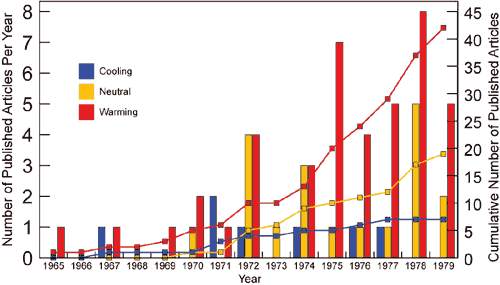
You're regurgitating complete nonsense. Once again, here’s figure 1 from Peterson et al. 2008. Notice that papers predicting warming vastly outnumbered those predicting cooling, even in the 1970s. Ironically:
- The term “global warming” was first used in a 1975 Science article by Wally Broecker called “Are we on the brink of a pronounced global warming?”.
- Sawyer 1972 estimated climate sensitivity as 2.4C, and Schneider 1975 gave a preliminary range of 1.5C to 3.0C.
- Manabe and Wetherald, 1975: “The Effects of Doubling the CO2 Concentration on the climate of a General Circulation Model.”
- In 1977, Freeman Dyson wrote that the “prevailing opinion is that the dangers [of the rise in CO2] greatly outweigh the benefits.”
- In 1977, Robert M. White, the head of the National Oceanic and Atmospheric Administration, wrote a report for the National Academy of Sciences that said “We now understand that industrial wastes, such as the carbon dioxide released in the burning of fossil fuels, can have consequences for climate that pose a considerable risk to future society.” [White, Robert, 1978, Oceans and Climate Introduction, Oceanus, 21:2-3]
- The 1979 JASON report “The long-term impact of atmospheric carbon dioxide on climate” estimated climate sensitivity as 2.4C to 2.8C.
- The National Academy of Science’s 1979 Charney report estimated climate sensitivity as 1.5C to 4.5C and said “If carbon dioxide continues to increase, [we] find no reason to doubt that climate changes will result, and no reason to believe that these changes will be negligible.”
While Jane is reading those papers, he should also consider addressing this issue with his basic thermodynamics:
Your own insistence that power in = power out (assuming perfect conversion and no entropic losses) belies this argument. You are arguing against yourself and you refuse to see that. If power in = power out (your own stipulation)
I'm not the only one insisting that power in = power out through any boundary where nothing inside is changing. Once again, that's a fundamental principle called "conservation of energy". Here are some introductions: example (backup), example (backup), example
-
Re:No one gets the oil!
You're regurgitating complete nonsense. Once again, here’s figure 1 from Peterson et al. 2008. Notice that papers predicting warming vastly outnumbered those predicting cooling, even in the 1970s. Ironically:
- The term “global warming” was first used in a 1975 Science article by Wally Broecker called “Are we on the brink of a pronounced global warming?”.
- Sawyer 1972 estimated climate sensitivity as 2.4C, and Schneider 1975 gave a preliminary range of 1.5C to 3.0C.
- Manabe and Wetherald, 1975: “The Effects of Doubling the CO2 Concentration on the climate of a General Circulation Model.”
- In 1977, Freeman Dyson wrote that the “prevailing opinion is that the dangers [of the rise in CO2] greatly outweigh the benefits.”
- In 1977, Robert M. White, the head of the National Oceanic and Atmospheric Administration, wrote a report for the National Academy of Sciences that said “We now understand that industrial wastes, such as the carbon dioxide released in the burning of fossil fuels, can have consequences for climate that pose a considerable risk to future society.” [White, Robert, 1978, Oceans and Climate Introduction, Oceanus, 21:2-3]
- The 1979 JASON report “The long-term impact of atmospheric carbon dioxide on climate” estimated climate sensitivity as 2.4C to 2.8C.
- The National Academy of Science’s 1979 Charney report estimated climate sensitivity as 1.5C to 4.5C and said “If carbon dioxide continues to increase, [we] find no reason to doubt that climate changes will result, and no reason to believe that these changes will be negligible.”
While Jane is reading those papers, he should also consider addressing this issue with his basic thermodynamics:
Your own insistence that power in = power out (assuming perfect conversion and no entropic losses) belies this argument. You are arguing against yourself and you refuse to see that. If power in = power out (your own stipulation)
I'm not the only one insisting that power in = power out through any boundary where nothing inside is changing. Once again, that's a fundamental principle called "conservation of energy". Here are some introductions: example (backup), example (backup), example
-
Re:No one gets the oil!
No,no. Global cooling. Haven't you read the scientific papers from top agencies and researchers from the 70's. Sheesh
You're regurgitating complete nonsense. Once again, here’s figure 1 from Peterson et al. 2008. Notice that papers predicting warming vastly outnumbered those predicting cooling, even in the 1970s. Ironically:
- The term “global warming” was first used in a 1975 Science article by Wally Broecker called “Are we on the brink of a pronounced global warming?”.
- Sawyer 1972 estimated climate sensitivity as 2.4C, and Schneider 1975 gave a preliminary range of 1.5C to 3.0C.
- Manabe and Wetherald, 1975: “The Effects of Doubling the CO2 Concentration on the climate of a General Circulation Model.”
- In 1977, Freeman Dyson wrote that the “prevailing opinion is that the dangers [of the rise in CO2] greatly outweigh the benefits.”
- In 1977, Robert M. White, the head of the National Oceanic and Atmospheric Administration, wrote a report for the National Academy of Sciences that said “We now understand that industrial wastes, such as the carbon dioxide released in the burning of fossil fuels, can have consequences for climate that pose a considerable risk to future society.” [White, Robert, 1978, Oceans and Climate Introduction, Oceanus, 21:2-3]
- The 1979 JASON report “The long-term impact of atmospheric carbon dioxide on climate” estimated climate sensitivity as 2.4C to 2.8C.
- The National Academy of Science’s 1979 Charney report estimated climate sensitivity as 1.5C to 4.5C and said “If carbon dioxide continues to increase, [we] find no reason to doubt that climate changes will result, and no reason to believe that these changes will be negligible.”
-
Re:No one gets the oil!
No,no. Global cooling. Haven't you read the scientific papers from top agencies and researchers from the 70's. Sheesh
You're regurgitating complete nonsense. Once again, here’s figure 1 from Peterson et al. 2008. Notice that papers predicting warming vastly outnumbered those predicting cooling, even in the 1970s. Ironically:
- The term “global warming” was first used in a 1975 Science article by Wally Broecker called “Are we on the brink of a pronounced global warming?”.
- Sawyer 1972 estimated climate sensitivity as 2.4C, and Schneider 1975 gave a preliminary range of 1.5C to 3.0C.
- Manabe and Wetherald, 1975: “The Effects of Doubling the CO2 Concentration on the climate of a General Circulation Model.”
- In 1977, Freeman Dyson wrote that the “prevailing opinion is that the dangers [of the rise in CO2] greatly outweigh the benefits.”
- In 1977, Robert M. White, the head of the National Oceanic and Atmospheric Administration, wrote a report for the National Academy of Sciences that said “We now understand that industrial wastes, such as the carbon dioxide released in the burning of fossil fuels, can have consequences for climate that pose a considerable risk to future society.” [White, Robert, 1978, Oceans and Climate Introduction, Oceanus, 21:2-3]
- The 1979 JASON report “The long-term impact of atmospheric carbon dioxide on climate” estimated climate sensitivity as 2.4C to 2.8C.
- The National Academy of Science’s 1979 Charney report estimated climate sensitivity as 1.5C to 4.5C and said “If carbon dioxide continues to increase, [we] find no reason to doubt that climate changes will result, and no reason to believe that these changes will be negligible.”
-
Dark Matter is not a tweak to gravity
A lot of engineers and computer programmers seem to think that dark matter is just a fudge to make rotation curves fit, and that they being smarter than astrophysicists can see through this obvious error. This is profoundly irritating
Dark matter is required to explain the ratio of elements produced during big bang nucleosynthesis, the acoustic peaks of the cosmic microwave background, gravitational lensing, cluster dynamics, the Local Group timing and finally, yes, rotation curves. In the last application (which is bizarrely considered to be the only place dark matter is invoked), the most popular alternative hypothesis MOND, which has no theoretical basis and exists purely to fit rotation curve data, doesn't actually do that well on modern rotation curves.
You cannot offering any critical comment on dark matter that won't make you sound like a terminal case of Dunning-Kruger to an astrophysicist unless you understand all of the things I mentioned above.
-
Re:Another "taking" by the California government..
I would hazard they are certain they can make the laws say whatever they want them to. Much the way taking someone's property to let developers have it was ruled a valid application of eminent domain. http://www.law.harvard.edu/stu...
-
Re:Yeesh
http://news.harvard.edu/gazett...
It's biological and it probably goes way back to our common ancestor. -
Re:Total Boondoggle
The mortgages themselves weren't the problem. The problem was the inflation of the mortgages into many times their original value, using financial derivatives and insurance. Because the derivatives were rated AAA, shadow banks didn't take out enough insurance. And insurance companies didn't really insure the derivatives, because they were rated so high they couldn't fail.
Then a few RMBSes failed, and market groupthink took over. Suddenly no one wanted these derivatives, not because they had no value, but because the market became paranoid and emotionally panicked. No private party wanted to roll over funding using the derivatives as collateral anymore. The private parties all wanted T-bills, because they were much much safer.
The government stepped in to take the instruments off the banks' balance sheets.
The government didn't make banks create financial derivatives. The government didn't rate those derivatives AAA. The government didn't fail to insure them adequately. In fact, the government became the insurer when the ostensible insurers (i.e., AIG) failed.
Righties like to quote Kenneth Rogoff. Here's a quote from him:
Without question the best and most effective approach to the problem would have been to bail
out the subprime homeowners directly, forcing banks to take losses but keeping them manageable.
For an investment of perhaps a few hundred billion dollars, the US Treasury could have saved
itself from a financial crisis whose cumulative cost, counting lost output, already runs into many,
many trillions of dollars. Instead of âoesaving Wall Street,â a subprime bailout would have been
targeted, almost by definition, at lower-income households. But unfortunately, this approach too
would have been politically impossible prior to the crisis.Why don't righties quote that passage from Rogoff? Why wasn't bailing out individuals politically feasible? Because of the ignorance of the Tea Party, that's why.
-
Re:Harvard Charter
There are two aspects of the Harvard Charter which may give standing. First, the endowment has a specific purpose: "be for the advancement and education of youth, in all manner of good literature, arts, and sciences." And, good sciences say that investing in fossil fuels is a bad idea. Second, the Harvard Corporation is established so that it may be sued: "and also may sue and plead, or be sued and impleaded by the name aforesaid, in all Courts and places of judicature, within the jurisdiction aforesaid." http://library.harvard.edu/uni... So, disagreements about the endowment are supposed to be settled in court.
These are probably relevant, but may not be the ticket.
Standing is a question of *who can sue* (it is rather literal - you have a right to stand up at Court and be heard).
As you note, the charter gives a purpose, a *why*, deviation from which may give rise to liability. But the question is who can enforce. Does the Charter exist to protect the students? Faculty? The institution itself? Its property? Who is harmed by deviation from the Charter?
A relevant phrase might be "that may conduce to the education of the English and Indian youth of this country, in knowledge and godliness" as the *who* benefitting (and hence may have standing) is "English and Indian youth", antiquated racism though that may be. But who knows what a Judge would think or other status may be alive in this case.
The naming of the corporation gives no indication of standing to sue either. It just mentions jurisdiction and by this order, presuming you have standing, the name one would provide the Court to sue and enforce an Order against the corporation as a defendant.
-
Harvard Charter
There are two aspects of the Harvard Charter which may give standing. First, the endowment has a specific purpose: "be for the advancement and education of youth, in all manner of good literature, arts, and sciences." And, good sciences say that investing in fossil fuels is a bad idea. Second, the Harvard Corporation is established so that it may be sued: "and also may sue and plead, or be sued and impleaded by the name aforesaid, in all Courts and places of judicature, within the jurisdiction aforesaid." http://library.harvard.edu/uni... So, disagreements about the endowment are supposed to be settled in court.
-
Re:But but but
Ken Griffin, a Harvard alum, made the single largest contribution towards the Harvard endowment at $150 Million as of Feb 2014. He's worth between $3-5 billion depending on which paper you read and what the markets are doing. He's also currently the wealthiest individual in Illinois. As CEO of Citadel, LLC, he's also heavily invested in the same. They also invest in, well, pretty much everything, including energy (whether crude oil, natural gas or whatever). Historically, he's not been terribly profitable investing in energy. Energy investments precipitated the firm's first ever sub-S&P500 returns in 2005, which led to laying off roughly 600 of 1100 employees (despite a roughly 12% return that year).
Not disputing anything you've said; I also didn't hear a single whisper of anyone objecting to such "dirty" money that came from the profiteering of a *shock* hedge fund *shock*. At the end of the day: this is political & public grandstanding on likely a relatively small handful of individuals that are likely trying to make their names known as future journalists or "green" lawyers (whilst burning any sort of a bridge they thought they had into any other industry).
Posting as AC because I am a former long-time Citadel employee. I still work in finance, but now at a non-trading entity.
-
In re: Your former editor's comments
Boyce Rensberger, your erstwhile editor at the Washington Post, said this a year ago in the comments section of this article:
Gladwell is the same Gladwell as when I was his editor at The Washington Post. At first, I fell for his approach and brought him over to the science pod from the Post's business staff. Then I realized that he cherry picks research findings to support just-so stories. Every time I sent him back to do more reporting on the rest of the story, he moaned and fumed.
When I read his proposal for "The Tipping Point," I found it to be warmed over epidemiology. It was based on a concept and a perception so old it was already an ancient saying about straw and a camel's back. But gussied up in Malcolm's writing style, it struck the epidemiologically naive as brilliant. Brilliant enough to win an advance of more than $1 million.
What's your response?
-
Re:Dumb idea ... Lots of assumptions ....
every mass killer in the past 30 years has been prescribed some sort of psychotropic SSRI.
That story keeps growing every time it's repeated. By next week, it will be up to "everyone who has ever killed anybody was on two different types of SSRI".
Here's a different hypothesis: People with mental disorders are more likely to commit violent crimes. They are also more likely to have been treated with drugs such as fluoxetine, particularly in the USA.
For your hypothesis to be supported, you will need to show a correlation between between violent crime and people who are taking SSRIs but have not been diagnosed with a serious mental disorder, and also show that people who suffer from mental disorders but have not been treated are less likely to commit violent crimes than people who have been treated but do not suffer from a disorder.
It's the "other connection" anti-gun folks never seem to want to talk about.
Well, don't let me stop you. Talk about it. Share with us the wealth of peer-reviewed medical studies which support your hypothesis and disprove mine. And talking heads from CNN don't count.
I'll wait.
-
Re:I wish there was a more reasonable option
The FBI doesn't even distinguish this kind of crime in a separate category. I think more on point though, is the summaries author making the ASSUMPTION that having looser/fewer gun regulations somehow makes us safer, when evidence shows that states that have looser/fewer gun regulations also have higher murder rates ( http://www.hsph.harvard.edu/hi... ). Somewhere in there is another social science fuck-up on drawing the wrong conclusion to the study they made... perhaps somewhere along the line of something like... some people can deal with the evidence presented by reality, others can't, or don't want to.
-
Glaring omission.Almost all the engineering and mathematics and physics papers would depend on Pythagoras theorem. Even if not in the usual a^2 + b^2 = c^2 form, it would be in sin^2(theta) + cos^2(theta) = 1 form. But to my knowledge there is only one paper (The Imperturbility of Elevator Operators, by S Candlestickmaker) cites Pythagoras and the gem about PI = 3 for large values of three.
So some of the most widely used scientific discoveries never get cited.
That explains why my work did not make it to the top of this flawed metric.
Here is another link that is more readable. In a more easily readable form Candlestickmaker, S., and Helpit, Canna E. 1955, Compositio Math., 237, 476.
Giftcourt. M. F. 1956, J. Symbolic Logic, 237, 476.
Nostradamus, M. 1955, Centuries (Lyons).
Pythagoras — 520, in: Euclid — 300, Elements, Book I, Prop. 47 (Athens).
Shopwalker, M., and Salesperson, F. 1955, Heredity, 237, 476.
-
Re:Bell Labs
And yet C and Unix came about because someone wanted to play games.
So what is the excuse for the existence of emacs? Surely it wasn't editing text.
-
Re:Bell Labs
The legacy of Bell Labs kind of runs contrary to this idea, because they were not only paid to come up with ideas, but also told to come up with ideas that would be profitable.
And yet C and Unix came about because someone wanted to play games.
-
Re:XKCD is correct
This is likely an inaccurate measure of entropy. If you have a dictionary of 65536 words and successfully choose a word with a uniform random number, that's 16 bits of entropy. (It would be less if those words are selected by average English frequency, perhaps as low as about 10-12 bits.) Using your example, with three "words" alligator terrorizes and newyorkcity (which I'm counting as one word), I'd guess the answer is closer to 48 bits. One bit encodes whether or not to capitalize the first letter of each word, so the second example is arguably more like 49 bits.
Or see http://people.seas.harvard.edu... - which sugests an average entropy of 2.6 bits per letter for English - that would estimate 78 bits. That reference also states that other estimates of entropy are as low as 1 bit per letter, which would estimate 30 bits.
IMHO, assuming that one has limited guesses, any of these are sufficient. A tougher problem arises when a hashed password is known or leaked, and unlimited guesses are therefore permitted. 30 bits may not be sufficient against a determined password breaker - as when breaking the password is known to have a high value.
-
Re:Birth control pills signifcant contributor?
I'm assuming you don't drink milk either.
-
Re:Irony
What's really ironic is Harvard awarding Malala Yousafzai "Humanitarian of the Year" for her efforts in promoting education for women.
Harvard started accepting women in 1999. Malala would have been two at the time.
-
Re:Sagan at Cornell
Sagan lived to be 62. For what it's worth he died from pneumonia, although I'm sure some one will try to blame the drugs for that. Grinspoon is 86 and still alive as far as my 30 seconds of googleing can tell (He was defiantly still alive in 2011) which is higher than average in the US.
-
Re:Blue LED should've never been awarded.
Are the good fellows at Harvard's health department not good enough for you either? http://www.health.harvard.edu/...
-
Re:Leader quotation bingo
Criminalizing firearm possession works reasonably well in most countries where they don't allow firearms.
No, it doesn't. It has the state use force to put people in cages for acts that do not credibly threaten the rights of others, i.e. the mere possession of the tools of self-defense. Under any reasonable definition of "works", ipso facto that's not working.
Beyond that is the problem that such laws have fsck-all effect on violent crime, because the problem with violent crime is the people who commit it and not the tools they use to do so, but that's secondary to the problem that a prohibition law *is*, by its nature, violent crime.
-
Guns are not the problem
Would you be in favor of gun control if it made your children less safe?
The studies and statistics about guns have been so completely obfuscated by special interests that it's nigh impossible for an average citizen - even smart ones like Slashdot readers - to answer the simple question: "is free access to guns good or bad?".
Looking into this in depth is really hard, but when you go back to basics there's a glimmer of truth.
Firstly, the thing to measure is mortality rate. Not all gun incidents lead to death, and if you have no money for medicine (or food) because you were robbed at gunpoint, it affects your chance of death.
Secondly, socialized medicine has such an enormous impact on mortality that you can't simply compare American mortality with, for example, the UK. You could compare UK mortality with, say, Swiss, or you could compare areas within the US which allow/disallow free access to guns. New Hampshire versus Michigan, for example.
When you do the proper comparison, you find that easy access to guns lowers the mortality rate.
This is counter intuitive simply due to the badly-cited statistics. Yes, if you let your kids play in the front yard of a gun owner their chance of death by accidental shooting goes up; however, their chance of death by all causes drops precipitously. You can believe the chosen statistic and it's unspoken implication, or you can dig into the real issues.
I'll leave you with this recent paper which attempts to sort out the issues in an academically rigorous manner. Here's a quote from that paper:
On the one hand, despite constant and substantially increasing gun ownership, the United States saw progressive and dramatic reductions in criminal violence in the 1990s. On the other hand, the same time period in the United Kingdom saw a constant and dramatic increase in violent crime to which England’s response was evermore drastic gun control including, eventually, banning and confiscating all handguns and many types of long guns.
[...] To conserve the resources of the inundated criminal justice system, English police no longer investigate burglary and “minor assaults. As of 2006, if the police catch a mugger, robber, or burglar, or other “minor” criminal in the act, the policy is to release them with a warning rather than to arrest and prosecute them.
I'm happy to discuss the advisability of gun control with anyone, so long as they don't cite a misleading statistic out of context, or focus on the wrong issues.
I like to form my opinions based on science. If you know of convincing counter studies, I'd like to read them.
-
Re:Folks need to see 'The Day After'
I guess that moderator didn't want us to know why the US relied so heavily on nuclear arms. Either that or it was an offended fan of communism, the bloodiest ideology of the modern age.
-
Re:too damn bright
Tinted window film should do the trick. But only if you have another use for it, as a roll will probably cost you as much as the clock.
While the advent of blue LEDs has been pretty cool from a certain stand point, some things make no sense. There was a study a few years back that showed how blue light can really screw with your sleep. Then another that seemed to indicate all kinds of health problems that can be caused by having blue lights on while sleeping. Here's one. but there are better ones if you feel like looking.
-
Re:lets pump the brakes here and analyze.
The genuine lunacy is to try and defend Communism. You should educate yourself, you've probably been studying the wrong issues regarding Communism.
The Black Book of Communism
The Soviet StoryIt has repeatedly turned areas that were breadbaskets for their region into food importers.
Communism has been tried in many countries and the result is bloody, oppressive, and ultimately a failure.