Slashdot Mirror
Domain: jamesshuggins.com
Stories and comments across the archive that link to jamesshuggins.com.
Comments · 40
-
Re:The disks usually don't ...
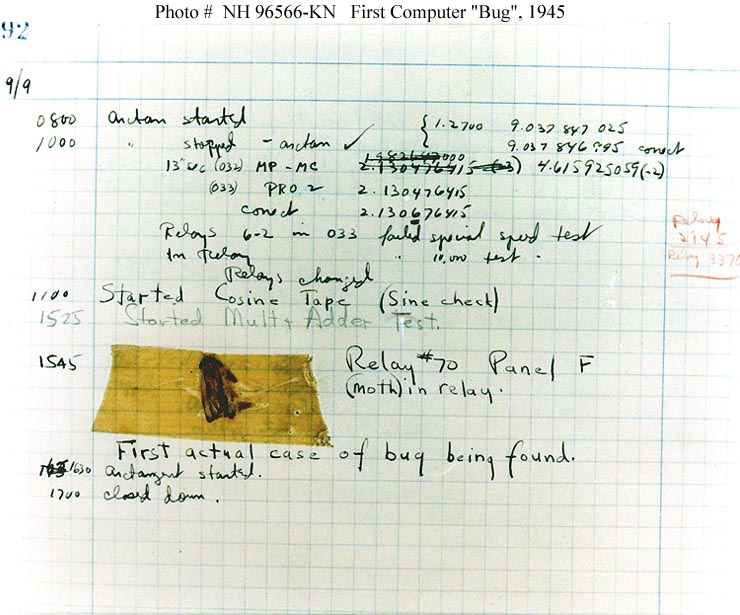
No, the cited log entry shows that the word "bug" was in use, but that they weren't commonly "found". That's because at the time "bug" meant some kind of mysterious issue with electronics, aka gremlin. The joke was that a bug had been *found*, at last. Computer bugs are often found, implying that this was the first application of the word "bug" to computer issues (with actual solutions) i.e. the first "computer bug". It's also where "debugging" was coined.
-
Re:A little humility
I'm being trolled, however I'll indulge you anyways with a little history lesson as I sometimes answer rhetorical questions. They even have a pretty picture you can look at.
-
Re:WHO THE FUCK CAPS IN BITS ??
Well, imagine you have a car with 250,000,000,000 seatbelts that break after being used once. The car has 105 million seats, and can drive in both directions on a road at once.
Also, there is only one road, and it is constantly clogged by other cars because the municipality responsible for the roads refuses to admit they have a traffic congestion problem.
1 LoC = 10 TiB, so you get 0.0227373675443232059478759765625 Libraries of Congress per month, at a speed of 9.5238095238095238095238095238095e-9 LoC/sec. -
Grace Hopper = COBOL (some "FYI")... apk
"At best, the compiler would date back to Grace Hopper, as she was the person who invented the compiler. I believe it was for Fortran." - by mog007 (677810) on Tuesday June 01, @07:51AM (#32416784)
See subject-line above, & this URL:
http://www.jamesshuggins.com/h/tek1/grace_hopper.htm
(IIRC, also/additionally? The lady's also an admiral too!)
APK
P.S.=> It's often said there aren't many women in computing, & compared to the male population involved in it? Typically, it's true! HOWEVER - When there is a woman involved in computing? They surely make a HUGE showing for females' sake (imo also, another one is my fellow polish-person, in Joanna Rutkowska also, & more currently (albeit moreso in the realm of computer security, but, she's far from a slouch in coding also))... apk
-
Re:thousand million?
http://www.jamesshuggins.com/h/tek1/how_big.htm
So roughly 20 million Library of Congresses (20mm LoC)
-
Re:About damn time!Correct and how many of those patents are hardware innovations NOT software? I keep mentioning this but you seem to gloss over it.
I addressed that a few posts above, but I'll address it more thoroughly now.
From IT Jungle:
"According to sources at IBM, about 1,800 of the patents that were issued to Big Blue in 2005 were for software-related inventions... IBM says that the percentage of its patents relating to software inventions has been increasing steadily in the past few years. It was 51 percent in 2003, 58 percent in 2004, and 61 percent in 2005."-----
Second, until patent reform takes place, this is the best IBM can do. Offer their patents to others wishing patent reform on software patents while at the same time making sure they are protected
Well, it's true that despite what changes are in store, you've got to play the current game as well as you can.
However, IBM is one of the strongest supporters of software patents, and has consistently been so throughout the history of software patenting.
Here is a transcript of USPTO hearings in 1994 - back when many industry players held Slashdot-like dislike for software patents. Even back then, IBM took a pro-software-patent stance and advocated for their allowance.
(Incidentally, that transcript should be required reading for anyone who wants to participate in this debate - IBM raised some extremely persuasive points that most Slashdotters don't like to acknowledge - such as: "We can't divorce computer program-related inventions from computer hardware and other microprocessor inventions. The overlap between the two is so great that cutting back on one automatically cuts back on the other.")
IBM continues to lobby in favor of software patents - particularly in the EU. From FFII.org:
"In the wake of the Opensource hype, IBM's rhetoric has become relatively moderate, but nonetheless it is supported by real pressure. IBM has acquired approximately 1000 European software patents whose legal status is currently unclear. Given the great number of software patents in IBM's hands, IBM is one of the few software companies who may have a genuine interest in software patentability."From Ars Technica:
"IBM and OSDL to help Patent Office get organized"
This article is about IBM's contributions to the USPTO to help it improve its search tools, and in developing a Wiki-like system for allowing the public to participate in patent examination. This initiative is hardly about deconstructing the patent system - it's about sharpening and improving it, so that better-examined patents can issue.And from Gartner:
"IBM Uses Patents to Lead Open-Source Community"
"IBM announced that it would open access to technology covered by 500 IBM software patents to any individual, community or company working on or using software that meets the Open Source Initiative (OSI) definition of open-source software (see www.opensource.org). IBM also proposed an industrywide "patent commons" for sharing patents among technology developers."Note: This is not "donating patents to the public domain" or "abandoning patents." This is "using patents strategically to promote a particular sector of the market," i.e., the OSI crew.
In short - you couldn't be more wrong in your summary of IBM's position on software patents. IBM is a HUGE player in this space. They know how to get them, and they know how to use them well. They have consistently supported software patenting, from its mainstream inception in the 1990's and through today, and consistently lobby for expansion in terms of allowability, regional acceptance, and enforcement power.
- David Stein
-
Re:Adobe?
For reference, here's Adobe's 1994 position (stated by Douglas Brotz, Principal Scientist at the time):
http://www.jamesshuggins.com/h/tek1/software_patent_adobe.htm
-
Re:First computer bugInterestingly, the first ever computer bug was also of the 'physical' variety - See here
From the article you link to:So, where did the term "bug" come from?
Well, the entry ("First actual case of bug being found.") shows that the term was already in use before the moth was discovered. Grace Hopper also reported that the term "bug" was used to describe problems in radar electronics during WWII [emph mine] -
First computer bug
Interestingly, the first ever computer bug was also of the 'physical' variety - See here
-
Re:New prefixes
No kidding, looking at how we got the prefixes in the first place we may run out of greek/latin words.
Hopefully it will come down to unobyte, dosbyte, or something with a number convention, otherwise we might be hearing "crazybyte" or "uberbyte". -
Re:I can't imagine 1 TB0.1 Library of Congresses according to this website:
http://www.jamesshuggins.com/h/tek1/how_big.htm10 Terabytes: Printed collection of the U. S. Library of Congress
-
Re:So that would make it use about...Proper conversion:
Start with a 100 Watt bulb
Divide by 7, which is the number of watts necessary to properly illuminate a square foot of floor space.
This gives roughly 14.28 square feet able to be illuminated.Divide this into 2.1 million sq ft, the amount of square feet in the Library of Congress (USLOC).
This tells us that 147,000 watts are necessary to illuminate the US Library of Congress.Divide by 1.09951163 × 10^13 bytes, the amount of storage per unit of USLOC.
This tells us that 1.33 x 10^-8 bytes are illuminated per wattMultiply by 7GB (7,516,192,768 bytes), which is the number of gigabytes of printed material that can be properly illuminated by a 1-watt bulb.
Answer: 100.4
So you were close.
-
Re:From the manufacturer's product page:
Hold 0.1 Libraries of congress
(10 TB = 1 LOC: http://www.jamesshuggins.com/h/tek1/how_big.htm) -
Re:Masters of estimates
Why are you so afraid of change?
Why fetishize change? I like how things are, and there's no compelling reason to change.
It's only two letters in a label! Why are you so attached to it?
Largely because I'm used to kilo and kibi, mebi, gibi sound retarded. It's never come up in any job I've held, and the only people I've heard advocate it live on slashdot.
Also, you use "we" and "our" a lot. You say that "we" coined the term. Are you saying that you personally had something to do with coining these terms?
I identify with my profession. What are you on about?
Who "owns" them? Again, we get back to the greek problem.
The SI units are adapted from both greek and latin. In greek, they didn't mean 10^n, they were various words for 'big' and fifth or sixth. They also don't count for information conten. Mega is 10^6 or 2^20 depending on context.
-
Re:Bugger
Actually, that's how we got that term in the first place http://www.jamesshuggins.com/h/tek1/first_compute
r _bug.htm -
Re:"old fart" indeed...
You're not an "old fart" if you started with edlin. There was life before MS-DOS, you know. Now, get off my lawn!
And computers weren't bugfree as well back then! -
Re:a billion protons
Could I get that in Libraries of Congress per fortnight?
Yes. Yes, you can. Four terabits per second is about 1.2 exabits per fortnight. There are about 10 terabytes, or 80 terabits in the Library of Congress. So do the math, and you get about 16,000 LoC/ftnt.Anyone else remember the thread in which the thrust generated by the space shuttle's rocket boosters was measured in (burning) Libraries of Congress?
-
Re:Education
Proper computing education should be mandatory for high school graduation and equivalent.
The problem is not computing education, but education in general.
Since when are standard metric prefixes considered "jargon"? Kilo-byte, mega-byte, etc.
(Yes, I know that in technical contexts, a kilobyte is 2^10=1024 instead of 10^3=1000, but either is sufficient for most purposes of common end users in grasping general differences in file or disk sizes.) -
Re:Oh, the good old days.
You insensitive cold! When I was young we didn't have viruses, we only had bugs (http://www.jamesshuggins.com/h/tek1/first_comput
e r_bug.htm). -
Re:Good for Science
Well in a lot of ways NASA's manned space program is a jobs program and without it there might a lot of homeless aerospace engineers(all the ones not willing to get a top secret clearance and work for the DOD on antimissile defense). The only problem with it as a jobs program for the potentially homeless is the efficiency of the charity is horrendous.
You know its a jobs program because in a recent article on the new adminstrator and his attempts to get NASA redirected towards something that isn't a dead end like the Shuttle and the ISS, there were several blurbs about how Congressman wouldn't stand for any budget cutting during the transition to CEV that meant lost jobs in any of their states/districts. The implication being NASA has to keep both its civil servant and Boeing/Lockheed contractor army at the same levels from now to eternity. That means NASA will continue to pour billions of dollars a year in to supporting this jobs program, whether there is real work or not, and it will drain funding away from actually building new launch vehicles. Also if you keep the staffing levels the same as now when CEV starts launching the launch costs are going to astronomical too.
Unfortunately since the beginning, NASA and its contractor horde were spread across the nation so congressman would give them money and political support because it resulted in jobs in their states and districts. It was OK during the Apollo era because funding was vast and they had a purpose. Over the years the funding dwindled, and the sense of purpose disappeared. It became a jobs program instead of an organization pushing back frontiers. It resulted in the ISS in particular, a 100 billion dollar hole in space which has no useful purpose other than it created high tech jobs, kept aerospace engineers in the U.S and Russia employed, and made Boeing, Lockheed etc. a lot of money for very little.
You want to fix NASA's manned space program can everyon civil servant and contractor and start over and implement Kelly Johnson's 14 rules(he built the SR-71 and U2 and the Skunkworks) in particular:
Rule No. 3
The number of people having any connection with the project must be restricted in an almost vicious manner. Use a small number of good people (10 percent to 25 percent compared to the so-called normal systems).
Basicly fire all the civil servants and all the contractors and start over. Put everyone in one place, and put someone in charge that can do more with less instead of less with more. Burt Rutan would be a great counterpart for Kelly Johnson though he would have to be completely freed of all the politics and bureaucracy that is strangling NASA. There are lots of people in the Russian Space Agency who would also be great for the nucleus of an all new manned space program. Of course they are already doing Kliper and it sounds like there is a chance Europe will team with them on it and kiss NASA off. The RSA is already building mockups of Kliper, while NASA is just pushing piles of paper from point A to point B on CEV.
You know the manned space program is fixed when Johnson is closed. It was insane to put a 1000 miles between the launch site and mission control just because LBJ wanted to give his home state jobs, see, a jobs program again. The bad communication between Johnson and Kennedy was a leading contributor to both shuttle disasters. -
Re:My memories
As I said elswhere it would have to be no strings attached grants, NASA no where in sight, maybe with some incentive clauses and milestones like Ansari X prize.
"I guarantee that in a matter of years his organization will be just as inefficient and bloated as that of the traditional aerospace companies."
I doubt it, its contrary to his nature to go down that path. He likes building air and space craft for the sheer love of it and not because its a welfare check. He hates bureaucracy to the root of his being.
First day you start this project you post Kelly Johnson's rules on the wall and live by them. Kelly did, for the most part, for decades.
Before you start the first rule is the to make the site and the project a bureaucrat and politician free zone other than maybe an inspector general to insure basic fiscal oversight. -
Re:Things To Look Forward
Vonnegut didn't write it, though.
-
Re:Heat is the problemI cannot speak about the fundamentals of heat issues, but I do remember something Grace Hopper said about working on the farm. She talked about the limits of using bigger and better horses to pull the plow. The obvious solution was to use a team of horses.
She was a lady ahead of her times. Aside from her finding the first true computer bug (which was a Gypsy Moth according to my memory
-
Re:No, really, you -shouldn't- have.
I don't think you've considered the possible real motives behind this initiative:
A) To lock up crucial votes in Florida and the space coast of Florida in the 2004 election, which happened nicely. You can be sure everyone in that area is going to vote for a President promising them years of lucrative employment and a strong local economy. To Florida as a whole space program is prestige so they like politicians who pour money in to it D or R.
B) Distract all the space advocates, lobbyists, contractors and politicians who represent the thousand places with NASA centers or contractors who dine from the giant pork machine that is NASA. While they are distracted with chump change for this new program, that will probably never make it to the bending metal stage, they quickly euthanize the Shuttle and ISS. Then around 2008 when this program starts sucking up real money one of two things happen:
1) The ISS model, they just pour money in to it forever, never enough to do it or do it right but just enough to keep all the pork addicted contractors and congressional districts in gravy
2) The Bush, I hate science and bureaucracy, model where some realist points out that with the U.S., which is running huge deficits thanks to privatizing Social Security, more tax cuts for the rich, and maintaing occupations in Afghanistan, Iraq, Iran and Syria, just can't afford it. The program gets the axe, the Shuttle and ISS are long gone, and the U.S. has no manned space program and one giant bureaucracy many politician's hate dies a quick death. Ironicly everyone will be relieved by this because the current manned space program sucks so bad.
At this point we can only hope private ventures lead by Burt "Kelly Johnson" Rutan and Transformational Space, (a.k.a t/Space), will have grabbed the fumbled ball and ran with it. Would be way better than letting Boeing and Lockheed continue to screw up the manned space program in the name of profit -
Re:In other words...
Its somewhat worse than that:
"to identify potential co-sponsor organizations interested in contributing cash toward one or more prize competitions,"
Before I start a rant let me preface it with an interesting URL, Kelly Johnson's rules. If you don't know Kelly Johnson he was the genius behind Lockheed's original skunworks and built two airplanes which are still engineering marvels and he did both in months not decades. His rules are the antithesis of all things that are now NASA's manned space program. In particular:
Rule No. 3
"The number of people having any connection with the project must be restricted in an almost vicious manner. Use a small number of good people (10 percent to 25 percent compared to the so-called normal systems)."
Now back to the Centennial prizes. NASA is apparently looking for organizations outside of NASA to give NASA money to help fund part of the prizes. The irony of an agency that wastes billions a year trying to suck cash out of little innovative organizations like the Ansari X prize is just to much.
Seems to me like they are trying to embrace, extend and extinguish the X prize concept much like another monopoly we know.
They make way to many references to "partners" in this program. Forming partnerships is how another monopoly we know destroys competitors.
NASA is obviously nervous about the X prize because its the first thing exciting to happen in manned space flight in a couple decades. Sure it was just a high altitude flight but they did it on a tiny budget and a fast schedule and it was entirely private and NASA was totally cut out of it and they have massive egg on their face.
NASA's effort would be a great program if they would take some of the billions they are now wasting on the Space Shuttle and ISS and put them in to either no string grants or real winner take all prizes.
If you are an organization that either wants to sponsor prizes or win them, partnering with NASA is about the last thing you want to do. In particular I'm guessing any work you do will end up belonging to NASA and not to your organization. If you want to get sucked up in to a money devouring bureaucracy that doesn't do anything innovative in manned space flight anymore, and now needs someone to do it for them but have it still look like NASA needs to be in the loop, then go right ahead. If you want to just feed at the NASA trough then this may also be a good route to go.
I'll reitereate what I've said before here. Giving Burt Rutan a billion or two in no strings grants to go to the next stage and build a vehicle that could fly to the ISS on a weekly basis would be priceless. Maybe he couldn't do it but manned space flight needs a new organization like Kelly Johnsons old skunkworks. You need a talented, seat of the pants, engineer who can put together a small, fast, agile team of the best of the best who are there to succeed and if they do get rewarded for it in a big way. Burt Rutan is the closest match I've seen to Kelly Johnson. -
Slashdotted
Here's two links from Google:
http://www.eecis.udel.edu/~mills/pic/h96566k.jpg
http://www.jamesshuggins.com/i/tek1/grace_hopper_h 96566k_thumb.jpg -
Whoo, karma to burn, boys!I think the US Navy in conjunction with Radio Shack should do a series comic books based on the adventures of Grace Hopper. Sort of like those "Electronics is Cool! No, Really!" comics they did in the 50's-80's. Here's some proposed titles:
- Grace Hopper : Girl Genius of Vassar
- Lt. Hopper of the U.S. Navy
- Grace Hopper and the Mystery of the Hollerith Code
- Grace Hopper Tames the MARK I
- Grace Hopper Defeats the NAZIs
- Grace Hopper vs the Pernicious Moth
- Grace Hopper Unravells Sputnik
- Grace Hopper vs the Commie Russians
- Grace Hopper Unleashes the Scourage of COBOL
- Grace Hopper Arm-Wrestles Hyman Rickover
- Cmdr. Grace Hopper : Recalled to Duty (special double issue)
- Cmdr. Grace Hopper Defeats the Commie Russians
- Grace Hopper CyberGrrrrrl
And remember, (+1, Funnay) does nothing for karma!
-
Re:Huh?According to this google post and this one, the ISO spec of a floppy disk says it's 3mm thick. One floppy holds 1.44MB of data in decimal format. Divide 1.2TB by that and you get 833,333 and 1/3. Multiply that by 3mm and convert to a larger unit understood by Americans and you get: 1.55 mile-high stack of floppies.
The Library of Congress holds 10TB of data. Convert the 1.2 decimal terabytes to hexadecimal and you get ~1.12TB. Divide the exact number into 10 and you get: 11.18% of the Library of Congress
-Lucas
-
550 tons
550 tons is the weight of all the electrons that have been inconvenienced, although momentarily, by people who read this stupid article online, and then couldn't keep from posting on
For that many electrons, we could have downloaded ourselves a few Libraries of Congress. Too late now, they're all wasted. We'll have to get the 20,000 CD-ROM worth of data delivered to our door by an elephant.
-
Re:At first
What about... both?
-
Re:Which Red Hat Should Be Worn in the Enterprise?
Nah, for real enterprise computing, you'll have to find something like this in red.
-
Re:Sure, if you say so
You must have missed that chapter.
-
Re:Naturally so
The story about the moth is true. The female programmer in question (Grace Hopper) worked on the project but she wasn't actually there when the bug was found. Also, the term "bug" was already in use before that time. See also the Jargon File entry.
-
Re:Yes, it's the same.
Parody is "fair use", even of trademarks (at least according to this.
-
Re:Long Term Storage> The Library of Congress is attempting to answer this question as they have huge amounts of media that is on highly degrading (nitrate-based films) materials.
> Their answer? A huge RAID array starting at 180TB and growing steadily over time.Last time I looked, one Library of Congress was only 10TB, and I bought a 100G drive for $100.
So my rig sported a cool 0.02 LoC in my rig. I felt gr8. I mean, I 0wn3d.
Now you're telling me I only have 0.00055555 Libraries of Congress? I f33l s0 l4m3.
Bastards.
-
Here are the images you wanted
-
In meaningful terms10Gigabit/sec = 1.25Gigabytes/sec
1 LoC (Library of Congress) = 10 Terabytes = 10,000 Gigabytes
That's 0.000125LoC/sec, or roughly 2.22 hours to transfer the entire contents across 10GigE.
Wow.
-
Re:Measurements....
Assuming James S. Huggins' How Much Data Is That? is right with 1 Library of Congress print collection == 10 TB, and using the 1 trillion bits(10^12 I assume) per square inch, I guess 17.6 x 10^7 Libraries of Congress/hectare.
-
Re:Metric Revolution
It pisses me off that Harddrive manufactures can lie and use (1000 per K not 1024 per K), thus a 100 Gigabyte drive is really only 97 Gigabytes. Seems like false advertising, even if they do add "In our world a gig is 1,000,000 bytes"
8 bits make 1 byte. 1024 bytes is 1K. 1 Gigabyte is 1024 Megabytes. 1 Megabyte is 1024 Kilobytes. 1 Kilobyte is 1024 bytes.
and
1Kbps is 1024bps. 56kbps is 57344 bytes per second, about 5K per second. A 128Kbps is really 13K per second of bandwidth. A 768K is 78K per second of bandwidth. A Megabyte is 1024K not 1000K.
Check here for a good table.
-
Any fool can tell the truth, but it requires a man of some sense to know how to lie well. - Samuel Butler (1835 - 1902) -
Re:What "I" wanna know is:
The Printed collection of the U. S. Library of Congress is only about 10 Terabytes. 144 petabytes is closer in size to ALL printed material.