Slashdot Mirror
Domain: kuleuven.ac.be
Stories and comments across the archive that link to kuleuven.ac.be.
Comments · 72
-
Re:Anybody using Ada?
We use it a lot to build simulations.
Here's an online simulation of the Belgian economy, written using the Ada Web Server.
Several more here.
Ada is a wondefully expressive language, with lots of nice libraries, and it's well worth a look if you build, for example, simulations, financial systems and the like.
-
The Netherlands != Belgium
http://kuleuven.ac.be/ is a Belgian University situated in Leuven, not in the Netherlands.
I know it's a very small and unknown country for you Americans but please verify your sources. -
Re:Wordstrobe: MARS - Vortex LINKS
thanks for reminder.. quick search finds latest version circa 1996.. apparently there was no reverse switch.. imagine not being able to re-read what you just read again..
-
If you prefer C++ ...
try Wt. It is like GWT without Java - uses standard C++ and the only essential dependencies are boost & Xerces. Doesn't have Google pushing it, but is being actively developed. I bet it can beat the pants off GWT for server-side performance, besides being architecturally modern (uses boost signal-socket library for both client and server based event handling). Another nice feature is that it degrades gracefully - defaults to DHTML if browser can't do AJAX.
-
C++ web app toolkits existC++ has absolutely no design considerations for a web application, and you'd have to build everything from scratch yourself.
Then you don't have the right libraries. Google C++ web app brought Wt on the first result page.
-
C++'s response: Qt-like AJAX Toolkit
We've been working on C++ AJAX toolkit called Wt. Similar to GWT, it completely hides the complexity resulting from Javascript ui logic, DHTML, XML, etc associated with creating AJAX applications. Best of all, it is pattterned from the Qt toolkit and allows you to design webapps as you would in any desktop Qt application.
It is completely object-oriented and the event mechanism is even handled by the signal and slots approach, allowing the same programming elegance found in Qt-based software. It allows you to focus on the design and logic of your program in one place and one place only! Quite similar to how Qt hides the details of the underlying window system from the programmer.
See this overview and a sample
Note the familar Qt-like syntax in creating a tree widget. [kuleuven.ac.be]
If you like writing GUI apps in Qt and would like to do the same in AJAX apps including the possiblity to integrate with desktop programs, please check it out!
-
C++'s response: Qt-like AJAX Toolkit
We've been working on C++ AJAX toolkit called Wt. Similar to GWT, it completely hides the complexity resulting from Javascript ui logic, DHTML, XML, etc associated with creating AJAX applications. Best of all, it is pattterned from the Qt toolkit and allows you to design webapps as you would in any desktop Qt application.
It is completely object-oriented and the event mechanism is even handled by the signal and slots approach, allowing the same programming elegance found in Qt-based software. It allows you to focus on the design and logic of your program in one place and one place only! Quite similar to how Qt hides the details of the underlying window system from the programmer.
See this overview and a sample
Note the familar Qt-like syntax in creating a tree widget. [kuleuven.ac.be]
If you like writing GUI apps in Qt and would like to do the same in AJAX apps including the possiblity to integrate with desktop programs, please check it out!
-
Re:When's the Object Oriented AJAX coming out?We've been working on a toolkit called Wt that completely hides the complexity resulting from Javascript ui logic, DHTML, XML, etc associated with creating AJAX applications. Best of all, it is pattterned from the Qt toolkit and allows you to design webapps as you would in any desktop Qt application.
It is completely object-oriented and the event mechanism is even handled by the signal and slots approach, allowing the same programming elegance found in Qt-based software. It allows you to focus on the design and logic of your program in one place and one place only! Quite similar to how Qt hides the details of the underlying window system from the programmer.
See this overview
Note the familar Qt-like syntax in creating a tree widget.
Please check it out!
-
Re:When's the Object Oriented AJAX coming out?We've been working on a toolkit called Wt that completely hides the complexity resulting from Javascript ui logic, DHTML, XML, etc associated with creating AJAX applications. Best of all, it is pattterned from the Qt toolkit and allows you to design webapps as you would in any desktop Qt application.
It is completely object-oriented and the event mechanism is even handled by the signal and slots approach, allowing the same programming elegance found in Qt-based software. It allows you to focus on the design and logic of your program in one place and one place only! Quite similar to how Qt hides the details of the underlying window system from the programmer.
See this overview
Note the familar Qt-like syntax in creating a tree widget.
Please check it out!
-
Re:Like most of the *NIX family . . .
ls, rm, df, du, etc . . . did any of the engineers at Bell Labs type 10-fingered?
I guess you've never typed on one of those old teletypes. -
Digital zoom vs. optical zoom, an exampleNope, it's not exactly the same, unless you use a camera which allows raw storage of images without lossy compression. But cameras which allow that, will either have no digital zoom, or are not targeted towards the average consumer who thinks digital zoom must be better than optical zoom because it sounds cooler.
The difference is: with digital zoom, the image is enlarged before compressing. If you just take the image, and enlarge it in Photoshop afterwards, you're also enlarging the compression artefacts. Here's a test with a simple Canon Ixus-i camera:
Digital zoom: http://www.esat.kuleuven.ac.be/~athomas/images/Zoo mDigital.jpg
Photoshop: http://www.esat.kuleuven.ac.be/~athomas/images/Zoo mPhotoshop.jpg
The 'stains' you see on the car's hood in the digital zoom image are not artefacts, but raindrops. As you can see, modern cameras do have quite good interpolation algorithms, maybe even better than Photoshop's bicubic interpolation. The contrast in the digital zoom image is also better because the camera can adapt to the zoomed part only, instead of having to make sure all the irrelevant parts of the image look good as well. In the photoshop image, you would need to increase the contrast to have the same effect, further amplifying the artefacts.Nevertheless, the use of digital zoom is never justified unless optical zoom is not available, like with my Ixus-i camera. Or, when you really want to photograph something tiny in the distance and you're already at the maximum of your optical zoom.
-
Digital zoom vs. optical zoom, an exampleNope, it's not exactly the same, unless you use a camera which allows raw storage of images without lossy compression. But cameras which allow that, will either have no digital zoom, or are not targeted towards the average consumer who thinks digital zoom must be better than optical zoom because it sounds cooler.
The difference is: with digital zoom, the image is enlarged before compressing. If you just take the image, and enlarge it in Photoshop afterwards, you're also enlarging the compression artefacts. Here's a test with a simple Canon Ixus-i camera:
Digital zoom: http://www.esat.kuleuven.ac.be/~athomas/images/Zoo mDigital.jpg
Photoshop: http://www.esat.kuleuven.ac.be/~athomas/images/Zoo mPhotoshop.jpg
The 'stains' you see on the car's hood in the digital zoom image are not artefacts, but raindrops. As you can see, modern cameras do have quite good interpolation algorithms, maybe even better than Photoshop's bicubic interpolation. The contrast in the digital zoom image is also better because the camera can adapt to the zoomed part only, instead of having to make sure all the irrelevant parts of the image look good as well. In the photoshop image, you would need to increase the contrast to have the same effect, further amplifying the artefacts.Nevertheless, the use of digital zoom is never justified unless optical zoom is not available, like with my Ixus-i camera. Or, when you really want to photograph something tiny in the distance and you're already at the maximum of your optical zoom.
-
Rotary braille reader
-
Re:And what did the UPS guy say?Just in case anyone takes this guy seriously.
No.
Real crypto (they type the government uses to protect top secret data) is free:
- Public domain C/C++ AES code
- DJB also has a public-domain C and assembly AES code
- Dr. Gladman has some simple BSD licensed (usable in any commerical closed-source program) C/C++ and assembly implementations of AES
- There are some GPL implementations of AES available, for people who can handle the GPL being in their code. (GPL forces the release of source code)
- This Javascript page will help people writing AES in other languages
-
Re:Belgium Population Explains eID
The e-id card does have one major design flaw though: the certificate issued by the government linking your public key to your identity contains your National Registry Number (Rijksregister/Registre national).
This number is used in many governmental databases as primary key, so it's not a good idea to give it out to everyone. The law restricts the use of the National Registry Number by private citizens and corporations for data processing. But it would have been better not create the opportunity for abuse in the first place, by spreading around this number in by way of this certificate.
The academic world in Belgium has repeatedly pointed this problem out to the government, but to no avail.
Some cool graphs on the roll out of the e-id card in Belgium are availble here: E-ID page. The e-id is no longer an experiment, in theory at least 'analog' cards will no longer be issued. -
5. Closed Torrent Sites
Bittorrent is on the winners list, but several key torrent sites that were raided are on the losers list as they have been permanently closed. The maddening thing is that torrent sites don't trade music files, just torrents (little road signs to files) so there is no legal precedent in ANY country that makes them illegal. The problem is, these sites don't have the money to mount a case. The concept of guilty until proven innocent gets a boost here.
That is not true actually, a few years ago, in Belgium, when mp3's where publicly available on http and ftp servers, some webmasters that only linked to those files or sites were sentenced/convicted in court (I don't know which is the most correct legal term). Here is a Dutch text that describes what happened: http://www.law.kuleuven.ac.be/jura/36n2/dumortier. htm . -
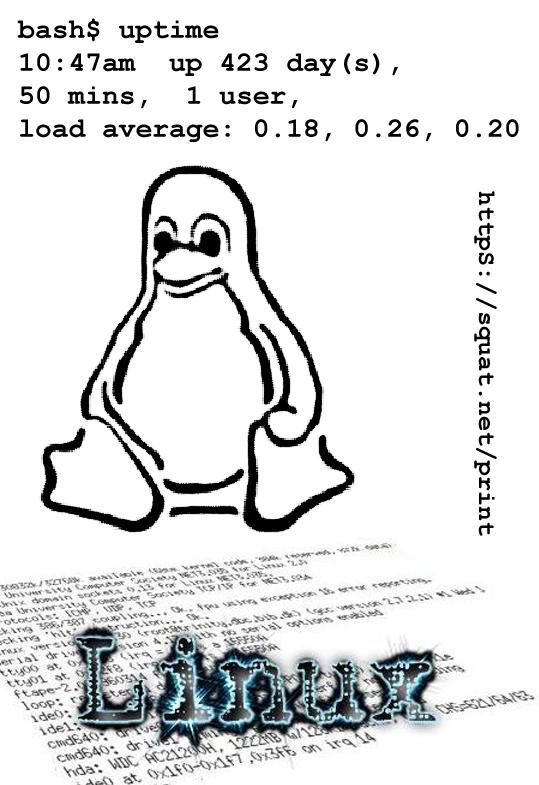
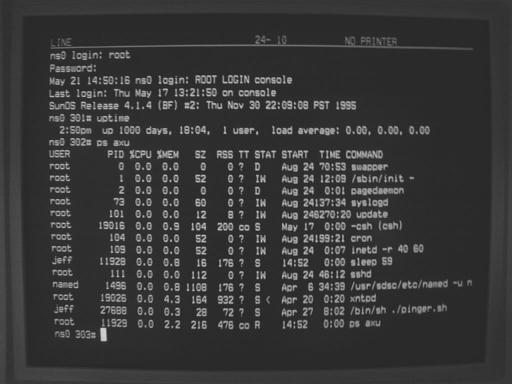
You restart your machine once a week??
You restart your machine once a week? Tell that to these guys:
http://print.squat.net/docs/affiches/print-uptime. jpg
http://pietila.info/muuta/screenshots/uptime.png
http://www.cs.kuleuven.ac.be/~jean/BILLY/uptime.gi f
http://www.arpa.net/console.jpg - *1000 DAYS*
http://www.beeck.nl/uptime.png -
Compare signals AND noise
You are probably right about the Voyager using less power per mile (in so far that unit makes sense anyway), but a big difference is the noise.
Space is rather cold. When listening to space ships, with these gigantic parabolic dishes, you pick up little noise so the signals can be very weak. Here on earth there is a lot of man-made noise (depending on the frequency you are using) and also thermal background noise because the earth is hot compared to space. (I wrote a fairly easy to grasp article on this topic)
I am still impressed bij this guy.
Z -
Re:Very trueNESSIE is an attempt to do for the European crypto standards what NIST does for the American crypto standards. Whirlpool was approved by NESSIE and is part of the ISO/IEC 10118-3:2003(E) standard. As such, it should be OK for use in Europe for secure systems, including military and Government applications.
The ISO approval also carries some weight in industry, although after some rather disasterous specifications (such as ISO 9000), they have lost some of their image. However, there are plenty of organizations that would consider an ISO standard an absolute must.
I don't know of anyone using Whirlpool for highly secure systems. It certainly wouldn't be ok in the US, as it's not a FIPS standard. France or Germany would be better bets. -
Maybe not electronic, but high tech for sure...The people at the material engineering department at the University of Leuven (KULEUVEN) built a carbon-fibre car. Ultra light! Ofcourse, they have been around in Formula One cars, but the novelty here is that they actually developed techniques to do it cheaply! To prove it, they built the chassis of a real Volkswagen Lupo in carbon-fibre. Weighs around 25kg! The advantages here are:
- Safety: carbon fibre is super strong! (Formula one, remember)
- Environment: lighter means less fuel consumption,
- Durability: no corrosion or metal fatigue.
-
Umm...Paint by numbers.
-
Re:Here they use Sun terminals
The website of this library:
http://www.wbib.kuleuven.ac.be/?l=2/
It's the library of the sience and engineering section of the http://www.kuleuven.ac.be/ -
Re:Here they use Sun terminals
The website of this library:
http://www.wbib.kuleuven.ac.be/?l=2/
It's the library of the sience and engineering section of the http://www.kuleuven.ac.be/ -
firefox
I wish someone would release such a sheet for firefox :
-
Yes!-List
-
For those who run into trouble looking for mirrors
Now at a station near you !
Windows : Linorg Projeto Brasil ISC | IndianaU | BinaryCode | ibiblio.org | PAIR | SecsUp | Telentente | Umbc Vienna UT
Linux : IndianaU | ISC | BehrSolutions | BinaryCode | ibiblio.org | pair | SecsUp | Telentente | Umbc Vienna UT Belnet | KULeuvenNet CVUT Sunsite FUNET -
Block/Disconnect
OK,
I've been off the university student network for some years, but there are occurrences where the user is just disconnected from the network. A mail is sent to the user, the mailbox is monitored and from the moment the mail is checked, the user is disconnected.I guess that works as a motivation.
They block almost everything and script the hell out of the logs AFAIK. Most common file sharing programs are detected and mails are sent out to the users, irrespective of what the content is on those programs (which is a bit too harsh).
The network is almost down to simple browsing over http, even combined with sliding downstream limitation windows.
I mainly quit because, due to increasing restrictions, it was getting pretty hard to have a decent server running with ssh/cvs/https. And that's worth a commercial service for me at twice the price.
This is the other side of the medal, and pretty annoying for non-windows-browsing-only users.
This almost makes a university network pointless (anyone can install a machine that is able to browse, and not being able to access your machine from other machines reduces it to M$ machines). I guess you can contact one of those sysadmins if you want to get BOFH scripts/blocks/advice.
There are some reasons why such drastic decisions needed to be taken though (e.g. cable access for ssh was extremely slow and basically not usable, vi over ssh for programming is not really an option anymore). I think this is combined with putting the software to secure the machines (with howto's) available, bought by the university with student group licenses. I assume that, if no actions are taken on your network, you'll end up in a simular situation where the network gets saturated (and unusable). -
Maple 8
At out university ( Kuleuven (Belgium) ) we always use Maple. It's a pretty complete mathematical application. It's about the same as Mathematica (a bit easier). I think we use it instead of other software because of the lower licensing fees involved.
-
TI DSPs
We are giving a seminar to a number of engineering students with the same goal and have put a lot of material online.
More information should become online on DSPInfoExchange, but as with most companies, promises, promises, promises... If you are interested, you can always contact me for the rest.
If you have a look at the Texas Instruments website and look for DSP Fest or Developer's Conference, you'll find a lot of relevant material. They promised to release linux tools a couple of weeks ago on the tidevcon 2002 (not the full blown gfx interface, but rather gdb like) for the 'C6000 line. Let's hope they deliver -
Not on the *ST* !
I really doubt NetBSD runs on the Atari ST, since that Motorola 68000-based machine doesn't have an MMU (and thus, no memory protection). But it sure can run on the 68030-based Atari TT and the mighty Falcon. BTW, Linux runs on these, too! A special fork of CLinux (the Linux without MMU , aimed at embedded implementations) existed to allow it to run on the original ST line of machines, but has been discontinued. Too bad I'm far from being a kernel hacker
Remember, people: Atari LIVES ! Now, if someone would just make a PowerPC extension for the Falcon, the life would finally have a meaning -
Another museum
The Computer Science department of the K.U.Leuven also has a museum online, although the computers in there are not as old as the ones in the UVA computer museum.
-
Another museum
The Computer Science department of the K.U.Leuven also has a museum online, although the computers in there are not as old as the ones in the UVA computer museum.
-
Another museum
The Computer Science department of the K.U.Leuven also has a museum online, although the computers in there are not as old as the ones in the UVA computer museum.
-
Re:Crackers?
First the encryption the military uses is way advanced of anything in PGP or the civilian sector.
I'd be very suprised if that was true. Would the military trust something that hadn't been reviewed by the academic sector, published in journals, etc? Trying to keep the algorithm secret simply doesn't stand up to modern cryptanalysis, if that algorithm isn't rock-solid to start with. You can download the source code and documentation to the new AES, which is the Federal standard for data encryption.
If the NSA are keeping anything secret, it will be that they have algorithmic attacks on popular techniques (and/or computing techniques and power to brute-force them), not new techniques of their own. -
Re:A T*roll....
Actually, you can program in any language you like - just compile it an hook it into Java via JNI. Maybe not quite as simple as the
WTF has Prolog got to do with this? You ever try running Prolog through the CLR? No, thought not.
Besides Prolog can be hooked into Java if you want anyway. -
Re:Some helpful links with reg code generation inf
It is not uncommon to use truncation to transform the output of a Message Authentication Code (MAC) in these circumstances. In fact, Preneel and van Oorschot have found some advantages in truncating the output of a hash-based MAC, although their results do not seem to extend to an overall security advantage for truncation [1]. The advantage stems from the fact that less information on the hash result is available to the attacker, but a disadvantage is that there are less bits for the attacker to predict. If you are going to truncate an n bit hash to m bits then I suggest that m should be not less than half of n. The value of m should also be large enough to be a suitable lower bound on the number of bits that need to be predicted by an attacker. While this lower bound is probably around 80 for most applications, since registration code applications are vulnerable to direct attack on the application you only need it to be stronger than the effort it takes to crack the application. I'd suggest that 64 bit truncation of a 128 bit hash such as MD5 is just fine.
2) Don't shorten the result from a hash.
[1] B. Preneel and P. van Oorschot, "MDx-MAC and building fast MACs from hash functions," Advances in Cryptology - CRYPTO'95, LNCS 963, Springer-Verlag, 1995, pp. 1-14.
ftp://ftp.esat.kuleuven.ac.be/pub/COSIC/preneel/md xmac_crypto95.ps.gz -
Re:Sound too good to be true.
-
Re:does that mean.. (yes, sort of)does that mean that there is some chance of getting my atari 1400ST running apache?
A serious reply to your jest: yes (sort of)
You can always run minix on your ST, for one.. and for another you can run Linux/68000 (or more properly said... you can TRY to run it
I've always had an interest in reviving my ST as a terminal, to control an mpg123 playlist running on the Linux box. I like the "instant on" and "no noise" thing about the ST, but I'm too lazy to configure everything
-
Re:RijndaelFrom the Rijndael FAQ...
How is that pronounced?
All that and more at The Rijndael Page.
If you're Dutch, Flemish, Indonesian, Surinamer or South-African, it's pronounced like you think it should be. Otherwise, you could pronounce it like "Reign Dahl", "Rain Doll", "Rhine Dahl". We're not picky. As long as you make it sound different from "Region Deal".Why did you choose this name?
Because we were both fed up with people mutilating the pronunciation of the names "Daemen" and "Rijmen". (There are two messages in this answer.)Can't you give it another name? (Propose it as a tweak!)
Dutch is a wonderful language. Currently we are debating about the names "Herfstvrucht", "Angstschreeuw" and "Koeieuier". Other suggestions are welcome of course. Derek Brown, Toronto, Ontario, Canada, proposes "bob". -
Re:Standard ?
> There a big ambiguity that I couldn't really sort out while reading these web pages : Is this an Open standard or a Commercial standard ?
It's a US government standard, meaning that all government-related (whatever that means) should use it (or something like that). It's just another algorithm instead of DES/3DES to be used as The Official US Government Encryption Standard.
Some pieces-o'-software, both free and commercial, use Rijndael, but it's not a standard (ISO or ANSI or whatever).
> Will I have to pay royalties if I intend to write AES-compliant programs then sell related services ?
Probably not. There are plenty of free implementations of the Rijndael algorithm, and from what I can figure out, there doesn't seem do be any restrictions to it. From the authour's page:
Rijndael is available for free. You can use it for whatever purposes you want, irrespective of whether it is accepted as AES or not.
Even if the US government puts some kind of export restriction on software using it, it's still very available (in several free (of some kind) implementations) outside US.
NIST too, provide their own reference implementation.
> I actually read in the facts page that the "public" helped building the algorithm and specs but in which way is that AES thing public ?
The algorithm was invented by "the public" (two guys in Belgium), not by NIST or the US government. NIST just selected the one algorithm they considered the most appropriate from the whole lot of available encryption algorithms out there. -
Rijndael popular acceptanceThe latest take on HushMail, called CryptoHeaven, is using AES/Rijndael, this was discussed here.
It seems to be open, and acceptable to alot of people. More information on the cipher is to be found here.
-
The other pages...
-
Try Ganesh Prasad
He has an article here that gives some details. He did right a very good analysis in a book, I edited, Pro Linux Deployment, that for instance gave no software roadmap as one of the problems of open source but he gave the counter arguments. There might be an article that is almost the same on the Web somewhere. The Introductory chapter he did was also licensed under some open documentation license.
-
Re:Depends on what you're protecting
Speaking of Rijndael, where can you download a good implementation that is free and licensed for commercial use? I recently had to choose an encryption package for a program my group was writing and our client (government affiliated) wanted to go with Rijndael since it was the new AES standard. The NIST implementation is not licensed for commercial use and other implementations don't seem to come from trustworthy enough sources. I couldn't find anything that I felt comfortable recommending so we ended up going with Blowfish.
-
Re:Just hide 'em on your camera!Don't you mean stenographic?
no. i mean steganographic.
stenography is writing in shorthand.
steganography is hiding information in such a way that people cannot tell you are hiding a message.outguess hides data in image (pnm and jpg) files in such a way that you cannot tell the image is also storing data. There is also StegFS, the steganographic file system, in which other people cannot discern information about the file system, like how much space is being used, how many files there are, filenames, etc.
The whole point is that if no one even knows you are hiding something, then they won't know to look. With information which is just encrypted, then people can see that there is something for them to attempt to decipher. But this means that steganography is security through obscurity, so you'd want to couple it with some strong encryption too.
-f
-
Re:Why admins dont install patches?
'unskilled' is a right word, even better might be 'unknowing'
I am a CS student (yes, same university as the guys behind AES-Rijndael
Fact is that a LOT of the sysadmins out there have no clou about security and the stunning amount of threats that exist in the software under their control, just waiting to be discovered and exploited. It should be mandatory in every decent computer related education to attend a course about security in software, not only for sysadmins but for software developers as well.
Knowledge == power!
and oh BTW: the professors main advice on how to avoid the majority of threats: use Java! -
The Rijndael Page
You should get your information from the horse's mouth. Here is Rijndael's page in Belguim: http://www.esat.kuleuven.ac.be/~rijmen/rijndael/
-
Re:Government sponsored encryption?
If you're really concerned about the governent subverting the algorithm, then go visit Vincent Rijmen's page about Rijndael.
-
Anti-browser sentiments?Something a friend pointed out to me on the official Rijndael site - if you go to the "Vincent Rijmen" link on the main page with Internet Explorer, it redirects you here, for no reason I can figure out from browsing the source. Also note the banner at the top of the page. Is this really the sentiment we want from the cocreator of an international standard? I realize yes, in some ways it doesn't matter because it's not part of the main page, it's part of his personal page (in theory), but still - it's linked *straight* from the official page, and is unviewable with IE.
(And I suppose I must mention this for the sake of the people who'll reply with "well, of course, IE sucks so it shouldn't be used" - how would you like it if that page redirected you to "This page is ONLY viewable with Internet Explorer" instead?)
Discussions? Flames?
-
Anti-browser sentiments?Something a friend pointed out to me on the official Rijndael site - if you go to the "Vincent Rijmen" link on the main page with Internet Explorer, it redirects you here, for no reason I can figure out from browsing the source. Also note the banner at the top of the page. Is this really the sentiment we want from the cocreator of an international standard? I realize yes, in some ways it doesn't matter because it's not part of the main page, it's part of his personal page (in theory), but still - it's linked *straight* from the official page, and is unviewable with IE.
(And I suppose I must mention this for the sake of the people who'll reply with "well, of course, IE sucks so it shouldn't be used" - how would you like it if that page redirected you to "This page is ONLY viewable with Internet Explorer" instead?)
Discussions? Flames?