Slashdot Mirror
Domain: laptop.org
Stories and comments across the archive that link to laptop.org.
Comments · 702
-
Yes, it was a cluster fuck.
As one who participated in the first G1G1 I can attest that they were totally unprepared to handle the orders. It was a huge mess. That said, it was eventually made right, the little green guy showed up, and although the initial software kind of sucked, the new build is a lot, LOT better.
And as a bonus it came with a year of T-Mobile Hotspot access free, which is nice.
I presume the new OLPC this year will not look like the 2.0 "all touch" dual-screen design previewed in May?
Actually somre more info re: the new G1G1 is here. From TFA, looks like Amazon will be handling the orders this time, which should be a major improvement. Is T-Mobile going to throw in like last time?
W
-
Yes, it was a cluster fuck.
As one who participated in the first G1G1 I can attest that they were totally unprepared to handle the orders. It was a huge mess. That said, it was eventually made right, the little green guy showed up, and although the initial software kind of sucked, the new build is a lot, LOT better.
And as a bonus it came with a year of T-Mobile Hotspot access free, which is nice.
I presume the new OLPC this year will not look like the 2.0 "all touch" dual-screen design previewed in May?
Actually somre more info re: the new G1G1 is here. From TFA, looks like Amazon will be handling the orders this time, which should be a major improvement. Is T-Mobile going to throw in like last time?
W
-
Re:Tragedy
-
For now.
For how long?
-
Re:You mean a sandbox, right?
And sandboxes are designed to control how a program interacts with the rest of the system.
Sandboxing is usually about controlling an untrusted program and denying it access to requested resources it's not authorised to access. I'd prefer a program was trusted and didn't make requests for access to unauthorised resources.
Most languages still can't parse string arguments deeply enough to distinguish open() in the user's home directory from open() elsewhere...
Yeah, so you don't even include open() in the standard lib of the language, so the programmer can't even make the request. Then you create a different syscall that's more restricted. Similar to how the Bitfrost #P_DOCUMENT section handles it.
Why even run untrustworthy code?
Because the major vendors of computer hardware for use in a home environment have declined to provide a convenient way to mark code developed by an amateur programmer as trustworthy.
This doesn't require hardware support(it would be nice, but not required), it just means that you have a small piece of code for a launcher that you must hand review that checks if a piece of code is correctly signed
-
You mean a sandbox, right?
It's easy enough to design a system to make obscuring the purpose of a piece of code impossible
Given: The purpose of a piece of code is either to halt or to loop. Deciding even this has been proven impossible.
and then have all programs define a contract with the system as to what resources they need to use on the system
In other words, you're recommending sandboxing. That is a solved problem on OLPC and on FreeBSD, but as far as I can see, no such software for creating and managing sandboxes comes with home editions of the Windows operating system.
-
wikislices on the XO -- how to choose the subset
It's an obvious win for OLPC's XO laptop to also have a standalone chunk of wikipedia that kids can browse offline. Their wiki has some discussion on different approaches to selecting stuff for inclusion. One is to use article traffic statistics, but apparently that weighs too heavily toward pop-culture. Another method is to combine those stats with three other factors -- "Importance rating by WikiProject, Number of internal links into the page, Number of interwiki versions of the article (i.e., other language versions)."
They ship an English subset as an "activity", and I'm pretty sure they made a Spanish language subset for some of the country projects. I gather that they also intend to produce subject-area slices for Chemistry, Biology, and so on. Not sure if that has come to pass yet.
-
wikislices on the XO -- how to choose the subset
It's an obvious win for OLPC's XO laptop to also have a standalone chunk of wikipedia that kids can browse offline. Their wiki has some discussion on different approaches to selecting stuff for inclusion. One is to use article traffic statistics, but apparently that weighs too heavily toward pop-culture. Another method is to combine those stats with three other factors -- "Importance rating by WikiProject, Number of internal links into the page, Number of interwiki versions of the article (i.e., other language versions)."
They ship an English subset as an "activity", and I'm pretty sure they made a Spanish language subset for some of the country projects. I gather that they also intend to produce subject-area slices for Chemistry, Biology, and so on. Not sure if that has come to pass yet.
-
Re:Go with Bazaar
I have to second this, I've used Git when working on OLPC and I've broken my repositories more times than I can count.
Bazaar does not break. -
Re:The Goal?
OLPC is not about anything more than being a cheap provider of technology and never has been unless I mistook something?
you missed something
from http://wiki.laptop.org/go/Core_principlesThe child with an XO is not just a passive consumer of knowledge, but an active participant in a learning community. As the children grow and pursue new ideas, the software, content, resources, and tools should be able to grow with them. The very global nature of OLPC demands that growth be driven locally, in large part by the children themselves. Each child with an XO can leverage the learning of every other child. They teach each other, share ideas, and through the social nature of the interface, support each other's intellectual growth. Children are learners and teachers.
There is no inherent external dependency in being able to localize software into their language, fix the software to remove bugs, and repurpose the software to fit their needs. Nor is there any restriction in regard to redistribution; OLPC cannot know and should not control how the tools we create will be re-purposed in the future.
A world of great software and content is necessary to make this project succeed, both open and proprietary. Children need to be able to choose from all of it. In our context of learning where knowledge must be appropriated in order to be used, it is most appropriate for knowledge to be free. Further, every child has something to contribute; we need a free and open framework that supports and encourages the very basic human need to express.
Give me a free and open environment and I will learn and teach with joy.
you may notice the mention of a need for proprietery software, i tried looking back at the page history to see if this was part of the original version, but that only went as far back as some anti-Microsoft FUD in march, but the project was clearly meant as more than a laptop project, from wikipedia:
OLPC's stated ethos that "It's an education project, not a laptop project"
Watch what they do. Be it on XP, Vista, RiscOS, Amiga, Linux, Unix, etc... I don't give a damn. Let them access the information that you and I can and let them make their own choices.
If this were any other project then the choice of ms would be disappointing as it causes a dependence and reliance on the support that linux/bsd would not but as its coming from a project that has been more about open software than others its more frustrating. Don't get me wrong, i agree that they should make their own choices, i just think that its a shame that this the OLPC project has gone from being a great thing about empowering communities with free software to a good thing about giving out some laptops.
-
Re:pilot project of Microsoft, not Peru
Agreed.
And I won't try to defend the direction OLPC has taken or anything. Actually not. The OLPC philosophy is 'throw them a computer, and they will learn by themselves'. This will work for some area's for some children, but not always is my humble opinion. But I think that that creating content is best left to [local | national] organisations that know the local requirements. The content has to tie into the local educational system because governments sets up certain educational goals to be met.
And believe it or not, the XO has actually helped spur such organizations. I'm sorry that I have to go a bit personal here but without OLPC, our organisation, OLE Nepal wouldn't have existed. We're a rapidly expanding non-profit organisation of about 20 people, 11 of which are working fulltime (compared to about four last year around this time) making content. We've now got over 100 activities ready, 90 of which (you can try them out for yourself) are in use at our pilot schools. We alse developed the groundworks for a digital library called E-Pustakalaya, we provide teacher training and we set up wireless infrastructure.
Those activities are a good thing. In Nepal about the only method of consolidating information atm is through rote-learning. This becomes very apparent in mathematics for example, where students can't calculate the opposite side of a triangle when in a test the indicators for the sides a, b and c are replaced with r, s and t.
If some organisation in Boston would just throw Nepal funky looking laptops with a random collection of software building blocks, teachers wouldn't have a use for them and well-willing people would have a hard time explaining what would justify the government or well-willing NGO's to fork out 200 a pop for these babies. -
Re:The Goal?
At least there is technology getting into the hands of children who can use it to further their education. Before we whine about it running on proprietary software let's also keep in mind that it gives them access greater than what they had, interoperability they may never have had, and there are plenty of open source projects that they can use if they want to.
This is all true, but it's like saying 'a crumb is better than no bread'. These laptops can run Linux effectively, but they cannot run Windows effectively - they aren't powerful enough. So there's a very fine limit on what they can do with Windows. They certainly can't run office and they almost certainly can't run Internet Explorer 8.
But besides that, Sugar is not just Linux. Sugar is the most thoughtful redesign of the user interface since the Apple Lisa. It would not surprise me in the least to find that Microsoft are much more afraid of Sugar than of Linux
So yes, an OLPC running Windows - if it does run, and can run any applications at all - is better than no access to computing. But compared to the feast that was on offer, it is crumbs.
-
Re:User experience
The issue is not which operating system is better but which is easier. The concept is that OLPC computers are going to children that do not have access to computers. As much as you don't like Microsoft it is easier to use for people who are not already familiar with computers.
"It's an education project, not a laptop project."
â" Nicholas Negroponte
Mission Statement: To create educational opportunities for the world's poorest children by providing each child with a rugged, low-cost, low-power, connected laptop with content and software designed for collaborative, joyful, self-empowered learning.
You are so wrong there. Microsoft is trying hard to make the ClassMate look like an educational tool, but the truth is it's the same uneducational closed-up Windows we all know. -
Re:Light and Matter
Indeed. They should take advantage of the open-source textbooks that already exist... either by simply selecting one for their purposes, or putting together the best pieces from various sources into a coherent textbook that serves their purposes. Here are the open-source textbook (or related information) sites I'm aware of:
Pointers to Textbooks and Content:
http://textbookrevolution.org/
http://www.opentextbook.org/
http://www.theassayer.org/
http://spiff.rit.edu/classes/
http://globaltext.terry.uga.edu/
http://en.wikibooks.org/wiki/Main_Page
http://wiki.laptop.org/go/Books
Some available lecture notes:
http://ocw.mit.edu/index.html
http://www.phys.uu.nl/~thooft/theorist.html#languages
http://spiff.rit.edu/classes/ -
Underwriters' Laboratories
Those people are why we have the idiot warnings.
Consider the OLPC XO as an example. After much
arguing, OLPC managed to talk the UL down to
just the very silly warnings that appear when
you shut down the laptop.Here it is, with "fixed" wording:
-
meanwhile, OLPC firmware gets edits to support XP
Among other things, of course.
OLPC seems to be plugging away as hard as ever since all that angst over XP.And some users are figuring out how to install regular linux desktops in an easier way. (Sugar's pretty hard for expert users to get used to.)
Obligatory on-topic snark: does ClassmatePC come with a virus checker?
-
spreadsheet is coming
spreadsheet development is underway. see the
SocialCalc wiki pagegreetings, eMBee.
-
Re:Developed for the XO?
-
Re:Developed for the XO?
-
Re:Developed for the XO?
-
Re:OLPC does say "if you don't like it, patch it."
I'm playing fair and answering this from memory. I tried it before Update.1, it didn't work, I tried it briefly and casually after Update.1 and it still didn't seem to work. When I tried it out I checked the documentation.
Here's my answer. It's the key that has a picture of a gear on it. It's a multifunction key. You have to hold at least one other key down at the same time, I think it's ctrl-key, and the multifunction key might actually be the spacebar or a key next to the spacebar.
In the browser, and only in the browser, it acts as a "View Source" key for HTML. Elsewhere, it does nothing whatsoever; there's no feedback that the key has been pressed at all.
Now that I'm on record, I'm going to go get my XO and try again and correct anything I'd said that's wrong.
1) The key with the picture of the gear on it is indeed the spacebar.
2) According to Keyboard Shortcuts, the "View Source" key is Fn+Space, and it is supposed to work "system wide."
On the one hand I was wrong because I said it was "ctrl," on the other hand the location of the "fn" key at the lower-left-hand corner of the keyboard, which is where the "ctrl" key is on my other keyboards. Most likely I in fact pressed the fn key the other times I've tried it.
3) I am looking at the main screen with the XO "buddy" in the center, the segmented doughnut with the Journal showing as the only open application. When I press fn+space, nothing appears to happen.
4) I am now opening the Journal. When I press fn+space, nothing appears to happen.
5) I am now opening the Browser. When I press fn+space, it does NOT, as I said above, show me HTML source. Instead, it opens the Journal to an entry describing the Browser page?????
6) I am now opening the Terminal. When I press fn+space, nothing appears to happen.
7) I am now opening Write. When I press fn+space, nothing appears to happen.
So, have I got the right key combination? And am I right or wrong in saying that, based on my observations, the Sugar software currently handles it by ignoring it?
-
Re:Sugar and XP accomplish different things....
Fine, people need to be able to use word processors. But why does it have to be a Microsoft word processor?
Microsoft Word is the "default standard" in most big businesses because people need to share word processor files, and copying complex documents between word processor formats in not practical. But if you're writing simple letters or preparing a CV, any word processor will do — and Sugar/OLPC comes with one. And it's probably better suited to a casual user than is Word.
-
Re:OLPC is Irrelevant
That you can't buy one is a really big problem in getting those things to the masses, especially now when Eee and other subnotebooks are taking over that market segment. However for those that really want to develop for the XO, there is the Developers Program over which one can get a device.
-
I Would Have Been Interested
but I'm still occupied fixing the numerous little annoyances that came with my last not-quite-ready-for-prime-time-alpha-version open source phone purchase. I hope they can make the beta version a little smaller since it doesn't quite fit into a pocket and it is too big to hold up to my ear for long.
-
Re:Not Very New
I remember when I was that young, we used Apple computers in school, which had a math flash-card type application. This concept isn't very new, however what IS new and interesting is that they're using the laptops to also completely replace books.
You know, well maybe you don't, laptops can be of immense help because they can replace textbooks. A number of years ago I read about how some nonprofits have helped African villages improve the education of children, and adults. Some of these villages were so remote and the costs of having books printed and delivered were high, so what these organizations would do is get some laptops and setup a dish for a network connection. One village had a bicycle setup by a team of engineers from the IEEE to recharge batteries in Thailand or Cambodia, villagers would just pedal the bike to recharge them. Maybe 15 minutes pedaling would give batteries a couple of hours of charge. Then with the laptops' wifi they could connect to the net and download the text and graphics for new book's. Or edited and revised books, misprints and plain errs in facts in books drive up costs of printing.
This is a reason I originally supported the OLPC's XO laptop.
Falcon
-
Illiteracy
I thank the overall literacy rate must be related to this - even abundant access to a computer won't mean much if you can't read. According to the OLPC website, "Most of the nearly twoâ"billion children in the developing world are inadequately educated, or receive no education at all. One in three does not complete the fifth grade." Also, let's not forget that much of the world does not have access to electricity on a regular basis. Also from the OLPC website: "...XO can be recharged by human power. This is a critical advance for the half-billion children who have no access to electricity."
-
Illiteracy
I thank the overall literacy rate must be related to this - even abundant access to a computer won't mean much if you can't read. According to the OLPC website, "Most of the nearly twoâ"billion children in the developing world are inadequately educated, or receive no education at all. One in three does not complete the fifth grade." Also, let's not forget that much of the world does not have access to electricity on a regular basis. Also from the OLPC website: "...XO can be recharged by human power. This is a critical advance for the half-billion children who have no access to electricity."
-
Re:Grrr...
However, once you have convinced the user to download and attempt to run the program, it is a short step to getting them to approve administrator access.
By "seriously limiting the functionality of legitimate programs" I was referring to systems such as Bitfrost which, while providing strong protection against Trojans, also makes certain classes of application almost impossible to implement (i.e. a mass Flickr uploader or an FTP client).
-
Re:educators yes, educational theorists NO
The OLPC crowd has made it clear from the start that their intent was never to provide kids with a computer. Their intent was to provide access to information.
This is not true. The OLPC mission statement says nothing about access to information.
If this were in fact their goal, providing a laptop to each and every child is a ridiculously inefficient and overpriced solution. It would be far cheaper, and perhaps more effective, to instead improve school libraries, many of which are virtually non-existent in the developing world. Simply adding more books, periodicals, and a few standard desktop computers with Internet access would greatly improve children's access to information, without the enormous cost of providing each child with a laptop.
-
Re:OLPC?
Well, the XO-1 is already capable of running Ubuntu with a GNOME desktop.
Next up, you could load it up with, say, Ubuntu Netbook Remix (I'm guessing that would be a bit choppy as the XO-1 doesn't have OpenGL acceleration), or Ubuntu Mobile Edition, and you have a nice mini interface that's perfect for its small screen.
-
G1G1 laptops can bypass security
If you have a laptop from the Give-1-Get-1 program, you can easily obtain a developer key from the OLPC website that lets you bypass the security restrictions. You can then install any operating system you want on the machine.
-
The more I read about OLPC...
...the less upset I am that I wasn't able to get in on the OLPC "buy one and give a child a laptop" deal.
Seriously, I researched the hell out of this topic, and this is the first mention I've seen that the laptops call home (or wherever). Just what was the OLPC thinking?
Sure enough, I missed this link. Wow...far more sinister than I first suspected. -
XFCE
http://wiki.laptop.org/go/Xfce
su
yum install xfdesktop xfce-utils xfce-mcs-plugins xfce4-session
yum install xfce4-mixer system-config-date xfce4-genmon-plugin xfce4-systemload-plugin
yum install wifi-radar
(Edit
Once that's done, you'll have a much more useful XO.
Sugar is nice, but it just isn't ready yet.
That method is easier than putting Ubunut on the XO.
http://olpcnews.com/forum/index.php?topic=1435.0
and
http://olpcnews.com/forum/index.php?topic=1436.0
Should help you with the Ubuntu install. -
Re:OLPC pie menu?Ding! Ding! We have a wiener!
The XO has exactly the same type of pie menu to switch from one application to another. Nothing new.
Windows 7 = Sugar + XP. No wonder Microsoft wanted to get involved in the OLPC project.
-
Re: Screw the OLPC
First off, parent should (IMHO) be modded as troll, because it has nothing to do with the subject, and looks intended to start a flame war. But just to debunk the argument:
I'd say the OLPC project has succeeded in a technical respect. It produced a computer that's rugged, cheap, power-efficient and flexible. And for the combination of properties, better than what existed before. What's more, if it didn't break open the market of cheap, ultra-mobile machines like the Asus EeePC, then at least accelerated that. Causing millions of people to use smaller, more eco-friendly computing devices than before.
From the education side, success needs more time to show, if it will happen. But progress is blocked here by political or market forces rather than technological options.
So even if the OLPC project hasn't (yet) succeeded in helping poor kids to connect to the rest of the world, and improve their education, it has done 2 things: a) realize part of that dream, and b) bring that goal closer.
-- Oh and btw. it's Nicholas Negroponte -
GoodNeWS / HyperNeWS / HyperLook
In 1989, Arthur van Hoff developed a HyperCard-inspired system called GoodNeWS, written in PostScript, for James Gosling's NeWS window system. Arthur later went on to work at Sun on Java, wrote the Java compiler in Java, the AWT gui toolkit, and the HotJava web browser.
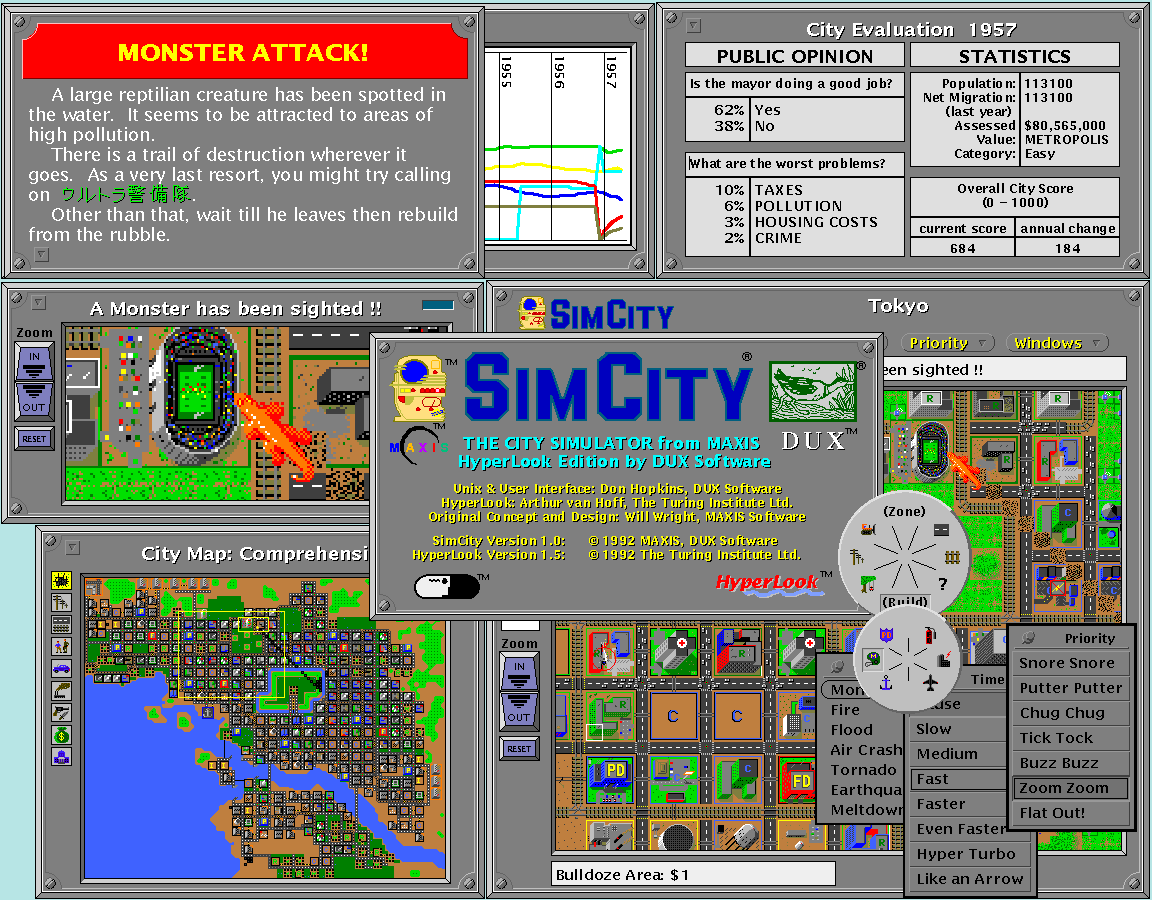
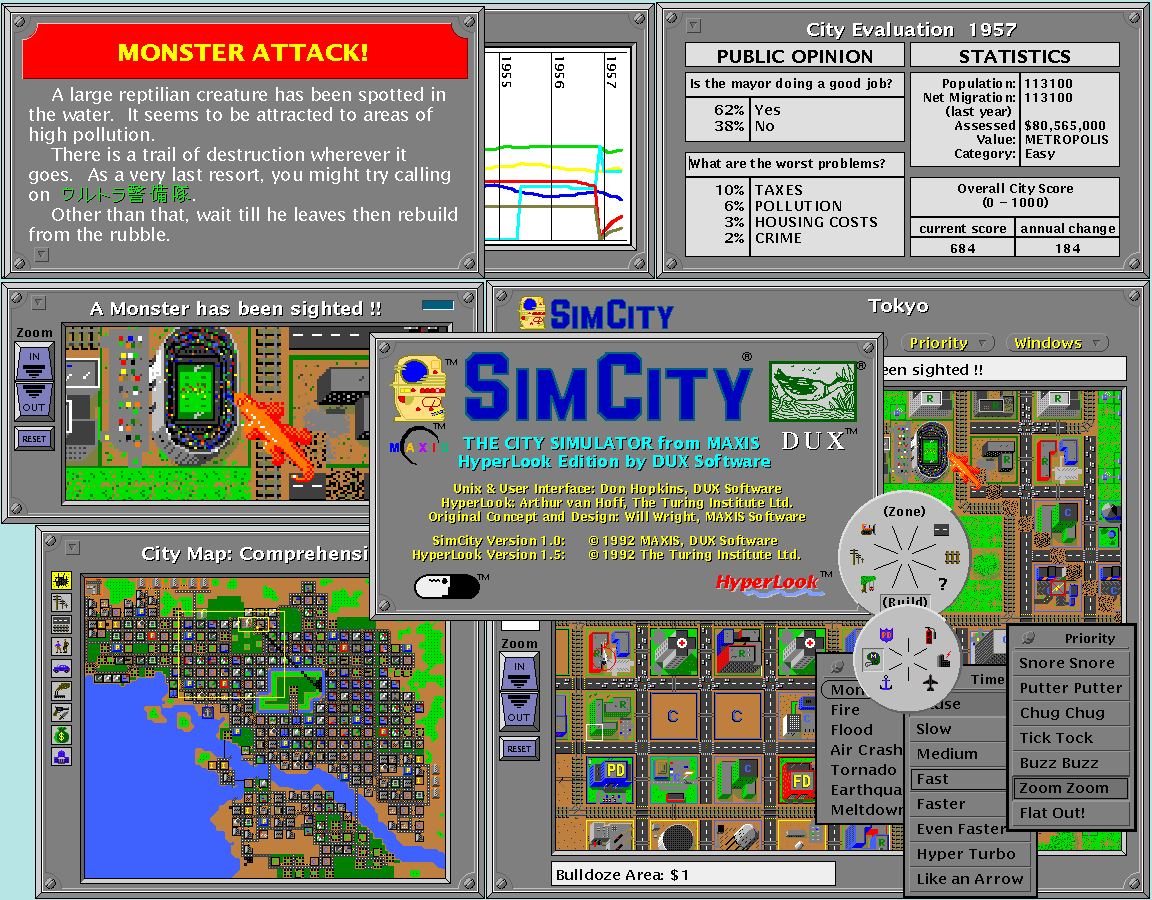
GoodNeWS was later renamed HyperNeWS, then later HyperLook. I went to Glasgow to work with Arthur at the Turing Institute, to develop HyperLook into a product, and I used it to develop the first Unix version of SimCity.
HyperLook was really wonderful, because it combined the strengths of HyperCard with the superior graphics and programmability of PostScript, and the network communication model currently known as AJAX.
I've written down some Ideas for Sugar development environment from HyperLook SimCity, with lots of links and illustrations, relating it with many different programming languages, user interface systems and applications that have inspired me.
Here is just the stuff about HyperLook -- the article goes on further to discuss and compare other technologies I think are interesting and applicable to the OLPC's constructionist education project.
Ideas for Sugar development environment from HyperLook SimCity
I love the ideas behind Smalltalk, EToys and HyperCard, and would like to combine them with ideas from visual programming languages like Robot Odyssey, KidSim, Klik-and-Play, SimAntics, Body Electric/Bounce, Max/MSP/Jitter, etc.
Here are some ideas about HyperLook and other systems, that could be applied to Sugar:
HyperLook was a PostScript-based user interface development environment for the NeWS window system, which Arthur van Hoff created at the Turing Institute in Glasgow. http://www.donhopkins.com/home/catalog/hyperlook/
I helped develop HyperLook into a commercial product, with a editable user interface development environment, as well as a redistributable non-editable runtime, and I used it to port SimCity to Unix, and develop other components and applications . http://www.donhopkins.com/home/catalog/hyperlook/ http://www.donhopkins.com/home/catalog/hyperlook/HyperLook-SimCity.gif
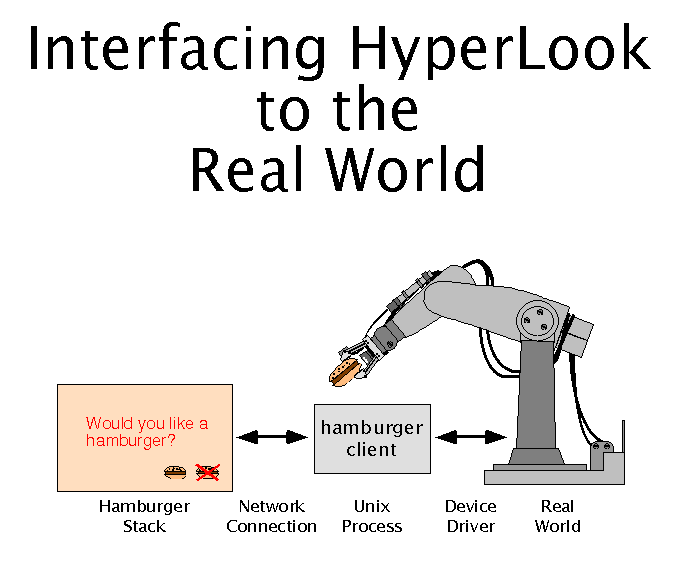
HyperLook was inspired by HyperCard, but it additionally provided a client/server programming model, and more powerful graphics and scripting based on NeWS's object oriented dialect of PostScript. http://www.donhopkins.com/home/catalog/hyperlook/TalkInterfacing.gif
The NeWS window system was like AJAX, but with:
1) PostScript code instead of JavaScript code
2) PostScript graphics instead of DHTML graphics, and
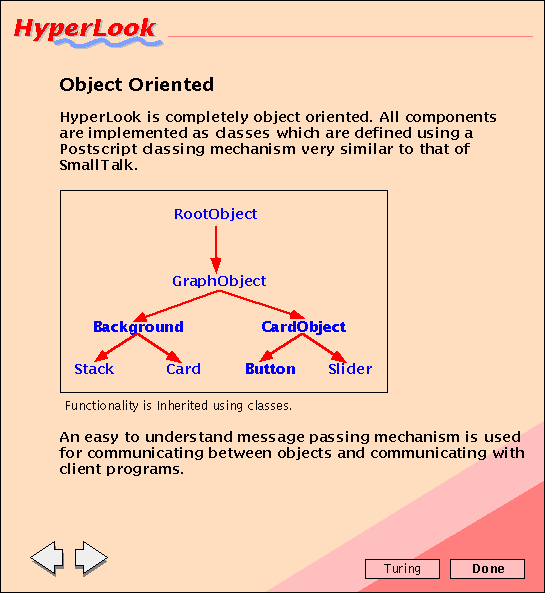
3) PostScript data instead of XML data.It had a unified programming/graphics/data/networking model based on NeWS's extended multi-threaded object-oriented dialect of PostScript, instead of a hodge-podge of accidental technologies. (Although I will be the first to admit the X11/NeWS merge was quite a hodge-podge and huge-kludge!) NeWS had an object system based on the simple dynamic ideas of Smalltalk, implemented with the PostScript dictionary stack, supporting multiple inheritance and runtime modification of objects and classes. http://www.donhopkins.com/home/catalog/hyperlook/HyperLookInfo10.g
-
Re:They want to go to whitelistingdistro people will know what to whitelist. As a developer, how do I get my package into a distro? usually, if it is not picked up already, you would contact packagers, find out who is packaging similar packages to yours and help them to get it up and running, so that the packager can easily wrap it all into package[s] and with different mandatory access control mechanisms, each application can b restricted even more to only access resources it is intended to, prventing some exploits in the app itself from working as well. The customized Linux distribution on One Laptop Per Child's XO laptops uses such capability restriction instead of whitelisting. See Bitfrost. well, maybe not instead - they can be easily used together. though current package signing can already can be considered whitelisting for some vectors, it (the whitelisting) still could be made more pervasive.
-
Re:They want to go to whitelistingdistro people will know what to whitelist. As a developer, how do I get my package into a distro? and with different mandatory access control mechanisms, each application can b restricted even more to only access resources it is intended to, prventing some exploits in the app itself from working as well. The customized Linux distribution on One Laptop Per Child's XO laptops uses such capability restriction instead of whitelisting. See Bitfrost.
-
Tactile Feedback; Sugar
Regarding the lack of tactile feedback, you make an excellent point. Luckily, there's been some innovation in that area. Immersion makes a touchscreen that vibrates vertically when one touches "buttons". Apparently, to the user, it feels like tactile feedback. Adapting such a technology would go a long way towards the more widespread adoption of touchscreens (which, even you will probably admit, are more useful than touch-less screens).
Regarding Sugar, on the other hand, you are dead wrong. The Desktop Metaphor is an ugly relic of the Xerox offices of the 70s. Subjecting millions of third-world children to "desktops" and WIMPs would be nightmarish, especially when there is a better alternative. It is so incredibly inhumane that I don't even know where to begin listing arguments and references against it. So, I'll give you just two. First, everyone should read The Humane Interface . Seriously. Second, read the Sugar Human Interface Guidelines, to see all the reasoning behind it. After that, come back if you still want to subjects these people to "grown-up" interfaces.
-
OLPC Project derailed?
In March and April Ivan Krstic and Walder Bender, two of the most famous technologists of the project left the project, with the following feedback to the community: Maintaining Clarity: http://radian.org/notebook/maintaining-clarity and Where is Walter: http://lists.laptop.org/pipermail/devel/2008-April/012986.html
May 13th, Ivan Krstic, the man behind the security system in the XO-machine wrote a much harder critic ( http://radian.org/notebook/sic-transit-gloria-laptopi ) against the OLPC project talking about the recent complete change in direction the company has taken, taking orders without knowing how to ensure the 700.000 machines actually end up where intended as orders are often taken to places where even no postal services go?
- Is it true that "learning" never was part of OLPC's mission?
- Are OLPC simply accepting orders without knowing how to deliver?
- Are the machines ending up in the right hands?
- How is theft and corruption prevented?
- Does the project really need to link the interface to the underlying OS? -
Re:Fool me once, shame on you
The purpose of the OLPC:
Any nation's most precious natural resource is its children. We believe the emerging world must leverage this resource by tapping into the children's innate capacities to learn, share, and create on their own. Our answer to that challenge is the XO laptop, a children's machine designed for âoelearning learning.â
A computer uniquely fosters learning learning by allowing children to âoethink about thinkingâ, in ways that are otherwise impossible. Using the XO as both their window on the world, as well as a highly programmable tool for exploring it, children in emerging nations will be opened to both illimitable knowledge and to their own creative and problem-solving potential.
OLPC is not, at heart, a technology program, nor is the XO a product in any conventional sense of the word. OLPC is a non-profit organization providing a means to an endâ"an end that sees children in even the most remote regions of the globe being given the opportunity to tap into their own potential, to be exposed to a whole world of ideas, and to contribute to a more productive and saner world community.
http://www.laptop.org/en/vision/mission/ -
Re:Will you be able to play games on the thing?
http://wiki.laptop.org/go/Linux_education_packages lists more, and it's a small fraction of what is available (finding all of it would require searching for each and every topic studied in a school curriculum).
-
Re:Give it to them for free
-
email to and response from olpci thought you all might find this interesting. yesterday, i sent and email to olpc and received a response today.
my comment:
This is nonsense. The OLPC program is supposed to be about helping children in underdeveloped nations learn and grow, right? Instead, you're forcing them to stagnate in the mire that Microsoft creates. Where we (the first-world nations) could be striving to help the tech-illiterate develop an understanding of how computers work, we're dooming them to a future at the mercy of a company that has made it clear that they only care about one thing: Microsoft. Now, you're not giving them the chance to learn how computers work, you're forcing them to develop under the oppressive yolk of Microsoft.
Not only that, but Microsoft should have had to pay for the privilege of subverting this new potential-customer base into more sheeple.
I was planning to defer my charitable contributions from other organizations to the OLPC program... but you've just told me (and everyone like me) that you don't want my money, that you value lining the pockets of a money-grubbing software giant over the well-being of developing nations.
The Salvation Army, Minnesota Public Radio and the Red Cross will all be very glad to know that your cause doesn't need or want my money and support.
response:
Thank you for your concern about One Laptop per Child.
OLPC maintains a firm and unequivocal commitment to open source software. Having an open system is fundamental to OLPC's mission, please see: http://wiki.laptop.org/go/Core_principles/lang-en
Any software developed by or for OLPC is released under GPL v2. The open source community remains a critical success factor in the one laptop per child mission and we are *extremely* grateful for all their past and future contributions.
Microsoft is developing a version of its XP operating system that runs on the XO laptop. OLPC will continue to develop its Linux-based OS and distribute it on all its XO laptops. Future distributions may include both open and proprietary software; however, the choice of what to use will remain the child's and the default will remain open source.
Best Regards,
OLPC
-
Re:Cool
Actually, the Fedora based LiveCD is out of date and there are better options available. More details can be found on the OLPC wiki: http://wiki.laptop.org/go/LiveCd
-
Re:Loose translation:Let me see if I can give you a couple of clu^H^H^Hanswers....
1) MS is not offering their software from the beneficence of samaritan spirit. They are offering it at that price to ensure that even the 5th world will be hooked on their constant upgrade and pay to play cycles. $3/CD is better than zero, and it will lead to sales later on. In the marketing world it's called a loss leader... http://www.investopedia.com/terms/l/lossleader.asp
2) More functionality in this case includes wasted battery usage through OS issues, BSODs, virus prone applications, upgrade cycles that are longer than the XO will be a viable product (read no upgrades)
3) No matter what language it supports, XP still has the same problems, so this is not much of a bonus, here is some data to see what the real language support is:
http://wiki.laptop.org/go/Linux_language_support
http://www.microsoft.com/globaldev/handson/dev/winxpintl.mspx
Now, when it comes down to it, neither is likely to support a dialect that is spoken by only several thousand people in the world, but both support a large number of languages making this an odd point to harp on. I've given you a couple of links, perhaps you can point out to the rest of us what huge advantage XP offers over Linux in general and the XO's original system in particular.
3) Redhat, Novell, Canonical et al were not asked to step up. OLPC chose their operating system and MS 'convinced' them to re-choose. I say convinced with all the irony that I can muster in this life and the next. MS is offering a raped version of XP, and not the version you are obviously used to.
Sugar OS was just right for the OLPC and with a few tweaks would have been very nice for the goals of that project.
As for your general attitude in your comment, I offer this review as rebuttal. It's from http://www.engadget.com/tag/olpc and the emphasis below is mine. It's been a controversial decision, but it looks like the OLPC XO has completed its transition from revolutionary education project to just another tiny Windows laptop with a useless keyboard -- albeit one with a pleasantly whimsical design. Yep, it's official: Microsoft and OLPC just put out a joint press release saying that XP-loaded XOs will be available starting in August or September, with some countries to get the machines as soon as next month. Users will get all the regular functionality of XP -- it's basically the same build as on the Eee and other ultraportables -- but Microsoft's spent over a year developing specialized drivers for the XO's various features like e-book mode, the writing pad, and camera. (We're pretty certain that doesn't include mesh networking, but WiFi is supported.) XP is too big for the built-in 1GB flash chip, so it'll come preloaded on a 2GB SD card, leaving just about 1.5GB free total for apps and media. It seems like Microsoft is thrilled about this partnership, but it's a not going to make NickNeg's search for new vision at the top any easier. As for Sugar? You'll still be able to get it, but we have a sinking feeling about its future. Demo video after the break. I realize that you seem to have been throwing down the gauntlet for the Linux fanbois, but you would be wise to remember to bring more than a knife to a gun fight. -
SugarIt is a huge shame that the OLPC project has deteriorated in this way. When first announced,I was really keen on getting hold of one of these machines to see what I could do to help. I downloaded the
Strongly agree. I think Sugar had - has - the potential to be the next big thing in user interface. It's a complete new look at how the graphical user interface works, and in my opinion it looks streets ahead of the conventional WIMP interfaces we're using now.
Of course, Sugar is a project which is, at least potentially, independent of OLPC. I really hope that enough of a community will carry on developing Sugar to make it a viable alternative desktop, not just for third world children, but for all of us.
-
Bitfrost?
Paraphrasing something I posted on OLPC News, I think the real loss here is Bitfrost which to me was one of the most interesting software developments to come out of the OLPC project. I remember reading somewhere that Ivan Krstic (the main architect behind it) was working on wrappers to help Bitfrost be usable on other flavours of Linux, but somehow I can't see it working on the XP XO...
-
Send them a message!I just did, to information@laptop.org:
Okay, I'm going to try to ask this in the most polite way I can:
WHAT THE FUCK IS WRONG WITH YOU?!
I thought the OLPC project was about helping children. I thought it was about teaching them to be self-sufficient, by giving them the opportunity to see and modify all the code the computer was running. I thought it was about giving them software (such as Squeak) that would help them learn.
Obviously, I was wrong. How sad: the most promising educational project EVER, and you've just FLUSHED IT DOWN THE DAMN TOILET.
FUCK YOU very much, and have a SHITTY day.
-
Pure?'We've stayed very pure,' Mr. Negroponte said. Yet from their core principles: There is no inherent external dependency in being able to localize software into their language, fix the software to remove bugs, and repurpose the software to fit their needs. Nor is there any restriction in regard to redistribution; OLPC cannot know and should not control how the tools we create will be re-purposed in the future. And they seem to have adapted their "core principles" to be more positive towards closed source. A real shame is you ask me. source: Core Principles (Renamed to "Five principles" instead of "Core principles" as the seem to value their principles less and less).