Slashdot Mirror
Domain: lowtechmagazine.com
Stories and comments across the archive that link to lowtechmagazine.com.
Comments · 33
-
Next breakthrough needed is in energy storageThe promising new technologies are: Compressed air in caverns, molten salt, and Li-Ion batteries.
Compressed air seems to be more economical than batteries today. Utilities would prefer this because, we would still need the grid.
Molten salt idea is to melt common salt using solar energy and keep it in underground tanks, and boil water off the stored energy to run steam turbines when the sun is not shining and the wind is not blowing. It involves basic thermodynamics and heat to mechanical energy conversion. So its efficiency is not great. It might come back to bite. Again utilities like this because we would still need the grid.
The Li-Ion battery prices are following a 7 year half life curve. We are at the cusp 100 $/kWh at pack level magic number right now. Tesla claims it is at 120$/kWh at pack level and below 100$/kWh in cell level. Others are close or ahead. Even at this price, batteries can stabilize the grid and take care of sudden changes in wind or solar generation. It has already saved Southern Australian grid several million dollars in the spot market for electricity. And with some financial engineering and capitalization of revenue streams, solar panel companies are viable in many places where the utility prices are high. At around 80$/kWh at pack level most middle class homes will be able to choose the grid or panel+batteries for their home. As prices drop below that level, affluent people will start dropping off the grid, (like affluent commuters dropped off public transportation in the 1960s and bus/tram lines collapsed in 1970s). This is the scary situation for the electric utility companies. Cost for remaining customers go up, and more people drop off the grid. When will the batteries be at 65$/kWh at pack level? If Elon Musk's secret master plan is right, it is just 7 Elon years from now. Like N Dog years = 7*N human years, N Elon years = N+6 human years. So we are looking at 2031 for this price for batteries.
-
Low Tech, but far from optimized
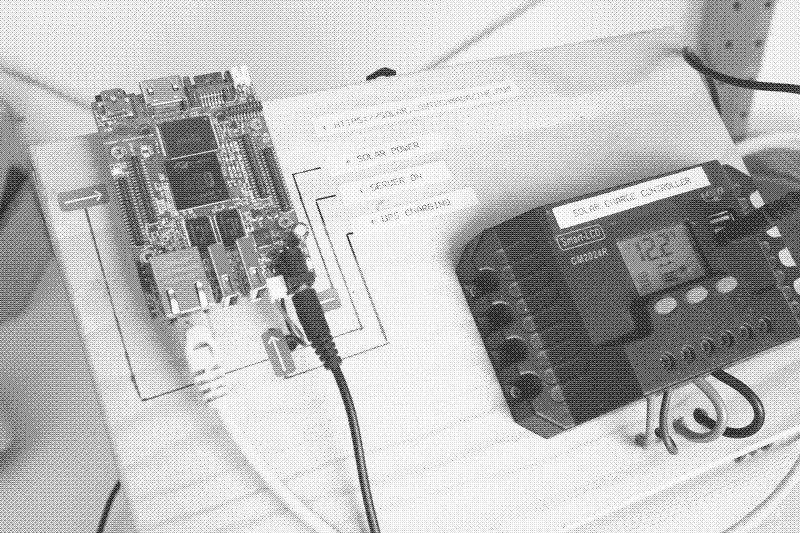
The image on the front page may look "low tech" with its dithering, but the file is a 800x553 pixels, 4-bit greyscale PNG image that weights 43415 bytes:
https://solar.lowtechmagazine....The same image would probably have looked much better and would probably be much smaller file if he had used JPEG, which is the proper format for photographs.
-
Re:Why turn it on at all?
That's not the argument, although they're not very bright: these are off-grid types of folks who don't understand things like storage overhead versus transmission overhead for overgeneration.
They've got an article about going off-grid with CAES that both assumes off-grid is a great idea and claims CAES is only 50% efficient (adiabatic systems are above 75% and predicted to mature to above 90%, even though theoretical limit is 100%).
These are preppers.
-
You know, it's not a bad thing
I'll probably retrofit my car to burn wood gas.
http://www.lowtechmagazine.com...
I wonder how a car computer would deal with it?
-
Re:Cost and workability vs strength
Since everyone is screaming at each other below this post, I'll leave this here. List of common building materials with their energy embodied in production
-
Re:That's just idiotic
Yeah, but do you think he wanted a description of that part?
I thought his point was "how can a carburettor (which vapourises a liquid) work with something that's already a gas".
I have no idea to be honest, but it's clearly a solved problem since I knew some Cheesehads with cars running on propane years ago. Not quite this long ago - you want KGIII for that.
-
Re:Renewable at what cost?
If you read this http://www.lowtechmagazine.com/2015/04/how-sustainable-is-pv-solar-power.html/ it presents an argument that the solar industry as a whole (production and then drawn out payback period) hasn't yet reached break even in terms of CO2. With CO2 warming for years and 2 degrees warming giving only a 50% chance of avoiding a cascade climate failure (increase in methane producing bacteria/methane clathrates from the ice caps leading to desertification of the amazon and then no huge amazon carbon sink) , perhaps we should stop investing in carbon intensive solar and go with the good old steel and wire of wind. Hell, recycle a shit car, make it a wind turbine.
-
Electric, not as perfect
Well under a life cycle of under 100k miles there's no benefit among electric or Diesel. The source of contamination of electric cars is fabrication itself and the batteries. http://journalistsresource.org... I'd rather go for a bike or a velomobile for short trips less than 10 km. Bike is faster in some cities than cars in that range GIYBF. I'll buy a sportswagon for the rest of tasks (gasoline, because i'll be using it for long trips). http://www.lowtechmagazine.com...
-
Re:Didn't think it was possible
This useless canard again. The emissions from making the panels are trivial, and get lower the more panels there are in use.
Hm. I could have sworn the manufacturing of photovoltaic panels involved a lot of pretty nasty chemicals. A quick Google search turns these up:
http://www.lowtechmagazine.com/2008/03/the-ugly-side-o.html
and
http://washington.cbslocal.com/2013/02/11/solar-companies-creating-millions-of-pounds-of-polluted-sludge-contaminated-water/I did not see anything about my initial understanding to be a canard. Perhaps you could offer some links?
-
Re:Seriously??
One step at a time...
Didn't it have some quite obvious maths that showed that if all cars in the USA were converted to electric, it would require 7,000 GWh of electricity just to charge them every day?
7,200 billion watt-hours versus 134 billion gallons of gasoline per year, which is equivalent to 12,372 billion watt-hours of energy per day (33,700 watt-hours per gallon!). Not including all the processing, handling and transportation energy which the DOE figures is 83% efficient, so net energy expenditure is closer to 14,900 billion watt-hours daily.
Velomobiles have several significant drawbacks compared to full sized electric cars: Single person occupancy is the ONLY option, can't carry anything in the way of cargo, not suitable for many people (only able-bodied persons need apply), not suitable for a wide variety of weather and terrain conditions, etc etc... Nice idea but to seriously suggest that everyone should use them is a fucking joke.
what that velomobiles article didn't also cover is that it's highly unlikely that the world has enough lithium and neodymium to go round to supply all those vehicles.
There is 29.7 million tons of lithium on reserve (meaning readily extractable with current infrastructure), and the total quantity of lithium on the planet being something like 3 million billion tons (only a fraction is actually accessible, of course). Lithium is about as plentiful as nickel.
If you need 140 grams of lithium per kWh of battery then today's typical electric car will need 3.4 kg of the stuff, meaning you can make 588 million such cars per million tons. Right now there are only about 600 million cars in the entire world. Advances in technology notwithstanding, roughly 1/30th of our currently available lithium supply will satisfy the entire global automotive market.
Plus, you can recycle Lithium batteries if you need to - currently not economical, but you can do it.
As for neodymium and other rare-earths? You dno't actually need those materials to make electric motors. They're very useful at making good, cheap motors - but you can make good, slightly more costly motors without them. If by some happenstance we run out of "rare earth" elements (which are actually about as rare as dirt but economically viable deposits are what's rare) then we'll manage.
i've *done* the analysis and the designs (http://lkcl.net/ev) and if EVs are to be the success that people really really WANT them to be...
Nothing on your website supports the claim that such a design is required to be successful (if it is, you have hidden it very well). In fact, I'm pretty sure that such a design - while very efficient - has absolutely no market potential to speak of. This is mostly because efficiency and cost are not actually the primary reasons most people buy cars.
Your shitty Geocities throwback of a site also incorrectly links the Chevy Volt fire to the lithium content. The actual reason for the fire was the battery coolant system was not drained after a crash test, and a week later the concentrated glycol residue from the leaking coolant caused a short. A short which, incidentally, can (and often does) happen in any car's electrical system. Even your proposed design can burst into flames without warning.
or am i missing something here?
Facts, mostly... facts and perspective.
=Smidge= -
New Miracle batteries since 1901
Breakthrough paradigm shifting innovative batteries have been around at least since 1901 and none of them worked.
(ctrl+f -> miracle batteries)
Technology changes incrementally and not on public demand.
-
Toxicity of nanoscale materials
When you go nanoscale the properties of materials change dramatically. This is why it's done and happens because of quantum mechanics take precedence over Newtonian physics of the macro world. One of the property changes is toxicity. This is why materials which have been known to be non-toxic should also be tested before applied in nanoscale. See e.g. http://www.lowtechmagazine.com/2008/05/nanotechnolog-1.html
When techno-optimists and greedy investors hurriedly work together the consequences are often dramatic and sad.
-
Re:Up to 10x more ... must be a fraud
C'mon. How often did we read this stuff? How often will we keep reading it again?
For over 100 years now, miracle batteries for electric cars have been supposed to be just around the corner.
Can't just finally file them right next to the perpetuum mobile cranks and move on until somebody actually delivers on those stupid promises?
From the article:
"If you were to put the lithium-ion battery of the Nissan Leaf in the 1908 Fritchle, the vehicle would have a range of about 644 km (400 miles). "Don't be so negative. It hasn't that battery tech hasn't advanced in 100 years, it's that it hasn't kept pace with the demand for faster, safer, bigger vehicles. The advancement in any technology is rarely a big bang. Take the lithium-ion battery in this laptop I am typing on for example, and look at the series of advanced necessary to give me a 6 hour battery in a high performance laptop: http://en.wikipedia.org/wiki/Lithium-ion_battery#History. From wikipedia:
"In 1979, John Goodenough demonstrated a rechargeable cell with high cell voltage in the 4V range using lithium cobalt oxide (LiCoO2) as the positive electrode and lithium metal as the negative electrode."
"In 1991, Sony and Asahi Kasei released the first commercial lithium-ion battery."
It took 12 years from discovery to the first commercial battery, and another 5 to 10 years for them to be widely used. Yet on a supposed "tech" site all I read about are people critiquing any battery tech discovery as lame if it doesn't allow for a plug-in to be driven 500 miles on a charge. This discovery may turn out to not be practical, or may turn out to be THE discovery that leads to a battery revolution.
And even if we didn't get a 500 mile per charge battery, but instead got some tech that allowed the Volt to be at the same price point as a current Prius? Or even got it from 40 miles to 60 miles in a charge. These relatively modest advancements could start a major revolution where liquid fuels are only used for long-haul travel.
-
Re:Up to 10x more ... must be a fraudThe Lowtechmagazine ran a story on the development of electric cars and batteries last year:
In spite of this, the 2010 vehicle has a much better battery under the hood than the 1908 vehicle. The Fritchle Electric had lead-acid batteries, like all its contemporaries, with an energy density between 20 and 40 Wh/kg (early 1900 batteries had energy densities of only 10 to 15 Wh/kg). The Nissan and the Mitsubishi have a more powerful lithium-ion battery with an energy density of around 140 Wh/kg.
The Nissan's battery can thus store 3.5 to 7 times more energy for a given weight than an average early electric from about 1910.The gain in runtime of laptops is mostly a matter of them getting much more efficient and using much less power over the last 20 years. The failure of cars to get greater range is mostly a matter of them getting much less efficient and using ever more power over the last 120 years.
-
Up to 10x more ... must be a fraudC'mon. How often did we read this stuff? How often will we keep reading it again?
For over 100 years now, miracle batteries for electric cars have been supposed to be just around the corner.
I'll quote from the link I gave:"A large number of people interested in stored power are looking forward to a revolution in the generating power of storage batteries, and it is the opinion of many that the long-looked-for, light weight, high capacity battery will soon be discovered." (source, 1901).
"The demand for a proper automobile storage battery is so crying that it soon must result in the appearance of the desired accumulator [battery]. Everywhere in the history of industrial progress, invention has followed close in the wake of necessity" (Electrical Review, 1901).Can't just finally file them right next to the perpetuum mobile cranks and move on until somebody actually delivers on those stupid promises?
-
Re:nuclear can be safe; short term profit preferre
http://www.lowtechmagazine.com/2008/03/the-ugly-side-o.html
Solar panels don’t come falling out of the sky – they have to be manufactured. Similar to computer chips, this is a dirty and energy-intensive process. First, raw materials have to be mined: quartz sand for silicon cells, metal ore for thin film cells. Next, these materials have to be treated, following different steps (in the case of silicon cells these are purification, crystallization and wafering). Finally, these upgraded materials have to be manufactured into solar cells, and assembled into modules. All these processes produce air pollution and heavy metal emissions, and they consume energy - which brings about more air pollution, heavy metal emissions and also greenhouse gases.
(from the linked article)
-
Wood gas would have been cheaper.
Wood would be cheaper, but not as efficient. Also has a proven track record.
-
Technology never dies.
Even something as obscure as the Breast Drill - http://www.lowtechmagazine.com/2010/12/hand-powered-drilling-tools-and-machines.html#more
Apparently can still be purchased at Sears. http://www.sears.com/shc/s/p_10153_12605_00934093000P
According to Kevin Kelley, Technology never dies. -- http://www.econtalk.org/archives/2010/11/kelly_on_techno.html
About midway through this hour-long podcast, Kelly describes an experiment where they took a 100 year old Montgomery Ward Catalog, and managed to find everything in it still being manufactured somewhere.I myself still manufacture ancient Catapults and Trebuchets, -- http://www.rlt.com/ -- both small model and full-sized machines. (Fortunately, I was NOT the maker of the drug launching catapult found at the Mexican border that was in the news recently.)
-
Don't forget to clean your room...
Hopefully, I'm not duplicating someone's post... Being able to cut a tighter line is one thing. Being able to do it on a "making license plates" scale is something else. As you move increase the density of what is being packed on the chip, you have to be able to increasingly control for smaller and smaller particles. Each jump in Clean Room Technology is neither easy, nor inexpensive. For details, and a whole lot more related material:
http://www.lowtechmagazine.com/2009/06/embodied-energy-of-digital-technology.html
-
Is nanotech the new asbestos?
-
Is nanotech the new asbestos?
-
Nanotech kills
How about we test radical new substances first before selling them instead of using the population as guinea pigs?
-
Is nanotech the new asbestos?
http://www.lowtechmagazine.com/2008/05/nanotechnolog-1.html
Remember kids, if something sounds too good to be true...
-
Re:Nuclear power plants are offtopic, but here goe
Actually, in addition to nuclear waste the world may be running out of uranium: http://www.lowtechmagazine.com/2007/08/nuclear-react-1.html And not only that, but uranium mining is a very polluting affair http://www.culturechange.org/cms/index.php?option=com_content&task=view&id=493&Itemid=66 http://www.technologyreview.com/blog/arxiv/24414/
(Of course, the World Nuclear Association downplays these issues: http://www.world-nuclear.org/info/inf75.html )
Ironically you need to burn fossil fuels in order to mine uranium; mining vechicles use diesel while the mining industry runs mainly on coal -- or have you heard of any solar-powered nuclear enrichment plants?
-
Inherently Promising
The more there are pie-in-the-sky technologies out there that have been researched over many years, the more promising and immediately useful (if currently marginally feasible) technologies there will be on hand to frantically improve at the last minute when ever-growing demand for energy peaks and readily available oil has become unaffordable for less important applications. Algae is particularly promising because it relies on a billion years of evolution focussed on minimal-energy solutions to extracting power from sunlight, and because it has relatively little background pollution associated with it (as compared to the array of toxic chemicals used to manufacture solar cells, for example). Plus, understanding of genetic engineering can only improve greatly.
I still strongly prefer nuclear energy (safe fission designs for now, fusion later if that ever gets off the ground), but the political controversy surrounding nuclear power plants appears set to make nuclear energy a minor part of future energy provisions. Algae looks to be uncontroversial and usable everywhere there is decent sunlight, with almost no toxic chemicals or proliferation concerns.
-
Re:Greentech!
Most assessments of microgeneration I've seen show that it's inefficient...
Wind energy scales well to large sizes, which means it's a poor choice at small sizes-- in fact, this link was on slashdot a few months ago.
-
The "English summary link" might be informative
You really should check things like article links more carefully if you want to quibble about "news" versus "discussion." The summary link: http://www.lowtechmagazine.com/2009/04/small-windmills-test-results.html, astonishingly is to a "journal." It is the author of the journal article that asserts that "small" windmills "are a swindle." The references to "design" by the OP also appear to derive from an uncited link: http://www.lowtechmagazine.com/2008/09/urban-windmills.html, to another journal article that debunked small windmills as a poor investment, or as the authors of the linked article put it "fundamentally flawed." There is in fact apparently nothing in the summary by the OP that does not appear to derive from a "journal" source, if you consider that important. So, evidently it really IS news, wouldn't you say?
-
The "English summary link" might be informative
You really should check things like article links more carefully if you want to quibble about "news" versus "discussion." The summary link: http://www.lowtechmagazine.com/2009/04/small-windmills-test-results.html, astonishingly is to a "journal." It is the author of the journal article that asserts that "small" windmills "are a swindle." The references to "design" by the OP also appear to derive from an uncited link: http://www.lowtechmagazine.com/2008/09/urban-windmills.html, to another journal article that debunked small windmills as a poor investment, or as the authors of the linked article put it "fundamentally flawed." There is in fact apparently nothing in the summary by the OP that does not appear to derive from a "journal" source, if you consider that important. So, evidently it really IS news, wouldn't you say?
-
Re:20 vacuum cleaners...Blatantly stolen from: http://www.lowtechmagazine.com/2009/03/fast-charging-electric-cars-off-peak-grid.html#more
"If you charge an electric car with a battery capacity of 25 kWh during 8 hours, it needs a power output of 3,125 watts (3.1 kilowatts x 8 hours = 25 kWh). If you charge the same car in just 20 minutes, you need a power output of 75,000 watts (75 kilowatts x 0.33 hours = 25 kWh). This corresponds to the energy output of 220 plasma televisions of 340 watts each. This amount of energy is required over a shorter period, but it has to be available. If you lower the recharging time to 10 minutes, the energy output will be 155,000 watts (155 kilowatts x 0.16 hours = 25 kWh). This equates to 450 plasma televisions. "
Now if you extrapolate that further to 10 seconds it becomes something more like 930,000 watts, just for ONE car! Imagine what kind of peak power output we'll need our THOUSANDS and THOUSANDS of power plants to produce when we plug 200,000 cars into the grid at the same time!
-
Re:This isn't "green"
It follows, then, that in order for it to take more energy to produce the device than it will generate over its useful lifetime, the manufacturer would effectively need to spend twice as much on electricity as they sell the finished product for... And that ignores other overhead such as labor and raw materials.
Uh. Or they could just set the price above their total costs and still manage to sell them. Companies sell lots of things that make no sense, and successfully. Particularly in this case, people will obviously pay more for something "green" and their 'pay'ing price doesn't not have to have anything to do with the 'pay'back period.
Your overall point is still, of course, correct. This subject has been around long enough that even Googling finds some straight talk. The closest to the doom-and-gloom, "don't use solar power at all" articles and papers I could find were about heavy metal emissions, but even they put the ratio at 9:1 in favor of solar. http://www.livescience.com/environment/080227-solar-power-green.html
I did find one that clearly says solar may sometimes be bad for a bad install location (duh), and that solar is universally bad for gadget-scale use: http://www.lowtechmagazine.com/2008/03/the-ugly-side-o.html -
Re:Wow, good job!
I read them looking for gaping holes to point out
I think I saw one: the fact that most of the US is built for cars, which is a problem itself. Population densities are too low. It'd be better if most of the stuff you'd need was closer by and you'd have parts of the road reserved for other traffic, so you'd be able to walk or use a bike, the latter being a vastly superior means of short-distance transport with incredible efficiency. There are all-weather bikes that look like raindrops on wheels - and possible of doing ~50mph when you're assisted by the battery. Add a little cart and you can do your grocery shopping for a week. I'd love to use this on the freeway - but its maximum speed is the freeway's minimum speed.
See http://www.twike.com/ and http://www.ted.com/index.php/talks/james_howard_kunstler_dissects_suburbia.html
Another thing I'm in favor of (but this would be easier to implement in most larger cities or here in Europe) - replacing all truck traffic with "email for things".
http://www.lowtechmagazine.com/2008/02/a-world-without.html It'd do miracles for the traffic congestion here in the Netherlands, since a lot of stuff has to go to Rotterdam anyway. One of the main freeways is blocked every day thanks to this. Trucks are limited to 50 mph (80 km/h) here and when one goes 49 due to the load, the next one will try to pass it - which takes 5 minutes. -
Re:Report at 11....
the anti-tech people already got it: is ecotech the new asbestos?
-
pedal power overview
Here you find a good overview of the possibilities of wind up power and bicycle machines