Slashdot Mirror
Domain: marginalrevolution.com
Stories and comments across the archive that link to marginalrevolution.com.
Comments · 73
-
Re:Great.
From a couple of noted economists, such as the radically right-wing (not!) UC Berkeley energy economist Severein Borenstein (More links at the destination):
I want to urge you not to adopt the standard. I, along with the vast majority of energy economist, believe that residential rooftop solar is a much more expensive way to move towards renewable energy than larger solar and wind installations. The savings calculated for the households are based on residential electricity rates that are far above the actual cost of providing incremental energy, so embody a large cross subsidy from other ratepayers. This would be a very expensive way to expand renewables and would not be a cost-effective practice that other states and countries could adopt to reduce their own greenhouse gas footprints.
tl;dr version: This law is stupid virtue signaling.
-
Re:Yeah
Agreed! We are in a trade war, however everyone wants the US to lay down and accept their raping of us. Trump realised the Trade war has started and is not going to lose without a fight (in fact obviously the US can and will win, if we fight.)
Obama was fighting for the other side, meaning he is a globalist and not a nationalist. Trump understands that it is no use being a globalist as you will just be abused by nationalists, until you are 3rd world country with no influence.
People even on here seemed to have embraced the hate Trump crap so much that they cannot see straight. Comments about Trump dying in jail or being executed with his family, and then they call Trump a fascist. There was a song by Michael Jackson "I'm starting with the man in the mirror." might be good for some of the teenagers posting this stuff to listen to and contemplate.
You really think Trump has the expertise to win a trade war? Trade deals are decided on the fine print and you've got a guy who can't even read the all-caps. He still thinks the US has a trade deficit with Canada!
He's just obsessed with trade deficits because it's an easy to understand number, but trade deficits aren't necessarily a bad thing, it just means you're selling them more than you're selling them. But if you can actually use the things you're buying then it's actually a good thing.
Of course if you don't believe me try reading his idiot of an advisor without laughing.
-
Re:Finally, a convincing argument
This is just
We get it already, the
Here's a different view, based on actual economics and studies and stuff...
I'm one of the ones who think the FCC regulating Internet access under Title II just leads over time to established/entrenched interests using that to preserve the status quo and prevent innovation and change which might disrupt them in favor of consumers, but hey, as long as
-
Re: Is this the same media
You can put that "New York Times was not reporting false news or outright lies" idea to bed because they absolutely do. Why don't you hear about this all the time? It's huge news when they do it, and they do it often.
They lied about Tesla car. "When the facts didn't suit his opinion, he simply changed the facts," Musk wrote. A Times spokeswoman reiterated that its story was "fair and accurate."
Last year, 35% of colleges saw international student numbers go up, 26% saw no change, and 39% saw them go down. New York Times publishes this with the headline "Amid Trump Effect Fear, 40% of Colleges See Dip in Foreign Applicants"
Glenn Thrush, the former senior staff writer at Politico who found himself in hot water when a WikiLeaks dump in October revealed that he ran an article by Hillary Clinton campaign chairman John Podesta prior to publishing, thought the Georgia results were lackluster. Thrush is now a political correspondent for The New York Times.
"We don't want to hear anything - we've long said this about this about the Right - but I think the Left, we don't - I'm not 'we,' I'm a journalist - but the Left as a rule does not want to hear thoughtful disagreement."
http://www.newsbusters.org/blo...New York Times says Trump's tweets incite violence, yet published an image of Stephen Miller's severed head on a pike.
The same people criticizing Trump for his WWE tweet had no problem with the New York Times sponsoring a play that depicted Trump's assassination.
New York Times lies about Trump's almost 40% figure
New York Times quotes a fake twitter account, publishes fake news.
The New York Times Misquoted Trump's Charlottesville Remarks In Five Different Reports
A New York Times reporter called Melania a hooker and they wouldn't even release the name of the reporter that said it, let alone fire her.
"Without your help," a beaming Fidel Castro said while nodding at Herbert Matthews during a visit to The New York Times's offices in April 1959, almost exactly a year after he'd visited Marquez-Sterling, "and without the help of the New York Times, the revolution in Cuba would never have been."
"Is The New York Times a Liberal Newspaper? Of course it is."
--Source: New York Times -
Re:Lack of information doesn't matter
Good point. Let's look at the 2017 data. http://marginalrevolution.com/... (Note, I did not check on MarginalRevolution's political leanings.) PopeRatzo, your point handguns being the weapon of choice for US murders is correct. However, your comment is off base. In fact ScentCone DID mention handguns in the very sentence before the one you quote. So my question back to you, PopeRatzo, is why YOU chose to ignore ScentCone's statement? As you yourself pointed out, that is not an NRA talking point but an FBI talking point. I dislike hypocrites. And another thing - the tragic event in Las Vegas did not involve hand guns, so you are the one who is off topic (or at least on the edge).
-
Re:except it wasn't people renting out their rooms
-
Sorry, the FAA says no.
The FAA has already said no to ridesharing. http://www.bloomberg.com/news/...
The FAA has already said no to "Uber in the sky". http://motherboard.vice.com/re...
And http://marginalrevolution.com/...
And https://fee.org/articles/how-t...The reason for it is that the FAA has different rules for carrying yourself as a private pilot, carrying others for commercial gain, fare-sharing, etc. The regulations for fare-sharing mean you actually ALL have to be going TO GO DO the same thing, not just going to the same place. https://www.tnooz.com/article/...
The FAA has a higher requirement of pilots, equipment, and maintenance when used to carry passengers (other than private pilots who are NOT getting reimbursed).
Ehud
OB DISC: I'm an FAA certificated commercial helicopter pilot -
Thanks, Obama!
Think I'm trolling? Think again:
In a new paper, also cited by Leubsdorf, Danny Yagan at Berkeley suggests that reduced migration is only part of the problem. What has made the aftermath to the 2008-2009 recession so bad is that migration is low at the same time that it has become more necessary than ever. The 2008-2009 recession was especially localized, it hit some places harder than others and in a way that appears to be permanent. But migration has been too slow to solve the problem.
The usual story is that in-and-out migration equalizes wage, unemployment and employment rates across the nation. Some places may be harder hit than others but movement quickly makes the US into one labor market. In the aftermath of this recession, however, that isn’t happening for employment rates. Using a clever research design that looks at workers with similar education and skills doing the same jobs at the same large firms but in different locations, Yagan finds that location continues to matter years after the recession has ended. Workers who worked in the places hardest hit in the 2007-2009 recession have employment rates today that are 1% lower than similar workers in regions that were less hard hit.
-
Bill Gates failed elementary statistics
For all his "geek" status, Bill Gates (with his foundation) failed elementary statistics. He succumbed to the law of small numbers and idiotically pushed for smaller schools for a long period spending a lot of time, money and energy convincing policy makers that the small schools will make students better.
They thought so only because frequently among the best performing schools were small schools. Idiots didn't notice that among the worst performers were ALSO small schools - small samples just lend themselves to a higher variability.
Read details here - http://marginalrevolution.com/...
If a lot of money is spent by non-accountable idiot organizations , it is not only not good for society but actively harmful.
-
Marginal students do not benefit from college
From The Option Value of Human Capital: Higher Education and Wage Inequality
"...we find that subsidies inducing marginal students to attend colleges will have a negligible net benefit: Such students are far more likely to drop out of college or become underemployed even with a four-year degree, implying only small wage gains from college education."
-
Re: Censoring speech...
That is simply not true, we do pollute more, that is because we have more people and are much more effective at getting resources.
But killing is just wrong while we do kill people, we probably live in the most peaceful time in human existence.
Here are murder rates:
http://marginalrevolution.com/...if you want a citation from wars:
http://www.huffingtonpost.com/...also think about deaths from illness,
Also in the past remember slavery was acceptable,
I am as pessimistic as the next person but don't blind yourself with false assumptions.
-
No, generics _do_ need to undergo testing
Part of the problem here is that the FDA requires generics do need to undergo testing similar to the original product (instead of merely proving that the ingredients in the generic are the same as in the original product), which can take years and millions of dollars. These FDA requirements make generics expensive to produce -- meaning that generic versions of many drugs do not exist. Without the FDA requirements, the market would take care of ridiculous price bumps by bringing in competitors.
Now, I just claimed that the FDA makes it hard to bring generics to the market, so how did a competitor spring up so quickly in this case? The answer is that the new manufacture seriously bent FDA rules: the product mentioned in the description is _not_ FDA approved. The company making the product is not a standard drug manufacturer; it is a "compounding pharmacy" -- meaning that it can skirt FDA rules by making batches of drugs for one individual at a time (not making huge batches and selling them to Wallgreen's, CVS, etc.) Since this drug is not widely used, this approach may work. However, the FDA regulations are still a burden in general (and the FDA still has some power to put the kibosh on compounding pharmacy).
See http://marginalrevolution.com/... for more information
-
No, gas stations will not go extinct soon
the tipping point will come when gas stations, not a massively profitable business, start to go out of business as many more electric cars are sold,
This idea is simply bogus. Here's a good analysis of the argument, but a choice quote sums up the problem with the argument:
Consider that in 2009 there were 246 million motor vehicles registered in the United States. A 10% reduction would be 221 million vehicles but that is how many vehicles there were in 2000.
Gas stations didn't go extinct in 2000 because there were fewer gas vehicles, and they won't do so now. In fact, there are already fewer gas stations now, mostly because gas-powered cars are more efficient. However, no one started yelling tipping point because gas-powered cars became more efficient, an effect which is probably more important than electric vehicles in the foreseeable future. There still so many that the gas-station-tipping-point hypothesis is BS.
-
Expert Blogs
A few of the "expert" ones I frequent:
Economics/Social Science:
Econlong
Marginal Revolution
The Money Illusion
Overcoming Bias
Bronte Capital - More short selling fund/capital management than economicsLaw
Volokh Conspiracy (Now tied into the Washington Post)Writing/Fantasy/SF
According to Hoyt
Mad Genius Club
Come Let Us Reason Together (more politics than writing) -
Re:Actually,
...
The shocking violence of prohibition days was only shocking becasue there was so little violence among the non-gangster population. In comparison to the violence associated with today's drug gangs, the violence of Al Capone and friends was trivial. The "Saint Valentine's Day Massacre" (1929) only involved the death of six mobsters (NOTHING on the scale of a typical Chicago weekend these days... and a modern Chicago weekend is more likely to involve dead innocent civilians)...
There is a word for this bit of historical 'explanation' - it is politely referred to as "B.S." Here is a very interesting long term graph of American homicide rates. It shows that there has been a long term (300 year) trend toward lower homicide rates, with two interesting spikes in the 20th Century.
One of these spikes is smack-dab in the middle of Prohibition, where the overall murder rate rose to 10 per 100,000. It rose again to this same level the late 20th Century (peak was in 1991). It has since dropped to half that. So, yeah, the 20's were very violent everywhere just like the late 80's and early 90's, and today we have much lower levels of murder despite "today's drug gangs".
-
Re:wildfires?
I have a solution for your CA home water issues.
Ready? Stop voting for Democrat environmentalists.
The science is in. If you divert millions of acre-feet of water to fulfill environmental regulations, you can't use that water for other stuff. If you stop building reservoirs and dams to store water while increasing water usage, you won't have enough water. If agriculture water prices went up enough that the agribusinesses used 12.5% less water, then every residential and industrial user in CA could use 50% more water.
-
Re:Yup
http://ourworldindata.org/data...
http://marginalrevolution.com/...The data doesn't support your assertion. The centuries-long trend is a decline in homicide rates. It appears that, on the whole, our "intelligent brains" are quite capable of choosing to be a non-homicidal member of society. The homicidal deviants you mention are an inconsequential percentage of the total population.
http://ourworldindata.org/data...
I found this chart to be especially interesting. The US homicide rate was roughly constant throughout the 20th century.* At first glance, this contradicts the overall trend, but it's more encouraging when you look at the demographic changes. In 1900, there were 75 million people, and 40% lived in urban areas. In 2000, there were 280 million people, and 80% lived in urban areas. Urban areas have much higher homicide rates than rural areas, so it's quite impressive that the per capita homicide rate didn't rise dramatically.
*The drop from 1940 to 1960 was a combination of the Great Depression and WW2. Young men commit most murders, and you won't have many young men if your families are too poor to have kids or your young men are off fighting a war. Predictably, the homicide rate shot back up when baby boomers started becoming young men.
-
Space flight failure rate is around 5%
http://marginalrevolution.com/...
I could accept a 5% risk of death if I was doing something worthwhile: contributing to science or the colonization of Mars. But for a joy ride? Even if it's an order of magnitude better, a 5 in 1000 chance in death is still pretty high. That's a couple of orders of magnitude riskier than skydiving (0.0007%) or driving 10,000 miles. (0.0167%)
-
Call it a "Driving Plane" not a "Flying Car"
Somehow it sounds cool to have a flying car, but kinda stupid to have a driving plane. This was an observation made by Tyler Cowen on his blog. It's a good point. It reminds me of a survey of priests that emphatically showed priests are ok with praying while smoking, but not with smoking while praying.
-
Re:Fighting rearguard actions against change
As if there's much difference between a libertardian an progtard. But even some libertarians are starting to get a clue. See the comments by Peter Schaeffer, as he schools Tyler Cowan on immigration economics.
-
Re:Took them long enough...
So? The existence of one academic who may have some dubious methods doesn't invalidate other work in a field. What about these guys? If anyone would be expected to give guns a fair shake it would be a free market economist with libertarian sympathies.
A free market economist who has no idea of what is statistically significant or not?
And I've given up on who "would be expected to give guns a fair shake" because too many people have a totally irrational fear of guns that they will not admit even to themselves.
-
Re:Took them long enough...
So? The existence of one academic who may have some dubious methods doesn't invalidate other work in a field. What about these guys? If anyone would be expected to give guns a fair shake it would be a free market economist with libertarian sympathies. The fact is the gun/suicide link it both completely expected from the relevant facts and completely backed up in the data. The fact gun rights advocates continue to deny it really just ruins their credibility on other questions like guns & crime where the data can be more fuzzy.
-
Re:Here we go...
Update: Candidate Obama agrees with me.
-
Re:Definition of shortage -- more may still be bet
I think this is best summed up by the following short post at Marginal Revolution (an excellent economics blog):
It comes down to the definition of shortage. The standard economics definition of a shortage is when supply does not meet demand. The paper shows that the supply of STEM workers does seem to meet demand for them.
However, it could well be that we'd be better off if there were more STEM workers -- driven by higher demand for them. That is not addressed by this paper, and this definition (that more resources allocated to STEM would be better) is a fine definition for a shortage.
That's the underlying issue.
Huh?
from your link:
Even without boosts in the complementary inputs, more STEM workers still can be put to good use, even if there is no “shortage” today.
How? Government mandate?
And it is intersting - your link and your comment have the same obfuscated (constipated) writing styles.
-
Definition of shortage -- more may still be better
I think this is best summed up by the following short post at Marginal Revolution (an excellent economics blog):
It comes down to the definition of shortage. The standard economics definition of a shortage is when supply does not meet demand. The paper shows that the supply of STEM workers does seem to meet demand for them.
However, it could well be that we'd be better off if there were more STEM workers -- driven by higher demand for them. That is not addressed by this paper, and this definition (that more resources allocated to STEM would be better) is a fine definition for a shortage.
That's the underlying issue.
-
Re:Supply and demand
The interesting thing about this whole episode is that, despite no obvious interventions by the state, the market itself failed to raise prices to clear the market.
In shortages like this, the logistics of gasoline make it difficult to really up capacity even by significant price raises. The gasoline market is highly segmented. It's not very easy to divert supplies from elsewhere and ship gasoline in the quantities needed, unlike with things like food and water.
What "price gouging" can do, however, is eliminate hoarding and frivolous use. $8.00 a gallon really makes you think twice whether you need that generator running 24 hours a day. That can help to calm down the shortage.
The puzzling thing is that gas stations seem to be much to afraid of being seen reaping a windfall profit by raising prices. So instead, we get lines miles long, essentially a gasoline lottery. -
As somebody who has to work under FDA oversight
Let me call a halt to this "failed organisation", "in pockets of big pharma" circle jerk.
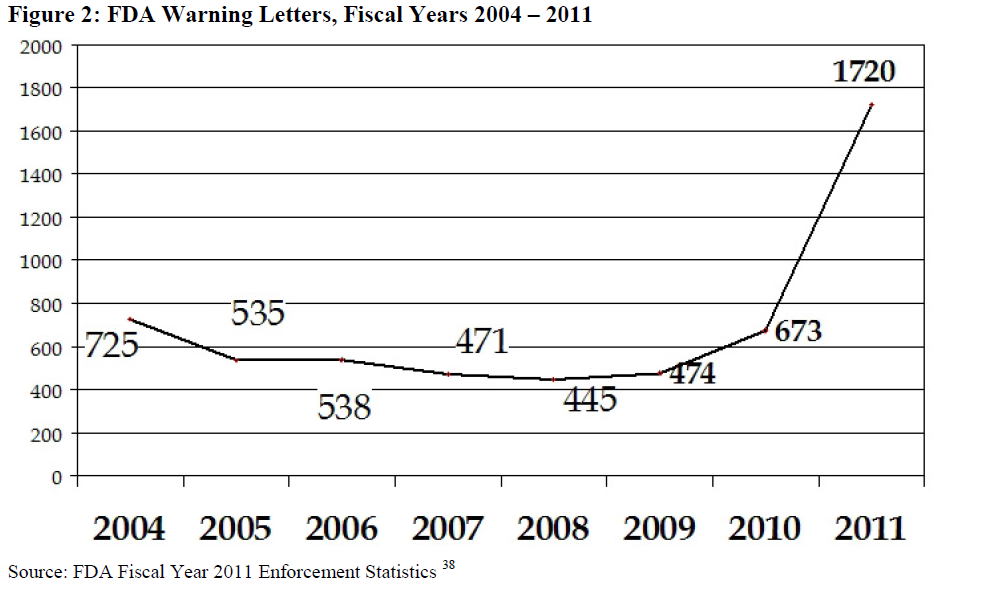
If you want a pharama company in this country (UK) to shit their pants, tell them they are about to be inspected by the FDA. No other organisation we have to deal with (we deal with the equivalent of the FDA from every country we market product to) instils such down right fear in the factory manager to the quality assurance through the scientists to the cleaner mopping the floors as they do. The FDA know they have been caught with their pants down on more than one occasion, and are out for blood. Also, now there is no longer a Republican in the white house, they feel able to do their job. Don't believe me? Take a look at the number of warning letters and recalls (the way by which the FDA assert their power on the companies) issued by the FDA to drug companies over the past few years:
I hate to use websites obviously pushing an agenda, but there is a graph from 1996 to 2006:
http://mgdservices.com/wp-content/uploads/2010/12/fdacloudgraph21.png
And from 2004 to 2011
http://marginalrevolution.com/wp-content/uploads/2012/06/FDA-letters1.png
Notice the (political) trend?
They are also the single most paranoid organisation we have dealings with, which most likely explains this spying incident. The FDA have also had a lot of trouble lately with scientists leaking information on drug trials to the stock markets. This makes a lot of people very wealthy at the expense of others. Doesn't justify what they have done, but does explain why.
But then again, these are just my experiences, I don't work for an american big pharma company and their is always an element of national-why aren't you making the drug in *our* country-protectionism within every one of these organisations.
Posting anonymously for obvious reasons. -
We need more inflation
I don't have time to watch a 53-minute YouTube video, but in case you haven't been paying attention, inflation is not a problem in this country right now. Interest rates are at record lows. In fact, rates on some T-bills are negative. This means that people are paying the federal government for the privilege of lending it money.
We could do with a lot more inflation in the near term. It would accelerate economic growth, and it would cause the debt held by many middle-class people to shrink in real terms. This would be good for people with underwater mortgages, massive student loans, or big credit card or medical bills.
Strict anti-inflationism (and the idea that the system is secretly rigged to create inflation) is a viewpoint that tends to be held by gold bugs and other "hard money" obsessives. But inflation is mostly something that hurts people with lots of money. It doesn't hurt ordinary people as much, as long as their incomes keep pace with inflation in the cost of living, and as long as we don't have hyperinflation. And again, inflation actually helps people with debts.
From a macroeconomic perspective, the best thing that both the Fed and the European Central Bank could do right now to jump-start the American and European economies would be to significantly increase inflation.
-
Re:The problem is still "free trade", not regulati
This is the only reason that China and Mexico, for instance, can produce goods far more cheaply than in the US. Their workers aren't any more productive than American workers would be, and are often much less productive due to using primitive manufacturing techniques that pre-date those used in America decades ago.
I would argue that this isn't true at all. It has been shown many times that Americans won't be as productive because they feel entitiled to higher wages to work harder. http://marginalrevolution.com/marginalrevolution/2011/07/the-fruits-of-immigration.html The article focuses on immigration, but the results are the same. We have a 10% unemployment rate and Americans turning down jobs because they don't want to do the work for the pay, yet it is looked down upon to use immigrants or send the work elsewhere.
-
Re:SImply not cooperating can stop things...
"WWII was the best thing to happen to the US in its economic history."
Citation needed...
Counter argument:
http://marginalrevolution.com/marginalrevolution/2011/05/was-world-war-ii-good-for-the-american-economy.html
" Had trends persisted in the absence of war, employment, TFP, and labor productivity would all likely have been higher in 1942â¦housing construction was robust and growing in 1939, 1940, and 1941, and when the postwar housing boom emerged with full force in 1946, it took off from where it had been arrested in 1941. Since the failure of residential construction to revive fully was one of the major contributors to the persistence of low private investment spending during the Depression, its signs of revival in the years immediately preceding the war suggest that had peace continued, investment, output, and employment growth would have continued as the economy reapproached capacity.
â¦There continues to be a popular perception that war is beneficial to an economy, particularly if it does not lead to much physical damaged to the country prosecuting it. The U.S. experience during the Second World War is the typical poster child for this point of view. Detailed research into the effects of armed conflict, however, has usually produced more nuanced interpretationsâ¦In that spirit, the research reported in this chapter represents a revisionist approach to the analysis of the Second World War, although one that is not entirely unanticipated."However, it is true that the fact that the USA was the only major industrial economy left mostly unscathed by WWII did set the stage for major export-led growth in the USA in the next couple of decades.
But ultimately, the same could have been achieved with different social policies without the war and related death and destruction -- if we were more enlightened.
Sections of Iraq have been turned into a radioactive wasteland by US depleted uranium munitions, leading to high rates of birth defects. I guess its true that some people benefit from that (doctors? health care supplier?). But what a way to "build democracy".
http://www.guardian.co.uk/world/2009/nov/13/falluja-cancer-children-birth-defectsWar is a racket:
http://www.lexrex.com/enlightened/articles/warisaracket.htmBut it is also true, as I say at the link below, that "transactions of decline" can prop up a scarcity-based socioeconomic model that does not make sense anymore by creating artificial scarcity even when abundance is possible:
http://knol.google.com/k/beyond-a-jobless-recovery -
How do you respond to Tyler Cowen?
In short: Although Bitcoin may have some admirable features as a medium of exchange, why do you suppose that it can represent a popularly desirable store of value when there are so many other excellent alternatives?
Note that a successful currency requires both features. Absent a reason to store value in bitcoins, people will keep their stock of wealth in other assets and then exchange them into bitcoins only when they need to engage in a transaction. But in that case, the real value of a bitcoin will be approximately zero; it will be slightly positive if the market deems its virtues as a medium of exchange to exceed those of other currencies, but beyond that, it will be zero.
-
How do you respond to Tyler Cowen?
In short: Although Bitcoin may have some admirable features as a medium of exchange, why do you suppose that it can represent a popularly desirable store of value when there are so many other excellent alternatives?
Note that a successful currency requires both features. Absent a reason to store value in bitcoins, people will keep their stock of wealth in other assets and then exchange them into bitcoins only when they need to engage in a transaction. But in that case, the real value of a bitcoin will be approximately zero; it will be slightly positive if the market deems its virtues as a medium of exchange to exceed those of other currencies, but beyond that, it will be zero.
-
How do you respond to Tyler Cowen?
In short: Although Bitcoin may have some admirable features as a medium of exchange, why do you suppose that it can represent a popularly desirable store of value when there are so many other excellent alternatives?
Note that a successful currency requires both features. Absent a reason to store value in bitcoins, people will keep their stock of wealth in other assets and then exchange them into bitcoins only when they need to engage in a transaction. But in that case, the real value of a bitcoin will be approximately zero; it will be slightly positive if the market deems its virtues as a medium of exchange to exceed those of other currencies, but beyond that, it will be zero.
-
What happens if you respond to SPAM?
A few days ago, I read an article about that here. Turns out they are serious businesses. Well, at least as serious as you can get if you send SPAM
-
Re:But...
Either FDR or Ida May Fuller, who paid in $22.75 and collected $22,88.92! http://www.marginalrevolution.com/marginalrevolution/2004/11/the_social_secu.html
-
Re:A soapbox for armchair gender theorists?
Statistics? Why are men better chess players than women?
-
Re:Read the Declaration of Independence
You seem to be missing the point. It is not about lower taxes it is about equal taxation. The infrastructure is there for all to use. If the wealthy use the infrastructure better than you do that is your problem. Learn how to use the infrastructure better. You seem to have a problem with people who make money. You want the rich to pay for goverment and then get upset when they run it. But wait... did you not want them to pay more and they do pay more in percentage, I would guess they pay more than you do unless you make more tham $250,000. If the burden of society is on the rich and they are paying for most of it, which they do http://www.marginalrevolution.com/marginalrevolution/2007/12/the-rich-pay-fo.html, then you should be fine with the elite running the country. It is clear however you are not, yet you want them to pay for most of everything. I hate to break it to you but you can't have your cake and eat it too.
We out spend any other nation when it comes to war. Both Democrats and Republicans are to blame for that, although Democrats do get us involved in more: WWI, WWII, Korean War, Vietnam War. http://nationalsecurityzone.org/site/why-the-u-s-outspends-the-world-on-defense/
Public education is the biggest failure. http://www.ed.gov/blog/2010/12/international-education-rankings-suggest-reform-can-lift-u-s/
We out spend everyone on healthcare as well. http://www.oregoncatalyst.com/index.php/archives/2593-Chart-1-US-Gov.-outspends-world-on-health.html
The problem here is that you want people to change their morality. You do that through social means, not the strong arm of goverment. -
Re:Automation versus offshoring
Sorry, no. This is the canonical article on this topic, by somebody who actually looked at the goddamn figures:
Hint: the "first large group of employees to be completely automated out of their jobs" were not pilots. They were farm labourers. Do you suggest burning all tractors?
-
Re:Should be good for the economy
Glass-Steagall's removal allowed diversification, and diverse institutions were the ones that suffered the least in the collapse. Despite what the left likes to believe, Gramm-Leach-Blily did not lead to the financial crisis. It was also a bipartisan, and passed under a Democrat president.
-
Re:What about the presumption of innocence?"Firstly, without even knowing how many illegals are in the country or what 95% of them are actually doing in terms of taxes and use of social services, I doubt the usefulness of any supposed "study". The best estimates are that between 12 and 20 million illegals are in the country illegally. That's a huge gap from low to high and that's the best job we can do estimating. If someone's trying to tell me they know exactly what's being contributed by and taken by a group whose numbers can't even remotely be determined, I can't help but think they're confused."
Look, this isn't complicated. Illegal immigrants pay sales taxes, but don't receive EITC, food stamps, or Medicaid. Because they usually work with fake social security numbers, they get a huge portion of their paycheck withheld for income tax, which is never refunded because they're not real tax payers.
There are some costs associated with schooling their kids and emergency care, but realistically, because of the above, they almost always pay more into the system then they use.
But hey, basic logic and every empirical study are on my side. But since you have a hunch, clearly that over-rides everything else...
"Secondly, illegals all commit crimes by definition. The act of crossing into the United States without permission is a violation of United States sovereignty and an affront to our entire legal system."
Lots of things are against the law. Having sex before 18 and drinking before the age of 21 is against the law. Yet, the vast majority of the US population has done it. Three of our last presidents have admitted to drug use. Most of us have gone over the speed limit!
And yet, you don't seem to regard this an "affront to our entire legal system". Why the double standard?
"Again, percentages and ratios are absurd here given that we don't even have a basic understanding of the total number. What we do know is that our citizens are being raped, kidnapped, and murdered in ever increasing numbers by people who should not even be here in the first place. We don't know which of them are otherwise good and decent people and which ones are violent psychopaths. Why? Because they chose to skip past the normal immigration system that would sort out known violent criminals."
This is not true. Logic would dictate that illegals, out of fear of deportation, would keep their head down and avoid crime. And that's what the data shows! To quote http://www.amconmag.com/article/2010/mar/01/00022// :
""Nearly all of the most heavily Latino cities have low or even extremely low crime rates, and virtually none have rates much above the national average. Eighty percent Latino El Paso has the lowest homicide and robbery rates of any major city in the continental United States. This is not what we would expect to find if Hispanics had crime rates far higher than whites. Individual cities may certainly have anomalously low crime rates for a variety of reasons, but the overall trend of crime rates compared to ethnicity seems unmistakable.""
"Thirdly, illegals drive down wages in every industry they become largely involved with. They not only take jobs away from citizens and other legal residents, but for those who manage to keep their job in that particular field, wages and benefits will drop when there are a dozen illegals waiting at the door to do the job at below minimum wage and without any benefits."
Anecdotes are great, but let's look at the actual data: http://www.marginalrevolution.com/marginalrevolution/2008/07/immigration-and.html
" Finally, we account for the short run and long run adjustment of capital in response to immigration. Using our estimates and Census data we find that immigration (1990-2006) had small negative effects in the short run on native workers with no high school degree (-0.7%) and on ave
-
Re:Into the future
Remove government setting of interest rates, remove government distortion of lending markets though things like FHA loan guarantees, Freddie and Fannie, student loan guarantees, FDIC insuranc, etc, etc, and you won't need the regulations.
Banking crises before regulations, FDIC, The Fed, Glass Steagall:
Panic of 1819, a U.S. recession with bank failures; culmination of U.S.'s first boom-to-bust economic cycle
Panic of 1837, a U.S. recession with bank failures, followed by a 5-year depression
Panic of 1857, a U.S. recession with bank failures
Panic of 1873, a U.S. recession with bank failures, followed by a 4-year depression
Panic of 1893, a U.S. recession with bank failures
The Great DepressionBanking crises after regulations, FDIC, The Fed, Glass Steagall:
Savings and loan crisis of the 1980s and 1990s in the U.S. (which came after deregulation)
Fannie and Freddie were originated in the 30s and expanded in the 70s. FHA insurance was created in the 30s and strengthened in the 70s. The current banking crises began with the bubble that started with the internet bubble, and was sustained through 2008 by "irrational exuberance" and a completely deregulated banking environment.
Oh yes, because they know what they are talking about. They pointed out the obviousness of the coming inevitable crash in the US economy in 2002, right? And saw through the bubble building low interest rates? Right???
The point is that when Forbes is running opinion columns called "Laissez-Faire Capitalism Has Failed" then you should be paying attention.
-
Re:Great...
I wish I had mod points - this needs modding up!
I don't doubt the anthropogenic basis for climate change - you can take a look at the IPCC Synthesis Report for a persuasive outline of the case. However, once you get past the most basic assertions, the scientific community is doing an absolutely terrible job. Most of the time when I read a paper on climate change I can immediately spot lots of methodological and deductive errors, and, conveniently, they always come out in favour of anthropogenic climate change. Some argue that science is just another religion. This isn't true. However, the sort of 'science' most climate scientists are doing nowadays may as well be a religion, basing conclusions on manifestly insufficient data, and inferring causation based on correlation alone. Right now the climate sceptics don't need to make straw men to argue against - the scientific community is making the straw men for them.
Scientists shouldn't be arguing against sceptics - scientists should be the sceptics. Even ignoring faulty reasoning, many published scientific results are wrong (see this article). Scientists should be constantly questioning results to try to arrive at a refined, unbiased analysis of the facts - instead we have become defensive, treating every sceptical inquiry as an attack, and as a result, the research doesn't get the sort of scrutiny necessary to advance our understanding. Something needs to change.
-
Re:The Money that was created by this error....
I'll let others explain it.
The short answer seems to be: monetary base is not money supply. This spike is related to the Fed's decision to pay interest on excess reserves, and it has not translated into a similar rise in the supply of currency.
-
Cowen on handling pandemicsTyler Cowen wrote a very-readable study about handling flu pandemics. This was 2005 so avian flu was the predominant example, but his advice is still germain (as it was intended to be).
(Tyler Cowen is economist who co-writes Marginal Revolution, an economics blog (among other things).
Wash your hands.
-
Re:And a billboard giving detailed instructions on
Oh
-
Re:What the hell are you talking about?
Don't blame the CRA, it only prohibited red-lining (denying a loan based on geographic area rather than individual credit rating), and only applied to banks, not independent mortgage companies.
The Home Mortgage Disclosure Act (HMDA) applied to banks, mortgage companies, and other lenders. Read what the Boston Fed was telling lenders about it...stuff like "Lack of credit history should not be seen as a negative factor...In reviewing past credit problems, lenders should be willing to consider extenuating circumstances. ". There also was the Equal Credit Opportunity Act and the Fair Housing Act.
Let's also not forget the FHA zero-downpayment program.
Don't blame Fannie Mae or Freddie Mac either. They weren't the ones making the loans.
But they did buy or guarantee nearly $400 million of Alt-A and subprime mortgage investments. At a conference in spring 2005, Fannie Mae Executive Vice President Thomas Lund warned about the danger to borrowers, asking, "Are we setting them up for failure?"
Besides the desire of the GSEs to get into the >80% LTV loan secondary market on pure profit grounds, they were also pushed by Congress. For example, see Schumer Unveils New Freddie Mac Plan With HSBC That Includes Low-Interest Low-Downpayment Loans.
Ironically, it was the repeal of the section of the Glass-Steagall Act (passed in response to the depression) which strictly separated banks from securities firms (to help assure the stability of banks) which exacerbated this mess and resulted in such massive failures.
No one has explained to me how this has changed the situation - "unified banks" have actually done a better job recently weathering the storm compared to banks with no investment side or pure investment banks. And they did better during the Great Depression as well. Glass-Steagall came from a war between the Morgans and Rockefellers rather than any actual data.
No honest person can say that government entities or regulations were "the cause" of the recent credit crisis, but certainly many regulations, Congress (in a bipartisan fashion), and the GSEs were on the side of "affordable housing" and "creative underwriting" for political profit, just as much as the private sector was in it for the monetary profit.
-
For those of you interested in learning more
Here is a good synopsis and collection of his recent work compiled by an Economics professor at George Mason University.
Marginal Revolution: Paul Krugman wins the Nobel Prize -
Re:And Yet ...
Hmmm... given that there is already at least anecdotal evidence of 4 percent false positives in fingerprints, zero reliability in bullet lead analysis, and questionable, and even non-existent review procedures, your analogy has holes in it. The reason we don't, and shouldn't have a database of ballistic fingerprints, is because we make the correct assumption of innocence. It's the same reason we don't put your fingerprints in a database when you're born. We assume you are innocent. Call me a libertarian (I view it as a compliment) but I think that any of these practices should raise eyebrows, hackles, dander, etc.
-
Re:Yay, Pittsburgh
You can thank Uncle Sam and the protectionists for that one. Read more.
-
Re:I find this so laughable...
Biofuels may be a factor, but the main reason for the recent dramatic increases in food prices is market speculation
Actually the problem is that the market is too regulated.
It is difficult for speculators to drive up prices in open, competitive markets. Rice is neither, plenty of countries have import quotas, huge import tariffs, export quotas, and export taxes.