Slashdot Mirror
Domain: mercatus.org
Stories and comments across the archive that link to mercatus.org.
Comments · 55
-
Not sure why Texas is being picked out
The same type of laws are present in all 50 states. Most of the states have had those laws for 50+ years, with a few going back 100 years. A few stragglers joined in the last 30 years, with Texas being the last one. So those accusing Texas of doing this because of some anti-Tesla agenda should read up on history, and look into their own states' laws before throwing stones. It'll be a helluva lot more productive towards repealing these laws or updating them to reflect how cars are purchased and repaired in the 21st century.
-
Re: Regulation
I didn't give the original figure, but I'll jump in on the topic with some sources:
Regulations Cost U.S. Business More Than Canada’s GDP
The accumulation of rules over the past several decades has slowed economic growth, amounting to an estimated $4 trillion loss in US GDP in 2012 (had regulations stayed at 1980 levels)A study published in the Journal of Economic Growth in 2013 finds that between 1949 and 2005 the accumulation of federal regulations slowed US economic growth by an average of 2 percent per year.[5] Had the amount of regulation remained at its 1949 level, 2011 GDP would have been about $39 trillion—or 3.5 times—higher than it was.
From: John W. Dawson and John J. Seater, “Federal Regulation and Aggregate Economic Growth,” Journal of Economic Growth 12, no. 2 (2013): 137–77.
-
Re:Hmm...I just can't think of an example...
The Koch brothers paid for a study to prove Medicare for all costs more. Unfortunately for them the cost we pay now is 34 trillion per decade and the cost of healthcare for all, with everyone using it and using it more often, is 32 trillion per decade. How do we afford something 2 trillion dollars cheaper?!? IDK but maybe we can do it by taking the money we spend now, but use less of it. The insurance companies have a market valuation of 940 billion per year, that's not what they pay out to hospitals and doctors, its overhead and profits. Disbanding them all would save 9.4 trillion dollars and since they are only leaches that contribute nothing, are the thing you are looking for that we cannot keep paying for. Yes it increases taxes but you don't have those massive payments to insurance taken out of your paycheck so the result is better care for less. You know, like the rest of the world does it.
-
Re:Spend less money ya dumb commies!
Yet we're #42 out of all 50 in terms of fiscal condition, mainly from debt. A lot of that "surplus" is because Sacramento loves to punt expenses further down the road, and bank a small "surplus" to fund special interest projects.
-
Re:Tariffs cost GM one billion dollars
Which is probably something like 200 times the salary of the average employee
So, if the $6M Walmart CEO gives his salaries to their employees, they get $4 more per year.
I make $80k. If I give my salary to my employees, they get $40,000 more per year.
"200 times the salary of the average employee" is a red herring: it's completely-meaningless for any practical purpose. You can claim a type of superfood has 200x the calories needed for the average person to eat...ignoring that it takes 5,000x the labor to produce, so it's unsustainable and can't feed the hungry.
"the times are bad, I have to let some of you go and the rest will get reduced salary, we have to tighten our belts to survive the recession. Oh and look at my shiny new Tesla" makes people hate the CEO and company owners in general, developing into an "us vs them" mentality that the government gladly exploits.
It does. It's a dialogue we must correct by educating people, as we can't solve problems if we invest our time in things that don't matter.
When there's a recession, people buy less. We need 1,000 of you to make the 50,000-unit demand; but now people are only buying 40,000 units and 200 of these workers are doing nothing. We can either charge 25% more per unit (further driving down purchasing, and making the customers more-poor) or we can eliminate 20% of the workforce. Downsizing the workforce impacts 200 workers (and, by extension, those from whom they buy things), while raising prices impacts 10,000 customers (and, by extension, those from whom they purchase using the money the new price claws away).
Meanwhile the CEO's new Tesla is still a few pennies per worker spread across the year.
The correct solution is social insurances and economic development programs.
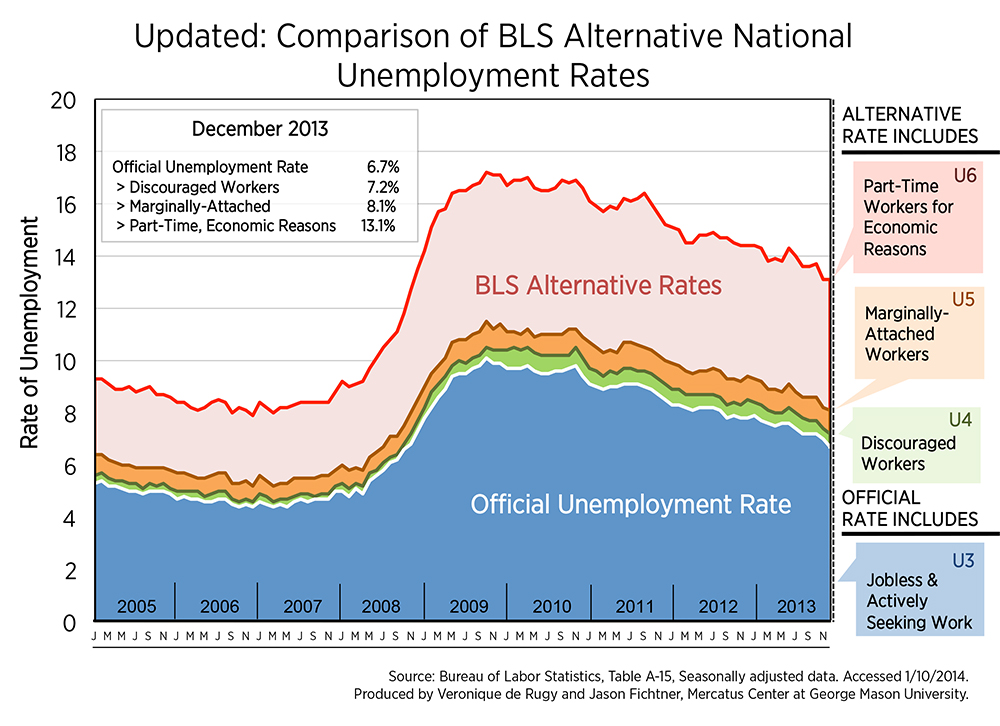
Depends on how you count it, in some cases people give up hope on ever finding a job and become alcoholics. Since they are not registered as looking for a job, the government does not count them as "unemployed".
Those people move from U3 to U4. U4 is strongly-correlated with U3.
As robots (and workers in foreign countries) are replacing less skilled local workers, those workers have nowhere to go. So, a factory with robots may need more engineers to program and maintain those robots, but the people who assembled the product by hand previously may not e able to do it.
Actually, robots tend to reduce the number of skilled workers as well. You turn 1,000 workers into 10 engineers and 190 robot operators, with 800 workers shaved off the top. As the economy shifts and grows, you'll create 800 more jobs.
While many people envision burger-flippers being replaced by burger-flipping robots, that's actually hard: a machine to flip burgers and make fries still needs an employee loading the hopper. Modern grease fryers have timers, and an employee incidentally dumps a bag of fries into the basket when appropriate, then responds to the alarm and dumps the basket. The investment is about 20 seconds of time per batch, and the employee is basically free to do other things. A grill requires a person tending it continuously, so does a bit better; but burgers get sold so fast that you'd invest most of the employee's time feeding the burger hopper, cleaning it (it's harder to clean than just a grill surface), and so forth. Bad deal.
Meanwhile we've replaced skilled network technicians with IT monkeys. We need a few engineers; configuring our networking hardware merely requires using the simple, easy interfaces which some engineers have developed.
In other words: many classes of jobs--such as in IT--have replaced 1,000 skilled engineers with 200 skilled engineers and 800 unskilled workers who spent a week training under other unskilled workers. There is no way to gain com
-
Re:Sounds like an excellent reason...
Cutting our military budget by 90% would put us down near Ghana and Nigeria. U.S. military spending is huge simply because the U.S. economy is huge.
Calls to slash military spending made sense in the 1950s and 1960s. But currently it's just slightly above the world average. If you account for Japan and NATO (whom we're obligated to defend by treaty), it's pretty much at the world average.
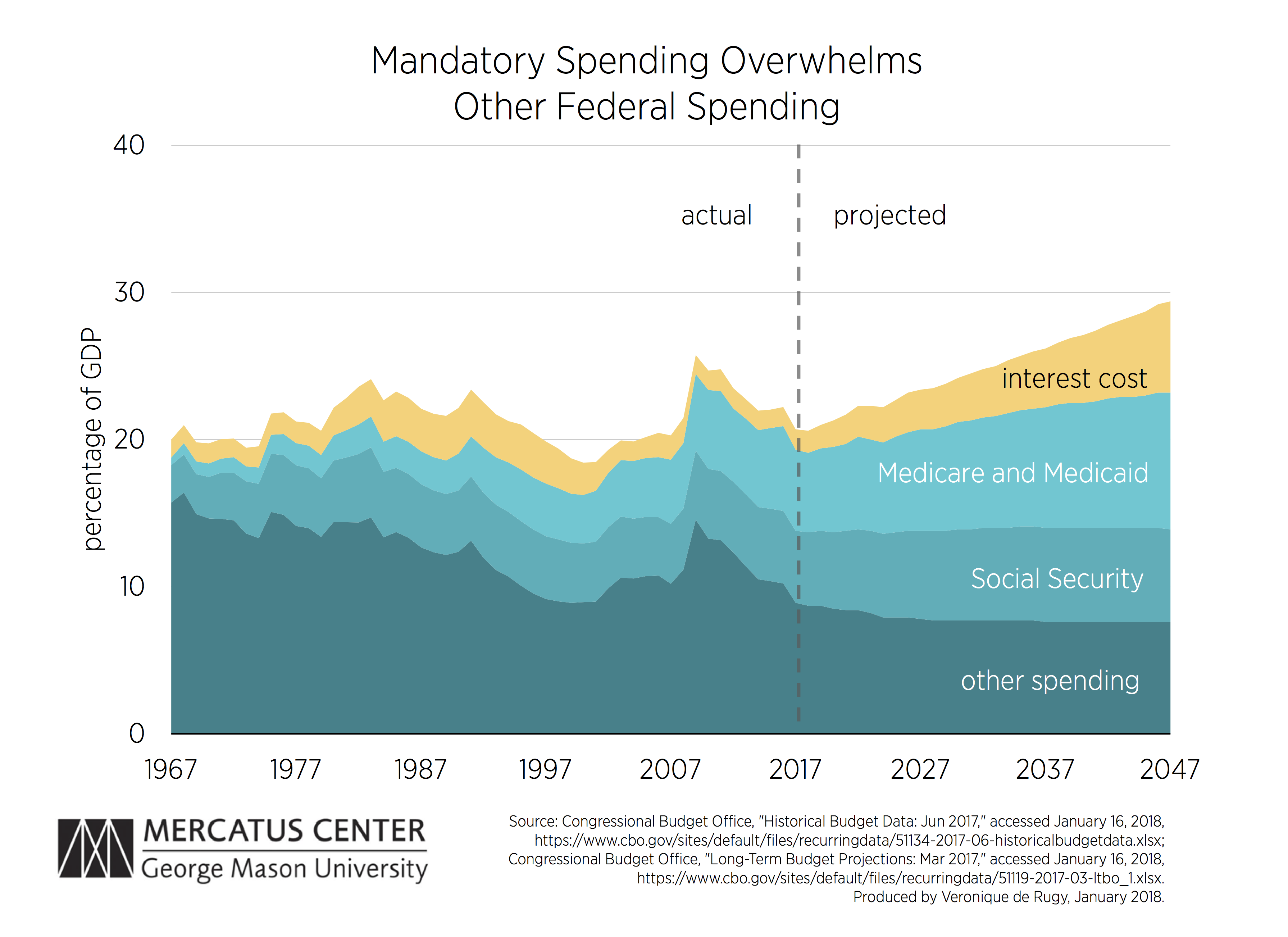
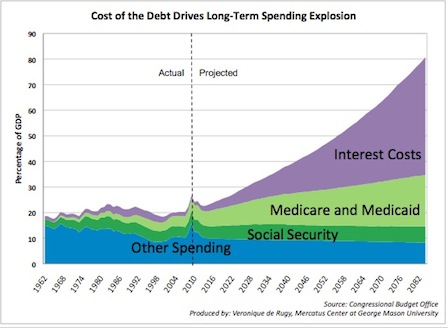
BTW, the biggest budget items are Social Security, and Medicare/Medicaid. They're the programs whose growth is bursting our budget, and what we need to get under control if you want to pay for everyone to go to college. Even if you completely eliminated 100% of military spending, entitlement growth in the next 20 years or so would eat up all that savings. Like it has already eaten up the savings from cutting the military budget from the 1950s/1960s.
I highly recommend you read the CBO long-term budget projections to understand what exactly is causing excessive growth in government spending. -
Re:Bad troll
Subtle troll. Nice. However, a lying troll you are.
The Democrats passed a law requiring banks make loans to risky applicants under the name of political correctness.
I assume you're referring the Community Reinvestment Act of 1977. But that played almost no part in the problem. Many subprime lenders were not subject to the CRA. Research indicates only 6% of high-cost loans - a proxy for subprime loans - had any connection to the law.
Enter the Obama regime. They decide to give the banks trillions of dollars to cover these bad loans that the Democrats made them give in the first place.
The Emergency Economic Stabilization Act of 2008 was done by Republican George W. Bush. Here's his televised address announcing the bailout.
Small banks have been steadily declining in numbers since 2000. However, total assets and deposits have grown over that same period.
Yes, regulations passed in the wake of the 2008 financial crisis, notably Dodd-Frank, weigh heavier on small banks. The attempt to standardize or homogenize service offerings runs counter to the small bank model of personalized service and relationship banking. One size fits all regulation is not working and needs changed.
Firsthand knowledge of customers provides useful information for making sound lending decisions. Credit unions report that delinquent loans peaked in 2009 at 1.82 percent of credit unionsâ(TM) loan portfolios and were down to 1.15 percent at the end of 2012. Community banksâ(TM) loans tend to default at lower rates than loans made by bigger institutions. The rate of loans in default for the first quarter of 2013 on loans secured by residential properties was 3.47 percent for banks with less than $1 billion and 10.42 percent for banks with more than $1 billion in assets. Community banks that are closest to their borrowers may fare best. [Citation: https://www.mercatus.org/system/files/Peirce_BurdensOnSmallBanks_testimony_112613.pdf]
-
Re:Bad troll
Subtle troll. Nice. However, a lying troll you are.
The Democrats passed a law requiring banks make loans to risky applicants under the name of political correctness.
I assume you're referring the Community Reinvestment Act of 1977. But that played almost no part in the problem. Many subprime lenders were not subject to the CRA. Research indicates only 6% of high-cost loans - a proxy for subprime loans - had any connection to the law.
Enter the Obama regime. They decide to give the banks trillions of dollars to cover these bad loans that the Democrats made them give in the first place.
The Emergency Economic Stabilization Act of 2008 was done by Republican George W. Bush. Here's his televised address announcing the bailout.
Small banks have been steadily declining in numbers since 2000. However, total assets and deposits have grown over that same period.
Yes, regulations passed in the wake of the 2008 financial crisis, notably Dodd-Frank, weigh heavier on small banks. The attempt to standardize or homogenize service offerings runs counter to the small bank model of personalized service and relationship banking. One size fits all regulation is not working and needs changed.
Firsthand knowledge of customers provides useful information for making sound lending decisions. Credit unions report that delinquent loans peaked in 2009 at 1.82 percent of credit unionsâ(TM) loan portfolios and were down to 1.15 percent at the end of 2012. Community banksâ(TM) loans tend to default at lower rates than loans made by bigger institutions. The rate of loans in default for the first quarter of 2013 on loans secured by residential properties was 3.47 percent for banks with less than $1 billion and 10.42 percent for banks with more than $1 billion in assets. Community banks that are closest to their borrowers may fare best. [Citation: https://www.mercatus.org/system/files/Peirce_BurdensOnSmallBanks_testimony_112613.pdf]
-
Re:Bad troll
Subtle troll. Nice. However, a lying troll you are.
The Democrats passed a law requiring banks make loans to risky applicants under the name of political correctness.
I assume you're referring the Community Reinvestment Act of 1977. But that played almost no part in the problem. Many subprime lenders were not subject to the CRA. Research indicates only 6% of high-cost loans - a proxy for subprime loans - had any connection to the law.
Enter the Obama regime. They decide to give the banks trillions of dollars to cover these bad loans that the Democrats made them give in the first place.
The Emergency Economic Stabilization Act of 2008 was done by Republican George W. Bush. Here's his televised address announcing the bailout.
Small banks have been steadily declining in numbers since 2000. However, total assets and deposits have grown over that same period.
Yes, regulations passed in the wake of the 2008 financial crisis, notably Dodd-Frank, weigh heavier on small banks. The attempt to standardize or homogenize service offerings runs counter to the small bank model of personalized service and relationship banking. One size fits all regulation is not working and needs changed.
Firsthand knowledge of customers provides useful information for making sound lending decisions. Credit unions report that delinquent loans peaked in 2009 at 1.82 percent of credit unionsâ(TM) loan portfolios and were down to 1.15 percent at the end of 2012. Community banksâ(TM) loans tend to default at lower rates than loans made by bigger institutions. The rate of loans in default for the first quarter of 2013 on loans secured by residential properties was 3.47 percent for banks with less than $1 billion and 10.42 percent for banks with more than $1 billion in assets. Community banks that are closest to their borrowers may fare best. [Citation: https://www.mercatus.org/system/files/Peirce_BurdensOnSmallBanks_testimony_112613.pdf]
-
Re:California news is the only good USA news
-
Re:California news is the only good USA news
-
Re:And that way, you never will.
Public pension plans are a great thing, SocSec should be expanded.
I can't tell whether you're trying to be funny or actually serious. Social security is unsustainable.
As far as a pension plan -- I trust an elected government more than a bunch of Wall Street hucksters.
You mean like Venezuela? Or 1933's Germany? They too promised government pension plans and free education.
-
Re:Not True
I cover this elsewhere on this thread, but it was cuts to federal subsidies that raised tuition, not loans.
Got any evidence for that claim?
Here's some on the other side: https://www.mercatus.org/%5Bno.... Emphasis mine.
In the second stage, with controls for all forms of aid, the authors found that each additional Pell grant dollar to an institution leads to about a 55-cent increase in sticker price tuition. For subsidized loans, they a found a somewhat larger passthrough effect of 70 percent, and for unsubsidized loans, the loading of tuition is about 30 percent. Those results, which are identified through cross-sectional exposures to the changes in student federal aid programs between 2007 and 2010 and contain numerous controls for other effects, support the hypothesis that increases in federal support for higher education lead to increases in tuition and not the other way around. The finding for subsidized loans is quite strong across different regression specifications in both magnitude and statistical significance.
-
The problem isn't funding for public schools
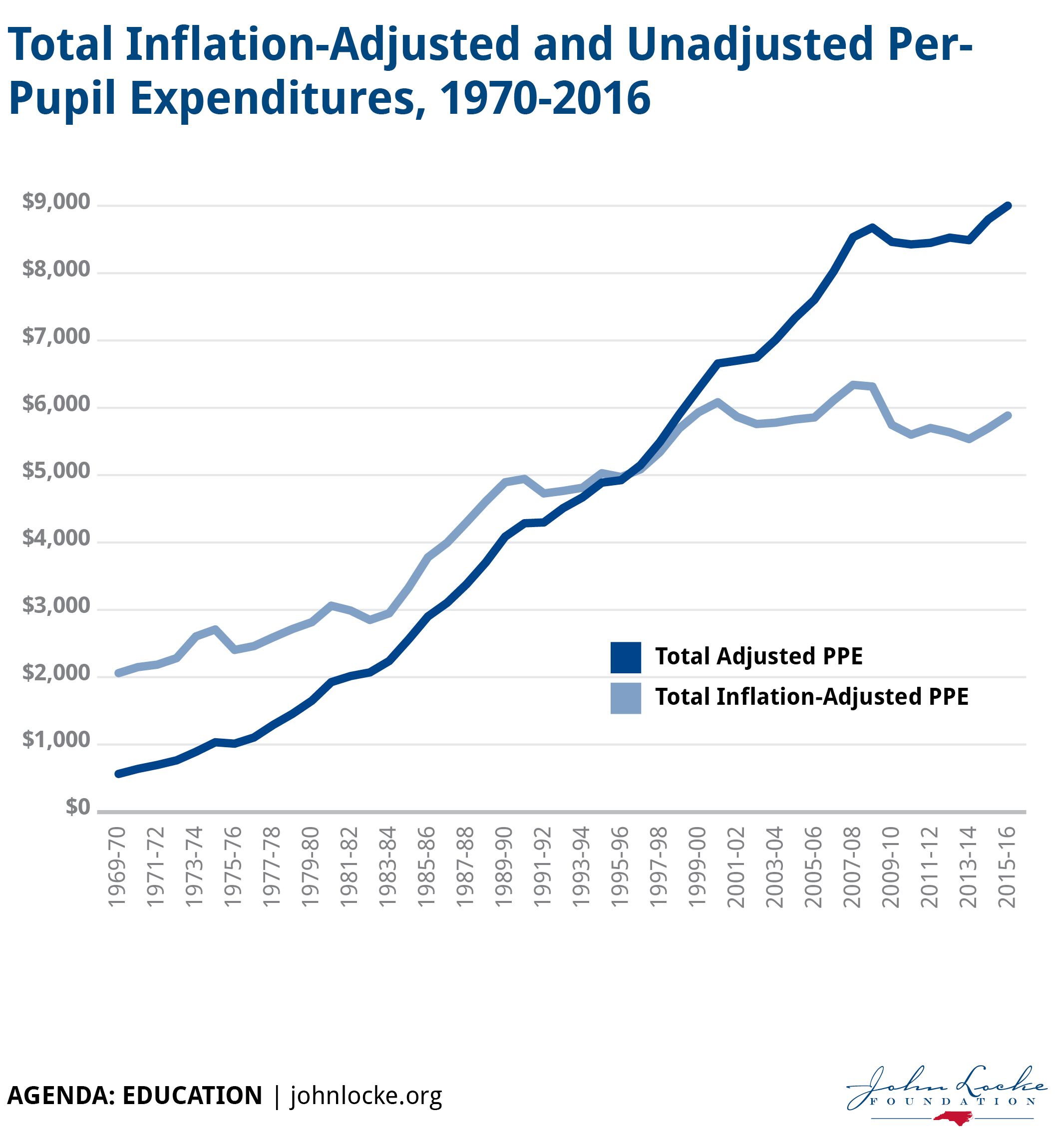
Spending per public school pupil has roughly tripled in the last 45 years (inflation-adjusted). The U.S. now spends more per student than any other OECD nation except Switzerland.
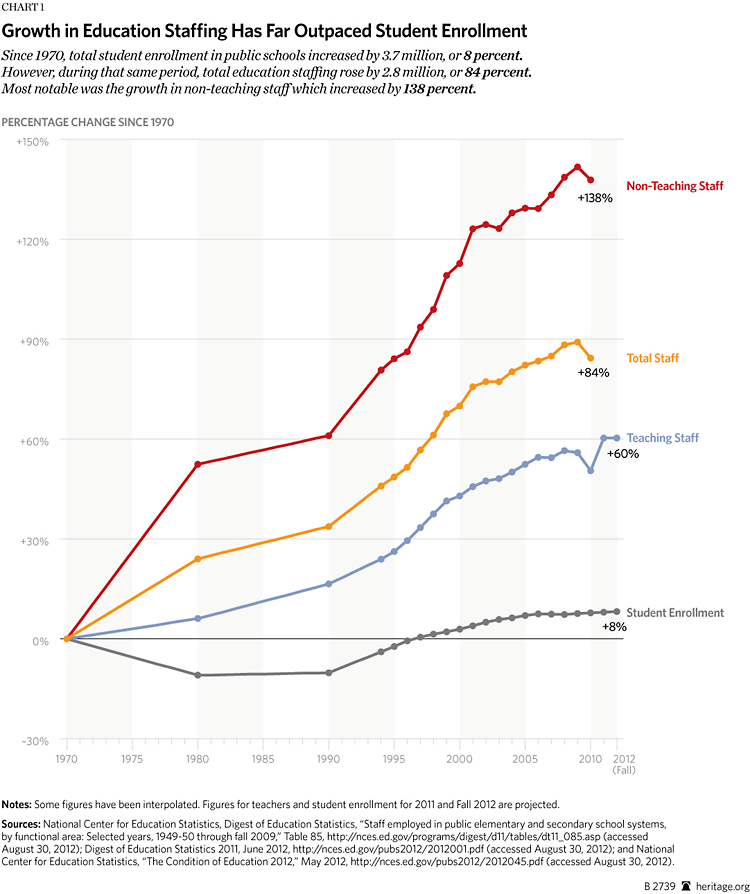
The problem is school administration. The number of non-teaching administrative staff has more than doubled in 45 years, far outpacing growth in number of teachers or students. They control how funds for education are spent. Basically every time we increase spending on education, the administrators use it raise their own pay, hire more administrators, and buy useless but high-profile bling like iPads. Every time we cut spending on education, the administrators make sure it goes straight to the teachers. The teachers then get lots of media coverage complaining about how they're underpaid and under-supplied. Which leads to further increases in education spending which the administrators sop up again, passing only a token amount down to the teachers.
If you've got a proposal for how to selectively reduce spending on only administrative staff in public schools, I'd love to hear it. If not, the only alternative we have that we know works is competition. Which means charter schools, even with all their warts. -
Your argument still doesn't make sense
The deregulation opened up the banking *environment* to abuses much like the election of Trump has encouraged every hitler-wannabe to Roman-salute in public.I don't understand your comment. This wasn't something like the subprime market where bankers were taking advantage of loopholes opened up by deregulation.
So there's no fraud or crime in heavily regulated industries like pharmaceuticals, arms manufacture or the petroleum industry... some of the most heavily regulated industries in the US (and abroad)? I'm not arguing against regulation, the repeal of Glass-Steagall was just stupid for instance. I was merely pointing out that this was already criminal behavior and tossing on additional regulations to make it "more illegal" most likely would have done nothing to prevent it.
A perfect example is the RICO legislation. It gave law enforcement more teeth to go after organized crime (and was effective in that regard) but the Mafia didn't go "holy shit guys, maybe we should stop"... they just tried to look for ways to work around it and kept on with business as usual. -
Re:Good on France
Inequality: Nope, the social programs Dems advocate for arent as significant as the programs actually in place in much of Western Europe.
US government social spending in the US is above OECD average and higher than, say, the UK.
http://www.oecd-ilibrary.org/s...
The tax rates Dems propose arent as redistributive either
In fact, the US has the highest tax progressivity among OECD nations.
https://www.mercatus.org/publi...
That's on top of a large, regressive VAT tax in Europe.
Spending: Obviously Europe is more to the left then us with spending.
In fact, European budgets are nearly balanced and debts capped as a requirement of EU membership.
https://en.wikipedia.org/wiki/...
Unlike the US, European countries cut social expenditures in order to meet their budget objectives.
Close but I think the laws in place against hate speach and the like (not a fan but they're there) push Europe ahead in this catagory.
Restrictions on free speech are a favorite of both the left and the right; in Europe, they largely came out of right-wing restrictions against criticizing church and state, and the restrictions aren't intended to help socially weak groups, but instead avoid conflict.
Their socialised medicine alone puts them beyond us. The dems Obamacare doesnt even come close.
Socialized medicine in Europe originated with right-wing governments, not left-wing governments, as a way to control workers. Many European nations have two-tiered systems, in which the bottom 90% are stuck with an inconvenient public system, and the top 10% enjoy a high quality private system. In addition, people have to pay for their coverage, either explicitly (Germany, Switzerland, etc.) or implicitly (other countries).
Note also that the US government already spends more per capita on healthcare than almost all other OECD governments (the problem is that the US government is spending the money so poorly):
https://en.wikipedia.org/wiki/...
So, I don't understand in what way you think that Europe's health care systems (and they are all different) are more "left wing" than the US healthcare system.
So in summary, I think you're wrong as our Democrats are to the right on most of the points you list, particularly the most significant ones.
I could go on with the other points... but I think I made my point.
I think the source of your confusion and the confusion of many other Americans is that you view the political spectrum as one-dimensional. In fact, there is a left-right axis and an authoritarian-libertarian axis. European parties are overwhelmingly authoritarian and differ along the left-right axis. US parties are first of all much more heterogeneous than European parties, but to the degree that they differ, they differ along the authoritarian-libertarian axis, with Democrats leaning strongly towards authoritarianism. That is what makes US Democrats similar to Europeans. But European authoritarianism is frequently Christian conservative, not socialist.
-
Re:Google, Motorola, Intel . . .
Every GOP dominated state has severely failing economies. See Kansas as a perfect example.
Define "failing". Red states, by and large, have lower economic growth because they are more rural, and urban centers generate more economic activity. That's a generality, though. If you look at a list of states by GDP per capita, some red states rank very highly. https://www.wikiwand.com/en/Li....
If you're talking about fiscal responsibility, it's pretty much exactly the opposite of what you say. The states that are on the edge of bankruptcy are nearly all blue states, while those with the healthiest governments are red states. https://www.mercatus.org/state...
Kansas, BTW, is firmly middle of the pack on both measures. Kansas is #25 of 50 in terms of GDP per capita, and according to the Mercatus rankings, they're #27. So Kansas isn't a perfect example.
-
Re:The fault lies....
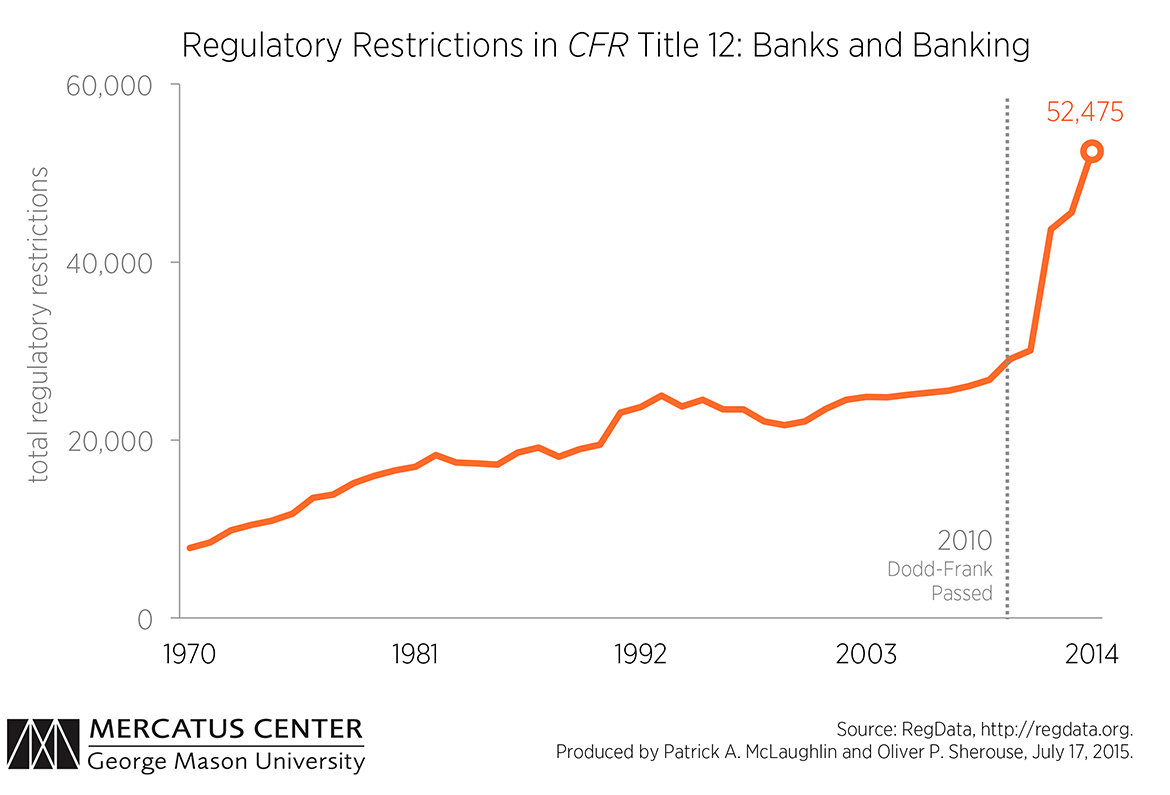
regulation is significantly higher than in the 1980s. http://mercatus.org/sites/default/files/C3-regulatory-restrictions-title-12.png
This IS what you get from heavy handed regulation.
-
Re:Screw San Fran
I already have, but here we go again:
http://mercatus.org/statefisca...
https://wallethub.com/edu/stat...
http://www.huffingtonpost.com/...
(Note that many education rankings consider amount of funding or student/teacher ratios as part of the score; that really isn't valid, but even that doesn't rescue California's poor showing.)
-
Re:Screw San Fran
Kansas is in a state of total collapse, including their education system. The entire state is in a freefall into the shitter, and it's been entirely run by conservative Republicans.
Daemonik gave Kansas as an example of a failing education system. I simply pointed out that in terms of student outcomes, Kansas is doing better than California and many other Democratic states. And I would respond to you that Kansas is also fiscally in much better condition than California.
Furthermore, pointing out that Democratic and progressive policies are utter failures doesn't translate into an endorsement of Republicans. In fact, partisan fools like you on both sides are responsible for the massive dysfunction of government.
-
Re: Regardless of the reasons...
The states of Oklahoma, Kansas are both perpetually hovering above bankruptcy because of the tax cuts and credits given to the oil industry (among the other stupid failed red state experiments).
The fiscal condition of Oklahoma and Kansas seems to be pretty good compared to states like California, New York, Massachusetts, and New Jersey.
http://mercatus.org/statefisca...
If you think that these states would balance their budget any better if they had $600 million / year more, I have a bridge to sell you.
Mind you, I think the way natural resource rights are handled in the US is atrocious, with massive government handouts to industry and massive crony capitalism. But fixing that isn't going to fix budgets, and it's not going to change the advantage fossil fuels have over renewables.
-
Re: unique id
Forbes: "The two sectors currently most affected by the regulatory environment in the U.S. are healthcare and financial services."
Regdata: "Regulation on Credit Intermediation and Related Activities has grown 517.73% since 1997."
Can you point to any data which shows the financial industry isn't heavily regulated? Simply googling the question is the financial industry heavily regulated seems to have a pretty broad consensus of answers in the affirmative. Why do you think otherwise?
-
Re:It might finally be time for this
- Offshoring of all manufacturing from first world countries shifted smart people to office work, less-than-smart people to crappy service jobs
Except there's still a huge amount of manufacturing in first world countries. Here's some info for the US. And the difference between "first world" and developing countries is shrinking rapidly.
- Offshoring of office work including IT shifted a bunch of the smart people to crappy service jobs or the "gig economy"
- Automation or offshoring of the rest of the office workPeople like you have been selling this story for 20 years. Unemployment is at 5%. Sure, there's significant underemployment and the U6 number is high, but those have been improving steadily for a few years now.
What's really happening is that we're transitioning to an "everything, everywhere" economy. Manufacturing, office work, construction, service jobs, gigs, and farming, mining, drilling and everything else will be done in the traditional first world countries and in traditional developing countries for customers worldwide.
-
Re:DRM is code for You Are Serfs
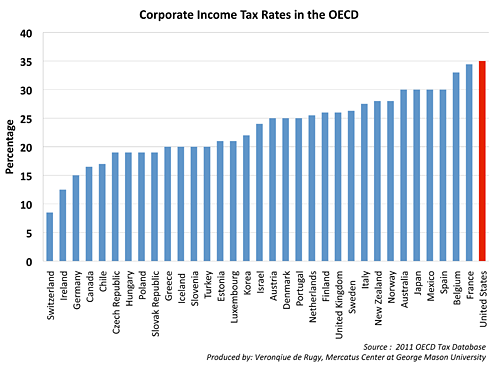
Corporate income tax rate in US is highest on the planet.
http://mercatus.org/sites/defa...
Lots of ranting, no substance. -
Re:Why force her to do something she doesn't want
Luckily we are largely immune to it in the US due to our high immigration rate.
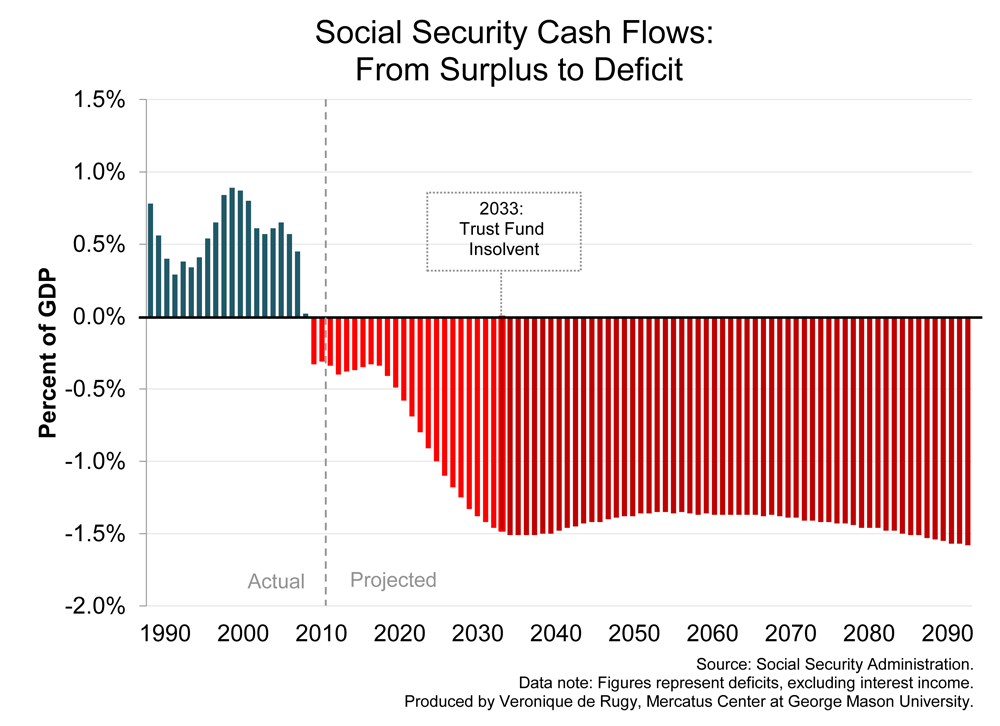
lol Far from it. http://mercatus.org/sites/defa... BTW, the "trust fund" is just special bonds currently held by the US Treasury. Those bonds are then sold along with the regular Treasury bonds that are issued to make up the regular "national debt".
-
Re:Regulations are all bad in the long term
Yes, the 1935 law absolutely blocked innovative package delivery services such as UPS and FedEx from even getting start..... Er, wait a minute!
Actually regulation did hold back FedEx. You're just looking at the wrong law. You need to reference instead the Civil Aeronautics Authority Act of 1938 that created the Civil Aeronautics Board.
The board was essentially dissolved after the Airline Deregulation Act of 1978.
After deregulation, express air services spread across the country.
-
Re:Exception, not rule.
This is a bigger reason why staffing agencies should be subject to the same laws as labor unions - even if it means that joining a staffing agency isn't a condition for accepting work at a given organization. If it really is about "flexibility" and not benefit-dodging "disposability", then they would welcome the challenge of competing with better forms of work.
I'd say no thanks there. Labor unions are perhaps the biggest reason why it is often so risky to hire people. Case in point:
-
Re:Blah, blah, blah.
Suppose in 1990 that the government froze spending, locked it to inflation. Well, 1990 wasn't so bad, right? Has there been great strides in the quality of life since then that we can attribute to government spending? Not at all,
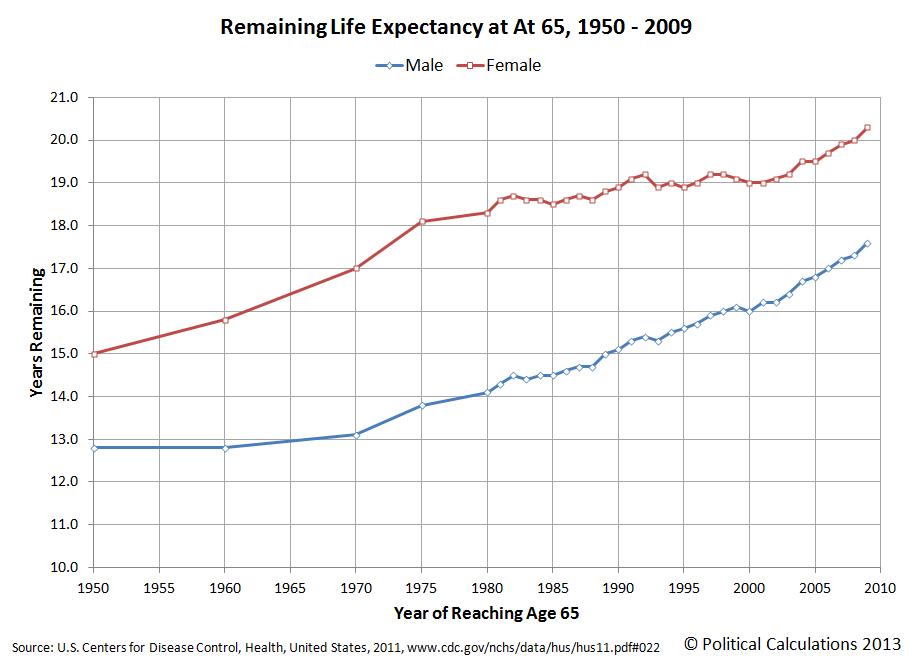
You are completely ignoring the main reason for the budget problem! It's demographics. In 1990 there were almost 20% more workers per retiree than now. The effect on social security / medicare is very predictable. Meanwhile healthcare costs have been increasing much faster than inflation. This is true both inside and outside government programs, but the government picks up the tab for the elderly, who incur the most expenses. So, have we got anything for our money since 1990? Yes! average remaining life expectancy at 65 has increased by 2 years since 1990.
So, the idea that government expenditures went up mysteriously, or due to largesse, is incorrect.
-
Re:D.A.R.E has no benefit
U.S. spending on education per student is the second-highest among OECD countries (PPP so no, the higher cost of living here isn't a factor). Money for education is not scarce. If anything, we spend too much money on education.
The problem is that it's spent ineffectively. A class of 30 kids gets over a quarter million dollars a year. In days past that would've been enough to build a new one-room schoolhouse for the kids, then teach them in it. Every year. If the teachers are complaining about having to buy their own supplies for their kids after you account for their $75k (with benefits) salary, you have to ask yourself where is the other $200k going?
It's mostly administrators. They eat up nearly twice as much money as teachers (the remainder pays for things like infrastructure). They are the middlemen of the public education system. They've situated themselves between the money and the teachers/kids, and make sure they get the biggest slice of the pie. If the education budget is ever cut, they make sure that it's the teachers and kids who bear the brunt of it so they'll complain and berate the government for cutting funding. If the budget is ever increased, they'll consume the lion's share of it while letting just enough of it trickle down that the public feels like it's getting something for its money. -
Re:Who the fuck is Alliance for Generational Equit
Indeed who the h*ll you they?
If you look at the website, available funding information, domain registration and anything at all about them you find that they have worked hard from the beginning to be completely obscure about who and what they are.
A look at the AGE website's "solutions outside of political parties and ideological partisanship" you find that their proposed solutions to health care costs are
- "tort reform" - freeing medical corporations from worrying about being penalized for bad practices and actions. This policy is beloved by the right despite, a) lawsuits costs are only 2% of America's helath care bill, and b) being show to be ineffective in saving costs where it has already been in place for a decade (Texas). Corporatists just hate accountability.
- Continue banning any drug imports. Those lower cost Canadian drugs are killers I tell you!
- Do no, repeat NOT, reduce the payment rate of Medicare Part D that pays drug companies whatever they ask for.
- But don't increase funding for the State Children’s Insurance Program, (SCHIP)!
Their Big Idea on energy costs? Not clear - it is simply to endorse whatever Matt Salmon (R-AZ) is proposing.
How to jump start the Jobs Crisis? Get this - expand the H-1 Visa Program and import more skilled foreign workers.
I could go on, but this "non-political": agenda is identical to those of the Chamber of Commerce, ALEC, and the numerous mouthpiece organizations of the Koch family, of which this clearly is one.
Oh, and about that study. What academic department and institution did it come from? Why the Economics Department of George Mason University.
The very department that has received $30 million from Charles Koch over the years, honoring him with a Doctorate in return, and hosts the Mercatus Center - an 'institute' with staff personally approved by Charles Koch and funded by him.
Astro-Turf by the truck load.
-
Re:I can't imagine...
U.S. spending per student on education is among the highest in the world. Of all the problems which plague our education system, funding is definitely not one of them.
So how come you have people with such large student debts?
Because, in my book, having universities that charge $100K for a degree course doesn't mean that you've spendt $100K on education, it just means you're funnelling money towards wealthy private educational institutions that should, self-evidently, all be nationalised and owned/run by the people.
-
Re:I can't imagine...
U.S. spending per student on education is among the highest in the world. Of all the problems which plague our education system, funding is definitely not one of them.
One can argue defense spending needs to be reduced. But proposing it should be spent on schools instead is just shifting money from one bloated program to another. -
Re:WTF?
That's nice, but personally I'm sick of hearing bureaucrats insist they can't cut anything or that the end is nigh if they don't receive as much of a budget increase as they really wanted.
Not to mention the tantrums they throw if they experience any "cuts"... yes, I'm sure there was *no way* the Secret Service could afford to allow White House tours to continue. Or that the DOJ had to release illegal immigrants from jail onto the streets in advance of "cuts" (I guess deportation isn't an option anymore).
It's not particularly useful to protest cuts when the CBO budget projections are like this: The Effects of Sequestration on Federal Spending
Don't forget, even if you zeroed out the DoD budget, we would still be facing a ~$300 billion deficit this year (projected $900 billion deficit with a ~$600 billion defense budget).
So, perhaps NASA has traditionally been last in line at the trough, but the necessity for cuts is real. No bureaucracy will ever suggest that even one cent could be cut from their budget, so cost-reductions tend to end up looking like hatchet jobs. Blame the obstinacy of the agencies involved.
-
Re:USA medical spend 15% of GDP, Europe 8-10%
ed funding has suffered through the last 3 decades
Not by actual money spent. The chart I just linked to shows US spending per capita adjusted for purchasing power parity (a crude measure for estimating the relative cost of living for various countries) is the second highers of OECD countries. Yet the results are far weaker (Finland spends a third less by the measure and gets better results).
-
Re:I say cut the F-35
For 50 years, far more has been collected than was needed to pay current obligations.
The catch is that "current obligations" is simply what's paid out today, not money needed to pay those who paid into it. The money you pay into Social Security isn't put into some savings account where it grows with interest waiting for you to retire. It's paid out almost immediately to current retirees (solvency varies from 1 year to about 15 years depending on program changes). That's why the baby boomers retiring is such a shock to the system - it drastically altered the ratio of SS payers to payees. If it had been structured like a real pension, the baby boomers would just be getting back money they paid in and there would be no shock to the system from the payer/payee ratio changing. But that's not how it works.
Medicare works the same way - current workers paying current retirees. This is why it's very dangerous to think of these programs as getting back money you paid in, or as "solvent and paid for" just because they've been running in the black on the accounting books thus far . They're not run like a regular retirement or pension fund. To compare their health like you would a pension fund, you have to project out about 30-40 years ahead to take into account the current batch of payers turning into payees. And the CBO has been warning for over a decade that these (primarily Medicare) are the biggest threats to the budget when you project out that far.
While I'm sure there's lots of waste in Defense spending which could be cut, it is not growing. It's more or less been holding steady. Even with the uptick from the two wars in Iraq and Afghanistan, Defense spending is still below 1980s levels. The bottom line is that you cannot balance a budget by cutting things which aren't growing, and ignoring the things which are growing. Eventually you're going to run out of things to cut, while the things you're ignoring will continue to grow (which btw is projected to happen around 2070, when SS + Medicare/Medicaid spending are projected to exceed all tax receipts). You have to look at the costs that are growing and do something to get their growth under control. The longer you wait, the harder it will be to implement those cost controls. -
Re:If the 1% has 40% of the money....
actually they do. what is troubling is why people like you are so ignorant of this fact.
-
Re:American Advantage
1) Really American's don't think they are special? How about whenever people get into chants like USA USA USA. Naaa nothing special at all.
Europeans have a long tradition of destructive and irrational nationalism. (You've even invented some thought-terminating cliches to thinkstop anyone from bringing them up.) USA, on the other hand, is a nation based more on the philosophical ideas of its founders rather than an accident of birth. (Or at least it would be if all Dems were deported to France...) It's not perfect, but it ranks near the top by most benchmarks of freedom - especially in how much of your labor you actually own!
I am an American by choice and conviction, and I have an extensive decision-support matrix to tell me when it will be time to become a Singaporean (etc) "by choice and conviction" instead. That time has not (yet?) come. USA, and particularly New Hampshire, is the best place for me to be. (And I wonder how NH would compare to the handpicked Potemkin Villages that Europeans like to select as their champions for each specific statistical comparison, forgetting the drastic difference of population and circumstance...)
2) Really have more wealth?
Yes, USA'ians have more wealth than the Europeans (with the possible exception of Norwaystan, Luxembourg, Monaco, the Vatican, and other tiny nations that could make money in particularly easy ways), and, most importantly, more opportunity to create wealth based on hard work and merit.
Compare USA's rankings in per-capita disposable income, median household income, etc. Then adjust them by purchasing power and fertility rates, and you'll see just how far ahead USA really is.
Without adjusting for fertility, all income statistics are meaningless! A family where the wife reduces her working hours and has 2-3 children has much lower income (particularly "per capita") than a family of DINKs, but children do have a great value, and a collapsing population eventually leads to an economic crisis.
3) Oh give me an effen break. European's hate success. Yes that's right because nobody drives any European cars, or buys any European products. No Europeans don't hate success. What Europeans hate is the difference in wealth between the poorest and the richest. If you think giving rich people privileges is right, then let me introduce you to King Louie XVI.
Of course Europe manufactures some cars (which are generally unreliable, overhyped, and overpriced). It has cheaper labor than the USA (particularly in Spain, Poland, etc), which gives it some advantage. Japan, SK, and soon China have an advantage over both. Europe's main export appeal is in luxury products that are a relic of its glorious past. But far fewer Europeans can afford to drive them...
You have confirmed the stereotype of Europeans hating success by comparing success to a despotic monarch - something that USA'ians weren't historically very fond of. As a country approaches sufficient economic freedom, over time, wealth flows out of the hands of the incompetent and is created in t
-
Re:They rejected 16% salary increase over 4 years
Yes, it is insane to pay those who are teaching the children well.
The U.S. already has the second-highest spending per student of any OECD country. And Illinois spends about 10% more than the national average (Table 8). If there's a problem with our education system, it's not due to lack of funds. Schools are already being paid plenty relative to other developed countries. Saying we should just throw more money at the problem is silly.
-
Re:Boo frickin' Hoo
Everything in America is about abuse from the gubmint, isn't it?
USA actually has more individual freedom (less "abuse from the gubmint") than the vast majority of countries in the world, particularly in the freest states like New Hampshire. Countries that (inconsistently) rank higher in various benchmarks of freedom are usually tiny exceptions that don't have to deal with the challenges of an ethnically diverse vast superpower.
The reason why USA-ians are more concerned about government abuse is the same reason why a modern surgeon is more concerned about germs than a cavemen - not because the caveman has fewer germs to worry about, but because the surgeon has greater understanding of their harm!
Can you think of less severe responses to the concern that corporations were being disadvantaged?
You mean the individuals that form functional non-governmental groups are disadvantaged - which the government does to protect its own power. The government is huge and united by shared power, while it indeed wants all other organized groups to be small and disadvantaged, and thus incapable of gradually taking over all of its functions.
Hijacking a Tolstoy quote: "if vile people [socialists] unite and constitute a force, then decent people [free market capitalists] are obliged to do likewise"!
And, yes, using government privileges to protect from government harms clearly isn't the most rational response, though possibly temporarily the most convenient...
--libman
-
Re:If the odds are against you
99% disagrees.
FTFY - You don't see the 1% complaining that the poor don't pay their fair share, despite the fact that they pay 38% of federal income taxes, when they only earn 22% of total US income. Interesting that the bottom 50% of the population only pays 2.7% of federal income taxes. THOSE are the people asking for free money.
That's federal *income* taxes, not total federal taxes paid. If anyone in the bottom 50% has a job, they're paying 7.65% of their income (if they have an employer), or 15.3% (if they're self-employed). Payroll taxes are a burden the rich don't have - earned income above $100k is exempt, as is any non-earned income (dividends, interest, capital gains, rent payments, etc.).
-
Re:If the odds are against you
99% disagrees.
FTFY - You don't see the 1% complaining that the poor don't pay their fair share, despite the fact that they pay 38% of federal income taxes, when they only earn 22% of total US income. Interesting that the bottom 50% of the population only pays 2.7% of federal income taxes. THOSE are the people asking for free money.
-
Re:Can't cut anything...
History has shown that high taxes on the rich do NOT harm the economy
History has also shown that higher taxes != higher revenue, but that's not your point, is it?
The issue is not the official tax RATE, but the ease with which high-income earners (individuals and corporations) can avoid paying taxes. Offshore accounts, tax havens and other income-tax-dodging practices are the primary reason why ANY government has revenue issues.
-
Re:Can't cut anything...
History has shown that high taxes on the rich do NOT harm the economy
History has also shown that higher taxes != higher revenue, but that's not your point, is it?
-
Re:Gotta love politicans
Instead of cutting where its needed (gross government pay and military), they cut everything else instead.
The problem with the Federal budget isn't military spending. Yes defense can be cut, but it's already the one budget item which has been cut the most in the last 50 years. Right now, our annual budget deficit exceeds the defense budget, so we could drop defense spending to zero and we'd still have a budget crisis. And FWIW, defense spending is on the chopping block as well if the Budget Control Act kicks in.
Likewise, the U.S. spends pretty close to the most of any country on public education per student. So our education problems aren't because of lack of funding. The "lack of money" for education is an illusion created by school administrators, either to cover up their own incompetence or to attempt to carve a bigger piece of the budget pie for themselves. Cutting defense and shifting the money to education is just swapping one form of wasteful spending for another.
What needs to be cut are the social programs - primarily Medicare and Medicaid. Social Security was a problem too, but its growth was mitigated with some of the reforms passed some years ago. Don't believe me? Go read the CBO reports. They've been saying this for over a decade now - Medicare and Medicaid projected to grow to consume 100% of tax revenue by 2050-2070 (the doomsday date changes from year to year). The notes on the NPR graph mention the same thing too - that the social programs are the parts of the budget which have grown the most. Unfortunately some people refuse to acknowledge that this is the real problem, and jealously guard these programs against any and all cuts - Medicare, Medicaid, and Social Security are all exempt from the Budget Control Act's mandatory budget cuts. And instead insist that everything can be fixed by cutting defense when simple math ($budget_deficit > $defense_budget) says it can't.
Don't trust what I tell you, don't trust what your friends in your political circles tell you. Read the CBO reports and decide for yourself. They're very enlightening. -
Fact check
Next time, before spewing all that venom on how the US is not spending any money on education, please check your facts:
http://mercatus.org/publication/k-12-spending-student-oecd
"As we can see, with the exception of Switzerland, the United States spends more than any other country on education, an average of $91,700 per student between the ages of six and fifteen."
How much of this money goes to actually educating the kids after the unions take their cuts, I don't know. But saying that Republicans "demand to have a first-rate educational system while not wanting to pay a [...] dime of taxes to support it", is simply not true.
Throwing more money at the problem won't fix it.
Fix the families. Restore family values. Education and all other aspects of life will follow.
-
Re:teachers' unions
Our per capita spending is very much at the high end of the spectrum: http://mercatus.org/sites/default/files/publication/k-12-education-spending-pdf_0.pdf And this spending has doubled since 1970: http://www.heritage.org/static/reportimages/8944CCA9757394F0CCE1821F36C34E6E.gif I don't think throwing more money at the problem is a solution.
-
Re:AMERICA FUCK YEA!!
U.S. spending on K-12 education per student is the second highest in the world (adjusted for local cost of living, PPP). If your kid's school can't afford to hire enough teachers, the problem isn't because they lack funding.
-
Re:It's all good.The difference between "investing" and what the government is doing when it spends money on stimulus is this: when you invest $1, you expect to get more than $1 of useful stuff back - and probably more. You want to get the most bang for your buck. When the government spends $1, they go out of their way to get as little bang for the buck as possible, so that they can spend more. For instance,
In one redolent example, a federal contractor said he was told to use smaller, nonstandard tiles that are harder and more expensive to install in order to increase the cost of the project.
(-- Why the Stimulus Failed, in The Wall Street Journal, c.f. also No Such Thing as Shovel-Ready and Did Stimulus Dollars Hire the Unemployed?)
I'll give you something, through. It's true that the money is "free" until the world economy actually thaws and people demand interest for their money again. But come on -- what are the odds of that happening?
-
Re:It's all good.The difference between "investing" and what the government is doing when it spends money on stimulus is this: when you invest $1, you expect to get more than $1 of useful stuff back - and probably more. You want to get the most bang for your buck. When the government spends $1, they go out of their way to get as little bang for the buck as possible, so that they can spend more. For instance,
In one redolent example, a federal contractor said he was told to use smaller, nonstandard tiles that are harder and more expensive to install in order to increase the cost of the project.
(-- Why the Stimulus Failed, in The Wall Street Journal, c.f. also No Such Thing as Shovel-Ready and Did Stimulus Dollars Hire the Unemployed?)
I'll give you something, through. It's true that the money is "free" until the world economy actually thaws and people demand interest for their money again. But come on -- what are the odds of that happening?
-
Re:Goes to prove the point . . .
Money might be a good start. Even in schools where this $5 Billion reaches, they still expect to pay teachers poverty wages.
No, money is not a good start. We're already drowning the education system in money. The U.S. spends over $10,000 per student per year on public education. It's just among the highest of the OECD countries. So a single teacher teaching a class of 25 kids (which is low these days) represents more than a quarter million dollars per year.
The problem isn't that we aren't spending enough money on education. The problem is that only a tiny amount of what we do spend is trickling down to the teachers and the classroom. The vast majority is being absorbed by bureaucracy and administration. That's what needs to be reformed. But they're the ones who control where education money gets spent, making it very difficult to reform them. They absorb increases in education funding, while passing down cuts to the teachers.