Slashdot Mirror
Domain: minidisc.org
Stories and comments across the archive that link to minidisc.org.
Comments · 174
-
Re:LISTEN!
Would you care to guess how much Sony's new hi-md portable player will cost?
Don't need to guess:
- MZ-NH600D - $200 (no mic or line-in inputs, consequently not very useful as far as I'm concerned)
- MZ-NHF800 - $250 (includes mic and line-in jacks, also AM/FM/TV/Weather tuner)
- MZ-NH900 - $300 (Nicer looking, charger has USB connection, but no radio tuner AFAIK)
- MZ-NH1 - $400 (Magniesium case, nice remote, not sure how you would justify the cost)
These four are slated for April 2004. From what I can see, the NHF800 looks like the best buy, but until reviews of available equipment come in, it will be useless to make final judgments.
More info at minidisc.org.
-
Re:LISTEN!
Would you care to guess how much Sony's new hi-md portable player will cost?
Don't need to guess:
- MZ-NH600D - $200 (no mic or line-in inputs, consequently not very useful as far as I'm concerned)
- MZ-NHF800 - $250 (includes mic and line-in jacks, also AM/FM/TV/Weather tuner)
- MZ-NH900 - $300 (Nicer looking, charger has USB connection, but no radio tuner AFAIK)
- MZ-NH1 - $400 (Magniesium case, nice remote, not sure how you would justify the cost)
These four are slated for April 2004. From what I can see, the NHF800 looks like the best buy, but until reviews of available equipment come in, it will be useless to make final judgments.
More info at minidisc.org.
-
Re:LISTEN!
Would you care to guess how much Sony's new hi-md portable player will cost?
Don't need to guess:
- MZ-NH600D - $200 (no mic or line-in inputs, consequently not very useful as far as I'm concerned)
- MZ-NHF800 - $250 (includes mic and line-in jacks, also AM/FM/TV/Weather tuner)
- MZ-NH900 - $300 (Nicer looking, charger has USB connection, but no radio tuner AFAIK)
- MZ-NH1 - $400 (Magniesium case, nice remote, not sure how you would justify the cost)
These four are slated for April 2004. From what I can see, the NHF800 looks like the best buy, but until reviews of available equipment come in, it will be useless to make final judgments.
More info at minidisc.org.
-
Re:LISTEN!
Would you care to guess how much Sony's new hi-md portable player will cost?
Don't need to guess:
- MZ-NH600D - $200 (no mic or line-in inputs, consequently not very useful as far as I'm concerned)
- MZ-NHF800 - $250 (includes mic and line-in jacks, also AM/FM/TV/Weather tuner)
- MZ-NH900 - $300 (Nicer looking, charger has USB connection, but no radio tuner AFAIK)
- MZ-NH1 - $400 (Magniesium case, nice remote, not sure how you would justify the cost)
These four are slated for April 2004. From what I can see, the NHF800 looks like the best buy, but until reviews of available equipment come in, it will be useless to make final judgments.
More info at minidisc.org.
-
Re:Sony? Never again.
'What happened to the Sony that was the undisputed king of technology just a few short years ago??'
Basically, they acquired their own media 'content' empire, became paranoid about copying, and imposed annoying (but ultimately futile) DRM on just about every digital product they sell. Curiously enough, they did produce a half-decent MD burner application ('Simple Burner') without the bloat, instability and 'check in/check out' nonsense, but only distribute it in certain markets - this may well solve your problems with the widely-disliked OpenMG software:
http://www.minidisc.org/NetMD_faq.html
http://www.minidisc.org/simple_burner.html
http://www.my-minidisc.com/index.php?language=en&a ction=download_en.html
-
Re:Sony? Never again.
'What happened to the Sony that was the undisputed king of technology just a few short years ago??'
Basically, they acquired their own media 'content' empire, became paranoid about copying, and imposed annoying (but ultimately futile) DRM on just about every digital product they sell. Curiously enough, they did produce a half-decent MD burner application ('Simple Burner') without the bloat, instability and 'check in/check out' nonsense, but only distribute it in certain markets - this may well solve your problems with the widely-disliked OpenMG software:
http://www.minidisc.org/NetMD_faq.html
http://www.minidisc.org/simple_burner.html
http://www.my-minidisc.com/index.php?language=en&a ction=download_en.html
-
Re:Getting Around DRM with NetMDsDon't you mean NetMD Simple Burner? which has no DRM but only lets you transfer in LP2 mode.
see here
-
iPod vs MD: the number one digital music player?Compare:
"Apple's iPod(TM), the number one digital music player in the world"
"Net MD Walkman recorders have been the top-selling digital music players for the past 18 months"
(Lest any USians sneer, MiniDisc is prevalent in Japan and at least somewhat more popular in Europe...)
-
Here's a LOT more information on this ...The below information is from minidisc.org.
Sony plans to release FOUR new devices in April. They are expected to cost $200 for the MZ-NH600D, $250 for the MZ-NHF800, $300 for the MZ-NH900, and $400 for the MZ-NH1, with Hi-MD blanks costing about $7. They are also planning to release a bookshelf system, the LAM-X1.
There are a few concept ideas also. Look here (Japanese) to see a bunch of other Hi-MD items, including a Hi-MD Camera!
Click here for a translated (Babelfish) document with a bit of technical information.
-
Here's a LOT more information on this ...The below information is from minidisc.org.
Sony plans to release FOUR new devices in April. They are expected to cost $200 for the MZ-NH600D, $250 for the MZ-NHF800, $300 for the MZ-NH900, and $400 for the MZ-NH1, with Hi-MD blanks costing about $7. They are also planning to release a bookshelf system, the LAM-X1.
There are a few concept ideas also. Look here (Japanese) to see a bunch of other Hi-MD items, including a Hi-MD Camera!
Click here for a translated (Babelfish) document with a bit of technical information.
-
Here's a LOT more information on this ...The below information is from minidisc.org.
Sony plans to release FOUR new devices in April. They are expected to cost $200 for the MZ-NH600D, $250 for the MZ-NHF800, $300 for the MZ-NH900, and $400 for the MZ-NH1, with Hi-MD blanks costing about $7. They are also planning to release a bookshelf system, the LAM-X1.
There are a few concept ideas also. Look here (Japanese) to see a bunch of other Hi-MD items, including a Hi-MD Camera!
Click here for a translated (Babelfish) document with a bit of technical information.
-
Here's a LOT more information on this ...The below information is from minidisc.org.
Sony plans to release FOUR new devices in April. They are expected to cost $200 for the MZ-NH600D, $250 for the MZ-NHF800, $300 for the MZ-NH900, and $400 for the MZ-NH1, with Hi-MD blanks costing about $7. They are also planning to release a bookshelf system, the LAM-X1.
There are a few concept ideas also. Look here (Japanese) to see a bunch of other Hi-MD items, including a Hi-MD Camera!
Click here for a translated (Babelfish) document with a bit of technical information.
-
Here's a LOT more information on this ...The below information is from minidisc.org.
Sony plans to release FOUR new devices in April. They are expected to cost $200 for the MZ-NH600D, $250 for the MZ-NHF800, $300 for the MZ-NH900, and $400 for the MZ-NH1, with Hi-MD blanks costing about $7. They are also planning to release a bookshelf system, the LAM-X1.
There are a few concept ideas also. Look here (Japanese) to see a bunch of other Hi-MD items, including a Hi-MD Camera!
Click here for a translated (Babelfish) document with a bit of technical information.
-
Re:Minidisk market sectors? - Theaters
YES. Ask any classical music student... I'm a violin student at the Shepherd School of Music at Rice University, and I'd say maybe a third to a half of the people in my class own portable Minidisc recorders. If you spend all day in a practice room, you can lose an objective angle on how you actually sound pretty easily. Recording yourself is an extremely effective practice technique, since [generally speaking], recordings don't lie.
Coupled with a small cheap mic, they come in very handy for recording lessons and performances-- sound quality isn't great, but considering how little you pay, they're a fantastic deal.
Most people I know get by with just a handful of discs- since they are easily re-recordable and erasable, every week you can just record over a previous lesson. And with media costs around $2/disc, you're not dropping much money to buy new discs should you ever need them.
Since I'm surrounded by music all day as a violin student, I don't spend much time listening to pre-recorded music on my MD player/recorder- I use it almost exclusively for its audio recording functions.
Minidiscs are also widely used in the field of linguistics, according to a professor last semester. Not only because they are random-access, but the sound quality is far better than a tape.
I think the greatest thing about minidiscs is that they have been adopted for so many highly specialized purposes. If you're interested, the Minidisc Community page has a list of creative uses for the minidisc.
-
Re:What's the point?
The capacity for the original minidisc was less than a CD-R.
A minidisc stores 160MB for 74 min. in audio mode (based upon 74 min discs).
The amount of compression in realtime allows the MD to store 80mins of music. Now, think about 1GB, thats a hell of a lot more than 160MB. I'd also say my opinion differs with yours when I see 300MB more than a cdr is significant (with compression), Also, the size of these disks. I could fit two in my pocket without any discomfort.
Sure hard drives are bigger, they probably will be for a long time. However, the media in hard drive is non changeable, despite its capacity. This leads to listening to the same songs (even if you listen to them all randomly) unless you connect it to the computer and change them every so often. Additionally, hard drives are not known for their robustness.
If I meet a friend in the street or he recommends a song, he might lend me the MD, I can listen to it there and then, while I go home, not have to go home, rip it, maybe find out its copy protected, download it, then listen to it.
Yeah the DRM is worrying, the original MD did seem to take off (judging by the many devices I've seen in public. Although it wasn't as successful as portable cd players were. Further restrictions may hinder the successful take up of this technology. However, since most MD users recorded their minidiscs from CD's rather than buy MD versions, it is probably a moot issue.
However as long as the MD supports recording, maybe even high speed recording, then I'd be happy spending my money on another Sony Product (should I need a personal stereo type device again).
I'm not trying to convince you of MD technology being better than those of HD mp3 players, it is probably suited for a different usage pattern than that of HD players (besides, you already own a HD player). In the world, where bigger often is associated with better, MD cannot compete. I am trying to point out the advantages of having one.
Personally I did own a MD player for about 4 years, but gave it away when I didn't need it anymore. I found it a good thing to have when travelling and especially when friends with good music taste owned one as well. To me, despite it being a "personal" player, the music became a communual sharing activity. -
Re:What's the point?
The capacity for the original minidisc was less than a CD-R.
A minidisc stores 160MB for 74 min. in audio mode (based upon 74 min discs).
The amount of compression in realtime allows the MD to store 80mins of music. Now, think about 1GB, thats a hell of a lot more than 160MB. I'd also say my opinion differs with yours when I see 300MB more than a cdr is significant (with compression), Also, the size of these disks. I could fit two in my pocket without any discomfort.
Sure hard drives are bigger, they probably will be for a long time. However, the media in hard drive is non changeable, despite its capacity. This leads to listening to the same songs (even if you listen to them all randomly) unless you connect it to the computer and change them every so often. Additionally, hard drives are not known for their robustness.
If I meet a friend in the street or he recommends a song, he might lend me the MD, I can listen to it there and then, while I go home, not have to go home, rip it, maybe find out its copy protected, download it, then listen to it.
Yeah the DRM is worrying, the original MD did seem to take off (judging by the many devices I've seen in public. Although it wasn't as successful as portable cd players were. Further restrictions may hinder the successful take up of this technology. However, since most MD users recorded their minidiscs from CD's rather than buy MD versions, it is probably a moot issue.
However as long as the MD supports recording, maybe even high speed recording, then I'd be happy spending my money on another Sony Product (should I need a personal stereo type device again).
I'm not trying to convince you of MD technology being better than those of HD mp3 players, it is probably suited for a different usage pattern than that of HD players (besides, you already own a HD player). In the world, where bigger often is associated with better, MD cannot compete. I am trying to point out the advantages of having one.
Personally I did own a MD player for about 4 years, but gave it away when I didn't need it anymore. I found it a good thing to have when travelling and especially when friends with good music taste owned one as well. To me, despite it being a "personal" player, the music became a communual sharing activity. -
Re:Copyright Protection Technology
I've got one of their NetMD's that use the OpenMG/Magic Gate bullshit. The OpenMG/Magic Gate tech is all software based as far as I know. It essentially asks you for all your MP3s, converts them to their proprietary, DRM-laced format, and uses those files to transfer to your drive. Using their software, you can copy songs to a minidisc, but you have to "remove" them using the software before you can copy them to another minidisc.
Fortunately, there's ways to get around them. My personal favorite is making a Audio CD image of all the songs you want, then mounting it using a virtual drive. Then use Sony's own tools to copy this CD to the MD, bypassing all their DRM. Using Ahead Nero Burning Rom and Image Drive, I've made 1.5 gig CD Images which can be copied to my NetMD[1]. There are tools out there to help speed this up, like SimplerMD. OpenMG/Magic Gate is more of a pain in the ass than anything else, but it certainly doesn't stop people from listening to their "illegal" MP3's.
[1]: For those of you confused to how I stuck 1.5 gigs of raw data on a minidisc, NetMD units support LP2 and LP4 modes, which let you store more music, but with lossy compression. If my MD holds 80 minutes of music at standard compression, LP2 holds around 140, and LP4 holds around 320 minutes - hence, the oversized CDs to fill 140 minutes of music. -
Re:Floppydisk replacement
The MD-Data format does exist but it isn't exactly viable.
We've already had Zip & Jazz drives, 120Mb "floppies" and all sorts of small MO-like formats. MD-Data was just another one of them. -
Re:MD-ROM format was a HUGE missed opportunity
I agree, Sony missed a big opportunity here. Perhaps it was just before its time, MD-DATA showed up in 1994 before most people needed so much storage. The first drive they introduced cost $769, and very few were sold. There is a list of all the MD-DATA devices here. most of them are digital cameras, there are a few PC drives at the bottom of the page. You can still buy the data discs at Minidisco for $12.99 each... pretty steep for 140 megabytes. It seems like a format that came too early and was too expensive combined with almost no marketing at all by Sony. It never came down in price and never caught on.
-
Re:I was thinking the opposit, actually...
I had been looking at Minidisks for recording, and while its nice that they are so small, i just can't stand the idea of waiting around to transfer two hours of recorded sound to my computer. I still might buy one (a sharp model), but i'm looking at these alternatives instead:
The MR-8 8-Track Digital Recorder "Genuine 16-bit/44.1kHz uncompressed linear sound quality. 2-track simultaneous recording and 8-track playback is just the tip of the iceberg. 38 self-illuminating keys, 13 knobs, and 7 smooth-moving faders combined with a 128x64 backlit LCD make it way easier to operate than any other full-featured digital recorder. Onboard guitar distortion, amp modeling, built-in mic, mic modeling, digital reverb and delay section, plus advanced editing and archiving features make stellar demos a breeze. Mastering effect for stereo bus, USB port for WAV transfer to PC, and optical S/PDIF out. Battery or included power supply operation."
SME Marantz PMD222 " Portable 3-head, 2-Speed Cassette Recorder with XLR"
NOMAD Jukebox 3
" # 20GB storage space holds up to 8000 songs encoded in WMA at 80kbps or 5000 MP3s encoded at 128kbps. 40GB of the storage space doubles that!
# High audio quality: 98dB Signal-to-Noise Ratio Playback
# Frequency range of 20Hz to 20kHz
# Maximum output 100mW
# Analog/Optical Line-In for direct high quality recording from external audio devices
# Firewire (IEEE 1394) and USB 1.1 Transfer
# Second Battery Bay: Up to 11 hours of continuous playtime with one lithium-ion rechargable battery, up to 22 hours of uninterrupted playback with both batteries
# Quick and easy navigation Scroller to find songs in seconds
# Smart Volume Management (SVM) for normalization of audio output
# AudioSync to synchronize your PC music library to the NOMAD Jukebox 3
# Anti-skip protection of up to 7 mins for smooth listening
# EAX-enabled
# Time-Scaling - Speed up or slow down audio playback without distortion
# Creative File Manager - Use the player as a portable storage device
# Personalization features: LCD color, faceplates, accessories, startup logos"
(according to some sites, i'd need a mic preamp to record with this)
Theres a whole section dedicated to "uploading facilities" here: http://www.minidisc.org/ -
Re:PSP
um... its a far cry from just spinning the disc. Their walkmans have 2 screens, one on the remote and one on the unit. The remote is backlit and in some models so is the screen on the unit but for some reason Sony decided not to put it on their lastest top of the line model.
LCD screen technology? Their 5inch PSOne screen only consumes 350mA when the light tube is replaced with LEDs. It shouldnt be too difficult for them to integrate that into a handheld while at the same time keeping power requirements low.
Speakers... well their walkmans are outputting sound through the earphones when they're giving 50hrs playback time, that means something right? Personally I'd rather use earphones anyway as I find the built-in speakers on handhelds less than adequate. Plugging in portable beach speakers won't sound very loud, but it is as loud as the music from the GBASP turned all the way up. When I bought my walkman I did such a test and had it on continuous play on a pair of cheapish unpowered speakers. I was surprised when I got ~10ish hours playing time on the MZ-N10 before the internal battery went flat.
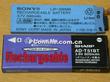
I don't have the dimensions for the internal battery as its sealed inside the unit but take a look at this pic. MZ-N10 battery The smaller battery is the one used in the MZ-N10. To get an idea of its size the bigger battery in the pic has dimensions of 67x25x6mm. The only thing I could find on the MZ-N10 battery is that it's only 3mm thin. 3mm!! And that gives 24 hrs playback time (58 if you use an AA battery as well). That's a incredible running time on a battery that small.
While I don't doubt the PSP will draw more power than their walkmans, I think Sony will be able to get good running times out of the PSP.
On the price, Sony have already said it will cost 19,000 to 30,000 yen (USD 159 - 251) at launch. Much higher than the GBA but as production ramps up so will the cost to produce it fall.
-
Re:The funny thing is?
Wow, you guys don't pay much attention.
MD *is* a MO format (albeit much smaller; a 3.5" ISO standard MO disk is about the size of a floppy and the thickness of two stacked.. MD is the size of
The beauty of 'real' MO is that you can format the disc any way you can format a hard drive. Want FAT? You can do that. Want partitions? Write a partition block, whether x86-style, BSD slice style, Mac style, or Amiga style. Want to boot from it? That's slightly more complex - find out if your IDE or SCSI BIOS supports booting from devices in the removable class; if not, flip the DIP switch or jumper on the drive that tells it to emulate a hard drive. (If you have to do that, you can't expect an OS with no concept of 'mounting' - Windows - to support safe ejection after booting.)
Want to store music on one? Format it however you like; there's no reason you couldn't 'dd' a dump of a CD to one, and then 'dd' it back to burn it to the 'right' media, though you'd need to fiddle around to trick software into playing it off the MO. It's not much different than a CF card, though presumably cheaper for the capacity and possibly even more robust.
At least one company is making a car MP3 player that reads the files off a standard (Windows FAT-format) MO disk. Sadly, I can't remember the name of the product; I was surprised to stumble across it in the back of my cousin's "Bling Wheelz!"-type magazine. -
For a corpse, it smells surprisingly goodThis appears to be a similar case to MiniDisc. In the USA, it never seemed to catch on, but here in TheRestOfTheWorld, we lapped it up.
A large percentage of new mobile phones from the major manufacturers are all equipped with Bluetooth, and combined with GPRS, it's an ideal way to connect your laptop to the internet when you're on the move.
It allows my calendar on my Mac to synchronise with the calendar on my organiser, it lets me send files to and from my office PC without the need for a network, and it's even used for wireless keyboards, mice, and audio headsets.
It's the wireless equivalent of USB, and it works just fine thank you.
-
Re:The industry standard...
>Minidiscs don't have SPDIF outputs. Only SPIDIF inputs.
Run that by me again...
I do think you are mistaken. Look closely at the diagram. -
Re:Hmmm...
..DAT is used in recording studios. I can bet you MD never is..
Well, Sony does make a multi-track Minidisc recorder, or at least used to (check out this page).
Also, when I was working at a [student] radio station, we used to use minidiscs for all of our ads and promos. Of course we didn't need pro audio quality for broadcast, but they had some pretty nice machines back then, and this was in 1994 or 1995. -
Re:HUH?!?!minidisc.org has a quick explanation from RIAA's point of view, and they clarify that this applies to devices designed for recording and playback... not necessarily GP computers. That is the interpretation by RIAA and may be correct... but it also might be successfully argued that your particular computer falls under the protection.
A better place to look might be hrrc.org where they have more interest in the consumer's rights.
Also, it's Audio home recording act, not American... sorry. And thanks to the poster that clarified the differences between audio and data CD's, I didn't know that.
-
Re:Digital
well, minidisc always stores your recording in a compressed (ATRAC) format so what do you expect?
What always amuses me is the number of people who claim to hate mp3 but love Minidisc... odd
-
Re:PSP UMD vs. GameCube Mini-DVD
Actually there was. The standard mini disc holds 140 MB of data
minidisc.org
The data side of the format seemed to catch on less than the audio side did(which is not much anyway, sadly) -
Re:PSP UMD vs. GameCube Mini-DVD
There was never any drives for storing data on MiniDiscs.
The Sony MDH-10 was a MiniDisc drive for data. It had a SCSI interface on it. MD-Data discs held about 140 MB. Here's a link. -
Re:Minidiscs and CD qualityStill not quite right, there... the capacity of a 74min Minidisc is about 160Mb - nowhere near enough space for uncompressed CD Audio (44.1kHz @ 16 bits), at least not 74mins worth.
Even at Standard Play speed (SP), you still need to apply compression to the sound to fit it all on the disc. The sound quality is pretty damn close to CD Audio - but still compressed.
I'm not aware of how to make either of my MD units (MZ-R55, MZ-N1) record uncompressed audio without the unit compressing it.
I think Sony do produce High-Density minidiscs that can store 650Mb, but I don't think commercially available players will read them. Take a peek at the Minidisc FAQ [minidisc.org]
-
Re:Ultra-efficient ATRAC?
There is a limit to how much return you get on progressively more expensive cables in the context of A/V eqipment. However, assuming a decent S/N ratio, there should be no reason why a Monster Cable branded RJ11 cable will perform better than a generic, unbranded one. The difference is really in the type of signal being transmitted.
On a modem line, the signal is a digital one. As previously stated, as long as there's a sufficiently high S/N ratio, there will be almost no signal loss and 100% of the data can be read. The same goes for generic vs. Monster Cable digital audio cables (coax and optical).
However, there *is* a difference that can be made in component interconnects and speaker wiring as any signal loss in a purely analog connection will be received by every component downstream of the source. At a certain point, however, there is a limit to how much you get back out of your cabling investment.
The cables that are provided with most mainstream components (Sony, Pioneer, Kenwood, etc.) will get the job done, and don't really hinder the sound quality all that much under normal circumstances. It would be a fairly good investment to buy the cheapest Monster Cable or other "upgraded" cable if you've got a hefty investment in both your components and your speaker system. Anything beyond that is probably overkill for 99% of the readership here, and the majority of the remaining 1% won't really be able to tell a difference in a double-blind comparison, anyway.
The recommendation I make to friends/family/customers/strangers the most is to upgrade your speaker cables. If you like listening to your system at anything lounder than background level, you *need* better speaker cable than what comes with systems, even boomboxes with detachable speakers and complete shelf systems. But you probably won't need the heavy, 8-gauge stuff that's available. Most system that pump out about 150w RMS per channel should have about 12- or 14-gauge on it. Monster Cable's XP line should be more than adequate, and isn't too expensive. Anything more than that, and you should probably be looking at 8-gauge, though.
All of this is assuming that you listen to music as a focus, rather than as a distraction. If your system is being used as background noise for whatever else you're doing, none of this is going to be noticeable. All of the above suggestions come from my own personal experince of over 10 years in home A/V system building (I've got 3 running at any given time, and a 4th is always being assembled to replace one of the existing 3: LR, MBR, and Basement Theater). In summary, if you feel the need to buy upgraded connections between your components, do so. But keep in mind that there really isn't any difference in the end-result if you go any higher than the first upgrade.
And before anyone gives me grief, there will always be someone that buys the best stuff available because they can. In their minds, they can hear the difference. And that's all that matters.
Oh, and there's a great site for comparing MP3 to Minidisc's ATRAC formats here. -
ATRAC, ATRAC3 bitratesfrom http://www.audiocoding.com/wiki/index.php?page=AT
R AC:
Codec is used in Sony's Minidisc recorders and the RealAudio 8 compression format.
Versions used by Minidisc:
- ATRAC1 Stereo (292 kbps)
- ATRAC1 Mono (146 kbps)
- ATRAC3 Stereo Longplay 2x (LP2) (132 kbps)
- ATRAC3 Stereo Longplay 4x (LP4) (66 kbps)
There are different implementations, they are called:
- ATRAC-1 (ATRAC1 Version 1)
- ATRAC-2 (ATRAC1 Version 2)
- ATRAC-3 (ATRAC1 Version 3)
- ATRAC-4 (ATRAC1 Version 4)
- ATRAC-4.5 (ATRAC1 Version 4.5)
They have the same bitstream syntax (ATRAC1), but different quality (like MP3's Xing vs. Lame). ATRAC-1 had many problems (pre-echos, metallic sound, 15 kHz bandwidth). The ATRAC-3 implementation was the first with good quality.
Versions used by RealAudio 8:
- ATRAC3 352 kbps
- ATRAC3 264 kbps
- ATRAC3 132 kbps
- ATRAC3 105 kbps
- ATRAC3 66 kbps
Links:
-
Try this...
-
Re:MDLP
What they'll probably do is allow recording of the ATRAC3 encoded files to a CD. This is how their NetMD software stores audio files on your computer. http://www.minidisc.org/NetMD_faq.html I think this is also how their current Network Walkman portables work. Stores the Encoded files to a memory stick. This whole system will probably include some form of DRM, as it's Sony we're talking about.
-
Re:Nice, but I already have one...
You know, I've often wondered why they haven't developed the ability to digitally transfer files from computer to minidisc, and minidisc to computer...
They do, though IIRC, you're limited to 1x. If you look at the release dates of some of those models, you'll note that MD-Data hasn't exactly been hot at Sony R&D for awhile.Now, if only I could get a NetMD player to work in Linux...
-
One casualty of this is battle is ...
One casualty of this is battle is the Sony NetMD line of MiniDisc recorders. In fact, the entire MiniDisc media has been crippled by Sony just to satisfy their DRM needs.
The NetMD line of players/recorders allows you to record at 44kHz quality on the road. This is great for radio jounalists because you can buy a nice battery powered mic and record interviews wherever you go. The packing for the recorders fails to mention that while you can transfer 'songs' to and from your computer over the digital link, it explictly denies you the ability to import audio that you recorded from a microphone -- presumably to prevent digital bootlegging. So, to protect against the %1 of people that might use the NetMD illegally, the other 99% of us lose out.
There are allot of people pissed about this and there's a petition to Sony to get this featured turned on via a software update here. Over 2,600 people have already signed it. Go sign it too!
As for the MiniDisc media, if Sony would stop charging ludicrous licensing fees for players, we'd finally have a nice, caddy protected, alternative to CD-Rs.
-
NetMD and OpenMG JukeboxThankfully, there are better ways to download to NetMD than the utter crapware OpenMG Jukebox. For directly copying CD->MD, the Simple Burner application is a lot more convenient and DRM-free -- no "checkout" limits, tracks are editable on the MD deck, etc. (If Simple Burner didn't come with your MD recorder, it can be downloaded
For MP3 downloads, you can avoid OpenMG by using RealOne Player; a plugin for Sony devices (including NetMD) is available through its online update facility. Like Simple Burner, RealOne shows absolutely no trace of OpenMG's idiotic DRM, and unlike OpenMG it doesn't re-encode all your music when you import it into the media library. (It does have to convert to ATRAC3 as it downloads, of course, but it doesn't waste space keeping the converted tracks around unless you ask it to.) One minor disadvantage of RealOne's NetMD support is that it has no support for grouping tracks.
There are also some independent utilities starting to appear; more information on some of them can be found in the minidisc.org NetMD FAQ.
Another MP3->MD option is to use Simple Burner along with a CD imager such as Nero ImageDrive, Daemon Tools, CloneCD etc. RealOne is still more convenient, but this method allows the use of whatever audio-related features your burning software has (filters, inserting track marks using a
Unfortunately there is still no way to upload directly from a MD. You can at least automate the process of analog uploading, and with a high quality sound card the result should at least sound good even though it will take a long time.
-
NetMD and OpenMG JukeboxThankfully, there are better ways to download to NetMD than the utter crapware OpenMG Jukebox. For directly copying CD->MD, the Simple Burner application is a lot more convenient and DRM-free -- no "checkout" limits, tracks are editable on the MD deck, etc. (If Simple Burner didn't come with your MD recorder, it can be downloaded
For MP3 downloads, you can avoid OpenMG by using RealOne Player; a plugin for Sony devices (including NetMD) is available through its online update facility. Like Simple Burner, RealOne shows absolutely no trace of OpenMG's idiotic DRM, and unlike OpenMG it doesn't re-encode all your music when you import it into the media library. (It does have to convert to ATRAC3 as it downloads, of course, but it doesn't waste space keeping the converted tracks around unless you ask it to.) One minor disadvantage of RealOne's NetMD support is that it has no support for grouping tracks.
There are also some independent utilities starting to appear; more information on some of them can be found in the minidisc.org NetMD FAQ.
Another MP3->MD option is to use Simple Burner along with a CD imager such as Nero ImageDrive, Daemon Tools, CloneCD etc. RealOne is still more convenient, but this method allows the use of whatever audio-related features your burning software has (filters, inserting track marks using a
Unfortunately there is still no way to upload directly from a MD. You can at least automate the process of analog uploading, and with a high quality sound card the result should at least sound good even though it will take a long time.
-
DRM ruined 2 gifts I gave
DRM ruined two gifts I gave this XMas:
- I gave a GE DVD Player to my boyfriend's parents. They came home to watch their new DVD's on their new player only to find that their newer Sony VCR nicely chokes on the DRM watermark fading in and out as it converts the RCA signal in to coax their older TV can use.
-
I gave my boyfriend a Sony MiniDisc Recorder complete with USB link to his computer so that he can record his first "Live Bagpipe Marching Band CD" while he's performing.
We got it connected to his computer and discovered that their damn software will only allow to transfer songs to your computer that you and only you put on the MiniDisc. There's a petition here to get Sony to enable this ability as many journalist would benefit from this feature. It's not made clear on the packaging that you cannot transfer songs to your computer that you record with a microphone.
Lesson learned: do your homework before buying any electronics from MPAA or RIAA members.
-
Re:Why Tape Is Good
Yes, tape is a "true backup medium", but it is *not* a suitable medium for longterm archival storage - at least, none of the affordable formats up till this point (like the DAT-derived DDS format) have been. There's a big difference between a backup medium (a copy that's probably replaced every day / week / month and is intended for use in the immediate future) and archival storage (a copy that's intended for use 5+ years in the future).
While the failure of a tape drive won't separate you from your data (unless the drive damages the tape at the same time it fails . .
"During the National Archives' routine monitoring of the tapes'
condition, the analog reel-to-reel copies have shown no signs of
deterioration whereas there is an estimated 5-10% catastrophic failure
rate among the DATs in the collection. There appears to be no pattern
to the failures. It has occurred on new tapes that were recorded six
months ago, and it has occurred on tapes that were recorded six years
ago. It has occurred on all brands of DAT purchased throughout the
previous seven years. Accordingly, the archivists routinely reduplicate
these DATS on multiple copies. As insurance, archivists also transfer
DAT copies back onto analog reel-to-reel preservation copies. Unlike
the other preservation analog copies, these copies have not been
filtered and closely "mirror" the original tapes. Therefore, in the
future when technology has progressed, the archivists can retrieve
conversations that are extremely close to the original audio recordings
and enhance these with the latest technology."
Leading audio preservationists have issued their own warning. This company deals with audio preservation, and has some interesting things to say about tape formats - analog and digital.
Of course, DDS tapes have supposedly been manufactured to a higher standard than their Audio DAT cousins, sport finer particles and stronger binders, and the format includes additional error correction and redundancy. Still, these issues with a modern tape format like Audio DAT are not an encouraging sign for those seeking to perform archival storage using DDS and it contemporaries. HP for example only claims a 10 year archival life for DDS. Contrast that with the 75-100 year lifespans Kodak and TDK are claiming for CD-R.
These longevity issues won't just be confined to older tape backup formats though, if history is any indication. It's the nature of the medium. I think Sony is currently claiming a 30-year lifespan for AIT, and HP something similar for their new format, but of course we only have a couple of years' experience with them so far, and given the incredible data density of those formats, if something should go wrong with either of them the results could be catastrophic. Unexpected deterioration has certainly happened with tape before - witness this article composer and synthesizer pioneer Wendy Carlos put on her website, as well as her own experience with her older tape masters.
Hard drives certainly aren't a great archival medium either, but I wouldn't be so quick to assert that tape is superior. At least drives have the advantage of being sealed from the outside atmosphere, and contain within them all the logic and hardware required to extract that information in the future. The only big issues I can see are, will there still be equipment to interface with them in 10 to 20 years (probably, since IDE is so widespread) and will the drives still spin up in 10 to 20 years (who knows). It's that second issue that's the real buzzkill for HD's as a longterm storage medium. Manufacturers won't even issue a decent warranty on drives anymore. What does that say about their planned longevity?
Me, I think your best bet is DVD. But if you really want to be able to read that data in the future, I'd suggest copying it to at least two different formats, perhaps AIT *and* DVD. Don't forget to check on it every few years, too. If there's any sign of deterioration, you'll hopefully be able to make another clone before the failure becomes catastrophic (perhaps to a superior format that hasn't even been invented yet). If you want something you can just throw in a hole and forget about, sorry - that media doesn't exist. -
I don't understand the exitement
Every time I see one of these devices come out, I always ask myself how come people don't like MiniDisc players.
They cost about 200 bux a pop for recordable portables, can store 80 minutes of music on a 2 dollar disc at a quality roughly equivalent to a 196bit mp3, or HOURS at a slight loss of quality, 10-20 hours of battery life, and most importantly can actually be used independent of a computer.
i.e. this is a pure audio device, you can hook up microphones, plug it into a stereo, anything you want.
Your music is stored in an editable manner, which gives you random access to data, edit tracks, move tracks around, etc.
They are really convenient for travelling - if you're going on a plane you can grab a stack of discs (2 bux each, remember) so you never run out of music.
Or you can go the portable mp3 player route, which means you can either listen to the same songs over and over again, or you could try to bring along a bunch of $50.00 memory sticks.
Do some reading - here and maybe you guys will be as underwhelmed by portable mp3 players as I am.
-
Re:what about mini-disks
I own three MD units (home, car, portable). I bought them years ago because I was utterly disgusted with the compact cassette and had sworn to myself to eliminate all tape-based media from my household.
Bad timing, as it turned out. I will not buy a MD unit again and am looking to get rid of my existing equipment and replace them with some kind of harddisk-based digital player. The concept of removable 74/80 min. discs looks terribly outdated today - compare it with the convenience of an iPod or similar device. No more juggling with discs in the car (and no, a MD-changer is _not_ a good solution), no more hassles with titling, no more SCMS or similar crapola issues, fast transfers from the PC which serves as my ripping station, thousands or hours of music at my fingertips, organized the way I want it.
I realize some of my gripes with MD (only single-speed transfers to MD) could be solved by buying newer gear (NetMD), but there are additional restrictions coming with it, and I'm not willing to spend even more money to get rid of some the screw-ups the designers made in my second-generation gear.
MD is not bad, but today I can have better. Oh, and the MD format is controlled by Sony - thanks, but no thanks. -
Re:what about mini-disks
I own three MD units (home, car, portable). I bought them years ago because I was utterly disgusted with the compact cassette and had sworn to myself to eliminate all tape-based media from my household.
Bad timing, as it turned out. I will not buy a MD unit again and am looking to get rid of my existing equipment and replace them with some kind of harddisk-based digital player. The concept of removable 74/80 min. discs looks terribly outdated today - compare it with the convenience of an iPod or similar device. No more juggling with discs in the car (and no, a MD-changer is _not_ a good solution), no more hassles with titling, no more SCMS or similar crapola issues, fast transfers from the PC which serves as my ripping station, thousands or hours of music at my fingertips, organized the way I want it.
I realize some of my gripes with MD (only single-speed transfers to MD) could be solved by buying newer gear (NetMD), but there are additional restrictions coming with it, and I'm not willing to spend even more money to get rid of some the screw-ups the designers made in my second-generation gear.
MD is not bad, but today I can have better. Oh, and the MD format is controlled by Sony - thanks, but no thanks. -
Portable Music
There is already a minuature disk format especialy for music. The Sony MiniDisk format. This clips the hight and low frequencies to make the file size smaller, and with a slight lose in quality five or six albums can be fited onto a single disk. The one I have only alows real time transfer, but more recent models allow data transfer form a PC.
-
Dataplay : Reasons for FAILURE pt.1Reasons for failure / Reasons I would never buy one.
Write ONCE media.
If cameras and PDA's were the target, this was the first fatal flaw.
(multisession sure, but that just eats up even more precious space)
EXPENSIVE MEDIA
($11.66 each, $0.46/MB. Compare that to MD- DATA2 650MB discs at $2.00 (And they're rewritable)
Digital Rights Managment, included FREE! for those who can't govern themselves.
Trying to fill a niche that the might of Sony couldn't for 10 years
Proprietary transport. With no S/PDIF digital out. In other words, NO FAIR USE.
Media -begging- to be lost.
How long do you think you could keep from losing this $11 gem??
I could add many more reasons but I have to get to work!
Maybe we could keep this list growing and send it to the (out of work) CEO...but then again, I'm sure they already knew what a horrible format it was before unit 1 shipped. This is a blatant attempt to copy Minidisc's design and burden it down with DRM (as well as package and market it to kids) ---NEXT!
-=Chud-Wretch -
Why don't they take MiniDisc Players?
Why don't they take the so cool&fancy NetMD-Players? They are the best choose then it comes to handcuffware. If you read NetMD FAQ on minidisc.org, you will see that you can't even delete the songs you put on your own recorder. I think there is even some build-in feature for `close player&disc for the paying owner forever` called *Open*MD.
`Digital Restrictions Management - restricted to everyone, everywhere, all the time.`
Can somebody please start building MD like ogg-Vorbis Players? And mircopayment for all... -
Re:This is why to AVOID MINIDISC!
Actually, the ATRAC compression is pretty transparent, and not nearly as lossy as mp3. Check out minidisc.org for more info. Through really good headphones, I have a hard time telling the difference between a cd and a minidisc recording of the same cd. And here's the catch: for classical music, the minidisc recording actually sounds better! The ATRAC compression adds a bit of warmth to the low-frequency strings and woodwinds.
-
Mini Storage
This link tells us the data storage of a minidisc (data mode) is 140MB...
Whilst this link tells us the state of play regarding the use of MD data years ago, and I don't really think it improved from here much (other than four-track audio recorder systems which used MD data but for audio purposes)...
The big monster vaio notebooks (and the highest end desktops) in the UK are starting to come with internal MD drives but as far as I am aware they only work with the slightly dodgy Sony music downloading software (no non-audio data)...
However, most Sony computer gear also comes with Memory Stick slots, which is becomming my favourite (small) removable format - mini, but not stupidly so...
-
Mini Storage
This link tells us the data storage of a minidisc (data mode) is 140MB...
Whilst this link tells us the state of play regarding the use of MD data years ago, and I don't really think it improved from here much (other than four-track audio recorder systems which used MD data but for audio purposes)...
The big monster vaio notebooks (and the highest end desktops) in the UK are starting to come with internal MD drives but as far as I am aware they only work with the slightly dodgy Sony music downloading software (no non-audio data)...
However, most Sony computer gear also comes with Memory Stick slots, which is becomming my favourite (small) removable format - mini, but not stupidly so...
-
Re:No ATRAC?I'm the proud owner of a Sony Minidisc recorder and a recording/sound engineer. While I haven't sat down to do any real testing, I can safely say that the LP2 mode of ATRAC3 is far superior to 128kb/s mp3 encoding.
For more info on ATRAC and minidiscs, check out minidisc.org. They have several good whitepapers, some with pretty graphs!