Slashdot Mirror
Domain: mit.edu
Stories and comments across the archive that link to mit.edu.
Comments · 7,673
-
Re:Arrogant, Naive, Just a hint of Dumb. Delicious
Wow, got a bit of an anger issue with academia do ya? Give the guy a break, he was given a task and he turned to a self professed community of ubergeeks to see if they had an answer.
Reading through some of the early responses it looks like they gave him at least one path to follow with moodle which looks like a pretty nice solution. I do feel that he threw out a bit of unintentional flame bait when he stated that they wanted a tool that would allow non-programmers to program when what it seems like he meant was he wanted a system where the users could add their own content without involving programmers.
For an alternative solution he might also want to take a look at http://ocw.mit.edu/index.html which is a solution heavily grounded in a commercial product by ab initio, after all, if it's good enough for MIT it might just fit his needs for flexability and scalability. Not only that, but I believe (and I could very well be mistaken) that OCW itself is available in an open source license format. -
Dogbert said it best
-
Re:How about for the geeks?The thing is, one of the first thing you notice on the official site http://laptop.media.mit.edu/ is
Please note that the $100 laptops--not yet in production--will not be available for sale. The laptops will only be distributed to schools directly through large government initiatives.
-
Re:Good Question...
-
Give a man a fish,
The project: http://laptop.media.mit.edu/
It might seem a bad idea to offer laptops over water, food and shelter, especially to governments/organizations, who in the past have held donations at ransom or misappropriated funds.
However, one can only hope, there are some smarter distribution plans this time.
As to the value;
Give a man a fish and feed him for a day...
Teach a man how to fish, and feed him for a lifetime.
Best to think of the project in these terms, no? -
Re:MIT OpenCourseWare
MIT World has over 300 full length videos of lectures and various presentations given at MIT. Its all free and complements the videos that are in OCW. For example, Prof. Walter Lewin has ~94 class lectures in OCW and 6 on MIT World. The ones on MIT World offer content that's more accessible to the general thinking public.
-
Re:MIT OpenCourseWare
MIT World has over 300 full length videos of lectures and various presentations given at MIT. Its all free and complements the videos that are in OCW. For example, Prof. Walter Lewin has ~94 class lectures in OCW and 6 on MIT World. The ones on MIT World offer content that's more accessible to the general thinking public.
-
Re:Is Darwinism the Only Factor?
The number of chromosomes is not engraved in stone. In fact, chromosomes break, rejoin and otherwise rearrange at a surprising rate---this is turmed chromosomal instability (a key signature of many cancers). Additionally, chromosome number can change through incorrect segregation at cell division. In general much of evolution is thought to occur through large changes in the structure of the genome (such as gene dulication). It has been shown that bakers yeast has duplicated its entire genome at some point, which could lead to twice as many chromosomes at least in the beginning. See http://www.wi.mit.edu/news/archives/2004/el_0308.
h tml. Of course most of such changes are deletirious (as are single gene mutations, the more familiar instrument of evolution) but some of them may confer an evolutionary advantage. Regarding your complaint regarding barriers to mating with different numbers of chromosomes: The equine species are good examples here, because they diverged rather recently and yet display rather different chromosone structure. Domestic horses have 32 pairs of chromosomes, Donkeys have 31. They hybridize to give offspring with... yep, you guessed it, 31.5 pairs of chromosomes. But they're sterile, you say, right? Sure, but what about the offspring of wild horses (33 pairs of chromosomes) and domestics (with 32)? They have fertile offsspring with 32.5 pairs of chromosomes. I encourable inquiring minds to explore these issues further on their own... this is not some gaping "hole" in the theory of evolution. It's troubling when posts on slashdot are modded "5: insightful" for being nothing but ignorant stabs in the dark... at best this is someone who has been puzzled by questions but too lazy to search for answers, and at worst, a sly underhanded attempt to equate Evolution and I.D. In the internet age, curious people (slashdot users, no less!) can quickly find answers to many of their simple questions with a quick internet search. I would recommend http://www.google.com/ and http://www.pubmed.com/. Search there for your conspiracies of scientists hiding holes in "Darwinism". -
Re:Free as in beer?
yup, free like MIT free: opencourseware Actually, it is really great. Some of the MIT courses have videos of the lectures. Have a look at the video lectures in Professor Lewin's Physics I course of 1999--pretty entertaining stuff!
-
Stanford on iTunes
There is no single class lecture on iTunes on Stanford's page. The faculty lectures are public-access lectures that have been recorded (audio-only) on campus and contain no class information. The "Heard on Campus" part is a bunch of PR material that has shown up on iTunes, including speeches by famous people (Steve Jobs, the Dalai Lama, etc.) and Stanford presidential speeches for all of you into that kinda thing. The entire presentation is a massive PR stunt between Apple and Stanford U. So, you can take the hype and chuck that as well...
And as for the free content for UC Berkeley courses, we have only 100-level (or lower) classes which are basically prerequisites for a UC Berkeley education. I'm sorry to say that if you were looking for course content, you'll need to look elsewhere.
So this leaves MIT, which actually does have a lot of content (although it depends on what is put up by the professor), like this page if you are interested in Computer Language Engineering (upper-level, apparently). -
Re:good deal
Good deal.
Sounds like a great idea!
Sounds like a nice counterpart to MIT's OpenCourseWare.
Unfortunately not... MIT's OpenCourseWare is well... Open.
Stanford on iTunes however requires an expensive piece of software (OS X or Windows) to use it.
I don't have a Mac, I don't run Windows - how am I supposed to access this?
I guess this what you can expect from a University that puts a 1 page FAQ in a PDF (why dear god, why?)
Good for some people I acknowledge, but no OpenCourseWare. -
MIT OpenCourseWare
Glad to see other universities are following the trend set by MIT with their OpenCourseWare project. It's interesting to see universities have faith that putting this content out for public consumption will not detract from their mission.
-
good deal
Good deal. Sounds like a nice counterpart to MIT's OpenCourseWare.
-
Totally the Opposite!
Sorry folks, maybe I'm just lucky, but I've been very happy with available training. First, there's online (free) training. Learn to read HOWTOs and free online books. OpenCourseware is good for academic content. Buy a book or two per month from Borders. You should be able to get reimbursed for that pretty easily. Conferences are a bit harder, especially Blackhat/RSA/SANS and the other expensive ones-- for these, try submitting a presentation. If you're going to speak at one of these things, your company may be more receptive.
Otherwise, take a vacation day or two and go to a cheaper conference (Defcon, OWASP) or a free one (there are many of these). The point is, investing a couple hundred bucks a year into your education will likely pay you back a hundred-fold.
Most employers don't want to throw away money, but you can usually make a convincing argument. Otherwise, earn favors by going the 'extra mile' and then cash them in for training.
Since most of these conferences publish their content online after the show, you usually don't NEED to be there-- between that, and books, you can get the same training. -
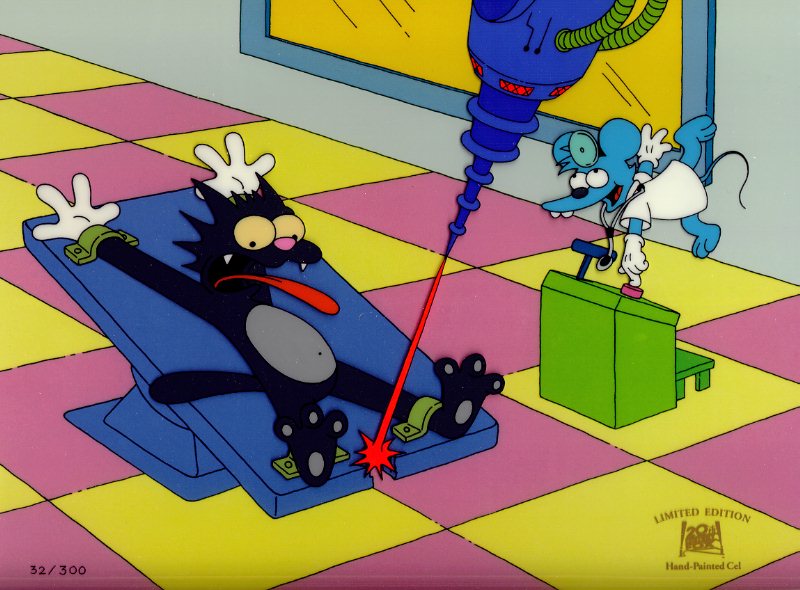
Itchy & Scratchy infringement
First Samba eats the cat, then Mickey eats Pixar...
Is this an indication that companies are getting so desperate that they are starting to copy the collected works of Itchy & Scratchy? -
Re:Not that sort of paper trail
The voter doesn't take the paper with him, as you say that would ruin the whole anonymous ballot thing.
There are crytographic methods that allow the voter to take with them a verifiable receit that can be validated by (and only by) someone with the proper key.
-
Widened horizons
Be all mystical if it makes you feel better. There is no reason the brain needs to be as complex as you make out but even if it is that makes it no less a computer. A very powerful computer in many regards but still a computer. The human brain is probably the most complex machine we've yet discovered and no doubt it'll be quite a while until we've figured it all out (willingness of test subjects to have their brains experimented on being as limited as it is) but there is no evidence that there is anything as complex or mystical going on as you seem to want to believe.
I think it's pretty mystical that I'm sitting here reading your post
Even smart people are sometimes religious. All of us have our little quirks and failures.
Funny that you see it as something negative. I see it as broadening perspectives and having more dimensions to the mind. You don't even have to become religious, just not dismiss what you have not investigated..
If it makes you feel better to believe the world has things about it that are so mystical that we cannot solve their mysteries then go right ahead. For me, religious though I am not, I am much more amazed by the power of our Creator for having created something where everything runs in an orderly fashion and can be explained and manipulated if you are smart enough and work hard enough. No the Universe isn't as simple as clockwork but it is just as orderly. We may never have enough time and mental capacity to unravel all the secrets but that doesn't mean the secrets could not be unraveled.
To stick with fixed ideas how things operate, slows down our progress in many areas. To mistake the map for the world is just silly.
A computer is any machine that calculates. The brain is a machine that calculates. Therefore by definition a brain is a computer. You can replicate that behavior in part in today's computers and maybe all in the computers of the future. You don't even have to duplicate the exact functionality - you just need to create functionality on the level that does what you need. As I pointed out emotions are not hard to replicate and can be done in a fairly low powered computer. Every living thing with any brain at all has some form of emotions so there is no reason a computerized pet can't.
Emulation is not the real thing though. Simple minds might be fooled, for a short period.
From http://vadim.www.media.mit.edu/MAS862/Project.html :
The total information processing activity of the brain is hard to estimate because the current knowledge in this area is fragmentary. However, it is possible to get a general picture of the electronic pulse exchange activity within a couple of orders of magnitude. The activity of the brain is equivalent to that of 1000 kHz processor with 40 Gbits of states. The corresponding processing power (channel capacity) is C=4*10^13 bit/s.
Good luck with that!
The brain, like the world is utterly amazing to me. -
The mystical remains mysterious
So because we don't have a full understanding about a subject there must be some mystical reason to explain it?
If something explains it, it is no longer mystical is it.
It seems the more science uncovers, the more mystical the universe gets and harder to uncover "the rest of it". That there might not be an end to the complexity of the universe, and its secrets. Then what?
From everything we understand about science (and admittedly there is a great deal that we still don't) the human mind is just a chemical process. A rather advanced and complicated one compared to other ones that we have encountered but simply that.
There is a difference between observation and the potential reality. We observe chemical reactions in the brain, and these seems to be connected with sight, thoughts, inner pictures, feelings and emotions to some crude degree.
However, to draw the conclusion that that is all these are, chemical reactions, is a logical fallacy. Just because A is observed in B, does not mean B is nothing but A.
It is a wishful short-circuit, without any conclusive evidence. To stick to that hypothesis is not being open minded, but cutting off potential explanations and models of our minds.
The total information processing activity of the brain is hard to estimate because the current knowledge in this area is fragmentary. However, it is possible to get a general picture of the electronic pulse exchange activity within a couple of orders of magnitude. The activity of the brain is equivalent to that of 1000 kHz processor with 40 Gbits of states. The corresponding processing power (channel capacity) is C=4*10^13 bit/s. (Source: http://vadim.www.media.mit.edu/MAS862/Project.html , just a quick Googled link since I've pondered this before..)
The brain is amazing isn't it?
It seems to me that most of us are to arrogant or scared to admit that we simply don't have all the answers.
That's what I'm saying, except for the arrogant-thing.
It ticks my buttons that everybody on here seems to "know" how the mind works. I really hope none of those saying that are really scientists, because it doesn't sound like it. It's cool to have faith in science, but to jump to conclusions this early in the game is not wise. If you think you know, never studying other material than those you believe in, then you lose out of potential findings.
Science is not reiteration of facts or observations.
Science is investigating and researching, questioning everything we know. Those I see doing that, I will applaud no matter what their preliminary conclusions are. -
dissapearing stories
i was just reading a story about a paint brush/scanner program http://helix.media.mit.edu/public/iobrush/iobrush
_ mpeg_medium.mpg , hit refresh and now is gonne ??? -
Re:Software Patents Aren't BadSoftware patents are not an inherently bad idea...
Please stop talking out of your ass. Plenty of information, research, and even mathematical models are available that explain why software patents are an inherently bad idea. If you can't be bothered to do your research, then you should at least have the good sense to keep your mouth shut so you don't drown out those who have.
-
Re:Could be great for textbooks
$300-$400 is a lot of money. I hope a company would make the $100 laptop (http://laptop.media.mit.edu/ a reality. Not only does the device allow you to read electronic books, you can also use it for taking down notes. There are several million students around the world. If they could do what Apple did to the iPod, provide an online service this time for electronic books now that would be something. Hey, Steve Jobs maybe you're up to the challenge!
-
Yes, they are.
A patent is a monopoly not on an implementation, but an idea. It is tantamount to thought ownership, which as close as we get to thought control. Currently it lasts about 20 years, and there is no compulsory licensing, so if the patent holder doesn't want you to use it, you're just out of luck. It doesn't matter if you independently discovered the same idea.
As far as your assertion about "closed source" patents, to the contrary, many well-defined algorithms are patented; but that is claiming ownership over chunks of the world of mathematics. Business idea software patents, which are basically "do X, but ON the Intarnets!" are likewise easy to grasp but also a bad idea.
The point of a patent originally was to promote the progress of science and useful arts; in every case, software patents work in the opposite manner. The landscape is so littered with patents that should never have been granted that the main use for patents is for big companies to cross-license them and keep guys in a garage out of the market. You see, even if a lone inventor invents something useful, actually making a working program will infringe numerous OTHER patents in the course of authoring software to implement the new one. You go to IBM with your one measly patent, and they'll fire back with 100.
Therefore, patents are kind of like nuclear proliferation; every large company has enough to wipe out all the others, so they cross-license as mutual self-defense. The new problem is with IP holding companies: these companies MAKE nothing useful, so they don't fear the patents of others; they exist only to shake down companies that DO make things. In the case of RIM, maker of Blackberries, an IP holding company is trying to 1) sue them for hundreds of millions; 2) grant exclusive use of "their" patent to a new-kid-on-the-block competitor, who wouldn't be able to compete at all except that RIM will go out of business as RIM will not be ALLOWED by said IP co. to make anything covered by the patent at all. Remember, no compulsory licensing.
For software in particular, http://lpf.ai.mit.edu/Patents/against-software-pat ents.html is 15 years old but sums up the situation.
As for the EU, patents have been consistently shot down in numerous skirmishes in the past couple of years. I don't believe for a moment that the other side is willing for ANY kind of "compromise". They will keep pushing and pushing, despite it being obvious that the people do not want software patents, because lobbyists are tossing lots of money at the rule-makers.
Software patents will spell the death knell for European tech companies. Why? Because U.S. companies have 20+ years of experience with them to the EU's zero. If software patents are allowed, U.S. companies will beat EU companies to the punch, and will own the EU from top to bottom. Even if they add a caveat that only EU-based companies can file for them, U.S. corps will set up shell companies to do so -- they have a lot of experience with this thanks to all the practice with offshoring for taxes. -
Re:if Sony follow their usual practice
Does it have one of these screens? Last I read it had a more conventional LCD.
I must be hallucinating. But it's far from conventional. Here's what the website says:
with a dual-mode display--both a full-color, transmissive DVD mode, and a second display option that is black and white reflective and sunlight-readable at 3X the resolution
snipThe first-generation machine will have a novel, dual-mode display that represents improvements to the LCD displays commonly found in inexpensive DVD players. These displays can be used in high-resolution black and white in bright sunlight--all at a cost of approximately $35.
Still sounds pretty cutting edge. And $35? Surely there are other applications for this amazing, cheap technology. Of course none exist yet, maybe therein lies the rub.Sorry if I've drifted off topic
-
You're misrepresenting the Knox caseYou are misrepresenting the case. If you are really interested in the details, you can read more about it yourself. I'll post a relevant portion of the case, which is an advertisement (placed by the defendant) for the videos on question:
"Sassy Sylphs" will blow your mind so completely you'll be begging for mercy.
Just look at what we have in this incredible tape: about 14 girls between the ages of 11 and 17 showing so much panty and ass you'll get dizzy. There are panties showing under shorts and under dresses and skirts; there are boobs galore and T-back (thong) bathing suits on girls as young as 15 that are so revealing it's almost like seeing them naked (some say even better).
I think that speaks for itself. Child pornography laws are not just about exposed skin; they're around to prevent the exploitation of children in which Knox was very obviously (and self-admittedly) involved. -
Re:not only that
That statement is made without knowledge of the case. This site has a good copy of the case details. The man knowingly purchased videos from a catalogue marketing to pedophiles.
These were not home movies. These videos were of minors doing provocative things, and being directed to do so. Sounds like a porn movie, no? -
Re:How to recognize a backhoe
Well yes, that is obviously a fine example of a European Yellow of the Jacob's Backhoe variety. However, academic experts in backhoe taxonomy prefer not to argue about which is the true backhoe-loader line. (They prefer to bicker about backhoe classification by the placement of the hoe on the back vs the backwards hoeing motion used. e.g. Should this be included as a member of the backhoes?)
-
I don't think you get it.Me:Not accepting SMTP requests from desktops is just another workaround to M$'s really shitty security that won't work.
You:Then why would any well-run Unix shop also use mailhub? Why do Unix MSPs implement that functionality? Why does every well-known figure in Unix mail recommend using that functionality for this purpose?
There's nothing wrong with a mailhub, as long as it works with published standards. What's happening in the big dumb company world is that admins are closing port 25 on their mail servers and eliminating SMTP in favor of some kind of M$ Exchange mess. As the administrator here told me, "I'll look into opening that port (he did not know which one) for SMTP on the Exchange server, but I'll have to find out it that poses any security risk." This replaces well known sturdy software with the worst of class, Exchange on the server and Outlook or IE on the desktop.
This is just another anti-competitive thing M$ has come up with for it's partners. Why anyone would listen to them and get themselves that much more locked in after their repeated failures is beyond me.
-
Re:Why bother?
It sounds like you probably wont have a problem, it is pretty fun actually and applicable to computer programing. There is always MIT video lectures if you lost track of something during class.
MIT OpenCourseWare Video Leactures -
Chicken Little, Yasuo Hamanaka, is that you?
For people who don't know, Yasuo Hamanaka attempted to corner the copper market for Sumitomo in the mid 1990's; there was a "shortage" then, too, which was used to manipulate the market price. Also involved were Merrill Lynch, Global Minerals and Metals Corporation, David Campbell, and Carl Alm.
It's actually an interesting story - more interesting than this "Chicken Little" piece:
http://web.mit.edu/krugman/www/copper.html
And the 1999 FTC docket for the case:
http://www.cftc.gov/enf/99orders/enfglobalmm.htm
Hmmm... I guess that begs the question that, if the sky actually was falling, it'd solve our "copper problem" in short order; as it is, we'll probably have to send ships to the copper, instead of the copper coming to us... 8-).
-- Terry -
Re:Keep it clean will yahttp://froogle.google.com/froogle?q=dvorak+keyboa
r dand to make it work:
http://web.mit.edu/jcb/www/Dvorak/
Remapping instructions part way down page.
now, does anyone know how to make the ALT-SHIFT/CTRL-SHIFT toggles behave in Win2K?
-
Idiots guide to Computers...
All you need to do is refer your mother/grandma/pa to
http://portal.acm.org/ft_gateway.cfm?id=363143&typ e=pdf&coll=GUIDE&dl=GUIDE&CFID=62709421&CFTOKEN=30 573549
and http://web.mit.edu/Saltzer/www/publications/endtoe nd/endtoend.txt
That would be a nice "oversimplified" start! -
the U.S. software patent mess
do you actually have a single concrete example of why software patents are sooooooooo bad
That's a really tough question. Picking a single example is not easy since there are so many good ones. Maybe you can help. Start with the LPF's examples to get you the "best of" through 2002. Then read up on the whole Blackberry/email mess. After that maybe we'll have to roll dice or something to pick a single one. -
Stallman explains the danger of software patents
You can find many answers here: http://lpf.ai.mit.edu/Patents/patents.html
The text of some of the talks is online in the links.
If you wish to watch a video of the talk he gave in Calgary 2005 May 18 then you can find it here: http://www.gnu.org/philosophy/audio/audio.html#CCA LG (its one of the TOP speeches! The TOP of the TOP in fact. hint - look at the top.)
The complete list if talks is found here: http://www.gnu.org/philosophy/audio/audio.html
I would post an answer to the question but to be thorough would require a couple hours and I think Stallman has said it better than I can - so watch the video.
-----------------
In answer to the quesiton of why software patents are more serious than hardware patents - a very simple explanation is that software products incorporate many more ideas than are incorporated in a hardware product. Typically very large companies are behind the manufacturing of hardware and they often can afford the protracted litigation process whereas software companies are small and often undercapitalized.
However the hardware issues also exist and an example of this is the latest patent attack on Toyota on the variable speed transmission used in the Prius. First patents on this idea were issues in 1916 or 1918. Yet a superficial analysis suggests that using two electric motors to drive the planetary gears is considered innovative enough to warrent a patent in the 1980's. Toyota may get around this because they used a gas motor and an electric motor in the Prius.
But this illustrates how silly the patent system has become.
Its not about what is necessarily provable in court - in many respects it is about how much of a financial burden can be imposed through the threat of litigation and for how much the victim can be milked.
A cynic would observe the business of law is conflict and litigation and creating an environment which encourages litigation is good for [the legal] business. Whether this benefits society is not taken into consideration any more than any parasite questions whether its activities are a benefit to its prey. A related example of this phenominon is that non-payment of invoices for goods delivered is considered criminal fraud in Europe whereas in North America it is considered civil and matters that could and should be handled by police in a 1/2 hour end up dragged through the courts for close to a decade at a cost of 10's of 1000's of bux.
Part of this is the legal community serving its own self interest of course. But there are other factions who benefit by supporting a broken patent system and among these we have those who are looking for ways to prevent fair competition as well as those who are just looking for victims to shake down. -
Re:Anyone out there read The World is Flat?
There is a video available of a talk he gave at MIT, might be interesting for people who haven't read the book.
-
Re:It's not built yetBeen there, done that (or at least some MIT students have). Except they put the LCD above the urinal, and sensors inside of it.
-
Re:It's not built yet
Been done, more or less: You're In Control
-
Exokernel Guys
The technical guys in the company are from MIT's exokernel project.
They worked on delivering high throughput for video with their superior OS technology. It interoperated with Windows, allowing them to make money.
This project looks surprisingly un-technical and uncomplicated in comparison, given how competent and accomplished they are.
Here's an exokernel link:
http://pdos.csail.mit.edu/exo.html -
Re:More to follow
I miss Claris/AppleWorks.
The main complaint I have about the Office suite is that it's too feature-ful. And unintuitive. Too helpful, in an annoying way, and the actual help files are more confusing than helpful. Claris' word processor was relatively simple, so you could get on with writing your document and not spend %20 of your time fighting it's auto-formatting and trying to find things in the menus.
I think modularity would improve the whole office suite paradigm:
Start with a basic word processing application, then for more complex or specialized word processing, include modules that can be turned on and off. You do medical writing, you add the medical writing module and it gives you... I dunno, a latin spellcheck? Same thing for law, finance, scholarship etc. In fact, make the whole suite modular, and sell the modules separately.
I would like to have a great word processor, but I don't necessarily need a presentation application. Or you may need a spreadsheet that's really capable, but can get by with a simple word processing application like Textedit or Wordpad. Extrapolate this with all of the Office parts, database, e-mail client, calendaring, etc.
Office gets pirated so much because it's so damned expensive that the average home user can't afford it. If you have a small business, sure, you can write it off, but who needs to spend almost $500 to write letters?
I know there are a plethora of solutions out there of various levels of quality and compatibility, but the real life truth is: Microsoft Office is the standard for business documents and business collaboration. Even where I work in academia, your colleagues expect you to send your documents in Word, or Excel, or Powerpoint formats.
I also know that MS has done some of this with their "Standard" & "Professional" packages, but it still misses the point.
But that's the main problem with the whole Microsoft product line. They want to do everything up front. Ship a system with all the bells and whistles turned on. Look where it got them in the security sphere. -
Re:Creepy
Actually, according to a few MIT students, the foil hat crowd may be the ones most easily controlled by the gov't.
See: http://people.csail.mit.edu/rahimi/helmet/ -
Straw Man and Software Freedom.His bad history is just a straw man. He's derived it from the intentional confusion created by the Wintel press and others. Shame on him for wasting time perpetuating it instead of making his point.
As for his point, I did not see too much that's original or any pieces of concrete advice. The Open Source movement has never pushed the four software freedoms over "practical" matters and has always had a fuzzy philosophy based on economics above all else. Other than slapping around a strawman and GNU, I'm not sure what his point was. Mostly he thinks everyone should think like him and pretends that it's true. He does not have any positive advice like, "do this and things will be better for you." The author mostly belittles people with ideological motivation without understanding that motivation or it's importance for his own well being. He summarized in his four key points, here:
Paraphrase: The internet is expanding and that will push Open Source which is just another tool without inherent morals.
The view that there is a core group of altruistic companies and true believers driving open source forward is simply false. The view that open source participants are idealistic Davids fighting against software Goliaths is also false. In fact, surveys of open source participants tend to bear this out.
Surveys don't bear this out. The average free software project is created by someone who just wants things to work and has no interest in monetary returns. Other surveys also bear out the importance of freedom for those who are using free software. The free software community has grown much larger in recent years and it still contains many people who are ideologically motivated. If he thinks their work is unimportant, I'd like to see him do without GNU's GCC, and other tools.
If he thinks that the movement will continue to grow without freedom, he's very wrong. The DMCA, software patents and other issues have a real ability to stop both free and open software dead. A very easy test of this is to look at licenses that are open but not free. An extreme example, and the limit of amoral "open software", is Microsoft's initiatives. This is really just an extension of the cross licensing cesspool which was created when a bunch of greed heads tried to scoop up the whole world of computing back in the 80's. Other less than free licenses form a spectrum that attracts more or less participation. Without software freedom, open source would quickly fall on it's face because no one wants to particpate in things that are owned and controlled by others.
The internet will continue to be pushed and expanded by government and major publishers with more or less freedom for it's end users. Free software will continue regardless.
If he thinks he can ignore the good advice the FSF offers, he's dead wrong about that too. I don't think they ever claimed to be the one and only driving force of free software. They understand that it's users writing software that gets the work done and that they can only do that if given the freedom they need. They are a loud and sensible voice for that freedom, and have created a very popular model, the GPL. Freedom is very important to a larger piece of the Open Source community than the author would like to realize.
-
A link to his....site containing his evidenence/proof that this vulnerabilty is there on purpose.
-
Re:Hell Yeah!
Slashdot: nearly a million monkeys, but still no Hamlet.
yeah, that's because it's over the posting limit (i know because i just tried to paste it in) -
To the naysayers... it's inevitable
So Google's big project is scanning every single book and indexing them online. It's a great idea. Why just search the internet when you can also be searching every work of literature? It's an obvious advance for Google, improving the search engine in a small but obvious way that makes a big difference as far as real usability.
Here's the thing: indexing books online is an incidental benefit. Google's real goal is to create a working, statistical AI. They've been hiring top-of-their-field AI researchers for a while. Last summer, Google won a competition for machine translation. They translated from Arabic to English and vice-versa better than all of their competitors. They did this using a statistical approach -- just feed the computer thousands and thousands of already translated documents, and eventually the machine can start making inferences based on probability. Given enough data, it works.
The same idea can be applied in the generic case. Wouldn't being able to ask an AI any question and receive a correct answer revolutionize society? And, the sum total of world literature is probably enough data to do so. They could call it AskG. He would know everything. And, the way they could roll it out, is by launching, and simultaneously updating wikipedia. It's well known that Wikipedia is riddled with small errors. Hell, the other day I inserted a gibberish statistic in an article about a city, and it's still there. Imagine if Google AI launches, and then announces that it has fixed Wikipedia. If Google AI made 50,000 edits it would overwhelm Wikipedia's normal editors, but whichever edits were checked by humans would certainly be confirmed as correct.
And, a new age of humanity would be ushered in. It would we a new Library of Alexandria. We would end the Age of Information and enter the Age of Knowledge. The singularity has already begun, but no one has realized it -- the singularity began the day Google went live.
Would AskG immediately fix quantum theory? Given all the data about science published by researchers, could G form new conclusions that humanity's best and brightest haven't? Could G solve the logistical challenge of solving world poverty?
There'd be one question left unanswered, of course, the classic "Can entropy be reversed?." What would be really scary would be if G had an immediate answer.
See the best sci-fi short story ever written, Asimov's The Last Question, or a simple find and replace hack of that story, The Last Query.
-
Re:FM10 eh?
Film takes quite a lot of volume compared to the biggest memory sticks/mini drives of various type - and that ratio will go continue tilting in favor of digital as time goes on. I don't see any real savings over digital when you go on a trip and have to take a crapload of pictures.
As for batteries - perhaps some heavy duty all-terrain cameras can have a hand-crank instead or in addition to batteries - like some flashlights these days or the $100 notebook:
http://laptop.media.mit.edu/ -
Re:most helpful book
you still need some kind of language to describe your algorithms . natural language is often a bit too ambiguous.
scheme is nice like the famous free mit video lectures http://swiss.csail.mit.edu/classes/6.001/abelson-s ussman-lectures/
i learned with pascal -
Affective Computing
This is not exactly new, but interesting. Affective Computing has been around for quite some time:
http://affect.media.mit.edu/ -
Re:Come back
Not that I am a big fan of windows being a Linux user since 92... but... sure you have gentoo+asterisk on that machine. Is it running X-window? Or just a console? Gotta compare apple to apple.
Please read the article. Even the Microsoft researcher who did the study agrees that Linux can outperform Windows on older hardware. His only point is that it does not do so unless customized:Asked why he believed there was such a pervasive belief that Linux could run on older hardware, Hilf said the technical capability to modify Linux, to strip it down to run with a minimal set of services and software so that it could run on all sorts of hardware devices, had generated that larger assumption that any type of Linux distribution could run on all sorts of hardware devices.
So how significant is his point that not all Linux apps run well on old hardware? Well it depends. I guess there are some newbies who think they'll be running OpenOffice and Gnome on a P100, who need to know this. On the other hand, Linux adopters such as One Laptop Per Child initiative are fully aware that RedHat's default install is not what they want. To them, the ability to selectively install the software that meets their hardware limitations is a boon. -
Re:"Quiet"?From reading the article, I gather "quiet" is being used here as a technical term which is roughly synonymous with laminar, or lack of turbulence (rather than "gee I wish my vacuum cleaner were quiet").
As slashdotnickname said, that is at least part of it. But another part of it may mean (I fully admit I haven't RTFA, I just skimmed it), quiet may also mean that steps were taken to isolate the test chember from external noise sources (tunnel motor, lab equipment, students, etc) so that experimenters can be sure that the only noise is from the air flow, and not from something else.
As far as my background, I haven't stayed at a Holiday Inn for a while, but I did spend a year and a half working with MIT's subsonic anechoic wind tunnel before it was crated off to Wilmington to make room for the Pappalardo Labs.
-
Re:Holography museum
Similar recommendation: if you find yourself in Boston, the MIT Museum has the world's largest collection of holography.
-
Re:Self serve advertising
http://web.mit.edu/newsoffice/1998/soapshopping.h
t ml
MIT Media Lab's HyperSoap uses hyperlinks to mix shopping, entertainment
November 9, 1998
CAMBRIDGE, Mass. -- The TV soap opera you watch may soon be a home shopping program, thanks to researchers at the MIT Media Laboratory. The Lab recently produced a soap opera which lets viewers select clothing and furnishings with a special remote control, and see an item's price and purchase information on a pop-up screen display. The program, called HyperSoap, offers an engaging and entertaining form of interactive shopping, and an alternative to the printed product catalogs that stores and manufacturers mail and distribute to customers.