Slashdot Mirror
Domain: nap.edu
Stories and comments across the archive that link to nap.edu.
Comments · 345
-
Re:Growing list
I read "Strange Matters: Undiscovered Ideas at the Frontiers of Space and Time" recently. Great read, almost too technical for this layman. I find it amazing that the long-scrutinized theories in the book are being proven(disproved) right now as I type. Amazing times we live in.
-
US Army Patent 5,242,820?
Seems there are other possibly related forms of this beast: http://www.nap.edu/openbook.php?record_id=11765&page=181
-
Re:Do they have the truth about electricity?
Oddly enough combining Christianity with science resulted in the history of Western Civilization.
There, FTFY.
Just because a lot of current Christians (e.g., the Fundamentalists) have some weird and fairly novel ideas that Christianity and science are at odds with each other doesn't mean its true. That isn't to say there haven't been issues along the way (like Galileo) but the reason Western Civilization totally took off, while many other societies stagnated or declined is precisely because Christianity, specifically Catholicism, is compatible with science and reason in ways that many other religions fail. For a much better summary of the idea, see Pope Benedict's Regensburg speech from a few years ago.
Meanwhile, I downloaded several books last night and found a couple I would like to buy. John Derbyshire has written two really excellent books about math that I have read and learned a lot from. They are both definitely worth reading again: Unknown Quantity and Prime Obsession.
-
Re:Do they have the truth about electricity?
Oddly enough combining Christianity with science resulted in the history of Western Civilization.
There, FTFY.
Just because a lot of current Christians (e.g., the Fundamentalists) have some weird and fairly novel ideas that Christianity and science are at odds with each other doesn't mean its true. That isn't to say there haven't been issues along the way (like Galileo) but the reason Western Civilization totally took off, while many other societies stagnated or declined is precisely because Christianity, specifically Catholicism, is compatible with science and reason in ways that many other religions fail. For a much better summary of the idea, see Pope Benedict's Regensburg speech from a few years ago.
Meanwhile, I downloaded several books last night and found a couple I would like to buy. John Derbyshire has written two really excellent books about math that I have read and learned a lot from. They are both definitely worth reading again: Unknown Quantity and Prime Obsession.
-
Not exactly "free".
This isn't "Free as in Freedom" it's "Free as in Promotional".
FTFA:
Printed books will continue to be available for purchase through the NAP website and traditional channels. The free PDFs are available exclusively from the NAP’s website, http://www.nap.edu/, and remain subject to copyright laws. PDF versions exist for the vast majority of NAP books. Exceptions include some books that were published before the advent of PDFs; books from the Joseph Henry Press imprint; and in cases where contractually prohibited, such as reference books in the Nutrient Requirements of Domestic Animals series.
So, you can download them to your computer, but you can't (legally) make a copy for your friend... This isn't the free as in "land of the free" that I grew up learning about... seems like a trap to me. "How did you know that without ever buying our book or downloading our PDF? You must be a sea faring rapist and murderous theif!"
Let me know when it's released under a CC license, then I'll think about downloading it.
-
Re:Smallpox Genome is Public, Its a Permanent Thre
Since the smallpox genome was decoded and published in 2006, it is impossible to rid the world of the threat of smallpox.
The Vaccinia virus used in smallpox vaccinations is 95% similar to
smallpox (see http://www.nap.edu/html/variola_virus/ch1.html). This
means that the base difference is 10,000 bases. This is only modestly
more than the 7500 bases assembled to synthetically recreate polio, which was also accomplished in 2006. You can order custom gene sequences of 1000 base pairs today at a cost of $1.30 per base pair.A gene assembly lab, a sample of Vaccinia and a hundred thousand dollars can recreate smallpox today.
There is no other option but continue smallpox research for defensive purposes.
Modded to "+5 Terrifiying"
-
Smallpox Genome is Public, Its a Permanent Threat
Since the smallpox genome was decoded and published in 2006, it is impossible to rid the world of the threat of smallpox.
The Vaccinia virus used in smallpox vaccinations is 95% similar to smallpox (see http://www.nap.edu/html/variola_virus/ch1.html). This means that the base difference is 10,000 bases. This is only modestly more than the 7500 bases assembled to synthetically recreate polio, which was also accomplished in 2006. You can order custom gene sequences of 1000 base pairs today at a cost of $1.30 per base pair.
A gene assembly lab, a sample of Vaccinia and a hundred thousand dollars can recreate smallpox today.
There is no other option but continue smallpox research for defensive purposes.
-
Of course it's us
People pave paradise, cut down native ecosystems and replace with farming and livestock, carve wilderness regions into isolated populations with roads and development, introduce alien species, and it's "settled facts" (according to the latest report from the National Academies of science and engineering) have caused the recent observed global warming. What the fuck else do you think is causing species to go extinct at a rate that strongly suggests we're living at the brink of the sixth great extinction event?
-
Re:Non-story, clueless writer
There is also this one: "Severe Space Weather Events--Understanding Societal and Economic Impacts: A Workshop Report" ( http://www.nap.edu/openbook.php?record_id=12507&page=1 ).
I did not read this one, but a summary that I apparently cannot find again.
Anyway, I doubt that adequate precautions will be installed, since IMHO these would require an essentially distributed model.
CC. -
Re:I see the Al Gore haters are out.Be nice if you knew anything about what you're talking about.
(1) Mann and Wegman have nothing do to with anything in the article, or, for that matter future predictions of Global Warming.
(2) The Wegman Report was commissioned by Joe Barton and Ed Whitfield., from the Energy and Commerce Committee of the House of Representatives, not the Senate.
(3) Neither Barton (who recently gained further notoriety by apologizing to the CEO of BP), nor Whitfield were the chairman of the relevant committee at the time. The Republican chairman of the committee and the rest of the Republican and Democratic members commissioned a real report from the National Academy of Sciences. That report was by a team of real researchers, chosen by the normal, careful practices of the National Academy of Sciences. It was then sent out for a formal peer review. It found that while the statistical methods used by Mann et al had a minor problem, correcting the problem made no substantial difference. Moreover, Mann's results had been validated by being repeated by several different researchers that found the same results, using completely different proxies for past temperatures and mathematical analyses.
http://www.nap.edu/openbook.php?isbn=0309102251
(4) In contrast, Wegman was chosen by Barton, whose opinions on climate change were already well known at the time, and Wegman was given material by Barton's staff to include in his report. He has said in interviews that he was under pressure to complete the report faster than he wanted.
http://www.usatoday.com/weather/climate/globalwarming/2010-11-22-plagiarism_N.htm
(5) Wegman's report was *not* peer reviewed. Wegman claims to have sent it to 6 people to look at, but of course even if this is true, they were chosen by *him*, not by any normal process of peer review.
(6) Wegman's report is now known to have been plagiarized and Wegman is now under formal investigation for it by George Mason University.
http://www.usatoday.com/weather/climate/globalwarming/2010-11-21-climate-report-questioned_N.htm
(7) Wegman has refused to release supporting code or data for his report. Prof. David Ritson of Stanford University made such a request in 2006, shortly after the Wegman report was released. Wegman's report called for disclosure of supporting materials and openness generally, but he has himself refused to comply, citing the technicality that his report was not federally funded.
http://deepclimate.org/2010/10/24/david-ritson-speaks-out/
The Wegman report is a piece of crap and it's pretty amusing that people who want to deny the reality of Global Warming keep citing it.
-
Re:Oh wow.
I have. Others cannot, could not, would not, have not. See peer reviewed references at http://www.nap.edu/openbook.php?record_id=10261&page=115. Google it for more.
-
Re:Oh wow.
Not a 'bluenose'. See http://www.nap.edu/openbook.php?record_id=10261&page=143 and read a little.
Yes, I get it. You want to censor content because some parents are not doing their job. You want to restrict just this little bit of freedom, not all the rest of the freedoms. We can trust you, right?
And yes, they are bluenoses.
-
Re:Oh wow.
Not a 'bluenose'. See http://www.nap.edu/openbook.php?record_id=10261&page=143 and read a little.
-
Re:Oh wow.
Go here to start: http://www.nap.edu/openbook.php?record_id=10261&page=143 so you'll understand that I'm not handwaving.
-
Re:Don't get into the science pool if you can't fl
Really, we both know what the word "theory" means...
Apparently not.
Regarding the 75 years, people have lost their minds in the past few decades.
I think it's far more likely that you have some sort of rosy-colored hindsight for the "good old days," which never really existed. It's not just this context, it's not likely to be true for any field. Music and movies are a great example -- the reason so many old movies we have are "classics" is no one wants to keep them around otherwise, unless they're so spectacularly bad that they're worth preserving for that reason alone (Plan 9 From Outer Space).
I don't think you'd be able to come up with a genuinely great thinker of any time who would make the distinction that you're trying to,
I'm not sure why this is required. Do I need a "great thinker" to tell me that work has a different meaning in physics than it does elsewhere? Do I need a "great thinker" to tell me that the "color" of a quark has nothing to do with the colors we actually see in everyday life?
In fact, can you find one who explicitly supports either of those ideas?
Anyway, this definition of "theory" that you're using is a bad one,
How so?
doesn't have a basis in anything,
Found a basis in a few minutes of idle Googling. Here's another. Or, more seriously, how about this one?
Now, your turn. What's the basis for your assertion that "people have lost their minds in the past few decades"? And this definition of "scientific theory" isn't at all obscure, so where are the thousands of dissenting scientists?
is going to be needlessly confusing for people.
People are also easily confused by the definitions in physics of work, energy, and power. They're also easily confused by the term "Big Bang", suggesting that something exploded.
Of course, somehow most people manage to figure out what people are talking about when they say "Evolution" in the biological sense compared to "evolution" in other contexts -- for instance, talking about the "evolution" of a product line, where there's hardly been artificial selection, let alone natural selection.
Words can have different definitions in different contexts, and that's fine. In this case, the definition I've given for "theory" is a useful one.
-
Re:Budget or 'plan'?
None of those things is going to happen, and budgeting for them is a waste of money better spent on actual space science and astronomy, like the stuff outlined in the new AAS Decadal Survey Of Astronomy and Astrophysics: http://www.nap.edu/catalog.php?record_id=12951
-
Re:Gold in your pocket is safe.
Personally, I found this review article to be very informative.
From the article:
...despite a large body of research, the committee found no credible evidence that the passage of right-to-carry laws decreases or increases violent crime... Some studies find that right-to-carry laws reduce violent crime, others find that the effects are negligible, and still others find that such laws increase violent crime.
The real trouble with gun control as an issue, from a scientific perspective, is that it is impossible to study it with a classic double-blind study. I'm sure that we'll see an explosion of posts here with a lot of anecdotal evidence that shows the issue one way or another, but in the end, I don't think that we will have a clear answer to that question.
-
Re:Great, instead of peak oil ...
"Most of that is used to blow up party balloons."
http://www.nap.edu/openbook.php?record_id=9860&page=27
party balloons could come under "pressurizing and purging" or "other" but the vast majority is used in cryogenics, welding or controlled atmospheres.
-
Re:"Undeniable"
Just in case anyone is interested, this is the graph you can be looking at. It's from the same data set, and though it begins in 1880, the spike does not occur until 1950.
You can also look at reconstructed data here that shows that the current temperature spike lies outside of the Medieval Warming period. Claims that the Northwest Passage was open at that time are unverified. There isn't any archaeological evidence for any European seafaring past certain points in modern Canada.
What about the spike from 1910 up until about 1940? It's just as steep as the one from 1960 onwards. Noone is denying warming, it's how strong the causal link with CO2 is that's being questioned and whether or not the warming will be an issue. As far as the Northwest Passage claims go, those are not evidence of anything either. Ice melt around the northern latitudes is more dependant on wind factors than actual temperature, since it's below freezing almost all year around (wind pushes the ice to lower latitudes where it can actually melt).
Your graph also shows about 0.8 degrees of warming from 1910 to present, hardly something to be so alarmed about. If that trend continues, we're looking at a total of 1.6 degrees by 2100. Hardly the kind of catastrophic values that everyone in the alarmist camp is peddling. As far as the proxy graph goes, I'd have to take a look at the actual methodology in the studies because I do not trust graphs like that. I am sure you are painfully aware of the hockey stick generator Mann built that generates hockey stick shapes even from random noise and then used that as evidence.
This simply means that any species that can't adapt may die out(if a change that small even necessitates adaptation), but they will be replaced by species that can live in that environment. Why this is considered to be catastrophic or even bad I do not understand.
Because our current way of life is very dependent on the current food chain, and some of us don't want to have a toxic lifeless soup for an ocean. Oysters in particular serve as filters, and are necessary to keep tidal creeks functioning. Corals are also a vital part of the shallow ocean ecosystem.
Here we go with alarmism again. Most of our food supply comes from farming and raising livestock, not from oysters. Are you suggesting that all fish will disappear within a hundred years? No? Your claim about oceans becoming toxic soup is funny as well, would you care to provide some form of evidence to support it? I'd also like some form of science to support that corals are being threatened by the current warming or ocean acidification or whatever it is you think they are being threatened by.
You're confusing CO2-induced warming and CO2-induced health effects in that argument.
I was pointing out that too much of anything is pollution.
And I was pointing out that CO2 will never reach levels that are anywhere near to actual pollution (which I define as emissions directly affecting human health, such as small particle emissions).
There's also a saying I heard somewhere: "Lack of food kills you in weeks, lack of water kills you in days, but lack of warmth can kill you in hours."
There's also a saying: this is the 21st Century, and very few people die of simple exposure. Humans that die in the winter are people whose immune systems fail to protect them from communicable diseases that are more prevalent when everyone's immune system is weakened. Any variation in weather will present the same seasonal death rate - that's why the curve is the same from Greece to Norway. So the equatorial states have little variation, but that's due to the lack of weather changes, not due to the h
-
Re:"Undeniable"
Just in case anyone is interested, this is the graph you can be looking at. It's from the same data set, and though it begins in 1880, the spike does not occur until 1950.
You can also look at reconstructed data here that shows that the current temperature spike lies outside of the Medieval Warming period. Claims that the Northwest Passage was open at that time are unverified. There isn't any archaeological evidence for any European seafaring past certain points in modern Canada.
This simply means that any species that can't adapt may die out(if a change that small even necessitates adaptation), but they will be replaced by species that can live in that environment. Why this is considered to be catastrophic or even bad I do not understand.
Because our current way of life is very dependent on the current food chain, and some of us don't want to have a toxic lifeless soup for an ocean. Oysters in particular serve as filters, and are necessary to keep tidal creeks functioning. Corals are also a vital part of the shallow ocean ecosystem.
You're confusing CO2-induced warming and CO2-induced health effects in that argument.
I was pointing out that too much of anything is pollution.
There's also a saying I heard somewhere: "Lack of food kills you in weeks, lack of water kills you in days, but lack of warmth can kill you in hours."
There's also a saying: this is the 21st Century, and very few people die of simple exposure. Humans that die in the winter are people whose immune systems fail to protect them from communicable diseases that are more prevalent when everyone's immune system is weakened. Any variation in weather will present the same seasonal death rate - that's why the curve is the same from Greece to Norway. So the equatorial states have little variation, but that's due to the lack of weather changes, not due to the heat.
There are no variations with water supply. If you don't have access to clean water and sanitation, you're going to be very sick, and probably dead.
Anyway, enough of reality. Go back to blogging against those evil scientists, whose plot to Destroy America will surely succeed if they aren't thwarted by your amazing intellect.
-
Re:Medical Radiation the New Demon
I don't know why you're taking medical advice from a physicist though.
Because I'm not arguing that children that live closer to power lines don't have higher likelyhoods of developing leukemia. I'm arguing that EMF is not the cause, and physicists are infinitely more qualified to speak on that matter.
As stated here, "there is no biological mechanism to explain the higher risk". Correlation does not imply causation, and in this case there is a very very notible absense of scientifically sound proposed mechanisms for causation.
If you want to play this just by references, then here you go. Courtesy of the paper I previously linked to you, I'd suggest actually reading it instead of dismissing it for being writting by a physicist (what could a physicist possibly know about EMF after all?). I think this trumps some article in Times..., have fun:
- Wertheimer N, Leeper E. Electrical wiring configurations and childhood cancer. American Journal of Epidemiology 109:273-284, 1979.
- Brodeur P. Currents of Death: Power Lines, Computer Terminals, and the Attempt to Cover Up the Threat to Your Health. New York: Simon and Schuster, 1989.
- Brodeur P. The Great Power Line Cover-Up: How the Utilities and Government Are Trying to Hide the Cancer Hazard Posed by Electromagnetic Fields. (Little-Brown, 1993, hardback). There is also a 1995 paperback edition.
- PBS Frontline. Currents of Fear. Program #1319, originally aired June 13, 1995.
- Davis JG and others. Health Effects of Low-Frequency Electric and Magnetic Fields. Oak Ridge Associated Universities, 1992.
- Park RL. Review panel exonerates low frequency electromagnetic fields. What's New, Nov. 20, 1992.
- American Physical Society, Executive Council Statement, April 23, 1995.
- National Research Council Committee on the Possible Effects of Electromagnetic Fields on Biologic Systems. Possible Health Effects of Exposure to Residential Electric and Magnetic Fields. Washington, DC: National Academy Press, 1997. [Press release] [Complete book]
- Linet MS and others. Residential exposure to magnetic fields and acute lymphoblastic leukemia in children. New England Journal of Medicine 337:1-7, 1997.
- Campion EW. Power lines, cancer, and fear. New England Journal of Medicine 337:44-46, 1997.
- Day N. Exposure to power-frequency magnetic fields and the risk of childhood cancer. Lancet 354:1925-1931, 1999.
- Adair RK. Constraints on biological effects of weak extremely-low-frequency electromagnetic fields. Physics Review A43:1039-1048, 1991.
- Savitz DA and others. Case-control study of childhood cancer and exposure to 60-Hz magnetic fields. American Journal of Epidemiology 128, 21-38, 1988.
- Gurney JG and others. Childhood cancer occurrence in relation to power line configurations: A study of potential selection bias in cas
-
Re:Polygraph
"Various techniques for detecting deception have been suggested or might be used as substitutes for or supplements to the polygraph... Some of the potential alternatives show promise, but none has yet been shown to outperform the polygraph." From the 2003 National Academy of Sciences report
Perhaps they are doing the best with what they have, to get the job done.
*I didnt read the report, just enough to back up my point -
Re:*yawn*
Alternately, you could look at where the money is getting spent in Constellation. Looking around, I see that ETDP funding was being cut in 2009 and operating well below desired funding levels. That indicates to me that it wasn't a serious part of the Constellation program. In comparison, Ares I development along with Orion (and other associated systems like a launch abort system) has apparently consumed somewhere around $10 billion dollars since 2005. For example, the Ares I-X test alone probably outspent ETDP spending in 2009 by more than 50% (400 million dollars supposedly for the test versus 250 million dollars for the ETDP program).
-
Re:magical negative feedback
Shouldn't distribution count as well as density?
Perhaps. But measurments will never be perfectly distributed, so insisting that the distribution is not good enough is empty handwaving--unless of course you can support it with a model that demonstrates that a more uniform distribution gives different conclusions.
And what about the model of just one temperature station -> that model is pretty simple, and based on that model you could judge that it is of sufficient density.
I see no value in such a contrafactual assumption. Perhaps if you have a mathematical model of climate for which you can show that only one station would be sufficient then that would be worthy of discussion.
That's simply not true. Although average volcanic activity is usually very low, catastrophic events that occur on the range of hundreds of thousands, if not millions of years, can certainly quantifiably influence atmospheric CO2.
If you want to argue that millions of years ago a volcano made a significant contribution to CO2 and climate, I'm willing to look at the evidence, but I don't see the relevance to our discussion of global warming in the modern era.
Riddle me this -> is it possible to find a trend where none exists? You seem to postulate that any set of measurements, if they are large enough, will be perfectly accurate and precise. You still haven't answered the resolution problem either.
You haven't provided any evidence of a "problem." You need to postulate some fairly contrived circumstance to generate an artifactual trend--as evidenced by the fact that you have not yet managed to come up with a scenario that would do it.
Read the article and the comments -> it's a thought experiment that reduces the theory of AGW down to its conceptual limits.
I've read the article. It is a toy model that omits so many of the factors that influence climate in the real world as to be of no relevance. Certainly a model that does not include CO2, much less its absorbance, emission, and solubility properties, cannot address the effect of CO2 on climate. And a static model obviously is not relevant to climate change.
Have you seen Mann's hockey stick?
Yes. I've also read the NRC peer-review report that concluded that Mann's conclusions are essentially correct.
Have you heard the IPCC fear-mongering about runaway warming and tipping points?
No, I haven't read anything of the sort in the IPCC report. Kindly quote the section of the IPCC report that predicts runaway warming as a consequence of anticipated levels of CO2.
You're still avoiding the issue with the ad hoc nature of your rationalizations, and fail to offer any opportunity for observations to possibly contradict your theory. If you see a historic record where CO2 is leading, you'll assert that it's due to some sort of "added" CO2.
You are the one who asserted, incorrectly, that the fact that CO2 lagged temperature change when there was no introduction of CO2 into the atmosphere, and led temperature increase when there was verified release of CO2 constituted a problem, apparently unaware that this behavior is not at hoc, but a necessary consequence of the well established physical chemistry of CO2. It is certainly possible to determine past CO2 levels, e.g. from ice core data, so a temperature rise due to increased solar activity that was not followed by a rise in CO2 would be a problem for the model. You have insisted that there are examples of massive releases of CO2 due to volcanoes. If you can find evidence of this, without a temperature increase following, then this would be a problem for the model.
-
Re:what are the chemical dispersants?
Surface chemistry is a little more complicated than anything you learn in high school.
Honestly, I don't think anyone really knows what happens to the oil that's dispersed - the stuff at the surface probably emulsifies or dissolves depending on the relative concentrations of surfactant, oil, and water, but what happens at 5000'? And this is crude oil we're talking about, not canola oil, there are components of various densities. Suffice to say, it's complicated.
-
Re:Paper and Environment
You are assuming most of the new paper made from virgin fiber remains intact. In fact, most of it will be disposed of: Either incinerated or stored in a landfill. Landfill storage turns out to be problematic: "Quantification of methane emissions from landfilled paper is still imprecise, but if it is included, at the least, the yield, measured in terms of CO2 equivalents, will be increased by a factor of 2.5 compared with the CO2 emitted during complete incineration." [Wood in Our Future: The Role of Life-Cycle Analysis: Proceedings of a Symposium (1997) ]
Either way, paper is a net contributor of greenhouse gasses. Also note the original reference I chose was from a "green" paper company. Estimates from environmental groups, such as the Environmental Defense Fund Paper Calculator, indicate far higher net CO2-equivalent impact - 5882 lb CO2 equivalent per ton of copy paper according to the EDF, a ton more than Verso's estimate. -
Radioactive isotope transmutation isn't "new".
We have known how to do it for several decades. Scientists at Los Alamos have an active program on using accelerators to transmute nuclear waste, e.g. http://www.lanl.gov/orgs/pa/science21/ATW.html and books have been published on the topic, e.g. http://www.nap.edu/catalog.php?record_id=4912
The problem is simply deciding to build the required facilities and incorporate the cost of making the radioactive material non-radioactive into the cost of producing electricity (which I suspect is the toughest hurdle).
It is also worth noting that if real molecular nanotechnology were available the "separation" part of the equation (producing a stream of pure radioactive isotope ions) would be much easier (and presumably cheaper). All concern regarding long term storage of radioactive isotopes is completely pointless since we will have the technology within this century to completely get rid of them.
-
Re:Popcorn and other practical applications
Oh yes it did. Your post-soviet propaganda post notwithstanding, the Soviet Union tried to saturate Star Wars by continuing to build ever more warheads, so a percentage getting through even a mostly effective Star Wars would still destroy the US. So the annihilation threat strategy was kept. But that did indeed push the basically unsustainable Soviet economy over the edge, which is why its most powerful people dismantled it, while there was still something to salvage.
That is what winning a war looks like. Even if you're Russian (which you are), and think winning a war can look only like establishing your government's laws and taxes over newly conquered territory, amidst piles of broken bodies and smashed cities, smoldering countryside.
The current US economic crisis doesn't at all indicate the US didn't win the Cold War. To the contrary, the US was and still is (despite the ongoing crash) able to borrow as much money as it wants, even when lenders don't want to lend. Because the US won the Cold War by creating that option, which the rest of the world was slaved to in order to be on the side that won, which it was.
The current US crash proves that Communist propaganda was right about capitalism. Just generations too late for it to be right about anything else. You should get over it if you want to be right about anything yourself. Rasputin's a good role model, but spend your extra long life freeing your mind, not wallowing in "decadent West" gibberish that just makes you look old.
-
Re:This is not science.
... they did discuss the MM papers
Of course, chapters 9 and 11 each mention McIntyre 3 times. Each time, their claim is briefly but not extensively discussed because their conclusions on page 117 include: "The instrumentally measured warming of about 0.6C during the 20th century is also reflected in borehole temperature measurements, the retreat of glaciers, and other observational evidence, and can be simulated with climate models."
As far as I can tell, the largest caveats to emerge from the NAS report are concerns about the uncertainty estimates (especially prior to 1600 CE) and this point on page 115: Even less confidence can be placed in the original conclusions by Mann et al. (1999) that "the 1990s are likely the warmest decade, and 1998 the warmest year, in at least a millennium" because the uncertainties inherent in temperature reconstructions for individual years and decades are larger than those for longer time periods, and because not all of the available proxies record temperature information on such short timescales.
Second, the two papers you mention (Rutherford 2005 and Wahl and Ammann 2007) are based on CRU data, the Rutherford paper even has Jones and Mann as coauthors.
My point is that those papers can't be affected by the claimed MM PCA "mistake" because they use different methodologies.
There was ample opportunity to cook (deliberately or via unintentional observer bias) the CRU estimates to restore the hockey stick by 2005.
I've already linked the results of independent temperature reconstructions. And last year I said: Each time series in the graph I previously linked is referenced in chapter 6 here. Turn to page 469 and examine Table 6.1 (later, if you get bored, consider checking out column 2 of page 466 which reviews the claims of MM03 and MM05.) Every time series is referenced well enough to be found on google scholar-- for example here's one of them. As you've seen from the graph, they all support the abrupt temperature increase in Mann's graph. (I freely admit that all these authors could be drooling morons, sheeple incapable of independent thought, or evil conspirators... any of these scenarios or a linear combination of them would completely discredit my position.)
Notice how all these reconstructions are consistent. Most interesting is PS2004, which reconstructs past temperatures using a borehole. By measuring the temperature of the ground at various depths, past temperatures can be reconstructed using heat conduction equations.
This isn't based on CRU data at all, yet is consistent with it. That's not too surprising, because there's no evidence that the CRU data has been "cooked" as you imply.
-
Re:This is not science.
It's still criticism (and he has been other than "probably false and/or misleading" at times in the past, remember the "hockey stick" complaint?).
The NAS report found no significant problems with Mann's 1998 reconstruction, and it's been confirmed repeatedly by independent teams.
-
Re:Blogs
Right, because nobody writes about stuff like that any more.
Hey man, just cause you're not reading them, doesn't mean they aren't being written. You also seem to think that writing is a zero-sum game: that the more is blogged, the less is published in a more permanent fashion. It just ain't so: today's blog is often just a more sharable and immediate addition to lab notes. The phrase is still "publish or perish", not "post or perish".
-
Re:Good Read.
Billions? Naw, if I remember correctly the US estimates were 120-150 million dead here and 110-130 million dead in the USSR.
http://en.wikipedia.org/wiki/Nuclear_warfare#Potential_consequences_of_a_regional_nuclear_war
"A study presented at the annual meeting of the American Geophysical Union in December 2006 asserted that even a small-scale, regional nuclear war could produce as many direct fatalities as all of World War I and disrupt the global climate for a decade or more. In a regional nuclear conflict scenario in which two opposing nations in the subtropics each used 50 Hiroshima-sized nuclear weapons (ca. 15 kiloton each) on major populated centers, the researchers estimated fatalities from 2.6 million to 16.7 million per country."
If there was an all out global nuclear war, coastal US, Rust Belt US, population centers of Europe would be gone. Middle Eastern capital cities, eastern China and South Asian capitals and population centers would be gone. So maybe a 700-850 million dead from the exchange, maybe another 500-1,000 dead over a year. But global nuclear wars won't happen, the US/Russia/France/UK/China don't have the deployed warheads anymore to do that.
Figure slightly higher ratios for western Europe, eastern China due to population density.
http://www.nap.edu/openbook.php?record_id=940&page=207
http://www.nap.edu/openbook.php?record_id=940&page=219Remember that a good chunk of warheads are aimed at the other side's missiles, airfields and C3 complexes, for Russian/PRC missiles coming our way, that means a good percentage of warheads are going for the Dakotas, Montana, Wyoming, Colorado and boomer ports like Seattle/Everett, Jacksonville/Kings Bay.
Takes 2-3 Russian warheads to account for a silo like the Minuteman III silos in North Dakota and Montana, so for the 450 missiles out there, 900-1250 Russian warheads are coming, thats a nice chunk of what they have to throw.
The Chinese and DPRK don't have enough warheads to destroy the US/Russian first and second strike capability, so in an exchange with them, they'd be aiming at cities in the US/Russia while the US/Russia would be looking to first strike missiles and C3 nodes.
-
Re:Good Read.
Billions? Naw, if I remember correctly the US estimates were 120-150 million dead here and 110-130 million dead in the USSR.
http://en.wikipedia.org/wiki/Nuclear_warfare#Potential_consequences_of_a_regional_nuclear_war
"A study presented at the annual meeting of the American Geophysical Union in December 2006 asserted that even a small-scale, regional nuclear war could produce as many direct fatalities as all of World War I and disrupt the global climate for a decade or more. In a regional nuclear conflict scenario in which two opposing nations in the subtropics each used 50 Hiroshima-sized nuclear weapons (ca. 15 kiloton each) on major populated centers, the researchers estimated fatalities from 2.6 million to 16.7 million per country."
If there was an all out global nuclear war, coastal US, Rust Belt US, population centers of Europe would be gone. Middle Eastern capital cities, eastern China and South Asian capitals and population centers would be gone. So maybe a 700-850 million dead from the exchange, maybe another 500-1,000 dead over a year. But global nuclear wars won't happen, the US/Russia/France/UK/China don't have the deployed warheads anymore to do that.
Figure slightly higher ratios for western Europe, eastern China due to population density.
http://www.nap.edu/openbook.php?record_id=940&page=207
http://www.nap.edu/openbook.php?record_id=940&page=219Remember that a good chunk of warheads are aimed at the other side's missiles, airfields and C3 complexes, for Russian/PRC missiles coming our way, that means a good percentage of warheads are going for the Dakotas, Montana, Wyoming, Colorado and boomer ports like Seattle/Everett, Jacksonville/Kings Bay.
Takes 2-3 Russian warheads to account for a silo like the Minuteman III silos in North Dakota and Montana, so for the 450 missiles out there, 900-1250 Russian warheads are coming, thats a nice chunk of what they have to throw.
The Chinese and DPRK don't have enough warheads to destroy the US/Russian first and second strike capability, so in an exchange with them, they'd be aiming at cities in the US/Russia while the US/Russia would be looking to first strike missiles and C3 nodes.
-
Re:These "scientists" weren't
Uhh, please check your facts. There are several proxy records available, such as stalactites, bore holes, ice cores and lake sediments. Tree rings are just one part of paleoclimate observational data. Global temperature records are available from 1850 onwards (from 1880 if you only include NOAA and GISS).
Between 1850 and 1960, all proxy reconstructions fully agree with the direct temperature readings. The only problematic one is the tree rings after 1960. Before 1960, all proxy reconstructions agree with each other, within experimental uncertainty. All proxy reconstructions except for tree rings show a dramatic increase in global temperatures.
It's also well-known and well-documented, and well-published, that some tree rings show a fall in temperature after 1960. This is not a new problem, and you are not the first person to suggest there may be a problem. Mind you, even if we had to scrap all tree ring data, or even all proxy reconstructions, it's still only a drop in the ocean of evidence.
Where is the fraud?
-
Re:From the last Slashdot article and FYI:
I did some research through google, and after some small amount of sifting and tracing up to the what I figured should be the most authoritative source (a scientific review article), I find the following:
...despite a large body of research, the committee found no credible evidence that the passage of right-to-carry laws decreases or increases violent crime... Some studies find that right-to-carry laws reduce violent crime, others find that the effects are negligible, and still others find that such laws increase violent crime.
This review, freely available online, seems to confirm what I've come to believe - crime is extraordinarily complicated, and so many variables can contribute to crime rates that it is very, very hard to reach any reliable conclusions.
What makes this issue so much more complicated is that it is, as you point out, very much an emotional topic. Even in this review, there is dissent among the committee, although it is important to note that the dissent is only on the topic of whether or not right-to-carry laws impact murder. All committee members agree that there isn't enough evidence on other types of crime (eg, rape, assault, theft, etc.).
Until there can be widespread agreement among the people studying this topic, there is, by definition, debate. This is not a media-created debate as you claim. It is a scientific debate in which the evidence is so complex that nobody is able to conclusively prove this question one way or another.
If you think that I'm wrong, show me the evidence that convinced you of your position. I hope to see a clear causal link (not just a correlation) between introduction of laws and a statistically significant drop in crime. Oh, and I want that evidence to be reviewed by a large number of people who come from different political leanings with majority agreement about what the numbers show.
Maybe the issue is too political for what I'm asking, but until someone can point me at that study (or one that shows the reverse - that guns increase crime), I will keep thinking of this debate as purely philosophical.
-
Datamining Doesn't Catch Bad GuysNo statistician with a brain think you can predict criminality with the type of information the FBI is collecting. The National Academy of Sciences issued a report recently saying just that - datamining doesn't work in criminal contexts. From the report:
Little is known about which patterns are linked to terrorism. As a result, programs that scan databases looking for any unusual patterns are apt to turn up far too many false leads to be useful, the report notes. No one should be arrested, searched, or have their rights denied simply because an automated data-mining program has identified them as suspicious.
As if that wasn't enough, the National Research Council datamining report said the same thing. From the summary:
Regarding data mining, the book concludes that although these methods have been useful in the private sector for spotting consumer fraud, they are less helpful for counterterrorism because so little is known about what patterns indicate terrorist activity. Regarding behavioral surveillance in a counterterrorist context, the book concludes that although research and development on certain aspects of this topic are warranted, there is no scientific consensus on whether these techniques are ready for operational use at all in counterterrorism.
The FBI obviously has seen these studies and knows what they say. So I can't help but assume their real motivation isn't to catch terrorists. Whether they're doing it to get information to blackmail/defame political opponents, to look like they're trying to catch terrorists, or something else - I don't know. But they're not dumb and they know this doesn't work for its stated purposes.
-
Re:Hope they warm up before starting
Are you referring to the standards which increase the per-capita consumption of gasoline?
Oh, god, another Jevonite...
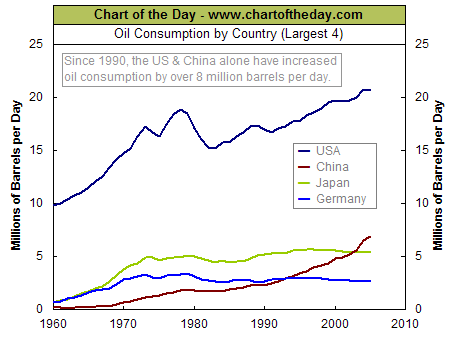
Right. And if our cars get 300 miles per gallon, I'll suddenly start driving 120,000 miles per year for no particular reason. Have you ever looked at a graph of the US's oil consumption? See that one major time in modern US history where there was a protracted drop in oil consumption? There was a dip during the 1973 oil crisis, but then consumption kept growing (despite oil prices plateauing at near the 1973 levels)... up until 1978. Then for years (despite the end of the 1979 energy crisis), consumption kept falling. In the 80s, consumption bottomed out, and then continued a steady rise. What happened in 1978 that was so different? The creation of CAFE. But then CAFE stagnated, and so eventually the market was saturated with vehicles produced under CAFE standards, and the continued growth of the US population and auto market overwhelmed it.
The "rebound effect" you refer to is estimated by the National Research Council to only be about 10-20%.
-
Some National Academy Books also free
If you go to the National Academy Press web site, http://www.nap.edu/about.html, you will find that many of their books are available in PDF format, and that many of those can be downloaded for free. To find what you are interested in, use the search box in the upper left hand side of their about page. Since we taxpayers paid for most, if not all, of the work being presented, perhaps they all should be free.
-
Re:The National Academies recommended this
This will undoubtedly induce all sorts of railing about both the government and climate, but this step was actually recommended by the National Academies of Science, and I'm happy that it's being seriously considered. The NAS issued in a report that, distilled down, says that we're already paying for climate science, but the info generated by that work isn't reaching the people who need it most, like the ones that have to manage water supplies in the desert southwest. When those people do find the research, it's typically not structured in a way that's especially useful to them. (For a more elaborate summary of the report, see here - full disclosure, i wrote that).
So, this is largely an attempt to take information we're already producing (the government has paid for climate research for a long time through NOAA and the NSF) and make it useful.
The foundation for a National Climate Service already is in place.
The Prism Group at Oregon State University has been mapping in climate in the US for a long time.
http://prism.oregonstate.edu/
So, maybe what needs to is better coordination of all the data sources through NOAA
-
The National Academies recommended this
This will undoubtedly induce all sorts of railing about both the government and climate, but this step was actually recommended by the National Academies of Science, and I'm happy that it's being seriously considered. The NAS issued in a report that, distilled down, says that we're already paying for climate science, but the info generated by that work isn't reaching the people who need it most, like the ones that have to manage water supplies in the desert southwest. When those people do find the research, it's typically not structured in a way that's especially useful to them. (For a more elaborate summary of the report, see here - full disclosure, i wrote that).
So, this is largely an attempt to take information we're already producing (the government has paid for climate research for a long time through NOAA and the NSF) and make it useful.
-
The truth about bird kills (not what you expect)The original poster is simply incorrect that turbines pose a negligible threat to birds (and to bats, which potentially is just as serious a problem). Bird kills are very real and have to be managed just like any other environmental cost. The key to acceptable bird/bat kills is: (1) proper siting of the facility; and (2) proper operations of the facility.
Nobody in the industry takes a cavelier attitude towards bird and bat kills. The Altamont Wind Project and it's well-documented bird problems probably set this industry back 10 years. It was an example of a very poorly sited facility. From Wikipedia:Considered largely obsolete, these numerous small turbines are being gradually replaced with much larger and more cost-effective units. The small turbines are dangerous to various raptors that hunt California Ground Squirrels in the area. 1300 raptors are killed annually. Among them are 70 golden eagles that are federally protected. In total, 4700 birds are killed annually.[2] The larger units turn more slowly and, being elevated higher, are less hazardous to the local wildlife.
This idea that we in the industry discount bird and bat issues is false. The American Wind Energy Association, the leading trade association for wind developers, has sponsored a number of studies of the issue. This 132 page report from 2004 is just one resource discussing recent research: www.awea.org/pubs/documents/WEBBProceedings9.14.04%5BFinal%5D.pdf . This report from the American Academy of Science's presents a similarly scientific look at bird and bat fatalities: http://books.nap.edu/openbook.php?record_id=11935&page=1. The Bats and Wind Energy Cooperative (http://www.batsandwind.org/default.asp) has fascinating video of bats encountering turbines:http://www.bu.edu/cecb/wind/video/, and has detailed discussions of proper siting and operation of facilities.
The better operations come in two ways -- (1) shut down the turbines during local migratory and breeding seasons; and (2) shut the turbines down at night when bat activity is at a maximum and power prices are at a minimum. By combining these two operating parameters, the bird and bat kills can be reduced to an acceptable level, while revenues to the wind mills decrease only slightly. This is particularly true since electricity demand is at its lowest during the spring and fall -- when animals are most likely to come into contact with the turbines. It's common for fossil units to shut down during this period for maintenance too, because the revenues do not justify the costs.
As usual, things are rarely as simple as we would wish. Generating power is not environmentally friendly. It just isn't. It's all about minimizing the bad parts. -
Re:Law is only way
The internet appears to have issues with laws.
As seemingly does the rest of society.
My point is that just because there's a law, doesn't mean it's followed or enforced. My solution is to just release enough security threats (redirects in this case) that people are simply forced to switch. In basic terms, money is the only reason why people change. Take the American government, for my obligatory Obama plug. -
The actual report
I know this is slashdot and all, but if anybody's actually interested in looking at the full report, it's available for reading in pdf format online.
-
We dont have tech for a manned mars mission yet
the national Academies Press released a report: "Managing Space Radiation Risk in the New Era of Space Exploration" (2008)
my brief reading if this was that they are actually closing down research facilities needed to do the reserach which is still largely undone that would reduce the mission risk as far as radiation is concerned to make a mission feasible.
The technolo9gy required for economically feasible craft design incorporating an acceptable level of radiation protection to the two prevalent radiation risks.Don't take my word for it read it yourself at:
http://books.nap.edu/catalog.php?record_id=12045 -
Who Did They Ask?
Obviously they asked a panel of, at least primarily, neuroscientists. TFA doesn't mention that the report wasn't an all-around technology assessment, but rather is from the outset a futurism projection of neuroscience: http://books.nap.edu/openbook.php?record_id=12177&page=R1
They didn't come to the conclusion, as implied by the tone of TFA, rather it was their starting point and working boundary.Had they asked a panel of archeologists, the battlefield of the future would probably be inside the Great Pyramid, but The Guardian would fail to note the profession of the report writers, instead simply calling them "leading scientists".
-
Re:first: override the teacher's unions
The most alarming aspect of merit-pay systems is the metric. How do we judge the effectiveness of a teacher? Is a teacher who takes a class that knows 70% of the material pre-instruction, and increases their knowledge to 85%, a good teacher? What about someone who takes a class that begins at 15% and ends at 45%? Are they worse than the first teacher, because their class only achieves to the 45% mark, or are they better than the first teacher because their class improved 30% instead of 15%?
For that matter, does standardized testing as it currently exists actually test useful indicators of learning? In science, testing is focused almost exclusively on knowledge of facts, where current science education research reveals that instruction needs to encompass the four strands of scientific proficiency. When testing focuses almost exclusively on the first strand, but research shows that effective science teachers need to address all four strands--how relevant are the tests?
We need to have a better evaluation system before we shift into merit based pay.
-
Re:The IPCC reports???
Then how about:
The InterAcademy Council
The National Academies
The International Council of Academies of Engineering and Technological Sciences
The European Academy of Sciences and Arts
The National Research Council
The Federation of American Scientists
The World Meteorological Organization
Need I go on? -
Re:what's the big deal?
how do you know it's a lie? have you proven creationism to be a lie and not told anyone? while you're at it you might as well tell everyone how you proved evolution as fact while the rest of the world is still trying...
I don't need to because many people already have. Here's a few to get you started.
- Was Darwin Wrong?
- Science, Evolution, and Creationism
- Evolution Resources from the National Academy of Science
Honestly, not wanting your kid's science class to teach intelligent design to your kids is no different (to anyone remotely familiar with scientific evidence, anyway) than not wanting your kid's math class to teach them the "theory" that pi equals 3 (1 Kings 7:23).
-
Pro Vs Anti
To be fair, there are a few other differences between the two forums, but the point may still be valid.
I'll say.
My first suspicion was that one just reeked of horrid angry fruit salad 1999 intarwebs design (dancing Jesu & flying toasters with a midi track in octaves meant for torture timed with a blinking marquee tag). Honestly, they look about on par although I prefer the simplicity of YaBB though in my opinion it doesn't seem to be an issue here. Normally this is the biggest discriminator for a website's success, not the content.
I did find it interesting to note the slant to these message boards though. The 'uncensored' website has this text as it's homepage:Did you know:
- The consensus view among scientists is that polygraph testing has no scientific basis?
- The FBI considered the creator of the lie detector test to be a phony and a crackpot?
- The man who started the CIA's polygraph program thinks that plants can read human thoughts?
- The foremost polygraph advocate in academia was discredited by a federal judge?
- A prominent past-president of the American Polygraph Association is a phony Ph.D., and this premier polygraph organization doesn't consider it an ethics problem?
- The longest polygraph school produces newly minted polygraphers in just 14 weeks -- less than half the time it takes to graduate from a typical barber college?
- The Defense Academy for Credibility Assessment (the erstwhile DoD Polygraph Institute) suppressed a study suggesting that innocent blacks are more likely to fail the polygraph than innocent whites?
- The researcher who developed the U.S. Government's polygraph Test for Espionage and Sabotage "thought the whole security screening program should be shut down?"
- The National Academy of Sciences concluded that "[polygraph testing's] accuracy in distinguishing actual or potential security violators from innocent test takers is insufficient to justify reliance on its use in employee security screening in federal agencies?"
- Spies Ignatz Theodor Griebl, Karel Frantisek Koecher, Jiri Pasovsky, Larry Wu-tai Chin, Aldrich Hazen Ames, Ana Belen Montes, and Leandro Aragoncillo all passed the polygraph?
- One of the most prolific serial killers in U.S. history passed the polygraph and killed again?
- Al-Qaeda and Iraqi insurgents know full well that the lie detector is bogus?
- You don't have to be a psychopath, go to spy school, or somehow believe your own lies to fool the polygraph? (We'll reveal how it's done.)
While the 'censored' board has this as its opening text:
The Polygraph Place
-
Re:So much to say...
...the elevation of Darwinian natural selection as a means of species creation to an unrealistic importance. I just don't see why it's so important in and of itself. One could certainly be a competent physician...one could even be a quite competent practitioner of any of the biological sciences...without necessarily agreeing with Darwinism. Yet, we are constantly told that a failure to teach Darwinism at the high school level will destroy science education as we know it and result in a US population that is hopelessly ignorant of all science, etc. etc. Evolutionary theory is a unifying concept that makes the broader study of biology more coherent. It's a set of basic principles that are ultimately relevant to a wide array of disciplines, including medicine and IT.
While belief in evolutionary theory may not be required for competence, understanding of it is. It has consistently proven to be an immensely useful tool, and giving that tool to students is a Good Thing(tm).