Slashdot Mirror
Domain: nasa.gov
Stories and comments across the archive that link to nasa.gov.
Comments · 16,365
-
Direct link to Hubble Press Release and pix
This came out after I posted the article... Hubble presents - Fomalhaut B! This graphic is particularly nice!
-
Direct link to Hubble Press Release and pix
This came out after I posted the article... Hubble presents - Fomalhaut B! This graphic is particularly nice!
-
Re:Anonymous Coward
The dust is not uniformly charged to one polarity or another. There has been very successful research in low power transparent electrodynamic screens that will remove all the deposited dust, however:
If future missions utilize solar panels, this technology will hopefully be implemented.
-
Re:Options
2. Launch a nuclear powered feather dusting support rover. No that's stupid.
Actually, the next planned mission WILL be nuclear powered. NASA Mars Science Laboratory
-
Different Hemispheres
It's fall in the northern hemisphere of Mars where Phoenix is located, so it dying was entirely expected, and although it lasted longer than its mission, they were hoping to get a few more weeks out of it. Landing was just a month before the summer solstice, so it had 30 days of conditions that started good and improved, then 130 days of declining conditions. Since it's in the arctic circle, it had complete daylight until a month or two ago, when the sun started setting again.
Spirit and Opportunity, however, are in the southern hemisphere, and it's early spring. Between the dust on Spirit's solar panels and being about 12 degrees further from the equator than Opportunity, things got a little worrisome for Spirit over the winter, but her minimum power levels at that time were over twice the 89 Watt-hours quoted in the article.
Low power is slightly less of a concern now than it was then, because the surface temperature should be higher and so electronics should need less heating, but that huge drop in power is probably more than enough to make up the difference. The other potential positive factor is Spirit's batteries had a decent level of charge when the storm started, so if the storm dissipates quickly they'll probably be in the clear. Trying to maintain 89 W-hr for several months, however, could very easily be fatal, so they're trying to use an absolute minimum of power to keep her out of fault mode.
Spirit actually hadn't moved an inch for several months to save power until a week or two ago. Her team had parked her on a sloped rock face at about a 30 degree angle to square her solar panels to the noon sun over the winter, and because of relatively clear skies, she was even able to take a high resolution panorama (link is to an index, not directly to the giant 42 MB image) and do some stationary science. As the sun angle increased, they had just started inching back towards a 20 degree tilt to follow it when the dust storm hit. There's a rather dramatic picture of what that 30 degree tilt looks like on the program site.
As of the last report I've seen, the atmosphere is 69% opaque due to suspended dust (although I believe more than 31% of the sunlight diffuses through indirectly), and the dust coating on Spirit's solar panels is only letting through 32% of of the sunlight that actually reaches them. In the past they'd had good luck with winds cleaning the panels off, but that hasn't happened in a while. The team is hoping that the same seasonal weather that brings on these dust storms will generate a few lucky dust devils.
Opportunity, on the other side of the planet meanwhile, has been getting 500-600 Watt-hours and averaging about 50 meters per day of progress towards the huge crater Endeavor, which is 12 km away.
And what nutjob modded the parent as a troll? Sheesh! And to think we probably let that person vote, too. -
Different Hemispheres
It's fall in the northern hemisphere of Mars where Phoenix is located, so it dying was entirely expected, and although it lasted longer than its mission, they were hoping to get a few more weeks out of it. Landing was just a month before the summer solstice, so it had 30 days of conditions that started good and improved, then 130 days of declining conditions. Since it's in the arctic circle, it had complete daylight until a month or two ago, when the sun started setting again.
Spirit and Opportunity, however, are in the southern hemisphere, and it's early spring. Between the dust on Spirit's solar panels and being about 12 degrees further from the equator than Opportunity, things got a little worrisome for Spirit over the winter, but her minimum power levels at that time were over twice the 89 Watt-hours quoted in the article.
Low power is slightly less of a concern now than it was then, because the surface temperature should be higher and so electronics should need less heating, but that huge drop in power is probably more than enough to make up the difference. The other potential positive factor is Spirit's batteries had a decent level of charge when the storm started, so if the storm dissipates quickly they'll probably be in the clear. Trying to maintain 89 W-hr for several months, however, could very easily be fatal, so they're trying to use an absolute minimum of power to keep her out of fault mode.
Spirit actually hadn't moved an inch for several months to save power until a week or two ago. Her team had parked her on a sloped rock face at about a 30 degree angle to square her solar panels to the noon sun over the winter, and because of relatively clear skies, she was even able to take a high resolution panorama (link is to an index, not directly to the giant 42 MB image) and do some stationary science. As the sun angle increased, they had just started inching back towards a 20 degree tilt to follow it when the dust storm hit. There's a rather dramatic picture of what that 30 degree tilt looks like on the program site.
As of the last report I've seen, the atmosphere is 69% opaque due to suspended dust (although I believe more than 31% of the sunlight diffuses through indirectly), and the dust coating on Spirit's solar panels is only letting through 32% of of the sunlight that actually reaches them. In the past they'd had good luck with winds cleaning the panels off, but that hasn't happened in a while. The team is hoping that the same seasonal weather that brings on these dust storms will generate a few lucky dust devils.
Opportunity, on the other side of the planet meanwhile, has been getting 500-600 Watt-hours and averaging about 50 meters per day of progress towards the huge crater Endeavor, which is 12 km away.
And what nutjob modded the parent as a troll? Sheesh! And to think we probably let that person vote, too. -
Re:Mars Rovers, Landers, and Orbiters
There's also the Mars Global Surveyor (http://mars.jpl.nasa.gov/mgs/), which died (probably of battery failure) after 4x longer life than expected.
-
Re:ThinkGeek??
I liked that story about the Commodore 64, and the kid learning to write his first BASIC programs. Now he has a skill that is actually employable (whether you write BASIC, Fortran, C, or VHDL, it's all basically the same). He just needs to keep practicing.
I learned programming on my own without my parents help. I was self-motivated; I don't know why? I guess I just wanted to see what images I could make the Commodore flash up on the screen. Eventually I lost interest in programming, and became more curious how the hardware actually work (how does a SID make sound?), and started devouring all the tech manuals I could find.
The key I think is to instill that same self-motivation/self-learning process to the next generation; how to do that is a mystery. I suspect it requires an innate curiosity instilled from birth.
TRIVIA:
Voyagers 1 and 2 are still alive and in daily communication with NASA: http://voyager.jpl.nasa.gov/news/profiles_dsn
-
Re:Ring tone one is awesome
I did. I tried every option I could to NOT reformat my drive, but after a day I realized I had no choice. I suspect the RAID information was lost during the power failure, and with the data being "divided" across two drives my PC couldn't make any sense of it. (shrug). I have since re-downloaded almost everything I lost, so it wasn't too bad of a tragedy. Now I make sure to back-up stuff on the external USB drive, just in case.
TRIVIA:
Voyagers 1 and 2 are still alive and in daily communication with NASA: http://voyager.jpl.nasa.gov/news/profiles_dsn
-
Re:RIP
Yes but what is the Question?
Trivia:
Voyagers 1 and 2 are still alive and in daily communication with NASA: http://voyager.jpl.nasa.gov/news/profiles_dsn.html
-
NASA discovered this years ago
In fact a sharkskin like surface was added to Stars and Stripes racing yacht. Stars and Stripes scored a 4-0 sweep in America Cup in 1987.
The technology provided such a tremendous advantage that it was banned in subsequent years of America Cuphttp://www.nasa.gov/centers/langley/news/factsheets/Riblets.html
-
Re:What about the Asteroid Belt?
There already are several telescopes dedicated soley to studying and discovering asteroids. We currently discover about three times as many asteroids per year as we did 10 years ago, and probably about 10 times as many as we did 15 years ago. In the first six months of 2008, we discovered on average one every ~11 hours.
At the same time, we've also already discovered most of the asteroids a kilometer in diameter or bigger. Despite the improved instrumentation and computer automated searching, only 12 such asteroids were discovered in the first six months of 2008, compared to a current catalog of 760 (1000 total estimated). More info here.
More to the point, a mission to Titan (or Jupiter...NASA is still deciding) is not exclusive of searching for asteroids. NASA has funding for both programs, and contrary to the claim that NASA ignored a directive from Congress to search for NEO's, they've been actively at it for the last 10 years, and will continue it for the foreseeable future. In fact, in 2003 they began making preparations to expand it further. The current goal is to catalog 90% of the objects 140m in diameter or larger within the next 20 years, whereas impacts from such objects are believed to occur roughly once every 1000 years. -
Titan vs. Europa
The balloon aspect is indeed cool, especially since the balloon will communicate by radio with a raft floating in one of Titan's methane/ethane lakes, and an orbiter that will solve some of the mysteries Cassini has revealed. The other mission being studied would explore the Galilean satellites, tackling questions raised by the Galileo orbiter beginning more than a decade ago. Given its abundant tidal heating, possible surface oxidation by solar wind particles (think food), liquid water ocean, and possible hydrothermal systems, Jupiter's moon Europa may be a better target in the search for life. Here are the mission descriptions from NASA, with links to the details: http://opfm.jpl.nasa.gov/europajupitersystemmissionejsm/jupitereuropaorbiter/ http://opfm.jpl.nasa.gov/titansaturnsystemmissiontssm/
-
Titan vs. Europa
The balloon aspect is indeed cool, especially since the balloon will communicate by radio with a raft floating in one of Titan's methane/ethane lakes, and an orbiter that will solve some of the mysteries Cassini has revealed. The other mission being studied would explore the Galilean satellites, tackling questions raised by the Galileo orbiter beginning more than a decade ago. Given its abundant tidal heating, possible surface oxidation by solar wind particles (think food), liquid water ocean, and possible hydrothermal systems, Jupiter's moon Europa may be a better target in the search for life. Here are the mission descriptions from NASA, with links to the details: http://opfm.jpl.nasa.gov/europajupitersystemmissionejsm/jupitereuropaorbiter/ http://opfm.jpl.nasa.gov/titansaturnsystemmissiontssm/
-
Late-Breaking News from the Council: VICTORY!> Did it sing "Bicycle Built for Two," slowing down and getting deeper as it ran out of power? Because that would have been awesome.
VICTORY!
The most Illustrious Council of Elders has declared tomorrow a planetary day of celebration. K'breel, Speaker for the Council, spake thus:
"Triumphant Citizens, today all our gelsacs are engorged with delight! After a 160-day campaign in the arctic wastelands of our world, our day of victory has come. For the past thirty days, this latest terror from the blue world has been able to do nothing more but wave its pendulous plumb bob at us.
Its relentless chanting of the Day-Z War Song - which our linguists have assured us is about a war machine driven so half-mad with emotion that it would enslave two of its creators for use as propulsion mechanisms - has finally ended. The Day-Z War Song is sung no more.
Rejoice, podmates, for victory is ours! We answer in the affirmative, for we are able!"
(A small group of dissidents in the Press Corps reminded the Speaker that the Invader on the Plains had begun to stir, and that The Twin at the Crater was rapidly advancing to the southeast after having made an obscene gesture. They were about to inquire as to what progress had been made over the past two and a half years against these threats, but K'Breel had already torn the antenna shaft from the Arctic Invader's lifeless hulk and made a shishkebab of their gelsacs before their question could be been fully heard.)
-
Late-Breaking News from the Council: VICTORY!> Did it sing "Bicycle Built for Two," slowing down and getting deeper as it ran out of power? Because that would have been awesome.
VICTORY!
The most Illustrious Council of Elders has declared tomorrow a planetary day of celebration. K'breel, Speaker for the Council, spake thus:
"Triumphant Citizens, today all our gelsacs are engorged with delight! After a 160-day campaign in the arctic wastelands of our world, our day of victory has come. For the past thirty days, this latest terror from the blue world has been able to do nothing more but wave its pendulous plumb bob at us.
Its relentless chanting of the Day-Z War Song - which our linguists have assured us is about a war machine driven so half-mad with emotion that it would enslave two of its creators for use as propulsion mechanisms - has finally ended. The Day-Z War Song is sung no more.
Rejoice, podmates, for victory is ours! We answer in the affirmative, for we are able!"
(A small group of dissidents in the Press Corps reminded the Speaker that the Invader on the Plains had begun to stir, and that The Twin at the Crater was rapidly advancing to the southeast after having made an obscene gesture. They were about to inquire as to what progress had been made over the past two and a half years against these threats, but K'Breel had already torn the antenna shaft from the Arctic Invader's lifeless hulk and made a shishkebab of their gelsacs before their question could be been fully heard.)
-
Original story and pictures
-
Re:stirling engine is a no-go
What I want to know is, how do we get the plans for the engine? If my tax money designed that thing, how on earth can it be justified to keep that information from me?
The reason I found that article was because I was seeking plans. What I found was that some of the major documents (like the summary I posted) have been scanned and are available online, but most of the technical documents are in their paper library. You have to buy them for something like $60 apiece (can't remember exactly the cost).
It is all there though.. for those who want to invest in the paper weight. This page will get you most of the Stirling results and this is the main document research website for NASA. -
Re:stirling engine is a no-go
What I want to know is, how do we get the plans for the engine? If my tax money designed that thing, how on earth can it be justified to keep that information from me?
The reason I found that article was because I was seeking plans. What I found was that some of the major documents (like the summary I posted) have been scanned and are available online, but most of the technical documents are in their paper library. You have to buy them for something like $60 apiece (can't remember exactly the cost).
It is all there though.. for those who want to invest in the paper weight. This page will get you most of the Stirling results and this is the main document research website for NASA. -
Largest truck?
"The largest truck in the world is about to become..." No, I'm pretty sure the Apollo/Shuttle crawlers have them beat.
http://science.ksc.nasa.gov/facilities/crawler.html.Might still be the biggest robots though.
-
Re:stirling engine is a no-go
It's been refined for 160 years plus change. So it ought to be really spiffy, right? Well, no. There are definite upper limits to the efficiency of such a device. Most Stirling sites are very cagey when it comes to mentioning the efficiency of what they're selling. For good reason, it's terrible. Like 3 to 6 percent. That kinda explains why it's not in use everywhere, more like nowhere.
Citation Needed
20 years ago NASA had an automotive Stirling program. Read it and stuff it.
They converted a Chevy Celebrity and the results show that the highway gas mileage was increased from 40 to 58 mpg and the urban mileage from 26 to 33 mpg with no change in gross weight of the vehicle. This is NOT a hybrid - it is Stirling only.
By combining the efficiency of the Stirling with the get-up-and go of an electric this is a pretty good thing coming, and I've been waiting a while to see someone to produce it. -
Re:It's a lifting body
[Shuttle cargo return] is a capability that has never really been used except for the SpaceLab flights.
There was also the Long Delay Exposure Facility. They've also returned the work platforms, fixtures, and special tools used for Hubble repair. They've also returned the the Spacehab cargo containers (pressurized and unpressurized) used for delivering cargo to the ISS. They've also returned the MPLMs used for cargo delivery to the ISS - the only system capable of delivering full sized equipment racks. The SRTM flown on STS-99 was built by modifying the SIR-C hardware which flew on both STS-59 and on STS-68
-
Re:Tea or Death?
how well does tea steep in zero G
I don't know, but you can drink it with chopsticks.
-
You'd be surprised
Actually, according to NASA, the Sun's total output has been increasing by about 0.05% per decade.
Quote from that link: "If a trend, comparable to the one found in this study, persisted throughout the 20th century, it would have provided a significant component of the global warming the Intergovernmental Panel on Climate Change reports to have occurred over the past 100 years."
Now again, I'm not saying that it covers the _whole_ global warming effect, but about 0.5 of that 1.2 increase is covered right there. It's almost half.
The moral of the story: yes, the Sun has been there for billions of years, but that doesn't mean it's been unchanged and perfectly constant output.
-
Re:One theory of dark matter eh?
Here is a good start (maybe) http://www.google.com/search?hl=en&output=googleabout&btnG=Search+our+site&q=space%20probe%20%22study%20the%20sun%22 They have already observed things that we did not know with space based observation vehicles. The magnetic 'portal' between Earth and the Sun has been confirmed, though not fully studied. http://www.sciencedaily.com/releases/2008/11/081101093713.htm so there are many things yet that we should really be trying to understand. Articles on the Aurora Borealis might help you with the Earth's magnetosphere and it's role in protecting life on this planet. As the Earth's magnetic poles shift over time, I have not yet seen what effect this might have on planetary weather, never mind radiation. It is presumed that as they shift, a hole (allowing in solar and cosmic radiation) will pass across parts of the the planet where the pole is moving through.
I've also looked for any data on volcanic activity vs. weather/temperature. It's difficult to find hard data without money to spend. NASA has some research available: http://nasadaacs.eos.nasa.gov/search.html I'm not sure what the Russians or EU have available. I need to spend more time reading, but there is always hope that someone at NASA reads
-
Re:Just go to Taco Bell
Now that you mention it, Jupiter's Io looks like a spherical pizza.
Damn the weird shit you find on the 'net:
-
New close-up pictures of Enceladus taken last week
Just a few days ago, Cassini buzzed close by Enceladus and took high-res shots of the fissures where the geysers originate. Earlier this month during an even closer pass, the spacecraft took direct samples of the plume.
-
Re:clue ?
A large one might dent your car in the extremely improbable case that one should hit it.
TFA says the largest piece could be about 40 pounds and hit at 100 mph. That wouldn't dent your car, it would totally destroy it.
Totally destroy yes, but it might also increase it's value.
-
Re:Cloudy
-
OMG
No, not my car again!
-
Re:Landfall projection?
It's rare but being hit by metorites *does* happen. I can't find a recorded instance since 2002 (although there's a nice picture of a destroyed car from 1992 which probably doesn't count as it didn't hit a person.
Of course by the time it hits someone it's normally little more than a very hot pebble, and causes little more than some burning.
If something the size of a fridge hit you you'd feel a little bit more than a burning sensation!
-
IGS
much as Navteq's data forms the backbone of most terrestrial GPS services
Define "most." I think that the people who run the International GNSS Service (IGS) would disagree with you.
-
IGS
much as Navteq's data forms the backbone of most terrestrial GPS services
Define "most." I think that the people who run the International GNSS Service (IGS) would disagree with you.
-
Spirit saw this firstIt's an important result that MRO is mapping the global location of hydrated silica across Mars, but it is worth noting that we saw it first with the Spirit Rover, in the site informally tagged "Silica Valley."
It's been discussed at several recent conferences (AGU, LPSC) and was the main focus of Spirit's scientific research all through the last (Martian) summer.
-
Re:The interesting part (to me anyway)
Er, scratch that. Mars Phoenix flew with ATK UltraFlex array, with Boeing Spectrolab cells
http://www.pv-tech.org/chip_shots/_a/no_juice_no_glory_inside_the_solar_arrays_powering_the_phoenix_mars_lander/105W/Kg
Similar array is scheduled to fly on ST8
http://nmp.nasa.gov/st8/
Shooting for 175W/Kg -
TIBOC Rendezvous vs. SmartSockets?
What are the differences between TIBCO SmartSockets and Rendezvous? They seem to be very similar. I suppose I could try reading the documentation for Rendezvous, but I know someone out there in
I use SmartSockets indirectly through a secondary API in some software that I maintain. The secondary API, GMSEC, is meant to provide a standard interface to the messaging layer; i.e. so that no matter what MOM you want to use, your programs use the same API. OK, in practice, GMSEC only supports a few MOM packages, but that's the idea anyway1
-
No matter ejected from inside the hole
They're not saying that matter is ejected from inside the hole, so no, stars wouldn't be recycled. Also, they are not saying black holes at galactic cores are at this limit. Sagittarius A*, for example, which lies at the center of the Milky Way, is estimated to be only 3.7 million solar masses...orders of magnitude below this theoretical maximum. Also, such a wind as you suggest should be observable as it interacts with free gas and dust in the Milky Way. This may sound hard to believe, but it is in fact regularly observed in supernova remnants and massive stars like in the Crescent Nebula.
So what they're actually decribing is gas, dust, etc in the accretion disc orbiting near but not yet swallowed by the black hole. As stated, this gas becomes superheated and expands as it swirls ever closer to the hole. They claim that at some point the heat grows so intense that like a Wolf-Rayet star at the Eddington limit, it just blows all of the remaining gas away from itself to form a big bubble of relative emptiness. The article fairly descriptively labels this as a "dry" black hole. Actually, going back to the star recycling concept, this effect may be so dramatic as to actually prevent star formation in the host galaxy for the predictable future.
At this point I think the description is a little sloppy, since the black hole would then be devoid of material to compress and heat, and therefore the "black hole wind" (AC's insert crude fart joke here) effect is now gone. Theoretically then, feeding is able to occur at slow rates, and reading between the lines of the article, it sounds like the researchers agree about that. However, it would not allow the super-fast feeding behavior that results in the distant strobes known as quasars, which are believed to be such super-massive black holes below this limit.
Ultimately what they're suggesting is that quasars can't last forever because eventually their growth slows down to practically nothing, and then you have a relatively quiet, but huge black hole. Please keep in mind, however, that the end of the article disclaims this as being speculative physics. It makes sense, and it seems to fit the data, but it hasn't been thoroughly validated yet. -
Re:Interesting repercussions
or one, does this means that stars are continously recycled by the black hole believed to be at the center of each galaxy? i.e. They get sucked in, crushed, then ejected as gassous emmisions which then collect and reform as a new star.
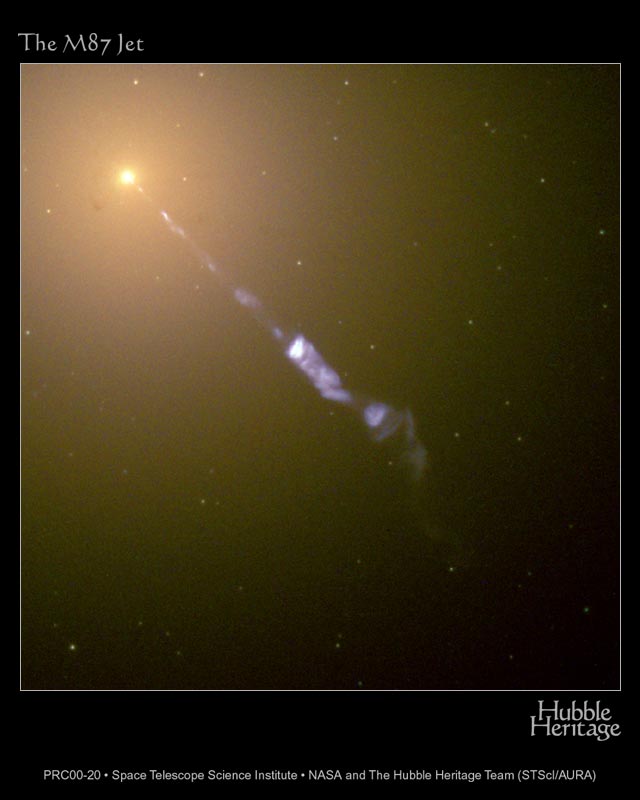
What happens, roughly, is that stars that stray too close to the black hole are torn apart by the tidal forces, their constituent gas adding to a large torus of gas orbiting the black hole. Some fraction of this torus loses enough angular momentum to either fall into the event horizon of the black hole, lost "forever" (astronomically speaking), or a grazing collision that gives it enough energy to avoid being sucked in. This gas can form a galactic wind of sorts: that flow becomes collimated by the high spin rate of the black hole and the torus of gas around it. This produces jets like those seen emanating from the core of M87. That gas, with its high temperature and flow rate, will not cool to a low enough temperature to coalesce into new stars any time "soon" (astronomically speaking.)
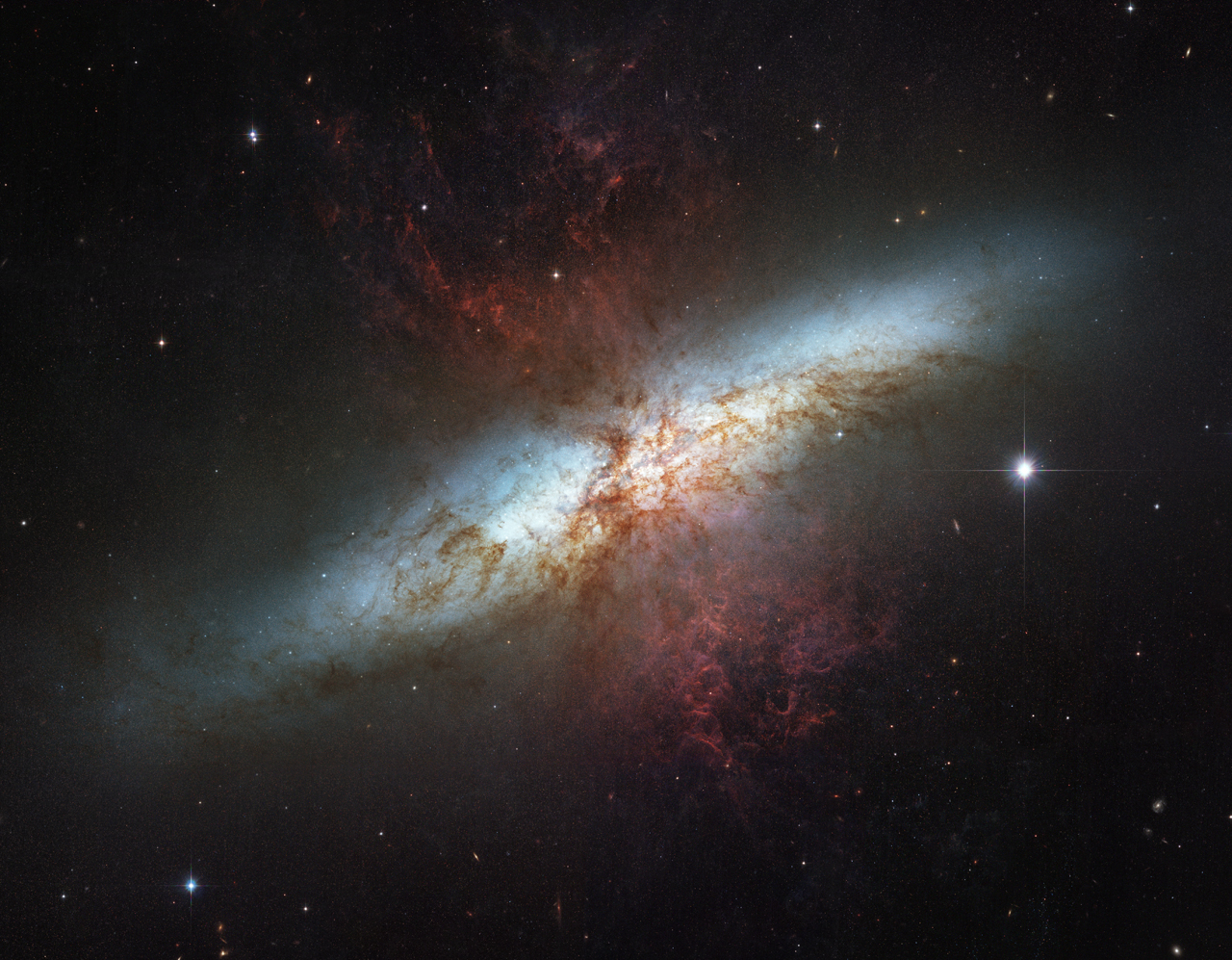
Now, there are flows that involve gas being ejected from the disk of the galaxy with less energy, which can rain back down onto the disk and contribute to newly-formed stars. But these "champagne flows" are usully caused not by the energetics of the central black holes, but rather the collective stellar winds from the stars in the disk; for example, the galactic superwind of M82
In both cases, the thermal energy of the ejecta is insufficient to explain the gravitational anomalies you mention. -
Re:Interesting repercussions
or one, does this means that stars are continously recycled by the black hole believed to be at the center of each galaxy? i.e. They get sucked in, crushed, then ejected as gassous emmisions which then collect and reform as a new star.
What happens, roughly, is that stars that stray too close to the black hole are torn apart by the tidal forces, their constituent gas adding to a large torus of gas orbiting the black hole. Some fraction of this torus loses enough angular momentum to either fall into the event horizon of the black hole, lost "forever" (astronomically speaking), or a grazing collision that gives it enough energy to avoid being sucked in. This gas can form a galactic wind of sorts: that flow becomes collimated by the high spin rate of the black hole and the torus of gas around it. This produces jets like those seen emanating from the core of M87. That gas, with its high temperature and flow rate, will not cool to a low enough temperature to coalesce into new stars any time "soon" (astronomically speaking.)
Now, there are flows that involve gas being ejected from the disk of the galaxy with less energy, which can rain back down onto the disk and contribute to newly-formed stars. But these "champagne flows" are usully caused not by the energetics of the central black holes, but rather the collective stellar winds from the stars in the disk; for example, the galactic superwind of M82
In both cases, the thermal energy of the ejecta is insufficient to explain the gravitational anomalies you mention. -
Re:Why is this so hard?
The key thing to know is that the Ares I conveniently keeps ATK Launch System's workforce employed. That's the only explanation that makes sense for how the Ares I was chosen and implemented. Here follows a list of rookie mistakes that shouldn't have happened:
- The Ares I was selected on the basis of a 60 day study, the ESAS (Exploration Systems Architecture Study). There was no serious deliberation on the options past that study.
- The criteria was slightly out of reach for the EELVs (Evolved Expendable Launch Vehicle), the Delta IV and Atlas V rockets. The manned capsule was originally (as I recall) about 10-20% too heavy for the Delta IV Heavy. I believe this was deliberate to throw the decision in favor of the Ares I.
- The safety numbers on the two options that used ATK's SRMs (Solid Rocket Motors) were IMHO greatly exaggerated with estimated loss of mission (which is not the same as loss of crew!) being roughly 1 in 400 (for a 5 segment SRM first stage and J-2S second stage) to 1 in 500 (4 segment SRM and SSME second stage). The key problem is that the failure rate in the SRMs alone is probably worse than 1 in 400. As far as I can tell, there's been around 300-400 SRM firings, either on a Space Shuttle or in tests. I understand there's been failures in test firings and of course, the Challenger accident (one of the solid rocket boosters (SRB) burned through on launch, destroying the vehicle and killing the crew). That yields a failure rate of more than 1 in 400 although I don't know how much worse.
- Meanwhile the risk of using the EELVs (somewhere around 1 in 100 chance of loss of mission) was calculated based on their current trajectories to orbit. The problem here is that the two launch platforms use a riskier trajectory today for launching the current unmanned payloads. The trajectories lack abort options in various parts of the flight (these are called "black zones"). But for manned launches, neither launch vehicle would use trajectories with black zones. That means risk for the EELVs was overstated in the ESAS.
- Economics of launch vehicles was not considered. Ares I launches maybe six times a year, Ares V maybe three times a year. Atlas V and Delta IV both are launching now. What that means is that the fixed costs of the EELV rockets can be split across NASA, the Department of Defense and anyone else who uses these rockets. Meanwhile the Ares I is a NASA-only vehicle. Fixed costs must be borne completely by NASA.
- The mass margins on the Ares I are too small. Henry Spencer does an excellent job of describing a similar situation during the Apollo program. Then the person, Wernher von Braun, in charge of designing the rocket, the Saturn V, had the authority to overdesign the Saturn V and he used it. Spencer speculates that even if a current manager anticipated the creep in mass requirements, they wouldn't have the authority to do anything about it.
- The solid rocket booster first stage is severely restricted by the physical dimensions of the motor. This contributes to the mass margin problem above. The motor is already as wide and as tall as it can be. That means no performance improvement can be had from the first stage as it currently is designed. The width is constrained by railroad tunnels between the Utah manufacturing facility and Florida. I see this as another indication of why the Ares I was chosen. While it'd be an expensive undertaking, NASA could move ATK's facilities to the other side of the Rockies, particularly somewhere on the coast. Or NASA could have used a liquid fueled first stage from the EELV makers. But that wouldn't employ Utah voters.
- The Orion capsu
-
Re:AND, there is the fact ...
I know you grabbed that 10 Billion dollar number out of the air, or at least I hope you did. It costs approximately 450 million to launch a shuttle. NASA's 09 FY budget is only 17.6 Billion. Your $10 Billion prize is over half their yearly budget used to sustain all of their operations.
Sources:
Budget http://www.nasa.gov/home/hqnews/2008/feb/HQ_08034_FY2009_budget.html
Launch http://www.nasa.gov/centers/kennedy/about/information/shuttle_faq.html#10 -
Re:AND, there is the fact ...
I know you grabbed that 10 Billion dollar number out of the air, or at least I hope you did. It costs approximately 450 million to launch a shuttle. NASA's 09 FY budget is only 17.6 Billion. Your $10 Billion prize is over half their yearly budget used to sustain all of their operations.
Sources:
Budget http://www.nasa.gov/home/hqnews/2008/feb/HQ_08034_FY2009_budget.html
Launch http://www.nasa.gov/centers/kennedy/about/information/shuttle_faq.html#10 -
Space elevators
Don't forget the space elevator, which, according to the late Arthur C. Clarke will get built 50 years after it stops getting modded funny.
-
Re:UpgradeI'm just going to be an ass and jump in on this thread here...
They need to have the chips hardened for radiation. I'm not sure what the process entails
I think we went over this not to long ago with one of the Mars craft, or we were it was in the thread about the dangers of outsourcing DoD hardware? (or was that digg..) Regardless, it's generally just tech a few years older that's proven itself without major flaws... http://en.wikipedia.org/wiki/Radiation_hardening#Radiation-hardening_techniques http://history.nasa.gov/computers/Part1.html And of course if your in the market for such kit... www.honeywell.com/radhard/
-
Re:Who Chooses?
Therefore Mars settlers will have to be unhappy with the government and require a great deal of money.
No need for money on Mars. Just people willing to work and trade some fungible unit of exchange such as energy or water.
Who is John Galt?
I don't know, but you gotta admit this qualifies as a pretty sweet gulch.
-
Re:blah the emporer has his new clothes on again.
-
Re:100 times colder than what?
TFA doesn't state any specific temperature, but I find the analogy to how "cold" space is rather troubling. Space is really "warm", as it contains energy left from the Big Bang (although no one with a common sense would describe it that way in daily talk), and saying that something is so many times colder than space really just doesn't make sense. You can always compare sizes, but as heat is a positive size, because you can't have negative energy, you can just say "this is a hundred times hotter than that" or "my freezer is two times as cold as my refrigerator compared to my living room". The one who thought of this analogy could be talking about degrees on Celsius or Fahrenheit, but then those numbers must be way below absolute zero, or 0 Kelvin, as space is just 2.7 Kelvin, or -270.7 C ( http://helios.gsfc.nasa.gov/qa_sp_ht.html ) and taking for granted he is comparing the temperature of space to 0 ÂC, that means that those crystals are actually -27070 C. And _that_ would be some real frontpage material...
You seem confused. He speaks of "a temperature about 100 times colder than intergalactic space". Intergalactic space has a temperature of about 3K. It does not make sense to talk of degrees C, since C is not an absolute scale. 100 times colder than 3K is 0.03K.
-
Re:No they didn't
Strawmen? Who's talking strawmen here?
The hard evidence for an anthropogenic (human) cause for the current warming (which has ceased since 1998 for this reason) is lacking.
Soft evidence, on the other hand, includes computer models of the infinitely complex (and thus un-modelable) climate system that have been tweaked to predict three times the observed "forcing" for the total carbon dioxide in the atmosphere. The human contribution to the total cannot even be accurately measured, but most evidence points to, at the outside, about 5% of the total atmospheric carbon dioxide coming from human sources.
Calling the hard evidence for global cooling a "straw man" while continuing to point at the soft evidence of an anthropogenic cause for climate change labels you an unscientific believer in the religion of Gaia.
Occam's razor suggests that natural climate forcings observed over thousands of years must be given more weight than the puny (and basically unmeasurable) contribution that humans have added to the atmospheric concentration of carbon dioxide during the current century.
-
NASA Projects conspiracy...er, links...
To start the fire of the moonlanding conspiracy flame war (that will inevitably start somewhere in this thread), here goes -
The two NASA instruments are designed to layover images and data readings where the landers and equipment are or are thought to be. Whether through some fancy electronic trickery/photoshop, or they built a scale model that hangs in front of the lenses at adjustable distances, or some other kooky theory. [sidebar] Perhaps the ISRO could snap a few photos of the sites in question to prove, yes or no, that we've been there and end this conspiracy.[/sidebar]
The actual projects by NASA are the Moon Mineralogy Mapper (M^3), here, and the Mini Synthetic Aperture Radar (Mini-SAR), here.
Congratulations to the ISRO! This really is a great achievement. Plus, my ulterior motive being that I hope to see a Space Race reignited. -
NASA Projects conspiracy...er, links...
To start the fire of the moonlanding conspiracy flame war (that will inevitably start somewhere in this thread), here goes -
The two NASA instruments are designed to layover images and data readings where the landers and equipment are or are thought to be. Whether through some fancy electronic trickery/photoshop, or they built a scale model that hangs in front of the lenses at adjustable distances, or some other kooky theory. [sidebar] Perhaps the ISRO could snap a few photos of the sites in question to prove, yes or no, that we've been there and end this conspiracy.[/sidebar]
The actual projects by NASA are the Moon Mineralogy Mapper (M^3), here, and the Mini Synthetic Aperture Radar (Mini-SAR), here.
Congratulations to the ISRO! This really is a great achievement. Plus, my ulterior motive being that I hope to see a Space Race reignited.