Slashdot Mirror
Domain: nasa.gov
Stories and comments across the archive that link to nasa.gov.
Comments · 16,365
-
Old news
This isn't the first evidence they have found of water on mars, see this article
-
Re:Yup
NASA did not "find water" years ago... or ever!
-
Re:Artificial cells
You might be referring to something similar to what NASA' helping to fund. I agree, it's pretty cool. Also we don't have to be overabout the Jehovah's witnesses anymore.
-
Not being a girl...
it's hard for me to say what might be appealing to a girl specifically. But relative to age range, I would suggest some stuff like:
1. the Madeline L'Engle "Wrinkle in Time" books
2. The Chronicles of Narnia
3. Some of the more sci-fi'ish "Choose Your Own Adventure" books
4. Any of the Tom Swift / Tom Swift Jr. adventures
5. The Mad Scientists Club
6. Any of the Doctor Who novelisations.
7. and while not exactly sci-fi, how about some of the "The Three Investigators" stories? -
Re:Bright enough to see in the day also
I really enjoy daylight unaided sightings of venus; it just feels amazing to me to see a planet in broad daylight. The funny thing is that after you find it, if you look away, and then look back, you can't miss it! A good empheris is helpful to narrow the search to a small part of the sky. This one at JPL is my favorite.
-
Looks like another place to search for life....
What was interesting to me was this diagram:
http://saturn.jpl.nasa.gov/multimedia/images/image -details.cfm?imageID=1681/
In JPL's warm-spot modelling for Enceladus there is an undersurface ocean heated by one of the two now-familiar forces of tidal heating or radiological decay heating (though the former seems more likely).
So the statement goes: "where there is liquid water, there could be life". Do we have another Europa on our hands here? -
Re:A semi-related question
I only know of a record-setting balloon flight on Antartica, I found it back here, but possibly we're talking about the same mission. I know that gas seeping is a problem, helium molecules being that small, and 100 days is already a lot. If you need longer duration, refilling seems to be your only option. Maybe you can replace/add a tether with a light-weight tube that refills it from the ground. The good news is that getting helium up is not a big problem
-
Re:Links
Forgot to post the link where I got the 0.27% number from: Global warming--a closer look at the numbers
The primary claim of this web page, and the point around which it's conclusions revolve - is that water vapor accounts for "around 95%" of earth's greenhouse gases. While a footnote is included giving the source of this data, the linked page unfortunately no longer exists. However, the web site this footnote points to - www.globalwarming.org - is not a source of scientific data, but rather a project of the Cooler Heads Coalition, a political group founded for the purpose of denying global climate change. The whois data for the site confirms that it was registered by the Nationial Consumer Coalition, a right-wing political lobbying group.
Now, if we seek out an actual scientific source for claim that "water vapor accounts for 95% of greenhouse gases", we come up more or less empty-handed. I found this article on NASA's website, which doesn't give an overall figure for wator vapor but mentions that human-induced methane has a severe effect on the amount of water vapor in the stratosphere. This introductory article on greenhouse gases by the NOAA mentions that the amount of water vapor in the atmosphere rises with the temperature, creating a feedback loop that I assume would amplify any human-made contributions.
Every "greenhouse gases overview" type of article I found mentions that water vapor is by far the most abundant greenhouse gas. The "closer look at the numbers" page's claim that "Interestingly, many "facts and figures' regarding global warming completely ignore the powerful effects of water vapor in the greenhouse system" makes it sound as if the author has discovered some closely guarded secret, when in fact the opposite is true.
Another interesting thing I noticed on this page is "Table 1", which appears to be evidence of the intentional cover-up of water vapor as the most important greenhouse gas. First, the title of the DOE data has been changed, without explanation, from the original title of "Current Greenhouse Gas Concentrations" to the more controversial sounding "The Important Greenhouse Gases". Second, two columns have been added to the table that do not exist in the DOE source, "Natural additions" and "Man-made additions." No mention is made of where these numbers come from or why they were inserted into the original data.
Second, if you take a look at the source of the DOE data, you will find that the UN Intergovernmental Panel on Climate Change's 2001 report says that "Water vapour is the strongest greenhouse gas" and that it is "central to the climate and its variability and change" but also that water vapor is "The most variable component of the atmosphere
Every time I examine one of these climate change denial pieces, I find the same thing. Unsubstantiated or out-of-context facts; inferences of conspiracy on the part of scientific organizations who suggest that climate change is both real and heavily influenced by human activity; and a political lobbying group with a direct profit motive at its source. -
Re:Previous Information?
The suits don't "leak." They're designed to vent gas. If you don't vent gas, you can't have a flow of gas at a constant pressure. http://ntrs.nasa.gov/archive/nasa/casi.ntrs.nasa.
g ov/19730064704_1973064704.pdf -
Re:Chemical makeup and toxicity
Wow, I totally missed that article.
OK, so, from the article:
Lunar dust, being a compound of silicon as is quartz, is (to our current knowledge) also not poisonous.
So it _has_ silicon in it, and it's probably chemically similar to quartz. After a little google work, I turned up This presentation that outlines the stuff a little. It appears to be mostly silicon monoxide--similar in composition to silica, but not chemically the same. But, hell, just looking at those particles, they look "sharp edged," and it's not really a chemical effect in the lungs anyhow--that's why it's not "toxic," there's no chemical action in the lungs, just a physical one. -
Re:Previous Information?
Apollo 17 lunar module pilot Harrison Schmitt suffered hay fever due to all the moon dust floating around in the lunar module.
-
Re:No! God did it!
You might be right. But there's some evidence that humanity is not completely responsible.
Today, an estimated 5.6 gigatons of carbon are released into the atmosphere each year due to fossil fuel burning. Burning of tropical forests contributes another 2.4 gigatons of carbon per year; or, about 30 percent of the total. -
Re:Toxic? Nonsense!
I actually read both articles in question and nowhere does it say that moondust is toxic. It does however say that Martian dust can be toxic in the second article. Here are the relevant quotes:
Quartz, the main cause of silicosis, is not chemically poisonous: "You could eat it and not get sick
Lunar dust, being a compound of silicon as is quartz, is (to our current knowledge) also not poisonous.
Martian dust could be even worse. It's not only a mechanical irritant but also perhaps a chemical poison. Mars is red because its surface is largely composed of iron oxide (rust) and oxides of other minerals. Some scientists suspect that the dusty soil on Mars may be such a strong oxidizer that it burns any organic compound such as plastics, rubber or human skin as viciously as undiluted lye or laundry bleach.
"If you get Martian soil on your skin, it will leave burn marks," believes University of Colorado engineering professor Stein Sture, who studies granular materials like Moon- and Mars-dirt for NASA. Because no soil samples have ever been returned from Mars, "we don't know for sure how strong it is, but it could be pretty vicious."
Moreover, according to data from the Pathfinder mission, Martian dust may also contain trace amounts of toxic metals, including arsenic and hexavalent chromium--a carcinogenic toxic waste featured in the docudrama movie Erin Brockovich (Universal Studios, 2000). That was a surprising finding of a 2002 National Research Council report called Safe on Mars: Precursor Measurements Necessary to Support Human Operations on the Martian Surface. -
Incidently...
The Apollo 17 landing film is truly great to watch; the excitement in the astronauts voices shows what it really means for man to land on the moon:
Landing at Taurus-Littrow -
Moondust is toxic
On the same NASA site, there's an article about the toxicity of moondust. It appears that because of its small particle size (10 microns), the moondust gets embedded into lungs, just like quartz used to do in the old mining days, causing silicosis.
The astronauts did inhale some of the moondust, with effects similar to a hay fever.
Not only that, but the dust is statically charged because of the Sun and lack of humidity, so it will stick to just about anything, causing abrasion.
http://science.nasa.gov/headlines/y2005/22apr_dont inhale.htm
There are plans to build a "microwave lunar lawn mower" that will melt the dust into something useful and stop it from bouncing.
http://science.nasa.gov/headlines/y2005/09nov_lawn mower.htm -
Moondust is toxic
On the same NASA site, there's an article about the toxicity of moondust. It appears that because of its small particle size (10 microns), the moondust gets embedded into lungs, just like quartz used to do in the old mining days, causing silicosis.
The astronauts did inhale some of the moondust, with effects similar to a hay fever.
Not only that, but the dust is statically charged because of the Sun and lack of humidity, so it will stick to just about anything, causing abrasion.
http://science.nasa.gov/headlines/y2005/22apr_dont inhale.htm
There are plans to build a "microwave lunar lawn mower" that will melt the dust into something useful and stop it from bouncing.
http://science.nasa.gov/headlines/y2005/09nov_lawn mower.htm -
The delicate balance
the delicate balance that existed before we began adding our share.
That delicate balance never existed. Earth has been heating up for thousands of years.
Sulphates? CO2 levels are pretty much uniform over the entire planet. Here is the temperature record for the oldest continually operating weather station in Australia:
http://data.giss.nasa.gov/cgi-bin/gistemp/gistemp_ station.py?id=501947030000&data_set=1&num_neighbor s=1
Now that's global warming! -
Re:Solar Activiity is at its highest levels since
You're a bit off on your timescales. The southern icecap on Mars is melting because it is spring there:
From NASA:
Like Earth, Mars has seasons that cause its polar caps to wax and wane. "It's late spring at the south pole of Mars," says planetary scientist Dave Smith of the Goddard Space Flight Center. "The polar cap is receding because the springtime sun is shining on it."
Similarly, the warming on Pluto is also apparently seasonal (though its seasons are long, of course). From Space.com:
Pluto's atmospheric pressure has tripled over the past 14 years, indicating a stark temperature rise, the researchers said. The change is likely a seasonal event, much as seasons on Earth change as the hemispheres alter their inclination to the Sun during the planet's annual orbit.
When scientists worry about global warming on earth, they're not just griping about the arrival of spring!
-
Re:I Remember When These First Came Out...
Actually, the GRiD Compass was in space before ever there was a Macintosh Portable:
http://www.hq.nasa.gov/office/pao/History/computer s/Ch4-6.html
1983
William -
Time to Check Up on Aerogel--extreme insulation
Aerogel is an incredible substance made 99.8% air. It's a super insulator (my words). Loosely speaking,it's like Jello in a solid form with the water replaced with air.
Hot water on demand would require a smaller amount of surface area for the chamber, thus less aerogel needed..a cost improvement. Google aerogel--I see some recent articles in the google 'News' tab as well.
Nasa/JPL offers a description here:
http://stardust.jpl.nasa.gov/tech/aerogel.html -
Re:JWST is not a HST replacement.
It seems that every time I hear about the Webb Telescope, newbie
Ha! Those NASA n00bs bought it too:
"The James Webb Space Telescope (JWST) is an orbiting infrared observatory that will take the place of the Hubble Space Telescope at the end of this decade."
http://www.jwst.nasa.gov/FastFacts/ -
Re:Pah!
I wish people would stop stereotyping all people from Alabama as redneck, uneducated, slackjaw hicks. I am a male in my mid-20s, a democrat, have a college degree in both computer science and mathematics from the University of Alabama (currently #104 of the 1400 in the most widely referenced list. I live in Huntsville, a city of more than 160,000 residents speaking over 100 languages, home of Redstone Arsenal, NASA Marshall Space Flight Center, and the 2nd largest research park in the United States (4th in the world). I work for NASA at MSFC making an upper-middleclass living, live in the suburb of Providence and drive an Audi, not a tractor. I don't follow any type of sports, run FreeBSD on one of the many computers at home, listen to music on my iPod while getting my MMORPG fix via EDGE on my widescreen Powerbook while drinking overpriced coffee.
Are there people in the state that fit your stereotypical remarks? You bet. Can you honestly say that there are no people in your state that you are embarassed by? Of course you can't. So the next time you make your uninformed, stereotypical remarks - remember the nut doesn't fall far from the tree. -
Why put a telescope in a dusty environment?
Recently, the DIRBE instrument on the COBE satellite confirmed earlier IRAS observations of a dust ring following the Earth's orbit around the Sun. The existence of this ring is closely related to the Trojan points, but the story is complicated by the effects of radiation pressure on the dust grains. The Lagrange Points
-
Re:X-Ray enhancement?
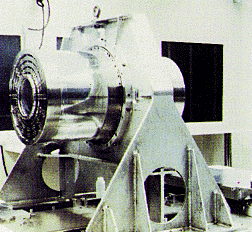
Not with this camera, as X-Rays are hardly ever focussed (they don't bend easily!). Here is an image of a rare and expensive X-ray focussing mirror. You have to use grazing incidence for it to work.
Medical X-ray photographies are simply taken by placing film (or these days a digital detector) behind the body and lighting with X-rays. No focussing is involved. -
Re:Question:Well, once you get through the tough problem of actually landing on the planet, you face a host of unknowns:
- the temperature is extremely cold, and thermal stresses could crack electronic solder joints and/or ruin components
- the batteries find it tough going at low temperatures
- the silicon solar cells degrade over time, losing efficiency
- an unknown amount of dust collects on the cells, how much and how long can you drive it? One of the surprises is that there are "dust devils" on Mars; some of these have actualy blown over the rovers and cleaned much dust off the solar cells! See the link for an amazing time-lapse movie of such winds caught by the rover cameras!
http://www.nasa.gov/vision/universe/solarsystem/m
e r_main.htmlBottom line: when you have thousands of parts in a harsh environment, you just don't know. They built them tough but light, and thought they had a good chance of exceeding 90 days. Thankfully, luck has been on JPL's side, and they're still going! What a success story.
At almost the same time the rovers landed, a European probe was also to land. It was never heard from again, and presumably crashed.
-
Re:Sun reflecting mirrors in space
"A while ago there was some research into giant tinfoil equipped satellites which could redirect sunlight onto the earth during darkness."
Indeed. Here's one plan that would only have cost a couple of billion dollars a time:
http://ntrs.nasa.gov/archive/nasa/casi.ntrs.nasa.g ov/19790076663_1979076663.pdf
Actually makes this EU boondoggle look cheap! -
ease of programming for, ease of usingSo there is growing interest in the notion of "time to solution" as a combination of ease of programming for, ease of using, and of course running a data set on the machine.
Sure, you got it quite right. A computer that's useful for a scientist has tools that can find the eigenvectors of a matrix, calculate the positions of planets in the solar system, solve the Navier-Stokes equation to plot the shock waves around a supersonic wing. Exactly the kind of problems which are so easy to solve using Microsoft Windows... -
Re:Source?
In the case of Columbia, it's listed right on the systems page.
-
Re:If no one wants it..
I don't agree with it either, but basically the only two options for hubble are, 1. a manned mission. 2. throw it away.
There's still work being done towards a robotic mission. -
Re:Make your own 3D images of Mars and things
And they keep claiming there isn't life on Mars...
Pfft...
http://marsrovers.nasa.gov/spotlight/images/3d01h. jpg -
Re:SOHO - sorry, here's faster links
for GIF: http://sohowww.nascom.nasa.gov/data/LATEST/curren
t _c3.gif
or JPEG: http://sohowww.nascom.nasa.gov/data/LATEST/current _c3.mpg
Sorry about that. -
Re:SOHO - sorry, here's faster links
for GIF: http://sohowww.nascom.nasa.gov/data/LATEST/curren
t _c3.gif
or JPEG: http://sohowww.nascom.nasa.gov/data/LATEST/current _c3.mpg
Sorry about that. -
Re:somewhat current sun pic
Thanks, these are fantastic, and this animated one is awe inspiring! http://sohowww.nascom.nasa.gov/data/LATEST/curren
t _eit_304small.gif -
SOHO daily views are best for now
Some of the best images of the sun's daily activity are to be found at SOHO's site, http://sohowww.nascom.nasa.gov/. I check it daily.
If you choose "the sun now" and then the MPEG or animated gif of the LASCO C3 (full res is best - and I'm so sorry SOHO for doing this to you!!!) you can watch as a comet makes a close approach to the sun today. Happens every few days. Sometimes they make it out the back, but most get eaten up. We'll see with this one. -
Make your own 3D images of Mars and things
http://marsrovers.nasa.gov/spotlight/3d01.html
NASA provides a guide for those with Photoshop, to make red / blue stereo images like you see on their website.
If anyone wants to convert the steps in the link to The Gimp 2.2, I'd be very greatful. I get stuck on about step 5 when I paste the 2 colour image into the other grey one and don't get the shaddowy red blue image that needs adjusting. -
Re:Where in Orbit?
Check out the mission website. Cool stuff.
-
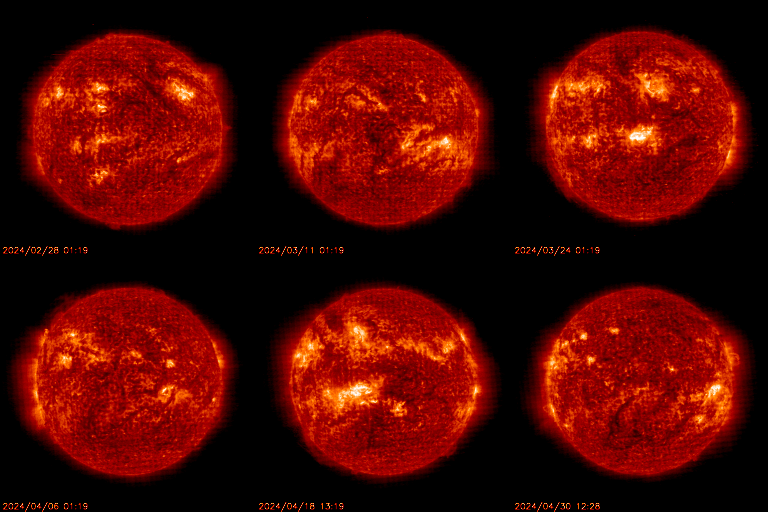
Current sun pics
-
Re:somewhat current sun pic
Here is a link to ALL of the different Sun Pictures in all sorts of wavelengths and formats:
http://sohowww.nascom.nasa.gov/data/realtime/
Yes, those are Live and RealTime Shots
Enjoy!
PS - and yes, that is a NEW set of sunspots getting ready to cross the sun! -
Re:High Anxiety
I think the point here is that the Universe is the whole closed system...where'd it get it's energy from?!?
Gee, I have no idea. -
AKA Alcubierre Warp Drive
This is an old idea from 1994.
Alcubierre, M. "The Warp Drive: Hyper-fast Travel within General Relativity," Classical and Quantum Gravity, 11(5), L73-77 (1994).
Description: http://www.nasa.gov/centers/glenn/research/warp/id eachev.html#alcub -
Been there, done that
"only commercial vehicle that can launch two mainstream telecommunications satellite payloads on the same mission."
The shuttle once launched 3 geosynchonous satellites in a single mission. This is not a big deal. I am surprised the moderators found it news worthy.
-
Re:Reminds me of an old joke
Here's the word on human vacuum exposure from NASA themselves. You can likely survive two minutes or so of hard vacuum exposure without serious injury; after that, you start getting busy with that whole dying thing.
-
Two weeks is nothing
Terrestrial bacteria were found to have survived for three years of lunar exposure. Apollo 12 Commander Pete Conrad who retrieved the camera from which these bacteria were cultured thinks this discovery is the, "most significant thing that we ever found," in the entire Apollo program.
http://science.nasa.gov/newhome/headlines/ast01sep 98_1.htm -
Re:Me too
Just for fun, I did some math:
If there are 1 trillion people in the world and each of them is assigned 1 trillion new IPv6 addresses every day, it will take over 931 billion years to use up all of the possible addresses.
3.4 x 10^38 / (10^12 x 10^12 x 365) = 9.315 x 10^11
By comparison, the sun might swallow the Earth in 4 to 5 billion years. -
Re:The mother of all asteroid deflection devices
$400,000,000 just to launch this thing into a geosynchronous transfer orbit (not counting construction costs). I assume the fuel to move it isn't included in the 20 ton estimate either (since it will burn off on the way) so that would need to be lifted as well.
To be fair, though, NASA spends (or used to spend) an average of $450,000,000 per Space Shuttle mission. If it were shown to be feasible and potentially useful, that sort of cost doesn't seem completely out of proportion. More expensive, certainly, but probably not by several orders of magnitude if it were done well.
-
Re:Double Edged Sword
"This happened in the aeronoughtics (ugh that is spelt bad) industry in the US"
I'm glad you brought that up. I think most people today, and until recently myself included, believe that the problems with the patent system in the United States is something of a new phenomena. This couldn't be further from the truth.
I think there were good intents when the system was first thought up, at least I hope there were, but looking back through history the system has been detrimental to the advancement of the United States as an economic force around the world. And I have two cases as proof.
As you had stated, the United States greatly lagged behind Europe when Aeronautics were in their infancy and in large part this was due to patents. Anyone who doubts this only has to study the history of the NACA and they will discover that this government organization was instrumental in setting up the MAA in 1917 because of "a virtual deadlock in aircraft construction because of patent infringement suits". The efforts of the United States government also included spending tax dollars to purchase patents so as to institute cross licensing that was necessary to spur the aeronautics industry.
http://www.hq.nasa.gov/office/pao/History/Timeline /1915-19.html
So this case makes it appear that the patent system actually does the opposite of what most people are taught its purpose is. But is this the only case? No. Going back even further you will find one George Selden, a New York patent attorney who filed a patent for the road engine, a.k.a. automobile, in 1879. After the patent was granted in 1895 he didn't setup a business making cars based on his new patent, he instead setup an extortion shop which charged each of the car manufacturers a licensing fee to use his patented technology. This guy never built a single car to sell, he just filed a patent and then started charging those who actually did build cars. I suspect this guy never even invented anything automotive but rather just took notice of what others were doing and realized there would be an industry. Henry Ford refused to pay the extortion fee and had to fight this guy in court for 7 years! Selden's company was forced to build a car to prove the patent was valid but they could not build a working car so the patent was thrown out.
http://inventors.about.com/library/weekly/aacarsse ldona.htm
So it appears to me that the patent system may have never worked as advertised from the beginning. Instead of having a system which spurs on industry we have a system which enables bickering among patent holders thus holding back progress and phonies who leech off industries and could never actually produce a real product if their life depended on it.
I don't have any replacement solutions to offer myself, I'm just ranting, but I'm not so sure that we wouldn't be better off with no patent system at all.
burnin -
Compare with current shuttle
20 tons just isn't that big.
The space shuttle masses over 10 metric tons at liftoff itself with its tanks (and for our purposes, metric tons and 2000 pound tons are interchangeable). The shuttle itself is 2 tons and is capable of delivering payloads of up to 25 metric tons.
So a loaded shuttle with enough fuel to take it out of LEO would be good enough - and this spacecraft would be a lot less sophisticated than the shuttle.
Also, given the low thrust requirements for "towing," this could be a good application for the ion drive, which is high efficiency / ultra low thrust. -
Re:Cool - Does that mean...
Possibly, but you can bet Worldwind will have the images, and do something sensible with them.
-
Re:The mother of all asteroid deflection devicesNice illustration of the miniscule strength of gravity relevant to tonnage, and how over long periods of time, it's possible to use gravity assists for just about anything. It is important to understand how weak - but persistent - and wonderful - interactions with gravity can be. The Grand Tour that Voyager went on, for example, or the Interplanetary Superhighway, or Lissajous orbits....
The spacecraft design with the angled rockets is wasteful, but if you are getting the fuel from the asteroid, the fuel is effectively unlimited. But: if you are getting fuel from the asteroid, you should be able to keep the spacecraft attached to the asteroid by the "hoover"ing effect of sucking up the raw material you are ejecting to the sides!! - a force far, far more potent than gravity would be.
Alternatives: You could focus mirrors one side of the asteroid and take advantage of the outgassing...
Or you could (my preference) just mine the asteroid down to nothing long before impact...
After all, covering that 400 million dollar launch cost would be a lot easier if we just shipped a few billion dollars worth of materials back to LEO!
-
Re:The Flying Spaghetti Monster Does Exist
You don't even need to go that far. NASA has pictures. Behold his noodly appendage!