Slashdot Mirror
Domain: nature.com
Stories and comments across the archive that link to nature.com.
Comments · 2,953
-
Re:Do not need to use human cells
They are using human cells because they want to be able to grow a human kidney, lung, heart, pancreas, etc. and transplant them into people that need them.
But there's already plenty of progress with doing that with human stem cells. There's no need to make pig-human hybrids (other than for publicity and publishing papers).
http://www.nature.com/ncb/jour...
http://www.nbcnews.com/health/...
http://www.wired.co.uk/article...
http://www.stemcellresearchfac...
http://www.nephrologynews.com/...Basically there are plenty of other technologies which are actually closer to real-world solutions than this "hybrid" stuff. And this hybrid stuff has lots more ethical and legal issues.
So the disadvantages of making such hybrids outweigh the benefits.
-
Skepticism over claim of metallic hydrogen
Other physicists have expressed skepticism over the Harvard group's claims of making metallic hydrogen. Importantly, the claim is made on the basis of one single experiment that has not yet been replicated by the group reporting the claims. From a news article published in Nature
Other researchers aren't convinced. It’s far from clear that the shiny material the researchers see is actually hydrogen, says geophysicist Alexander Goncharov of the Carnegie Institution for Science in Washington DC. Goncharov has criticized the Silvera lab’s methods before. He suggests that the shiny material may be alumina (aluminium oxide), which coats the tips of the diamonds in the anvil, and may behave differently under pressure.
Loubeyre and others think that Silvera and Dias are overestimating the pressure that they reached, by relying on an imprecise calibration between turns of the screw and pressure inside the anvil. Eugene Gregoryanz, a physicist at the University of Edinburgh, UK, adds that part of the problem is that the researchers took only a single detailed measurement of their sample at the highest pressure — making it hard to see how pressure shifted during the experiment.
-
Some doubts
The paper (preprint in arxiv ) is regarded with serious doubts by many physicists.
-
fake news
-
Re:more disguised opinion
If the facts are so important, why don't you present facts?
We do, we present facts on a regular basis. That's our job.
Problem is, the regular person doesn't spend much time reading academic journals. They'd rather get their news from Facebook or Twitter. So we've created these sensationalist measures to call attention and stir debate on the real facts that otherwise might go unnoticed by the general population.
-
Re:See Also!
While probably much safer than traditional cigarettes, electronic cigarettes still carry risks. For starters the flavoured ones produce toxic and carcinogenic compounds when they are vaporized. See following link for peer reviewed paper on the subject.
http://pubs.acs.org/doi/abs/10...
Here are three peer reviewed papers that show that e-cigarette vapour causes DNA damage
https://academic.oup.com/toxsc...
http://www.sciencedirect.com/s...
http://www.nature.com/ebd/jour...
If you need a low dose of nicotine then I would suggest gum or patches would be safer than e-cigarettes but I doubt even then that it is a zero risk choice because in general there is no such thing as zero risk choice.
-
Contrast this with the incoming administration
Contrast this with the incoming administration which wants to favor fossil fuels above pretty much all else https://www.nytimes.com/2016/05/27/us/politics/donald-trump-global-warming-energy-policy.html, http://www.nature.com/news/trump-s-next-move-scientists-struggle-with-foggy-future-1.21339.
-
Re:Wind and Solar are Environmental Disasters
10,000x more birds are killed by cats than by solar (?!?) and wind? Can you provide a citation for that? I'd like to use it in shutting-up idiots in the future (if true).
Oh, it's quite true. See this recent study for the numbers on wind turbines, and this one for cats*. This report ranks various energy sources; perhaps unsurprisingly coal actually kills the most birds.
It turns out cats kill a lot of animals, making them "the single greatest source of anthropogenic mortality for US birds and mammals." According to that second study, though, most of the deaths are attributable to un-owned cats. The actual numbers from the studies are exactly those quoted by Anaerin above.
* Nature isn't open access but...
-
Re:This may lead to an even more interesting...
Actually this will not do what the BBC headline implies it will, the drug Tideglusib will cause the regeneration of dentine by the natural stem cells present in the pulp cavity, when there is a penetration of the pupal chamber. What this will do is prevent recurring carries (decay) under existing Fillings from turning into crowns and root canals, and prevent recurring carries (decay) under existing crowns from turning into root canals and extractions.
What it's not doing is growing enamal, Growing enamal is the brass ring.
Full article, Promotion of natural tooth repair by small molecule GSK3 antagonists.
Still very good news, if it works on Humans like it does on Rats, that doesn't always happen in the real world. -
Re:Teeth - Britain
Have you seen British teeth in recent decades? Theirs are nicer than those of us who live in the US, now.
Maybe nicer, but only if can pay out of pocket, or you can find an NHS dentist...
Brexit may exasperate this probably as many dentist in the UK come from EU countries...
-
Very misleading article
Both the summary and the article don't know what they are talking about. Reading these will only confuse you.
Read the paper here instead : http://www.nature.com/articles...To summarize :
- ReRAM is a promising type of non-volatile memory.
- Earlier, it was discovered that ReRAM cells could be used to perform computations. This is not news.
- Multi-level ReRAM, which is able to store more than 2 states per cell exist. This is similar to MLC/TLC for flash memory. This is not news.
- The new thing is that with using 6-state cells, they managed to do calculations in base 3 directly. More generally, they said it would be possible to do base-n using 2n-state cells. This is good because higher bases means less cells are required for the same computation. -
Re:Helps, but New York won't run LA's cars and tru
Tell it to Nature that it doesn't work. In the above paper (you can download it on SciHub if you don't have access) they model the creation of an optimal HVDC grid and cross-country solar, wind, and NG peaking plants (as well as one scenario with coal) and end up with reliable, low carbon power at lower costs than current grid rates - with no use of storage and no assumption of improved technologies.
Wind and solar tend to run counter to each other. Wind is strongest at night; solar only generates during the day. Wind is associated with low pressure zones; clear skies with high pressure zones. And while one system is moving off the US east coast, another one (or more) is moving in from the west. A HVDC grid also timeshifts loads - aka, the sun is still shining out west after sundown in the east, and so forth. It also spreads out peaking capabilities across the country. The grid costs about 0.3 cents per kWh to build/maintain but saves about 1.1 cents per kWh in generation hardware costs.
By adding in storage or allowing for tech improvements, the figures only get better. Indeed, the figures they use for solar pricing are already pessimistic. And they make no use of uprating existing hydro for storage (very cheap). Or no pumped hydro storage, which is already cheap in certain areas. No use of battery storage, which although marginal currently due to cost is expected to become vastly cheaper over the next decade. Etc.
New nuclear plants, with their high price tags, have no place. It's nearly an order of magnitude more expensive than renewables per kWh generated, and it sucks for use as peaking (even if you use a plant which can ramp quickly - most can't - you fundamentally (by the nature of peaking) would cut the capacity factor severalfold, which directly corresponds to a severalfold increase in construction / operating / decommissioning costs per kWh generated.
-
Re:Two of those are great certain parts of Califor
This is incorrect.
1) You don't need baseload with intermittent renewables, you need peaking or storage. Nuclear makes for terrible peaking. It's literally the worst non-intermittent option available. Natural gas is the best.
2) With peaking and/or storage and/or a HVDC grid, intermittent renewables can make up the lion's share of the grid. The exact level of penetration depends on the details of the options chosen, but can in some cases even approach 100%. With current tech and current prices, penetrations of ~70-80% are reasonable - and very low carbon.
3) Renewables + peaking is already cheap. Renewables + storage is looking to be heading in that direction.
4) The problem with nuclear is the cost, not the waste. Nuclear plants are absurdly expensive per watt, even ignoring that they get their catastrophic liability coverage provided for free by the federal government.
5) Alpha radiation in free space is harmless, but alpha emitters are exceedingly dangerous. Ingested/inhaled alpha emitters are an order of magnitude more destructive to tissue than neutron, beta and gamma emitters. The fact that they can be inhaled or ingested if leaked into the environment (airborne dust, soil contamination, groundwater contamination) is precisely the reason that you have to contain them. Aka like the reason they've had to spend a fortune cleaning up Hanford Site (estimated ~115B remaining). Without proper containment and disposal procedures, every site would be a Hanford Site.
-
Re:Where's a telco when you need one?Have you actually read the Canadian Supreme Court decision against Schmeiser? It's a complete repudiation of all of Monsanto's claims except for their claim of patent ownership of the seed. And that claim was later disproven.
- The lower court judgement against Schmeiser was reduced to just $1. Why? Because (and the Monsanto apologists never tell you this) Schmeiser never used Round-Up on his crops. He only used Round-Up to kill weeds in the gulleys between his crops and the road. Never on his crops. As such, there was no way for him to benefit from using Monsanto's patented gene (and in fact no incentive for him to steal it).
- He "acquired" the seed when he noticed that some stray canola which was growing in the gulleys survived his anti-weed spraying of Round-Up. Since his canola crop was not Round-Up-Ready, the only way the Round-Up-resistant canola could've gotten there is by falling off a passing truck (the explanation the Court decided was correct), or via natural cross-pollination of his crop with a neighbor's Round-Up-Ready crop (the explanation Schmeiser gave for his behavior).
- The Court decided for Monsanto (5 to 4) because Monsanto claimed it was impossible for the gene to spread by natural cross-pollination as Schmeiser claimed. The Court took Monsanto at their word and decided in their favor because Schmeiser "ought to have known" that any canola which survived spraying with Round-Up was Monsanto's patented seed, not the result of natural cross-pollination.
- Monsanto's argument was disproven a decade later when researchers found the Round-Up-Ready gene could spread to weeds via cross-pollination. Basically, Schmeiser was right and Monsanto was wrong. The gene could spread through cross-pollination, meaning the Round-Up resistant canola he found next to his fields may very well have been the result of natural cross-pollination, and not Monsanto's patented seed. And the only reason the Canadian Supreme Court decided in Monsanto's favor was erroneous.
-
Re:You liedYou said: the claims after Katrina hit 11 years ago that THE GULF COAST would see hurricane after hurricane, claiming there would be 3, 4, maybe over half a dozen per year and offered these links as articles that made this claim. Let's take a look.
This article says nothing about the Gulf coast being hit by 3, 4, maybe over half a dozen hurricanes per year. Just that as there is a observable and measurable correlation between oceans warming and hurricanes growing more frequent and severe.
This article mostly talks about the fact that hurricanes may become more intense and that a category 6 will eventually have to be created if that happens because hurricanes with windspeed ranging from 257.5 kph to 407 kph are being lumped together into category 5. It goes on to speculate that dumping the category system might be a better idea than creating a category 6. Towards the end it even says: This oscillation means the Atlantic is expected to cool in the future, obscuring links among hurricane activity and global warming. Perhaps counterintuitively, recent computer modeling studies predict fewer tropical cyclones if the ocean heats up further as a result of global warming. But they also predict intensification of the ones that do form, albeit with limited confidence. Frequency drops by 6 to 34 percent this century, according to 2010 review article in Nature Geoscience, whereas intensity rises 2 to 11 percent. (Scientific American is part of Nature Publishing Group.) , i.e. fewer hurricanes but the ones we'll get will be more severe. Nothing about the Gulf coast being hit by 3, 4, maybe over half a dozen hurricanes per year.
The independent isn't really a scientific source but all this piece says is that somebody found evidence that warmer oceans seem to be linked to an increase in hurricane frequency and that in a warm year hurricanes are twice as likely as in a cold year. The real news here is that somebody found a way to extract data about hurricanes from old measurements made before the satellite age. They say nothing about the Gulf coast being hit by 3, 4, maybe over half a dozen hurricanes per year.
Still nothing about the Gulf coast being hit by 3, 4, maybe over half a dozen hurricanes per year. It does talk about more hurricanes but the frequency is nothing like you claim: ”If this trend continues, it is realistic to expect a ten-fold increase in hurricanes like Katrina. That amounts to once every two years,”
And yet again nothing about the Gulf coast being hit by 3, 4, maybe over half a dozen hurricanes per year. This guy talks about improvements in computer modelling since 2005 and seems to be making the case that global hurricane frequency will not increase but that the severity of the hurricanes we do get will increase. I.e. about the same number of hurricanes but they'll be more destructive.
Yea, you did a search.
Found all these in less than 1 minute, and everyone voted you up because they want you to be right, but obviously you are not. I like the one claiming Category 6 hurricanes will be hitting any day now.Bonus speech by Al Gore saying the same thing.
Read that long winded piece and it is mostly a regurgitation of d
-
You lied
Story 1
Story 2
Story 3
Story 4
Story 5Yea, you did a search. Found all these in less than 1 minute, and everyone voted you up because they want you to be right, but obviously you are not. I like the one claiming Category 6 hurricanes will be hitting any day now.
Bonus speech by Al Gore saying the same thing.
-
Re:Don't forget about the War on Drugs.
Congratulations for brainlessly repeating the propaganda they instilled in you in elementary school.
Or noting my observations of friends in high school and college who developed problems with cocaine and methamphetamines and either upped dosages over time to "cope" or switched to other equally hard drugs of different families once the high became harder to achieve. But yes, it's anecdotal evidence. YMMV.
What you describe is how it works for reactional users chasing the rush. It is not at all true that your body completely adjusts to low to moderate doses as "the new normal" and you have to increase the dose to get any effect.
Depends on the substance. E or LSD? Sure. Heroin? Not so much.
An interesting exception to the psychiatric taboo against prescribing euphoric drugs is of course in children with ADHD, who are routinely given Ritalin or Adderall (amphetamine, i.e. something that's very very similar to that stuff Walter White was making.)
Good lord man, I mean I know this is Slashdot, but that is one of the most gross oversimplifications of biochemistry I've seen in a long time! Why not revive the bogus "glucose, sucrose, and fructose are the same chemical and are metabolized the same way!" argument all over again while you're at it?
These drugs have significant effects that persist even though the dose is held constant. It's also pretty well-established that constant-dose opioids have persistent effects. In both cases, it's primarily those people who want instant gratification, pure recreational euphoria, who are compelled to raise the dose.
Why yes, dosage and exact chemical makeup are important. Designed and administered in a controlled fashion there is much less risk of adverse side effects. Are you suggesting that self-medicating with euphorics would be more beneficial than the current controlled medications prescribed for panic attacks and depression? Personally, I would find a study on the subject fascinating (though unlikely to occur) and would love to read the results. But I really just want to figure out what, exactly, you're suggesting as an alternative to current drug treatment practices.
Even if you were correct that euphoric drugs (Just Say No!) lose all potency once the body develops tolerance, this would still be an incorrect conclusion.
What about illnesses that are episodic, like sporadic panic attacks (these, too, are often treated with spectacularly ineffective SSRIs)? What about regular cases of depression (as opposed to refractory major depressive disorder), which can often resolve over just a couple months?
I was unaware of SSRIs spectacular ineffectiveness in treating panic attacks or depression. I would be interested in details of the trials showing just how spectacularly ineffective they are. I am, however, aware of a concerns that began within the last couple of years that seemed to show that unpublished clinical trials showed SSRIs to be no more effective than placebos. I felt that the issue was most effectively explained in this article in Molecular Psychology: http://www.nature.com/mp/journal/v21/n4/pdf/mp201553a.pdf. In short, aggregating loosely related symptoms into an overall score instead of focusing specifically on anxiety or depression does indeed make SSRIs look little better than placebos. But if you look at their effectiveness on those areas specifically, they show extremely consistent improvement.
If you're going to nitpick on the outliers, then what about severe depression that does not resolve over just a couple of months and leads to suicide? Is it better to err on the side of overprescription that may buy someone time for treatment through cognitive behavioral therapy to save their life and/or help them put their life back together or is it better to err on the side of not prescribing until you're absolutely sure other options haven't worked and run the risk of the person's life becoming steadily worse or ending altogether?
-
Re:Great for 10% of the population
I can't comment much about your situation, as I don't know where you live. I can, however, say this in general.
* Intermittency is nothing new to grid operators; through the entire history of power generation, they've been having to deal with demand fluctuation and random losses of plants and lines. Hardware is, and always will be, built to the minimum needed to statistically guarantee a given level of uptime
* There have been many, many studies on the issue of high-renewables grids - here's an example covering cost analyses on wind + solar + HVDC + NG peaking (no power storage) using current technology only.
* A HVDC grid actually saves about three times more than it costs due to lower hardware (and thus capital) requirements for grid operators. While HVDC lines and conversion stations pose their own point of failure risks, overall they increase grid stability against localized failures, particularly cascading failures (AC sync failures don't cascade over HVDC). The stability benefits of HVDC links has led to the US to use a number of them even without long lines, just to connect different disjoint grids together (the lines are the cheap part, relatively - it's conversion stations that are expensive). HVDC provides baseload from Quebec hydro to the northeastern US. Europe and China both make heavy use of HVDC - Europe mainly for submarine links, China mainly for bringing power from the interior to the densely populated coast (plus some HVAC). Both have huge expansion plans.
* Large HVDC grids cause both timeshifting (aka, it's nighttime wind in on the east coast during the evening demand peak on the west and on the west coast during the morning rush in the east coast; likewise with solar shifting) and weather diversity (whenever a front is moving off the east, there's almost always a new one (or more) that has come in from the west).
* Solar and wind tend to run counter to each other. Wind peaks at night; solar in the day. High pressure zones create low winds and lots of sun; low pressure zones create high winds and little sun.
* Combined with NG peaking, these factors can provide a statistically guaranteed uptime with low power costs.
* All of this is based around there being no storage - which is a pessimistic assumption:
** Dirt cheap storage can be had by uprating hydro turbine houses, combined with the aforementioned HVDC grid. Hydro thus shifts from baseload to peaking. There's extensive hydro on both coasts that can be uprated.
** Pumped hydro - as standalone plants or as modifications to existing plants - can often be affordable, but depends entirely on local geography.
** Compressed air has gained some interest, although is not yet cost effective.
** Batteries used to be by far the most expensive option, but their prices too have been plummeting, to the point that li-ion is starting to make some grid penetration. There's not going to be some huge takeoff of it at current prices, but given that large scale production (gigafactory, etc) is expected to halve costs, that would seriously take off. There's other rival chemistries also seeking for the low cost per-Wh / per-W crown.
But, storage is not a necessity when you have peaking, source diversity, and geographic diversity with a modern, well-connected grid.
-
Re:Didn't we see it coming?
Didn't we have bunch of articles some time ago about melting permafrost, bubbling tundra and the positive feedback loop this creates?
But here's a better one: Soil bacteria methane. It's not just the trees. As temperatures rise, soil bacteria which produce methane become more active...
-
Re:There's an obvious alternative explanation
Thanks, I didn't know that about starch digestion. Brings me back to Jared Diamond's book "The Third Chimpanzee" which theorized that the need to consume tubers was a major driver in human divergence from other apes. Heck, starch might even have been mentioned in that book but I don't remember it.
-
Re: You mean, like Global Warming?!??
Ooh sounds like a conspiracy theory, do tell so it can be debunked.
Jones refused to release his data and his algorithms meaning it was impossible to vet and review his claims. Of course, Michael Mann (he who wanted to hide the decline in his own data) now states that we don't really need data because we can just see what happens. Data is irrelevant, anecdotal evidence is all that one needs.
-
Re:the cause of this sudden decline
Peer reviewers. Other scientists. A vital part of the scientific process is validation and verification.
Don’t trust everything you read in the psychology literature. In fact, two thirds of it should probably be distrusted.
-
So how to get more seaweed? - more CO2
Seaweed grows faster with more CO2 - just one of those facts that interferes with the dominate narrative.
That being said - Instead, they should feed seaweed to chickens instead of corn - chicken meat is super high in LA(the most common O-6) - I think LA is the likely cause of the obesity pandemic and the great increase in depression after the 1960's when it was introduced on the market. Concentrated veg oils are obviously not human food.
The increase in CO2 has slowed - in part due to the great increase of plant mass:
http://www.nature.com/articles...
"Over the past 50 years, the amount of CO2 absorbed by the oceans and terrestrial biosphere annually has more than doubled"
Not sure how this can be happening - as everyone says the science is settled...
So what happens if it doubles again over the next 50 years?
-
Re:20% of GHGs not from ruminant animals really
Paddy fields account for around 20% of human-related emissions of methane... http://www.nature.com/news/200...
-
Re:Oceans
Most corals regulate their internal pH and studies in Australia several years ago found that the lowering of pH from CO2 rates increasing might actually increase calcification rates.
Study results: http://www.nature.com/nclimate...
Presentation of results: https://www.youtube.com/watch?... -
Re:Ummm, OK...
you need a few star lifetime iterations to produce enough "metals" (for astronomers anything above hellium is a metal) for life to be viable.
This is probably true. But those stellar generations are not the generations of common stars (dwarf stars, up to, for example, the Sun's mass), but the lifetime of larger, faster evolving stars. You don't get metals further up the periodic table than carbon from a Sun-mass star. The lifetimes of such stars (say, more than 3 Sun masses ; I forget where the exact dividing line is for stars getting up to burning silicon to iron. It's somewhere near that mass.) is much shorter - more like a half billion years, The time for the ejecta from a supernova to become incorporated into the next generation of stars is more significant than the lifetime of the stars.
Interestingly, there is a fair correlation between the metallicity of a host star and it hosting a "super-Jupiter," but that correlation breaks down for smaller (Neptune-size and Earth-size) planets. While they still form around stars with a solar-similar metallicity on average, they're not more common around higher metallicity. That's odd. There's something going on there that works against the obvious expectation of how things go. I don't know about you, but I'd take that as a sign to pay more attention to observational data than theory.
they have other problems that are harmful to life in our sense
The study was (as is normal) carried out with the assumption of the stability zone of liquid water as the criterion for "habitable zone". No other constraint. You might be interested in finding something that would find William Shatner attractive - even if only as food - but that's not the only thing "life" could plausibly mean. A prokaryote-grade of organism with a non-nucleic acid genetic system would be far more interesting than something that beat Shatner at chess with an RNA-world type genetic system.
-
Water vapour feedback is an emergent property
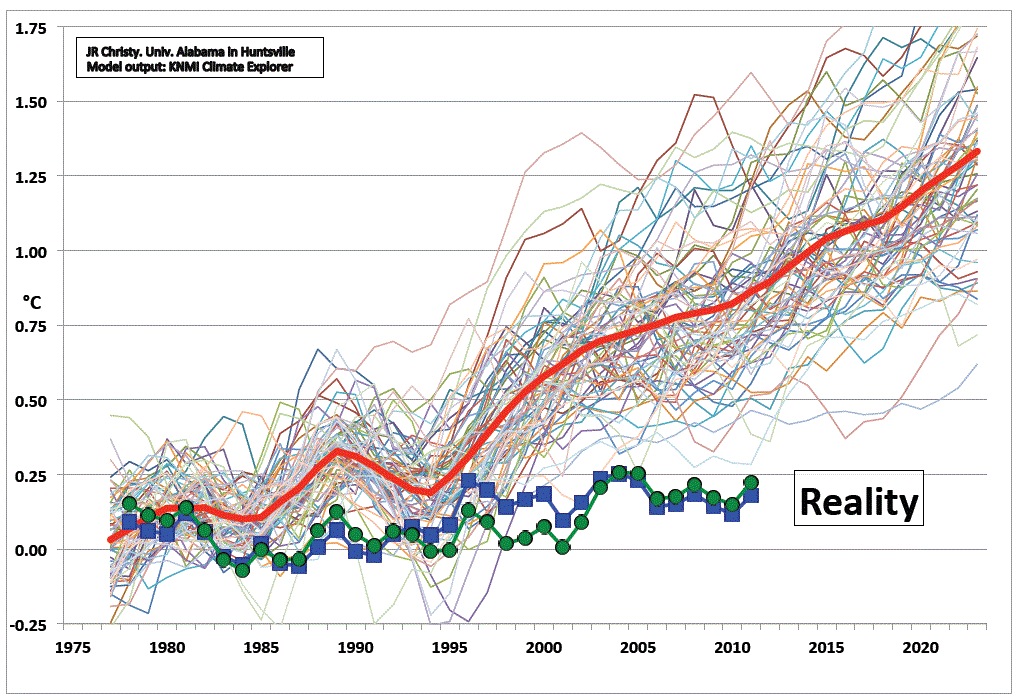
All the models include a CO2/Water vapor positive feedback coefficient.
Wrong. This is an emergent property in models, not a built-in assumption. It is also confirmed by real world observations today (e.g., here and here).
-
Re:Psychology. Salt required.
is that so? I'm sure some psychology is science, but the fact is that a lot of it isn't.
-
Re:And I keep coming back to my same question
-
climate models
-
Re:climate change deniers (you!)
You have cited no research at all.
Every one of my links is well-sourced with numerous references to peer-reviewed research to support the argument that they (and I) are making. I'm not the one making completely unsupported assertions here.
the IPCC represents opinion, not fact
In your own opinion. In everyone else's, the IPCC's summaries and countless references to peer-reviewed research are a heck of a lot more reliable than some random web comment.
you are pointing to the 2007 report
Your point is? Would you like me to cite more cost-benefit research? There's plenty out there. Or perhaps you'd care to present actual evidence for a change?
That's an assumption you're making without any justification.
Well, only justified by the historical track record of successful government interventions in other emissions issues, as I stated further down. Where's the justification for your own assumptions?
you haven't cited any research
No, you've just dismissed and ignored it all.
putting solar cells on the roof and buying electricity from renewable sources
Good for you. Leaving aside all the people in rental properties, apartment buildings, shaded areas, multistory shopping malls, industrial factories, developing nations etc who can't meet their needs with solar cells, how many of them have any alternate options of renewable grid sources? What makes you so confident they will get an alternate option in any reasonable time-frame, if fossil-fuel companies are allowed to continue offloading their biggest costs?
The existence of externalities a century from now
Well, those and the hundreds of billions annually in health costs that I already mentioned.
even for RCP8.5, sea level rise by 2100 will likely stay below 3 ft, yet you conjure up disaster scenarios.
And you think 3 feet isn't a problem? The research I didn't conjure is concerned with rises beyond 2100 - if their model is valid, there could be far more drastic sea level rise over the next 500 years than was anticipated, to the point that almost every coastal city on the globe will be heavily flooded. I'd like to see that possible scenario avoided, and I don't share your faith that it'll automatically happen on its own.
making any other arguments irrelevant
And here you've lost me. Leaving aside the various other studies that disagree with you, your apparent insistence that all other human, social, and health costs, risks & uncertainties, etc are completely valueless in your cost-benefit analysis makes any further discussion fairly pointless. If discounted direct costs are your only metric for action then I don't see that we can agree on anything.
I'll leave you with this: most current power stations will EOL sometime in the next 30 years anyway, and will need to be replaced. So long as they are required to be replaced with low- or zero-carbon alternatives, be they wind, solar, nuclear, or whatever, then we will have eliminated a lot of our CO2 emissions at minimal additional cost, especially considering that renewables have low ongoing costs. Similarly, most vehicles will be up for replacement in much the same time frame, and mandating most replacements to low- or zero-carbon (EV, hydrogen, biodiesel, etc) would also have a relatively low impa
-
Re:Weather != Climate
This isn't a standard climate simulation either; it's (relatively) short-term and local, somewhere between "climate" and "weather".
The original paper is actually an improved simulation of the North Atlantic Oscillation, which "profoundly influences European and North American winter weather".
-
Re:Exhibit A
-
Re:Arbitary definitions
could I suppose redefine the pound if Earth's gravitational field changed that would have to be an affirmative action - it would not automatically change because the reference value is a chosen one, not a natural one
A change might also be provoked by an improvement in the precision of our technology (very unlikely to happen) or an agreement on a different value. These situations have happened relatively often by also affecting some inter-related units (e.g., the new AU value affected other units like parsec). If such a modification occurred, the pound-force definition would certainly be updated.
For purposes of defining the pound (force) we are talking about the rate of acceleration due to gravity under a standard (nominal earth's surface) gravitational field
A force is defined as a function of mass (any) and acceleration (any). The force unit in metric units is defined according to such generic ideas; that's why one newton equals kg*m/s2 (i.e., mass unit * acceleration unit). On the other hand, the English-system-based units are defined according to a different approach: each of them individually. The newton can always be divided into its constituent units; the pound-force cannot, because it has no constituent units. To convert pound-force to newtons (or to other force units; or to relate it to the corresponding mass unit, if you prefer), it was decided to rely on the constant acceleration of gravity. That's why pound-force depends on gravity (understood as the commonly-accepted constant) and its definition would have to be updated in case of changing such a constant.
In any case, note that the whole point of my comment was highlighting that the original statement "depends on gravity" was right; at least, as I understood it: a reference to the used-everywhere constant acceleration of gravity. Your comment interprets the word "gravity" in a way which, in my opinion, neither was that AC's intention nor is a usual interpretation. I do use gravity as synonym to 9.8... m/s2, commonly-accepted-as-acceleration-of-gravity constant and most of people get my intention right. -
everybody will die
Everybody on these missions will die.
There is no known way to protect spacefarers from galactic cosmic radiation.
The Apollo astronauts were in deep space for a little less than two weeks and look what happened: http://www.nature.com/articles...
-
Re:Elephants have a defense against cancer
And it's surprisingly simple. And they need it, because they have so many more cells than people do they would have a high risk of cancer without some sort of defense.
http://www.nature.com/news/how...
To summarize the contents of the link, elephants just have 20 copies of the p53 gene. To incite cancer, all the copies would have to be disabled, via the most common cancer generating mutation mechanism.
If you want to engineer people to be cancer resistant, it might be as simple as introducing more copies of the p53 gene into our genome.
the p16 and p27 genes of the naked mole rat perform a similar function and we human have just the p16 and a crappier version too.
-
Elephants have a defense against cancer
And it's surprisingly simple. And they need it, because they have so many more cells than people do they would have a high risk of cancer without some sort of defense.
http://www.nature.com/news/how...
To summarize the contents of the link, elephants just have 20 copies of the p53 gene. To incite cancer, all the copies would have to be disabled, via the most common cancer generating mutation mechanism.
If you want to engineer people to be cancer resistant, it might be as simple as introducing more copies of the p53 gene into our genome.
-
But climate change is a myth!!!
The GOP, the oil industry, and The Donald ALL agree!
Stories from Nature Magazine suggesting permanent droughts in California http://www.nature.com/articles... are just fear mongering to distract you from your civic obligation to consume conspicuously and excessively!
Industry must continue to grow eternally, or the financial Apocalypse will happen!
remember, Jesus will come and fix everything, so its all good!
-
Re: Why do people continue to believe alarmist cra
Global Warming is causing major extinctions - citation: Gawker Media
Also in the study cited just two posts up from yours - Barnosky, Matzki , et al. Nature, 2011. Talk about willful blindness.
-
Re: Yes
The Germans would disagree with you (and they're not the only ones). Even aircrews within the protection of Earth's magnetosphere flying at high altitudes receive higher radiation doses (the FAA classifies flight crew as radiation workers, and on average they receive twice the radiation exposure of someone working in a nuclear power plant). >p>The moon doesn't have the protection the earth does. And it looks like the Apollo moon walkers have a much higher rate of radiation-induced cardiovascular disease than those who stayed within the earth's radiation shield.
-
Re:In 1348 the Black Death took 60%
Interestingly, I believe we still haven't conclusively determined yet that the Black Death was also caused by Yersinia pestis. Some interesting alternative explanations exist. Or at least they did a few years ago.
The fact that Y. pestis is responsible for the Black Death was conclusively determined a few years ago. In fact, the paleopathologist quoted in the featured article, Dr. Kirsten Bos, is the first author of a 2011 Nature paper presenting a genome of Yersinia pestis recovered from the remains of victims of the Black Death:
Kirsten I. Bos*, Verena J. Schuenemann*, G. Brian Golding, Hernán A. Burbano, Nicholas Waglechner, Brian K. Coombes, Joseph B. McPhee, Sharon N. DeWitte, Matthias Meyer, Sarah Schmedes, James Wood, David J. D. Earn, D. Ann Herring, Peter Bauer, Hendrik N. Poinar, Johannes Krause. “A draft genome of Yersinia pestis from victims of the Black Death”. Nature 478: 506–510. doi:10.1038/nature10549
-
Re:Might want to think about that...
Citation from another thread in this topic:
http://www.nature.com/news/201... -
Re:Somebody please mod this ignorant crap down.
I admitted that I was wrong about the honeybees immediately. I still maintain that's not the real topic here. The real topic, at least as I understood it, was the massive meta story of major publications giving serious ink to the idea of killing all 12 species of mosquitos. I did some reading realized I was wrong about the honeybees. This misinformation is extremely common as the media focuses on it and the meme has spread unhindered by fact checking. There are a number of species of wild bees that are indigeous that are the concern of the the scientists looking this problem. They were not looking at honeybees but somehow that point got lost in translation, a side effect of something getting repeated enough it becomes accepted, received truth. Scientists were concerned about THOSE bees all along. That's a valid concern they have. I learned something new today. The story of honeybees is bullshit. That doesn't necessarily mean nothing to see here, move along, these aren't the droids you're looking for. When I learn I'm wrong I don't just run and hide, I try to figure out what the truth. The first step is admitting when you're wrong. I've been involved in a lot of discussions and a lot of people have trouble with admitting fault and tend to decide something and then take an almost religious position to salvage ego. I could have brought out the smoke and mirror about honeybees because it kind of through me off balance to be completely wrong on a truth I've "known" for years. There are plenty of people in my shoes who would not have admitted even to themselves they were wrong. I've also found that a lot of people are libertarians, conservatives, liberals, socialists, you name it. That's almost as bad and requires some of the same intellectual hand waiving. I just said I'm wrong but that doesn't mean I run and hide. The fucking honey bees aren't the only thing going on here. http://www.nature.com/news/201... And you've seen the dozen other stories on this and who knows how many me to pieces today.
-
Re:Somebody please mod this ignorant crap down.
I made a mistake and posted anon. Moderators, to delete the dupe? I'll concede you're right on "honey bees." It's sort of nomenclature and visibility problem. We talk about and see honey bees routinely. The bees scientists are concerned about are these: http://www.wired.com/2015/04/y... Most of the arguments I could find that are new seemed like cheap click bait. I went back to a Nature piece from 2010 that's premise isn't precisely the same because it extends beyond North America. But let's be real, if the US goes that route, others will follow. It's going to be a global effort. http://www.nature.com/news/201... I really ask that you consider this with an open mind. I probably am not going to be able to sell you on the idea that this is a problem, and I don't know if spraying to the extent that it would take to kill all the mosquitoes would have on bees AND other parts of the system, including the effect of killing off all the mosquitoes, food for many species of birds and other insects. I'm not trying to take a hard stand against the complete extermination of 12 species of this insect, distributed across the entire continent. That's not a Saturday afternoon job by the exterminator. It's massive industrial sized effort to cause the complete extinction of 12 species of mosquitos. I don't know of a time in history where humans have successfully intentionally killed off a species. It's not that easy. A little bit of stagnant water here and there and they creep back in. Then there will be unintended consequences of killing off a prey species for birds and insects in many different habitats. There are a whole lot of risks but the tone I get from you is you've made up your mind already. Do you want your position to be true and have no ego over beating me? I'll concede I'm no bee expert. Not even close. I don't understand how the global Gaie works, nor do I even understand really how even the smallest unit of ecosystem works. I've got some humility around this. I'm now realizing I was wrong on the honey bees. They're a red heron. It'd be about as useful to focus on them as it would be to focus on the well being of the canary as you mine. I hope you're open to the truth as I'm trying to be. I'm basically acknowledging that I know almost nothing about the effects of exterminating these species would be and frankly I think you've already been sold a POV and you've completely bought in. That's OK maybe the evidence is so strong and you're convinced with good reason that this is not only the right thing to do, the effects on the system will be trivial so let's just go for it. Also, it's insulting to basically call what I'm saying ignorant crap. I'm someone who will concede an error or even that I'm wrong on an entire issue but if I have a misconception or am distracted by something far from the core issue, chances are there are others too. Correct me with a strong argument and help educate me and others. You can't insult your way to any gain for your position. The people using pejoratives such as neo-luddite are using the same sort of tactics. It's not how civilized smart people have conversations. Alll ideologies and ism are fucking crap, including whatever one has you and the others that toss insults. I've found that people who use cheap tactics usually have an ideology. All ism's are rubbish. Every single one. Argue to read the truth not support the decision you already made.
-
Re: Law of unintended consequences, also frosty
The only dire consequence of eliminating these is that great Green boogeyman of more humans surviving tropical diseases. Mosquito-eating species can easily switch to other, similar, bugs: http://www.nature.com/news/201...
That very article, midway through, discusses the potential pitfalls that would result. It openly says that Arctic tundra (which is very fragile) would definitely be seriously affected. It then quotes a study noting that one species of birds reduces egg laying by one third just in reaction to dropped mosquito populations.
The article repeatedly says "yes, mosquitos serve important niches, but other species will step up to the plate" while steadfastly to reflect on how the changes in those populations will spiral out. It admits that human populations will benefit both in health (which is undeniable) and growth, but doesn't bother to bring up the consequences of either. It closes out with a quote from an entomologist from a mosquito control association, admitting that it's entirely possible something worse could spring out of it.
Sure, the article tries to make it sound like mosquitos being gone would be an unassailable net good for the earth, but it refuses to back it up.
-
Re: Law of unintended consequences, also frosty
You can't imagine consequences because you lack any kind of knowledge about nature.
While they are undesirable for humans, mosquitoes are the source of food of a very large number of animals. Bats, lizards, frogs, fish, birds, etc many of them survive on eating mosquitoes. Kill the mosquito and you will be killing a good number of species of animals that depend on them.
Not so, actually: out of the 3,500 species of mosquitos out there, only about 200 bite man. The only dire consequence of eliminating these is that great Green boogeyman of more humans surviving tropical diseases. Mosquito-eating species can easily switch to other, similar, bugs:
http://www.nature.com/news/201... -
Re:Pierson's Puppeteers
What went wrong with that link?
Ah, that's better. -
Re:The name says it all...
Not sure about that, but it's definitely a dong.
-
We'll just move
Who cares? By the time the results of global warming become catastrophic, we'll have the means to move to the newly found second earth. We're all gonna make it.
-
Too early to get excited
So far the evidence is limited to one experiment. There will be more of them within a year or two from different teams, then we can have more confidence. So far, there are interesting, internally consistent possible explanations from two teams for this anomaly, but they are not so easy to fit in the current model as to accept them immediately. For all we know, this may go the same way as the FTL neutrinos, etc.