Slashdot Mirror
Domain: networkworld.com
Stories and comments across the archive that link to networkworld.com.
Stories · 2,229
-
Woman Uses 'Hey Siri' To Call An Ambulance and Help Save Her Child's Life (networkworld.com)
An anonymous reader quotes a report from Networkworld: When Apple released the iPhone 6s, it included a great new Siri feature which enables users to activate the intelligent assistant via voice. Dubbed 'Hey Siri,' the feature is particularly convenient because the iPhone 6s' M9 motion co-processor is 'always listening' and thereby lets users use 'Hey Siri' even when the device isn't connected to a power source. Recently, Stacey Gleeson of Australia used the 'Hey Siri' feature to successfully call an ambulance while she was tending to her daughter Giana who had stopped breathing. "I picked her up and sat down with her on the floor," Gleeson said in an interview. "And as I checked her airways, I looked over and remembered my phone." Thinking quick on her feet, Gleeson said, "Hey Siri, call the ambulance." Fortunately, Gleeson managed to resuscitate her daughter while the ambulance was in route. And while it's impossible to know for sure, it's entirely possible that the time Gleeson saved by not having to call an ambulance manually helped save her daughter's life. "Saving me the trouble of having to physically dial emergency services was a godsend," Gleeson said. -
Qualcomm's Connected Car Reference Platform To Connect Smart Cars To Everything (networkworld.com)
An anonymous reader writes: Qualcomm wants to supply the next generation of autonomous and connected cars with networking to connect everything inside and outside of the cars. That means 5G, WiFi, Bluetooth, GNSS, DSRC, V2X, OABR, CAN, etc. ... [Networkworld reports: "Qualcomm today announced its Connected Car Reference Platform intended for the car industry to use to build prototypes of the next-generation connected car. Every category from economy to luxury car will be much smarter than the connected luxury car of today, creating a big opportunity for Qualcomm to supply semiconductors to automakers and suppliers. Qualcomm described the following features of the Connected Car Reference Platform in its release:
Scalability: Using a common framework that scales from a basic telematics control unit (TCU) up to a highly integrated wireless gateway, connecting multiple electronic control units (ECUs) within the car and supporting critical functions, such as over-the-air software upgrades and data collection and analytics.
Future-proofing: Allowing the vehicleâ(TM)s connectivity hardware and software to be upgraded through its life cycle, providing automakers with a migration path from Dedicated Short Range Communications (DSRC) to hybrid/cellular V2X and from 4G LTE to 5G.
Wireless coexistence: Managing concurrent operation of multiple wireless technologies using the same spectrum frequencies, such as Wi-Fi, Bluetooth and Bluetooth Low Energy.
OEM and third-party applications support: Providing a secure framework for the development and execution of custom applications."] -
Tor Browser 6.0: Ditches SHA-1 Support, Uses DuckDuckGo For Default Search Results (torproject.org)
The version 6.0 of Tor Browser, a free software for enabling anonymous communication, is now available to download. The new version introduces several changes, including disabling SHA-1 support, and removing Mac Gatekeeper issue. Another big change is that Tor now uses DuckDuckGo for search results by default. The Tor Project, people behind Tor, add that the "updater is not relying on the signature alone, but is checking the hash of the downloaded update file as well before applying it." More details on NetworkWorld. -
FCC Formalizes Massive Fines For Selling, Using Cell-Phone Jammers (networkworld.com)
An anonymous reader quotes a report from Network World: Two years ago the FCC announced its intention to fine a Chinese electronics maker $34.9 million and a Florida man $48,000 for respectively selling and using illegal cell-phone jammers. Today the agency has issued press releases telling us that those fines have finally been made official, without either of the offending parties having bothered to mount a formal defense of their actions. From the press release announcing the fine against CTS. Technology: "[...] The company's website falsely claimed that some jammers had been approved by the FCC, and advertised that the company could ship signal jammers to consumers in the United States." The company did not respond to the FCC's allegations, although the agency does report that changes were made to its website that appear to be aimed at complying with U.S. law. Next up is Florida man, Jason R. Humphreys, who is alleged to have used a jammer on his commute: "Mr. Humphreys' illegal operation of the jammer continued for up to two years, caused interference to cellular service along Interstate 4, and disrupted police communications." Last Fall, a Chicagoan was arrested for using a cell-phone jammer to make his subway commute more tolerable. -
DARPA Extreme DDOS Project Transforming Network Attack Mitigation (networkworld.com)
coondoggie quotes a report from Networkworld: Researchers with the Defense Advanced Research Projects Agency (DARPA) have quickly moved to alter the way the military, public and private enterprises protect their networks from high-and low-speed distributed denial-of-service attacks with a program called Extreme DDoS Defense (XD3). The agency has since September awarded seven XD3 multi-million contracts to Georgia Tech, George Mason University, Invincea Labs, Raytheon BBN, Vencore Labs (two contracts) and this week to the University of Pennsylvania to radically alter DDOS defenses. One more contract is expected under the program. [DARPA says the XD3 program looks to develop technologies that: Thwart DDos attacks by dispersing cyber assets (physically and/or logically) to complicate adversarial targeting, disguise the characteristics and behaviors of those assets to confuse or deceive the adversary, blunt the effects of attacks that succeed in penetrating other defensive measures by using adaptive mitigation techniques on endpoints such as mission-critical servers.] -
NASA's Planet Hunter Spots Record 1,284 New Planets, 9 In A Habitable Zone (networkworld.com)
coondoggie quotes a report from Network World: NASA's planet hunting space telescope Kepler added a record 1,284 confirmed planets to its already impressive discoveries of extraterrestrial worlds. [This batch of planets is the largest single account of new planets since Kepler launched in 2009 and more than doubles the number of confirmed planets realized by the space telescope so far to more than 2,300.] The discoveries were a result of an automated technique implemented in a publicly available custom software package called Vespa, which lets scientists analyze thousands of signals Kepler has identified to determine which are most likely to be caused by planets and which are caused by non-planetary objects such as stars. "Vespa computed the reliability values for over 7,000 signals identified in the latest Kepler catalog which identified 4,302 potential planets and verified the 1,284 planets with 99% certainty," said the Princeton researchers that developed Vespa. NASA said, based on their size, nearly 550 of the validated planets could be rocky like Earth. Nine of which orbit in their sun's habitable zone. -
FTC Orders Apple, Google, Microsoft, BlackBerry, Samsung To Divulge Mobile Security Practices (networkworld.com)
coondoggie quotes a report from Networkworld: The Federal Trade Commission today said it issued a 10-page letter to eight leading players in the mobile communications arena requiring them to tell the agency how they issue security updates to address vulnerabilities in smartphones, tablets, and other mobile devices. Apple, BlackBerry, Google, HTC America, LG Electronics, Microsoft, Motorola Mobility, and Samsung must provide the following: The factors that they consider in deciding whether to patch a vulnerability on a particular mobile device, detailed data on the specific mobile devices they have offered for sale to consumers since August 2013, the vulnerabilities that have affected those devices, and whether and when the company patched such vulnerabilities. -
Nvidia GPU-Powered Autonomous Car Teaches Itself To See And Steer (networkworld.com)
An anonymous reader quotes a report from Network World discussing Nvidia's project called DAVE2, where their engineering team built a self-driving car with one camera, one Drive-PX embedded computer and only 72 hours of training data: Neural networks and image recognition applications such as self-driving cars have exploded recently for two reasons. First, Graphical Processing Units (GPU) used to render graphics in mobile phones became powerful and inexpensive. GPUs densely packed onto board-level supercomputers are very good at solving massively parallel neural network problems and are inexpensive enough for every AI researcher and software developer to buy. Second, large, labeled image datasets have become available to train massively parallel neural networks implemented on GPUs to see and perceive the world of objects captured by cameras. The Nvidia team trained a convolutional neural network (CNN) to map raw pixels from a single front-facing camera directly to steering commands. Nvidia's breakthrough is the autonomous vehicle automatically taught itself by watching how a human drove, the internal representations of the processing steps of seeing the road ahead and steering the autonomous vehicle without explicitly training it to detect features such as roads and lanes. -
Almost Two-Thirds of Software Companies Contributing To Open Source, Says Survey (networkworld.com)
Reader alphadogg writes: Open source's march toward preeminence in business software continued over the past year, according to a survey released by open source management provider Black Duck Software and venture capital firm North Bridge. Roughly two-thirds of respondents to the survey -- which was administered online and drew 1,300 respondents -- said that their companies encouraged developers to contribute to open-source projects, and a similar proportion said that they were actively engaged in doing so already. That's a 5% increase from the previous year's survey. -
NASA Gives Solar Ionic Propulsion A Monster Boost (networkworld.com)
coondoggie quotes a report from Network World: NASA this week took a giant step toward using solar electric power for future space missions by awarding a $67 million contract to Aerojet Rocketdyne to develop an advanced electric propulsion system. Network World writes, "Specifically, Aerojet Rocketdyne will develop and deliver an integrated electric propulsion system -- known as the Advanced Electric Propulsion System (AEPS) -- consisting of a thruster, power processing unit (PPU), low-pressure xenon flow controller, and electrical harness. Such a system would deploy large solar arrays that can be used to convert sunlight into electrical power that ionizes atoms of xenon which is the propellant for the spacecraftâ(TM)s thrusters. In addition, such a power plant could potentially increase spaceflight fuel efficiency by 10 times over current chemical propulsion technology and more than double thrust capability compared to current electric propulsion systems, NASA said." NASA's plan is to use this propulsion system on its future Asteroid Redirect Mission, as well as on its mission to Mars. -
RIP Prince, A Legendary Musician With A Complicated Internet History (networkworld.com)
alphadogg writes: Reflecting on the popular musician's uneasy relationship with the Internet and social media upon the 57-year-old surprising death. In 2010, Prince "famously shuttered his LotusFlow3r.com website," proclaiming that "The Internet is completely over... All these computers and digital gadgets are no good. They just fill your head with numbers and that can't be good for you." In 2014, The Guardian ran a story titled "Prince quits the Internet," after the singer deleted his social media accounts. He filed a lawsuit against his fans, which was later dropped, for sharing bootlegged copies of his music online. He even banned fans from taking smartphone photos at his concerts in 2013. Prince did seem to open up to the Internet to some degree in the past couple years. Prince's HTNRUN album was posted on Jay Z's Tidal music site last year. In Silicon Valley, Prince is being remembered as a social innovator and a passionate advocate for Black youth," inspiring YesWeCode, Van Jones' initiative to teach 100,000 low-income kids to write code, and hackathons across the country to expose kids in underserved communities to computer science. Bob Brown from Networkworld writes, "News of Prince's death Thursday briefly crashed the TMZ news site. From there, fans flocked to the Internet and social media to mourn this music star who did his darnedest to stay off the grid." RIP Prince. -
RIP Prince, A Legendary Musician With A Complicated Internet History (networkworld.com)
alphadogg writes: Reflecting on the popular musician's uneasy relationship with the Internet and social media upon the 57-year-old surprising death. In 2010, Prince "famously shuttered his LotusFlow3r.com website," proclaiming that "The Internet is completely over... All these computers and digital gadgets are no good. They just fill your head with numbers and that can't be good for you." In 2014, The Guardian ran a story titled "Prince quits the Internet," after the singer deleted his social media accounts. He filed a lawsuit against his fans, which was later dropped, for sharing bootlegged copies of his music online. He even banned fans from taking smartphone photos at his concerts in 2013. Prince did seem to open up to the Internet to some degree in the past couple years. Prince's HTNRUN album was posted on Jay Z's Tidal music site last year. In Silicon Valley, Prince is being remembered as a social innovator and a passionate advocate for Black youth," inspiring YesWeCode, Van Jones' initiative to teach 100,000 low-income kids to write code, and hackathons across the country to expose kids in underserved communities to computer science. Bob Brown from Networkworld writes, "News of Prince's death Thursday briefly crashed the TMZ news site. From there, fans flocked to the Internet and social media to mourn this music star who did his darnedest to stay off the grid." RIP Prince. -
Magic Leap Adds Virtual Reality Head-Tracking and Possibly Hand-Tracking (networkworld.com)
An anonymous reader quotes a report from Networkworld: Magic Leap has made progress. A year ago, the MR apparatus wasn't really wearable. This may have been due to the sheer size of the prototype hardware, or the software that adjusts the illusion for head movement and changes in perspective may not have been completed. The complexity of the mathematics of this head-tracking applied to the complexity of the mathematics of Magic Leap's proprietary light-field chip may have required more development time. The Wired report of Kelly's experience indicates the prototype headset he tested is now wearable, perhaps untethered from a high-powered graphics-rendering computer used by the Oculus Rift and HTC Vive. Kelly's report raises the question: Could Magic Leap have implemented hand-tracking, too? He writes, "When I raise a hand, it approaches and extends a glowing appendage to touch my fingertip." -
NASA: Top 10 Space Junk Missions (networkworld.com)
coondoggie writes: NASA' s Orbital Debris Program Office said that by far the source of the greatest amount of orbital debris remains the Fengyun-1C spacecraft, which was the target of a People's Republic of China anti-satellite test in January 2007. Much more debris is now floating around Earth's atmosphere since the six years NASA last looked at the top 10 space junk missions. The space agency says that 10 missions out of the 5,160 space missions that have launched since 1957 account for approximately one-third of all cataloged objects now in Earth orbit. NASA said that the second and fourth most significant satellite breakups are Cosmos 2251 and Iridium 33 spacecraft, which were involved in the first ever accidental satellite collision February 2009. -
AMC Drops 'Texting Friendly' Theaters Idea (networkworld.com)
netbuzz writes: Stung by a ferocious backlash on social media, AMC Entertainment this morning took to Twitter to announce that it will not be experimenting with "texting friendly" movie theaters, a trial balloon floated only days ago by the company's boss. "NO TEXTING AT AMC. Won't happen. You spoke. We listened," the company said.That escalated quickly. -
Optional Windows Update Aims To Halt Wireless Mouse Hijacking
Reader itwbennett writes: An optional Windows patch released Tuesday protects against an attack, dubbed MouseJack that affects wireless mice and keyboards from many manufacturers, including Microsoft and allows attackers to spoof a wireless mouse from up to 100 meters away and send rogue keystrokes instead of clicks to a computer. According to a Microsoft security advisory, the devices affected by this attack are: Sculpt Ergonomic mouse, Sculpt Mobile Mouse, Wireless Mobile Mouse 3000 v2.0, Wireless Mobile Mouse 3500, Wireless Mobile Mouse 4000, Wireless Mouse 1000, Wireless Mouse 2000, Wireless Mouse 5000 and Arc Touch Mouse. But Marc Newlin, one of the researchers who developed the attack said on Twitter that the patch doesn't go far enough and 'injection still works against MS Sculpt Ergonomic Mouse and non-MS mice.' -
The Battle Between LTE and Wi-Fi May Have Left LTE-U Out In the Cold (networkworld.com)
alphadogg quotes a report from Networkworld: After more than a year of rancor over whether it would hurt Wi-Fi, a technology that lets LTE networks use unlicensed spectrum may have already missed its window of opportunity. LTE-Unlicensed is designed to improve cellular service by tapping into some of the frequencies used by Wi-Fi and other unlicensed technologies. But almost as soon as LTE-U was proposed in late 2014, Wi-Fi supporters pounced. They charged that it would drown out Wi-Fi signals because LTE didn't know how to make room for other users. Now carriers may be getting ready to bypass LTE-U altogether in favor of another system, called LAA (Licensed Assisted Access), that does the same thing but with additional protections for Wi-Fi. The LAA standard is complete, and products are expected to start shipping later this year. -
FBI Offers $25K Reward For Andy Warhol Campbell's Soup Painting Heist (networkworld.com)
coondoggie quotes a report from Networkworld: The FBI today said it was offering a reward of up to $25,000 for information leading to the recovery of seven Andy Warhol paintings stolen from the Springfield Art Museum in Springfield, Missouri. The collection, which has been owned by the Springfield Art Museum since 1985, is set number 31 of the Campbell's Soup I collection and is valued at approximately $500,000. Each painting in the screen print collection measures 37 inches high by 24.5 inches wide and framed in white frames, the FBI stated. The FBI says that seven of 10 Andy Warhol paintings Campbell's Soup I collection, made in 1968, were taken. Since its inception, the FBI's Art Crime Team has recovered more than 2,650 items valued at over $150 million. -
Siemens and Airbus To Push Electric Aviation Engines (networkworld.com)
coondoggie quotes a report from Networkworld: Siemens and Airbus teamed up today to develop electric and hybrid electric/combustion engines for commercial and private aircraft. The companies said they would amass a joint development team of about 200 employees that would jointly develop prototypes for various propulsion systems with power classes ranging from a few 100 kilowatts up to 10 and more megawatts, for short, local trips with aircraft below 100 seats, helicopters or unmanned aircraft up to classic short and medium-range flights. Hybrid-electric propulsion systems can significantly reduce fuel consumption of aircraft and reduce noise. European emissions targets aim for a 75% reduction of CO2 emissions by 2050. These ambitious goals cannot be achieved by conventional technologies, the companies stated. Airbus has developed a 2-seat electrically powered aircraft, known as the E-Fan. Siemens too has been developing an electric aircraft engine. -
Christie's Set To Auction Space Rocks For Out Of This World Prices (networkworld.com)
coondoggie quotes a report from Networkworld: It's not everyday you could have the opportunity to buy a piece of space -- but Christie's London auction house will on April 20 offer about 80 meteorite pieces and a bunch of space-rock paraphernalia to go along with them. The collection -- consisting of a variety of space rocks from private and public collections -- is expected to sell for over a million dollars at the auction. The Valera Meteorite may be the most famous rock in the collection as it is purported to have killed a cow. -
GE's Move To Boston Could Revive Local Tech Business Ambitions (networkworld.com)
An anonymous reader quotes a report from Networkworld: Two-hundred people will run General Electric from the company's new headquarters in the Fort Point part of the city and another 600 will work in its labs. According to Immelt's vision, the headquarters will be open for interacting with startups and academia in which GE is both convener and catalyst. In an interview with Boston's business and political elite yesterday, chairman of the board and chief executive officer of GE Jeff Immelt said GE moved to Boston for two reasons: to win the Internet of Things and rethink how companies work in this winner-take-all technology and innovation economy. If GE's top management can add the missing ingredient by transferring the know-how for growing businesses to billions of dollars in quarterly revenue, Boston could regain its preeminent position for technology business leadership equal to its reputation for leading-edge research and development. -
Massachusetts AG Sues ITT Tech For Exploiting Computer Network Students (networkworld.com)
alphadogg quotes a report from Networkworld: Browsing through the latest news releases from ITT Technical Institute you'd never think the for-profit school would be capable of the things that Massachusetts Attorney General Maura Healey says the state is suing it for. The school, which boasts of over 130 locations in 38 states, touts its efforts for women in STEM, its donation of laptops to public schools in Indiana and its record giving for United Way. But AG Healey is suing ITT Tech "for engaging in unfair and harassing sales tactics and misleading students about the quality of its Computer Network Systems program, and the success of the program's graduates in finding jobs." ITT Educational Services, however, rejected the AG office's claims and lashed out at the office for the manner in which it has brought the suit. ITT's statement reads in part: "The litigation follows the Office's wide-ranging fishing expedition that lasted for more than three years..." If the state wins, the school could be forced to reimburse students for tuition and fees, though ITT says it will defend itself against the charges. -
MIT Media Lab Defaults To Free and Open Source Software (networkworld.com)
Reader alphadogg cites a report on NetworkWorld: MIT Media Lab, that 30-year-old tech innovation factory that has had a huge hand in churning out everything from LEGO MindStorms to the Guitar Hero video game, has now wowed the open source and free software crowd. Lab Director Joi Ito over the weekend revealed that MIT Media Lab has changed its approach to software releases to FLOSS (free/libre/open-source software) by default. -
US Federal Court: This Year's Scams More Aggressive and Sophisticated Than Years Past (networkworld.com)
coondoggie quotes a report from Network World: The fraud and scam war rages. This week the Federal Courts warned of swindles involving people posing as federal court officials and U.S. Marshals targeting citizens, threatening them with arrest unless they pay some fake fine for failing to show up for jury duty. "This year's scams are more aggressive and sophisticated than we've seen in years past," says Melissa Muir, Director of Administrative Services for the U.S. District Court of Western Washington in a statement. "Scammers are setting up call centers, establishing call-back protocols and using specific names and designated court hearing times." The bottom line: A federal court will never threaten an individual or demand the immediate payment -- either over the telephone or money wire service -- for fines or for not responding to a jury summons, the court stated. -
NASA Competition Could Net You $1.5 Million For Next Great Airship (networkworld.com)
coondoggie quotes a report from NetworkWorld: NASA this week said it was considering a new Centennial Challenge: Build an airship capable of long-duration flight for scientific missions. The agency issued a Request For information to see if there was enough industry interest in the challenge and to further develop rules for the competition.
The challenge would award prizes for successful demonstration of a stratospheric airship that would be required to accomplish the following: Reach a minimum altitude of 20 km, maintain the altitude for 20 hours (200 hours for Tier 2 competition), remain within a 20 km diameter station area (and navigate between two designated points for Tier 2), successfully return the 20 kg payload (200 kg for Tier 2 competition) and payload data, and show airship scalability for longer duration flights with larger payloads through a scalability review. The proposed structure for this competition is [centered around two main awards]. Award 1: A proposed $1.0 million will be split between teams successfully completing Tier 1 within 3 years of the challenge initiation. Award 2: A proposed $1.5 million will be awarded to the first successful demonstration of Tier 2 within four years of challenge initiation. -
FBI Grows "Cyber Most Wanted" List With Syrian Electronic Army Members (networkworld.com)
coondoggie quotes a report from NetworkWorld: The FBI today added two members of a Syrian hacker group to its Cyber Most Wanted list, offering a reward of up to $100,000 each for information that leads to their arrest.
The article goes on to say, "According to the FBI, the new cybercriminals Amad Umar Agha22, known online as 'The Pro,' and Firas Dardar, 27, known online as 'The Shadow,' engaged in a multi-year conspiracy that began in 2011 to collect usernames and passwords that gave them the ability to deface websites, redirect domains to sites controlled by the conspirators, steal e-mail, and hijack social media accounts. To obtain the login information they spear-phishing, where they tricked people who had privileged access to their organizations' websites and social media channels into volunteering sensitive information by posing as a legitimate entity." -
Snowden: What Happened In 2013 Couldn't Have Happened Without Free Software (networkworld.com)
An anonymous reader writes from a NetworkWorld article: NSA whistleblower Edward Snowden spoke at Free Software Foundation's LibrePlanet 2016 on free software, privacy, and security. He credited free software for his ability to help disclose the U.S. government's far-reaching surveillance projects. "What happened in 2013 couldn't have happened without free software," he said, particularly citing projects like Tor, Tails (a highly secure Linux distribution) and Debian. "I didn't use Microsoft machines when I was in my operational phase, because I couldn't trust them," Snowden stated. "Not because I knew that there was a particular back door or anything like that, but because I couldn't be sure." -
How Far Have We Come With HTTPS? Google Turns On the Spotlight (networkworld.com)
alphadogg writes from an article on NetworkWorld: HTTPS is widely considered one of the keys to a safer Internet, but only if it's broadly implemented. Aiming to shed some light on how much progress has been made so far, Google on Tuesday launched a new section of its transparency report dedicated to encryption. Included in the new section is data highlighting the progress of encryption efforts both at Google and on popular third-party sites. "Our aim with this project is to hold ourselves accountable and encourage others to encrypt so we can make the Web even safer for everyone," wrote HTTPS evangelists Rutledge Chin Feman and Tim Willis on the Google Security Blog. -
Wi-Fi Hotspot Blocking Persists Despite FCC Crackdown (networkworld.com)
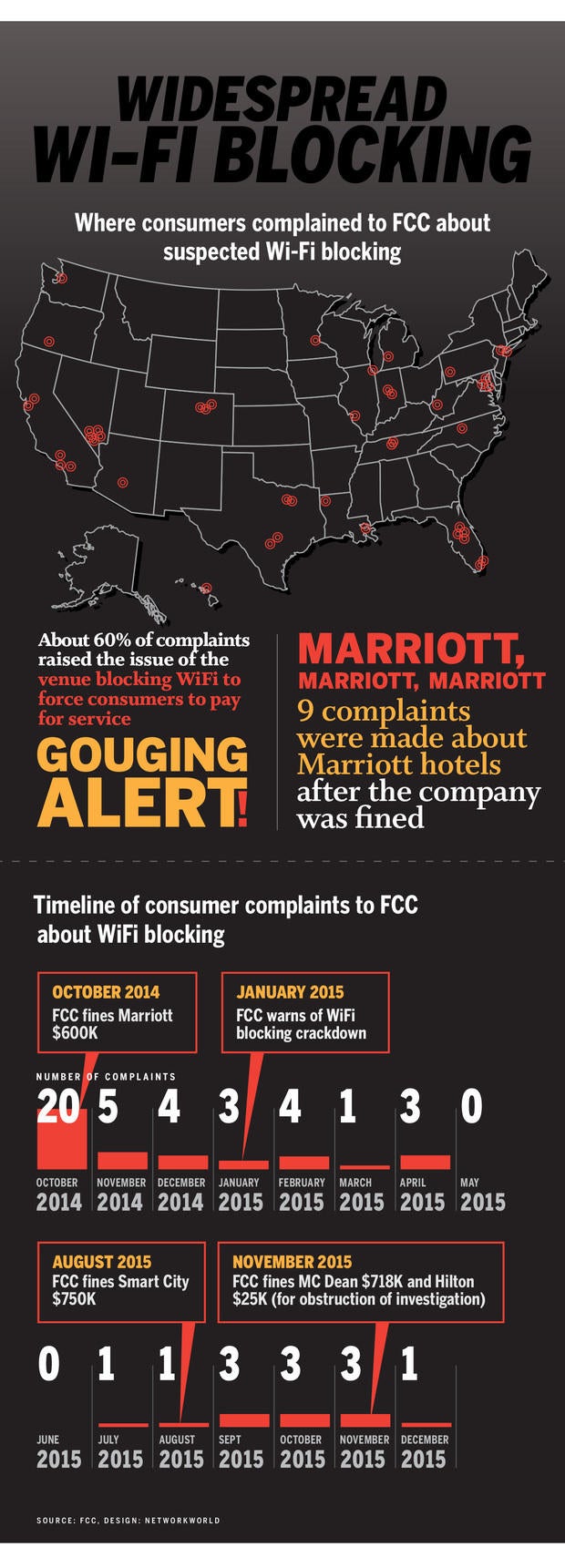
An anonymous reader writes: An examination of consumer complaints to the FCC over the past year and a half shows that the practice of Wi-Fi hotspot device blocking continues even though the agency has slapped organizations such as Marriott and Hilton more than $2 million in total for doing this. Venues argue they need to block hotspots for security reasons, but the FCC and consumers say the organizations are doing this to force people to pay for pricey Internet access.
"Consumers who purchase cellular data plans should be able to use them without fear that their personal Internet connection will be blocked by their hotel or conference center," FCC Enforcement Bureau chief Travis LeBlanc said in a statement. "It is unacceptable for any hotel to intentionally disable personal hotspots while also charging consumers and small businesses high fees to use the hotel's own Wi-Fi network. This practice puts consumers in the untenable position of either paying twice for the same service or forgoing Internet access altogether." Consumers have filed many complaints about Wi-Fi hotspot blocking to the FCC. -
Wi-Fi Hotspot Blocking Persists Despite FCC Crackdown (networkworld.com)
An anonymous reader writes: An examination of consumer complaints to the FCC over the past year and a half shows that the practice of Wi-Fi hotspot device blocking continues even though the agency has slapped organizations such as Marriott and Hilton more than $2 million in total for doing this. Venues argue they need to block hotspots for security reasons, but the FCC and consumers say the organizations are doing this to force people to pay for pricey Internet access.
"Consumers who purchase cellular data plans should be able to use them without fear that their personal Internet connection will be blocked by their hotel or conference center," FCC Enforcement Bureau chief Travis LeBlanc said in a statement. "It is unacceptable for any hotel to intentionally disable personal hotspots while also charging consumers and small businesses high fees to use the hotel's own Wi-Fi network. This practice puts consumers in the untenable position of either paying twice for the same service or forgoing Internet access altogether." Consumers have filed many complaints about Wi-Fi hotspot blocking to the FCC. -
Microsoft To Court: Make Comcast Give Us Windows-Pirating Subscriber's Info (networkworld.com)
An anonymous reader writes: Microsoft is using the IP address 'voluntarily' collected during its software activation process to sue a Comcast subscriber for pirating thousands of copies of Windows and Office. The Redmond giant wants the court to issue a subpoena which will force Comcast to hand over the pirating subscriber's info. If the infringing IP address belongs to another ISP which obtained it via Comcast, then Microsoft wants that ISP's info and the right to subpoena it as well. "Defendants activated and attempted to activate at least several thousand copies of Microsoft software, much of which was pirated and unlicensed," Microsoft's legal team wrote. The product keys "known to have been stolen" from Microsoft's supply chain were used to activate Windows 8, Windows 7, Office 2010, Windows Server 2012 and Windows Server 2008. The product keys, Microsoft said, were used "more times than is authorized by the applicable software license," used by "someone other than the authorized licensee," or were "activated outside the region for which they were intended." Whether or not the IP traces back to a Comcast subscriber or was assigned by Comcast to a different ISP, as the The Register pointed out, "It would be a significant gaffe on behalf of the alleged pirates if the IP address data pointed to their real identifies." -
Boeing's Self-Cleaning Aircraft Bathroom Lets You Use Loo Without Touching Anything
coondoggie writes: With barely enough space to um, sit, and with high capacity usage, the commercial airline toilet perhaps is an engineering marvel but little else. Boeing however is looking to that notion with a self-cleaning aircraft bathroom -- known as the Fresh Lavatory -- that the company says uses ultraviolet (UV) light to kill 99.99% of germs in the loo -- and even puts down the toilet seat lid. "We're trying to alleviate the anxiety we all face when using a restroom that gets a workout during a flight," said Jeanne Yu, Boeing Commercial Airplanes Director of Environmental Performance in a statement. "In the prototype, we position the lights throughout the lavatory so that it floods the touch surfaces like the toilet seat, sink and countertops with the UV light once a person exits the lavatory. This sanitizing even helps eliminate odors." -
DARPA Moves Ahead With Radical Vertical Take-Off Aircraft (networkworld.com)
coondoggie writes: DARPA took one step further in building a radically different VTOL (Vertical Take-Off and Landing) aircraft that can fly fast and carry a big load. Specifically, DARPA awarded Aurora Flight Sciences the $89 million prime contract for Phase 2 of the agency's VTOL X-Plane program which looks to: achieve a top sustained flight speed of 300-400 kt, raise aircraft hover efficiency from 60% to at least 75%, present a more favorable cruise lift-to-drag ratio of at least 10, up from 5-6, and carry a useful load of at least 40% of the vehicle's projected gross weight of 10,000-12,000 lbs. DARPA said Aurora's Phase 2 design for the VTOL X-Plane envisions an unmanned aircraft with two large rear wings and two smaller front canards -- short winglets mounted near the nose of the aircraft. "A turboshaft engine -- one used in V-22 Osprey tiltrotor aircraft -- mounted in the fuselage would provide 3 megawatts (4,000 horsepower) of electrical power, the equivalent of an average commercial wind turbine. The engine would drive 24 ducted fans, nine integrated into each wing and three inside each canard. Both the wings and the canards would rotate to direct fan thrust as needed: rearward for forward flight, downward for hovering and at angles during transition between the two," DARPA stated. -
Crypto Gurus Diffie, Hellman Win 2015 Turing Award (networkworld.com)
alphadogg writes: Whitfield Diffie and Martin Hellman, whose names have been linked since their seminal paper introduced the concepts of public key encryption and digital signatures some 40 years ago, have been named winners of the $1M A.M. Turing Award for 2015 (a.k.a., the 'Nobel Prize of Computing'). The work of Diffie, formerly chief security officer of Sun Microsystems, and Hellman, professor emeritus of electrical engineering at Stanford University, has had a huge impact on the secure exchange of information across the Internet, the cloud and email. -
NASA Wants To Get Supersonic With New Passenger Jet (networkworld.com)
coondoggie writes: NASA wants to put a supersonic passenger jet back in the sky that promises to a soft thump or supersonic heartbeat as the agency called it - rather than the disruptive boom currently associated with such high-speed flight. The 'low-boom' aircraft known as Quiet Supersonic Technology (QueSST) will be built by a team led by Lockheed Martin Aeronautics. It will cost $20 million to develop baseline aircraft requirements and a preliminary aircraft design. -
Arizona County Attorney To Ditch iPhones Over Apple Dispute With FBI (networkworld.com)
alphadogg writes: Apple's refusal to help the FBI unlock an iPhone 5c used by one of the terrorists in the San Bernardino, California attack on Dec. 2 has prompted the Maricopa County attorney's office in Arizona to ban providing new iPhones to its staff. 'Apple's refusal to cooperate with a legitimate law enforcement investigation to unlock a phone used by terrorists puts Apple on the side of terrorists instead of on the side of public safety,' Maricopa County Attorney Bill Montgomery said in a statement Montgomery described as a corporate public relations stunt Apple's positioning of its refusal to cooperate on privacy grounds. On the other hand, I suspect Apple's public refusal to decrypt, and Tim Cook's strong words in favor of user privacy, have probably triggered an opposite reaction among many would-be phone buyers. -
Army Researchers Patent Self-destructing Bullet Designed To Save Lives (networkworld.com)
An anonymous reader writes: Researchers from the U.S. Army Armament Research, Development and Engineering Center recently patented a new type of bullet capable of self-destructing after traveling over a predetermined distance. The idea behind the new and advanced projectile is that it might help limit the extent of collateral damage (read: innocents dying) during battle or in other operational settings and environments. As for how it all works, the U.S. Army explains that when one of these limited-range projectiles is fired, a pyrotechnical material is ignited at the same time and reacts with a special coating on the bullet. "The pyrotechnic material ignites the reactive material, and if the projectile reaches a maximum desired range prior to impact with a target," the Army writes, "the ignited reactive material transforms the projectile into an aerodynamically unstable object." The researchers add that the desired range of its limited-range projectile can be adjusted by switching up the reactive materials used. Put simply, the Army has come up with what effectively amounts to a self-destructing bullet that is rendered ineffective over certain distances. -
Researchers Make Low-Power Wi-Fi Breakthrough (networkworld.com)
alphadogg writes: The biggest downside of Wi-Fi for most users might be that it can really drain your smartphone or tablet battery, but a research team at the University of Washington has come up with a way to make using the nearly ubiquitous wireless technology in a less taxing way. They have demonstrated a technique for using 10,000 times less power than typical Wi-Fi (well, at up to 11Mbps anyway) and next month will present a paper titled "Passive Wi-Fi: Bringing Low Power to Wi-Fi Transmissions" at the USENIX Symposium on Networked Systems Design in Santa Clara. The main trick involves decoupling digital and analog components of a typical Wi-Fi router. -
Indoor LTE Wireless: Not To Be Overlooked At Mobile World Congress (networkworld.com)
alphadogg writes: Likely to get lost among the shiny new Android and Windows smartphones and tablets at this week's Mobile World Congress in Barcelona are demonstrations of technology that could bring LTE indoors over the 3.5 GHz wireless spectrum band, previously the sole domain of the military and satellite providers. But the exploitation of the Citizens Broadband Radio Service in the 3550-3700 MHz band, which the FCC voted about a year ago to make available for shared wireless broadband use, is worth paying attention to, especially if you're an organization that could stand to deliver more oomph for your employees who rely on wireless devices to make and receive calls in the office. CBRS — backed by the likes of Intel and Google — could overcome some of the troubles people currently have making LTE calls from indoors, due to interference or weak signals that result from penetrating tough building materials. -
Apple's iPhone Already Has a Backdoor
Nicola Hahn writes: As the Department of Justice exerts legal pressure on Apple in an effort to recover data from the iPhone used by Syed Rizwan Farook, Apple's CEO has publicly stated that "the U.S. government has asked us for something we simply do not have, and something we consider too dangerous to create. They have asked us to build a backdoor to the iPhone." But, as one Windows rootkit developer has observed, the existing functionality that the FBI seeks to leverage is itself a backdoor. Specifically, the ability to remotely update code on a device automatically, without user intervention, represents a fairly serious threat vector. Update features marketed as a safety mechanism can just as easily be wielded to subvert technology if the update source isn't trustworthy. Something to consider in light of the government's ability to steal digital certificates and manipulate network traffic, not to mention the private sector's lengthy history of secret cooperation. Related: wiredmikey writes: Apple said Monday it would accept having a panel of experts consider access to encrypted devices if US authorities drop efforts to force it to help break into the iPhone of a California attacker. Apple reaffirmed its opposition to the US government's effort to compel it to provide technical assistance to the FBI investigation of the San Bernardino attacks, but also suggested a compromise in the highly charged legal battle.
In his first public remarks since Apple CEO Tim Cook said he would fight the federal magistrate's order, FBI Director James Comey claimed the Justice Department's request is is about "the victims and justice." -
Opera Founder Opens Up About New Vivaldi Browser (networkworld.com)
alphadogg writes: Since the days of Mosaic in the early 1990s, Jon von Tetzchner has been working on web browsers. He is one of the creators of Opera, the alternative browser that's been a power-user favorite since 1995. His new project, Vivaldi, is heading for its first stable release. Network World sat down with von Tetzchner on Thursday to talk about Vivaldi and Opera at the Innovation House, a related venture of his. -
Good Riddance Payphones: NYC's Free Gigabit Wi-Fi Kiosks Go Live (networkworld.com)
alphadogg writes: New York City on Thursday officially launched its payphone booth replacements: shiny new 9-foot-plus-high kiosks, dubbed Links, that offer free Gigabit-speed Wi-Fi as well as free domestic VoIP calls via a tablet app. Mayor Bill de Blasio, joined by vendor partners such as Qualcomm and NYC Department of IT and Telecommunications reps, showed off the first operating LinkNYC kiosks, just over a dozen of which are spread across 3rd Avenue for starters. The spacing of the hotspots will enable users to stay connected as they walk down the street. More than 500 of the advertising-supported kiosks are slated to be installed by mid-year, with promises of secure and private connectivity. -
IRS Warns Of 400% Flood In Phishing and Malware This Tax Year Alone (networkworld.com)
coondoggie writes: There has been a 400% surge in phishing and malware incidents in this tax season alone, the Internal Revenue Service warned this week. According to the IRS, there have been thousands of phony emails aimed at fooling taxpayers into thinking these are official communications from the IRS or others in the tax industry, including from many tax software companies. -
Authorities Reportedly Question McAfee's Ex-girlfriend (networkworld.com)
netbuzz writes: While antivirus software pioneer John McAfee is in the media spotlight for his long-shot Libertarian presidential run, law enforcement authorities in Belize and the FBI have just this week reportedly questioned one of his ex-girlfriends as they continue to investigate the 2012 murder of McAfee's American neighbor. That probe prompted McAfee to flee Belize and eventually land back in the United States. McAfee has steadfastly denied any involvement in the murder. -
SCO vs. IBM Battle Over Linux May Finally Be Over (networkworld.com)
JG0LD writes with this news from Network World: A breach-of-contract and copyright lawsuit filed nearly 13 years ago by a successor company to business Linux vendor Caldera International against IBM may be drawing to a close at last, after a U.S. District Court judge issued an order in favor of the latter company earlier this week.
Here's the decision itself (PDF). Also at The Register. -
Magic Leap Raises $794 Million To Accelerate Adoption of Secretive AR Tech (roadtovr.com)
An anonymous reader writes: A massive new $794 million Series C investment in secretive AR startup Magic Leap puts the company among the world's most valuable startups, now reportedly valued at $4.5 billion. The company has aggressively teased what they believe to be revolutionary augmented reality display technology, allowing a mixture of the real and virtual dimensions in a way previously not achieved. Although they've played coy to the public, offering little more than bold claims, investors like Alibaba, Google Ventures, and Qualcomm Ventures have bought into the company's vision to the tune of $1.39 billion in total raised by Magic Leap thus far. Also at Network World, which notes that their demo must be amazing. -
CIA: 10 Tips When Investigating a Flying Saucer (cia.gov)
coondoggie writes: You may not associate the Central Intelligence Agency with historical UFO investigations, but the agency did have a big role in such investigations many years ago. This week the agency posted an article called 'How to investigate a flying saucer." The release is part of a series of old documents dredged up as a nod to the return of The X-Files to TV this weekend. -
TSA: Gun Discoveries In Baggage Up 20% In 2015 Over 2014 (networkworld.com)
coondoggie writes: There was a 20% increase in firearm discoveries at TSA airport checkins from 2014's total of 2,212. It's an astounding number really, but the details get worse. The TSA goes onto say 2,653 firearms were discovered in carry-on bags at checkpoints across the country, averaging more than seven firearms per day. Of those, 2,198 (83%) were loaded. Firearms were intercepted at a total of 236 airports; 12 more airports than last year. Last year a TSA spokesman, when asked of the TSA has a theory on why so many more guns are being brought onboard airlines, Tweeted “The vast majority of passengers just tell law enforcement, ‘I forgot.’ We continue to remind passengers they can check them.” -
Verizon Vows To Build the First 5G Network In the US (networkworld.com)
alphadogg writes: Verizon says it will have the first 5G network in the U.S., a promise it probably can't fulfill until 2020 but will start working at this year. Verizon Chief Financial Officer Fran Shammo made the pledge Thursday on the company's fourth-quarter financial results call. He also repeated the company's plans for so-called 5G trials this year. -
Microsoft Open Sources Edge JavaScript Code, Plans Linux Port (windows.com)
colinneagle writes: One month after promising to release the JavaScript engine of its Edge browser, Microsoft has proven good for its word and then some. Not only is it releasing the code, it's planning a Linux port. The company uploaded the code to GitHub and announced its plans via a blog post by Gaurav Seth, principal PM manager for Chakra, which is what they're calling the JavaScript engine. "Today, we are excited to share with you that we've just made the sources for ChakraCore available under the MIT License at the ChakraCore GitHub repository," he wrote. "Going forward, we'll be developing the key components of Chakra in the open." With the release, you can build ChakraCore on Windows 7 SP1 or above with Visual Studio 2013 or 2015 with C++ support installed, Seth said. Of course, Edge is more than just the Chakra engine, but this could result in a back port to Windows 7. He also said Microsoft is committed to bringing it to other platforms, starting with Linux, and invited developers to "help us in the pursuit either by letting us know which other platforms they'd like to see ChakraCore supported on, or even by helping port it to the platform of their choice."