Slashdot Mirror
Domain: newscientistspace.com
Stories and comments across the archive that link to newscientistspace.com.
Stories · 58
-
Venus's Surface May Be 1 Billion Years Old
dptalia writes, "For a while scientists have believed that Venus's surface is fairly young, having recently been covered by lava 1 to 3 kilometers deep. However, more study into photos sent back by Magellan seems to show that the cataclysmic volcano theory is wrong. Now scientists are postulating that Venus's surface may be a billion years old and could be probed to determine the history of the planet." -
More Evidence for Early Oceans on Mars
DestroyAllZombies writes "More news about Mars. The good news: New Scientist reports that more analysis of Rover data supports the claims for widespread oceans in Mars' distant past. The bad news, from the article: 'An ocean of water once wrapped around Mars, suggests the discovery of soil chemicals by NASA's rovers. But the same chemicals also indicate that life was not widespread on the planet at the time the ocean was present.'" -
Detailed Panorama of Mars Released
dptalia writes "NASA has just released a detailed panorama of Mars taken by the Spirit rover. During the short Martian winter the rover didn't get enough sunlight to move, so it took these pictures instead. Spirit took over 1400 pictures, for a total of 500 megs of data. If you look to the left of the picture, you'll see the tracks from the rover's trip." -
Detailed Panorama of Mars Released
dptalia writes "NASA has just released a detailed panorama of Mars taken by the Spirit rover. During the short Martian winter the rover didn't get enough sunlight to move, so it took these pictures instead. Spirit took over 1400 pictures, for a total of 500 megs of data. If you look to the left of the picture, you'll see the tracks from the rover's trip." -
Space Elevator Challenge
MattSparkes writes "For the second year in a row, no team has won the $200,000 prize in the Space Elevator Challenge at the Wirefly X Prize Cup. Three teams were disqualified before the contest even started. Another competition at the event has been held up by confusion. Incredibly, it seems the organisers of the competition are not sure whether the ribbon used was 50 or 60 metres long, and whether any team completed the climb fast enough to win." -
Slashback: What Dell Knew, China's Fusion, Vista
Slashback tonight brings some clarifications and updates to previous Slashdot stories, including: What Dell knew and when they knew it, GNU/Linux may gain from the Vista WGA crackdown, China's fusion test was a hoax, and the Vista startup chime will be optional. Read on for details.Dell knew of battery flaw last year. digihome writes, "Dell pinpointed the problem with faulty Sony notebook batteries almost a year ago but only called for a 22,000-unit recall at the time because it believed the problem was limited in scope. Only later, after more customers reported incidents of Dell laptops overheating or catching fire, did Dell realize that millions of its notebook PCs, not just thousands, could be at risk, according to government records and interviews with Dell spokesmen."
GNU/Linux to gain from Vista WGA crackdown? An anonymous reader writes, "Linux is set to take on the Desktop PC market with gusto. It is a well-known fact that most proprietary software companies lose a significant amount of their revenue because of illegal copying of their software. By deciding to clamp down on piracy in the forthcoming Vista OS, Microsoft is sending a clear message to pay up to use the software. The article suggests that a sizable group of people — especially in emerging countries — who do not care about the ideology of free software but expect the software and OS to be free will be swayed to embrace GNU/Linux."
China's fusion test was a hoax. dptalia writes, "On September 28th, China claimed to successfully initiate a fusion reaction. It has come out that the announcement was a hoax. In fact, no attempt to generate fusion was even made."
Vista startup chime will be optional. Seier writes, "Microsoft looks to have had a change of heart regarding its start-up chime. Weeks ago it was learned that the company was considering locking the startup sound down so that it could not be turned off. Ars Technica reports that Microsoft has added the option to disable the sound in the control panel. Meanwhile, Microsoft has still not revealed the startup sound, which will reportedly based on the guitar work of Robert Fripp."
-
Magnetic Ring Could Launch Satellites, Weapons
MattSparkes writes, "A new study funded by the US Air Force has suggested a cheaper method of sending satellites (possibly missile weapons) into orbit. A 2-km-wide ring of superconducting magnets would contain and propel a payload, accelerating it over a period of hours, before suddenly flinging the satellite into space at 23 times the speed of sound. The satellites would be engineered to withstand the g-forces encountered (2,000 g), and be cased in an aerodynamic shell. A two-year study has been commisioned and will begin within a few weeks at LaunchPoint Technologies in Goleta, California." New Scientist points out that if such a launch ring were built, it would instantly become "one of the most important targets on the planet." -
Hubble Camera Shuts Down
Maggie McKee writes "Hubble's main camera is offline again, but the problem does not appear to be with its power supply, like it was this summer. This time, the issue seems to be the electronics on the sharpest of its three camera-like channels, the High Resolution Channel. NASA says the worst-case scenario is that the ACS could lose half the channel's field of view, so it would take longer to observe its targets. If the problems are truly unrelated, it's been an especially unlucky few months for this instrument!" -
First Zero-Gravity Surgery a Success
MattSparkes writes "Slashdot reported earlier this week that the first ever zero gravity surgery was to take place. Today the team of doctors successfully carried out the operation, removing a benign tumour from the forearm of a 46-year-old volunteer. "Now we know that a human being can be operated on in space without too many difficulties," team leader Dominique Martin said after the flight. The studies show that minor surgery is possible even during long-term inhabitation of space." -
Space Elevator vs Wildlife
An anonymous reader writes "The longest test yet of the technology that might one day lead to space elevators has revealed some unusual problems. From the article: "There were several unexpected encounters with wildlife. More than a dozen insect egg colonies had been laid on the tether and curious bats flew around the balloons, apparently attracted by the sound made by the tether's vibrations. Late in the test, swallows were also seen swooping down on the balloons, possibly to sip the morning dew on their surfaces." Maybe all the critters just want to go to space too." -
French Doctors to Perform Zero-Gravity Surgery
STFS writes "NewScientistSpace has a story about a team of French doctors who will attempt the worlds first zero-gravity operation on a human aboard an Airbus A300 dubbed "Zero-G". The patient, according to forbes.com, was chosen because of his experience with 'dramatic gravitational shifts' as an avid bungee-jumper. The operation will serve as a test for performing surgery in space." -
NASA Administrator Mike Griffin to visit China
Maggie McKee writes "China has repeatedly extended a hand to the US to work together in space, but for military and political reasons the US has always refused. Now, New Scientist Space reports that NASA chief Mike Griffin and other bigwigs are about to head to China for a meet-and-greet. But Griffin says: 'This is a get-acquainted session, and it is nothing more, and to characterise it as anything more would be to create expectations that would be possibly embarrassing to us or embarrassing to China.'" -
Supernova Casts Doubt on "Standard Candle"
Krishna Dagli writes, "A supernova more than twice as bright as others of its type has been observed, suggesting it arose from a star that managed to grow more massive than theoretically thought possible. The observation suggests that Type 1a supernovae may not be 'standard candles' — all having the same intrinsic luminosity — as previously thought. This could affect their use as probes of dark energy, the mysterious force causing the expansion of the universe to accelerate." -
A Puffed-Up Extrasolar Planet
Maggie McKee writes, "New Scientist Space reports astronomers have found a planet less dense than a wine cork and 38% larger than Jupiter. It circles a star about 450 light years from Earth. A similarly bloated planet has been found before (HD 209458b), so these puffed-up planets may be quite common. But no one knows how they got so swollen. One possibility is 'that some poorly understood mechanism has separated hydrogen and helium in each planet.'" -
EU Craft Successfully Hits The Moon
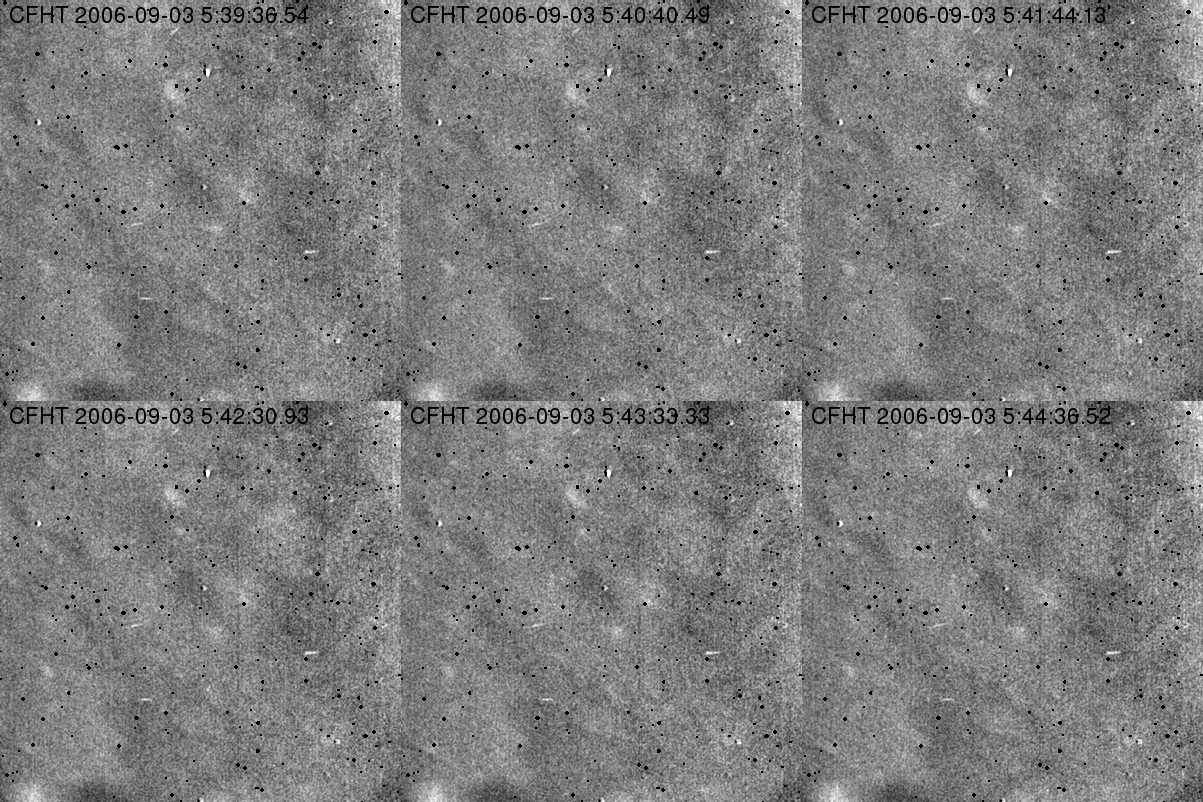
An anonymous reader writes "SMART-1 has hit the Moon , just as planned and — even better — the impact threw out a bright infrared that was seen by the Canada-France-Hawaii Telescope in Hawaii. There's an animation of the images grabbed by the telescope. Scientists now hope to analyse the chemistry of the rock ejected by the crash. If only you could dump old cars in such a useful way." -
Perseid Meteor Shower To Peak This Weekend
Krishna Dagli writes "This weekend provides one of the year's best opportunities to see some "shooting stars". The annual Perseid meteor display is expected to peak on Friday and Saturday night. Meteors are bits of dust or rock that plunge into the Earth's atmosphere and burn up, making bright streaks in the sky. It does not take a large object to produce a visible meteor — most are the size of a grain of sand or a small pebble." -
Japan Plans a Moonbase by 2030
Aglassis writes "The Japanese Aerospace Exploration Agency (JAXA) announced at a conference that they are planning to build a Moonbase by 2030. Since JAXA doesn't currently have a 100 ton-class heavy lift rocket or a human transportation system perhaps now is a good time for JAXA to join in with NASA on the Project Constellation rocket program." -
Slashback: New E3, Archimedes Webcast, Dell Wildfires
Slashback tonight brings some clarifications, and updates to previous Slashdot stories including: a victory for evolution in Kansas, the Stardust Program launched, Lego Mindstorms goes live, continued backlash on the new E3, Archimedes gets a webcast, another Dell bursts into flame, and a possible RIAA silver bullet Read on for details.A Victory for Evolution in Kansas. SatanicPuppy writes "Yesterday, elections in Kansas saw four of six pro-Creationism school board members replaced by pro-Evolution candidates in a one issue election. Interestingly, it didn't go by party lines; at least one of the conservative Republicans who supported Creationism failed to make it past their party primary. Ken Willard and John Bacon are the two remaining pro-Creationism incumbents."
Stardust Program Launched. lee1 writes "Anyone with an internet connection now has the the chance to find microscopic grains of dust from beyond the solar system. The project, called Stardust@home, is patterned on projects like SETI@home. But rather than exploiting idle processor time, it will ask volunteers to search through millions of microscope images on their computer screens, exploiting spare time in general as well as ego: 'People get very competitive,' explains the project director. The first volunteer to spot an actual interstellar dust grain will get to name it and will be listed as a co-author on any resulting research papers. The images come from a NASA project called Stardust, whose primary mission was to collect samples of dust from the tail of Comet Wild 2, but might also have captured some interstellar dust that could reveal the physics of the stars that produced it. To minimize false positives and to ensure that all the grains are found, each participant will go through an online training and testing process before starting their search. They will be scored on how well they distinguish real dust grain impacts from fakes."
Lego Mindstorms goes live. MicroBerto writes "As of August 1, 2006, the next generation of Lego Mindstorms is now available for sale in North America. Mindstorms NXT is a robotics toolset that allows you to build and program robots for various purposes. It combines the power of the Lego technic building system and an all new intuitive software environment powered by National Instruments LabVIEW."
Continued backlash on the new E3. Anonymous Howard writes "Angry Gamer reacts badly to the news of the Electronic Entertainment Expo's demise. They see it as a major blow for small game developers who are having enough of a hard time getting noticed by press and retailers as it is. From the article: 'This is a win only for the EAs, Sonys and IGNs of the world. Everyone else has to fend for themselves.' It seems like the days of smaller developers getting noticed by 'drive by traffic' at E3 are over." Relatedly The Escapist Lounge has an interview with the Academy of Interactive Arts and Sciences president, Joseph Olin, on what is actually happening to E3. As Joseph Olin responds: 'So it's going to take a couple of months until the world knows what the scope of E3 2007 will be, and how it will be structured. The opportunity to make material changes to improve it shouldn't be snap judgments. The rhetorical question I might pose is: "You know you have a problem. You know you need to make changes. How do you make changes and convey it and announce it, and to whom, and when?" There's never a good time. Whenever you make significant change, there's no way to introduce that change without detractors. The challenge is that without being able to announce the exact implementation of change it leaves that gray area for ignorance to fill the void.'"
Archimedes gets a webcast. jd writes "Some time ago, Slashdot covered the story of the rediscovery of several lost writings of Archimedes by means of X-Ray fluorescence. Well, they're still scanning the book and at 11pm GMT (4pm PDT) on August 4th will be putting on a live webcast as they scan and interpret pages not seen by human eyes for over a thousand years."
Another Dell bursts into flame. starwindsurfer writes "A Dell laptop's battery caught on fire in a company's IT department this week, burning a hole right through the casing. Nearby techs used fire extinguishers to put out the blaze. Employee Henrik took pictures to document the affair and uploaded them to the Toms Hardware message boards. From the writeup: 'The police department showed up. The entire lower floor was allowed to leave early and as we stood there in front of the building we simply couldn't resist... we jokingly called the engineer a terrorist as he was being asked a few questions by the friendly officer.'"
An RIAA silver bullet? Chris Fairman writes "TechDirt is running a story about how the RIAA seems to be dropping cases where the defense includes (or hinges on) an IP address as the means to identify the source of criminal activity. Essentially the defense argues that all an IP address can prove is who was paying for the net access at a particular time. Having a wide open WiFi router on your network seems to be currently the most effective means of getting the RIAA to drop all charges. Essentially the activity originating from one IP, only proves that illegal file sharing behavior is coming from one network, and not necessarily from any one specific computer or user. More importantly, it seems that the legal system is beginning to catch on to more complex technology concepts. Such concepts play a large part in how future legal cases are argued, and contribute ultimately to the foundation of complex technology legal precedents."
-
Possible Hole in Black Holes
jd writes "Researchers have found what they believe may be a MECO (Magnetic, Eternally Collapsing Object) inside of a quasar. MECOs are rivals to black hole theory and involve plasmas that never reach the state of being a singularity. The most obvious differences between them are that MECOs have a magnetic field and do not have an event horizon. The problem lies in that the Universe cannot have both MECOs and black holes — it can only have one or the other. If this object truly is a MECO, then black holes do not exist. Anywhere. (Furthermore, this would require Professor Hawking to return a year's subscription to Private Eye and give Professor Thorne a year's subscription to Penthouse.) On the other hand, if this thing isn't a MECO, it's behaving very very oddly for a black hole." -
Safe Landing For Space Shuttle Discovery
dylanduck writes "Discovery is back safe and sound, despite minor problems with a leaky power unit and a last minute change of approach direction to the runway. The mission tested some post-Columbia safety changes, and also set up the space station for future construction. But in some ways, the tough job starts now - NASA has just 40 days or so to get Atlantis up." -
Astronauts Pull Off Risky Spacewalk
dylanduck writes "A pair of NASA astronauts overcame an issue with a loose jet pack to make crucial repairs to the International Space Station, according to a story on New Scientist Space. No jet pack means not getting home if you inadvertently push yourself away from the space station and into space. That's a long goodbye that doesn't bear thinking about." -
Solar System in a Can May Reveal Hidden Dimensions
dylanduck writes "A model solar system, made of tungsten and placed in space, could reveal hidden spatial dimensions and test alternative theories of gravity. If the system's 'planets' moved slightly differently to the way predicted by standard gravity, it would signal the presence of new physical phenomena." From the article: "Once at the Lagrange point, the artificial solar system would be set in motion inside the spacecraft. An 8-centimetre-wide sphere of tungsten would act as an artificial sun, while a smaller test sphere would be launched 10 cm away into an oval-shaped orbit. The miniscule planet would orbit its tungsten sun 3,000 times per year." -
Supercomputer Models Sun's Corona Dynamics
gihan_ripper writes "Researchers from San Diego are using supercomputers to accurately predict the shape of the Sun's corona, based on magnetic field data from the photosphere. It is hoped that this model will enable us to predict Coronal Mass Ejections. When CMEs reach the Earth, they produce geomagnetic storms and can wreak havoc with communcations, GPS, and power networks. In the decade or so, the researchers hope to be able to predict CME collisions with the Earth and determine their impact." -
Slashback: Oklahoma Spyware, FSF DRM, Lenovo Linux
Slashback tonight brings some corrections, clarifications, and updates to previous Slashdot stories including Oklahoma's Spyware Bill dies a quiet death, Lenovo denies ditching Linux, Mars rover escapes again, RIM CEO speaks out against unlimited wireless, Microsoft LiveMail gets ads, FSF anti-DRM campaign expands, and AT&T calls Wired to task over leaked documents -- Read on for details.Oklahoma's Spyware Bill dies a quiet death. enforcer999 writes to tell us that the Oklahoma Computer Spyware Protection Act has been pretty much dismantled by the Senate review committee. From the article: "Sen. Clark Jolley, R-Edmond, the Senate author of the legislation, said revisions he had made to the bill were well received by those who had originally opposed it, but that after making the changes, the companies backing the measure -- which had included Microsoft and Symantec Corp. -- opposed it."
Lenovo denies ditching Linux. btornado writes "According to News.com, Lenovo has denied ditching Linux on their notebook computers. Lenovo actually plans to support Linux on its ThinkPads starting in the third quarter, in partnership with Novell. From the article: 'Customers of the recently introduced Lenovo 3000 units still won't have a preloaded option, however, because the small and midsize business customers that are the targets for those units have many different requirements, he said.'"
Mars rover escapes again. An anonymous reader writes "New Scientist is reporting that NASA's Mars Opportunity rover has freed itself from the sandy soil that ensnared it for more than a week. This is the second time the rover has gotten bogged down in a Martian sand trap. Both times, the rover has managed to escape to solid bedrock by churning its wheels in reverse."
RIM CEO speaks out against unlimited wireless. frdmfghtr writes "The president and co-CEO of Research in Motion seems to think that wireless data services providing unlimited data traffic for a flat monthly rate will have a 'devastating effect on wireless innovation.' From the article: '"No matter how you slice it, bandwidth is not free," he said. "If we don't set up economic incentives now, research and innovation for new networks won't happen for the future. We want companies to be encouraged to make efficient use of the network, so we don't cross over and use up all the capacity of the networks." Counters Jeff Pulver, the founder of Pulver Media, saying that (FTA) "unlimited bandwidth use in the wireless world is needed because access to the network is what spurs innovation."'"
Microsoft LiveMail gets ads. Blahbooboo3 writes to tell us BetaNews is reporting that Microsoft will be embedding advertising in their new e-mail client software, Windows Live Mail Desktop. Similar to Google's Gmail, it will serve ads based on the text of your mail messages. Microsoft's Active Search feature, being tested within Windows Live Mail Desktop, scans users' emails and displays potential search terms related to that email as well as text-based contextual ads. The effort is an example of the Windows Live ad-supported software initiative. Contextually relevant ads served by Microsoft-partner Kanoodle will be displayed next to each email message. Also, paid search links will be served by Microsoft adCenter when users conduct searches via a search box that's built into the mail interface.
FSF anti-DRM campaign expands. nanday writes "According to an article on Newsforge (Also owned by VA), the Free Software Foundation's Defective by Design campaign against Digital Rights Management expanded on Saturday, targeting Apple Stores in eight American cities. However, unlike the event outside WinHEC 2006 two weeks ago, this time the police and security guards were waiting when campaign volunteers arrived to demonstrate."
AT&:T calls Wired to task over leaked documents. John Young writes to tell us that AT&T is standing in opposition [PDF] to Wired's recent intervention and the unsealing of documents. AT&T stated that "Wired argues that it has a 'unique perspective in this case.' If that is anything other than hot air, it is a reference to the fact that Wired has leaked eight pages of what it claims are AT&T Proprietary documents--and did so despite actual knowledge that AT&T claims its documents contain trade secrets and the Court had ordered that such documents remain under seal. A 'unique perspective' indeed--that of the scofflaw. [...] Wired maintains that the Klein and Marcus Declarations should be unsealed in their entirety because "the course of events has overtaken the sealing order." The "course of events" to which Wired refers is, of course, its own leaking of subsets of the information that the Court ordered remain under seal. Wired's argument appears to be that because it has openly chosen to disregard the Court's order (not to mention AT&T's rights) the Court should reverse that order. Talk about chutzpah."
-
Slashback: Oklahoma Spyware, FSF DRM, Lenovo Linux
Slashback tonight brings some corrections, clarifications, and updates to previous Slashdot stories including Oklahoma's Spyware Bill dies a quiet death, Lenovo denies ditching Linux, Mars rover escapes again, RIM CEO speaks out against unlimited wireless, Microsoft LiveMail gets ads, FSF anti-DRM campaign expands, and AT&T calls Wired to task over leaked documents -- Read on for details.Oklahoma's Spyware Bill dies a quiet death. enforcer999 writes to tell us that the Oklahoma Computer Spyware Protection Act has been pretty much dismantled by the Senate review committee. From the article: "Sen. Clark Jolley, R-Edmond, the Senate author of the legislation, said revisions he had made to the bill were well received by those who had originally opposed it, but that after making the changes, the companies backing the measure -- which had included Microsoft and Symantec Corp. -- opposed it."
Lenovo denies ditching Linux. btornado writes "According to News.com, Lenovo has denied ditching Linux on their notebook computers. Lenovo actually plans to support Linux on its ThinkPads starting in the third quarter, in partnership with Novell. From the article: 'Customers of the recently introduced Lenovo 3000 units still won't have a preloaded option, however, because the small and midsize business customers that are the targets for those units have many different requirements, he said.'"
Mars rover escapes again. An anonymous reader writes "New Scientist is reporting that NASA's Mars Opportunity rover has freed itself from the sandy soil that ensnared it for more than a week. This is the second time the rover has gotten bogged down in a Martian sand trap. Both times, the rover has managed to escape to solid bedrock by churning its wheels in reverse."
RIM CEO speaks out against unlimited wireless. frdmfghtr writes "The president and co-CEO of Research in Motion seems to think that wireless data services providing unlimited data traffic for a flat monthly rate will have a 'devastating effect on wireless innovation.' From the article: '"No matter how you slice it, bandwidth is not free," he said. "If we don't set up economic incentives now, research and innovation for new networks won't happen for the future. We want companies to be encouraged to make efficient use of the network, so we don't cross over and use up all the capacity of the networks." Counters Jeff Pulver, the founder of Pulver Media, saying that (FTA) "unlimited bandwidth use in the wireless world is needed because access to the network is what spurs innovation."'"
Microsoft LiveMail gets ads. Blahbooboo3 writes to tell us BetaNews is reporting that Microsoft will be embedding advertising in their new e-mail client software, Windows Live Mail Desktop. Similar to Google's Gmail, it will serve ads based on the text of your mail messages. Microsoft's Active Search feature, being tested within Windows Live Mail Desktop, scans users' emails and displays potential search terms related to that email as well as text-based contextual ads. The effort is an example of the Windows Live ad-supported software initiative. Contextually relevant ads served by Microsoft-partner Kanoodle will be displayed next to each email message. Also, paid search links will be served by Microsoft adCenter when users conduct searches via a search box that's built into the mail interface.
FSF anti-DRM campaign expands. nanday writes "According to an article on Newsforge (Also owned by VA), the Free Software Foundation's Defective by Design campaign against Digital Rights Management expanded on Saturday, targeting Apple Stores in eight American cities. However, unlike the event outside WinHEC 2006 two weeks ago, this time the police and security guards were waiting when campaign volunteers arrived to demonstrate."
AT&:T calls Wired to task over leaked documents. John Young writes to tell us that AT&T is standing in opposition [PDF] to Wired's recent intervention and the unsealing of documents. AT&T stated that "Wired argues that it has a 'unique perspective in this case.' If that is anything other than hot air, it is a reference to the fact that Wired has leaked eight pages of what it claims are AT&T Proprietary documents--and did so despite actual knowledge that AT&T claims its documents contain trade secrets and the Court had ordered that such documents remain under seal. A 'unique perspective' indeed--that of the scofflaw. [...] Wired maintains that the Klein and Marcus Declarations should be unsealed in their entirety because "the course of events has overtaken the sealing order." The "course of events" to which Wired refers is, of course, its own leaking of subsets of the information that the Court ordered remain under seal. Wired's argument appears to be that because it has openly chosen to disregard the Court's order (not to mention AT&T's rights) the Court should reverse that order. Talk about chutzpah."
-
On Orbital Fuel Stations
dylanduck writes "Being able to fill up your spacecraft from a fuel depot in orbit round the Earth or Moon is key to the long-term prospects of astronauts exploring the solar system, according to NASA engineers. Trouble is NASA doesn't want to build it themselves. So there's $5 million for any enterprising groups who can develop a simple version themselves." -
New Wide-Angle Telescope to Capture Night Sky
NewScientist is reporting that a new telescope located in Chile is aiming to capture images of the entire night sky every three nights. From the article: "The telescope will use a digital camera with 3 billion pixels to image the entire sky across three nights, producing an expected 30 terabytes of data per night. This will allow astronomers to detect objects that quickly change their position, such as near-Earth asteroids, or their brightness, such as supernovae." -
ISS Loses Orbit-Boosting Options
An anonymous reader writes "NewScientist reports is reporting that the International Space Station has lost some of its options when it comes to altitude-boosting due to several recent failures. From the article: 'The problems began on 19 April 2006, when the Russian Zvezda service module's main engines failed during a test. The failure may have been due to a sunshade cover that was not completely open, according to a station status report.'" -
Dwarf Galaxies Discovered
d'alz writes "Two new satellite galaxies have been discovered in the Milky Way. These dim dwarf galaxies bring the total number of galaxies in the Milky Way's cosmic neighborhood to a total of 14. Of course, theorists believe there could be a hundred more. The two dwarfs were found in the direction of the constellations Canes Venatici (the hunting dogs) and Bootes (the herdsman), scientists studying the Sloan Digital Sky Survey said in a statement. However, even though these galaxies are presumably quite close, they are difficult to spot, as they are very dim, which is a defining characteristic of dwarf galaxies." -
Mirror Jams on Venus Express Spacecraft
tsarina writes "The European Space Agency is trying to fix a stuck instrument on its Venus Express spacecraft. A mirror in front of its interferometer is not pointing in the right direction, making it useless until it is moved. Managers hope to fix the Planetary Fourier Spectrometer this week. An identical instrument on the Mars Express probe has also acted up, but it is currently working properly."" -
Satellites To Try Formation Flying on ISS
SoySauc writes "From a story on the New Scientist site: 'A soccer-ball-sized satellite will soon be floating aboard the International Space Station. Once joined by two others, it will help researchers test formation flying and autonomous rendezvous and docking maneuvers for future orbiting satellites.' NASA's DART mission was designed to do the same thing, but in 2005 shut itself down and bumped into the satellite it was only meant to approach." -
Spirit Rover Reaches Safety
dylanduck writes "Good news for rover fans - Spirit is safe for the winter. It had been heading for a north-tilting spot to make sure its solar panels got enough sunlight during the imminent winter to survive, when a sand trap appeared. But, despite its busted wheel, it scooted round and is now sitting pretty. From the article: 'We've got a safe rover,' says principal investigator Steve Squyres. 'That's huge news for us.'" -
Spirit Rover Reaches Safety
dylanduck writes "Good news for rover fans - Spirit is safe for the winter. It had been heading for a north-tilting spot to make sure its solar panels got enough sunlight during the imminent winter to survive, when a sand trap appeared. But, despite its busted wheel, it scooted round and is now sitting pretty. From the article: 'We've got a safe rover,' says principal investigator Steve Squyres. 'That's huge news for us.'" -
Totally Random One Time Pads
liliafan writes "Scientists in Japan have come up with a way of harnessing a truly random datasource for generating one time encryption pads: Quasars. One time encryption pads are widely accepted as being the most secure form of encryption, but this new technology from the National Institute of Information and Communications Technology makes the pads even more secure." -
Want to Experience Zero G? Stay in Bed
mrogers writes "New Scientist Space is reporting that the health effects of microgravity can be reproduced by staying in bed. Inclining the bed at an angle of 6 degrees with the head at the lower end produces bone and muscle loss, decreases in cardiovascular activity, and reduced capacity to exercise similar to those produced by prolonged spaceflight. (Valeri Polyakov was not available for comment at the time of going to press.)" -
Stardust Part II, Deep Impact Revisited?
oneill40 writes to tell us New Scientist is reporting that NASA's Stardust spacecraft may be gearing up for another run. Stardust recently made the news by returning samples from the comet Wild 2 and is being looked at to pick up where the Deep Impact mission left off. From the article: "In addition to revealing the comet's interior composition, studies of the crater should shed light on the comet's structure and density. "If the impactor hit something that was very hard, it would produce a smaller crater than if it hit something very soft," Veverka told New Scientist." -
Earth Life Possibly Could Reach Titan
dylanduck writes "New simulations show that big asteroid impacts on Earth could have sent about 600 million boulders flying into space. About 100 have reached Jupiter's moon Europa - but they landed at 24 miles/sec. 'This must be rather frustrating if you're a bacterium that survived launch from Earth,' says a researcher. But 30 boulders from each impact reach Titan - and they land gently." From the article: "'I thought the Titan result was really surprising - how many would get there and how slowly they'd land,' Treiman told New Scientist. 'The thing I don't know about is if there are any bugs on Earth that would be happy living on Titan.' Titan's surface temperature is a very cold -179C and its chemistry is very different from Earth's." -
Orbiter Successfully Enters Orbit
dylanduck writes "Mars Reconnaissance Orbiter has slipped safely into orbit - unlike two of the last four orbiters NASA sent to Mars. Remember Mars Climate Orbiter and the mix up between metric and English units? MRO is going to send back 34 trillion bytes of data, more than all the previous missions put together." From the article: "The spacecraft will use a suite of six instruments, including the most powerful camera ever sent to another planet. This will image objects as small as 1-metre wide and should be able to snap pictures of the Spirit and Opportunity rovers. The instruments will track the planet's weather, geology and mineralogy, and even probe about a kilometre beneath its surface to hunt for water." -
NASA To Push Human Spaceflight
b00le wrote to mention a New Scientist article in which NASA chief Mike Griffin says that human spaceflight should be NASA's top priority. From the article: "Griffin countered that the same loss of expertise threatened NASA's human spaceflight programme, which had served to define the US as a world 'superpower'. He said NASA lost a substantial fraction of skilled engineers during a six-year gap between the end of the Apollo programme in 1975 and the first space shuttle flight in 1981. Letting the human spaceflight programme 'atrophy' after Apollo damaged the agency for three decades, he said." -
Shuttle Retirement Costs Divert Science Funding
FleaPlus writes "Although overall NASA funding is expected to increase next year, NASA has announced plans to divert money from its science program to help pay for the expected cost overruns for flying the Space Shuttle safely until its retirement in 2010. A number of science projects are being canceled or delayed indefinitely." -
Should We Land on the Moon's Poles or Equator?
Cujo writes "There is at present a lively controversy about sites for a crewed lunar landing. Advocates for landing near the poles, possibly on a mountain, point out the advantages of much higher sunlight availability and possible water resources in nearby cold traps. However, there may be more interesting geology and better mineral resources near the better-explored equator. NASA's Exploration Systems Architecture report lays out some of the tradeoffs." -
Deep Impact Mission Reveals Comet Ice
Ant writes "New Scientist reports water ice is present on the surface of Comet Tempel 1." From the article: "The finding was made via observations from NASA's Deep Impact mission. This is the first direct detection of exposed water ice on a comet. The mission's science team says the water ice is present in surprisingly small amounts, covering less than 1% of Comet Tempel 1's surface. The finding suggests the comet's surrounding cloud of gas and dust may largely be fed by underlying ices, rather than by gas streaming off its surface." -
German Scientists Create Augmented Reality Scope
porkchop_d_clown writes "New Scientist is reporting that German engineers have developed a scope that combines imaging and planitarium software with a telescope to overlay what you see in the scope with stored images and information about the object being viewed." From the article: "Bernie Volz, president of the Amateur Telescope Makers of Boston, Massachusetts, US, says an augmented reality telescope could serve as a useful educational tool. At star parties, bright objects such as the Moon, Mars and Saturn elicit 'the wow factor' from novices, he says. 'But when they look at galaxies or planetary nebulae or something that is just a fuzzy white spot in the sky, they don't have that kind of reaction.'" -
Plan To Bomb Mars For Signs of Climate Change
Oliver Harris writes "Scientists are planning on launching huge copper slugs at Mars in the hope that they will reveal signs of climate change. Problem: What happens when the Martians launch their own copper slugs back?" From the article: "'It's neat because it's a brute force way to gain access to the subsurface of Mars,' says David Spencer, a team member at NASA's Jet Propulsion Laboratory in Pasadena, California, US. 'The impactor will be very simple and we'll get our first look at material from that depth.' Christensen says that will provide a crucial test for models of Mars's past climate." -
Galaxies Floating on a Dark Matter Stream
Darkman, Walkin Dude writes "A team in Switzerland has discovered that most of the small satellite galaxies around the Milky Way's near-twin, Andromeda, are lined up in a single plane that slices through Andromeda's spiral disc. Using images from the Hubble space telescope, soon to be decommissioned, the researchers found that 9 of the 14 of Andromeda's satellites lay on a relatively narrow plane bisecting Andromeda. From the article: 'The team believes the plane could have formed in several ways. In one scenario, the galaxies may have fallen towards Andromeda along an invisible filament of dark matter. Computer simulations show these filaments can form a cosmic web along which galaxies flow.'" -
(Yet) Another Year End List
gordonb writes "New Scientist has yet another of those endless end-of-year lists, "13 things that do not make sense", including such topics discussed on Slashdot this year as the placebo effect, dark energy, and the ever-popular cold fusion. I know there are a lot more than 13 things that don't make sense, such as free markets, but, oxymorons aside, this is an interesting list, nevertheless." -
(Yet) Another Year End List
gordonb writes "New Scientist has yet another of those endless end-of-year lists, "13 things that do not make sense", including such topics discussed on Slashdot this year as the placebo effect, dark energy, and the ever-popular cold fusion. I know there are a lot more than 13 things that don't make sense, such as free markets, but, oxymorons aside, this is an interesting list, nevertheless." -
Ingredients of Life Found Around Sun-Like Star
smooth wombat writes "NASAs Spitzer Space Telescope has detected the basic organic building blocks of life in a ring orbiting in the 'habitable zone', that area where Earth orbits the Sun and where water exists on the borderline between gas and liquid, in a nearby stellar nursery. When acetylene and hydrogen cyanide combine with water they form adenine, one of the four bases of DNA. The detection supports the widely held theory that many of the molecular building blocks of life were present in the solar system even before planets formed, thus assisting the initial formation of complex organic molecules and the start of life itself." Though it was a little shakier than this observation, we've discussed the possibility of life elsewhere in the galaxy before. -
New Object Found at Edge of Solar System
Rei writes to tell us NewScientist is reporting that a new object has been found beyond Pluto. The new object, nicknamed "Buffy", has an almost circular orbit which is tilted some 47 degrees off of most other bodies in our solar system. From the article: "Neptune has been blamed for scattering many other [Kuiper Belt Objects] into tilted paths. But these tend to show other signs of a past interaction with the giant planet, such as moving in elliptical paths and having one part of their orbit pass near Neptune's at 30 astronomical units from the Sun. [Buffy], however, follows a nearly circular path. And it is too distant to have come into direct contact with Neptune, traveling between 52 and 62 AU from the Sun. Its orbit is also too circular - and too small - to have been tilted by a passing star." -
Lunar 'Lawnmower' Devised for Moon Colonists
moon_unit_alpha writes "Future Moon residents may have to mow the lunar lawn. New Scientist Space reports that a planetary geologist has come up with a way to prevent Moon dust from sticking to space suits, getting into seals and damaging electronic and mechanical equipment - the lunar lawnmower. The mower could be hauled behind a lunar rover, generating microwaves that cause iron particles in the dust to clump together."