Slashdot Mirror
Domain: njit.edu
Stories and comments across the archive that link to njit.edu.
Comments · 55
-
Re:Entropy
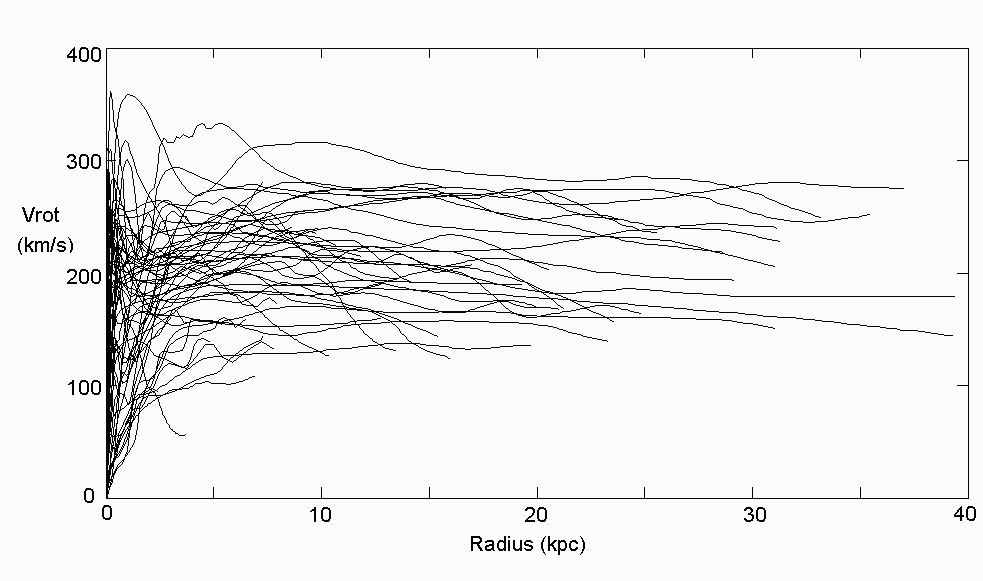
Seriously, just look up any rotation curve, whether from Google, Wikipedia, or here is an example page that includes a summary plot of many curves, or another intro page that includes many examples. There are many papers measuring or refining curves of a great variety of galaxies. Some are close to flat, some are sloping in either direction, most show a fair amount of structure, and none are exactly flat.
Also, from your previous post:
The stars near the core spin around with the SAME angular velocity as stars at the rim.
They do not have the same angular velocity, it is not like a rigid rotation. "Flat" rotation curves are those that have the same linear velocity with radius, so there is still a slow down in angular velocity with radius, just not as fast as expected from visible matter.
mean, even if we buy into the missing mass, explain why the mass would be distributed that way? There's nothing in the known laws of physics that would explain a distribution pattern like that
Read up on the cold dark matter theory, as there is an expectation a halo would form that would give a flat rotation curve. The flat part is easy, but the cusp near the center of the curve is the hard part. Considering this is well written about, and often in any non-trivial intro to the subject, I'm not going to copy-paste or paraphrase it here.
The distribution of dark matter should be equivalent to the distribution of non-dark matter.
Not in the slightest. If the interaction between dark matter and electromagnetism is weak or non-existent, then there is no easy way for dark matter to coalesce or form dense objects. For things like dense clouds, stars, and planets to form, you need electromagnetism to prevent atoms from passing through each other, to provide a quick way to exchange energy between particles so they will thermalize. Without that, particles will just mostly pass through each other, even with gravitational interactions, and you end up with everything in an overlapping orbit and very little pressure or force to cause it to settle toward the center.
I've seen nothing that explains that.
Look up course notes from an intro astronomy course or even Wikipedia. If you haven't seen that explanation yet, then you've not really looked or are unfortunately now good at finding decent sources.
-
Re:Disincentivized
Some of this can be attributed to the College Board changing the language of choice for the AP Computer Science test curriculum from C++ to Java in 2004. Most universities in the US phased out C++ in their introductory programming classes after that. I'm also disappointed they phased out the AB Computer Science test.
You can also add NJIT to that list of places that require programming. Check out the syllabus for CS288. I was required to take that class back in the day. It was a joke, mostly because it was developed and taught by a tenured professor that didn't seem to enjoy his job. Somebody else appears to have taken over a revamped it. Plenty of pointers to be found there. -
Re:Somewhat welcome news
and even the NH ice coverage is within a fingernail's width of the thirty year mean.
When (no matter what) the sea level isn't going to suddenly jump ten centimeters in a decade (where at most 1-2 cm is a lot more likely)
the measured bond albedo of the Earth has increased by 7% over the last fifteen years,
Mistaking cycles for linear trends
which corresponds to a roughly 2 C temperature drop due to reduced net insolation "off the top" as it were.
Total lack of data for that statement. I'm willing to check out any support you have, but just as a warning, a 2 C change due to change in bond albedo is basically impossible just based on the temperature data we have.
looking out the window at the water in Beaufort NC, where the tidal levels haven't significantly changed for years).
Yes, because eye-balling a waterline trumps actual measurements taken over the course of decades, and where significant seems to mean something completely different to you than to oceanographers - or anyone working with oceans.
Yes, you've indeed admirably proven your position with sources that are peer-reviewed, based on multiple and independent data sets, and you have demonstrated a strong understanding of basic physics, scientific principles and research methodology.
-
Recommended reading
Recommended and relevant reading is "A Mathematician’s Apology" by G. H. Hardy.
Available online at http://web.njit.edu/~akansu/PAPERS/GHHardy-AMathematiciansApology.pdf
-
Math is useless: G.H. Hardy said it better
-
Re:Greatest Opening to a book review ever:
well, it was published in 1943, so i think it fits the criteria of 'been around a while'.
Wow, you really have a sense of history, huh? My father has been around since 1942, I guess he's halfway on his way to being a classic according to your definition of 'a while'.
Let me try to be more explicit: what I meant was that a classic is something or someone who transcends their particular historic and cultural context, whom people from different generations and different cultures find equally relevant to their lives.
You can throw all the insults you want at me, but that will not change the fact that the top two results for "Betty Smith" are this and this. Neither of those pages is longer than your average omelette recipe. That is a staggering lack of interest in a "classic" author.
-
Re:Structure can be learned creativity cannot
Academic have been studying this for 30 years. A long term study of a 2 year college level creative thinking program was done in the mid 70s: http://scholar.google.com/scholar?hl=en&lr=&q=parnes+applied+creativity&btnG=Search
Three years ago, a similar paper was published specifically looking at CPS (Creative Problem Solving) process training done in a business climate with successful results: http://tsf.njit.edu/2006/fall/puccio-CPS-training.pdf
Net result -
Re:The scientific method; potential misconceptions
Did you ever consider that when you're looking at very similar shapes and very dissimilar colors you've made a very silly experiment? Try something like picking the [0,0,205] blue ball out of the field of [0,0,255] blue balls (search for blue3 on this page) as easily as you did the red? I'd also bet you could find the O in a field of T's almost as easily as you did the red ball in the blob of green ones, as long as you weren't colorblind.
But I'm betting that I'm just a peer in your scientific review process -
Re:A Beautiful Thing Coming
See my reply here.
Also, I would argue (am arguing) that the drive to create is separate from the drive for money. There would still be artists if creating art was punishable by death, it has nothing to do with making money.
The connection between creating art and becoming rich and famous was propagated by the middle men who looked at artists and said, "You know, I could really make a killing by distributing this." That is capitalism.
Now that we are in the "Digital Age" and distribution can be widespread and done by anyone, the middle-men are threatened and are reacting, sometimes by adapting to the new technology, sometimes by suing everyone in sight.
The ideal solution would be to find a way to reward artists, without restricting the distribution of art. That is the goal, remember? -
More blogodreck. See actual article.
First, the article is the NJIT press release, with essentially the same text and pictures.
Second, this is yet another of those overhyped "minor advance in materials science" articles. The abstract for the technical article says only "The results indicate that C60 decorated SWCNTs are promising additives for performance enhancement of polymer photovoltaic cells." There's no mention of "paintable solar cells".
"Paintable solar cells" have been talked up before (they were mentioned on Slashdot two years ago) but nobody has actually made that work. There's this fantasy that you somehow spray something on your roof and get power out. But it's not likely to work.
Some guy at the University of Toronto has been hping this for several years now. He got quite a bit of press in 2005. But his actual cells were, according to Business Week, 3 orders of magnitude worse than existing technology, were more expensive to make, and had a limited lifetime.
I was much more impressed when I went to a talk by Mark Pinto, the VP of Applied Materials' solar unit. He spoke for an hour and a half, and never mentioned "eco" or "green". He's a manufacturing exec, and he sees this as a manufacturing cost problem. They know what to do; they just need to do it bigger, faster, and cheaper. Which is what Applied Materials does, very successfully, for ICs and flat panel displays. He has charts showing that in high-sun areas like southern Spain, solar power can now be cheaper than existing electricity sources. So they're building a big solar panel plant there. As the materials improve, they'll convert to new materials and processes, just like they do for ICs. And as with ICs and flat panel displays, they expect to follow the cost curve down.
Their existing generation of solar panel fab is derived from their flat panel display fab equipment, but they expect that, over time, those technologies will diverge. They'd like a roll-to-roll solar cell process, and bought a company with one that sort of works, but if it doesn't, they think they can do OK with something that works like a huge wafer fab, with each wafer covering five square meters.
-
From one of his students
Wow, I never expected somebody that I knew to get on Slashdot. Bruce Bukiet is my Calculus II professor at NJIT.
He mentioned this before a few times, including today after that article made it to the most popular spot on Yahoo! News. This is more of a hobby for him than an official project.
From what he has said in the past about the model, it tends to overestimate the Yankees, among other reasons, because they often buy good players at the end of their prime. Thus the players won't play as well as they had in the past. He hasn't used it to make any bets. For the model, coming within a game or two of the actual results is considered a good prediction.
As some people above said, the model isn't intended to be extremely accurate, and is frequently off by a significant amount. The interviews he does are more to get people interested in math, and to see how it has real use, rather than to try and show off. He used to go into more details in the past, but doesn't now because they tend to confuse the interviewer, and don't make it into the final article.
Some pages of his own about the project are:
http://m.njit.edu/~bukiet/baseball/baseball.html
http://www.egrandslam.com/ -
He's been way off-the-mark for years...First, a link to the professor's baseball page.
In 2006, he predicted 102 Yankee wins. They won 97. Not too bad.
In 2005, he predicted 113 Yankee wins. They won 95. Way off.
In 2004, he predicted 117 Yankee wins. They won 101. Way off.
In 2003, he predicted 110 Yankee wins. They won 101. Not great.
In other words, take this forecast with a big boulder of salt.
-
Re:Classes offered online
I have looked at 3 online degree programs in recent years: Florida State, University of Hawaii, and New Jersey Institute of Technology. The downsides to these programs
1. FSU had a requirement that you MUST take Florida government classes. At the time I inquired, they would not substitute these classes for something else (like government classes from your own state).
2. U Hawaii required that you take final exams on site. If you can afford 2 trips a year to Hawaii, then this is a great option. Oh damn, you MUST go to Hawaii twice a year! What a HORRIBLE degree plan!
3. NJIT seems to have pulled back what they now offer for someone seeking a CS degree. In addition, NJIT had the highest tuition of these 3 programs.
Ultimately, here is my take. A degree is a degree. Obviously the more recognized the name the better, but don't fret over that too much. Try to avoid programs that give "life credit" for working in a real job, or offer things like "Bachelor's Degree in Computer Studies". These things look funky on a resume, especially if you apply at a prestigious company or university. You may also look at local schools in your area if you live some place with choice. Here in Dallas, The University of Texas at Dallas offers many of their CS classes at night, and if you take your basics at night at a local junior college you can get through while still working. This is obviously a tough path, and one that will take many years of hard work.
Good luck to you! -
Re:Different technologies, different purpose
look at how popular IRC was when we were in our late teens and early 20s.
Speak for yourself, young whippersnapper! In *my* teens we had tin cans with strings, but by my early 20's, we had progressed all the way to VMSPhone! -
Re:RefBase
I agree that, if you can get others to use it, maintaining a literature database online rules. Metcalf's Law is powerful, indeed.
My personal choice is also refbase. It features Endnote import & endnote/bibtex export. You can store PDFs & make complicated searches & it has an active (though small) group of developers to add more features. One of my favorite features is RSS of new entries. -
Re:That poor strawwoman
Excellent comments.
First off, I wasn't attempting to knock him/her down. I don't know that who I was talking to was a woman, I assumed they were male from a previous comment they had made.
"Just because your wife can make you do the dishes does not mean that women as a global class are empowered. This is the kind of folsky wisdom that is hilarious when it's in a "Cathy" comic, but when applied to reality, it's a dangerous denial"
I'm not married, and Cathy is a horrible excuse for a comic. I wasn't implying that women don't have a hard time in aspects of todays society and especially in some cultures, but I think society in general has moved forward much faster than some believe. I'm sure that's mostly politics though... squeaky wheel gets the grease and all.
"as many as 95% of domestic violence perpetrators are male"
Great statistic, it shows that many men are short tempered dicks and that too many women stay in abusive relationships. Although, it doesn't account for the men whom are too embarassed to report violence against them, I doubt they would change the figure much... maybe closer to 90%.
"Most women (I would claim the vast majority) would gladly pick 'Not being objectified, cat-called, occasionally terrorized, and generally humiliated based on my gender'"
Again, I say that being thought of sexually isn't objectification. I think of my girlfriend sexually, yet not as an object.
Maybe that's just me and how I was raised, sex is something people do together, not something somebody does on somebody else. Thinking of somebody sexually makes me want to engage in activities with them, not on them.
I think that idea is based on long time standards of male dominance where their satisfaction was key and a womans role was subservient. I think it's safe to say that, for the most part, sex isn't a man acting upon a woman anymore.
"that gets back to the fact that you don't seem to have a very clear understanding of what feminists really want, as opposed to what some random women you know want."
On the contrary, I had the esteemed pleasure to have http://orion.njit.edu/merlin/people/ricki/ as a professor. If you look through her publication list, you'll see she is very focused on the area of gender bias. I think the amount of papers I've read on the issue and discussions give me a good basis on what feminism is about.
You'll find that equity through inequality is a major theme supported by feminism. Much like affirmative action. Where the historically subservient class is given an advantage over the historically ruling class.
My personal opinion is that this method doesn't work. But I have no evidence for or against that. -
Next box will be a Mac... but so were the last 5.I've "switched" about four times now, I think.
Started out with Commodores. First a 64, then a 128. On which I ran, among other things, GEOS.
Then went to DOS on a '286 (which I was required to build as an incoming freshman at NJIT in the late '80s).
A year or two later, I got my hands on PC/GEOS, and ran that on top of DOS until 1993-1994, since it was object-oriented and multithreaded and pre-emptively multitasked in 1990. (Coincidentally, it used Objective-C...)
Around 1994 I managed to download Linux floppies and started using that. By 1997, I was running it on a laptop, a year later, my wife had a Linux laptop as well (and I must say, classically trained ballerinas who use vi make excellent wives).
2001 rolled around, and my laptop - a 486-75 - was getting pretty long in the tooth, so I started looking around for possible replacements. I wanted something that could play DVD's, which at that point on Linux was no minor thing.
I noticed Apple's dual USB iBooks. I noticed that if I wanted dual USB ports, FireWire, and 10/100 ethernet, built in, on the PC side of the fence, it would cost me an extra $500. This made my brain hurt, since as everyone knew, Apples were supposed to be more expensive. But I bought one anyway.
And then another. And then a Power Mac G5. And the one of the iBooks got lost at the repair depot and we got an iBook G4 as a replacement. And then I bought a PowerBook.
The Power Mac is for sale (I'm not home enough to make it worth having any more), and when it sells, I'll buy a Mac mini for my daughter. The older iBook is also going to be for sale soon, and when it sells, maybe another Mac mini to replace a 2000-vintage Dell laptop I've got running Linux as a home "server." Dunno.
I switched from Linux to Mac because the Mac "just worked." Getting it to play DVD's required, well, nothing. I didn't have to install WINE to run Office. And so on. (And I say this as someone who thought nothing of working with another person to figure out the X modelines for my wife's Linux laptop, as someone who thought nothing of buying a SCSI scanner and being the first to determine that yes, it did work with SANE, and so on - I'm not a technophobe.)
I've stuck with Macs because for the most part, they continue to "just work." I deal professionally with Windows 95, 98, NT 4 and XP, Red Hat 7 through 9, Solaris, SunOS 4, SCO OpenSewer on a 100-pound Dell, and things even more abominable. A PowerBook with OS X is a very nice counterpoint to the vast majority of the above. (Coincidentally, it uses Objective-C)
-
Bram Cohen's dad...
... taught my CIS-435 class. Data structures and algorithms. Its true! He was a good teacher too.
-
Re:Yet another reason to avoid MicrosoftActually, they do:
Vulnerable operating systems are increasingly moving onto a number of different devices. Last year the Slammer worm infected 13,000 Bank of America ATMs as a result of them moving to a Windows-based operating system.
"I've even seen screenshots of major commercial aeroplanes with Windows 2000-based operating systems," said Mikko Hypponen, director of anti-virus research at Finnish firm F-Secure. "Cars are an obvious target for viruses. It's okay if you don't use the operating system for the engine and the brakes, but when you do..."
Besides, here's a couple of other things, including a press release from Microsoft about how the BMW 7 series has WinCE as its embedded system, and a discussion on some of its failures. Old news? Maybe. Still an extremely likely connection.
-
False information
Anyone else notice that their school had incorrect information? Funny, I never knew NJIT didn't host personal websites, I guess that makes my website null and void under the DMCA... oh wait, I mean they just had misrepresented data.
The reports of NJIT lacking a wireless network are greatly exaggerated.
I also recall we were the top #1 wired school in the nation my frosh year or so ('99), but now not even given a rating despite a massive upgrade of equipment. -
what about NJIT?
i go to NJIT and i hate it, BUT, im involved in our schools smartcampus project and our campus is really wired, we shouldve been in the top 25. when i clicked on the details of my school on the forbes site, almost all of the things they said we did not have were lies.
-
Re:Misleading title
Yes, obviously it will be an approximation of the whole universe. It would be impossible to simulate the entire thing...
I had this idea for my science fair in high school, I wanted to simulate the universe but in a slightly different manner (I knew it would be impossible to do a good computational simulation this way on my home PC). Rather than running gravational computations on massive amount of particles, instead I used each star (or stellar object) as a data point, and created a group of equations to simulate how they would age according to known laws of stellar evolution. I also included some basic work on nebulas, white dwarfs, and black holes.
Since it took most of my time writing the equations to age my simulated universe, the graphics and front end were rather weak (320x200x256c). However, my sophomore year at NJIT I rewrote the stellar evolution part of my application in OpenGL with data from real stellar models computed at Geneva University.
Check out the application here if you're interested. -
tale of 2 technologists'... wouldn't you agree Linus got a measly sum compared to Steve Jobs
the salesman
different generation, different locale. Jobs was around at the birth of the PC revolution. He's had plenty of time to create products (hardware + software), make mistakes and sell to a large domestic then international market. I dont think Jobs has ever given away code. Jobs has a knack (and the appropriate reality distortion field ) to foster an ideas environment, root out the better ones (for good or bad: read Insanly Great and think Andy Herzfeldt (And another thing)), take a punt and back the idea to the hilt.For that Apple, Next, Pixar have delivered big bucks.
the engineer
Compared to Jobs and Apple, Linus and Linux are babies. Linux is a product of it's time. Just like in Victorian England where amateur gentleman had the time (and money) to ponder, think, question and execute their way into the industrial revolution, Linus tucked away in his bedroom with a donated '386 and copy of GCC gave heart and life to the GNU suite of tools in the form of the Linux kernal.This is one big block in the Information revolution that is now occuring. And while Linus maybe currently *worth less* than Jobs the potential for Linux to generate new wealth is staggering.
In Killer App, Downes and Mui argue that moore + metcalf = law of disruption + coase . Linux and the birth of the Internet has in a way directly influenced this. Anyone who can exploit these effects and sell products stand to make $$$.
- I can't help think of Frank Capras, Its a wonderful life, where instead of Jimmy Stewart it's Linus giving up his big dreams of making lots of money for the good of the (software) community. Only to have that goodwill repayed when it really counts.
Linux is a product. How Linus utilises his time, programming and creating or selling: Its up to him.
'... Beyond that, make $$$ by selling some commercial software that people are not willing to write for their own enjoyment or use.
think diesel not ford
or to put in a different lightI like to think of Linux as revolutionary as the Diesel engine (which by the way was not patented and possibly led to the early death of Rudolf
-
From an astronomer
Ground based astronomy isn't as sexy as space based astronomy, but has one big advantage -- light gathering power. We can build 8-meter (SUBARU and GEMINI), 10-meter (KECK), and in the near future 30 to 50-meter telescopes. The JWST, by comparison, is only 6.5 meters, and that's still 7 years away (at least). It's expensive to get telescopes into orbit, first off, and to send a probe up, well, you only get one look at the system with that! Additionally, launching anything drives the cost up by tens of millions of dollars. Ground based telescopes are easier to service, last virtually forever, and only have the disadvantage of having the atmosphere to fight with. Adaptive optics, and camera technology have significantly advanced in recent years, so that ground based telescopes with adaptive optics have huge advantages over those without it. They haven't caught the space telescopes yet, but the gap is closing. I'm a huge advocate of hubble, chandra and other space-based missions, but what can be accomplished on the ground (such as this) should NOT be overlooked!
-
Re:D Robbins
If you really want to find out how linux really "works" you should try Linux from Scratch.
This I'm sure will help but to really, really know how Linux works, become a kernel hacker. Or write your own OS and make it Linux (POSIX?) compatible. -
Unfortunate
As most people have agreed, this is a bad mark on IBM's record. I respect them for their pro-Linux attitude (despite the fact it may partially be due to retaliation on MS) and think they have contributed a lot to the field, this is why it's so unfortunate.
Thankfully this problem doesn't effect me as I use almost all SCSI devices, however I have noticed my IBM SCSI drive hasn't quite been up to par recently. And I had to RMA it already once... hmmm. I think I'm sticking with Seagate from now on, I love my ST336607LW. -
Re:Or you can use software...
Actually I was thinking a mix of the two. Take his project but remove the el-cheapo duracell battery tester and replace with a VU meter or something similiar. A schematic similar to this would work, although either the voltage supplied would have to be upped or some resistors need to be changed on that schematic, either way it would work and actually look somewhat decent (and respond in realtime too!)
Put it on top of your stereo or in your cabinet and be the uber-geek (mine's right next to my PC so it makes sense -
NJIT...
I would have to agree with some of the other posts... Get an undergrad degree in CS or perhaps IT (I'd recommend CS) and then specialize in graduate school.
Depending upon how good your existing skills in CS are (I'm talking about mostly programming and general computer knowledge), I can recommend NJIT as a recent (2 weeks ago) BS in CS graduate. If you happen to live somewhere near the NYC metro area, it's not a bad education if you go in with a good background and don't mind teaching yourself when you can't understand the profs (that happens at most tech schools from what I hear). I thought it was rather easy but then again I started really programming in 2nd grade - most of my classmates wouldn't have agreed with me on the ease of the program though.
Price is reasonable and if you have high enough GPA/SAT scores you could apply for the Albert Dorman Honors College - they paid for almost my entire undergraduate tuition, but I must warn you it is a lot of work.
One bad thing I must say though is the quality of campus life - it fucking sucks. ~85% men here and as for the 10-15% left of women... well, you get the idea. However we are about 10 miles due west of the financial district of NYC, about a 30 minute train ride right to Penn Station and there's *plenty* to do in the city, so it' really up to you. -
NJIT...
I would have to agree with some of the other posts... Get an undergrad degree in CS or perhaps IT (I'd recommend CS) and then specialize in graduate school.
Depending upon how good your existing skills in CS are (I'm talking about mostly programming and general computer knowledge), I can recommend NJIT as a recent (2 weeks ago) BS in CS graduate. If you happen to live somewhere near the NYC metro area, it's not a bad education if you go in with a good background and don't mind teaching yourself when you can't understand the profs (that happens at most tech schools from what I hear). I thought it was rather easy but then again I started really programming in 2nd grade - most of my classmates wouldn't have agreed with me on the ease of the program though.
Price is reasonable and if you have high enough GPA/SAT scores you could apply for the Albert Dorman Honors College - they paid for almost my entire undergraduate tuition, but I must warn you it is a lot of work.
One bad thing I must say though is the quality of campus life - it fucking sucks. ~85% men here and as for the 10-15% left of women... well, you get the idea. However we are about 10 miles due west of the financial district of NYC, about a 30 minute train ride right to Penn Station and there's *plenty* to do in the city, so it' really up to you. -
Re:Just how big is a petabyte...
It's probably worth mentioning that of course this is a redefinition of the traditional meanings and will probably irritate the same people who object to the phrase "Native American". But as in that case the traditional usage is entirely wrong. New standards are slowly being adopted. Although I rarely use them myself, I think using "mebi" etc. are preferable to coopting the SI prefixes. (Knuth doesn't like them).
-
Re:BitTorrent links hot off the press
Here are the mirror links for the program and the data update in case telestra.org goes down again. There is nothing posted there besides this list anyway.
Maestro for Windows XP/2000/Me/98
Download from NASA Download from Freecache Download from USF FTP (Florida) (Internet II - university students start here) Download from LibertyOutreach Download from KNCL FTP (Texas) Download from Lakewebs (Oklahoma) Download from NJIT (New Jersey) Download from UALR (Arkansas) (Internet II - university students start here) Download from Emporia State Univ. (Kansas) (Internet II - university students start here) Download from TU-Budapest (Hungary) Download from TU-Berlin (Germany) Download via BitTorrent (what's this?) Download via ed2k (what's this?)
Maestro for Mac (requires Java3D)
Download from NASA Download from FreeCache Download from USF FTP (Florida) (Internet II - university students start here) Download from KNCL FTP (Texas) Download from Lakewebs (Oklahoma) Download from NJIT (New Jersey) Download from UALR (Arkansas) (Internet II - university students start here) Download from Emporia State Univ. (Kansas) (Internet II - university students start here) Download from TU-Budapest (Hungary) Download from TU-Berlin (Germany) Download via ed2k (what's this?)
Maestro for Linux
Download from NASA Download from Freecache Download from USF FTP (Florida) (Internet II - university students start here) Download from KNCL FTP (Texas) Download from Lakewebs (Oklahoma) Download from NJIT (New Jersey) -
Re:BitTorrent links hot off the press
Here are the mirror links for the program and the data update in case telestra.org goes down again. There is nothing posted there besides this list anyway.
Maestro for Windows XP/2000/Me/98
Download from NASA Download from Freecache Download from USF FTP (Florida) (Internet II - university students start here) Download from LibertyOutreach Download from KNCL FTP (Texas) Download from Lakewebs (Oklahoma) Download from NJIT (New Jersey) Download from UALR (Arkansas) (Internet II - university students start here) Download from Emporia State Univ. (Kansas) (Internet II - university students start here) Download from TU-Budapest (Hungary) Download from TU-Berlin (Germany) Download via BitTorrent (what's this?) Download via ed2k (what's this?)
Maestro for Mac (requires Java3D)
Download from NASA Download from FreeCache Download from USF FTP (Florida) (Internet II - university students start here) Download from KNCL FTP (Texas) Download from Lakewebs (Oklahoma) Download from NJIT (New Jersey) Download from UALR (Arkansas) (Internet II - university students start here) Download from Emporia State Univ. (Kansas) (Internet II - university students start here) Download from TU-Budapest (Hungary) Download from TU-Berlin (Germany) Download via ed2k (what's this?)
Maestro for Linux
Download from NASA Download from Freecache Download from USF FTP (Florida) (Internet II - university students start here) Download from KNCL FTP (Texas) Download from Lakewebs (Oklahoma) Download from NJIT (New Jersey) -
Re:BitTorrent links hot off the press
Here are the mirror links for the program and the data update in case telestra.org goes down again. There is nothing posted there besides this list anyway.
Maestro for Windows XP/2000/Me/98
Download from NASA Download from Freecache Download from USF FTP (Florida) (Internet II - university students start here) Download from LibertyOutreach Download from KNCL FTP (Texas) Download from Lakewebs (Oklahoma) Download from NJIT (New Jersey) Download from UALR (Arkansas) (Internet II - university students start here) Download from Emporia State Univ. (Kansas) (Internet II - university students start here) Download from TU-Budapest (Hungary) Download from TU-Berlin (Germany) Download via BitTorrent (what's this?) Download via ed2k (what's this?)
Maestro for Mac (requires Java3D)
Download from NASA Download from FreeCache Download from USF FTP (Florida) (Internet II - university students start here) Download from KNCL FTP (Texas) Download from Lakewebs (Oklahoma) Download from NJIT (New Jersey) Download from UALR (Arkansas) (Internet II - university students start here) Download from Emporia State Univ. (Kansas) (Internet II - university students start here) Download from TU-Budapest (Hungary) Download from TU-Berlin (Germany) Download via ed2k (what's this?)
Maestro for Linux
Download from NASA Download from Freecache Download from USF FTP (Florida) (Internet II - university students start here) Download from KNCL FTP (Texas) Download from Lakewebs (Oklahoma) Download from NJIT (New Jersey) -
Sharp Zaurus + clisp + maxima
If you want industrial-strength problem solving, check this out: clisp+maxima+zaurus. See also qplot.
-
Same here
Yeah, it's driving our telecom department nutty here at NJIT
-
Kafka-esque
Reminds me of In the Penal Colony.
-
Re:Kafkesque
Sorry. My bad.
Kafka's The Penal Colony -
Extreme InfraredLook up "Extreme Infrared". Both RF and optics work in this band. See this paper from Applied Physics Letters.
(I wrote a little note on this, but Slashdot's posting system hasn't worked right since the switch to the new server, and my posting was lost. Every time I click on "Preview", I get the message that I posted twice.)
-
My haunting experiences...
I feel at least a little capable of discussing this, since I've been haunting my house for 3 years now. The key to good haunting, IMHO, is to never use store-bought things unmodified. It doesn't take much. I do break this rule in the website I reference above, since it doesn't have this year's pictures on it yet. Look for trends; effects that used to cost a lot of money are getting cheap and easy, like fog machines (a fog chiller is a must), fake flames (replace the cloth part, the default ones are terrible). These things are slowly becoming mainstream --unfortunately, since people can spot a store-bought effect much more easily, but fortunately because they are much more available and affordable.
I dislike moving props. They almost always look fake and mechanical unless you do a really good job. The only one I have is the Flying Crank Ghost mentioned above, that I built from a windshield wiper motor and various hardware. This is mounted in my balcony, running from below with fishing line so that none of the mechanism is visible. My personal goal is to have a mostly static setup with such a terrifying ambiance that trick-or-treaters refuse to get their candy.
Some quick tips:
* Know your location -- some things work well where others wouldn't. I've got a cheap winged-skull clock that fits perfectly in a space on my balcony; it wouldn't work in a lot of houses.
* Skulls, skulls, skulls -- possibly the best decorating element ever. Buy them by the dozen. I like Bucky skulls myself. Be creative. Use gel stains to age them, melt candles on them, stick spikes through them, layer lunchmeats on them for parties.
* Thunder and lightning machines are great. Hook up some spotlights and a thunder cd with some cheap subwoofers and you'll get everyone's attention.
* Ignore the infamous ten-foot rule. TOTs get really close to your props, make them believable from inches away.
I've slacked off a little this year, I still have some things left to construct. Use the monsterlist referenced above, it's a lifesaver. Join Halloween-L (www.wildrice.com/halloween-l to sign up) for lots of great tips. Be creative, work with what you have available.
Happy hauntings, and may all your dreams be nightmares
-SablKnight -
Re:Hypothetical Questions
"Both these examples are considered 'fair use' under case law but are being made illegal under the SSSCA. Hardware manufacturers will be forced to make copying for any purpose impossible without expressed permission."
If he doesn't agree, ask him to explain his reasoning.
> I don't agree, and I wonder if you'd care to explain yours.
Here's an explaination of fair use.
Under the SSSCA, hardware manufacturers will have to incorporate copy protection into the hardware. How this protection works will ultimately depend on industry standards, but the obvious intention is to prevent all copying. So, if you buy a game for your computer and want to make a copy, the hardware will prevent you, by law. This would occur even though "fair use" would allow you to make copies. That's one reason why the SSSCA goes too far. -
High-energy fuels need not be dangerous
You are right that a fuel must have high chemical potential energy, otherwise it is inert, and a non-fuel. But this does not justify the conclusion ("fuel is dangerous") because it is possible for a substance to have a high chemical potential energy content and be inert.
Elemental hydrogen certainly isn't an example, but various pure elements are: aluminum, boron, beryllium, and silicon. Even carbon might be so considered, although without the hydrogen its energy per pound isn't that high.
Aluminum isn't inert if you scrape the sapphire off it. Do so underwater and you'll see bubbles where you have exposed new surface. These are hydrogen bubbles; naked aluminum has taken their oxygen away.
Boron is inert even without an oxide coat (PDF file).
As vehicle fuels, both of these have fuel-plus-containment masses and volumes way less than those of hydrogen. Hydrogen at car scale is a heavy fuel. -
Re:Wouldn't it be better to track eye movement?
I looked into this as part of my thesis. It was really preliminary work done with a really lousy camera and Matlab (not real time), but given the right equipment and a DSP it could probably be done.
-SablKnight -
Re:Hmmm
My college, NJIT, has a program in this. They didn't when I signed up; it was just a couple of CS classes. Now the program includes psych classes and multimedia classes, and is very well fleshed out. I'll be coming back for my masters in 3 years or so (when the burnout fades), and by then there will be an HCI major.
Place to start: Ask Tog. Read the article on Fitts's law, and then read his other rants and articles. Feel free to email me for more resources. -
knuth's suggestion
surprised that no-one has mentioned knuth's suggestion yet
i've mirrored knuth's discussion and suggestion for a solution below - link can be found here, on his news for 1999 page.
~~~~~~~mirrored text of donald knuth~~~~~~~~
What is a kilobyte?Many people (and many online dictionaries) claim that a kilobyte (kB or KB) is 2^10 bytes, and that a megabyte (MB) is 2^10 kilobytes, etc.
I'm a big fan of binary numbers, but I have to admit that this convention flouts the widely accepted international standards for scientific prefixes.
Therefore I propose a simple way to resolve the dilemma and the ambiguity: Let us agree to say that
2^10 bytes is a large kilobyte, abbreviated KKB;
2^20 bytes is a large megabyte, abbreviated MMB;
and so on up the line: Large giga-, tera-, peta-, exa-, zetta-, and yottabytes are GGB, TTB, PPB, EEB, ZZB, and YYB, taking us up to 2^80. (Notice that doubling the letter connotes both binary-ness and large-ness.)
These proposals were motivated by the suggestions in 1995 of IUPAC-IDCNS (the International Union of Pure and Applied Chemistry's Interdivisional Committee on Nomenclature and Symbols), which were extended by IEC TC 25 (Technical Committee 25 of the International Electrotechnical Commission), chaired by Anders J. Thor. According to those committees, 2^20 bytes should be called a "mebibyte" and abbreviated MiB; 2^40 bytes should be called a "tebibyte" and abbreviated TiB; etc. The members of those committees deserve credit for raising an important issue, but when I heard their proposal it seemed dead on arrival --- who would voluntarily want to use MiB for a maybe-byte?! So I came up with the suggestion above, and mentioned it on page 94 of my Introduction to MMIX. Now to my astonishment, I learn that the committee proposals have actually become an international standard. Still, I am extremely reluctant to adopt such funny-sounding terms; Jeffrey Harrow says "we're going to have to learn to love (and pronounce)" the new coinages, but he seems to assume that standards are automatically adopted just because they are there. Surely a huge number of standards for other computer things, like networking protocols, have been replaced by better ideas when they came along. Thus I hope it still isn't too late to propose what I believe is a significantly better alternative, and I still think it unlikely that people will automatically warm to "mebibytes". Indeed, the last time I looked (June 28), names like "mebibyte.com" were being offered for sale but with no takers! I might, however, want to buy into a name like mmegabyte.com... And even in the unlikely event that mebibytes do catch on, MMB surely wins over MiB as their abbreviation. [See also the discussion by Kevin Walsh.]
-
Re:Classes in Ethics?After having me (and my classmates) on-campus for a semester, the first university I attended decided that having an "Ethics in Technology" course, required for graduation, was a splendid idea.
I can't imagine where they got that idea... I mean, we were just traversing the 'net by telnetting from one Cisco to another (this was in the late '80s).
Anyway, I wound up not coming back the next semester (my grades weren't good... I flunked Freshman Orientation, which should tell you something) and started playing with computers for money instead. I guess maybe I've picked up some ethics along the way.
Maybe.
-- -
"The Network Nation", 1974
Gee, not a single reference to "The Network Nation", a 1974 book describing past and possible computer-mediated communications. It's old enough that in 1994 it was examined for its historical value. However, web-based interfaces are more recent than that. I think a better network communication summary is this paper.
-
"The Network Nation", 1974
Gee, not a single reference to "The Network Nation", a 1974 book describing past and possible computer-mediated communications. It's old enough that in 1994 it was examined for its historical value. However, web-based interfaces are more recent than that. I think a better network communication summary is this paper.
-
Re:wrong quoteHmm. Don't think you have that quote right. Louis Sullivan, the mentor of Frank Lloyd Wright and one of the greatest American architects, wrote "form ever follows function" in 1896. The context for the quote was "The Tall Office Building Artistically Considered," which is available online at
http://www.njit.edu/Library/archlib/pub-domain/su
l livan-1896-tall-bldg.htmlThe Bauhaus was founded in Germany in 1919, so Sullivan should probably get credit for having the idea first.
(Frank Lloyd Wright was to later say of his teacher: "Form follows function-that has been misunderstood. Form and function should be one, joined in a spiritual union." This quote has been shortened over time, by various paraphrasers, as "Form and function are one.")
-
Re:What chance has this got - remember Tclets?I do happen to know something more than others do simply because I was in school when all this was happening and I was very interested at that time. May be you should check out the following links. And check out the dates of those articles.
Inferno and Java comparison from your favorite Bell labs.
A news item that I got by just searching for inferno and java on google. I suggest you do the same.
How about this link? That URL comes incorrect when I post with Dec 7 nightly build of Mozilla. Remove the garbase after
-
Oh no!!I'm Infected
the spread of different kinds of disease.212 In a common source epidemic, as where members of a population contract a non-contagious disease from a poisoned well, the disease spreads only by exposure to the common source. If one eliminates the source, or closes the contaminated well, the epidemic is stopped. In a propagated outbreak epidemic, on the other hand, the disease spreads from person to person. Hence, finding the initial source of infection accomplishes little, as the disease continues to spread even if the initial source is eliminated.213 For obvious reasons, then, a propagated outbreak epidemic, all other things being equal, can be far more difficult to control.
This disease metaphor is helpful here. The book infringement hypothetical is analogous to a common source outbreak epidemic. Shut down the printing press (the poisoned well) and one ends the infringement (the disease outbreak). The spread of means of circumventing access to copyrighted works in digital form, however, is analogous to a propagated outbreak epidemic. Finding the original source of infection (e.g., the author of DeCSS or the first person to misuse it) accomplishes nothing, as the disease (infringement made possible by DeCSS and the resulting availability of decrypted DVDs) may continue to spread from one person who gains access to the circumvention program or decrypted DVD to another. And each is infected, i.e., each is as capable of making perfect copies of the digital file containing the copyrighted work as the author of the program or the first person to use it for improper purposes. The disease metaphor breaks down principally at the final point. Individuals infected with a real disease become sick, usually are driven by obvious self-interest to seek medical attention, and are cured of the disease if medical science is capable of doing so. Individuals infected with the disease of capability of circumventing measures controlling access to copyrighted works in digital form, however, do not suffer from having that ability. They cannot be relied upon to identify themselves to those seeking to control the disease. And their self-interest will motivate some to misuse the capability, a misuse that, in practical terms, often will be untraceable.214
These considerations drastically alter consideration of the causal link between dissemination of computer programs such as this and their illicit use. Causation in the law ultimately involves practical policy judgments.215 Here, dissemination itself carries very substantial risk of imminent harm because the mechanism is so unusual by which dissemination of means of circumventing access controls to copyrighted works threatens to produce virtually unstoppable infringement of copyright. In consequence, the causal link between the dissemination of circumvention computer programs and their improper use is more than sufficiently close to warrant selection of a level of constitutional scrutiny based on the programs functionality.