Slashdot Mirror
Domain: nongnu.org
Stories and comments across the archive that link to nongnu.org.
Comments · 557
-
Re:What hardware does this support?
Good idea.
Come to #gnewsense on Freenode or use the mailing list http://lists.nongnu.org/mailman/listinfo/gnewsense-users to discuss how to get started.
-
Duplicity
Looks like it needs some work though..
-
duplicity + ftplicity
duplicity combined with ftplicity:
"Anyone storing data on an unfamiliar FTP server needs to encrypt and sign it to ensure reliable protection against prying eyes and external manipulation. duplicity is just the tool for this, and the ftplicity script from c't magazine makes working with it child's play."
http://www.heise-online.co.uk/security/Backups-on-non-trusted-FTP-servers--/features/79882
http://duplicity.nongnu.org/ -
Switch Web Hosts -- Proper Backups are a MUST
I'm in agreement that an rsync based offsite backup solution is always a great idea. rdiff-backup or duplicity is the way to go.
That being said, proper backups is a must that any web host should provide. I used to use dreamhost and they did incrementals and gave you easy access to them. Some time ago I outgrew shared hosting and went to slicehost which offers absolutely awesome service and although backups cost extra, they do full nightly snapshots, and it's all easy to manage (restore, take your own snaps, etc) via a nice web interface.
Seriously, take your money where your mouth is: find a better host -- AND do your own offsite rsync based backups.
-
Switch Web Hosts -- Proper Backups are a MUST
I'm in agreement that an rsync based offsite backup solution is always a great idea. rdiff-backup or duplicity is the way to go.
That being said, proper backups is a must that any web host should provide. I used to use dreamhost and they did incrementals and gave you easy access to them. Some time ago I outgrew shared hosting and went to slicehost which offers absolutely awesome service and although backups cost extra, they do full nightly snapshots, and it's all easy to manage (restore, take your own snaps, etc) via a nice web interface.
Seriously, take your money where your mouth is: find a better host -- AND do your own offsite rsync based backups.
-
Programming from the ground up
let him learn assembly, just as I'm sure you probably would have, only this time he has these handy things called system calls for useful things
programming from the ground up will help his knowledge of how computers work also, so when he codes in c, he can know what it's actually being compiled into.
-
Join the Ratpoison revolution!
Ratpoison Window Manager for X windows
Say goodbye to your rodent right, now. Just download Ratpoison.
C-t c brings up a terminal emulator
C-t 0 (screen 0)
C-t 1 (screen 1)Get rid of the rat right now, not in the future. You may also want to download the conkeror web browser to browse internet without point and click as well using only your keyboard.
-
Re:Storage array.
Bad form to reply to one's own comment, but this is how I manage my data at home. Essentially, almost nothing ever gets deleted from the backup array. I can access it via Samba, NFS, or SSH if I need to recover anything. Some of my backups are straight copies of data, while others use rdiff-backup if I might need to revert to an older version of a directory from a specific point in time. For me, it's a "good enough" setup.
-
Re:MehI've always wanted a realtime graphics engine based on something like the POV-ray ray-tracer CSG can work with a rasterizer, see for example Ensemblist. The problem with CSG however is that it just isn't very practical for game modeling, its nice for industrial work where you want to have exactness, but not for games where you want it pretty and want it fast. And of course CSG is rather useless when you want to model something organic like a human or a monster.
-
Re:I hate to sound cynical, but ...
It's true that microsoft sells ergonomic keyboards. I think their most famous ones are the "split" or "natural hand" boards (that's the ones I know, and the names I know them under), i.e. the one I linked to.
The problem is that it's not a good keyboard design. If we stick to a (roughly) flat board with buttons on it, you first of all want more space between the hands, since that's how you hold them naturally. Second of all, you want vertically aligned keys (the unaligned keys is a holdover from typewriter manufacturing constraints).
Third of all, you want something that takes the shape and anatomy of the human hand into account. Your fingers don't have equal length. When you rest your palm, you tend to want to let your fingers "hang", being in rest at a lower place than the palm. Your thumb can do useful work besides just hitting the space bar.
Kinesis has made a quite good keyboard, taking the above considerations into account.
If you want to move away from the board-with-buttons, I've heard many good things about the datahand (sorry, couldn't find a picture from the makers).
On top of picking a good keyboard, you may want to pick a good keyboard layout. I'm very happy using dvorak, and I hear that people with RSI can type with less pain (some with no pain at all) on dvorak. Comparison: on qwerty, you move your fingers 15-20 miles per day, compared to 1 mile on dvorak for (I assume) the same workload.
For a longer explanation about dvorak, see dv zine. It's in my experience well worth the time spent learning a new keyboard layout.
So yeah, microsoft sells ergonomic keyboards, but you can get better elsewhere. I've tried both a microsoft ergonomic board and the kinesis, and the kinesis definitely wins any comparison hands down; except when you spill coke into one and not the other. -
Re:Laptop drive?When you say 'based on 2.5" tech,' does that mean this IS a laptop drive? It is not a laptop drive. Here, take a gander. I assume the power requirements would be intense though According to TFA, the Velociraptor consumes the least power out of the drives compared (all WD, including a Raptor 150). And also being a WD drive, as far as reliability goes you'd probably be better off just keeping your important documents in RAM. I've had 1 drive out of over 20 fail on me in the last 6 years, all made by WD (including several Raptors, which run hot as hell but never seem to skip a beat). The one WD drive that did fail did so only after 3+ years of constant usage in a server.
I guess I don't understand all the WD bashing. They do have warranties, you know, and I hear they even honor them.
Besides, why are you relying on a single drive? If you have Important Documents you need redundancy + backups, not a "better" hard drive. You should check this out. It's saved my butt on more than one occasion. -
Re:keyboard is king
If you are using Firefox or Epiphany, pressing / will allow you to search the text of the link and press enter to access it.
Or you could just use a CLI browser to minimize the use of the rodent.
-
Re:What's with the Fisher-Price trend?
Ratpoison is on the way there
-
POS Rizoma Comercio
I've been working on a POS project called Rizoma Comercio, doesn't have any translation but it's currently working on a few stores here in Chile. You may want to take a look at https://savannah.nongnu.org/projects/rizoma/ Regards,
-
Re:How to Check a LAMP Server?
I don't have a great answer but I may have found a step in the right direction. Check out Tiger at http://www.nongnu.org/tiger/. It's a Debian scanner that checks for common signs that someone has pwned your system. I'll warn you now that I haven't tried it yet but might do so in the next few weeks to see how it operates. It doesn't check specifically for any malware but does check for signs that someone has altered your system for remote control. Like I said, not a great solution, but another tool in the toolbox.
-
Re:"dying breed"?
Haha, I had to read the first couple of paragraphs of the inspiration for ratpoison before I figured out what it was talking about.
-
Re:"dying breed"?
Sounds like Rat Poison might be perfect for you.
-
Re:Forecase: Overcast with clouds increasing
For the most part, storing personal or sensitive data on Amazon S3 (like backups - see duplicity) should go hand in hand with encryption (GPG etc). I carry my laptop in my bag to work, and really do think that the data on that stands much more chance of being nicked than the encrypted data I have on S3.
-
Re:For those who can't wait to play Goo...
Or how about Construo, which seems to be rather close in terms of gameplay to Goo and is Free Software as well.
PS: Sorry, shameless advertisment. -
Shameless plug
This *is* a shameless plug, which is more or less on-topic here. You have been warned
http://www.nongnu.org/bubblemon/
The Bubbling Load Monitor (or "Bubblemon" for short) is a system CPU and memory load monitor. It displays something that looks like a vial containing water. The water level indicates how much memory is in use. The color of the liquid indicates how much swap space is used (watery blue means none and angry red means all). The system CPU load is indicated by bubbles floating up through the liquid; lots of bubbles means high CPU load. If you have unread mail, a message in a bottle falls into the water.
A screenshot doesn't do the applet much justice, since part of its coolness is its physics engine, making the bubbles move and the surface ripple.
It's a GNOME applet, try "apt-get install bubblemon" on your favorite Debian derivative. There are also some forks which also have bubble related names.
Have fun -
Re:Amazon S3
There is also duplicity.
-
Re:Encryption method? - the answer is duplicity
duplicity:
http://duplicity.nongnu.org/
is a mash-up of (lib)rsync, tar, and GPG. Plaintext, normal filesystem on your end, and a big bunch of gibberish tarfiles on the remote end.
The remote end can be anything - it just needs to be accessible via plain-old scp/sftp (or ftp).
A new version of duplicity was just released and because of a bounty and ongoing funding provided by rsync.net:
http://www.rsync.net/resources/notices/2007cb.html
there is a permanent maintainer dedicated to the project now. I don't use it for all of my data, because one of the main selling points of rsync.net was the ability to just connect and browse with any old sftp/scp based client - and that won't work if the files are all gibberish tarballs, but for my "important" data, I do use duplicity and point it at a special directory. -
SHOUTcast et al
Xbox Media Center has a built-in SHOUTcast interface. And after falling in love with that, I found streamtuner to bring that and others to the PC realm.
-
duplicity and S3
Use http://duplicity.nongnu.org/ and Amazon S3.
-
rdiff-backup?
As expected, there are a lot of mentions of rsync, but rsync alone isn't going to get you the versioning feature that comes with Time Machine. I use rdiff-backup for versioned rsync.
Restoring my just-deleted file: rdiff-backup -r now host.net::/remote-dir/file local-dir/file
Restoring a file to 10 days ago: rdiff-backup -r 10D host.net::/remote-dir/file
Viewing changes to a directory in the past 5 days: rdiff-backup --list-changed-since 5D out-dir/subdir
And yes, I use this even on my Macbook. Time Machine works poorly with File Vault, the disk encryption feature paranoids like me use on portable computers, but rdiff-backup does just fine. -
rdiff-backup
I can't help but mention rdiff-backup, which stores deltas of files changes going backwards in time, allowing one to retrieve the file at time X with a minimum of storage waste. The interface is, of course, nowhere near as nice as Time Machine.
-
Re:Mac Time Machine - rsync for dummies
rdiff-backup, which uses the rsync algorithm, does. Works very well too
-
Re:The student edition is now $47 more
-
Emacs in term of functionnality
The main emacs package is just 25 MB uncompressed. By today's standards, that's positively tiny.
I meant Emacs from the point of view of functionnality. Initially, Emacs was supposed to be an editor with some extension capability.
This extension capability has been abused over time, and now Emacs can be used as an e-mail client, a browser, features interactive chatbots, and has pretty much everything else including probably a kitchen sink (indeed: There's a Nethack extension for Emacs, and Nethack does feature a kitchen sink).
It has gone beyond anything it was supposed to do, in a completely unstructured way.
In the case of Emacs, it is based on old technology, and the software follows the corresponding speed of inflate. 75MB is just fucking crazy for a simple text editor. On the other hand, as you point out, it is dwarfed by most modern graphical software, where the smallest new feature is going to take several hundreds of MB.
But the fact is, Windows gets regularily added a lot of new dubious functionnality (regularily playing me-too with whatever is a popular download at the time), witch is beyond the initiall intent of windows, and in the end gets added to the power requirement bill. -
Re:Peer-reviewed source? Come on
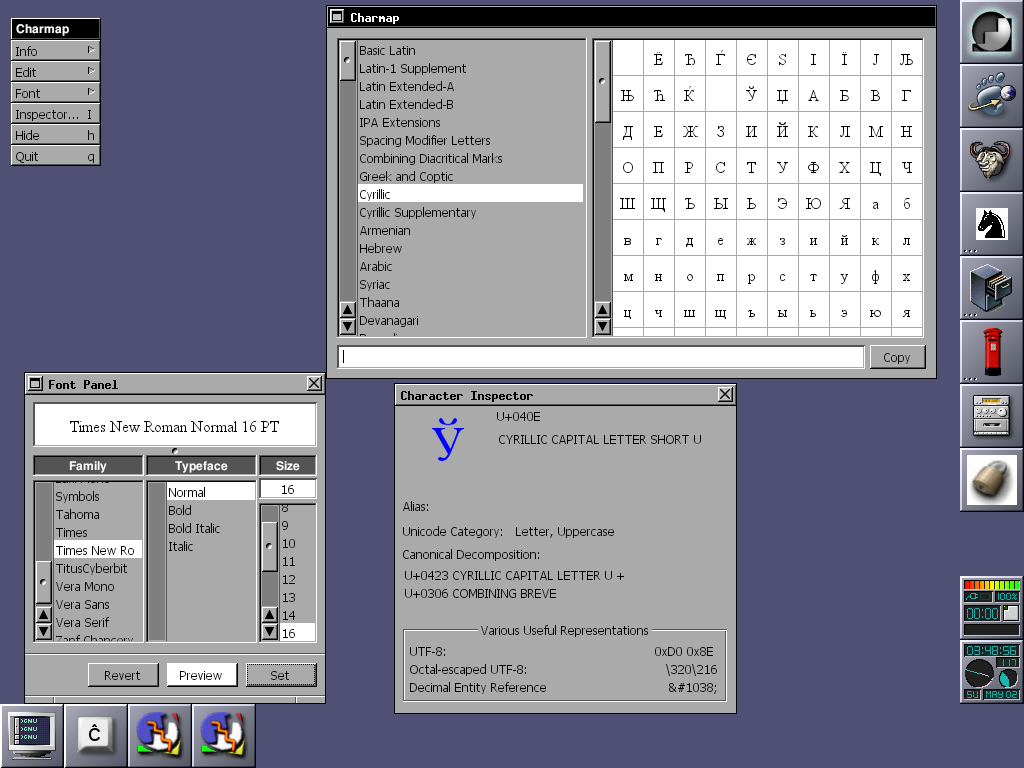
It seems like you have reinvented gucharmap, a simple clean GUI which only requires gtk, and made it into a confusing multiple-window application based on OpenStep, hardly a standard. The only way you would be able to convince geeks to look at the source would be to include Klingon.
-
Duplicity, OpenVPN and a friend or family memberI've been doing this for about a year, and it's working pretty well for my needs:
I setup my parents windows PC with an OpenVPN connection to my house and an FTP server (only listening on the TAP interface). I use Duplicity to do an GPG encrypted incremental backup to the FTP server over the VPN.
Duplicity uses encrypted TAR files for the backup, so your internal filenames...etc are never visible, which is an added benefit if you wanted to do this to a hosting provider..etc. Depending on the amount/size of your files, the first backup can be large. To get around that, I made the first backup to an external hard drive, and brought it with me on a visit (rinse and repeat a couple of times a year for good measure).
I haven't tried to restore a single file over the network, but have tested a full restore (copying the files back to an external). That being the case, I'm not sure I'd recommend this solution for an quasi on-line backup system. However, it does work quite well for just getting your data off-site (securely and incrementally), and since my parents live about 60 miles away, I'm getting a bit of geographical diversity as well. -
Free tools for laptop backup
We use rdiff-backup to automatically backup our laptops (all running Ubuntu Linux) onto a server at our office each day. Similarly, as the director, I maintain a server at home and my laptop backs up there each night. For those that don't know, rdiff-backup uses the rsync algorithm to create a mirror of your laptop's drive on another machine. It checks any files that differ between the source (laptop) and the destination (mirror on server). Rdiff-backup goes one step further, keeping the diffs of older versions of each file for as long as instructed so that you can also recreate older versions of any backed up file!
To avoid backing up invalid/troublesome/cache files, these are the excludes we use: --exclude
For a 100GB laptop drive (nearly full) a daily rdiff-backup run takes about 20 minutes and is triggered by cron automatically. We've got a script which determines which network the laptop is on and backs up to the relevant server.
Rdiff-backup runs on any Linux with a reasonably up-to-date python implementation and rsync library. I believe it's also available for OS X and there's another client for Windows, but I'm not sure what it's called. Or you can run it with cygwin... -
Re:Applications: Trickle backup
I don't know if a convenient 'trickle' uploader exists yet, but I'm setting up a backup scheme for myself that uses duplicity to upload to Amazon's S3, and uses an EC2 instance for a few hours each month to coalesce the incremental backups into a full backup. Since this is for my VPS, I don't worry too much about using a lot of bandwidth when it runs the backup (the incrementals are usually small anyway).
-
Re:***Yo, yo, yo. Question: ***
you could always try to use ratpoison
-
Re:It is if the linker complains about not findinggetopt() is in the header <unistd.h>, which is in POSIX, not ANSI. POSIX facilities are not guaranteed to be present on W*nd?ws systems. It also handles only short options, not long options. For those, you have to use getopt_long() of <getopt.h>, which isn't even in POSIX. You can also use Arg_parser and avoid all the portability problems of getopt_long.
-
Re:OpenCVS?
I feel the OpenBSD guys are right. In general, a simpler system is less likely to have bugs (and hence security holes) than a more complex one. Indeed the first rule of programming is 'keep it simple'. CVS is an old program, having started life as a collection of shell scripts around RCS and then been gradually borged into a C program. CVS development hasn't exactly been rapid in the past few years and it is barely being maintained (look at the CVS site on Savannah).
CVS has had plenty of security holes and still does (like this one I found recently). In many ways it's a classic example of the kind of crusty traditional Unix program that the OpenBSD people have done such a good job securing, rewriting and replacing over the past decade.
As for moving to Subversion - plenty of people are happy with CVS; it has its limitations, but what it does, it does well. The project has a lot of infrastructure built round CVS and if the development process ain't broke, why fix it? -
Re:Your English hurts, too
Or ratpoison.
-
If your teachers are discouraging GNU/Linux...
Then most of what you're learning in school, will probably be worthless in the real-world (as is a lot of the times the case), unless your idea of 'real world' involves working as a
IRC, mailing lists, and LUG/SIGs are a great way to get familiar with things, especially IRC, since it's a real-time international discussion.
Find some applications with bugs. Fix the bugs and submit them to the project's BDOL.
If I may suggest, one project that I am particularly fond of, and would like to see it further developed, is multi-aterm. -
Had to revert...
Well it WAS going to be ZFS, but now they're going to use rdiff-backup instead.
-
That's why I use duplicity ...
-
Re:Lemme check my last home appraisal...
You hit the nail on the head. Distributed version control often comes with superior merging, making the process less painful and encouraging it to occur frequently. Monotone employs a 3-way merge, Codeville has an innovative merging algorithm, and some may even support 5-way merging ("left's immediate ancestor, left, merged, right, right's immediate ancestor") in the future.
In my experience, nearly all merges occur automatically and cleanly. Only if two developers modified code in conflicting areas of the source code do you have to merge manually--and even then, only one person has to do it. It is much better to have merging operate automatically and transparently when possible, than to have to have two people manually coordinate each and every one of their changes beforehand. -
Re:Python as a starter language
Pygsear is supposed to simplify teaching programming via Python and graphics. It's implemented as a layer on top of PyGame. The author is writing a textbook for a course using it. I haven't used it, so I don't know how effective it is, but it seems to implement the LOGO turtle as well as some sort of retained-mode graphics.
-
Re:Can't anyone create a GNU version of Mathematic
Also the number of people who are able to contribute significantly to such project is very limited. This is on the border of several areas - pure abstract mathematics, computer science and engineering. How many qualified LISP programmers you can find nearby? How many of them are also good at abstract algebra? Very few such people exist in the world, partially because mathematicians tend to hate computer tools in their abstract work. That's why most of the CAS systems were created by physicists in response to their practical needs.
Apart from Maxima, which is free software, if somebody wants to contribute, please have a look also at Axiom CAS http://savannah.nongnu.org/projects/axiom, which IMHO gives a very nice and strict approach.
Another C++ based project is GiNaC http://www.ginac.de/ -
Re:Weak comparison
You mean like gksu? It's a simple graphical password prompt. All the ease of use of UAC, with all the security of sudo. And no command line in sight.
Thanks for trying, please play again. -
Re:Fitts' Law
Why on earth in OS X is the menu bar for any given application not attached to the application itself? Why is it fixed to the top of the screen, detached from the very thing it controls?
It's called "FItts' Law." The edge-of-screen menu is a much easier target to access.This isn't an either-or scenario, though. I use a tiling window manager (ratpoison), and that places the menus at the top of the screen, which just so happens to also be adjacent to where the window manager places the window's content. If I want to work in two windows simultaneously, each window's menubar takes up a fraction of the screen.
I honestly don't know why this hasn't caught on. It seems like more than the best of both worlds.
-
Re:Shadow copy
rdiff-backup is the Linux version of shadow copy. Very easy to use backup with revisions. find it here: http://www.nongnu.org/rdiff-backup/examples.html
-
Ratpoison mascot
Ratpoison is a simple Window Manager with no fat library dependencies, no fancy graphics, no window decorations, and no rodent dependence.
No time was wasted drawing it's mascot! -
Re:Consequences of Linux Demand
Looking for this?
-
Re:Applications Packages
As does clicking on a checkbox. Seriously, I don't need it to be any easier.
What we do need now are better guides telling people what they need to install for a given problem, since the link from task to program/package name is not always obvious. I know I can use google for that, but a more centralized and guided way would be nice for less technical people. That's why I think that click-n-run has its place. -
Re:Beagle allready does this!
While it might not have the gloss of Time machine, Duplicity offers similar functionality.