Slashdot Mirror
Domain: nongnu.org
Stories and comments across the archive that link to nongnu.org.
Comments · 557
-
Re:On using AVR Studio / STK500
Dude, why not use the free open source tool chain for AVR? To quote:
AVR Libc is an open source project whose goal is to provide a high quality C library for use with GCC on Atmel AVR microcontrollers.
Together, avr-binutils, avr-gcc, and avr-libc form the heart of the Opensource toolchain for the Atmel AVR microcontrollers.
They are further accompanied by projects for in-system programming software (uisp, avrdude [formerly avrprog]), simulation (simulavr) and debugging (avr-gdb, AVaRICE).
I use most of the above to program ATmegas under Linux with no problems. But this stuff even runs on Windows, or so I hear. -
Re:Why is more dimensions "better"
You might want to have a look at Ratpoison http://www.nongnu.org/ratpoison/ as a WM. It is a Windowsmanager that basically maximizes every Window (tiling is possible AFAIK) and you can switch between them with the same keys you would use in "screen" (with a different prefix key of course). I use it as the final step of a constant descend KDE->XFCE->Fvwm->Ratpoison since I also use X only to give me more Xterms and for browsing, movies and pictures.
-
MLDonkey
Possibly the most widely used app written in Objective Caml -- MLDonkey
-
Re:Decentralization
- Compared to modern revision control systems, I don't think CVS is even in the running. It's SVN (in the non-distributed camp), and Arch, Darcs and Monotone in the distributed camp... with plenty of infighting between them.
Walter
-
Re:Darcs is KISS
- Arch undoubtedly has the most extensive protocol support of any revision control system.
Walter
-
Diggingg dirt.A whois shows:
Registrant
Shamsuddoha Ranju
Siemens Road #115, House #39/B
Gulshan, Dhaka 1213
BD
Registrar..: IARegistry.com (http://www.iaregistry.com)
AKSHOR.COM
Created on..............: 02-Oct-2001
Expires on..............: 02-Oct-2006
Administrative Contact:
Ranju, Shamsuddoha shamsu.ddoha@siemens.com
Alpona Portal
Siemens
ZN Tower, Road # 8, Plot # 2
Gulshan, Dhaka 1212 BD
+880.18.218638 (FAX) +880.2.8819702
Technical Contact:
Ranju, Shamsuddoha unibangla@yahoo.com
Alpona Portal
Siemens
ZN Tower, Road # 8, Plot # 2
Gulshan, Dhaka 1212 BD
+880.18.218638 (FAX) +880.2.8819702
The interesting thing is that this guy is not a stranger to OSS either, he's got a savannah account.
A picture of this con artist showing off the work of other's he's trying to take credit for: here
The related article says:
"Licensing is one of the problems the Ekush team is expecting to face. As the project is not based in the US, Ekush OS will not be able to obtain the license banner of General Public License (GPL), the US-based licensing company."
Showing that either Mr. Ranju or the journalist (or likely both) have little clue on the GPL. -
This is the future of the web
Browsing metadata is the next frontier in the evolution of the web. Some of the other RDF browsers popping up include Gnowsis, MIT Haystack, and Fenfire.
With the growth of the Internet, the value of data itself is dropping, while the value of metadata (i.e. "data about data") increases, introducing a need for tools that can manipulate metadata. That is what RDF is all about - standardizing a way to represent metadata. It is not a standard for the metadata itself...those standards will be determined the same way everything else is on the Internet: with the best solutions rising to the top.
The most common objections to this scenario?
a) "Nobody will bother entering metadata". Wrong...it's already happening. Users are voluntarily generating metadata all the time. Just check out sites like flickr (photo blogging) and del.icio.us (collaborative bookmarks), not to mention Amazon reviews and Ebay ratings.
b) "RDF tags will just be abused with spam, trolls, and other useless info". A variety of techniques are emerging that are designed to protect the integrity of user-contributed data, including trust metrics like Slashdot's own distributed moderation (PDF) or Advogato. -
Re:Direct Link
-
Re:No. We need people that can...
We need a way to track down what we install, modify or remove. In other words, something like apt but more global. This again I'm refering to the last point I made. Maybe if we had a universal format, maybe then we'd see various package managers available to almost all distributions to make the user's life easier.
Apt is fantastic for managing a core set of distribution provided packages. Throw a nice frontend like Synaptic on it and it's user friendly too. Apt works fine for both deb and rpm packages, so you really have the majority of distribution provided packages covered. Those that aren't covered are source distributions like Gentoo, or other fairly hands on distributions like Slackware.
The problem comes when users want to install something outside of their ditribution provided set. Sure, Debian has a very large repository, but it'll never have commercial software. Meanwhile Fedora has a very small repository (comparatively). For non-distribution provided packages I'd suggest you check out Autopackage. You download a packages, run it, and it will check dependencies, resolve them if at all possible, and install itself - it's like installshield but nicer and with dependency resolution. Autopackage isn't done yet, but it already has working packages - its just lacking nice to have features like integration with rpm and deb package databases etc.
Given a combination of Synaptic and Autopackage for base and third party software I think Linux has a very bright future for installing and managing software.
Jedidiah. -
Re:Grotesque look and feel
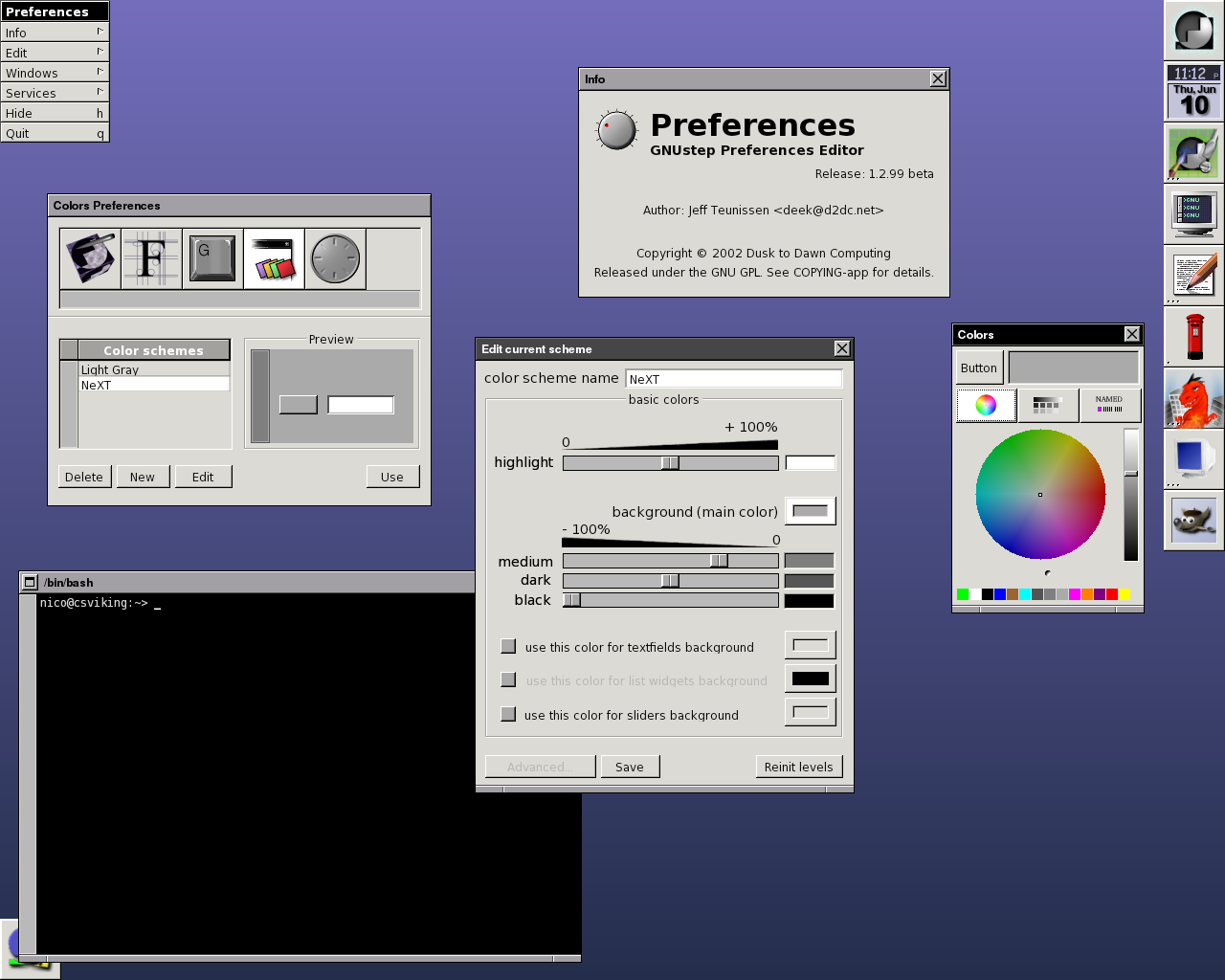
Actually, you probably want to correct your screen's gamma -- with a proper gamma, the default color scheme of GNUstep looks much better.
It's also not very difficult to change the color scheme using Preferences.app, as you can see on this screenshot.
Plus, the look can be modified with themes -
Re:Next
-
gotmail
I know this submission is geared towards windows users but I use Gotmail - it's a perl script that logs into hotmail and forwards your messages to another account or saves them locally. All from the command line.
Nongnu.org -
We don't care about Outlook...
Does gotmail still work on free accounts? =) But seriously. You couldn't make stories this ludicrous up. Microsoft, on their capped-sends-per-day free e-mail service, declares that they want to cut down on spammers, so they eliminate the one feature that most Hotmail lusers love...being able to use it from the comfort of their home, ad-free. Meanwhile, they declared over a month ago that they would upgrade free account sizes [carrot and stick, anyone?], but now, when it comes into effect, only some accounts received the increase in space, and Microsoft cites unexpected capacity utilization. Let me get this straight. Microsoft offers you more space as A) an incentive to not switch services and B) to attract more customers, and then they A) cut off the convenient client interface to Hotmail and B) declare that there have been unexpected usage levels in space, and so have delayed the upgrades. In other words...Microsoft punishes their customers for staying with them and believing them about their upgraded features. Honest. I've seen more financially feasible situations in the Weekly World News.
-
Alternatives:Really, I haven't taken my time to see if any of these below is different. However, there are other ways to access a Hotmail account from an email client.
hotpop (shareware, for Windows. Still working here at my office);
Gotmail. Free as in everything, for Linux.
There are some more, I just can't pull them off my mind right now. -
Re:Several weeks ago
Use gotmail to forward your mail from hotmail to any other account.
-
Re:arch is...
> Arch has been forked once before. It didn't do much good. Search arch-users for Walter Landry, or ArX.
Hey, I resemble that remark!
In any case, the fork has done me quite a lot of good. The latest version, soon to be released, no longer has the annoying--long--names requirements, ++funky =names have been mostly eliminated, strong checksums, internationalization, and arbitrary properties are in, and all of the annoyances in the archive format are gone. Plus some other things that I'm sure I've forgotten.
The whole thing was long ago rewritten in C++, and it has a working python binding. There is still work to be done (optimizations mostly), but it is far easier to work with than tla ever was.
Cheers,
Walter -
Re:I don't like CVS, Subversion, or Arch
There is also ArX, a fork from arch.
-
Re:Comparison of R, Mathematica, S-plus, Matlab, eI don't really do much statistical work, but I've been looking into the various Matlab clones for my physics lab reports, and have come up with a few different options --- all free/opensource --- which as a suite provide a very good, free, alternative to Matlab: Octave Octave is closest to Matlab in terms of source compatibility: you can (almost) take the m-files you wrote for Matlab and run them through Octave, and vice-versa. Octave has no GUI (it uses gnuplot for plotting); the programming language is very similar to Matlab's. Scilab For some reason, Scilab doesn't seem to be as well-known as many of the other projects, but in my opinion it is one of the best Matlab clones. The latest version provides tools for translating m-files to scilab's native format. Scilab uses a syntax which is slightly different than matlab's, but the same kind of style, and pretty easy to learn. It also has many toolboxes which are provided for various uses (check the contributions section on the site). Scilab does have a GUI, and some of the toolboxes provide further GUI enhancements. Grace Grace is a graphing tool for 2D graphs, so it's not a general-purpose Matlab clone --- but for graphing, it's the best (I prefer it to Matlab's graphing capabilities!). As an important bonus, it provides many data-set transformations, such as interactive curve-fitting capabilities. It has a full GUI, but also provides a scripting language for non-interactive use as a backend for producing graphs. Maxima This is a great tool for symbolic computations. It has no GUI, and the syntax is a little strange (it may be similar to LISP, in which it is written; I don't know LISP
Other tools which I have come across, but haven't really worked with: Axiom (symbolic computations, CAS); Scigraphica (graphing); opendx (data explorer + visualization).
I've actually never really used R (by the time I came across it, I was done with my physics labs), so I can't really compare any of the others to it. But it definitely looks like one of the tools that I should add to my suite.
-
Cross-Platform OSS edonkey Client
I'm suprised no one has mentioned it already, but mldonkey is a nice cross-platform edonkey client. It runs pretty nicely on Linux (and somewhat decently on Windows) and comes with a web and telnet interface (it also supports third-party GUI clients).
As an added benefit, mldonkey supports FastTrack, Gnutella 1 and 2, DirectConnect, SoulSeek, Bittorrent, OpenNap...you get the idea. I've been using it for a couple of years, and it's replaced every P2P client for me.
Oh, edonkey is a great network to find PDFs of textbooks - a godsend for students. -
Re:Open source rules again
the eMule client (an open-source clone of edonkey, for windows) is an amazing piece of software. much better than the edonkey client, and and awesome program in its own right. and since it's open source, it's about as non-evil (no spyware or other intrusive shit) as they come. there aren't many windows-specific open source programs, and few approach this caliber.
for linux, the mldonkey client is a pretty nice daemon. i generally use kmldonkey as a gui for it. kmldonkey (a nice attempt to clone emule) crashes quite often, but since it is separate from the network core daemon, nothing is affected. just launch it again, and your transfers are still going.
good stuff. super slow network, though. -
freehoo got also released recently but got no news
and theyre even at version 3.0.0. that means three times more stable than gaim,
three times more features, three thousand times smalles userbase.
but check it out.
http://www.nongnu.org/freehoo/
its got readline support, and its got guile support. what could someone want more
in a client? too bad it doesnt support irc. -
Re:Not surpriseing - deliberate dumbing down
Please ask mom to explain reflexive pronouns.
-Peter
PS: I'm a big advocate of homeschooling.
-P -
duplicity
duplicity already allows trading disk space for backups with friends, or even people you don't know. It's safe (all data encrypted by gpg), it's low bandwidth (deltas sent using rsync algorythm), and it's not a business.
The hardest thing about duplicity right now is probably finding a similarly interested party to trade disk space with.
I trade duplicity space with someone I've never met who has a machine in the same colo, for a backup close to my coloed machine. I also use duplicity to send backups of the server home. I've be happy to trade duplicity space from 1 to 20 gb with most any interested and competant party. -
Re:Compilable with GCJ?
and will it be possible to compile it to 'native' code using GCJ for maximum performance?
It will be possible sooner or later. Depends on what things the applet uses and if they've been implemented yet. Not sure if it works right now, but you can try.
There is a project gcjwebplugin, which is a applet-client utilizing gcj. So far, they've gotten Slime Volleyball working.
And if that isn't an important applet, I don't konw what is.
-
Sound familiar?
Freecraft received a C&D letter and ended up changing their engines name to Stratagus with the FCMP media renamed to Aleona's Tales.
For old memories sake, Freecraft still works out of the box here (eDonkey link)
ed2k://|file|freecraft-030311-win32-with-fcmp.ex e| 8310061|FAF827D537033A8E3E7EA97BC9E5CA93|/ -
Re:No they won't
> 1) Standard control panel through EVERY distro & desktop environment. Gnome and KDE need to learn how to play nice. Obviously, this will involve some work at lower levels by others. We need everyone to create some STANDARDS here.
You could maybe lend a hand. The source is available, you know. First problem to tackle : write configuration software that will parse *any* configuration file thrown at it. That's not so trivial. Some configuration files have very hairy syntax (*cough* Sendmail *cough*). Next, make sure your software doesn't do a big mess while writing changes, this will irk power users (I did make a clean, commented
Still, there are efforts in this area. One example would be the GNOME System Tools. Although I won't settle for something less than stellar, this kind of software could satisfy you. As for your demand that everything should be the same from distro to distro, I just can't understand why that would be. The very point of having more than one distro is, we get to choose which one is best suited to our working methods. And, generally, we end up settling on one preferred distro and we don't move anymore (instead, we go trolling on Web forums saying it is the best distro
> 2) An installer. n00b's don't know what the hell a freakin' tar.gz file is and once they do figure it out, they don't know to where they should extract it. If Linux had a standardized software installer (complete with a dedicated file extension that could be "picked up" from a browser click)
An installer... you mean, like apt-get ? You know, that tool you just tell 'install foobar', and it downloads and installs the program foobar ? Or would you like some graphical thingie like Synaptic, where you just click on the program, then on Install ? Don't tell me you're still building from source without some specific reason on a 2004 distro ? That's SO nineties
> 3) Rules for software companies. Right now, there's no problems with this as there are with Windows because Linux hasn't become mainstream. What am I talking about? Software installs run amok. I hate to see Windows programs putting shortcuts *everywhere*
Then, you'll just LOVE Linux : you see, the Filesystem Hierarchy Standard specifies very clearly where files go on a Linux distribution : binaries (executables) in
That's it. I hope I've been helpful, and I wish you good luck in your quest for a better Linux. But remember : diversity and freedom to experiment with your own solutions is what appeals so much to Linux users. A more rigid f
-
Re:Free as in Beer?
Well, as the author was asking for a free as in beer way of running a windows environment on *nix systems, bochs satisfies his request. Particularly if he is trying to run wincode on a SPARC or PPC chip.
However, in an attempt to feed the Troll, there is a project called plex86 which attempts to virtualize the hardware, as well as a forked version that is much faster and lighter but only designed to run linux variants. Obligatory links:
-
Re:My suggestion
It needs an "update software" program which shows a list of programs (not libraries), and installs necessary updates. Then it needs a "new software browser" which can browse and search the library of available programs (not libraries) and can install them. This would be it.
There's a decent GTK2 based package manager for Debian - Synaptic. It can handle upgrades and everything that you need for the apt system.
I think for a newbie, the sheer number of packages would make it hard to find a package that they want, but have no idea of its name however this isn't the fault of Synaptic - purely that there is so much choice
Although for that, Googling packages.debian.org is very useful, and synaptic can search package descriptions etc also. -
Re:Where is the notifier for
mail-notification for most of your mail notification needs.
-
Re:Best P2P client?
giftcurs and Apollon are both quite good, both based on the gift daemon which has plugins for gnutella/openft/fasttrack/soulseek
http://www.nongnu.org/giftcurs/
http://apollon.sourceforge.net/files.html/ -
Not to be confused with the XForms toolkit
Right. It's not as if the much older project called XForms was listed anywhere either.
-
Duplicity
You want duplicity. It'll run over SSH, and uses librsync. You get compressed backups, and compressed incremental changes. You can easily go back to the version of the file from a few days previously, or the latest version. It requires Python, librsync, and either a ssh or ftp server. You can make it work with cygwin, or with ActivePython + some other ssh server.
-
Re:Why linux isn't ready.....
So linux isn't ready because if you choose to use software distributed as source you have to use the commandline? It's not even a terribly hard sequence of commands, and they are almost always described in the INSTALL document.
That aside though, the main issue with source installs is that you end up with a mess - files all over the place. You can't remove what you just installed unless the Makefile happened to include an "uninstall".
Up until now I've been very happily avoiding this issue by using stow, but recently I found checkinstall which you run instead of make install. Checkinstall creates a package (.deb, or
"That's still too hard!" you say? Yes, quite possibly - but then the only real reason to be installing from source is if you have very particular needs (special configure options) or a need to be on the bleeding edge. Pretty much anyone who thinks compiling is too hard should be happy with binary installs. With things like synaptic, redcarpet, up2date, etc. around installing distro provided packages is a breeze. If you have to go outside your distro try autopackage. Yes, autopackage isn't finished yet, but they're at the stage where they have some test packages (install the latest version of inkscape via autopackage for instance), and what they do have is fantastic - think of it as installshield with advanced dependency checking resolution. All those third parties currently supplying distro specific rpms ought to shift their project to supplying autopackages, and certainly autopackage looks to be the way to go for any commercial vendor who wants to create a linux installer for their software.
Installs are still a little tricky, but the issues have been spotted, and are being worked on - and the solutions look better than anything Windows provides.
Jedidiah -
Re:Cygwin + rsync
To expand on this slightly, I have had good success with duplicity.
It supports gpg signing and encrypting of archives and provides direct support for scp/ssh as a transport while handling full and incremental backups very nicely (well, after I wrote a few wrapper scripts just to make my life easier).
I have not used it on windows with cygwin, but I know people who are. -
Exactly. Democracy needs to evolve already.
Agreed. Our current governmental systems are deeply flawed.
Luckily, there are alternatives. 'Semi-direct democracy' (or 'hybrid democracy' and 'liquid democracy' as some call it) seems like a more suitable option for our current communications technology. AMPU, and a few other projects are aiming to implement something like that. -
If you are using Y! Messenger
They were sending pop-up ads using the Messenger function enabled on many Windows operating systems
Yup yahoo messenger is annoying simply use zinc http://zinc.sourceforge.net/ or curphoo http://savannah.nongnu.org/projects/curphoo/ for Linux/FreeBSD/OpenBSD etc all. They just not block the advts; but also got facility to ignore users, stop booters and other features -
Re:What Is The Worry?
-
Re:Which begs two questions..
Well unless you left something off or I missed something your chipset is listed as supported. I used a Vortex based card myself for years (Monster) under Linux (I use SB now for the easy support).
Here's a link to the original project (it was merged into the ALSA project):
savannah.nongnu.org/projects/openvortex/
Its also listed in the ALSA matrix as supported:
www.alsa-project.org
My advice would be (and you'll probably hate this) to NOT use Gentoo unless your idea of a relaxing afternoon is digging into the heart of how things work. I've been using Linux for at least 5 years now and I prefer Mandrake because (aside from MandrakeSoft making all their additions GPL) it has great auto configuration and hardware detection.
Before you go crazy at me, you can always try one of their live disks (MandrakeMove) out first and see if it works okay for you.
MandrakeMove
Sometimes easier isn't lame, its productive. -
This game rulez!!
RobotFindsKitten
Really I think Monkey Bubble, Trackballs, Chromium are all pretty cool. One other that I've wasted tons of time. Enigma -
Just naming a few...
...i nearly always install on new systems:
CoreWar: simulation game where a number of warriors try to crash each other while they are running in a virtual computer.
Battle for Wesnoth: fantasy turn-based strategy game.
BZFlag: multiplayer 3D tank battle game.
Crimson Fields: tactical war game in the tradition of Battle Isle.
Crossfire: cooperative multiplayer graphical RPG and adventure game.
Enigma: inspired by Oxyd on the Atari ST and Rock'n'Roll on the Amiga.
FlightGear: Flight simulator.
FreeDroid: clone of the classic game "Paradroid" on Commodore 64.
Frozen Bubble: puzzle-bobble clone.
Globulation 2: Real-Time Strategy.
LinCity: city/country simulation game.
LBreakout 2: breakout-style arcade game in the manner of Arkanoid.
NetHack - Falcon's Eye: mouse-driven interface for NetHack that enhances the visuals, audio and accessibility of the game, yet retains all the original gameplay and game features.
netPanzer: online multiplayer tactical warfare game designed for FAST ACTION combat.
Pathological: enriched clone of the game "Logical" by Rainbow Arts.
Project StarFighter: xy-axis star fighting game.
SuperTux: classic 2D jump'n run sidescroller game.
XKobo: astpaced multiway scrolling shoot-em-up.
XRick: clone of Rick Dangerous.
XScorch: Scorched Earth clone.
Have fun! -
Open Source RFID
If anybody wants to do something constructive, then help "hack" on the open source RFID C library on Savannah.
-
Limited experience personally
but I can give my thumbs up towards Liferea on Linux. Straw is also good if for some reason Liferea isn't to your liking.
I found a nice Windows reader called rssbandit that I setup for a few people while doing Windows installs recently. They seemed to like it.
I have no experience with OS/X, so I can't put a vote towards anything there. The Linux apps are gtk based and the Windows app is a dotNet programmed app. -
Straw
Straw is a very nice app for Linux (Gnome): website here... be careful about the dependencies when compiling it.
-
Re:Still Wondering
What am I not seeing here?
Oh! Oh! I know! That the government isn't the answer to all problems?
But that's just the Libertarian in me talking.
In all seriousness, if you really think that this is a good idea consider pitching in to make it happen. I have my own project to this end, the Free Curriculum Project.
I also help out a bit with another, Free High School Science Texts.
I know that both or either project would sincerely appreciate your help.
Both are focused on High School texts. Mine is biased to the United States of America, the other is South African.
-Peter -
Re:Still Wondering
What am I not seeing here?
Oh! Oh! I know! That the government isn't the answer to all problems?
But that's just the Libertarian in me talking.
In all seriousness, if you really think that this is a good idea consider pitching in to make it happen. I have my own project to this end, the Free Curriculum Project.
I also help out a bit with another, Free High School Science Texts.
I know that both or either project would sincerely appreciate your help.
Both are focused on High School texts. Mine is biased to the United States of America, the other is South African.
-Peter -
Re:Fair go
Fedora's base install will never include mp3 and ntfs until either U.S. patent law is reformed or patents on Mp3 and NTFS expire. Its really not that hard to get mp3 and ntfs support. Its included in a nice FAQ list.
I agree that it would be nice to get mp3 support built in but Red Hat is just covering their legal ass. And its a great example of how software patents are problematic.
As for installing software via commandline, you can get around that by using Synaptic. After installing APT in Fedora, just apt-get install synaptic. Makes it a little less scary. -
Re:Linux stupid stuff
Fedora could have solved their package management problem easily: just include apt and synaptic, and put freshrpms' repositories as default, and you are all set. My non-commandline friends are throughly happy with this setup, and if one doesn't want to type commands, he should not be forced to deal with rpm files directly anyway (IMO).
-
Re:Vortex Linux drivers
Ops forgot to mention that is always useful to apply patches to the driver in the vanilla kernels, because linux is a lazy bastard and could not care less about our poor soundcards
cheers -
I use ...I am happy with my current selection of console applications.
All console aplications are wrapped inside GNU Screen- shell: bash
- editor: vim
- email: mutt
- audio playback: cplay front-end
- mixer: aumix
- irc & im: irssi
- im/irc gateway: bitlbee
- web browser: w3m
- p2p:
- news aggregator: raggle
-
giFTcurs
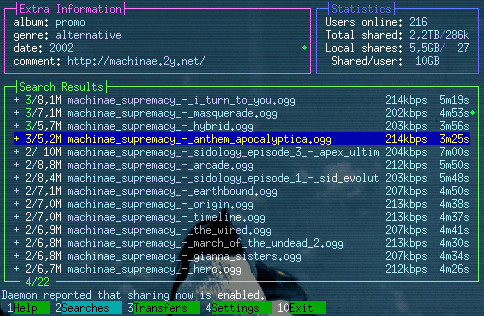
For P2P, the giFT frontend giFTcurs does the job well. Look, pretty screenshot. All-in-one package for OpenFT, FastTrack, Gnutella and OpenNap.