Slashdot Mirror
Domain: nongnu.org
Stories and comments across the archive that link to nongnu.org.
Comments · 557
-
giFTcurs
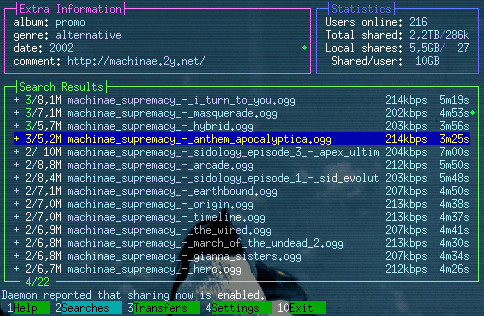
For P2P, the giFT frontend giFTcurs does the job well. Look, pretty screenshot. All-in-one package for OpenFT, FastTrack, Gnutella and OpenNap.
-
Open Source Artworks
You can start by browsing already "open sourced" works at opart.org and opsound.org. If you cannot find anything pre-existing to fit your needs, you will at least find a community of artisans who embrace open source principles. You'll also want to consult creative commons for the various free asin speech liscenses for the various mediums of art you'll be using.
I think you'll find that most open source artists, as with most open source developers are not seeking to be financially compensated directly, though are open for donations.
I myself am an "open source" musician and have contributed music to a few open source projects: SonarBuoyix and Tong. -
Re:It's True About Desktop Management ToolsConectiva has also adapted apt-get to work with RPMs
Conectiva also made a damn fine graphical front-end to apt-get, which works both with Conectiva and Debian: Synaptic.
-
Shameless Plug
If you find this interesting, check out my Free Curriculum Project and the Free High School Science Texts project (to which I am a very minor contributor).
Both of these projects use the FDL.
-Peter -
Shameless Plug
If you find this interesting, check out my Free Curriculum Project and the Free High School Science Texts project (to which I am a very minor contributor).
Both of these projects use the FDL.
-Peter -
MLDonkey
Before you consider trying Shareaza, have a peek at MLDonkey. A nice multi-interface multi-protocol project done in Python that supports all that Shareaza supports and more.
-
Re:been done, README in StumpWMFunny thing that I read a very similar story last year: it was the README of the window manager stumpwm, which was written in Common Lisp.
Cite:The current trends shown by Big Software is to use XML for all data formats. It won't be long before we have XML interpreters, XML data being interpreted as functions:
Want to see for yourself?
<math>
<operator>plus</operator>
< operand>4</operand>
<operand>5</operand>
</math>
I predict within 2 years Big Software will announce the Next Big
Thing: XML++. An Object Oriented language with all the advantages of
the superior XML data format coupled with modern advancements in
Server side Web based technologies. XML Code and XML Data will be
almost interchangeable, except for some tweaky markup which will be
justified by the need for more aggressive innovative content creation
services.
But why wait? We have it all already.
http://www.nongnu.org/stumpwm -
Linux friendly microcontrollers
I've been using the BASIC Stamp Tools for Linux for a while now. It uses the (unfortunately) beerfree parallax pbasic tokenizer so. If you don't want to use the BS, the Atmel AVR series is well supported by open source software, and really fast as well (native code vs. interpreted).
-
Re:Text of the article
On my FC2 system I use Synaptic. It's a GUI frontend to apt that will handle installing single packages, or upgrading your entire distro.
Just follow the instructions listed on the fedora.us site. -
Re:You can't laugh this off, not even with Mozilla
Running as an Administrator isn't secure.
True enough, but I still do it. Why? My Windows partition exists solely to play games. Lots of games are stupid and assume that they can write all of the drive at well. If you want to play arbitrary modern games under WindowsNT/XP, you're doing it as Administrator. I simply accept this.
Interestingly, the opposite is true of Linux. There was a really good looking RSS aggregator I was interested in; good enough that I was considering purchasing it. However, it pretty much demanded to be installed as root and world write permission for its install directories given to any user accounts who was going to use it. I didn't stand for it, I instead used a less mature product that behaved like software should. (Not perfectly mind you; installing it as a user proved to be a mess. However, once installed as root it worked correctly without unusual permissions.)
My brother administrates a research lab of computers. He's asked to keep a wide selection of software packages available for his users. I regularly listen to his tales of woe as he complains that package X assumes write access to C:\Windows, package Y demands write access to sensitive parts of the Windows registry, and the like.
I work with an eclectic selection of specialized physics simulation software that runs on Unix-like systems (mostly Linux these days). Every single piece I've worked with was quite happy to be dumped into a random directory and run directly by the user .
There is an interesting difference in attitude between Windows and Unix-like systems. On Windows lots of developers assume Administrator access. On a Unix-like system assuming root access is gets you dirty looks. Microsoft officially wants software developers to play nice and support user-installed software and user-used software that was installed by Administrator, but developers simply don't take it seriously. The culture of respecting security boundaries doesn't exist. Sure, there are people doing great work on Windows, but there the main masses of Windows programmers doing specialized work just don't think about it. Microsoft needs to lean harder on them.
-
Shameless Plug
-
Keeping it for now
I am still gonna use RH9 for a while. I mostly use Synaptic for checking and installing the latest packages anyway. I have a FBSD 4.7 web server / mailserver and a FBSD 5.1 SAMBA server running on the LAN as well, so most of the data is safe, but my RH9 machine is dual boot with (:( ) win98, just coz I don't want to pay for XP and also don't want to overwite my RH partition by installing Xp. I only use windoze because I have a crappy Hauppage WinTV usb, which isn't supported in Linux / FBSD. I also like to rip and burn dvds, for which I need windoze.
-
Re:This has a lot of potential
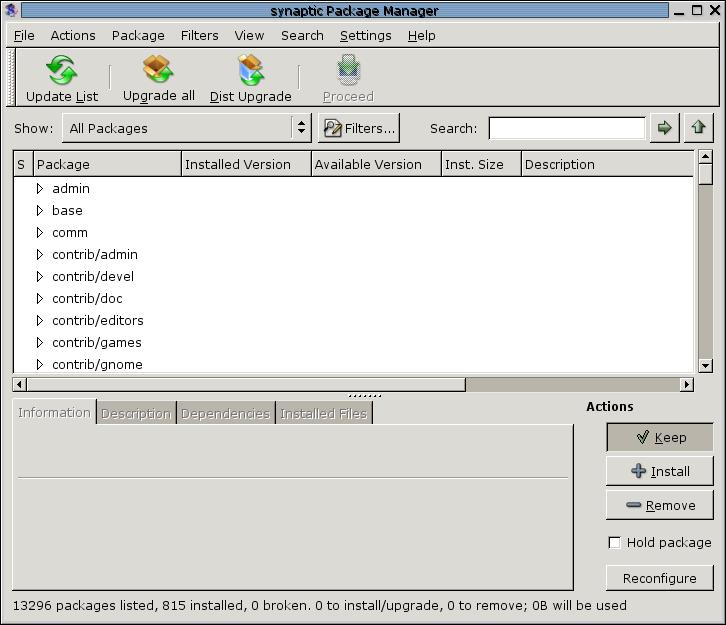
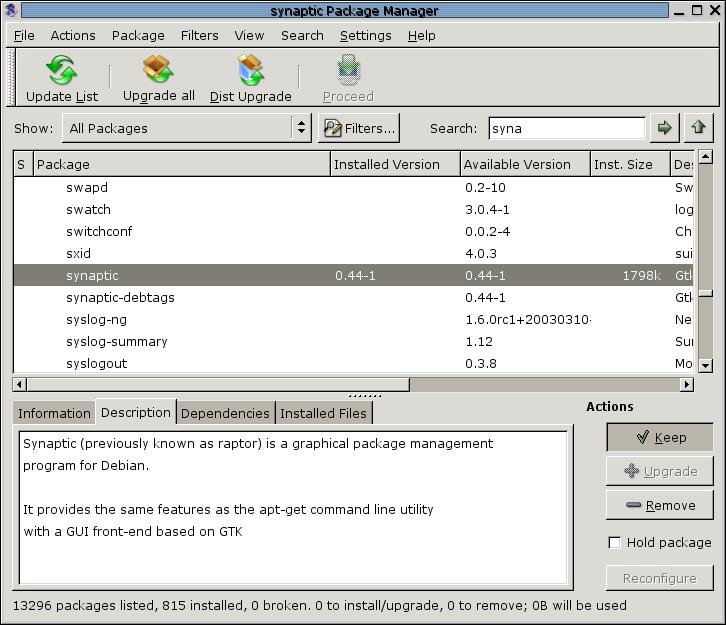
You mean something that might look a little like this, with nice descriptions of the packages, and filters to see only upgradable packages, or new packages in the archive or even searches, like this?
Right, well, done. It;s called Synaptic. Except it works with apt not portage and is available for debian, fedora, connectiva, and any other distro using apt.
I'm sure a system is being developed for Gentoo - only logical really - but Synpatic has been available for quite some time now to make package management, installation, and upgrade simple.
Gentoo is a great distribution, but don't try to claim superiority for the wrong reasons.
Jedidiah. -
Re:This has a lot of potential
You mean something that might look a little like this, with nice descriptions of the packages, and filters to see only upgradable packages, or new packages in the archive or even searches, like this?
Right, well, done. It;s called Synaptic. Except it works with apt not portage and is available for debian, fedora, connectiva, and any other distro using apt.
I'm sure a system is being developed for Gentoo - only logical really - but Synpatic has been available for quite some time now to make package management, installation, and upgrade simple.
Gentoo is a great distribution, but don't try to claim superiority for the wrong reasons.
Jedidiah. -
Re:This has a lot of potential
-
Re:DIY
transactions - use JDBC.
sessions - use a database or create server that acts as shared memory.
stickyness - don't do it, or have a dedicated server when you need it.
Anyway, the point is, it will make you smarter if you learn how to do this stuff your self. Once you get good at it, it won't seem like magic.
I've written my own jsp-like server , my own database . My own bean-managed persistence framework (before j2ee).
I once shocked my colleges by running our application which usually runs in Weblogic in a simple RMI server which I wrote in a few hours.
It would take a long time to rewrite the entire J2EE spec or to rewrite Struts, but it doesn't take long to write something that does what my own application needs.
And no, I don't write simple apps.
-
On GNU/Linux boxes
...most of these are already installed for me in the standard installs of the various distros I try, but I consider these ten pretty crucial:
1. Mozilla
2. OpenOffice.org
3. Straw (RSS Aggregator)
4. Thunderbird (w/ Enigmail)
5. Evolution (which may soon be replaced by the amazing Mozilla Calendar)
6. Gaim
7. Gimp
8. XCDRoast
9. xmms
10. Xine/gXine -
Re:Topic misleading.
this is a bit old, but sf.net hosts many non-free software packages. don't be fooled by slashdot. the retaliation against this is http://savannah.nongnu.org/ so adjust your advocacy appropriately. thank you
-
Re:Why not just use P2P?
And how hard is it for the installer to set a cron job to run 'apt-get update;apt-get upgrade' at every logon or 24 hour increments thereafter? This requires _no_ user interraction - less so than Windows Update or whatever magical solution they were using on their last box. And if they really want a graphical solution then Synaptic is great for that purpose.
Also, what's the point of letting people use what they know? If F/OSS inherits familiar characteristics from proprietary software then it's going to bring some bad ones with it too - why have to wean them off it later when you can start immediately? -
media player
Yes, multimedia is certainly something we'd like the desktop to do well. However, it's not realistic to expect comprehensive multimedia support from a Linux desktop today with open source software. It's a very difficult and costly problem to solve comprehensively. There are some positive signs, such as helix community, but you don't really have a single piece of software that does it all as well as the Windows variants.
Ummm...I'm not sure how to respond to this. How about mplayer? That has to be the best movie player I have ever used. And didn't it receive some sort of award recently? Or how about Xine?
Let's see...what else? The GStreamer framework is coming along nicely and will probably mature before the end of the year. There are several audio players available, some more usable than others, though. There are also more specialized programs like the Bedevilled Audio System. So I would hardly say linux is deficient in multimedia software. -
Re:Sadly, I think the key might be
-
Re:Reliability comes first
-
Shameless plug...
-
Re:is this a trick question?Wouldn't it be nice if you could connect to your kazaa session from any machine? Or allow all users to use one kazaa "daemon" and run a seperate client to search for and download files?
Thats what we call mldonkey.
- MLdonkey runs as a daemon on the computer. It can be controlled using several interfaces: the simplest one is telnet (telnet 127.0.0.1 4000), a more interesting one is a WEB server (http://127.0.0.1:4080/), and a binary protocol allows access using more elaborate Graphical Interfaces (see the GUIs available on your system at the bottom of the page). MLdonkey comes by default with a GTK interface. All these interfaces can be used locally, or remotely (after disabling security restrictions).
-
Re:Building your own UAV
Paparazzi has an autonomous model airplane for 500$. a little cheaper !
-
Re:Please explain....?
Agreed... very rare (in my experience) that you'll find a uninstall target in the makefile, unfortunately.
That said, I think up2date is a pretty absymal package management system, last time I recall it doesn't even solve dependencies automatically, which is why I prefer APT (w/ Synaptic of course) for most things. -
Re:Why reinvent the wheel? (ot)
-
Re:Why reinvent the wheel?
Then try Synaptic It's a desktop, graphical APT.
-
Re:Not So New Concept
You don't need to buy it. I just downloaded the pdf and read the intro. This is really well written, and he even recognizes Donald knuth in the second paragraph:
"One of the greatest programmers, Donald Knuth, describes programming not as telling a computer how to do something, but telling a person how they would instruct a computer to do something. The point is that programs are meant to be read by people, not just computers. Your programs will be modified and updated by others long after you move on to other projects. Thus, programming is not as much about communicating to a computer as it is communicating to those who come after you. A programmer is a problem-solver, a poet, and an instructor all at once. Your goal is to solve the problem at hand, doing so with balance and taste, and teach your solution to future programmers. I hope that this book can teach at least some of the poetry and magic that makes computing exciting."
I look forward to reading the rest! -
Link to online version
-
Link to online version
-
Re:Not So New Concept
You don't have to buy the book. You can download it from here for free in pdf format.
-
It's available online
Sorry if this has already been mentioned, but the book is available for dowload from this site, under the filelist link. Here is a direct link to the pdf.
--
Was it the sheep climbing onto the altar, or the cattle lowing to be slain,
or the Son of God hanging dead and bloodied on a cross that told me this was a world condemned, but loved and bought with blood. -
It's available online
Sorry if this has already been mentioned, but the book is available for dowload from this site, under the filelist link. Here is a direct link to the pdf.
--
Was it the sheep climbing onto the altar, or the cattle lowing to be slain,
or the Son of God hanging dead and bloodied on a cross that told me this was a world condemned, but loved and bought with blood. -
This book
has been available for some time under the GNU Free Documentation License. I tried to use it a while back when I decided to learn assembler, but I found Paul Carter's PC Assembly Language to be a much better introduction.
-
Re:Your book?I'm put off too.
I'll download it for free myself.
-
Available under GNU FDLI don't know why he didn't mention that this is a free documentation project:
http://savannah.nongnu.org/projects/pgubook/
It's also being used at Princeton
-
Re:Why aren't there useful public-domain textbookswe need authors... please help us!
we are nearly ready to release the section on physics to the world
we also have sections on maths, chemisty and biology in the pipeline.
-
Re:C# vs Java
I'm using IKVM in production right now in a real (albeit small) company. And mono plan on releasing 1.0 within the next 6 months, which they will recommend for production use - we're evaluating that for use within our company also.
I have some development tools written in Java which have language-independent output (supporting both Java and C#) but our company primarily uses C# these days. Still, every developer had to install the JDK and a JDBC driver in order to run our compile process, since it invokes these Java tools.
These days, I've used IKVM to compile that code to a
It is true, though, that I've found that following projects like these has helped my ability to write much more boring code. It's also helped when I'm faced with a problem like "hey, we might have a customer who wants to buy our (.NET) stuff but uses primarily Unix, can we help them?" and I can say "Well, it's not 1.0 yet, but there's this project called Mono..." -
Re:SSH over satellite
You might want to check out udpeq , if you have root on a well connected machine somewhere else. You can use it to combine the bandwidth of several connections.
-
Re:Virtual machine
-
Re:Pygame
While on the topic of Pygame, you should check out the Pygsear project, which is aimed at making things very simple for novices.
Perhaps your son can make a silk purse with it.
Pygsear
The book that goes along with it -
Re:Is FastTrack network same as the old Linux KaZa
MLdonkey is open source and supports not only donkey but fasttrack, bittorent, soulseek, dc, gnutella, gnutella2, overnet, opennap networks too. u can use it with many guis and from console.
-
Re:so what?
There is a strange mlnet.exe file on the new morpheus... =)
Try to compile from the CVS of mldonkey and tell me what is the strange mlnet file you got... -
Re:Command line
mldonkey comes to mind...
You can use it on a console and has a web interface and a GTK interface.
-
Re:Is FastTrack network same as the old Linux KaZa
The old kza will not work because it does not have the new encryption layers. Instead you can use giFT, giFT-FastTrack and giFTcurs.
It looks alot better than kza and it's guaranteed to be free of spyware (it's free software). It's all in Debian, except for gift-fasttrack which you can get here:
deb ftp://ftp.berlios.de/pub/gift-fasttrack unstable main -
Re:Call me...
-
Re:Bittorrent
The BT works like a charme for me. Even tho my upload-rate is capped at 10kb/s I'm getting ~95kb/s straight D/L (from 40 sources).
Make sure you're using a good/recent client (e.g. the original BT Python Client or the excellent mldonkey)
Also make sure your Firewall is not blocking the BT ports: 6881-6889,6969 TCP. If you're running your BT downloader behind NAT you might have to forward these ports. Remember how BT works: If other downloaders can't connect to you they will slow YOUR download down to a very low rate (or just refuse to send you anything). That's the magic mechanism that keeps BT from being clogged down by freeloaders. -
Re:this makes MS looks stupid
Have you ever seen Synaptic? Windows has nothing on it, an entire library of software to install. (Taken from any apt-get repository.) All dependencies handled automatically.
Granted, Linux is still several years behind Windows in application breadth. (Example: genealogy software -- Linux has one decent one, GRAMPS, Windows has literally dozens.) But this continues to improve with time, from being pathetic back when I started in 1999, to having "most major applications" today.
I'm certainly no software developer, but both my wife and I now use Linux full time. Neither of us have booted to Win95 in over a month. All this on a four year old P3-450.
-
Re:Hmm...
Shit, I wonder what would happen if you threw Emacs into an mp3 player? Hehe
Would that be sort of the opposite of this?