Slashdot Mirror
Domain: nytimes.com
Stories and comments across the archive that link to nytimes.com.
Stories · 5,561
-
Why a Cure For Cancer Is So Elusive
Hugh Pickens DOT Com writes "George Johnson writes in the NYT that cancer is on the verge of overtaking heart disease as the No. 1 cause of death and although cancer mortality has actually been decreasing bit by bit in recent decades, the decline has been modest compared with other threats. The diseases that once killed earlier in life — bubonic plague, smallpox, influenza, tuberculosis — were easier obstacles. For each there was a single infectious agent, a precise cause that could be confronted. But there are reasons to believe that cancer will remain much more resistant because it is not so much a disease as a phenomenon, the result of a basic evolutionary compromise. As a body lives and grows, its cells are constantly dividing, copying their DNA — this vast genetic library — and bequeathing it to the daughter cells. They in turn pass it to their own progeny: copies of copies of copies. Along the way, errors inevitably occur. Some are caused by carcinogens but most are random misprints. Mutations are the engine of evolution. Without them we never would have evolved. The trade-off is that every so often a certain combination will give an individual cell too much power. It begins to evolve independently of the rest of the body and like a new species thriving in an ecosystem, it grows into a cancerous tumor. 'Given a long enough life, cancer will eventually kill you — unless you die first of something else (PDF). That would be true even in a world free from carcinogens and equipped with the most powerful medical technology,' concludes Johnson. 'Maybe someday some of us will live to be 200. But barring an elixir for immortality, a body will come to a point where it has outwitted every peril life has thrown at it. And for each added year, more mutations will have accumulated. If the heart holds out, then waiting at the end will be cancer.'" -
Anti-GMO Activists Win Victory On Hawaiian Island
biobricks writes "New York Times reports on how the county council on the Big Island of Hawaii banned GMOs. 'Urged on by Margaret Wille, the ban’s sponsor, who spoke passionately of the need to “act before it’s too late,” the Council declined to form a task force to look into such questions before its November vote. But Mr. Ilagan, 27, sought answers on his own. In the process, he found himself, like so many public and business leaders worldwide, wrestling with a subject in which popular beliefs often do not reflect scientific evidence. At stake is how to grow healthful food most efficiently, at a time when a warming world and a growing population make that goal all the more urgent.'" -
Losing Aaron
theodp writes "It's said that you can't fully understand someone until you meet their family. In Janelle Nanos's 'Losing Aaron,' you'll meet Bob Swartz, father of the late Aaron Swartz and adviser to MIT's Media Lab, and get a better understanding of how Aaron's family helped plant the seeds of his idealism. You'll also, sadly, see how MIT — the institution which Bob Swartz long felt stood for compassion and creativity, challenging authority, and pure scientific inquiry — took a self-described stance of 'neutrality' in the aggressive prosecution of his son that ended with Aaron's senseless death last January. 'Clearly I failed,' a tortured Bob Swartz acknowledges. 'There's no question, my son is dead. On the other hand, do I feel that I didn't try hard enough? Yes. Do I feel guilt about not trying hard enough? No. If you understand the distinction I'm trying to make. Could I have done more? Of course I could have done more. Because you can always do more. Did I put everything in that I possibly could? Did I work as hard pretty much as I knew how? Yes. Do I wish I did more? Yes. But I don't go home at night and say, "Well, you didn't care." Because I did. I cared about it more than anything else. And I don't go home at night and say, "I didn't try." Because I tried. Everything I could figure out. But I failed.'" -
Losing Aaron
theodp writes "It's said that you can't fully understand someone until you meet their family. In Janelle Nanos's 'Losing Aaron,' you'll meet Bob Swartz, father of the late Aaron Swartz and adviser to MIT's Media Lab, and get a better understanding of how Aaron's family helped plant the seeds of his idealism. You'll also, sadly, see how MIT — the institution which Bob Swartz long felt stood for compassion and creativity, challenging authority, and pure scientific inquiry — took a self-described stance of 'neutrality' in the aggressive prosecution of his son that ended with Aaron's senseless death last January. 'Clearly I failed,' a tortured Bob Swartz acknowledges. 'There's no question, my son is dead. On the other hand, do I feel that I didn't try hard enough? Yes. Do I feel guilt about not trying hard enough? No. If you understand the distinction I'm trying to make. Could I have done more? Of course I could have done more. Because you can always do more. Did I put everything in that I possibly could? Did I work as hard pretty much as I knew how? Yes. Do I wish I did more? Yes. But I don't go home at night and say, "Well, you didn't care." Because I did. I cared about it more than anything else. And I don't go home at night and say, "I didn't try." Because I tried. Everything I could figure out. But I failed.'" -
Helicopter Rescue For All Passengers Aboard Antarctic Research Ship
The BBC reports (with video) that all aboard the ice-trapped MV Akademik Shokalskiy have been rescued by helicopter, after more than one icebreaker attempt to reach the vessel directly proved too challenging. Also at the New York Times, which reports "The twin-rotored helicopter, based on a Chinese icebreaker, the Xue Long, or Snow Dragon, flew several sorties across miles of packed ice to pluck scientists, tourists and journalists from a makeshift landing zone next to the marooned MV Akademik Shokalskiy research vessel." -
The New York Times Pushes For Clemency For Snowden
Hugh Pickens DOT Com writes "The Editorial Board of the New York Times has weighed in on the criminal charges facing Edward Snowden and writes that 'Snowden deserves better than a life of permanent exile, fear and flight..' 'He may have committed a crime to do so, but he has done his country a great service. It is time for the United States to offer Mr. Snowden a plea bargain or some form of clemency that would allow him to return home, face at least substantially reduced punishment in light of his role as a whistle-blower, and have the hope of a life advocating for greater privacy and far stronger oversight of the runaway intelligence community.' The president said in August that Snowden should come home to face charges in court and suggested that if Snowden had wanted to avoid criminal charges he could have simply told his superiors about the abuses, acting, in other words, as a whistle-blower. In fact, notes the editorial board, the executive order regarding whistleblowers did not apply to contractors, only to intelligence employees, rendering its protections useless to Snowden. More important, Snowden told The Washington Post that he did report his misgivings to two superiors at the agency, showing them the volume of data collected by the NSA, and that they took no action. 'Snowden was clearly justified in believing that the only way to blow the whistle on this kind of intelligence-gathering was to expose it to the public and let the resulting furor do the work his superiors would not. ... When someone reveals that government officials have routinely and deliberately broken the law, that person should not face life in prison at the hands of the same government,' concludes the editorial. 'President Obama should tell his aides to begin finding a way to end Mr. Snowden's vilification and give him an incentive to return home.'" -
US Justice Blocks Implementation of ACA Contraceptive Mandate
theodp writes "First approved for contraceptive use in the U.S. in 1960, 'The Pill' is currently used by more than 100 million women worldwide and by almost 12 million women in the U.S. But just hours before the Affordable Care Act was to go into effect, Justice Sonia Sotomayor issued a stay temporarily blocking a mandate requiring health insurance coverage of birth control, and gave the Obama administration until Friday to respond to the Supreme Court on the matter. Sotomayor's order applies to a group of nuns, the Little Sisters of the Poor, and other Roman Catholic nonprofit groups that use the same health plan, known as the Christian Brothers Employee Benefit Trust (PDF). The group is one of many challenging the federal requirement for contraceptive coverage, but a decision on the merits of that case by the full Supreme Court could have broader implications. One imagines Melinda Gates is none too pleased. So, will U.S. health care require a Department of Personal Belief Exemptions that are dictated by employers (PDF, 'The Trustees of CBEBT and the management of Christian Brothers Services are dedicated to protecting the employers participating in the CBEBT from having to face the choice of violating their faith or violating the law')?" -
Wisconsin Begins Using Cheese To De-Ice Roads
Hugh Pickens DOT Com writes "The NYT reports that Milwaukee has begun a pilot program to use cheese brine to keep city roads from freezing, mixing the dairy waste with traditional rock salt as a way to trim costs and ease pollution. 'You want to use provolone or mozzarella,' says Jeffrey A. Tews, the fleet operations manager for the public works department, which has spread the cheesy substance in Bay View, a neighborhood on Milwaukee's south side. 'Those have the best salt content. You have to do practically nothing to it.' Local governments across the country have been experimenting with cheaper and environmentally friendly ways of thawing icy thoroughfares, trying everything from sugar beet juice to discarded brewery grain in an attempt to limit the use of road salt, which can spread too thin, wash away and pollute waterways. 'If you put dry salt on a roadway, you typically lose 30 percent to bounce and traffic,' says Emil Norby, who works for Polk County and was the first in Wisconsin to come up with the cheese brine idea to help the salt stick. In a state where lawmakers once honored the bacterium in Monterey Jack as the state's official microbe, residents of Bay View say they have noticed little difference, good or bad, in the smell of their streets, and city officials say they have received no complaints. The mayor of Bay View says it's an experiment, but one that makes sense. The brine will come from the Dresser Farm in Polk County, where it is already being used on the roads. The only cost will be for transportation and distribution. 'We thought, 'Well, let's give it a shot.' The investment in this project is $1,474.'" -
U.S. Mobile Internet Traffic Nearly Doubled This Year
An anonymous reader sends this news from the NY Times Bits Blog: "Two big shifts happened in the American cellphone industry over the past year: Cellular networks got faster, and smartphone screens got bigger. In the United States, consumers used an average of 1.2 gigabytes a month over cellular networks this year, up from 690 megabytes a month in 2012, according to Chetan Sharma, a consultant for wireless carriers, who published a new report on industry trends on Monday. Worldwide, the average consumption was 240 megabytes a month this year, up from 140 megabytes last year, he said." -
E-Books That Read You
An anonymous reader writes "Internet users have sadly grown used to having their every click and scroll measured by advertisers and content providers seeking to squeeze every last ounce of attention out of them. Now, it seems such data gathering is spreading into your favorite novels as well. The NY Times profiles several companies trying to collect data on how people read ebooks. Quoting: 'Scribd is just beginning to analyze the data from its subscribers. Some general insights: The longer a mystery novel is, the more likely readers are to jump to the end to see who done it. People are more likely to finish biographies than business titles, but a chapter of a yoga book is all they need. They speed through romances faster than religious titles, and erotica fastest of all. At Oyster, a top book is What Women Want, promoted as a work that "brings you inside a woman's head so you can learn how to blow her mind." Everyone who starts it finishes it. On the other hand, Arthur M. Schlesinger Jr.'s The Cycles of American History blows no minds: fewer than 1 percent of the readers who start it get to the end. Oyster data shows that readers are 25 percent more likely to finish books that are broken up into shorter chapters. That is an inevitable consequence of people reading in short sessions during the day on an iPhone.'" -
Mikhail Kalashnikov: Inventor of AK-47 Dies At 94
necro81 writes "Lt. Gen. Mikhail T. Kalashnikov, an arms designer for the Soviet Union, creator of the AK-47, passed away today at age 94. Kalashnikov was born a peasant and entered the Soviet Army as a conscript. However, the self-taught tinkerer had an aptitude that took him far. The AK-47, his best-known creation, was praised for its reliability and low cost; attributes that have made it the most successful firearm ever, seeing use in homeland defense, rebellion, terrorism, and untold massacres. The inventor was himself ambivalent about the uses his creation had seen, but was nevertheless proud of his contribution to his country, where he is praised as a hero." -
Smooth, 6.5 Hour Spacewalk To Fix ISS Ammonia Pump
The ISS crew can breathe a little easier now; the NY Times reports that the ammonia pump repair that the station has needed has now been partly completed, and in less time than expected. More work is scheduled, but, says The Times: "The astronauts, Col. Michael S. Hopkins of the Air Force and Richard A. Mastracchio, were far ahead of schedule throughout the spacewalk as they detached tubing and electrical connectors from the pump. They were able to remove the 780-pound module and move it to a temporary storage location, a task that had been scheduled for a second spacewalk on Monday. ... Colonel Hopkins and Mr. Mastracchio stepped out of an airlock at 7:01 a.m. Eastern time, and even though they accomplished more than they had set out to do, they were able to return at 12:29 p.m., an hour earlier than had been scheduled. The two encountered few complications." Ars Technica has video, too. -
Enormous Tunneling Machine 'Bertha' Blocked By 'The Object'
An anonymous reader sends word that 'Bertha,' the world's largest tunneling machine, which is currently boring a passage beneath Seattle's waterfront, has been forced stop. The 57.5ft diameter machine has encountered an unknown obstruction known as "the object." "The object’s composition and provenance remain unknown almost two weeks after first contact because in a state-of-the-art tunneling machine, as it turns out, you can’t exactly poke your head out the window and look. 'What we’re focusing on now is creating conditions that will allow us to enter the chamber behind the cutter head and see what the situation is,' [said project manager Chris Dixon]. Mr. Dixon said he felt pretty confident that the blockage will turn out to be nothing more or less romantic than a giant boulder, perhaps left over from the Ice Age glaciers that scoured and crushed this corner of the continent 17,000 years ago. But the unknown is a tantalizing subject. Some residents said they believe, or want to believe, that a piece of old Seattle, buried in the pell-mell rush of city-building in the 1800s, when a mucky waterfront wetland was filled in to make room for commerce, could be Bertha’s big trouble. That theory is bolstered by the fact that the blocked tunnel section is also in the shallowest portion of the route, with the top of the machine only around 45 feet below street grade." -
Bitcoin Exchange Value Halves After Chinese Ban
An anonymous reader writes with news of the latest major fluctuation in the price people are willing to pay for Bitcoins. From the article: "China's ban on its financial institutions handling bitcoin causes world's largest exchange to cease trading, halving the value of the currency from $1,000 to less than $500 in a matter of days. The country's central bank took a hard line on Bitcoin in early December when it banned financial institutions from handling the decentralized crypto-currency, and as a result BTC China, the world's largest bitcoin exchange, has stopped accepting deposits from its users." Just watch that line trend downward. -
Ted Nelson's Passionate Eulogy for Douglas Engelbart
theodp writes "Speaking at a memorial event for the legendary Douglas Engelbart at the Computer History Museum, Ted Nelson was pissed-with-a-capital-P. Nelson in effect gave two powerful eulogies — one for his friend Dr. Engelbart, who left this Earth in July, and a second for Engelbart's career, which essentially began 'dying' four decades earlier due to short-sighted organizations' failure to fund the brilliant guy who gave the world The Mother of All Demos in 1968. 'Let us never forget that Doug Engelbart was dumped by ARPA,' Nelson laments. 'Doug Engelbart was dumped by SRI, Doug Engelbart was snubbed by Xerox PARC, and for the rest of his working life he had no chance to take us further...Just as we can only guess what John Kennedy might have done, we can only guess what Doug Engelbart might have done had he not been cut down in his prime.' It's a very moving and passionate speech (despite some oddly inappropriate audience laughter). And, alas, a very sad one in a world that throws $4 billion at the likes of Snapchat and Pinterest." -
The Business of Attention Deficit Disorder
Hugh Pickens DOT Com writes "Alan Schwarz writes in the NYT that the rise of ADHD diagnoses and prescriptions for stimulants over the years have coincided with a remarkably successful two-decade campaign by pharmaceutical companies to publicize the syndrome and promote the pills to doctors, educators and parents. 'The numbers make it look like an epidemic. Well, it's not. It's preposterous,' says Dr. Keith Conners, a psychologist who has led the fight to legitimize attention deficit hyperactivity disorder for more than fifty years. Few dispute that classic ADHD, historically estimated to affect 5 percent of children, is a legitimate disability that impedes success at school, work and personal life. But recent data from the CDC show that the diagnosis had been made in 15 percent of high school-age children, and that the number of children on medication for the disorder had soared to 3.5 million from 600,000 in 1990." (Read on for more.) "Behind that growth has been drug company marketing that has stretched the image of classic ADHD to include relatively normal behavior like carelessness and impatience, and has often overstated the pills' benefits. Advertising on television and in popular magazines like People and Good Housekeeping has cast common childhood forgetfulness and poor grades as grounds for medication that, among other benefits, can result in 'schoolwork that matches his intelligence' and ease family tension. The FDA has cited every major ADHD drug — stimulants like Adderall, Concerta, Focalin and Vyvanse, and nonstimulants like Intuniv and Strattera — for false and misleading advertising since 2000, some multiple times. And although many doctors have portrayed the medications as benign — 'safer than aspirin,' some say — they can have significant side effects and are regulated in the same class as morphine and oxycodone because of their potential for abuse and addiction. Meanwhile profits for the ADHD drug industry have soared. Sales of stimulant medication in 2012 were nearly $9 billion, more than five times the $1.7 billion a decade before, according to the data company IMS Health. 'This is a concoction to justify the giving out of medication at unprecedented and unjustifiable levels,' concludes Conners." -
France Broadens Surveillance Powers; Wider Scope Than NSA
krakman writes "With the NSA disclosures, French media was 'outraged'. Yet they appear to be worse than the NSA, with a new law that codifies standard practice and provides for no judicial oversight while allowing electronic surveillance for a broad range of purposes, including 'national security,' the protection of France's 'scientific and economic potential' and prevention of ;terrorism' or 'criminality.' The government argues that the law, passed last week with little debate as part of a routine military spending bill, which takes effect in 2015, does not expand intelligence powers. Rather, officials say, those powers have been in place for years, and the law creates rules where there had been none, notably with regard to real-time location tracking. French intelligence agencies have little experience publicly justifying their practices. Parliamentary oversight did not begin until 2007." -
NSA Has No Clue As To Scope of Snowden's Data Trove
krakman writes "According to a NY Times article, a 6-month internal investigation has not been able to define the actual files that Edward Snowden had copied. There is a suspicion that not all the documents have been leaked to newspapers, and a senior NSA official (Rick Ledgett), who is heading the security agency's task force examining Mr. Snowden's leak, has said on the record that he would consider recommending amnesty for Mr. Snowden in exchange for those unleaked documents. 'They've spent hundreds and hundreds of man-hours trying to reconstruct everything he has gotten, and they still don't know all of what he took,' a senior administration official said. 'I know that seems crazy, but everything with this is crazy.' That Mr. Snowden was so expertly able to exploit blind spots in the systems of America's most secretive spy agency illustrates how far computer security still lagged years after President Obama ordered standards tightened after the WikiLeaks revelations of 2010." -
Google Acquires Boston Dynamics
First time accepted submitter totally_mad writes "The New York Times reports that Google has acquired Boston Dynamics, a company that is primarily a concept robot maker for the military. The robot wars appear to be heating up between the big corporations, with Amazon recently announcing plans to have 30-minute home deliveries using drones. Perhaps Boston Dynamics', or now Google's, Cheetah will outrun the drone!" -
NuScale Power Awarded $226 Million To Deploy Small Nuclear Reactor Design
New submitter ghack writes "NuScale power, a small nuclear power company in Corvallis Oregon, has won a Department of Energy grant of up to $226 million dollars to enable deployment of their small modular reactor. The units would be factory built in the United States, and their small size enables a number of potential niche applications. NuScale argues that their design includes a number of unique passive safety features: 'NuScale's 45-megawatt reactor, which can be grouped with others to form a utility-scale plant, would sit in a 5 million-gallon pool of water underground. That means it needs no pumps to inject water to cool it in an emergency - an issue ... highlighted by Japan's crippled Fukushima plant.' This was the second of two DOE small modular reactor grants; the first was awarded to Babcock and Wilcox, a stalwart in the nuclear industry." -
Nokia Takeover In Jeopardy Due To Alleged $3.4B Tax Bill In India
New submitter Snotboble_ writes "The government of India apparently thinks Nokia owes a lot of taxes. They originally told Nokia that the company owed around $340 million, but now reports suggest it could be an order of magnitude higher. Such a large liability would have consequences for Nokia's sale of its handset division to Microsoft. From the article: 'Nokia Corp.'s tax troubles in India worsened Tuesday as local authorities ratcheted up the amount of tax they say the Finnish company may owe to more than $3 billion. Nokia's battle to defend itself from the claims—one of the latest surprise tax bills slapped on big foreign companies in India—could affect its plans to sell its handset division to Microsoft Corp. as the phone company's factory in India is part of the $7 billion deal.'" -
New Documentary Chronicles Road Tripping Scientists Promoting Reason
Hugh Pickens DOT Com writes "Dennis Overbye reports in the NY Times that two years ago Richard Dawkins and Lawrence Krauss set off on a barnstorming tour to save the world from religion and promote science. Their adventure is now the subject of The Unbelievers, a new documentary. 'If you think a road trip with a pair of intellectuals wielding laptops is likely to lack drama, you haven't been keeping up with the culture wars,' writes Overbye. The scientists are mobbed at glamorous sites like the Sydney Opera House. Inside, they sometimes encounter clueless moderators; outside, demonstrators condemning them to hellfire. At one event, a group of male Muslim protesters are confronted by counterprotesters chanting, 'Where are your women?' 'Travelogue shots, perky editing and some popular rock music, as well as interview bits with such supportive celebrities as Woody Allen, Cameron Diaz, Sarah Silverman and Ricky Gervais, shrewdly enliven the brainy — but accessible — discourse,' writes Gary Goldstein in the LA Times, 'but mostly the movie is an enjoyably high-minded love fest between two deeply committed intellectuals and the scads of atheists, secularists, free-thinkers, skeptics and activists who make up their rock star-like fan base.' The movie ends at the Reason Rally in Washington, billed as the largest convention of atheists in history. Dawkins looks out at the crowd standing in a light rain and pronounces it 'the most incredible sight I can remember ever seeing' and declares that too many people have been cowed out of coming out as atheists, secularists or agnostics. 'We are far more numerous than anybody realizes.'" -
US Treasury Completes Bailout of General Motors
Hugh Pickens DOT Com writes "Jim Puzzanghera writes in the LA Times that the federal government has sold its remaining shares of General Motors stock, ending the controversial $49.5-billion bailout of the automaker begun in late 2008 under former President George W. Bush. Although the GM bailout ended with a $10.5-billion loss for taxpayers, Treasury officials say the goal never was to turn a profit. The rescue prevented further damage to the economy and the potential loss of 1 million jobs says Treasury Secretary Jacob J. Lew. 'This marks one of the final chapters in the administration's efforts to protect the broader economy by providing support to the automobile industry.' At its height, taxpayers had a 60.8% ownership stake in GM. The auto bailout will rank as 'one of the most important interventions, maybe the most important, in U.S. economic history,' says Sean McAlinden, chief economist for the Center for Automotive Research. Without it, 'the upper Midwest would still be a gaping, double-digit unemployment hole in the economy, 600,000 retirees would've lost their pensions.' ... The Cadillac CTS was picked as Motor Trend's car of the year and the Chevrolet Impala was the first U.S. car chosen as the best sedan on the market by Consumer Reports in 20 years. 'We will always be grateful for the second chance extended to us and we are doing our best to make the most of it,' says GM CEO Dan Akerson. 'Today is not dramatically different from the hundreds of preceding days during which we have worked to make GM a company our country can be proud of again.'" -
The Yin and Yang of Hour of Code & Immigration Reform
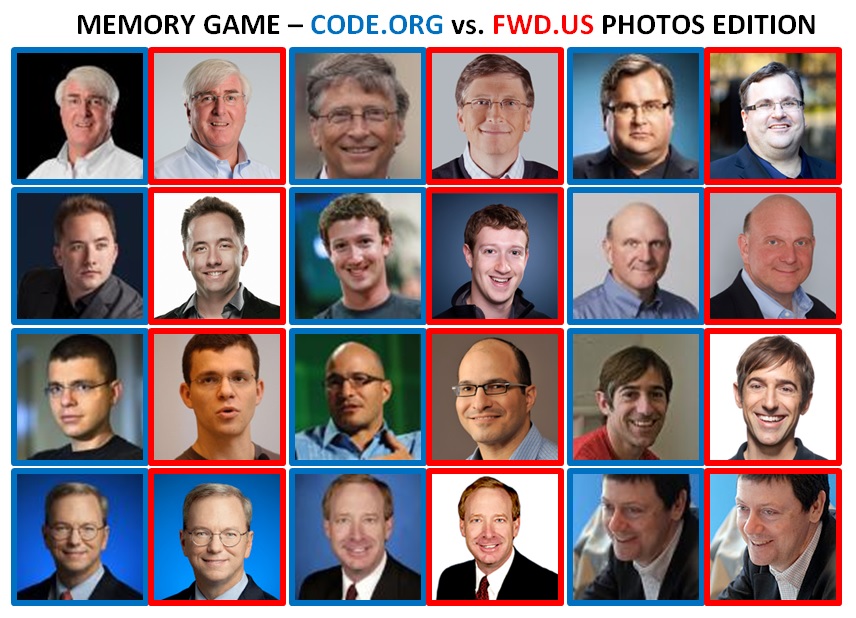
theodp writes "The weeklong Hour of Code kicks off tomorrow, with Mark Zuckerberg and Bill Gates doing their part to address a declared nationwide CS crisis by ostensibly teaching the nation's schoolchildren how to code. But a recent NY Times Op-Ed by economist Paul Collier criticizing Zuckerberg's FWD.us PAC as self-serving advocacy (echoing earlier criticism) serves as a reminder that Zuckerberg and Gates' Code.org and Hour of Code involvement is the Yin to their H-1B visa lobbying Yang. The two efforts have been inextricably linked together for Congress, if not for the public. And while Zuckerberg argues it's 'the right thing to do', Collier argues that there are also downsides to the tech giants' plans to shift more bright, young, enterprising people from the poorest countries to the richest. 'An open door for the talented would help Facebook's bottom line,' Collier concludes, 'but not the bottom billion.'" -
Diet Drugs Work: Why Won't Doctors Prescribe Them?
Hugh Pickens DOT Com writes "Suzanne Koven, a primary-care doctor at Massachusetts General Hospital in Boston, writes in the New Yorker that the FDA has currently approved four drugs that will help patients lose weight but few primary-care physicians will prescribe them. Qsymia and Belviq work by suppressing appetite and by increasing metabolism, and by other mechanisms that are not yet fully understood. 'But I've never prescribed diet drugs, and few doctors in my primary-care practice have, either,' writes Koven and the problem is that, while specialists who study obesity view it as a chronic but treatable disease, primary-care physicians are not fully convinced that they should be treating obesity at all. The inauspicious history of diet drugs no doubt contributes to doctors' reluctance to prescribe them. In the nineteen-forties, when doctors began prescribing amphetamines for weight loss, rates of addiction soared. But in addition, George Bray thinks that socioeconomic factors play into physicians' lack of enthusiasm for treating obesity because obesity is, disproportionately, a disease of poverty. Because of this association, many erroneously see obesity as more of a social condition than a medical one, a condition that simply requires people to try harder. Louis Aronne likens the current attitude toward obesity to the prevailing attitude toward mental illness years ago and remembers, during his medical training, seeing psychotic patients warehoused and sedated, treated as less than human. 'What the hell was I thinking when I didn't do anything to help them? How wrong could I have been?' Specialists are now developing programs to aid primary-care physicians in treating obesity more aggressively and effectively but first primary-care physicians will have to want to treat it. 'Whether you call it a disease or not is not so germane,' says Lee M. Kaplan. 'The root problem is that whatever you call it, nobody's taking it seriously enough.'" -
Nelson Mandela Dead At 95
New submitter Emilio Hodge writes "Nelson Mandela, the revered statesman who emerged from prison after 27 years to lead South Africa out of decades of apartheid, has died, President Jacob Zuma announces. He was 95." Mandela's death is covered by lots of news sources, of course, including The New York Times and The Washington Post. -
Andy Rubin Is Heading a Secret Robotics Project At Google
sfcrazy writes "The creator of the most sought after 'Android' of the world has been secretly working on creating a robotics division within Google. The search engine giant has acquired over seven robotics companies recently to create the robotics unit which is being headed by none other than Andy Rubin himself. Andy made the disclosure in an interview given to the New York Times." Their initial goal is to automate the woefully manual process of electronics manufacturing. -
R2-D2: Mall Cop
theodp writes "'The night watchman of the future,' explains the NY Times' John Markoff, 'is 5 feet tall, weighs 300 pounds and looks a lot like R2-D2 – without the whimsy. And will work for $6.25 an hour.' California-based Knightscope has developed a mobile robot known as the K5 Autonomous Data Machine as a safety and security tool for corporations, as well as for schools and neighborhoods. 'But what is for some a technology-laden route to safer communities and schools,' writes Markoff, 'is to others an entry point to a post-Orwellian, post-privacy world.'" -
Reverse Engineering the Technical and Artistic Genius of Painter Jan Vermeer
Hugh Pickens DOT Com writes "Kurt Anderson has an interesting read at Vanity Fair about Dutch painter Jan Vermeer, best known for 'Girl with a Pearl Earring,' and the search for how he was able to achieve his photo-realistic effects in the 1600s. Considered almost as mysterious and unfathomable as Shakespeare in literature, Vermeer at age 21, with no recorded training as an apprentice, began painting masterful, singular, uncannily realistic pictures of light-filled rooms and ethereal young women. 'Despite occasional speculation over the years that an optical device somehow enabled Vermeer to paint his pictures, the art-history establishment has remained adamant in its romantic conviction: maybe he was inspired somehow by lens-projected images, but his only exceptional tool for making art was his astounding eye, his otherworldly genius,' says Anderson. To try to learn how Vermeer was able to achieve such highly realistic painting, American inventor and millionaire Tim Jenison spent five years learning how to make lenses himself using 17th-century techniques, mixed and painted only with pigments available in the late 1600s and even constructed a life-size reproduction of Vermeer's room with wooden beams, checkerboard floor, and plastered walls. The result has been a documentary movie, Tim's Vermeer, by magicians Penn & Teller that may have resolved the riddle and explains why it has remained a secret for so long. 'The photorealistic painters of our time, none of them share their techniques,' says Teller. 'The Spiderman people aren't talking to the Avatar people. When [David] Copperfield and I have lunch, we aren't giving away absolutely everything.'" -
Code.org Wants Participating Students' Data For 7 Years
theodp writes "As part of its plan to improve computer science education in the U.S., the Mark Zuckerberg and Bill Gates-backed Code.org is asking school districts to sign a contract calling for Code.org to receive 'longitudinal student achievement data' for up to seven academic years in return for course materials, small teacher stipends, and general support. The Gates Foundation is already facing a backlash from the broader academic community over attempts to collect student data as part of its inBloom initiative. The Code.org contract also gives the organization veto power over the district teachers selected to participate in the Code.org program, who are required to commit to teaching in the program for a minimum of two school years." -
Why Bitcoin Is Doomed To Fail, In One Economist's Eyes
Hugh Pickens DOT Com writes "Economist Edward Hadas writes in the NYT that developers of bitcoin are trying to show that money can be successfully privatized but money that is not issued by governments is always doomed to failure because money is inevitably a tool of the state. 'Bitcoin exemplifies some of the problems of private money,' says Hadas. 'Its value is uncertain, its legal status is unclear, and it could easily become valueless if users lose faith.' Besides, if bitcoin ever really started to take off, governments would either ban it or take over the system says Hadas. The authorities might be motivated by a genuine concern about the stability of a shadow monetary system or they might act out of self-preservation because tax evasion would be too easy in a parallel economy. 'Part of the interest in virtual currencies like bitcoin is that their anonymity can provide a convenient cloak for criminal activity. Part is technological — this is a cool idea. And part is speculative — gamblers bet that bitcoin's value will increase,' concludes Hadas. 'Truly private money is an inferior alternative to the money that comes with the backing of a political authority. After all, no bank or bitcoin-emitter can be as public-minded as a government, and no private power can raise taxes or pass laws to unwind monetary excesses.'" Could be there's something good about money that can't be manipulated by law. Some people at least think there's plenty of value in Bitcoin and similar currencies, despite the risks. And those risks at present probably aren't enough to comfort the unfortunate Welsh fellow who (HT to reader judgecorp) "has realised he threw out a hard drive containing 7500 bitcoins, worth £4 million at today's prices. It is now under four feet of garbage in a landfill site the size of a football pitch." -
Art Makes Students Smart
Hugh Pickens DOT Com writes "For many education advocates, the arts supposedly increase test scores, generate social responsibility and turn around failing schools but research that demonstrates a causal relationship has been virtually nonexistent. Now the NY Times reports that with the opening of the Crystal Bridges Museum of American Art, a large-scale, random-assignment study (abstract) of school tours to the museum has determined that a strong causal relationship does in fact exist between arts education and a range of desirable outcomes. Students who, by lottery, were selected to visit the museum on a field trip demonstrated stronger critical thinking skills, displayed higher levels of social tolerance, exhibited greater historical empathy and developed a taste for art museums and cultural institutions. Moreover, most of the benefits are significantly larger for minority students, low-income students and students from rural schools — typically two to three times larger than for white, middle-class, suburban students — owing perhaps to the fact that the tour was the first time they had visited an art museum. Further research is needed to determine what exactly about the museum-going experience determines the strength of the outcomes. How important is the structure of the tour? The size of the group? The type of art presented? 'Clearly, however, we can conclude that visiting an art museum exposes students to a diversity of ideas that challenge them with different perspectives on the human condition,' write the authors. 'Expanding access to art, whether through programs in schools or through visits to area museums and galleries, should be a central part of any school's curriculum.'" -
Getting Evolution In Science Textbooks For Texas Schools
First time accepted submitter windwalker13th writes "Recently the New York Times ran an article highlighting the pull that a State Board in Texas holds over that state and rest of the Nation. Because of the unique way in which Texas picks school textbooks (purchasing large volumes of textbooks at once to be used for the next decade) publishers pander to this board to get their books approved. The board currently holds several members (6 of 28 who are known to reject evolution) who hold creationist views and actively work to ensure that the science textbooks do not use as strong language or must include "critical thinking" about possible alternate explanations for evolution." -
Study Suggests Link Between Dread Pirate Roberts and Satoshi Nakamoto
wabrandsma writes "Two Israeli computer scientists say they may have uncovered a puzzling financial link between Ross William Ulbricht, the recently arrested operator of the Internet black market known as the Silk Road, and the secretive inventor of bitcoin, the anonymous online currency, used to make Silk Road purchases." -
Code.org: More Money For CS Instructors Who Teach More Girls
theodp writes "The same cast of billionaire characters — Mark Zuckerberg, Bill Gates, Steve Ballmer, Eric Schmidt — is backing FWD.us, which is lobbying Congress for more visas to 'meet our workforce needs,' as well as Code.org, which aims to popularize Computer Science education in the U.S. to address a projected CS job shortfall. In laying out the two-pronged strategy for the Senate, Microsoft General Counsel and Code.org Board member Brad Smith argued that providing more kids with a STEM education — particularly CS — was 'an issue of critical importance to our country.' But with its K-8 learn-to-code program which calls for teachers to receive 25% less money if fewer than 40% of their CS students are girls, Smith's Code.org is sending the message that training too many boys isn't an acceptable solution to the nation's CS crisis. 'When 10 or more students complete the course,' explains Code.org, "you will receive a $750 DonorsChoose.org gift code. If 40% or more of your participating students are female, you'll receive an additional $250, for a total gift of $1,000 in DonorsChoose.org funding!" The $1+ million Code.org-DonorsChoose CS education partnership appears to draw inspiration from a $5 million Google-DoonorsChoose STEM education partnership which includes nebulous conditions that disqualify schools from AP STEM funding if projected participation by female students in AP STEM programs is deemed insufficient. So, are Zuckerberg, Gates, Ballmer, and Schmidt walking-the-gender-diversity-talk at their own companies? Not according to the NY Times, which just reported that women still account for only about 25% of all employees at Code.org supporters Apple, Google, Facebook, and Microsoft. By the way, while not mentioning these specific programs, CNET reports that Slashdot owner Dice supports the STEM efforts of Code.org and Donors Choose." -
NYT: Healthcare.gov Project Chaos Due Partly To Unorthodox Database Choice
First time accepted submitter conoviator writes "The NY Times has just published a piece providing more background on the healthcare.gov software project. One interesting aspect: 'Another sore point was the Medicare agency's decision to use database software, from a company called MarkLogic, that managed the data differently from systems by companies like IBM, Microsoft and Oracle. CGI officials argued that it would slow work because it was too unfamiliar. Government officials disagreed, and its configuration remains a serious problem.'" The story does not say that MarkLogic's software is bad in itself, only that the choice meant increased complexity on the project. -
Another Casualty of Typhoon Haiyan: Geothermal Power
necro81 writes "Little known even in environmental circles is a renewable energy success story: five geothermal power plants on Leyte Island in the Philippines — each of which produces enough power for the entire island — that collectively produce more than 10% of the Philippines' total electrical demand. From boreholes deep underground comes pressurized water heated to 280 Celsius. At the surface it flashes into steam, turning one set of turbines, then cools and contracts to spin a second set of turbines. The low-grade steam is then condensed back into water and reinjected into the bedrock. But Typhoon Haiyan destroyed the cooling towers, snapped transmission towers, and scattered the employees." -
Chinese Gov't To Tighten Internet Controls Even Further
jfruh writes "The new Chinese leadership released a document outlining its vision for the country Friday, and most of the attention was paid to reforms, like plans to loosen state control of the economy and end the one-child policy. But when it comes to the Internet, the Chinese Communist government is doubling down on its restrictive policies. The document notes that social networking and instant messaging tools can rapidly disseminate information and mobilize society; the government doesn't think those are good things, and plans to bolster its regulatory systems and increase the scope of their legal authority." -
Google to Pay $17 Million to Settle Privacy Case
cold fjord writes "The New York Times reports, 'Google agreed on Monday to pay $17 million to 37 states and the District of Columbia ... The case involved Google's bypassing of privacy settings in Apple's Safari browser to use cookies to track users and show them advertisements in 2011 and 2012. Google has said it discontinued circumventing the settings early last year, after the practice was publicly reported, and stopped tracking Safari users and showing them personalized ads. ... the case is one of a growing pile of government investigations, lawsuits and punishments related to privacy matters at the company. They include cases involving a social networking tool called Buzz, illegal data collection by Street View vehicles and accusations of wiretapping to show personalized ads in Gmail. '" From the DOJ, the settlement (PDF). -
US Wary of Allowing Russian Electronic Monitoring Stations Inside US
cold fjord writes "The New York Times reports, '... the next potential threat from Russia may not come from a nefarious cyberweapon or secrets gleaned from Snowden. Instead, this menace may come in the form of a ... dome-topped antenna perched atop an electronics-packed building surrounded by a security fence somewhere in the United States. ... the Central Intelligence Agency and the Pentagon have been quietly waging a campaign to stop the State Department from allowing ... the Russian space agency, to build about half a dozen ... monitor stations, on United States soil ... These monitor stations, the Russians contend, would significantly improve the accuracy and reliability of Moscow's version of the Global Positioning System ... The Russian effort is part of a larger global race by several countries ... to perfect their own global positioning systems and challenge the dominance of the American GPS. For the State Department, permitting Russia to build the stations would help mend the Obama administration's relationship with the government of President Vladimir V. Putin ... But the C.I.A. and other American spy agencies, as well as the Pentagon, suspect that the monitor stations would give the Russians a foothold on American territory that would sharpen the accuracy of Moscow's satellite-steered weapons. The stations, they believe, could also give the Russians an opening to snoop on the United States within its borders. ... administration officials have delayed a final decision until the Russians provide more information and until the American agencies sort out their differences.'" -
Fukushima Disaster Leads Japan To Backpedal On Emissions Pledge
mdsolar writes with this excerpt from the New York Times: "Japan took a major step back on Friday from earlier pledges to slash its greenhouse gas emissions, saying a shutdown of its nuclear power plants in the wake of the Fukushima disaster had made previous targets unattainable. The announcement cast a shadow over international talks underway in Warsaw aimed at fashioning a new global pact to address the threats of a changing climate. Under its new goal, Japan, one of the world's top polluters, would still seek to reduce its current emissions. But it would release 3 percent more greenhouse gases in 2020 than it did in 1990, rather than the 6 percent cut it originally promised or the 25 percent reduction it promised two years before the 2011 nuclear disaster." -
Can the US Be Weaned Off Ethanol?
Hugh Pickens DOT Com writes "Matthew Wald reports in the NYT the the Environmental Protection Agency has proposed reducing the amount of ethanol that is required to be mixed with the gasoline supply, the first time it has taken steps to slow down the drive to replace fossil fuels with renewable forms of energy. The move drew bitter complaints from advocates of ethanol, including some environmentalists, who see the corn-based fuel blend as a weapon to fight climate change and was also unwelcome news to farmers, coming at a time when a record corn crop is expected, and the price of a bushel has fallen almost to the cost of production. "Boy, my goodness, are the oil companies going to benefit from this," says Bob Dinneen, president of the Renewable Fuels Association. "We're all just sort of scratching our heads here wondering why this administration is telling us to produce less of a clean-burning American fuel." But the EPA says that a big part of the problem was that automobile fuel systems and service stations were not set up to absorb more than about 10 percent ethanol. Most cars on the road are limited to the current mixture, called E10, and there has been little demand by consumers for more. Reasons for the turnaround are many: The boom in domestic oil drilling has dimmed the urgency to find other alternatives to Mideast petroleum. Demand for gasoline has slumped. And criticism of the environmental impacts of corn ethanol has dimmed its luster nationally. The chill on ethanol will certainly affect the industry's powerhouse, corn ethanol. But the risk is far greater for smaller sectors of the industry still struggling to get out of the gate — those aimed at producing next-generation biofuels like "cellulosic" ethanol, made from ingredients like switchgrass and corn stalks. "I don't know if the EPA is aiming for uncertainty, but they may inadvertently create it," says Jan Koninckx, the global business director of biorefineries for DuPont. "The impact could be that another country will lead this rather than the U.S."" -
Facebook Patented Making NSA Data Handoffs Easier
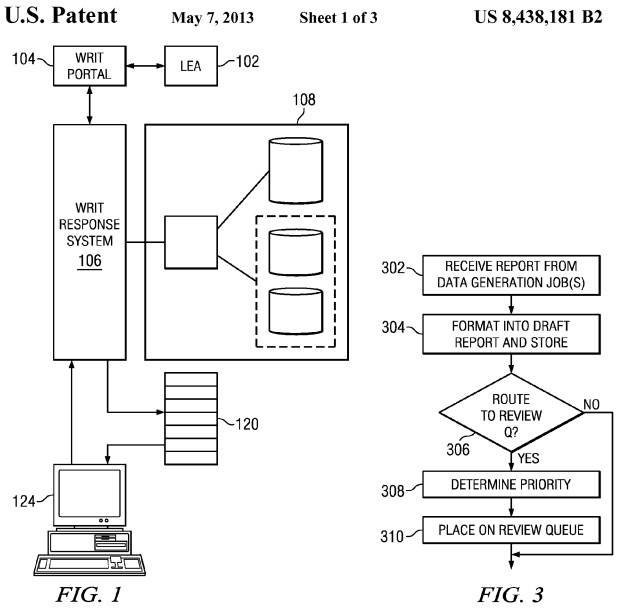
theodp writes "In June, Facebook CEO Mark Zuckerberg blasted 'outrageous press reports' about the PRISM surveillance program, denying that Facebook was ever 'part of any program to give the U.S. or any other government direct access to our servers.' What Zuckerberg didn't mention, and what the press overlooked, is that the USPTO granted Facebook a patent in May for its Automated Writ Response System. Like the NSA-enabling systems described by the NY Times on the same day Zuckerberg cried foul, the patent covers technical methods to more efficiently share the personal data of users with law enforcement agencies (LEAs) in response to lawful government requests via APIs and secured portals installed at company-controlled locations. 'While handing over data in response to a legitimate FISA request is a legal requirement,' the Times noted, 'making it easier for the government to get the information is not, which is why Twitter could decline to do so.'" -
US Postal Service To Make Sunday Deliveries For Amazon
guttentag writes "The New York Times is reporting The USPS has struck a deal to deliver Amazon's packages on Sundays — a first for both. The Postal Service, which lost nearly $16 billion last year, often loses money on first-class mail delivery, but package delivery is profitable. The Postal Service said it expected to make more such deals with other merchants, seeking a larger role in the $186 billion e-commerce market. For this holiday shopping season, Sunday delivery of Amazon products will be limited to the Los Angeles and New York metropolitan areas. In 2014 it is expected to expand to other cities including Dallas, Houston, New Orleans and Phoenix." -
World War II's Last Surviving Doolittle Raiders Make Their Final Toast
Hugh Pickens DOT Com writes "As we come up on Veteran's Day, Barrie Barber reports for the Dayton Daily News that the last Doolittle Raiders symbolically said goodbye to a decades-old tradition and to a history that changed the course of the Pacific war in World War II. Gathering from across the country together one last time, three surviving Raiders sipped from silver goblets engraved with their names and filled with 1896 Hennessy cognac in a once-private ceremony webcast to the world at the National Museum of the U.S. Air Force. Robert E. Cole, 98, led the final toast to the 80 members of 'the Greatest Generation' who took off in 16 B-25 Mitchell bombers April 18, 1942, from the deck of the USS Hornet to bomb Japan four months after a Japanese surprise naval and air attack on Pearl Harbor. 'Gentleman, I propose a toast,' said Cole, as about 700 spectators watched one final time, 'to those we lost on the mission and those that passed away since. Thank you very much and may they rest in peace.' Acting Secretary of the Air Force Eric Fanning said the raid showed the courage and innovation of the World War II airmen flying from a carrier in a bomber that had never seen combat to attack a heavily defended nation and to attempt to land at unseen airfields in China in a country occupied by Japanese troops. More than 70 years after the attack, Edward J. Saylor, 93, remembered ditching at sea once he and his crew dropped their bombs and several close calls with being discovered by the Japanese Army while making his way through China. 'This may be the last time I see them together,' said the 92-year-old raider who has attended Raider reunions since 1962. 'It's a little sad for me because I've known them so long and know the story of what they did in 1942.'" -
CIA Pays AT&T Millions To Voluntarily Provide Call Data
First time accepted submitter binarstu writes "The New York Times reports that 'The C.I.A. is paying AT&T more than $10 million a year to assist with overseas counterterrorism investigations by exploiting the company's vast database of phone records, which includes Americans' international calls, according to government officials. The cooperation is conducted under a voluntary contract, not under subpoenas or court orders compelling the company to participate, according to the officials.'" -
Critics Reassess Starship Troopers As a Misunderstood Masterpiece
Hugh Pickens DOT Com writes "Calum Marsh writes in The Atlantic that when Paul Verhoeven's Starship Troopers hit theaters 16 years ago today, American critics slammed it as a 'crazed, lurid spectacle' featuring 'raunchiness tailor-made for teen-age boys' and 'a nonstop splatterfest so devoid of taste and logic that it makes even the most brainless summer blockbuster look intelligent.' But now the reputation of the movie based on Robert Heinlein's Hugo award winning novel is beginning to improve as critics begin to recognize the film as a critique of the military-industrial complex, the jingoism of American foreign policy, and a culture that privileges reactionary violence over sensitivity and reason. 'Starship Troopers is satire, a ruthlessly funny and keenly self-aware sendup of right-wing militarism,' writes Marsh. 'The fact that it was and continues to be taken at face value speaks to the very vapidity the movie skewers.' The movie has rightfully come to be appreciated by some as an unsung masterpiece. Coming in at number 20 on Slant Magazine's list of the 100 best films of the 1990s last year, the site's Phil Coldiron described it as 'one of the greatest of all anti-imperialist films,' a parody of Hollywood form whose superficial 'badness' is central to its critique. 'That concept is stiob, which I'll crudely define as a form of parody requiring such a degree of over-identification with the subject being parodied that it becomes impossible to tell where the love for that subject ends and the parody begins,' writes Coldiron. 'If you're prepared for the rigor and intensity of Verhoeven's approach—you'll get the joke Starship Troopers is telling,' says Marsh. 'And you'll laugh.'" -
US FDA Moves To Ban Trans Fat
UnknowingFool writes "Citing growing health concerns about trans fat, the FDA today proposed measures to eliminate it from the U.S. food supply. While trans fat can still be used, the new measures now place the burden on food processors to justify the inclusion of it in a food product as experts have maintained that there is no safe level of consumption and no health benefits. Since 2006, the amount of trans fat eaten by the average American has declined from 4.5g per serving to less than 1g as restaurants and the food industry have reduced their use of it. There will be a 60-day public comment period for the new proposal." -
Why Organic Chemistry Is So Difficult For Pre-Med Students
Hugh Pickens DOT Com writes "Science writer and 42-year old pre-med student Barbara Moran writes in the NY Times that organic chemistry has been haunting pre-meds since 1910, when the Carnegie Foundation for the Advancement of Teaching released a landmark report calling for tougher admission standards to medical school and for medical training based on science. "The organic chemistry on the MCAT is chemistry that students need to know to succeed in medical school," says Karen Mitchell, senior director of the MCAT Program. Basically, orgo examines how molecules containing carbon interact, but it doesn't require equations or math, as in physics. Instead, you learn how electrons flow around and between molecules, and you draw little curved arrows showing where they go. This "arrow pushing" is the heart and soul of orgo. "Learning how to interpret the hieroglyphics is pretty easy. The hard part is learning where to draw the little arrows," writes Moran. "After you draw oxygen donating electrons to a positive carbon a zillion times, it becomes second nature." But the rules have many exceptions, which students find maddening. The same molecule will behave differently in acid or base, in dark or sunlight, in heat or cold, or "if you sprinkle magic orgo dust on it and turn around three times." You can't memorize all the possible answers — you have to rely on intuition, generalizing from specific examples. This skill, far more than the details of every reaction, may actually be useful for medicine. "It seems a lot like diagnosis," says Logan McCarty. "That cognitive skill — inductive generalization from specific cases to something you've never seen before — that's something you learn in orgo." This takes a huge amount of time, for me 20 to 30 hours a week writes Moran. This is one thing that orgo is testing: whether you have the time and desire to do the work. "Sometimes, if a student has really good math skills, they can slide through physics, but you can't do that in orgo," says McCarty ." -
Does Software Need a Siskel and Ebert?
theodp writes "Over at Scripting News, Dave Winer laments the lack of serious software reviews in the NY Times. That wasn't always the case, recalls Dave. 'When they started doing software reviews in the early '80s it was with the usual Times flair,' says Winer. 'But somewhere along the line they stopped taking tech seriously. It's as if they would only review Saturday morning television shows. How could television like The Sopranos or Breaking Bad take root in the culture if there was no criticism that discussed it? Yet that's where we are today with software.' So, does software need a Siskel and Ebert (or A.O. Scott and Manohla Dargis for you highfalutin NYT readers!)?"