Slashdot Mirror
Domain: nytimes.com
Stories and comments across the archive that link to nytimes.com.
Stories · 5,561
-
Google Apps Premier Edition Launches
prostoalex writes "Google Apps is adding a premium offering: a custom 10-GB Gmail box, Google Calendar, GTalk instant messenger, Writely, Google Pages, Google Custom home page iGoogle and Google SpreadSheets for $50 a year per employee. The NYTimes provides some details on competitive pricing: 'By comparison, businesses pay on average about $225 a person annually for Office and Exchange,... in addition to the costs of in-house management, customer support and hardware, according to the market research firm Gartner.' Boston.com quotes an analyst for Nucleus Research on Google's ease-of-use: '"What we see in the Google Apps is a real focus on making them easy to use and intuitive," she said. "And that's something that Microsoft has been unable to do in all of its years with Office."' But the same analyst is bearish on Google Apps' shortcomings relative to the mature Microsoft desktop products: 'Right now Google's going to give companies a better ability to negotiate with Microsoft.'" -
NASA's New Mission to the Moon
mattnyc99 writes "Popular Mechanics has a new, in-depth preview of NASA's Orion spacecraft, tracking the complex challenges facing the engineers of the CEV (which NASA chief Michael Griffin called 'Apollo on steroids') as America shifts its focus away from the Space Shuttle and back toward returning to the moon by 2020. After yesterday's long op-ed in the New York Times concerning NASA's about-face, Popular Mechanic's interview with Buzz Aldrin and podcast with Transterrestrial.com's Rand Simberg raise perhaps the most pressing questions here: Is it worth going back to the lunar surface? And will we actually stay there?" -
From Bess to Worse
Frequent Slashdot contributor Bennett Haselton writes " From about 1996 to 2003, there were regular reports listing examples of sites stupidly blocked by blocking software. The genre has tapered off recently, probably as a result of the Supreme Court ruling in 2003 that the Children's Internet Protection Act (CIPA) was constitutional, requiring blocking software in schools and libraries that receive federal funds, despite all the evidence of over-blocking presented at the trial. The last high-profile story about a site blocked by blocking software was about the blocking of BoingBoing almost a year ago. But the lack of recent reports on blocking software errors doesn't mean that the software has gotten better." The rest of his essay follows.One product that generated several reports over the years was "Bess, the Internet Retriever" from N2H2, which has since been bought out by Secure Computing, which also makes a blocking program called SmartFilter (the one that blocked BoingBoing) and now sells "SmartFilter, Bess Edition" which uses the same database as Bess. Different organizations and individuals published a series of investigative reports about Bess from 1997 until 2002, listing sites about gay rights, eating disorders, and other subjects that were blocked as "pornography". In Ben Edelman's supplemental report, submitted as testimony in the CIPA trial, he listed examples of erroneously blocked sites that he had reported to N2H2 in his first expert report, and which were still being blocked five months later.
Since Bess represents a set of data points showing how the accuracy of a blocking program can change, or not change, over the years, recently I began testing it again. I didn't know whether to expect it to be better or worse. On the one hand, advances in technology and greater revenue to censorware companies could have caused the software to improve. On the other hand, the number of Web pages, and the rate at which dynamic sites like blogs change content every day, has exploded. The result? I'm still tabulating data, but it looks as if the accuracy rate is roughly the same as it was in 2000, when about 30% of blocked sites were obvious errors. Then and now, I found most of the errors by starting with a large list of URLs culled from search engines and other sources, and simply running them through the software to see what was blocked.
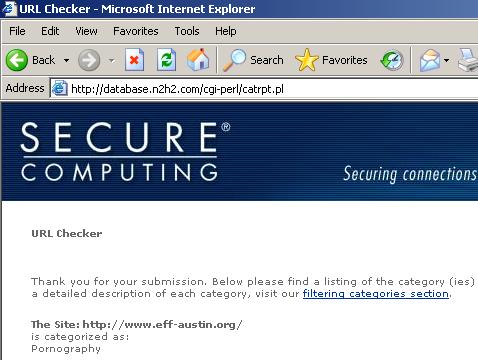
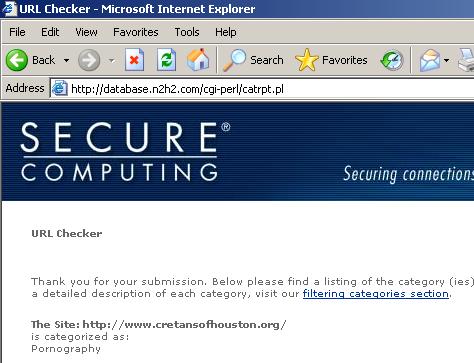
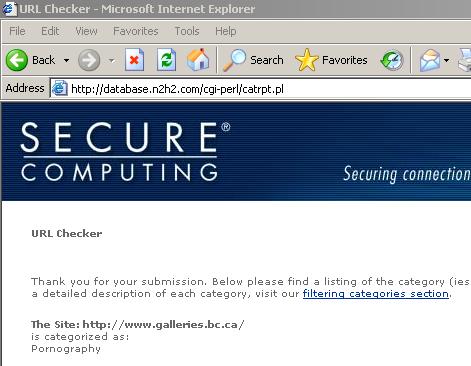
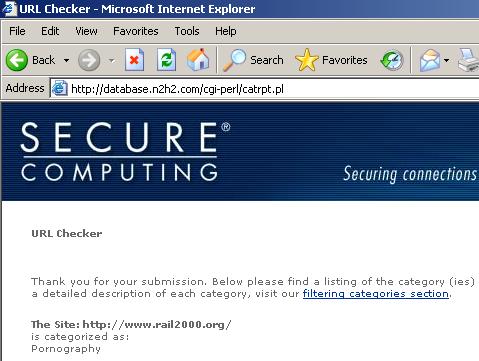
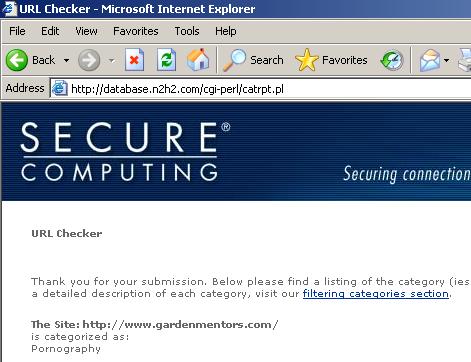
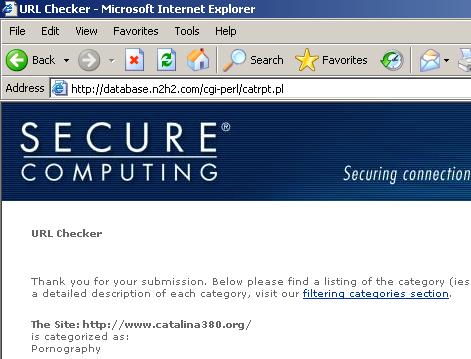
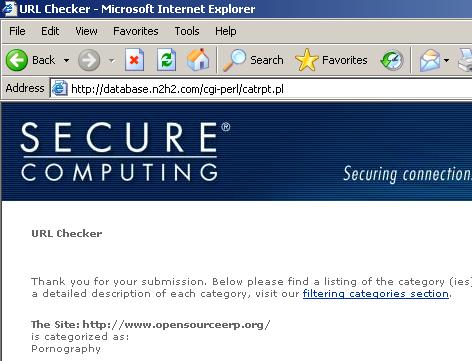
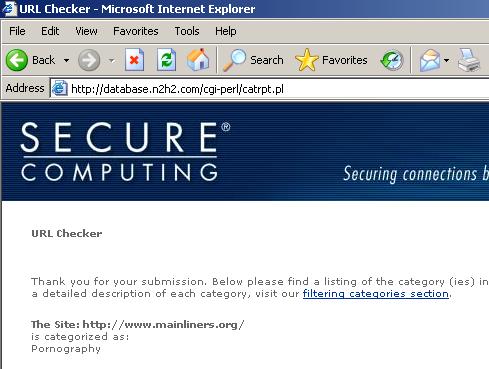
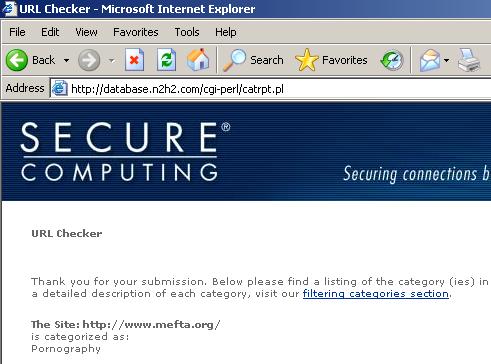
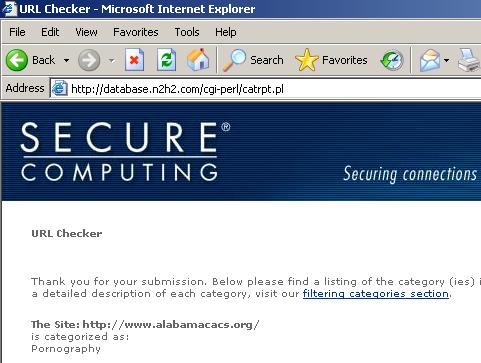
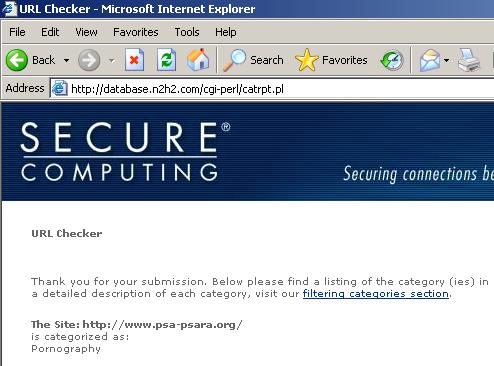
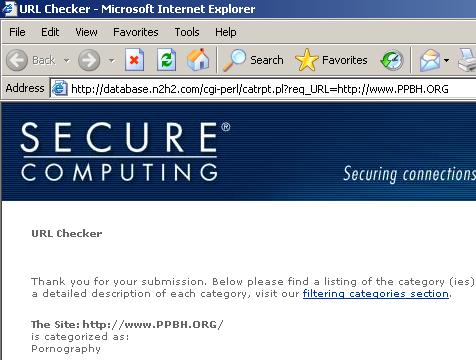
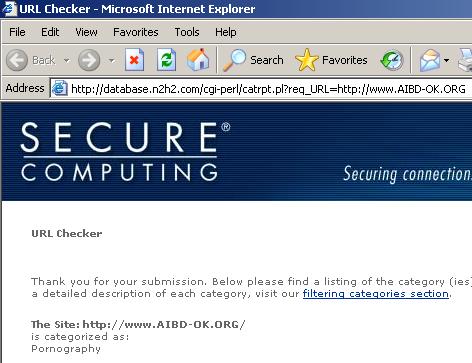
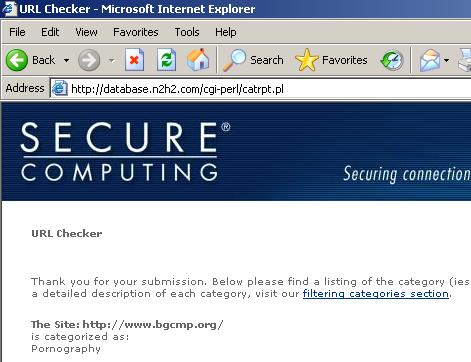
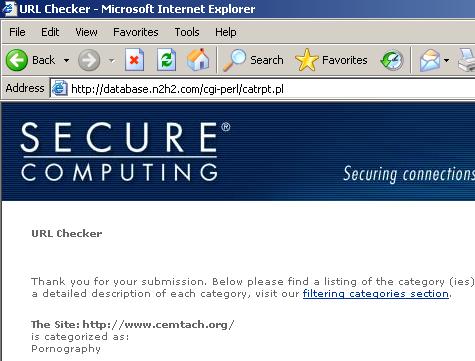
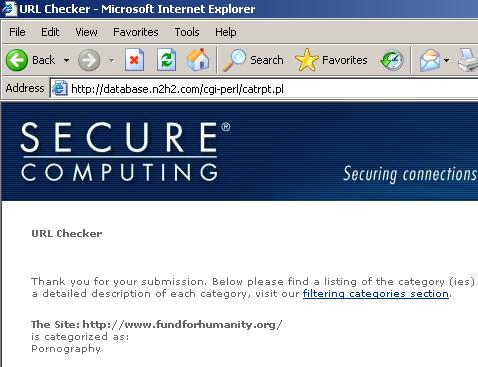
Here is a partial list of some of the questionable categorizations made by Bess; as of this writing, all of the following sites are listed as "Pornography" when you look them up on Secure Computing's Bess lookup form. (This is not just a fluke of the lookup tool; I tested against a copy of the software that all of these sites really were blocked.) The "screen cap" link next to each site links to a snapshot of the results taken from the lookup form (you can check on http://database.n2h2.com/ to see if the page is still returning the same results, although the more obvious errors will probably be fixed after this article is published):
- The Electronic Frontier Foundation, Austin chapter (screen cap)
- Cretans of Houston (screen cap). That's Cretans, as in "people from the island of Crete". Not to be confused with the Cretins of Houston, located here.
- The Rhode Island Coalition Against Domestic Violence (screen cap)
- The website of the public art galleries of British Columbia, Canada (screen cap)
- Rail2000, now the Bay Rail Alliance, a consumer group lobbying for a San Francisco regional rail system (screen cap)
- Rainbow Service Organization, a gay rights advocacy group (screen cap)
- GardenMentors.com, a custom gardening services company in Seattle (screen cap)
- A web site for Catalina 380 series boats (screen cap)
- Open Source ERP, a site promoting open source software for enterprise resource planning and customer relationship management (screen cap)
- The Bryn Mawr Mainliners, a barbershop harmony group (screen cap)
- Timber Trails, an outdoor recreation site (screen cap)
- The MEFTA Institute: "Middle East Free Trade Areas for Business Peace" -- world peace through cheap oil! (screen cap)
- Topple Rummy, a (somewhat out-of-date) site calling for the ouster of Donald Rumsfeld (screen cap)
- The Alabama Network of Children's Advocacy Centers (screen cap)
- PSARA, a non-profit organization for training cruise travel agents (screen cap)
- Park Place Behavioral Health Care, a non-profit mental health care agency (screen cap)
- The Oklahoma chapter of the American Institute of Building Design (screen cap)
- The Boys & Girls Clubs of Metropolitan Phoenix (screen cap)
- CEMTACH -- Computational ElectroMagnetics Theory-Algorithm-Code-Hardware. "Our goal is to develop systems simulations capabilities based on time-domain computational electromagnetics methods." Thanks for clearing that up. (screen cap)
- Fund for Humanity, a San Francisco non-profit supporting environmental organizations and organizations that assist the poor. (screen cap)
A long-standing point of contention while earlier reports about Bess were coming out, was whether every site on their blacklist had been reviewed by a human before being blocked. In 1998 the CEO testified before Congress that "All sites that are blocked are reviewed by N2H2 staff before being added to the block lists." However in their 2002 annual report the company finally admitted that not all sites were reviewed before being blocked: "Through automated categorization or human review, Web sites are identified as fitting into one or more of our categories". At one point an N2H2 employee also told me that when one site is blocked, they will often block all sites hosted on that machine or at that IP -- which of course means that those sites are also not reviewed before being blocked. In any case, it's possible to access some of these sites by IP address, such as the BC Art Galleries site via this link, or the or the Rhode Island Coalition Against Domestic Violence via this link -- so if they're not sharing their IP with other sites, that wouldn't explain how they got blocked either. Smartfilter spokesperson Tomo Foote-Lennox said that one other blocked URL that I found, http://www.arbiol.org/, was the result of an experiment N2H2 once did with fully automated website ratings.
Foote-Lennox added, "In general, we find that schools are VERY sensitive to under-blocking. The would rather block a whole lot of useful reference sites to avoid exposing one porn site." Probably true, although keep in mind we're talking about liability issues, not actual moral outrage. (If they were really morally outraged, they'd be trying to keep kids away from uncensored Internet access everywhere, not just in school! That is in fact the approach that schools take with things like drugs, which do inspire moral outrage because they really are harmful.) Perhaps what is needed is a law explicitly shielding schools from all liability for what students do or see on the Internet at school, if the faculty had no knowledge of it.
(Obligatory interstitial advertisement for common sense: I still don't see what the big deal is about porn anyway. Ask yourself: Why is it harmful to see a picture of a naked person, or even a picture of people having sex? And try to find an answer to that question that doesn't involve, "Lots of other people think so." That includes all variations like "Our society has determined...", "We as a people have decided...", which are just re-phrasings of "Lots of other people think so." I submit that if you disallow those variations of grownup-peer-pressure as an excuse, most people can't really come up with any reason at all.)
OK, flame-retardant suit off, lab coat back on. Previous reports have listed absurd examples of sites blocked by Bess, and looking at any one of those examples or the ones listed here, I'd say that in terms of public policy discussions -- specifically, whether a blocking software company should be trusted to decide what students can look at -- any one of these blocked sites would be more significant than, say, the blocking of BoingBoing which got so much attention. BoingBoing got blocked because of a non-sexual picture of a bare breast on the cover of one of the books they reviewed -- and in fact they were blocked only in the "nudity" category, which includes only "non-pornographic images of the bare human body". So the block on BoingBoing really only revealed that Secure Computing was a bit heavy-handed. (The real problem is that SmartFilter has the category for non-pornographic nudity blocked by default, even though the CIPA filtering law certainly doesn't require schools to block non-pornographic artistic images!) On the other hand, the fact that EFF Austin and the Rhode Island Coalition Against Domestic Violence are currently blocked as "Pornography", suggests that in many instances the blocking companies have nobody at the controls at all. To focus on stupid-but-not-completely-insane blocks like BoingBoing is letting them off easy.
So why did the laundry lists of blocked sites released over the years never become as widely known as BoingBoing, or the guffaw-inducing examples like "Beaver College", which had to change their name in part because of students reportedly being blocked from accessing their website? I think it's because the news favors a good "punch line" -- a fact that anybody can understand that makes us feel smarter than the computers making these dumb mistakes. "Oh, I get it, it was blocked because it was called Beaver College!" But the "punch line" anecdotes are precisely the ones that let the blocking companies off lightly, because it gives them a plausible-sounding excuse for making an error. On the other hand, when the Rhode Island Coalition Against Domestic Violence gets blocked as "Pornography", that could probably force the blocking company to answer some tough questions if it got more press, but there's no good punch line there, so the story just fizzles.
So, while I'm looking through the rest of the data, let me try and come up with some punch lines for reporters to make these blocked sites newsworthy. OK: Why was GardenMentor.com blocked? To keep kids away from all the dirty bitches and hoes! Get it? Ha ha! Why was the Catalina 380 yachting site blocked from kids? Because teens are too vulnerable to pier pressure! Hey, where are you going?
-
From Bess to Worse
Frequent Slashdot contributor Bennett Haselton writes " From about 1996 to 2003, there were regular reports listing examples of sites stupidly blocked by blocking software. The genre has tapered off recently, probably as a result of the Supreme Court ruling in 2003 that the Children's Internet Protection Act (CIPA) was constitutional, requiring blocking software in schools and libraries that receive federal funds, despite all the evidence of over-blocking presented at the trial. The last high-profile story about a site blocked by blocking software was about the blocking of BoingBoing almost a year ago. But the lack of recent reports on blocking software errors doesn't mean that the software has gotten better." The rest of his essay follows.One product that generated several reports over the years was "Bess, the Internet Retriever" from N2H2, which has since been bought out by Secure Computing, which also makes a blocking program called SmartFilter (the one that blocked BoingBoing) and now sells "SmartFilter, Bess Edition" which uses the same database as Bess. Different organizations and individuals published a series of investigative reports about Bess from 1997 until 2002, listing sites about gay rights, eating disorders, and other subjects that were blocked as "pornography". In Ben Edelman's supplemental report, submitted as testimony in the CIPA trial, he listed examples of erroneously blocked sites that he had reported to N2H2 in his first expert report, and which were still being blocked five months later.
Since Bess represents a set of data points showing how the accuracy of a blocking program can change, or not change, over the years, recently I began testing it again. I didn't know whether to expect it to be better or worse. On the one hand, advances in technology and greater revenue to censorware companies could have caused the software to improve. On the other hand, the number of Web pages, and the rate at which dynamic sites like blogs change content every day, has exploded. The result? I'm still tabulating data, but it looks as if the accuracy rate is roughly the same as it was in 2000, when about 30% of blocked sites were obvious errors. Then and now, I found most of the errors by starting with a large list of URLs culled from search engines and other sources, and simply running them through the software to see what was blocked.
Here is a partial list of some of the questionable categorizations made by Bess; as of this writing, all of the following sites are listed as "Pornography" when you look them up on Secure Computing's Bess lookup form. (This is not just a fluke of the lookup tool; I tested against a copy of the software that all of these sites really were blocked.) The "screen cap" link next to each site links to a snapshot of the results taken from the lookup form (you can check on http://database.n2h2.com/ to see if the page is still returning the same results, although the more obvious errors will probably be fixed after this article is published):
- The Electronic Frontier Foundation, Austin chapter (screen cap)
- Cretans of Houston (screen cap). That's Cretans, as in "people from the island of Crete". Not to be confused with the Cretins of Houston, located here.
- The Rhode Island Coalition Against Domestic Violence (screen cap)
- The website of the public art galleries of British Columbia, Canada (screen cap)
- Rail2000, now the Bay Rail Alliance, a consumer group lobbying for a San Francisco regional rail system (screen cap)
- Rainbow Service Organization, a gay rights advocacy group (screen cap)
- GardenMentors.com, a custom gardening services company in Seattle (screen cap)
- A web site for Catalina 380 series boats (screen cap)
- Open Source ERP, a site promoting open source software for enterprise resource planning and customer relationship management (screen cap)
- The Bryn Mawr Mainliners, a barbershop harmony group (screen cap)
- Timber Trails, an outdoor recreation site (screen cap)
- The MEFTA Institute: "Middle East Free Trade Areas for Business Peace" -- world peace through cheap oil! (screen cap)
- Topple Rummy, a (somewhat out-of-date) site calling for the ouster of Donald Rumsfeld (screen cap)
- The Alabama Network of Children's Advocacy Centers (screen cap)
- PSARA, a non-profit organization for training cruise travel agents (screen cap)
- Park Place Behavioral Health Care, a non-profit mental health care agency (screen cap)
- The Oklahoma chapter of the American Institute of Building Design (screen cap)
- The Boys & Girls Clubs of Metropolitan Phoenix (screen cap)
- CEMTACH -- Computational ElectroMagnetics Theory-Algorithm-Code-Hardware. "Our goal is to develop systems simulations capabilities based on time-domain computational electromagnetics methods." Thanks for clearing that up. (screen cap)
- Fund for Humanity, a San Francisco non-profit supporting environmental organizations and organizations that assist the poor. (screen cap)
A long-standing point of contention while earlier reports about Bess were coming out, was whether every site on their blacklist had been reviewed by a human before being blocked. In 1998 the CEO testified before Congress that "All sites that are blocked are reviewed by N2H2 staff before being added to the block lists." However in their 2002 annual report the company finally admitted that not all sites were reviewed before being blocked: "Through automated categorization or human review, Web sites are identified as fitting into one or more of our categories". At one point an N2H2 employee also told me that when one site is blocked, they will often block all sites hosted on that machine or at that IP -- which of course means that those sites are also not reviewed before being blocked. In any case, it's possible to access some of these sites by IP address, such as the BC Art Galleries site via this link, or the or the Rhode Island Coalition Against Domestic Violence via this link -- so if they're not sharing their IP with other sites, that wouldn't explain how they got blocked either. Smartfilter spokesperson Tomo Foote-Lennox said that one other blocked URL that I found, http://www.arbiol.org/, was the result of an experiment N2H2 once did with fully automated website ratings.
Foote-Lennox added, "In general, we find that schools are VERY sensitive to under-blocking. The would rather block a whole lot of useful reference sites to avoid exposing one porn site." Probably true, although keep in mind we're talking about liability issues, not actual moral outrage. (If they were really morally outraged, they'd be trying to keep kids away from uncensored Internet access everywhere, not just in school! That is in fact the approach that schools take with things like drugs, which do inspire moral outrage because they really are harmful.) Perhaps what is needed is a law explicitly shielding schools from all liability for what students do or see on the Internet at school, if the faculty had no knowledge of it.
(Obligatory interstitial advertisement for common sense: I still don't see what the big deal is about porn anyway. Ask yourself: Why is it harmful to see a picture of a naked person, or even a picture of people having sex? And try to find an answer to that question that doesn't involve, "Lots of other people think so." That includes all variations like "Our society has determined...", "We as a people have decided...", which are just re-phrasings of "Lots of other people think so." I submit that if you disallow those variations of grownup-peer-pressure as an excuse, most people can't really come up with any reason at all.)
OK, flame-retardant suit off, lab coat back on. Previous reports have listed absurd examples of sites blocked by Bess, and looking at any one of those examples or the ones listed here, I'd say that in terms of public policy discussions -- specifically, whether a blocking software company should be trusted to decide what students can look at -- any one of these blocked sites would be more significant than, say, the blocking of BoingBoing which got so much attention. BoingBoing got blocked because of a non-sexual picture of a bare breast on the cover of one of the books they reviewed -- and in fact they were blocked only in the "nudity" category, which includes only "non-pornographic images of the bare human body". So the block on BoingBoing really only revealed that Secure Computing was a bit heavy-handed. (The real problem is that SmartFilter has the category for non-pornographic nudity blocked by default, even though the CIPA filtering law certainly doesn't require schools to block non-pornographic artistic images!) On the other hand, the fact that EFF Austin and the Rhode Island Coalition Against Domestic Violence are currently blocked as "Pornography", suggests that in many instances the blocking companies have nobody at the controls at all. To focus on stupid-but-not-completely-insane blocks like BoingBoing is letting them off easy.
So why did the laundry lists of blocked sites released over the years never become as widely known as BoingBoing, or the guffaw-inducing examples like "Beaver College", which had to change their name in part because of students reportedly being blocked from accessing their website? I think it's because the news favors a good "punch line" -- a fact that anybody can understand that makes us feel smarter than the computers making these dumb mistakes. "Oh, I get it, it was blocked because it was called Beaver College!" But the "punch line" anecdotes are precisely the ones that let the blocking companies off lightly, because it gives them a plausible-sounding excuse for making an error. On the other hand, when the Rhode Island Coalition Against Domestic Violence gets blocked as "Pornography", that could probably force the blocking company to answer some tough questions if it got more press, but there's no good punch line there, so the story just fizzles.
So, while I'm looking through the rest of the data, let me try and come up with some punch lines for reporters to make these blocked sites newsworthy. OK: Why was GardenMentor.com blocked? To keep kids away from all the dirty bitches and hoes! Get it? Ha ha! Why was the Catalina 380 yachting site blocked from kids? Because teens are too vulnerable to pier pressure! Hey, where are you going?
-
Europe Moves To Track Phone and Net Use
An anonymous reader writes with a NYTimes piece on the early moves by European governments to implement an EU data retention directive. The governments of Germany and the Netherlands are initially proposing much more stringent programs than the EU directive requires. For example, the German proposal "would essentially prohibit using false information to create an e-mail account, making the standard Internet practice of creating accounts with pseudonyms illegal." The Times notes that, early days as it is, nevertheless some people involved in the issue are "concerned about a shift in policy in Europe, which has long been a defender of individuals' privacy rights." -
RIAA Hires Artists, Then Sends In the SWAT team
cancan writes "The NY times is carrying an article about how the RIAA is hiring hip hop artists to make mix tapes, and then helping the police raid their studios. In the case of DJ Drama and DJ Don Cannon, they were raided by SWAT teams with their guns drawn. The local police chief said later that they were 'prepared for the worst.' Men in RIAA jackets helped cart away 'evidence'. Just the same, 'Record labels regularly hire mixtape D.J.'s to produce CDs featuring a specific artist. In many cases, these arrangements are conducted with a wink and a nod rather than with a contract; the label doesn't officially grant the D.J. the right to distribute the artist's songs or formally allow the artist to record work outside of his contract.' " This is more of the shenanigans that we've previously discussed on the site. -
Silicon Valley - Still Important To Tech Advances
mrspin writes "This week the The New York Times sparked a lively debate by publishing an article which argued that, when it comes to creating innovative technology, geography still matters — and that Silicon Valley is the place to be. It's certainly true that Silicon Valley, compared with other innovation hot-spots, has the much needed Venture Capital and the connections that enable money to flow from one new company to another. Want proof? ZDNet takes a look at LinkSViewer, a new web-based visual networking tool for exploring capital relationships in Silicon Valley." Is the success of Valley-area projects the result of a more creative environment, or is the cachet of the area (and the resulting money) the reason behind their success? -
Google News Found Guilty of Copyright Violation
schmiddy writes "A court in Brussels, Belgium, has just found Google guilty of violating copyright law with its Google News aggregator. According to the ruling, Google News' links and brief summaries of news sources violates copyright law. Google will be forced to pay $32,600 for each day it displayed the links of the plaintiffs. Although Google plans to appeal, this ruling could have chilling effects on fair use rights on the web in the rest of Europe as well if other countries follow suit." -
Michael Crichton on Why Gene Patents Are Bad
BayaWeaver writes "Michael Crichton, author of The Andromeda Strain and Jurassic Park has made a strong case against gene patents in an op-ed for the New York Times. Striking an emotional chord, he begins with 'You, or someone you love, may die because of a gene patent that should never have been granted in the first place. Sound far-fetched? Unfortunately, it's only too real.' From there, he moves on to use logic, statistics, and his way with words to make his point. Arguing against the high costs of gene therapies thanks to related patents, he eventually offers hope that one day legislation will de-incentivize the hoarding of scientific knowledge. As he points out: 'When SARS was spreading across the globe, medical researchers hesitated to study it — because of patent concerns. There is no clearer indication that gene patents block innovation, inhibit research and put us all at risk.'" -
Princeton ESP Lab to Close
Nico M writes " The New York Times reports on the imminent closure of one of the most controversial research units at an ivy league School. The Princeton Engineering Anomalies Research laboratory is due to close, but not because of pressure from the outside. Lab founder Robert G. Jahn has declared, in the article, that they've essentially collected all the data they're going to. The laboratory has conducted studies on extrasensory perception and telekinesis from its cramped quarters in the basement of the university's engineering building since 1979. Its equipment is aging, its finances dwindling. Jahn points the finger at detractors as well: 'If people don't believe us after all the results we've produced, then they never will.'" -
The Return of Toys
valdean writes "With videogames becoming so ubiquitous, it sometimes seems like kids have less and less time for toys these days. Toy makers, however, are pushing back with high tech toys designed to be more compelling than a game of Supreme Commander. The New York Times reports that remote controlled vehicles in particular seem to be up for some friendly competition. As one designer suggests, 'navigating well-designed vehicles in the physical world... is vastly more compelling than steering a virtual vehicle in a computer-generated universe.' Will toys ever be able to compete with videogames again?" -
Indonesia Stops Sharing Avian Virus Samples
dankrabach writes "Indonesia has apparently decided to play the IP game, with the world's health at stake. The country, one of the hardest-hit by avian flu, has stopped submitting virus samples to the World Health Organization, and is negotiating to sell them to an American drug company that makes the vaccine. They feel slighted when they give away such samples, but then cannot afford the patented vaccines. Logical to me, given the rules of the game; however, can't we come up with some GPL'ish license to free any product based on this data?" -
Harvard Physicists Make Light Dance
tetrikphimvin and others clued us to the latest work by Harvard's Lene Vestergaard Hau, being published today in the journal Nature. The NYTimes has a good layman's overview of how Hau's team encoded a light beam in a clump of atoms and later reconstituted it elsewhere. The Harvard Gazette offers additional details, a photo, and video links. -
A Wikipedia WIthout Graffiti
Frequent Slashdot Contributor Bennett Haselton writes "I'm a Wikipedia junkie. There's nothing more fun than switching back and forth between reading about the history of human evolution, and following the latest speculation about the identity of the mysterious R.A.B. in the Harry Potter books, and Wikipedia is the best site to find it all in one place. But as a fan, it's always been frustrating for me knowing that Wikipedia could never improve beyond a certain point -- as it becomes more popular, it becomes more tempting to vandalize, and in turn becomes less reliable, a point that many have made already. That's why I'm excited that sites like Citizendium are approaching the same problem with a different model, one that could enable them to become what Wikipedia almost was, but which its intrinsic nature kept it from being: a central, reliable source of freely redistributable information about almost anything. The main difference is that Citizendium articles, after initially being built up through the same collaborative process that Wikipedia uses, will go into an editor-approved stage, at which point an editor (publicly identifiable on the article's history page) signs off on the accuracy of the article, and further edits also have to be approved by an editor."Editor control over articles is controversial within the "radical collaboration" community; the Wikimedia foundation lists five "foundation issues that are essentially beyond debate", which includes "Ability of anyone to edit articles without registering". (In practice there are some safeguards in place to protect articles that are frequent targets of vandalism, like the George W. Bush entry.) But I'm fanatically results-oriented in my thinking, and I always ask: What are the purposes of this project, and how does this feature help achieve those purposes? It seems to me that a free online encyclopedia fills four main needs:
- A source of information about pop culture that can be fun to read even without being 100% sure that it's accurate (like who R.A.B. is)
- A source of information that can be freely and legally redistributed, e.g. by printing out copies for a class to read
- A source of information on subjects where you need to be close to 100% certain that the information is reliable -- at least as certain, say, as you would be if you read the same fact in several books
- A source of information that you can cite in a school paper as being reasonably authoritative and reliable
For the reliability problem, I can't improve on this priceless sentence from Wikipedia's own "Citing Wikipedia" page:
For many purposes, but particularly in academia, Wikipedia may not be considered an acceptable source. [ citation needed ]
Wikipedia has actually done much better than I would have expected -- a study done in 2005 found that Wikipedia averaged about 4 errors per article compared to Britannica's 3, which is pretty good for a site where anybody can write that Columbus sailed to the New World in ships named the Ninja, the Pinto, and the Santa Fe. But for a site that harnesses the efforts of volunteers all over the world, I think the goal should be to surpass what has been done before, not just to tie with Britannica. And even if Wikipedia's error rate someday beats Britannica's, under its current model Wikipedia can never have the key property that Britannica has, which is that you can cite it as an authoritative source without sounding silly.Citizendium's model of editor-approved articles, and editor approval of further edits to those articles, can help to achieve the benefits of collaboration, harnessing the efforts of volunteers, without falling into Wikipedia's traps. Assuming you can verify an editor's credentials (and we'll get to this in a minute), having an editor manage an article means two things: (a) you know the page wasn't vandalized in the last five minutes, and (b) you ought to be able to cite the work as a reference in a paper if your teacher isn't a total Luddite and you can explain to them how Citizendium works. Meanwhile, volunteers can still contribute without their own credentials being checked out; they can write as much as they want for an editor-approved article, as long as it's approved by the editor before going live.
There are still loopholes, of course. Currently Citizendium asks people to edit under their real name, but says that "we will use the honor principle to begin with", so anyone could claim to be a professor or a lunar astronaut. But the key words are "to begin with"; the difference between Wikipedia and Citizendium is that Citizendium views this as a loophole and not an intrinsic "community value", and loopholes can be fixed. To make the reliability as airtight as possible, I hope that Citizendium will eventually implement some sort of verification system, such as checking a professor's contact information on a Web page in the "faculty" section of an .edu Web server. I'm not instinctively thrilled by the thought of checking out volunteers' contact information, but it seems like the only way to achieve goals #3 and #4 above, so if it's as simple as sending a verification e-mail to an .edu address, that's a lot of gain for little effort. (Remember, this only has to be done for editors who sign off on articles, not for all volunteers. A non-editor volunteer could still ask to have their credentials checked out, so that they can be cited by their real name in the "end credits" of an article that lists volunteer contributors. But impersonation among regular volunteers is not likely to be a problem, since the editorial approval process ensures that only value-adding edits will be allowed, and it's unlikely that Alice would pretend to be Bob so that Bob can take all the glory of Alice's contributions to the project!)
Besides verifying authors' credentials, the one change that I hope Citizendium considers in the future is to give authors and editors credit at the top of each article -- or, for articles with many contributors, perhaps editors would be listed at the top and the "end credits" would list all contributors, on a separate page if necessary. This is because credited authorship for an article can help improve the article's usefulness in two ways -- the article can be cited as a reliable source, and the "name up in lights" factor rewards people for contributing more and better articles. Having authors listed only on the history page of an article, as they are in the current model, achieves the credibility benefit but not the "name up in lights" benefit. Larry Sanger suggested that having authors listed at the top of each article might put off readers from submitting edits -- if an article is perceived as being "owned", then others might feel like it's rude for them to change it. For me personally, this could go either way -- on the one hand, I might not realize that I was welcome to edit an article, but on the other hand, I think I might be more inclined to submit edits if I knew there was an editor in charge to keep someone else from frivolously overwriting my edits later. But in any case, to address this problem, each article could carry a banner at the top saying "Readers are encouraged to submit edits and other suggestions", and each paragraph could be accompanied by an "Edit" link, similar to Wikipedia (except that edits would go into a queue to be reviewed by the editor instead of going live). This would address the ownership-intimidation problem without taking away from the "name up in lights" factor. Sanger says that the Digital Universe Encyclopedia -- comprising the Encyclopedia of Earth and an Encyclopedia of the Cosmos, under development -- has plans to join with Citizendium and will use the credited-author model on their version of the site.
You might say that editors having their "name up in lights" would be an ego thing for editors, and I think you'd be right -- but I don't think this would be a bad thing, inasmuch as ego would motivate more people to become editors and do their best work. Perhaps I'd be wrong about this. Maybe a limited experiment could be carried out with two sites that are similar in every respect except that one allows editors and authors to take credit for their work, as might turn out to be the case with Citizendium and Encyclopedia of Earth. The point is that I don't think such a suggestion should be judged by whether it goes against the "spirit" of the project (as it certainly does in the case of Wikipedia!), but rather whether it helps to achieve the projects goals, such as goals #1 through #4 listed above.
There are still some problems that Citizendium's differences from Wikipedia won't solve. Many schools discourage citing Wikipedia not because it's written anonymously or because it contains errors, but because it's an encyclopedia. Yale's guidelines for citing Wikipedia state:
As an encyclopedia, Wikipedia is written for a common readership. But students in Yale courses are already consulting primary materials and learning from experts in the discipline. In this context, to rely on Wikipedia -- even when the material is accurate -- is to position your work as inexpert and immature.
Presumably many academics would have the same objections to a student citing Citizendium. I understand what these teachers mean, but I think this is a case of not thinking in terms of results. If the purpose of an assignment is to collect and present information, then any means of accomplishing that goal should be valid, including the easiest method of looking up the information in an encyclopedia. To make a student look beyond the encyclopedia, an assignment can simply require depth of research that goes beyond what the encyclopedia would provide. (Students, if you're worried that your teacher will take this to heart and make your assignments harder, just be happy that your teacher is hip enough to be reading this in the first place.) Some things are hard, but they should only be hard if they're intrinsically hard, not because you handicapped yourself with arbitrary rules.But there is another, more permanent problem -- even with verification of authors' credentials, how do we know that the information in Citizendium articles is accurate? How do we know the author didn't make a mistake, or lie? This gets into deeper issues because these problems exist no matter what source you're consulting. There are books in print that deny the Holocaust or the possibility of evolution, and they're printed on real paper, with ISBN numbers and everything. Some of them even make it into libraries. How skeptical should we be of we read in books? In January two advocacy groups presented a report to Congress in which many government scientists said they felt pressured by the Bush administration to downplay the global warming threat in their statements. Does that mean statements from government scientists are inherently suspect?
And almost anyone who has had more than two articles written about them, knows the feeling of reading the article and reacting, "Wow, I had no idea that I was a transgendered NRA member who volunteers with the Moonies!" The New York Times is hosting an article about me from 2000 claiming that I was fired from Microsoft, when I actually quit. I showed them a copy of my personnel file with "Voluntary resignation" printed on it, but they have still refused to change the article. (When I first wrote to the paper's "Public Editor" about the matter, created to restore "reader credibility" after the Jayson Blair scandal, they replied that they wouldn't change the error because it never appeared in the print version of the paper. Huh?) I put up my own webpage to tell my side of the story, but if you were a Wikipedia or Citizendium editor and you had conflicting information from different sources, who would you believe, the New York Times, or a Web site called PublicEditorMyAss.com?
And yet, I freely admit that even today, I would trust a fact from the New York Times more than a fact from Bob's Bait And Tackle Shop And Technology Blog. We instinctively trust sources because of their reputation; we figure that they must have gotten their reputation somehow. This is not a great algorithm for deciding trustworthiness, but it may be the best that we can do -- in a world where we can't verify every fact firsthand, what choice do we have but to rely on sources that have provided mostly-reliable information in the past? (Wikipedia vandals are able to hack this mental algorithm because we think of Wikipedia as "one source" with a high average reliability, when it's really comprised of many sources, some of whom are deliberately less reliable than others.)
So, I think the Citizendium model is a move in the right direction -- taking into account the limits of what we can know from third-party sources, and doing the best we can within those limits. The least we can do is to know who has signed off on the accuracy of an article, so we can factor that into our decision to trust it. Last month Citizendium released their first editor-approved article, a single article about Biology. It may not look like anything revolutionary right now, but the difference between that and the Wikipedia entry is that you can't change the title of the Citizendium article to LARRY SANGER IS A BUTT BRAIN HA HA. You have to go through an editor for that.
-
Low Earth Orbit Junk Yard Nearly Full
vlado4 writes "The New York Times has up an article on the amount of space junk in Earth Orbit. According to NASA officials, the amount of stuff we've put into LEO is at critical levels. Additionally they have great graphics of the nearly 1000 new pieces resulting from testing the new Chinese anti-satellite weapon, as well as the damage to Hubble's solar array. The litter is now so bad that, even if space-faring nations refrained from further interference, collisions would continue to create more clutter just above our atmosphere. Space debris appear to be a difficult problem to deal with and may hinder future space exploration." -
Aqua Teen Stunt Costs Turner and Agency $2M
evw writes "The NYTimes reports that the Turner Broadcasting System and the ad agency responsible have reached a $2M settlement with the city of Boston and state and federal agencies that treated the light boards placed around the city as an act of terrorism (as covered earlier on /.) Half of the money is to cover direct costs associated with the response. The other $1M goes to 'goodwill funds' that will be used for response training and public outreach." -
Study Finds Bank of America SiteKey is Flawed
An anonymous reader writes "The NYT reports on a Harvard and MIT study, which finds that the SiteKey authentication system employed by Bank of America is ineffective at prevent phishing attacks. SiteKey requires users to preselect an image and to recognize this image before they login, but users don't comply. 'The idea is that if customers do not see their image, they could be at a fraudulent Web site, dummied up to look like their bank's, and should not enter their passwords. The Harvard and M.I.T. researchers tested that hypothesis. In October, they brought 67 Bank of America customers in the Boston area into a controlled environment and asked them to conduct routine online banking activities, like looking up account balances. But the researchers had secretly withdrawn the images. Of 60 participants who got that far into the study and whose results could be verified, 58 entered passwords anyway. Only two chose not to log on, citing security concerns.' The study, aptly entitled "The Emperor's New Security Indicators", is available online." -
US Set on Expansion of Security DNA Collection
An anonymous reader dropped us a link to this New York Times article about a 'vast expansion' of DNA sampling here in the US. A little-noticed rider to the January 2006 renewal of the 'Violence Against Women Act' allows government agencies to collect DNA samples from any individual arrested by federal authorities, and from every illegal immigrant held for any length of time by US agents. The goal is to make DNA collection as routine a part of detainment as fingerprinting and photography. Privacy experts and immigrant rights groups are decrying this initiative already. Many are also skeptical of lab throughput, as FBI analysts indicate this may increase intake by as much as a million samples per year. There is already a backlog of 150,000 samples waiting to be entered into the agency's database. -
Windows Vista Launches To Mixed Reactions
Several users have submitted stories reporting on the launch of Microsoft's newest operating system. The Guardian focuses on virus warnings already threatening the OS, while the New York Times discusses the bug hunt that's begun. With hackers writing scripts to attack, and well-paid bounty hunters looking for bugs to defend, Vista's first few months on the market are sure to be interesting. In the meantime, what is your impression of the OS? Have you had a chance to use the retail version yet? Are you supporting it in a business environment? What's the launch of Vista been like for you? -
Intel, IBM Announce Chip Breakthrough
Intel announced a major breakthrough in microprocessor design Friday that will allow it to keep on the curve of Moore's Law a while longer. IBM, working with AMD, rushed out a press release announcing essentially equivalent advances. Both companies said they will be using alloys of hafnium as insulating layers, replacing the silicon dioxide that has been used for more than 40 years. The New York Times story (and coverage from the AP and others) features he-said, she-said commentary from dueling analysts. If there is a consensus, it's that Intel is 6 or more months ahead for the next generation. IBM vigorously disputes this, saying that they and AMD are simply working in a different part of the processor market — concentrating on the high-end server space, as opposed to the portable, low-power end. -
Scientist Develops Caffeinated Baked Goods
Zephyros writes "The AP is reporting on a scientist who has found a way to get caffeine into donuts, bagels, and other baked goods without the bitter flavor. Each piece has as much caffeine as two cups of coffee. No word on when or where they will be available, but for those of us that just don't get the same kick from the morning cuppa that we used to, this may be another tasty delivery vector to look forward to for that jump-start." -
Scientist Develops Caffeinated Baked Goods
Zephyros writes "The AP is reporting on a scientist who has found a way to get caffeine into donuts, bagels, and other baked goods without the bitter flavor. Each piece has as much caffeine as two cups of coffee. No word on when or where they will be available, but for those of us that just don't get the same kick from the morning cuppa that we used to, this may be another tasty delivery vector to look forward to for that jump-start." -
Something in Your Food is Moving
Dekortage writes "The New York Times has a report on probiotic food: food that has live bacteria in it. From the article: "[for Dannon's] Activia, a line of yogurt with special live bacteria that are marketed as aiding regularity, sales in United States stores have soared well past the $100 million mark.... Probiotics in food are part of a larger trend toward 'functional foods,' which stress their ability to deliver benefits that have traditionally been the realm of medicine or dietary supplements."" -
RIAA Arrests Pro Artist for Making Mixtapes
Maximum Prophet writes "The RIAA is now going after mixtapes; specifically, the well-known mixtapes of rap artist DJ Drama. From the article: 'On Tuesday night he was arrested with Don Cannon, a protégé. The police, working with the Recording Industry Association of America, raided his office, at 147 Walker Street in Atlanta. The association makes no distinction between counterfeit CDs and unlicensed compilations like those that DJ Drama is known for.' The story goes on to say that many of the artists featured on the mixtapes would never have had the exposure and thus sales they had if DJ Drama had not featured them on a mix. Nowhere is a specific artist mentioned who claims to have been wronged by him. Additionally, the article states that mixtapes such as those made by DJ Drama are an accepted and integral part of rap music culture. His arrest is confusing on several levels." -
NASA Slashing Observations of Earth
mattnyc99 points us to a new report by the National Research Council warning that, by 2010, the number of NASA's Earth-observing missions will drop dramatically, and the number of operating sensors and instruments on NASA spacecraft will decrease by 40 percent. The report says, "The United States' extraordinary foundation of global observations is at great risk." Popular Mechanics asks an MIT professor what it all means. From these accounts it is clear that the Bush administration's priorities on a Mars mission and a moon base are partly to blame for the de-emphasizing of earth science. Neither article quite says that some responsibility must fall to the administration's footdragging on global warming. -
Global Warming Exposes New Islands in the Arctic
circletimessquare writes "The New York Times has a sobering article about the rapidly accelerating pace of glacial melting across the arctic, focusing on the discovery of new islands and the fact that this is occurring far faster than climate scientist's models predict. What were called Nunataks or 'lonely mountains' in Inuit, trapped in the ice, only a few years ago, are now in the open ocean by kilometers. Off of Greenland, what was known previously as peninsulas have been revealed to be islands as the ice retreats. Dennis Schmitt, a modern day explorer and discoverer of one of these new islands and fluent in Inuit, has named it Uunartoq Qeqertoq: the warming island." -
Beware the Apple iPhone iHandcuffs
Nrbelex writes "Randall Stross makes a fresh and surprisingly accurate review of one of the biggest "features" in the upcoming iPhone and the iPod in general, 'fairplay'. Stross writes, 'If "crippleware" seems an unduly harsh description, it balances the euphemistic names that the industry uses for copy protection. Apple officially calls its own standard "FairPlay," but fair it is not.... You are always going to have to buy Apple stuff. Forever and ever.' Can mainstream media coverage help the battle over DRM or will this warning, like those of the pas, continue to go unnoticed?" -
Does Income Inequality Matter?
theodp is concerned about the following: "Alarmed by Goldman Sachs CEO Lloyd Blankfein's record-setting $53M bonus, Charles Wheelan (aka The Naked Economist) argues that income inequality matters. Wheelan notes that the Gini Coefficient (a measure of income inequality) for the U.S. has been moving away from countries like Japan and Sweden and closer to that of Brazil, where the murder rate is 5X that of NYC and crime is materially impacting GDP." -
No Third-party Apps on iPhone Says Jobs
wyldeone writes "In an interview with the New York Times, Steve Jobs confirms reports that the recently-announced iPhone will not allow third party applications to be installed. According to Jobs, 'These are devices that need to work, and you can't do that if you load any software on them.' In a similar vein, Jobs said in a MSNBC article that, 'Cingular doesn't want to see their West Coast network go down because some application messed up.'" -
MPAA Caught Uploading Fake Torrents
An anonymous reader writes "The MPAA and other anti-piracy watchdogs have been caught trapping people into downloading fake torrents, so they can collect IP addresses, and send copyright infringement letters to ISPs. The battle between P2P networks and copyright holders seems to be a never ending battle. It will be interesting to see how much the anti-piracy groups practices change once they begin begin selling movies and TV shows legally on bittorrent.com." -
Blue Origin Building DC-X Lookalike
rrohbeck writes "The New York Times is running an article on what Blue Origin (Amazon.com founder Jeff Bezos' space company) is up to after his Texas land grab. A couple of Flash videos show a short successful test hop of the 'Goddard' test vehicle. From the article: 'The Goddard has a science-fiction sleekness. Videos show the craft taking off and landing again with a loud whooshing sound. In one view, one of the nine rocket nozzles jitters as it maintains the ship's attitude. Goddard resembles the DC-X, another vertical-takeoff-and-landing craft under development in the 1990s by McDonnell Douglas for the Defense Department and NASA until the government pulled the plug.' And in case you're an aerospace engineer, they're hiring." -
Congress to Debate Net Neutrality
evw writes "The NYTimes is reporting that legislation was introduced in the Senate on Tuesday in support of Net Neutrality. It is bipartisan legislation introduced by Olympia Snowe, R-Maine and Byron Dorgan, D-N. Dakota, however the article notes that Senator Snowe is one of the few Republicans that supports it. "Senior lawmakers, emboldened by the recent restrictions on AT&T and the change in control of Congress, have begun drafting legislation that would prevent high-speed Internet companies from charging content providers for priority access." This isn't the first attempt. Last year a similar amendment was blocked. However, conditions placed on AT&T in its merger with SBC have emboldened supporters of the legislation." -
NYT Security Tip - Choose Non-Microsoft Products
Giorgio Maone writes "The New York Times article 'Tips for Protecting the Home Computer' follows a story we recently discussed about the proliferation of botnets, and contains some statements which may sound quite unusual from mainstream press, especially if targeted to home users: 'Using a non-Windows-based PC may be one defense against these programs, known as malware ... Alternative browsers, like Firefox and Opera, may insulate users ... NoScript, a plug-in utility, can limit the ability of remote programs to run potentially damaging programs on your PC'." -
The NYT on the Proliferation of Botnets
ThinkComp writes "The New York Times has a up a story on the proliferation of botnets. The article cites a number of security researchers who paint a depressing picture of the state of internet security, and concludes with the suggestion that for home users, buying a new 'updated' PC may be the only real solution. Unfortunately, as most of us know, given the number of outstanding flaws in software and the ingenuity of malicious software authors, that might not even help." -
Google's Answer to Filling Jobs Is an Algorithm
An anonymous reader tipped us to a New York Times article about Google's newest HR tool: an algorithm. Starting soon, the company (which gets roughly 100,000 applications a month) will require all interested applicants to fill out an in-depth survey. They'll be using a sophisticated algorithm to work through the submitted surveys, matching applicants with positions. The company has apparently doubled in size in each of the last three years. Even though it's already 10,000 employees strong Laszlo Bock, Google's vice president for people operations, sees no reason the company won't reach 20,000 by the end of the year. This will mean hiring something like 200 people a week, every week, all year. From the article: "Even as Google tries to hire more people faster, it wants to make sure that its employees will fit into its freewheeling culture. The company boasts that only 4 percent of its work force leaves each year, less than other Silicon Valley companies. And it works hard to retain people, with copious free food, time to work on personal projects and other goodies. Stock options and grants certainly encourage employees to stay long enough to take advantage of the company's surging share price. Google's hiring approach is backed by academic research showing that quantitative information on a person's background -- called 'biodata' among testing experts -- is indeed a valid way to look for good workers." -
End of the Blu-Ray / HD-DVD Format War?
Next week's Consumer Electronics Show in Las Vegas should shake up the format war. The NYTimes reports that Warner Brothers will announce the Total HD disc that can store both Blu-ray and HD-DVD content. The article also mentions that LG (along with "possibly other gadget makers") is expected to announce a player that can play both formats. According to Yahoo, LG has not announced pricing, but the Times notes that such dual-format devices are bound to cost more than existing players. And the Times outlines the many considerations that would come into play before studios decide to release their content in both formats on a single disc. -
U.S. Bars Lab From Testing E-Voting Machines
joshdick writes to point out a NYTimes story on the decertification of Ciber Inc. from testing electronic voting systems. It will come as a surprise to no-one here on Slashdot that experts say the deficiencies of the laboratory suggest that crucial features like the vote-counting software and security against hacking may not have been thoroughly tested on many machines now in use. From the article: "A laboratory that has tested most of the nation's electronic voting systems has been temporarily barred from approving new machines after federal officials found that it was not following its quality-control procedures and could not document that it was conducting all the required tests... The federal Election Assistance Commission made this decision last summer, but the problem was not disclosed then... Ciber... says it is fixing its problems and expects to gain certification soon." -
Net Neutrality to Win Big on Capitol Hill?
The New York Times has weighed in again on Net Neutrality, this time with a hopeful message of change in the near future due to the shift of power in the House and Senate. The opinion piece takes a look at Ron Wyden in the Senate and Edward Markey in the House who have both promised to lead the charge to pass a net neutrality bill in the coming months. Lessig, on the other hand, has a somewhat more cynical view of the new Congress. -
Wal-Mart Is Pushing Compact Fluorescent Bulbs
While we all know from reading the internets that Wal-Mart is irredeemably evil, the world's largest retailer has committed to get compact fluorescent lightbulbs into 100 million homes this year. CFLs are found in only 6% of households today. These energy-saving bulbs use 75% less electricity than incandescents and produce far less greenhouse gas to manufacture and use. Wal-Mart seems determined to use its marketing prowess to do what hasn't successfully been done in the CFL's 25-year history: to convince consumers to pay more upfront for large savings over the product's lifetime. -
NYT Reports Steve Jobs' Exoneration
heyitsgogi writes "The New York Times is reporting that Apple has cleared Steve Jobs of any wrongdoing. From the article: 'In a filing with the Securities and Exchange Commission, Apple said that while its investigation revealed that the company's stock option procedures did not include sufficient safeguards to prevent manipulation, Mr. Jobs did not benefit financially from any questionable stock awards.' As a result of the internal investigation, Apple said it would record $84 million in expenses related to the options awards." -
Child's Play Profiled by NYT
There's a very nice profile of the Child's Play charity up on the New York Times site. It goes into some detail on the history of the gamer's charity, and paints the participants in a positive light. Good press all around. From the article: "... Common purpose drew Bernie Burns to get involved. Mr. Burns is a member of Rooster Teeth, a troupe that produces 'Red vs. Blue,' an online comedy series based on the game Halo. Rooster Teeth attended the Child's Play dinner auction this year and successfully bid $9,000 to record dialogue for the coming video game Halo 3, a prize comparable to being given a cameo appearance in a movie. The game's developer, Bungie Studios, would probably have allowed the troupe to record the dialogue anyway, but 'it's for charity,' Mr. Burns said of the $9,000 bid." The article states that the charity has raised $2 Million over its lifespan, and the official site is currently this year's contribution to that number is around $885,000. -
Plasma or LCD?
WeeBit asks: "I saw a news article on why you should buy Plasma instead of LCD TV's. It just sparked my interest. Flat panel TV's have the market now, and our analog TV's are on their way out. I am sure many will be thinking of purchasing their new flat panel within the next couple years. Have you given this any thought? Panasonic, has been pushing ads that sell the consumer on the plasma TV's over the LCD's. Is this a good argument, or is it just hype? Which do you prefer Plasma or LCD? Why?" -
Liberating & Restricting C-SPAN's Floor Footage
bigmammoth writes "C-SPAN's bid to "liberate" the House and Senate floor footage has re-emerged and been shot down. In an aim to build support a recent New York Times editorial called for reality TV for congress. But what is missing from this editorial is the issue of privatization and the subsequent restriction of meaningful access to these media assets. Currently the U.S. government produces this floor footage and it is public domain. This enables projects such as metavid to publicly archive these media assets in high-quality Ogg Theora using all open source software, guaranteeing freely reusable access to both the archive and all the media assets. In contrast C-SPAN's view-only online offerings disappear into their pay for access archive after two weeks and are then subject to many restrictions." (Continues) "If C-SPAN succeeds, reusable access to floor footage will be lost and sites such as metavid will be forced to stop archiving. Because of C-SPAN's zealous IP enforcement metavid has already been forced to take down all already 'liberated' committee hearings which are C-SPAN produced. Fortunately, the house leadership sees private cameras as a loss of 'dignity and decorum' and will be denying C-SPAN's request." -
Verizon to Allow Ads on Its Mobile Phones
srizah tipped us to a New York Times article, which has the news that Verizon is going to introduce ads to their phones. The offerings will show up when users browse the internet via their cell service, and will exclude streaming ads that might not work in the mobile format. Sprint began offering ads right on their cell 'deck' in October, and the article indicates that access to cellphone screens is a going concern with online advertisers. From the article: "Even without cooperation from carriers, advertisers have been able to reach consumers visiting off-deck sites, and such marketing has grown in size and in scope. The first advertisers drawn to mobile phones tended to be quick-serve restaurants and hotels -- businesses that people might want access to on the go. But increasingly, there is traditional brand marketing, said Jeff Janer, chief marketing officer for Third Screen Media, a mobile ad management company that pairs advertisers and agencies with providers of mobile content, like USA Today and the Weather Channel." -
Using Cellphones to Track Your Kids
David Pogue at the New York Times wrote this week about a new, novel use for cellphones: tracking your children. Several new ventures, including ones from names like Disney, Verizon, and Sprint, will offer web-accessible locating services by pinpointing the G.P.S. signal in their commercial devices. There's also some discussion of child-specific services, like the 'Whereifone', which is more 'Star Trek communicator' than actual cell. From the article: "To pinpoint the phone's location, you call up the Web site, enter your password, click 'locate,' and presto: an icon appears on a map -- either a street map or actual satellite photo. In the photo view, you can zoom in enough to see individual buildings. These are existing satellite photos --you won't actually see your child standing there -- but this feature is still creepy and awesome. You can even watch 'bread crumbs' appear on the map as the phone moves around (cost: one talk-time minute apiece). That could be helpful if you're trying to assist someone lost on the road, or in the kinds of emergencies encountered primarily in your nightmares." -
White House Forces Censorship of New York Times
VE3OGG writes "It would seem that scientists are not the only ones facing censorship from the White House. According to several news sources the New York Times originally had intended to run an article co-authored by a former employee of the National Security Council, critical of the current administration's policies toward Iran. The article had passed the CIA's publication review board, but was later redacted on orders from the White House. Article authors Flynt Leverett and Hillary Mann were former advisers to the White House, and thus all of their publications are scrutinized by a board before they can be published. Of the numerous documents this pair has published since leaving their positions, they say this was the first that was actively censored. -
How the Wiimote Works
The New York Times' 'How it Works' series touches on a remote with a twist: the Nintendo Wiimote. The article describes the micron-sized machines that make it work, displays cut-away graphics of the little white marvel, and rounds out the discussion with a breakdown of where the tech came from. From the article: "The controller's most-talked-about feature is the capacity to track its own relative motion. This enables players to do things like steer a car by twisting the remote in the air or moving a game character by tilting the remote down or up. 'This represents a fabulous example of the consumerization of MEMS,' the tiny devices known as micro-electro-mechanical systems, said Benedetto Vigna, general manager of the MEMS unit at STMicroelectronics, a leading maker of the accelerometers embedded in the controllers. (Nintendo itself declined to talk about the controllers' inner workings.) He said the motion sensors, using the technology that activates vehicle air bags, can accurately sense three axes of acceleration: up and down, left to right, and forward and backward." -
How the Wiimote Works
The New York Times' 'How it Works' series touches on a remote with a twist: the Nintendo Wiimote. The article describes the micron-sized machines that make it work, displays cut-away graphics of the little white marvel, and rounds out the discussion with a breakdown of where the tech came from. From the article: "The controller's most-talked-about feature is the capacity to track its own relative motion. This enables players to do things like steer a car by twisting the remote in the air or moving a game character by tilting the remote down or up. 'This represents a fabulous example of the consumerization of MEMS,' the tiny devices known as micro-electro-mechanical systems, said Benedetto Vigna, general manager of the MEMS unit at STMicroelectronics, a leading maker of the accelerometers embedded in the controllers. (Nintendo itself declined to talk about the controllers' inner workings.) He said the motion sensors, using the technology that activates vehicle air bags, can accurately sense three axes of acceleration: up and down, left to right, and forward and backward." -
David Pogue Takes On Vista
guruevi writes to let us know about a review of Microsoft Vista in the NY Times, in the form of an article and a video, by the known Mac-friendly David Pogue. In the article, Pogue recasts Microsoft's marketing mantra for Vista: "Clear, Confident, Connected" becomes "Looks, Locks, Lacks." Pogue writes that Vista is such a brazen rip-off of Mac OS X that "There must be enough steam coming out of Apple executives' ears to power the Polar Express." But the real fun is in the video, in which Pogue attempts to prove that Vista is not simply an OS X clone. -
Melting Coins Now Illegal In the U.S.
A number of readers have noted the action by the U.S. Mint to outlaw the melting down or bulk export of coins. This has come about because the value of the precious metals contained in coins now exceeds their face value. The Mint would rather not have to replace pennies (at a cost of 1.73 cents per) or nickels (at 8.74 cents). The expectation is that Congress will mandate new compositions for some U.S. coins in 2007.