Slashdot Mirror
Domain: ornl.gov
Stories and comments across the archive that link to ornl.gov.
Comments · 647
-
Re:NOVA episodeThen why is there warming in the smokey Northern Hemisphere and none at all in the Southern Hemisphere?
We now wait for the traditional round of excuses.
We'll save the excused for actual facts, shall we? The Southern hemisphere is warming, despite recent assertions to the contrary from certain unreliable sources.
You are entitled to your own opinions but you are not entitled to your own facts.
-
Re:Global Hubris
Talk about pseudo-scientific gibberish. Good frickin lord. What's your alternative hypothesis for the relationship between human emissions and atmospheric concentrations? Yes, there's a lot of natural carbon flux going both ways. But we've tipped the balance. No one with more than three neurons firing debates this. There are plenty of things about global warming to debate; please for everyone's sake find a topic that's not so obviously wrong and easily disproved.
Here's another fun graph -
Re:Global Hubris
A 22.5% increase over 2 centuries, 19.4% in 45 years, is a small percentage?
[ http://cdiac.ornl.gov/trends/co2/siple.htm ]
>>
An atmospheric CO2 record for the past 200 years was obtained from the
Siple Station ice core.
[...]
Neftel et al. (1985) concluded that the atmospheric CO2 concentration
ca. 1750 was 280±5 parts per million by volume (ppmv) and that it
increased by 22.5% to 345 ppmv in 1984 essentially because of human
factors.
>>
[ http://cdiac.ornl.gov/trends/co2/sio-mlo.htm ]
>>
The Mauna Loa record shows a 19.4% increase in the mean annual
concentration, from 315.98 parts per million by volume (ppmv) of dry
air in 1959 to 377.38 ppmv in 2004.
>> -
Re:Global Hubris
A 22.5% increase over 2 centuries, 19.4% in 45 years, is a small percentage?
[ http://cdiac.ornl.gov/trends/co2/siple.htm ]
>>
An atmospheric CO2 record for the past 200 years was obtained from the
Siple Station ice core.
[...]
Neftel et al. (1985) concluded that the atmospheric CO2 concentration
ca. 1750 was 280±5 parts per million by volume (ppmv) and that it
increased by 22.5% to 345 ppmv in 1984 essentially because of human
factors.
>>
[ http://cdiac.ornl.gov/trends/co2/sio-mlo.htm ]
>>
The Mauna Loa record shows a 19.4% increase in the mean annual
concentration, from 315.98 parts per million by volume (ppmv) of dry
air in 1959 to 377.38 ppmv in 2004.
>> -
Re:Beowulf Cluster?
Someone tried that with the stone supercomputer:
http://stonesoup.esd.ornl.gov/
But it was later decommisioned. -
Re:Why doesn't anybody do the easy thing?
Amount of C burnt by the USA in 2003: ~1.5*10^12 kg (http://cdiac.ornl.gov/ftp/trends/emis_mon/emis_m
o n_usaoxid.dat)
Avg amount of C in 1 hectare of the Amazon: ~1.75*10^5 kg (http://www.whrc.org/resources/published_literatur e/pdf/CarvalhoEnvDevtSust.04.pdf)
Annual growth of Amazon required to offset burnt C by USA: 8.6*10^6 hectares = 86,000 km^2 = an area greater than Lake Superior (http://en.wikipedia.org/wiki/1_E10_m%C2%B2)
That's growth per year.
Good luck. -
Re:Yea, and when it explodes/melts down
capable of instantly eradicating all life within an 10 km radius,
Do you have a source for that figure?
all of the examples you gave above are cleanable to an extent.
You do realise that coal-fired plants release radioactive waste into the atmosphere during normal operation, right?
Sources:
http://www.bbc.co.uk/climate/adaptation/nuclear_po wer.shtml
http://www.ornl.gov/info/ornlreview/rev26-34/text/ colmain.html
http://www.epa.gov/radtown/coal-plant.htm
But feel free to google it for more; they're just the top few results for a search for "coal power station radioactivity". -
Global warming vs. global wobbling
The fascinating average temperature data from Vostok Antarctic ice data:
http://cdiac.ornl.gov/trends/temp/vostok/graphics/ tempplot5.gif
shows that for last 450,000 years Earth was mostly in the Ice Age, interrupted
by 10,000 year long warm periods spaced 100,000 years apart. We are about 15,000
years into the last warm period on record.
Because of strong periodicity, the current best explanation of this cycle is
by astronomical phenomena (Earth orbit/axis wobble).
This does not contradict global warming---it just shows that the climate
is a very delicate balance between strong opposing phenomena; the point being
that we should be real careful how we influence it. -
Re:One wonders
Greenpeace founder supports nukes.. Watch The Inconvenient Truth, one of the salient points of the movie was we can make changes today, now that will in time have tangible effects, switching from coal to nuclear for example (also fyi coal also is highly radioactive , minute quantities of radioactivity x tons n tons of coal). Another equally important point with hydrocarbons worth billions if not trillions of dollars in the ground there is sufficient business for people to do anything possible to stem erosion in market share (cue the CO2 is life ad's) The bottom line is regardless of our 'understanding' of us being the causative agents or not, the CO2 levels are rising and this in turn will have adverse effects. Even if this were a result of polar bears farting if we can work to offset the excess to minimize impact, would that not be a sound move? Also regarding what we can do? cut down on power usage, energy saving appliances, the whole thread on slashdot and elsewhere on minimizing idle mode power consumption, energy efficient cars hybrid electric etc, flourescent lightbulbs etc etc. Bottom line there is no significant downside that i'm aware of to conservation and switching from hydrocarbons to the maximal extent possible, then why not do it?
-
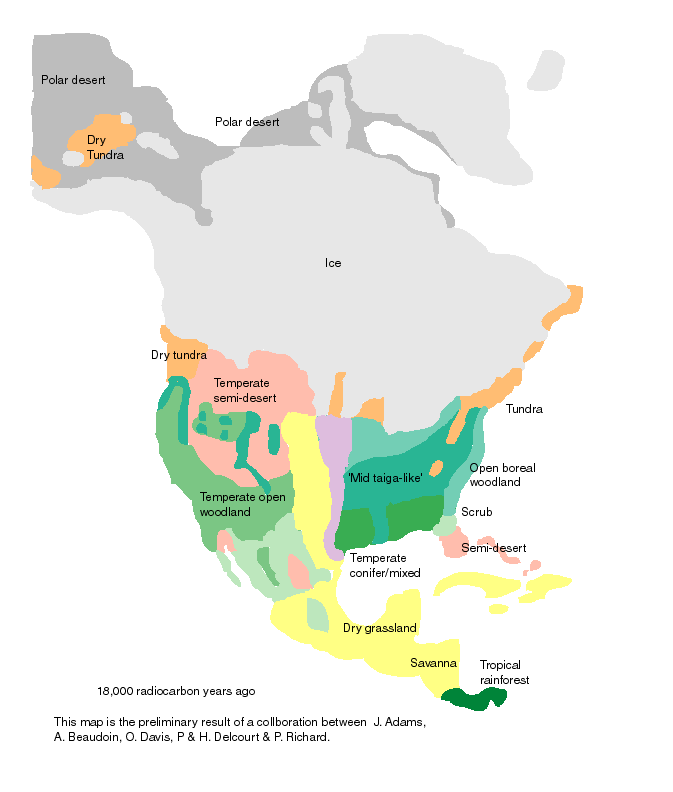
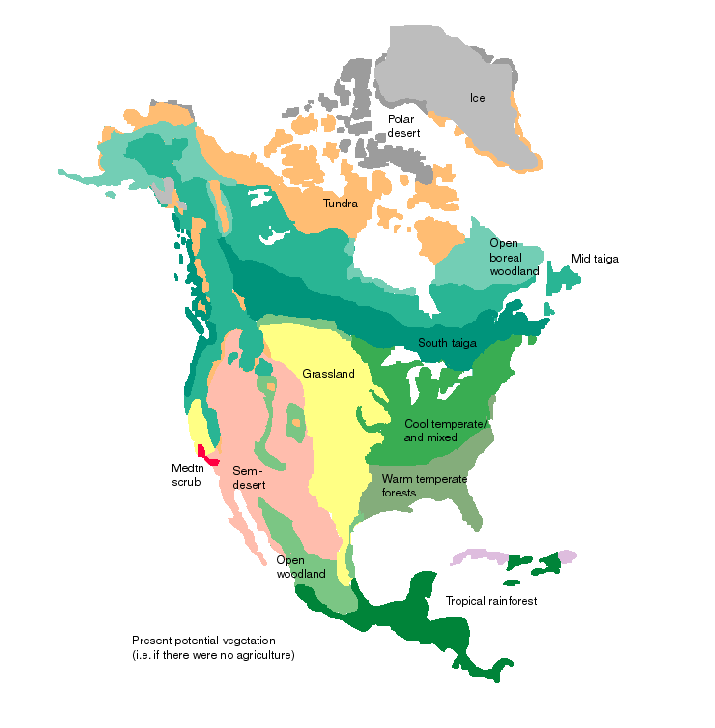
Who needs Gulf Stream most - USA or EU or both?Look at these vegetation maps. Who exports more grain - USA or Europe? Which region of the US accounts for over 80% of total US agricultural production? Which map do you prefer?
A. Gulf Stream OFF image of US vegetation (Ice Age conditions)
or
B. Gulf Stream ON image of US vegetation (present day conditions)
-
Who needs Gulf Stream most - USA or EU or both?Look at these vegetation maps. Who exports more grain - USA or Europe? Which region of the US accounts for over 80% of total US agricultural production? Which map do you prefer?
A. Gulf Stream OFF image of US vegetation (Ice Age conditions)
or
B. Gulf Stream ON image of US vegetation (present day conditions)
-
Re:More than just aircraft
It SHOULD have been a slaughterhouse, according to conventional wisdom. But in reality, the amount of casulties due to agent was tiny; they inflicted more casulties through panic and stampeding than due to agent exposure.
The AUM Shinrikyo cult attack wasn't effective because they had very low grade agent and poor delivery systems for their intended target. It was hardly ideal and yet they still managed to kill people and sicken about a thousand.
Chemical weapons JUST DON'T WORK unless delivered in huge volumes - and the ability to deliver in huge volumes is limited to large, well-equipped state armies. A chemical strike is well down the list of potential threats to the civillian populace.
That is entirely dependet upon the target. The reason you typically need large amounts of chemical agents to have a significant effect on soldiers is that they are typically trained, alert, warned by sensors, dispersed and have protective gear. Civilians are typically unprotected and tend to be more concentrated. Terrorist use of chemical weapons is a genuine threat and Al Qaeda is pursuing it. US forces have found records of their experiemnts in Afghanistan.
A skilled and motivated sniper is far, far more dangerous than a dozen nutballs with a litre of VX.
That depends a great deal on what the nutballs (suicide terrorists?) do with the VX.
The fact that the Department of Homeland Security was advising people to buy plastic sheeting to protect themselves against chemical attack is completely ludicrous... and while I have a hard time buying into anybodies' tinfoil-hat conspriracy theories (never assume malevolance where stupidity will serve) that sure looks like fear-mongering to me.
Instead of guessing, try reading. -
But I know the culprit
For my house, A/C is by far the biggest chomper of energy. During the summer months my electric bill gets as high as $270, and during the winter it gets as low as $70. Not only that, but on hot (97 degrees f) days my upstairs never gets cooler than about 78f.
It's a fairly new house, so I can't simply replace the upstairs unit, but I think it's clear that they didn't install a large enough one. What can I do? Put another powered roof ventilator in? Add more insulation in the attic? Put a radiant barrier on the underside of my roof?
This website helps to answer these questions. It provides some analysis of the different scenarios. Dunno if the analysis is accurate or not...
-
Re:Mercury waste
Wow, I didn't know that. I did know that burning coal releases considerable radioactivity, which makes nuclear power much safer than coal burning even if you factor in some accidental radiation leaks in nuclear power plants. See http://www.ornl.gov/info/ornlreview/rev26-34/text
/ colmain.html.Although burning less coal is a step in the right direction, the mercury vapor in fluorescent lights remains a concern. Do you know if the old fluorescent tubes removed from offices are recycled today?
-
Tours
Apparently, so do they.
-
Oak Ridge National Labs Public Tour Info
From http://www.ornl.gov/ornlhome/visiting.shtml#publi
c
"Public Tours
The 2006 DOE Oak Ridge Facilities Public Tour continues through Friday, Sept. 29. The 2 ½-hour tour begins and ends at the American Museum of Science and Energy, 300 S. Tulane, Ave., Oak Ridge. The tour is open to U.S. citizens 10 years of age and older. Charge is $3-$5 and registration is conducted the morning of each tour at the museum. The route focuses on DOE missions and the history of Oak Ridge. The program highlights all three DOE Oak Ridge facilities - Oak Ridge National Laboratory, the Y-12 National Security Complex, and the East Tennessee Technology Park -- and includes an off-the-bus stop at ORNL's Graphite Reactor Museum, the New Bethel Baptist Church and the East Tennessee Technology Park Visitors Overlook. The Friday tour stops at the new Spallation Neutron Source.
Nearly 20,000 people from 50 states have taken the public tour since its inception. The program is offered primarily for visitors who have a nontechnical interest in the DOE facilities. For more information, contact Fred Strohl (strohlhf [add an at sign here] ornl [add a dot here] gov, 865.574.4165). " -
Re:Radioisotope Thermoelectric Generators
well...the "Fear" of anything nuclear (it's funny how all those environmentalists bitch and moan about a few kilograms of uranium when many tons of it was released into the atmosphere due to coal power plants (ref: http://www.ornl.gov/info/ornlreview/rev26-34/text
/ colmain.html)
By the year 2040, the prediction/projected cumulative amounts released by coal burning plants is
U.S. release (from combustion of 111,716 million tons):
Uranium: 145,230 tons (containing 1031 tons of uranium-235)
Thorium: 357,491 tons
Worldwide release (from combustion of 637,409 million tons):
Uranium: 828,632 tons (containing 5883 tons of uranium-235)
Thorium: 2,039,709 tons
Anyways, back to the subject at hand, why can't we make the radioisotopes now in nuclear waste facilities (especially in the Yucca Mountain range in Nevada) produce energy using a RTG? It may not be the most efficient method but the stuff is just "sitting" there and can't be used in a traditional power generation method.
Just a thought. It might at least be able to power the lighting systems at those facilities. -
Re:Sort of like this....No, more like
Software guy: Hey, I wrote this new software, but you can't use it, so neener neener
Military type: Who gives a shit about your petty solution. We've got much better software to do that kind of shit.
Software guy: Oh...
-
Re:What a waste"This is crazy. I had never heard of this fact before. After reading the PBS thing and a bunch more on the web, I can't believe that fuel reprocessing/breeder reactors haven't been put more widely into use."
Well, the USA isn't (yet) using this technology, but the Chinese are. Even Toshiba has one of these super-safe "pre-fab" tiny reactors, that are intended for distributed use. By distributing power generation, you eliminate many of the grid effects (like blacking out a significant portion of the country when there's a problem). Oh, and as a byproduct, you also get a plentiful supply of hydrogen. It's a crime that instead we are burning coal - releasing more "natural" radioactivity than any reactor ever has, as well as poisoning our seafood with mercury.
-
Re:What will be powering our cars 10 years from no
> I'm hoping your comment was tongue-in-cheek.
maybe by coal power, he means take the radiation from coal, and we will have nuclear powered cars (transported by a electric battery from the actual generator I hope.)
Consequently, the energy content of nuclear fuel released in coal combustion is more than that of the coal consumed!
basically if you were to break up into small enough piecies, and burn the nuclear waste from nuclear plants, releasing all waste to the atmosphere. The population around these plants would have less exposure (per Kw electricity produced) from nuclear power, than that of the current coal power. -
bureaucracy at national labs
I have a different experience with national labs. The bureaucracy was not too bad at PNNL, and friends at Oak Ridge have never complained about it.
On the other hand, a lot of Los Alamos employees have complained about it.
You could visit potential employers and ask people there about the work environment, office politics, etc. That would probably also give you the best feel of your possible future co-workers.
Do you have any preference for which part(s) of the country you would like to live in? -
Re:But no Texans will own it!I'll somewhat buy into the nuclear power arguement you made. Do realize though that this "mostly clean" waste it produces is stored underground, and is highly radioactive. What happens when the shielding on its casing decays, or a seismic shift ruptures the storage facility?
Even then we are better off than with coal plants, which are spewing radiation into the air we breathe. You will absorb more radiation living next door to a coal plant than a nuclear plant. From a paper at the Oak Ridge National Laboratory's website:
Former ORNL researchers J. P. McBride, R. E. Moore, J. P. Witherspoon, and R. E. Blanco made this point in their article "Radiological Impact of Airborne Effluents of Coal and Nuclear Plants" in the December 8, 1978, issue of Science magazine. They concluded that Americans living near coal-fired power plants are exposed to higher radiation doses than those living near nuclear power plants that meet government regulations. This ironic situation remains true today and is addressed in this article.
The fact that coal-fired power plants throughout the world are the major sources of radioactive materials released to the environment has several implications. It suggests that coal combustion is more hazardous to health than nuclear power and that it adds to the background radiation burden even more than does nuclear power.
For some reason americans have an irrational fear of nuclear power, even though the worst accident in US history (Three Mile Island) released no detectable radiation into the environment. Go figure.... -
Genes wash out after too many generationsHow much actual genetic material would descendants share after 20 generations? There are no more that 35,000 distinct genes, according to the Human genome project http://www.ornl.gov/sci/techresources/Human_Genom
e /faq/genenumber.shtml. This would break down around the 15th generation, so at 20 generations there would be perhaps a 3% chance of a shared gene, assuming no additional shared ancestors.Going through so many generations, it seems like a better approach would be to ask how many genes any two people are expected to share in common, which would encompass one or more mutual ancestors, some initial distribution of genes in the original pool and rates of mutation.
-
Re:Oh, help, the eco-science terrorists will get y
you found my message unsupportable - yet I assume you found his completely justified?
Nice - fallacy of the undistributed middle, right after saying I'd done it to you.Which do you want more? To be proven right or to be correct, even if that means admitting you are wrong?
I'll certainly be suprised if either one will be "proven" in my lifetime. I'm old enough that it's unlikely I'll be alive to see empirical results. I'm also old enough to have admitted being wrong hundreds if not thousands of times - and while I don't like finding out I've made a mistake, it certainly doesn't bother me at all to tell other people about it when I do find out. If you don't leap at the chance to redress any errors you have created or disseminated, people stop considering you a worthwhile source of information, which limits what you can do in cooperation with others.What disconfirming evidence have you looked at, and why did you discount it?
All the dozens of claims to "disconfirming evidence" that I have investigated turned out to be nothing of the sort; when I consulted the actual data (such as the Mauna Loa Co2 readings and the the Greenland ice core data) and, in some cases, spoke to scientists involved in the data gathering, I found scientifically rigorous proceedings run by non-political academics, but when I attempted to find the supposedly "scientific" dissenters I found gross misrepresentations of fact pushed by political hacks without field qualifications.
I'm not going to address the rest of your propaganda, except to mention that equating corporations with scientists is novel. I haven't noticed a lot of corporations funding cross-correlation of historical documents with carbon logging, dendrochronology, or coral reef data.
Your time would be better spent learning how to analyze data than arguing with me. -
Global warming = Flame War
I think this is one of the sure-fire ways to start a flame-war on slashdot... and is ridiculous.
Your post may 'expose' the asinine grandparent post, but also doesn't answer the valid point it raises. The question you/ (science) needs to answer is if we (mankind) are to blame for the rise in temperature, or if we can even stop the warming trend. If we are not to blame, what evidence, (moral/ethical/scientific), is there that we should do anything to stop it, assuming we could?
When looking at temperature models, it is important to take TIME in to consideration. Yes, we are probably the warmest we have been in 400 years... possibly in over 100,000 years.
http://www.pbs.org/wgbh/warming/etc/graphs.html [pbs.org] (NOVA) - Note that the pictures don't overlay the correlation, (let me say that word again; CORRELATION), between the two. Take a look at these others;
http://cdiac.esd.ornl.gov/trends/co2/graphics/vost ok.co2.gif [ornl.gov]
http://www.brighton73.freeserve.co.uk/gw/paleo/400 000yrfig.htm [freeserve.co.uk] - (This is also a good read)
As you can see, we are on a warming trend, and are not yet as warm as it has reached in the non-industrialized past. Either way, there seems to be a strong force in the earth to bring this heating cycle back down, and though there is a correlation in carbon and temperature, though it is debatable that -
Are they nutters?
Appearing before the Commons Committee on Environment and Sustainable Development last year, Carleton University paleoclimatologist Professor Tim Patterson testified, "There is no meaningful correlation between CO2 levels and Earth's temperature over this [geologic] time frame.
CO2 and Temerature plots for the past 450,000 years from the Carbon Dioxide Information Analysis Center at Oak Ridge National Laboratory
http://cdiac.esd.ornl.gov/trends/co2/graphics/vost ok.co2.gif
http://cdiac.esd.ornl.gov/trends/temp/vostok/graph ics/tempplot5.gif
No meaningful correlation!!!
Nutter: A person who is regarded as eccentric or mad. -
Are they nutters?
Appearing before the Commons Committee on Environment and Sustainable Development last year, Carleton University paleoclimatologist Professor Tim Patterson testified, "There is no meaningful correlation between CO2 levels and Earth's temperature over this [geologic] time frame.
CO2 and Temerature plots for the past 450,000 years from the Carbon Dioxide Information Analysis Center at Oak Ridge National Laboratory
http://cdiac.esd.ornl.gov/trends/co2/graphics/vost ok.co2.gif
http://cdiac.esd.ornl.gov/trends/temp/vostok/graph ics/tempplot5.gif
No meaningful correlation!!!
Nutter: A person who is regarded as eccentric or mad. -
Re:Data collection versus data usage
Then the mere collection of data becomes a moot point.
"Twins"... uhoh, what was that sound? Oh, it was the sound of a multibillion dollar program going down in flames with my tax money on board.
http://www.ornl.gov/sci/techresources/Human_Genome /elsi/forensics.shtml
DNA matching is currently done on a 13 point basis. If we assume each point is a gene with two possibilities (as is the case with some forms of analysis, either the tracer attaches to the gene or it does not), that gives us 2^13 or 8192 different identifiers for a few hundred million people. Uhoh, it sounds like this plan's engines just exploded on liftoff! Oh the stupidity! Even newer schemes are generally assumed to be unique to 1% of the population. Of course, for a few million dollars and a couple years per human, we could sequence those genes and be able to identify specific mutated forms of these genes which would be a much better identifier.
This particular form of data collection just won't work at this stage, and the suggestion that it would comes from a lawyer who probably stands up in court every day and misleads the jury about how effective DNA matching is. This is just more of that, probably for the benefit of the lawyer's stock shares in DNA Analysis Incorporated. -
Re:My favorite bandwidth testThats a pretty front page I guess, but it only supports up to 8mbit/s.
http://cruise.ornl.gov:7123/ and its associate NDT servers are free, have no such limits, and have tons technical info in the details section after the test.
Plus its the government so you know you can trust it! Well... at least they arn't going to try and sell you anything.Note the list of other places running NDTs lower down in the page.
-
Re:Same reason people rice out cars
Unless your case looks like this, I'm not going to be impressed.
-
Re:Blasts....
Well, I just found on the HGP project page ( http://www.ornl.gov/sci/techresources/Human_Genom
e /home.shtml )that it was completed in 2003. Ant this page: http://www.ornl.gov/sci/techresources/Human_Genome /project/progress.shtml announces any number of completions since then. So yeah, a little explanation would be in order. -
Re:Blasts....
Well, I just found on the HGP project page ( http://www.ornl.gov/sci/techresources/Human_Genom
e /home.shtml )that it was completed in 2003. Ant this page: http://www.ornl.gov/sci/techresources/Human_Genome /project/progress.shtml announces any number of completions since then. So yeah, a little explanation would be in order. -
Re:Waiting for second generation..Leftover crap?
While fermenting the straw as well as the grain of cereal crops would increase the energy production per Ha., it probally wouldn't be the best move from an environmental or crop growing point of view.The leftover crap as you call is is biologically degraded and brought back into the soil, helping the increase the OM (organic matter) content of the soil and recycling the nutrients needed by the growing crops.
The straw and other residue material is usually chopped and spread over the ground, and this helps in moisture retention, soil erosion and increase the numbers of natural predators.Now if you have technology to use the cellulose material from the crops, why would you grow cereal crops to produce ethanol? Many other crops such as miscanthus and hemp will produce much higher yields of usable biomass per Ha.
Miscanthus is especially suitable for this purpose, once sown it usable for up to 20 years, with annual harvesting. The harvested stems contain low levels of N, P and K which means that there is little or no transportation of essential plant nutrients off site and consequently no requirement for additional nutrients (fertiliser) after year 2-3.
At the moment in Europe there is a lot of interest in growing miscanthus for bio-energy, i.e. in wood chip, wood pellet boilers and the like.
-
We all know where cancer comes from.Let's take cancer. People don't know where cancer comes from and think that some habits are better than others. Yet we all can get cancer, regardless if you excercise, etc.
Some choice quotes:
- As population increases worldwide, coal combustion continues to be the dominant fuel source for electricity
- Americans living near coal-fired power plants are exposed to higher radiation doses than those living near nuclear power plants that meet government regulations
- coal combustion wastes more energy than it produces
- the amount of uranium-235 alone dispersed by coal combustion is the equivalent of dozens of nuclear reactor fuel loadings
Now, consider that the US Government conducted more than 2000 nuclear tests in the roughly 40 years following WWII, 500 of which were above ground tests. Thats roughly one nuke every two weeks, one above ground every two months, for 40 years.
I think we all know where cancer comes from.
- As population increases worldwide, coal combustion continues to be the dominant fuel source for electricity
-
Re:Analyzing Anomalous Materials
All they need now is cart to push... http://www.ornl.gov/~webworks/sns/y2006/Feb/full/
s ns-0302-2006.jpg -
As an added benefit...
The facility puts out a huge flux of neutrinos, allowing improved measurements of the neutrino-matter interaction cross-section.
-
As opposed to coal, yes
Many people beleive that coal fired electric generation emits more radioactive material into the environment than nuclear plants do. See this article
-
Re:What about Canada?
You are simply mistaken with respect to carbon. In 2002, Canada emitted 4.5 metric tons carbon per capita. In the same year, the US emitted 5.5. Still very large compared to the global average of about 1.1 though.
http://cdiac.ornl.gov/trends/emis/top2002.cap -
Reminds me of days of yore....
... the old Stone Soup Supercomputer was the first I can remember that used cast-off computers to generate (what passed for) Serious Horsepower. Tempus fugit, indeed.
-
Re:Volcanic contributions are a drop in the bucket
Is there a coal plant in Centralia? I don't know, but I suspect not. I do know that if there is, that it processes a lot less than 28,000 tons of coal a day -- No 10 plants in the world combines process that amount combined. According to this site: http://www.ornl.gov/info/ornlreview/rev26-34/text
/ colmain.html in 1982 (a year in which more coal was burned than 2005) the entire world processed 2.8 billion tons, but you'd have us believe that one plant in Centralia output 1.2 billion tons of Carbon Dioxide in a year from processing coal? If that's true, it'd explain the dismal overcast over western Washington most of the time, but if you're right, most of it didn't come from coal. Since I decided to look up statistics, I decided to find out, and yes, there is actually a coal plant in Centralia, though it's a model of efficiency and low environmental impact: http://www.power-technology.com/projects/centralia / According to the site, it provides roughly enough power for all of Seattle. -
George Bush is CLEARLY teh debbil!
"Climatological Cassandras are becoming increasingly apprehensive,
for the weather aberrations they are studying may be the harbinger of another ice age." - TIME, Monday, Jun. 24, 1974
But NOW (I understand) they're sure?
Let's just point out:
"From around 150,000 to 130,000 years ago, North America experienced colder and generally more arid than present conditions. About 130,000 years ago, a warm phase slightly moister than the present began, and conditions at least as warm as the present lasted until about 115,000 years ago. Subsequent cooling and drying of the climate led to a cold, arid maximum about 70,000 years ago, followed by a slight moderation of climate with a second aridity maximum around 22,000-13,000 14C years ago. Conditions then quickly became warmer and moister, though with an interruption by cold and aridity in many areas around 11,000 14C years ago."
(Jonathan Adams, Environmental Sciences Division, Oak Ridge National Laboratory)
http://www.esd.ornl.gov/projects/qen/nercNORTHAMER ICA.html [ornl.gov]
Does the temperature seem to be moving up lately? Yep.
Beyond that, it seems to be a huge guessing game: are humans responsible for the current warming? (personally, I think we probably contribute significantly to it)
Is warming a catastrophe? Even IF you buy into the Cassandras, for every "coral reef is gonna die because the water's too warm!" it's hard to believe that there's not a corresponding expansion (northward) of coral-reef-able zones. For every acre of expanded desert, there's another acre of former-tundra that now has a growing season.
And don't even get me STARTED on "cities will flood" crap. Duh? For ANY city in any location, over a long enough span of time, the odds of it surviving unscathed are ultimately zero. Nobody built the big cities (generally starting as a cluster of wooden huts around a river or nice bay) with an eye toward their long term survivability - NOBODY. To presume at this point that we need to exert every effort to somehow FREEZE Earth's dynamic climate to accomodate habitation choices made 000's of years ago?
That's just stupid. -
Re:water
exactly. vapor does change. The ice age was colder and drier http://www.esd.ornl.gov/projects/qen/nerc130k.htm
l
Or were you refering to some of the precambrian ice ages?
I just find it confusing that water vapor gets neglected in most discussions except for the caveat that cloud cover may change. But in any case, CO2 is only one factor amongst many. The pessimist in me thinks that focusing on just one part is going to result in us shooting ourselves in the foot somehow. -
strawmen, ahoy!
"Climatological Cassandras are becoming increasingly apprehensive,
for the weather aberrations they are studying may be the harbinger of another ice age." - TIME, Monday, Jun. 24, 1974
NOW they're sure?
Let's just point out:
"From around 150,000 to 130,000 years ago, North America experienced colder and generally more arid than present conditions. About 130,000 years ago, a warm phase slightly moister than the present began, and conditions at least as warm as the present lasted until about 115,000 years ago. Subsequent cooling and drying of the climate led to a cold, arid maximum about 70,000 years ago, followed by a slight moderation of climate with a second aridity maximum around 22,000-13,000 14C years ago. Conditions then quickly became warmer and moister, though with an interruption by cold and aridity in many areas around 11,000 14C years ago."
(Jonathan Adams, Environmental Sciences Division, Oak Ridge National Laboratory)
http://www.esd.ornl.gov/projects/qen/nercNORTHAMER ICA.html
Does the temperature seem to be moving up lately? Yep.
Beyond that, it seems to be a huge guessing game: are humans responsible for the current warming? (personally, I think we probably contribute significantly to it)
Is warming a catastrophe? Even IF you buy into the Cassandras, for every "coral reef is gonna die because the water's too warm!" it's hard to believe that there's not a corresponding expansion (northward) of coral-reef-able zones. For every acre of expanded desert, there's another acre of former-tundra that now has a growing season.
And don't even get me STARTED on "cities will flood" crap. Duh? For ANY city in any location, over a long enough span of time, the odds of it surviving unscathed are ultimately zero. Nobody built the big cities (generally starting as a cluster of wooden huts around a river or nice bay) with an eye toward their long term survivability - NOBODY. To presume at this point that we need to exert every effort to somehow FREEZE Earth's dynamic climate to accomodate habitation choices made 000's of years ago?
That's just stupid. -
Re:finally
Try this. This gives the US o/p as 6000 TgCO2
http://yosemite.epa.gov/OAR/globalwarming.nsf/Uniq ueKeyLookup/RAMR69V528/$File/05executivesummary.pd f
it doesn't give the "rest of the world" numbers - That's arithmetic, but is cited uniformly by nearly all "Googlable" sources,
Then there is this
http://cdiac.ornl.gov/
And this is, I reckon the authoritative source.
http://cdiac.ornl.gov/trends/emis/tre_nam.htm
Scary isn't it ?
"Western Europe", note emits around 1/3rd than the US, with a larger population.
Steve -
Re:finally
Try this. This gives the US o/p as 6000 TgCO2
http://yosemite.epa.gov/OAR/globalwarming.nsf/Uniq ueKeyLookup/RAMR69V528/$File/05executivesummary.pd f
it doesn't give the "rest of the world" numbers - That's arithmetic, but is cited uniformly by nearly all "Googlable" sources,
Then there is this
http://cdiac.ornl.gov/
And this is, I reckon the authoritative source.
http://cdiac.ornl.gov/trends/emis/tre_nam.htm
Scary isn't it ?
"Western Europe", note emits around 1/3rd than the US, with a larger population.
Steve -
Re:Um. . .Duh?The statement that CO2 correlates well with temperature is incorrect. CO2 has been steadily increasing over the last 100 years, while temperatures rose from the 1880's to about 1940, cooled until about the 1970s, and has risen again of late.
The 500k year Vostok ice core data: http://cdiac.esd.ornl.gov/trends/co2/vostok.htm shows CO2 either in phase or lagging temperature by up to 1000 years, over four temperature oscillations. This means the CO2 does not drive temperature, but that temperature drives CO2. The most likely explanation is that the ocean outgases and releases more CO2 when temperature increases, and holds more dissolved gasses as the oceans cools. Since we are near an alltime CO2 low over the last 250 million years, it is worthwhile to note a few things:
1. CO2 is not a pollutant. It is, in fact, the lifeblood of the planet, required for growth of vegetation. It is the cornerstone of the food chain. The increased CO2 aerial fertilization effect has contributed to the greening of the planet, as confirmed by satellite photography.
2. Water vapor is by far the primary contributor of the greenhouse effect, accounting for 96 to 99%. CO2 accounts for 1 to 3%. Methane and others trace gasses account for less than 1%. The greenhouse effect lets solar radiation in, but, like a blanket over the planet, absorbs some IR heat that would otherwise radiate out. This keeps the Earth's mean temperature somewhere around 15 C, instead of roughly -15 C. This vital 30 C swing is the reason that the Earth is habitable.
3. During the current interglacial period, the Earth has been about 2C cooler (The "Little Ice Age" around 1600-1700, when the Thames regularly froze over), and it has also been about 2C warmer (The medieval warm period around 1000 - 1200, when Greenland was colonized by the Vikings and exported surplus crops.) We are currently about in the middle of this natural variation, which occurred without manmade CO2.
4. The best protection against climate change is a rich, technologically advanced society that can adapt to natural variation. Don't damn the 3rd world to extended time in poverty by crippling the world's economy with a meaningless Kyoto type treaty, that will cost billions, but will have no measureable impact on real world temperature.
-
Re:Coal is Not Radioactive
But we don't burn soil and release that into the air.
"Former ORNL researchers J. P. McBride, R. E. Moore, J. P. Witherspoon, and R. E. Blanco made this point in their article "Radiological Impact of Airborne Effluents of Coal and Nuclear Plants" in the December 8, 1978, issue of Science magazine. They concluded that Americans living near coal-fired power plants are exposed to higher radiation doses than those living near nuclear power plants that meet government regulations. This ironic situation remains true today and is addressed in this article."
http://www.ornl.gov/info/ornlreview/rev26-34/text/ colmain.html -
Someone should mod you up teutonicA coal plant? Now, that ADDS to emissions AND it actually produces more radioactive waste isotopes than a regular nuclear plant
Hey, there ya go! That looks better
The energy content of nuclear fuel released in coal combustion is greater than that of the coal consumed.
And the global warmers are worried about the frickin' CO2.
-
ORNL Mouse House
I'm kind of amazed that at no point is the Oak Ridge National Laboratory (ORNL) Mouse House mentioned anywhere in the article. ORNL has been in the mouse genetics business for decades with a large number of genetic variants available on site.
Not long ago, they relocated to a new facility.
http://bio.lsd.ornl.gov/mgd/news/MH/Sept2003.html -
Re:No more concern about endangered species?This is far from creating new species. New species would mean inability to produce capable off-spring with the original species (examples: horse and donkey can produce off-spring that won't reproduce, no grandkids for an old horse-donkey couple). Despite being "almost identical" the differences in genome organization are quite substantial (factsheet for laymen):
Similarities between mouse and human genes range from about 70% to 90%, with an average of 85% similarity but a lot of variation from gene to gene (e.g., some mouse and human gene products are almost identical, while others are nearly unrecognizable as close relatives). Some nucleotide changes are "neutral" and do not yield a significantly altered protein. Others, but probably only a relatively small percentage, would introduce changes that could substantially alter what the protein does.
There is another problem. Producing the sequence of nucleotides for human genome is one thing (done), but finding genes in this sequence is more difficult. A lot depends on the sequence similarity to previously discovered genes which are in turn also discovered by the means of sequence similarity to earlier discovered genes, etc. There are ab initio gene predicting tools but they work ok only for procaryotic (bacterial) genomes, for eucaryotes (that covers human and mouse) the effectiveness of those tools is around 50%. That means a lot of genes that participate in comparison might be yet undiscovered or wrongfully identified. The databases of protein sequences need a massive overhaul. Similar overhaul has been done for PDB - database of protein structures years ago (as a result, Brookhaven lost hosting of it and it went to multi-site concortium RCSB).