Slashdot Mirror
Domain: ornl.gov
Stories and comments across the archive that link to ornl.gov.
Comments · 647
-
CO2 warming a mythMy last post recieved a 0 - flamebait tag, so I cleaned and edited for clarity: I challenge anyone to find a factual error or false statement in my humble attempt to bust the CO2 warming myth.
1. CO2 is not a pollutant. It is, in fact, the lifeblood of the planet, required for growth of vegetation. It is the cornerstone of the food chain. The increased CO2 aerial fertilization effect has contributed to the greening of the planet, as confirmed by satellite photography.
2. Water vapor is by far the primary contributor of the greenhouse effect, accounting for 96 to 99%. CO2 accounts for 1 to 3%. Methane and others trace gasses account for 3. During the current interglacial period, the Earth has been about 2C cooler (The "Little Ice Age" around 1600-1700, when the Thames regularly frozen over), and it has also been about 2C warmer (The medieval warm period around 1200, when Greenland was colonized by the Vikings.) We are currently about in the middle of this natural variation, which occurred without manmade CO2.
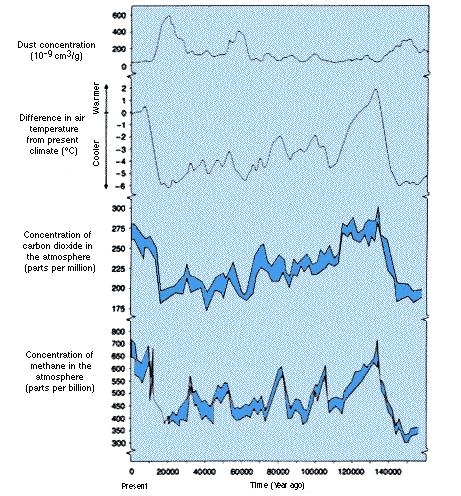
4. The 500k year Vostok ice core data: http://cdiac.esd.ornl.gov/trends/co2/vostok.htm/ shows CO2 either in phase or lagging temperature by up to 1000 years, over four temperature oscillations. This means the CO2 does not drive temperature, but that temperature drives CO2. The most likely explanation is that the ocean outgases and releases more CO2 when temperature increases, and holds more dissolved gasses as the oceans cools.
5. I'm not disputing the Earth may be getting relatively warmer (as we are coming out of the little ice age). One reason is likely the unusually active Sun. This report: http://cc.oulu.fi/~usoskin/personal/aah4688.pdf/ shows that over the last several centuries, solar activity is at its highest levels. The IPCC determined that the Sun's variation in energy output were too small to explain global warming. They dismissed the sun as a likely source of Earth changing climate!. Here is a link to a recent study showing how the sun's variation could have a feedback that would drive earth's climate change: http://news.bbc.co.uk/2/hi/science/nature/2333133. stm/ The theory goes like this: When the sun is highly magnetically active, the increased solar wind shields us from cosmic radiation. Low levels of incoming comic reduce cloud formation. Reduced low level cloud formation reduces reflectivity (i.e., the Earth's albedo). More energy is absorbed instead of reflected, and the temperature increases. The difference from an active Sun to an inactive Sun was about 3% global cloud coverage. The correlation in the study is remarkable. The jury is still out, but it could explain the correlation between the Maunder minimum of the 1600's and the little ice age, and account for the warming in the last 3 decades that corresponds with unusually high solar activity at the same time.
6. In November 1991, Danish scientists Eijil Friis-Christensen and Knud Lassen, startled the climatological world with a paper in "Science" describing a 0.95 correlation between solar cycle length and global temperature (IPCC version). "Science" writer, Richard Kerr described it as "one dazzling correlation". The blue line is temperature, the red line is solar cycle length.) As can be seen, global temperature has tended to increase in lockstep with shortening of the solar cycle length (ie. solar maxima becoming more frequent) I hope you follow the link, because one look at it, and you are forced to say, "Its the Sun, stupid." The graph is at the bottom of this link: http://http//web.dmi.dk/sol-jord/projekter/rum_vej r/oversigt.html/
7. The best protection against climate change is a rich, technologically advanced society that can adapt to natural variation. Don't damn the 3rd
-
Re:Yikes!
Can I have a play on that slippery slope once you're done with it?
This may seem like a slippery slope fallacy, but it is indeed based on solid evidence. Analysis of historical climates indicates that climate changes are indeed very sudden.
source
source
source
source
But hey... we can wait untill our society has been crushed by global climate change before we take off our blinders. -
Re:Not quiteSo, why should I not be worried? Please enlighten me.
Because the electricity you used to post this message was probably generated at a coal-burning power plant, which spews radioactive material into the air all day, every day. Current totals are around 27,000 tons of uranium and thorium per year for all coal plants in the world.
So, really, you should be using less electricity if you want to get radioactive elements out of the atmosphere, not blaming NASA for putting niggling little amounts of radioactive material into spacecraft. Heck, if it succeeds, all that bad stuff is gone forever!
-
Re:Cool, but misleading title
Why do you say that gas turbines are some of the most efficient fuel to energy converters known to man? Every link I can find in a google search says otherwise. http://www.britannica.com/eb/article?tocId=45726 for example.
Gas turbines seem to only become highly fuel efficient when the heat of their exhaust gas is captured by a secondary system, like a steam recovery boiler. http://www.ornl.gov/info/ornlreview/v33_1_00/turbi ne.htm -
Wetware, Quantum effects, and 'Spookiness'
I would counter a few of your underlying assumptions with the following references - note that electron tunneling pathways affect protein folding dynamics and that quantum interference plays a critical role in photosynthesis. See also Zeilinger's biomolecule matter-wave interference experiments.
Of course, future computing architectures can incorporate these 'spooky' features. -
Re:Not The Same!Show me some EPA statistics and I will listen.
The EPA numbers are the source for the calculations in the report linked to earlier. From that link:
"For a large number of coal samples, according to Environmental Protection Agency figures released in 1984, average values of uranium and thorium content have been determined to be 1.3 ppm and 3.2 ppm, respectively. Using these values along with reported consumption and projected consumption of coal by utilities provides a means of calculating the amounts of potentially recoverable breedable and fissionable elements."
From there, it's simple multiplication to derive the total emmision, for the elements in question.
-
Re:Not The Same!"Burning fossil fuels may emit trace amounts of "radioactive" elements, but this is NOT a concern versus the issues with NO2, Sulfur Dioxide, Mercury, etc."
145,230 tons of Uranium (containing 1031 tons of uranium-235) and 357,491 tons of Thorium released into the air and water is not exactly trace.
Yes, there are also heavy metal poisons released from fossil fuel plants, and they are a concern too.
-
Re:Modded Interesting??
The folks at Oak Ridge Labs aren't as sure as you are. Still, the previous poster is probably overstating the case a bit.
-
Re:Still burning hydrocarbons though
Actually, the parent was right. Burning fossil fuels like coal releases large amounts of radioactive waste into the air and water. In fact, coal burning plants release many times more radiation than all the nuclear reactors in the world (yes, even including the "accidents"). See this report from the Oak Ridge National Laboratory for details.
-
Re:Take note
BZZT! Try again. The US only produces twice of China's emissions. Keep in mind though, that China is nowhere near the US's technology level. China's emissions are likely to increase substantially. The US's world share of emissions, however, are only 24% of all CO2.
-
Re:More on sinks
"Come on guys, your liberalism is showing."
Not everything is political. There is a consistent record of increasing concentrations of CO2 over time. This increase corresponds to an increase in the production of CO2 by humans (coal, oil, etc.); the predicted increase is twice the observed increase, possibly because the oceans have acted as CO2 sinks. The record on CO2 concentrations goes back about 800,000 years (also interesting). I assume that any reasonable person can accept this information (i.e. this is not political).
The next question is what is the impact this increasing concentration of CO2 (and other "greenhouse" gasses) on the climate. No one has a completely correct answer. A variety of mathematical models have been used and the predictions of these models have been tested in various ways (e.g. comparison with existing recoreds). None of these models is perfect. However, the majority of scientists who study climate questions, using a variety of techniques, conclude that the increased concentration of greenhouse gasses has contributed and will contribute to a warming of the earth's atmosphere. No one knows exactly how great will be this increase and this is a subject of great interest.
-
Re:The Guardian
It may be anti-Bush, but it's generally a reasonably good paper. (Maybe those are effect and cause?)
Unfortunately, like other newspapers, it's not very good on science. They don't even provide a plot of the CO2 levels, or the history of the year-over-year rises. If you plot the data (available online, as another reader posted), it's clear that the last two years aren't particularly unusual. -
Re:More on sinks
The main problem is that if the tipping point has been reached, then the first time you might get your 'hard evidence' is the entire population of Florida migrating north.
Tipping point? Proof, please?
Look, just because we had a three- or four-sigma year doesn't mean that it's the end of the world. Has anyone around here taken statistics? I would think that the crowd around here would be better educated.
The language of the article indicates that it's a sham: atmospheric CO2 levels jumped 4 PPM? Four Parts Per Million? First of all, they don't mention what the level was before. Is 4PPM isn't a large number. From a table I found through Google, 4 PPM would be a normal monthly swing.
This is just like the TV news reporting that "unemployment claims skyrocketed 1% this past month." Attaching such emotional language to tiny numbers illustrates their political bent. -
Or a fountain
Or a fountain
http://www.csm.ornl.gov/ssi-expo/cray2.jpg/
The coolest computer ever.
Michael -
Re:Weather is complicated
Hurricanes are heat engines driven by the energy contained in warm surface water. As the winds pick up, they are able to suck more and more of the energy from the sea surface. Because there is a limited supply of warm surface water, they need to keep moving to continue to grow.
In many ways, they are like wildfires burning through brush. The heavier the brush, the more intense the fire. If there is global warming, it will certainly lead to increases in mean sea surface temperatures, which increases the energy available to storms such as Hurricanes, therefore, bigger hurricanes.
While many aspects of global warming, like the rate and the detailed effect it will have on different regions is controversial, saying that global warming will lead to more intense hurricanes is not controversial.
I've been a bit of a skeptic about global warming for years. The chicken little crowd has always bugged me. But, if you turn off the politics and look at the data you see that currrent C02 levels are the highest in the last 150K years and are rising every year. This is a dangerous experiment we are doing with our atmosphere.
If reducing CO2 was going to cost lives or billions of dollars, then it is debatable whether we should do it. But, the things you'd do to reduce C02 like driving more efficient cars, buying more efficient appliances, insulating your houses, etc. are things we should do anyway, for other reasons - reduce polution, dependence on foreign oil, and on a micro scale, save everyone money.
My $.02
-DT- -
Doing the math.Information taken from here; I presume the information to be largely sound. Units work done with converter here; results matched my old engineering sense of unit size, and thus were not checked from my CRC HoC&P.
US Electricity production in 2003 was 3800 Billion KWh (=3.8 PWh =13 Quad); 21% nuclear (.76 PWh=2.6). For comparison, hydro was 7%; solar, geothermal, and other alternative sources about 1%.
Total energy consumption, however, is about 100 Quad, once you include all energy use ("petroleum, dry natural gas, coal, net hydro, nuclear, geothermal, solar, wind, wood and waste electric power").
Since nuclear energy is used exclusively for electricity generation (neglecting the effect of a few floating cities), it would not be impossible to replace nuclear power with an expanded coal program, especially given the vast proven US coal reserves. However, coal-fired plants have arguably greater drawbacks-- coal ash is radioactive, and burning more coal would release more CO2.
Replacing nuclear power with an expanded alternatives program (wind or solar) would require an order of magnitude increase in generation capacity. It would also result in a cost increase; wind energy costs around .
-
carbon corrals
Russia's interest in this treaty is based on its provision of credits for carbon sequestration. By growing trees, without burning them, Russia sinks scads of CO2 from the air they breathe into their woody flesh. The vast stretches of foresty Russia, which can be treed and cut for unburned products, would make Russia almost as rich in sequestration points as it is in burnable oil. The US, with our vast stretches of clearcut, would be positioned similarly, especially if much of the clearcut Federal lands weren't being kept as new, subsidized grassland for ranchers' grazing herds.
-
Re:Someone please explain this to me
True supercomputers (particularly the Cray family) are not just ultra-fast cousins of the beige box under your desk. Of particular interest is the idea of a vector processor.
True HPCs Also tend to incorporate tight integration between compute units. Where a cluster would have the processors roughly in a star topology, many of the true supercomputing champions arrange their processors into something resembling a crystal.
As a consequence of these architectural differences, Cray and family are much more suited to work on large indivisible problems while super clusters excel at tasks involving easily separated components. -
Re:You forget about nuclear powerObviously not - since you didn't know the stuff is mostly silicon and is safe enough to use in building materials.
Okay, you're clearly a fucking idiot. Coal ash isn't just silicon, it's oxides of aluminum, calcium, magnesium, sodium, arsenic, sulfur, and mercury. Yes, the bulk of it is pretty much inert, but the contaminants are present in sufficiently large amounts to be an environmental hazard.
It's safe to use in building materials because when you encapsulate it in concrete you're sealing the toxins in it off from the surrounding environment. I never claimed otherwise.
There are plenty of real toxic materials that should be treated with respect instead of inventing some stuff about fly ash being radioactive waste.
You also are illiterate. I never claimed that fly ash was radioactive waste. What I mentioned was the fact that uranium and thorium isotopes are present in significant quantities in coal, and when that coal is burned those elements are oxidized and emitted into the atmosphere just like the carbon is.
Here:
Using these data, the releases of radioactive materials per typical plant can be calculated for any year. For the year 1982, assuming coal contains uranium and thorium concentrations of 1.3 ppm and 3.2 ppm, respectively, each typical plant released 5.2 tons of uranium (containing 74 pounds of uranium-235) and 12.8 tons of thorium that year. Total U.S. releases in 1982 (from 154 typical plants) amounted to 801 tons of uranium (containing 11,371 pounds of uranium-235) and 1971 tons of thorium. These figures account for only 74% of releases from combustion of coal from all sources. Releases in 1982 from worldwide combustion of 2800 million tons of coal totaled 3640 tons of uranium (containing 51,700 pounds of uranium-235) and 8960 tons of thorium.
Maybe try hiring an adult to read my posts to you next time. -
Re:Carbon-14 is *not* Plutonium or U238Ok, so Coal's radioactive
The point is that the radioisotopes naturally present in coal are many of the same long half-life materials used as nuclear fuel. Coal has been in the ground for a long time before it is recovered. Actually, in biological materials C-14 levels start pretty low--only about one part per trillion. Comparatively short-lived species like carbon-14 have long since decayed to negligible levels. (Every hundred thousand years, the C-14 level drops by a factor of about a million.)
On the other hand, most coal contains relatively larger fractions of some other species--and we've known this for quite some time. There's a detailed analysis here. Highlights include,
Coal burned in the U.S. contains about 1 part per million of uranium and 3 ppm thorium. That's 1 gram of uranium per ton of coal.
Total activity of coal is about 4 microcurie per ton.
In operation, a 1000 MWe coal plant exposes the population to about 500 person-rem/year. For a nuclear plant the figure is less than 5 person-rem/year. (If one includes exposures in mining and preparing the fuel, that goes up to 136 person-rem/year.)
The real question to "portable" reactors is the refuelling safety and shield maintanence (think about it , fresh fuel is more radioactive than wastes).
Actually, the usual problem is that waste fuel is more active. Uranium-235 is fairly stable, long half-life stuff. It's not good for you, but I wouldn't be bothered by holding nuclear fuel pellets in my hand. On the other hand, the stuff that comes out of a reactor is a witches brew of fission products plus various heavier isotopes produced by neutron bombardment. They're not getting rid of that 'spent' fuel because it's going cold; they're getting rid of it because it's a mess. Hard to characterize, hard to control. In principle it's possible to reprocess that spent fuel to extract fissionable isotopes (mostly plutonium) that will supply more useful energy than the uranium you started with. (The so-called 'breeder' reactor). It's not done for commercial production anywhere that I know of right now, because handling spent fuel is such a messy and dangerous business.
-
Re:One good reason at least
>Unfortunately Three Mile Island and Chernobyl proved they were right. They are risky. They are extremely complex and very fallible.
Not the new pebble bed reactors. The old designs would melt down if you didn't actively control the reaction. The new designs just stop producing energy.
Also, I hate to break it to you, but burning coal produces much more environmental radiation than nuclear power.
Nuclear really is safer and more environmentally friendly than coal.
-
Re:Nice
"Assuming 10% usage, the total of the thermal energy capacities from each of these three fissionable isotopes is about 10.1 x 10E14 kWh, 1.5 times more than the total from coal.
"Coal Combustion: Nuclear Resource or Danger" -- Alex Gabbard -
Re:Nuclear energy works!
Coal releases more radioactivity that nuclear power anyway.
From this article, "the population effective dose equivalent from coal plants is 100 times that from nuclear plants." -
New explosives for DisneyWhile the compressed gas systems won't change the toxics used in the shells, this will. (Look for the bit at the bottom on "Better Holidays through Chemistry.")
Some of the new high nitrogen explosives are well suited to this application.
It will be difficult to replace all of the colors produced by metals and other compounds used in fireworks- some of which are quite toxic (strontium, cadmium, arsenic, antimony, PVC plastic, etc.). It will also be much more expensive. But high nitrogen explosives and newer organic compounds have a lot to offer the field- including colors you can't get with the old standbys.
Some of the high nitrogen stuff I used to work with was pretty interesting. Lots of newer, potentially safer compounds are in the pipeline- mainly for military applications, but they can be bastardized to, er, recreational purposes.
-
Re:Safety of Nuclear Power
No, that's not correct. For example, over 3,000 people died in one week in 1952. The problem is the makeup of most coal. From this link
Coal is one of the most impure of fuels. Its impurities range from trace quantities of many metals, including uranium and thorium, to much larger quantities of aluminum and iron to still larger quantities of impurities such as sulfur. Products of coal combustion include the oxides of carbon, nitrogen, and sulfur; carcinogenic and mutagenic substances; and recoverable minerals of commercial value, including nuclear fuels naturally occurring in coal.
MORE NUCLEAR MATERIALS ARE RELEASED BY COAL BURNING THAN ANY NUCLEAR PLANT HAS EVER RELEASED. That's a VERY important thing to know, because COAL KILLS PEOPLE.
-
Re:Step in the right direction
Call me when they are able to use non-visible light to generate solar power.
Pass the crack pipe. That happened in 1999. It's just still really fucking expensive. -
Re:How much power would that be? And at what cost?
-
Re:Why not compare it with coal-fired plants?
Sorry, you're wrong. Contrary to the anti-nuke propaganda popular with the general public, the emissions of coal fueled powered plants include silicon, aluminum, iron, calcium, magnesium, titanium, sodium, potassium, arsenic, mercury, and sulfur plus small quantities of uranium and thorium. As has been pointed out for decades, Nuclear plants actually emit less radioactivity into the environment than do Coal plants. Google for coal radioactive emissions to get an education or just click here if you're too lazy.
-
Current State of the Art - 2 TB mem and 256 cpus
I am happy to say that I have worked, and continue to work on the current state of the art:
http://www.ccs.ornl.gov/Ram/Ram.html
A few notes:
Linux kernel: 2.4.21-sgi240rp04051808_10074
From df, a 1 TB ram disk:
none 1023700704 0 1023700704 0%
From
Red Hat Linux Advanced Server release 2.1AS (Derry)
The machine is actually not nice to work on. It is prone to frequent short freezes (2-15 seconds long; about one every 2-3 minutes, although not evenly spaced out). -
fuel energy contents?
A gallon of gasoline has 121MJ, while a gallon of diesel has about 138MJ.
-
Re:High Mileage Cars
a gallon of diesel fuel has about twice the energy as a gallon of gasoline. (Of course I'm not counting the energy used in refining, gasoline needs a lot of energy to create)
This is simply not true. There is a bit of variation between the different types and grades of diesel and gasoline but it pretty much comes down to they are fairly equal in the amount of energy that each fuel contains. If you look at this web site you will see the following numbers:gasoline - 35 MJ/liter
Diesel has a bit more energy than gasoline but by no means does it have twice the energy!
diesel - 36.4 MJ/liter -
No.
My imaginary car weighs nothing, but requires a driver. I (imagine that
-
Re:Great Idea, but..I won't go into the environmental risks of nuke power
You mean radioactivity? Yeah, because we know coal power doesn't produce any of that. Oh wait, it does.
-
Re:windows copied, too
Both Apple and Microsoft got the idea for a windowing systen from Xerox research. The first company to implement the windowing system was Sun. Check this link for a brief history.
Why would you want to re-invent the wheel anyway? It works!
Improvement on existing ideas is a great way continue innovation. For example, you typical nuclear power plant is just an improvment on James Watt's idea for the steam engine. We do all that fancy stuff to heat water, which creates steam, which turns turbines, to ultimately harness energy.
We are witnessing the evolution and improvement upon good ideas. -
Re:Lighting! Yes! Let your employees choose!
It just so happens that my "Intro to Speech" textbook had an example outline, with some great info on this subject.
Here are some links to both research and justify spending extra money (if neccesary) to secure natural lighting, or other appropriate lighing.
Daylighting Performance and Design
"Beyond the Bulbs: In Praise of Natural Light," article
"A Literature Review of the Effects of Natural Light on Building Occupants," PDF
I wish I could include the full outline or transcript of the speech, it really has the numbers needed to justify to the beancounter, but I'm unsure on the (c).
-PHiZ -
Re:Can you say "knee-jerk"?A troll, I presume
Forensic DNA matching does not involving matching all or even a significant amount of your DNA to a challenge. Try 13 short, matching sequences of a dozen or so base pairs out of 3.2B base pairs for the mostly commonly used type of forensic DNA testing. Sure there are 6B people so that doesn't sound too bad, but are they indepenently distributed in geography or DNA space? Nobody knows - a whole company exists to try to find out - eventually). Afterall a single American White Male was the primary source of the DNA for Celera HSG work. What does that say about statistical relevance?
To put the statistics of forensic DNA matching in perspective, imagine that you wanted to "match" a suspect piece of literature to a book missing from your library (assuming that you have every copy of each author's work - no twins/clones) and that you could only match it based on the content of the book's words. Now say you decided to define a match by randomly picking one word that started with the letter 'H' of from each chapter from a book the size of War and Peace, up to 10 chapters only, and then saying that if more than 5 out of 10 words are the same, that defines a "match". Only to a certain condifidence interval you can claim to have a match and even then it's certainly never 100% sure. Basically that's how forensic DNA matching works.
You can probably be pretty sure that a given work of James Joyce is not Edgar Allen Poe, but declaring a match between some unknown challenge against a random library edition is a bit more iffy. The cases you hear about "long-shot hits" on "dead file" cases are both very long shots and (should) never (be) sufficient for conviction on DNA alone, railroading excepted. If used for a narrow range of matching tasks, DNA is superlative. Used for the wrong matching task, you might as well draw suspect names from a hat.
-
Re:SELinux
Well, I was payed to work on these projects udner my stint working for the US govt.
PVM was created in 1989 - so we have had quite a bit of time to look up an know that the federal govt funds at least one open source project. It's not like PVM is an unknown project that four people on this planet use. -
Re: Now the question is...
Carbon-14 is not really a hazard.
The hazard's from naturally-occuring elements such as Uranium in the coal. Uranium is only present in coal in minute amounts... approximately 1 - 3 parts per million, Thorium is about double that. This seems to be fuck-all, until you burn a 1000 million tons of coal a year (total for the US, year 2000) and end up with a thousand tons of uranium and thorium in your atmosphere and the local surrounds of your power plants.
An interesting article I just found, by searching for "radioactive coal" is here
-
Re:Toxic waste, but not much of it
Considering coal releases 100's of tons of uranium in the atmosphere per year it is pry the nastiest thing we have ever burned.
-
Coal power plants are more radioactive
Most people don't seem to be aware of the fact that coal power plants are more radioactive than nuclear power plants.
It is also now possible to design nuclear power plants so that they fail safe, unlike the poorly designed plant at Chernobyl.
Safety-driven memes are difficult to counter, but once we run out of options perhaps we'll do what we must.
-
Re:I you have to wonder that
- CO2 is the primary green house gas that has been rising. And it is in fact a major greenhouse gas. You see the majority of greenhouse gases blanketing the earth are in fact O3 (Ozone), however a C02 molecule is much more effective, ~200 times as effective (can't link to my course notes unfortunately) as Ozone at turning visible light into infrared (heat).
Nope, most of the Earth's greenhouse effect is not caused by CO2 or O3. Check your sources, or find new sources because they're not telling you the whole story. The major greenhouse gas causes 65-95 percent of the heating, so you're apparently missing something.
- Thus, a change in C02 levels can lead to temperature change. Of course earth is a dynamic system and adjusts to change, so the effects won't be that noticeable until a critical level is reached and a cascading effect takes place (much like adding enough energy to a process to allow a reaction to occur).
Oh, it's more complex than a simple linear system where things happen at increasing levels as a single factor increases. We know how some factors behave, we know of some factors with unknown effects, and some effects imply unknown factors. There are many thresholds.
- As for fossil fuels in 1945, we have been burning coal far longer then that in far greater abundance. During the industrial age, Europe experienced adverse climate conditions that many attribute to the blankets of fumes pouring out of the smoke stacks.
Early coal use? Let's see.. First page of one Google search, two clicks.. Global Carbon Emissions. Human carbon emissions are 7 times greater than in 1900. If human CO2 is the major greenhouse gas, the Earth's greenhouse warming of 33C (60F) should have increased by a significant fraction of 7 times. It seems a tad cooler than 270C (420F). Your information suggests we're at the limit of your knowledge, but perhaps you can see there's something missing.
- Also, we have looked at ice samples of the past couple of hundred thousand years (far further then 15,000).
Yup. See any temperature changes, or have we had a constant temperature for a couple of hundred thousand years?
- What's more, one can determine the carbon levels of the atmosphere based on ratios of carbon isotopes in plants. This allows us to ascertain that the highest levels of carbon dioxide in the atmosphere in the past 300 million years where during the time of the dinosaurs, where (during the triassic and cretaceous at least) they lived in an ice free world (no frozen poles) with considerably less land mass above water.
Well, no. Carbon 14 dating can measure plant age only for the recent tens of thousands of years. Atmospheric gas estimates over millions of years tends to be based upon estimated temperature limits of various plants and creatures.
And why do you think there was more carbon dioxide in the air during the Triassic and Cretaceous? Because the temperature was warm, there must have been more CO2? That's circular logic, probably required by assumptions that everything was like it is now, and air temperature changes are based only upon what is in the air.
Well, there wasn't ice covering Antarctica, but Antarctica wasn't how it now is. Things were different. A "Paleogeography" search will help you see where the continents were. There presently is cold water circulating around Antarctica, but that couldn't happen while other land masses were connected. Antarctica is smaller than the southern land mass back then. Even the recent climate of Antarctica - It is true that ice melting isn't new in the poles, after all the earth naturally shifts between warm and cold and we are currently on an up swing, with or with out our best efforts to pour greenhouse gases into the atmosphere.
Ah, so we are currently on a natural upswing. So how much of current
- CO2 is the primary green house gas that has been rising. And it is in fact a major greenhouse gas. You see the majority of greenhouse gases blanketing the earth are in fact O3 (Ozone), however a C02 molecule is much more effective, ~200 times as effective (can't link to my course notes unfortunately) as Ozone at turning visible light into infrared (heat).
-
Re:Huh?For ORNL's performance evaluation of the X1 vs. the Altix, SP, and Alpha, see:
The X1 comes out on top on nearly every benchmark.
-
3D torus topologyI checked out the topology of the Cray X1; they call it an "enhanced 3D torus." A 3D torus would be if you made an NxNxN cube of nodes, connected all ajacent nodes (top, bottom, left, right, front, back), and then connected all the processors on one face thru to the opposite face. I can't tell what an "enhanced" torus is. (Each X1 node, by the way, has four 12.8 gflop MSPs, and each MSP has eight 32-stage, 64 bit floating point pipelines.)
So each node is directly connected to six ajacent nodes. Contrast this with the Thinking Machines Connection Machine CM2 topology, which had 2^N nodes connected in an N dimensional hypercube. So each node in a 16384 node CM2 was directly connected to 16 other nodes. There's a theorem that you can always embed a lower dimensional torus in an N dimensional hypercube, so the CM2 had all the benefits of a torus and more. This topology was criticized because you never needed as much connectivity as you got in the higher node-count machines, to CM2 was in effect selling you too much wiring.
Thinking Machines changed the topology to fat trees in the CM5. One of the cool things about the fat tree is it allows you to buy as much connectivity as you need. I'm really surprised that it seems to have died when Thinking Machines collapsed. On the other hand, any kind of 3D mesh is probably pretty good for simulating physics in 3D. You can have each node model a block of atmosphere for a weather simulation, or a little wedge of hydrogen for an H-bomb simulation. But it might be useful to have one more dimension of connection for distributing global results to the nodes.
-
Cray X1.. What role do IBM and SGI have?
They were listed as part of the solution.
Oak Ridge has done extensive evaluations of recent IBM, SGI and Cray technology. Though I am still looking forward to data on IBM's Power5.
Cray X1 Eval
SGI Altix Eval -
Cray X1.. What role do IBM and SGI have?
They were listed as part of the solution.
Oak Ridge has done extensive evaluations of recent IBM, SGI and Cray technology. Though I am still looking forward to data on IBM's Power5.
Cray X1 Eval
SGI Altix Eval -
Re:.... (sigh)
Ice cores
Any discussion of global warming as a climatic cycle needs to extend in a timespan of tens of thousands of years to look at a single cycle. The problem with the "global warming" as being a man-made effect is the localization of the time period were talking about. Most of the data being used to "prove" the theory are on the order of a decades and at best centuries. From a historical perspective we are in a regular warming trend that is situated inside of the end of an ice age. To this end it is highly likely that it will continue to get hotter regardless of human activity. This is factual based on data from hundreds of thousands of years. As the gp has said, while human efforts do have an effect on this pattern, to what degree is unknown. Anything contrary to this has to date has not modeled the climate to any appreciable margin of error. The problem lies in the complex interaction of a very large system. The simplifications assumed to actually compute projections cause unacceptable margins of error in a short future window. -
Re:So, that Global Climate Change exhibit...
therefore does the increased carbon dioxide in the atmosphere cause Global Climate Change?
yes. we can even quantify how much energy the CO2 traps (radiative forcing): 1.46 W/m^2. (Current Greenhouse Gas Concentrations) A little more than the 1 W/m^2 difference between the max and min of the 11-year solar cycle. Total change in solar radiative solar forcing since the Maunder Minimum (associated with the "little ice age") is estimated at 0.7 W/m^2
The difficult part of this process is figuring out the feedbacks between CO2, water vapor, vegetation, and clouds. And then we have to include the other things humans do to the Earth that have implications for global climate--other greenhouse gasses, aerosol emissions, deforestation, reforestation, etc. Some of these may offset or intensify CO2 induced warming. Of course, the "cure" (stabiliazation mechanisms) could be worse than the disease (a change in monsoon patterns, for instance.)
If you look at the historical record, increases in temperature PRECEDED the increase in CO2 levels. This is due to CO2 being released into the atmosphere from the oceans as they are warmed. Most likely temperature fluctuations are related to increased solar activity.
And your evidence for this is -
Re:Correct.
With coal all that radiation is dumped into the air slowly.
Quoth Dans Data:
Of course, what power costs you, the consumer, isn't what it costs, full stop. There's greenhouse gas emissions and other power plant exhaust pollution, depletion of resources, destruction of wilderness by mines and their associated infrastructure, and more.
Most of Australia's electricity is generated by coal-fired power plants, which emit an awful lot of carbon dioxide. And coal plant fly ash contains radioactive uranium and thorium in surprising amounts. Even if the ash is effectively caught by filters, something still has to be done with it.
Not that fly ash scraped out of a filter and dropped into a bucket is actually amazingly dangerous stuff, but waste of similar levels of activity that happens to come from nuclear power plants is treated like pure megadeathium. You certainly can't get away with burying it in dams -
Microsoft does not always recognize talent whenit sees it.
Read the following article, and laugh: One of those magical Microsoft moments(tm)
-
Re:OpenBSD SMP
Combine that with the fact that almost all of the programs used on a modern UNIX-like system arn't CPU bound and it's easy to see why SMP took a back seat to more "interesting" issues.
Wrong. Very wrong. Are you anaware of this field called "banking"? What about "financial trading"? These firms have huge portfolios and run and re-run various models on them. At night, the systems have to run various "end-of-day" scripts and reports, which take CPU-hours to complete. Most of this things run on Unix...
There is also on-the-fly image manipulation, and the scene-rendering done by fleets of Unix machines. The more CPUs each such Unix machine can fit, the better.
Then come databases -- depending on the queries (with joins and orderings), DB-servers can be CPU bound and appreciate multiple processors when available.
What about PVM? What was it -- and similar packages both free and commercial -- written for? What about this proverbial "beowulf clusters"? Of course, it is much better to have several CPUs inside the box, rather than in separate machines.
However there is a developer being paid to work full time writing SMP support for OpenBSD. He expects to have a working implementation by 3.6 or 3.7.
Until which time, the OpenBSD zealots will continue to deny the issue exists or is of any importance. I see...