Slashdot Mirror
Domain: ox.ac.uk
Stories and comments across the archive that link to ox.ac.uk.
Comments · 560
-
Re:Do you want computer science, or engineering?
Software Engineering. Here's what my old school lists as appropriate:
http://www.softeng.ox.ac.uk/courses/subjects.html
By the way, this is for their M.Sc., Soft Eng isn't taught at the UG level in ox.
-
Just the facts Ma'am.
I've noticed very much the opposite at work.
As you can see, there's been a general trend downwards, in jumps, since July-Sept. 2009.
The filters being used here are (1) IP addresses with valid DNS entries, (2) DNS blacklists, (3) ClamAV (with spam signatures added), followed by (4) SpamAssassin, which has been detuned so that it doesn't produce any false positives. Seeing as only a few spams actually get past ClamAV this is merely to catch those which don't have a signature yet.
P.S.: Off topic: Right on commander!
-
Re:Of course, it's the end of the year!
Have a look at the statistics I've been gathering at work:
Oxford University Dept. of Earth Sciences spam statistics.
As you can see, both the volume and percentage of spam relative to legitimate e-mails is down to the lowest levels in a couple of years, by an order of magnitude (in terms of volume) from its peak in July 2009.
-
conformance
People with a university degree tend to be (in b4 outliers) more conformist, walking in lockstep with society and less willing to question themselves or their surroundings. Like the old stereotype says, the easterner spends too much time in meditation staring into space, and the westerner spends too little time doing so.
Before anyone cries, "dropout!" and/or "education broadens your horizons, luddite!", only the components of my degree(s) containing philosophy really helped me contemplate mortality. And we're increasingly insulting about philosophy (even while, in the UK, many of the major players in government/civil service have been through PPE), and study it in an increasingly bookish manner rather than asking students to use it as a vehicle to contemplate for themselves.
-
Re:UK gov "sorry" = UK gov "we got caught"
The sample is my year group. With about 100 it's small enough that I knew all of them to some extent and I know what they went on to do.
I attended lectures in the first term, then I realised I wasn't at school and didn't have to so I stopped. I spent one day a week working, didn't revise for my finals and got a first. You can believe it or not, but that's true.
In 2008, 88 Oxford graduates were accepted onto the civil service fast track programme. In 2009/10 (close enough) Oxford had 10421 undergraduates. Assuming most are on three year courses that works out at about 2.5% of Oxford students accepted. One out of one hundred in my year is not unreasonable. I am quite surprised to find that 27% applied, but I suppose the unsuccessful didn't boast about it.
What are you basing your grumblings on?
-
Re:Steve Jobs, the Satanist
I just have to say that to be ruled by pure fact then you must have an open mind. Understanding that what you know now is most likely wrong. The bible I was given as a gift has the passage as 616. Quoting the passage doesn't work because that proves nothing at all as misprints have been repeatedly mentioned. The best proof I have is this; http://www.csad.ox.ac.uk/POxy/beast616.htm. It is important to know that this is most likely wrong, but should be sufficient evidence until better evidence is found. And please don't assume I am Christian.
-
Re:What happens if the OS does run?
I can confirm your post on the need to able to change BIOS settings, I've had to do that many times to stabilize a computer.
But I do object slightly (I'm not a Mac owner) with your assessment that Macs are eye candy and not useful for hauling the lumber. Here is a link showing that Macs can not only haul the lumber, they excel at it:
http://climateapps2.oucs.ox.ac.uk/cpdnboinc/top_hosts.php
As a long-time climateprediction.net participant, I know my jaw was on the floor when I first saw this.
-
Re:Digital
Keeping a physical copy of all the books they want to is going to become a very overwhelming task
Given their hundreds of years of experience with an ever-growing collection, I'm confident they know what they're getting themselves into. Consider that their historical entitlement to receive a copy of each book published in the UK dates back to the early 1600s.
The library website implies that they do have digital resources. As for replacing physical with digital, consider that keeping a physical copy of each book is not only nice for continuing the historic archive, but also negates the technical unknowns of maintaining a massive archive of scans for (what I'm sure they hope will be) hundreds more years into the future. Who knows what the digital landscape will look like in hundreds of years...
-
Re:Found a bug in tiny ches...
Today, a day that will live in infamy, I was beaten by a 1000 byte program.
Whippersnapper. I seem to recall being beaten more than two decades ago by a 1k chess program on a Timex/Sinclair 1000 (aka ZX81).
Possibly even this one:
http://users.ox.ac.uk/~uzdm0006/scans/1kchess/ -
Re:Amazing
It may indeed be too small, but I simply don't believe you when you say that mercury and friends are not dangerous. Cinnabar is toxic.
From the MSDS: http://msds.chem.ox.ac.uk/ME/mercuric_sulphide.html
Environmental informationMercury salts are harmful in the environment.
-
Computational Chemistry/Molecular Modelling
I'm interested in Computational Chemistry/Molecular Modelling with a view to drug design. I don't have anything like the resources available to the big pharma companies, but as it turns out, that doesn't matter in a hobbyist setting. Think of it as a manual equivalent of running the DrugDiscovery@Home or the old Screensaver lifesaver project ( http://www.chem.ox.ac.uk/curecancer.html )
All the software you would need can be freely obtained as you aren't doing this commercially, although I try to use as much of my own code as possible, being the geek that I am. There's nothing to prevent people modelling proteins, docking molecules into those proteins, making toxicity predictions, and so on, with open source software and a moderately good PC.
Sure, I'll never be able to run in vitro screening, and I'll definitely never get to the stage of running a clinical trial, but I'm going to have fun at the beginning of the process. If I found myself without a job and with a spare $5-$10 million, then I'd love to take it to the next stage!
-
Re: Fascinating!
I believe you need to read up on Godel again. It isn't the completeness or consistency of the universe which is at stake here but rather systems of formal logic of sufficient complexity to code arithmetic (which is basically any system worth looking at--such as the one inside our minds, computers, and which science is based on). Whether the universe is consistent or not, we will not be able to detect it fully; i.e., reality outruns knowledge.
For further reading on the philosophical implications of Godel's theorems, I recommend JR Lucas: http://users.ox.ac.uk/~jrlucas/Godel/implic.html -
Re:C14 isn't used for rocks...Researchers say? Really? No clue as to where they are from or what they have been trained to do? Because it is sure as hell not anything that uses carbon dating.
Yes the article gives some caveats but it really isn't enough. C14 dating really, really isn't as simple as it looks. As an archaeological scientist (well I trained as one) the one thing that was drummed into our heads was that C14 cannot be accuratly used past 1950 and that C14 dating is a science based upon statistics and will never, ever give you one year as an answer.
The reason C14 can't be used past 1950 is that the whole thing is based upon the idea that in the past the amount of atmospheric C14 has always been the same as in 1950. We know this isn't true however. Since 1950 nuclear testing has really screwed with the amount of C14 in the atmosphere and we know that in the past C14 varied as we have ways of checking (this is mostly done by counting tree rings, I know high tech).
So we have adjust the results we get based upon what we know about the amount of C14 in the atmosphere. I'm going off track here so I'll just point you in the direction of a website that shows how C14 dates are calibrated. http://c14.arch.ox.ac.uk/embed.php?File=calibration.html#calibration
The main reason that this research is suspect is that C14 really isn't suited to this sort of fine detail work. I'm sure that you can date wine but the result you would get would be pointless. You could probably get a 95% certainty of the wine coming from a certain date range but that range would be so wide as to be of no use. If you want to get a precise date then you can but only by dropping your certainty to an amount to low to have any confidence in. Your magin for error would be astronomical.
I never thought I'd say it but who approves these non-articles to appear on
-
Re:Yes I Do Want
This is why I will just use the fully open alternative (hardware / software) so I can control my own perception of reality. http://www.robots.ox.ac.uk/ActiveVision/ http://www.eyetap.org/
-
Re:Load leveling Vs. Supply leveling
You are using a false dichotomy here. In fact the best approach is to use all available flexibility to improve the match between supply and demand. There is no need to smooth out either supply or demand on a one-to-one basis. Instead, you use a smaller amount of flexible assets (hydro, pumped hydro, air storage, fast-start gas generators, electric vehicle chargers, price-sensitive customers, etc.) to fill in the gaps between the two. To the extent that variations in supply and demand (or between different locations) are uncorrelated, you can take advantage of statistical smoothing and get more bang for your buck by smoothing out the whole portfolio.
It is likely that there will be days when loads are fairly high and wind power production in the same region is relatively low. It is less likely that solar would also be low on those days. If you have customers who are willing to use less power on these rare occasions, then you can take advantage of that. If not, it doesn't cost much to build a few natural gas turbines that you only run on these rare occasions.
See, e.g., http://users.ox.ac.uk/~cenv0115/
-
Re:Trinity College ...
There's a Trinity College at both Cambridge and at Oxford: Trinity College, Oxford.
-
Quick responses to common /. responses
Okay, I know nobody RTFAs. But the original paper is here, and it makes the following points:
1) It has nothing to do with technical abilities. Terrorists don't attempt to recruit people by technical ability, they just take whoever they can get.
2) It has nothing to do with ease of immigration as a skilled migrant. The paper cites studies on American religious terrorists (the nominally Christian far-right) and concludes that the unusual tendency of engineers towards right-wing radicalism seems universal.
3) The paper argues that the 'styles of thinking' that predispose people towards engineering, also predispose them towards right-wing radicalism. Engineers are more reliably right-wing than even economists! (who are the second-most reliably right-wing academic group). Likewise, a liberal arts education is correlated with left-wing radicalism (e.g., communist bombing campaigns in postwar Western Europe). But there have been relatively few left-wing bombing terrorist acts after the end of the Soviet Union, while right-wing radicalism is on the rise. Hence mad engineers rather than mad Marx-spewing liberal arts graduates. -
Re:Browser down.
You spoke tooo soon, it already does!
http://www-jpc.physics.ox.ac.uk/home_home.html
boot DSL linux in a browser using a java based x86 emulator.
Note some of the images take a while to start, but tty linux at:
http://www-jpc.physics.ox.ac.uk/tty.htmlworks.
-
Re:Browser down.
You spoke tooo soon, it already does!
http://www-jpc.physics.ox.ac.uk/home_home.html
boot DSL linux in a browser using a java based x86 emulator.
Note some of the images take a while to start, but tty linux at:
http://www-jpc.physics.ox.ac.uk/tty.htmlworks.
-
Travels with a laptop
One very big advantage of having a laptop is that you can upload you days photos to the internet (either a web service or NAS box at home) far far away from the risks of theft and prying customs inspection. Upload can take some time if your even a mild shutterbug so doing it overnight on the hotel wifi is very handy
On the matter of places to go I'll say again Oxford is worth a day trip just for the Pitt Rivers Museum (t the small but perfectly formed Oxford natural history museum located on the same site is a nice bonus and the nearby Museum of the History of Science. has great geek appeal. (.I suppose you could also go to the Ashmolean if you have some spare time)
Also not that the Pitt rivers website does not do justice to the sheer random strangeness of the place here is an article about it.
-
Travels with a laptop
One very big advantage of having a laptop is that you can upload you days photos to the internet (either a web service or NAS box at home) far far away from the risks of theft and prying customs inspection. Upload can take some time if your even a mild shutterbug so doing it overnight on the hotel wifi is very handy
On the matter of places to go I'll say again Oxford is worth a day trip just for the Pitt Rivers Museum (t the small but perfectly formed Oxford natural history museum located on the same site is a nice bonus and the nearby Museum of the History of Science. has great geek appeal. (.I suppose you could also go to the Ashmolean if you have some spare time)
Also not that the Pitt rivers website does not do justice to the sheer random strangeness of the place here is an article about it.
-
Travels with a laptop
One very big advantage of having a laptop is that you can upload you days photos to the internet (either a web service or NAS box at home) far far away from the risks of theft and prying customs inspection. Upload can take some time if your even a mild shutterbug so doing it overnight on the hotel wifi is very handy
On the matter of places to go I'll say again Oxford is worth a day trip just for the Pitt Rivers Museum (t the small but perfectly formed Oxford natural history museum located on the same site is a nice bonus and the nearby Museum of the History of Science. has great geek appeal. (.I suppose you could also go to the Ashmolean if you have some spare time)
Also not that the Pitt rivers website does not do justice to the sheer random strangeness of the place here is an article about it.
-
Travels with a laptop
One very big advantage of having a laptop is that you can upload you days photos to the internet (either a web service or NAS box at home) far far away from the risks of theft and prying customs inspection. Upload can take some time if your even a mild shutterbug so doing it overnight on the hotel wifi is very handy
On the matter of places to go I'll say again Oxford is worth a day trip just for the Pitt Rivers Museum (t the small but perfectly formed Oxford natural history museum located on the same site is a nice bonus and the nearby Museum of the History of Science. has great geek appeal. (.I suppose you could also go to the Ashmolean if you have some spare time)
Also not that the Pitt rivers website does not do justice to the sheer random strangeness of the place here is an article about it.
-
Going to Oxford
Do NOT go to Oxford, or if you do, only go for an afternoon. Once you've seen the university, it is an extremely tedious place.
Go to Oxford and spend that afternoon in The Pitt Rivers Museum and the Museum of the History of Science
-
Going to Oxford
Do NOT go to Oxford, or if you do, only go for an afternoon. Once you've seen the university, it is an extremely tedious place.
Go to Oxford and spend that afternoon in The Pitt Rivers Museum and the Museum of the History of Science
-
Re:Visit England too if you can
Good advice, I'll second that. Go to Oxford (not sure it counts as England either, but it's a fun place with good pubs) - regular bus or train from London. If you go, go and see the Pitt Rivers museum for a very random collection of all that is human.
-
Re:Cringely points out...
If they cannot find 1,000 US experts, they simply outsource to Pakistan. You can find a lot of techies there.
-
Re:Crass Ambition
Even good old Oxford is branching out into online learning these days; I do not think you would consider them a second-grade diploma mill. Unless you are one of those Cambridge types, of course
-
Not entirely new
For a few years, MOOS has been developed at Oxford University, to separate low-level control issues from high-level issues. It runs on OS X, Linux, and Windows.
There's also IvP, an autonomous vehicle control system that gets uses MOOS to abstract away the low-level details of controlling the particular vehicle on which it's running.
-
Re:TemporaryVery temporary. I think the biggest thing here is what the researchers speculate can be done with this. I submitted a story after this guy but I'll just past the firehose here because I'm lazy:
Star Trek's transparent aluminum has already been realized by heating aluminum but Oxford scientists claim to have found a new state of matter while making transparent aluminum. The laser in use is the FLASH laser, based in Hamburg, Germany and each brief pulse of X-Ray energy it releases is 'more powerful than the output of a power plant that provides electricity to a whole city.' Although the new state only lasts about 40 femtoseconds, Oxford Professor Justin Wark has high hopes for this research, "Transparent aluminium is just the start. The physical properties of the matter we are creating are relevant to the conditions inside large planets, and we also hope that by studying it we can gain a greater understanding of what is going on during the creation of 'miniature stars' created by high-power laser implosions, which may one day allow the power of nuclear fusion to be harnessed here on Earth."
I think they're excited about the strange fusion capabilities this new state may allow them to harness. Nothing conclusive yet though.
-
Open Source Clouds are Possible
Isn't this Slashdot article pointing to the answer? http://tech.slashdot.org/article.pl?sid=09/07/03/1248246 Check out: http://www-jpc.physics.ox.ac.uk/applications_cloud.html
-
Yes, it runs FreeDOS
"Classic DOOM and DSL Linux Desktop inside your Java-enabled browser! The latest JPC, the fast 100% Java x86 PC emulator, is now available with online demos and downloads. JPC is open source [...] Visit the website to try out some classic games and [...]"
Where it mentions playing DOOM and other DOS games, JPC is booting FreeDOS. So yes, this can run FreeDOS.
Here's a screenshot of FreeDOS in action on JPC, if you need one.
In fact, we've discussed the Java PC emulator on the FreeDOS web site since JPC was first released. We even link to it on our "About" page and "Links" page. It's a great way to introduce new users to the idea of running DOS, without asking them to install their own PC emulator, or even install FreeDOS at all.
Java PC has been released under the GNU GPL since May 2007, so to answer your question: source code is available. We mirrored an old copy of the source code from 2007, but looks like we haven't made further copies. But maybe it's enough to interest folks who don't want to wait for the JPC site to recover from its slashdotting today.
-
More data needed
I'd really like to see the curves, and not just the conclusions on this study.
This 1999 study by Calle et al. suggested that the optimum BMI is about 22-24. The new study summary says people with BMI 25 to 29.9 are less likely to die than people with B.M.I. 18.5 to 24.9.
The problem is that there's a huge difference between "18.5" (= way underweight) and "24.9" (around the optimum). That's just too large a data bin to be useful. It's too large to be able to tell if the new data contradicts the old data, or not.
What does the mortality vs mass curve look like?
-
From the Shanzhai angle, it's hilarous
Here's the best write-up I've seen on the absurdities of Green Dam Youth Escort. http://people.oii.ox.ac.uk/hanteng/2009/06/12/shanzhai-nature-inside-the-green-dam-youth-escort-software/ The adoption of this software has the following absurdities: 1. It simultaneously embodies paranoid totalitarianism (surveillance and internet access controls) and extreme incompetence (this opens a huge security hole everywhere it is installed, the folks at the NSA must be grinning). 2. It embodies an ethos both puritanical (blocking porn) and piratical (taking commercial and BSD software without attribution). Plus more I'm sure. It's my new favorite software.
-
Re:Oxyrhynchus
In addition to Oxyrhynchus, significant finds have been made at Herculaneum and Pompeii.
If those ones take your fancy more than the ones from Oxyrhynchos -- and there are some good reasons why they might -- you might find it useful to have these links at your disposal:
- Oxyrhynchos papyri site (Oxford) -- here's some info on the imaging process, but I think it's rather out-of-date and only covers basic photography in the visible spectrum
- more up-to-date info on more advanced imaging techniques, with regard to papyri from Bubastos
- the Philodemus Project, dedicated to the most important ancient author to be discovered from carbonised books found at Herculaneum
For texts, the Big Two sites are Oxyrhynchos and Herculaneum (though, IIRC, the idea of using multispectral imaging for damaged manuscripts was first got from trying to decipher the Dead Sea scrolls).
What's distinctive about Herculaneum is the finding of the works of the philosopher Philodemos, as noted above. Editions have started to appear in the last two decades; I think there's at least one translation available. Oxyrhynchos is overall much more important, though. Oxyrhynchos doesn't have a Philodemos, but that's more than compensated for by the sheer quantity of papyri -- in the first century of publication only about 1-5% have been edited and published so far, and that isn't because they've been slacking off. No complete literary works have emerged from Oxyrhynchos -- but we do have gajillions of letters to a relative who lives in the next town over, contracts, land deeds, shipping lists, shopping lists; but also a few bits of literary stuff -- tiny bits of lost plays, about a thousand lines of an otherwise lost epic called the Catalogue of Women, heaps of pieces of texts of which we already had complete copies, and other odds and ends. And yes, in response to the sibling post, ancient porn too. (Well, I know of one sex manual by Philainis, at least.)
-
Re:Oxyrhynchus
In addition to Oxyrhynchus, significant finds have been made at Herculaneum and Pompeii.
If those ones take your fancy more than the ones from Oxyrhynchos -- and there are some good reasons why they might -- you might find it useful to have these links at your disposal:
- Oxyrhynchos papyri site (Oxford) -- here's some info on the imaging process, but I think it's rather out-of-date and only covers basic photography in the visible spectrum
- more up-to-date info on more advanced imaging techniques, with regard to papyri from Bubastos
- the Philodemus Project, dedicated to the most important ancient author to be discovered from carbonised books found at Herculaneum
For texts, the Big Two sites are Oxyrhynchos and Herculaneum (though, IIRC, the idea of using multispectral imaging for damaged manuscripts was first got from trying to decipher the Dead Sea scrolls).
What's distinctive about Herculaneum is the finding of the works of the philosopher Philodemos, as noted above. Editions have started to appear in the last two decades; I think there's at least one translation available. Oxyrhynchos is overall much more important, though. Oxyrhynchos doesn't have a Philodemos, but that's more than compensated for by the sheer quantity of papyri -- in the first century of publication only about 1-5% have been edited and published so far, and that isn't because they've been slacking off. No complete literary works have emerged from Oxyrhynchos -- but we do have gajillions of letters to a relative who lives in the next town over, contracts, land deeds, shipping lists, shopping lists; but also a few bits of literary stuff -- tiny bits of lost plays, about a thousand lines of an otherwise lost epic called the Catalogue of Women, heaps of pieces of texts of which we already had complete copies, and other odds and ends. And yes, in response to the sibling post, ancient porn too. (Well, I know of one sex manual by Philainis, at least.)
-
Re:Duh!
Fat drunk people are funny.
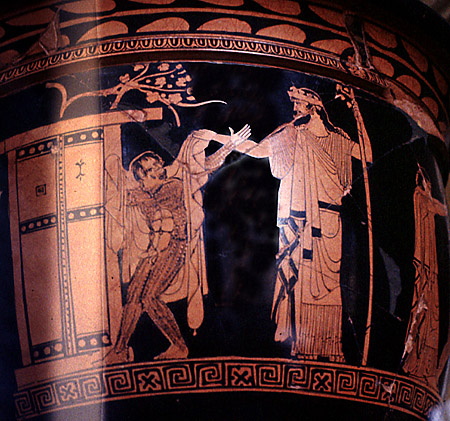
Look at classical depictions of Bacchus...never skinny.*Ahem* I hate to be nit-picky,
I'm guessing you're thinking of Silenos
Oaooow. Now my brain needs washing to get rid of that mental image.
-
Re:Was the racist overtone intended???
You are correct. There's no shortage of Middle Eastern material already on the Internet ETCSL, Library of Congress, CDLI all have collections of cuneiform documents from Sumeria, Akkadia and Babylonia. It would have been child's play to collect all of that and add it to the collection.
They might well do so, in future. The standings in the league table are merely the starting point. But, yes, because of who is doing the starting, it IS no surprise that American and British researchers would concentrate on texts closer to home, particularly as there's going to be a national incentive to prioritize home-grown stuff above museum pieces. Especially if *cough* some of the museums would rather not remind people of what they have.
On the other hand, Middle Eastern countries don't have quite the same fascination with massively ancient cultures, many simply don't have the money or the resources (Iraq being a good example), and even when they DO have these, more than a few of the really early writings from the region are, ummm, elsewhere.
-
Re:This sums it up...
Off topic but interesting article by Richard Dawkins on trial by jury in general:
http://www.simonyi.ox.ac.uk/dawkins/WorldOfDawkins-archive/Dawkins/Work/Articles/1997-11-16trialbyjury.shtml -
Re:Congrats!
Let me just quote from the HF MSDS:
"Rubber gloves, face mask or safety glasses, apron, good ventilation. Do not work without calcium gluconate gel available to treat burns. Do not assume that gloves provide an impenetrable barrier to the acid. DO NOT WORK ALONE! Ensure that those working in the same laboratory are aware of how to treat hydrofluoric acid burns in an emergency."
-- http://msds.chem.ox.ac.uk/HY/hydrofluoric_acid.html'amateur' and 'hydrofluoric acid' do not go well together.
-
Any link to creationism?
Want good science education, come to Illinois, the state that bans "evolution" and teaches creationism.
Clearly, Illinois is not a place to get yourself educated.
-
Donate safely with Nereus
Donate the cpu's to academic research and grid computing research by running Nereus on them. http://www-nereus.physics.ox.ac.uk/
-
Re:Childish
The creation and support of the state of Israel: when Israel was created in 1947 it was done with no regard or consultation of the indigineous population of the region.
Not true.
The indigenous population were consulted and were quite happy to talk about creating the state of Israel. Unfortunately, for all the discussion that went on, the west simply walked away from the problems caused by each Arab leader wanting their own slice of the pie. The infighting in the Arab league allowed Israel to consolidate and essentially deprive the real Palestinians of any hope of a national state. More reading here. -
Re:Counter-intuitive
Err.. with all due respect, you might want to vet your sources better. The original Oxford report was on the elderly (at higher risk of B12 deficiency), and it said "people who had higher vitamin B12 levels were six times less likely to experience brain shrinkage compared with those who had lower levels of the vitamin in their blood". Nothing about vegetarians. At all.
And it's certainly not "much more difficult" for a vegetarian to balance the food they eat. Nice FUD.
-
Re:Sexy Stats
The people who wrote this paper don't give a shit whether this might induce false furore. All they care about is using pop culture science issue to get you to read their rhetoric.
But..but..but these researchers are esteemed members of the Future of Humanity Institute who are very worried about Global Catastrophic Risks!
Philosophy profs trying to remain relevant I guess.
(Didn't see much about the global economic meltdown currently happening when I perused their site just now. I guess that kind of catastrophe is not futuristic enough.)
-
Re:99.3% accurate?
BIG nit-pick. This is funny, until you realize that 'B' is a recognized character in the DNA alphabet. It is a degenerate base that means 'not A' (i.e. a mixture of C, G, T/U).
More degenerate codes here.
Sometimes these are artifacts of the sequencing technology. More commonly, there is actually an admixture of DNA in the starting sample. They are very common in RNA virus genomes, where the error-correction of the polymerase enzymes is crap compared to what mammals have evolved. This is a good thing for the virus, as it mutates quickly and escapes from immunity in the population.
In a bad sequencing run, you'll get a bunch of these mixed positions, and your data is crap. In an otherwise clean sequencing run, a mixed base position is extremely important information, and is often called incorrectly by both humans and automated base calling software, because people think that there must be exactly one non-degenerate 'right' answer.
This is actually a major problem as we start using '2nd generation' sequencing (454) and developing '3rd generation' sequencing like this article is describing. The amount of data being produced is moving past the point where humans can deal with it directly, so the assembly has to be automated. But the heuristics for tasks like calling bases are not yet up to the task, meaning that we sacrifice quality of information for quantity.
There are good opportunities in the field of bioinformatics for computer scientists who know enough biology!
-
Re:OS analogy
FINALLY. After reading the comments all the way down (just about to rtfa) somebody, namely theheadlessrabbit, finally said something that addresses something important.
Cities are _designed_ to pull your attention in a thousand ways. Capitalism causes that. If you pay attention to someone or something you're more likely to give that someone or something money, so cities, which are far more money-centric than less population dense areas, will always be more attention hungry than everything else. Even the wildest jungle (to follow the hyperbole). We spend billions on marketing (the art of getting and keeping people's attention), so naturally we're going to be good at it.
The jungle, on the other hand, doesn't give two shits what you pay attention to. Sure there's lots to choose from, but the choice is yours. And you get to focus on whatever you want for as long as you want (ie no commercial interruptions in every sense of the phrase).
Of course, the jungle hyperbole was just a
And since brains tend to get better at things they do often (no I'm not going to cite anything for this, but go ahead and find me someone who disagrees), you'd expect that in places where you get to choose and focus your attention people will be better at paying attention to things they care about than people in places where their attention is going like a speed-freaked superball. To say it more concisely, OF COURSE forcing people to hyperactively shift their attention will teach them to be ADHD. DUH.
Think about academia. Lots of good, focused, thinking goes on at colleges all over the world. Now think about the types of schools that generally produce the major thinkers within the group of thinkers. What is their layout like? I'll tell you that I've never seen a picture of a campus with a 3lane each way road, nor of a 10+ story building, nor a subway system...
-
Re:Not enough history
There is a saying for modern historians that when you are faced with too much data, your job is to select representative sets.
No-one will ever be able to keep everything. I had to discard collections of 50 years of hard to get subscription papers, newsprint etc because no-one wanted them, no storage possible and no digital scanning available at the time. It got thrown out, with only some items kept. Even those are getting damaged over time, but I don't want to spend hours scanning them, storing the data or making them public. No-one cares for that sort of stuff and your own collections will eventually be thrown out. I'm faced with the same prospect and I hope someone will keep a representative set of what I had for a few years.
Ultimately, you backup, then convert, then backup as a cycle until you die.
Then, out of the blue, someone in the future will come across parts of your life represented by these collections, either in a 2nd hand shop, the garbage tip, deceased estate, relative or what/whoever and some of it may be kept.So you're approaching 60 and you still have 1000 LPs? Are you going to spend 45,000 minutes resurrecting them? Maybe some rarities.
Photos? 8mm film stock? I have 1000's of photos of dogs in dog shows in the 60s and 70s. Most of the people are dead, the dogs certainly are and as they are slides, there is no captions or any indication what they represent.
So the decision is - Is it worth archiving? Who will eventually be the custodian? What value has it for future generations?
When you look at it like that, then there's very little you want to keep.Here's some links for everyone's consideration.
Are you interested? http://www.cs.arizona.edu/patterns/weaving/lace.html
What about this? http://dsr.nii.ac.jp/toyobunko/index.html.en
-
Re:Magnetic Tapes...
-
Re:Yeah...
Why yes it does!
http://www-jpc.physics.ox.ac.uk/DemoLinux.html
[ Warning: above link will in fact boot linux in your browser - I'm serious! ]