Slashdot Mirror
Domain: pcmag.com
Stories and comments across the archive that link to pcmag.com.
Stories · 692
-
For Boot Camp Users, New Macs Require Windows 8 Or Newer
For anyone using Windows 7 by way of Apple's Boot Camp utility, beware: support for Windows via Boot Camp remains, but for the newest Apple laptops, it's only for Windows 8 for now. From Slashgear: This applies to the 2015 MacBook Air, and the 13-inch model of the 2015 MacBook Pro. Windows 8 will remain compatible, as will the forthcoming Windows 10. The 2013 Mac Pro also dropped Boot Camp support for Windows 7, while 2014 iMacs are still compatible, along with 2014 MacBook Airs and 2014 MacBook Pros. For those who still prefer to run Windows 7 on their Macs, there are other options. This change to Boot Camp will not affect using the Microsoft operating system through virtualization software, such as Parallels and VMware Fusion. Also at PC Mag. -
Chevy Malibu 'Teen Driver' Tech Will Snitch If You Speed
mpicpp writes General Motors wants to help curb teen crashes with a new system that lets parents monitor their kids' driving habits—even when mom and dad aren't actually in the car. Dubbed Teen Drive, the new system will debut in the 2016 Chevy Malibu, offering a bunch of features designed to encourage safe driving. It will, for instance, mute the radio or any device paired with the car when front seat occupants aren't wearing their seatbelts, and give audible and visual warnings when the vehicle is traveling faster than preset speeds. It doesn't end there. Brace yourself, teens, because you might not like this next part too much. The new system also lets parents view a readout of how you drove the car, including how fast you went, how far you drove, and whether any active safety features (like over-speed warnings) were engaged. Parents can also set the radio system's maximum volume to a lower level, and select a maximum speed between 40 and 75 miles per hour, which, if exceeded, will trigger warnings. -
Apple Reportedly Working On an Online TV Service
An anonymous reader writes: According to a Wall Street Journal report (paywalled) Apple is in negotiations with media companies to develop an online TV service. The service will include a bundle of roughly 25 channels, so less popular channels will have a very difficult time fighting for a spot. Most major networks should be present, although NBC's participation is dubious because of its ties to Comcast, which would be in direct competition with Apple's service. "If Apple can offer a comprehensive, albeit slimmed-down, bundle for $30 to $40 a month, that could force distributors to cut prices or eat into margins to retain subscribers. At Comcast, for example, average video revenue per user should be about $79.45 in 2015, according to UBS. Meanwhile, its programming costs per average subscriber should be about $39.60. Those costs may need to rise. That roughly 50% gross margin looks vulnerable." -
Laser Takes Out Truck Engine From a Mile Away
MutualFun (1730480) writes Aerospace company Lockheed Martin has used a laser to obliterate the engine of a small truck from more than a mile away. (Finally, Star Wars is making a comeback!) The company says, "The demonstration marked the first field testing of an integrated 30-kilowatt, single-mode fiber laser weapon system prototype. Through a technique called spectral beam combining, multiple fiber laser modules form a single, powerful, high-quality beam that provides greater efficiency and lethality than multiple individual 10-kilowatt lasers used in other systems." -
AT&T To Match Google Fiber In Kansas City, Charge More If You Want Privacy
An anonymous reader writes: When Google Fiber started bringing gigabit internet to cities around the U.S., we wondered how the incumbent ISPs would respond. Now we know: AT&T has announced they will match Google Fiber's gigabit offerings in Kansas City. Of course, there are some caveats. First, AT&T's rollout may stop as it fights the Obama administration over net neutrality. Not that it would be a nationwide rollout anyway: "AT&T does not plan to offer the ultra-fast Internet lines to every home in the market. Rather, he said the company would calculate where demand is strongest and the investment in stringing new cables promised a decent return."
There are also some interesting pricing concerns. The company plans to charge $70/month for gigabit service, but that's a subsidized price. Subsidized by what, you ask? Your privacy. AT&T says if you want to opt out of letting them track your browsing history, you'll have to pay $29 more per month. They say your information is used to serve targeted advertising, and includes any links you follow and search terms you enter. -
New Chinese Regulations Require Real Name On Internet
mpicpp sends word that starting March 1st, China will ban internet accounts that impersonate people or organizations, and will require that people use real names when registering accounts online. "As part of an effort to increase control over the Internet, China's government this week revealed new regulations that require Web users to register their real names. According to The Wall Street Journal, the rules apply to users of blogs, microblogs, instant messaging services, online discussion forums, news comment sections, and other related services. Beginning March 1, China will also ban Web accounts that impersonate people or organizations, Reuters said. That includes groups posing as government entities—the People's Daily state newspaper—and impersonations of foreign leaders, like President Barack Obama and Vladimir Putin." -
Apple Awarded Gesture-Control Patent
mpicpp points out a report that Apple has been awarded a broad patent for gesture control of a computer interface (8,933,876). The company inherited the patent after their acquisition of motion-sensor company PrimeSense in 2013. (PrimeSense's technology is used in Microsoft's Kinect gesture control system.) Here's the patent's abstract: A method, including receiving, by a computer executing a non-tactile three dimensional (3D) user interface, a set of multiple 3D coordinates representing a gesture by a hand positioned within a field of view of a sensing device coupled to the computer, the gesture including a first motion in a first direction along a selected axis in space, followed by a second motion in a second direction, opposite to the first direction, along the selected axis. Upon detecting completion of the gesture, the non-tactile 3D user interface is transitioned from a first state to a second state. -
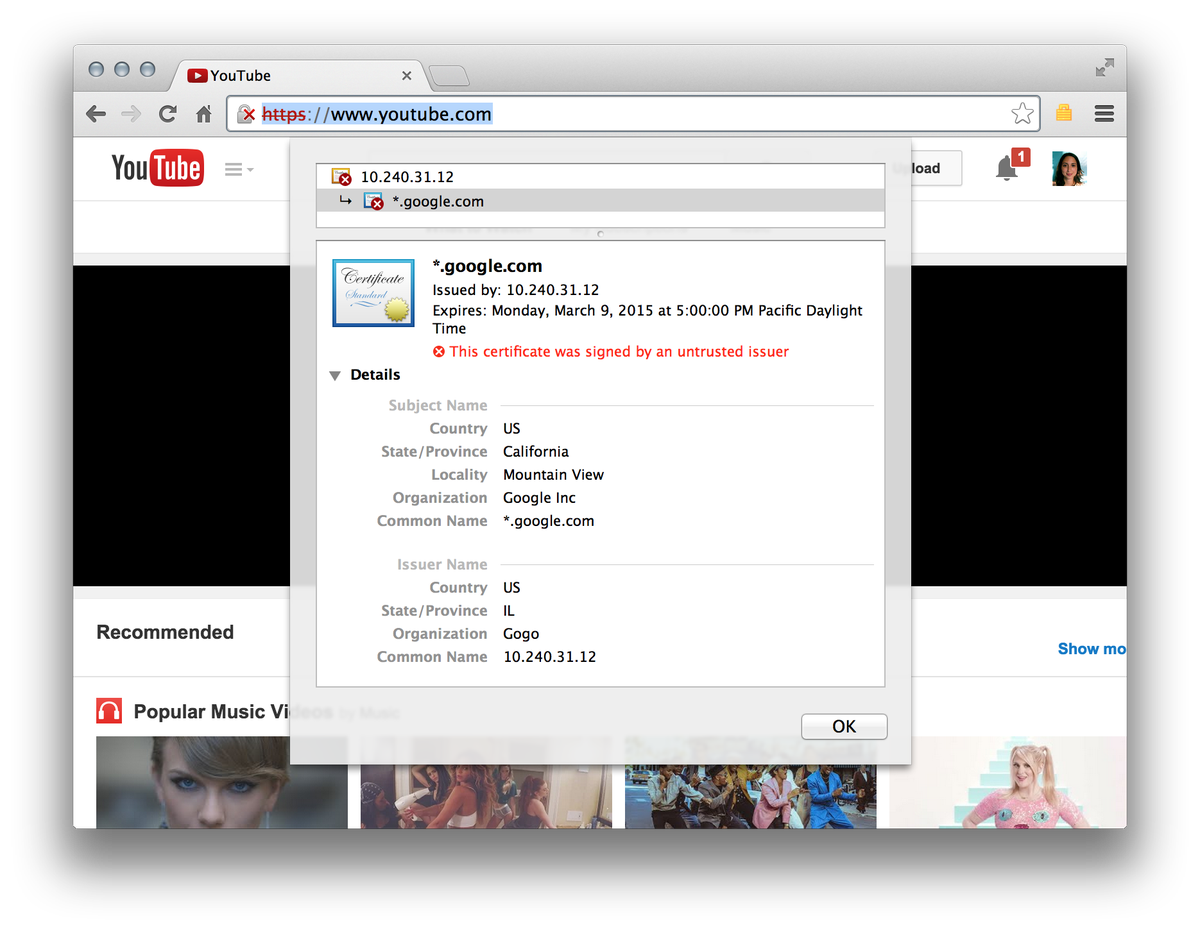
In-Flight Service Gogo Uses Fake SSL Certificates To Throttle Streaming
Amanda Parker writes In-flight internet service Gogo has defended its use of a fake Google SSL certificates as a means of throttling video streaming, adding that it was not invading its customer's privacy in doing so. The rebuttal comes after Google security researcher Adrienne Porter Felt posted a screenshot of the phoney certificate to Twitter. From the article: "The image clearly shows that Gogo signed the certificate, not Google, thus misleading customers and opening the door to malware on users' devices. It also serves as a way to throttle data and limit traffic on its networks. 'Gogo takes our customer's privacy very seriously and we are committed to bringing the best Internet experience to the sky,' CTO Anand Chari said in a Monday statement." -
Netflix Denies There Was a Policy Change With VPNs
Dangerous_Minds writes "The other day, Slashdot linked to a TorrentFreak story saying that Netflix was cracking down on VPN users. But PCMag has a story that quotes a Netflix spokesperson saying that there was no change in their policy on VPNs. Freezenet also did some digging around and found very few reports saying there were VPN access issues and even more reports from users say that their VPN solution is working for the time being." -
Comcast-TWC Merger Review On Hold
An anonymous reader writes: When the U.S. Federal Communications Commission began reviewing the merger between Comcast and Time Warner Cable, it imposed a 180-day deadline on the review process. The agency has now pushed that deadline back a few weeks after learning that TWC withheld over 7,000 documents they shouldn't have. TWC originally claimed the documents fall under attorney-client privilege, but that appears not to be the case.
Perhaps more disturbing, the article says another 31,000 documents "went missing" because of a vendor error. (Perhaps even more disturbing is that this is a drop in the bucket compared to the sum total of information TWC dumped on the FCC — apparently over 5 million pages. How they can be expected to properly review that much material is beyond me.)
The FCC is also ready to close the public comment period for the merger, during which over 600,000 comments were filed. Critics are making their final arguments and Comcast is tallying up all the nice things people (and paid public relations agencies) had to say. -
Apple Pushes First Automated OS X Security Update
PC Magazine reports (as does Ars Technica) that Apple this week has pushed its first automated security update, to address critical flaws relating to Network Time Protocol: The flaws were revealed last week by the Department of Homeland Security and the Carnegie Mellon University Software Engineering Institute—the latter of which identified a number of potentially affected vendors, including FreeBSD Project, NTP Project, OmniTI, and Watchguard Technologies, Inc. A number of versions of the NTP Project "allow attackers to overflow several buffers in a way that may allow malicious code to be executed," the Carnegie Mellon/DHS security bulletin said. ... The company's typical security patches come through Apple's regular software update system, and often require users to move through a series of steps before installing. This week's update, however, marks Cupertino's first implementation of its automated system, despite having introduced the function two years ago, Reuters said. -
Cardboard Hits Half a Million Mark, Gets an SDK
PC Magazine reports (citing a blog post from project manager Andrew Nartker) that Google's Cardboard -- first introduced to some laughter -- is growing up, with a small but growing collection of compatible apps and a recently announced SDK. And while Cardboard itself is pretty low-tech (cardboard, rubber band, a magnet) and consequently cheap, the resulting VR experience is pretty good, which explains why more than 500,000 of them have now shipped. -
Corning Reveals Gorilla Glass 4, Promises No More Broken IPhones
An anonymous reader writes "Corning introduced next-generation Gorilla Glass, which it said is ten times tougher than any competitive cover glass now in the market. The company says that the Gorilla Glass 4 so launched is to address the No.1 problem among the smartphones users- screen breakage due to everyday drops." -
Apple Swaps "Get" Button For "Free" To Avoid Confusion Over In-App Purchases
New submitter lazarus (2879) writes Apple is falling in line with the European Commission's request that app sellers do more to stop inadvertent in-app purchases. Following Google's lead, Cupertino has removed all instances of the word "free" within its iOS and Mac app stores (with the exception of its own apps, like iMovie), and replaced them with the term "Get." The new label clarifies what users can expect when downloading an app. Apps previously labeled as "Free" will now have a "Get" label. If those apps include in-app purchases, a small gray "In-App Purchase" label will appear below the "Get" button. -
AT&T To "Pause" Gigabit Internet Rollout Until Net Neutrality Is Settled
An anonymous reader writes AT&T says it will halt its investment on broadband Internet service expansion until the federal rules on open Internet are clarified. "We can't go out and just invest that kind of money, deploying fiber to 100 cities other than these two million [covered by the DirecTV deal], not knowing under what rules that investment will be governed," AT&T Chief Randall Stephenson said during an appearance at a Wells Fargo conference, according to a transcript provided by AT&T. "And so, we have to pause, and we have to just put a stop on those kind of investments that we're doing today." -
FCC Postpones Spectrum Auction Until 2016
An anonymous reader writes: 2014 was supposed to be the year broadcasters would be allowed to sell off their unused spectrum to mobile carriers. That got pushed back to 2015 in December, and now the Federal Communications Commission has bumped it to 2016 in the face of a lawsuit from the National Association of Broadcasters. The FCC says the legal briefs aren't even due until January 2015, and it will take them until the middle of the year to review the documents and respond in court. The delay is just fine with the NAB, but probably bad news for anyone hoping that spectrum would help to improve mobile communications in the U.S. any time soon. -
3-D Printed "Iron Man" Prosthetic Hands Now Available For Kids
PC World (drawing on an article from 3DPrint.com) notes that inventor Pat Starace has released his plans for a 3-D printable prosthetic hand designed to appeal both to kids who need it and their parents (who can't all afford the cost of conventional prostheses). The hand "has the familiar gold-and-crimson color scheme favored by Ol' Shellhead, and it's designed with housings for a working gyroscope, magnetometer, accelerometer, and other "cool sensors", as well as a battery housing and room for a low-power Bluetooth chip and charging port." It takes about 48 hours in printing time (and "a lot" of support material), but the result is inexpensive and functional. -
Flight Attendants Want Stricter Gadget Rules Reinstated
stephendavion writes You might be super happy to toil away on your phone or tablet the entire time you're on a plane, but not everyone is pleased to see your face buried in your device during takeoff and landing. The Federal Aviation Administration's new, more relaxed rules on gadget use aren't sitting well with one group — flight attendants. According to a report from The Wall Street Journal, the nation's largest flight attendant union is now suing the FAA to have the ban on gadget use during takeoff and landing reinstated. The Association of Flight Attendants-CWA argues that the change has caused many passengers to ignore flight attendants' emergency announcements, and that the new rules violate federal regulations requiring passengers to stow all items during takeoff and landing. -
Facebook Apologizes To Drag Queens Over "Real Name" Rule
An anonymous reader writes Facebook apologized to drag queens and the LGBT community after an outcry over the social network's policy of requiring members to use real names on their accounts. While the policy itself will stay in place, Facebook says, it will be changing how the rule is enforced. In a Wednesday post, Facebook's Chief Product Officer Chris Cox apologized to "the affected community of drag queens, drag kings, transgender, and extensive community of our friends, neighbors, and members of the LGBT community for the hardship that we've put you through in dealing with your Facebook accounts over the past few weeks." -
Verizon Working On a La Carte Internet TV Service
An anonymous reader writes: One of the reasons people have been fleeing cable TV in droves is the idea that they're paying for hundreds of channels but only using a handful. Even though that's not really true, Verizon is now working on an internet TV service that lets people pick and pay for only the channels they want. Verizon CEO Lowell McAdam said, "I think everyone understands it will go to a la carte. The question is what is that transition look like ... I don't think there is anyone that would stand up here and say the only way it's going to be offered five years from now is linear and it's going to be tied to your TV set because frankly they will miss the market and they will be the ones left behind." -
Ask Slashdot: How Dead Is Antivirus, Exactly?
Safensoft writes: Symantec recently made a loud statement that antivirus is dead and that they don't really consider it to be a source of profit. Some companies said the same afterwards; some other suggested that Symantec just wants a bit of free media attention. The press is full of data on antivirus efficiency being quite low. A notable example would be the Zeus banking Trojan, and how only 40% of its versions can be stopped by antivirus software. The arms race between malware authors and security companies is unlikely to stop.
On the other hand, experts' opinions of antivirus software have been low for a while, so it's hardly surprising. It's not a panacea. The only question that remains is: how exactly should antivirus operate in modern security solutions? Should it be one of the key parts of a protection solution, or it should be reduced to only stopping the easiest and most well-known threats?
Threats aren't the only issue — there are also performance concerns. Processors get better, and interaction with hard drives becomes faster, but at the same time antivirus solutions require more and more of that power. Real-time file scanning, constant updates and regular checks on the whole system only mean one thing – as long as antivirus is thorough, productivity while using a computer goes down severely. This situation is not going to change, ever, so we have to deal with it. But how, exactly? Is a massive migration of everything, from workstations to automatic control systems in industry, even possible? Is using whitelisting protection on Windows-based machines is the answer? Or we should all just sit and hope for Microsoft to give us a new Windows with good integrated protection? Are there any other ways to deal with it? -
Sony Tosses the Sony Reader On the Scrap Heap
Nate the greatest (2261802) writes Sony has decided to follow up closing its ebook stores in the U.S. and Europe by getting out of the consumer ebook reader market entirely. (Yes, Sony was still making ereaders.) The current model (the Sony Reader PRS-T3) will be sold until stock runs out, and Sony won't be releasing a new model. This is a sad end for what used to be a pioneering company. This gadget maker might not have made the first ebook reader but it was the first to use the paper-like E-ink screen. Having launched the Sony Librie in 2004, Sony literally invented the modern ebook reader and it then went on to release the only 7" models to grace the market as well as the first ereader to combine a touchscreen and frontlight (the Sony Reader PRS-700). Unfortunately Sony couldn't come up with software or an ebook retail site which matched their hardware genius, so even though Sony released amazing hardware it had been losing ground to Amazon, B&N, and other retailers ever since the Kindle launched in 2007. -
Verizon Now Throttling Top 'Unlimited' Subscribers On 4G LTE
PC Magazine (along with Forbes, Reuters, and others) reports that those on the rightmost edge of the graph for Verizon's "unlimited" 4G LTE service are about to hit a limit: [T]hose in the top five percent of Verizon's unlimited data users (which requires one to pull down an average of just around 4.7 gigabytes of monthly data or so) who are enrolled on an unlimited data plan and have fulfilled their minimum contract terms (are now on a month-to-month plan) will be subject to network throttling if they're trying to connect up to a cellular tower that's experiencing high demand." As the article goes on to point out, though, [A] user would have to hit all of these criteria in order to have his or her connection slowed down. There are a lot of hoops to jump through, giving even more weight to the fact that Verizon's throttling — while annoying on paper — won't affect a considerable majority of those still holding on to their unlimited data plans. -
Three-Year Deal Nets Hulu Exclusive Rights To South Park
First time accepted submitter gunner_von_diamond writes with news about a deal between the creators of South Park and Hulu. If you're a fan of South Park, you better be a fan of Hulu as well. Specifically, Hulu Plus. The creators of the funny, foul-mouthed animated TV show have signed a deal with the online streaming service. Valued at more than $80 million, the three-year deal grants Hulu exclusive rights to stream the 240+ episode back catalog of South Park in addition to all new episodes (as soon as they've aired on Comedy Central). "This is a natural partnership for us. We are excited that the entire library will be available on Hulu and that the best technology around will power South Park Digital Studios," said creators Trey Parker and Matt Stone, in a statement. -
Oculus Suspends Oculus Rift Dev Kit Sales In China
An anonymous reader writes with news about how Oculus is dealing with the reselling of dev kits in China. Bad news for those of you looking to get your hands on a preorder of the Oculus Rift virtual reality headset. A representative from Oculus recently confirmed that the company has had to stop selling its headsets in China as a result of an undisclosed amount of reselling. Which is to say, some of those preordering the developer edition of the virtual reality headset in China — not the consumer product, which hasn't been officially released in any capacity just yet — aren't actually looking to develop anything on the headsets. Nor are they even interested in getting a first look at the virtual reality capabilities of the $350 development kit. They're scalping, plain and simple, to take advantage of what appears to be a hefty amount of demand for the device. -
Google Fiber Is Officially Making Its Way To Portland
An anonymous reader writes This week the Portland City Council has approved a franchise agreement with Google to bring its fiber service to Portland. "As a result of the unanimous vote, Google will be subject to a five percent 'franchise fee' on its video revenues. It won't have to pay a three percent 'PEG' fee that Portland otherwise charges rival Comcast, but it will offer free Internet service for Portland residents for a $300, one-time fee. It'll also provide free Internet service to some to-be-determined nonprofits, in addition to providing a total of three free Wi-Fi networks in various parts of the city." -
BMW, Mazda Keen To Meet With Tesla About Charging Technology
PC Magazine reports that following Elon Musk's announcement that Tesla would be freeing for other electric car makers to use the various patents that the company has amassed, at least two companies — Mazda and BMW — are said to be interested in meeting with Tesla, for a very good reason: According to undisclosed sources speaking to the Financial Times, both Nissan and BMW would be interested in working with Tesla to craft up some universal vehicle charging standards. To quote unnamed official: "It is obviously clear that everyone would benefit if there was a far more simple way for everyone to charge their cars." -
Tetris Turns 30
An anonymous reader writes "Wildly popular video game Tetris launched 30 years ago today, and continues to capture the hearts of folks around the world. Topping best-of video game lists for years, the colorful block puzzle has sold an estimated 170 million copies—about 100 million of which are played on mobile devices." -
HP (Re-)Announces a 14" Android Laptop
PC Mag reports that an upcoming laptop from HP (one that was prematurely announced in April, and now official) has decent-to-good specs — under 4 pounds, battery life more than 8 hours, Tegra processor, and a 1928x1080 touch screen — but an unusual operating system, at least for a laptop. The SlateBook 14 will run Android, rather than Windows (or ChromeOS, for that matter), which helps keep it relatively cheap, at $400. According to the article, Android is "a lot cheaper for HP to implement in a laptop; ChromeOS, in contrast, comes with more stringent system requirements that would cost HP a bit more." Ars Technica's mention in April includes a screenshot taken from a video (note: video itself appears to be disabled) which shows the keyboard layout and which reveals some Android-specific changes. Update: 06/01 19:23 GMT by T : Here's an alternative link to the promotional video. -
AOL Finally Admits They Were Hacked
pdclarry writes: "Anyone managing email servers or lists has suspected for several weeks a major hack of AOL's servers, based on a sudden spurt in spam ostensibly from AOL email addresses (but actually spoofed) and sent to the contact lists of those AOL accounts. Of course, there is a steady stream of such spam from hacked individual accounts on many services, but the magnitude and suddenness of the most recent spam attack argues against individual account invasions. Well, AOL has finally come clean. Apparently unknown individuals accessed AOL's servers and took screen names, account information including mailing addresses, contact lists, encrypted passwords and encrypted answers to security questions. And possibly credit card information. AOL claims that it affects 'only' 2% of their members, but recommends that everyone change their passwords and security questions." -
SpaceX Files Suit Against US Air Force
Today Elon Musk announced that SpaceX has decided to challenge the U.S. Air Force's restrictions on rocket launches related to national security. Such launches are done with a Russian rocket right now, and that contract is not up for competition with other rocket makers, like SpaceX. Musk says the company has exhausted other options to become part of the bidding process. "We're just protesting and saying these launches should be competed. And if we compete and lose, that's fine, but why were they not even competed?" He also said it's the "wrong time to send hundreds of millions of dollars to the Kremlin," referencing events in the Ukraine.
At the same press conference, Musk announced that SpaceX's recent attempt to soft-land a rocket booster stage was successful. It landed and was in "healthy condition" immediately afterward. Unfortunately, they weren't able to recover it because it landed in the middle of a rough storm, which eventually destroyed the stage. The storm was rough enough that the Coast Guard wouldn't even send a boat out to help recover it. Musk said, "We'll get much bigger boats next time." SpaceX also plans on landing the stage on shore at some point, which makes recovery easier. Musk made this prediction: "I expect we will be able to land a stage back at Cape Canaveral by the end of the year." -
Apple, Google Vying For Mobile Game Exclusivity
An anonymous reader writes "Here's an interesting look at the battle for mobile video game money between Google and Apple. 'Last August, for the launch of "Plants Vs. Zombies 2," a highly anticipated sequel to a popular zombie-survival strategy game, publisher Electronic Arts Inc. struck a deal with Apple, which promoted the game prominently in its App Store, according to people familiar with the matter. In exchange, one of these people said, EA agreed to give Apple about a two-month window of exclusivity for the title, which wasn't released on Google's Android software until October.'" -
RCMP Arrest Canadian Teen For Heartbleed Exploit
According to PC Mag, a "19-year-old Canadian was arrested on Tuesday for his alleged role in the breach of the Canada Revenue Agency (CRA) website, the first known arrest for exploiting the Heartbleed bug. Stephen Arthuro Solis-Reyes (pictured) of London, Ontario faces one count of Unauthorized Use of Computer and one count of Mischief in Relation to Data." That exploit led to a deadline extension for some Canadian taxpayers in getting in their returns this year. The Register has the story as well. The Montreal Gazette has some pointed questions about how much the Canadian tax authorities knew about the breach, and when. -
44% of Twitter Users Have Never Tweeted
First time accepted submitter RileyWalz (3614865) writes "Twopcharts (a third party website that records and monitors activity on Twitter) is reporting that about 44 percent of all 947 million accounts on Twitter have never posted a single tweet. Of the 550 million users who have tweeted before, 43 percent posted their last tweet over a year ago. And only about 13.3 percent have tweeted in the last 30 days. This could be a sign of many users just signing up and forgetting about their account, or they just prefer reading other's posts. Twitter is not commenting on this data, saying that they do not talk about third-party information related to its service." -
Google and Viacom Finally Settle YouTube Lawsuit
An anonymous reader sends word that Google and Viacom have settled their copyright lawsuit over videos posted to YouTube. The case has been ongoing for seven years, with Viacom initially demanding $1 billion and losing in court, but then successfully appealing. 'At the heart of the matter was whether YouTube was responsible for the copyrighted material its users posted on the site. In general, sites that host user-generated content are protected by the DMCA if they take swift action to remove offending content when it's reported. YouTube argued that it does remove this content, but Viacom's initial lawsuit said YouTube was hosting at least 160,000 unauthorized Viacom clips.' You may recall that Viacom was caught uploading some of the videos in question to YouTube themselves. The terms of the new settlement were not disclosed. -
Google and Viacom Finally Settle YouTube Lawsuit
An anonymous reader sends word that Google and Viacom have settled their copyright lawsuit over videos posted to YouTube. The case has been ongoing for seven years, with Viacom initially demanding $1 billion and losing in court, but then successfully appealing. 'At the heart of the matter was whether YouTube was responsible for the copyrighted material its users posted on the site. In general, sites that host user-generated content are protected by the DMCA if they take swift action to remove offending content when it's reported. YouTube argued that it does remove this content, but Viacom's initial lawsuit said YouTube was hosting at least 160,000 unauthorized Viacom clips.' You may recall that Viacom was caught uploading some of the videos in question to YouTube themselves. The terms of the new settlement were not disclosed. -
Google Blocking Asus's Android-Windows "Duet"?
theodp writes "Android is free and open," reiterated Google Android Chief Andy Rubin in 2010 as Microsoft launched Windows Phone 7. Rubin added, 'Competition is good for the consumer and if somebody has an idea for a feature or a piece of functionality in their platform and Android doesn't do it, great. I think it's good to have the benefit of choice, but in the end I don't think the world needs another platform.' But now, CNET and Digitimes report that Google is holding up the Asus Transformer Book Duet TD300 (specs), a laptop-tablet hybrid that can instantly switch between Android and Windows 8.1. A source familiar with the Asus Duet told CNET that Google is the one that has not favored the idea, while Microsoft has not, to date, been actively opposed to the idea. 'If true,' reports Apple Insider, 'it may not be the first time Google has helped to quash such a product.' South Korean electronics giant Samsung quietly canceled plans for its hybrid Ativ Q tablet last year, and Digitimes notes that Asus may not be the only company to bow to Google's wishes." -
Google Acquires Israeli Security Startup SlickLogin
Fnord666 writes "SlickLogin, an Israeli startup and developer of smart identification technology through user smartphones has been acquired by Google for several million (the official transaction amount remains undisclosed). SlickLogin was founded under a year ago by Or Zelig, Eran Galili and Ori Kabeli. The company first unveiled its technology at TechCrunch Disrupt held last September. The company has yet to launch their product." -
IBM's PC Junior Turns 30, Too
McGruber writes "Like the Mac, the IBM PC Junior first went on sale in late January 1984. That is where the similarities end — the PC Junior became the biggest PC dud of all time. Back on May 17, 1984, the NY Times reported that the PC Junior 'is too expensive for casual home users, but, at the same time, is not nearly powerful enough for serious computer users who can afford a more capable machine.' The article also quoted Peter Norton, then still a human programmer who had not yet morphed into a Brand, who said that the PC Junior 'may well be targeted at a gray area in the market that just does not exist.'' IBM cancelled the machine in March 1985, after only selling 270,000 of them. While it was a commercial flop, the machine is still liked by some. Michael Brutman's PCJr page attempts to preserve the history and technical information of the IBM PCjr and YouTube has a video of a PC Junior running a demo." -
4 Tips For Your New Laptop
Bennett Haselton writes with four big tips for anyone blessed by the holiday buying frenzy with a new laptop; in particular, these are tips to pass on to non-techie relatives and others who are unlikely to put (say) "Install a Free operating system" at the very top of the list: Here's Bennett's advice, in short: (1) If you don't want to pay for an anti-virus program, at least install a free one. (2) Save files to a folder that is automatically mirrored to the cloud, for effortless backups. (3) Create a non-administrator guest account, in case a friend needs to borrow the computer. (4) Be aware of your computer's System Restore option as a way of fixing mysterious problems that arose recently." Read on for the expanded version; worth keeping in mind before your next friends-and-family tech support call. > If you or a friend -- especially a non-techie friend -- received a laptop for Christmas, these are my favorite low-cost high-benefit tips that anyone can follow. They apply to any operating system, although I'm writing from a Windows-centric point of view.Yes, a lot of this will be obvious stuff to techies, but I've found that if a human asks a techie "I just got a new laptop, can you give me any advice?", the answer frequently will (a) not cover these crucial bases, and/or (b) include a lot of unhelpful stuff to impress the listener. The following is a baseline for what I think a useful answer should consist of. (And if you're the techie, you may want to walk the laptop owner through following these directions, since I'm not actually spelling out what icons you have to click on, etc.)
(1) If you don't want to pay for an anti-virus program, at least install a free one.
Your PC probably came with a trial version of an anti-virus program that will stop working after a month unless you upgrade to the paid version. Of course you can do that if you want. Especially if you ever think you might want phone tech support for your anti-virus software, I expect it's better for a product that you've paid money for.
On the other hand, I know people who thought that if they didn't want to pay for the upgrade to their PC's default anti-virus program, their only option was to let it expire and let their computer run unprotected. If you don't want to pay for a non-free program, install a free one -- Wikipedia has a list of 15 different free or freemium anti-virus products for Windows. PC Magazine gave their "Editor's Choice" award for best free Windows anti-virus to Malwarebytes Anti-Malware 1.70 in 2013 and AVG Anti-Virus Free in 2012, so either of those will work.
(Yes, I know you guys know this. But pass the word on to your Mom or kid brother with the new laptop.)
(2) Save files to a folder that is automatically mirrored to the cloud, for effortless backups.
The era in which everybody talks about backing up, but nobody actually does it, should have ended completely in 2013. Old-style backups, even the incredibly easy options, still mostly required you stop what you were doing for a minute, connect to a remote server or connect a piece of hardware to your computer, and twiddle your thumbs while waiting for some copy process to execute. So nobody bothered.
With cloud-mirrored folders, there's no excuse any more. I found out about Dropbox by asking a mailing list, "I would really like it if there were an online backup service that let me open and close files from a local folder so that there was no delay, but as soon as I made any changes, would automatically be queued to be backed up over the network to a remote host," and my listmates said, "That already exists." Windows 8 comes with the similar SkyDrive service already built in.
You can read a detailed comparison of Dropbox vs. SkyDrive vs. Google Drive, but the key point is to use one of them to mirror one of your local folders to the cloud, and get into the habit of saving stuff to that folder. Obviously this may not apply to you if you have something special going on (if you're creating large multimedia files that won't fit within the several-gigabyte limit imposed by these services, or if your privacy concerns are great enough that you don't want to back up files online), but it's good enough for most people. The horror stories about people saving months or years of writing, and then losing it all in a hard drive crash, should never happen to anyone again.
(3) Create a non-administrator guest account, in case a friend needs to borrow the computer.
Some of my friends and relatives have no problem telling people, "No, I don't care if you need to check the weather, you can't touch my computer!" But if you can't resist the urge to be helpful if someone needs to borrow your laptop for a few minutes, then eventually one of those people will mess it up somehow -- either by installing a game, or visiting a website that installed malware on your computer, or just changing a system setting that you can't figure out how to change back.
When the day comes when someone needs to borrow your computer, you may be too rushed or might not know how to create an unprivileged non-administrator account that they can log in under. So go ahead and do it when your computer is brand new, while the thought is still fresh in your mind. Then if people who borrow your computer sign in under that account, in almost all cases, nothing that they do while logged in should interfere with your user experience when you log them off and log back in as yourself.
That's not a completely secure solution to stop someone from accessing private files on your computer. (There are many pages describing how to boot up a Windows machine from a Linux CD, in order to access files on the computer -- they are usually described as "disaster recovery" options, but they can also be used to access files on a PC without the password.) However, it will stop most casual users from messing up your computer while they borrow it.
(4) Be aware of your computer's System Restore option as a way of fixing mysterious problems that arose recently.
I say "be aware" because, unlike the other three tips, this may not ever be something that you have to actually do. However, intermediate-level computer users just need to understand what it means: to restore your computer's settings and installed programs to a recently saved snapshot, while leaving your saved files untouched. This means if your computer has started acting funny in the last couple of days, you may be able to fix the problem by restoring to a snapshot that was saved before the problems started.
Intermediate users sometimes confuse this with either (a) restoring files from backup, or (b) doing a system recovery (which generally refers to restoring your computer to the state in which it left the factory). So if you're the techie doing the explaining, make sure they understand the difference. (A system recovery will often fix problems, too, but then of course you'll have to re-install all your software; a system restore is more convenient since it only undoes the most recent system changes.)
So these are the first four things I would tell people who were the recipient of a new laptop. What would you tell them?
-
4 Tips For Your New Laptop
Bennett Haselton writes with four big tips for anyone blessed by the holiday buying frenzy with a new laptop; in particular, these are tips to pass on to non-techie relatives and others who are unlikely to put (say) "Install a Free operating system" at the very top of the list: Here's Bennett's advice, in short: (1) If you don't want to pay for an anti-virus program, at least install a free one. (2) Save files to a folder that is automatically mirrored to the cloud, for effortless backups. (3) Create a non-administrator guest account, in case a friend needs to borrow the computer. (4) Be aware of your computer's System Restore option as a way of fixing mysterious problems that arose recently." Read on for the expanded version; worth keeping in mind before your next friends-and-family tech support call. > If you or a friend -- especially a non-techie friend -- received a laptop for Christmas, these are my favorite low-cost high-benefit tips that anyone can follow. They apply to any operating system, although I'm writing from a Windows-centric point of view.Yes, a lot of this will be obvious stuff to techies, but I've found that if a human asks a techie "I just got a new laptop, can you give me any advice?", the answer frequently will (a) not cover these crucial bases, and/or (b) include a lot of unhelpful stuff to impress the listener. The following is a baseline for what I think a useful answer should consist of. (And if you're the techie, you may want to walk the laptop owner through following these directions, since I'm not actually spelling out what icons you have to click on, etc.)
(1) If you don't want to pay for an anti-virus program, at least install a free one.
Your PC probably came with a trial version of an anti-virus program that will stop working after a month unless you upgrade to the paid version. Of course you can do that if you want. Especially if you ever think you might want phone tech support for your anti-virus software, I expect it's better for a product that you've paid money for.
On the other hand, I know people who thought that if they didn't want to pay for the upgrade to their PC's default anti-virus program, their only option was to let it expire and let their computer run unprotected. If you don't want to pay for a non-free program, install a free one -- Wikipedia has a list of 15 different free or freemium anti-virus products for Windows. PC Magazine gave their "Editor's Choice" award for best free Windows anti-virus to Malwarebytes Anti-Malware 1.70 in 2013 and AVG Anti-Virus Free in 2012, so either of those will work.
(Yes, I know you guys know this. But pass the word on to your Mom or kid brother with the new laptop.)
(2) Save files to a folder that is automatically mirrored to the cloud, for effortless backups.
The era in which everybody talks about backing up, but nobody actually does it, should have ended completely in 2013. Old-style backups, even the incredibly easy options, still mostly required you stop what you were doing for a minute, connect to a remote server or connect a piece of hardware to your computer, and twiddle your thumbs while waiting for some copy process to execute. So nobody bothered.
With cloud-mirrored folders, there's no excuse any more. I found out about Dropbox by asking a mailing list, "I would really like it if there were an online backup service that let me open and close files from a local folder so that there was no delay, but as soon as I made any changes, would automatically be queued to be backed up over the network to a remote host," and my listmates said, "That already exists." Windows 8 comes with the similar SkyDrive service already built in.
You can read a detailed comparison of Dropbox vs. SkyDrive vs. Google Drive, but the key point is to use one of them to mirror one of your local folders to the cloud, and get into the habit of saving stuff to that folder. Obviously this may not apply to you if you have something special going on (if you're creating large multimedia files that won't fit within the several-gigabyte limit imposed by these services, or if your privacy concerns are great enough that you don't want to back up files online), but it's good enough for most people. The horror stories about people saving months or years of writing, and then losing it all in a hard drive crash, should never happen to anyone again.
(3) Create a non-administrator guest account, in case a friend needs to borrow the computer.
Some of my friends and relatives have no problem telling people, "No, I don't care if you need to check the weather, you can't touch my computer!" But if you can't resist the urge to be helpful if someone needs to borrow your laptop for a few minutes, then eventually one of those people will mess it up somehow -- either by installing a game, or visiting a website that installed malware on your computer, or just changing a system setting that you can't figure out how to change back.
When the day comes when someone needs to borrow your computer, you may be too rushed or might not know how to create an unprivileged non-administrator account that they can log in under. So go ahead and do it when your computer is brand new, while the thought is still fresh in your mind. Then if people who borrow your computer sign in under that account, in almost all cases, nothing that they do while logged in should interfere with your user experience when you log them off and log back in as yourself.
That's not a completely secure solution to stop someone from accessing private files on your computer. (There are many pages describing how to boot up a Windows machine from a Linux CD, in order to access files on the computer -- they are usually described as "disaster recovery" options, but they can also be used to access files on a PC without the password.) However, it will stop most casual users from messing up your computer while they borrow it.
(4) Be aware of your computer's System Restore option as a way of fixing mysterious problems that arose recently.
I say "be aware" because, unlike the other three tips, this may not ever be something that you have to actually do. However, intermediate-level computer users just need to understand what it means: to restore your computer's settings and installed programs to a recently saved snapshot, while leaving your saved files untouched. This means if your computer has started acting funny in the last couple of days, you may be able to fix the problem by restoring to a snapshot that was saved before the problems started.
Intermediate users sometimes confuse this with either (a) restoring files from backup, or (b) doing a system recovery (which generally refers to restoring your computer to the state in which it left the factory). So if you're the techie doing the explaining, make sure they understand the difference. (A system recovery will often fix problems, too, but then of course you'll have to re-install all your software; a system restore is more convenient since it only undoes the most recent system changes.)
So these are the first four things I would tell people who were the recipient of a new laptop. What would you tell them?
-
French Court Orders Google To Block Pictures of Ex-F1 Chief Mosley
Virtucon writes "This one goes to the old adage 'closing the stable door after the horse bolted.' A French court on Wednesday ruled that Google must remove from its search results photos of a former Formula One racing chief, Max Mosley, participating in an Nazi-themed orgy. Google could be fined up to 1,000 Euros/day for not complying. What's strange here is that Mosley A) Sued in a French Court B) Didn't go after anybody else other than Google and C) has definitely strange tastes in extracurricular activities. In this day and age it's laughable to think that once your private photos/videos hit the Internet that you have any expectation of reining them in or filtering the embarrassing parts out. Google isn't the only game in town so to speak in terms of Internet search. I wonder if his lawyers checked out Yahoo or WebCrawler?" -
30% of Americans Get News From Facebook According To Pew Research Poll
An anonymous reader writes "According to a recent Pew Research poll a third of Americans get their news while they 'like' things. 'All in all, then, it may be the very incidental nature of the site that ultimately exposes more people to news there,' Pew said. 'Indeed, the more time one spends on the site, the more likely they are to get news there.'" -
Acer Officially Announces C720 Chromebook
adeelarshad82 writes "Acer officially announced its new Chromebook, C720. The C720 is 30% thinner (at 0.75 inches thick) and lighter (at 2.76 pounds) than Acer's previous Chromebook, C7. The C720 Chromebook has an 11.6-inch anti-glare widescreen, with a 1,366-by-768 resolution. Acer claims seven second boot times and up to 8.5 hours of battery life. The C720 comes with 4GB of DDR3L memory and uses an Intel Celeron 2955U processor based on Haswell technology. The system also has 16GB of local SSD storage along with 802.11 a/b/g/n Wi-Fi to get to Google's cloud-based storage. Like previous Chromebooks, the C720 Chromebook is constantly updated with the latest version of the Chrome OS and built around the Chrome browser." One thing this machine lacks is the most intriguing feature of the new ARM-based (and lower-power) Chromebook 11 from HP: charging via Micro-USB. -
Scientists Build Computer Using Carbon Nanotubes
trendspotter writes "Future computers could run on lab-grown circuits that are thousands of times thinner than a human hair and operate on a fraction of the energy required to power today's silicon-based computer chips, extending 'Moore's Law' for years to come. Stanford engineers' very basic computer device using carbon nanotube technology validates carbon nanotubes as potential successors to today's silicon semiconductors. The achievement is reported today in an article on the cover of Nature magazine written by Max Shulaker and other doctoral students in electrical engineering. The research was led by Stanford professors Subhasish Mitra and H.S. Philip Wong." -
Why Apple Went 64-Bit With the iPhone 5s
Hugh Pickens DOT Com writes "Adrian Kingsley-Hughes says it's not just because Apple likes bragging about being first and because a 64-bit processor sounds cooler than 32-bits that Apple used the 64-bit A7 chip in the new iPhone 5s. A shift from a 32-bit processor to a 64-bit part paves the way for iPhones to be fitted out with 4GB+ of RAM down the line, but more importantly the move brings iOS and OS X apps much closer. The architecture for 64-bit apps on iOS will be almost identical to the architecture for OS X apps, making it easy to create a common code base that runs in both operating systems. 'Apple has slowly been bringing iOS-like features to Mac OS for years now: think of Launchpad and Gatekeeper,' writes Sascha Segan. 'The ultimate prize, of course, would be to bring the million-plus iOS apps to Macs. Apple could do that with an ARM-compatible virtual machine on Mac hardware, but it would want the VM, the OS and the associated apps to play nicely in the much larger memory space available on Macs. That means moving the whole system over to 64 bit.' By unifying iOS and Mac OS with Xcode developer tools in a 64-bit space, Apple could once again leap ahead of Microsoft and Google, says Segan. Microsoft hasn't yet been able to leverage its desktop strengths to achieve success as a mobile OS. The 64-bit chips for Android devices aren't ready, and neither is Android itself." -
Yahoo Issues Its First Transparency Report
Yahoo has joined the ranks of large online businesses like Google and Facebook who have made it a practice to disclose the number and kind (if not all the details) of requests they've received from government agencies for user data. Its first report (you can read it here) lists "12,444 requests from U.S. authorities relating to a total of 40,322 user accounts." Those numbers are only part of the story, though: at the bottom of the linked report, note this disclaimer from Yahoo: "The numbers reported above include all types of government data requests such as criminal law enforcement requests and those under U.S. national security authorities, including the Foreign Intelligence Surveillance Act (FISA) and National Security Letters (NSLs), if any were received. The U.S. Government does not permit us to disclose additional details regarding the number of requests, if any, under national security authorities at this time, or even to separate them in aggregate from other requests. Additionally, the government would not authorize us to separate NSLs from other government data requests or to express the NSLs that we have received, if any, as a range from 0 to 1,000—even though the government allowed other providers to do so in the past." -
Break Microsoft Up
Hugh Pickens DOT Com writes "Tom Worstall writes in Forbes that the only way to get around the entrenched culture that has made Microsoft a graveyard for the kind of big ideas that have inspired companies like Apple, Google, and Amazon is to split the company up so as to remove conflicts between new and old products. With Ballmer's departure, instead of finding someone new to run the company, bring in experts to handle the legal side and find suitable CEOs for the new companies. 'The underlying problem for Microsoft is that the computing market has rapidly left behind the company's basic strategy of controlling the machines that people use with operating-system software,' says Erik Sherman. 'The combination of mobile devices that broke Microsoft's grip on the client end, and cloud computing that didn't necessarily need the company in data centers, shattered this form of control.' Anyone can see how easily you could split off the gaming folks, business division, retail stores, and hardware division says John Dvorak. Each entity would have agreements in place for long-term supply of software and services. 'This sort of shake up would ferret out all the empire builders and allow for new and more creative structures to emerge. And since everyone will have to be in a semi-startup mode, the dead wood will be eliminated by actual hard work.'" -
Microsoft: Xbox One Won't Require Kinect To Function
UnknowingFool writes "Microsoft has reversed course on another aspect of the Xbox One. Though Xbox One will come bundled with a Kinect sensor, the console will work without it. Critics were had suggested that an always-on video and audio sensor could be used to spy on users. Microsoft's Marc Whitten said, 'Games use Kinect in a variety of amazing ways from adding voice to control your squad mates to adding lean and other simple controls beyond the controller to full immersive gameplay. That said, like online, the console will still function if Kinect isn't plugged in, although you won't be able to use any feature or experience that explicitly uses the sensor.' This is the latest reversal from Microsoft since they killed the phone-home DRM and made it region-free." -
Ask Slashdot: Favorite Thing Out of This Year's Black Hat?
Nerval's Lobster writes "This year's Black Hat conference wasn't just about the NSA director defending his agency's surveillance practices (and getting a bit heckled in the process). Other topics included hacking iOS devices via a modified charging station, eavesdropping on smartphones via compromised femtocells, demonstrating a password-security testing tools that leverage AWS (and 9TB of rainbow tables) to crush weak passwords, and compromising RFID tags with impunity. What was your favorite news out of Black Hat?"