Slashdot Mirror
Domain: phys.org
Stories and comments across the archive that link to phys.org.
Comments · 496
-
Re:One word
-
Re:Why it matters
One possible solution is that our wormholes (if they exist) are actually "pre big bang events" for a whole new universe inside the wormhole, and that they actually contain an infinite volume. "White hole" stage happens at the big bang inside, and any subsequent mass energy that falls in from our side just becomes dark energy on their side, distributed everywhere.
It would be interesting to try to plot out how causality works over the bridge.
the way I envision it though (which is almost certainly wrong), is that time is more confined (slower) near the bridge, but becomes less confined (faster) as the space on the other side expands in volume. (Speed is measured as 'planc seconds against unit of spacetime traversed by photon in vacuum' EG, near the bridge, photons appear to travel more slowly, where away from the bridge, they appear to travel more quickly. The actual energy of the photon has not changed, but the ratio between space and time has changed. There is more 'time' near the bridge than there is space, and vise versa further away.)
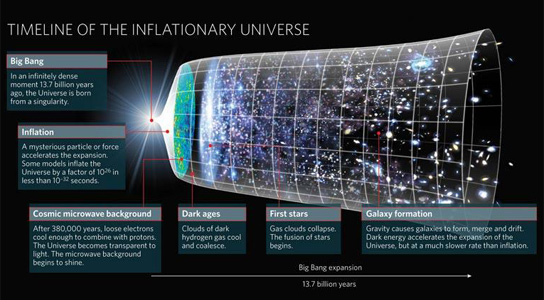
Any particular "moment" can be seen as a topological point on the 'surface' of the wormhole.(See for instance this image of the standard inflation model of our universe.)
http://scitechdaily.com/images...
If you cross your eyes when you look at it, the model resembles a white hole, where the "hole" is the big bang, the energy was delivered "all at once", and what we percieve as time is just a manifestation of the energy delivered. (it would explain why time runs only in one direciton, and a number of other interesting things. it could theoretically explain dark energy, etc.)
Another interesting tidbit: Supermassive objects like sagitarius A have a hard time "feeding". This may account for the inflationary curvature of our own universe if you, again, cross your eyes when you look at it.
EG, early in the universe, mass energy from the higher up one was spilling into ours. (their "hole" was feeding), but as it grew in intensity, the curvature on their end made such feeding more difficult, and the rate of influx slowed sharply-- ending the rapid expansion period.
If that's the case, then some corollary math should add up against observational metrics against black hole feeding on our side, and may give some interesting insights.
http://phys.org/news140370694....
Can any of the more physics-head types see if there is a correlation between the estimated energy of the universe at the end of the hyper-expansionary epoch, and the event horizon size of these super massive black holes that can no longer feed?
-
Get Your Butt In the Lab...
...and get this or something like it to work:
http://phys.org/news199005915....
Extracting CO2 out of the air to preindustrial levels within 10 years would probably give us Valley Forge sort of cold every winter, but certainly no "global warming" would exist after that. The precipitate from that process, elemental carbon, might cover the state of Texas to about 30 ft. deep with such carbon, but we could always burn the ultra-pure carbon as fuel, in everything from formerly coal-fired power plants to the return of the steam locomotive.
-
Re:2 tips for preppers
See, that's one of the things I don't get about every apocalypse scenario: the assumption that virtually every battery, solar panel, radiothermal generator, gas station, methane pipe, hydroelectric dam, geothermal and/or nuclear power plant will all be offline at the same time. Most of those things basically run themselves and at least one of those is going to survive for at least a couple of years unattended, so just store a portable computer somewhere with a couple of thumb drives containing all the world's useful knowledge and you'll be good for a spell. If you anticipate needing that info any longer than that, get one of these, or at least inscribe the location of one on every stone surface you come across.
-
Re:Deniers
A carbon tax? You think that a carbon tax is the answer?
No, the answer isn't going to come out of legislation. The answer is going to come out of a laboratory somewhere, and it will be an energy solution that doesn't emit.
But a tax will just create millions more that fall below the poverty line, as the cost of energy skyrockets and they can't even pay to get to work in their cars, and their work further moves out of the USA and to places that aren't trying to sabotage their industries with taxes.
You know what WOULD make a difference? We should kill the income taxes dead, all of them, and then industry would build 100's of 1,000's of factories in the United States. And, thanks to fracking and horizontal drilling, we would be able to provide cheap electricity for them to run those factories on natural gas fired electricity. THAT would get a lot of manufacturing out of places like India and Chna because they still tax their industry. Something like THAT would make a difference, and retain enough prosperity that we could use much more readily available funds to perfect the ultimate solution to the problem. Maybe that solution would be something like this:
http://phys.org/news199005915....
Pre-industrial levels of atmospheric carbon dioxide within 10 years, as well as more elemental carbon sans things like mercury and radioactive components so it could be burned in what would otherwise be coal-fired generators, and not add enough CO2 to undo everything.
That's just an example of what might be. There could be other solutions that would do the same thing that we just haven't heard about, or something that some smart guy in a lab somewhere is going to get to work as a prototype next Tuesday. But you can't kill the economy with a carbon tax and expect the money to materialize to develop the process I linked to, nor pay the guy in the lab to discover the Tuesday process that will save us all. The people that would be trying to do that will be home, trying to set the heat lower and not drive anywhere because gasoline and heating oil are so expensive. (BTW, I've already come to that point with a $683 oil bill for one month last month - geothermal heat will be a reality here by next Christmas. Quote is $25K - $30K. Yeah, I'll use the subsidy.) (But you don't need to make petroleum any higher than it already is, there's too many in poverty already.
-
Re:Why so much resistance to climate science?
The best guestimate of the amount of oil burned (no coal included) is 135 billion tonnes. The earth has a surface area of 510 million square kilometers. So, about 260g/m^2. That's extra insulation up there, over everywhere, 24/7/365.
-
Re:Why so much resistance to climate science?
And they're / we're doing that because all of the global warming extremists want to wreck prosperity in pursuing actions that will not work. The US simply pauperizing itself in trying to use extremely expensive "clean" energy won't do a damn thing to get India and China to quit digging coal, and we cannot support out population without petroleum anyway.
If you _ever_ outline a course of action that will _increase_ prosperity and solve the problem at the same time, then you MIGHT have a chance of getting the plan approved by all. But until that time, expect opposition even if you show that it is 100% the case. You have to be able to keep everyone alive and still not burn anything. You can't.
Work on geo-engineering solutions instead. Figure out how to remove the CO2 from the atmosphere, either cheaply, or profitably. The STEP process:
http://phys.org/news199005915....
if perfected, would have us so rich in elemental carbon as a byproduct that we could fire all our coal-burning power plants with elemental carbon and no mercury or radioactive emissions while introducing no new carbon to the atmosphere. No, THAT would be a solution everyone could support. Research that. Make it work. We'll get behind it because it'll solve the problem and not harm us while doing it.
-
Re:Buy a Prius as your next car...
Bird deaths are no myth:
http://www.cfact.org/2013/03/1...
and keep in mind that wind power is a very small portion of the power produced in the country now. Ramp it up to produce 100%, and you're going to have nowhere where you wont be able to see a turbine, and nowhere a bird can fly and expect to live a normal lifetime.
Drilling absolutely should be done for both sustainability and geopolitical reasons. We cannot convert the entire vehicular complement of transportation in this country to electricity for decades, and possibly never if the magic battery is not invented. Still no one knows how to build it. When they do, then we can get on with battery powered cars that can perform like internal combustion engined cars, and semi-trucks and boats / ships too. This may never happen.
And, BTW, fracking has been around since the 40's. Whats you're problem? Are you one of those enviros that opposes everything?
What we have to do is to keep costs down as long as possible, and that means petroleum. Only with the prosperity brought to us by petroleum will we have the research money to possibly perfect something that actually works, be it wind, solar, geothermal, whatever.
And we still have to research geo-engineering because the damn commies in China are NOT going to quit digging coal, ever. We either figure out a way to take the CO2 out of the air in order to reduce its concentration, or figure out how to live with a warmer planet. Maybe put some $$$ behind getting this working:
-
Re:So...?
If you're too lazy to use google: http://phys.org/news/2014-03-daylight-energy.html
-
Re:Japan and technology
There are serious doubts as to Japanese law enforcement's abilities to deal with the technical issues involved.
Surprisingly, this is correct. The National Police Agency, as of last summer, was just setting up their computer crime unit. It's mostly aimed at infrastructure protection. The Tokyo Metropolitan Police also set up a cybercrime squad in 2013. So they're just getting started on this.
For better or worse, security paranoia after 9/11 has funded substantial computer crime analysis capabilities in the US. Japan's JPCERT is a small industry-funded nonprofit. US CERT was a small nonprofit before 9/11. It's now part of Homeland Security's empire. The Secret Service and the FBI also have big computer crime units.
-
re: Germanium X
"When we tested the IHP 800 GHz transistor at room temperature during our evaluation, it operated at 417 GHz,"
-
Why two wheels?
What specific value is there in using two wheels and a "code heavy" stability algorithm instead of using more vehicles. For example, Elio motors is aiming for 84mpg with a three wheel car that uses "no special technology" and is expected to cost $6800.
-
Re:Many exciting developments in batteries
Here's another that's very energy dense - molten-air batteries: http://phys.org/news/2013-09-m...
If you want something that's closer to commercial production, keep an eye out for Sumitomo's low-temp molten-salt battery, due in the next year or two.
-
Re:Still a ways to go
Have a look at molten-air batteries - http://phys.org/news/2013-09-m...
With an iron anode, the energy content is roughly the same as petrol - ~ 10000 watt-hours per liter. But the most you can hope for an a straight gasoline ICE is about 30%, whereas a battery is likely to be 2.5x as efficient. A carbon anode, which is more likely to be developed is nearly double that of iron so if this tech pans out and it looks to be quite affordable, it'll kill the demand for fossil fuels in almost all light-duty vehicles and make it possible to have hybrid long-haul trucks.
-
Hope you've got a big mixer
I hope you've got a big mixer to make sure that blends evenly, because it turns out that dropping stuff in the ocean isn't like putting food coloring in a glass. The ocean is big and has currents and thermal zones that prevent even, global mixing. That's why Fukushima raised Strontium-90 levels 100-fold in some hot spots in the three months after the disaster.
-
link between mass value and avogadro's constant
well... this is puzzling. i tried converting the value reported to MeV and accidentally divided by the atomic units constant 9.109 382 91 x 10-31 instead. what i got shocked the hell out of me: 1000x avogadro's constant. according to reports here http://phys.org/news/2014-02-p... the value is 0.000548579909067 atomic mass units. if however you divide that by the atomic unit of mass reported here http://physics.nist.gov/cgi-bi...|search_for=atomic+mass+unit you get, to 6 decimal places, avogadro's constant times 1,000.
i am... very very startled! the implications are that there is some sort of link between the mass of the electron and (if you look up the definition of 1 mole on wikipedia) the number of atoms in 12 kg of carbon. which is.... incredibly odd.
i don't think it's a systemic error, because the original experiment's value agrees with that of other measurements that have been made of the electron's mass. what it would mean is that there appears to genuinely be a link between the mass of the electron and avogadro's constant.
-
How is this different from previous research?
-
Re:Waiting on the next jump in knowledge
I think he's referring to the 10% difference in the observed radius of force from the proton.
It's been a tricky one since no one was able to convince themselves it wasn't just measurement error for a long time, but the most recent results seem to say it's real - and no one can propose a good explanation as to why.
-
Re:Thankfully it's NYC
That's really not fair to rats, considering the research results showing their empathy for their fellow rodent.
-
Why morons are so prevalent in scientific circles.
Oh, cancer is an evolutionary compromise of multi-cellular life? Yeah, right. It's a product of mutation, but it runs counter to reproductive fitness, and it's not like our bodies don't have immune systems which reject other foreign (differently mutated) cells, so, Checkmate, moron.
If cancer is so damn inherent in the very fabric of complex life then we probably wouldn't find any species on the planet that doesn't get cancer... Like Naked Mole Rats. Some studies I've seen suggest cancer has less to do with an evolution-wide compromise, and instead may have something to do with the fact we have live young -- Which isn't intrinsic to complex life. Compared to labor and live delivery this seems a bit of a back-asswards path; Probably a product of having too big of a brain to be as overcome with instinctual drives as is required for protecting a nest, but not a big enough brain to build artificial incubators with automated laser defense systems. Well, that and maybe an advantage to survive in colder climates, or migrate during gestation. Then again isn't there eggs in Antarctica -- Penguins, eh?
So, no. Cancer exists because our immune system isn't picky enough, you dolt. Just like we use gene therapy to cure extreme allergy "bubble boy" types when they're young, we'll likely eventually be able to fix up our immune system with a way to sick our own white blood cells on cancer, or cause our bodies to produce anti-cancer sugar in our cellular matrix like the naked mole-rats do.
So, yeah, it seems this fool is just ignorant of the very field they're researching. That's what happens when you over-specialize: You're likely to think your own studies are so damn important that you develop a penchant for making grandiose claims that seem moronic to everyone else even remotely in the know. When combined with a largely ignorant populace (who specialized in other fields) it's a breeding ground for this sort of stupidity.
-
Re:Shouldn't have to run oil by railThe real world disagrees with you:
If you want to argue about the safety of oil transport then I'll have that argument. I'd then demonstrate the statistical safety, low cost, and minimal carbon output of nuclear power.
Nuclear power has an intrinsic government subsidy that you (and all nuclear advocates) ignore: disaster insurance
Insurance available to the operators of nuclear power plants varies by nation. The worst case nuclear accident costs are so large that it would be difficult for the private insurance industry to carry the size of the risk, and the premium cost of full insurance would make nuclear energy uneconomic.
The next paragraph says the same about installations like dams, but you made a blanket statement about nuclear power, and I'm addressing that topic.
For a real world example, what is the cost of the Fukushima disaster? I suspect that this question literally has no answer, since there are so many unknowns in dealing with the aftermath. One figure is $58 billion. I suspect this is wildly optimistic, since every evaluation to come out of official channels in Japan has been that way since the earthquake hit. Other values are $100 billion and $250 billion. Some of this variation may be due to what is considered a direct cost vs. what is being ignored.
To give some perspective of how things are being managed, consider this recent report on labor used for the cleanup
In January, October and November, Japanese gangsters were arrested on charges of infiltrating construction giant Obayashi Corp's network of decontamination subcontractors and illegally sending workers to the government-funded project.
In the October case, homeless men were rounded up at Sendai's train station by Sasa, then put to work clearing radioactive soil and debris in Fukushima City for less than minimum wage, according to police and accounts of those involved. The men reported up through a chain of three other companies to Obayashi, Japan's second-largest construction company.
Do you expect that homeless exploited workers who suffer from exposure to radiation and other environmental toxins will be accurately accounted for in the cost of the cleanup? Does this give you any confidence that the cleanup process itself is going to be done correctly, even with a multibillion dollar price tag?
And remember, the disaster isn't over yet. Of the four units that had explosions, two of them have not had a survey of reactor damage because no technology exists that can stand up to the radiation. They could be going through a process that could release more radiation and the only way we would find is is when it happens. Speaking of which: steam of unknown origin is coming out of Unit 3.
Fresh plumes of most probably radioactive steam have been detected rising from the reactor 3 building at the crippled Fukushima nuclear plant, said the facility’s operator company.
The steam has been detected by surveillance cameras and appeared to be coming from the fifth floor of the mostly-destroyed building housing crippled reactor 3, according to Tokyo Electric Power Co (TEPCO), the plant’s operator.
This started on Dec 24, i.e. last week, and is continuing intermittently. It could be rain water contacting surfaces heated by radioactive decay, or an early warning of the damaged core or fuel pool becoming critical.
-
Metamaterial lens has ten times more power
-
Re: It's more complex than you understand
Go back and study the last big U.S. East Coast outage. This is a huge issue. Instead of twenty or thirty sources to synchronize there will be many thousands. It is not a solved problem and is an area of active research.
http://phys.org/news/2013-02-power-grid-synchronization-enable-smart.html
http://scitechdaily.com/synchronization-in-a-decentralized-power-grid/
-
Re:Scale smaller than the wavelength?
I saw these items that you might find interesting.
How to Repel an Earthquake
How to prevent earthquake damage: make buildings invisible
Seismic Metamaterials Could Cloak Dams and Power Stations -
Re:NOT a Chinese released panorama
I imagine it was a std def broadcast.
Chang'E 3 has several cameras (as does the YuTu rover), following the MER standard of having "science," "navigation" and "hazard avoidance" cameras. One of the Lander camera pointing systems was designed in Hong Kong; I suspect that system made these images.
Note - some of the published images were high-def (16:9 ?) and were just aired as 4:3 on the TV broadcasts, making the lander (to me) look squished on screen and screen-shots.
-
Re:Time for some really new physics
Although there has long been a connection between math and physics, as people dig further into the math they are finding some unexpected things, and ways to better understand, simplify, or extend the equations.
Mathematicians Link Knot Theory to Physics
A Jewel at the Heart of Quantum PhysicsThere are a number of seemingly promising developments out there that are sharpening the investigative tools as well as providing interesting new lines of investigation, as well as new data to chew on.
Spooky Connection: Wormholes and the Quantum World
Physicists Create Quantum Link Between Photons That Don't Exist at the Same Time
Schrodinger’s ‘Kitten’? Large-Scale Quantum Entanglement Achieved By Two Physics LabsString theorists squeeze nine dimensions into three
New work gives credence to theory of universe as a hologramNow we are developing a growing understanding of the interplay between biology and physics.
Quantum biology: Do weird physics effects abound in nature?
Who knows where things may lead next? Of course people should be careful in performing experiments.
-
Re:Time for some really new physics
Although there has long been a connection between math and physics, as people dig further into the math they are finding some unexpected things, and ways to better understand, simplify, or extend the equations.
Mathematicians Link Knot Theory to Physics
A Jewel at the Heart of Quantum PhysicsThere are a number of seemingly promising developments out there that are sharpening the investigative tools as well as providing interesting new lines of investigation, as well as new data to chew on.
Spooky Connection: Wormholes and the Quantum World
Physicists Create Quantum Link Between Photons That Don't Exist at the Same Time
Schrodinger’s ‘Kitten’? Large-Scale Quantum Entanglement Achieved By Two Physics LabsString theorists squeeze nine dimensions into three
New work gives credence to theory of universe as a hologramNow we are developing a growing understanding of the interplay between biology and physics.
Quantum biology: Do weird physics effects abound in nature?
Who knows where things may lead next? Of course people should be careful in performing experiments.
-
link to the triple-star discovery
As the summary notes, it was only recently discovered that this system has three gravitationally bound stars, making it the widest such group currently known. Paper from a few months ago on the arXiv, and a news write-up of that.
-
Re:Good
http://www.telegraph.co.uk/news/worldnews/europe/sweden/10080320/Stockholm-riots-leave-Swedens-dreams-of-perfect-society-up-in-smoke.html
http://www.thelocal.se/20110810/35462
http://phys.org/news/2011-10-group-boundaries-key-ethnic-violence.html
http://news.nationalpost.com/2012/02/01/police-routinely-suppress-racial-data-in-canada-study-says/ -
Re:Didn't some Canadian kid develop bugs for this?
I clearly remember a science project where some teenager bred bacteria that could break down plastic bags in about three weeks. It won somebody's science fair project and everything.
That would have been this guy. Other people have made similar claims, such as here and here. I've no idea why they haven't made it to mainstream processing yet, but it wouldn't be the first time there was a problem scaling something up from a small lab-batch process to an industrial sized continuous one, or a problem finding a way to make it commercially viable either.
-
Re:I think I will stop reading slashdot.......
To be honest, Slashdot and http://phys.org/ are by far, my favorite websites for interesting stories news.
However, I am getting tired of fucking bitcoin stories. Enough is enough.You don't have to read the summary. You don't have to click on the links. You don't have to post annoying comments. In fact, I think slashdot will be better if you do stop "reading" it.
But, yeah, I'll give you that there are way too many bitcoin stories...
-
Re:*world's smallest VCO
Is the size of the VCO a big deal in manufacturing of any radio transmitter?
Only for people interested in listening in on other people without their knowledge. I can't imagine anyone wanting to do that, though. Besides, you'd need a barely visible microphone to make it useful.
-
Our Ancestors Porked Some Pigs and We're ....
the result! Humans are chimp-pig hybrids
Goddam perverts! Get offa my lawn!
-
Other prior research
Researchers at the University of Maryland have been using the tobacco mosaic virus for similar purposes: http://phys.org/news/2010-12-virally-nano-electrodes-boost-energy-capacity.html
-
Re:Maybe replace with
Transparent Aluminium
http://phys.org/news167925273.htmlWow, TFA states the program is cost sensitive and your suggestion is to use a material that is titled as a "new state of matter"?
There is simple axiom in engineering (albeit with many variations):
You can have it Light, Strong, or Cheap. Pick any two.
All the physics in the world will never change this. There are no free lunches in engineering.
-
Maybe replace with
Transparent Aluminium
http://phys.org/news167925273.html -
Re:Related question re: Women's Chess
It is not actually separated. Most chess is open. And there is no such thing as men's chess. There are special women-only tournaments as a response to there being 10-1 men in the sport, and a lot of sexist morons. So for a lot of women that is the only way for them to enjoy it.
See also: http://phys.org/news150954140.html
In one hand, you claim it's not actually separated, and then in the other hand you claim they hold special women-only tournaments...?
Using the ratio as the reason is bullshit. The ratio is just as bad for women in other areas of competition (professional poker or video gaming comes to mind), and yet they thrive just fine with men and women playing.
-
Re:Related question re: Women's Chess
It is not actually separated. Most chess is open. And there is no such thing as men's chess. There are special women-only tournaments as a response to there being 10-1 men in the sport, and a lot of sexist morons. So for a lot of women that is the only way for them to enjoy it.
See also: http://phys.org/news150954140.html
-
Yes, there is the American race
-
Re:Well, he's not wrong
Don't forget about this http://phys.org/news/2013-01-nanosilicon-rapidly-electricity.html though i think what they are 'stumbling' onto is the effective surface area to volume ratio more than anything else.
-
Re:It's not mutually exclusive.
and the first group of people that came to America.
http://phys.org/news/2013-01-ancient-dna-reveals-humans-years.html
Or, more presently...
-
Re:Eight million is small spuds
You're thinking of Solar PV. Solar thermal can use molten salt for storage and provide power for hours after dark ( e.g. Crescent Dunes near Tonopah ) or even around-the-clock ( Gemasolar, Seville )
As for energy-dense batteries, there's hope. I have a pending submission to Slashdot about molten-air batteries from George Washtingon U, demo'ed with anodes of either iron, carbon or vanadium boride where the energy density by weight is about 10-70% that of gasoline.
Lots more work to be done, I'm sure, battery-cycling and all that but this is a big step forward.
There's also made towards lithium-air and sodium-air.
I expect we'll reach peak oil or even peak coal long before peak oxygen.Phys.org story: http://phys.org/news/2013-09-molten-air-battery-storage-capacity-highest.html
Arxiv.org paper: http://arxiv.org/ftp/arxiv/papers/1307/1307.1305.pdf" -
What a terrible article summary.
What a terrible article summary.
Light is not self interacting at the tree level. This means there is no scattering of light in the classical sense, only through virtual particles (quantum loop corrections). Did this group of experimenters prove otherwise? No.
This is the most clear statement from TFA
"It's a photonic interaction that's mediated by the atomic interaction," Lukin said. "That makes these two photons behave like a molecule, and when they exit the medium they're much more likely to do so together than as single photons."
http://phys.org/news/2013-09-scientists-never-before-seen.html
What the experiment did do was place another particle in the theory, the electron, with which the light may interact. So the light continuously scattering off of electrons keeps the two light beams spatially near each other. This is not new physics. The sun does the same thing. How long does it take a photon to escape from the sun? Typically a few million years.
What is significant about this experiment is the level of control the experimenters have over the scattering proximity of the light. Unlike the sun, whereby a very large volume is effectively trapping the light, this is a tabletop experiment.
A proper summary would be that a breakthrough in experimental techniques allowed for controlling photon scattering to a higher degree than before achieved.
-
There could be a more mundane explanation.
-
Nope!
Won't any direct observation we make as 3D critters point to a 3D universe? Isn't that sort of inherent to us being only able to perceive 3D?
Nope. Actually there is evidence that the early universe had only one dimension and that the other two have only come into existence as the universe cooled.
http://phys.org/news/2011-04-primordial-weirdness-early-universe-dimension.html -
Zoolander
If you look at the picture of the thing, it's pretty amazing. Each gear strip is 400 micrometers long.
What is this? A car for ants?
-
picture
If you look at the picture of the thing, it's pretty amazing. Each gear strip is 400 micrometers long.
-
Re:Of course the application wasn't free
Well, if we go to the Mars One website, "No new technology developments are required to establish a human settlement on Mars."
But in fact nobody knows how to land on Mars. For example, http://phys.org/news/2013-05-key-puzzle-mars.html... the Mars One people basically claim that because they don't plan on leaving, it's no big deal, but the LM for the Apollo missions was 15 tons... you're really telling me that you want to go to Mars and land in something significantly smaller than that, even if you don't plan on taking off again?
A project with that much attention is just not a viable method of scamming people.
Sure, keep telling yourself that.
-
Re:This needs to be taken out of their hands
I don't understand why so many nations are trying to reach a consensus on military action in Syria over a chemical weapon attack that may or may not have been done by the regime there but nobody has suggested multi-national cooperation to take over the mess in Fukushima.
Good thinking. Perhaps we should form some sort of International Atomic Energy Agency with the authority to monitor this kind of situation and set safety standards.
The only thing missing is a standing army to enforce compliance. All they have now is a big box to stand on and yell.
-
Re:Neurons on a circuit
I just did a quick search, and it looks like there was some progress in 2006 I have a feeling we are going to see this happen in the next decade or two.