Slashdot Mirror
Domain: rice.edu
Stories and comments across the archive that link to rice.edu.
Comments · 754
-
Re:Hilarious
Anyway, it is pretty sad that something so shallow as height will drive people's dating decisions.
Women in general prefer taller men, and the taller the better. https://www.lovepanky.com/men/... And for an actual study, Rice University: http://news.rice.edu/2014/02/1...
I was watching a woman reporter interviewing James Comey, who is pretty tall. She was a pretty liberal person, and would normally be pretty antagonistic toward some damage he might have done. But she was entranced - even giddy around him.
-
Re:Loss leader?
I wonder if they found that they still make a nice profit on the room and board, etc.
They have a page breaking down the costs of a Rice education. Roughly 72% of the cost is tuition, so it's safe to say that they're waiving their biggest money generator. They also have a page dedicated to discussing off-campus housing, on which they earn no profit at all (plus, Rice is in Houston, and as that page goes into detail about, Houston is one of the cheapest big cities to live in). So, no, I don't think they view room and board as a profit center. Universities like Rice typically operate on endowments and donations from alumni more than tuition payments.
-
Re:Loss leader?
I wonder if they found that they still make a nice profit on the room and board, etc.
They have a page breaking down the costs of a Rice education. Roughly 72% of the cost is tuition, so it's safe to say that they're waiving their biggest money generator. They also have a page dedicated to discussing off-campus housing, on which they earn no profit at all (plus, Rice is in Houston, and as that page goes into detail about, Houston is one of the cheapest big cities to live in). So, no, I don't think they view room and board as a profit center. Universities like Rice typically operate on endowments and donations from alumni more than tuition payments.
-
Re:How much have ya got?
Per Rice's web site, $46,600 is the tuition for this year. With fees and room and board the total cost of going to Rice is almost $60k, which is still below the elite schools but it is 6 times what it was when I went there starting in 1989.
-
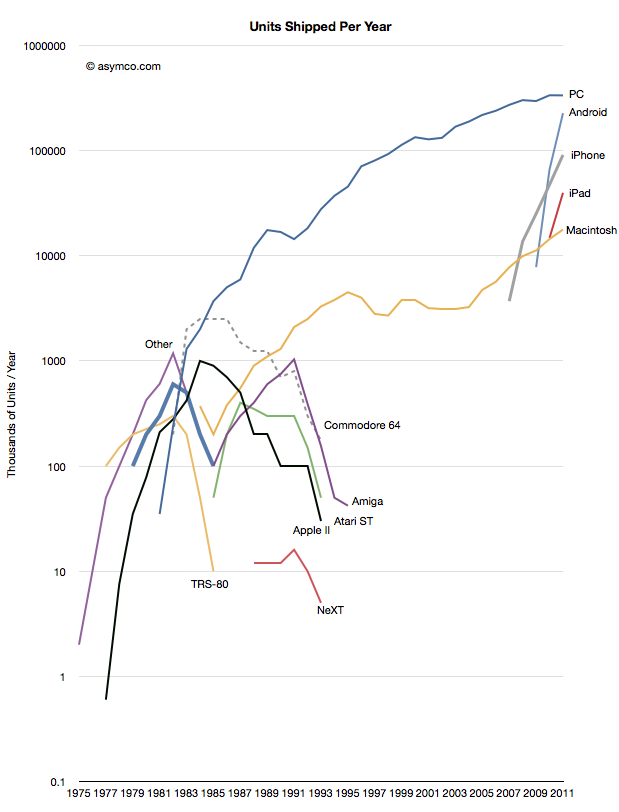
It's not due to mobile
PC sales began leveling off in the late 1990s, more steeply after 2000. Long before smartphones and tablets.
What happened was Intel and AMD ran headfirst into physics. Prior to 2000, CPU clock speeds had been doubling roughly every 18 months. But the power a processor needs increases non-linearly with frequency. Past about 3 GHz (roughly 2002), CPUs began to require exorbitant amounts of additional power for little gains in clock speed.
Consequently, the rate of clock speed increases nearly stalled after 2002 (at a bit above 3 GHz). Before 2000, each new gen of Intel CPU roughly doubled performance. Today, each new gen only nets about a 5%-15% performance improvement, and most of that has been due to improvements in parallel processing (more cores, speculative execution, hyperthreading, all the goodies which made the news last year as avenues for new exploits).
Up til about 20002, software makers had been counting on increased CPU performance to support the new features they were adding. They relied on people upgrading their PCs to be able to run the latest version of their software. Now that an upgraded PC was barely faster than the PC it replaced, software makers were forced to do something they'd given little thought to in the past - optimize. -
Re:Why rescue those who acted stupidly?
The assertion that Houston doesn't have zoning or has grown without planning is more legend than fact. But legends aside, building in areas that might flood once every 500 years seems like a reasonable risk. And yes, some places in that area flood more often and people are willing to accept that risk. The real issue isn't whether people should be allowed to build, but rather who should pay for the damage when it does.
-
Re:Who is doing the building?
DARPA is working on this in the MUSE program. Here is one of the performers: http://pliny.rice.edu/index.ht....
Much of the code that you need has already been written, and you just have to find it. So, have a system read in github, figure out what each of the pieces of software do, take the best parts and stitch them together into the program that you need. A great deal of 'computer science' has devolved into looking in stack overflow for what you need and copying and pasting into your program. Just automate that. (Some assembly required, your mileage may vary)
-
Re:Rule the waves?
Ships are not the only carriers of anti-ship missiles, and this budget cut damages all platforms. As another poser mentioned look into the Battle of Bubiyan and also here.
-
Re:I NEED A CHINESE GIRLFRIEND! \o/
You laugh. But I met this guy several years ago.
http://bioengineering.rice.edu...
He helped me build my 3D printer.
-
Re:Backdoors and Encryption
Have heard this asserted before, but never really bothered looking it up. Had assumed tithes would be a datapoint in study, but nobody seems to mention it (even in my links). http://papers.ssrn.com/sol3/pa... http://news.rice.edu/2012/05/3... https://s3.amazonaws.com/s3.do... Looks like there's no difference between the two groups (generally).
-
Newton's second law of motion
"Acceleration is produced when a force acts on a mass. The greater the mass (of the object being accelerated) the greater the amount of force needed (to accelerate the object). Or F=MA or FORCE = MASS times ACCELERATION." http://teachertech.rice.edu/Pa...
So if an SUV is two times heavier than a light sedan it requires two times more force (energy, fuel) to accelerate (to drive). I mean if two cars are of approximately the same technological level the heavier one burns more fuel, and consequently emits more CO2. No way around Newton's second law of motion, no filters, no electronics, nothing, absolutely nothing can remove the mass M, i.e. the weight from the formula F=MA.
Unless the humanity solves anti-graviti scientific problem: https://en.wikipedia.org/wiki/... what will not arrive soon. -
Re:Very cool, dangerous, but necessary to learn mo
Unfortunately the electrodes had to be removed due to complications and he can't continue these tests on himself. I wonder if the fda is preventing research on people who would volunteer for such a procedure, and why the fda would stop people from doing it voluntarily if to doesn't harm anyone else?
Ethics.
Lawsuits
Finding people who don't mind a good chance they will end up dead, or worse, paralyzed.
Probably the only people who would volunteer for this sort of thing are prisoners looking at a life sentence reduction and who wouldn't mind being dead if it meant they were getting out of the pokey.
And lawsuits. Signing a piece of paper doesn't protect the doctor from "gross negligence" lawsuits. Some one on a ventilator and immobile in the courtroom maks almost as unbeatable and sympathetic a victim as an aggrieved mother who lost her baby. Which is related to why there aren't many drugs approved for pregnant women - way too dangerous to do the testing.
There has been a rather spotty record on medical ethics in research, so I'm not surprised the FDA clamps down on brain surgery on healthy people for shits and giggles.
Even my prisoner example has extreme oversight issues. Some folks still aren't all that happy about the Tuskegee syphilis experiments, when they decided to see what happened to men when purposely leaving their disease untreated while pretending to treat it. https://en.wikipedia.org/wiki/...
It's definitely not a simple "We need to know this stuff" matter. No holds barred experimentation, and it starts to resemble this: https://owlspace-ccm.rice.edu/...
We actually learned a lot of stuff from those high altitude evil experiments, which is a bit disturbing on many levels.
-
Re:Brother Guy rocks:
More foolishness... Let's try reality, not idle speculation, for a change.
-
Re:Finally
Religion is essentially "I believe in a sky daddy because I'm ignorant of science."
That's completely delusional.
Theology is even worse, take Islam:
Theology is the study of religious beliefs and practices. You'll find no shortage of atheist theologians. Or do you mean theology in the sense of a system of beliefs? In that case, you'll find that Islam is not monolithic, but divided along theological lines. Either way, your statement is incoherent.
science must be outlawed at all costs
I can find no branch of Islam that "outlaws" or otherwise forbids science. On the contrary, there are many Muslim scientists practicing today, as well as many historically significant Muslim scientists.
because I can't and won't ever show myself or preform miracles
Many Christians would disagree. I can't find a Christian sect that would affirm that. It's possible one exists, but it would be exceptional, not representative.
it made no sense back in the day and less sense now.
What makes "no sense" is your post. If you want anyone to take you seriously, you're going to have to offer more than nonsense like this to support your position.
-
Runaway Greenhouse
Please don't talk about runaway greenhouse effects here on Earth. It really isn't possible.
Quick summary: for a runaway greenhouse effect, you need a big surface reservoir of some greenhouse gas (on Earth, water vapor). Theoretically, you increase the temperature a little, this vaporizes more of the gas, trapping more heat, which vaporizes more gas, and so on until the planet no longer has a radiative balance. Then things get a bit warm.
On Earth, the tropopause generally keeps water vapor near the surface; if water vapor rises to that point, it usually freezes and precipitates. This prevents it from building up in the upper atmosphere. One of the effects of CO2 on Earth is to cool the stratosphere, so ironically adding more of it could be moving us further away from a runaway greenhouse effect.
There is a vague possibility that we might make some lasting change to the climate, but probably not. We're still a few orders of magnitude away from the most drastic outgassings that the Earth has experienced. We're drastically compressing the timeframe of those events, but we will exhaust all fossil fuels long before we match the CO2 emissions of the largest LIPs. We can and seemingly will fuck up the planet for a geologic age, but the planet has recovered from worse extinction events before. We'll have to be satisfied with 90% of terrestrial life, I am afraid that the Ultimate Species Fuckup is beyond us.
-
Re:Maybe the aliens are just as religiousFrom your same link.
Indian scientists less religious than other Indians.Indian scientists significantly more religious than UK scientists
when it comes to religious affiliation, we can see here that when we look at religious practices, Indian scientists are significantly more likely than the Indian general population to never participate in a religious service or ritual, even at home
while only 4 percent of the general Indian population said they never attend religious services, 19 percent of Indian scientists said they never attend.
See science and education are cures for religion.
-
Re:Maybe the aliens are just as religious
-
Re:Maybe the aliens are just as religious
An alien lands on Earth and finds it odd that all the scientists of our planet are trending towards atheism....
Maybe in the West, but not necessarily in the rest of the world.
Indian scientists significantly more religious than UK scientists
...interviews with scientists revealed that while 65 percent of U.K. scientists identify as nonreligious, only 6 percent of Indian scientists identify as nonreligious. In addition, while only 12 percent of scientists in the U.K. attend religious services on a regular basis — once a month or more — 32 percent of scientists in India do.
Science and atheism - correlation is not causation.
-
gravitational time dialation
I met a guy that used to work at NIST that mentioned that their clocks are so sensitive, they can tell what floor the atomic clocks are on because of of the slightly different gravitational potential each clock experiences. I wonder what kind of resolution the can resolve. Can a very massive bolder throw off the clock a little?
Here is an wikipedia article that mentions the phenomena with atomic clocks: http://en.wikipedia.org/wiki/G...
-
Why do we have to use modern?
I can build a crude telescope in my garage using the EXACT techniques he used. It's not hard.
http://galileo.rice.edu/lib/st...
And then just half ass the optics by only looking through them as you grind. dont use modern collimation techniques and you will get the nasty blurry full of chromatic nasty that he had to deal with.
The other problem is that pollution and light pollution is 9000% higher than what he had.
-
Re:Yes and no
No, usually you're applying your test to the average of a single sample, and since possible averages are always normally distributed (for a fair sample size), you can indeed use that to assess the likelihood that your one sample average is usefully close to the population average.
But only if your sample is not biased because you determine the average based upon your sample. If the sample is badly distributed or biased in some way then your estimate of the population mean will be similarly biased and you will not be able to make meaningful inferences regarding the population mean. Problems are worse with small samples.
The same thing happens with parametric stats tests. e.g. with a t-test, the p-value it returns is only meaningful if the sample meets the assumptions of the test. If the sample distribution violates those assumptions substantially (and the test is robust to some degree) then your estimates will be biased and your p-value not trustworthy (i.e. the actual and nominal alpha levels will differ). This is something you can simulate and watch in action: http://www.ruf.rice.edu/~lane/stat_sim/robustness/ http://onlinestatbook.com/2/tests_of_means/robust_sim.html
-
This could be huge
If this really works, it could be huge. One of the interesting things about quantum computing is that there has been a fair amount of algorithm development done for quantum computers even though they are barely out of the concept stage.
A bit dated but nice general background article on quantum computers:
The Quantum Computer -
Re:Ugh..
no, you're confused. 32,000 years ago the TILT of the earth's axis was at lowest angle, 10,000 years ago it reached a maximum and is now heading back to low value. But it is not near a high or low.
http://earth.rice.edu/mtpe/cryo/cryosphere/topics/ice_age/compare.html
That angle has nothing to do with the wanders on the surface of the earth of the axis, what this article is addressing.
-
Re:What about modern processors?
It helps to provide context to what you're talking about.
PDF from mid last year on performance tools, page 26 documents the LWP issues with the kernel.
It looks like integration with the kernel and getting upstream is a task for AMD. So it is unfortunate, but entirely AMD's problem as an Intel variant is already in kernel apparently.
-
Re:I'm pretty sure it doesn't work
Wow, you still insist on being a moron even after sjames patiently tried to explain this to you.
Newton's second law: Each and every action has an equal and opposite reaction.
With a rocket, you are chucking plasma out the exhaust end. You are pushing against the plasma, and you accelerate in the opposite direction. The rocket is interacting with its exhaust in order to provide acceleration. Here's a nice simple image which explains how a rocket works: http://teachertech.rice.edu/Participants/louviere/Newton/rocket1.gif
This engine has no exhaust. The claim is that it is an entirely CLOSED system, and is not interacting with anything.
Some mod this twit down.
-
Re:Hasn't this been done before?
It tells it on their link here in the article. I'm pretty amazed by this...seems like a very good thing.
In the first experiment, nine bathroom tile-based batteries were connected in parallel. One was topped with a solar cell that converted power from a white laboratory light. When fully charged by both the solar panel and house current, the batteries alone powered a set of light-emitting diodes that spelled out “RICE” for six hours; the batteries provided a steady 2.4 volts.
The researchers reported that the hand-painted batteries were remarkably consistent in their capacities, within plus or minus 10 percent of the target. They were also put through 60 charge-discharge cycles with only a very small drop in capacity, Singh said.
-
Paper is NOT the answer
I am a poll worker in Virginia. If you haven't tried to run an election, you're probably thinking that paper is the obvious answer. Just count the votes! How hard can it be?
Paper is a horrible medium for counting things. Paper gets lost. It gets defaced. It can become illegible ("hanging" chads anyone?). It can be crumpled, torn, shredded, soaked, burned, stuffed, and stuck to other pieces of paper. Bottom line, voters prefer electronic voting equipment because it is easier and simpler to use. (See this study from Rice University.) Poll workers prefer electronic voting because it much more reliable, and far easier to manage effectively.
There's a reason banks don't use paper receipts and hand-written ledger books anymore. Those same reasons apply to running elections. Automation is great.
The MITM attack scenario outlined in the parent article requires that someone gain physical access to the voting machine not once but twice -- both before and after the election. That's a very high hurdle! Our voting machines are under lock and key. The cases are sealed. We check the serial numbers and write them down. We open and close the cases in the open. The courts keep a record of the serial numbers.
If your scenario is that I have to collude with an entire staff of volunteer poll workers, or I have to corrupt an entire office of election, or I have to corrupt the local Court, then getting into the machines is the least of your worries. Granted, physical security is important, and that's why we have procedures such as serialized seals.
-
Re:Cool!
All the links from TFA lead to full papers (caveat, I'm on a University network, but arxiv should be accessible anywhere):
http://arxiv.org/pdf/1107.0607v1
http://arxiv.org/pdf/1107.1276v1
http://warp.rice.edu/trac/attachment/wiki/Asilomar2010_FullDuplex/MDAsilomar2010.pdf
http://warp.rice.edu/trac/attachment/wiki/Asilomar2011_FullDuplex/Everett11FullDuplexDirectionalDiveristy.pdf -
Re:Cool!
All the links from TFA lead to full papers (caveat, I'm on a University network, but arxiv should be accessible anywhere):
http://arxiv.org/pdf/1107.0607v1
http://arxiv.org/pdf/1107.1276v1
http://warp.rice.edu/trac/attachment/wiki/Asilomar2010_FullDuplex/MDAsilomar2010.pdf
http://warp.rice.edu/trac/attachment/wiki/Asilomar2011_FullDuplex/Everett11FullDuplexDirectionalDiveristy.pdf -
Re:Wasn't Stanford first?
and thus, the circle is complete...
So:
1. Rice University had (and has) WARP - a sophisticated research platform of software controlled radios, build from the ground up using open source software
2. Stanford has the idea of using self-interference and demoes single-channel full-duplex wireless in 2010 at mobicon
3. Microsoft Research UK had some other ideas (May 2011) on self-interference and meshing for medium access control (check the citations: Stanford is mentioned)
4. Rice University takes a step further and establishes a math model and (this is the actual novelty) a way of doing it using an unexpensive setup.Can't stop but wonder: in all the above there's no patent? Is it the promotion of "the progress of science and useful arts" possible outside "securing for limited times to authors and inventors the exclusive right"? And this is not communism?
-
Re:Wasn't Stanford first?
Real-time Full-duplex MAC
We’ve implemented a real-time full-duplex MAC for an access point based network. The MAC design is based on the Contraflow generalized full-duplex MAC from Microsoft Research. The design is implemented and tested using the WARP software radio platform from Rice University. Using this MAC, we’ve shown in experiments with real nodes that full-duplex can reduce hidden terminal losses by up to 88% and significantly improve fairness in WLAN based networks.
and thus, the circle is complete...
-
Re:Patents
This is really disingenuous. The issue of what we call now intelectual property is not new, and has existed long before patents and copyrights were introduced. Because there was no good mechanism for establishing and enforcing ownership of new inventions and discoveries, many creators refused to make them public, to the disadvantage of everybody else. Many skills and processes were passed only within a family, or a guild, or from master to apprentice, and their secret was jealously guarded. Look at the Venetian Republic, which ensured the monopoly of Murano glass for centuries, by forbidding glassmakers to leave the city; look at many scientists, like Galileo: in order to claim priority for his discoveries, he used to send encrypted descriptions to other scientists (see here for details), and only make the discoveries public later.
Nice show-off of erudition, but how what you describe is much different from present day trade secrets, NDAs, legal practices for attributing ownership?...
Copyright and patent systems are tools which were born and evolved to address the needs of our knowledge, ideas, and technology based economy, but they don't make those issues magically disappear, and at this point they badly need reform to avoid representing a burden, rather than an enabler, for further development.
-
Re:Patents
OMG! How on earth did the human race survive for millenia before patents? You're so right, without patents nobody would ever invent anything
This is really disingenuous. The issue of what we call now intelectual property is not new, and has existed long before patents and copyrights were introduced. Because there was no good mechanism for establishing and enforcing ownership of new inventions and discoveries, many creators refused to make them public, to the disadvantage of everybody else. Many skills and processes were passed only within a family, or a guild, or from master to apprentice, and their secret was jealously guarded. Look at the Venetian Republic, which ensured the monopoly of Murano glass for centuries, by forbidding glassmakers to leave the city; look at many scientists, like Galileo: in order to claim priority for his discoveries, he used to send encrypted descriptions to other scientists (see here for details), and only make the discoveries public later. It's possible he had even discovered Neptune, back in 1613 (see here for details) but he did not disclose it, fearing somebody else may claim it. As a result, the existence of Neptune remained unknown until 1846, that is more than two hundred years later.
Or check the thoughts of actual writers living in a period of weak or inexistent copyrights; look at Dickens here or Twain here.
-
How To Design Programs
Seriously, whatever you end up doing in more advanced or more applied courses (if that's the right word for homeschooling), start with "How To Design Programs". It teaches you how to *think* about just about everything else in computing. There's a second edition in progress. Both the original book and the draft second edition (which is probably much better) are available for free downloads. The original can also be purchased on paper.
The software system that goes with it is also free: Dr. Scheme, now renamed as Racket.
-- hendrik
http://www.cs.rice.edu/CS/PLT/Teaching/Lectures/Released/Companion/index.htm
http://www.ccs.neu.edu/home/matthias/HtDP2e/
http://mitpress.mit.edu/catalog/item/default.asp?ttype=2&tid=3879
-
Re:On the upside
Maybe you're right... But I think you're forgetting something: human space exploration has values beyond the purely rational. Kennedy didn't propose putting a man on the moon because it was useful somehow, he did it to inspire his people, to win the space race against the Soviet Union, and to win votes in future elections. Just look at this speech - if Obama or someone else manages to put together a piece half as inspiring, then I think we will have a human on Mars within 15 years: http://webcast.rice.edu/speeches/19620912kennedy.html
-
Re:Why?
And if they're going to implement another image format, why don't they do it right and pick some form of embedded zerotree wavelet? Those beat the pants off JPEG (and most other DCT codecs) while being perfectly progressive (i.e. you can truncate the picture data itself at any point and get the same result as you would if you had compressed to that size).
Instead we'll get yet another block coding format, for what? So that Google can use it to leverage WebM? -
A little more info at rice.edu
-
It's about the Error Rate.
The key part they are removing is error detection and correction. They are creating chips which have an ~8% chance of producing an incorrect result. Supposedly hearing aids will accept a 10% error rate, so it is a good trade off.
These aren't "redundant" parts, they're parts which prevent errors from happening. It's just that in some applications they don't care about errors.
It's like looking at the various floating point bugs and going, "meh, close enough". Sucks for a spreadsheet, but if all you care about is integers 0-10, you probably aren't going to notice.
Here's the actual press release:
http://www.media.rice.edu/media/NewsBot.asp?MODE=VIEW&ID=15497&SnID=154992879"Inexact Hardware" seems to be the new term. Since they mention hearing aids, it seems to be that it's bringing the fuzziness of analog back into the digital world.
-
Re:Men are more aware of reality?
Having virtual farm is pointless if you can have a real one.
So I guess you don't play military shooters either because you could join the real army? Just because you could do something in real life, doesn't mean it is practical or worth the effort. Let alone the fact that most games portraying "real-world" activities have as much to do with the real world as an alien shooter.
And more important - what fun is doing chores?!
This, this and this link explain quite well why the chores of FarmVille are "fun".
-
Re:Jesus, listen to you guys
Ironic isn't it, since you get people shouting all day long on here about wanting to use their media/computer/apps/OS/golf cart the way THEY want to use it.
You assume that because somebody is investing a lot of time into something they are actually enjoying it and wanting it, thats not really the case, as FarmVille employs plenty of rather dirty manipulative tricks that force you to sink tons of time into it.
Jonathan Blow, creator of Braid, has given a pretty nice talk on the issues with games such as FarmVille and other common game design practices that really serve little other purpose then basically addicting the player without adding any real value to the game.
-
Please FWD:
To Rice U.: http://www.media.rice.edu/media/NewsBot.asp?MODE=VIEW&ID=14734
Seriously. Has no one ever heard of encryption? Or just not allowing people to copy personal data onto computers/media not behind at least 1 locked door?
-
The real hero here is compressed sensing
This has been said elsewhere in this thread, the real breakthrough here is due to compressed sensing, but here are some extra information:
1- Compressed sensing basically used the idea that it is not necessary to sample an image (or a projection in this case) everywhere because natural data is fairly redundant. This is why you can capture a 10 Mpixel image in a digital camera and have it compressed to a 2 Mbyte JPEG file without losing much visible information. Compressed sensing basically does the compression *before* the sampling and not after. Researchers at Rice University for instance built a working, one-pixel camera using this brilliant principle.
2- Compressed (or compressive) sensing was proposed by Emmanuel Candes and Terence Tao respectively at Stanford and UCLA. Tao is a recent Fields medalist. I recommend reading his blog if you like mathematics.
3- This field is really less than 10 years old, it has completely turned on its head classical ideas about sampling-limited signal processing (Nyquist, Shannon, etc). It is a brilliant combination of signal, image processing and recent advances in combinatorial and convex optimization.
4- However this is only the beginning. Because compression happens before sampling, you need to make so-called sparsity assumptions about the signal ; in other words you need to know a great deal about what you are going to try to image. In interventional therapy, precise imaging of the patient is made beforehand in a classical way (CT or MRI), and this kind of technique is only used to make fine adjustments as therapy is ongoing. This is extremely useful and safe because of lower radiation output and because the physicians know what to expect.
5- Here the GPU is useful because it makes the processing fast enough to actually be used. It is an essential brick in the application, but of course not in the theory.
Best.
-
Re:Security
The problems:
- 60% of the voters don't notice if their vote is modified on the confirmation screen. I'm not sure they'll do any better with the printed ballot.
- The above means hacking the voting computers at the polling station is pretty much sufficient to hack the whole election (since the machines cannot be wrong the 5% of voters who complain their printed ballot is wrong must be dumbasses who don't know what they type, this gives an 8% margin to hackers).
- Barring that, your only hope of detecting fraud is that hackers (mainly town and manufacturer employees) did not have access to both systems and thus that the two computers give different results.
- The result given at the polling station is given by a computer and and the counting of the ballots is done by another computer. There is a good chance they are from the same manufacturer (if you make the razor you also sell the blades, single contract for the town, no blaming it on the other manufacturer when the scanners cannot read the printed ballots). This all boils down to no real redundancy and simplifies hacking both systems.
- Nobody counted the ballots by hand and as long as the results from the two machines agree there's no way you will get anyone to spend time to recount even a sample by hand.
- The wait time is not related to whether you have machines or not but to the number of voters per voting booth.
-
Re:Security
Because people fuck up? Their hands can shake, they can have trouble seeing the little circles to fill out, their hands can slip, all manner of fuck ups can happen when a human has to fill out a little piece of paper with time pressure added to the top.
They could get another ballot and try again. Or you could have people only vote on one issue at a time so all they have to do is fold a pre-printed piece of paper.
With this design the person makes their choice on a large screen, with easy to read categories, and gets an "are you sure this is what you want?" (which you don't have with paper)
Unfortunately 60% of voters don't notice if you change their vote on this confirmation screen! So it seems there's not much point.
The sheet has BOTH human readable and machine code so it can be scanned quickly and if there is any doubt can be recounted by hand.
Who will want to manually recount the ballots when the result is known already (except for the sore loser and conspiracy nuts who claim otherwise).
After the whole election 2000 fiasco, it should be obvious to anyone that trusting a human to make a perfect circle in a tiny box, something they only have a chance to do once every 4 years and no practice in between, is a bad idea.
Maybe they should train by voting every year instead of skipping three elections out of four.
-
Re:How to build a good voting machineHere is a non exhaustive list of your mistakes:
- Thinking the software never needs an update (that would be somewhat true with a trivial voting machine such as the Indian one, but not with the one you propose) so that with your scheme it's necessary to regularly remove the tamper-proof stickers to upgrade the software, then put new ones and yet maintain the illusion that the machine has not been tampered with!
- Thinking the stickers protect you against tampering by the government organizing the elections (the ones with the most to lose).
- Thinking the stickers protect the machines for the 11 months they spend in storage waiting for the next election, or thinking any hack done during that period would be detected before the election.
- Not figuring out that the tamper proof stickers can be used for denial of service: break them and you can cast suspicion on all the votes of that computer (only to be done in precincts where your opponent is expected to make a good score).
- Thinking open-source helps: this is no guarantee that the published source is the one running on the day of the election.
- Thinking it's possible to verify that the voting computers are working and have not been tampered with: that's akin to verifying your computer has no virus just by browsing a couple of websites.
- Thinking voting computers are inherently more usable than paper or that people actually verify their vote.
- Thinking you can remove the memory cards containing the votes and ship them around without creating a thousand opportunities for tampering.
-
Stop complaining
It's just the inverse of the single-pixel camera. Nothing a little compressive sensing won't fix.
-
Re:Demo image
whoops... that should have been Bibliography references
-
A correct interpretation
The
Okay, yes, that might be a little bit weighty if you aren't in the field, but I would suggest you check out Nuit Blanche ( http://nuit-blanche.blogspot.com/ ) for a description of what exactly CS is, how it works, and what it is useful for. Today's article is especially interesting in this regard. -
Re:Demo image
For real images created using compressed sensing, check out Rice's one-pixel camera.
-
Re:I am a bit worried about the "fill in the shape
i agree, the description of the algorithm is too vague to really understand what is going on.
30 seconds of googling turned up this brief lecture on compressed sensing. written for undergrads, "the prerequisites for understanding this lecture note material are linear algebra, basic optimization, and basic probability."
http://dsp.rice.edu/sites/dsp.rice.edu/files/cs/baraniukCSlecture07.pdfside note: rich baraniuk was one of the best professors i had in undergrad