Slashdot Mirror
Domain: sciencemag.org
Stories and comments across the archive that link to sciencemag.org.
Comments · 1,625
-
Review in Science
Here's a good review that appeared Science. Has a fair discussion of the quality of the work, and the Wolfram problem of trying to take too much credit or overrepresent the impact of the work. See the summary at the end for quicker read.
-
Re:artificial origin
You said: " it's seems pretty probable to me that this might be of artificial origin, accidentally or intentionally
with the massive amounts of research we have going on right now with the virii (using them to fight cancer; finding cure for AIDS; studying influenza; sequencing virii's DNA) it's possible that we might have artificially produced SARS or have abused a population of some virus to the point that the population experienced a high mutation rate (e.g. if we tagged them with radiation-produced molecules, which is common practice for studying their spread in an animal)"
This is unlikely, since the SARS-CoV is not more closely related to any known type of coronavirus than any other. If it were a modified virus it should be very similar to a known class of coronavirus. -
Re:Tufte's money machineWell - an academic can put their papers on the web for free, as long as the journal they sent it to, who take the copyright for it as a condition for publication, allow you to.
Are online papers free? A few are, but the vast majority are not, like Nature, which makes you pay directly, or Science , that makes you pay indirectly through society memberships.
-
Re:For those not wanting to clickActually, human activity is almost certainly to blame. Volcanic eruptions change the atmosphere by adding significant quantities of sulphur oxides. This causes a global cooling but the changes are temporary and only last a few years. Volcanoes don't emit large quantities of greenhouse gases. Human activity has substantially changed the composition of the atmosphere. The observed changes in temperature of the 20th century were in excess of natural variations, such as what can be accounted for by changes in the sun's irradiance.
But don't take my word for it, this is according to a paper published in Science today.
-
Re:For those not wanting to clickActually, human activity is almost certainly to blame. Volcanic eruptions change the atmosphere by adding significant quantities of sulphur oxides. This causes a global cooling but the changes are temporary and only last a few years. Volcanoes don't emit large quantities of greenhouse gases. Human activity has substantially changed the composition of the atmosphere. The observed changes in temperature of the 20th century were in excess of natural variations, such as what can be accounted for by changes in the sun's irradiance.
But don't take my word for it, this is according to a paper published in Science today.
-
Re:"movie"
The Science article has an image of the EPD images.
-
Journal Science link, NOT life
The article starts out:
It is the stuff of science fiction and bioethical debates: The creation of artificial life.
A virus can reproduce, but does not consume energy -> they are not alive in a technical sense.
Also see this news from Science.
Incredibly cool. -
Pretty PicturesMacKinnon and his co-workers are responsible for determining the crystal structure of the potassium ion channel protein, of fundamental importance to many biological processes, include nerve impulse transduction. Pictures of the tetrametric (four identical proteins complexed together) channel are available in the Science paper, or at the protein data bank. If you have the appropriate viewer (such as Chime or RasMol) you can view the structure in 3D !
-c
-
Not new, improved
Just to be clear, they aren't the first to look at Mn-doped ZnO as a spintronic material - people have been working on this material since the 1990s. Theoretical work by researchers at Tohoku University in Japan and others predicted that Md-doped ZnO could work at room temperature. After which, Others started work investigating the properties, and trying to improve the fabrication of the material to reach ferromagentism at higher temperatures.
-
WTF?
How is this easier to use than this?
I'm already storing data by topic. I use a concept commonly called "directories". For example, all my pr0n is held in the ~/pr0n directory all my tunes are held in the ~/Tunes directory and all my pictures are held in the ~/Pictures directory.
I haven't looked at data based on physical location in eons. I used to read data sector by sector off floppy drives. Yeah, that did suck. Data wasn't necessarily organized by topic. But since the advent of filesystems, I've been able to organize by topic through use of these so-called "directories".
-
Help
-
space.com is better-informed that youThose two pages are talking about the same study, which was recently published in the journal Science (non-free reg required).
What the study showed is that Mars lacks the large deposits of carbonate rocks that would be expected from the presence of large, longstanding bodies of water like oceans. So, Mars was not "watery." This is what the BBC was talking about.
This is not the same thing as saying that Mars never had liquid water on its surface. On the contrary, the study revealed carbonate in the Martian dust, which may have formed by the interaction of liquid water and the carbon dioxide in the atmosphere. This is what space.com was talking about.
On the other hand, the carbonate could also have formed by the direct interaction of atmospheric water and carbon dioxide with the dust. That's why space.com points out that "Bandfield cautioned [that] the results are not 100 percent conclusive in proving the existence of liquid water."
Perhaps more significantly, however, the study shows that large amounts of carbon dioxide are locked up in these carbonates, which points to a thicker atmosphere in the Martian past, which may have been better able to support liquid water on the surface.
In fact, Bandfield (one of the authors of the study) also says elsewhere about the study:
"Mars appears to have locked up its atmosphere in minerals until it reached the point where the process largely stopped because liquid water ceased to exist at regional to global scales at the surface."
This study does not end the debate about water on Mars, and I don't think it's too strong an assertion to say that this study (among others) have hinted at liquid water on the dusty planet." -
A link to the paper
I had to dig but eventually found it at the following location. http://www.sciencemag.org/cgi/data/1087128/DC1/1
-
Re:Having taken one semester of astrophysics...As usual for Hubble press releases, not only is the release dumbed down to the max, it also provides no link to any additional information. Seems like they feel compelled to hide the dirty details of science from the masses.
The PDF of the full paper is available from the website of Stephen Torsett, one of the authors of the paper. As this is a Science paper, it is fairly readable.
-
Science journalA detailed report by Dr. Sigurdsson and his colleagues is being published today in the journal Science
Published, but requires a paid subscription.
-
Re:New tape of squid
Wow! this is cool, its like a bird!!!
You have to dig to find the actual movies though.
If thats too much hassle, heres the Lazy link to the Supplementary Material
Have fun! -
Re:48 hours... before what?
After reading the article(may need a subscription to view), I'm happy to answer your question.
The catalytic activity degrades over time - but stabilizes at 72% of initial activity after about 48 hours of use. They published data out to 60 hours of use. (since I eat lunch with John & George on a semi-regular basis, I can find out Monday how far they actually tested, but for now that's the best I can tell you.)
So if you're wondering why the activity degrades over time, that's an easier and harder question to answer. It's easy, since it's one of a couple of likely culprits - impurities in the feed stream can poison (ie, react with) the catalyst; the catalyst might physically break down over time, the metals in the catalyst might rearrange themselves over time (like tin on the catalyst surface might migrate to the sub-surface), etc. The hard part is figuring out which one (or how many) of these things are actually happening.
And as an aside, I can't believe it's a story in -
Old News, already done in mice, fish, HIV ...
The jellyfish protein introduced as a transgene in different organisms is known as green fluorescence protein, or GFP. There are actually quite a few derivatives of this protein with different spectral properties (e.g. see here http://www.clontech.com/gfp/excitation.shtml). Since the late 1990's, many researchers have engrafted GFP into the genome of mice as well as zebrafish to study developmental processes. GFP has also been used to label and track HIV-1 in light microscopy studies (see here, here, here, and here). Because of the protein's stability and ability to fluoresce under physiological conditions, it has been enormously useful to track live processes at the molecular level in real time. In short, this molecule rocks.
The researcher at NTU hasn't really done anything new or innovative, and patent rights to this molecule and its applications are in part held by Columbia University (at least they used to be). Thus even if a firm is interested in these glow-in-the-dark fish, they're likely going to pay significant royalties to be licensed to do so.
-
Re:Brain Food?
In an article in Science this April ("Balancing Selection at the Prion Protein Gene Consistent with Prehistoric Kurulike Epidemics"), British scientists suggest that our ancestor's urge to eat brains may have lead to the modern absence of prion-based diseases (such as mad cow disease) in humans. This suggests that, to some extent, at some point evolution selected for brain eating in humans. The actual article requires a paid subscription, but here's a summary from a newspaper.
-
Re:Accuracy (Goes past Mars too...)From Science Magazine
If the spin axis of 1950 DA is fixed near our direct rotation pole solution, solar pressure and asteroid perturbations could counter the Yarkovsky effect so that the probability of a collision in 2880 would be comparable to that of the initial detection case of 0.33%. Thus, the impact probability currently lies in the interval from 0 to 0.33%, where the upper bound will increase or decrease more rapidly as physical knowledge improves than as ground-based optical astrometry accumulates. We are unable to calculate a reliable, specific collision probability, because the trajectory uncertainties are dominated by unmeasured or poorly determined systematic physical effects.
And don't forget it goes out past Mars, too! For more calculation fun, of course, don't forget
- Galactic tide
- Numerical integration error
- Solar mass loss
- Solar oblateness
- 61 additional asteroids [not included in their model]
- Planetary mass uncertainty
- Solar radiation pressure
And a wacky idea I've had floating around for a while:
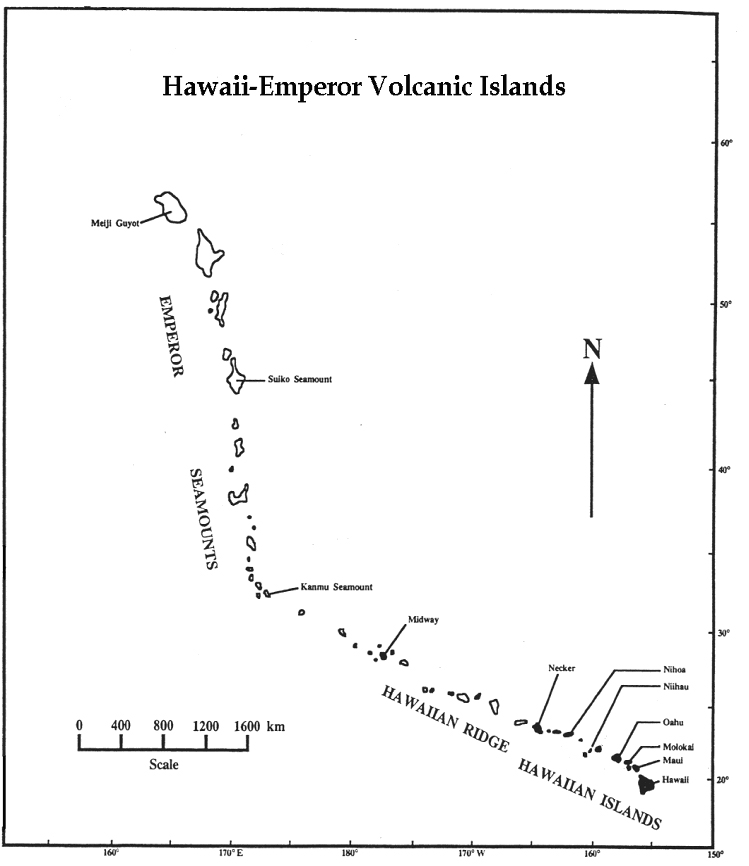
Could the "hole" which produced Hawaii be the result of an ancient impact? Then the Hawaiian Islands, the Hawaiian Ridge and the Emperor Seamounts are just a record of the Pacific plate drifting over that impact site, which is still bubbling...
And if you accept that, what produced the "sudden" left turn in the volcanic chain? Did the Pacific plate go "bump"?
-
Re:It's not about classYeah, that publication list. Most of those journals do not qualify as scientific publication outlets in this research psychologist's humble opinion.
You'd do better starting with Johnson et al.'s Science 2002 Mar 29;295(5564):2468-71 (TV) or Anderson and Bushman's meta-analysis in Psychol Sci 2001 Sep;12(5):353-9 (video games)
Both of those do demonstrate a relationship between violent media exposure and aggressive behaviors, and those are scientific studies in good journals.
-
The Science Behind the Technology
For those who are interested, the Nantero's technology is based on earlier work in the lab of Charles M. Lieber. The original paper was published in the journal Science. Rueckes et al, Science, Vol 289, P. 94. Rueckes went on to found Nantero.
The original experiment worked as follows:
One rope of singled walled carbon nanotubes sits suspended above another in a crossbar configuration. When an electric charge is applied, the top nanotube rope bends downward, where it is held in place by van der waals attraction to the bottom rope. To deactivate the switch, another charge is applied to repel the bent nano-rope into its original position.
This electromechanical switch works as a switch because of tunneling of electrons between the upper rope and the lower rope. When the ropes are sticking together, enough electrons tunnel from the upper to the lower, or vice versa so that one can measure a good signal, turning the switch on. When the ropes are apart, the tunneling conductance drops by several orders of magnitude, turning the switch off.
The original experiment was done with bundles of carbon nanotubes. In principle, the concept should work at much higher densities for single nanotubes, but the technology still has hurdles to cross. Currently, the tubes conduct because ropes of tubes are likely to contain both semiconductor type and metal type tubes. Since metal type tubes are fantastic conductors, having even a few of them in a rope will allow a device to work. However, when one crosses the threshold to single nanotubes, the device will only work if the tubes are metal type. Hence, an important problem will be finding a way to produce only metal type single walled nanotubes. Currently, carbon nanotubes are produced in a mixture of semiconductor type and metal type nanotubes. It's difficult to control that property because it depends sensitively on the way the sp2 bonds on the nanotube sidewall line up, something that no one yet knows how to control.
-
The Science Behind the Technology
For those who are interested, the Nantero's technology is based on earlier work in the lab of Charles M. Lieber. The original paper was published in the journal Science. Rueckes et al, Science, Vol 289, P. 94. Rueckes went on to found Nantero.
The original experiment worked as follows:
One rope of singled walled carbon nanotubes sits suspended above another in a crossbar configuration. When an electric charge is applied, the top nanotube rope bends downward, where it is held in place by van der waals attraction to the bottom rope. To deactivate the switch, another charge is applied to repel the bent nano-rope into its original position.
This electromechanical switch works as a switch because of tunneling of electrons between the upper rope and the lower rope. When the ropes are sticking together, enough electrons tunnel from the upper to the lower, or vice versa so that one can measure a good signal, turning the switch on. When the ropes are apart, the tunneling conductance drops by several orders of magnitude, turning the switch off.
The original experiment was done with bundles of carbon nanotubes. In principle, the concept should work at much higher densities for single nanotubes, but the technology still has hurdles to cross. Currently, the tubes conduct because ropes of tubes are likely to contain both semiconductor type and metal type tubes. Since metal type tubes are fantastic conductors, having even a few of them in a rope will allow a device to work. However, when one crosses the threshold to single nanotubes, the device will only work if the tubes are metal type. Hence, an important problem will be finding a way to produce only metal type single walled nanotubes. Currently, carbon nanotubes are produced in a mixture of semiconductor type and metal type nanotubes. It's difficult to control that property because it depends sensitively on the way the sp2 bonds on the nanotube sidewall line up, something that no one yet knows how to control.
-
Re:Genetic code, cite of a site
You could eventually get to it from the first link in the article, but here you go.
-
SARS genome free at Science magazine
Science magazine decided to give free access to its reports on the sequenced genome of SARS. Rather enlightened of them.
-
Brilliant!
Tonny Yu, founder and CEO of Mailshell, says that any new and better replacement for SMTP would have to have some sort of certification system to guarantee that senders are who they say they are.
Try SMTP AUTH. Any respectable MTA implements it.
The other important requirement, according to Yu, is a system for tracking resource usage per sender. Basically this means that profiles should be established for normal amounts of mail sending from different types of users. If you limited normal users to 100 messages per second and major companies to 10,000 messages a second it would be hard for legitimate users to complain, but spamming would be much harder.
This would take a centralized authority -- without one, enforcement is left to the commons, and we all know what happens then.
I'm sure we'd have no trouble finding a decent, well-respected, centralized authority to control all of the world's email. After all, no one has any cause to complain about the Internet's existing centralized authorities!
-
Science Netwatch
The American Assoc'n for the Advancement of Science, publishers of Science have been commenting on a few science-related links every week for the last several years on a page they call Netwatch. While more often of interest to graduate students and slashdot readers than kids, every so often you may find a real gem.
-
Science Netwatch
The American Assoc'n for the Advancement of Science, publishers of Science have been commenting on a few science-related links every week for the last several years on a page they call Netwatch. While more often of interest to graduate students and slashdot readers than kids, every so often you may find a real gem.
-
Science..
..is by far the best scientific rag out there. Yeah, it's pricey ($120/yr, includes AAAS membership and lots of other goodies), and all the articles are either papers (it's the biggest place to get published, sort of like having a solo show at the Met or something) or written by scientists for scientists...but it's all solid, real, peer-reviewed bleeding-edge research and theory, all in all VERY worth the price.
-
Researchers proved hotter sun killed Maya empire
It's about bloody time that the "hotter sun" concept breaks into the mainstream. That's what I have been repeating over and over about the reason why the best computer climatology models fail to reproduce known climating history, and hence prove their uselessness. It's because they are based on a "solar constant" (about 900 W/m2 at equatorial peak if I remember correctly) but the solar output is not a constant.
(Hey, sounds like this old Murphy's law of programming: "Constants aren't".)
Two years ago, the Science magazine carried a paper explaining how researchers examined sediments in Yutacan and proved that solar output increase, with a cycle of about 208 years, forced a drought on the Maya that was probably the last straw and destroyed their empire. Findings are correlated with other data. See "Solar Forcing of Drought Frequency in the Maya Lowlands" by David Hodell et.al. Very important paper for anyone who wants to understand climatology.
-- SysKoll
-
Evaluating sources and providing narrativesMaybe the problem has something to do with how science tries to be objective and rather disembodied- which can make it tough for humans (predisposed to play psychological games with each other) to relate. An untestable hypothesis: in the past, survival may have depended as much on accepting sensationalistic narratives and understanding tribal intrigues as applying critical thinking and technology, if not more so. Carl Sagan and Feynman added a personal touch to the quest for understanding. Many people are entertained by the story of a creative underdog trying to get at the truth.
That said- if mainstream media would do a better job of citing sources, critically evaluating credibility (even when less credible sources say more entertaining things), and giving reasons and deductions instead of rote facts, people might learn that science is a process, not a dogma.
The same problem exists for science ed- if you don't tell students how we got from Darwin's observations and theories to empirical tests, the compelling stories of trusted parents and friends will outweigh the rare knowledgeable biology teacher. For every fact, people should have an idea of the process of thinking behind it. (And maybe the world could use more stories of heros who succeed with knowledge, rather than manipulation and smokescreens.)
-
Lunar solar power
David Criswell published a good review of the concepts for lunar solar power in the April 2002 issue of the Industrial Physicist. Mining and processing lunar silicon would allow a bootstrap process that could result in huge levels of power being available to Earth directly from the Moon. The recent Science magazine article on our energy future listed space-based solar power and in particular this lunar option as one of the most promising to resolve our energy problems over the next few decades.
The problem is getting any economic return requires a huge up-front investment - and no government or private body has yet stepped up to the potential opportunity. Maybe China will be it... -
The Original Research Article
See that reference at the bottom of the New Scientist article: "Journal reference: Science (vol 299, p 677)"?
Science Magazine is where to go for the actual results as explained by the people who did the research (as opposed to results as filtered through the mind of a journalist on a deadline, without the time to really understand the research, and with a desire to make the research more "interesting" and more "accessible" to his readers, regardless of the impact that may have on accuracy).
For those who have access to Science (your school may have a site subscription?) go here. For everyone else, the abstract is here courtesy of the National Institutes of Health.
I'll come back and post the full text of the article later.
-A.C. -
The Original Research Article
See that reference at the bottom of the New Scientist article: "Journal reference: Science (vol 299, p 677)"?
Science Magazine is where to go for the actual results as explained by the people who did the research (as opposed to results as filtered through the mind of a journalist on a deadline, without the time to really understand the research, and with a desire to make the research more "interesting" and more "accessible" to his readers, regardless of the impact that may have on accuracy).
For those who have access to Science (your school may have a site subscription?) go here. For everyone else, the abstract is here courtesy of the National Institutes of Health.
I'll come back and post the full text of the article later.
-A.C. -
Re:such accuracy... not
They're a long way away. The light from them has to have taken a long time to get here (speed of light being constant) so the picture we see of them is the one made up of light that left a long time ago. You can also tell they're old because of their composition, which brings us to your next question...
Actually, the clusters observed are within our own milky way galaxy and are therefore not distant. Although it seems counterintuitive, if you want to see extremely old objects in the universe, it is best to look close by, because, as you mention, looking far out into space you see light that left a long time ago and therefore you are looking at the universe as it was when it was younger.
The ages of the clusters are determined from the Hertzsprung-Russell Diagram which plots the brightness versus temperature of the cluster. A description of this method may be found in the full article in Science for those at a university with a subscription (Main-Sequence Turnoff Ages)
article
or though a number of other web pages, such as this one
They might have been, but it's a simple thing to check. The early universe was composed almost entirely of hydrogen, which they converted to helium. When they died, their helium was scattered and helped form younger stars, which started converting the helium into heavier stuff.
A substantial amount (30% I think) of the early universe was helium because of Big-Bang Nucleosynthesis. The first generation stars formed other elements throughout the periodic table and then went supernova, distributing the material for second generation stars. Uranium and other radioactive elements have been seen in very few of the very earliest second generation stars, leading to an independent age determination based on radioactive decay rates (a method often used to measure ages of earth rocks). The detections and method are described in the Science article. -
Enabling Cultural Evolution
The Science article makes the case that observed orangutan behavior is more closely correlated with geographic location and opportunities for direct transfer of skills than to habitat (independent innovation). The authors then speculate that the common ancestor of all the great apes could have had this ability, and therefore, the beginnings of hominid culture could extend back 14 million years.
I find it interesting to speculate that something in our neural circuitry enabled early primates to learn from each other. I wonder if anyone within the human brain project is considering this area of research.
-
Re:This is news?
I haven't read enough about Kellerman and the spotted owl to accurately comment on them, however, your dismissal of global warming as scaremongering only suggests that it is you, not government scientists that lack credibility.
Global warming (and humanities role in causing it) is a well respected theory within the scientific community. As an example, this site, contains a joint statement from a large number of scientific societies about global warming. It should be easy to find more, from organisations such as the National Academy of Sciences and the AGU.
-
Slashdot articles are also one-sidedI'd like to point out that this article is probably true -- almost completely true -- and it's stuff that matters, and it's for us nerds alright, and it's appropriate for slashdot, but it isn't news.
More than that, the same thing happened in the opposite direction under the Clinton administration. It is one of the reasons that Ayn Rand (and no, I'm not a Randian; I think her books are lousy) claimed that government-sponsored science cannot be science.
That said, this problem is everywhere. Take a look at science news this week, for example. Every week, at least two of their articles are directly politically topics, mostly on the liberal end.
Or try Scientific American. Just in time for a big Democrat Party gun-control push, they came out with a whole issue complete devoted to the source of terrorist and revolutionary-army weaponry.
I have no inherent reason to believe the latest results any less or any more than the results that came out of the Clinton Administration, "proving" that condom use reduced the incidence of STDs, or anything else of a political nature, for that matter. The real benefit (if you want to call it that) of all this pseudo-scientific politics is that it allows anyone to believe whatever they want, and draws all of society away from reality into a fantasy land.
I'll go one step farther and personalize the statement: if this is the first time that you noticed anything, or if this is the first time you complained -- then you need to rethink whether what you call "science" really is science.
-
Re:High speed film of electrons?
Well, its not quite a film of electrons, but we're apparently getting close. This quote is from Science... "This year, researchers turned their new attosecond strobes onto the action within atoms. In October, the Austrian and German members of the original team used their attosecond pulses to excite electrons in krypton atoms, each of which left behind an electron vacancy. With another laser pulse, they were then able to track the timing with which excited electrons gave up some of their energy and fell back into the more stable energy levels. It's not Hitchcock, but attosecond movies will give physicists a whole new view of life inside the atom."
-- -
nytimes google partner linkgoogle partner link to nytimes
Merkac Dot : 48210Links to Google Cache(N.B. Not always cached.)
article cache [Link not cached at time of posting]
Public Library of Science(PLoS) cache [Cache link active]
Nobel cache [Cache link active]
Harold Varmus cache [Cache link active]
Pat Brown cache [Cache link active]
Michael Eisen cache [Cache link active]
journals cache [Cache link active]
journals cache [Link not cached at time of posting]
Gordon and Betty Moore Foundation cache [Cache link active]
Licence cache [Link not cached at time of posting]
editorial board cache [Link not cached at time of posting]
-
Why return? Science, energy, tourism...
There are a lot of scientific reasons to go back to the Moon - first a lot of questions about the Moon itself, and the early history of the solar system that can be learned from lunar cratering. Of most interest in this is the South Pole - Aitken basin, which is mostly on the far side; the south polar regions of this very deep basin have craters that may hold water ice and other cometary debris. But the basin material is itself of some geological interest, and a sample-return mission to this area was listed as one of the highest priorities in planetary science in the recent NRC decadal survey.
Second, for science, is the potential of the Moon as a platform for observation of the rest of the universe. A lunar telescope has the same lack-of-atmosphere advantages of Hubble, but could be constructed much larger than is possible for a free-space telescope (with current technology) with use of in-situ materials. This is particularly important for infrared and ultraviolet/x-ray astronomy, for which much of the spectrum is almost completely attenuated in the Earth's atmosphere and space is the only real option. It makes a lot of sense to base the next generation of space telescopes on the Moon, though I have not seen much movement in this direction, other than some early-stage proposals.
Space solar power is considered by many to be the only long-term solution to Earth's energy needs that meets both global energy and environmental requirements over the next 50 years. Making use of lunar materials, possibly even generating the power on the Moon, is the only realistic option for building these things on the scale needed. If this globe could ever manage to get its act together and move beyond carbon-based fuels to invest in the future, the Moon has a major role to play.
Finally, space tourism has been in the news, and private companies are starting to look at orbiting hotels and lunar excursions - for those who can pay of course. With the right price, demand can be expected to be huge
So the Moon has a bright future - if we could just pay it a bit of attention with all the other distractions the world has to offer these days! -
You are the one who is uninformedWhy do you post when it is clearly you who is misinformed?
FACT: most people can hear up to at least 30 kHz. No, they cannot hear a pure sine wave at that frequency. But they can hear a difference if such frequencies are or are not present in the music. Moreover, almost all music contains such frequencies. No, not as pure sine waves. And it is not even the harmonics that cause the effect. Rather, because to duplicate the waveform transients, you must have the high frequencies. (Think Fourier.)
Yes, such transients are reproduced on vinyl. No, they are not reproduced on CD.
There are various controlled studies demonstrating these things. Since you are such an authority, I shouldn't need to give you references, but since I'm so magnanimous, I'll give a few anyway:
- M. L. Lenhardt et al., "Human ultrasonic speech perception", Science [sciencemag.org] 253: 82 [1991].
- T. Oohashi et al., "High-frequency sound above the audible range affects brain electronic activity and sound perception", AES Preprints [aes.org]
91: 3207 [1991]. - P. Mills, "The need for extended high-frequency bandwidth [westhost.com]" [1999].
Your final star'ed points are just dumb. You don't give any references, because of course you don't have any. Get a good turntable/arm/cartridge. The reverse of most of what you say is true. E.g. your claim of 60dB dynamic range is nuts: the range is over 100 dB. You are confusing the noise floor of a high-hiss record with dynamic range--but you can hear 20 dB into that noise, and a good record need not have high hiss. Vinyl has poor bass??? It's much better than CD. And so on.
- M. L. Lenhardt et al., "Human ultrasonic speech perception", Science [sciencemag.org] 253: 82 [1991].
-
Re:Application
After checking your posting history, I'm going to ignore the the inevitable YHBT and respond, since you seem to have garnered a high rating anyway without exhibiting anything more than a buzzword knowledge of a related (but not specifically relevant) subject.
Go into your University Library, sit down at one of the nice P-II's , and point your browser to Science Online, surf to the current issue and article ("Broadband Modulation of Light by Using an Electro-Optic Polymer") and quit whining about paper copies. In fact, you can probably do this from nearly anywhere in
Also, to correct the opinion of anyone else out there, this article is not about a fiber. This polymer device is an Electro-Optical modulator, a gadget used to transfer electrical signals onto optical waveforms inside a fiber. To repeat, this is not a type of fiber. Modulators are absolutely critical components in optical communications. They have little to do specifically with secure quantum communications.
It is, however, an extremely fast modulator. You can currently buy 40-50 GHz response modulators packaged and ready to go. Historically, polymer modulators have been a bit higher power and tend to degrade (decay) more over time than the competing technology.
One interesting milestone to note is that communications systems go up in factors of four. Current implementation in the ground is 10 Gb/s. Current state of the art (that a slew of telecom startups are crashing and burning selling because no one is buying) is 40 Gb/s. This is the first modulator I've seen that might do 160 Gb/s.
BMagneton -
link to their published paper
You can read the express paper at Science.
-
Re:Drug Research is a farce.
Pharmaceutical research is undergoing a revolution and the benefits to be reaped are considerable. The old methadology of screening random chemicals from plants in the rainforest is being displaced by a system of calculated chemical design.
Consider the drug "Gleevec" from cancer research company Norvartis. This is a "designer drug" that has virtually cured a rare type of leukemia called Chronic Myeloid Leukemia (CML). Gleevec was not screened and isolated from any natural source. Rather, it was engineered using data obtained from bioinformatic sources.
To elaborate, CML is caused by a mutant form of the enzyme PI3 Kinase. This mutant enzyme was computer modeled in 3D using data from X-ray diffraction techniques. Then, Gleevec was designed to "fit" into this mutant enzyme and inhibit its activity.
This new approach to disease treatment can work. Expect to hear of this type of pharmaceutical "discovery" over chemical screening in the future.
-R
-
Re:Why are holographs prohibitive?The explanation in the actual paper is this:
Beyond the obvious constraint of having to record 10^11 or more distinct interference patterns in order to produce the hologram, the incoherent superposition of these N patterns decreases the overall diffraction efficiency of the hologram by 1/N, making them all effectively unobservable.
-
Re:Why are holographs prohibitive?
Holography requires sufficient film resolution to record the information content of the object modulated on a high spatial frequency carrier. In simplistic terms, lots of images of the object from different perspectives are recorded on film as a hologram, which means the film resolution requirement for making a hologram of the object is much higher than for taking a photograph of the object. The problem here is that the object is so detailed that you could not find film with sufficient resolution to record the hologram.
The original Science article cites an Applied Optics article from 1984, which I'm would guess basically says what I've said in the previous paragraph. -
Thought this sounded familiar
It appeared in the May 10 issue of Science; abstract here. Can't blame PopSci for being so late, though. They're a monthly.
-
Mice may have died, rather than have been killed
"from MSNBC: IT IS NOT yet clear whether the mice are smarter -- they were all killed soon after birth"
After taking a look around Sciene Magazine's Website, I found a quote on their Science Now which is worded a little bit differently:
"The mice died soon after birth, so the researchers do not know how the bigger brains would affect their behavior"
This seems to suggest that the mice weren't euthanized -- instead, the modification itself was lethal. However, I couldn't find any confirmation of this in the text of the paper itself (Also on Science's website, requires subscription, though). The gene studied here, B-catenin, is expressed in numerous tissues throughout the developmental process, so I'd be a little surprised if such a major change yielded a viable organism. -
Rescaled imagesIn the MSNBC article, they rescaled the brain images to be about the same size - going to the original article (subscription req'd), the brains overexpressing ß-catenin look to be about twice the size of the normal ones.
The researchers genetically altered the brain cells, but not bone growth - so I wonder whether the increased folding is a response to being crammed into a cranial cavity that is too small.