Slashdot Mirror
Domain: scientificamerican.com
Stories and comments across the archive that link to scientificamerican.com.
Comments · 1,496
-
Re:More testing required
Probably not, in the US atheists are hated more than Muslims and distrusted as much as rapists.
-
And where's your evidence of this? It is not clear
To get an idea, consider the energy output of a windmill and divide it by the span of the prop to get the amount of energy removed per centimetre of length, assuming the width is about the same all the way is good enough. That puts it at the scale of a small fragile bat. The number you get is very small because it is less than the pressure of the prevailing wind on an area the size of a bat since you can't get all the energy out of the wind due to bearing friction etc.
Now do you see why I am dismissing the "bats killed by pressure drop" stupid bullshit as the PR campaign lie it is? It's the sort of thing that sounds OK initially due to technical terms thrown in to hide the really stupid lie, but if you think about how a windmill works the audacious lie is apparent. People caught out with it are also likely to be embarrassed that they fell for something so stupid so it's hard to talk them out of it.I don 't know if the length is directly proportional to the amount of energy captured by wind mills. I bet the area of the blade, as well as it's pitch, is more important. Oh, and obviously the height. The bottom of the blades are supposed to be higher than the tallest thing that can block the wind. That includes trees. And I bet that that is higher than most bats will be flying.
And no I don't expect your explanation as to why you dismiss the "bats killed by pressure drop" as stupid bullshit. For all I know what you said was bullshit. More of the NIMBY shit delaying wind farms, even off the coast. You still did not provide evidence which is what I asked for. Can you provide scientific studies supporting your position? That is what I'm looking for.
Now here are some of the things I found:
- Wind turbines make bat lungs explode
- The Wind Turbine Interactions with Birds, Bats, and their Habitats: A Summary of Research Results and Priority Questions [pdf] section "What is the effect of barotrauma injuries to bats" says
"While direct collision is thought to be responsible for most of the bat fatalities observed at wind facilities (Horn et al. 2008), recent work by Baerwald et al. (2008) suggests that some of the observed bat fatality may be due to barotrauma (i.e., injury resulting from suddenly altered air pressure). Fast- moving wind turbine blades create vortices and turbulence in their wakes, and bats may experience rapid pressure changes as they pass through this disturbed air, potentially causing internal injuries leading to death. The occurrence of barotrauma in bats, the proportion of individuals that succumb immediately versus those that fly away injured, and the associated influences on the estimation of bat fatalities are uncertain." - Adirondack Bats: Wind Turbine Bat Threat says there are 2 causes of death to bats found at wind generators, blunt-force trauma and barotrauma.
- On a Wing and Low Air: The Surprising Way Wind Turbines Kill Bats says "It is the pressure change--not the blades--that wipe out thousands of bats annually at wind farms".
- Bats' Lungs Burst When They Fly Close to Wind Turbines
That's 5 links to science to your zero links. I found those by Googling
-
Re:Topsoil-based fuels are wrongheaded in every wa
-
Re:Everything gave us civilization
At least some animals do: http://www.scientificamerican.com/article.cfm?id=animals-like-to-get-drunk
-
That's an unfair dismissal of a serious issue.
The problem with wind farms isn't just the silly people surrounding it but the ecological risks and damage done. In NA our bat populations are critically endangered and being destroyed by the pressure differential caused by various wind farms, if you bother to count the bodies. It sounds OK until you realize that bats are incredibly useful, they pollinate more than bees do, they control more insect pest populations than anything else. A single bat can eat many thousands of mosquitoes in a night.
In countries with more wind farms the damage is magnified. See Costa Rica. If only more people even gave a shit.
Do you have actual data to back up how many bats are being killing by wind gennies? I recalled people opposed to wind gennies saying they killed a lot of birds. However studies have shown cats kill more birds than wind generators. The article Do wind turbines kill birds? has a chart of statistics showing how many birds are killed by different things, from cars, wild and feral cats (but not pet cats?), to windows. Some may have a problem with the chart though, out of seven killers of birds 5 of the statistics are provided by the American Wind Energy Association, one by treehugger, and one by American Bird Conservancy. Sciam asks the question Are Wind Turbines Getting More Bird and Bat-Friendly? It partially answers by saying stake holders from AWEA, ABC, and National Audubon are working on ways to reduce bird and bat mortality rates.
Falcon
-
2010: time to end the war on salt?
But Kuchroo and other researchers say that evidence so far cannot predict the effect of salt on human autoimmunity. âoeAs a physician, Iâ(TM)m very cautious,â Hafler says. âoeShould patients go on a low-salt diet? Yes,â he says, adding that âoepeople should probably already be on a low-salt dietâ for general health concerns.
Myself I would like to see physicians who are a little more cautious about making health recommendations.
There's a lot of evidence that salt has been getting a bad rap, e.g. a Scientific American article from 2010 suggests it's time to end the war on salt.
That's based on attempting to find evidence that reducing salt intake will help avoid heart disease, hypertension, etc. I expect it'll be awhile before we know if this new cellular-level research has any application on the level of human populations.
But myself I don't see why I should "already" be avoiding salt.
-
Reliability, space, and efficiency
It may initially seem like a good idea, but if the population isn't homogeneous, you could find your time eaten up looking for spares. With a single type of PC, a node can be sacrificed to keep others running. But these are systems near the end of their design lifetime (and loaded with dust -- and who knows what else?) so components (fans, HDDs, power supplies) are going to be starting to fail more frequently. And the rats' nest of power cables! Perhaps a bunch of multiprocessor, multicore server blades would be a better choice? They go pretty cheaply, and you'd get more cores per power supply, and use less floor space to boot, by rack mounting them.
Scientific American article: http://www.scientificamerican.com/article.cfm?id=the-do-it-yourself-superc -
we don't trust atheists
If Americans are going to trust robots, we'll have to program religion into the robots.
-
Re:Bad Summary
While a nuclear plant does pollute as long as the radiation is contained its effect is much smaller.
Even ignoring containment issues, coal power plants produce more radioactive waste than nuclear power plants.
http://www.scientificamerican.com/article.cfm?id=coal-ash-is-more-radioactive-than-nuclear-waste
http://skeptics.stackexchange.com/questions/1018/do-coal-plants-release-more-radiation-than-nuclear-power-plantsThe issue is how much less efficient combustion reactions are than fission reactions. It takes so much more material to produce a given amount of energy that the trace amounts of radioactive materials in coal combustion outweigh the concentrated amounts used in nuclear fission.
-
Re:Functional?
Oops that seeing tongue link is paywalled.
Try this one instead: http://www.scientificamerican.com/article.cfm?id=device-lets-blind-see-with-tongues -
Re:CD's Not digital
Are you stupid or something?
How old are you, son?
Only as stupid as Craig Hogan (Professor of Astronomy and Physics at the University of Chicago)
-
Re:Portion of the proceeds?
It's also worth noting that Francis Crick wished to give Rosalind Franklin greater credit, but didn't due to the personality conflicts between Maurice Wilkins and Rosalind Franklin:
Moreover, she became great close friends with Watson and with Crick. But sheâ(TM)s unlikelyâ"if in fact she felt they had stolen her discovery. She must have known that they were using her data because there were no other dataâ"her data are acknowledged in Crickâ(TM)s paper. And again, in the second paper he published in Nature a month later. What prevented Crick from giving a much fairer acknowledgment to Rosalind Franklin in the original Nature paper, which he wished to do, was that he to negotiate this with Wilkins.
So in his original draft is, he says, "We thank Rosalind Franklin for her beautiful uh photo of DNA," which makes quite clear that this was what he was relying on. Now, at Wilkinsâ(TM) suggestion he crossed out the phrase "beautiful photo." So it was not an adequate acknowledgment but it was a very different story than stealing her discovery, which is the way it has been portrayed.
Elkin: Nicholas, you are absolutely right. There was an earlier, more accurate acknowledgment. It wasnâ(TM)t to Franklin, it was to Wilkins and Franklin and it did say "very beautiful photographs" which only meant Franklinâ(TM)s. And Wilkins was the one who crossed it out. There are actually six drafts. Very interesting to see that.
And also to see how weak, false, even the first two or three were, before Wilkins got it to decimate it more compared to the draft they wrote about the first model, where they very very clearly acknowledged Franklin.
-
Re:Think you may want to look at his logs
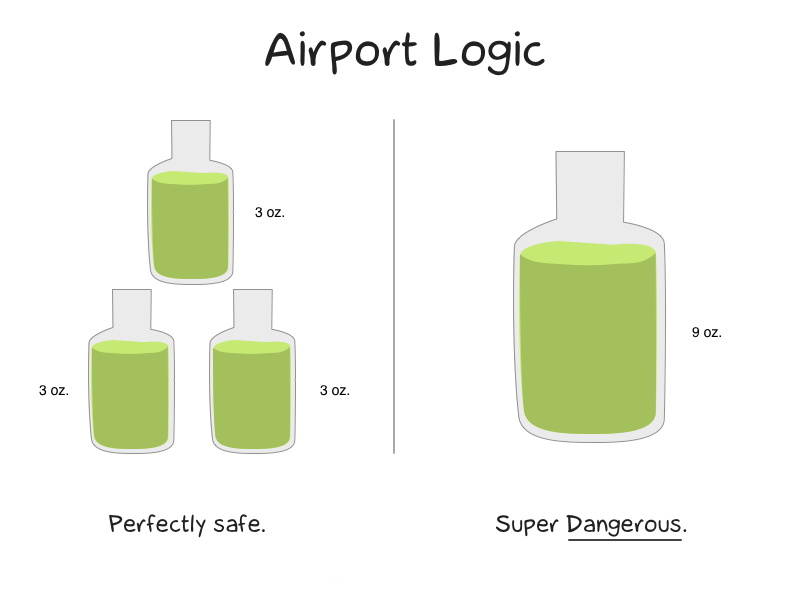
The scanners are not the problem. The patdowns are not the problem. The fact that these things are there is the problem.
Bullshit things like this airport logic are the problem.
The fact that almost nobody complains is the problem.
Another nice read from scientificamerican.comThe security theater and everything that comes with it is the real problem.
Security theatre isn't the problem, it's a symptom of the military-industrial-complex (now branching out into pervasive monitoring and other totalitarian activities). The problem is the idea that we're constantly at war (with other countries, illegal aliens, drugs, sexuality). I'm not a pure libertarian, but this is the most fundamental agreement I have with libertarians: that sacrificing freedom for the appearance of security is a sure sign you're going to lose all your freedoms... one by one.
TSA and DHS are the latest symptoms of decades-long degradation of war-oriented policy.
-
Re:Think you may want to look at his logs
The scanners are not the problem. The patdowns are not the problem. The fact that these things are there is the problem.
Bullshit things like this airport logic are the problem.
The fact that almost nobody complains is the problem.
Another nice read from scientificamerican.comThe security theater and everything that comes with it is the real problem.
-
Re:Scaling is the Key!
Actually sequestering CO2 may be quite simple:
CO2 into Cement -
Re:Scaling is the Key!
Pretty sure the output is the same from regular coal combustion...lots and lots of ash along with now, hopefully, contained CO2.
The CO2 can be used as such -
Re:Bullshit
-
Re:Sounds like rubbish
99% of the CO2 as a pure gas. That pure CO2 can be converted to methanol (at what cost?) ala:
http://www.scientificamerican.com/article.cfm?id=turning-carbon-dioxide-back-into-fuel
If not commercially viable as fuel stock it could be used for a variety of applications that adulterated CO2 can not.
-
Whos side should I be on?
"that allowed Bowman to use Roundup indiscriminately to kill weeds without any risk of harming the soybean crop. "
Oh great.. what about the risk to humans who eat this shit? Are people round-up ready?
http://www.scientificamerican.com/article.cfm?id=weed-whacking-herbicide-pI keep thinking the answer to this is not biotech but robotech...how hard can it be to create an army of roombas that kill weeds? Some hyperspectral cameras, pattern recognition and burners or pullers. It has got to be possible to engineer something workable and cost effective.
Anyway here is my delimma... if Monsanto wins they will be happy which will mean I will be sad.
If the farmers win they will be happy which means we all get to eat even more shit "indiscriminately" laced with roundup.
It seems I loose either way.
-
Re:Or IS there even a genetic test?.
My understanding is that identical twins -- arising from the same zygote -- are genetically identical. Not just "pretty much identical" as the article states.
Then your understanding is wrong, see this article:
Geneticist Carl Bruder of the University of Alabama at Birmingham, and his colleagues closely compared the genomes of 19 sets of adult identical twins. In some cases, one twin's DNA differed from the other's at various points on their genomes.
Show us the evidence that such variations don't occur within the body of a single person.
-
Re:Or IS there even a genetic test?.
My understanding is that identical twins -- arising from the same zygote -- are genetically identical. Not just "pretty much identical" as the article states.
Then your understanding is wrong, see this article:
Geneticist Carl Bruder of the University of Alabama at Birmingham, and his colleagues closely compared the genomes of 19 sets of adult identical twins. In some cases, one twin's DNA differed from the other's at various points on their genomes. At these sites of genetic divergence, one bore a different number of copies of the same gene, a genetic state called copy number variants.
It is generally felt that copy number variation (CNV) between MZ twins is generally post-meiosis (i.e. mitosis).
Typical police forensic genetic tests look for a "fingerprint" based on lengths of DNA when cut by particular enzymes. This is unlikely to find CNVs.
Some CNVs might be discoverable with a SNP microarray chip (not super expensive to perform), but it is possible that you may need to do a complete sequence of both twin's DNA to find the needed CNV differentiator.
-
Re:Or IS there even a genetic test?.
less than 30 seconds with google produces this:
http://www.scientificamerican.com/article.cfm?id=identical-twins-genes-are-not-identical
-
Re:Cue the
The problem is, of course, that the market already did it's "thing".
That thing was to dice up the country into little fiefdoms for each of the ISPs so they could charge whatever the hell they wanted to, which is why we have studies that show US citizens pay the most per megabyte for internet access than anyone else in the world.
I agree with your reservations about the government directly managing the infrastructure of internet access for all citizens, but maybe they could classify it as a utility and have it regulated similar to electricity and water.
-
Re:Let's hope it begins a trend
Solendra, look it up. Just because you are lazy or stupid doesn't mean it didn't happen.
ok, lets look it up: Solyndra recieved $535M in a federal subsidy, and in response, China put up $35 Billion to subsidize their own solar research and industry.
It appears that both an agressive foreign entity and a softening PV market played roles in Solyndra's demise.
what do you mean by 'look it up', exactly? i don't read publications that exist exclusively inside your political 'bubble'. -
Re:Original Environmental Action
As to the Thorium, I spotted this in an web article, but could not find much out more about it and was not entirely satisfied that the information was 100 percent good. But here goes anyways. Coal contains Thorium and other radioactive materials that are released into the air when it is burnt. They do not purify coal before the burn it. Coal is a mixture of all sorts of stuff, most of flammable, but some of it other stuff. The scaremonger writing the piece claimed that coal plants spewed more radiactivity into the environment than a nuclear plant. Who knows for sure. I could not google enough up.
Factiods I remember:
1. A coal plant releases more radioactive material than a nuclear plant produces
2. There's more potential energy in the radioactive materials in coal than you can get from burning the coal itselfOkay, here goes: Coal ash is more radioactive than nuclear waste. Uranium and Thorium content of coal. CO2 production of a coal plant,
500MW = 3 million tons of CO2/year. The carbon is 27% of that, and coal is 'almost' pure carbon. Call it 1.7M tons of coal consumed per year for a 1GW plant. Of course, this site says 2M tons of coal. At 1 part per million Uranium and 2 parts per million Thorium, that's ~5-6 tons of radioactive material released per year, 1% of it up the flue(EPA limit). It says that you need about 162 tons of Uranium to fuel a conventional reactor a year.
However, conventional reactors are only about 1% efficient at their fuel burn - if you go to breeder reactors, that could, theoretically at least, drop to 1.62 tons of nuclear material needed per year per GW. Outside of accidents, the nuclear waste isn't released.Realistically speaking, you could get more electricity out of the coal via nuclear power if you were using breeders. Thorium reactors would be required, but at least they are naturally breeder-type.
So I'd tend to say that my 'coal plants release more radioactive materials than nuclear plants produce' is true - only limited amounts, less than 1%, are actually being converted into more highly radioactive material. It's producing 2 tons of radioactive material*, vs 'release' of 5-6.
Your 'emits more than a nuclear plant' is also very much true.
My last statement - 'more energy in the heavy metal traces' depends on using highly efficient processes and somehow having an energy-cheap way to collect the relatively diffuse uranium and thorium.*I'm ignoring waste that isn't annual, like the reactor vessel, at the moment, though it's probably only a ton or so more.
I hear about the Chinese Economic Miracle. But when I see the youtube videos of the 'Fog' in Bejing, the price they paid was too high. You could be the richest man in Bejing, but your quality of life, as a living creature, is horrible. This is not some abstract human rights issue. This is breathing filth into your lungs with every breath.
I figure that if you give them another 10 years or so, they're going to start taking their own environmental rules much more seriously, precisely because of this.
-
Re:What about the wheel?
Looks like I tried to use normal HTML for the link. Lets try this: Why it took so long to invent the wheel. http://www.scientificamerican.com/article.cfm?id=why-it-took-so-long-to-inv
-
Doorway amnesia, gorilla arm, and 2-page monitors
I'd say any task in which you traditionally would have overlapping windows rather than side-by-side windows would be a case where switching between full screen views wouldn't be so bad. The utility of the overlapping windows is to give you an easy way to remember what else you were doing and how to get back to it
In an overlapping mode, the user can always see at least a sliver of the other window, which prevents doorway amnesia by giving the user's subconscious mind a continuous cue that the thing in the other window still exists. Preventing something from ever being completely out of sight prevents it from being out of mind. It also gives a drag and drop target when moving or copying an object from one window to another, which is faster than long-pressing an object (where a short press is bound to Open), tapping Share, and selecting the correct application from a long list.
getting to your "last" task is especially fast w/ touch on Windows 8
Which sucks for devices without a touch screen. It also sucks for laptop and desktop computers with a touch screen because of the gorilla arm issue.
Finally, I'd add that on most laptops, side-by-side screens aren't really that great: a typical laptop at 1280 or 1360 pixels wide doesn't really allow two standard webpages or word documents to be displayed next to each other
How would these 720p-class displays (1280x720 WXGA and 1280x1024 SXGA) not admit two Word documents? Word existed in the 640x480 era, and at a nominal 96 dpi, 640 pixels cover 6.67 inches (169 mm), or the width of a US letter or A4 sized page minus standard 1" or 25 mm margins. Heck, back in the day, an XGA+ (1152x870) display was considered two-page.
-
Doorway amnesia
I prefer seeing them side by side.
No. I'd prefer this to be tiled.
That's what I meant: the side-by-side view that results from the Snap feature in Windows 7 and several Linux window managers or from clicking one taskbar entry, Ctrl+right clicking another, and choosing Tile Vertically in Windows XP. Even on a netbook with a 10" 1024x600 pixel display, I can have an 80-column editor window and an 80-column output window open at once.
Switching between them isn't actually as bad as you seem to think.
I've tried doing various thoughtful tasks with the input on one full-screen application and the output on another full-screen application, or by comparing two documents in two different full-screen applications, and the act of switching between them caused me to lose my train of thought in much the same way as doorway amnesia, as I've mentioned before. It'd be like having a desk that's big enough for only one book, and whenever you want to look at a different book, you need to put away one book and open the other one. If maximization-induced doorway amnesia is a disability, then the use of tiled windows or overlapping windows as needed has been an assistive technology. Consider that in some Star Trek spinoffs, characters were seen using multiple PADD tablets to study multiple documents. Eventually we can look forward to tablets being that cheap, but until then, splitting is probably the best way to handle it.
This was how I worked with Watcom C++.
And I worked differently. I seem to remember that in RHIDE, an old DOS-based IDE for GCC inspired by Borland Turbo C, I could reserve the top two-thirds of the 80x50-character screen for a source code file and the bottom third for compiler diagnostics that I'd tackle one at a time.
-
Re:Well that proves it
It's all about the sulfur. http://www.scientificamerican.com/article.cfm?id=how-do-volcanoes-affect-w&page=2
Ok, maybe not all.. there's those large parasols women were using in the 1880's that did a little. -
Re:Please cite study
Your citations will be appreciated as well. As for point 2, it is important to distinguish between those who go through the motions and those who truly believe someone is watching. It's also worth considering that the observations I noted may hold in cases where the threshold is something other than crime/not crime. Various rationalizations and sophistry might also be involved, particularly where the requirement of deep sincerity (and perhaps penance) to receive forgiveness and absolution through prayer has not been emphasized. Perhaps that is more important in the case of the adult mind.
On point 3, note that I do not claim that atheists cannot be ethical or moral. I am quite certain that it is possible. As for the relative likelihood of ethical behavior, it is worth considering that in a society where theism is the default, people who think more deeply about things will be over-represented amongst atheists and that such reflection likely has bearing on ethical behavior. The results might be much less pretty if atheism was the default.
As for your conclusion, Princess Alice seems to disagree
-
Re:We USED TO burn biofuels and look what happened
Bio fuels should not be mistaken for the green, organic, nature lover's wet dream. It will require an awful lot of land to cover the energy needs of our current standard of living.
One, most bio fuels are not organic, so organic nature lover's don't have wet dreams about them. Two, the negawatt is powerful. Turning off electrically powered when they are not needed and using more energy efficient energy users can have a big impact. Californians complain about how high home heating costs are yet a properly designed and built home uses very little energy compared to conventional homes, and yet do not cost much more to build than standard construction. Adding insulation and sealing thermal barriers significantly reduces heat loss when cold outside and heat gain when hot outside.
However other energy sources can provide a lot of energy as well. The Department of Defense (DoD) "could generate 7,000 megawatts (MW) of solar energy—equivalent to the output of seven nuclear power plants—on four military bases located in the California desert, according to a study released today by DoD’s Office of Installations and Environment." The article in SciAm A Grand Solar Plan says that by 2050 solar energy can produce 69% of the U.S.’s electricity and 35% of its total energy by 2050. I didn't find it but another online source said that just 10% of the land in Nevada could produce enough electricity to power the 48 contiguous states. And another said the wind potential in the Rocky Mountains was also enough. Thinking small scale and big scale along with building a national smart gird can allow coal and nuclear power plants to be shut down, leaving natural gas plants operating along with goethermal plants to serve as baseline electrical generators until storage improves.
Falcon
-
Re:How strong?
Another question, what happens if you expose these to a camera flash?
http://www.scientificamerican.com/article.cfm?id=camera-flash-prompts-carb -
Re:LG Tab Book, Tab Book Ultra
The Microsoft Surface RT comes with a cover/keypad that includes a touchpad; they offer both inputs. And with the USB port, I use a mouse all the time.
I really don't see anything wrong with that. The normal keyboard is crap but you could leave it at home so it doesn't take anything away. There have been Android tablets that come with keyboards for ages and they are perfect for certain strange niche markets. The difference here is that, 99.5% of the time you use the surface without its keyboard and so direct pointing works fine. On the 0.5% of the time when you a) want to use a keyboard b) have it with you and c) aren't sitting next to a PC anyway the inconvenience of getting gorilla arm from using direct touch on a device which is far from you is probably worth it to avoid having to carry a separate mouse with you.
The problem with touch comes only when you have a fixed screen separated from you by a keyboard such as a laptop or desktop monitor. You either mount the screen in a position which causes neck strain or you mount it in a position which causes ergonomic problems. Either way people are going to hate it. When this was tried last time, the solution developed was to separate the screen from the tablet interface (look up Wacom Bamboo). Those who don't know their history are doomed to repeat it, it seems.
As far as using a mouse with a surface RT, seems a bit perverse, but each to their own. How long did it take you to learn to avoid all the various gestures whilst dragging items around the screen?
-
How GMO corps suppress studies
"For a decade their user agreements have explicitly forbidden the use of the seeds for any independent research. Under the threat of litigation, scientists cannot test a seed to explore the different conditions under which it thrives or fails. They cannot compare seeds from one company against those from another company. And perhaps most important, they cannot examine whether the genetically modified crops lead to unintended environmental side effects."
http://www.scientificamerican.com/article.cfm?id=do-seed-companies-control-gm-crop-research
-
brain size = intelligence ?
"the bigger-brained fish also tended to have smaller guts and produce fewer babies."
Just like humans!
I have to question the association with size & smarts. 100 years ago in the age of eugenics, there was an effort to measure people- individuals and ethnic groups, and to draw conclusions based on those measurements. There was a general assumption that a large head (and presumably brain) indicated an intelligent person. However, one source that I found from around 1950 stated that the largest brain ever recorded was that of an idiot.
Has this changed? Is there evidence now that size = smarts? Is this true for animals as well as humans? The most recent I had heard (probably 1990s) was that a large brain in relation to body size might indicate intelligence in some species.
So I'm googling around today and this question looks even more complicated, however this
http://www.scientificamerican.com/article.cfm?id=does-brain-size-matter
agrees with most that size alone is meaningless.Add to that the already debunked 'smaller gut' significance and what's left?
This experiment just looks stupid to me; something that a small brained scientist might try.
-
Re: Actually, meat may be getting a bad rep
The fact that meat consumption is so high is a much bigger problem than most people are willing to admit. Meat production is helping to starve people.
Actually, the latest research appears to give red meat a somewhat cleaner bill of health than you might expect: http://www.scientificamerican.com/article.cfm?id=meat-of-the-matter-modern-methods-preserving-cooking-meat-healthy It turns out that it's just processed meats that are bad for you, not meat itself. I've always wondered how such a "natural" part of the human diet could be so unhealthy, and now we know: it probably isn't, not in and of itself. It's the preservatives and all the other crap added to processed meat that's the real problem.
-
Re:Going to get modded down as sexist for this, bu
Understand that in average both sexes are not equally fit for every task and equally gifted in everything is not sexism it is lucidity
Sorry for the poor source, but girls and boys are equal in mathematic ability when you look worldwide, which indicates that differences in the west are due to cultural bias, not natural ability.
Physically, men are stronger than women on average, but mentally it appears that it's entirely or nearly entirely cultural. In that case, saying that they're different on average in mental ability is at the very least supporting a sexist construct in our culture. -
Re:Rent seeking
Interesting... this would mean that my sources arguing that rising insurance costs are an acute problem for the nuclear industry are dead wrong. And on closer inspection, it looks like they are too. Yet again, never trust anything you read on the internets, folks.
BTW, the 0.03$/kWh figure with which this discussion started is dead wrong as well:
http://en.wikipedia.org/wiki/Economics_of_new_nuclear_power_plants#Cost_per_kW.C2.B7h
http://www.scientificamerican.com/blog/post.cfm?id=nuclear-power-could-cost-trillions-2009-06-19 -
Re:peaceful protesters?
Life is short, and there is not enough room in this brief post to correct your many mistakes.
The easiest one, and the most appropriate one for Slashdot, is, "The government had very little to do with the Internet."
Fortunately, Wall Street Journal editorial writer Gordon Crovitz -- the same asshole who lives in Battery Park City and complained about Occupy Wall Street at the Community Board meeting -- also wrote an editorial debunking the "myth" that the government invented the Internet.
Crovitz has contributed to computer education and the history of technology by making an argument that is completely wrong, but has been the occasion for people who know far more about the Internet than Crovitz to explain it. Two of the better rebuttals are here http://articles.latimes.com/2012/jul/23/news/la-mo-who-invented-internet-20120723 and here http://blogs.scientificamerican.com/observations/2012/07/23/yes-government-researchers-really-did-invent-the-internet/ As Hiltzik points out, those "university researchers" you cite did their work on government contracts.
I don't know where your family came from, but I guess it wasn't the Soviet Bloc. The USSR had one of the best education systems in the world -- all free. Soviet emigres came here with their EE degrees and PhDs and were quickly hired up at good salaries. I know other Soviet emigres who came to this country with less marketable degrees who where shuttled off to free (welfare) housing, free (government-paid) job training, and often civil service (government) jobs. Immigrants from Communist countries got a better safety net here than most Americans, and they vote Republican and preach self-reliance from government.
I've heard all these self-made immigrant stories and I don't believe them. Every time somebody looks at the facts behind the self-made myth, you find government handouts.
-
Re:STILL doesn't prove causation!
There are many existing studies that have already proven several things about marijuana use:
1. Smoking (anything) raises your risk of oral and lung cancers, including marijuana.
In fact studies show the opposite for marijuana.
http://www.scientificamerican.com/article.cfm?id=large-study-finds-no-link
Cannabis smoking appears to protect against lung cancer. This study is now seven years old, and an even larger one fifteen years ago found the same thing:
http://link.springer.com/article/10.1023%2FA%3A1018427320658
Can't be cannabis interfering with your ability to process information. I guess we will just have to chalk it up to prejudice and willful ignorance.3. Marijuana causes psychosis in healthy people...
Link please?
4. Marijuana is addictive. It's a hotly debated point but the fact is that many people really struggle to stop using it and relapse.
Meaning... you know there is no real support for this, but you want to throw it out there as a claim anyway. You do know that by this same standard tanning is addictive too, right?
Marijuana advocates reject all criticism, and assume all scientific studies are somehow flawed or are the result of anti-marijuana conspiracies. To them marijuana _has_ to be the perfect drug, even if reality contradicts that viewpoint. Sounds crazy, but it's roughly what you'd expect from people who are no longer living in our reality.
Looking glass time. You are describing your own rejection of scientific evidence.
-
Re:Would that be considered cruel ?
I used to think like you when I was a kid. Then I discovered reality is more nuanced and the science on this is surprisingly soft.
Nervous system morphology: yes, arthropods' nervous systems surely looks different from ours, with one large ganglion in the head and multiple somewhat smaller ganglia controlling motoric and digestive functions. But to conclude from this that they can't possibly feel pain is a huge leap of logic. An insect brain is organized much like a crustacean's brain, and a crustacean's brain is capable of complex behaviour. http://www.scientificamerican.com/article.cfm?id=clever-crustaceans
Nervous system organization: suppose you want to argue that our nervous system not only look different, but is organized differently, with everything centralized, as opposed to different ganglia taking care of different functions. Well, the differences are not that huge. Have you ever seen a freshly beheaded chicken? I can tell you, some of them run like hell - a sight so spooky that you won't easily forget it. This is because the act of running originates from the spinal cord, which is still there when you cut off the head. Similarly, it is speculated that the human spinal cord plays an important role in coordinating monotomous tasks such as walking. And the number of neurons associated with coordinating our digestive tract is larger then the number of neurons in a rat, and comes surprisingly close to the number of neurons in the cerebral cortex of a dog.
http://www.scientificamerican.com/article.cfm?id=gut-second-brain
http://en.wikipedia.org/wiki/List_of_animals_by_number_of_neurons#Cerebral_cortexThat bring us to Nervous system size. The above shows that a large structure of neurons is no guarantee for intelligence. On the other hand, there are many studies showing that corvids like crows and magpies show surprisingly intelligent behaviour on a smaller budget of neurons than our digestive system or a dog...
My point of all this is that neither brain size nor morphology or organization necessarily equates to complexity of function.
http://en.wikipedia.org/wiki/Pain_in_invertebrates#Central_nervous_system
What does, then? We do not know! And we know even less whether bees can feel pain; nobody ever became a bee and wrote a book about it. The thought of not knowing this might feel threatening to your ethical preconceptions, but it's the hard truth! To make matters worse, the more we learn, the more it looks like some if not most invertebrates are able to experience pain at some level. Funny that we were just talking about administering electric shocks to honeybees: http://en.wikipedia.org/wiki/Pain_in_invertebrates#Conditioned_suppressionNow the interesting question is: how to build a system of ethics on this (lack of) knowledge. This I cannot answer for you, but the solution I use for myself is attributing gradual weights to the torture of different animals, with molluscs falling into the lowest tier, small insects a bit higher, large crustaceans a bit higher, birds and small mammals a bit higher and "intelligent" mammals even higher. The most important element of my system of ethics is that even the lowest tiers have a nonzero weight and torturing them for no good reason should be avoided.
Regardless of all the above soft ethics, there's a hard reason why "bee-tox" is a horrible idea. There already is a shortage of honeybees to the extent that fruit farmers start worrying about pollination:
http://en.wikipedia.org/wiki/Co -
Re:Would that be considered cruel ?
I used to think like you when I was a kid. Then I discovered reality is more nuanced and the science on this is surprisingly soft.
Nervous system morphology: yes, arthropods' nervous systems surely looks different from ours, with one large ganglion in the head and multiple somewhat smaller ganglia controlling motoric and digestive functions. But to conclude from this that they can't possibly feel pain is a huge leap of logic. An insect brain is organized much like a crustacean's brain, and a crustacean's brain is capable of complex behaviour. http://www.scientificamerican.com/article.cfm?id=clever-crustaceans
Nervous system organization: suppose you want to argue that our nervous system not only look different, but is organized differently, with everything centralized, as opposed to different ganglia taking care of different functions. Well, the differences are not that huge. Have you ever seen a freshly beheaded chicken? I can tell you, some of them run like hell - a sight so spooky that you won't easily forget it. This is because the act of running originates from the spinal cord, which is still there when you cut off the head. Similarly, it is speculated that the human spinal cord plays an important role in coordinating monotomous tasks such as walking. And the number of neurons associated with coordinating our digestive tract is larger then the number of neurons in a rat, and comes surprisingly close to the number of neurons in the cerebral cortex of a dog.
http://www.scientificamerican.com/article.cfm?id=gut-second-brain
http://en.wikipedia.org/wiki/List_of_animals_by_number_of_neurons#Cerebral_cortexThat bring us to Nervous system size. The above shows that a large structure of neurons is no guarantee for intelligence. On the other hand, there are many studies showing that corvids like crows and magpies show surprisingly intelligent behaviour on a smaller budget of neurons than our digestive system or a dog...
My point of all this is that neither brain size nor morphology or organization necessarily equates to complexity of function.
http://en.wikipedia.org/wiki/Pain_in_invertebrates#Central_nervous_system
What does, then? We do not know! And we know even less whether bees can feel pain; nobody ever became a bee and wrote a book about it. The thought of not knowing this might feel threatening to your ethical preconceptions, but it's the hard truth! To make matters worse, the more we learn, the more it looks like some if not most invertebrates are able to experience pain at some level. Funny that we were just talking about administering electric shocks to honeybees: http://en.wikipedia.org/wiki/Pain_in_invertebrates#Conditioned_suppressionNow the interesting question is: how to build a system of ethics on this (lack of) knowledge. This I cannot answer for you, but the solution I use for myself is attributing gradual weights to the torture of different animals, with molluscs falling into the lowest tier, small insects a bit higher, large crustaceans a bit higher, birds and small mammals a bit higher and "intelligent" mammals even higher. The most important element of my system of ethics is that even the lowest tiers have a nonzero weight and torturing them for no good reason should be avoided.
Regardless of all the above soft ethics, there's a hard reason why "bee-tox" is a horrible idea. There already is a shortage of honeybees to the extent that fruit farmers start worrying about pollination:
http://en.wikipedia.org/wiki/Co -
Re:Don't you worry...
PV Prices (note log scale)
-
Amnesia as you go through a doorway
treat the Start screen like a full-screen version of the Start menu
And because it's full-screen, it all but encourages the user to forget what he's working on. Ever have amnesia as you go through a doorway? The fact that the Start screen is full-screen is like that.
You don't need a Start orb to click on -- just hit the Windows key.
How are users who have been opening the Start menu with the mouse for a decade and a half expected to discover the Windows key?
-
Re:I'm ready...
Right now only the USA are not changing
Incorrect.
-
Re:20-year's worth of underestimation
Hopefully the new models are not just continuing a 20-year trend of underestimating the impacts of global warming. Like melting arctic ice.
That trend has been so consistent that I find myself wondering whether the IPCC deliberately shoots low to make their projections more palatable.
-
20-year's worth of underestimation
Hopefully the new models are not just continuing a 20-year trend of underestimating the impacts of global warming. Like melting arctic ice.
-
Re:Fail
I hope it "fails" just like solar research has - about a 90% cost reduction in 30 years.
But the cost fell too quickly, leaving politically connected manufacturers with stranded costs. So now we have government action to raise the cost again.
-
Re:Fail
I hope it "fails" just like solar research has - about a 90% cost reduction in 30 years.
-
Re:Even the air gap isn't enough
Considering we already have autonomous lab robots that iteratively form hypotheses, test, and interpret and integrate results, this not an unreasonable suggestion. Arguably though, such a scenario is actually in the biotech category (whether 'bio' or 'nano' is semantics as far as the science of the small is concerned) – just with AI put on top. Admittedly, the robot might help to short-circuit human oversight for boundary conditions...
In that light, I'd suggest these folk should look closely at interactions. AI*bio, as discussed above, has dangerous potential. Likewise, I'd suggest, bio*climate could be risky if we start to use engineered organisms for geo-engineering projects. AI*nuclear would be risky in theory, but is sufficiently unlikely not to worry about. AI*climate is a maybe. If we start using deep-learning type algorithms for climate modelling, we might end up making decisions on the basis of reasoning we don't fully understand. I can't see any sensible interpretations for bio*nuclear or climate*nuclear scenarios – so probably we can ignore those. The only viable 3-way is maybe AI*climate*bio, which pretty much couples the pitfalls of indecipherable modelling with autonomous bio-engineering, plus a motivational hack on the humans (climate will make us more and more desperate over time – and consequently sloppier) and an industrial scale insertion vector (geoengineering).